~/sacred-texts/middle-egyptian-tales
The Westcar Papyrus: He Knows How to Put a Severed Head Back On
- Date
- Copied in hieratic in the Second Intermediate Period (about 1650–1550 BC) from a Middle Kingdom tale set at the court of Khufu in the 4th Dynasty
- Found
- Probably from a tomb at Qurna, Thebes; acquired by Henry Westcar about 1824; now Papyrus Berlin P 3033, Ägyptisches Museum und Papyrussammlung, Berlin
- Language
- Middle Egyptian · Hieratic
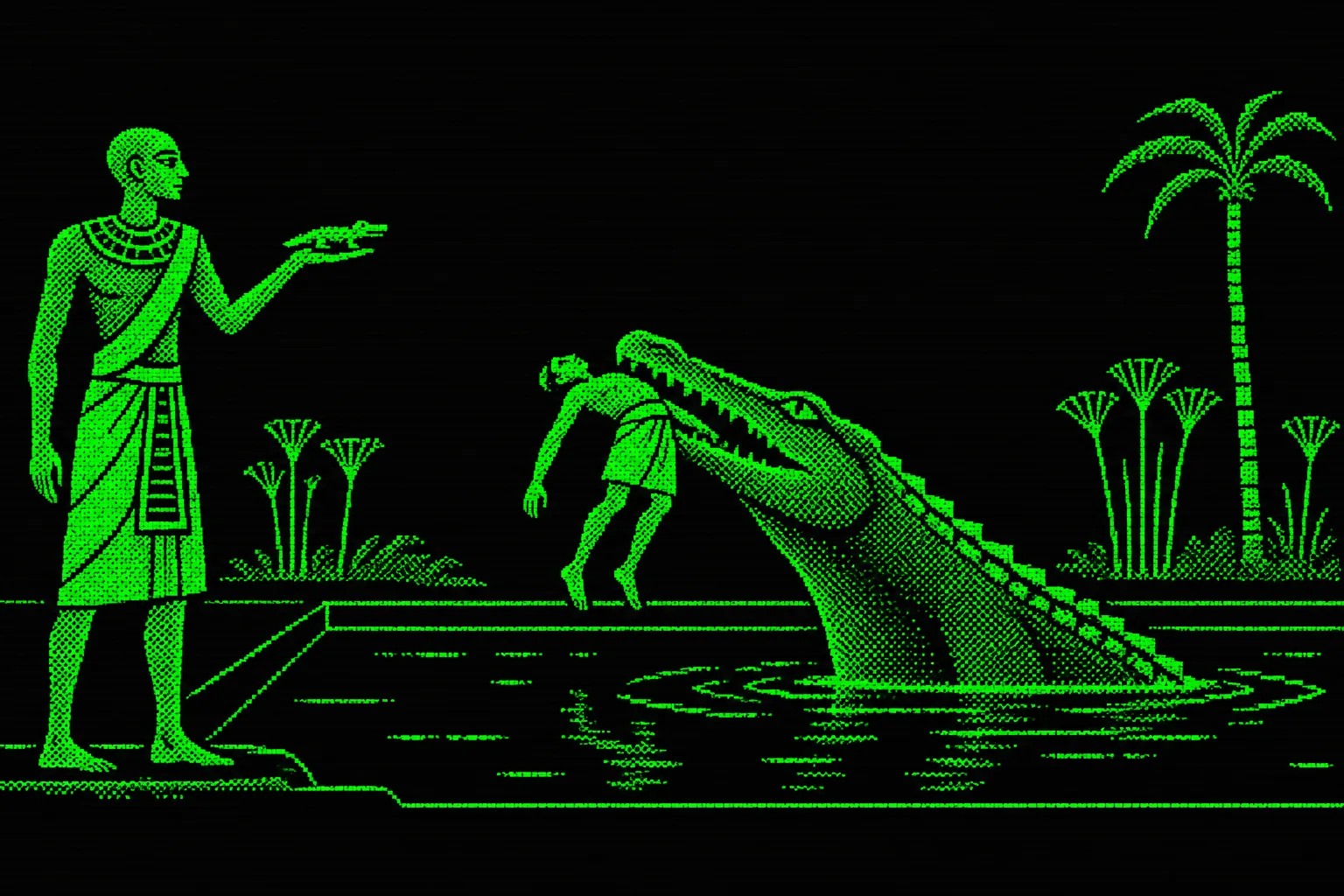
Khufu’s sons take turns telling their father wonders. Khafre tells of Ubainer, a priest whose wax crocodile seizes the commoner who had sex with his wife; the king has her burned. Baufre tells how Sneferu was rowed by twenty women stripped and given nets, and how a priest laid one half of the lake’s water on top of the other to recover an amulet.
Djedefhor fetches the magician Djedi, of whom he says: He knows how to put a severed head back on. Djedi refuses a human prisoner, rejoins a goose and an ox, and foretells three kings fathered by Ra. Isis delivers them. The maid who goes to inform Khufu is taken: Then a crocodile seized her.
- 1
… 𓈖 𓇓𓆤
[...] [ḏd.jn] [ḥm] n(,j) nswt-bj,tj [Ḫ]fw mꜣꜥ-[ḫrw]
… Then His Majesty Khufu, King of Upper and Lower Egypt, true of voice, said:
Note · Line 1
“True of voice” is a title of the dead: it declares that they have been vindicated in the judgment after death. - 2
𓂧𓊃𓏊 𓍢 𓇓𓆤 𓂦𓂋𓏛 𓏤 𓇋𓏲𓆑𓄹𓏥 𓅨𓂋𓇋𓄹 …
[jmi̯] [ḏi̯] =[tw] [mꜣꜥ] [tʾ] [1000] ḥ(n)q,t ds 100 jwꜣ [1] [sntr] [pꜣd] [2] [n] nswt-bj,tj Ḏsr mꜣꜥ-ḫrw [ḥnꜥ] [rḏi̯.t] [ḏi̯] =[tw] [šns] [1] [ḥ(n)q,t] [ḏ]wjw 1 jwf wrj [sntr] [pꜣd] [1] [n] [ẖr(,j)-ḥb-ḥr,j-tp] [...]
“Have an offering of a thousand loaves of bread, a hundred des-jars of beer, one longhorn ox and two pellets of incense presented to Djoser, King of Upper and Lower Egypt, true of voice. And have one shenes-cake, one dewiu-jar of beer, a large cut of meat and one pellet of incense presented to the chief lector priest …
Note · Line 2
The offerings honor the king and the priest from the tale Khufu has just heard. A lector priest recited the sacred texts at rituals. - 3
𓆑 𓈖 𓂋𓐍𓏛
[jw] mꜣ[.n] =[j] s[p] =f n(,j) rḫ
I have seen what his learning could do.”
- 4
𓏇𓇋 𓎗𓏲𓏏𓏛𓏥
jri̯[.jn] =[tw] mj wḏ.t.pl [nb.t] [ḥm] =[f]
Everything was done as His Majesty had commanded.
- 5
𓁹𓈖 𓇓𓏏𓈖𓅭
[ꜥḥ]ꜥ pw jri̯.n zꜣ-nswt Ḫꜥ,w≡f-Rꜥ [r] [mdwi̯.t] [ḏd] =[f]
Then the king’s son Khafre rose to speak. He said:
- 6
𓎢 𓆣𓂋𓏏 𓅓 𓂋𓎡𓇳 𓌳𓐙𓂝𓊤𓏲𓀁 𓆑 𓂋 𓊹𓉗𓏏𓉐 𓈖𓏏
[ḏi̯] =[j] [sḏm] [ḥm] =k [b]j(ꜣ),yt ḫpr.t m rk jt =[k] Nb-kꜣ mꜣꜥ-ḫrw wḏꜣ =f r ⸢ḥw,t-nṯr⸣ n.t [Ptḥ] [nb]-ꜥnḫ-tꜣ.du
“I will tell Your Majesty of a marvel that took place in the days of your father Nebka, true of voice, when he went to the temple of Ptah, lord of Ankh-tawy.
Note · Line 6
Khafre is speaking to his own father, Khufu. He calls Nebka Khufu’s “father” in the broader sense of a royal forebear. Ankh-tawy was a name for the Memphis area, where Ptah was worshipped. - 7
𓇋𓋴𓏏 𓂋 𓆑 𓇋𓈖 𓍛𓏤𓅆 𓆑 𓈝𓅓𓂻 𓂋 …
jst r =f jn ḥm =f šm r wn[,t] [n.t] [Ptḥ] [...]
Now it was His Majesty himself who went to the sanctuary of Ptah …
- 8
𓇋𓈖 𓍛𓏤𓅆 𓆑 𓁹𓂋 𓎨𓈖𓏏𓏛𓏥 𓈖𓏏 𓍏𓃀𓅡𓄿𓏛𓇋𓈖𓂋𓊌𓀀 𓎛𓈖𓂝
jn ḥm =f jri̯ ⸢ḥn,t⸣ n.t [wn,t] [n.t] [Ptḥ] [jw] [ẖr(,j)-ḥb-ḥr],j-tp Wbꜣ-jnr ḥnꜥ =[f]
His Majesty himself performed the rites of Ptah’s sanctuary, with the chief lector priest Ubainer at his side.
- 9
𓈞𓏏𓁐 …
[jst] [r] =[f] [⸮mri̯.n?] ḥm,t Wbꜣ-jnr n[ḏs] [...]
Now Ubainer’s wife had fallen in love with a commoner …
- 10
[ꜥḥꜥ.n] [hꜣb.n] [n] =[f] [tꜣ] [ḥm,t] [Wbꜣ-jnr] [wbꜣ,yt] =[s]
Then Ubainer’s wife sent her maid to him.
- 11
𓈖 𓆑 𓂾𓏤𓆱 𓏤 𓅓 𓎛𓃀𓋴𓏲𓋳𓏫 𓆤
[ꜥḥꜥ.n] [rḏi̯.n] =[s] [⸮jṯi̯?].tw n =f pds 1 mḥ m ḥbs,w [m] [⸮špss?] [n] bj,tj
She had a chest full of clothes and treasures fit for a king of Lower Egypt taken to him.
- 12
𓂻𓏲𓏏 𓊪𓏲 𓁹𓈖 𓆑
jwi̯.t pw jri̯.n =f ḥn[ꜥ] [tꜣ] wbꜣ[,yt] [ḫr-m-ḫt] hrw[.pl] [swꜣ] ⸢ḥr⸣ [nn]
Some days later he came with the maid.
- 13
𓂋 𓆑 𓃹𓈖
[js]t r =f wn šzp[,t] [m] [š] [n(,j)] [W]bꜣ-jnr
Now there was a pavilion on Ubainer’s lake.
- 14
𓊢𓂝𓈖 𓆓𓂧𓈖
ꜥḥꜥ.n ḏd.n [p]ꜣ nḏs [n] [tꜣ] [ḥm,t] [Wbꜣ]-jnr
The commoner said to Ubainer’s wife:
- 15
𓇋𓏲 𓃹𓈖 𓊏𓊪𓏏𓉐
jw ms wn šzp,t [m] [pꜣ] [š]
‘There’s a pavilion on the lake, after all.’
- 16
𓊢𓂝𓈖
ꜥḥꜥ.n [ḏd.n] [tꜣ] [ḥm,t]
Then the wife said:
- 17
𓅓𓂝 𓏏𓈖𓏥 𓁹 𓈖𓏥 𓇋𓅓 𓋴
⸢m⸣ =tn jri̯ =n ꜣ[,t] jm =s
‘Look, let’s spend a little time there.’
- 18
𓈖 𓁷𓂋𓏭𓉐𓏤𓀀 𓈖𓏏𓏭
[ꜥḥꜥ.n] [hꜣb.n] [tꜣ] [ḥm,t] Wbꜣ-jnr n ḥr,j-pr n,tj [m-sꜣ] [pꜣ] [š] [r-ḏd]
Then Ubainer’s wife sent word to the steward who looked after the lake:
- 19
𓏏𓏲 𓏏𓄿 𓊏𓊪𓏏𓉐
[j]mi̯ sspd =tw tꜣ šzp,t [m] [bw-nb-nfr]
‘Have the pavilion made ready with every good thing.’
- 20
𓋴 𓋴 𓇋𓅓 𓁷𓏤 …
[šꜣs] [pw] [jri̯.n] =⸢s⸣ wršu̯.n =s jm ḥr swr[j] [ḥnꜥ] [pꜣ] [nḏs] [...] [r] ḥtp =[sn] [...]
She went and spent the day there drinking with the commoner … until they were satisfied …
- 21
𓐍𓂋𓀒𓅓𓆱𓐍𓏏𓂻 𓆑
ḫr-m-ḫt [mšr,w] [ḫpr] [jwi̯.t] [pw] [jri̯.n] =f
When evening fell, he came out.
- 22
𓃹𓈖𓇋𓈖 𓆑 𓁷𓏤 𓈙𓈇𓏤
wn.jn =f ḥr [hꜣi̯.t] [r] [pꜣ] š
Then he went down to the lake.
- 23
𓅯𓄿
wn.j[n] [tꜣ] wbꜣ,yt [ḥr] [ꜥḥꜥ] [n] =[f] [r] [jwi̯.t] =[f] [r] pꜣ [š]
The maid stood waiting for him until he reached the lake.
- 24
[wn.jn] [pꜣ] [ḥr,j]-pr [jm]
The steward was there.
- 25
[ꜥḥꜥ.n] [ḏd.n] =[f]
Then he said:
- 26
𓂋
[jw] =[j] r [š]m[.t] [r] [Wbꜣ]-jnr
‘I will go to Ubainer.’
- 27
𓌉𓆓𓇳 𓊪𓏲
[ḫr-m-ḫt] tꜣ ḥḏ 2 [n(,j)] h[rw] [ḫpr] [šꜣ]s pw [jri̯.n] [pꜣ] [ḥr,j-pr] [r] [Wbꜣ-jnr] [r] [wḥm] [n] =[f] mdw,t tn [ḏd] =[f]
When the land grew light and two days had passed, the steward went to Ubainer to report the affair. He said:
- 28
𓎢
[m] =[k] [jn] [tꜣy] =[k] [ḥm,t] [wršu̯] [m] [tꜣy] =k [šzp,t]
‘Look, it was your wife who spent the day in your pavilion.
- 29
𓅯𓄿 …
[j]s[t] [sj] [ḥnꜥ] pꜣ n[ḏs] [...]
She was with the commoner …
- 30
… 𓁹𓈖 𓆑 𓋴𓊪 𓆑 𓈙𓈇𓏤
[...] jri̯.n =f 〈r〉 ⸮sp〈.du〉? =⸮f(j)? [m] [pꜣy] =[k] š
… is what he did, twice, in your lake.’”
Note · Line 30
The steward is accusing the commoner of adultery with Ubainer’s wife. - 31
𓂋𓂝𓈖 𓆑 𓇓𓏲 𓈖 𓅯𓄿𓇋𓇋 𓆑 𓈖𓏏 𓈗
[ꜥḥꜥ.n] rḏi̯.n =f sw n pꜣy =f [nb] [Wbꜣ-jnr] [r] ḥꜣ[y,t] n.t mw
Then he went to the shallows on behalf of his master Ubainer.
- 32
ꜥḥꜥ.n _f [...]
Then …
- 33
𓊢𓂝𓈖
ꜥḥꜥ.n [ḏd.n] [Wbꜣ-jnr]
Then Ubainer said:
- 34
𓏎𓈖 𓈖 𓀀 … 𓈖 𓍁𓈖𓏭𓆮 𓁷𓏤 𓌀𓅓𓏲𓋞
jni̯ n =j ꜥ.[w]j [...] ⸮n? hbnj ⸢ḥr⸣ ḏꜥmw
“Bring me a pair of … made of ebony and electrum.
Note · Line 34
Electrum is an alloy of gold and silver. - 35
msi̯ =[j] _b_ [h]ꜣb wp[w,tj] [...]
I will fashion it … and send it as a messenger …”
- 36
𓆑 𓈖 … 𓎔
[ꜥḥꜥ.n] [jṯi̯].n =f [ms]ḥ n(,j) [...] ⸮mḥ? 7
Then he took a crocodile of …, seven cubits long.
Note · Line 36
Seven Egyptian cubits were about twelve feet (3. 7 metres). - 37
𓆑 𓄞𓂧𓀁 𓎛𓎛𓏭𓂻 𓆑 … 𓄞𓂧𓀁 … 𓁷𓏤 …
[wn.jn] =f [ḥr] šdi̯[.t] ⸢ḥḥ⸣ =⸢f⸣ [...] šd [...] ḥr [...]
Then he recited a spell and searched … the spell … over …
- 38
𓂻𓏲𓏏 𓆑 𓃂𓈗 𓈙𓈇𓏤𓀀 … 𓅓 …
jwi̯t =f [r] wꜥb [m] š [...] [n]ḏs ⸢m⸣ [...]
“Let him come to wash himself in the lake … the commoner in …”
Note · Line 38
The commoner is the man who has been sleeping with Ubainer’s wife. - 39
𓊢𓂝𓈖 𓂋𓂝𓈖 𓆑 𓇓𓏲 𓂜 𓅯𓄿 𓆓𓂧𓈖 𓆑 𓈖 𓆑
ꜥḥꜥ.n rḏi̯.n =f sw n pꜣ [ḥr,j-pr] ḏd.n =f n =f
Then he gave it to the steward and said to him:
- 40
𓉔𓄿𓏲𓂻 𓈖𓆓𓋴𓅪𓀀 𓂋 𓈙𓈇𓏤 𓈖𓏏𓂝𓏤𓏛𓏥 𓆑 𓈖𓏏 𓂋𓂝𓇳𓏤 𓎟 𓎢𓄿𓀁 𓎢 𓆼𓄿𓂝𓂡 𓎢 𓂋𓐟𓏤 𓆑
j[r] [m]-ḫt hꜣi̯.w nḏs r p[ꜣ] š m[j] n,t-ꜥ.pl =f n.t rꜥ nb kꜣ =k ḫꜣꜥ =k [pꜣ] [m]sḥ [n] [mnḥ] r-sꜣ =f
“Once the commoner has gone down to the lake, as he does every day, you are to throw the wax crocodile after him.”
- 41
𓆷𓄿𓊃𓂻 𓊪𓏲 𓁹𓈖 𓅯𓄿 𓎁𓏏𓂡𓈖 𓆑 𓅓𓋴𓎛𓆊 𓈖 𓏠𓈖𓎛𓈒𓏥 𓅓 𓂝 𓆑
šꜣs pw jri̯.n pꜣ [ḥr,j-pr] jṯi̯.n =f [pꜣ] msḥ n(,j) mnḥ m ꜥ =f
Off went the steward, having taken the wax crocodile from Ubainer’s hand.
- 42
𓊢𓂝𓈖 𓏏𓄿 𓍏𓊌𓀀 𓈖 𓅯𓄿 𓁷𓂋𓏭𓉐𓏤𓀀 𓈖𓏏𓏭 𓅓𓐟𓏤 𓂋𓆓𓂧
ꜥḥꜥ.n [hꜣ]b.n tꜣ [ḥm,t] Wbꜣ-jnr n pꜣ ḥr,j-pr n,tj m-sꜣ p[ꜣ] [š] r-ḏd
Then Ubainer’s wife sent word to the steward who looked after the lake:
- 43
𓇋𓅓𓅓𓂝 𓋴𓋴𓊪𓂧𓇮𓏛 𓏏𓏲 𓏏𓄿 𓊏𓊪𓏏𓉐 𓈖𓏏𓏏 𓅓 𓅯𓄿
jmi̯ sspd =tw tꜣ šzp,t n,tt m pꜣ š
“Have the pavilion on the lake made ready.
- 44
𓎢 𓏲𓀀 𓂋 𓈞𓊃𓏏𓀉 𓇋𓅓 𓋴
m =k wj jy.kwj r ḥmsi̯.t jm =s
Look, I have come to sit in it.”
- 45
𓊢𓂝𓈖 𓏏𓄿 𓊏𓊪𓏏𓉐 𓅓 𓃀𓏲𓎟𓄤𓆑𓂋
ꜥḥꜥ.n s[s]pd tꜣ šzp,t ⸢m⸣ bw-nb-nfr
Then the pavilion was made ready with every good thing.
- 46
𓆷𓄿𓊃𓂻 𓊪𓏲 𓁹𓈖
šꜣs pw jri̯.n =[sn]
Off they went.
- 47
𓃹𓈖𓇋𓈖 𓁷𓏤 𓉔𓂋𓏲𓇳𓏤 𓄤𓆑𓂋 𓎛𓈖𓂝 𓅯𓄿 𓈖𓆓𓋴𓅪𓀀
wn.jn =s[n] ḥr hrw nfr ḥnꜥ pꜣ nḏs
They spent a happy day with the commoner.
- 48
𓐍𓂋𓀒𓅓𓆱𓐍𓏏𓂻 𓅓𓂝𓈙𓂋𓃭𓏲𓇰 𓆣𓂋 𓂻𓅱𓏏 𓊪𓏲 𓁹𓈖 𓅯𓄿 𓈖𓆓𓋴𓅪𓀀 𓏇𓇋 𓈖𓏏𓂝𓏤𓏛𓏥 𓆑 𓈖𓏏 𓂋𓂝𓇳𓏤 𓎟
ḫr-m-ḫt mšr,w ḫpr jwi̯.t pw jri̯.n pꜣ nḏs mj n,t-ꜥ.pl =f n.t rꜥ nb
When evening fell, the commoner came, as he did every day.
- 49
𓊢𓂝𓈖 𓆼𓄿𓂝𓂡𓈖 𓅯𓄿 𓅯𓄿 𓅓𓋴𓎛𓆊 𓈖 𓏠𓈖𓎛𓈒𓏥 𓆑 𓂋 𓈗
ꜥḥꜥ.n ḫꜣꜥ.n pꜣ [ḥr],j-pr pꜣ msḥ n(,j) mnḥ r-sꜣ =f r mw
Then the steward threw the wax crocodile into the water after him.
- 50
𓊢𓂝𓈖 𓆑 𓅓 𓅓𓋴𓎛𓆊 𓈖 𓎔𓂝
ꜥḥꜥ.n [ḫpr.n] =⸢f⸣ ⸢m⸣ msḥ n(,j) mḥ 7
It became a crocodile seven cubits long.
- 51
𓊢𓂝𓈖 𓎔𓂡𓈖 𓆑 𓅓 𓅯𓄿 𓈖𓆓𓋴𓅪𓀀 𓁹 𓎁𓈖
ꜥḥꜥ.n mḥ.n =f m pꜣ nḏs ⸢jri̯⸣ ⸢jṯi̯.n⸣ =[f] [sw]
Then it seized the commoner who had done the deed and held him fast.
- 52
𓋴𓏠𓈖𓏌𓏲𓏛 𓍏𓊌𓀀 𓎛𓈖𓂝 𓍛𓏤 𓈖 𓇓𓆤 𓂜 𓉔𓂋𓏲𓇳𓏥 𓈖𓆓𓋴𓅪𓀀 𓅓 … 𓋴𓋴𓈖𓏏𓂊 …
[j]st smnw Wbꜣ-jnr ḥnꜥ ḥm n(,j) nswt-bj,tj Nb-kꜣ [mꜣꜥ-ḫrw] n hrw.pl 7 p[ꜣ] nḏs m ḏꜣ⸢,t⸣ [...] ḏꜣ⸢,t⸣ [...] [nn] ⸢ss⸣n.t [...]
Now Ubainer stayed seven days with His Majesty the King of Upper and Lower Egypt, Nebka, true of voice, while the commoner, for his wrongdoing, was … the underworld … without drawing breath …
Note · Line 52
“True of voice” honors a dead person as having been vindicated. The storyteller speaks of Nebka as a king of the past. - 53
𓅯𓄿 𓉔𓂋𓏲𓇳𓏥 𓆣𓂋 𓏲𓍑𓄿𓂻 𓊪𓏲 𓁹𓈖 𓇓𓆤 𓎟𓂓𓏤 𓌳𓐙𓂝𓊤𓏲𓀁 …
⸢ḫr⸣-m-ḫt pꜣ hrw 7 ḫpr wḏꜣ pw jri̯.n nswt-bj,tj Nb-kꜣ mꜣꜥ-ḫrw s__ [...]
When the seven days had passed, the King of Upper and Lower Egypt, Nebka, true of voice, set out …
- 54
𓂋𓂝𓈖 𓇓𓏲 𓍏𓊌𓀀 𓅓𓂺𓏛
[ꜥḥꜥ.n] ⸢rḏi̯.n⸣ ⸢sw⸣ ẖr(,j)-ḥb-ḥr,j-tp Wbꜣ-jnr m-bꜣḥ
Then the chief lector priest Ubainer came before His Majesty.
Note · Line 54
A lector priest read sacred texts aloud in rituals, giving voice to spells like the one Ubainer uses here. - 55
𓊢𓂝𓈖 𓆓𓂧𓈖
ꜥḥꜥ.n ḏd.n =[f]
Then he said:
- 56
… 𓋴𓆓𓂧 𓀀
[...] sḏd [n] =j
“… has been told to me.
- 57
𓎢 𓎢 𓏏𓄿 𓂋𓎢𓇳 𓍛𓏤𓅆 𓎢
wḏꜣ ḥm =k m[ꜣ]n =k tꜣ [bjꜣ,y]t ḫpr[.t] [m] rk ḥm =k
May Your Majesty go and see the marvel that has come to pass in your reign.
- 58
… 𓋴 …
[...] ⸢n⸣[ḏ]⸢s⸣ [...] s [...] ⸮[nk]n?
… a commoner … did harm.”
- 59
… 𓍏𓊌𓀀
ꜥḥꜥ[.n] [...] Wbꜣ-jnr
Then … Ubainer.
- 60
𓂋𓆓𓂧
ꜥḥꜥ.n [šdi̯.n] [Wbꜣ-jnr] [pꜣ] [m]sḥ r-ḏd
Then Ubainer summoned the crocodile with these words:
- 61
𓏎𓈖 𓈖 𓎢 𓈖𓆓𓋴𓅪𓀀 𓅓
jni̯ n =k [pꜣ] nḏs ⸢m⸣ [ḏꜣ,t] [n.t] [pꜣ] [š]
“Bring the commoner up from the depths of the lake!”
Note · Line 61
Ubainer is speaking to a crocodile he fashioned from wax. It came to life and seized the man who had sex with his wife. - 62
𓅯𓄿
pr[i̯.t] [pw] [jri̯.n] ⸢pꜣ⸣ ⸢m⸣[s]⸢ḥ⸣ [m] [pꜣ] [š] [ḥnꜥ] [pꜣ] [nḏs]
Out of the lake came the crocodile with the commoner.
- 63
𓆓𓂧𓈖
[ꜥḥꜥ.n] ḏd.n ẖr(,j)-ḥ[b-ḥr,j-tp] [Wbꜣ-jnr] [r-ḏd]
Then the chief lector priest Ubainer said:
Note · Line 63
A lector priest recited sacred texts; his command of their words was also a source of magical power. - 64
𓇓𓏲
[jmi̯] [n] =[k] ⸢sw⸣
“Hand him over!”
- 65
𓊢𓂝𓈖 𓆑 𓇓𓏲 …
[ꜥḥꜥ].n [šdi̯].n =f sw [...]
Then Ubainer cast a spell on the crocodile …
- 66
𓊢𓂝𓈖
ꜥḥꜥ.n [r]ḏi̯.n =[f] [sw] [n] [Wbꜣ-jnr]
Then it gave the man to Ubainer.
- 67
𓇓𓏲
[ꜥḥꜥ.n] [jṯi̯].n sw [Wbꜣ-jnr]
Ubainer took hold of him.
- 68
𓆓𓂧𓇋𓈖 𓍛𓏤 𓈖 𓎟𓂓𓏤 𓌳𓐙𓂝𓊤𓏲𓀁
ḏd.jn ḥm n(,j) nswt-bj,tj Nb-kꜣ mꜣꜥ-ḫrw
Then His Majesty King Nebka of Upper and Lower Egypt, true of voice, said:
- 69
𓋴𓅓𓃹𓈖𓀁 𓅓𓋴𓎛𓆊 𓊪 𓈖𓇉𓄿𓀜
smwn msḥ p〈w〉 nḥꜣ
“That is a fierce crocodile indeed!”
- 70
𓎢𓊃𓏏𓀗 𓊪𓏲 𓁹𓈖 𓍏𓃀𓅡𓄿𓏛𓇋𓈖𓂋𓊌𓀀
ksi̯.t pw jri̯.n Wbꜣ-jnr
Ubainer bent down.
- 71
𓊢𓂝𓈖 𓅷𓄿𓀜𓈖 𓆑 𓇓𓏲
ꜥḥꜥ.n ṯꜣi̯.n =f sw
Then he picked it up,
- 72
𓃹𓈖𓇋𓈖 𓆑 𓅓 𓂧𓏏𓏤 𓆑 𓅓𓋴𓎛𓆊 𓈖 𓏠𓈖𓎛𓈒𓏥
wn.jn =f m ḏr,t =f msḥ n(,j) mnḥ
and there in his hand it was a crocodile of wax.
- 73
𓃹𓈖𓇋𓈖 𓎛𓌨𓂋𓃀𓎱𓀀𓁷𓂋𓏭𓁶𓏤 𓍏𓊌𓀀 𓁷𓏤 𓄙𓅓𓀁 𓌃𓂧𓏏𓀁 𓏏𓈖 𓁹𓈖 𓅯𓄿 𓈖𓆓𓋴𓅪𓀀 𓅓 𓉐𓏤 𓆑 𓎛𓈖𓂝 𓏏𓄿𓇋𓇋 𓆑 𓈞𓏏𓁐 𓂜 𓈖 𓇓𓆤 𓎟𓂓𓏤 𓌳𓐙𓂝𓊤𓏲𓀁
wn.jn ẖr(,j)-ḥb-ḥr,j-tp Wbꜣ-jnr ḥr wḥm mdw,t tn jri̯.n pꜣ nḏs m pr =f ḥnꜥ tꜣy =f ḥm,t n ḥm n(,j) nswt-bj,tj Nb-kꜣ mꜣꜥ-ḫrw
Then the chief lector priest Ubainer recounted the affair to His Majesty King Nebka of Upper and Lower Egypt, true of voice: the commoner had had sex with Ubainer’s wife under Ubainer’s own roof.
- 74
𓊢𓂝𓈖 𓆓𓂧𓈖 𓍛𓏤𓅆 𓆑 𓂜 𓅯𓄿 𓅓𓋴𓎛𓆊
ꜥḥꜥ.n ḏd.n ḥm =f n pꜣ msḥ
Then His Majesty said to the crocodile:
- 75
𓏎𓈖 𓈖 𓎢 𓅯𓄿𓇋𓇋 𓎢
jni̯ n =k pꜣy =k
“Take what is yours!”
Note · Line 75
The king is giving the man back to the crocodile. - 76
𓉔𓄿𓏏𓂻 𓊪𓏲 𓁹𓈖 𓅯𓄿 𓅓𓋴𓎛𓆊 𓂋 𓈖𓏏 𓅯𓄿 𓈙𓈇𓏤
hꜣi̯.t pw jri̯.n pꜣ msḥ r [ḏꜣ],t n.t pꜣ š
Down went the crocodile into the depths of the lake.
- 77
𓂜 𓂋𓐍𓏛𓏏𓏲 𓃀𓏲 𓈝𓅓𓂻𓈖 𓆑 𓇋𓅓 𓌨𓂋 𓆑
n rḫ.tw bw šm.n =f jm ẖr =f
No one knows where it went with him.
- 78
𓊢𓂝𓈖 𓂋𓂝𓈖 𓎟𓂓𓏤 𓌳𓐙𓂝𓊤𓏲𓀁 𓎁𓏏𓂡𓏏𓏲 𓏏𓄿 𓈞𓏏𓁐 𓂋 𓄞𓂧𓏲𓈇 𓎔𓏏𓏭𓈇 𓈖 𓄚𓈖𓏌𓏲𓊖
ꜥḥꜥ.n rḏi̯.n [ḥm] [n(,j)] [nswt]-bj,tj Nb-kꜣ mꜣꜥ-ḫrw jṯi̯.tw tꜣ ḥm,t Wbꜣ-jnr r šd,w mḥ,tj n(,j) ẖnw
Then His Majesty King Nebka of Upper and Lower Egypt, true of voice, had Ubainer’s wife taken to the northern boundary of the royal residence.
- 79
𓊢𓂝𓈖 𓂋𓂝𓈖 𓆑 𓐍𓏏𓊮 𓇋𓅓 𓋴
ꜥḥꜥ.n rḏi̯.n =f ḫ,t jm =s
Then he had her set on fire,
- 80
𓈎𓌳𓄿𓏲𓌙𓅯𓂡 𓈖 𓇋𓏏𓂋𓏲𓈘𓈇𓏤
[wn.jn] =[s] [m] ⸢qmꜣ.w⸣ n(,j) jtr,w
and she became the river’s prey.
- 81
𓅓𓂝 𓎢 𓃀𓇋𓎺𓄑𓇋𓇋𓏏𓏯𓏛𓏥 𓂋𓎢𓇳 𓇋𓏏𓅃𓆑 𓎢 𓇓𓆤 𓎟𓂓𓏤 𓅓 𓁹𓇋𓇋𓏏𓏥 𓎛𓌨𓂋𓃀𓎱𓀀𓁷𓂋𓏭𓁶𓏤 𓍏𓃀𓅡𓄿𓏛𓇋𓈖𓂋𓊌𓀀
m =k bj(ꜣ),yt ḫp[r.t] [m] rk jt =k nswt-bj,tj Nb-kꜣ m jri̯.yt ẖr(,j)-ḥb-ḥr,j-tp Wbꜣ-jnr
“See, this wonder took place in the reign of your father, King Nebka of Upper and Lower Egypt. It was the work of the chief lector priest Ubainer.”
Note · Line 81
Prince Khafre is finishing his tale before his father, King Khufu. In calling Nebka “your father,” he means a predecessor on the throne. - 82
𓆓𓂧𓇋𓈖 𓍛𓏤 𓈖 𓇓𓆤 𓐍𓆑𓏲 𓌳𓐙𓂝𓊤𓏲𓀁
ḏd.jn ḥm n(,j) nswt-bj,tj Ḫ(w)fw mꜣꜥ-ḫrw
Then His Majesty King Khufu of Upper and Lower Egypt, true of voice, said:
- 83
𓇋𓅓𓐛𓂝 𓂞 𓏏𓏲 𓌳𓐙𓂝𓏛 𓏏𓏐𓈀𓏥 𓆼 𓎛𓈎𓏏𓏊𓏥 𓂧𓊃𓏊 𓍢 𓇋𓍯𓄿𓃒 𓏤 𓊹𓌢𓏏𓂋𓈒𓏥 𓅯𓄿𓂧𓈒 𓂜 𓇓𓆤 𓎟𓂓𓏤 𓌳𓐙𓂝𓊤𓏲𓀁 𓎛𓈖𓂝 𓂋𓂧𓏏 𓂞 𓏏𓏲 𓍲𓈖𓋴𓈀 𓏤 𓎛𓈎𓏏𓏊𓏥 𓈋𓏲𓇋𓏲𓏊 𓏤 𓇋𓏲𓆑𓄹𓏥 𓅨𓂋𓇋𓄹 𓊹𓌢𓏏𓂋𓈒𓏥 𓅯𓄿𓂧𓈒 𓏤 𓈖 𓎛𓌨𓂋𓃀𓎱𓀀𓁷𓂋𓏭𓁶𓏤 𓍏𓃀𓅡𓄿𓏛𓇋𓈖𓂋𓊌𓀁
jmi̯ ḏi̯ =tw mꜣꜥ tʾ 1000 ḥ(n)q,t ds 100 jwꜣ 1 sntr pꜣd 2 n nswt-bj,tj Nb-kꜣ mꜣꜥ-ḫrw ḥnꜥ rḏi̯.t ḏi̯ =tw šns 1 ḥ(n)q,t ḏwj,w 1 jwf wrj sntr pꜣd 1 n ẖr(,j)-ḥb-ḥr,j-tp Wbꜣ-jnr
“Have an offering made to King Nebka of Upper and Lower Egypt, true of voice: a thousand loaves of bread, a hundred des-jars of beer, one longhorn ox and two balls of incense. And have one shenes-cake, one dewiu-jar of beer, a large cut of meat and one ball of incense offered to the chief lector priest Ubainer.
Note · Line 83
Des and dewiu are names for different kinds of jars; a shenes-cake was a kind of baked offering. - 84
𓀀 𓊃𓊪𓊗 𓆑 𓈖 𓂋𓐍𓏛
j[w] [mꜣ].n =j sp =f n(,j) rḫ
I have seen what his learning could do.”
- 85
𓁹𓇋𓈖 𓏏𓏲 𓏇𓇋 𓎗𓏲𓏏𓏛𓏥 𓎟𓏏 𓍛𓏤𓅆 𓆑
jri̯.jn =tw mj wḏ.t.pl nb.t ḥm =f
And all was done as His Majesty had commanded.
- 86
𓇳𓅢𓏲𓏛𓏥𓆑𓀻 𓂋 𓌃𓂧𓏏𓀁 𓆓𓂧 𓆑
ꜥḥꜥ [pw] jri̯[.n] Bꜣ,w≡f-⸢Rꜥ⸣ r mdwi̯.t ḏd =f
Then Baufre rose to speak. He said:
Note · Line 86
Baufre is another son of Khufu. It is his turn to tell the king a tale. - 87
𓂞 𓀀 𓄔𓅓 𓆣𓂋𓏏 𓅓 𓇋𓏏𓆑𓅆 𓎢 𓌳𓐙𓊤𓏲𓀁 𓅓 𓎛𓌨𓂋𓃀𓎱𓀀𓁷𓂋𓏭𓁶𓏤 …
ḏi̯ =j sḏm ḥm =[k] bj(ꜣ),yt ḫpr.t m rk jt =k S[n]fr ⸢mꜣꜥ-ḫrw⸣ ⸢m⸣ ⸢jri̯⸣[.yt] ẖr(,j)-ḥb-ḥr,j-tp [Ḏ]ꜣḏꜣ-m-ꜥnḫ [...]
“Let me tell Your Majesty of a wonder that took place in the reign of your father Sneferu, true of voice, the work of the chief lector priest Djadjaemankh …
- 88
… 𓇆𓏛𓏥
[ḥ]ḏ [s]f s__ [...] wꜣḏ [sḫꜣ,w]
Bright is yesterday …
fresh is the memory. - 89
… 𓉔𓂋𓏲𓇳𓏤 𓈖𓄿 𓈖 𓇋𓏲 𓍃 𓁹 𓂋𓂝 𓆣𓂋
⸢ḥsi̯⸣ [...] hrw nꜣ n(,j) jw tm ⸮⸢jri̯⸣? ⸢rḏi̯⸣ ḫpr
Praised be … the day of these things, never before done or brought to pass.”
- 90
𓈖𓏏 𓇓𓏏𓈖𓉐𓏤 𓋹𓍑𓋴 𓂋 𓎛𓎛𓏭𓂻 𓈖 𓆑
[jst] [r] =[f] [dbn.n] [ḥm] [n(,j)] [nswt-bj,tj] [Snfr,w] [mꜣꜥ-ḫrw] [ꜥ,t] [nb.t] n.t pr-nswt ꜥnḫ-(w)ḏꜣ-s(nb) r ḥḥj n =f [⸮s,t-qb,t?]
Now His Majesty King Sneferu of Upper and Lower Egypt, true of voice, had gone through every chamber of the palace—life, prosperity, health!—looking for a place to refresh himself.
Note · Line 90
“Life, prosperity, health!” is a customary blessing when the king or his palace is mentioned. - 91
[n] [gmi̯.n] =[f] [sj]
But he could not find it.
Note · Line 91
He has been looking for something to lift his spirits. - 92
[ḏd.jn] [ḥm] =[f]
Then His Majesty said:
- 93
𓇋𓊄𓂻 𓏎𓈖 𓈖 𓀀
jz jni̯ n =j ⸢ẖr,j-ḥb⸣-ḥr,j-tp zẖꜣ,w-[mḏꜣ,t] [Ḏꜣḏꜣ-m]-⸢ꜥnḫ⸣
“Go and fetch me Djadjaemankh, the chief lector priest and scribe of the book.”
Note · Line 93
A lector priest read sacred texts aloud during rites. - 94
𓏎𓈖𓇋𓈖𓏏𓏲 𓆑 𓆑
jni̯.jn.tw =f [n] =f ḥr-[ꜥ.w]j
He was brought before the king at once.
- 95
𓆓𓂧𓇋𓈖 𓈖 𓆑
ḏd.jn n =f ⸢ḥm⸣ =[f]
His Majesty said to him:
- 96
𓂋 𓎛𓎛𓏭𓂻 𓈖 𓀀 𓊨𓏏𓉐𓈎𓃀𓏏𓏁𓈗
[jw] [dbn.n] =[j] [ꜥ,t] [nb.t] n[.t] ⸢pr-nswt⸣ [ꜥnḫ-(w)ḏꜣ-s(nb)] r ḥḥj n =j s,t-qb,t
“I have been through every chamber of the royal palace—life, prosperity, health!—looking for something to refresh me.
Note · Line 96
The blessing is spoken at the mention of the royal house. - 97
𓂜 𓅠𓅓𓈖 𓀀 𓋴𓏭
n gmi̯.n =j sj
But I cannot find it.”
- 98
𓆓𓂧𓇋𓈖 𓈖 𓆑 𓍑𓄿𓍑𓁶𓅓𓋹𓈖𓐍𓀀
ḏd.jn n =f Ḏꜣḏꜣ-m-ꜥnḫ
Djadjaemankh said to him:
- 99
𓎛𓏲𓏭𓀁𓄿 𓏲𓍑𓄿𓂻 𓍛𓏤𓅆 𓎢 𓂋 𓈙𓈇𓏤 𓈖 𓉐𓏤𓉻𓉐 𓋹𓍑𓋴 𓐢𓂋𓏛 𓈖 𓎢 𓃀𓅡𓄿𓏲𓊛𓏤 𓅓 𓄤𓆑𓂋𓏏𓁐𓏫 𓎟𓏏 𓈖𓏏 𓄚𓈖𓏌𓏲𓉐 𓉥𓂝𓉐 𓎢
ḥwj-ꜣ wḏꜣ ḥm =k r š n(,j) pr-ꜥꜣ ꜥnḫ-(w)ḏꜣ-s(nb) ꜥpr n =k bꜣw m nfr,t.pl nb.t n.t ẖnw ꜥḥ =k
“If only Your Majesty would go to the lake of the Great House—life, prosperity, health!—once a barge has been fitted out for you with all the beautiful women from within your palace.
- 100
𓄣𓏤 𓈖 𓍛𓏤𓅆 𓎢 𓂋 𓈎𓃀𓃀𓏁𓈗 𓂜 𓌳𓁹𓄿𓄿 𓂙𓈖𓈖𓊛𓀜 𓋴𓈖𓏥 𓂙𓈖𓏏𓊛 𓅓𓐍𓂧𓊛 𓅓𓏃𓈖𓏏𓊛
jb n(,j) ḥm =k r qbb n mꜣꜣ ẖnn =sn ẖn,t m-ḫd m-ḫnt
It will refresh Your Majesty’s heart to watch them row downstream and upstream.
Note · Line 100
Downstream and upstream also mean north and south, the directions defined by the Nile. - 101
𓇋𓏲 𓎢 𓁷𓏤 𓌳𓁹𓄿𓄿 𓅹𓏲𓈇𓏥 𓄤𓆑𓂋𓏲𓏛𓏥 𓈖 𓈙𓈇𓏤 𓎢
jw =k ḥr mꜣꜣ zš.w.pl nfr.w.pl n(.w) š =k
You will see the lovely bird marshes of your lake;
- 102
𓇋𓏲 𓎢 𓁷𓏤 𓌳𓁹𓄿𓄿 𓇏𓏏𓈇𓏥 𓆑 𓐍𓆑𓄿𓄿𓏏𓏛𓏥 𓆑 𓄤𓆑𓂋𓏲𓏛𓏥
jw =k ḥr mꜣꜣ sḫ,t.pl =f ḫfꜣꜣ,t =f nfr.w.pl
you will see its fields and its banks, and how lovely they are.
- 103
𓇋𓏲 𓄣𓏤 𓎢 𓂋 𓈎𓃀𓃀𓏁𓈗 𓌨𓂋 𓋴
jw jb =k r qbb ẖr =s
That will refresh your heart.”
- 104
𓇋𓏲 𓀀 𓈞𓅓𓀜 𓂋 𓁹𓏏 𓂙𓈖𓏏𓊛 𓀀
jw =j ḥm r jri̯.t ẖn,t =j
“I shall indeed go for a row.
Note · Line 104
Sneferu is speaking now. - 105
𓇋𓅓𓅓𓂝 𓏎𓈖 𓏏𓏲 𓈖 𓀀 𓄊𓋴𓂋𓏲𓆱𓏥 𓎆𓎆 𓈖 𓍁𓈖𓆮 𓅡𓎢𓀜 𓅓 𓋞 𓐍𓅓𓂝𓏏𓆱𓏥 𓇋𓂋𓏭 𓅓 𓋴𓈎𓃀𓆮 𓅡𓎢𓀜 𓅓 𓌀𓅓𓏲𓋞
jmi̯ jni̯(.t) =tw n =j wsr.w.pl 20 n(.w) hbnj bꜣk m nbw ḫmꜥ,t.pl jr,j m sqb bꜣk m ḏꜥmw
Have twenty ebony oars brought to me, overlaid with gold, their handles of pale wood overlaid with electrum.
- 106
𓇋𓅓𓅓𓂝 𓏎𓈖 𓏏𓏲 𓈖 𓀀 𓊃𓏏𓁐𓈞𓏏𓁐𓏥 𓎆𓎆 𓅓 𓄤𓆑𓂋𓏏𓏛𓏫 𓈖𓏏 𓎛𓂝𓄹𓏫 𓋴𓈖𓏥 𓅓 𓃀𓈖𓏏𓏏𓂑𓄹𓏥 𓎛𓆰𓈖𓋴𓎢𓇋𓇋𓏏𓏏𓁸𓏥 𓈖𓏏𓏭 𓂜 𓄋𓊪𓏏𓏴 𓋴𓈖𓏥 𓅓 𓄟𓋴𓏏𓏯 𓎛𓈖𓂝 𓂋𓂝𓏏 𓏎𓈖 𓏏𓏲 𓈖 𓀀 𓇋𓄿𓂧𓏏𓏯𓍢 𓎆𓎆 𓎛𓈖𓂝 𓂋𓂝𓏏 𓇑𓇑 𓇋𓄿𓂧𓏏𓏯𓍢𓏥 𓂜 𓇑𓇑 𓈞𓏏𓁐𓏥 𓎝𓎛𓏛 𓎛𓃀𓋴𓏲𓋳𓏫 𓋴𓈖𓏥
jmi̯ jni̯(.t) =tw n =j z,t-ḥm,t.pl 20 m nfr,t.pl n.t ḥꜥ.pl =sn m bn,tt.pl ḥnsk,ytt.pl n,tj n wpi̯.t =sn m ms,(w)t ḥnꜥ rḏi̯.t jni̯(.t) =tw n =j jꜣd,t 20 ḥnꜥ rḏi̯.t nn jꜣd,t.pl n nn ḥm,t.pl wꜣḥ ḥbs.w.pl =sn
Have twenty women brought to me, beautiful of body, with breasts and braided hair, who have not yet opened in childbirth. Have twenty nets brought to me as well, and give these nets to the women once their clothes have been laid aside.”
Note · Line 106
The nets are to be worn in place of their clothes. - 107
𓊢𓂝𓈖 𓁹 𓏇𓇋 𓎗𓏲𓏏𓏛𓏥 𓎟𓏏 𓍛𓏤𓅆 𓆑
ꜥḥꜥ.n jri̯ mj wḏ.t.pl nb.t ḥm =f
Then everything was done just as His Majesty had commanded.
- 108
𓃹𓈖𓇋𓈖 𓁷𓏤 𓂙𓈖𓏏𓊛 𓅓𓐍𓂧𓊛 𓅓𓏃𓈖𓏏𓊛
⸢wn⸣.jn =⸢s⸣[n] ḥr ẖni̯.t m-ḫd m-ḫnt
The women began to row downstream and upstream.
- 109
𓃹𓈖𓇋𓈖 𓄣𓏤 𓈖 𓍛𓏤𓅆 𓆑 𓂜 𓌳𓁹𓄿𓄿 𓂙𓈖𓈖𓊛𓀜 𓋴𓈖𓏥
wn.jn jb n(,j) ḥm =f nf[r] n mꜣꜣ ẖnn =sn
His Majesty’s heart was glad at the sight of them rowing.
- 110
𓊢𓂝𓈖 𓌡𓂝𓏏𓏤 𓈖𓏏𓏏 𓂋 𓈙𓅂𓆱𓏤 𓎛𓏏𓁸𓂡𓈖 𓋴 … 𓅓 𓎛𓆰𓈖𓋴𓎢𓏏𓁸 𓋴
ꜥḥꜥ.n wꜥ.t n,tt r štj,w ḥt.n =s [...] m ḥnsk,t =s
Then one of them, the woman at the handle of the stroke oar, ran … through her braid.
Note · Line 110
She sets the pace for the rowers on her side of the boat. - 111
𓊢𓂝𓈖 𓈖𓐍𓆼𓄿𓏲𓆝 𓈖 𓅓𓂝𓆑𓄿𓎢𓏏𓈒𓏥 𓌳𓄿𓏏𓏛 𓐍𓂋𓀒 𓁷𓏤 𓈗
ꜥḥꜥ.n nḫꜣ,w ⸢n(,j)⸣ mfꜣk,t mꜣ(w).t ḫr ḥr mw
A fish amulet of freshly mined turquoise fell into the water.
- 112
𓊢𓂝𓈖 𓋴 𓎼𓂋𓀁𓍘𓇋 𓂜𓈖 𓂙𓈖𓏏𓊛
ꜥḥꜥ.n =s gr.tj nn ẖni̯.t
She fell silent and stopped rowing.
- 113
𓃹𓈖𓇋𓈖 𓅯𓄿𓇋𓇋 𓋴 𓂋𓏠𓈖𓂢𓁐𓏥 𓎼𓂋𓀁 𓂜𓈖 𓂙𓈖𓏏𓊛𓀜
wn.jn pꜣy =s rmn gr nn ẖni̯.t
Then the rowers on her side fell silent and stopped rowing.
- 114
𓆓𓂧𓇋𓈖 𓍛𓏤𓅆 𓆑
ḏd.jn ḥm =f
His Majesty said:
- 115
𓇋𓈖 𓂜 𓂙𓈖𓈖𓊛𓈖 𓏏𓈖𓏥
jn n ẖn{n}.n =tn
“Are you not rowing?”
- 116
𓊢𓂝𓈖 𓆓𓂧𓈖 𓋴𓈖𓏥
ꜥḥꜥ.n ḏd.n =sn
They replied:
- 117
𓏏𓄿𓇋𓇋 𓈖𓏥 𓂜𓈖 𓂙𓈖𓏏𓊛
tꜣy =⸢n⸣ šty,t g[r].tj nn ẖni̯.t
“The woman who sets our stroke is silent and no longer rows.”
- 118
𓊢𓂝𓈖 𓆓𓂧𓈖 𓈖 𓊃 𓍛𓏤𓅆
ꜥḥꜥ.n ḏd.n n =s ḥm =[f]
Then His Majesty said to her:
- 119
𓍃𓅓 𓏏
tm =⸢t⸣ ⸢ẖni̯⸣ [ḥr-m]
“Why have you stopped rowing?”
- 120
𓆓𓂧𓈖 𓋴
[ꜥḥ]ꜥ.n ḏd.n =s
She replied:
- 121
𓐍𓂋𓀒 𓁷𓏤 𓈗
⸢nḫꜣ,w⸣ [pw] [n(,j)] [mfꜣk,t] mꜣ(w)[.t] ⸢ḫr⸣ ḥr mw
“It’s the fish amulet of fresh-cut turquoise. It’s fallen into the water.”
Note · Line 121
One of the women rowing King Sneferu on the palace lake is telling him why she has stopped. - 122
𓊢𓂝𓈖 𓆑
⸢ꜥḥꜥ.n⸣ ⸢r⸣[ḏi̯.n] =f s[j] [r] [štj,w]
Then he brought her back to the oar.
- 123
𓈖 𓊃
[ḏd.jn] [ḥm] =[f] n =s
His Majesty said to her,
- 124
𓌻𓂋 𓆑
⸮mri̯? =[j] [rḏi̯.t] [n] =[t] [sn,tj] =f 〈r〉 ḏb[ꜣ,w]
“I would like to give you its twin in its place.”
- 125
ꜥḥꜥ.n [ḏd.n] =[s]
She answered,
- 126
𓀀 𓆑
[mr]i̯ =j ḥnw =[j] [r] [sn,tj] =f
“I’d rather have my own than its twin.”
- 127
𓆓𓂧𓇋𓈖
ḏd.jn [ḥm] =[f]
Then His Majesty said,
- 128
[jz] [jni̯] [n] =[j] ẖr(,j)-ḥb-[ḥr,j-tp] [Ḏꜣḏꜣ-m-ꜥ]n[ḫ]
“Go and fetch me the chief lector priest Djadjaemankh.”
Note · Line 128
A lector priest recited sacred texts aloud during rituals. - 129
[jni̯.jn.tw] =[f] [n] =[f] [ḥr-ꜥ.wj]
He was brought to the king at once.
- 130
𓆓𓂧𓇋𓈖 𓍛𓏤𓅆 𓆑
ḏd.jn ḥm =f
His Majesty said,
- 131
𓍑𓄿𓍑𓄿𓁶𓏤𓅓𓋹𓈖𓐍𓀀 𓌢𓀀 𓀀 𓇋𓏲 𓁹𓈖 𓀀 𓏇𓇋 𓈖𓄿 𓎢
Ḏꜣḏꜣ-m-ꜥnḫ sn =j jw jri̯.n =j mj nꜣ ḏd[.n] =k
“Djadjaemankh, my brother, I have done as you said,
- 132
𓃹𓈖𓇋𓈖 𓄣𓏤 𓈖 𓍛𓏤𓅆 𓆑 𓈎𓃀𓏁𓈗 𓂜 𓌳𓁹𓄿𓄿 𓂙𓈖𓈖𓊛𓀜 𓋴𓈖𓏥
wn.jn jb n(,j) ḥm =f qb n mꜣꜣ ẖnn =sn
and the sight of them rowing cooled His Majesty’s heart.
Note · Line 132
The king speaks of himself by his title. A cool heart is one at ease. - 133
𓊢𓂝𓈖 𓈖𓐍𓆼𓄿𓏲𓆝 𓈖 𓅓𓂝𓆑𓄿𓎢𓏏𓈒𓏥 𓌳𓄿𓏏𓏛 𓈖𓏏 𓌡𓂝𓏏𓏤𓁐 𓈖𓏏 𓈙𓏏𓍘𓇋𓇋𓏏𓁐 𓐍𓂋𓀒 𓁷𓏤 𓈗
ꜥḥꜥ.n nḫꜣ,w n(,j) mfꜣk,t mꜣ(w).t n.t wꜥ.t n.t šty,t ḫr ḥr mw
Then a fish amulet of fresh-cut turquoise, belonging to one of the women who set the stroke, fell into the water.
- 134
𓊢𓂝𓈖 𓋴 𓂜𓈖 𓂙𓈖𓏏𓊛𓀜
ꜥḥꜥ.n =s gr.[t]j nn ẖni̯.t
She fell silent and stopped rowing.
- 135
𓇍𓇋𓂻𓈖 𓌉𓆓𓏴𓅪𓈖 𓋴 𓅯𓄿𓇋𓇋 𓋴 𓂋𓏠𓈖𓂢𓁐𓏥
jyi̯.n ḥḏi̯.n =s pꜣy =s rmn
That was how she threw her side out of stroke.
- 136
𓊢𓂝𓈖 𓆓𓂧𓈖 𓀀 𓈖 𓋴
ꜥḥꜥ.n ḏd.n =j n =s
Then I said to her,
- 137
𓍃𓅓 𓏏 𓂙𓈖𓊛𓀜 𓁷𓏤𓅓𓂝
tm =⸢t⸣ ẖni̯ ḥr-m
‘Why aren’t you rowing?’
- 138
𓊢𓂝𓈖 𓆓𓂧𓈖 𓋴 𓈖 𓀀
ꜥḥꜥ.n ḏd.n =s n =j
She said to me,
- 139
𓈖𓐍𓆼𓄿𓏲𓆝 𓊪𓏲 𓈖 𓅓𓂝𓆑𓄿𓎢𓏏𓈒𓏥 𓌳𓄿𓏏𓏛 𓐍𓂋𓀒 𓁷𓏤 𓈗
nḫꜣ,w pw n(,j) mfꜣk,t mꜣ(w).t ḫr ḥr mw
‘It’s the fish amulet of fresh-cut turquoise. It’s fallen into the water.’
- 140
𓊢𓂝𓈖 𓆓𓂧𓈖 𓀀 𓈖 𓋴
ꜥḥꜥ.n ḏd.n =j n =s
Then I said to her,
- 141
𓂙𓈖𓊛
ẖni̯
‘Row!
- 142
𓅓𓂝 𓏏 𓏌𓎢𓀀 𓇓𓏲
m =t jnk ḏbꜣ sw
Look, I’ll replace it myself.’
- 143
𓊢𓂝𓈖 𓆓𓂧𓈖 𓋴 𓈖 𓀀
ꜥḥꜥ.n ḏd.n =s n =j
She said to me,
- 144
𓌻𓂋𓀁 𓀀 𓎛𓆰𓈖𓏌𓏲𓏊𓏤 𓀀 𓂋 𓊃𓈖𓏏𓏭𓏯𓏛 𓆑
mri̯ =j ḥnw =j r sn,tj =f
‘I’d rather have my own than its twin.’”
- 145
𓊢𓂝𓈖 𓆓𓂧𓈖 𓎛𓌨𓂋𓃀𓎱𓀀𓁷𓂋𓏭𓁶𓏤 𓍑𓄿𓍑𓄿𓁶𓏤𓅓𓋹𓈖𓐍𓀀 𓆓𓂧𓏏𓏥 𓆑 𓅓 𓎛𓂓𓄿𓀁𓏫
ꜥḥꜥ.n ḏd.n ẖr(,j)-ḥb-ḥr,j-tp Ḏꜣḏꜣ-m-ꜥnḫ ḏd.t.n =f m ḥkꜣ.pl
Then the chief lector priest Djadjaemankh spoke the words he used for spells.
- 146
𓊢𓂝𓈖 𓂋𓂝𓈖 𓆑 𓂋𓏠𓈖𓂢𓈇 𓈖 𓈗 𓈖 𓅯𓄿 𓈙𓈇𓏤 𓁷𓏤 𓌡𓂝𓏤 𓋴𓈖𓏥 𓅠𓅓𓈖 𓆑 𓅯𓄿 𓈖𓐍𓆼𓄿𓏲𓆝 𓎝𓎛𓏛 𓁷𓏤 𓅯𓄿𓈎𓇋𓇋𓏏𓊌 … 𓅯𓄿𓈎𓇋𓇋𓏏𓊌
ꜥḥꜥ.n rḏi̯.n =f rmn n(,j) mw n(,j) pꜣ š ḥr wꜥ =sn gmi̯.n =f pꜣ nḫꜣ,w wꜣḥ ḥr pꜣq,yt [...] pꜣq,yt
Then he laid one half of the lake’s water on top of the other and found the fish amulet resting on a potsherd … a potsherd.
Note · Line 146
The same word names the rower’s side of the boat and the half of the lake the priest moves. - 147
𓊢𓂝𓈖 𓏎𓈖𓈖 𓆑 𓇓𓏲 𓂋𓂝 𓂜 𓎛𓏌𓏏𓁐 𓆑
ꜥḥꜥ.n jni̯.n =f sw rḏi̯ n ḥnw,t =f
He fetched it, and it was given to its mistress.
- 148
𓇋𓋴𓏏 𓂋 𓆑 𓇋𓂋 𓅯𓄿 𓈗 𓇋𓏲 𓆑 𓅓 𓎔𓂝 𓎆 𓁷𓏤 𓇋𓄿𓏏𓄧 𓆑
jst r =f jr pꜣ mw jw =f m mḥ 12 ḥr jꜣ,t =f
Now the water had measured twelve cubits from bed to surface;
Note · Line 148
A cubit was about half a metre, or twenty inches. - 149
𓇥𓂋𓇋𓈖 𓆑 𓎔𓂝 𓎆𓎆 𓂋𓐟𓏤 𓏲𓂧𓃀𓄴𓂻 𓆑
ḏr.jn =f mḥ ⸢2⸣4 r-sꜣ wd⸢b⸣ =f
once it had been folded over, it reached twenty-four cubits.
- 150
𓊢𓂝𓈖 𓆓𓂧𓈖 𓆑 𓆓𓂧𓏏𓏥 𓆑 𓅓 𓎛𓂓𓄿𓀁𓏫
ꜥḥꜥ.n ḏd.n =f ḏd.t.n =f m ḥkꜣ.pl
Then he spoke the words he used for spells.
- 151
𓊢𓂝𓈖 𓏎𓈖𓈖 𓆑 𓈖𓄿 𓈖 𓈗 𓈖 𓅯𓄿 𓈙𓈇𓏤 𓂋 𓊢𓂝𓏲𓂻𓏥 𓋴𓈖𓏥
ꜥḥꜥ.n jni̯.n =f nꜣ n(,j) mw n(,j) pꜣ š r ꜥḥꜥ,w =sn
“Then he brought the waters of the lake back to their places.
Note · Line 151
Prince Baufre is finishing a tale for his father, Khufu. The priest Djadjaemankh had folded the waters back to recover a pendant lost by one of the royal rowers. - 152
𓅨𓂋𓈙𓇳𓈖 𓍛𓏤𓅆 𓆑 𓁷𓏤 𓉔𓂋𓏲𓇳𓏤 𓄤𓆑𓂋 𓎛𓈖𓂝 𓇓𓏏𓈖𓉐𓏤 𓋹𓍑𓋴 𓏇𓇋𓈎𓇋𓀾𓏛 𓆑
wršu̯.n ḥm =f ḥr hrw nfr ḥnꜥ pr-nswt ꜥnḫ-(w)ḏꜣ-s(nb) mj-qj =f
His Majesty spent a happy day with the whole royal household—life, prosperity, health!
Note · Line 152
The blessing follows the mention of the royal household. - 153
𓉐𓂋𓂻𓈖 𓆑𓈎𓄿𓈀𓏛𓈖 𓆑 𓎛𓌨𓂋𓃀𓎱𓀀𓁷𓂋𓏭𓁶𓏤 𓍑𓄿𓍑𓄿𓁶𓏤𓅓𓋹𓈖𓐍𓀀 𓅓 𓃀𓏲𓎟𓄤𓆑𓂋
pri̯.n fqꜣ.n =f ẖr(,j)-ḥb-ḥr,j-tp Ḏꜣḏꜣ-m-ꜥnḫ m bw-nb-nfr
In the end he rewarded Djadjaemankh, the chief lector priest, with every good thing.
Note · Line 153
A lector priest recited the ritual texts aloud. - 154
𓅓𓂝 𓎢 𓃀𓇋𓎺𓄑𓇋𓇋𓏏𓏯𓏛𓏥 𓆣𓂋𓏏 𓅓 𓂋𓎢𓇳 𓇋𓏏𓆑𓅆 𓎢 𓇓𓆤 𓋴𓄤𓆑𓂋𓏲 𓌳𓐙𓂝𓊤𓏲𓀁 𓅓 𓁹𓇋𓇋𓏏𓏥 𓎛𓌨𓂋𓃀𓎱𓀀𓁷𓂋𓏭𓁶𓏤 𓏟𓀀𓏛𓏏𓏤𓍼𓏤 𓍑𓄿𓍑𓄿𓁶𓏤𓅓𓋹𓈖𓐍𓀀
m =k bj(ꜣ),yt ḫpr.t m rk jt =k nswt-bj,tj Snfr,w mꜣꜥ-ḫrw m jri̯.yt ẖr(,j)-ḥb-ḥr,j-tp zẖꜣ,w-mḏꜣ,t Ḏꜣḏꜣ-m-ꜥnḫ
There, then, is a wonder that came to pass in the time of your father Sneferu, king of Upper and Lower Egypt, true of voice: the work of Djadjaemankh, chief lector priest and scribe of books.”
Note · Line 154
“True of voice” honors the dead as having been judged in the right. - 155
𓆓𓂧𓇋𓈖 𓍛𓏤 𓈖 𓇓𓆤 𓐍𓆑𓏲 𓌳𓐙𓂝𓊤𓏲𓀁
ḏd.jn ḥm n(,j) nswt-bj,tj Ḫ(w)fw mꜣꜥ-ḫrw
Then His Majesty King Khufu of Upper and Lower Egypt, true of voice, said:
- 156
𓇋𓅓𓅓𓂝 𓂞 𓏏𓏲 𓌳𓐙𓂝𓏛 𓏏𓏐𓈀𓏥 𓆼 𓎛𓈎𓏏𓏊𓏥 𓂧𓊃𓏊 𓍢 𓇋𓍯𓄿𓃒 𓏤 𓊹𓌢𓏏𓂋𓈒𓏥 𓅯𓄿𓂧𓈒 𓂜 𓍛𓏤 𓈖 𓇓𓆤 𓋴𓄤𓆑𓂋𓏲 𓌳𓐙𓂝𓊤𓏲𓀁 𓎛𓈖𓂝 𓂋𓂝𓏏 𓂞 𓏏𓏲 𓍲𓈖𓋴𓈀 𓏤 𓎛𓈎𓏏𓏊𓏥 𓈋𓏲𓇋𓏲𓏊 𓏤 𓊹𓌢𓏏𓂋𓈒𓏥 𓅯𓄿𓂧𓈒 𓂜 𓎛𓌨𓂋𓃀𓎱𓀀𓁷𓂋𓏭𓁶𓏤 𓏟𓀀𓏛𓏏𓏤𓍼𓏤 𓍑𓄿𓍑𓄿𓁶𓏤𓅓𓋹𓈖𓐍𓀀
jmi̯ ḏi̯ =tw mꜣꜥ tʾ 1000 ḥ(n)q,t ds 100 jwꜣ 1 sntr pꜣd 2 n ḥm n(,j) nswt-bj,tj Snfr,w mꜣꜥ-ḫrw ḥnꜥ rḏi̯.t ḏi̯ =tw šns 1 ḥ(n)q,t ḏwj,w 1 sntr pꜣd n ẖr(,j)-ḥb-ḥr,j-tp zẖꜣ,w-mḏꜣ,t Ḏꜣḏꜣ-m-ꜥnḫ
“Have an offering made to His Majesty King Sneferu of Upper and Lower Egypt, true of voice: a thousand loaves, a hundred des-jars of beer, one longhorn ox and two pellets of incense. And have one shenes-cake, one dewiu-jar of beer and a pellet of incense given to Djadjaemankh, chief lector priest and scribe of books.
Note · Line 156
These are offerings for the dead. The des and the dewiu were different kinds of jar; the dewiu was earthenware. - 157
𓇋𓏲 𓌳𓁹𓄿𓈖 𓀀 𓊃𓊪𓊗 𓆑 𓈖 𓂋𓐍𓏛
jw mꜣ.n =j sp =f n(,j) rḫ
I have seen what his knowledge can do.”
- 158
𓁹𓇋𓈖 𓏏𓏲 𓏇𓇋 𓎟𓏏 𓍛𓏤𓅆 𓆑
jri̯.jn =tw mj wḏ.t.pl nb.t ḥm =f
Then all was done as His Majesty had commanded.
- 159
𓁹𓈖 𓇓𓏏𓈖𓅭 𓅃𓂞𓂞𓆑𓀻 𓂋 𓌃𓂧𓏏𓀁 𓆓𓂧 𓆑
ꜥḥꜥ p[w] jri̯.n zꜣ-nswt Ḏḏ≡f-Ḥr r mdwi̯.t ḏd =f
The king’s son Djedefhor rose to speak. He said:
- 160
𓈖 𓅓 𓂋𓐍𓏏𓏛𓈖 𓈖𓏏𓅂𓏫 𓏴𓂻
[mdw,t] n(,j) ⸢sp⸣ [pw] [n(,j)] [bj(ꜣ),yt] [swꜣ.tj] m rḫ.t.n n,tj.w swꜣ
“These are tales of wonders past, known to those who have passed on.
- 161
𓂜 𓂋𓐍𓏛𓈖 𓏏𓏲 𓎼𓂋𓍅𓅪𓏥
⸢n⸣ rḫ.n =tw mꜣꜥ[,t] [r] ⸢grg⸣
No one can tell truth from falsehood.
- 162
𓍛𓏤𓅆 𓎢 𓅓 𓉔𓄿𓏲𓏛𓏥 𓎢 𓆓𓊃 𓎢 𓂜 𓂋𓐍𓏛
[jw] [wn] [ḫr] ḥm =k m hꜣw =k ḏs =k n rḫ.n =[tw]
Yet there is someone under Your Majesty’s rule, in your own time, whom no one knows.
- 163
[jn] [rḫ] [ḏḏ] [rḫ] [ḫm]
It takes one who knows to teach one who does not.”
- 164
𓆓𓂧𓇋𓈖 𓍛𓏤𓅆 𓆑
ḏd.jn ḥm =f
Then His Majesty said:
- 165
𓇋𓍱𓊃𓏏𓀁
jšs.t [pw] [Ḏḏ≡f]-Ḥr [zꜣ] =[j]
“What do you mean, Djedefhor, my son?”
- 166
[ḏd.jn] [zꜣ-nswt] Ḏḏ≡f-[Ḥr]
Then the king’s son Djedefhor said:
- 167
𓇋𓏲 𓃹𓈖 𓊽𓊽𓇋𓏛𓀀 𓂋𓈖𓀁 𓆑 𓈞𓊃𓀉 𓆑 𓅓 𓊽𓊽𓏛𓋴𓄤𓆑𓂋𓏲 𓌳𓐙𓂝𓊤𓏲𓀁
jw wn nḏ[s] Ḏdj rn =f ḥmsi̯ =f m Ḏd-Snfr,w mꜣꜥ-ḫrw
“There is a commoner named Djedi. He lives at Djed-Sneferu, true of voice.
Note · Line 167
Djed-Sneferu means “Sneferu endures.” - 168
𓇋𓏲 𓆑 𓅓 𓈖𓆓𓋴𓅪𓀀 𓈖 𓆳𓏏 𓍢𓎆
jw =f m nḏs n(,j) rnp,t 110
He is a commoner a hundred and ten years old.
Note · Line 168
A hundred and ten years was the Egyptian ideal of a full lifetime. - 169
𓇋𓏲 𓆑 𓁷𓏤 𓇬𓅓𓀁 𓏏𓏐𓈀𓏥 𓂋𓏠𓈖𓂢𓄹 𓈖 𓃒𓏤 𓅓 𓇋𓏲𓆑𓄹𓏥 𓎛𓈖𓂝 𓋴𓅨𓂋𓇋𓈗𓀁 𓎛𓈎𓏏𓏊𓏥 𓂧𓊃𓏊 𓍢 𓂋𓏠𓈖𓏛𓅓 𓉔𓂋𓏲𓇳𓏤 𓊪𓈖
jw =f ḥr wnm tʾ 500 rmn n(,j) jwꜣ m jwf ḥnꜥ swrj ḥ(n)q,t ds 100 r-mn-m hrw pn
To this day he eats five hundred loaves and the meat from a longhorn ox’s shoulder, and drinks a hundred des-jars of beer.
- 170
𓇋𓏲 𓆑 𓂋𓐍𓏛 𓋭𓊃𓍢𓂡 𓁶𓏤 𓎛𓋴𓈎𓏴𓂡
jw =f rḫ ṯ(ꜣ)s tp ḥsq
He knows how to put a severed head back on.
- 171
𓇋𓏲 𓆑 𓂋𓐍𓏛 𓂋𓂝𓏏 𓈝𓅓𓂻 𓌳𓄿𓇋𓄛𓏤 𓁷𓏤𓐟𓏤 𓆑 𓍼𓏤 𓆑 𓁷𓏤 𓇾𓈇𓏤
jw =f rḫ rḏi̯.t šm mꜣj ḥr-sꜣ =f sšd =f ḥr tꜣ
He knows how to make a lion walk behind him with its leash trailing on the ground.
- 172
𓇋𓏲 𓆑 𓂋𓐍𓏛 𓏏𓈖𓏌𓏲𓌙𓅯𓏛𓏥 𓊒𓏏𓉐𓏫 𓈖𓏏 𓃹𓈖𓏏𓉐 𓈖𓏏 𓅝𓅆
jw =f rḫ tnw jp,t.pl n.t wn,t n.t Ḏḥwtj
He knows the number of iput-chambers in the Wenet sanctuary of Thoth.”
Note · Line 172
Thoth is the god of writing and reckoning. What distinguished an iput-chamber is not known. - 173
𓇋𓋴𓏏 𓅨𓂋𓈙𓇳 𓍛𓏤 𓈖 𓇓𓆤 𓐍𓆑𓏲 𓌳𓐙𓂝𓊤𓏲𓀁 𓁷𓏤 𓎛𓎛𓏭𓂻 𓈖 𓆑 𓈖𓄿 𓈖 𓇋𓊪𓏏𓊒𓉐𓏫 𓈖𓏏 𓃹𓈖𓏏𓉐 𓈖𓏏 𓅝𓅆 𓂋 𓁹𓏏 𓈖 𓆑 𓏇𓏏𓏏𓏛 𓇋𓂋𓏭 𓂜 𓈌𓏏𓉐 𓆑
jst wršu̯ ḥm n(,j) nswt-bj,tj Ḫ(w)fw mꜣꜥ-ḫrw ḥr ḥḥj n =f nꜣ n(,j) jp,t.pl n.t wn,t n.t Ḏḥwtj r jri̯.t n =f mj,tt jr,j n ꜣḫ,t =f
Now His Majesty King Khufu of Upper and Lower Egypt, true of voice, had been spending his days searching for those iput-chambers in the Wenet sanctuary of Thoth, so that he might make their like for his own Horizon.
Note · Line 173
Khufu’s “Horizon” is his pyramid at Giza, whose Egyptian name means “Horizon of Khufu.” - 174
𓆓𓂧𓇋𓈖 𓍛𓏤𓅆 𓆑
ḏd.jn ḥm =f
Then His Majesty said:
- 175
𓆓𓊃 𓎢 𓇋𓂋 𓆑 𓅃𓂞𓂞𓆑𓀻 𓅭𓅆 𓀀 𓏎𓈖𓏏𓏲 𓎢 𓈖 𓀀 𓇓𓏲
ḏs =k jr =f Ḏḏ≡f-Ḥr zꜣ =j jnt =k n =j sw
“Bring him to me yourself, then, Djedefhor, my son.”
- 176
𓊢𓂝𓈖 𓋴𓋴𓊪𓂧𓇮𓏛 𓊢𓂝𓏲𓊛𓏥 𓂜 𓇓𓏏𓈖𓅭 𓅃𓂞𓂞𓆑𓀻
ꜥḥꜥ.n sspd ꜥḥꜥ.w.pl n zꜣ-nswt Ḏḏ≡f-Ḥr
Ships were fitted out for the king’s son Djedefhor.
- 177
𓆷𓄿𓊃𓂻 𓊪𓏲 𓁹𓈖 𓆑 𓅓 𓏃𓈖𓏏𓄡𓍘𓇋𓇋𓏏𓊛 𓂋 𓊽𓊽𓏛𓋴𓄤𓆑𓂋𓏲 𓌳𓐙𓂝𓊤𓏲𓀁
šꜣs pw jri̯.n =f m ḫnt(,j)-ẖty,t r Ḏd-Snfr,w mꜣꜥ-ḫrw
At the festival of the first month of the harvest season, he sailed to Djed-Sneferu, true of voice.
- 178
𓐍𓂋𓀒𓅓𓆱𓐍𓏏𓂻 𓈖𓄿 𓈖 𓊢𓂝𓏲𓊛𓏥 𓏠𓈖𓇋𓐪𓊛 𓂋 𓌻𓂋𓇋𓇋𓏏𓈇𓏤 𓆷𓄿𓊃𓂻 𓊪𓏲 𓁹𓈖 𓆑 𓅓 𓁷𓂋𓏏𓏭𓂻 𓋴𓇛𓅓𓏛𓈖 𓆑 𓅓 𓈎𓈖𓇋𓏲𓂘𓆱 𓈖 𓍁𓈖𓏭𓆮 𓈖𓃀𓅡𓄿𓏲𓆱𓏥 𓅓 𓋴𓋴𓇛𓅓𓆮 𓎼𓈖𓄡𓈔 𓂋 𓆑 𓅓 𓋞
ḫr-m-ḫt nꜣ n(,j) ꜥḥꜥ.w.pl mnj r mr,yt šꜣs pw jri̯.n =f m ḥrtj snḏm.n =f m qnj,w n(,j) hbnj nbꜣ.w.pl m ssnḏm gnẖ r =f m nbw
Once the ships were moored at the quay, he went on by land, seated at his ease in an ebony carrying chair with poles of sesnedjem wood overlaid with gold.
- 179
𓐍𓂋𓀒𓅓𓆱𓐍𓏏𓂻 𓄭𓂋𓂻 𓆑 𓂋 𓊽𓊽𓏛𓀀 𓊢𓂝𓈖 𓎝𓎛𓏛 𓅯𓄿 𓈎𓈖𓇋𓏲𓂘𓆱
ḫr-m-ḫt spr =f r Ḏd(j) ꜥḥꜥ.n wꜣḥ pꜣ qnj,w
When he reached Djedi, the chair was set down.
- 180
𓊢𓂝𓂻 𓊪𓏲 𓁹𓈖 𓆑 𓂋 𓏲𓄞𓂧𓀁 𓆑 𓅠𓅓𓈖 𓆑 𓇓𓏲 𓋴𓇥𓂋𓁀 𓁷𓏤 𓏤 𓅓 𓊃𓈙𓏴𓉐 𓈖 𓆑
⸢ꜥḥꜥ⸣ pw jri̯.n =f r wšd =f gmi̯.n =f sw sḏr ḥr [t]mꜣm 1 m sš n(,j) [⸮s,t?] =f
Finding Djedi lying on a mat in the doorway of his house, the prince rose to greet him.
- 181
𓍛𓏲𓀀 𓌨𓂋 𓁶𓏤 𓆑 𓁷𓏤 𓂝𓅓𓂝𓅓𓂷𓂡 𓈖 𓆑
ḥm,w ẖr tp =f ḥr ꜥmꜥm n =f
One servant was supporting his head and massaging it for him.
Note · Line 181
The man being tended is Djedi, said to be 110 years old. - 182
𓎢𓇋𓇋𓀀 𓁷𓏤 𓋴𓇋𓆛𓈖𓏋𓂡 𓂾𓂾 𓆑𓏭
ky ḥr sjn rd.du =fj
Another was rubbing both his feet.
- 183
𓊢𓂝𓈖 𓆓𓂧𓈖 𓇓𓏏𓈖𓅭
ꜥḥꜥ.n ḏd.n zꜣ-nswt Ḏ[ḏ]≡f-Ḥr
Then the king’s son Djedefhor said:
- 184
𓇋𓏲 𓐍𓂋𓏏𓏛𓏥 𓎢 𓏇𓇋 𓋹𓈖𓐍 𓁶𓏤𓅓 𓐍𓂋 𓇋𓄿𓏲𓏏𓀗 𓊨𓏏𓉐 𓏠𓈖𓇋𓏭𓐪𓏱 𓊨𓏏𓉐 𓈎𓂋𓋴𓊭𓂝 𓊨𓏏𓉐 𓄥𓄿𓏛𓇾𓈇𓏤 𓋴𓇥𓂋𓁀 𓂋 𓊏𓊪𓇳 𓆅𓏲𓅪 𓅓 𓆼𓄿𓏏𓐎𓅪𓏥 𓂜𓈖 𓎢𓎛𓎢𓎛𓏏𓀁𓈖𓏏𓋴𓂋𓇋𓇋𓏏𓀁
jw ḫr,t =k mj ꜥnḫ tp-m tnj ḫr jꜣw,t s,t mnj s,t qrs s,t zmꜣ-tꜣ sḏr r sšp šwi̯ m ḫꜣ,t nn kḥkḥ,t-n.t-sry,t
“You fare like a man who has yet to grow old—
for old age is the time to come to one’s mooring,
the time to be made ready for burial,
the time to be laid in the earth—
like one who sleeps till daybreak,
free of sickness, without the wheeze of an old man’s cough.”Note · Line 184
To come to one’s mooring is to die: the image is of a boat at the end of its voyage. - 185
𓐩𓏌𓀁 𓐍𓂋𓏏𓏛𓏥 𓇋𓌳𓐍𓇋𓇋𓄪𓏴𓏛𓀀 𓊪𓏲
nḏ ḫr,t jmꜣḫ,y pw
That is how one asks after the health of a revered man.
- 186
𓇍𓇋𓂻𓈖 𓀀 𓉻𓂝𓄿𓈐 𓂋 𓈖𓇋𓋴𓀁 𓂋 𓎢 𓅓 𓄋𓊪𓏲𓏏𓏴𓀁 𓈖𓏏 𓇋𓏏𓆑𓅆 𓀀 𓐍𓆑𓏲 𓌳𓐙𓂝𓊤𓏲𓀁 𓇬𓅓𓀁 𓎢 𓀻𓋴𓋴𓏛𓏥 𓈖 𓂞𓂞 𓇓𓏏𓈖𓅆 𓆓𓆑𓄿𓏲𓅰𓏛𓏥 𓈖 𓏶𓅓𓏲𓏥𓌞𓋴𓏲𓂻𓀀𓏫 𓆑
jyi̯.n =⸢j⸣ ꜥꜣ r njs r =k m wpw,t n.t jt =j Ḫ(w)fw mꜣꜥ-ḫrw wnm =k špss n(,j) ḏḏ nswt ḏfꜣ,w n(,j) jm,j.w.pl-šms,w =f
“I have come here to summon you at the bidding of my father Khufu, justified, so that you may eat the delicacies the king gives, the fare of his retinue,
Note · Line 186
“Justified” means vindicated in the judgment of the dead. Khufu is alive in the tale, but the storyteller looks back on his reign. - 187
𓊄𓃀𓂻 𓆑 𓏏𓏲 𓅓 𓊢𓂝𓅱𓇳𓏤 𓄤𓆑𓂋 𓈖 𓇋𓏏𓆑𓏲𓅆𓏥 𓎢 𓏶𓅓𓏲𓏥 𓊹𓌨𓂋𓈉
zbi̯ =f tw m ꜥḥꜥ,w nfr n jt.w.pl =k jm,j.w.pl ẖr(,t)-nṯr
and so that, after a good lifetime, he may guide you to your fathers in the necropolis.”
- 188
𓆓𓂧𓇋𓈖 𓊽𓊽𓇋𓏛𓏥 𓊪𓈖
ḏd.jn Ḏdj pn
Then this Djedi said:
- 189
𓅓𓊵𓏏𓊪 𓊗𓏭 𓅃𓂞𓂞𓆑𓀻 𓇓𓏏𓈖𓅭 𓈖 𓇋𓏏𓆑𓅆 𓆑
m-ḥtp zp-2 Ḏḏ≡f-Ḥr zꜣ-nswt [mri̯].y n jt =f
“Welcome, welcome, Djedefhor, king’s son, beloved of his father!
- 190
𓎛𓎿𓊃𓀁 𓏏𓏲 𓇋𓏏𓆑𓅆 𓎢 𓐍𓆑𓏲 𓌳𓐙𓂝𓊤𓏲𓀁
ḥsi̯ tw jt =k Ḫ(w)fw mꜣꜥ-ḫrw
May your father Khufu, justified, praise you.
- 191
𓋴𓏃𓈖𓏏𓂊𓏛 𓆑 𓊨𓏏𓉐 𓎢 𓅓 𓇋𓄿𓏲𓀗𓀀𓏥
sḫnti̯ =f ⸢s,t⸣ =k m jꜣw.pl
May he give you a foremost place among the elders.
- 192
𓍲𓈖𓏏𓍢𓀁 𓂓𓏤 𓎢 𓐍𓏏𓏛𓏥 𓂋 𓐍𓆑𓏏𓎢𓏱
šnt kꜣ =k ḫ,t r ⸢ḫft,j⸣
May your ka plead your cause against a foe.
Note · Line 192
The ka is a person’s vital power. - 193
𓂋𓐍𓏛 𓊸𓅡𓏤𓏱 𓎢 𓈐𓏏𓏥 𓂝𓆑𓂧𓏏𓏛 𓂋 𓋴𓃀𓐍𓏏𓊀𓉐 𓈖𓏏 𓎛𓃀𓋴𓋳𓀜 𓃀𓅡𓄿𓎼𓁹
rḫ bꜣ =k wꜣ,t.pl ꜥfd.t r s⸢b⸣ḫ,t n.t ḥbs ⸢bꜣ⸣gi̯
May your ba know the paths that lead to the gate where the weary one is shrouded.”
Note · Line 193
The ba is the aspect of a person that can travel after death. The weary one is the dead person being wrapped for burial. - 194
𓐩𓏌𓀁 𓐍𓂋𓏏𓏛𓏥 𓇓𓏏𓈖𓅭 𓊪𓏲
nḏ ḫr,t zꜣ-nswt pw
That is how one asks after the health of the king’s son.
- 195
𓊢𓂝𓈖 𓄫𓏲𓂡𓈖 𓈖 𓆑 𓇓𓏏𓈖𓅭 𓅃𓂞𓂞𓆑𓀻 𓂝𓏤𓏲𓏭 𓆑𓏭
ꜥḥꜥ.n ꜣwi̯.n n =f zꜣ-nswt Ḏḏ≡f-Ḥr ꜥ.du =fj
Then the king’s son Djedefhor stretched out both arms to him.
- 196
𓊢𓂝𓈖 𓋴𓊢𓂝𓂻𓈖 𓆑 𓇓𓏲
ꜥḥꜥ.n sꜥḥꜥ.n =f sw
Then he raised him to his feet.
- 197
𓅱𓍑𓄿𓂻 𓊪𓏲 𓁹𓈖 𓆑 𓎛𓈖𓂝 𓆑 𓂋 𓌻𓂋𓇋𓇋𓏏𓈇𓏤 𓁷𓏤 𓂋𓂝𓏏 𓈖 𓆑 𓂝𓏤 𓆑
wḏꜣ pw jri̯.n =f ḥnꜥ =f r mr,yt ḥr rḏi̯.t n =f ꜥ =f
He walked with him to the quay, giving him his arm.
- 198
𓊢𓂝𓈖 𓆓𓂧𓈖 𓊽𓊽𓇋𓏛𓀀
ꜥḥꜥ.n ḏd.n Ḏdj
Then Djedi said:
- 199
𓇋𓅓𓅓𓂝 𓂞𓏏𓏲 𓈖 𓀀 𓌡𓂝𓏲𓏤 𓈖 𓈎𓄿𓈎𓄿𓏲𓊛
jmi̯ ḏi̯ n =j wꜥ n(,j) qꜣqꜣ,w
“Have a riverboat given to me.
- 200
𓏎𓈖𓏏𓏲 𓆑 𓈖 𓀀 𓀔𓏲𓀀𓏥 𓁷𓏤 𓏟𓏛𓏥 𓀀
jnt.(t)w =f n =j ẖrd.w.pl =〈j〉 ḥr zẖꜣ.pl =j
Let it be brought to me, and my children too, along with my books.”
- 201
𓊢𓂝𓈖 𓂋𓂝 𓊢𓂝𓂻 𓈖 𓆑 𓊛 𓎛𓈖𓂝 𓇩𓏏𓏤𓀀𓏥 𓋴𓈖𓏥
ꜥḥꜥ.n rḏi̯ ꜥḥꜥ n =f qꜣqꜣ,w 2 ḥnꜥ jz,t =sn
Then two riverboats were made ready for him, with their crews.
- 202
𓂻𓏲𓏏 𓊪𓏲 𓁹𓈖 𓊽𓊽𓇋𓏛𓏥 𓅓𓐍𓂧𓊛 𓅓 𓏲𓋴𓐍𓎺𓊛 𓈖𓏏𓏭 𓇓𓏏𓈖𓅭 𓅃𓂞𓂞𓆑𓀻 𓇋𓅓 𓆑
jwi̯.t pw jri̯.n Ḏdj m-ḫd m wsḫ n,tj zꜣ-nswt Ḏḏ≡f-Ḥr jm =f
Djedi came downstream aboard the same barge as the king’s son Djedefhor.
- 203
𓐍𓂋𓀒𓅓𓆱𓐍𓏏𓂻 𓄭𓂋𓂻 𓆑 𓂋 𓄚𓈖𓏌𓏲𓊖 𓅧𓈎𓂻 𓊪𓏲 𓁹𓈖 𓇓𓏏𓈖𓅭 𓅃𓂞𓂞𓆑𓀻 𓂋 𓋴𓏇𓇋𓏏𓀁 𓂜 𓍛𓏤 𓈖 𓇓𓆤 𓐍𓆑𓏲 𓌳𓐙𓂝𓊤𓏲𓀁
ḫr-m-ḫt spr =f r ẖnw ꜥq pw jri̯.n zꜣ-nswt Ḏḏ≡f-Ḥr r smj.t n ḥm n(,j) nswt-bj,tj Ḫ(w)fw mꜣꜥ-ḫrw
When he reached the royal residence, the king’s son Djedefhor went in to report to His Majesty the King of Upper and Lower Egypt, Khufu, justified.
- 204
𓆓𓂧𓇋𓈖 𓇓𓏏𓈖𓅭 𓅃𓂞𓂞𓆑𓀻
ḏd.jn zꜣ-nswt Ḏḏ≡f-Ḥr
Then the king’s son Djedefhor said:
- 205
𓇋𓀁 𓍘𓇋𓇋𓅆 𓋹𓍑𓋴 𓎟𓅆 𓀀 𓇋𓏲 𓏎𓈖𓈖 𓀀 𓊽𓊽𓇋𓏛𓀀
j (j)ty ꜥnḫ-(w)ḏꜣ-s(nb) nb =j jw jni̯.n =j Ḏdj
“O sovereign—life, prosperity, and health!—my lord, I have brought Djedi.”
Note · Line 205
“Life, prosperity, and health” is a customary blessing that follows a mention of the king or his palace. - 206
𓆓𓂧𓇋𓈖 𓍛𓏤𓅆 𓆑
ḏd.jn ḥm =f
Then His Majesty said:
- 207
𓇋𓊄𓂻 𓏎𓈖 𓈖 𓀀 𓇓𓏲
jzi̯ jni̯ n =j sw
“Go and bring him to me!”
- 208
𓅱𓍑𓄿𓂻 𓊪𓏲 𓁹𓈖 𓍛𓏤𓅆 𓆑 𓂋 𓍯𓄿𓐍𓏭𓇇𓉐 𓈖 𓉐𓏤𓉻𓉐 𓋹𓍑𓋴
wḏꜣ pw jri̯.n ḥm =f r wꜣḫj n(,j) pr-ꜥꜣ ꜥnḫ-(w)ḏꜣ-s(nb)
His Majesty went to the pillared hall of the palace—life, prosperity, and health!
- 209
𓍬𓂻𓇋𓈖𓏏𓏲 𓈖 𓆑 𓊽𓊽𓇋𓏛𓀀
sṯꜣ.jn.tw n =f Ḏdj
Then Djedi was led before him.
- 210
𓆓𓂧𓇋𓈖 𓍛𓏤𓅆 𓆑
ḏd.jn ḥm =f
Then His Majesty said:
- 211
𓊪𓏏𓏭𓆵𓀁 𓋴𓏏 𓊽𓊽𓇋𓏛𓀀 𓍃𓅓 𓂋𓂝 𓌳𓁹𓄿𓈖 𓀀 𓏏𓏲
ptj st Ḏdj tm rḏi̯ mꜣn =j tw
“How is it, Djedi, that you haven’t let me see you before now?”
Note · Line 211
King Khufu is speaking. He has sent his son to bring Djedi to court. - 212
𓆓𓂧𓇋𓈖 𓊽𓊽𓇋𓏛𓀀
ḏd.jn Ḏdj
Then Djedi answered:
- 213
𓈖𓇋𓋴𓏲𓀁 𓊪𓏲 𓇍𓇋𓇋𓂻 𓇋𓀁 𓍘𓇋𓇋𓅆 𓋹𓍑𓋴
njs.w pw jy.y j (j)ty ꜥnḫ-(w)ḏꜣ-s(nb)
“The one who comes is the one who is called, O sovereign—life, prosperity, and health to you!
Note · Line 213
The wish for life, prosperity, and health is a customary blessing spoken after the king’s name or title. - 214
𓈖𓇋𓋴𓀁 𓂋 𓀀 𓅓𓂝 𓎢 𓏲𓀀 𓇍𓏭𓂻𓎢𓏲𓀀
njs r =j m =k wj jy.kwj
I was called, and look: I have come.”
- 215
𓆓𓂧𓇋𓈖 𓍛𓏤𓅆 𓆑
ḏd.jn ḥm =f
Then His Majesty said:
- 216
𓇋𓈖 𓇋𓏲 𓌳𓐙𓂝𓏏𓏯𓏛𓏥 𓊪𓏲 𓅯𓄿 𓆓𓂧 𓇋𓏲 𓎢 𓂋𓐍𓏛𓍘𓇋 𓋭𓊃𓍢𓂡 𓁶𓏤 𓎛𓋴𓈎𓏴𓂡
jn jw mꜣꜥ,t pw pꜣ ḏd jw =k rḫ.tj ṯ(ꜣ)s tp ḥsq
“Is it true, what they say—that you know how to put a severed head back on?”
- 217
𓆓𓂧𓇋𓈖 𓊽𓊽𓇋𓏛𓀀
ḏd.jn Ḏdj
Then Djedi answered:
- 218
𓍘𓏲𓀁 𓇋𓏲 𓀀 𓂋𓐍𓏛𓎢𓏲𓀀 𓇋𓀁 𓍘𓇋𓇋𓅆 𓋹𓍑𓋴 𓎟𓅆 𓀀
tjw jw =j rḫ.kwj j (j)ty ꜥnḫ-(w)ḏꜣ-s(nb) nb =j
“Yes, I know how, O sovereign, my lord—life, prosperity, and health to you!”
- 219
𓆓𓂧𓇋𓈖 𓍛𓏤𓅆 𓆑
ḏd.jn ḥm =f
Then His Majesty said:
- 220
𓇋𓅓𓅓𓂝 𓏎𓈖𓏏𓏲 𓈖 𓀀 𓐍𓈖𓂋𓇋𓍕𓅪𓀀 𓈖𓏏𓏭 𓅓 𓍕𓏏𓉐 𓏲𓂧𓏴𓀜 𓈖𓎢𓈖𓂿 𓆑
jmi̯ jnt.(t)w n =j ḫnrj n,tj m ḫnr,t wdi̯ nkn =f
“Have a prisoner brought to me from the prison to be put to death.”
- 221
𓆓𓂧𓇋𓈖 𓊽𓊽𓇋𓏛𓀀
ḏd.jn Ḏdj
Then Djedi said:
- 222
𓂜𓇋𓋴 𓂜 𓂋𓏏𓀀𓁐𓏥 𓇋𓀁 𓍘𓇋𓇋𓅆 𓋹𓍑𓋴 𓎟𓅆 𓀀
n-js n r(m)t.pl j (j)ty ꜥnḫ-(w)ḏꜣ-s(nb) nb =⸢j⸣
“Not on human beings, O sovereign, my lord—life, prosperity, and health to you!
- 223
𓅓𓂝 𓎢 𓂜 𓎗𓏲𓏛𓏏𓏲 𓁹𓏏 𓏠𓈖𓏏𓏛 𓇋𓂋𓏭 𓂜 𓏏𓄿 𓋿𓏲𓏏𓃙𓏫 𓀻𓋴𓏏𓏛
m =k n wḏ.tw jri̯.t mn,t jr,j n tꜣ ꜥw,t šps.t
Look, no one has ever ordered such a thing done to the noble flock.”
Note · Line 223
The “noble flock” is humankind. Djedi refuses to use a human being to prove what he can do. - 224
𓊢𓂝𓈖 𓏎𓈖 𓈖 𓆑 𓋴𓏠𓈖𓅭 𓏲𓆓𓂝𓐣𓀜 𓁶𓏤 𓆑
ꜥḥꜥ.n jni̯ n =f smn wḏꜥ tp =f
Then a Nile goose was brought to him and its head was cut off.
- 225
𓊢𓂝𓈖 𓂋𓂝 𓅯𓄿 𓋴𓏠𓈖𓅭 𓂋 𓎼𓃀𓅡𓄿𓂢𓈇𓏤 𓋀𓏏𓏭𓈇 𓈖 𓍯𓄿𓐍𓏭𓇇𓉐 𓍑𓄿𓍑𓄿𓁶𓏤 𓆑 𓂋 𓎼𓃀𓅡𓄿𓂢𓈇𓏤 𓋁𓃀𓏏𓏭𓈇 𓈖 𓍯𓄿𓐍𓏭𓇇𓉐
ꜥḥꜥ.n rḏi̯ pꜣ smn r gbꜣ jmn,tj n(,j) wꜣḫj ḏꜣḏꜣ =f r gbꜣ jꜣb,tj n(,j) wꜣḫj
The goose was laid in the west wing of the pillared hall, its head in the east wing of the hall.
- 226
𓊢𓂝𓈖 𓆓𓂧𓈖 𓊽𓊽𓇋𓏛𓀀 𓆓𓂧𓏏𓏥 𓆑 𓅓 𓎛𓂓𓄿𓀁𓏫
ꜥḥꜥ.n ḏd.n Ḏdj ḏd.t.pl =f m ḥkꜣ.pl
Then Djedi spoke the words he would speak to work his magic.
- 227
𓃹𓈖𓇋𓈖 𓅯𓄿 𓋴𓏠𓈖𓅭 𓊢𓂝𓂻 𓁷𓏤 𓎛𓃀𓅡𓄿𓃀𓅡𓄿𓂻 𓍑𓄿𓍑𓄿𓁶 𓆑 𓅓𓏇𓏏𓏏𓏛
wn.jn pꜣ smn ꜥḥꜥ ḥr ḥbꜣbꜣ ḏꜣḏꜣ =f m-mj,tt
The goose got up and began to waddle, and so did its head.
- 228
𓐍𓂋𓀒𓅓𓆱𓐍𓏏𓂻 𓄭𓂋𓂻 𓆑 𓌡𓂝𓏲𓏤 𓂋 𓌡𓂝𓏲𓏤 𓊢𓂝𓈖 𓅯𓄿 𓋴𓏠𓈖𓅭 𓊢𓂝𓂻 𓁷𓏤 𓎼𓄿𓎼𓄿𓀁
ḫr-m-ḫt spr =f wꜥ r wꜥ ꜥḥꜥ.n pꜣ smn ꜥḥꜥ ḥr gꜣgꜣ
When one part reached the other, the goose stood up and began to honk.
- 229
𓊢𓂝𓈖 𓂋𓂝𓈖 𓆑 𓏎𓈖𓏏𓏲 𓈖 𓆑 𓆱𓉻𓅬
ꜥḥꜥ.n rḏi̯.n =f jni̯(.t).tw n =f ḫt-ꜥꜣ
Then he had a khet-aa bird brought to him,
- 230
𓁹𓈖 𓏏𓏲 𓂋 𓆑 𓅓𓏇𓏏𓏏𓏛
jri̯.n =tw r =f m-mj,tt
and the same was done to it.
- 231
𓊢𓂝𓈖 𓂋𓂝𓈖 𓍛𓏤𓅆 𓆑 𓏎𓈖𓏏𓏲 𓈖 𓆑 𓃒𓏤 𓋴𓐍𓂋𓀒 𓁶𓏤 𓆑 𓂋 𓇾𓈇𓏤
ꜥḥꜥ.n rḏi̯.n ḥm =f jnt.(t)w n =f jwꜣ sḫr tp =f r tꜣ
Then His Majesty had a longhorn ox brought to him, and its head was cast to the ground.
- 232
𓊢𓂝𓈖 𓆓𓂧𓈖 𓊽𓊽𓇋𓏛𓀀 𓆓𓂧𓏏𓏥 𓆑 𓅓 𓎛𓂓𓄿𓀁𓏫
ꜥḥꜥ.n ḏd.n Ḏdj ḏd.t.n =f m ḥkꜣ.pl
Then Djedi spoke the words he had spoken to work his magic.
- 233
𓊢𓂝𓈖 𓅯𓄿 𓃒𓏤 𓊢𓂝𓂻 𓁷𓏤𓐟𓏤 𓆑 𓍼𓏤 𓆑 𓐍𓂋𓀒 𓂋 𓇾𓈇𓏤
ꜥḥꜥ.n pꜣ jwꜣ ꜥḥꜥ ḥr-sꜣ =f sšd =f ḫr r tꜣ
The ox stood up behind him, its tether lying on the ground.
- 234
𓊢𓂝𓈖 𓆓𓂧𓈖 𓅯𓄿 𓇓𓏏𓈖 𓐍𓆑𓏲 𓌳𓐙𓂝𓊤𓏲𓀁
ꜥḥꜥ.n ḏd.n pꜣ ⸢nswt⸣ Ḫ(w)fw mꜣꜥ-ḫrw
Then the king of Upper Egypt, Khufu the vindicated, said:
Note · Line 234
“The vindicated” is a title of the honored dead. - 235
𓅯𓄿 𓇋𓂋 𓆑 𓆓𓂧 𓇋𓏲 𓎢 𓂋𓐍𓏛𓍘𓇋 𓏏𓈖𓏌𓏲𓌙𓅯𓏛𓏥 𓈖𓄿 𓈖 𓈖𓏏 𓃹𓈖𓏏𓉐 𓈖𓏏
pꜣ j⸮r? =f ḏd jw =k rḫ.tj tnw nꜣ n(,j) [j]p[,t].pl n.t ⸢wn⸣,t n.t [Ḏḥwtj]
“Now what of this claim that you know the number of iput-chambers in the Wenet sanctuary of Thoth?”
Note · Line 235
Earlier in the tale, Khufu sought to copy the chambers of this sanctuary for his own pyramid. - 236
𓆓𓂧𓇋𓈖 𓊽𓊽𓇋𓏛𓀀
ḏd.jn Ḏdj
Then Djedi answered:
- 237
𓎛𓎿𓊃𓀁𓍘𓇋 𓂜 𓂋𓐍𓏛 𓀀 𓏏𓈖𓏌𓏲𓌙𓅯𓏛𓏥 𓇋𓂋𓏭 𓇋𓀁 𓍘𓇋𓇋𓅆 𓋹𓍑𓋴 𓎟𓅆 𓀀
ḥsi̯.tj n rḫ =j tnw jr,j j (j)ty ꜥnḫ-(w)ḏꜣ-s(nb) nb =⸢j⸣
“May you be praised! I do not know their number, O sovereign, my lord—life, prosperity, and health to you!
- 238
𓇋𓏲 𓀀 𓇓𓏲𓏏 𓂋𓐍𓏛𓎢𓏲𓀀 𓃀𓏲 𓈖𓏏𓏭 𓋴𓏏 𓇋𓅓
jw =j swt rḫ.kwj bw n,tj st jm
But I do know where it is.”
- 239
𓆓𓂧𓇋𓈖 𓍛𓏤𓅆 𓆑
ḏd.jn ḥm =f
Then His Majesty said:
- 240
𓇋𓏲 𓇋𓂋 𓆑 𓏏𓈖𓌙𓅯𓈐
jw jr =f tn
“Where, then?”
- 241
𓊽𓊽𓇋𓏛𓀀 𓊪𓈖
ḏd.j[n] Ḏdj pn
Then this Djedi said:
Note · Line 241
Djedi is speaking to King Khufu, who wants to know the number of chambers in the sanctuary of Thoth. - 242
𓇋𓏲 𓂝𓆑𓂧𓏏𓈇 𓇋𓅓 𓈖𓏏 𓂧𓊃𓌪 𓅓 𓂝𓏏𓉐 𓋴𓇋𓊪𓏏𓏭𓏛 𓂋𓈖𓀁 𓋴 𓅓 𓉺𓏌𓊌
jw ꜥfd,t jm n.t ds m ꜥ,t sjp.tj rn =s m Jwn,w
“There is a flint scroll chest there, in a room called the Archive in Heliopolis.
- 243
𓅓 𓏏𓄿 𓂝𓆑𓂧𓏏𓊌
〈m〉 =〈k〉 〈st〉 m tꜣ ꜥfd,t
Look, it is in that chest.”
- 244
𓆓𓂧𓇋𓈖
ḏd.jn Ḏdj
Then Djedi said:
- 245
𓇋𓀁 𓍘𓇋𓇋𓅆 𓋹𓍑𓋴 𓎟𓅆 𓀀 𓅓𓂝 𓎢 𓂜𓈖 𓏌𓎢𓀀 𓇋𓋴 𓏎𓈖𓈖 𓈖 𓎢 𓋴𓏭
j (j)ty ꜥnḫ-(w)ḏꜣ-s(nb) nb =j m =k nn jnk js jnn n =k s⸢j⸣
“O Sovereign—life, prosperity, health!—my lord, see: I am not the one who will bring it to you.”
- 246
𓆓𓂧𓇋𓈖 𓍛𓏤𓅆 𓆑
ḏd.jn ḥm =f
Then His Majesty said:
- 247
𓇋𓈖𓅓𓂝 𓇋𓂋 𓆑 𓏎𓈖 𓆑 𓈖 𓀀 𓋴𓏭
jn-m ⸢j⸣r =f jni̯ =f n =j sj
“Who, then, will bring it to me?”
- 248
𓆓𓂧𓇋𓈖 𓊽𓊽𓇋𓏛𓀀
ḏd.jn Ḏdj
Then Djedi said:
- 249
𓇋𓈖 𓀗𓀀 𓈖 𓅯𓄿 𓀔𓏲𓀀𓏥 𓈖𓏏𓏭 𓅓 𓄡𓏏𓏤 𓈖 𓂋𓂧𓌗𓏛𓊽𓂧𓏏𓁐 𓏎𓈖 𓆑 𓈖 𓎢 𓋴𓏭
jn smsw n(,j) pꜣ ẖrd.w.pl 3 n,tj m ẖ,t n(.t) R(w)d-ḏd,t jni̯ =f n =k sj
“It is the eldest of the three children in Ruddjedet’s womb who will bring it to you.”
- 250
𓆓𓂧𓇋𓈖 𓍛𓏤𓅆 𓆑
ḏd.jn ḥm =f
Then His Majesty said:
- 251
𓌸𓂋𓀁 𓀀 𓇋𓋴 𓋴𓏏 𓈖𓄿 𓆓𓂧𓇋𓇋 𓎢
mri̯ =j js st n⸢ꜣ⸣ ḏd.y =k
“I do want what you speak of.
- 252
𓊪𓏏𓏭𓆵𓀁 𓋴𓏭 𓏏𓄿 𓂋𓂧𓌗𓏛𓊽𓂧𓏏𓁐
ptj sj tꜣ R(w)d-ḏd,t
Who is she, this Ruddjedet?”
- 253
𓆓𓂧𓇋𓈖 𓊽𓊽𓇋𓏛𓀀
ḏd.jn Ḏdj
Then Djedi said:
- 254
𓈞𓏏𓁐 𓃂𓈗𓀀 𓊪𓏲 𓈖 𓂋𓂝𓇴𓅆 𓎟𓐟𓏤𓄡𓃀𓏲𓊖 𓃛𓏲𓅨𓂋𓁓𓍘𓇋 𓅓 𓀔𓏲𓀀𓏥 𓈖 𓂋𓂝𓇴𓅆 𓎟𓐟𓏤𓄡𓃀𓏲𓊖
ḥm,t wꜥb pw n(,j) Rꜥ nb-Sꜣẖb,w jwr.tj m ẖrd.w.pl 3 n(,j) Rꜥ nb-Sꜣẖb,w
“She is the wife of a wab-priest of Ra, lord of Sakhebu. She is carrying three children by Ra, lord of Sakhebu.
Note · Line 254
A wab-priest was a temple priest; the title means ‘pure one.’ - 255
𓆓𓂧𓈖 𓆑 𓂋 𓊃
j[w] ḏd.n =f r =s
He has said of her:
- 256
𓇋𓏲 𓋴𓈖𓏥 𓂋 𓁹𓏏 𓇋𓄿𓏏𓏯𓏛𓏥 𓏏𓏲𓇋𓇋 𓏠𓈖𓍊𓏛𓏥 𓅓 𓇾𓈇𓏤 𓊪𓈖 𓂋𓇥𓂋 𓆑
jw =sn r jri̯.t jꜣ,t twy mnḫ.t m tꜣ pn r-ḏr =f
‘They will hold this noble office throughout this land,
Note · Line 256
The office is the kingship: Djedi is telling Khufu that these children will sit on his throne. - 257
𓇋𓏲 𓀗𓀀 𓈖 𓋴𓈖𓏥 𓇋𓅓𓇋𓇋 𓂋 𓁹𓏏 𓅨𓂋𓌳𓏥𓀀 𓅓 𓉺𓏌𓊖
jw smsw n =sn jm,y r jri̯.t wr-mꜣ.pl m Jwn,w
and the eldest of them will serve as Greatest of Seers in Heliopolis.’”
Note · Line 257
Greatest of Seers was the title of the high priest of Ra at Heliopolis. - 258
𓃹𓈖𓇋𓈖 𓍛𓏤𓅆 𓆑 𓄣𓏤 𓆑 𓈐 𓂋 𓈋𓏲𓏏𓅪𓏥 𓁷𓂋 𓋴
wn.jn ḥm =f jb =f wꜣi̯ r ḏw,t ḥr =s
At this, His Majesty’s heart sank.
- 259
𓆓𓂧𓇋𓈖 𓊽𓊽𓇋𓏛𓀀
ḏd.jn Ḏdj
Then Djedi said:
- 260
𓊪𓏏𓏭𓆵𓀁 𓇋𓂋 𓆑 𓅯𓄿 𓄣𓏤 𓇋𓀁 𓍘𓇋𓇋𓅆 𓋹𓍑𓋴 𓎟𓅆 𓀀
ptj jr =f pꜣ jb j (j)ty ꜥnḫ-(w)ḏꜣ-s(nb) nb =j
“Why this heavy heart, then, O Sovereign—life, prosperity, health!—my lord?
- 261
𓇋𓈖 𓁹𓏏𓏲 𓁷𓏤 𓅯𓄿 𓀔𓏲𓀀𓏥 𓆓𓂧𓈖 𓀀
jn jri̯.tw ḥr pꜣ ẖrd.w.pl 3 ḏd.n =j
Is it because of the three children I spoke of?
- 262
𓎢𓀁 𓅭𓀀 𓎢 𓎢𓄿𓀁 𓅭𓀀 𓆑 𓎢𓄿𓀁 𓌡𓂝𓏲𓏤 𓇋𓅓 𓋴
kꜣ zꜣ =k kꜣ zꜣ =f kꜣ wꜥ jm =s
Then your son, then his son, then one of hers.”
- 263
𓆓𓂧𓇋𓈖 𓍛𓏤𓅆 𓆑
ḏd.jn ḥm =f
Then His Majesty said:
- 264
𓄟𓋴𓏯 𓋴 𓇋𓂋 𓆑 𓊄𓈖𓍇𓏌𓏲𓇳 𓂋𓂧𓌗𓏛𓊽𓂧𓏏𓁐
msi̯ =s jr =f zj-nw R(w)d-ḏd,t
“When, then, will Ruddjedet give birth?”
- 265
〈ḏd.jn〉 〈Ḏdj〉
Then Djedi said:
- 266
𓄟𓋴𓁓 𓋴 𓅓 𓇹 𓏤 𓉐𓂋𓏏 𓇳 𓎎𓏫𓏭
msi̯ =s m ꜣbd 1 pr,t sw 15
“She will give birth on the fifteenth day of the first month of Peret.”
Note · Line 266
Peret was the growing season, when the fields emerged from the receding Nile flood. - 267
𓆓𓂧𓇋𓈖 𓍛𓏤𓅆 𓆑
ḏd.jn ḥm =f
Then His Majesty said:
- 268
𓇋𓏲 𓋴 𓍘𓇋 𓋭𓊃𓏲𓈇𓏥 𓏌𓏤 𓆝𓆝𓊾𓈘𓈇 𓎛𓋴𓈎𓏛
jw =s tj ṯs.w.pl n.w ⸮ꜥꜣḏ.du? ḥsq
“That is just when the shoals of the Canal of the Two Mullets are cut off.
Note · Line 268
At low water the sandbanks block the passage by boat. - 269
𓅡𓎢 𓀀 𓄿𓂾 𓈖 𓋴𓏏 𓆓𓊃 𓀀 𓎢𓄿𓀁 𓌳𓁹𓄿𓈖 𓀀 𓏏𓄿 𓊹𓉗𓏏𓉐 𓈖𓏏 𓂋𓂝𓇴𓅆 𓎟𓐟𓏤𓄡𓃀𓏲𓊖
bꜣk =j ꜣ n =st ḏs =j kꜣ mꜣn =j tꜣ ḥw,t-nṯr n.t Rꜥ nb-Sꜣẖb,w
I would even take the trouble to set foot on them myself. Then I could see the temple of Ra, lord of Sakhebu.”
- 270
𓆓𓂧𓇋𓈖 𓊽𓊽𓇋𓏛𓀀
ḏd.jn Ḏdj
Then Djedi said:
- 271
𓎢𓄿𓀁 𓂋𓂝 𓀀 𓆣𓂋 𓈗 𓏌𓏤 𓎔𓂝 𓁷𓏤 𓋭𓊃𓏲𓈇𓏥 𓏌𓏤 𓆝𓆝𓊾𓈘𓈇
kꜣ rḏi̯ =j ḫpr mw n.w mḥ 4 ḥr ṯs.w.pl n.w ⸮ꜥꜣḏ.du?
“Then I shall make the water stand four cubits deep over the sandbanks of the Canal of the Two Mullets.”
Note · Line 271
An Egyptian royal cubit was about twenty-one inches. - 272
𓏲𓍑𓄿𓂻 𓊪𓏲 𓁹𓈖 𓍛𓏤𓅆 𓆑 𓂋 𓉥𓂝𓉐 𓆑
wḏꜣ pw jri̯.n ḥm =f r ꜥḥ =f
His Majesty went to his palace.
- 273
𓆓𓂧𓇋𓈖 𓍛𓏤𓅆 𓆑
ḏd.jn ḥm =f
Then His Majesty said:
- 274
𓇋𓅓𓅓𓂝 𓂞𓏏𓏲 𓅓 𓁷𓏤 𓈖 𓊽𓊽𓇋𓏛𓀀 𓂋 𓉐𓏤 𓇓𓏏𓈖𓅭 𓅃𓂞𓂞𓆑𓀻 𓈞𓊃𓀉 𓆑 𓎛𓈖𓂝 𓆑
jmi̯ ḏi̯.tw m ḥr n Ḏdj r pr zꜣ-nswt Ḏḏ≡f-Ḥr ḥmsi̯ =f ḥnꜥ =f
“Have Djedi assigned to the household of the king’s son Djedefhor, so that he may live with him.
- 275
𓁹 𓅧𓈎𓏲𓈀𓏥 𓆑 𓅓 𓏏𓏐𓈀𓏥 𓆼 𓎛𓈎𓏏𓏋𓏥 𓂧𓊃𓏋 𓍢 𓇋𓍯𓄿𓃒 𓏤 𓐍𓂋𓈙𓍢𓏫 𓍢
jri̯ ꜥq,w =f m tʾ 1000 ḥ(n)q,t ds 100 jwꜣ 1 jꜣq,t ḫrš 100
Let his allowance be set at a thousand loaves of bread, a hundred des-jars of beer, one longhorn ox and a hundred bunches of leeks.”
Note · Line 275
A des-jar was a measure for drinks as well as a vessel for them. - 276
𓁹𓇋𓈖 𓏏𓏲 𓏇𓇋 𓎗𓏲𓏏𓏛𓏥 𓎟𓏏 𓍛𓏤𓅆 𓆑
jri̯.jn =tw mj wḏ.t.pl nb.t ḥm =f
Then they did all that His Majesty had commanded.
- 277
𓌡𓂝𓏲𓏤 𓅓 𓇑𓇑 𓉔𓂋𓏲𓇳𓏤 𓆣𓂋 𓃹𓈖𓇋𓈖 𓂋𓂧𓌗𓏛𓊽𓂧𓏏𓁐 𓁷𓏤 𓍲𓈖𓏏𓅪 𓋴
wꜥ m nn hrw ḫpr wn.jn R(w)d-ḏd,t ḥr šni̯.t =s
One of those days came, and Ruddedet began to feel her pains,
- 278
𓌟𓈖𓅪 𓄟𓋴𓋴𓏯 𓋴
qsn mss =s
for her labor was hard.
- 279
𓆓𓂧𓇋𓈖 𓍛𓏤 𓈖 𓂋𓂝𓇴𓅆 𓎟𓐟𓏤𓄡𓃀𓏲𓊖 𓂜 𓊨𓏏𓏯𓅆 𓎟𓏏𓉗𓏏𓉐𓅆 𓄟𓋴𓐍𓈖𓏏𓊌𓅆 𓎛𓈎𓏏𓏯𓅆 𓎸𓅓𓏲𓅆
ḏd.jn ḥm n(,j) Rꜥ nb-Sꜣẖbw n ꜣs,t Nb,t-ḥw,t Msḫn,t Ḥq,t H̱nm,w
Then the Majesty of Ra, lord of Sakhbu, said to Isis, Nephthys, Meskhenet, Heqet and Khnum:
Note · Line 279
Ra, the sun god, is the children’s father. Ruddedet’s husband is his priest at Sakhbu. - 280
𓎛𓏲𓏭𓀁 𓄿 𓆷𓄿𓊃𓂻 𓏏𓈖𓏥 𓋴𓄟𓋴𓇋𓇋𓏯 𓏏𓈖𓏥 𓂋𓂧𓌗𓏛𓊽𓂧𓏏𓁐 𓅓 𓅯𓄿 𓀔𓏲𓀀𓏥 𓈖𓏏𓏭 𓅓 𓄡𓏏𓏤 𓋴 𓈖𓏏𓏭 𓂋 𓁹𓏏 𓇋𓄿𓏏𓏯𓏛𓏥 𓏏𓏲𓇋𓇋 𓏠𓈖𓐍𓏏𓍊𓏛𓏥 𓅓 𓇾𓈇𓏤 𓊪𓈖 𓂋𓇥𓂋 𓆑 𓀨𓀜 𓋴𓈖𓏥 𓂋𓏤𓏥𓉐𓏤𓏫𓊖𓏥 𓏏𓈖𓏥 𓋴𓆓𓆑𓄿𓇋𓇋𓅯𓏛𓏥 𓋴𓈖𓏥 𓆼𓄿𓏲𓏏𓊰𓈇𓏥 𓏏𓈖𓏥 𓋴𓇆𓏛𓏥 𓋴𓈖𓏥 𓎗𓎛𓏲𓏋𓏥 𓏏𓈖𓏥 𓋴𓉻𓂝𓄿𓇋𓇋𓏛 𓋴𓈖𓏥 𓊹𓊵𓏏𓊪𓏲𓈀𓏥 𓏏𓈖𓏥
ḥwj ꜣ šꜣs =tn smsi̯.y =tn R(w)d-ḏd,t m pꜣ ẖrd.w.pl 3 n,tj m ẖ,t =s n,tj r jri̯.t jꜣ,t twy mnḫ.t m tꜣ pn r-ḏr =f qd =sn rʾ.pl-pr.pl =tn sḏfꜣ.y =sn ḫꜣw,t.pl =tn swꜣḏ =sn wḏḥw.pl =tn sꜥꜣi̯.y =sn ḥtp,w-nṯr =tn
“Go, I pray you, and help Ruddedet give birth to the three children in her womb, who are to hold this high office throughout this land, so that they may build your temples, stock your offering tables, make your libation stands flourish and multiply your divine offerings.”
Note · Line 280
The tale makes the first three kings of Egypt’s Fifth Dynasty brothers. - 281
𓏲𓍑𓄿𓂻 𓊪𓏲 𓁹𓈖 𓇑𓇑 𓊹𓊹𓊹 𓁹𓈖 𓋴𓈖𓏥 𓆣𓂋𓏲𓀾𓏛𓏥 𓋴𓈖𓏥 … 𓅓
wḏꜣ pw jri̯.n nn nṯr.pl jri̯.n =sn ḫpr,w.pl =sn [...] m ḫ[n],yt.pl
So these gods set out, having taken on the forms … of women who danced and played music.
- 282
𓎸𓅓𓏲𓅆 𓎛𓈖𓂝 𓋴𓈖𓏥 𓌨𓂋 𓈎𓈖𓇋𓎅𓏤
H̱nm,w ḥnꜥ =sn ⸢ẖr⸣ qnj
Khnum went with them, carrying the bundles.
- 283
𓄭𓂋𓂻 𓊪𓏲 𓁹𓈖 𓋴𓈖𓏥 𓂋 𓉐𓏤 𓂋𓂝𓇴𓅆𓄊𓋴𓂋𓂡𓀀
spr pw jri̯.n =sn r pr ⸢Rꜥ⸣-wsr
They came to the house of Rawoser.
- 284
𓅠𓅓𓈖 𓋴𓈖𓏥 𓇓𓏲 𓊢𓂝𓂻 𓈀𓏤𓋳 𓋴𓐍𓂧𓀡
gmi̯.n =sn ⸢sw⸣ ꜥḥꜥ dꜣjw sḫd
They found him standing there with his linen garment on upside down.
- 285
𓃹𓈖𓇋𓈖 𓁷𓏤 𓅓𓂝𓊄𓂻 𓈖 𓆑 𓏠𓈖𓇋𓏏𓋧 𓋴𓈖𓏥 𓌂𓏤𓏫
wn.jn =sn ḥr mz n =f mnj,t〈.pl〉 =sn sḫm.pl
Then they held out their menat necklaces and sistra to him.
Note · Line 285
Both made music: the dancers shook the beaded necklaces and rattled the sistra, instruments with loose crossbars set in a frame. - 286
𓊢𓂝𓈖 𓆓𓂧𓈖 𓆑 𓈖 𓋴𓈖𓏥
ꜥḥꜥ.n ḏd.n =f n =sn
Then he said to them:
- 287
𓎛𓏌𓏏𓁐𓏥 𓀀 𓊃𓏏𓁐 𓊪𓏲 𓈖𓏏𓏏 𓁷𓏤 𓏠𓈖𓅪 𓊃
ḥnw,t.pl =j m =[t]n z,t pw n,t{j}〈t〉 ḥr mn =s
“My ladies, look, there is a woman here in pain.
- 288
𓌟𓈖𓅪 𓄟𓋴𓏯 𓋴
qsn ms〈s〉 =s
Her labor is hard.”
- 289
𓊢𓂝𓈖 𓆓𓂧𓈖 𓋴𓈖𓏥
ꜥḥꜥ.n ḏd.n =sn
Then they said:
- 290
𓂞 𓎢 𓌳𓁹𓄿 𓋴𓏭
ḏi̯ =k mꜣ(n) =⸢n⸣ sj
“Please let us see her.
- 291
𓅓𓂝 𓎢 𓈖𓏥 𓂋𓐍𓏛𓏲𓏭𓈖𓏥 𓋴𓄟𓋴𓏭𓏯
m =k n rḫ.wjn smsi̯
You see, we know how to help a woman give birth.”
- 292
𓊢𓂝𓈖 𓆓𓂧𓈖 𓆑 𓈖 𓋴𓈖𓏥
ꜥḥꜥ.n ḏd.n =f n =sn
Then he said to them:
- 293
𓏲𓍑𓄿𓂻𓏥
wḏꜣ.pl
“Go in!”
- 294
𓅧𓈎𓂻 𓊪𓏲 𓁹𓈖 𓋴𓈖𓏥 𓁶𓏤𓅓 𓂋𓂧𓌗𓏛𓊽𓂧𓏏𓁐
ꜥq pw jri̯.n =sn tp-m R(w)d-ḏd,t
They went in, straight to Ruddedet.
- 295
𓊢𓂝𓈖 𓐍𓏏𓅓𓋩𓂡𓈖 𓋴𓈖𓏥 𓂝𓏏𓉐 𓁷𓂋 𓋴 𓎛𓈖𓂝 𓋴 … 𓁷𓂋 𓋴 𓎛𓈖𓂝 𓋴
ꜥḥꜥ.n ḫtm.n =sn ꜥ,t ḥr =s ḥnꜥ =s〈n〉 [...] 〈pr〉-ḥr(,j) =s ḥnꜥ =s
Then they shut themselves in the chamber with her … on her upper floor with her.
- 296
𓊢𓂝𓈖 𓂋𓂝𓈖 𓋴𓏭 𓊨𓏏𓏯𓅆 𓐍𓆑𓏏𓁷𓏤 𓋴 𓎟𓏏𓉗𓏏𓉐𓅆 𓇉𓄿𓁶 𓋴 𓎛𓈎𓏏𓏯𓅆 𓁷𓏤 𓋴𓐍𓆼𓄿𓐍𓂻 𓄟𓋴𓏲𓏏𓏯𓏥
ꜥḥꜥ.n rḏi̯.n sj ꜣs,t ḫft-ḥr =s Nb,t-ḥw,t ḥꜣ =s Ḥq,t ḥr sḫꜣḫ ms,wt
Isis took her place facing Ruddedet, and Nephthys behind her, while Heqet hastened the birth.
- 297
𓊢𓂝𓈖 𓆓𓂧𓈖 𓊨𓏏𓏯𓅆
ꜥḥꜥ.n ḏd.n ꜣs,t
Then Isis said:
- 298
𓇋𓅓𓂜 𓎢 𓄊𓋴𓂋𓂡 𓅓 𓄡𓏏𓏤 𓋴 𓅓 𓂋𓈖𓀁 𓎢 𓊪𓏲𓇋𓇋 𓈖 𓄊𓋴𓂋𓂡𓀀𓂋𓆑
jmi̯ =k wsr m ẖ,t =s m rn =k pwy n(,j) Wsr-r≡f
“May you not be mighty in her womb, in this name of yours, Userref!”
Note · Line 298
Isis calls the child out by name: the Egyptian word for “be mighty” is the sound heard at the start of Userref. The child is the future king Userkaf. - 299
𓏲𓂝𓂋𓂾𓂻𓇋𓈖 𓀔𓀀 𓊪𓈖 𓁶𓏤 𓂝𓏤𓏲𓏭 𓋴𓏭 𓅓 𓀔𓀀 𓈖 𓎔𓂝 𓏤
wꜥr.jn ẖrd pn tp ꜥ.wj =sj m ẖrd n(,j) mḥ 1
Then this child sprang into her two arms, a baby one cubit long.
- 300
𓂋𓂧𓌗𓏛 𓌟𓏤𓏥 𓆑
r(w)d qs.pl =f
His bones were firm.
- 301
𓈖𓐍𓃀𓏏𓏴𓏛 𓂝𓏏𓄹𓏥 𓆑 𓅓 𓋞
nḫb,t ꜥ,t.pl =f m nbw
His limbs were clad in gold.
Note · Line 301
Ruddjedet has just borne the first of three sons fathered by Ra, the sun god. In the tale they will become the first three kings of Egypt’s Fifth Dynasty. - 302
𓂝𓆑𓈖𓏏𓏯 𓆑 𓅓 𓐍𓊃𓃀𓂧𓈒𓏫 𓌳𓐙𓂝𓏛
ꜥfn,t =f m ḫsbd mꜣꜥ
His headcloth was of true lapis lazuli.
Note · Line 302
The gods were said to have flesh of gold and hair of lapis lazuli, a deep blue stone. - 303
𓇋𓂝𓈗𓇋𓈖 𓋴𓈖𓏥 𓇓𓏲 𓈙𓂝𓂧𓌪𓀜 𓄡𓊪𓅯𓄿𓄹 𓆑 𓂋𓂝 𓁷𓏤 𓇋𓆑𓂧𓏭𓂢𓋳 𓅓 𓅙𓃀𓏏𓊌
jꜥi̯.jn =sn sw šꜥd ẖpꜣ =f rḏi̯ ḥr jfdj m ḏb,t
Once his cord had been cut, they washed him, and he was laid on a square of four-thread linen in a bed of brick.
- 304
𓊢𓂝𓈖 𓅓𓂝𓊄𓂻𓈖 𓋴𓏭 𓄟𓋴𓐍𓈖𓏏𓊌𓅆 𓂋 𓆑
ꜥḥꜥ.n mz.n sj Msḫn,t r =f
Then Meskhenet came to him.
Note · Line 304
Meskhenet is the goddess of childbirth who declares a newborn’s destiny. - 305
𓊢𓂝𓈖 𓆓𓂧𓈖 𓋴
ꜥḥꜥ.n ḏd.n =s
She said:
- 306
𓇓𓏏𓈖𓅆 𓁹𓏏 𓆑𓏭 𓇓𓏏𓈖𓇋𓇋𓏏𓏛𓏫 𓅓 𓇾𓈇𓏤 𓊪𓈖 𓂋𓇥𓂋 𓆑
nswt jri̯.t(j) =fj nsw,yt m tꜣ pn r-ḏr =f
“Here is a king who will reign over this whole land!”
- 307
𓎸𓅓𓏲𓅆 𓁷𓏤 𓋴𓏲𓍑𓄿𓏛 𓎛𓂝𓄹𓏥 𓆑
H̱nm,w ḥr swḏꜣ ḥꜥ.pl =f
Khnum was making his body sound.
Note · Line 307
Khnum is the creator god who shapes human bodies on a potter’s wheel. - 308
𓂋𓂝𓇋𓈖 𓋴𓏭 𓊨𓏏𓏯𓅆 𓐍𓆑𓏏𓁷𓏤 𓋴 𓎟𓏏𓉗𓏏𓉐𓅆 𓆼𓄿𓁶 𓋴 𓎛𓈎𓏏𓏯𓅆 𓁷𓏤 𓋴𓐍𓆼𓄿𓐍𓂻 𓄟𓋴𓏲𓏏𓏯𓏥
rḏi̯.jn sj ꜣs,t ḫft-ḥr =s Nb,t-ḥw,t ḥꜣ =s Ḥq,t ḥr sḫꜣḫ ms,wt
Then Isis took her place facing the mother, Nephthys behind her, while Heqet hastened the birth.
- 309
𓆓𓂧𓇋𓈖 𓊨𓏏𓏯𓅆
ḏd.jn ꜣs,t
Then Isis said:
- 310
𓇋𓅓𓂜 𓎢 𓋴𓐟𓄿𓎛𓃃𓂻 𓅓 𓄡𓏏𓏤 𓋴 𓅓 𓂋𓈖𓀁 𓎢 𓊪𓏲𓇋𓇋 𓈖 𓂋𓂝𓇴𓅆𓋴𓐟𓄿𓎛𓃃𓂻𓀀
jmi̯ =k sꜣḥ m ẖ,t =s m rn =k pwy n(,j) Sꜣḥ-Rꜥ
“May you not kick in her womb, in this name of yours, Sahure!”
Note · Line 310
Isis calls the child forth by name: the Egyptian word for the kick, sah, echoes the opening of Sahure. - 311
𓏲𓂝𓂋𓂾𓂻𓇋𓈖 𓀔𓀀 𓊪𓈖 𓁶𓏤 𓂝𓏤𓏲𓏭 𓋴𓏭 𓅓 𓀔𓀀 𓈖 𓎔𓂝 𓏤
wꜥr.jn ẖrd pn tp ꜥ.wj =sj m ẖrd n(,j) mḥ 1
Then this child sprang into her two arms, a child one cubit long.
Note · Line 311
A royal cubit was about twenty and a half inches, or fifty-two centimetres. - 312
𓂋𓂧𓌗𓏛 𓌟𓏤𓏥 𓆑
r(w)d qs.pl =f
His bones were strong.
- 313
𓈖𓐍𓃀𓏏𓏴𓏛 𓂝𓏏𓄹𓏥 𓆑
nḫb,t ꜥ,t.pl =f 〈m〉 〈nbw〉
His limbs were clad in gold.
- 314
𓂝𓆑𓈖𓏏𓏯 𓆑 𓅓 𓐍𓊃𓃀𓂧𓈒𓏫 𓌳𓐙𓂝𓏛
ꜥfn,t =f m ḫsbd mꜣꜥ
His headcloth was of true lapis lazuli.
- 315
𓇋𓂝𓈗𓇋𓈖 𓋴𓈖𓏥 𓇓𓏲 𓈙𓂝𓂧𓌪𓀜 𓄡𓊪𓅯𓄿𓄹 𓆑 𓂋𓂝 𓁷𓏤 𓇋𓆑𓂧𓏭𓂢𓋳 𓅓 𓅙𓃀𓏏𓊌
jꜥi̯.jn =sn sw šꜥd ẖpꜣ =f rḏi̯ ḥr jfdj m ḏb,t
Once his cord had been cut, they washed him, and he was laid on a square of four-thread linen in a bed of brick.
- 316
𓊢𓂝𓈖 𓅓𓂝𓊄𓂻𓈖 𓋴𓏭 𓄟𓋴𓐍𓈖𓏏𓊌𓅆 𓂋 𓆑
ꜥḥꜥ.n mz.n sj Msḫn,t r =f
Then Meskhenet came to him.
- 317
𓊢𓂝𓈖 𓆓𓂧𓈖 𓋴
ꜥḥꜥ.n ḏd.n =s
She said:
- 318
𓇓𓏏𓈖𓅆 𓁹𓏏 𓆑𓏭 𓇓𓏏𓈖𓇋𓇋𓏏𓏛𓏫 𓅓 𓇾𓈇𓏤 𓊪𓈖 𓂋𓇥𓂋 𓆑
nswt jri̯.t(j) =fj nsw,yt m tꜣ pn r-ḏr =f
“Here is a king who will reign over this whole land!”
- 319
𓃹𓈖𓇋𓈖 𓎸𓅓𓏲𓅆 𓁷𓏤 𓋴𓏲𓍑𓏛 𓂝𓏏𓄹𓏥 𓆑
wn.jn H̱nm,w ḥr swḏꜣ ꜥ,t.pl =f
Then Khnum made his limbs sound.
- 320
𓂋𓂝𓇋𓈖 𓋴𓏭 𓊨𓏏𓏯𓅆 𓐍𓆑𓏏𓁷𓏤 𓋴 𓎟𓏏𓉗𓏏𓉐𓅆 𓇉𓄿𓁶 𓋴 𓎛𓈎𓏏𓏯𓅆 𓁷𓏤 𓋴𓐍𓆼𓄿𓐍𓂻 𓄟𓋴𓏲𓏏𓏯𓏥
rḏi̯.jn sj ꜣs,t ḫft-ḥr =s Nb,t-ḥw,t ḥꜣ =s Ḥq,t ḥr sḫꜣḫ ms,wt
Then Isis took her place facing the mother, Nephthys behind her, while Heqet hastened the birth.
- 321
𓆓𓂧𓇋𓈖 𓊨𓏏𓏯𓅆
ḏd.jn ꜣs,t
Then Isis said:
- 322
𓇋𓅓𓂜 𓎢 𓎢𓎢𓏲𓇰 𓅓 𓄡𓏏𓏤 𓋴 𓅓 𓂋𓈖𓀀 𓎢 𓊪𓏲𓇋𓇋 𓈖 𓎢𓎢𓏲𓀀
jmi̯ =k kkw m ẖ,t =s m rn =k pwy n(,j) Kkw
“May you not lie in darkness in her womb, in this name of yours, Keku!”
Note · Line 322
The word for being in darkness sounds like Keku, the tale’s form of Kakai, the birth name of King Neferirkare. - 323
𓏲𓂝𓂋𓂾𓂻𓇋𓈖 𓀔𓀀 𓊪𓈖 𓁶𓏤 𓂝𓏤𓏲𓏭 𓋴𓏭 𓅓 𓀔𓀀 𓈖 𓎔𓂣 𓏤
wꜥr.jn ẖrd pn tp ꜥ.wj =sj m ẖrd n(,j) mḥ 1
Then this child sprang into her two arms, a child one cubit long.
- 324
𓂋𓂧𓌗𓏛 𓌟𓏤𓏥 𓆑
r(w)d qs.pl =f
His bones were strong.
- 325
𓈖𓐍𓃀𓏏𓏴𓏛 𓂝𓏏𓄹𓏥 𓆑 𓅓 𓋞
nḫb,t ꜥ,t.pl =f m nbw
His limbs were clad in gold.
- 326
𓂝𓆑𓈖𓏏𓏯 𓆑 𓅓 𓐍𓊃𓃀𓂧𓈒𓏫 𓌳𓐙𓂝𓏛
ꜥfn,t =f m ḫsbd mꜣꜥ
His headcloth was of true lapis lazuli.
- 327
𓊢𓂝𓈖 𓅓𓂝𓊄𓂻𓈖 𓋴𓏭 𓄟𓋴𓐍𓈖𓏏𓊌𓅆 𓂋 𓆑
ꜥḥꜥ.n mz.n sj Msḫn,t r =f
Then Meskhenet came to him.
- 328
𓊢𓂝𓈖 𓆓𓂧𓈖 𓋴
ꜥḥꜥ.n ḏd.n =s
She said:
- 329
𓇓𓏏𓈖𓅆 𓁹𓏏 𓆑𓏭 𓇓𓏏𓈖𓇋𓇋𓏏𓏛𓏫 𓅓 𓇾𓈇𓏤 𓊪𓈖 𓂋𓇥𓂋 𓆑
nswt jri̯.t(j) =fj nsw,yt m tꜣ pn r-ḏr =f
“Here is a king who will reign over this whole land!”
- 330
𓃹𓈖𓇋𓈖 𓎸𓅓𓏲𓅆 𓁷𓏤 𓋴𓏲𓍑𓄿𓏛 𓂝𓏏𓄹𓏥 𓆑
wn.jn H̱nm,w ḥr swḏꜣ ꜥ,t.pl =f
Then Khnum made his limbs sound.
- 331
𓇋𓂝𓈗𓇋𓈖 𓋴𓈖𓏥 𓇓𓏲 𓈙𓂝𓂧𓌪𓀜 𓄡𓊪𓅯𓄿𓄹 𓆑 𓂋𓂝 𓁷𓏤 𓇋𓆑𓂧𓏭𓂢𓋳 𓅓 𓅙𓃀𓏏𓊌
jꜥi̯.jn =sn sw šꜥd ẖpꜣ =f rḏi̯ ḥr jfdj m ḏb,t
Once his cord had been cut, they washed him, and he was laid on a square of linen in a bed of brick.
Note · Line 331
This is the last of Ruddedet’s three newborn sons. - 332
𓉐𓂋𓏏𓂻 𓊪𓏲 𓁹𓈖 𓇑𓇑 𓊹𓊹𓊹 𓋴𓄟𓋴𓏯𓈖 𓋴𓈖𓏥 𓂋𓂧𓌗𓏛𓊽𓂧𓏏𓁐 𓅓 𓅯𓄿 𓀔𓏲𓀀𓏥
pri̯.t pw jri̯.n nn nṯr.pl smsi̯.n =sn R(w)d-ḏd,t m pꜣ ẖrd.pl 3
Having delivered Ruddedet of the three children, these gods went outside.
Note · Line 332
The goddesses have come in the guise of women who play music and dance, with the god Khnum as their porter. - 333
𓊢𓂝𓈖 𓆓𓂧𓈖 𓋴𓈖𓏥
ꜥḥꜥ.n ḏd.n =sn
Then they said,
- 334
𓇛𓅓𓏛 𓄣𓏤 𓎢 𓂋𓂝𓇴𓄊𓋴𓂋𓂡𓀀
nḏm jb =k Rꜥ-wsr
“May your heart be glad, Rawoser!
- 335
𓅓𓂝 𓎢 𓄟𓋴𓏯 𓈖 𓎢 𓀔𓏲𓀀𓏥
m =k msi̯ n =k ẖrd.w.pl 3
Look, three children have been born to you.”
- 336
𓊢𓂝𓈖 𓆓𓂧𓈖 𓆑 𓈖 𓋴𓈖𓏥
ꜥḥꜥ.n ḏd.n =f n =sn
Then he said to them,
- 337
𓎛𓏌𓏏𓁐𓏥 𓀀 𓊪𓏏𓏭𓆵𓀁 𓁹𓏏 𓀀 𓈖 𓏏𓈖𓏥
ḥnw,t.pl =j ptj jri̯.t =j n =tn
“My ladies, what can I do for you?
- 338
𓆼𓄿𓀁 𓂞 𓏏𓈖𓏥 𓅯𓄿 𓌾𓏥𓏤 𓂜 𓅯𓄿𓇋𓇋 𓏏𓈖𓏥 𓌨𓂋𓈎𓈖𓎅𓀀
ḥꜣ ḏi̯ =tn pꜣ jt n pꜣy =tn ẖr(,j)-qnj
If only you would give this barley to your porter!
- 339
𓎁𓏏𓀜 𓏏𓈖𓏥 𓈖 𓏏𓈖𓏥 𓇓𓏲 𓂋 𓌕𓈖𓏏𓏛𓏫 𓏏𓈖𓌰𓅓𓏲𓏋𓏥 … 𓂋 𓌰𓅓𓏲𓏋𓏥
jṯi̯ =tn n =tn sw r swn,t ⸮t?nm,w [...] ⸮r? nm.w.pl
May you take it for yourselves to buy beer …”
- 340
𓃛𓏲𓉔𓂢𓂡𓇋𓈖 𓇓𓏲 𓎸𓅓𓏲𓅆 𓅓 𓅯𓄿 𓌾𓏥𓏤
jwh.jn sw H̱nm,w m pꜣ jt
Then Khnum shouldered the barley.
- 341
𓅱𓍑𓄿𓂻 𓊪𓏲 𓁹𓈖 𓋴𓈖𓏥 𓂋 𓃀𓏲 𓇍𓇋𓂻𓈖 𓋴𓈖𓏥 𓇋𓅓
wḏꜣ pw jri̯.n =sn r b⸢w⸣ jyi̯.n =sn jm
They set out for the place they had come from.
- 342
𓊢𓂝𓈖 𓆓𓂧𓈖 𓊨𓏏𓏯𓅆 𓈖 𓇑𓇑 𓊹𓊹𓊹
ꜥḥꜥ.n ḏd.n ꜣs,t n nn nṯr.pl
Then Isis said to these gods,
- 343
𓊪𓏏𓏭𓆵𓀁 𓈖𓄿 𓈖𓏏𓏏 𓈖𓏥 𓇍𓏭𓂻𓏲𓏭𓈖𓏥 𓂋 𓋴 𓂜𓈖 𓁹𓏏 𓃀𓇋𓎺𓄑𓇋𓇋𓏏𓏯𓏛𓏥 𓂜 𓈖𓄿 𓈖 𓀔𓏲𓀀𓏥 𓋴𓏇𓇋𓀁 𓈖𓏥 𓈖 𓅯𓄿𓇋𓇋 𓋴𓈖𓏥 𓇋𓏏𓆑𓅆 𓂋𓂝 𓂻𓏲𓏏 𓈖𓏥
ptj nꜣ n,tt =n jyi̯.wjn r =s nn jri̯.t bj(ꜣ),yt n nꜣ n(,j) ẖrd.w.pl smj =n n pꜣy =sn jt rḏi̯ jwi̯,t =n
“Why have we come away without working a wonder for these children, one we could tell their father of, who sent us here?”
Note · Line 343
She means Ra, the children’s divine father, not Rawoser, Ruddedet’s husband. - 344
𓊢𓂝𓈖 𓄟𓋴𓏯𓈖 𓋴𓈖𓏥 𓈍𓂝𓏲𓏯𓏥 𓈖 𓎟𓅆 𓋹𓍑𓋴
ꜥḥꜥ.n msi̯.n =sn ḫꜥ,w.pl 3 n nb ꜥnḫ-(w)ḏꜣ-s(nb)
Then they brought forth three crowns of the king—life, prosperity and health to him!
Note · Line 344
The crowns are a sign that each child will be king. - 345
𓂋𓂝𓇋𓈖 𓋴𓈖𓏥 𓋴𓏏 𓅓 𓅯𓄿 𓌾𓏥𓏤
rḏi̯.jn =sn st m pꜣ jt
They put them in the barley.
- 346
𓊢𓂝𓈖 𓂋𓂝𓈖 𓋴𓈖𓏥 𓂻𓏲𓏏 𓊪𓏏𓇯 𓅓 𓆓𓂝𓊡 𓁷𓏤 𓎛𓀜𓇋𓇋𓏏𓈗
ꜥḥꜥ.n rḏi̯.n =sn jwi̯,t p,t m ḏꜥ ḥr ḥw,yt
Then they brought the sky down in a gale of wind and rain.
- 347
𓊢𓂝𓈖 𓂝𓈖𓈖𓂽 𓋴𓈖𓏥 𓋴𓏏 𓂋 𓅯𓄿 𓉐𓏤
ꜥḥꜥ.n ꜥn.n =sn st r pꜣ pr
They turned back to the house.
- 348
𓊢𓂝𓈖 𓆓𓂧𓈖 𓋴𓈖𓏥
ꜥḥꜥ.n ḏd.n =sn
Then they said,
- 349
𓇉𓄿𓀁 𓂞 𓏏𓈖𓏥 𓅯𓄿 𓌾𓏥𓏤 𓉻𓂝𓄿𓈐 𓅓 𓂝𓏏𓉐 𓋩𓅓𓀜𓍘𓇋 𓂋 𓂻𓏲𓏏 𓈖𓏥 𓁷𓏤 𓐍𓈖𓏏𓅯𓂻𓏫 𓎔𓏏𓏭𓈇
ḥꜣ ḏi̯ =tn pꜣ jt ꜥꜣ m ꜥ,t ḫtm.tj r jwi̯.t =n ḥr ḫni̯.t mḥ,tj
“If you would put the barley here in a sealed room until we come back from dancing in the north!”
- 350
𓊢𓂝𓈖 𓂋𓂝𓈖 𓋴𓈖𓏥 𓅯𓄿 𓅓 𓂝𓏏𓉐 𓋩𓅓𓀜𓍘𓇋
ꜥḥꜥ.n rḏi̯.n =sn pꜣ [jt] m ꜥ,t ḫtm.tj
So they put the barley in a room that was then sealed.
- 351
𓊢𓂝𓈖 𓂋𓂧𓌗𓏛𓊽𓂧𓏏𓁐 𓃂𓈗𓈖 𓊃 𓅓 𓃂𓈗 𓈖 𓉔𓂋𓏲𓇳 𓎆
ꜥḥꜥ.n R(w)d-ḏd,t wꜥb.n =s m ⸢wꜥb⸣ n(,j) hrw 14
Then Ruddedet purified herself in the fourteen-day rite of purification.
- 352
𓊢𓂝𓈖 𓆓𓂧𓈖 𓋴 𓂜 𓍏𓃀𓅡𓄿𓏏𓏛𓁐 𓋴
ꜥḥꜥ.n ḏd.n =s n wbꜣ,(y)t =s
She said to her maid,
- 353
𓇋𓈖 𓇋𓏲 𓅯𓄿 𓉐𓏤 𓋴𓋴𓊪𓂧𓇮𓏛
jn jw pꜣ pr sspd
“Is the house stocked?”
- 354
𓊢𓂝𓈖 𓆓𓂧𓈖 𓋴
ꜥḥꜥ.n ḏd.n =s
She answered,
- 355
𓇋𓏲 𓆑 𓋴𓋴𓊪𓂧𓇮𓏛 𓅓 𓃀𓏲𓎟𓄤𓆑𓂋 𓄋𓊪𓏲𓏴𓁷𓏤 𓉔𓈖𓏌𓏲𓏋𓏥 𓂜 𓏎𓈖𓏏𓏲
jw =f sspd m bw-nb-nfr wpw-ḥr hnw.pl n jni̯.tw
“It’s stocked with every good thing except the hin-measures of beer. Those haven’t been brought.”
Note · Line 355
A hin was a measure of about half a liter. - 356
𓊢𓂝𓈖 𓆓𓂧𓈖 𓂋𓂧𓌗𓏛𓊽𓂧𓏏𓁐
ꜥḥꜥ.n ḏd.n R(w)d-ḏd,t
Then Ruddedet said,
- 357
𓍃𓅓𓏏𓏲 𓄟𓋴𓀁 𓏎𓈖 𓉔𓈖𓏌𓏲𓏋𓏥 𓁷𓏤𓅓𓂝
tm.tw ms jni̯ hnw ḥr-m
“Why haven’t the measures of beer been brought, then?”
- 358
𓊢𓂝𓈖 𓆓𓂧𓈖 𓏏𓄿 𓍏𓃀𓅡𓄿𓏏𓏛𓁐
ꜥḥꜥ.n ḏd.n tꜣ wbꜣ,(y)t
The maid said,
- 359
𓄤𓆑𓂋𓊪𓏲 𓋴𓏠𓈖𓐍𓊃𓏛 𓉻𓂝𓄿𓈐 𓄋𓊪𓏲𓏴𓁷𓏤 𓅯𓄿 𓌾𓏥𓏤 𓂜 𓇑𓇑 𓐍𓈖𓇋𓇋𓏏𓅯𓂻𓁐𓏥
nfr-pw smnḫ ꜥꜣ wpw-ḥr pꜣ jt n(,j) nn ḫn,yt.pl
“There’s nothing here fit for brewing except the barley that belongs to those women who play and dance.
- 360
𓇋𓏲 𓆑 𓅓 𓂝𓏏𓉐 𓁷𓏤 𓋩𓏤𓊌 𓋴𓈖𓏥
jw =f m ꜥ,t ḥr ḫtm =sn
It’s in a room with their seal on it.”
- 361
𓊢𓂝𓈖 𓆓𓂧𓈖 𓂋𓂧𓌗𓏛𓊽𓂧𓏏𓁐
ꜥḥꜥ.n ḏd.n R(w)d-ḏd,t
Then Ruddedet said,
- 362
𓉔𓄿𓂻 𓏎𓈖 𓇋𓅓 𓆑
hꜣi̯ jni̯ jm =f
“Go down and fetch some.
Note · Line 362
The barley belongs to the goddesses who helped Ruddedet give birth. They left the sack for safekeeping. - 363
𓎢𓄿𓀁 𓇋𓈖 𓇳𓄊𓋴𓂋𓂡𓀀 𓂋𓂝 𓆑 𓈖 𓋴𓈖𓏥 𓌥𓃀𓏛 𓇋𓂋𓏭 𓅓𓆱𓐍𓏏𓂻 𓂻𓏲 𓆑
kꜣ jn Rꜥ-wsr rḏi̯ =f n =sn ḏbꜣ jr,j m-ḫt jwi̯ =f
Rawoser himself will repay them for it when he returns.”
- 364
𓆷𓊃𓂻 𓊪𓏲 𓁹𓈖 𓏏𓄿 𓍏𓃀𓅡𓄿𓏏𓏛𓁐 𓃹𓈖𓉿𓂡𓈖 𓊃 𓏏𓄿 𓂝𓏏𓉐
šꜣs pw jri̯.n tꜣ wbꜣ,(y)t wn.n =s tꜣ ꜥ,t
Off went the maid, and she opened the chamber.
- 365
𓊢𓂝𓈖 𓄔𓅓𓈖 𓋴 𓊤𓏲𓀁 𓎛𓎿𓊃𓏭𓀁 𓇗𓂝𓏯𓀁 𓐍𓃀𓏏𓀤 𓍯𓄿𓎼𓀁 𓁹𓂋𓏏𓏫 𓎟𓏏 𓂜 𓇓𓏏𓈖𓅆 𓅓 𓏏𓄿 𓂝𓏏𓉐
ꜥḥꜥ.n sḏm.n =s ḫrw ḥsj šmꜥ ḫbi̯.t wꜣg jrr.t nb.t n nswt m tꜣ ꜥ,t
Then from inside the chamber she heard singing and music, dancing and shouts of joy—all that is done for a king.
Note · Line 365
The goddesses have hidden three royal crowns in the barley, one for each of Ruddedet’s newborn sons. - 366
𓆷𓄿𓊃𓂻 𓊪𓏲 𓁹𓈖 𓋴
šꜣs pw jri̯.n =s
Off she went.
- 367
𓃹𓈖𓇋𓈖 𓊃 𓁷𓏤 𓄙𓅓𓀁 𓄔𓅓𓏏𓈖 𓊃 𓎟𓏏 𓈖 𓂋𓂧𓌗𓏛𓊽𓂧𓏏𓁐
wn.jn =s ḥr wḥm sḏm.t.n =s nb.t n R(w)d-ḏd,t
She repeated to Ruddedet everything she had heard.
- 368
𓃹𓈖𓇋𓈖 𓋴 𓁷𓏤 𓄲𓈖𓂻 𓏏𓄿 𓂝𓏏𓉐
wn.jn =s ḥr dbn tꜣ ꜥ,t
Then Ruddedet went all around the chamber,
- 369
𓂜 𓅠𓅓𓈖 𓊃 𓃀𓏲 𓁹𓂋𓏲 𓋴𓏏 𓇋𓅓
n gmi̯.n =s bw jrr.w st jm
but she could not find where the sounds were coming from.
- 370
𓊢𓂝𓈖 𓂋𓂝𓈖 𓋴 𓌳𓐙𓂝𓆀 𓋴 𓂋 𓅯𓄿 𓆞𓄿𓂋𓎅𓏤 𓅠𓅓𓈖 𓊃 𓁹𓏏𓏲 𓅓𓄚𓈖𓏌𓏲𓉐 𓆑
ꜥḥꜥ.n rḏi̯.n =s mꜣꜥ =s r pꜣ ẖꜣr gmi̯.n =s jri̯.tw m-ẖnw =f
Then she laid her temple against the sack and found that the sounds came from inside it.
- 371
𓊢𓂝𓈖 𓂋𓂝𓈖 𓋴 𓂋 𓂾𓋴𓆱𓏤 𓂋𓂝 𓅓𓄚𓈖𓏌𓏲𓉐 𓎢𓇋𓇋 𓋩𓅓𓉐 𓇋𓋴𓏏𓈖𓏌𓏲𓍢𓂡 𓅓 𓂧𓁷𓂋𓄛𓏫
ꜥḥꜥ.n rḏi̯.n =s 〈sw〉 r pds rḏi̯ m-ẖnw ky ḫtm jstn m dḥr
She put the sack in a wooden box. The box was set inside another chest, one that could be sealed, and the chest was bound with leather.
- 372
𓂋𓂝𓈖 𓊃 𓋴𓏏 𓂋 𓂝𓏏𓉐 𓃹𓈖𓈖𓏏 𓌨𓂋 𓎛𓆰𓈖𓏌𓏲𓏋𓏥 𓋴 𓐍𓏏𓅓𓋩𓂡𓈖 𓋴 𓁷𓏤 𓆑
rḏi̯.n =s st r ꜥ,t wnn.t ẖr ḥn,w.pl =s ḫtm.n =s ḥr =f
Having set her seal on the chest, she put it in a chamber where she kept her belongings.
- 373
𓂻𓏲𓏏 𓊪𓏲 𓁹𓈖 𓂋𓂝𓇴𓄊𓋴𓂋𓂡𓀀 𓅓 𓇍𓇋𓂻 𓅓 𓆷𓈇𓏤
jwi̯.t pw jri̯.n Rꜥ-wsr m jyi̯ m šꜣ
Rawoser came home from the marshes.
- 374
𓃹𓈖𓇋𓈖 𓂋𓂧𓌗𓏛𓊽𓂧𓏏𓁐 𓁷𓏤 𓄙𓅓𓀁 𓈖 𓆑 𓌃𓂧𓏏𓀁 𓏏𓈖
wn.jn R(w)d-ḏd,t ḥr wḥm n =f mdw,t tn
Ruddedet told him what had happened.
- 375
𓃹𓈖𓇋𓈖 𓄣𓏤 𓆑 𓄤𓆑𓂋 𓂋 𓐍𓏏𓏛𓏥 𓎟𓏏
wn.jn jb =f nfr r ḫ,t nb.t
Then his heart was glad beyond measure.
- 376
𓈞𓊃𓏏𓀉 𓊪𓏲 𓁹𓈖 𓋴𓈖𓏥 𓁷𓏤 𓉔𓂋𓏲𓇳𓏤 𓄤𓆑𓂋
ḥmsi̯.t pw jri̯.n =sn ḥr hrw nfr
They sat down to a day of good cheer.
- 377
𓐍𓂋𓀒𓅓𓆱𓐍𓏏𓂻 𓉔𓂋𓏲𓇳𓏥 𓏴𓂻 𓁷𓏤 𓇑𓇑 𓊢𓂝𓈖 𓍲𓈖𓏏𓍢𓀁 𓐍𓏏𓏛𓏥 𓈖 𓏏𓄿 𓍏𓃀𓅡𓄿𓇋𓇋𓏏𓁐 𓂋𓂝𓈖 𓊃 𓍚𓀜 𓏏𓏲 𓈖 𓊃 𓅓 𓎛𓀝𓏏𓂡
ḫr-m-ḫt hrw.w swꜣ ḥr nn ꜥḥꜥ.n šnt R(w)d-ḏd,t ḫ,t n tꜣ wbꜣ,yt rḏi̯.n =s ḫsf =tw n =s m ḥwi̯.t
Some days later, Ruddedet quarreled with the maid over something and had her beaten for it.
- 378
𓊢𓂝𓈖 𓆓𓂧𓈖 𓏏𓄿 𓍏𓃀𓅡𓄿𓇋𓇋𓏏𓏛𓁐 𓂜 𓈖𓄿 𓈖 𓂋𓏏𓀀𓁐𓏥 𓈖𓏏𓏭 𓅓 𓅯𓄿 𓉐𓏤
ꜥḥꜥ.n ḏd.n tꜣ wbꜣ,yt n nꜣ n(,j) r(m)t n,tj m pꜣ pr
Then the maid said to the people in the house,
- 379
𓇋𓈖 𓁹𓂋𓏏 𓋴 𓂋 𓈖𓄿 𓊗
jn jrr.t =s ⸮r? nꜣ ⸮zp-2?
“Is that why she does this? Is that really why?
- 380
𓇋𓏲 𓄟𓋴𓏯𓈖 𓊃 𓇓𓏏𓈖𓇋𓇋𓏲𓅆𓏫
jw msi̯.n =s nsw.yw.pl 3
She’s given birth to three kings-to-be!
Note · Line 380
The three boys are destined to take the throne after Khufu’s line. - 381
𓇋𓏲 𓀀 𓂋 𓈝𓅓𓏏𓂻 𓆓𓂧 𓋴𓏏 𓂻 𓍛𓏤 𓈖 𓇓𓆤 𓐍𓆑𓏲 𓌳𓐙𓂝𓊤𓏲𓀁
jw =j r šm.t 〈r〉 ḏd st n ḥm n(,j) nswt-bj,tj Ḫ(w)fw mꜣꜥ-ḫrw
I’ll go and tell His Majesty the King of Upper and Lower Egypt, Khufu, true of voice.”
- 382
𓆷𓄿𓊃𓂻 𓊪𓏲 𓁹𓈖 𓋴 𓅠𓅓𓈖 𓊃 𓌢𓈖𓀀 𓋴 𓈖 𓅐𓏏𓁐 𓋴 𓀗 𓁷𓏤 𓌸𓂋𓍢𓂝 𓎔𓂝𓏭𓄧𓆰𓏥 𓈖𓍇𓏌𓏲𓏏𓇾 𓁷𓏤 𓆱𓐍𓏏𓅂𓈇𓏤
šꜣs pw jri̯.n =s gmi̯.n =s sn =s n(,j) mw,t =s smsw ḥr mr mḥj nw,t ḥr ḫtjw
Off she went and found her eldest brother on her mother’s side tying the harvested flax into bundles on the threshing floor.
- 383
𓊢𓂝𓈖 𓆓𓂧𓈖 𓆑 𓈖 𓊃
ꜥḥꜥ.n ḏd.n =f n =s
He said to her,
- 384
𓁹 𓏏 𓂋𓏏𓈖𓌙𓅯𓈐 𓇋𓂧𓇋𓇋𓏏𓀔 𓈙𓂋𓏏𓀔
jri̯ =t r-tn(j) jdy,t šr.t
“Where are you off to, little girl?”
- 385
𓃹𓇋𓈖 𓊃 𓁷𓏤 𓄙𓅓𓀁 𓈖 𓆑 𓌃𓂧𓏏𓀁 𓏏𓈖
wn.jn =s ḥr wḥm n =f mdw,t ⸢tn⸣
She told him what had happened.
- 386
𓊢𓂝𓈖 𓆓𓂧𓈖 𓈖 𓊃 𓅯𓄿𓇋𓇋 𓋴 𓌢𓈖𓀀
ꜥḥꜥ.n ḏd.n n =s pꜣy =s sn
Then her brother said to her,
- 387
𓁹 𓇋𓋴 𓁹𓏏 𓏏 𓅯𓄿 𓇍𓇋𓏏𓂻 𓁶𓏤𓇋𓅓 𓀀 𓇋𓏲 𓀀 𓁷𓏤 𓌢𓈖𓌢𓈖𓏛
jri̯ js jrr.t =t p[ꜣ] jyi̯.t tp-jm =j jw =j ḥr snsn w[ṯs],t
“Is this any way to act, coming to me and making me a party to treachery?”
Note · Line 387
His word for joining in the treachery echoes the Egyptian word for “brother.” - 388
𓊢𓂝𓈖 𓅷𓄿𓂡𓈖 𓆑 𓎔𓂝𓎛𓏭𓄧𓆰𓏥 𓆷𓄿𓇋𓍢𓏤 𓂋 𓊃
ꜥḥꜥ.n ṯꜣi̯.n =f mḥj šꜣj r =s
He seized a bundle of flax to use against her.
- 389
𓁹𓈖 𓆑 𓂋 𓊃 𓋴𓐍𓏏𓀜
ꜥḥ[ꜥ.n] jri̯.n =f ⸮r? =s sḫ,t [b]jn.t
Then he struck her a vicious blow.
- 390
𓆷𓄿𓊃𓂻 𓊪𓏲 𓁹𓈖 𓏏𓄿 𓍏𓃀𓅡𓄿𓇋𓇋𓏏𓏛𓁐 𓂋 𓏎𓈖𓏏 𓈖 𓊃 𓇋𓎢𓈖𓀜 𓈗
šꜣs pw jri̯.n tꜣ wbꜣ,yt r jni̯.t n =s jkn [n(,j)] mw
Off went the maid to fetch herself a bowl of water.
- 391
𓊢𓂝𓈖 𓎁𓏏𓈖𓂡 𓋴𓏭 𓅓𓋴𓎛𓆊
ꜥḥꜥ.n jṯi̯.n sj msḥ
Then a crocodile seized her.
Note · Line 391
The woman is Ruddedet’s servant. - 392
𓆷𓄿𓊃𓂻 𓊪𓏲 𓆓𓂧 𓋴𓏏 𓂜 𓂋𓂧𓌗𓏛𓊽𓂧𓏏𓁐 𓇋𓈖 𓅯𓄿𓇋𓇋 𓋴 𓌢𓈖𓀀
šꜣs pw jri̯[.y] [r] ḏd st n R(w)d-ḏd,t jn pꜣy =s ⸢sn⸣
Her brother went to tell Ruddedet what had happened.
- 393
𓅠𓅓𓈖 𓆑 𓂋𓂧𓌗𓏛𓊽𓂧𓏏𓁐 𓈞𓊃𓀉𓍘𓇋 𓁶𓏤 𓋴 𓁷𓏤 𓌳𓄿𓊨𓏏𓂾 𓋴 𓄣𓏤 𓋴 𓈋𓏴𓅪 𓂋 𓐍𓏏𓏛𓏥 𓎟𓏏
gmi̯.n =f R(w)d-ḏd,t ḥmsi̯.tj tp =s ḥr mꜣs,t =s jb =s ḏwi̯ r ḫ,t nb.t
He found Ruddedet sitting with her head in her lap, her heart heavy beyond measure.
- 394
𓊢𓂝𓈖 𓆓𓂧𓈖 𓆑 𓈖 𓊃
ꜥḥꜥ.n ⸢ḏd.n⸣ =f n =s
Then he said to her,
- 395
𓎛𓏌𓏏𓁐 𓀀 𓁹𓂋 𓏏 𓅯𓄿 𓄣𓏤 𓁷𓏤𓅓𓂝
ḥnw,t =j jrr =t pꜣ jb ḥr-m
“My lady, why such a heavy heart?”
- 396
𓊢𓂝𓈖 𓆓𓂧𓈖 𓋴
ꜥḥꜥ.n ḏd.n =s
Then she said,
- 397
𓏏𓄿 𓊪𓏲 𓎢𓏏𓏏𓅪𓁐 𓅓 𓅯𓄿 𓉐𓏤
tꜣ pw kt,t ḫp[r.t] ⸢m⸣ pꜣ pr
“It’s that little girl who grew up in this house.
- 398
𓅓𓂝 𓎢 𓄟𓋴𓀁 𓋴𓏭 𓈝𓅓𓂻𓍘𓇋 𓂋𓆓𓂧
m =k ms sj šm.tj r-ḏd
Look, she’s gone off saying,
- 399
𓇋𓏲 𓀀 𓂋 𓈝𓅓𓏏𓂻 𓏲𓍿𓊃𓍞𓀁 𓀀
jw =j r šm.t wṯs =j
‘I’ll go and report it!’”
- 400
𓊢𓂝𓈖 𓂋𓂝𓈖 𓆑 𓁶𓏤 𓆑 𓅓𓂝𓌨𓂋𓏲𓈇
ꜥḥꜥ.n rḏi̯.n =f ⸢tp⸣ =f m-ẖr,w
Then he lowered his head.
- 401
𓊢𓂝𓈖 𓆓𓂧𓈖 𓆑
ꜥḥꜥ.n ḏd.n =f
Then he said,
- 402
𓎛𓏌𓏏𓁐 𓀀 𓐍𓈖𓅯𓀁 𓋴𓏭 𓂋 𓆓𓂧 𓈖 𓀀 𓀀 𓁹𓇋𓇋 𓋴 𓄿𓂾𓈇𓏤 𓂋𓐛𓏤 𓀀
ḥnw,t =j ḫn sj jyi̯.tj r ḏd n =j [___] =⸮j? jri̯.y =s ꜣ r-gs =j
“My lady, yes, she came to tell me … so she could walk beside me.
- 403
𓊢𓂝𓈖 𓁹𓈖 𓀀 𓈖 𓊃 𓋴𓐍𓏏𓀜 𓃀𓇋𓈖𓏏𓅪
ꜥḥꜥ.n jri̯.n =j n =s sḫ,t bjn,t
Then I struck her a cruel blow.
- 404
𓊢𓂝𓈖 𓈝𓅓𓂻𓍘𓇋 𓂋 𓈖 𓊃 𓈖𓉔𓏭𓅪𓈒𓏥 𓈖 𓈗
ꜥḥꜥ.n =[s] [š]m.tj r [j]k[n] n =s nhj n(,j) mw
Then she went off to draw some water for herself.
- 405
𓊢𓂝𓈖 𓎁𓏏𓂡𓈖 𓋴𓏭 …
ꜥḥꜥ.n jṯi̯.n sj msḥ [...]
Then a crocodile seized her …”
Note · Line 405
The surviving manuscript breaks off here.