~/sacred-texts/lives-of-the-saints-of-benevento
Life of Barbatus: The Lombards' Viper and Sacred Tree
Translated by AI straight from the Medieval Latin, not from a modern translation, then checked against the editions and studies listed below. How we translate
- Text
- Lives of the Saints of Benevento, Vita Barbati episcopi Beneventani (Waitz, MGH SS rer. Lang., pp. 556–563)
- Date
- Written at Benevento after Paul the Deacon's History (c. 790), in the 9th century, about events of 663–682; manuscripts of the 11th–13th centuries
- Found
- Benevento, Campania (Italy); the oldest manuscripts are at Benevento, Naples and the Vatican
- Language
- Medieval Latin · Latin; several manuscripts in Beneventan script
Barbatus was bishop of Benevento, the Lombard duchy of southern Italy, from 663 until his death in 682. His Life was written at Benevento in the 9th century; it borrows from Paul the Deacon’s History of the Lombards (c. 790) for its account of the emperor Constans II’s siege of the city in 663. Around that siege the hagiographer sets what Paul does not have: the Lombards, baptised yet still pagan, bowing to the image of a viper, and riding at a holy tree outside the walls, where they hurled spears backwards at a hanging hide and ate scraps of it. The place was called Votum, “the Vow”. Barbatus promises that the city will be saved if they give up their idols, shows Duke Romuald the Mother of God on the wall, cuts down the tree and buries the place under earth. The duke goes on worshipping the viper in secret, until his wife Theodorada gives the image to the bishop, who has it melted into a paten and chalice.
This page translates the whole Life: the prologue and eleven chapters, from Georg Waitz’s edition in the Monumenta Germaniae Historica (1878), pp. 556–563, read from the page images. Waitz follows chiefly his codices 1–3 and 7, which he judged closest to the original, and keeps their late spellings (presul for praesul, capud for caput). The notes give the variants that matter: one manuscript (Waitz’s 5) calls the viper “golden”, and most make the smiths cast a golden model of Benevento from the same metal; several have it carried above the host at Easter. Waitz also quotes the other, shorter Life on the name Votum: the place where “the dues of devotion were paid to the viper”.
As far as we can find, the Life has not been put into English before. Butler’s Lives of the Saints and the encyclopedias retell the viper and the tree, and Italian scholarship cites the Latin; we found no translation.
Each numbered line gives the Medieval Latin first. Our English is underneath. Tap a dotted word for its meaning, and Note for our comment on the line; our comments are in the right margin.
Prologue
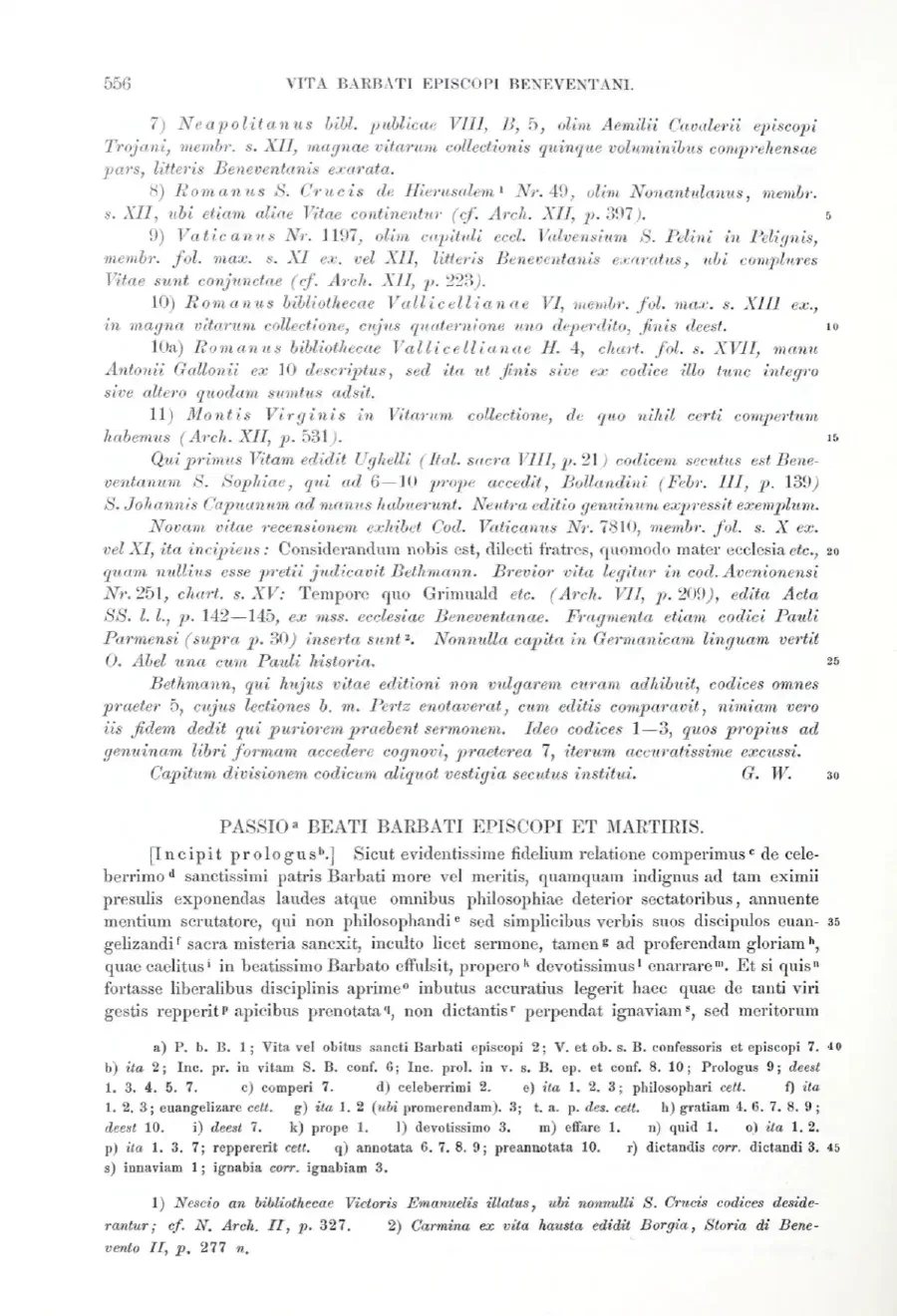
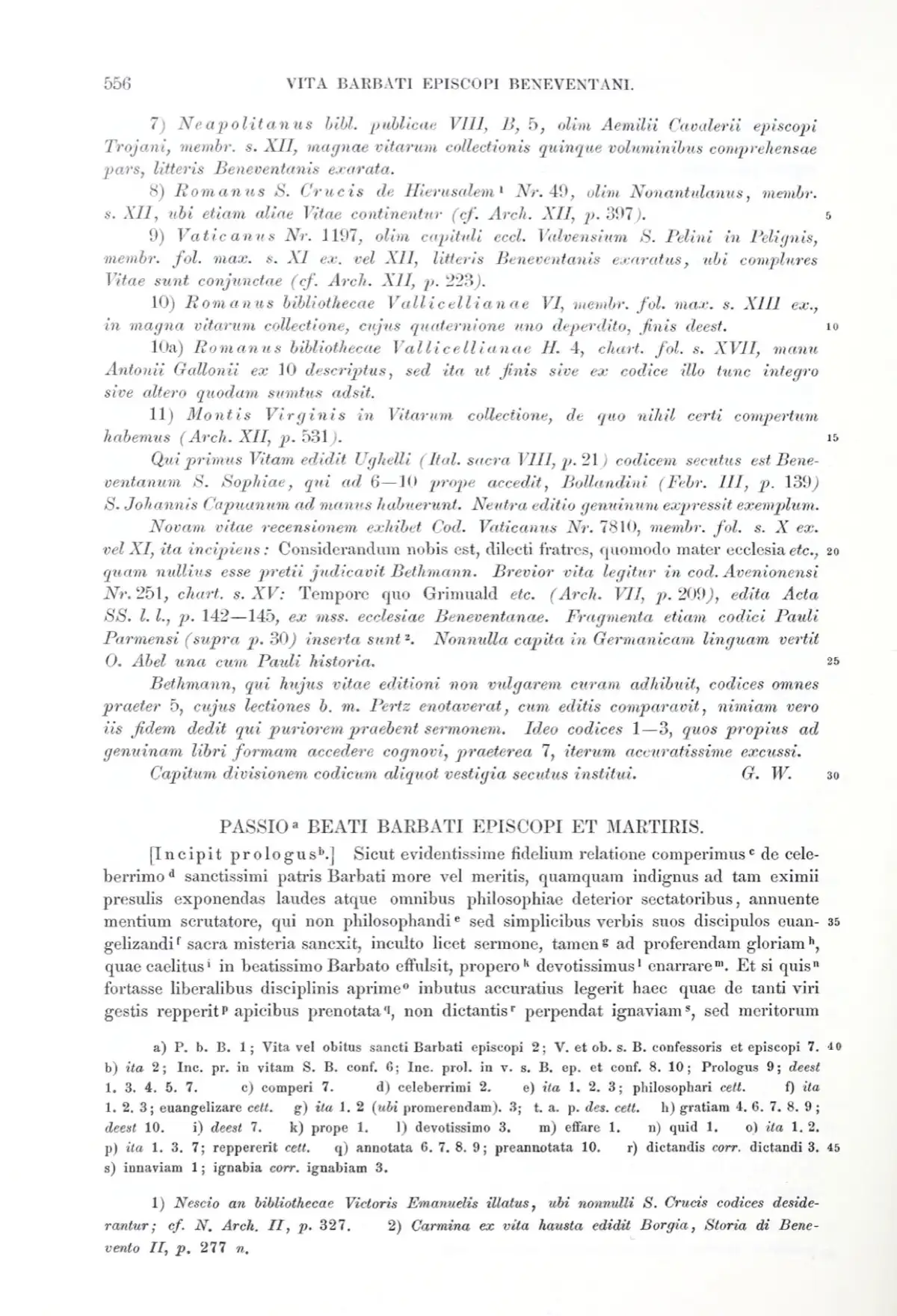
Page 556. Waitz 1878, p. 556: the end of the editor's preface, and the prologue from line 31. Scans of Georg Waitz's edition (MGH, Hannover, 1878), pp. 556–563, from the copy on the Internet Archive Full source - 1556,32
Sicut evidentissime fidelium relatione comperimus de celeberrimo sanctissimi patris Barbati more vel meritis, quamquam indignus ad tam eximii presulis exponendas laudes atque omnibus philosophiae deterior sectatoribus, annuente mentium scrutatore, qui non philosophandi sed simplicibus verbis suos discipulos euangelizandi sacra misteria sancxit, inculto licet sermone, tamen ad proferendam gloriam, quae caelitus in beatissimo Barbato effulsit, propero devotissimus enarrare.
As we have learned most clearly from the report of the faithful about the celebrated conduct and merits of our most holy father Barbatus, I, though unworthy to set out the praises of so eminent a praesul: one who presides; a bishop, and worse than all who follow philosophy, by the assent of the searcher of minds, who ordained that his disciples should preach the sacred mysteries of the gospel not by philosophizing but in simple words, hasten most devotedly to tell, in unpolished speech indeed, yet to bring forth the glory that shone from heaven in the most blessed Barbatus.
Note on line 1
Waitz prints the title Passio, a martyr’s passion, from codex 1, though Barbatus died in peace; codices 2 and 7 have Vita vel obitus, “Life or death”. The bracketed headings are missing from some manuscripts. - 2556,37
Et si quis fortasse liberalibus disciplinis aprime inbutus accuratius legerit haec quae de tanti viri gestis repperit apicibus prenotata, non dictantis perpendat ignaviam, sed meritorum eius excellentiam, de quo summo mentis conamine, postposita verecundia, ut temerarius loquor.
And if someone thoroughly schooled in the liberal arts should read with some care what he finds written down in these letters about the deeds of so great a man, let him weigh not the dullness of the writer but the excellence of the merits of the man of whom, with the utmost effort of mind and with shame set aside, I speak like one who is rash.
Chapter 1: The viper and the tree
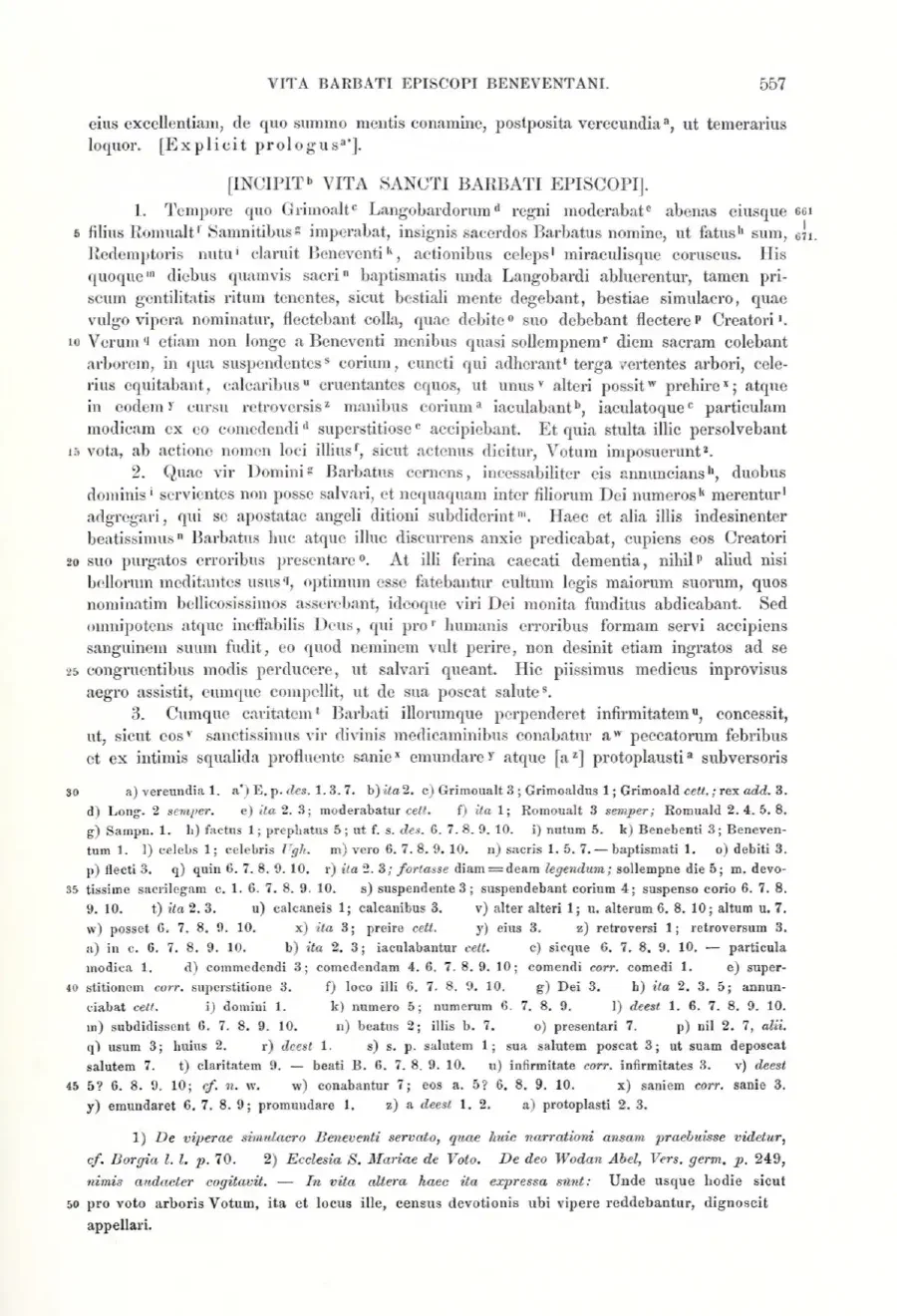
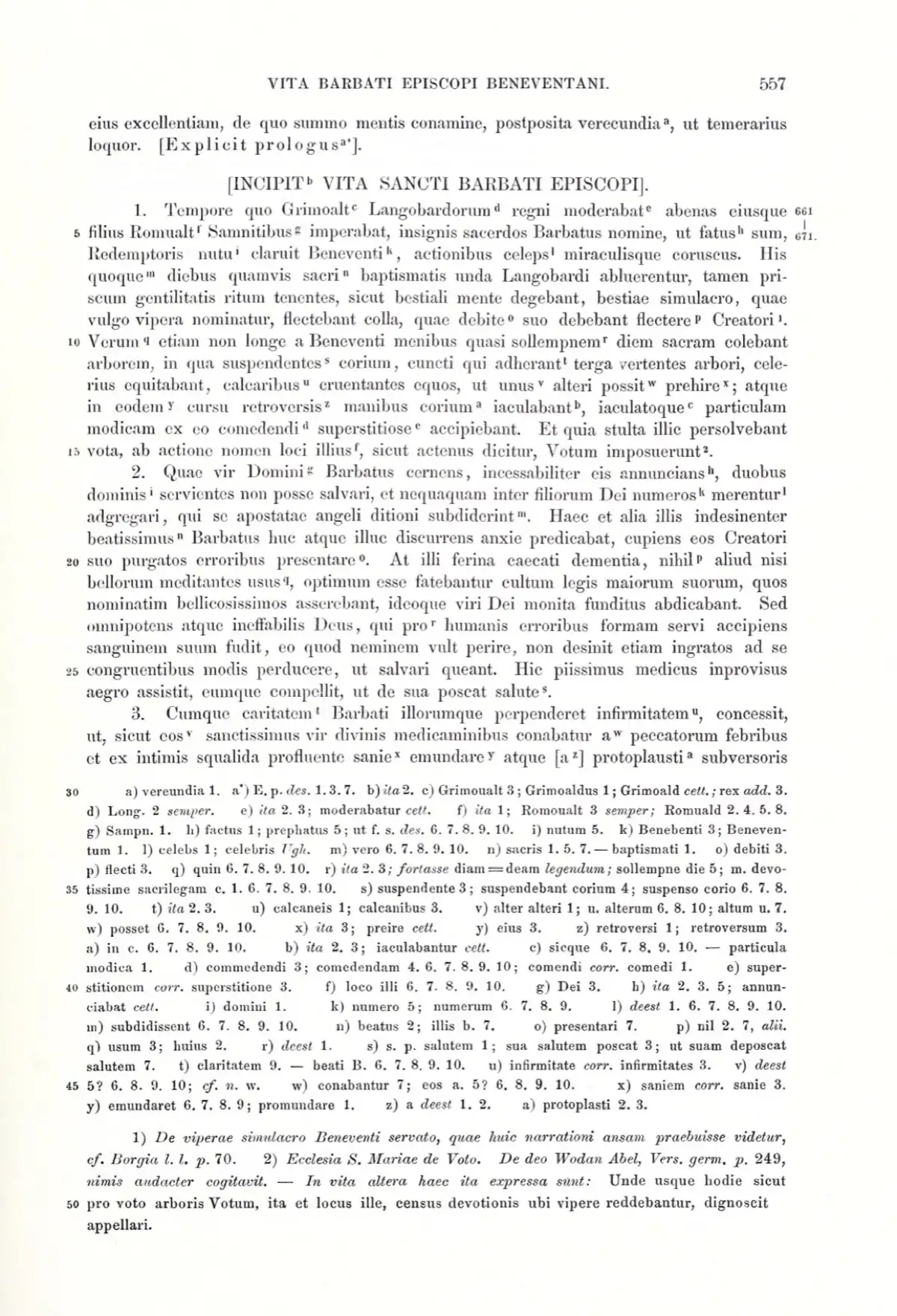
Page 557. Waitz 1878, p. 557: the viper and the sacred tree, lines 6–15. Scans of Georg Waitz's edition (MGH, Hannover, 1878), pp. 556–563, from the copy on the Internet Archive Full source - 3557,4
Tempore quo Grimoalt Langobardorum regni moderabat abenas eiusque filius Romualt Samnitibus imperabat, insignis sacerdos Barbatus nomine, ut fatus sum, Redemptoris nutu claruit Beneventi, actionibus celeps miraculisque coruscus.
In the time when Grimoald held the reins of the kingdom of the Lombards, and his son Romuald ruled over the Samnites: the ancient people of the inland south; here the duchy of Benevento, a distinguished priest named Barbatus, as I have said, shone at Benevento by the will of the Redeemer, renowned in his deeds and flashing with miracles.
Note on line 3
Grimoald, duke of Benevento, seized the Lombard throne at Pavia in 662 (Waitz’s margin: 661) and reigned until 671, leaving his son Romuald as duke of Benevento. “As I have said” points back to nothing in the surviving text. - 4557,6
His quoque diebus quamvis sacri baptismatis unda Langobardi abluerentur, tamen priscum gentilitatis ritum tenentes, sicut bestiali mente degebant, bestiae simulacro, quae vulgo vipera nominatur, flectebant colla, quae debite suo debebant flectere Creatori.
In those days, though the Lombards had been washed in the water of holy baptism, they still kept the ancient rite of gentilitas: the condition of the gentes, the heathen; paganism: as they lived with the mind of beasts, so they bowed their necks to the simulacrum: likeness, image, idol of a beast, which is commonly called a vipera: viper, adder; also used of snakes in general, necks which by right they owed to bow to their Creator.
Note on line 4
This edition’s text never calls the viper golden. Codex 5 adds aureum, “golden”, twice (in passages 44 and 48 here), and the story makes it gold anyway: the bishop calls goldsmiths to melt it into a chalice. Waitz notes (after Borgia) that an image of a viper was still kept at Benevento, and the tale grew from it. - 5557,10
Verum etiam non longe a Beneventi menibus quasi sollempnem diem sacram colebant arborem, in qua suspendentes corium, cuncti qui adherant terga vertentes arbori, celerius equitabant, calcaribus cruentantes equos, ut unus alteri possit prehire; atque in eodem cursu retroversis manibus corium iaculabant, iaculatoque particulam modicam ex eo comedendi superstitiose accipiebant.
And not far from the walls of Benevento they also worshipped a sacred tree, as on a feast day. They hung a corium: hide, skin, leather on it, and all who were there turned their backs to the tree and rode at full speed, bloodying their horses with their spurs, so that one might outstrip another; and in that same course, with their hands turned backward, they iaculor: to throw a javelin; to strike with a missile the hide; and of the hide so struck they superstitiously took a small piece comedo: to eat.
Note on line 5
Waitz suggests diam, i.e. deam, for diem: they would then worship the tree “as a solemn goddess”. Iaculari is to throw a javelin; the text names no weapon. Iaculatoque … ex eo, a piece “from it, once it had been struck”, shows they threw at the hide, not the hide itself. The riders throw backwards over their shoulders at full gallop, and then eat a scrap of the struck hide: a sacrificial meal from the skin of a victim hung on the holy tree. The text names no animal. - 6557,14
Et quia stulta illic persolvebant vota, ab actione nomen loci illius, sicut actenus dicitur, Votum imposuerunt.
And because they paid their foolish votum: vow, a promise made to a god and the offering that fulfils it there, they gave that place a name from the deed, as it is called to this day: Votum, the Vow.
Note on line 6
Waitz identifies the place with the church of S. Maria de Voto. The other Life of Barbatus explains the name differently: “as Votum from the vow to the tree, so that place too, where the dues of devotion were paid to the viper, is known to be named” (census devotionis ubi vipere reddebantur). Abel’s guess that Votum hides the god Wodan Waitz calls too bold. Chapter 2: The preaching refused
- 7557,16
Quae vir Domini Barbatus cernens, incessabiliter eis annuncians, duobus dominis servientes non posse salvari, et nequaquam inter filiorum Dei numeros merentur adgregari, qui se apostatae angeli ditioni subdiderint.
Seeing this, Barbatus, the man of the Lord, told them without ceasing that those who serve two masters cannot be saved, and that those who have put themselves under the rule of the apostate angel by no means deserve to be counted among the sons of God.
- 8557,18
Haec et alia illis indesinenter beatissimus Barbatus huc atque illuc discurrens anxie predicabat, cupiens eos Creatori suo purgatos erroribus presentare.
These things and others the most blessed Barbatus preached to them tirelessly, running here and there in his anxiety, longing to present them to their Creator cleansed of their errors.
- 9557,20
At illi ferina caecati dementia, nihil aliud nisi bellorum meditantes usus, optimum esse fatebantur cultum legis maiorum suorum, quos nominatim bellicosissimos asserebant, ideoque viri Dei monita funditus abdicabant.
But they, blinded by a savage madness and thinking of nothing but the practice of war, declared that the best worship was that of the law of their forefathers, whom they named one by one as the most warlike of men, and so they utterly rejected the warnings of the man of God.
Note on line 9
The Lombards’ defence of their rite: it is the worship their forefathers’ law laid down, and those forefathers are named one by one as the greatest warriors. - 10557,22
Sed omnipotens atque ineffabilis Deus, qui pro humanis erroribus formam servi accipiens sanguinem suum fudit, eo quod neminem vult perire, non desinit etiam ingratos ad se congruentibus modis perducere, ut salvari queant. Hic piissimus medicus inprovisus aegro assistit, eumque compellit, ut de sua poscat salute.
But almighty and ineffable God, who took the form of a servant and shed his blood for the errors of men, because he wills that no one perish, does not cease to draw even the ungrateful to himself by fitting means, so that they can be saved. This most loving physician stands unlooked for at the sick man's side and drives him to ask for his own healing.
Chapter 3: Miracles, and the sharp medicine
- 11557,27
Cumque caritatem Barbati illorumque perpenderet infirmitatem, concessit, ut, sicut eos sanctissimus vir divinis medicaminibus conabatur a peccatorum febribus et ex intimis squalida profluente sanie emundare atque [a] protoplausti subversoris servitio ad filiorum Dei perducere libertatem, etiam mirabilibus signis suae predicationis verba firmaret; ut, si non verbis, ad suam salutem visis miraculis flecterentur.
So when he weighed the charity of Barbatus and their sickness, he granted that, as the most holy man was trying with divine medicines to cleanse them of the fevers of sin and of the filthy sanies: diseased matter, pus flowing from deep within, and to lead them [from] the service of the overthrower of the protoplastus: the first-formed, Adam to the freedom of the sons of God, he should also confirm the words of his preaching with wonderful signs, so that, if not by words, they might be turned to their salvation by the miracles they saw.
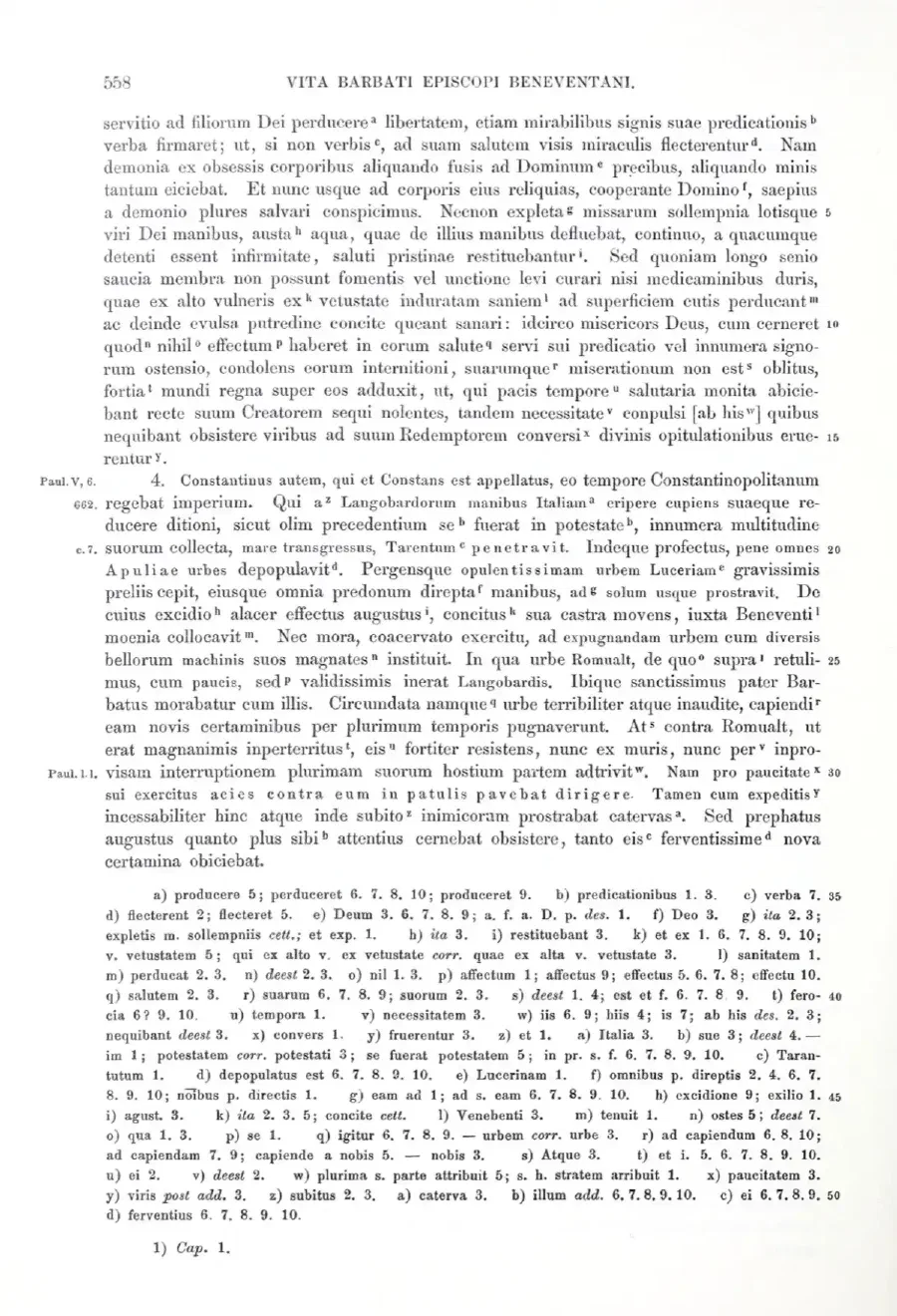
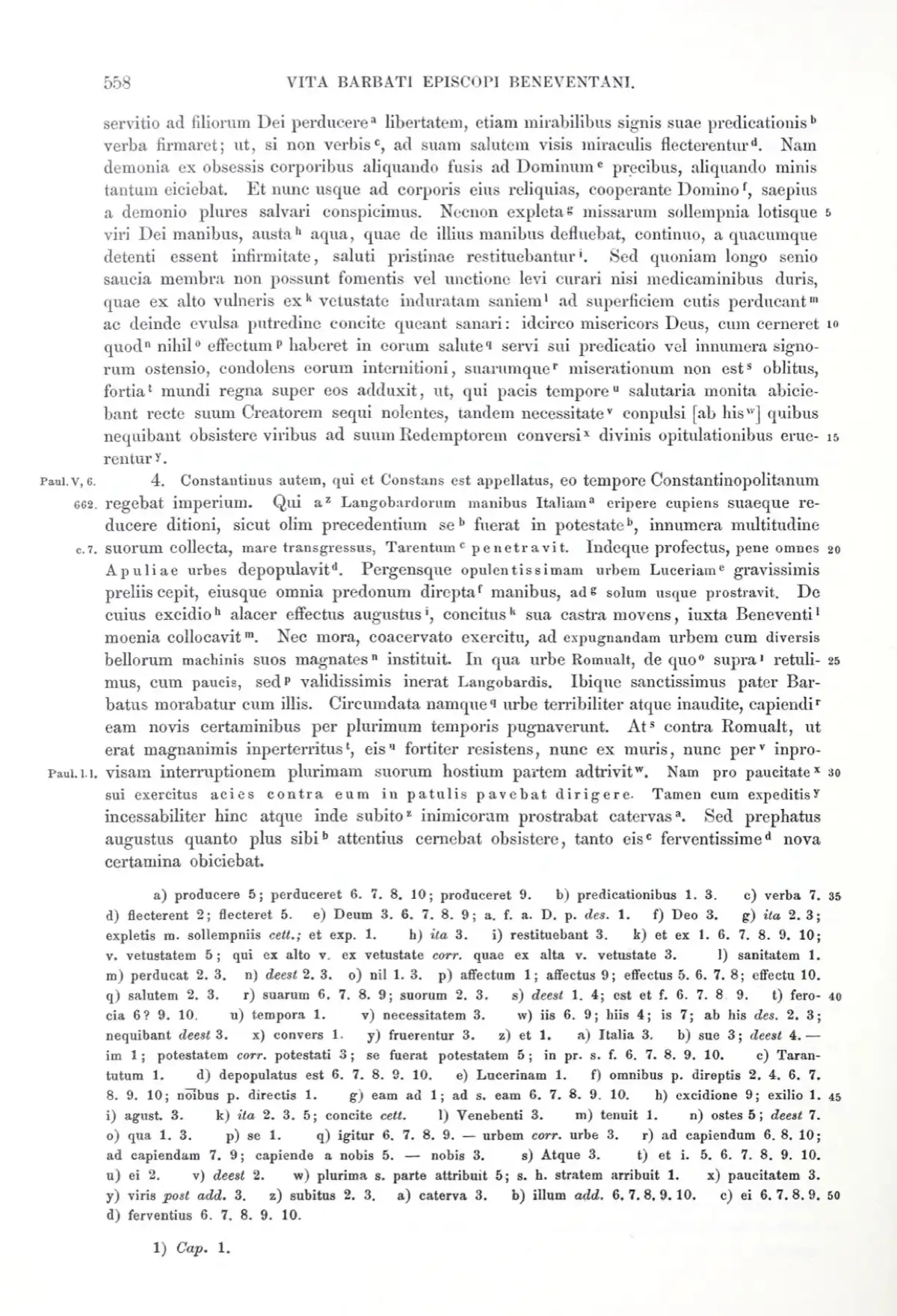
Page 558. Waitz 1878, p. 558. Scans of Georg Waitz's edition (MGH, Hannover, 1878), pp. 556–563, from the copy on the Internet Archive Full source - 12558,2
Nam demonia ex obsessis corporibus aliquando fusis ad Dominum precibus, aliquando minis tantum eiciebat. Et nunc usque ad corporis eius reliquias, cooperante Domino, saepius a demonio plures salvari conspicimus.
For he drove demons out of possessed bodies, sometimes by pouring out prayers to the Lord, sometimes by threats alone. And to this day, at the relics of his body, by the Lord's working, we often see many set free from a demon.
- 13558,5
Necnon expleta missarum sollempnia lotisque viri Dei manibus, austa aqua, quae de illius manibus defluebat, continuo, a quacumque detenti essent infirmitate, saluti pristinae restituebantur.
Moreover, when the solemnities of the mass were finished and the man of God had washed his hands, whoever haurio: to draw (water); to drink the water that ran off his hands was at once restored to their former health, whatever sickness had held them.
Note on line 13
Austa is hausta, “drawn” or “drunk”. The water of the bishop’s hand-washing after mass was drunk as a cure. - 14558,7
Sed quoniam longo senio saucia membra non possunt fomentis vel unctione levi curari nisi medicaminibus duris, quae ex alto vulneris ex vetustate induratam saniem ad superficiem cutis perducant ac deinde evulsa putredine concite queant sanari: idcirco misericors Deus, cum cerneret quod nihil effectum haberet in eorum salute servi sui predicatio vel innumera signorum ostensio, condolens eorum internitioni, suarumque miserationum non est oblitus, fortia mundi regna super eos adduxit, ut, qui pacis tempore salutaria monita abiciebant recte suum Creatorem sequi nolentes, tandem necessitate conpulsi [ab his] quibus nequibant obsistere viribus ad suum Redemptorem conversi divinis opitulationibus eruerentur.
But since limbs wounded by long age cannot be cured by poultices or a light anointing, only by harsh medicines, which draw the pus hardened with age from deep in the wound to the surface of the skin, so that the rot can then be torn out and the wound heal quickly: therefore merciful God, when he saw that the preaching of his servant and the countless display of signs had no effect on their salvation, grieving over their ruin and not forgetting his mercies, brought the mighty kingdoms of the world against them, so that those who in time of peace had thrown off the warnings that would save them, unwilling to follow their Creator rightly, should at last, forced by necessity [by those] whom they could not resist by strength, turn to their Redeemer and be rescued by divine help.
Note on line 14
The “mighty kingdoms of the world” are the Eastern Roman empire, whose invasion follows: the siege is God’s lancet. Chapter 4: The emperor’s siege
- 15558,17
Constantinus autem, qui et Constans est appellatus, eo tempore Constantinopolitanum regebat imperium. Qui a Langobardorum manibus Italiam eripere cupiens suaeque reducere ditioni, sicut olim precedentium se fuerat in potestate, innumera multitudine suorum collecta, mare transgressus, Tarentum penetravit.
Now Constantine, who was also called Constans, ruled at that time the empire of Constantinople. Wishing to snatch Italy from the hands of the Lombards and bring it back under his rule, as it had once been in the power of his predecessors, he gathered a countless host of his men, crossed the sea and entered Taranto.
Note on line 15
Constans II, emperor 641–668, landed in Italy in 663 (Waitz’s margin: 662). Chapters 4–7 follow Paul the Deacon, History of the Lombards 5.6–9, as Waitz’s margin shows, and he prints the borrowed words in spaced type; the viper, the tree, Theodorada’s part and the chalice are not in Paul. - 16558,20
Indeque profectus, pene omnes Apuliae urbes depopulavit. Pergensque opulentissimam urbem Luceriam gravissimis preliis cepit, eiusque omnia predonum direpta manibus, ad solum usque prostravit.
Setting out from there, he laid waste almost all the cities of Apulia. Going on, he took the very rich city of Lucera in the heaviest fighting, and when everything in it had been plundered by the hands of looters, he levelled it to the ground.
- 17558,22
De cuius excidio alacer effectus augustus, concitus sua castra movens, iuxta Beneventi moenia collocavit. Nec mora, coacervato exercitu, ad expugnandam urbem cum diversis bellorum machinis suos magnates instituit.
Elated at its destruction, the emperor moved his camp in haste and pitched it beside the walls of Benevento. Without delay he massed his army and set his nobles to storm the city with siege engines of every kind.
- 18558,25
In qua urbe Romualt, de quo supra retulimus, cum paucis, sed validissimis inerat Langobardis. Ibique sanctissimus pater Barbatus morabatur cum illis.
In that city was Romuald, of whom we spoke above, with a few but very strong Lombards. And there the most holy father Barbatus was staying with them.
- 19558,27
Circumdata namque urbe terribiliter atque inaudite, capiendi eam novis certaminibus per plurimum temporis pugnaverunt. At contra Romualt, ut erat magnanimis inperterritus, eis fortiter resistens, nunc ex muris, nunc per inprovisam interruptionem plurimam suorum hostium partem adtrivit.
Having surrounded the city in a terrible and unheard-of way, they fought for a very long time with new kinds of assault to take it. But Romuald, being great-hearted, stood against them undaunted and resisted them bravely, now from the walls, now by sudden sallies, and wore down a great part of his enemies.
- 20558,30
Nam pro paucitate sui exercitus acies contra eum in patulis pavebat dirigere. Tamen cum expeditis incessabiliter hinc atque inde subito inimicorum prostrabat catervas. Sed prephatus augustus quanto plus sibi attentius cernebat obsistere, tanto eis ferventissime nova certamina obiciebat.
For because his army was so small he was afraid to draw up battle lines against the emperor in the open; yet with light-armed men he kept cutting down bands of the enemy, suddenly, on this side and that, without pause. But the more the emperor saw himself stubbornly resisted, the more fiercely he threw new assaults at them.
Chapter 5: Barbatus calls them to Christ
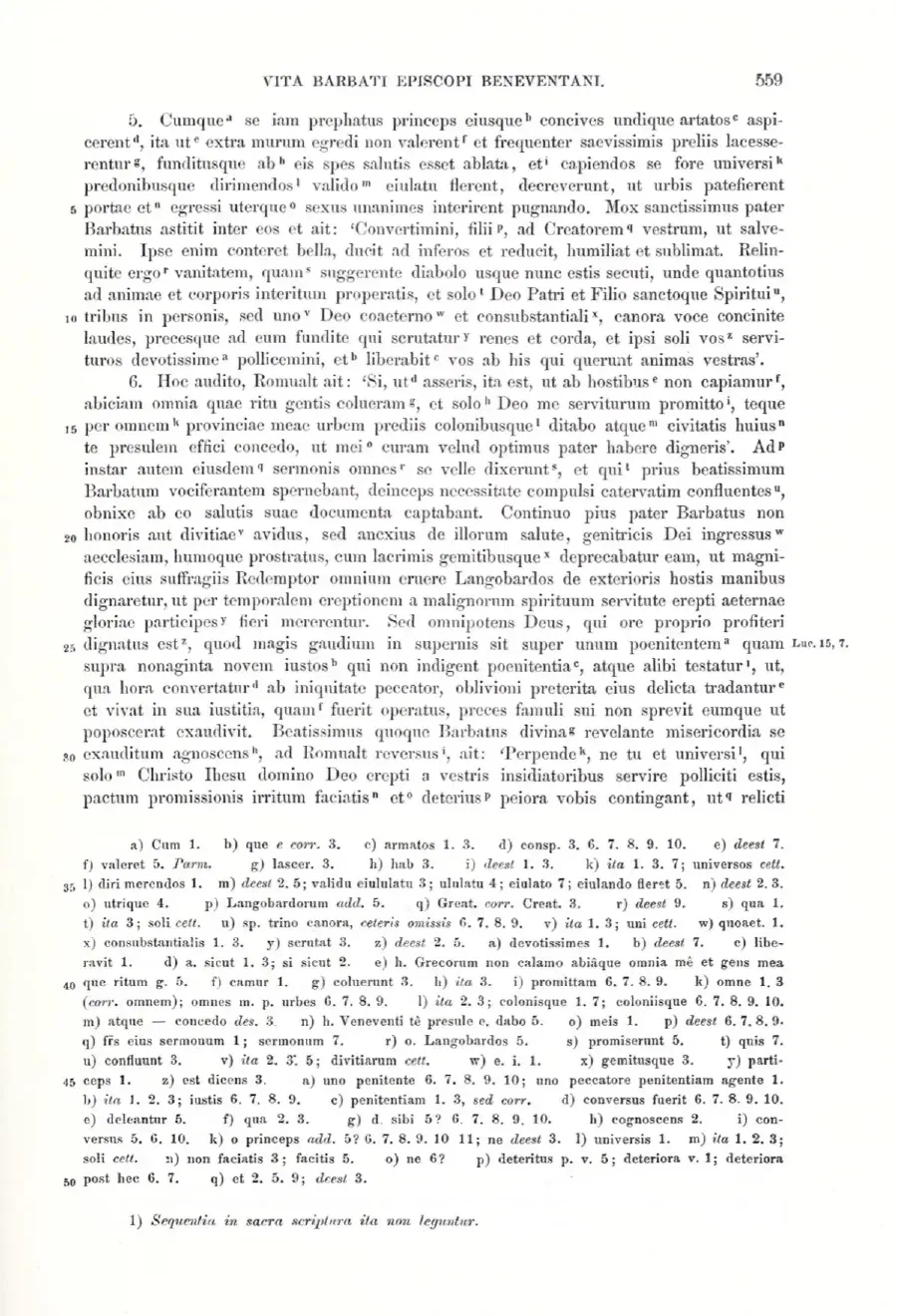
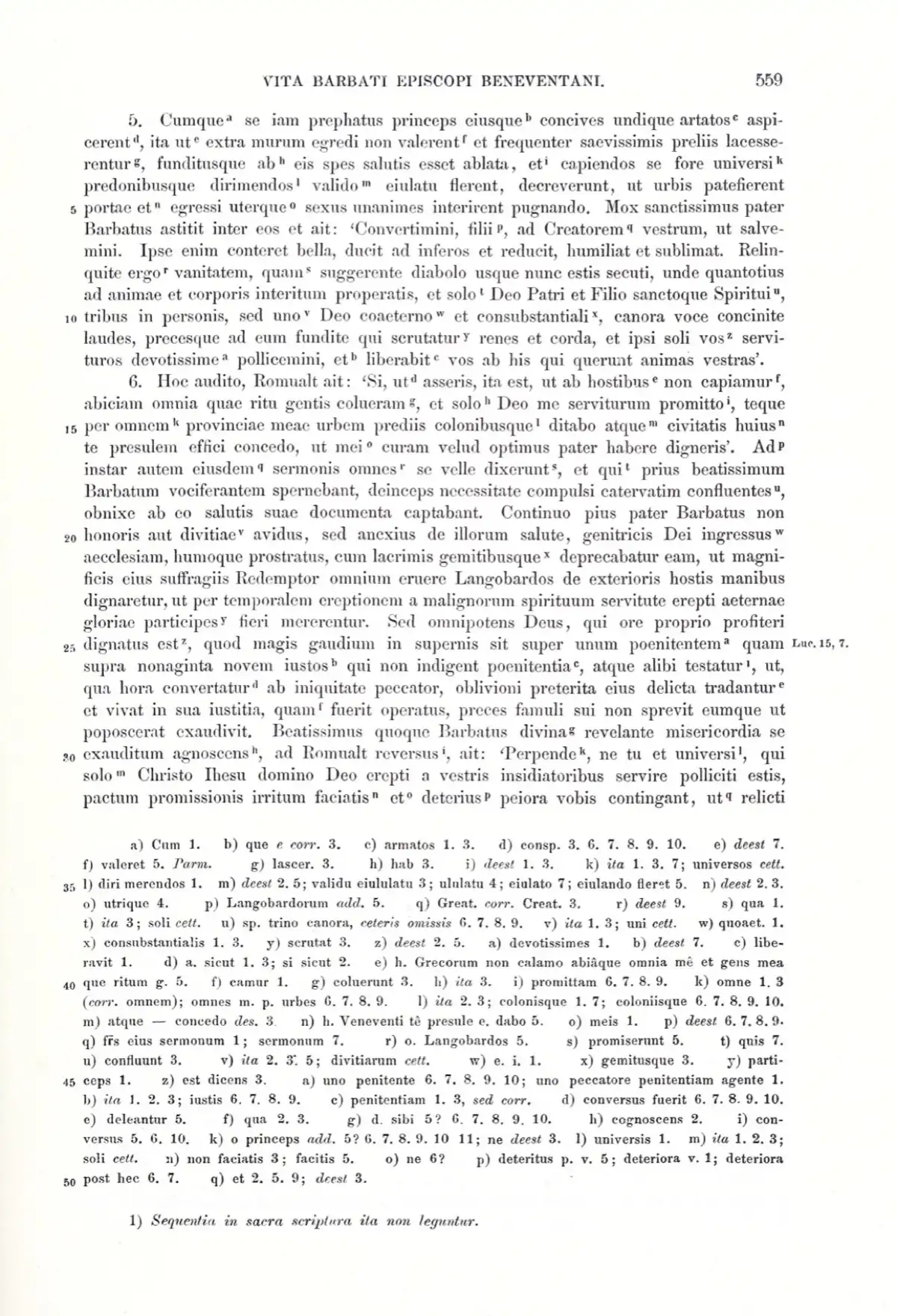
Page 559. Waitz 1878, p. 559. Scans of Georg Waitz's edition (MGH, Hannover, 1878), pp. 556–563, from the copy on the Internet Archive Full source - 21559,1
Cumque se iam prephatus princeps eiusque concives undique artatos aspicerent, ita ut extra murum egredi non valerent et frequenter saevissimis preliis lacesserentur, funditusque ab eis spes salutis esset ablata, et capiendos se fore universi predonibusque dirimendos valido eiulatu flerent, decreverunt, ut urbis patefierent portae et egressi uterque sexus unanimes interirent pugnando.
When the prince and his fellow citizens now saw themselves hemmed in on every side, so that they could not go out beyond the wall and were often assailed in the most savage fighting, and all hope of safety had been utterly taken from them, and all of them, expecting to be captured and torn apart by the looters, wept with loud wailing, they decided that the gates of the city should be thrown open and that men and women alike should go out together and die fighting.
- 22559,5
Mox sanctissimus pater Barbatus astitit inter eos et ait: 'Convertimini, filii, ad Creatorem vestrum, ut salvemini. Ipse enim conteret bella, ducit ad inferos et reducit, humiliat et sublimat.
At once the most holy father Barbatus stood among them and said: 'Turn, my sons, to your Creator, that you may be saved. For he crushes wars; he leads down to the underworld and brings back up; he humbles and he exalts.
Note on line 22
Judith 9:10 and 16:3 (“the Lord who crushes wars”) and 1 Samuel 2:6–7 (“he leads down to the underworld and brings back”), from the Latin Bible. - 23559,7
Relinquite ergo vanitatem, quam suggerente diabolo usque nunc estis secuti, unde quantotius ad animae et corporis interitum properatis, et solo Deo Patri et Filio sanctoque Spiritui, tribus in personis, sed uno Deo coaeterno et consubstantiali, canora voce concinite laudes, precesque ad eum fundite qui scrutatur renes et corda, et ipsi soli vos servituros devotissime pollicemini, et liberabit vos ab his qui querunt animas vestras'.
So leave the vanity that you have followed until now at the devil's prompting, by which you are hurrying with all speed to the ruin of soul and body, and with tuneful voice sing praises to God alone, the Father and the Son and the Holy Spirit, three in persons but one God, coeternal and consubstantial; and pour out prayers to him who searches the reins and the hearts, and promise most devoutly that you will serve him alone; and he will free you from those who seek your lives.'
Chapter 6: The vow, and the Mother of God on the wall
- 24559,13
Hoc audito, Romualt ait: 'Si, ut asseris, ita est, ut ab hostibus non capiamur, abiciam omnia quae ritu gentis colueram, et solo Deo me serviturum promitto, teque per omnem provinciae meae urbem prediis colonibusque ditabo atque civitatis huius te presulem effici concedo, ut mei curam velud optimus pater habere digneris'.
When he heard this, Romuald said: 'If it is so, as you assert, that we shall not be taken by the enemy, I will throw away everything I used to worship by the rite of my people, and I promise to serve God alone; and I will enrich you with estates and coloni: tenants bound to the land in every city of my province, and I grant that you be made bishop of this city, so that you may deign to take care of me like the best of fathers.'
Note on line 24
Ritu gentis, “by the rite of my people”: the duke calls what he worshipped the rite of his people. - 25559,16
Ad instar autem eiusdem sermonis omnes se velle dixerunt, et qui prius beatissimum Barbatum vociferantem spernebant, deinceps necessitate compulsi catervatim confluentes, obnixe ab eo salutis suae documenta captabant.
After the pattern of his words all said that they wished the same, and those who had once scorned the most blessed Barbatus when he cried out to them now, driven by necessity, flocked to him in crowds and eagerly sought from him the teachings of their salvation.
- 26559,19
Continuo pius pater Barbatus non honoris aut divitiae avidus, sed anexius de illorum salute, genitricis Dei ingressus aecclesiam, humoque prostratus, cum lacrimis gemitibusque deprecabatur eam, ut magnificis eius suffragiis Redemptor omnium eruere Langobardos de exterioris hostis manibus dignaretur, ut per temporalem ereptionem a malignorum spirituum servitute erepti aeternae gloriae participes fieri mererentur.
At once the loving father Barbatus, not greedy for honour or riches but anxious for their salvation, went into the church of the Mother of God, and lying flat on the ground he begged her with tears and groans that by her mighty intercession the Redeemer of all would deign to rescue the Lombards from the hands of the enemy outside, so that, rescued from the slavery of evil spirits through a deliverance in time, they might be worthy to share in eternal glory.
- 27559,24
Sed omnipotens Deus, qui ore proprio profiteri dignatus est, quod magis gaudium in supernis sit super unum poenitentem quam supra nonaginta novem iustos qui non indigent poenitentia, atque alibi testatur, ut, qua hora convertatur ab iniquitate peccator, oblivioni preterita eius delicta tradantur et vivat in sua iustitia, quam fuerit operatus, preces famuli sui non sprevit eumque ut poposcerat exaudivit.
And almighty God, who deigned to declare with his own mouth that there is more joy above over one sinner who repents than over ninety-nine just who have no need of repentance, and who testifies elsewhere that at whatever hour the sinner turns from his wickedness his past offences are given over to oblivion and he lives in the righteousness he has done, did not spurn the prayers of his servant, and heard him as he had asked.
Note on line 27
Luke 15:7 and Ezekiel 18:21–22, 33:12–16, paraphrased. Waitz notes that the second saying does not stand in scripture in these words. - 28559,29
Beatissimus quoque Barbatus divina revelante misericordia se exauditum agnoscens, ad Romualt reversus, ait: 'Perpende, ne tu et universi, qui solo Christo Ihesu domino Deo erepti a vestris insidiatoribus servire polliciti estis, pactum promissionis irritum faciatis et deterius peiora vobis contingant, ut relicti a Deo non sit qui eripiat vos.
The most blessed Barbatus, knowing by the revelation of divine mercy that he had been heard, went back to Romuald and said: 'Take care that you and all of you, who have promised to serve Christ Jesus alone, the Lord God, once you are rescued from those who lie in wait for you, do not make void the pact of your promise, so that worse things than before befall you, and, abandoned by God, you have no one to rescue you.
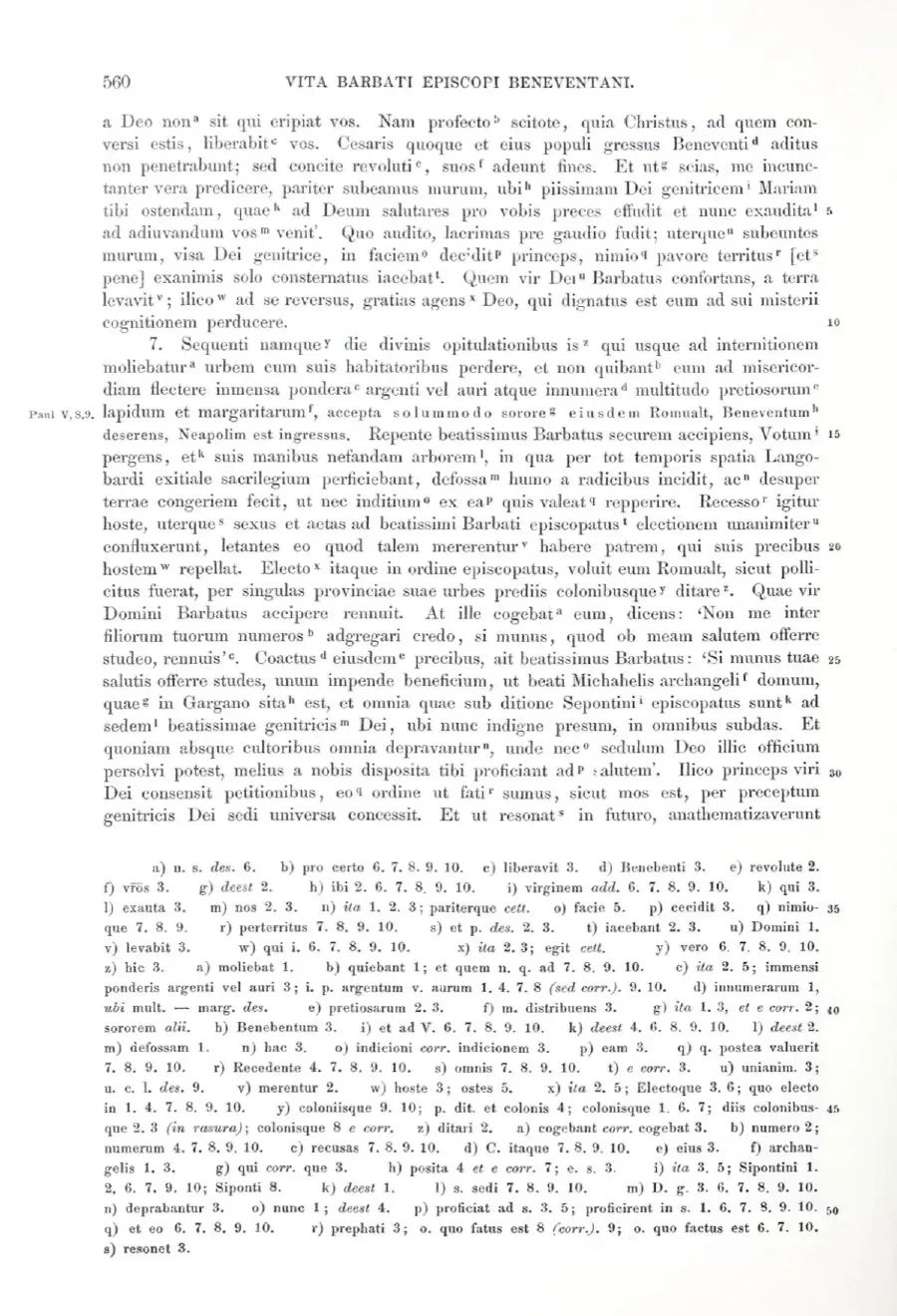
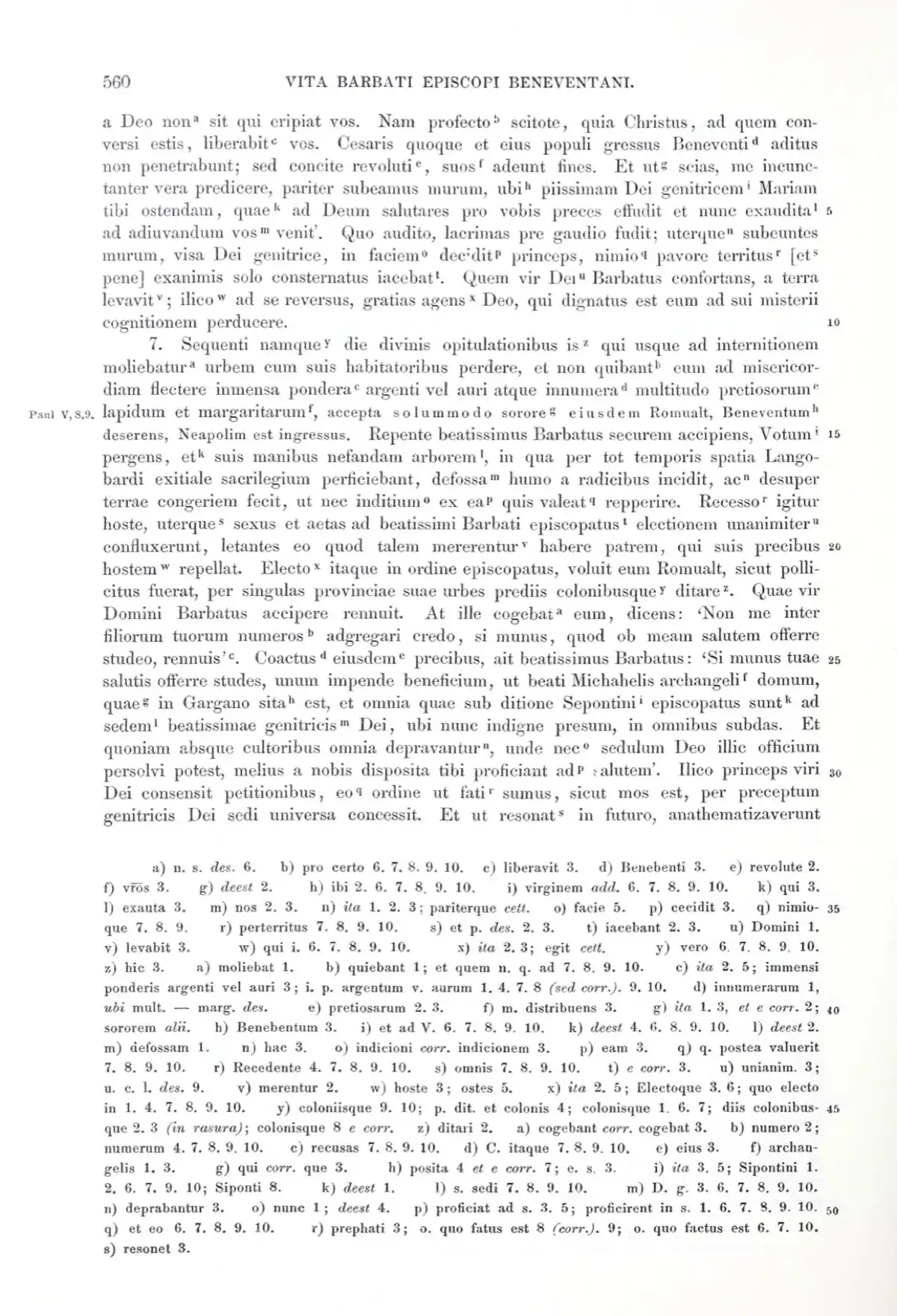
Page 560. Waitz 1878, p. 560: the tree cut down, lines 15–18. Scans of Georg Waitz's edition (MGH, Hannover, 1878), pp. 556–563, from the copy on the Internet Archive Full source - 29560,1
Nam profecto scitote, quia Christus, ad quem conversi estis, liberabit vos. Cesaris quoque et eius populi gressus Beneventi aditus non penetrabunt; sed concite revoluti, suos adeunt fines.
For know this for certain: Christ, to whom you have turned, will free you. The steps of Caesar and his people will not pass the approaches of Benevento; they will turn back in haste and go to their own lands.
- 30560,3
Et ut scias, me incunctanter vera predicere, pariter subeamus murum, ubi piissimam Dei genitricem Mariam tibi ostendam, quae ad Deum salutares pro vobis preces effudit et nunc exaudita ad adiuvandum vos venit'.
And so that you may know that I foretell the truth without wavering, let us go up on the wall together, and there I will show you the most holy Mother of God, Mary, who has poured out prayers for your salvation to God and now, having been heard, has come to help you.'
- 31560,6
Quo audito, lacrimas pre gaudio fudit; uterque subeuntes murum, visa Dei genitrice, in faciem decidit princeps, nimio pavore territus [et pene] exanimis solo consternatus iacebat. Quem vir Dei Barbatus confortans, a terra levavit; ilico ad se reversus, gratias agens Deo, qui dignatus est eum ad sui misterii cognitionem perducere.
When he heard this, Romuald wept for joy. The two went up on the wall, and when the prince saw the Mother of God he fell on his face and lay stretched on the ground, struck with such terror that he was [almost] lifeless. Barbatus, the man of God, comforted him and raised him from the ground; at once he came to himself, giving thanks to God, who had deigned to bring him to the knowledge of his mystery.
Chapter 7: The tree cut down; Barbatus made bishop
- 32560,11
Sequenti namque die divinis opitulationibus is qui usque ad internitionem moliebatur urbem cum suis habitatoribus perdere, et non quibant eum ad misericordiam flectere inmensa pondera argenti vel auri atque innumera multitudo pretiosorum lapidum et margaritarum, accepta solummodo sorore eiusdem Romualt, Beneventum deserens, Neapolim est ingressus.
And the next day, by divine help, the man who had been bent on destroying the city and its inhabitants to the last, and whom immense weights of silver and gold and a countless mass of precious stones and pearls could not move to mercy, took only the sister of Romuald, left Benevento and went into Naples.
Note on line 32
From Paul 5.7–9. In Paul, Constans withdraws on news of Grimoald’s relief army and takes Romuald’s sister Gisa as hostage; she died in Sicily. - 33560,15
Repente beatissimus Barbatus securem accipiens, Votum pergens, et suis manibus nefandam arborem, in qua per tot temporis spatia Langobardi exitiale sacrilegium perficiebant, defossa humo a radicibus incidit, ac desuper terrae congeriem fecit, ut nec inditium ex ea quis valeat repperire.
At once the most blessed Barbatus took an axe and went to Votum, and with his own hands he dug away the earth and cut the nefandus: not to be spoken of, abominable tree, in which the Lombards had for so long performed their deadly sacrilege, from its roots, and heaped a mound of earth over it, so that no one could find a trace of it.
Note on line 33
He digs the earth away, cuts the tree off at the roots and heaps earth over the place; it is not burnt. The sanctuary is erased so that it can never again be found. - 34560,18
Recesso igitur hoste, uterque sexus et aetas ad beatissimi Barbati episcopatus electionem unanimiter confluxerunt, letantes eo quod talem mererentur habere patrem, qui suis precibus hostem repellat.
So when the enemy had withdrawn, men and women of every age flocked together with one mind to elect the most blessed Barbatus bishop, rejoicing that they were worthy to have such a father, one who could drive off the enemy by his prayers.
Note on line 34
Barbatus was bishop of Benevento from 663 to his death in 682. - 35560,20
Electo itaque in ordine episcopatus, voluit eum Romualt, sicut pollicitus fuerat, per singulas provinciae suae urbes prediis colonibusque ditare. Quae vir Domini Barbatus accipere rennuit. At ille cogebat eum, dicens: 'Non me inter filiorum tuorum numeros adgregari credo, si munus, quod ob meam salutem offerre studeo, rennuis'.
When he had been made bishop in due order, Romuald wished, as he had promised, to enrich him with estates and tenant farmers in each of the cities of his province. Barbatus, the man of the Lord, refused to accept them. But Romuald pressed him, saying: 'I do not believe I shall be counted among your sons if you refuse the gift that I am eager to offer for my salvation.'
- 36560,25
Coactus eiusdem precibus, ait beatissimus Barbatus: 'Si munus tuae salutis offerre studes, unum impende beneficium, ut beati Michahelis archangeli domum, quae in Gargano sita est, et omnia quae sub ditione Sepontini episcopatus sunt ad sedem beatissimae genitricis Dei, ubi nunc indigne presum, in omnibus subdas. Et quoniam absque cultoribus omnia depravantur, unde nec sedulum Deo illic officium persolvi potest, melius a nobis disposita tibi proficiant ad salutem'.
Overcome by his pleas, the most blessed Barbatus said: 'If you are eager to offer a gift for your salvation, grant a single favour: put the house of the blessed Archangel Michael on the Gargano, and everything under the rule of the bishopric of Siponto, wholly under the see of the most blessed Mother of God, over which I now unworthily preside. And since everything decays without anyone to tend it, so that not even the service of God can be performed there with care, it will be better for your salvation that we put it in order.'
Note on line 36
Monte Sant’Angelo on the Gargano, Michael’s cave sanctuary, was the Lombards’ national shrine. Barbatus asks for it and for the whole see of Siponto, and the Life says Romuald put them under Benevento. - 37560,30
Ilico princeps viri Dei consensit petitionibus, eo ordine ut fati sumus, sicut mos est, per preceptum genitricis Dei sedi universa concessit. Et ut resonat in futuro, anathematizaverunt qui contra haec agens irritam hanc facere voluerit concessionem.
At once the prince agreed to the requests of the man of God, and in the way we have said, as is the custom, he granted everything by a praeceptum: order; a ruler's written grant, a diploma to the see of the Mother of God; and so that it might ring out into the future, they laid an anathema on anyone who should act against it and seek to make this grant void.
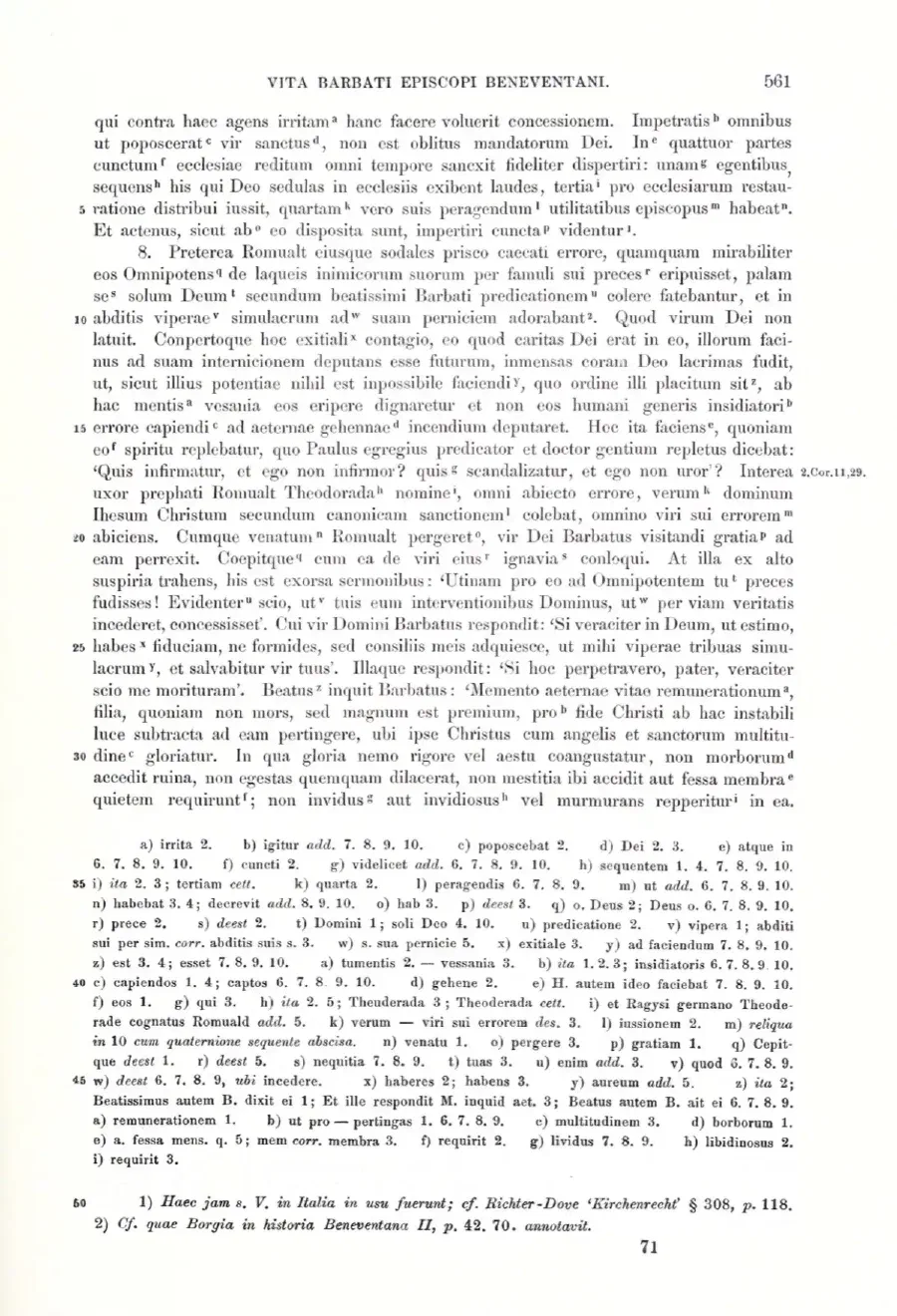
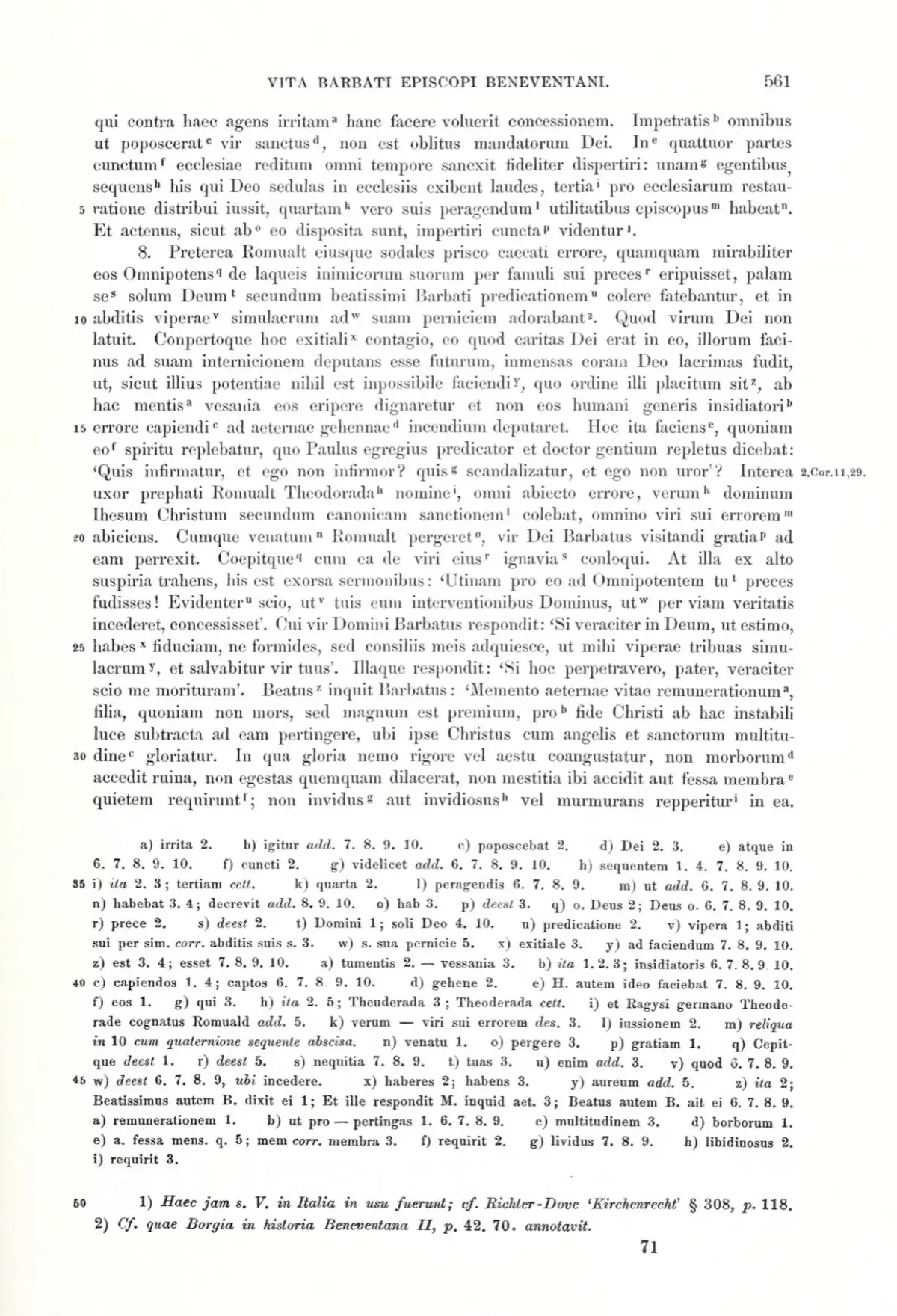
Page 561. Waitz 1878, p. 561: the viper worshipped in secret; Theodorada. Scans of Georg Waitz's edition (MGH, Hannover, 1878), pp. 556–563, from the copy on the Internet Archive Full source - 38561,1
Impetratis omnibus ut poposcerat vir sanctus, non est oblitus mandatorum Dei. In quattuor partes cunctum ecclesiae reditum omni tempore sancxit fideliter dispertiri: unam egentibus, sequens his qui Deo sedulas in ecclesiis exibent laudes, tertia pro ecclesiarum restauratione distribui iussit, quartam vero suis peragendum utilitatibus episcopus habeat. Et actenus, sicut ab eo disposita sunt, impertiri cuncta videntur.
When he had obtained everything as he had asked, the holy man did not forget the commandments of God. He decreed that the whole income of the church should always be faithfully divided into four parts: he ordered one to be given to the needy, the next to those who offer God diligent praises in the churches, the third for the repair of the churches, and the fourth the bishop is to have for his own needs. And to this day everything is seen to be shared out as he arranged it.
Note on line 38
The fourfold division of church revenue was in use in Italy from the 5th century (Waitz, after Richter–Dove). Chapter 8: The viper worshipped in secret
- 39561,7
Preterea Romualt eiusque sodales prisco caecati errore, quamquam mirabiliter eos Omnipotens de laqueis inimicorum suorum per famuli sui preces eripuisset, palam se solum Deum secundum beatissimi Barbati predicationem colere fatebantur, et in abditis viperae simulacrum ad suam perniciem adorabant.
But Romuald and his companions, blinded by their ancient error, though the Almighty had wonderfully rescued them from the snares of their enemies through the prayers of his servant, openly professed to worship God alone, as the most blessed Barbatus preached, while in secret they adoro: to worship, adore, pray to the image of the viper, to their own destruction.
- 40561,10
Quod virum Dei non latuit. Conpertoque hoc exitiali contagio, eo quod caritas Dei erat in eo, illorum facinus ad suam internicionem deputans esse futurum, inmensas coram Deo lacrimas fudit, ut, sicut illius potentiae nihil est inpossibile faciendi, quo ordine illi placitum sit, ab hac mentis vesania eos eripere dignaretur et non eos humani generis insidiatori errore capiendi ad aeternae gehennae incendium deputaret.
This did not escape the man of God. And when he had found out this deadly contagion, because the love of God was in him, reckoning that their crime would end in their own ruin, he poured out immense tears before God, that, as nothing is impossible to his power, he would deign, in whatever way pleased him, to snatch them from this madness of mind, and not consign them, caught in error by the ambusher of the human race, to the fire of eternal Gehenna.
- 41561,15
Hoc ita faciens, quoniam eo spiritu replebatur, quo Paulus egregius predicator et doctor gentium repletus dicebat: 'Quis infirmatur, et ego non infirmor? quis scandalizatur, et ego non uror'?
He did this because he was filled with the spirit with which Paul, the great preacher and teacher of the Gentiles, was filled when he said: 'Who is weak, and I am not weak? Who is made to stumble, and I do not burn?'
Note on line 41
2 Corinthians 11:29. - 42561,17
Interea uxor prephati Romualt Theodorada nomine, omni abiecto errore, verum dominum Ihesum Christum secundum canonicam sanctionem colebat, omnino viri sui errorem abiciens.
Meanwhile the wife of this Romuald, Theodorada by name, had thrown off all error and worshipped the true Lord Jesus Christ by the rule of the canons, utterly rejecting her husband's error.
Note on line 42
Paul the Deacon (5.25; 6.1) names Romuald’s wife Theodorada, daughter of Lupus, duke of Friuli; she built a church of St Peter outside the walls of Benevento. - 43561,20
Cumque venatum Romualt pergeret, vir Dei Barbatus visitandi gratia ad eam perrexit. Coepitque cum ea de viri eius ignavia conloqui. At illa ex alto suspiria trahens, his est exorsa sermonibus: 'Utinam pro eo ad Omnipotentem tu preces fudisses! Evidenter scio, ut tuis eum interventionibus Dominus, ut per viam veritatis incederet, concessisset'.
When Romuald had gone out hunting, Barbatus, the man of God, went to visit her and began to talk with her about her husband's sloth. She, drawing sighs from deep within, began with these words: 'If only you had poured out prayers for him to the Almighty! I know for certain that at your pleading the Lord would have granted that he walk in the way of truth.'
- 44561,24
Cui vir Domini Barbatus respondit: 'Si veraciter in Deum, ut estimo, habes fiduciam, ne formides, sed consiliis meis adquiesce, ut mihi viperae tribuas simulacrum, et salvabitur vir tuus'. Illaque respondit: 'Si hoc perpetravero, pater, veraciter scio me morituram'.
Barbatus, the man of the Lord, answered her: 'If, as I think, you truly trust in God, do not be afraid, but follow my counsel: give me the image of the viper, and your husband will be saved.' And she answered: 'If I do this, father, I know for certain that I shall die.'
Note on line 44
Her fear, presumably, is that her husband will kill her for giving away his god. In ch. 10 a bystander says he would have cut off his own wife’s head for it. - 45561,27
Beatus inquit Barbatus: 'Memento aeternae vitae remunerationum, filia, quoniam non mors, sed magnum est premium, pro fide Christi ab hac instabili luce subtracta ad eam pertingere, ubi ipse Christus cum angelis et sanctorum multitudine gloriatur.
Blessed Barbatus said: 'Remember the rewards of eternal life, daughter: it is not death but a great prize to be taken from this unstable light for the faith of Christ and to reach that life where Christ himself is in glory with the angels and the multitude of the saints.
- 46561,30
In qua gloria nemo rigore vel aestu coangustatur, non morborum accedit ruina, non egestas quemquam dilacerat, non mestitia ibi accidit aut fessa membra quietem requirunt; non invidus aut invidiosus vel murmurans repperitur in ea. Evulsa est ab ea suspicio mortis et amissio gloriae.
In that glory no one is pinched by cold or heat, no ruin of disease comes on, no want tears anyone, no sadness befalls, nor do weary limbs seek rest; no one envious or envied or grumbling is found there. From it the fear of death and the loss of glory have been torn out.
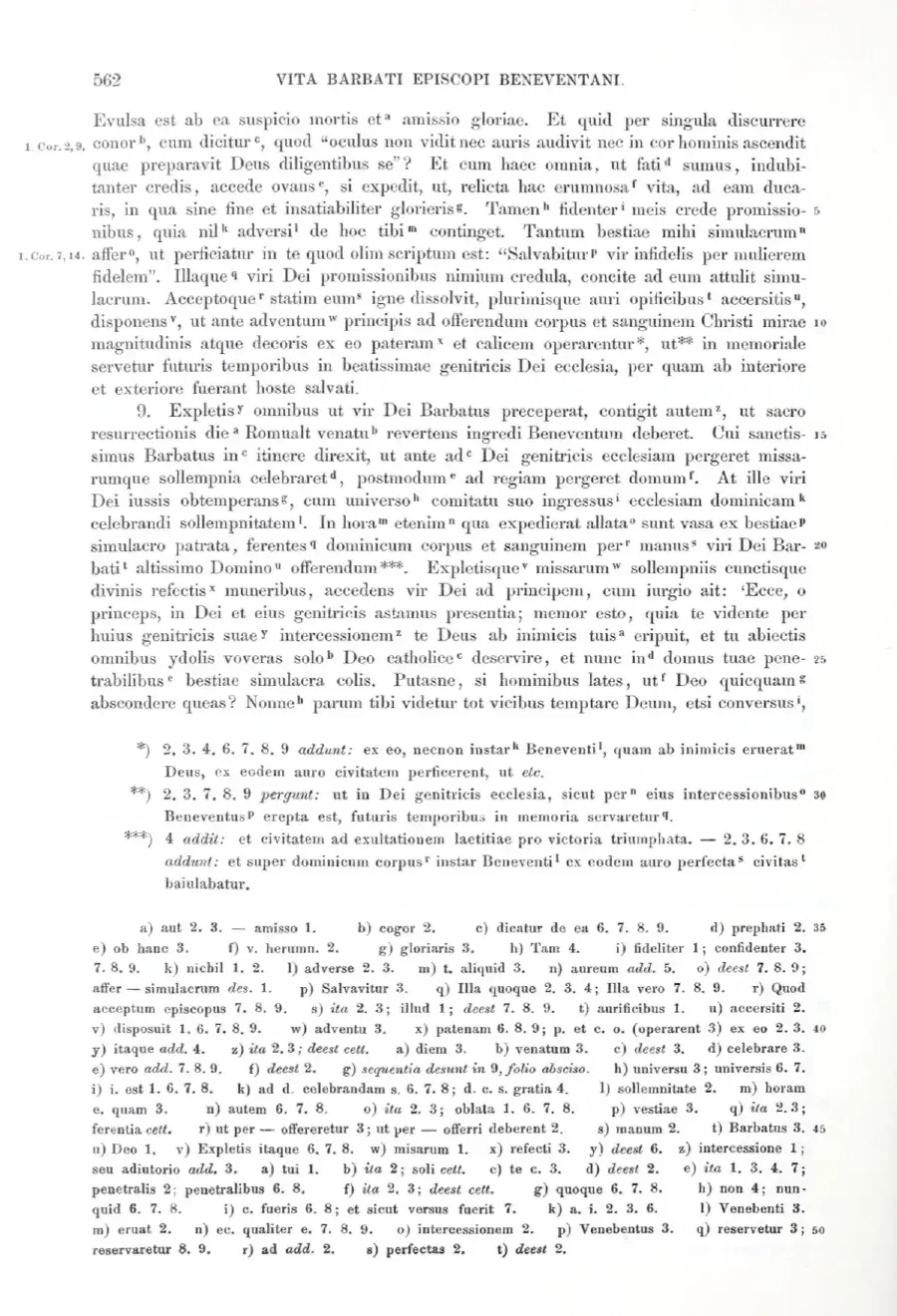
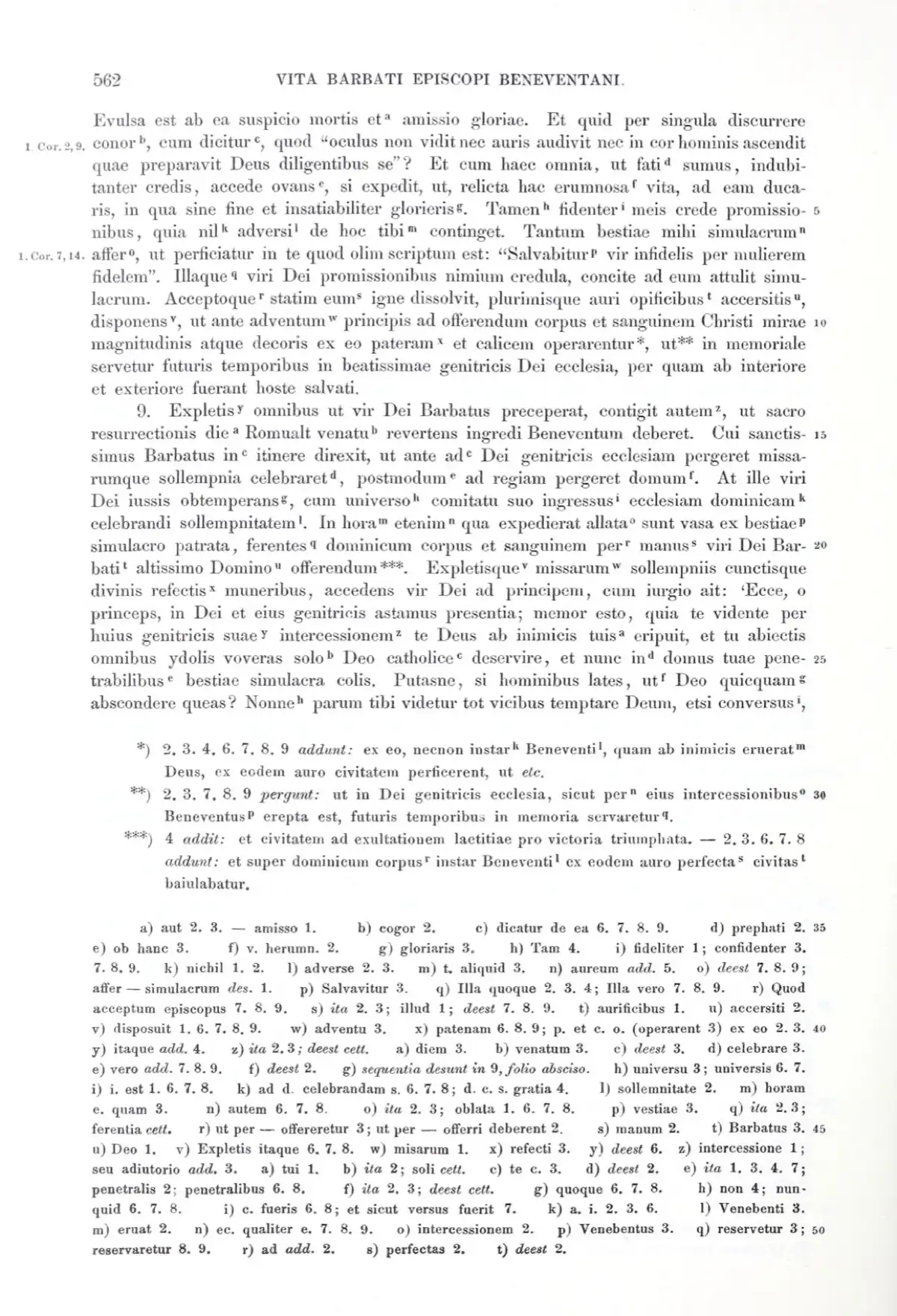
Page 562. Waitz 1878, p. 562: the image melted into a paten and chalice. Scans of Georg Waitz's edition (MGH, Hannover, 1878), pp. 556–563, from the copy on the Internet Archive Full source - 47562,1
Et quid per singula discurrere conor, cum dicitur, quod "oculus non vidit nec auris audivit nec in cor hominis ascendit quae preparavit Deus diligentibus se"? Et cum haec omnia, ut fati sumus, indubitanter credis, accede ovans, si expedit, ut, relicta hac erumnosa vita, ad eam ducaris, in qua sine fine et insatiabiliter glorieris.
And why do I try to run through each thing, when it is said that "eye has not seen nor ear heard, nor has it gone up into the heart of man, what God has prepared for those who love him"? And since, as we have said, you believe all this without doubt, go to it rejoicing, if it is for your good, so that you may leave this wretched life and be led to the life in which you will be in glory without end and without having your fill.
Note on line 47
1 Corinthians 2:9. - 48562,5
Tamen fidenter meis crede promissionibus, quia nil adversi de hoc tibi continget. Tantum bestiae mihi simulacrum affer, ut perficiatur in te quod olim scriptum est: "Salvabitur vir infidelis per mulierem fidelem"'.
Yet trust my promises boldly, for nothing bad will come to you from this. Only bring me the image of the beast, so that what was written long ago may be fulfilled in you: "The unbelieving husband will be saved by the believing wife."'
Note on line 48
1 Corinthians 7:14, with sanctificatus est, “is made holy”, turned into salvabitur, “will be saved”. Codex 5 again has “the golden image”. - 49562,8
Illaque viri Dei promissionibus nimium credula, concite ad eum attulit simulacrum. Acceptoque statim eum igne dissolvit, plurimisque auri opificibus accersitis, disponens, ut ante adventum principis ad offerendum corpus et sanguinem Christi mirae magnitudinis atque decoris ex eo pateram et calicem operarentur, ut in memoriale servetur futuris temporibus in beatissimae genitricis Dei ecclesia, per quam ab interiore et exteriore fuerant hoste salvati.
And she, trusting completely in the promises of the man of God, quickly brought him the image. As soon as he had it he melted it in the fire, called in many goldsmiths and ordered them to make from it, before the prince returned, a patera: dish; here the paten that holds the bread of the eucharist and a chalice of wonderful size and beauty for offering the body and blood of Christ, to be kept as a memorial in time to come in the church of the most blessed Mother of God, through whom they had been saved from the enemy within and the enemy without.
Note on line 49
Most manuscripts add that from the same gold the smiths also made a model of Benevento, “the city which God had rescued from its enemies”. The “enemy within” is the viper and the evil spirits of ch. 6; the “enemy without” is the emperor. Chapter 9: Easter: the chalice from the viper
- 50562,14
Expletis omnibus ut vir Dei Barbatus preceperat, contigit autem, ut sacro resurrectionis die Romualt venatu revertens ingredi Beneventum deberet. Cui sanctissimus Barbatus in itinere direxit, ut ante ad Dei genitricis ecclesiam pergeret missarumque sollempnia celebraret, postmodum ad regiam pergeret domum.
When everything had been done as Barbatus, the man of God, had ordered, it happened that on the holy day of the Resurrection Romuald, coming back from the hunt, was due to enter Benevento. The most holy Barbatus sent word to him on the road to go first to the church of the Mother of God and celebrate the solemnities of the mass, and only then go on to the palace.
Note on line 50
The day of the Resurrection is Easter. - 51562,17
At ille viri Dei iussis obtemperans, cum universo comitatu suo ingressus ecclesiam dominicam celebrandi sollempnitatem. In hora etenim qua expedierat allata sunt vasa ex bestiae simulacro patrata, ferentes dominicum corpus et sanguinem per manus viri Dei Barbati altissimo Domino offerendum.
Obeying the orders of the man of God, he entered the church with his whole retinue to celebrate the feast of the Lord. And at the hour when it was needed, the vessels made from the image of the beast were brought in, bearing the Lord's body and blood, to be offered to the Lord most high by the hands of Barbatus, the man of God.
Note on line 51
Codices 2, 3, 6, 7 and 8 add: “and above the Lord’s body was carried a city, a model of Benevento, made of the same gold”. Codex 4: “and the city, for exultation and joy at the victory won”. - 52562,21
Expletisque missarum sollempniis cunctisque divinis refectis muneribus, accedens vir Dei ad principem, cum iurgio ait: 'Ecce, o princeps, in Dei et eius genitricis astamus presentia; memor esto, quia te vidente per huius genitricis suae intercessionem te Deus ab inimicis tuis eripuit, et tu abiectis omnibus ydolis voveras solo Deo catholice deservire, et nunc in domus tuae penetrabilibus bestiae simulacra colis.
When the solemnities of the mass were finished and all had been fed with the divine gifts, the man of God went up to the prince and said to him in reproach: 'Look, prince, we stand in the presence of God and of his Mother. Remember that before your eyes God rescued you from your enemies through the intercession of this his Mother, and you, casting away all idols, had vowed to serve God alone as a catholic; and now, in the inner rooms of your house, you worship images of the beast.
- 53562,26
Putasne, si hominibus lates, ut Deo quicquam abscondere queas? Nonne parum tibi videtur tot vicibus temptare Deum, etsi conversus, ut de iniquitatibus tuis ulciscatur, ante faciem eius te proteget viperae simulacrum aut dicet ei: "Ne percutias eum", aut eruet te de manibus eius? Perpende, ne veniat ultionis dies, et non sit qui eripiat te nec tui clamoris audiat vocem'.
Do you think that, if you hide from men, you can hide anything from God? Does it seem to you a small thing to tempt God so many times, even after your conversion, so that he takes vengeance for your sins? Will the image of the viper protect you before his face, or say to him, "Do not strike him", or snatch you from his hands? Take care that the day of vengeance does not come, with no one to rescue you, and no one to hear the voice of your crying.'
Chapter 10: The confession, and the curse on the scoffer
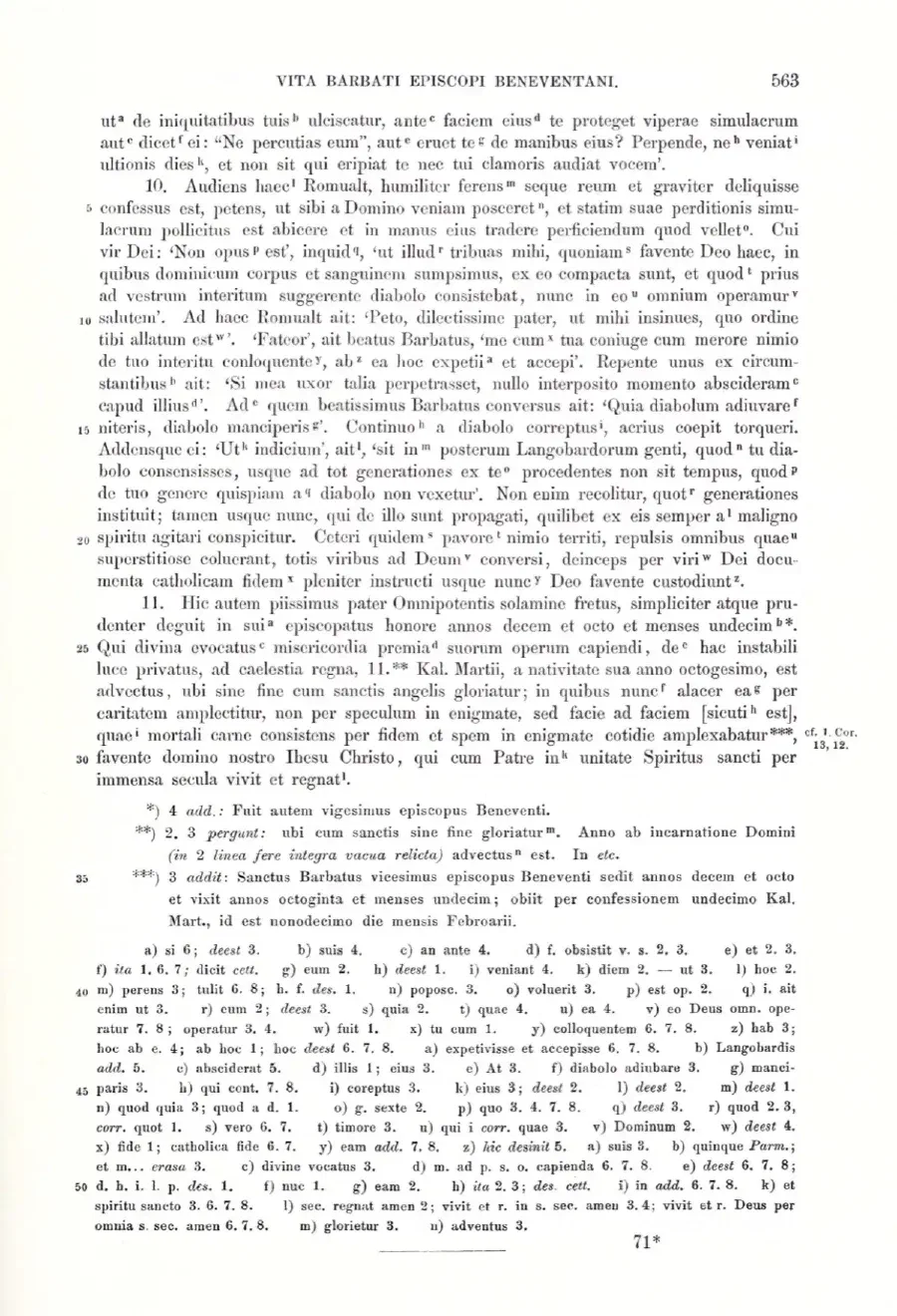
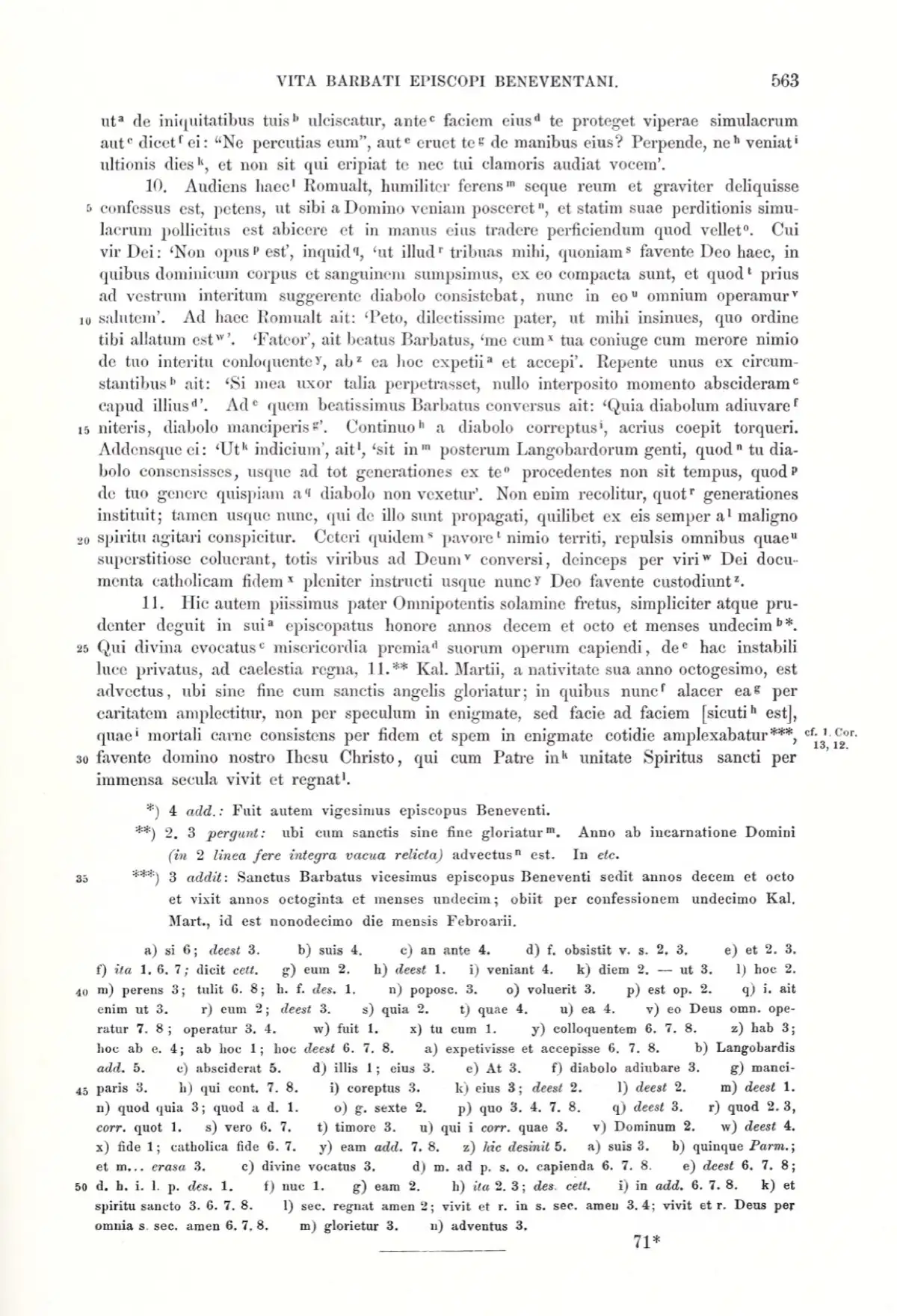
Page 563. Waitz 1878, p. 563: the end of the Life. Scans of Georg Waitz's edition (MGH, Hannover, 1878), pp. 556–563, from the copy on the Internet Archive Full source - 54563,4
Audiens haec Romualt, humiliter ferens seque reum et graviter deliquisse confessus est, petens, ut sibi a Domino veniam posceret, et statim suae perditionis simulacrum pollicitus est abicere et in manus eius tradere perficiendum quod vellet.
Hearing this, Romuald took it humbly and confessed that he was guilty and had sinned gravely, asking him to beg pardon for him from the Lord; and at once he promised to throw away the image of his perdition and hand it over to him, to do with it whatever he wished.
- 55563,6
Cui vir Dei: 'Non opus est', inquid, 'ut illud tribuas mihi, quoniam favente Deo haec, in quibus dominicum corpus et sanguinem sumpsimus, ex eo compacta sunt, et quod prius ad vestrum interitum suggerente diabolo consistebat, nunc in eo omnium operamur salutem'.
The man of God said to him: 'There is no need for you to give it to me, for by God's favour these vessels in which we have received the Lord's body and blood are made from it; and what once stood for your destruction at the devil's prompting, in that we now work the salvation of all.'
Note on line 55
The duke drinks Christ’s blood from the melted god without knowing it, and the bishop tells him so only after communion. - 56563,10
Ad haec Romualt ait: 'Peto, dilectissime pater, ut mihi insinues, quo ordine tibi allatum est'. 'Fateor', ait beatus Barbatus, 'me cum tua coniuge cum merore nimio de tuo interitu conloquente, ab ea hoc expetii et accepi'.
At this Romuald said: 'I beg you, dearest father, tell me how it was brought to you.' 'I confess,' said blessed Barbatus, 'that when I was talking with your wife, with great sorrow, about your ruin, I asked her for it and received it.'
- 57563,12
Repente unus ex circumstantibus ait: 'Si mea uxor talia perpetrasset, nullo interposito momento abscideram capud illius'. Ad quem beatissimus Barbatus conversus ait: 'Quia diabolum adiuvare niteris, diabolo manciperis'. Continuo a diabolo correptus, acrius coepit torqueri.
At once one of the bystanders said: 'If my wife had done such a thing, I would have abscido caput: to cut off the head without a moment's delay.' The most blessed Barbatus turned to him and said: 'Because you strive to help the devil, you shall be made over to the devil.' At once he was seized by the devil and began to be cruelly tormented.
- 58563,16
Addensque ei: 'Ut indicium', ait, 'sit in posterum Langobardorum genti, quod tu diabolo consensisses, usque ad tot generationes ex te procedentes non sit tempus, quod de tuo genere quispiam a diabolo non vexetur'. Non enim recolitur, quot generationes instituit; tamen usque nunc, qui de illo sunt propagati, quilibet ex eis semper a maligno spiritu agitari conspicitur.
And Barbatus added: 'As a sign to the Lombard people for all time to come that you agreed with the devil, through so many generations descended from you there shall be no time when someone of your line is not tormented by the devil.' It is not remembered how many generations he set; yet to this day every one of those descended from him is always seen to be driven by an evil spirit.
Note on line 58
Instituit, “he set”: the number of generations Barbatus fixed for the curse has been forgotten, but the possession is still seen in the man’s descendants in the writer’s day. - 59563,20
Ceteri quidem pavore nimio territi, repulsis omnibus quae superstitiose coluerant, totis viribus ad Deum conversi, deinceps per viri Dei documenta catholicam fidem pleniter instructi usque nunc Deo favente custodiunt.
The rest, struck with terror, cast away everything they had worshipped in their superstition and turned to God with all their strength, and from then on, fully instructed by the teachings of the man of God, they keep the catholic faith, by God's favour, to this day.
Chapter 11: The death of Barbatus
- 60563,23
Hic autem piissimus pater Omnipotentis solamine fretus, simpliciter atque prudenter deguit in sui episcopatus honore annos decem et octo et menses undecim. Qui divina evocatus misericordia premia suorum operum capiendi, de hac instabili luce privatus, ad caelestia regna, 11. Kal. Martii, a nativitate sua anno octogesimo, est advectus, ubi sine fine cum sanctis angelis gloriatur;
This most loving father, relying on the comfort of the Almighty, lived simply and wisely in the honour of his bishopric for eighteen years and eleven months. Called by divine mercy to receive the rewards of his works, he was taken from this unstable light and carried to the heavenly kingdoms on the eleventh day before the Kalends of March, in the eightieth year from his birth, where he is in glory without end with the holy angels;
Note on line 60
The eleventh day before the Kalends of March is 19 February, his feast; the year is 682. Codex 4 adds that he was the twentieth bishop of Benevento. - 61563,27
in quibus nunc alacer ea per caritatem amplectitur, non per speculum in enigmate, sed facie ad faciem [sicuti est], quae mortali carne consistens per fidem et spem in enigmate cotidie amplexabatur, favente domino nostro Ihesu Christo, qui cum Patre in unitate Spiritus sancti per immensa secula vivit et regnat.
and among them he now joyfully embraces in love, not through a mirror in a riddle but face to face [as it is], the things which, while he lived in mortal flesh, he embraced every day in faith and hope, in a riddle: by the favour of our Lord Jesus Christ, who with the Father in the unity of the Holy Spirit lives and reigns through endless ages.
Note on line 61
1 Corinthians 13:12.