~/sacred-texts/old-kingdom-tomb-inscriptions
Tomb of Mehu, Saqqara: A Vizier Lists His Good Deeds
- Date
- Carved in the 6th Dynasty (c. 2345–2181 BC) on a door lintel in the tomb of the vizier Mehu at Saqqara
- Found
- Mastaba of Mehu, Saqqara, south of the causeway of Unas; still in place in the tomb
- Language
- Egyptian (Old Egyptian) · Hieroglyphic
- 1
ḥtp-ḏi̯ nswt ḥtp-ḏi̯ Jnp,w ḫnt(,j)-zḥ-nṯr ḥtp-ḏi̯ Jnp,w tp(,j)-ḏw≡f jm,j-wt nb-tꜣ-ḏsr
An offering which the king gives; an offering which Anubis gives, he who is before the god's booth; an offering which Anubis gives, he who is upon his mountain, Imiut, Lord of the Sacred Land:
Note · Line 1
This is the offering formula that opens most Egyptian funerary inscriptions: gifts pass from the king and the gods to the dead. - 2
qrs.t(j) =f m jz =f m ẖr-nṯr m z(my),t jmn,t(j).t nfr jꜣwi̯(.w) wr,t
may he be buried in his tomb in the necropolis, in the western desert, having grown old most beautifully.
Note · Line 2
The dead were buried on the west bank, where the sun sets. A burial in old age was the ideal end of life. - 3
ḥtp-ḏi̯ nswt ḥtp-ḏi̯ Wsjr nb-Ḏd,w
An offering which the king gives; an offering which Osiris gives, lord of Busiris:
Note · Line 3
Osiris, the murdered and revived king of the dead, had an ancient cult centre at Busiris in the Nile Delta. - 4
pr-ḫrw n =f m ḥtp-nswt rꜥw-nb Wpi̯-rnp,t Tp(,j)-rnp,t Ḏḥw,t(y)t Wꜣg Ḥꜣb-Zkr Ḥꜣb-wr Rkḥ Tp,j.pl-rnp,t.pl (Tp,j-)ꜣbd(,w) (Tp,j-)smd.t
invocation offerings for him as the king's offering every day, at the Opening of the Year, at the Beginning of the Year, at the Thoth festival, at the Wag festival, at the festival of Sokar, at the Great Festival, at the Burning, at the beginnings of the years, at the first of the month and at the half-month festival.
Note · Line 4
“Invocation offering” renders an Egyptian phrase meaning “a coming forth at the voice”: bread, beer and other goods were believed to appear for the dead whenever the formula was spoken aloud. - 5
ḥtp-ḏi̯ nswt ḥtp-ḏi̯ Ḫnt(,j)-jmn,tw nb-Tꜣ-wr
An offering which the king gives; an offering which Khentyamentiu gives, lord of Tawer:
Note · Line 5
Khentyamentiu, “Foremost of the Westerners” (that is, of the dead), was the jackal god of Abydos, later merged with Osiris. Tawer is the district around Abydos. - 6
zmꜣ =f tꜣ ḏꜣi̯ =f bjꜣ jꜥ =f n nṯr-ꜥꜣ m z(my),t jmn,t(j).t
may he come to land, may he cross the metal waters of the sky, may he ascend to the great god in the western desert.
Note · Line 6
“Come to land” is a mooring term for a boat and also a common way of saying “to be buried.” - 7
ḥtp-ḏi̯ Jmn,t
An offering which the West gives:
Note · Line 7
The West, the land of the dead, is personified here as a goddess. - 8
hꜣi̯ =f jm =s m rn =f nfr
may he go down into her with his good name.
Note · Line 8
“Her” is the West. A “good name” is a good reputation, which outlives the body. - 9
ḥtp-ḏi̯ nswt ḥtp-ḏi̯ Jnp,w tp(,j)-ḏw≡f ḫnt(,j)-zḥ-nṯr
An offering which the king gives; an offering which Anubis gives, he who is upon his mountain, before the god's booth:
- 10
jri̯.t n =f ḥmw,t ẖr(,j)-ḥ(ꜣ)b(,t) kꜣ,t wt(,j) sꜣḫ jn ẖr(,j)-ḥ(ꜣ)b(,t).pl m zẖꜣ,w ꜣḫ n mdw-nṯr sm mri̯.w jn rmṯ
that there be done for him the craft of the lector priest and the work of the embalmer, the glorification by the lector priests from the glorious writings of the god's words, and the care of one beloved by the people.
Note · Line 10
The lector priest read the ritual texts aloud. - 11
(j)r(,j)-pꜥ(,t) ḥꜣ,t(j)-ꜥ tꜣ(,tj)-zꜣb-ṯꜣ(,tj) (j)m(,j)-r(ʾ)-kꜣ,t-nb,t-n,t-nswt smr-wꜥ,t(j) (j)m(,j)-r(ʾ)-gs-pr ẖr(,j)-tp-nswt jmꜣḫ,w-ḫr-nswt jmꜣḫ,w-ḫr-Bꜣ-(nb-)ḏd,t
The hereditary noble, count, vizier, overseer of all the king's works, sole companion, overseer of the work administration, king's chamberlain, honoured before the king, honoured before Banebdjedet.
Note · Line 11
These are the titles of the tomb owner, whose name, Mehu, is given at the end of the inscription. - 12
pri̯.n =(j) m nʾ,t =(j) hꜣi̯.n =(j) m spꜣ,t =(j) wr.k(w) jꜣwi̯.k(w)
I came out from my town, I went down from my nome, grown great and grown old.
Note · Line 12
Now the dead man speaks. Leaving his town and going down from his nome (his province) is the conventional way of saying that he died and went down to his tomb. - 13
jri̯.n =(j) mꜣꜥ,t mrr!.t nṯr
I did what is right, which the god loves.
Note · Line 13
“What is right” translates Maat, the Egyptian ideal of truth, justice and cosmic order. - 14
sḥtp.n =(j) nṯr m mrr!.t =f nb(.t)
I contented the god with everything he loves.
- 15
pri̯-ḫrw.n =(j) ꜣḫ.w =(j)
I made invocation offerings to my spirits.
Note · Line 15
“Spirits” here means his own glorified dead, the ancestors who had become akhs. - 16
snḏ.n =(j) jtj =(j)
I stood in awe of my father.
- 17
jꜣm.n =(j) n mw,t =(j)
I was kind to my mother.
- 18
qrs.n =(j) jw,tj zꜣ =f
I buried the man who had no son.
Note · Line 18
Burying a father was a son’s first duty. To bury a sonless man was to stand in that son’s place, one of the stock good deeds an Egyptian claimed in his tomb. - 19
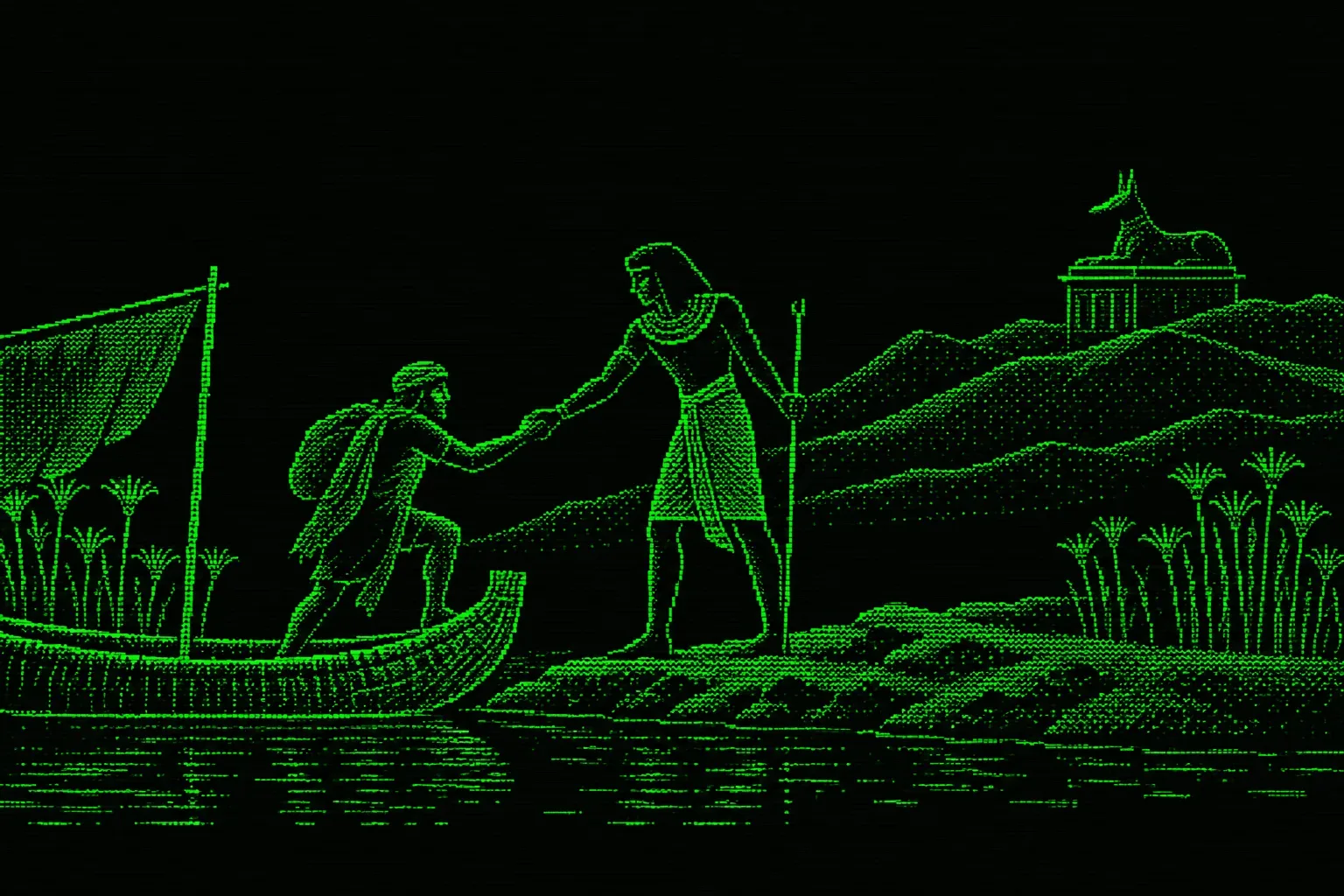
zmꜣ.n =(j) tꜣ m jw,tj mẖn,t =f
I brought to land the man who had no ferryboat.
Note · Line 19
Literally “I joined the land with him who had no ferry.” In a country whose roads were the Nile and its canals, carrying the boatless across was another classic act of charity. - 20
nḥm.n =(j) mꜣr m-ꜥ wsr
I rescued the wretched from the hand of the mighty.
- 21
rḏi̯.n =(j) ẖr,t jtj n zꜣ =f
I gave a father's share to his son.
- 22
wn.t ḏd pw jn r(m)ṯ swꜣ.y ḥr =sn
And so this is what was said by the people as they passed them by:
- 23
mk jmꜣḫ,w pw mr,y nṯr ḫru̯ =sn
"Look, here is an honoured one, beloved of the god," they say.
- 24
jnk ꜣḫ jqr ꜥpr
I am an able spirit, well equipped.
- 25
jw =(j) rḫ.k(w) ḥkꜣ nb jqr
I know every spell, and know it well.
- 26
jmꜣḫ,w (j)m(,j)-rʾ-gs-pr ẖr,j-tp-nswt Mḥw
The honoured one, overseer of the work administration, chamberlain of the king, Mehu.
Note · Line 26
Mehu is the tomb owner and the speaker of the first-person part of the text. His titles are those of a high official of the late Old Kingdom.