~/sacred-texts/old-kingdom-tomb-biographies
Debehen’s Tomb Biography: King Menkaure Builds Him a Tomb
- Date
- Carved in the 4th Dynasty, reign of Menkaure (2532–2503 BC), on the east wall of the tomb of Debehen at Giza
- Found
- Rock-cut tomb of Debehen (LG 90), Central Field, Giza, Egypt
- Language
- Old Egyptian · Hieroglyphic
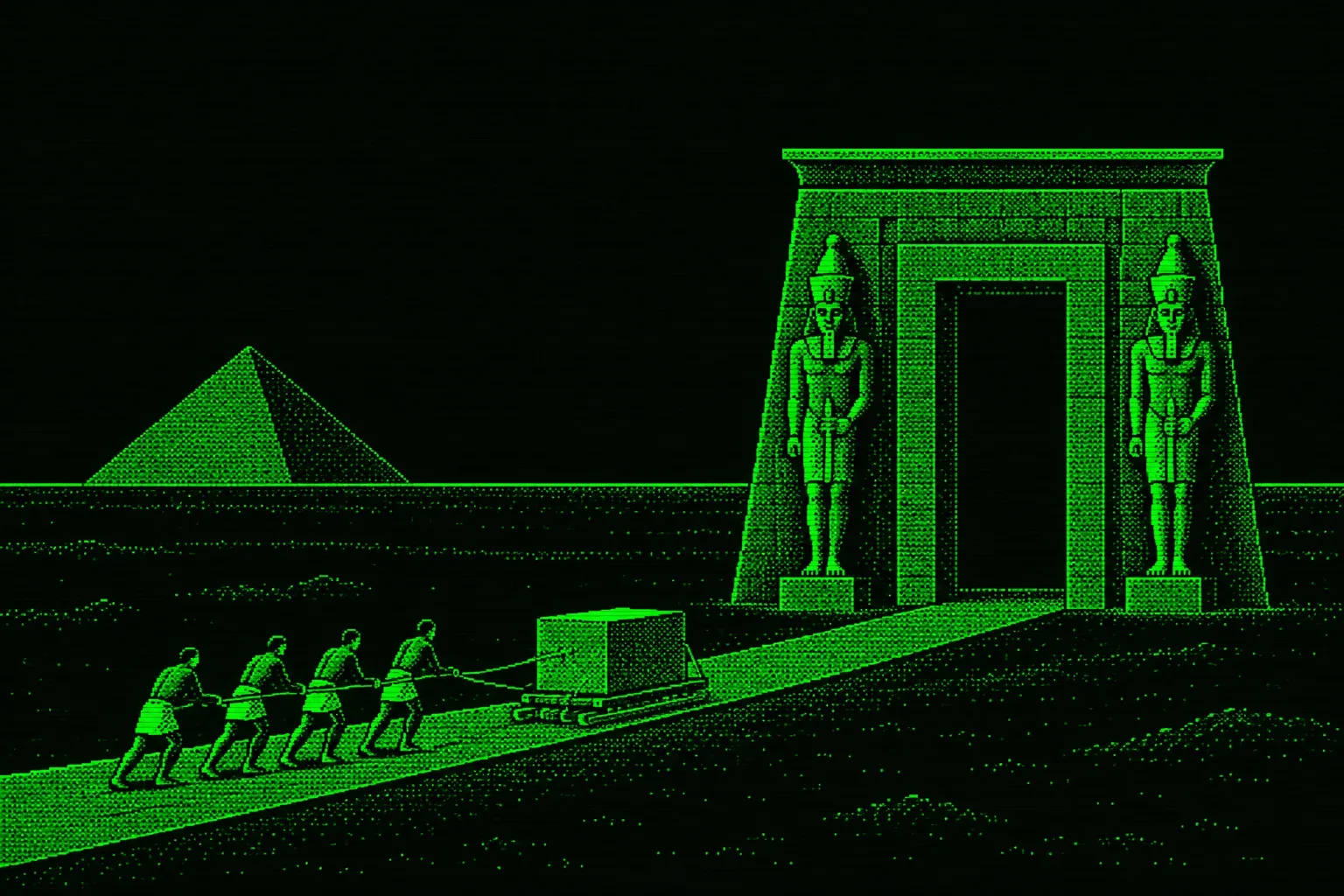
Debehen, an official buried at Giza, tells how King Menkaure went out to see the work on “Menkaure Is Divine,” his pyramid, and commissioned Debehen’s tomb. Fifty men stayed behind to work each day on the tomb and on the road to the courtyard of the embalming house. Menkaure ordered that they be called away for no other duty and had Tura limestone brought for the entrance and gateway jambs.
Debehen then lists the complex: the purification tent, statue shrine, the two statues in my keeping, which are without equal, and green eye paint, black kohl. A royal decree gives its scale: A tomb a hundred cubits long, fifty cubits wide and five cubits high.
- 1
[...] nb [...]
… lord …
- 2
ḏd =f jr jz pn
He says of this tomb:
Note · Line 2
The speaker is Debehen, the owner of the tomb at Giza. - 3
jn nswt-bj,t Mn-kꜣ,w-Rꜥw ḏi̯ ꜥnḫ ḏ,t sk ḫpr [sḏꜣ.t] ⸢ḥr⸣ wꜣ,t r-gs ḥr,j r mꜣꜣ kꜣ,t r Nṯr,j-Mn-kꜣ,w-Rꜥw ⸢jw⸣ [jri̯] mḏḥ,w-qd,w-nswt ḥnꜥ wr-ḫrp-ḥmw,t.⸢du⸣ [...] [⸮_?].pl ꜥḥꜥ ḥr =f r mꜣꜣ kꜣ,t jrr![.t] [...]
When Menkaure, king of Upper and Lower Egypt, given life forever, went along the road beside the Upper Place to see the work on “Menkaure Is Divine,” the king’s master builder and the two chief directors of craftsmen … and the craftsmen stood on the site to see the work being done …
Note · Line 3
The Upper Place is the ground on the plateau where the pyramid and its mortuary temple stood. “Menkaure Is Divine” was the pyramid’s name. - 4
[sk] wꜣḥ rmṯ 50 r jri̯.t kꜣ,t jm =f rꜥw-nb ḥnꜥ šmm,t m h,w n wꜥb,t
Fifty men stayed behind to work each day on the tomb and on the road to the courtyard of the embalming house.
- 5
wḏ ḥm =f t⸢m⸣ =⸢sn⸣ ⸢jṯi̯⸣ r wnw,t nb(.t) ḥꜣ,w jri̯.t kꜣ,t jm =f r ḥtp =f
His Majesty ordered that they be called away for no other duty, but work on the tomb to his satisfaction.
- 6
wḏ jgr ḥm =f sk jꜣ,t n(,j).t ḥꜣi̯.t sw
His Majesty also ordered that the place where he was to be mourned be swept clean.
- 7
[...] jz pn
… this tomb.
- 8
wḏ ḥm =f [...] r sk ⸢jm,w[tj]⸣ =[sn] [...]
His Majesty ordered … to sweep between them …
- 9
⸢wḏ⸣ [ḥm] =[f] jm jw ḫtm,w-nṯr.du
There His Majesty ordered the two seal-bearers of the god to come.
- 10
ḏd.⸢jn⸣ [ḥm] =[f] [...]
Then His Majesty said …
- 11
[...] r rḏi̯.t n =sn ⸢nbw⸣ ⸢n⸣ [...]
… to give them gold for …
- 12
[...] ⸢wr-ḫrp-ḥmw,t⸣
… chief director of craftsmen.
Note · Line 12
This was the title of a high priest of Ptah at Memphis. Two men could hold the office at the same time. - 13
wḏꜥ ḥm =f pẖr =f m kꜣ,t ⸢šmm,t⸣
His Majesty decided that he should make his rounds where the road was being built.
- 14
[...] m j⸢ḫ,t⸣ =f
… with his property.
- 15
jni̯.t(j) jnr m Rʾ-ꜣw r ꜥjn rʾ pr jm ḥnꜥ rw,t.du sbḫ,t r jz pn
Stone was brought from Tura to face the entrance of the building there and both jambs of the gateway to this tomb.
Note · Line 15
The quarries at Tura, across the Nile from Giza, supplied fine white limestone for such facing work. - 16
jn ⸢ꜥpr⸣-wjꜣ ḥnꜥ wr-ḫrp-ḥmw.t ḥnꜥ mḏḥ(,w)-qd(,w)-nswt jy.w [...]
It was the boat crew, together with the chief director of craftsmen and the king’s master builder, who came …
- 17
[...] [⸮_?]t n twt n,(j) ⸢šzp⸣ r ꜥnḫ ꜥꜣ ⸢r-ꜥꜣ,t⸣
… for the statue that receives, so as to live fully here.
- 18
[...] nb m ẖr(,t)-hrw
… all as daily provisions.
- 19
jw mjn ⸢ꜣb(,w)⸣ ⸢ḥr⸣ ⸢ḫꜣs⸣,t =f ḥnꜥ pr-wꜥb [...] ḥnꜥ twt.du n,(j.du) ẖr,j-ꜥ =(j) n,tj.wj wꜥi̯ =sn [...]
Today the purification tent stands on its patch of desert ground, together with the statue shrine … and the two statues in my keeping, which are without equal …
Note · Line 19
The purification tent was a place where the body was washed before burial. - 20
[...] ḥ(ꜣ)b Ḥp m nṯr,j
… the festival of Apis in the chapel.
Note · Line 20
Apis was the sacred bull worshipped at Memphis. - 21
[...] nw n [...]
… this for …
- 22
wnn jmꜣḫ =f ḫr nb =f
His provision rests with his lord.
- 23
[...] [⸮_?]t n jtj =(j) ḥnꜥ mw.t =(j)
… for my father and my mother.
- 24
ḫwi̯ =(j) n =sn [...]
For them I safeguard …
- 25
[...] wꜣḏ(,w) msdm.t ⸢⸮ꜥr,t?⸣ ⸢⸮n?⸣ [...] r-rw,t s,t
… green eye paint, black kohl, aret of … outside the place.
Note · Line 25
The green pigment was usually malachite; the black was galena, a lead ore. - 26
jḫr jgr [...] ⸮stš? m tꜣ-mḥ(,w) m ḫꜣsw,w m Jꜣ,t-mn rn =s
And further, … to travel about in Lower Egypt, in the Mountain Bull district, at a place named Iat-men.
- 27
jri̯.t(j) wḏ n nswt n (j)m(,j)-rʾ-[⸮_?] [⸮ḥnꜥ?] [⸮_?].pl r jri̯.t =f
A royal decree was issued to the overseer of … and the workmen to carry it out.
- 28
jz n 100 mḥ m ꜣw =f r 50 mḥ m sḫ,w r 5 mḥ [m] [qꜣw] [...]
A tomb a hundred cubits long, fifty cubits wide and five cubits high …
Note · Line 28
The Egyptian royal cubit was about 52 centimetres, a little over 20 inches. - 29
[...] r jri̯ jt pf sk sw ꜥnḫ
… than the one that father built while he was still alive.
- 30
rḏi̯ jgr ḥm =f [...]
His Majesty also had …