~/sacred-texts/old-kingdom-tomb-inscriptions
Tomb of Henqu: Egyptian Chief Feeds the Hungry and Jackals
- Date
- Carved in the late Old Kingdom to early First Intermediate Period (c. 2300–2150 BC) on the wall of the rock-cut tomb of Henqu at Deir el-Gebrawi
- Found
- Tomb of Henqu, Deir el-Gebrawi, Asyut Governorate, Egypt (in situ)
- Language
- Old Egyptian · Hieroglyphic
Speaking from his tomb to passersby, great chief of Atfet Henqu requests water, bread, and beer, then recites his rule alongside his brother Hem-Ra. He fed the hungry, clothed the naked, posted watchmen in ruined villages, settled people and herds on every mound, and never enslaved a daughter or took a poor woman.
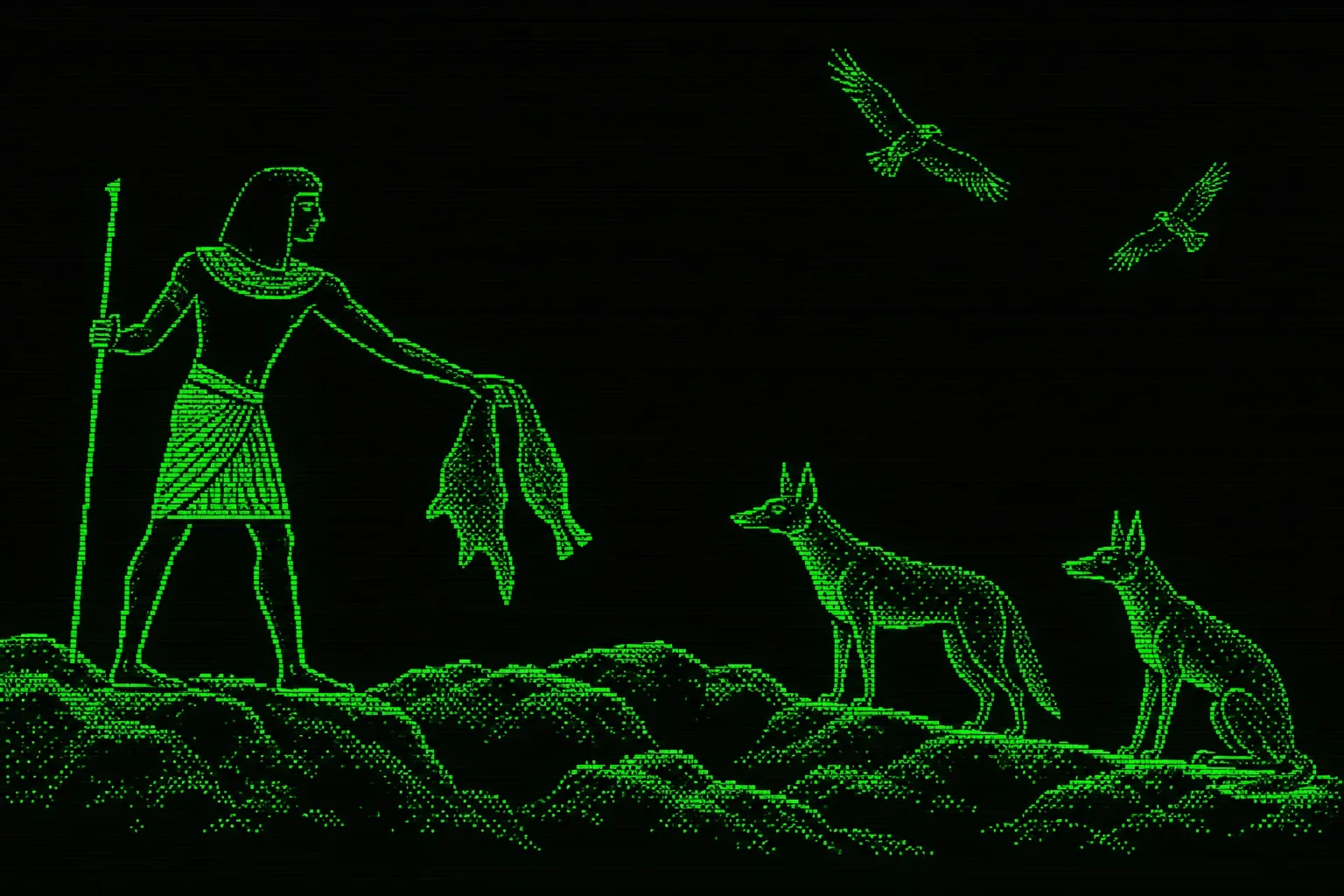
Unusually, he boasts: I also fed the jackals of the mountain and the kites of the sky their fill of hides and offal from the flocks, for I love the ba of the Strong One that dwells in them. Telling young hearers to ask their fathers, he closes as an excellent akh, well provided for in this place where I am.
- 1
j rmṯ.w nb.w n,j.w ꜣtf,t
O people of Atfet, all of you!
Note · Line 1
Atfet was the twelfth nome, or province, of Upper Egypt. - 2
⸢j⸣ ⸢ḥr,j.w-⸣[tp-ꜥꜣ] n,j.w k(y).(w)t spꜣ,t.pl swꜣi̯.tj =sn ḥr jz [pn]
O great chiefs of the other nomes who will pass by this tomb!
- 3
jnk Hnqw
I am Henqu.
Note · Line 3
Henqu speaks from his tomb to those who will visit it. - 4
ḏd =(j) nfr bnj
I speak well and sweetly.
- 5
sti̯ mw [jmi̯] ⸢tʾ⸣ ⸢ḥnq,t⸣ ⸢n⸣ jmꜣḫ,w-⸢ḫr-Mꜣtj,t-nb,t-Jꜣkm,t⸣ ⸢〈〈jmꜣḫ,w〉〉-ḫr-Nm,tj⸣[-⸮m/nb?]-pr,w-n,jw-Mꜥm n (j)r(,j)-pꜥ,t ḥꜣ,t(j)-ꜥ sm ⸢smr-wꜥ,t(j)⸣ ⸢ẖr(,j)-ḥ(ꜣ)b,t⸣ ⸢ḥr(,j)-tp-ꜥꜣ(-n)-ꜣtf,t⸣ ⸢jmꜣḫ,w-ḫr-nb≡f⸣ Hn[qw]
Pour out water and give bread and beer to the one honored by Matit, Lady of Iakemet, and honored by Nemty, who dwells in the houses of Mam—to the hereditary prince and count, sem-priest, sole companion, lector priest and great chief of Atfet, Henqu, honored by his lord.
Note · Line 5
The water, bread and beer are offerings for the dead. “Hereditary prince,” “count” and “sole companion” were court ranks. The sem-priest performed rites for the dead; the lector priest read the ritual texts aloud. - 6
⸢jnk⸣ ⸢j⸮s?⸣ ⸢jmꜣḫ,w⸣ [mr,]⸢y⸣ ⸢n⸣ ⸢jtj.pl⸣ ⸢ḥz,y⸣ ⸢n⸣ ⸢mw,t.pl⸣ ⸢qrs.w⸣ ⸢n⸣ ⸢jꜣw.pl⸣ ⸢wḥꜥ.w⸣ n ⸢zꜣ.⸮w?⸣ =⸢ṯn⸣ ⸢n⸣ ⸢qꜣs⸣ ⸢jtḥ⸣ =⸢ṯn⸣ ⸢tp⸣ ⸢mr⸣ mki̯ ṯn ⸢m⸣ [zḥ] n,j sr.pl
For I am one held in honor, loved by fathers, praised by mothers, who buried the old, who loosed for your sons the rope you hauled on the canal. I am the one who protected you in the hall of officials.
- 7
n-zp bꜣk =(j) zꜣ,t n,j.t wꜥ jm =ṯn ꜥn [...] ꜥ.w(j) =s r =(j)
Nor did I ever enslave a daughter of any of you … her two arms against me.
- 8
n rḏi̯ =(j) mḏw 10 m wꜥ [...] n(,j) [...] m bw pn n,tj w(j) jm
I did not give ten medju for a single … of … in this place where I am.
Note · Line 8
What was being counted in tens is unknown. - 9
jw =(j) rḏi̯.n =(j) tʾ ḥnq,t n ḥqr nb n,j ꜣtf,t ḥbs n ḥꜣ,y jm =s
I gave bread and beer to every hungry person in Atfet and clothing to the naked there.
- 10
jw =(j) gr mḥ.n =(j) wḏb.pl =s m jḥ.pl mḫr.pl =s m ꜥw,t.pl
I also filled its banks with cattle and its low pastures with sheep and goats.
- 11
jw =(j) gr ssꜣi̯.n =(j) w⸢nš.pl⸣ ⸢n,j.w⸣ ḏw,⸢t⸣ ḏr,t.pl n,j.(w)t p,t m ḫꜣw n,j ꜥw,t.pl j:mri̯ =(j) bꜣ qn 〈n〉,tj jm =s(n)
I also fed the jackals of the mountain and the kites of the sky their fill of hides and offal from the flocks, for I love the ba of the Strong One that dwells in them.
Note · Line 11
A ba is a being’s power to make itself present, here in the animals that come to feed. - 12
jw =(j) jri̯.n =(j) ḥr,j-tp (j)m(,j)-rʾ-jt-šmꜥ m spꜣ,t (t)n
I served as chief and as overseer of Upper Egyptian barley in this nome.
- 13
n-zp ꜥḥꜥ n =s mꜣꜥ jm r =(j) ḥr ⸢pgꜣ{,t}⸣ =j
No just man there ever stood against me on my fighting ground on behalf of the nome.
- 14
〈〈n-zp〉〉 šdi̯.y =(j) ẖn,w jtr.t zꜣ,t =f z,t n šwꜣ,t r z,t m pry,t
Never did I take away a rower of the god’s shrine, his daughter, or a woman on account of poverty as one might take a woman from the harem.
Note · Line 14
A god’s shrine could travel in procession aboard a sacred boat. - 15
jr nḫn.tj =f jm =ṯn r mdw,t tn wḥm ꜥ =k jtj =k swt ḏd =f n =k
You among my hearers who will be too young for these words, put your question again to your father. He is the one who will tell you.
- 16
jw gr grg.n =(j) nʾ,t.pl bꜣ.(wt) gbi̯(.wt) m spꜣ,t 〈〈t〉〉n m ⸮rs?.pl [n,j].w ky.(w)t spꜣ,t.pl
I also furnished the ruined and impoverished villages of this nome with watchmen from other nomes.
- 17
wn.w jw =sn n mr,w.pl =(j) jm =sn jri̯ =(j) jꜣw,t.pl =sn m sr
Those among them who belonged to my household I raised to the rank of high official.
- 18
⸢n-zp⸣ kfi̯.y =j z ḥr ẖr,t =f [s]jwi̯ =f w(j) ḥr =s n nṯr-nʾ,t(j)
Never did I strip a man of what he needed and give him cause to accuse me before the town god.
Note · Line 18
The town god was the community’s divine patron, to whom a wronged person could appeal. - 19
jnk ḏd wḥm bw-nfr
I am one who speaks what is good and speaks it again.
- 20
⸢n-zp⸣ hm(hm) =j z n wsr =j r =f sjwi̯ =f ḥr =s n nṯr
Never did I roar at a man because I was stronger than he and give him cause to complain of it before the god.
- 21
ꜥḥꜥ.n =(j) ḥm r ḥqꜣ m ꜣtf,t ḥnꜥ sn =(j) jmꜣḫ,w [s]mr-wꜥ,tj ẖr(,j)-[ḥ](ꜣ)b(,t) Ḥm-Rꜥw jmꜣḫ jmꜣḫ ⸢Hnq⸣w
Now I rose to rule in Atfet alongside my brother, the revered one, sole companion and lector priest, the honored Hem-Ra, whom Henqu honors.
- 22
ꜣḫ.n =(j) s(w) m zꜣ-pr.pl n,j.w jḥ.pl grg,t n,j.t wḥꜥ.pl
I served him well by providing cattle pens and a settlement for fowlers.
- 23
jw =(j) grg.n =(j) jꜣ,t =s nb(.t) m z.pl jḥ.pl ⸮[z]r[.pl]? ꜥw,t m bw-mꜣꜥ
In truth, I settled people on every mound in the nome and stocked each with cattle, rams and other small livestock.
Note · Line 23
The mounds offered high ground for settlement above the Nile flood. - 24
n ḏd =(j) grg jm ⸮⸢zp⸣[-2]?
I tell no lie in this, no lie.
- 25
jnk ⸢j⸮s?⸣ gr mr,y n jtj =(f) ḥ⸢z,y⸣ ⸢n⸣ ⸢mw,t⸣ =⸢f⸣ mnḫ qd jm,j n sn[.pl] =f jꜣm 〈〈jm,j〉〉 〈〈n〉〉 [⸮špss.w?] =[⸮f?]
I am also a man loved by his father, praised by his mother, of fine character among his brothers, gracious among his nobles.
- 26
jnk ḥm wꜥb.w n nṯr-nʾ,t(j) rʾ =f
I am indeed one purified for the town god and his spell.
- 27
rḏi̯ w(j) snḏ r [⸮hꜣ?]w =⸢f⸣
Fear makes me one of his kin.
- 28
⸢j⸣ ⸢mri̯⸣ =(j) ⸢wnn⸣ ⸢j[mꜣḫ]⸣ =(j) ḫ⸢r⸣ =⸢sn⸣ ⸢m⸣ ⸢b⸣w [nb] [n,tj] [wj] [jm]
Oh, how I wish to be held in honor among them wherever I am!
- 29
[...] [jnk] špss pn m rwḏ,w jwꜥ,w ḏs =[f]
… I myself am this nobleman, the heir’s deputy.
- 30
špss.kw [ḫr] [...] [⸮spꜣ,t?] tn jtj =(j) mw,t =(j) sn.w =(j) šps,w.pl =(j) špss.w [ḫr] [...] jtj.pl =[s]n
I am held in esteem by … of this nome, by my father, my mother, my brothers and my nobles, who are themselves held in esteem by … their fathers.
- 31
jnk gr ꜣḫ jqr ꜥ⸢p⸣[r.kw] [m] [bw] [p]n n,tj wj [j]m
I am also an excellent akh, well provided for in this place where I am.
Note · Line 31
The tomb owner speaks as an akh, one of the dead transfigured into a spirit with the power to help or harm the living.