~/sacred-texts/kamose-stelae
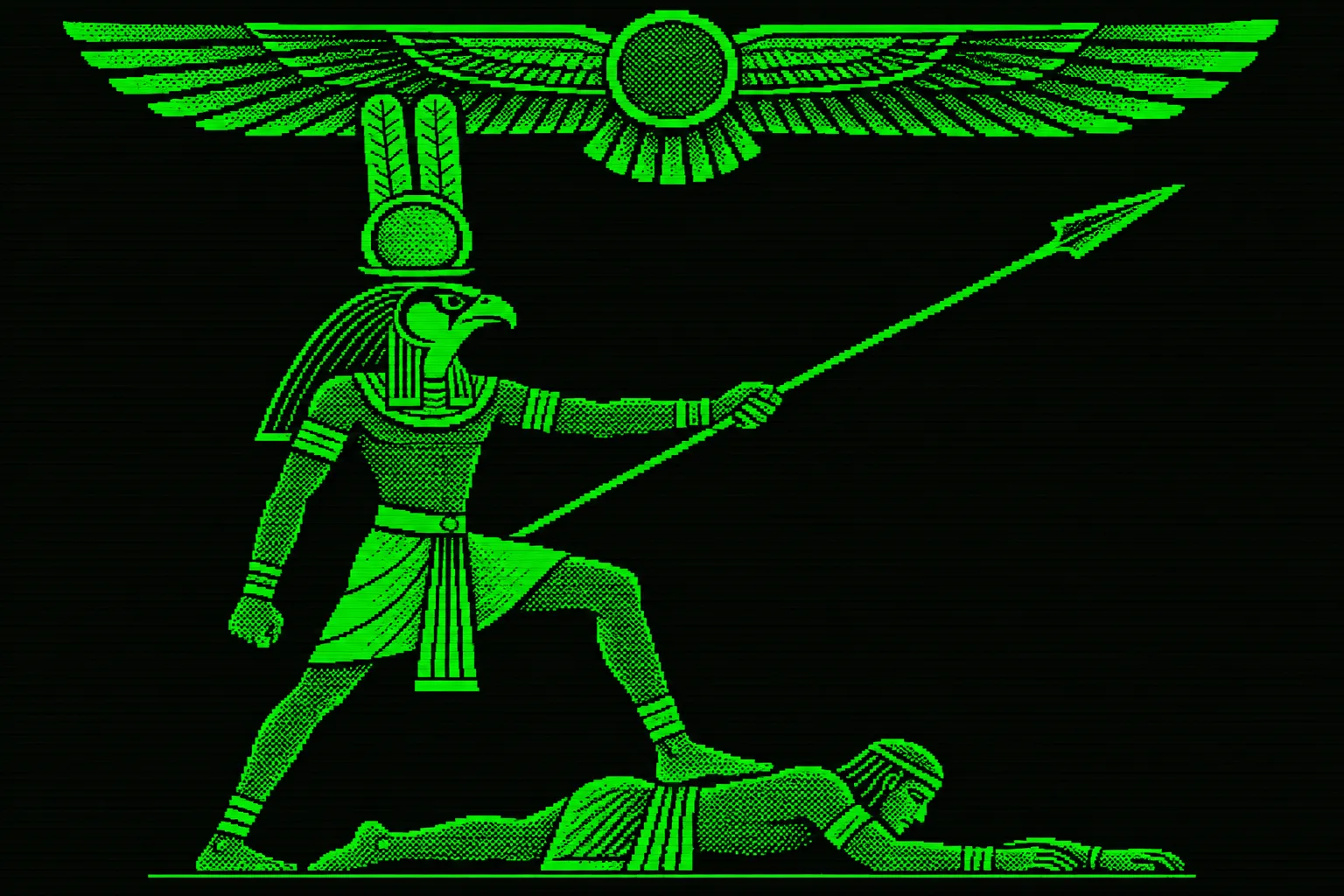
The Third Stela of Kamose: Montu, the Theban Falcon, Instilling Fear
- Date
- Carved in the reign of Kamose, last king of the 17th Dynasty (about 1555–1550 BC), for the temple of Amun at Karnak
- Found
- Found in fragments at Karnak, Thebes (Luxor), in 2004; kept at Karnak
- Language
- Middle Egyptian · Hieroglyphic
The stela is broken into scraps, and each line is a few words between gaps. It opens under the winged sun, the Behdetite, the great god, and names the king by his Two Ladies name, He who renews the monuments, the one who has brought the Two Banks low. Nubians and Asiatics follow, with Thebes between them.
Then the king speaks: I gave …, my army opened …. Montu, the Theban falcon, is instilling fear; someone is told when you tread on him, the hearts …. The end turns to the temple: copper with figures on silver for his father, gold, and a promise to the god, I make columns for you out of …
- 1
[...] Bḥd,tj nṯr-ꜥꜣ
… the Behdetite, the great god.
Note · Line 1
The Behdetite is Horus of Behdet, often shown as a winged sun disk above a royal inscription. - 2
[...] [Nb,tj] Wḥm-mn,w-m [...]
… Two Ladies: He who renews the monuments in …
Note · Line 2
The Two Ladies are Nekhbet, the vulture goddess of Upper Egypt, and Wadjet, the cobra goddess of Lower Egypt. Together they introduce one of the king’s formal names. - 3
[...] wꜥf [⸮jdb,wj?] [...]
… who has brought the Two Banks low …
Note · Line 3
The Two Banks are the banks of the Nile and stand for Egypt as a whole. - 4
[...] ___.w =sn jmn,t(j).t [...]
… their western …
- 5
[...] __,wt [...]
[gap in the text]
- 6
[...] ḥr nn-[n] [...]
… because of these …
- 7
[...] jw =f ⸮mn__? [...]
… he is …
- 8
[...] Rꜥ ḥr [...]
… Ra upon …
- 9
[...] ⸮[j]ṯꜣ? r [...]
… taken to …
- 10
[...] [nḥ]s,y [...]
… a Nubian …
Note · Line 10
Nubia lay to the south of Egypt, along the Nile. - 11
[...] Wꜣs,t [...]
… Thebes …
Note · Line 11
Thebes, in Upper Egypt, was Kamose’s royal seat. - 12
[...] r [...]
… toward …
- 13
[...] wr [...]
… great …
- 14
[...] __.pl [...]
[gap in the text]
- 15
[...] n [...]
… for …
- 16
[...] =[s]n Nḥs,y [...]
… their … Nubian …
- 17
[...] =⸮f? ⸮tp__? [...]
… his …
- 18
[...] nṯr,t ⸮n(,j).t? ⸮jri̯.n? [...]
… the goddess who made …
- 19
[...] q__ [...]
[gap in the text]
- 20
[...] ⸮[ꜥꜣm].w.pl? [...]
… Asiatics …
Note · Line 20
The Egyptian term refers to people from western Asia, especially the Levant. - 21
[...] Nḥs,j [...]
… a Nubian …
- 22
[...] ⸮tꜣ? ⸮n(n)? ꜥꜣm.w.pl [...]
… land, no Asiatics …
- 23
[...] =sn ⸮m? [...]
… their … in …
- 24
[...] Rꜥ
… Ra.
- 25
jst rf [...]
Now then, …
- 26
[...] __t,t ⸮n? ⸮pꜣ? [...]
… for the …
- 27
[...] sḫr [...]
… bring down …
- 28
[...] =⸮j? [...] jb =sn [...]
… my … their heart …
- 29
[...] wn [...]
… be …
- 30
[...] ⸮psš? [...] r =f [...]
… divide … to him …
- 31
[...] pw [...]
… it is …
Note · Line 31
Only fragments of this part of King Kamose’s inscription survive. - 32
[...] m [...]
… in …
- 33
[...] ⸮mꜣj? [...] ⸮jrr? [...] ⸮nfr? [...]
… a lion … who makes … good …
- 34
[...] n ⸮th[m]? [...]
… for piercing …
- 35
[...] m J__ [...]
… from I…
- 36
[...] rš =w(j) [...] ⸮__.tjw? jm =f [...]
… how the … rejoice in him! …
- 37
[...] ḫnd =k ḥr =f ⸮ḥꜣ,t(j).w? [...]
… when you tread on him, the hearts …
- 38
[...] =f n zꜣ =f Ḏḥw,tj kꜣ Ḫmn,w [...]
… his … for his son Thoth, the bull of Hermopolis …
Note · Line 38
Hermopolis was Thoth’s chief place of worship. The bull is a title of the god himself. - 39
[...] Mnṯ,w bjk wꜣs,tj ḥr wdi̯.t ⸮šꜥ[,t]? [...]
… Montu, the Theban falcon, is instilling fear …
Note · Line 39
Montu was a war god of the Theban region, often shown with a falcon’s head. - 40
[...] ḥꜣ,(w)tj jm,j-rʾ-smr.w.pl
… the foremost, overseer of the courtiers.
Note · Line 40
The courtiers in this title are literally the king’s “companions.” - 41
ḏi̯.n =j [...]
I gave …
- 42
[...] ⸮wn.n? ⸮mšꜥ? =⸮j? [...]
… my army opened …
- 43
[...] Rꜥ [...] ḥwi̯ [...]
… Ra … who strikes …
- 44
[...] bjꜣ m ẖp,w.pl ḥr ḥḏ n jt =f [...]
… copper with figures on silver for his father …
- 45
[...] nbw
… gold.
- 46
jri̯ =〈j〉 n =k wḫꜣ.w.pl m [...]
I make columns for you out of …
- 47
[...] jb.pl =sn [...]
… their hearts …
- 48
[...] __.w.pl m [...]
… of …