~/sacred-texts/middle-kingdom-tales
The Sporting King: Take This Red Harpoon Shaft of Yours
- Date
- Composed in the 12th Dynasty (about 1900–1800 BC); copied at the end of the 18th Dynasty (about 1330–1300 BC) on a papyrus roll
- Found
- Findspot unknown; bought in Egypt by Vladimir Golenishchev, now in the Pushkin State Museum of Fine Arts, Moscow
- Language
- Middle Egyptian · Hieratic
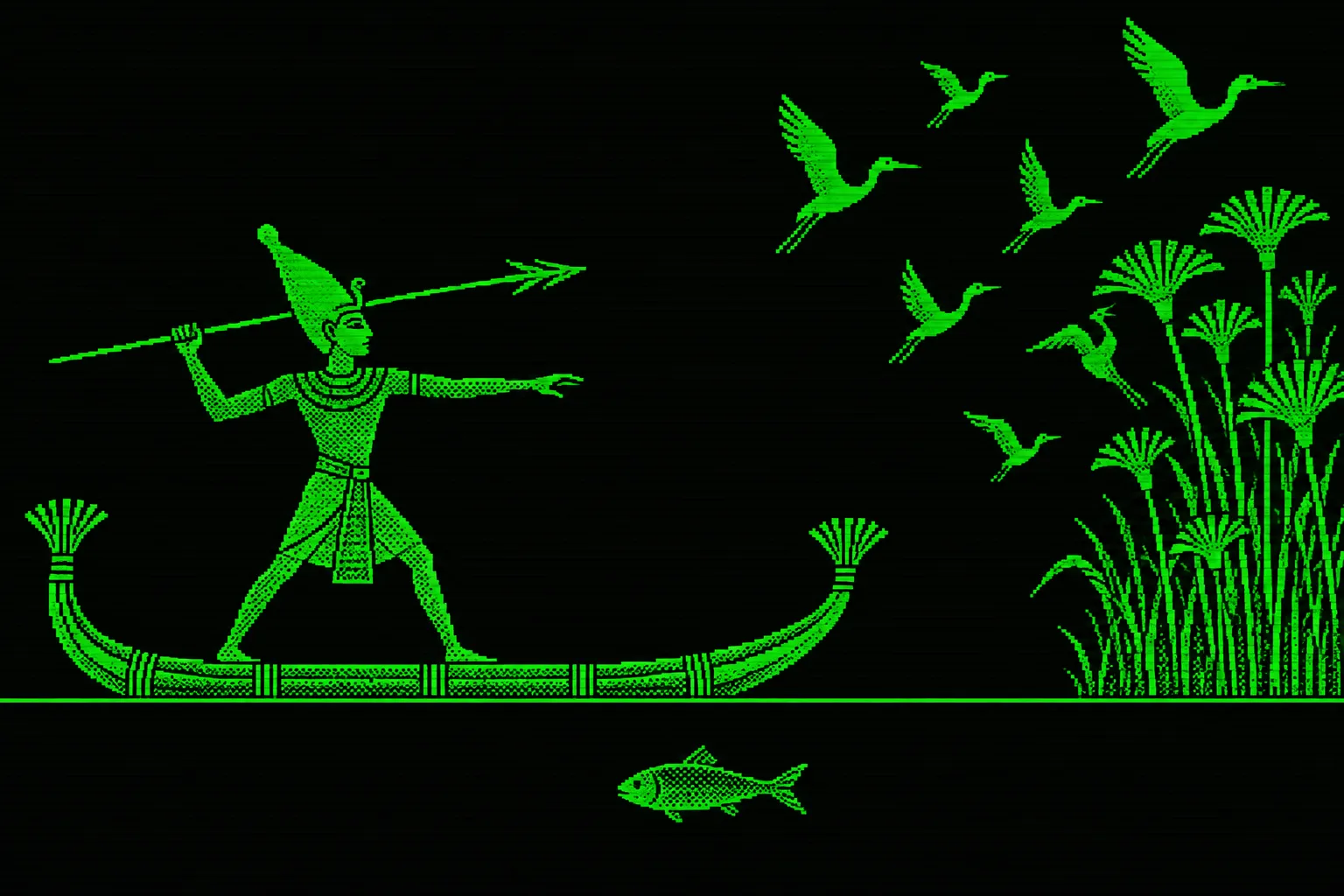
The papyrus is in shreds, and the tale survives as broken phrases. The seal-bearer Sehetepibreankh tells the king what he has seen: I have seen birds feeding. The court tells the king Your business is in the cool marshland, and he sails to the palace of the Fayum while The king’s children were shouting for joy.
At the foot of the throne the scribe hands him his weapon: Take this red harpoon shaft of yours, ruddy in hue. A long chain of likenesses follows: the shaft is like red ochre for the bodies of the gods. Then the hunt: The greylag geese weigh heavy on both arms. The king’s own name is the Fowler and Fisher.
- 1
[...] ⸮[ḥm]? [...]
… Majesty …
- 2
[...] [___]w.pl [...]
… people …
- 3
[...] jn šps.w.pl =f jpn
… by these nobles of his.
- 4
ḫtm,w-bj,t(j) zẖꜣ-(j)r,(j)-ꜥ-n-nsw-n-ḫft-ḥr Sḥtp-jb-Rꜥ-[ꜥnḫ] [ḏd] =f
The seal-bearer of the King of Lower Egypt, the scribe in charge of the king’s documents in the royal presence, Sehetepibreankh, says:
- 5
jw mꜣꜣ.n =j jty ꜥnḫ-(w)ḏꜣ-s(nb) nb =j
I have seen it, O sovereign—life, prosperity, and health!—my lord.
Note · Line 5
The threefold wish is a blessing spoken at the mention of the king. - 6
ḏd.jn ḥm =f ꜥnḫ-(w)ḏꜣ-s(nb)
Then His Majesty—life, prosperity, and health!—said:
- 7
mj-zj-jšst [pw] [ḏd] =[k] [mꜣꜣ].n =k st
What is it like, this thing you say you saw?
- 8
ḏd.jn zẖꜣ-(j)r,(j)-ꜥ-n-nsw-n-ḫft-ḥr
Then the scribe in charge of the king’s documents in the royal presence said:
- 9
[jw] [mꜣ]ꜣ.n =j wnm ꜣpd.pl
I have seen birds feeding.
- 10
⸢sf⸣[_] [snm] tp-ꜥ ṯꜣw wr{t}
… torrents of rain before a mighty wind.
- 11
p,t [...] ḥ(w),yt ꜥꜣ.t
The sky … heavy rain.
- 12
[...] ꜣpd.pl mj hꜣw [...] [___].n =f [...]
… birds, as in the days of … he has …
- 13
[jw] ⸢sḏm⸣.n =j ḫrw tꜣ[_] [...] n.w Wꜣḏ-[⸮wr?] [...] [__]w m Ḥꜣw-nb,wt [...]
I have heard the voice of … of the Great Green … among the islanders …
- 14
[jw] mꜣꜣ.n =j wn[m] [ꜣpd.pl] [...] ⸢nḥ⸣sj
I have seen birds feeding … a Nubian;
- 15
⸮mj? [...] n.t mw wsr.w [...]
like … of the mighty waters …
- 16
[...] m ẖꜣ,wt Tꜣ-mḥ,w [...]
… in the lagoons of Lower Egypt …
- 17
[...] ḥr-gs.wj jꜣd,t =k
… on both sides of your net.
- 18
jw =s mj [...] ẖkr [...]
It is like … adorned …
Note · Line 18
Four or five lines are lost here. - 19
[...] jw rḫ,yt m pr-sḏ,t
… the common people are in the House of Fire.
Note · Line 19
The lapwing was an emblem of the king’s subjects and stands for them here. - 20
[...] 〈Ḫnsꜣ,t〉 〈ḥtm.tj〉 m ⸢spd⸣ [...] ẖkr.pl
… Khensit is arrayed in … ornaments.
Note · Line 20
Khensit is a goddess of the eastern Nile Delta. - 21
mꜣtjr,yt.pl n,t⸮jw? [...]
The mourning women who …
- 22
[...] r-tnw{t}
… where to?
- 23
j⸢w⸣ [...] [jp] bj,t mr.pl [...] Sḫꜣ,t-[⸮Ḥr?] [...] [__].w tp.pl šzp [...] sw šb[_] [...]
… Bit counts the bulls … Sekhat-Hor … of heads, receiving … him …
Note · Line 23
Bit is the goddess of the crown of Lower Egypt; Sekhat-Hor is a cow goddess. - 24
[...] [___] =k m jꜣ⸢d,t⸣ =⸢k⸣
… your … in your net.
- 25
[...] [ḫ]nt,t sḫ[m] [...]
… the entrance hall of the sanctuary …
- 26
[...] [Nb,t].du ⸢Wḥꜥ⸣
… He of the Two Ladies, the Fowler and Fisher.
Note · Line 26
“Fowler and Fisher” is the king’s Two Ladies name. The Two Ladies are Nekhbet and Wadjet, the vulture and cobra goddesses of Upper and Lower Egypt. - 27
ḫnt,t [sḫm] [...]
The entrance hall of the sanctuary …
- 28
[...] n bj,t m sꜥḥ js,wt [...]
… of Bit, as a noble of the crew …
- 29
[...] [⸮jty?] ꜥnḫ-(w)ḏꜣ-s(nb) nb =n
… O sovereign—life, prosperity, and health!—our lord!
- 30
⸢ḫr⸣,t =k m šꜣ qb[_] [...]
Your business is in the cool marshland …
- 31
[...] ⸮dmḏ? m ḏ,t
… united for ever.
- 32
[...] m jn,w [...]
… as a gift …
- 33
[...] ḥm,t.pl
… the women.
- 34
ms,w.pl-nsw ḥr jhhy šzp [...]
The king’s children were shouting for joy as they received …
- 35
[...] wḏꜣ m ḥtp [...] ⸮m? sjn,t n.t s[ꜣb.t] [zš]
… went in peace … in a swift paddleboat for crossing the marsh.
- 36
[...] mꜣꜥ [...] tꜣ m ꜥḥ Tꜣ-š sꜣq.w [___] ⸢ms,w.pl⸣-[nsw]
… the bank … land at the palace of the Land of the Lake, as … the king’s children were gathered together.
Note · Line 36
The Land of the Lake is the Fayum. - 37
mdw.pl [...] tp-rd.wj.du s,t
Words … at the foot of the throne.
- 38
ḫtm,w-bj,t(j) zẖꜣ-(j)r,(j)-ꜥ-n-nsw-n-ḫft-ḥr Sḥtp-jb-Rꜥ-ꜥnḫ [ḏd] =[f] [n] [nb] =f
Sehetepibreankh, seal-bearer of the king of Lower Egypt and scribe entrusted with the king’s documents in his presence, said to his lord:
- 39
m(j) n =k mꜣw,t =k twy dšr.t tjms.t jrtjw [...] [ḥm] =k ꜥnḫ-(w)ḏꜣ-s(nb)
Take this red harpoon shaft of yours, ruddy in hue. … Your Majesty—life, prosperity, health!
Note · Line 39
The three wishes are a blessing spoken at the mention of the king. The praise that follows is addressed to him but describes his harpoon shaft. - 40
stp =s zꜣ =s r =k
May it spread its protection over you.
- 41
jw =s mj N,t [...] N,t ḏi̯.w ḫꜥ.w =s šzp.n [...] [ḫ]ꜣs jm,j P ḫꜣs jm,j Dpw
It is like the Red Crown … Neith, when she was made to appear, when … received the coil in Pe and the coil in Dep;
Note · Line 41
The Red Crown of Lower Egypt has a coil rising from its front. Neith wears this crown. Pe and Dep were the two towns that made up Buto. - 42
mj {{ḥꜣ}} ((ḥꜣ.du)) ḫt n Gbt,y
like the two horns on the pole of the god of Coptos;
Note · Line 42
The god of Coptos is Min. - 43
mj [...] [__]p jr,(j)t-šnb,t =f
like … his breast ornament;
- 44
mj ꜣḫ,tj ḏi̯ =f sw m dwꜣ,yt n ḥtm [...] bꜣq.t [...]
like the god of the horizon when he shows himself at dawn, when … does not perish … bright …
- 45
⸢mj⸣ [...] ḫꜥi̯ [...]
like … rising …
- 46
[...] ⸮m? ⸢pr⸣-nzr hrw.pl [___],t
… in the House of Flame on the days of …
Note · Line 46
The House of Flame was a sanctuary at Buto. - 47
[...] [pẖ]r ms,w.pl-nsw hrw [...]
… the king’s children go round on the day of …
- 48
[jw] =[s] [mj] mnw m ḥrs,t ḫnt.t-[___] [...] ⸮ḏbꜥ.pl? [...] ⸮30000? n.w [...]
It is like quartz and the carnelian of Khent-… fingers … thirty thousand of …
- 49
mj ẖn,t m ḥw,t-pꜥ,t zmꜣ n =s sḫm Tp,j-ḏw
like the hide in the House of the Nobles, when the power of Him upon the Hill unites with it;
Note · Line 49
“He upon the Hill” is Anubis, the god who watches over the dead. - 50
mj šps m [...] m jmw =f sbt =f m tmꜣm,t =f
like shepes-fruit in … in his lament, as he laughs on his mat;
- 51
mj ẖn{t}k,〈t〉 [...] psḏ,w n.w mꜣtjr,yt.pl
like the khenket garment … on the backs of the mourning women;
- 52
mj mꜣs.w.pl m ḥtrj [...] pẖr =f jnb Jṯi̯,w
like the red mas-beasts in harness … when he circles the wall of Itjtawy;
Note · Line 52
Itjtawy was a royal capital near modern Lisht. - 53
mj jwn [...] [wr]⸢ḥ⸣.yw m rʾ ntr,yt
like the pillar … those whose mouths are anointed with natron;
Note · Line 53
Natron is a naturally occurring mineral salt used in ritual cleansing. - 54
mj šmꜣm.w.[pl] [...] [n]bꜣ.w.pl ẖr ⸮qs-msḥ?
like the wanderers … horns filled with “crocodile bone”;
Note · Line 54
“Crocodile bone” appears to be the name of a substance; its identity is unknown. - 55
mj mr s[__] [...] hrw.pl jp bj,t mr.pl
like the canal … on the days when Bit counts the bulls;
- 56
mj ṯꜣw m ḥꜥ.pl wꜣ[_] [...] [ꜥn]tjw 〈ḥr〉 sḏ,t tp,(j)-nw,y
like breath in the limbs … myrrh on the fire at the feast of the first floodwaters;
Note · Line 56
The feast marked the beginning of the Nile’s annual rise. - 57
mj jm,j-ꜥ m sḫ,t [...] [___],t
like the attendant in the field …
- 58
jw =s mj mꜣmꜣ.w.pl m ḫnt,(j) sḫm [...] jr,w =sn
It is like the doum palms in the entrance hall of the sanctuary … their companions;
- 59
mj jb[ḥ] qs[_] [...]
like the tooth … of a foreigner …
- 60
jw =s mj mw ⸢jm,j⸣ [...] ḥḏi̯ [...]
It is like the water in … destroy …
- 61
⸢mj⸣ [...]
like …
Note · Line 61
The shaft of a harpoon is being compared to something now lost. - 62
[...] rḫ [...]
… know …
- 63
[...] Nb.du [...]
… the Two Lords …
Note · Line 63
The Two Lords are Horus and Seth. - 64
[...] [sdg]ꜣ.t.n nsw s[__] [...]
… what the king hid …
- 65
[...] zmꜣ,yt Ḥr [...]
… the companion of Horus …
- 66
[...] Nfr-ḥr nw[_] [...]
… the Fair of Face …
- 67
[...] =s ḥtr [...]
… her wooden …
- 68
[...] jp.t.n [...]
… what … counted …
- 69
[...] nw,t =s [...]
… her cord …
- 70
[...] ḫꜥ,w [...]
… appearances …
- 71
[...] [hꜣ]b.n =k sj m-ꜥ =k [...]
… you sent it from your hand …
- 72
[...] Rꜥ ḏi̯.n [...]
… Ra. … gave …
- 73
[...] [___] =f [___] =k [___] [⸮jw?] =s mꜣꜣ [...]
… he … you … she sees …
- 74
[...] 〈wḏi̯〉 ẖn,t nsw m ꜥꜥ =f
… the rowers cast off, the king aboard his aa-boat.
- 75
stp-zꜣ [...]
The palace …
- 76
[...] dšr.w.pl psḥ =f šn(j) =f
… red tilapia, as he chews his fish scraps.
- 77
nwḥ.w.pl [...] [___] =f s[tꜣ]w jr,j
The ropes … he … the hauling of them.
- 78
ḫsr.n [...]
… drove off …
- 79
⸢ꜥn⸣w.n ⸢wḥꜥ,w⸣.pl [...]
The fishers and fowlers turned back …
- 80
[...] wr.t
… greatly.
- 81
⸮ḥ(w)i̯?.n =s tp.pl =[⸮sn?] ⸢m⸣ ⸢ꜥ.pl⸣ =⸢s⸣
She struck their heads with her washbowls.
- 82
⸢ḏ⸣d [...]
… say …
- 83
[...] [sj]p.tw s,t =k tn nrj rj n.t [...]
… this throne of yours is examined at the appointed times of …
- 84
jw ḥr =k n =n m ḥḥ pn n ḥb-sd [...]
Your face is turned toward us through this million Sed festivals …
Note · Line 84
The Sed festival was a jubilee at which the king renewed his power to rule. - 85
[m] =k jb =k r nw [⸮n?] nsw n ḏd =s
Look, your heart is set on the time of the king she spoke of.
- 86
wdi̯ mꜣw,t.pl ḥr mh[ꜣ]n.pl =sn
Lay the harpoon shafts on their boxes.
- 87
sqd,wt [...] tꜣ m ꜥḥ Tꜣ-š
The voyage … land at the palace of the Fayum.
Note · Line 87
The Egyptian name for the Fayum means “Land of the Lake.” - 88
m-ḫt-nn snm.t [...] ꜥ n Nb,t.du ⸢Wḥꜥ⸣
After that, a meal … the arm of the king whose Two Ladies name is Fisher and Fowler.
- 89
m(j) n =[k] [...] jrtjw m [...] ⸮Kꜣ? [...]
Take for yourself … color in … the Bull …
- 90
[...] [_]mw.pl n.w nḥꜣ swnnw
… buildings of the dangerous waters of the fishpond.
- 91
mj kꜣꜣ gn.w [...] šn,w
like quartz for bowl stands … cartouche amulets;
Note · Line 91
A cartouche is the oval that encloses a royal name. The amulets have that shape. - 92
mj mnj r ḥꜥ.pl nṯr.pl
like red ochre for the bodies of the gods;
- 93
mj bwꜣ,t bꜣ⸢q⸣ [...] hrw.pl ṯꜣm.w.pl wḏꜣ,t
like a marsh thicket … on the days when the Eye of Horus is wrapped.
Note · Line 93
The eye was injured and made whole again; its Egyptian name, Wedjat, means “the sound eye.” - 94
jw =s mj gm[_] [...] ꜣbd.w.pl rsfj [...] [ḏr]ww [...]
It is like … in the months of fowling and fishing. … flanks …
- 95
[...] ⸢fn⸣d.w.pl ḫd[_] [...]
… noses …
- 96
[...] ꜥḥ n ḥw,t-nbw
… the palace of the House of Gold.
Note · Line 96
The House of Gold is a place name here; its location is unknown. - 97
[...] sḫm ẖr-s,t-ḥr Wr,t-[ḥkꜣ],w qn.t(j) r ḫwi̯.[t] [...]
… of the sanctuary in Werethekau’s keeping, completed to protect …
Note · Line 97
Werethekau’s name means “Great of Magic.” - 98
[...] Rs,j-jnb≡f
… He Who Is South of His Wall.
Note · Line 98
This is a title of Ptah at Memphis. - 99
Sšꜣ,t nn ḫꜥi̯.tj r =s r-rw.tj-⸢n⸣ [...]
This is Seshat. She has come forth in procession to it, outside …
Note · Line 99
Seshat is the goddess of writing and measurement. The procession seems to be heading for a shrine. - 100
[...] ꜣ jm.w.pl =s
… indeed, her im-birds.
Note · Line 100
The bird’s name means “mourner.” - 101
šbn.n =s Jr Sḏm,j ḏi̯ =f ḫꜥi̯ [...]
Once she had joined Sight and Hearing, he made … appear.
Note · Line 101
Sight and Hearing are the gods Ir and Sedjem. - 102
[...] ꜣpd.w.pl Tꜣ-š r ḫḏw jm,(j).w qb[ḥ,w] [...]
… the birds of the Fayum compared with the waterfowl in the marshes …
- 103
[...] [Šsm],w nwd,tj m mrwḥ,t ẖr,{t}-ꜥ =f
… Shesmu, the maker of ointments, with the oils in his charge.
- 104
sḏꜣ.t [...] snsn.yt m pr-wr sẖkr.t.n wrḥ,w{ꜥw} [...]
to go … she who joins the others in the Per-wer shrine, whom the anointer adorned …
Note · Line 104
The Per-wer, or “Great House,” was the traditional shrine of Upper Egypt at Elkab. - 105
[...] mḏꜣ,t.pl =s r šn,w n.w jꜣd,t =k tn
… her wooden pegs for the cords of this net of yours.
- 106
ḏi̯ =s šs =⸢s⸣ [...]
May she give her rope …
- 107
[...] [⸮ṯꜣ?]m,w ḥḏ.t nw,t n.t Rnn-wtt ẖr,{t}-ꜥ [...]
… wrappings and white linen, the cloth of Renenutet, in the keeping of …
- 108
[...] ⸮zꜣ? Jdḥ,y bꜣnn,t [...]
… the son of the Delta god …
Note · Line 108
This Delta god takes the form of a crocodile. - 109
[...] Sšꜣ,t sḥḏ.t n fḫ.t [...]
… and Seshat, who gives light to what has perished …
- 110
[...] bj,t wjꜣ.t n [...]
… Bit, set apart from …
- 111
[...] grg m jꜣd,t =k tn
… caught in this net of yours.
- 112
[...] nmt,t rʾ-ꜥ.wj.du rḫt,j [...]
… the washerman’s steps and the work of his two hands …
- 113
[...] r smn.t rʾ (m)ꜥḥꜥ,w [...]
… to secure the mouth of the tomb …
- 114
[...] [⸮wḥꜥ?].pl =k r ḏd sft [...]
… your fowlers and fishers, to say, “Slaughter …”
- 115
[...] r ms.w ẖ,t ꜣpd.pl =s tj[_] [...]
… compared with what the bellies of her birds bring forth …
- 116
[...] _h [...] r [...] [___].pl [...] ꜥr,tjw [...]
… building at … people who climb …
- 117
[...] r sḫ,t m sjn,t n.t sꜣb.t zš
… to the field in a swift paddleboat for crossing the marsh.
- 118
ḏi̯ r [tꜣ] [...]
It was put ashore …
- 119
[...] [q]ꜣ n ḫrw sšm,w.pl =sn
… the loud voices of their leaders.
- 120
tp-nfr mnj [...]
The landing is a good beginning …
- 121
[...] ḥtj m jr,t n.t ḥḏ ꜣpd.pl
… smoke in the eye of the chapel of the birds.
- 122
ḏd-mdw jn ẖr,[j-⸮ḥꜣb,t?] [...]
Words to be spoken by the lector priest: …
Note · Line 122
A lector priest read the ritual words aloud. - 123
[...] [___] =f ḫꜣwj m tjr,wt.pl wbꜣ,y[t] [...]
… he … among the willows of the forecourt …
- 124
[...] ⸢hꜣ,w⸣ ⸢m⸣ [...]
… wildfowl in …
- 125
s[__] [...] šnt [...] =⸮s? wnw,t.pl w[__] [...]
… she … the hours …
- 126
[...] ꜥ-rsj n mꜣnw
… the southern part of the western mountains.
Note · Line 126
The western mountains marked the place where the sun set and entered the realm of the dead. - 127
pẖr [...] ⸢jꜣb,t⸣ p,t rwd.tj [...]
To roam … in the east of the sky, while the sky stands firm …
- 128
[...] [___].⸢wj⸣ ⸢sj⸣
How … she is!
- 129
špssj =s wr,[t] ⸢ḥr(,j)-jb⸣ [...] sj
She is exalted, the Great One who dwells in …
- 130
grg.n =f hrw.pl [...] ḥr-ꜥ.wj
He has set the days in order … at once.
- 131
sqd,wt ꜥḥꜥ,w [...]
The voyage of the ship …
- 132
[...] [__]nw Nbw-kꜣ.pl-Rꜥ [...]
… the monuments of Nubkaure …
Note · Line 132
Nubkaure was the throne name of Amenemhat II. - 133
[...] ⸢ḥtp,w⸣ m-ẖnw kꜣp [...]
… at rest inside the shelter …
- 134
[...] [__]m m s,t Tꜣ-š rs.tj ẖr =s r 〈n〉{b}ḫ〈b〉,w =sn
… on the throne of the Lake Land, she keeps watch on its account, as their ordinances prescribe.
Note · Line 134
The Lake Land was the Faiyum, the lake basin west of the Nile. - 135
mꜣ [...] ꜥn,t.pl mꜣj[.w.pl]
To see … the claws of lions.
- 136
[s]ḫpr.n =s ꜣpd.pl n mrw
She brought the birds of the canal into being.
- 137
ꜥpr [...] [w]bꜣy,t [...] n tp tp.pl ((ḥr)) =s
To equip … the forecourt … on the heads, on her account.
- 138
sḫpr.n =s ꜣpd.pl [...]
She brought the birds … into being.
- 139
mꜣꜣ ⸢jr,t⸣ [...]
The eye sees …
- 140
sḥḏ wr r rw,t[j] [...]
The Great One at the double gate lights up …
- 141
wnm,w ꜣpd.pl h[__]
Food for the birds …
- 142
[...] ⸢ḫr⸣ [...] m ꜥ.pl =k
… fall … by your wooden sticks.
Note · Line 142
In Egyptian marsh hunts, fowlers hurled curved wooden sticks at birds in flight. - 143
šnj,t [...] [ḏ]ꜥ n ꜣpd.pl [...]
A hailstorm … a gale of birds …
- 144
[w]dn rʾ.pl ḥr ꜥ.[wj] [...]
The greylag geese weigh heavy on both arms …
- 145
[...] rḏi̯.t sḫt [...]
… she who has … caught in a net.
- 146
[...] sj m ꜥ =k wnm,j [...]
… her in your right hand …
- 147
[...] Wntj sd [...]
… Wenti, clad in …
Note · Line 147
Wenti means “the Conqueror,” a name borne by more than one god. - 148
[...] mꜣꜣ.n =k Sḫ,t jw =s ḥr tp =k [...]
… you saw Sekhet when she was on your head …
Note · Line 148
Sekhet was the goddess of the fields and marshes, where people fished and caught wildfowl. - 149
[...] [ḥ]bꜣ.w =s sjp =s n =k ḫnt,jw [...]
… her heba-fish. She allots you the southern lands …
Note · Line 149
The species of fish called heba is unknown. - 150
[...] [sjꜥr] mr.pl
… to offer bulls.
- 151
hꜣw nfr n mꜣw,t =k [...]
Good fortune to your harpoon shaft! …
- 152
[...] [ḏd].jn smr pn
… Then this courtier said:
- 153
m =k sj r ꜥfꜣ [...]
“Look, she is near the camp …”
- 154
[...] r(m)ṯ.pl n.w ⸢tꜣ⸣ [...]
… the people of the land …
- 155
[...] rnwy.pl =f
… his bull calves.
- 156
ḏd.jn [...]
Then … said:
- 157
[...] bj,t wḥꜥ,w [...]
… Bit … the fishers and fowlers …
- 158
[...] ꜣḥ,t.pl pẖr.n [...]
… the fields; … went about …
- 159
[...] [šnj],t j[w] [...]
… a hailstorm …
Note · Line 159
The hailstorm may be an image for a sudden rush of birds. - 160
[...] [___] =f jw swꜣḥ [...]
… his …; … makes … last.
- 161
[...] nb-p,t [...]
… the Lord of the Sky …
- 162
[...] jr,w [...]
… form …
- 163
[...] [Sfḫ],t-ꜥb.du nb,t-nr,w [...]
… Sefkhet-abwy, Mistress of Terror …
Note · Line 163
Her name means “She who loosens the two horns.” - 164
[...] [š]⸢m⸣ =s rʾ =s ḫft wḏ [...]
… she acts on her word, in keeping with the command …
- 165
[...] ⸮fꜣi̯? [...] ꜣṯp tꜣ[š] [...]
… lift … load … boundary …
- 166
[...] mj šm [...]
… as … goes …