~/sacred-texts/ptolemaic-and-roman-temple-inscriptions
Abaton of Osiris at Bigeh: His Voice Is Heard, but He Is Not Seen
- Date
- Carved under Ptolemy XII (80–51 BC) in the columned hall and under Augustus (30 BC–AD 14) on the gateway of the temple of Osiris on Bigeh
- Found
- Bigeh island at the First Cataract, opposite Philae, south of Aswan; the ruined temple still stands on the island
- Language
- Egyptian (Ptolemaic hieroglyphic) · Hieroglyphic
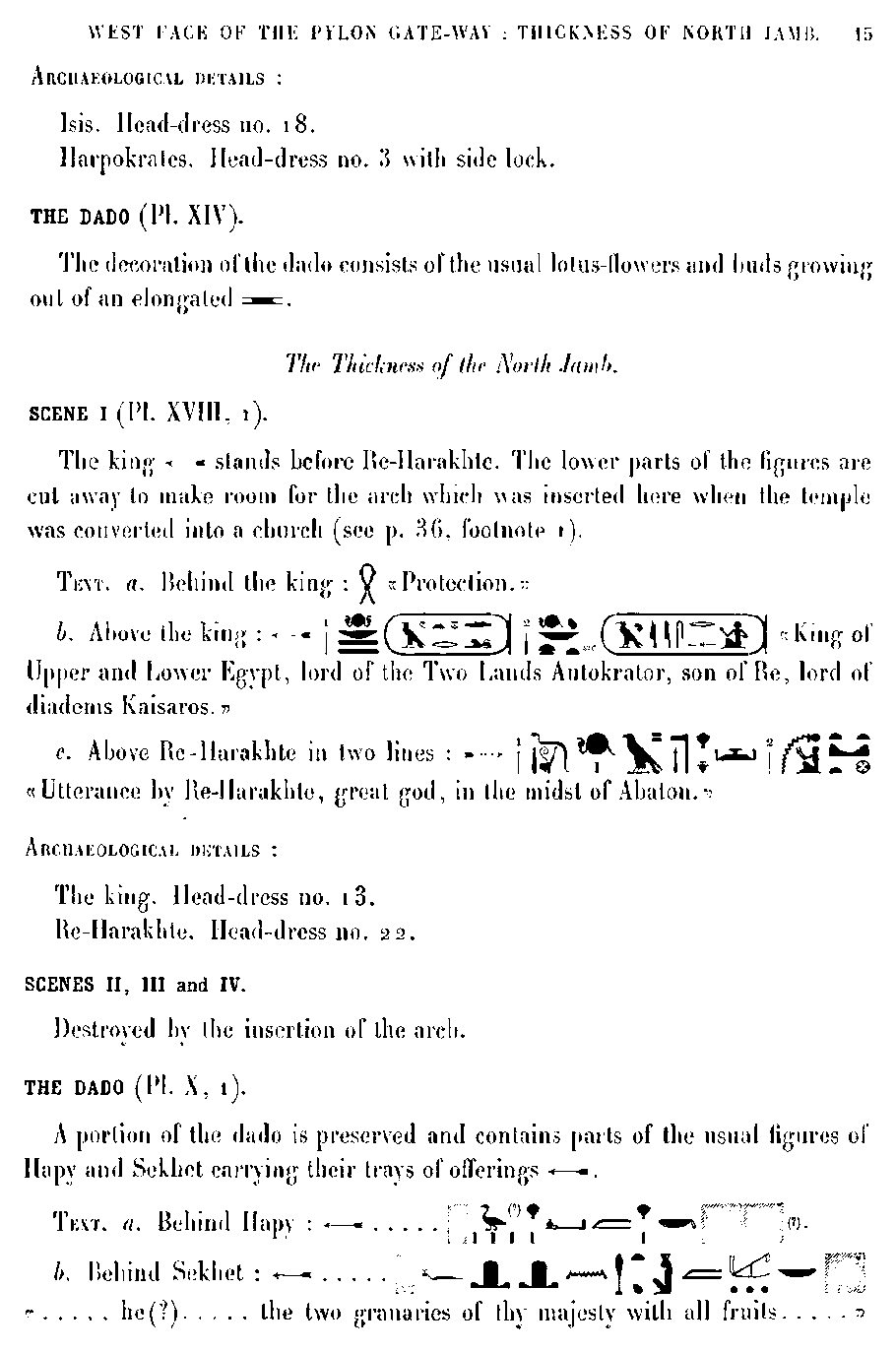
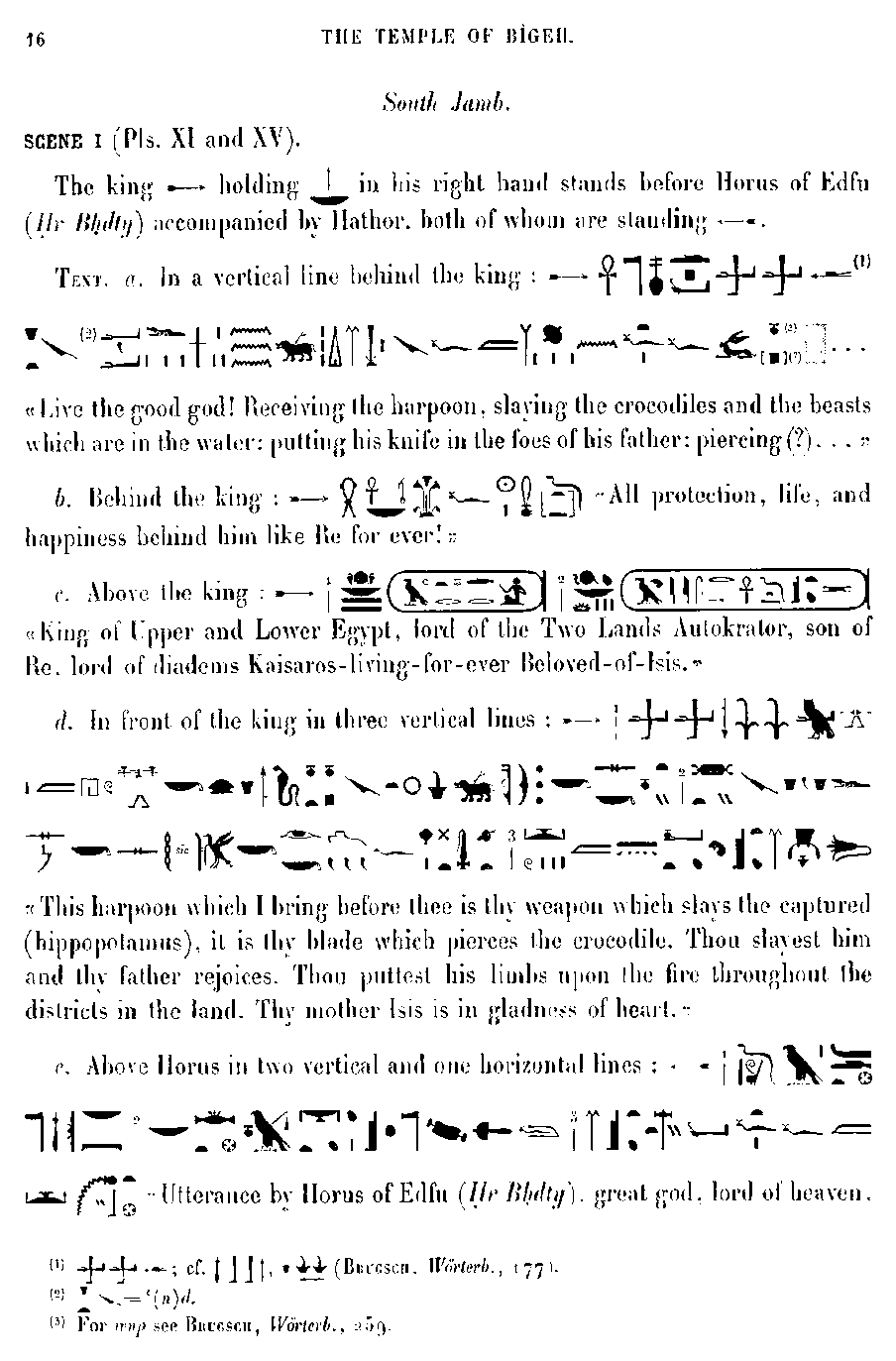
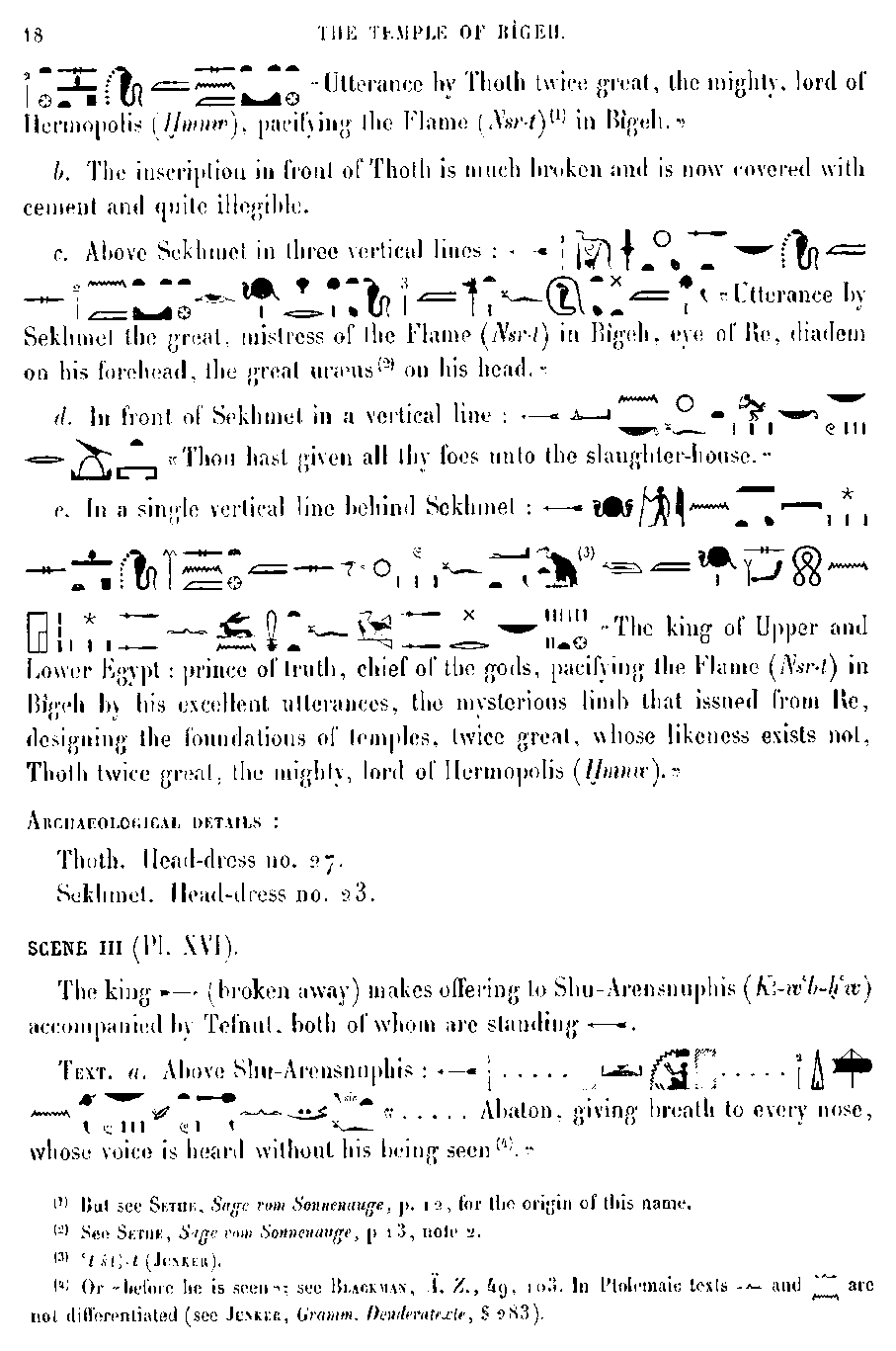
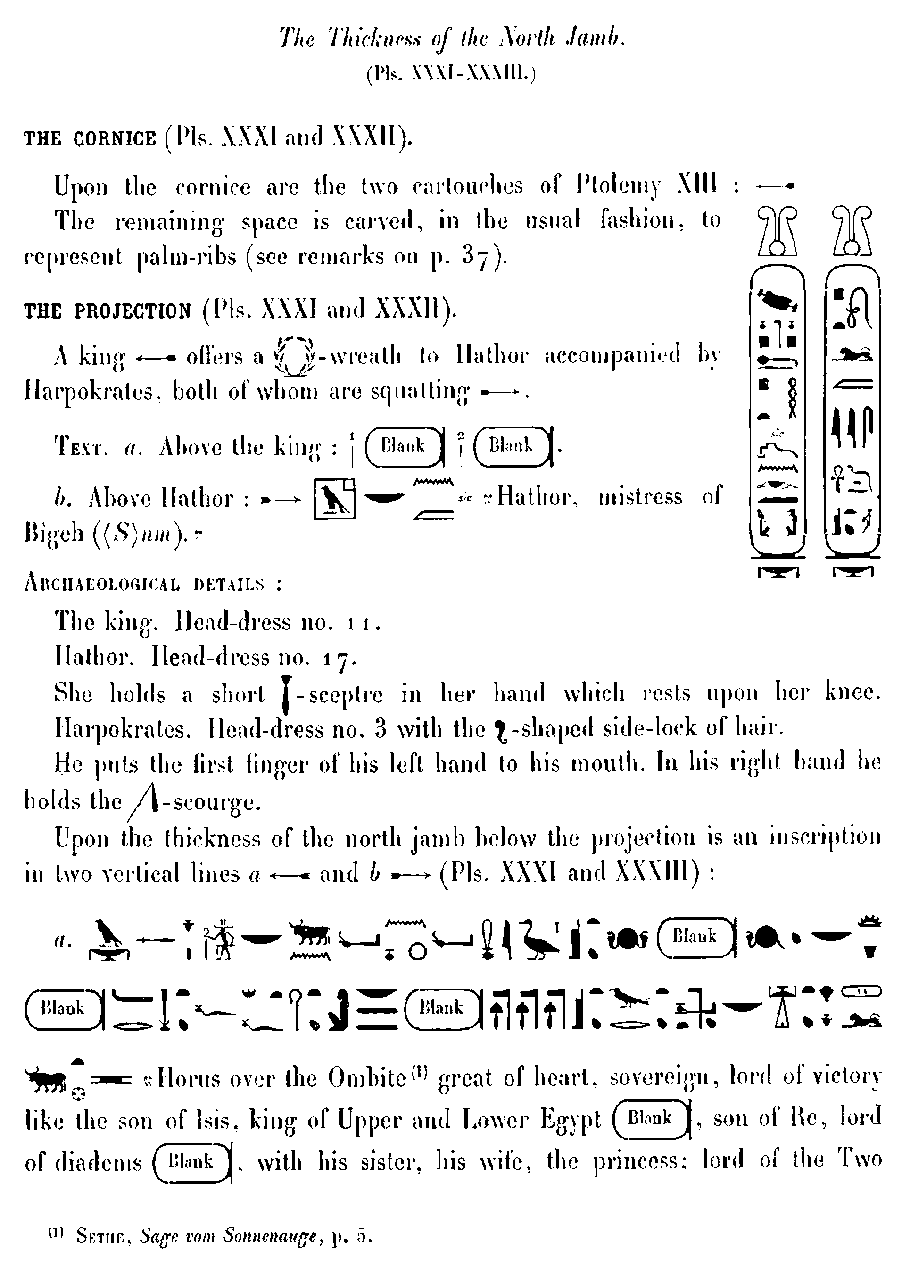
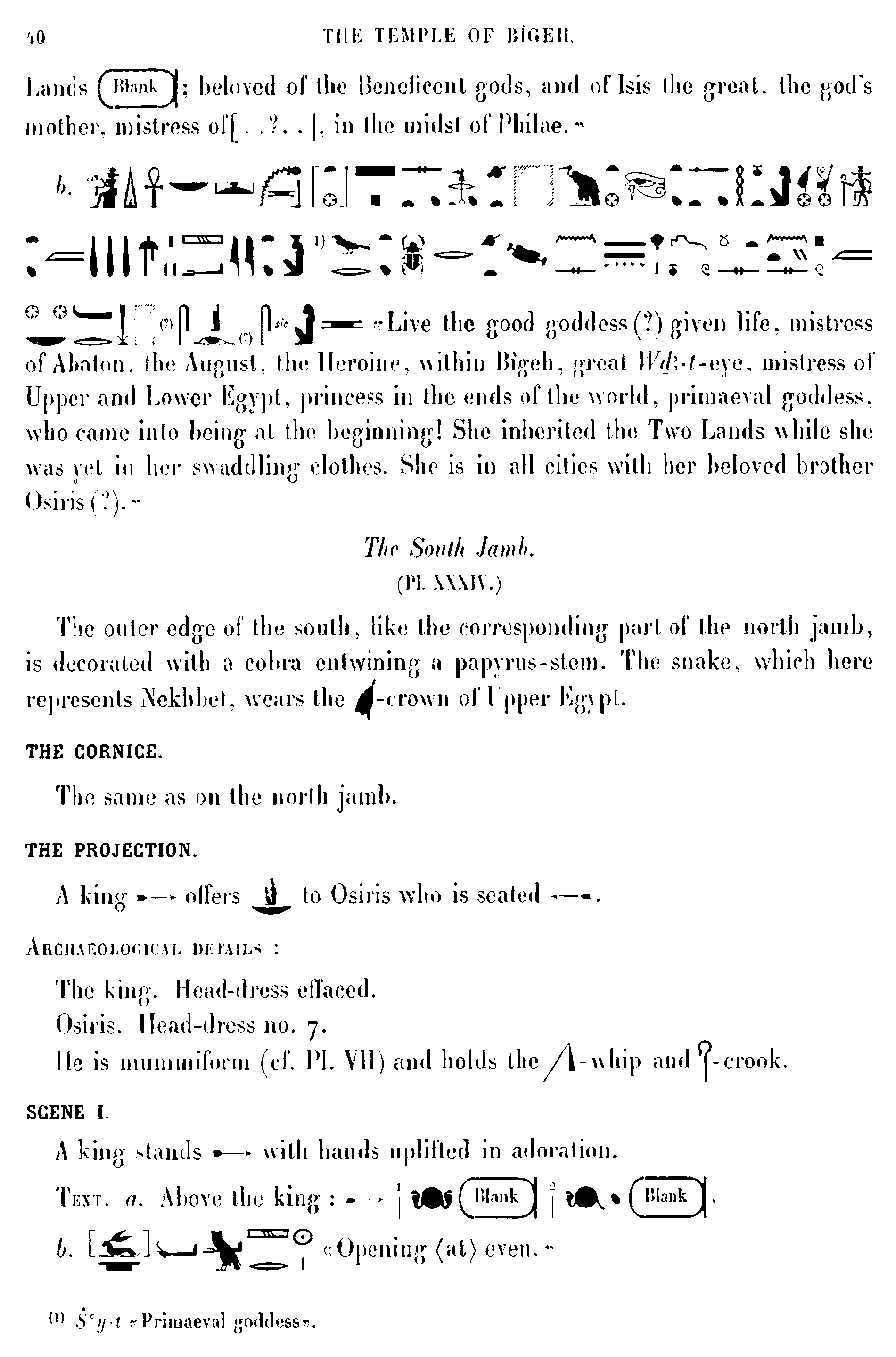
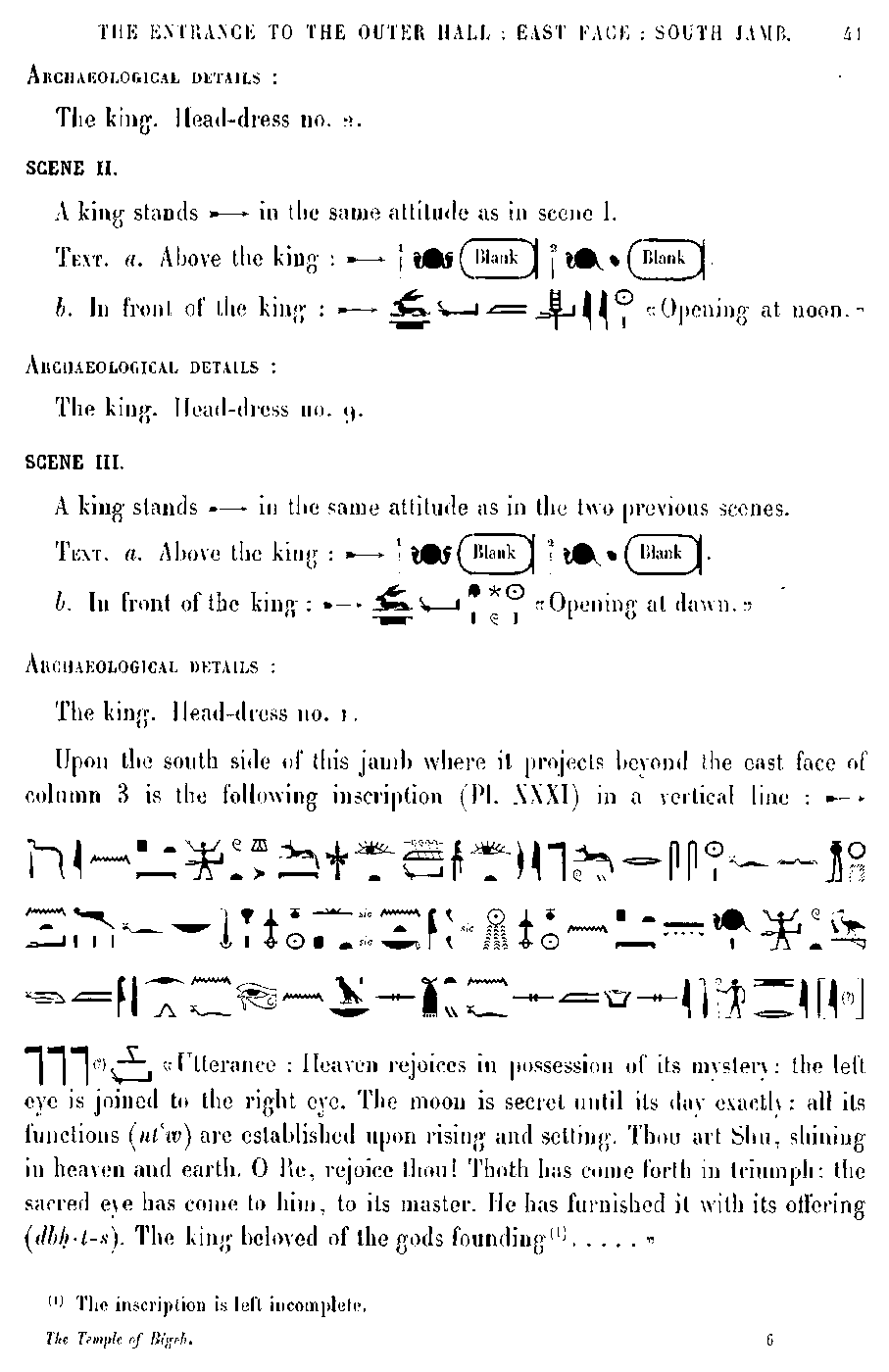
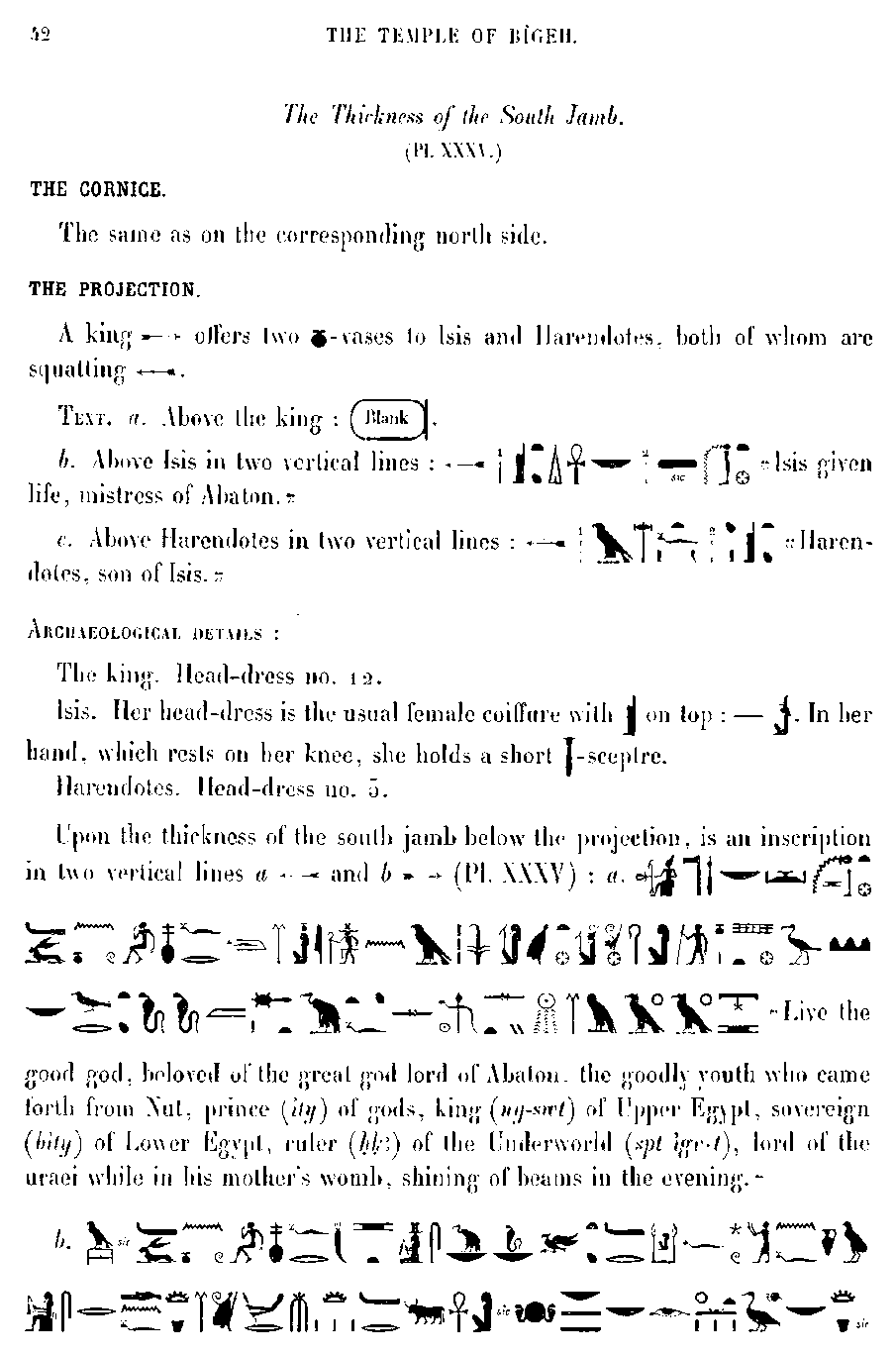
On the gateway of Bigeh the Roman emperor, named only as Autokrator Caesar, offers to Osiris, Isis and the gods of the cataract. He brings the Nile flood from the two caverns and takes up the harpoon as Horus, who slaughters the crocodiles and those that dwell in the water, who drives his knife into his father’s foes. The gods answer with gifts. Sekhmet says I give you all your enemies for the slaughterhouse.
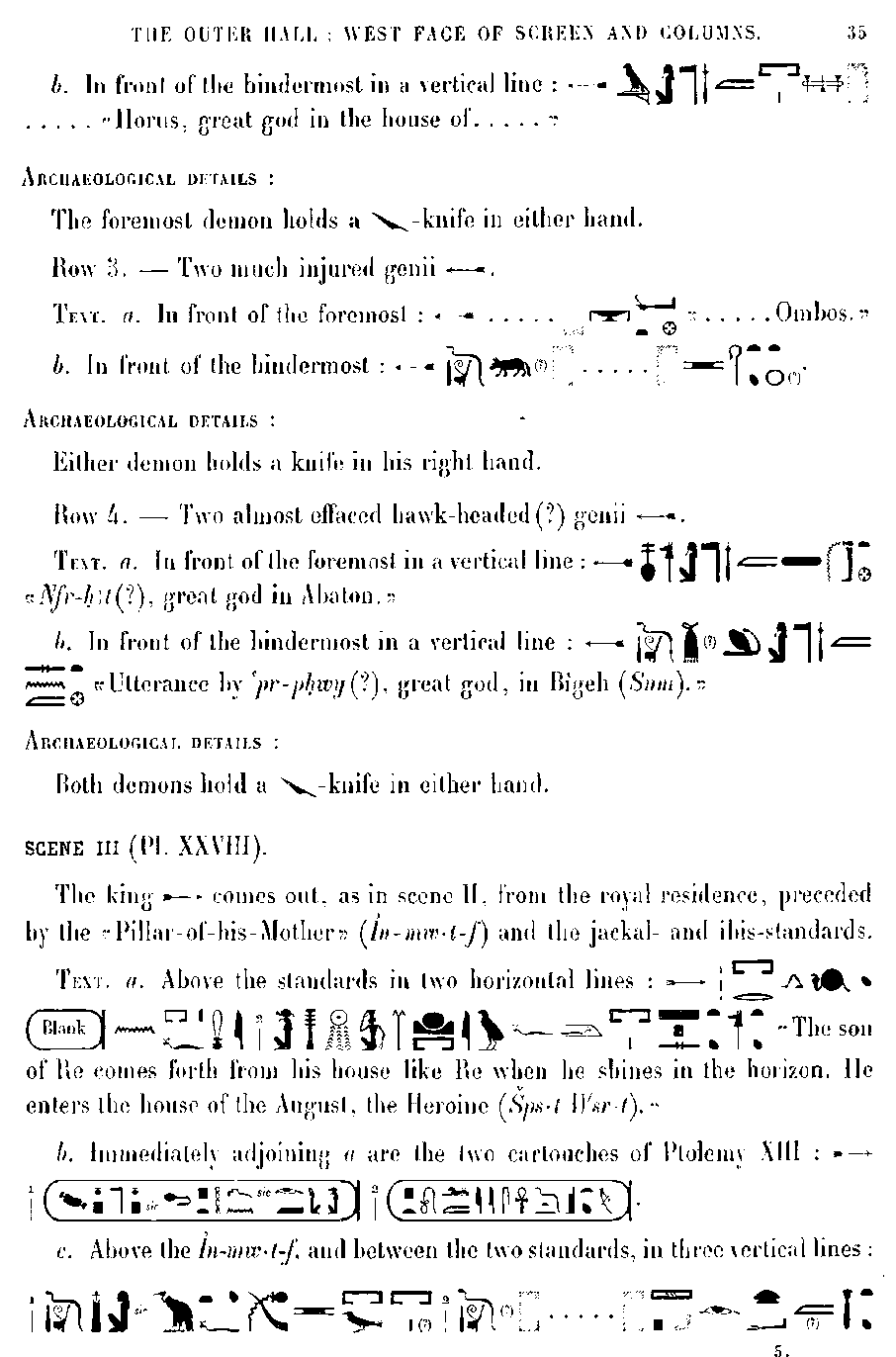
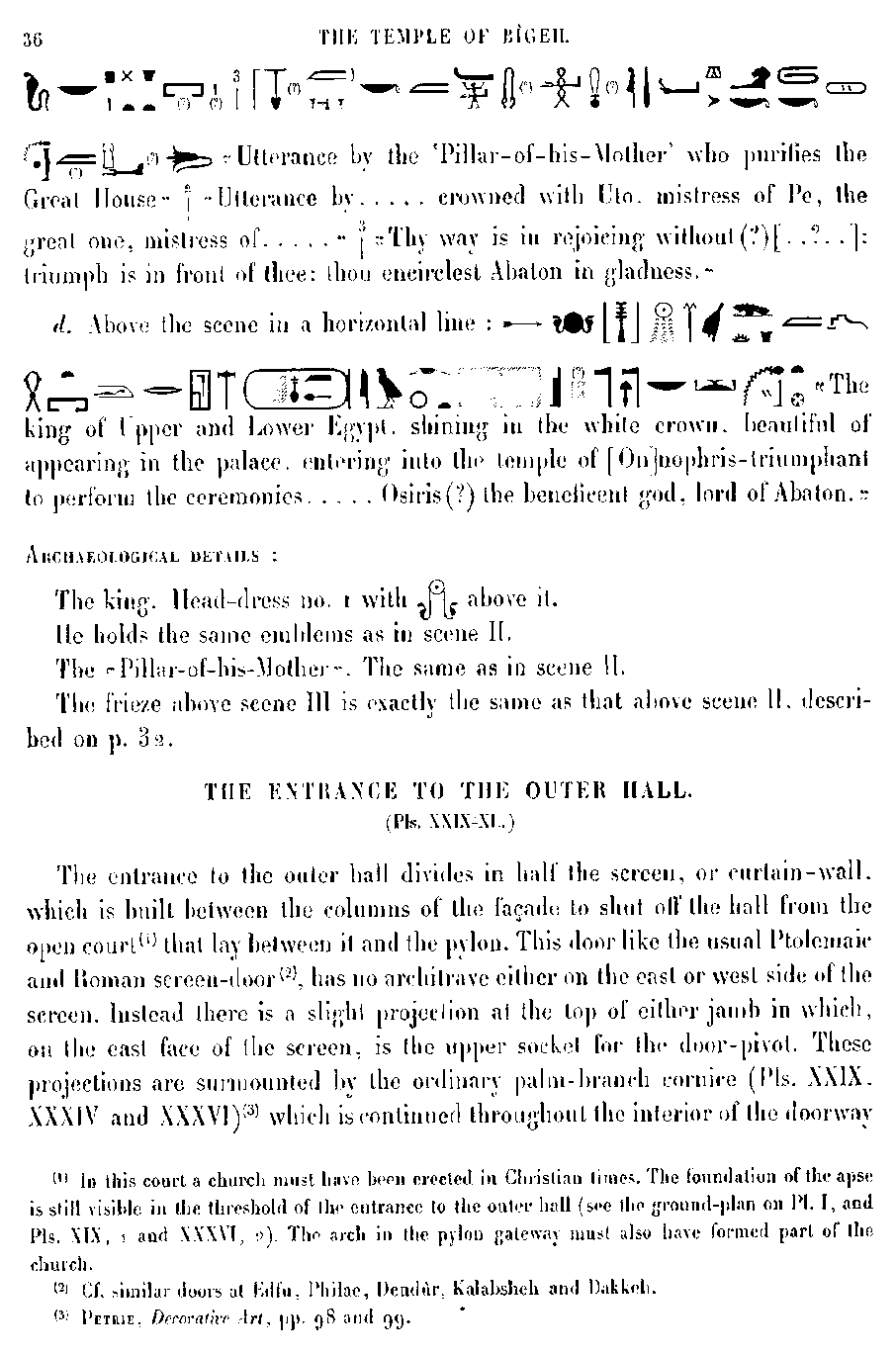
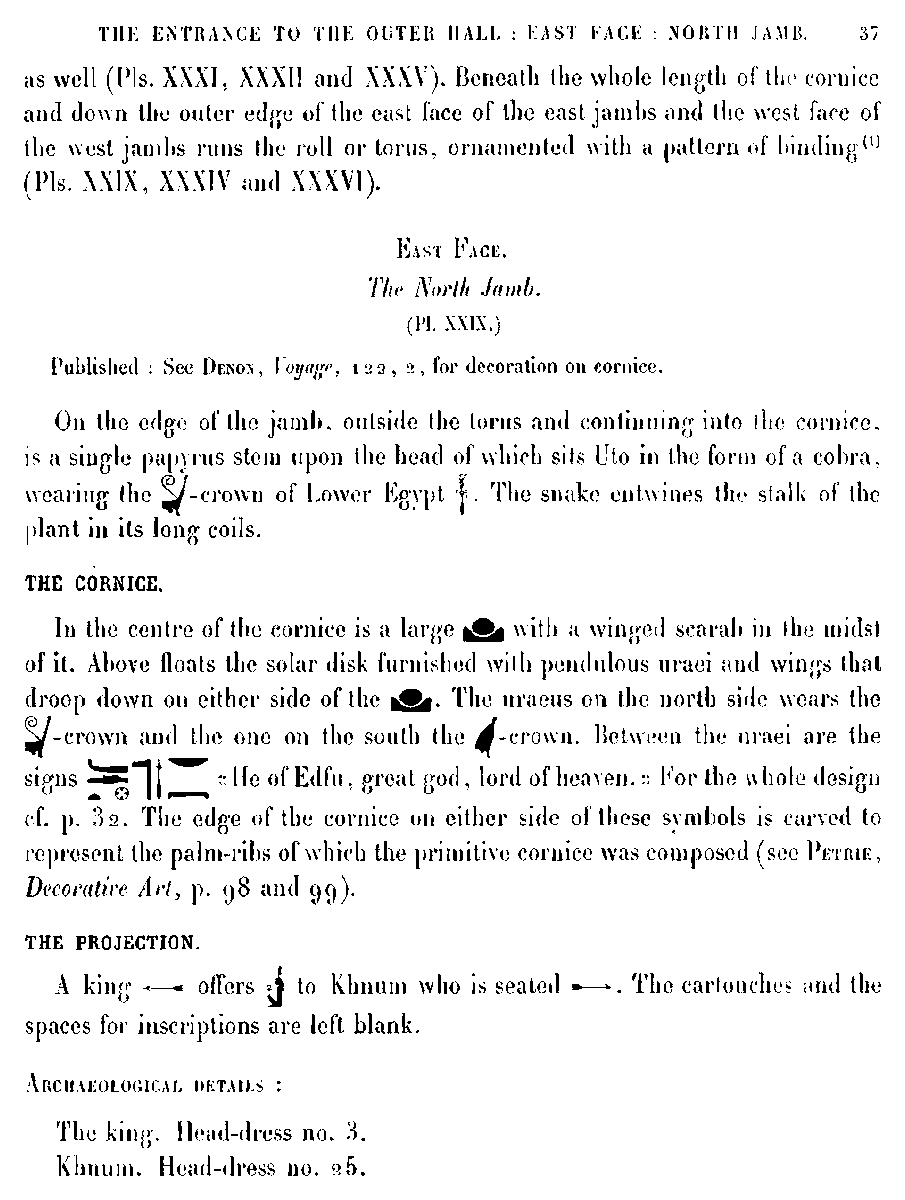
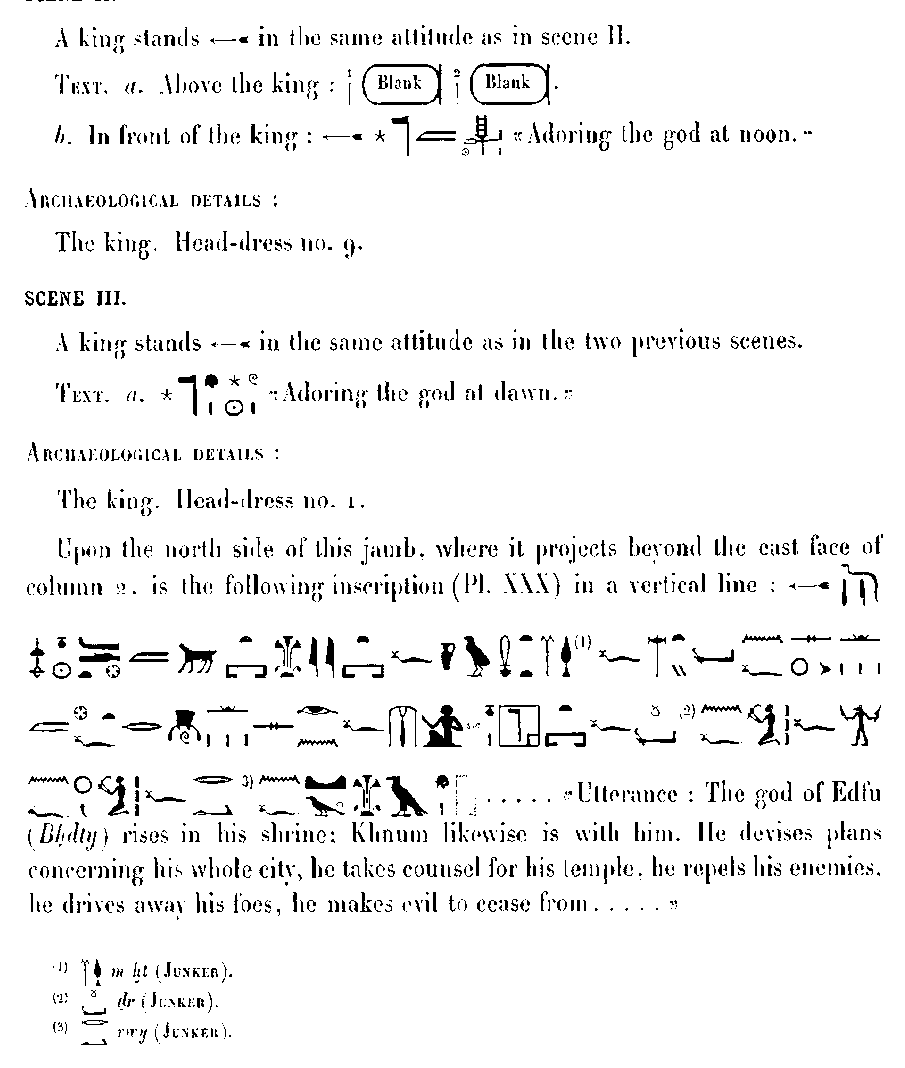
In the hall Ptolemy XII raises silver mirrors to a goddess, shakes the sistrum for Hathor and is purified with four jars of water. The guardian gods of the mound speak, among them The ba who lives on blood. Horus of Edfu declares the temple of Osiris pure: “Pure!” Four times.
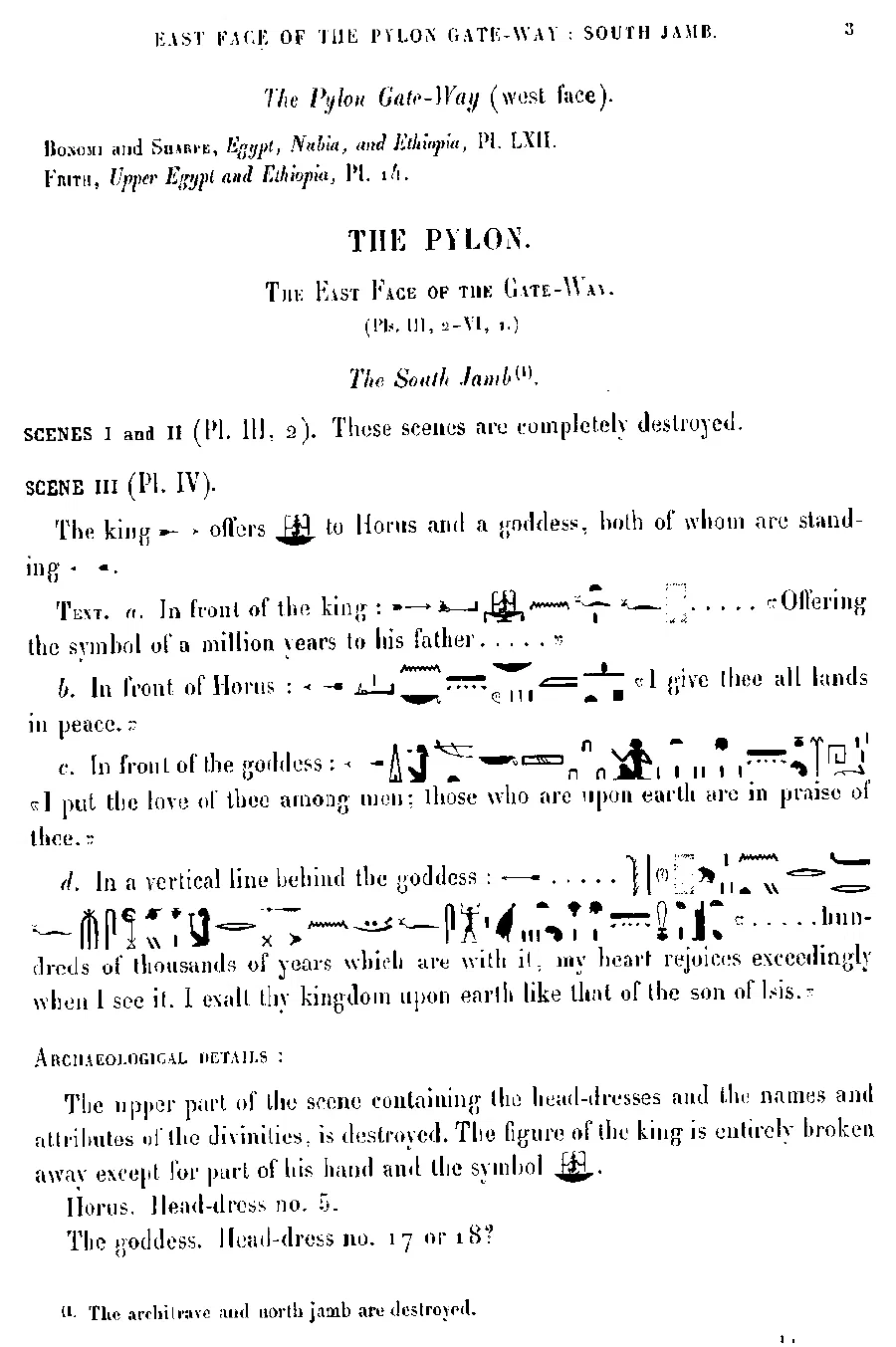
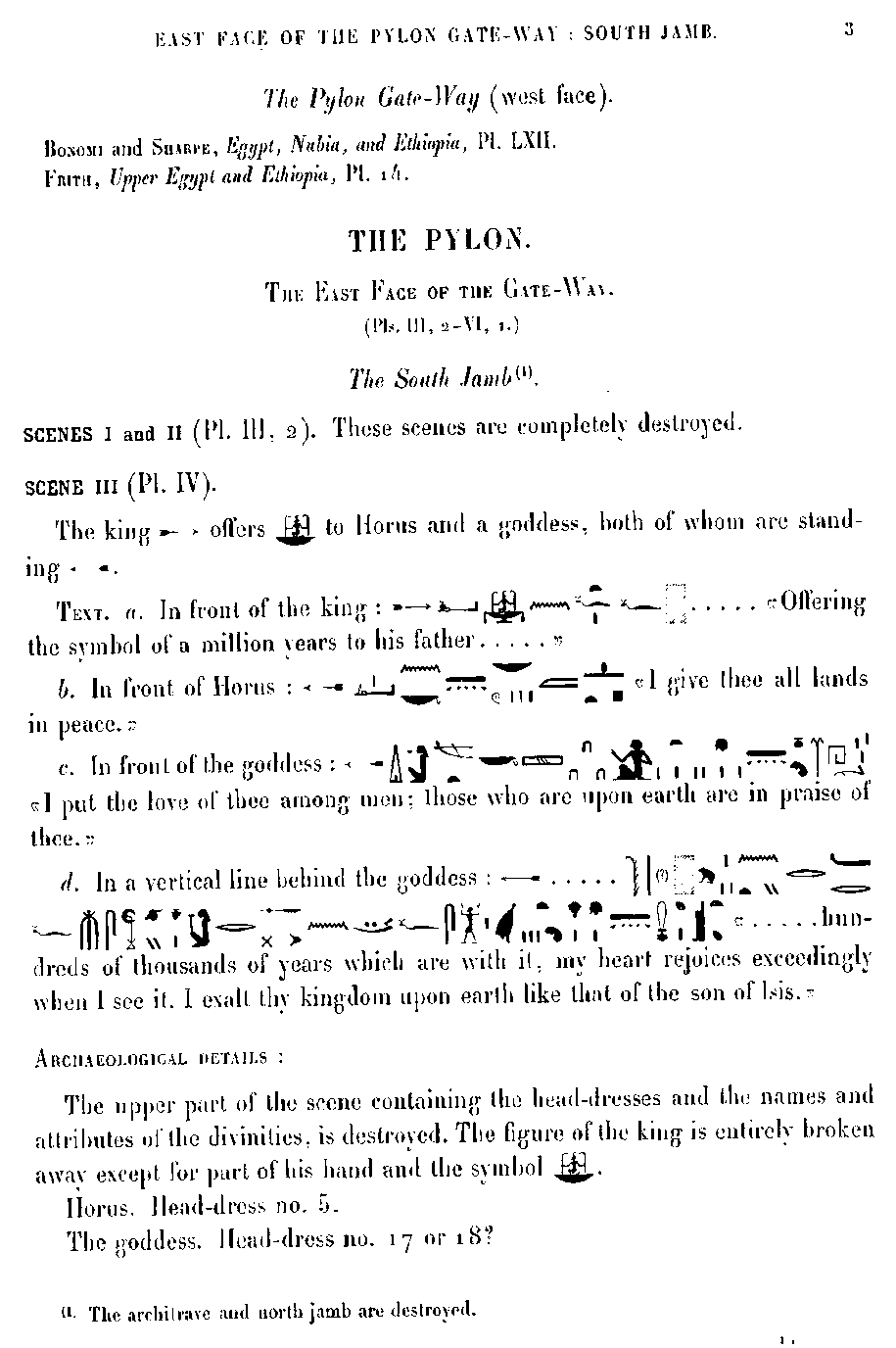
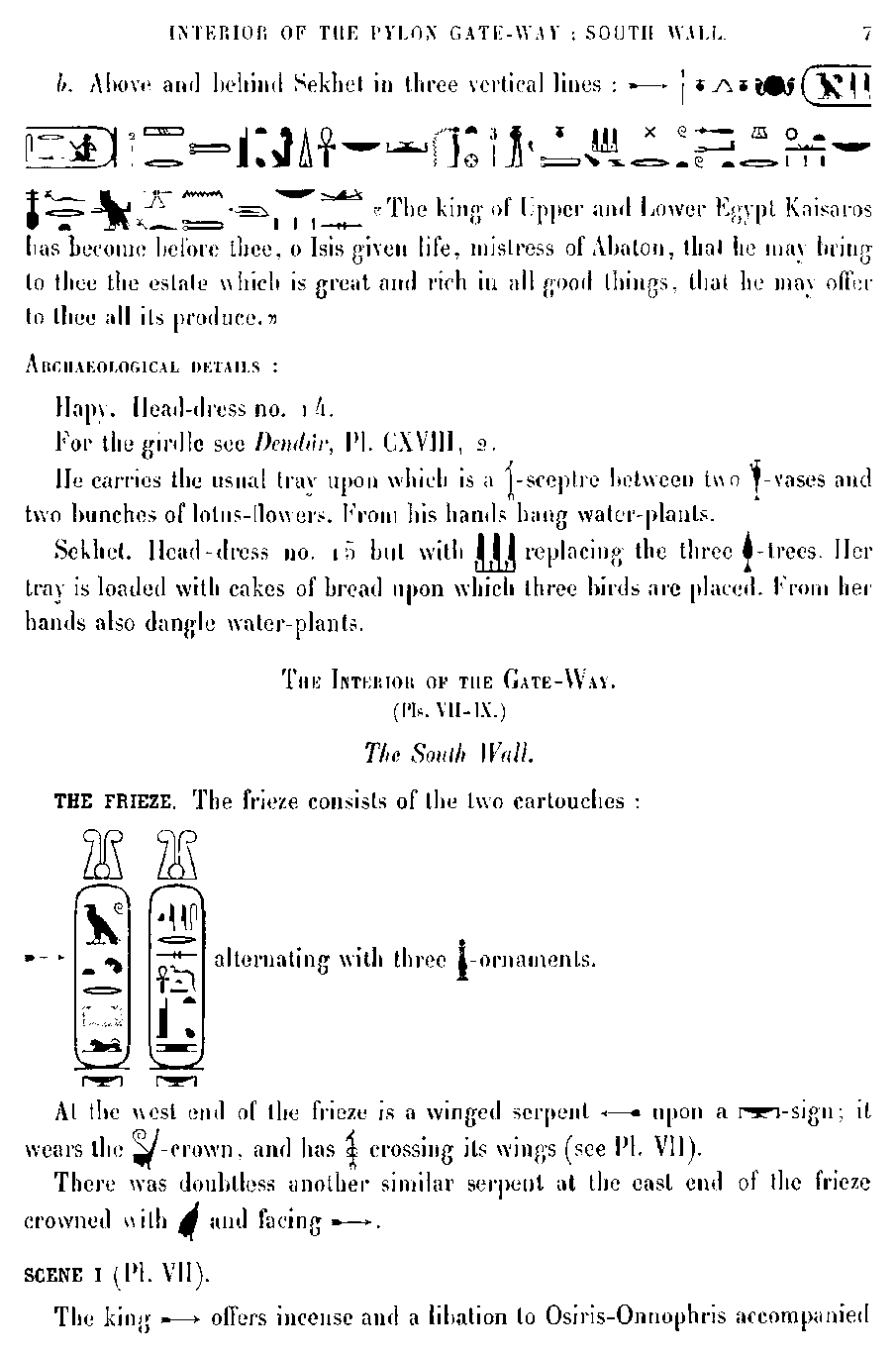
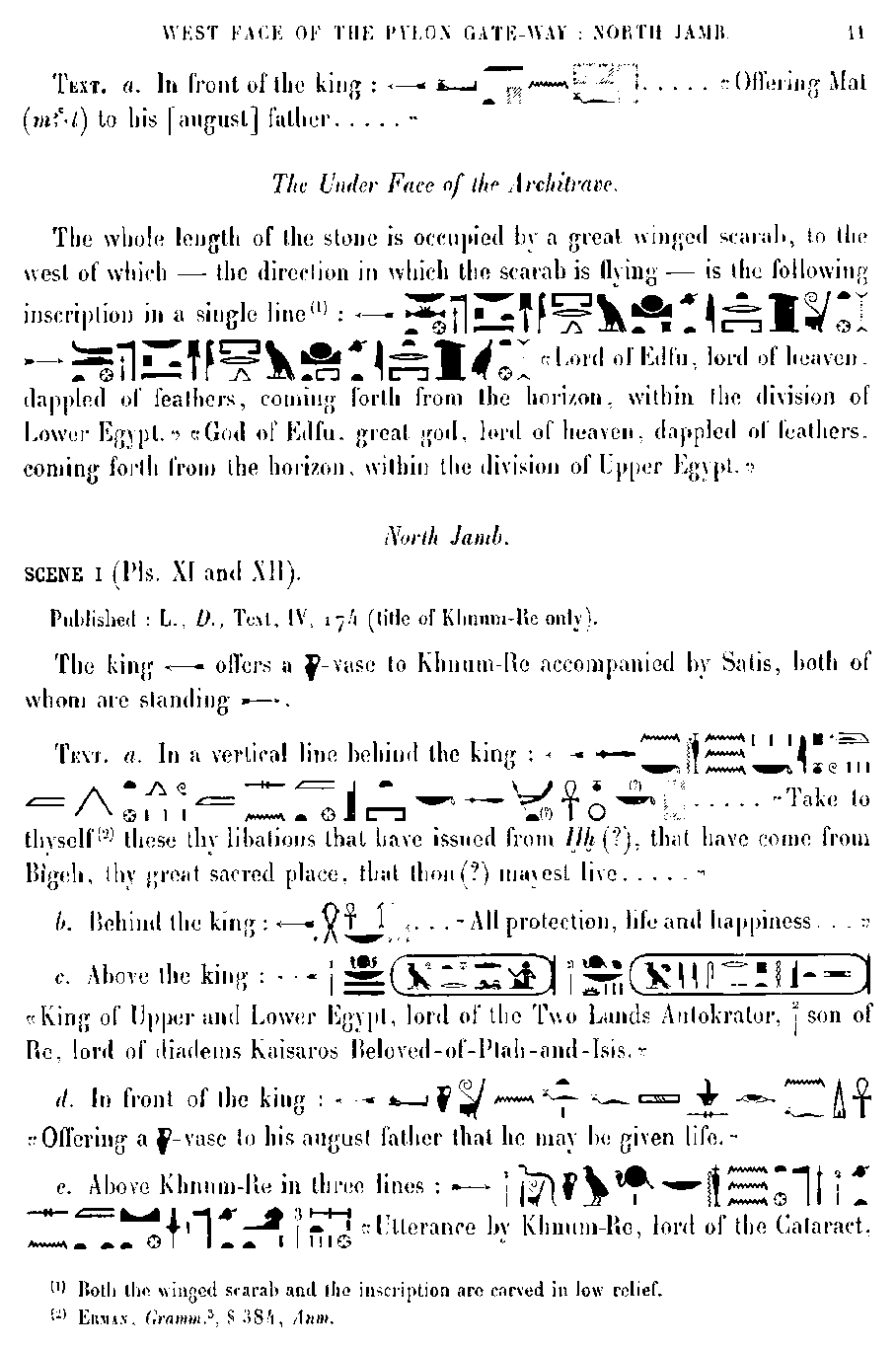
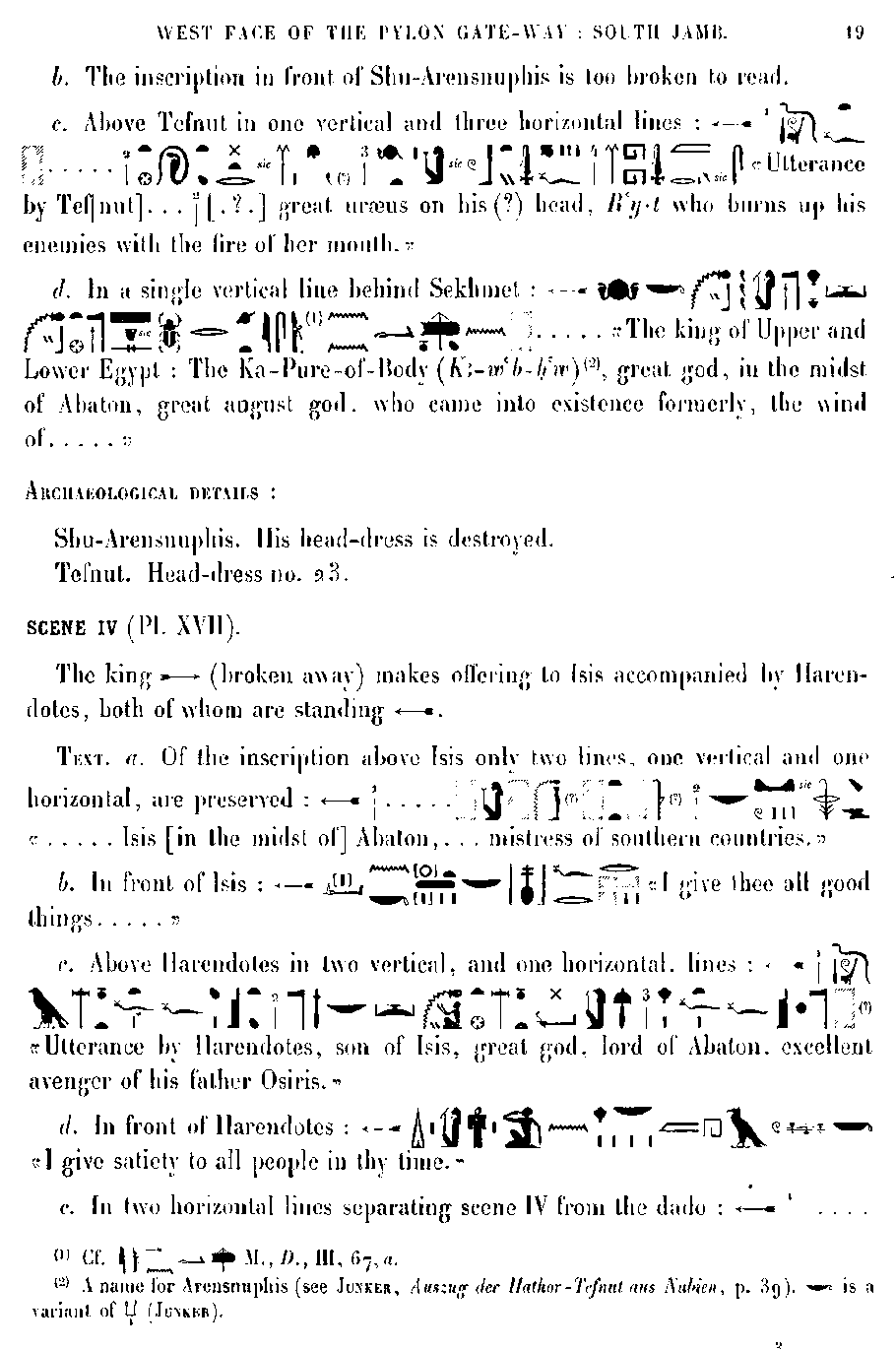
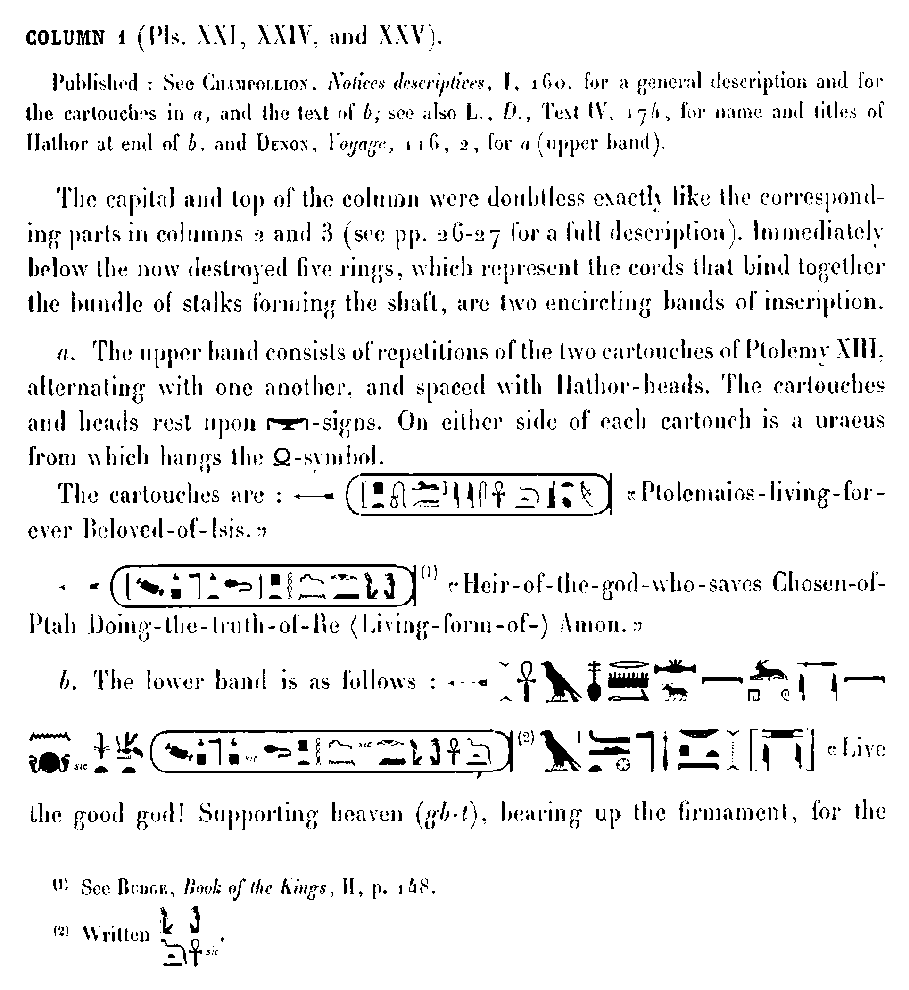
Page 3. Blackman, The Temple of Bigeh (1915), p. 3 Printed hieroglyphs from A. M. Blackman, The Temple of Bigeh (1915) - 1p. 3, l. 13
ḥnk ḥḥ n jt=f --détruit--
Offering Heh to his father …
Note · Line 1
Heh personifies a million years. The king offers his image as a gift of measureless time. - 2p. 3, l. 15
dj=j n=k tꜣ nb.{w} m ḥtp
I give you the whole land at peace.
- 3p. 3, l. 17
dj=j mrw.t=k n mꜥbꜣj.t tp.j.w-tꜣ n=k m hj rmn (1)
I give the Thirty love for you, while those on earth do you homage.
Note · Line 3
The Thirty are a divine council. - 4p. 3, l. 20
--détruit-- ḥfn.w nt.j.(w) r-ḥnꜥ=f
… hundreds of thousands who are with him.
- 5p. 3, l. 21
msḫꜣ jb=j r-ꜥꜣ-wr-n mꜣ=f sḳꜣ=j nswj.t=k ḥr-tp tꜣ mj sꜣ ꜣs.t
My heart rejoices greatly at the sight of him, and I exalt your kingship on earth like that of the son of Isis.
Note · Line 5
The son of Isis is Horus, who inherited the throne of his father Osiris. 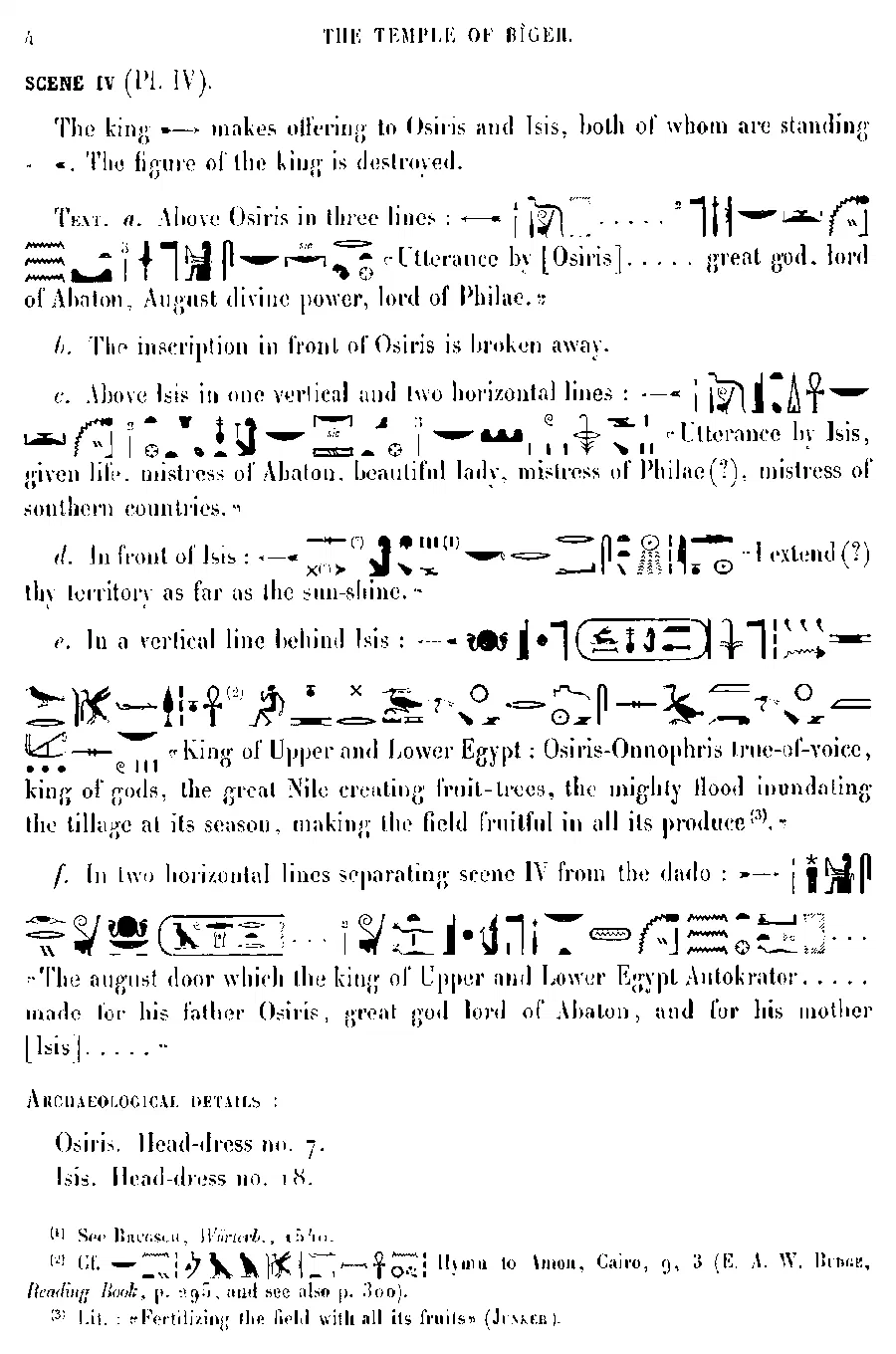
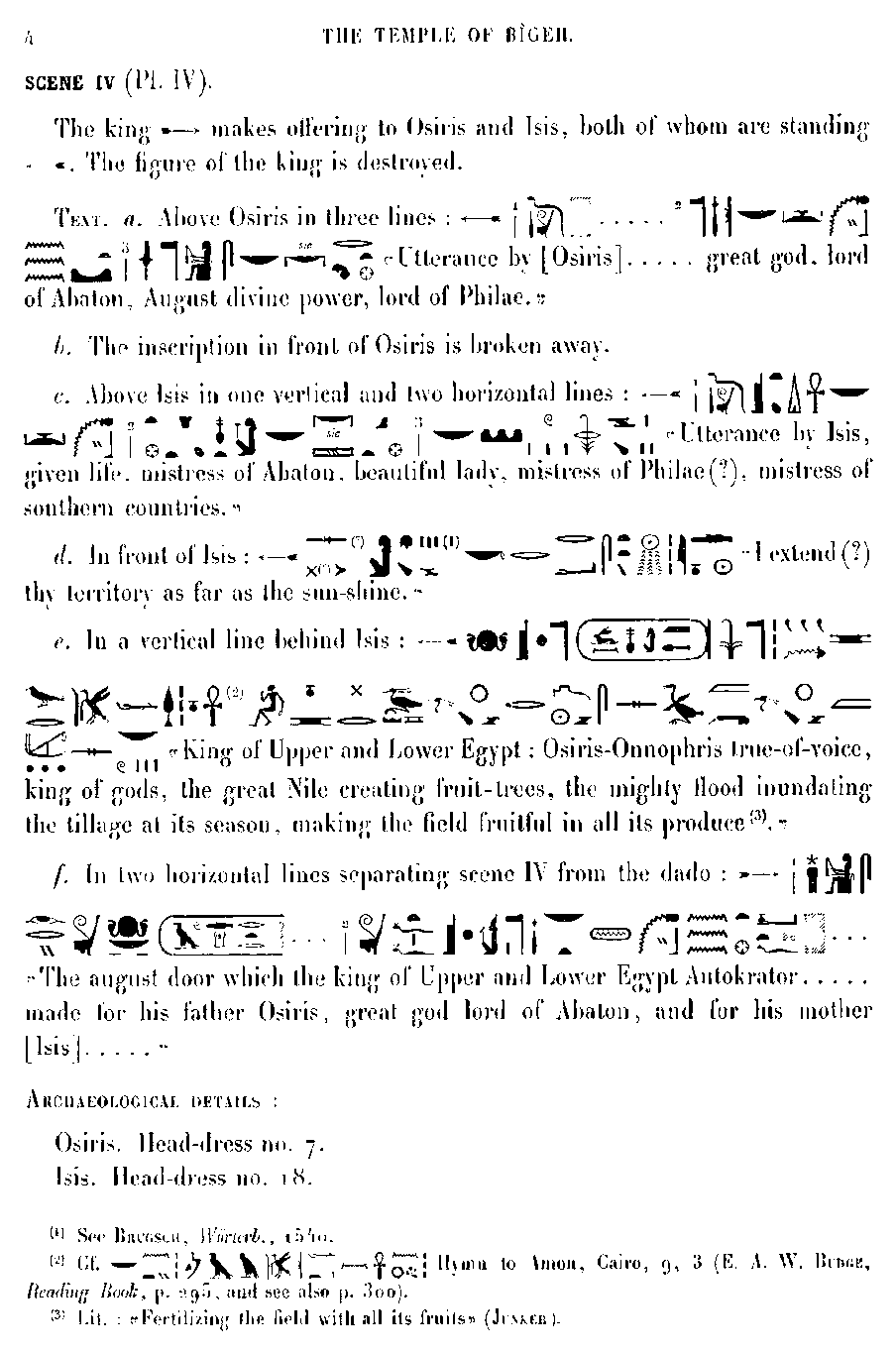
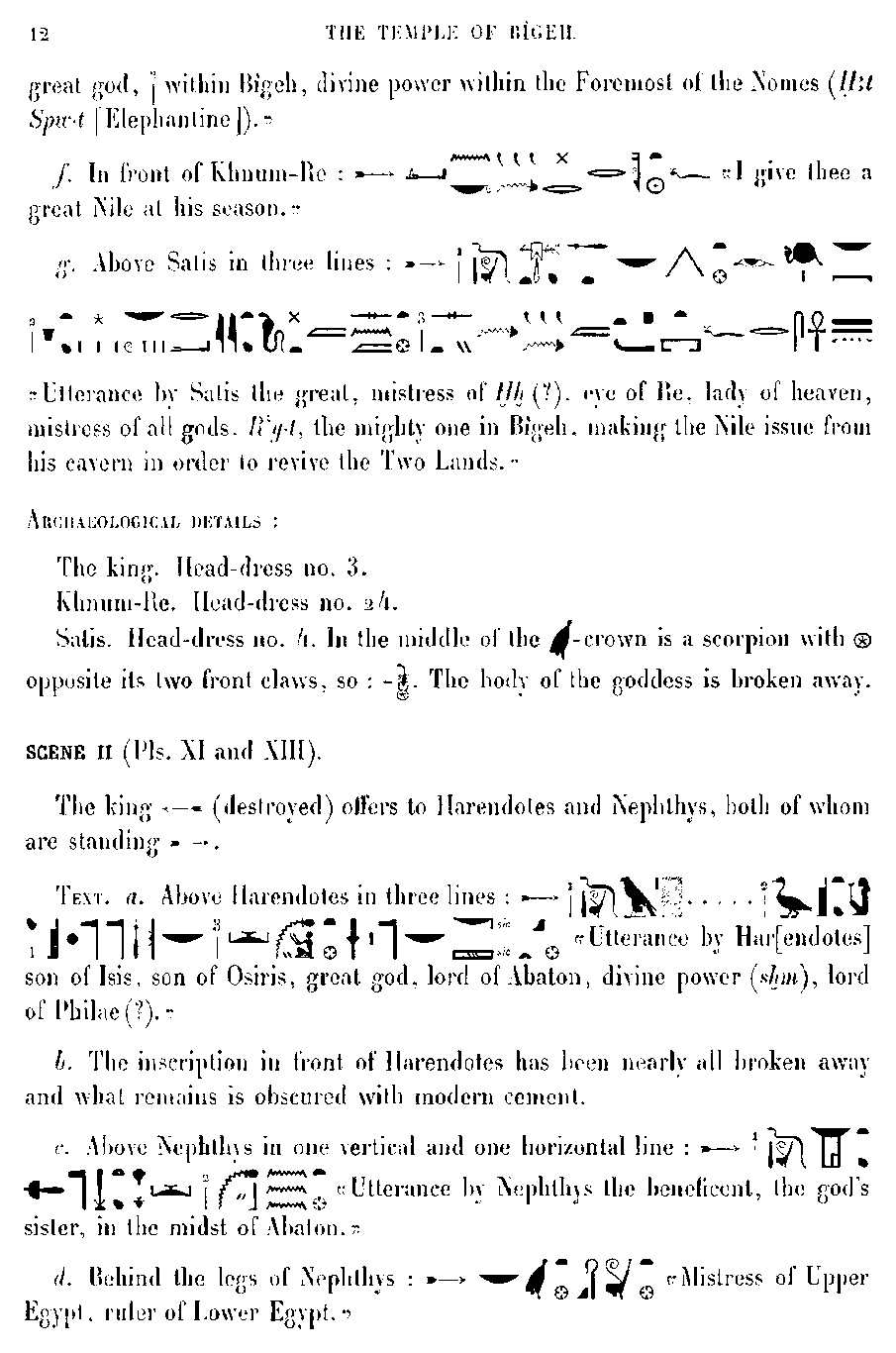
Page 4. Blackman, The Temple of Bigeh (1915), p. 4 Printed hieroglyphs from A. M. Blackman, The Temple of Bigeh (1915) - 6p. 4, l. 4
ḏd-mdw jn --4Q-- nṯr ꜥꜣ nb jꜣ.t-wꜥb.t
Words spoken by …, the great god, lord of the Abaton,
Note · Line 6
The Abaton was the restricted sanctuary on Bigeh, revered as a burial place of Osiris. - 7p. 4, l. 5
sḫm šps nb jwrḳ
the august power, lord of Philae.
- 8p. 4, l. 8
ḏd-mdw jn ꜣs.t dj.(t) ꜥnḫ nb.(t)
Words spoken by Isis, giver of life, lady of
- 9p. 4, l. 9
jꜣ.t-wꜥb.t ḥnw.t nfr.t nb.(t) jwrḳ nb.(t) ḫꜣs.wt rsj.w(t)
the Abaton, fair mistress, lady of Philae, lady of the southern foreign lands.
- 10p. 4, l. 12
swr=j tp.w=k r-rꜣ-ꜥ stw.t jtn
I extend your lands as far as the rays of the sun disk reach.
- 11p. 4, l. 14
wsjr wnn-nfr mꜣꜥ-ḫrw nswt nṯr.w ḥꜥpj
Osiris Wennefer, vindicated, king of the gods, Hapy
Note · Line 11
Wennefer is a name of Osiris. He is identified here with Hapy, the Nile flood, and with Nun, the primeval waters. - 12p. 4, l. 15
wr ḳmꜣ ḫt.w-n-ꜥnḫ nwn wr bꜥḥ ꜣḫ.t r nw=s sṯꜣm ꜣḫ.t m
the Great, who created the fruit trees, Nun the Great, who floods the field in its season and clothes the field with
- 13p. 4, l. 16
pr.wt=s nb.w(t)
all its fruits.
- 14p. 4, l. 19
sbꜣ šps
The august gate
- 15p. 4, l. 20
jrj.n nswt-bj.tj nb-tꜣ.wj ꜣwdkrtr --détruit-- n jt=f wsjr nṯr ꜥꜣ nb jw-wꜥb mw.t=f --détruit--
that the king of Upper and Lower Egypt, lord of the Two Lands, Autokrator, … made for his father Osiris, the great god, lord of the Abaton, and for his mother …
Note · Line 15
Autokrator is the Roman emperor’s Greek title, written here in hieroglyphs as a royal name. 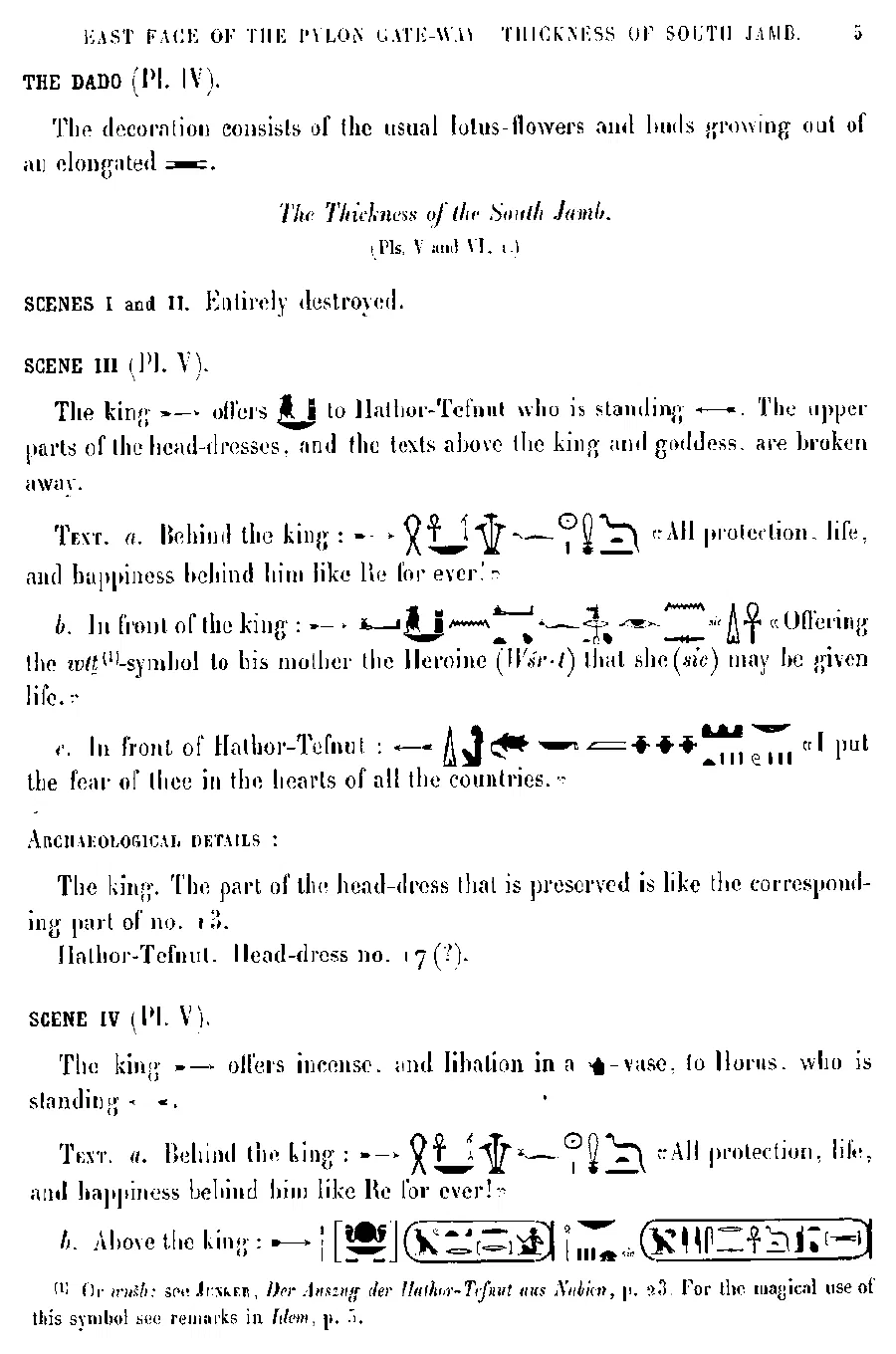
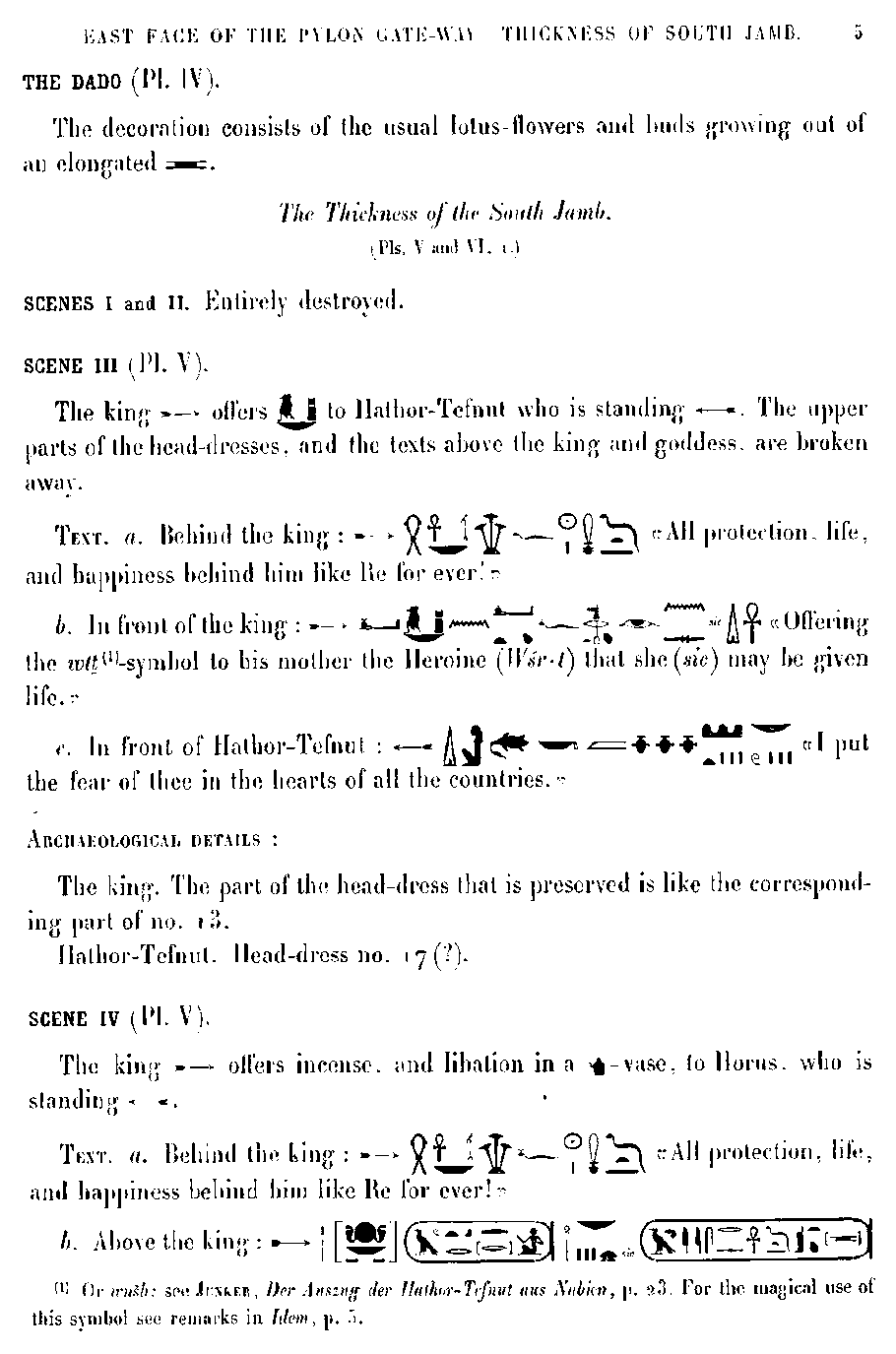
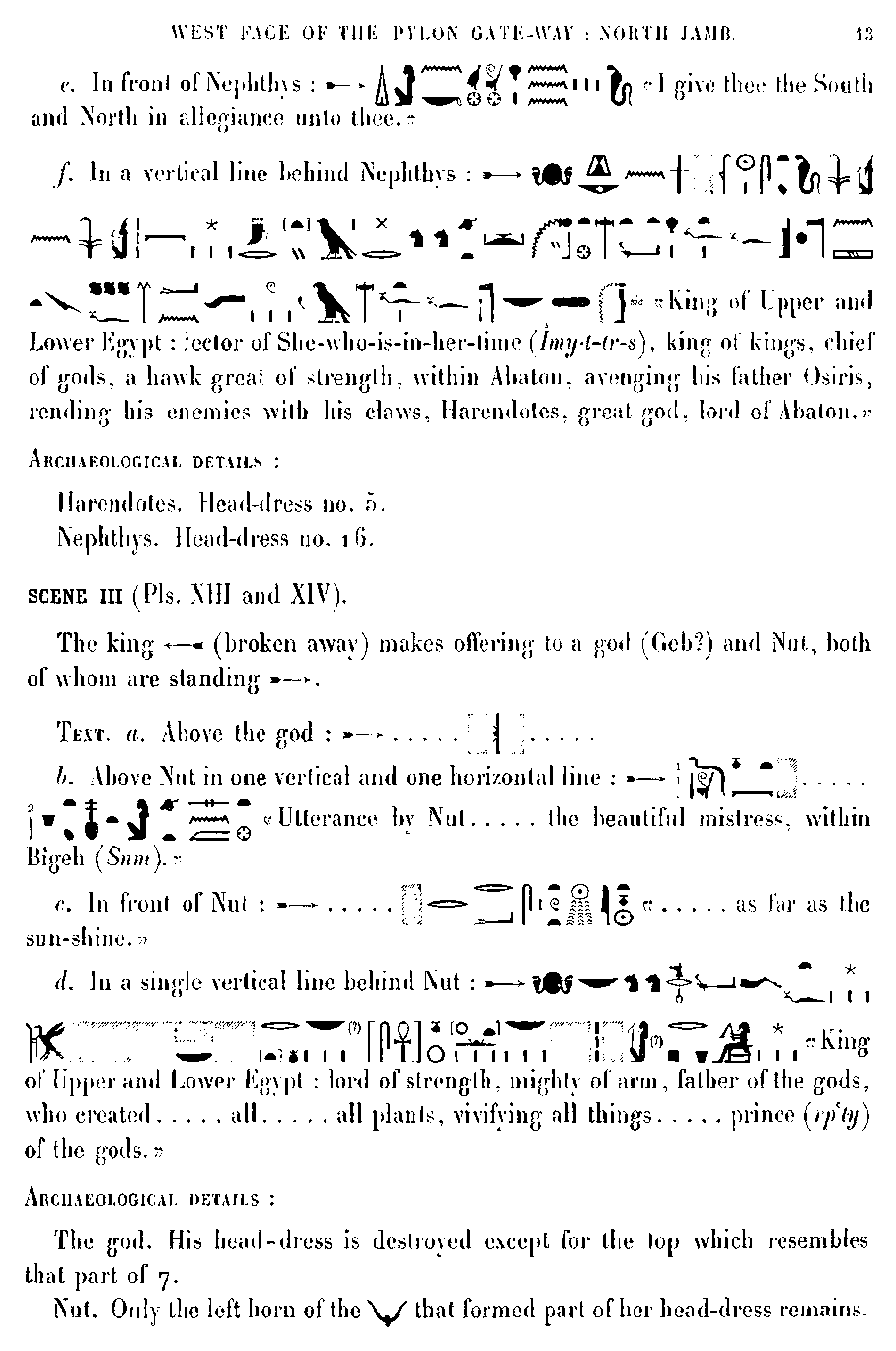
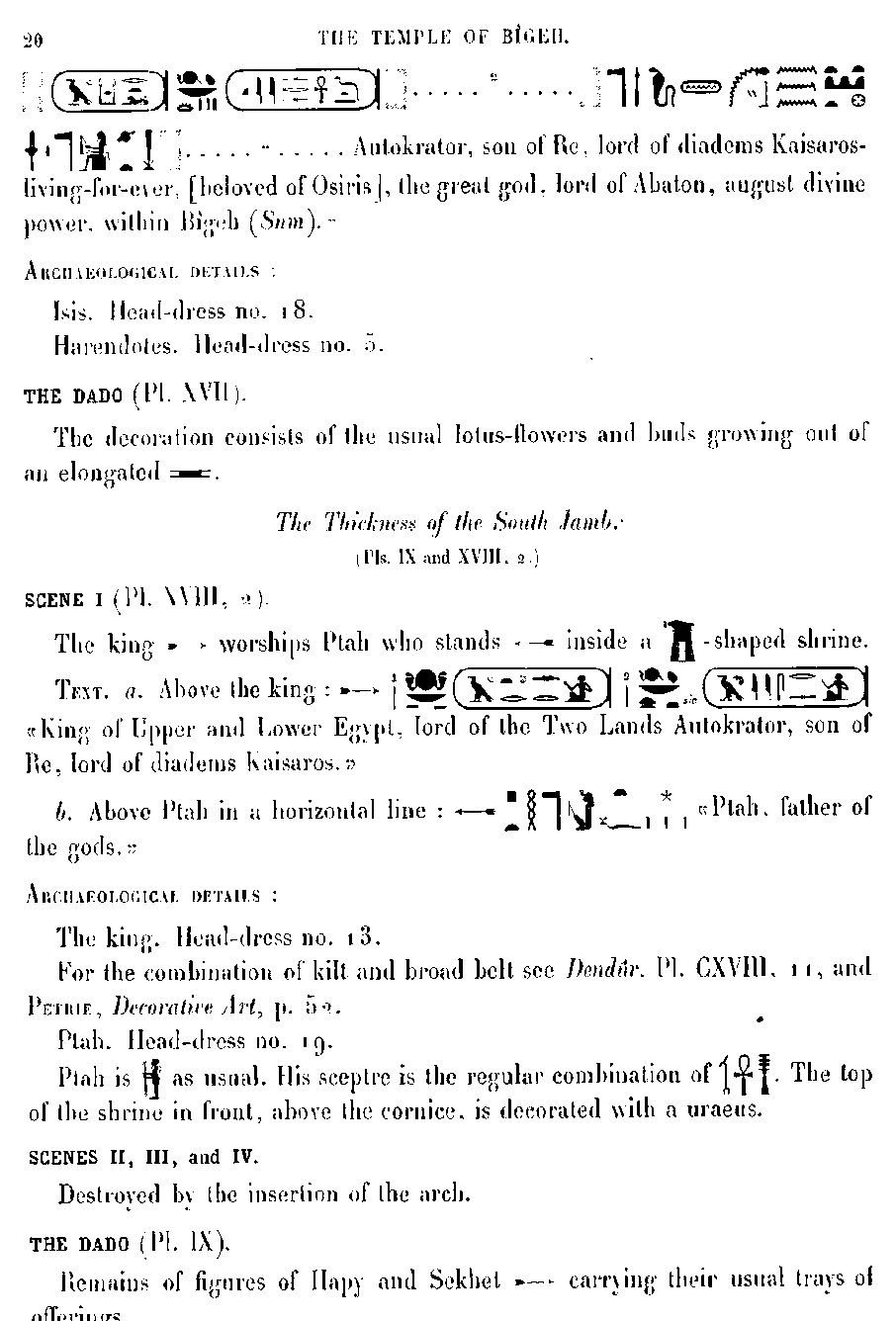
Page 5. Blackman, The Temple of Bigeh (1915), p. 5 Printed hieroglyphs from A. M. Blackman, The Temple of Bigeh (1915) - 16p. 5, l. 11
sꜣ ꜥnḫ wꜣs nb ḥꜣ=f mj rꜥ ḏ.t
All protection, life and dominion are behind him, as they are behind Ra, forever.
- 17p. 5, l. 13
ḥnk wnšb n mw.t=f wsr.t jrj.n=<f> {s} dj.(t) ꜥnḫ
Offering the wensheb to his mother, the Mighty One. He has done this that he may be given life.
Note · Line 17
The wensheb is a ceremonial water clock. - 18p. 5, l. 16
dj=j snḏ=k m jb.w ḫꜣs.wt nb.w(t)
I set the dread of you in the hearts of all foreign lands.
- 19p. 5, l. 25
sꜣ ꜥnḫ wꜣs nb ḥꜣ=f mj rꜥ ḏ.t
All protection, life and dominion are behind him, as they are behind Ra, forever.
- 20p. 5, l. 27
[nswt-bj.tj nb-tꜣ.wj] ꜣwtḳrd[r] nb-ḫꜥ.w kꜣysrs-ꜥnḫ-ḏ.t-[mrj]-ꜣs.t
The king of Upper and Lower Egypt, lord of the Two Lands, Autokrator, lord of crowns, Caesar, living forever, beloved of Isis.
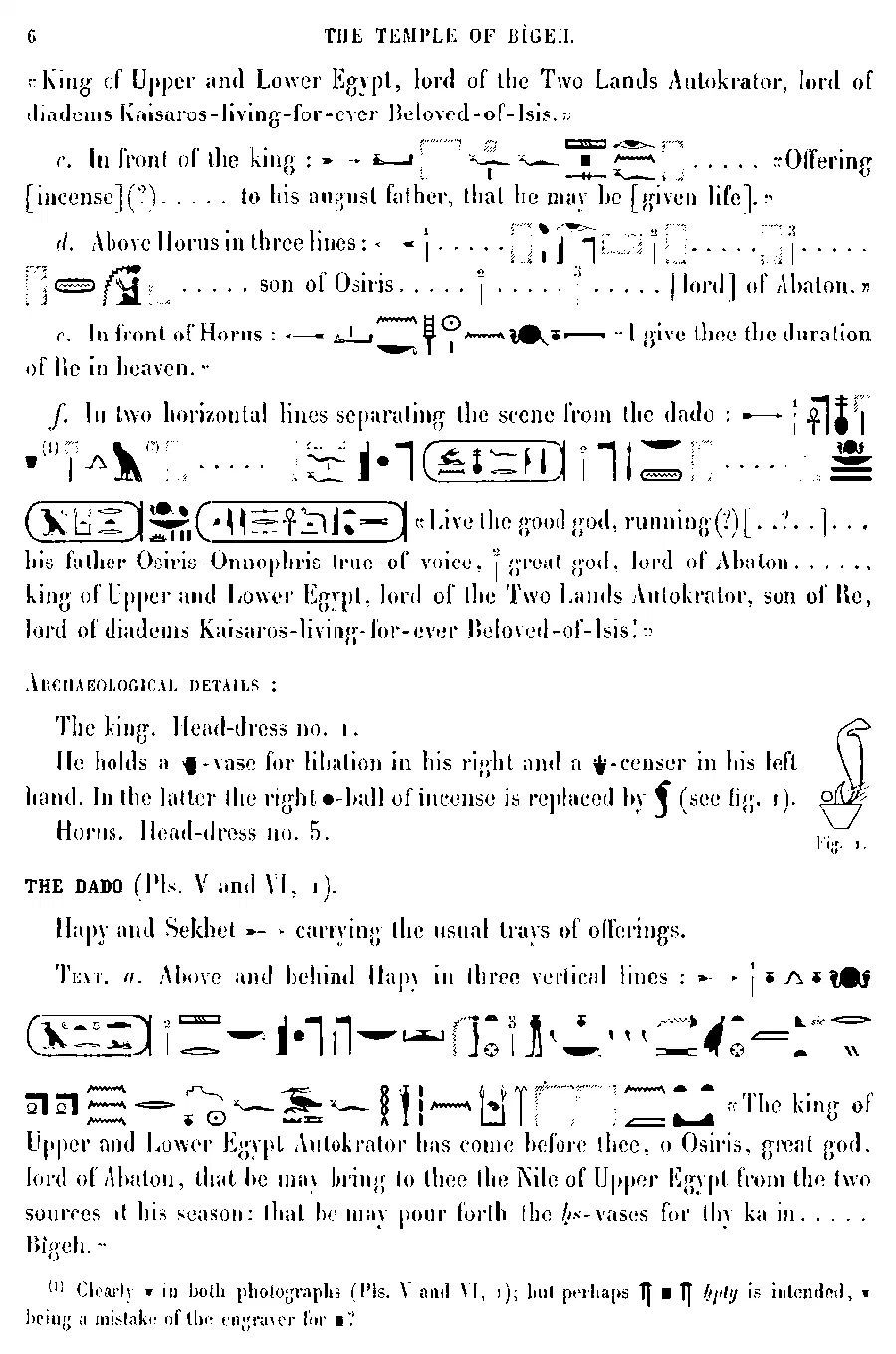
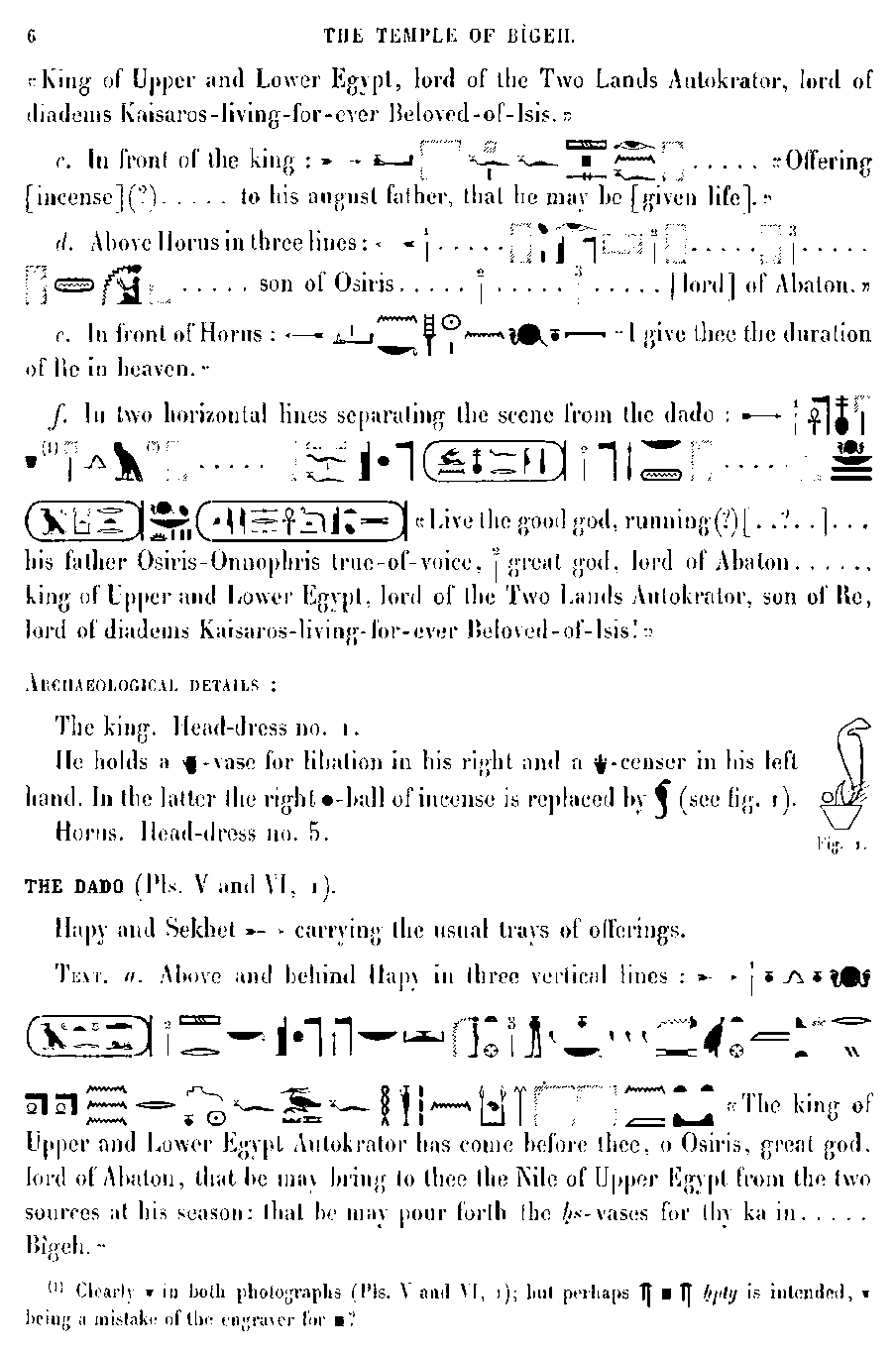
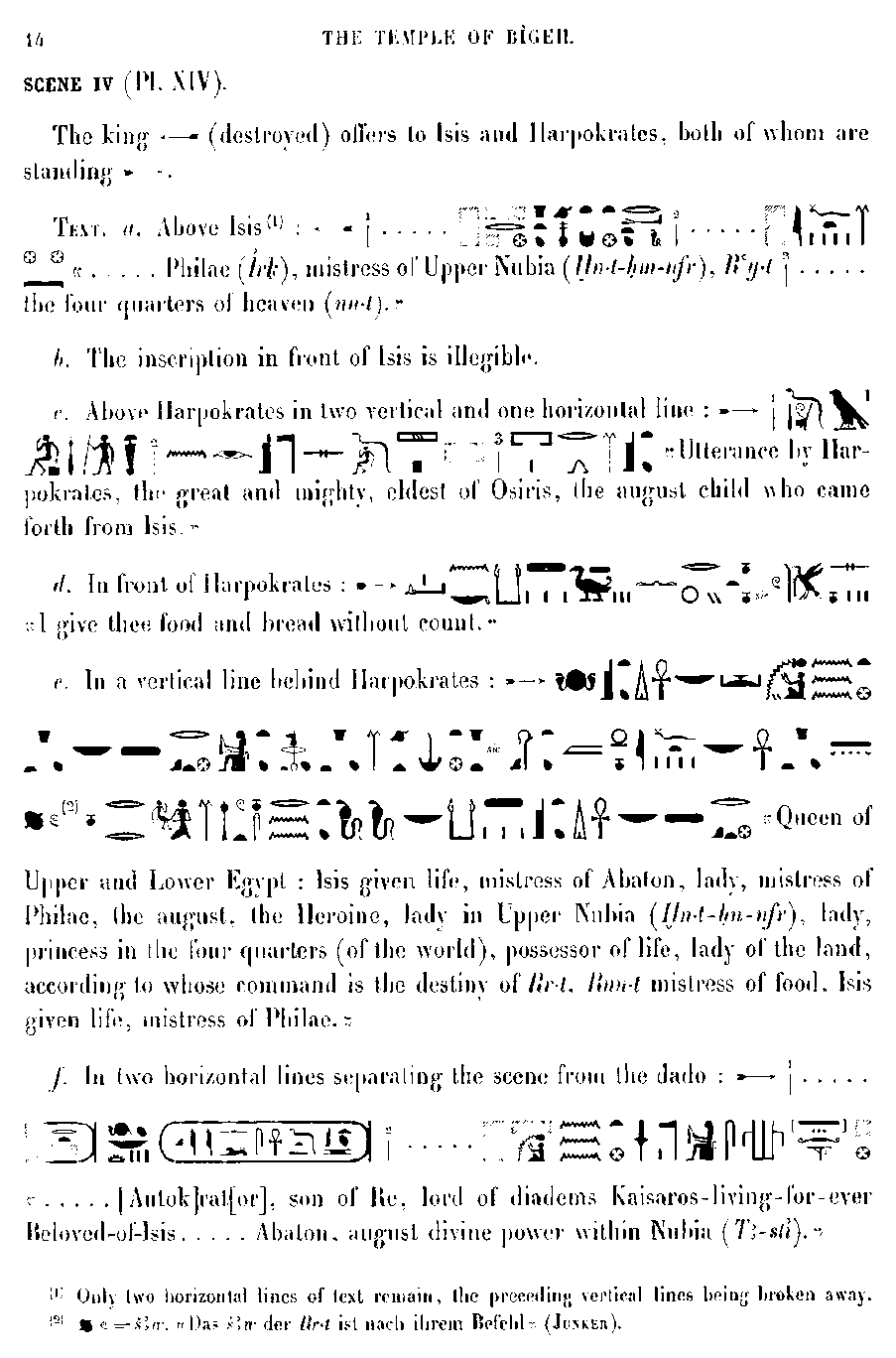
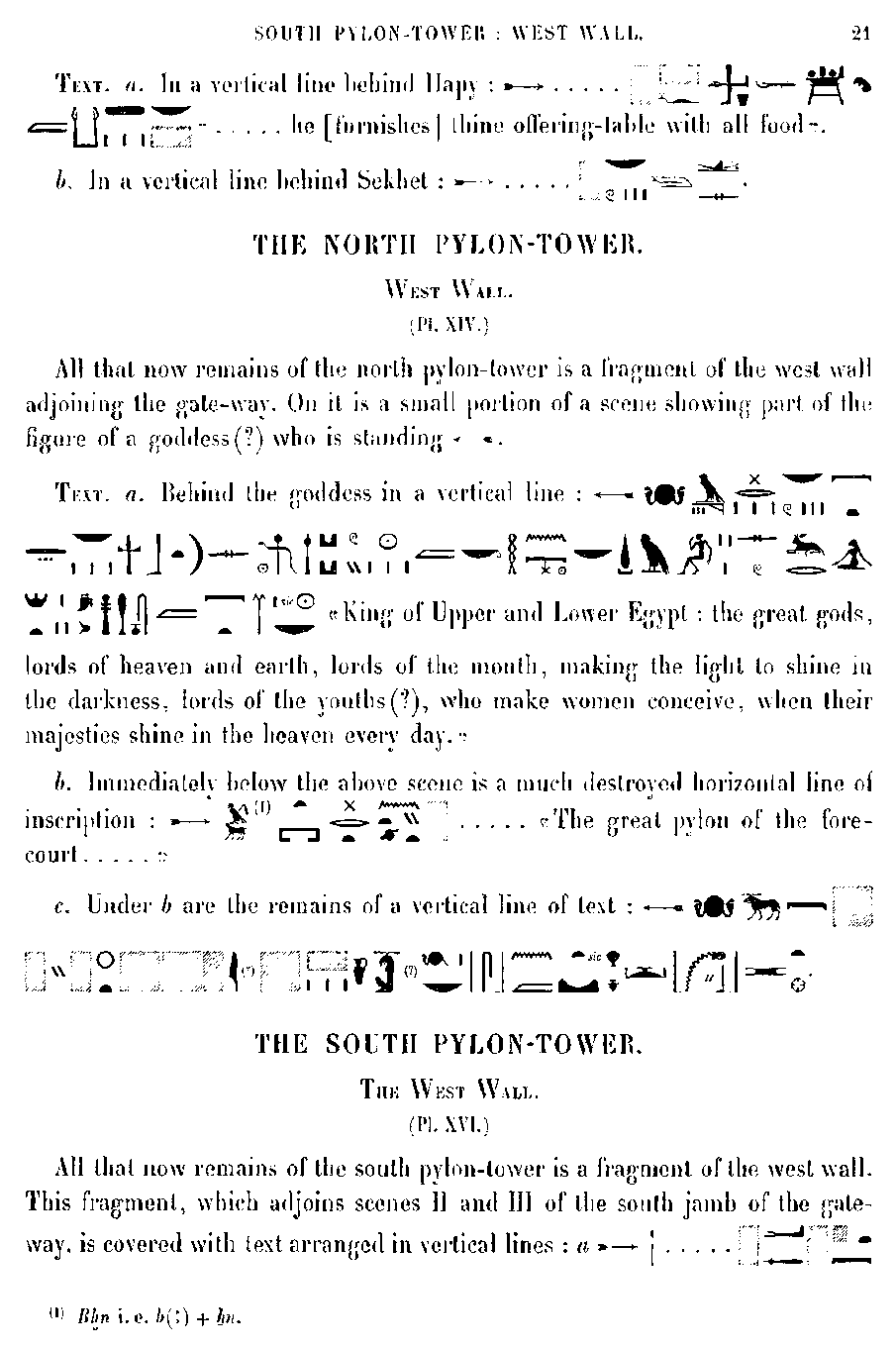
Page 6. Blackman, The Temple of Bigeh (1915), p. 6 Printed hieroglyphs from A. M. Blackman, The Temple of Bigeh (1915) - 21p. 6, l. 3
ḥnk --1Q-- [n] jt=f šps jrj.n=f [dj.t ꜥnḫ]
Offering … to his august father. He has done this that he may be given life.
- 22p. 6, l. 5
--4Q-- sꜣ wsjr --10Q--
… son of Osiris …
- 23p. 6, l. 6
jw-wꜥb --1Q--
the Abaton …
- 24p. 6, l. 7
dj=j n=k ꜥḥꜥw n rꜥ n p.t
I give you the lifespan of Ra of the sky.
- 25p. 6, l. 9
ꜥnḫ nṯr nfr
Long live the perfect god,
- 26p. 6, l. 10
...? (2) --7Q-- jt=f wsjr wnn-nfr mꜣꜥ-ḫrw nṯr ꜥꜣ nb jw-[wꜥb] --7Q-- nswt-bj.tj nb-tꜣ.wj
… his father Osiris Wennefer, vindicated, the great god, lord of the Abaton, … the king of Upper and Lower Egypt, lord of the Two Lands,
- 27p. 6, l. 11
ꜣwtkꜣrtr sꜣ-rꜥ nb-ḫꜥ.w ḳysrs-ꜥnḫ-ḏ.t-mrj-ꜣs.t
Autokrator, son of Ra, lord of crowns, Caesar, living forever, beloved of Isis.
- 28p. 6, l. 22
jj.n nswt-bj.tj
The king of Upper and Lower Egypt,
- 29p. 6, l. 23
ꜣwtgrdr ḫr=k wsjr nṯr ꜥꜣ nb jꜣ.t-wꜥb.t jnj=f n=k ḥꜥpj šmꜥw m ḳr.tj
Autokrator, has come to you, Osiris, great god, lord of the Abaton, to bring you Hapy of the South from the two caverns
Note · Line 29
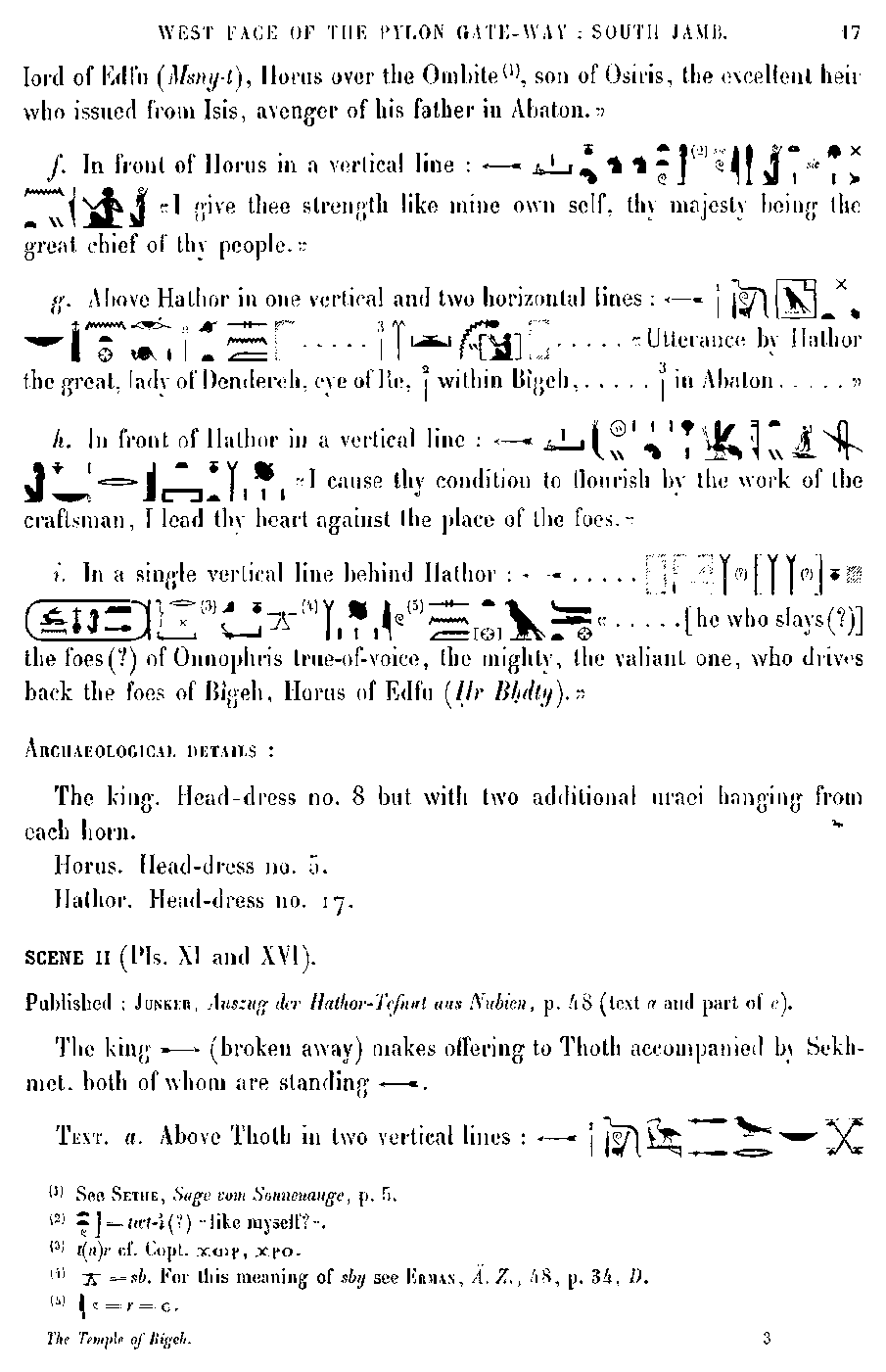
The Nile flood was believed to issue from two caverns in the region of the First Cataract. - 30p. 6, l. 24
r nw=f bꜥḥ=f ḥs.wt n kꜣ=k m --2Q-- (3) [s]nm.t
in his season, that he may flood the libation jars for your ka with … of Senmet.
Note · Line 30
Senmet is Bigeh. The libation is offered to the god’s ka, his vital force. 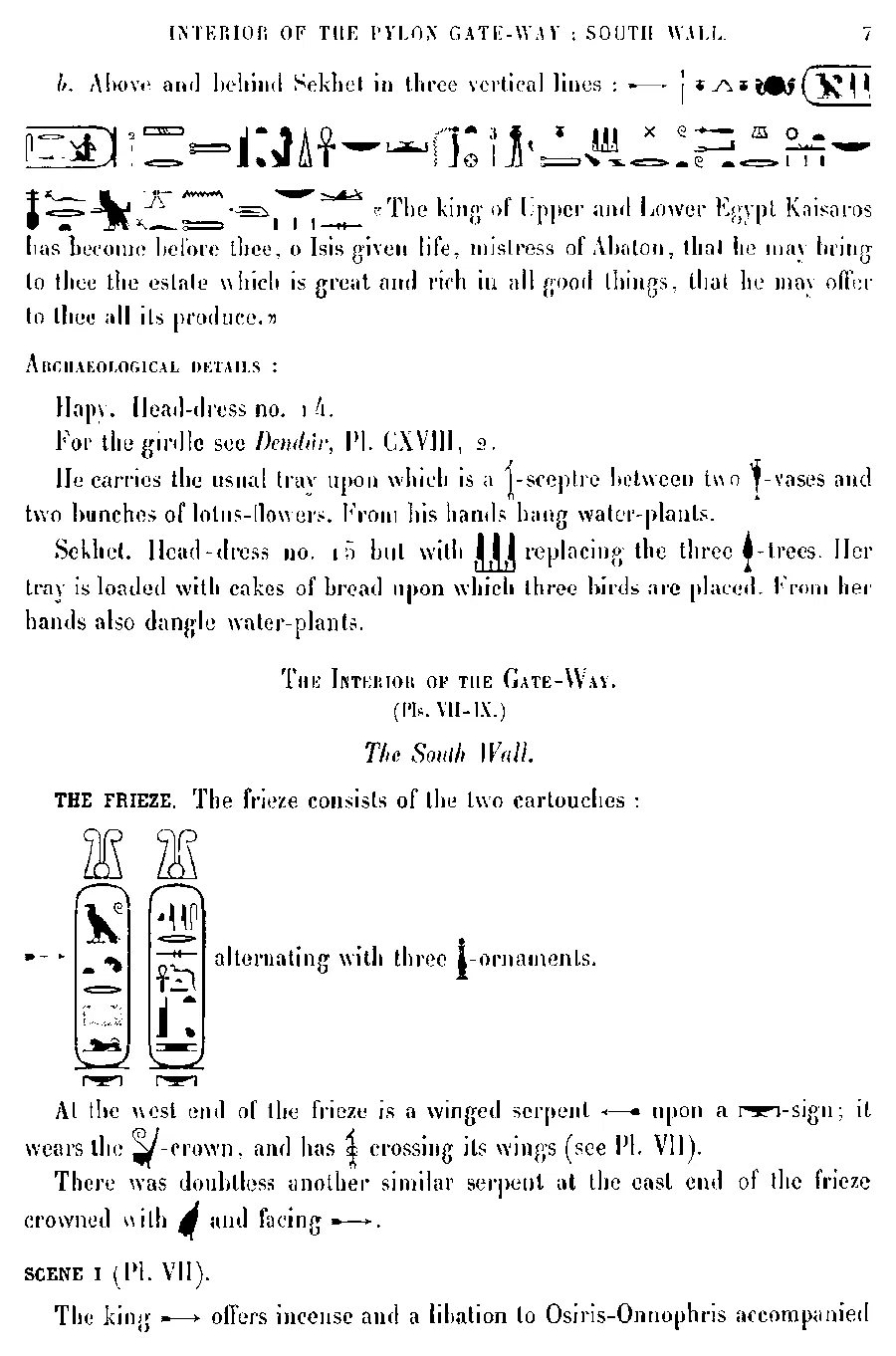
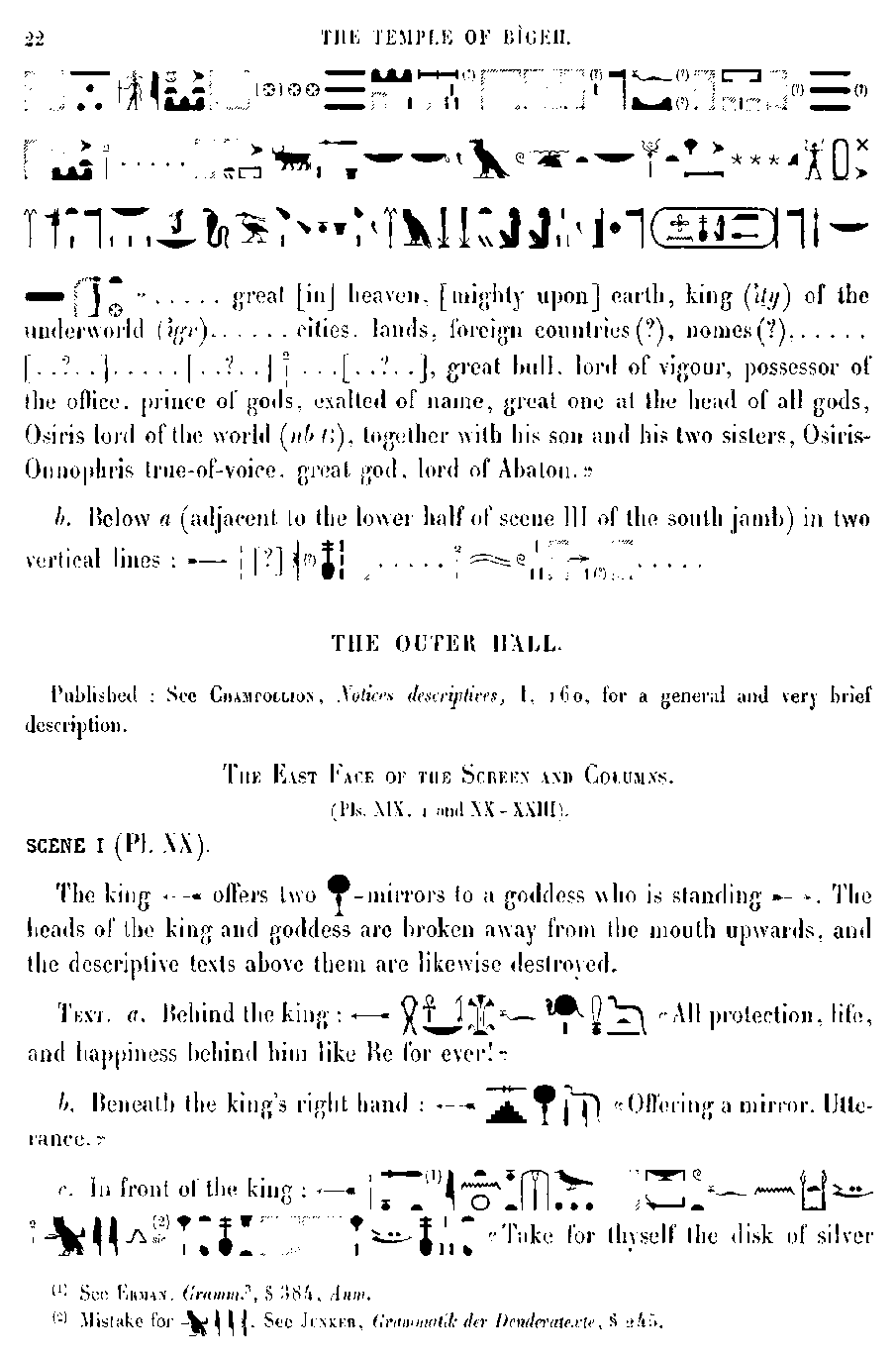
Page 7. Blackman, The Temple of Bigeh (1915), p. 7 Printed hieroglyphs from A. M. Blackman, The Temple of Bigeh (1915) - 31p. 7, l. 1
jj.n nswt-bj.tj kꜣysrs
The King of Upper and Lower Egypt, Caesar, has come
- 32p. 7, l. 2
ḫr=ṯ ꜣs.t dj.(t) ꜥnḫ nb.(t) jꜣ.t-wꜥb.t jnj=f n=ṯ sḫ.t wr.tj ꜥꜣ.tj ẖr jḫ.t nb.t.
to you, Isis, giver of life, Lady of the Abaton, to bring you the field, broad and rich, laden with every
Note · Line 32
The Abaton, the “Pure Mound,” was the sacred burial place of Osiris on Bigeh, opposite Philae. Access to it was restricted. - 33p. 7, l. 3
nfr.t ms=f n=ṯ prj.(t) nb.{w}(t) jm=s
good thing, and to present to you all that springs from it.
- 34p. 7, l. 19
ꜣwtkr[d]r ḳysrs-ꜥnḫ-ḏ.t-mrj-ꜣs.t
Autokrator, Caesar, who lives forever, beloved of Isis.
Note · Line 34
Here it forms part of the Roman emperor’s Egyptian royal name. 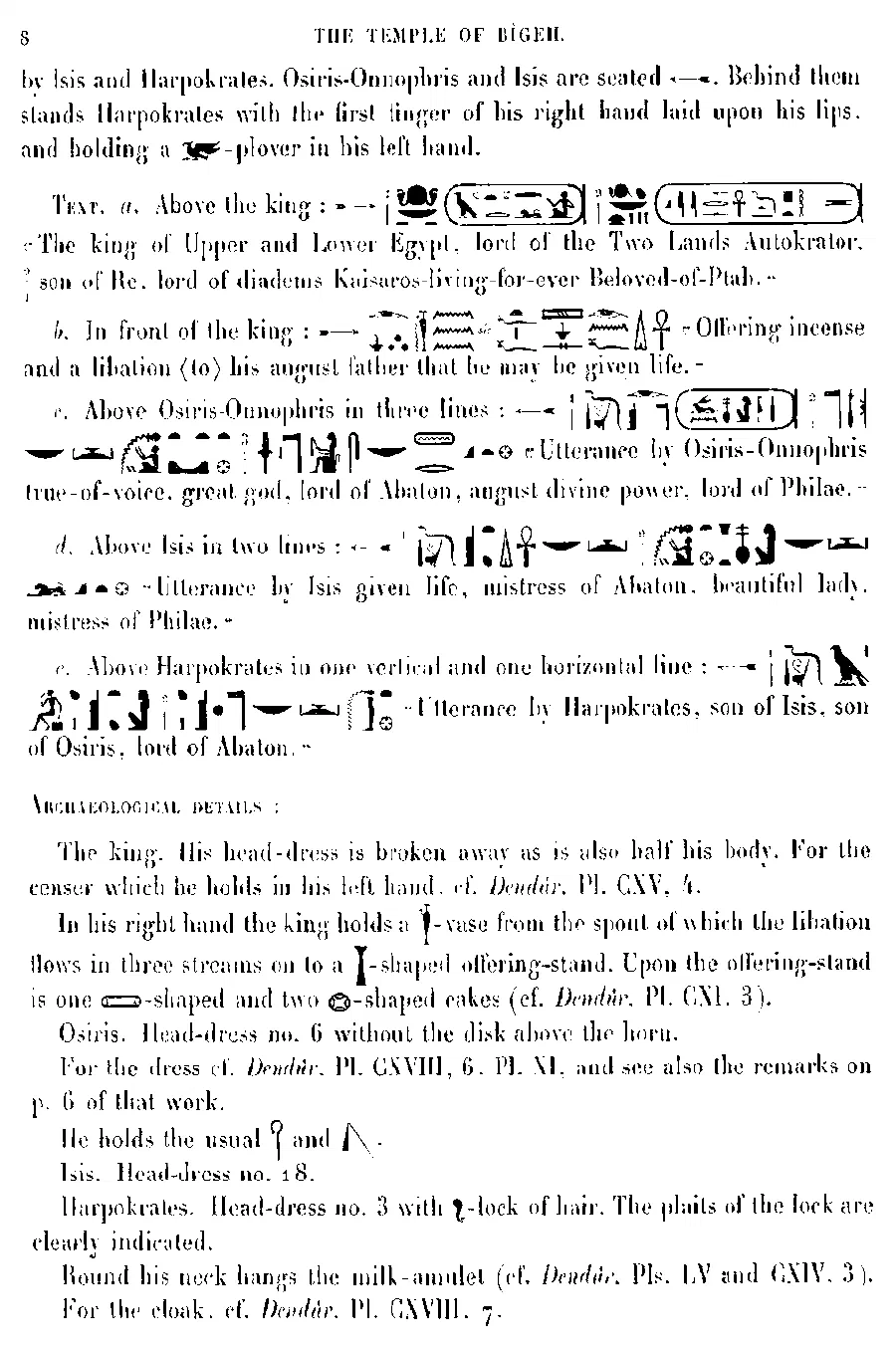
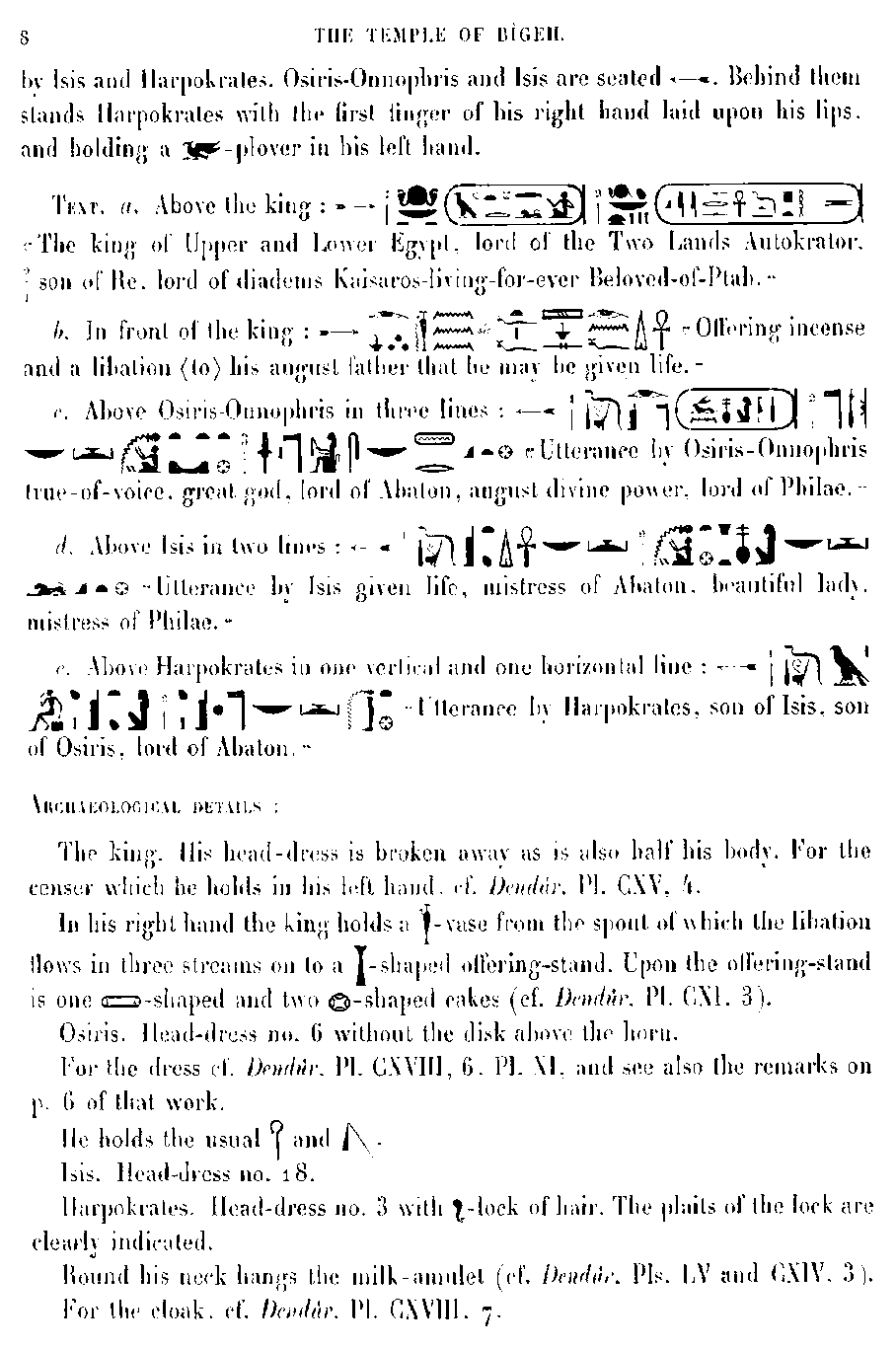
Page 8. Blackman, The Temple of Bigeh (1915), p. 8 Printed hieroglyphs from A. M. Blackman, The Temple of Bigeh (1915) - 35p. 8, l. 4
nswt-bj.tj nb-tꜣ.wj ꜣwtgrdr sꜣ-rꜥ nb-ḫꜥ.w ḳysrs-ꜥnḫ-ḏ.t-mrj-ptḥ-[ꜣs.t]
King of Upper and Lower Egypt, Lord of the Two Lands, Autokrator; Son of Ra, Lord of Crowns, Caesar, who lives forever, beloved of Ptah and Isis.
- 36p. 8, l. 7
jrj.t snṯr ḳbḥw <n> jt=f šps jrj.n=f dj.(t) ꜥnḫ
Burning incense and pouring a libation for his august father. He has done this that he may be given life.
Note · Line 36
The king’s father here is Osiris. The king offers to the god as a son to his father and receives life in return. - 37p. 8, l. 9
ḏd-mdw jn wsjr wnn-nfr mꜣꜥ-ḫrw nṯr ꜥꜣ
Words spoken by Osiris Wennefer, vindicated, the great god,
Note · Line 37
Osiris is called “vindicated” because the divine court found in his favor against Seth, his killer. - 38p. 8, l. 10
nb jꜣ.t-wꜥb.t sḫm šps nb jwrḳ
Lord of the Abaton, the august power, Lord of Philae.
- 39p. 8, l. 12
ḏd-mdw jn ꜣs.t dj.(t) ꜥnḫ nb.(t) jꜣ.t-wꜥb.t ḥnw.t nfr.(t) nb.(t) jwrḳ
Words spoken by Isis, giver of life, Lady of the Abaton, gracious mistress, Lady of Philae.
- 40p. 8, l. 15
ḏd-mdw jn ḥrw-
Words spoken by Horus
- 41p. 8, l. 16
pꜣ-ẖrd sꜣ ꜣs.t sꜣ wsjr nb jꜣ.t-wꜥb.t
the Child, son of Isis, son of Osiris, Lord of the Abaton.
Note · Line 41
Horus the Child is the god known in Greek as Harpocrates. 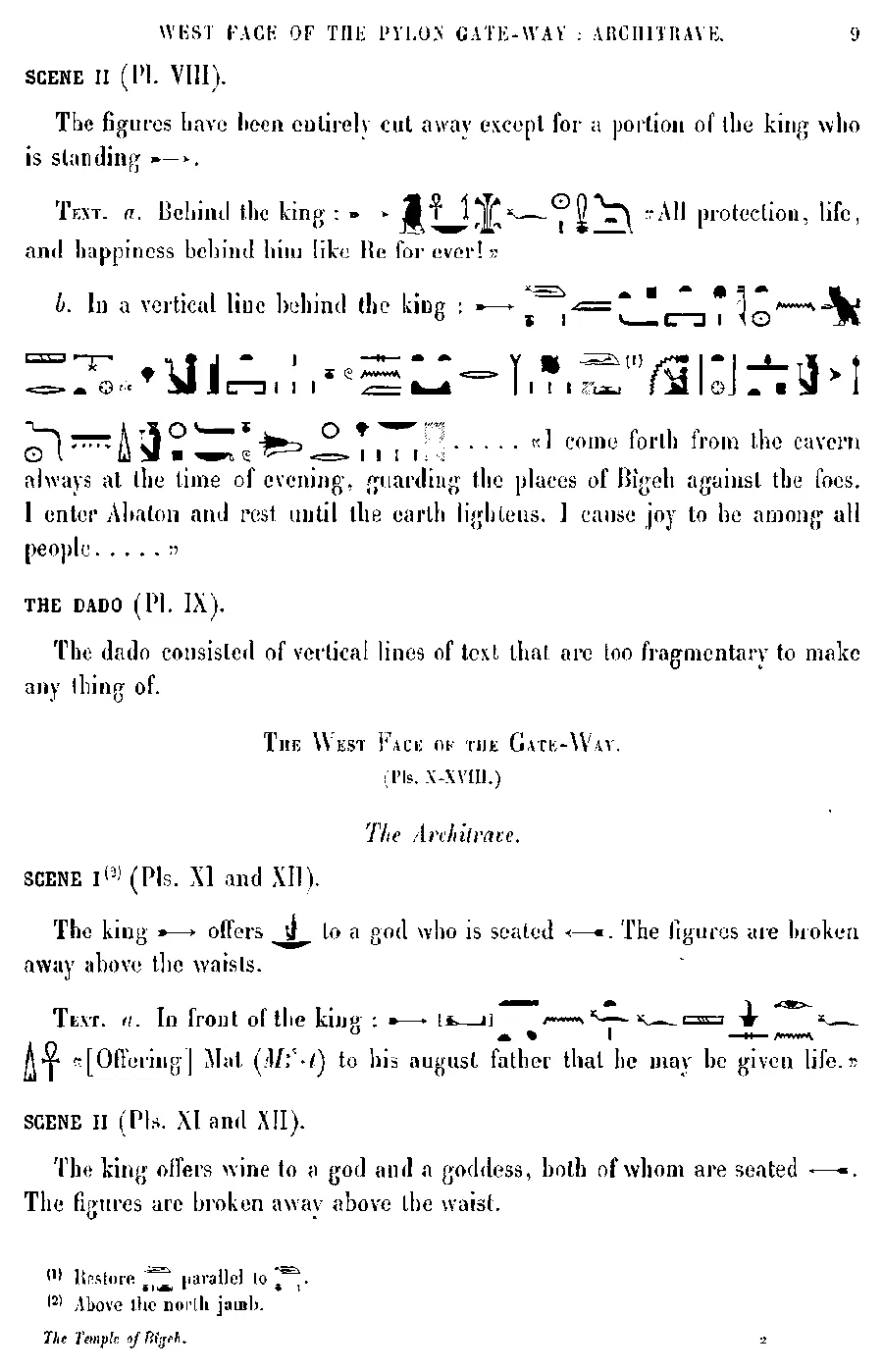
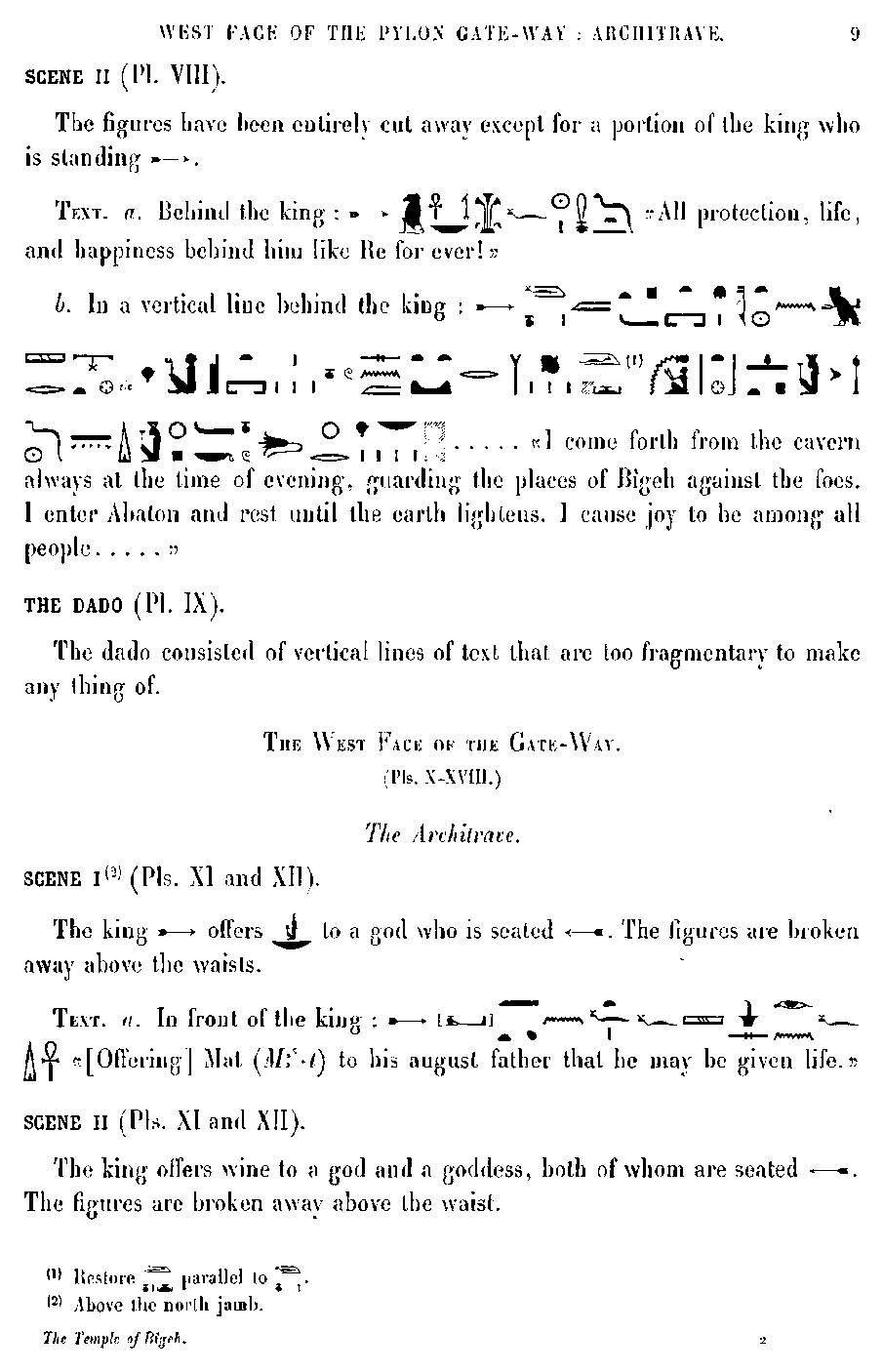
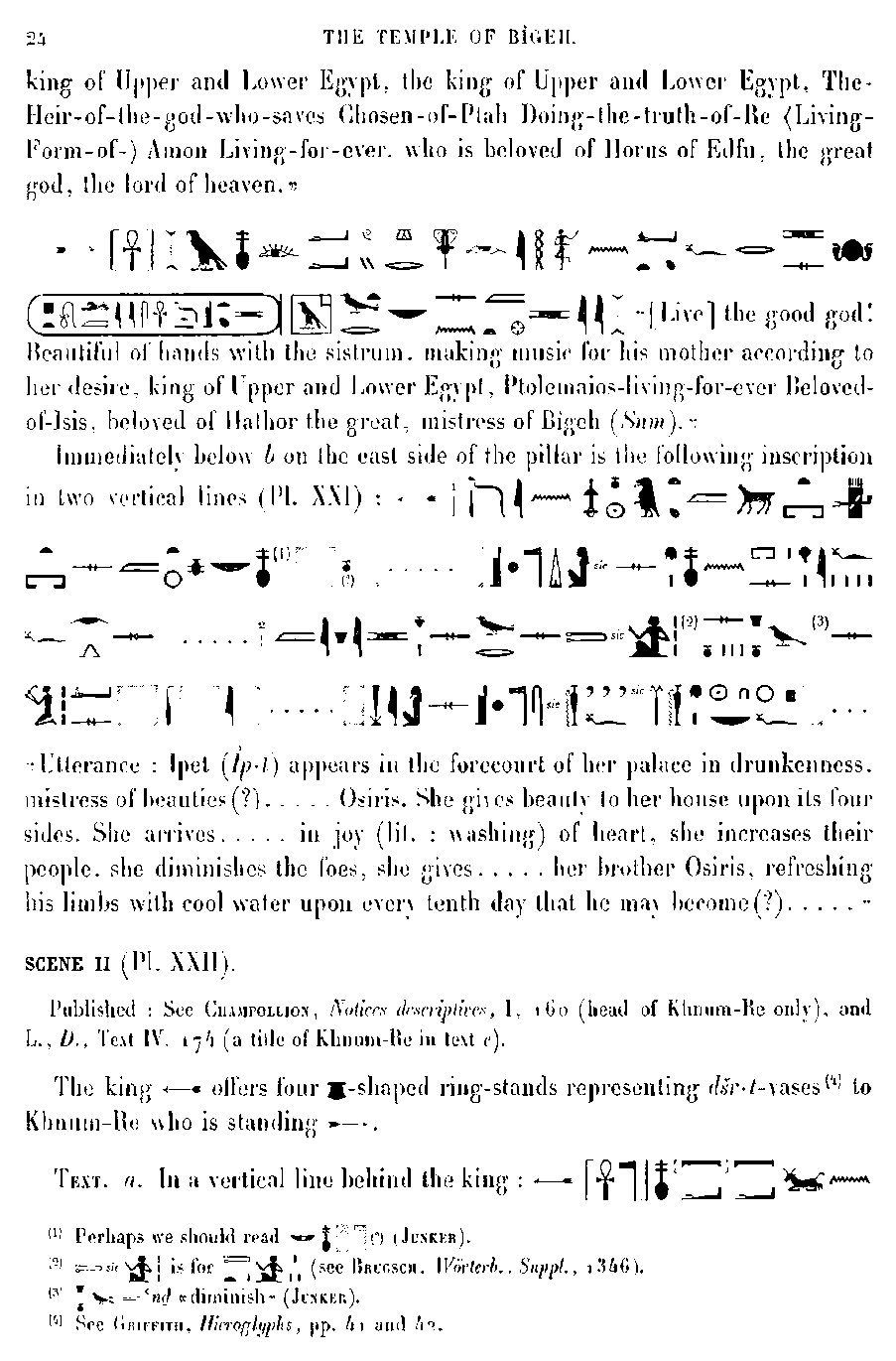
Page 9. Blackman, The Temple of Bigeh (1915), p. 9 Printed hieroglyphs from A. M. Blackman, The Temple of Bigeh (1915) - 42p. 9, l. 4
sꜣ ꜥnḫ wꜣs nb ḥꜣ=f mj rꜥ ḏ.t
All protection, life and dominion are behind him, as they are behind Ra, forever.
Note · Line 42
This blessing is for the king. In temple scenes it often stands behind his figure, just where the words place his protection. - 43p. 9, l. 6
prj.n=j m ṯpḥ.t tp tr n mšrw
I have come forth from the cavern at dusk
- 44p. 9, l. 7
ḥr sꜣw s.wt n snm.t r sbj.w ꜥḳ.[n=j] jꜣ.t-wꜥb.t ḥtp=j r
to guard the places of Senmet against rebels. I have entered the Abaton, where I rest until
- 45p. 9, l. 8
ḥḏ-tꜣ dj=j ḫpr ḥkn ḫr ḥr-nb --2Q--
daybreak, and I stir everyone to praise …
- 46p. 9, l. 21
[ḥnk] mꜣꜥ.t n jt=f šps jrj.n=f
Offering Maat to his august father. He has done this that he may be
Note · Line 46
Maat is truth and right order, personified as a goddess. In this rite the king offers her image. - 47p. 9, l. 22
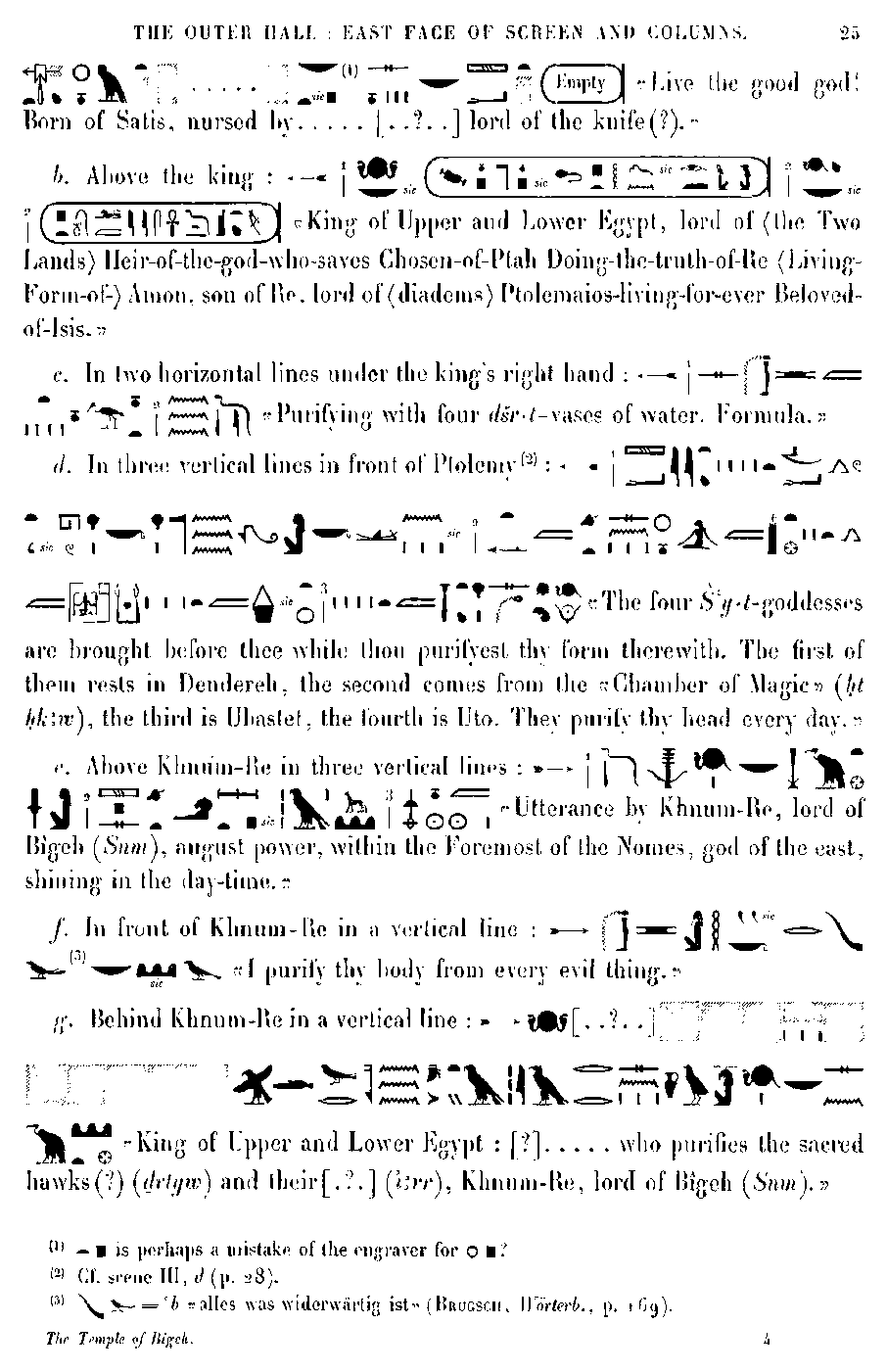
dj.(t) ꜥnḫ
given life.
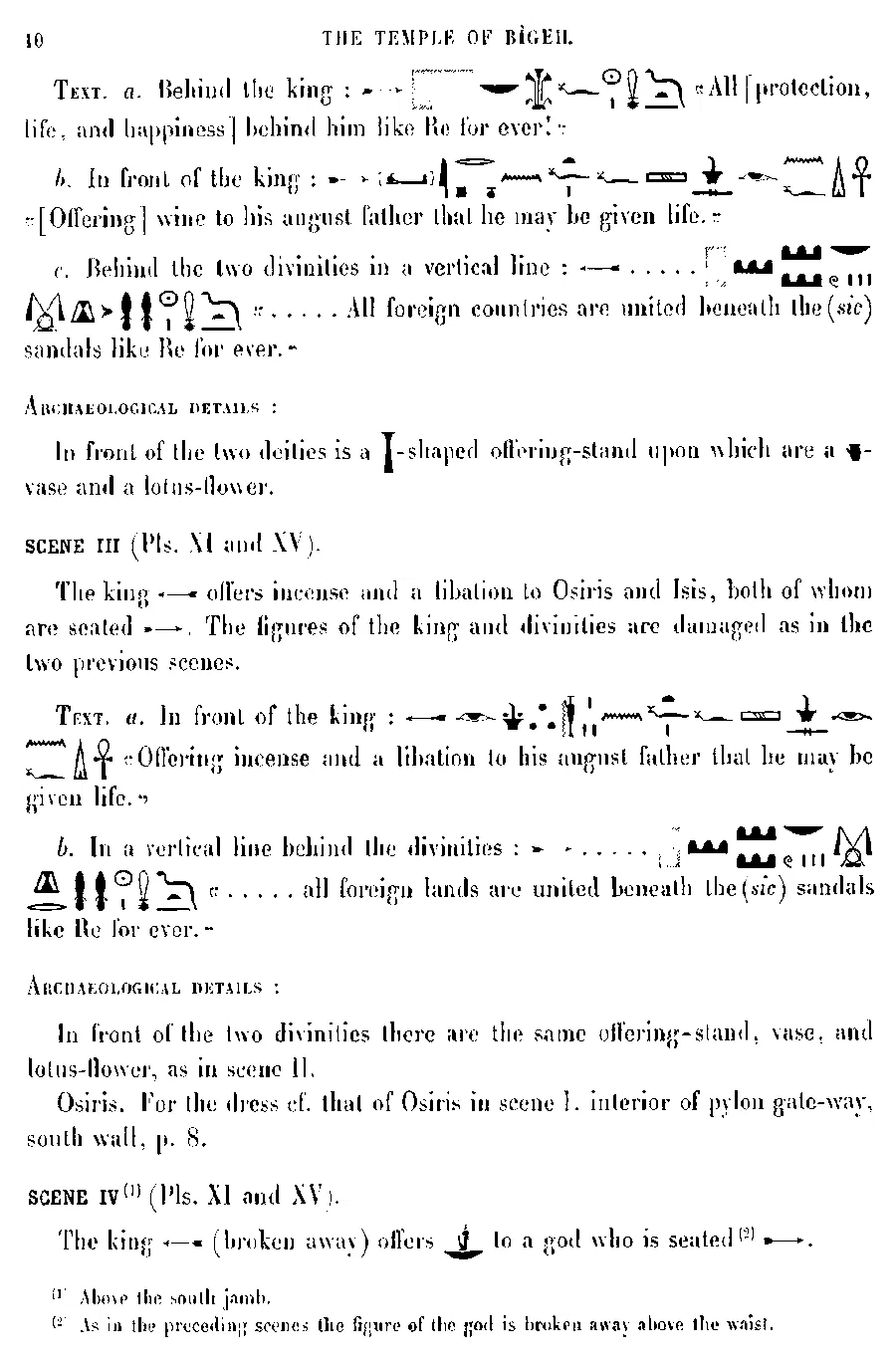
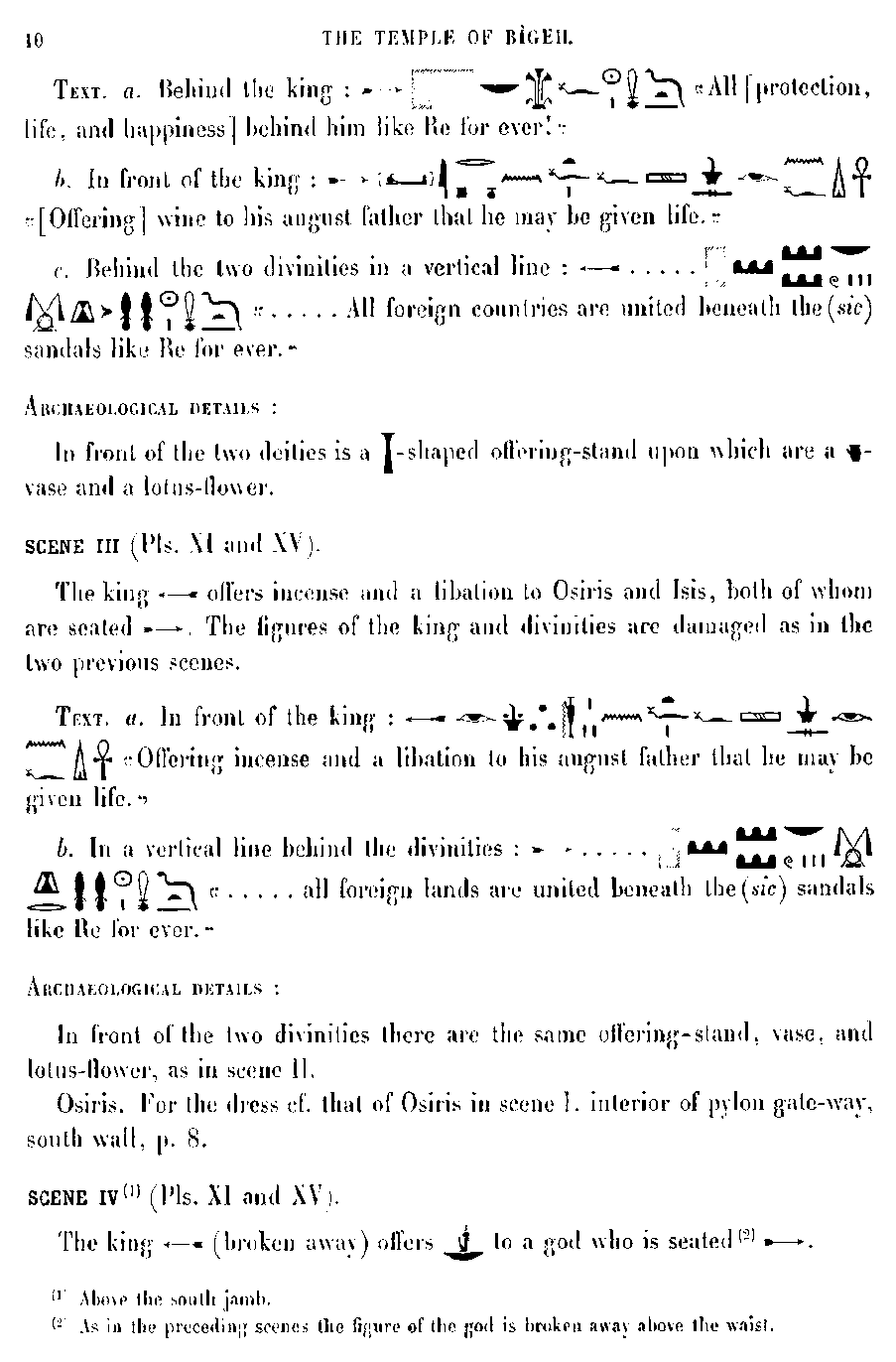
Page 10. Blackman, The Temple of Bigeh (1915), p. 10 Printed hieroglyphs from A. M. Blackman, The Temple of Bigeh (1915) - 48p. 10, l. 1
[sꜣ ꜥnḫ wꜣs] nb ḥꜣ=f mj rꜥ ḏ.t
All protection, life and dominion are behind him, as they are behind Ra, forever.
- 49p. 10, l. 3
[ḥnk] jrp n jt=f šps jrj.n=f dj.(t) ꜥnḫ
Offering wine to his august father. He has done this that he may be given life.
- 50p. 10, l. 5
--détruit-- ḫꜣs.wt nb.w(t)
… all foreign lands,
- 51p. 10, l. 6
dmḏ.(wt) ẖr ṯb.tj mj rꜥ ḏ.t
gathered beneath your two sandals as beneath Ra’s, forever.
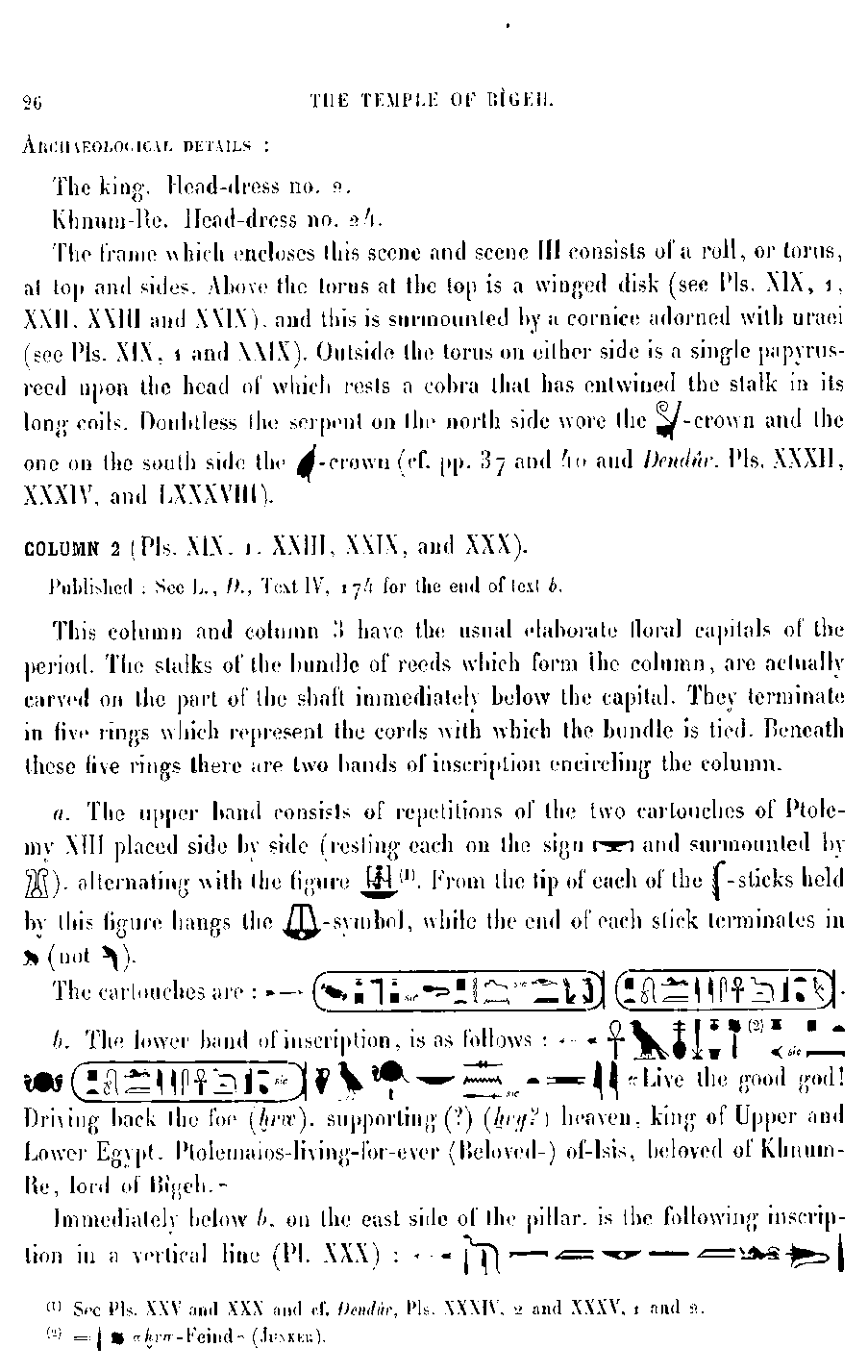
Note · Line 51
The lands beneath the king’s feet are an image of his rule over them. - 52p. 10, l. 15
jrj.t snṯr ḳbḥw n jt=f šps jrj.n=f
Burning incense and pouring a libation for his august father. He has done this that he may be
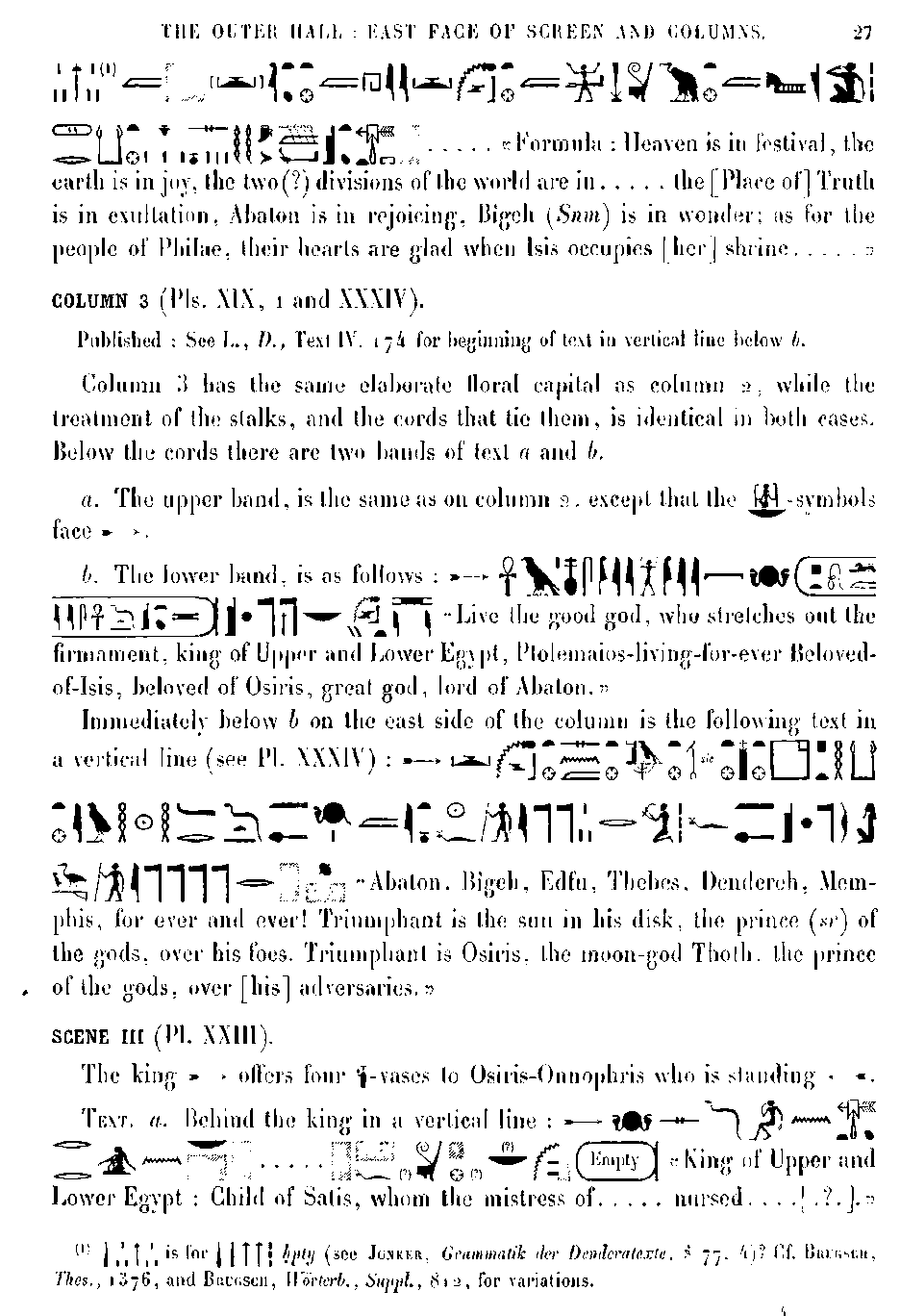
- 53p. 10, l. 16
dj.(t) ꜥnḫ
given life.
- 54p. 10, l. 18
--détruit-- ḫꜣs.wt nb.w(t) dmḏ.(wt)
… all foreign lands, gathered
- 55p. 10, l. 19
ẖr ṯb.tj mj-rꜥ-ḏ.t
beneath your two sandals as beneath Ra’s, forever.
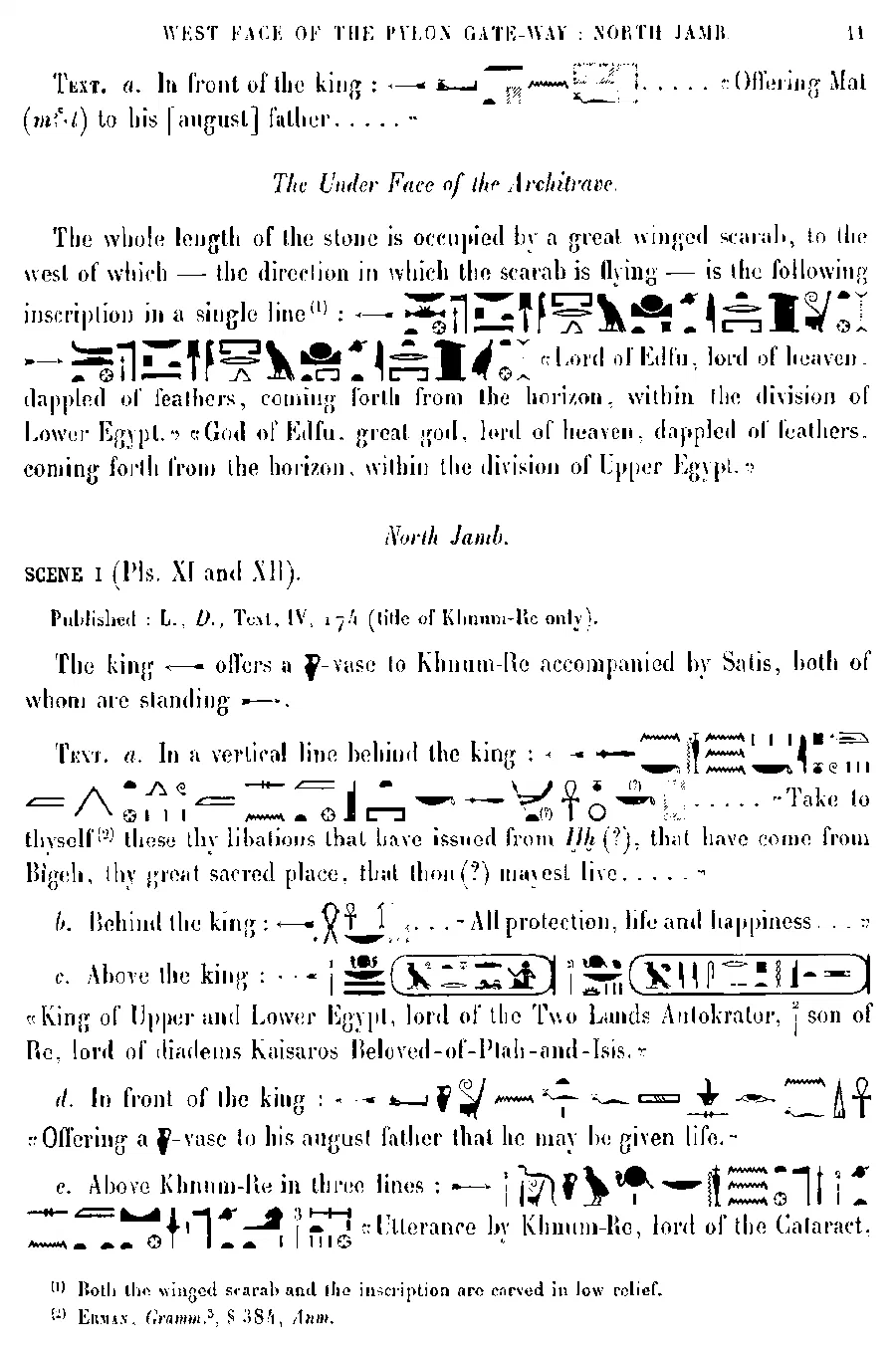
Page 11. Blackman, The Temple of Bigeh (1915), p. 11 Printed hieroglyphs from A. M. Blackman, The Temple of Bigeh (1915) - 56p. 11, l. 1
ḥnk mꜣꜥ.t n [jt]=f --détruit--
Offering Maat to his father …
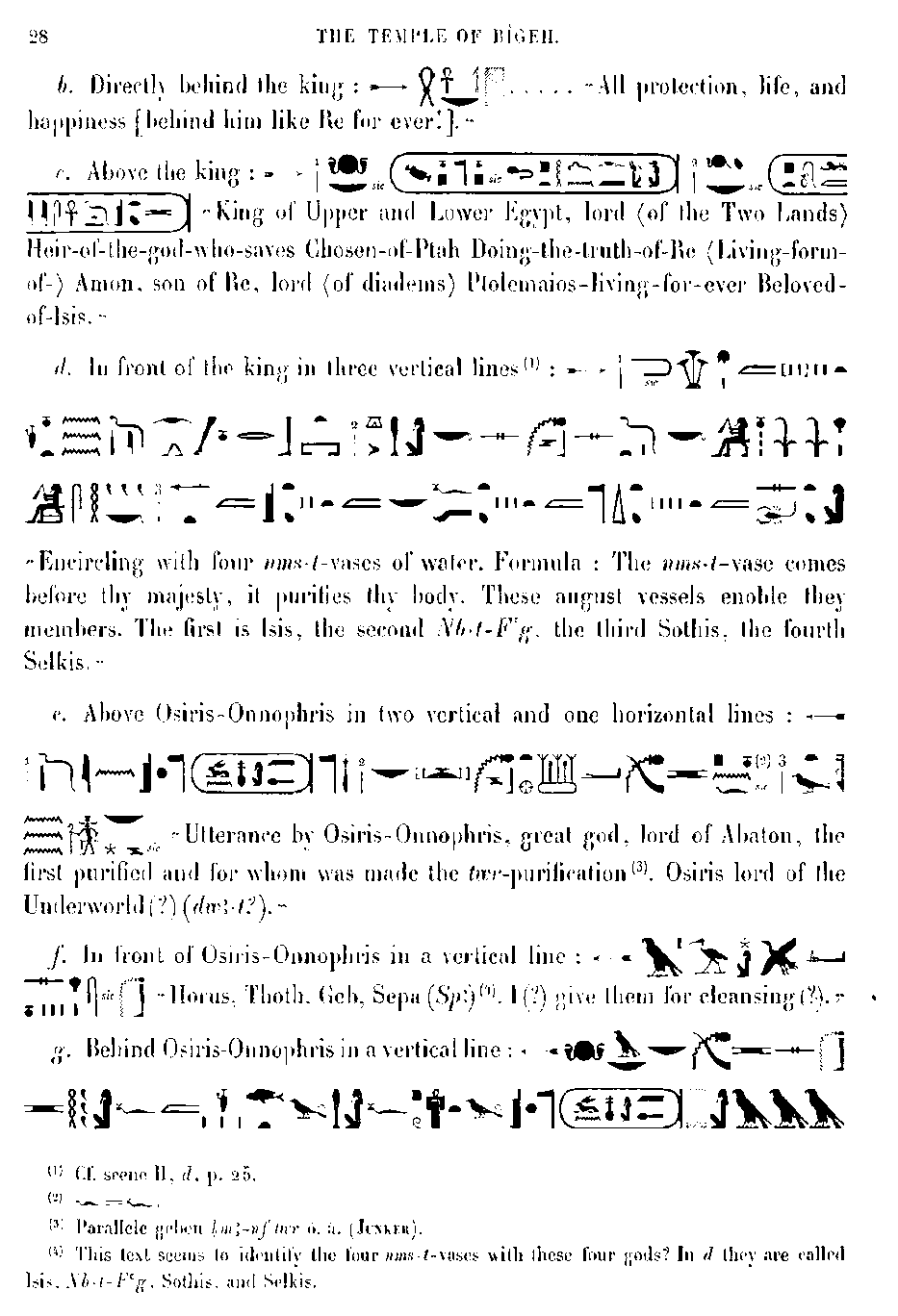
- 57p. 11, l. 6
nb msn nṯr ꜥꜣ nb p.t sꜣb šw.t prj m ꜣḫ.t ḫnt.j jtr.t mḥw
Lord of Mesen, the great god, Lord of the Sky, whose feathers are of many colors, who comes forth from the horizon and presides over the northern shrine.
- 58p. 11, l. 7
bḥd.tj nṯr ꜥꜣ nb p.t sꜣb šw.t prj m ꜣḫ.t ḫnt.j jtr.t šmꜥw
He of Behdet, the great god, Lord of the Sky, whose feathers are of many colors, who comes forth from the horizon and presides over the southern shrine.
Note · Line 58
He of Behdet is Horus of Edfu, the falcon god. - 59p. 11, l. 16
mn n=k ḳbḥ.w=k jpn prj=w
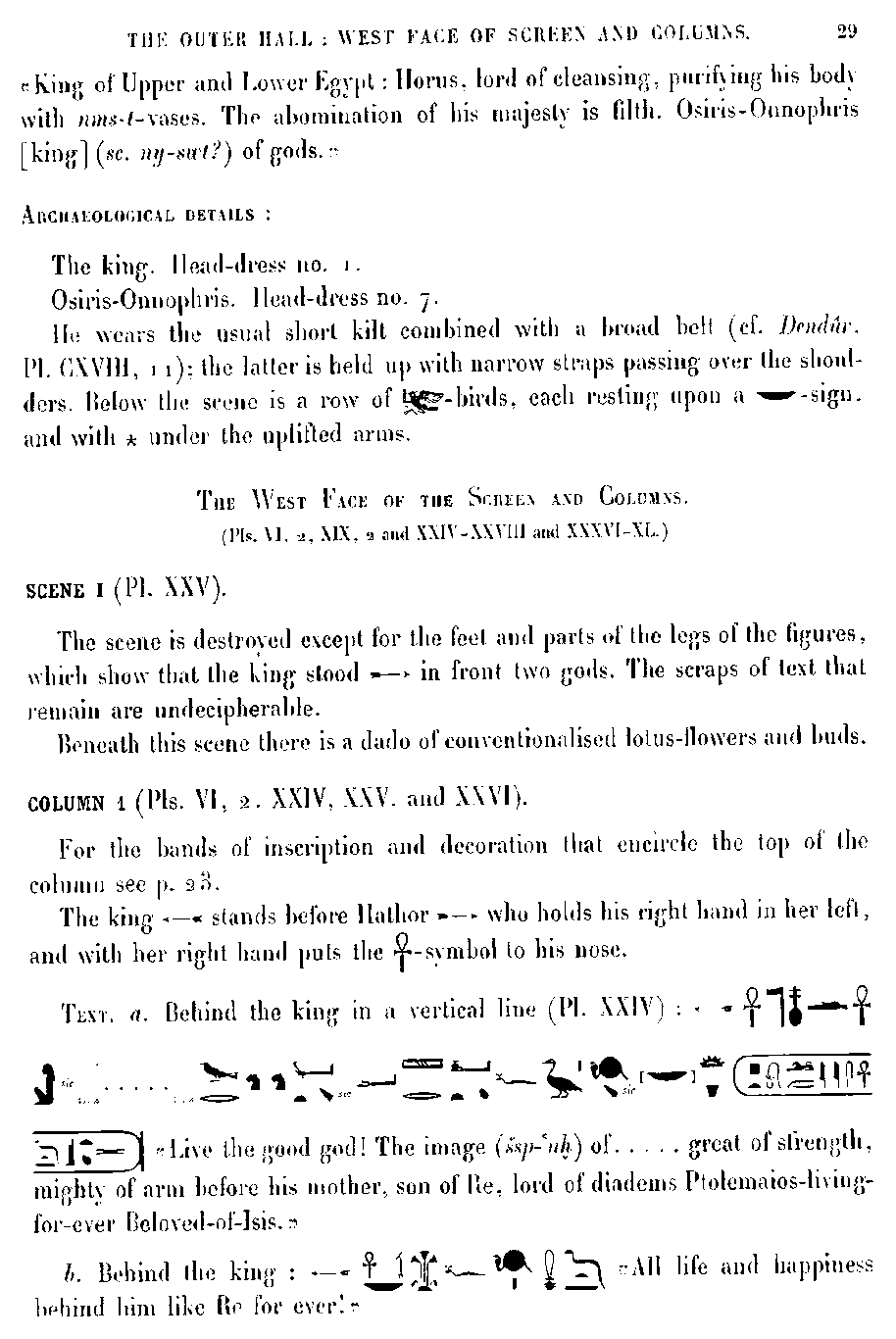
Receive these libation vessels of yours. They come forth
- 60p. 11, l. 17
m swnw jw=w m snm.t s.t=k ꜥꜣ.(t) ḏsr.t ꜥnḫ=k --12Q--
from Aswan; they come from Senmet, your great and sacred place, where you live …
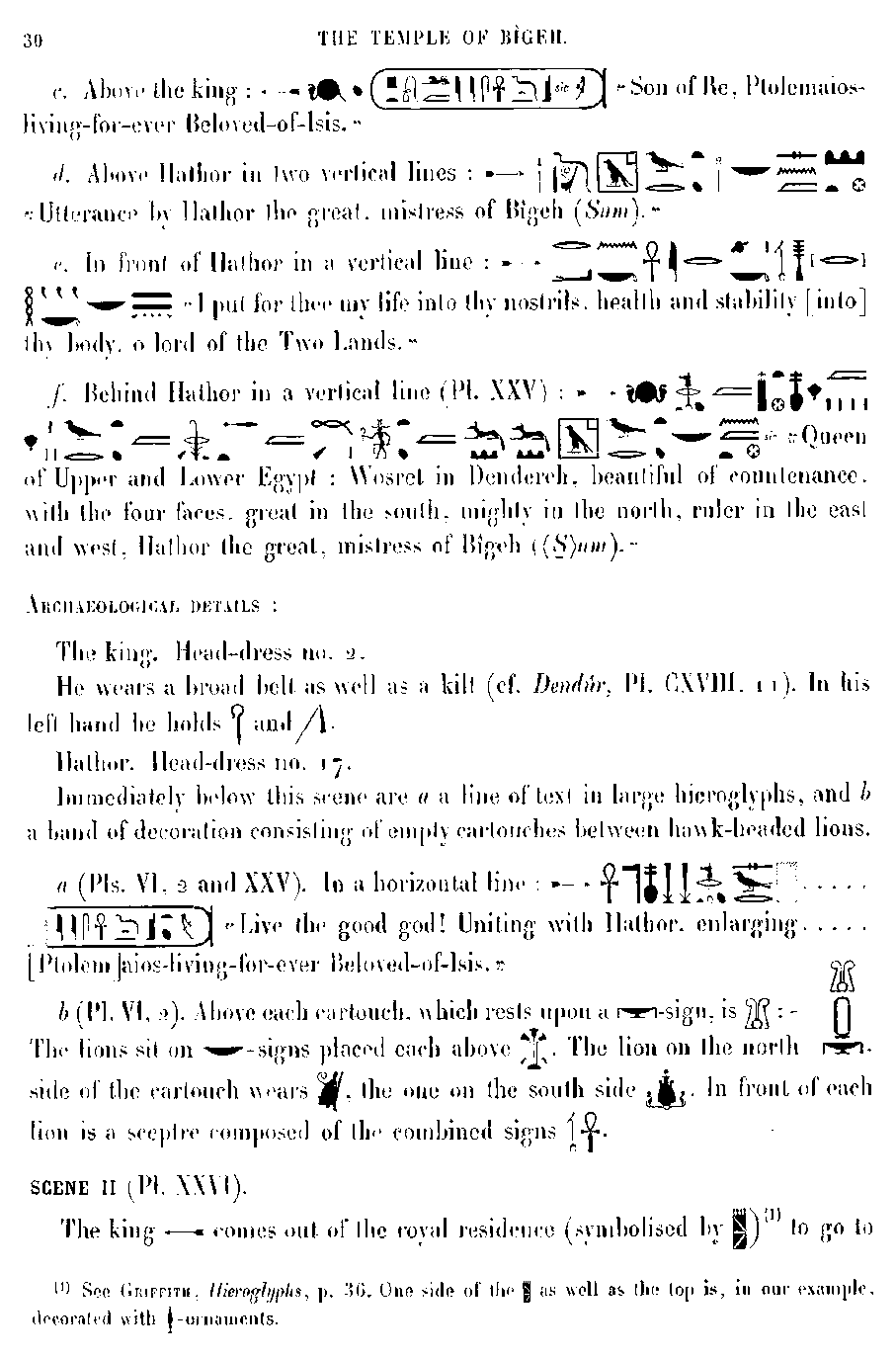
- 61p. 11, l. 20
sꜣ ꜥnḫ wꜣs nb [ḥꜣ=f mj rꜥ ḏ.t]
All protection, life and dominion are behind him as they are behind Ra, forever.
- 62p. 11, l. 21
nswt-bj.tj nb-tꜣ.wj ꜣwtgrdr sꜣ-rꜥ nb-ḫꜥ.w kꜣysrs-mrj-ptḥ-ꜣs.t
King of Upper and Lower Egypt, lord of the Two Lands, Autokrator; son of Ra, lord of crowns, Caesar, beloved of Ptah and Isis.
Note · Line 62
The Roman emperor bears the titles of a pharaoh. - 63p. 11, l. 24
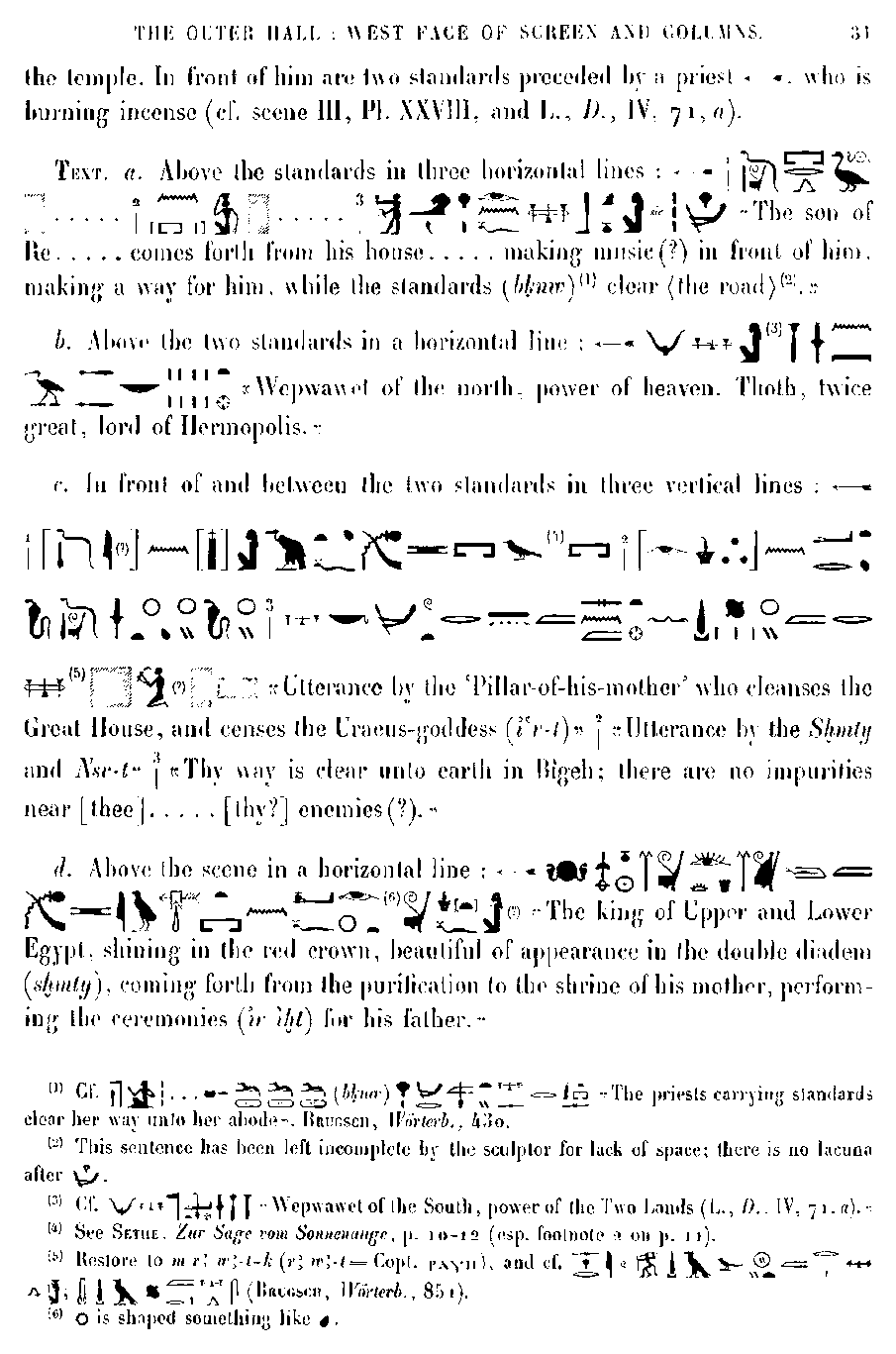
ḥnk ẖnm.t n jt=f šps jrj.n=f dj.(t) ꜥnḫ
Offering the henem-vase to his noble father. He has done this so that his father may give him life.
Note · Line 63
The king offers the vase to Khnum. Its Egyptian name echoes the god’s name. - 64p. 11, l. 26
ḏd-mdw jn ẖnmw-rꜥ nb ḳbḥw nṯr ꜥꜣ ḫnt.j
Words spoken by Khnum-Ra, lord of the springs, the great god who presides over
Note · Line 64
The springs are the sources of the Nile, believed to lie in the cataract region near Philae. - 65p. 11, l. 27
snm.t sḫm šps ḫnt.j ḥꜣ.t-spꜣ.wt
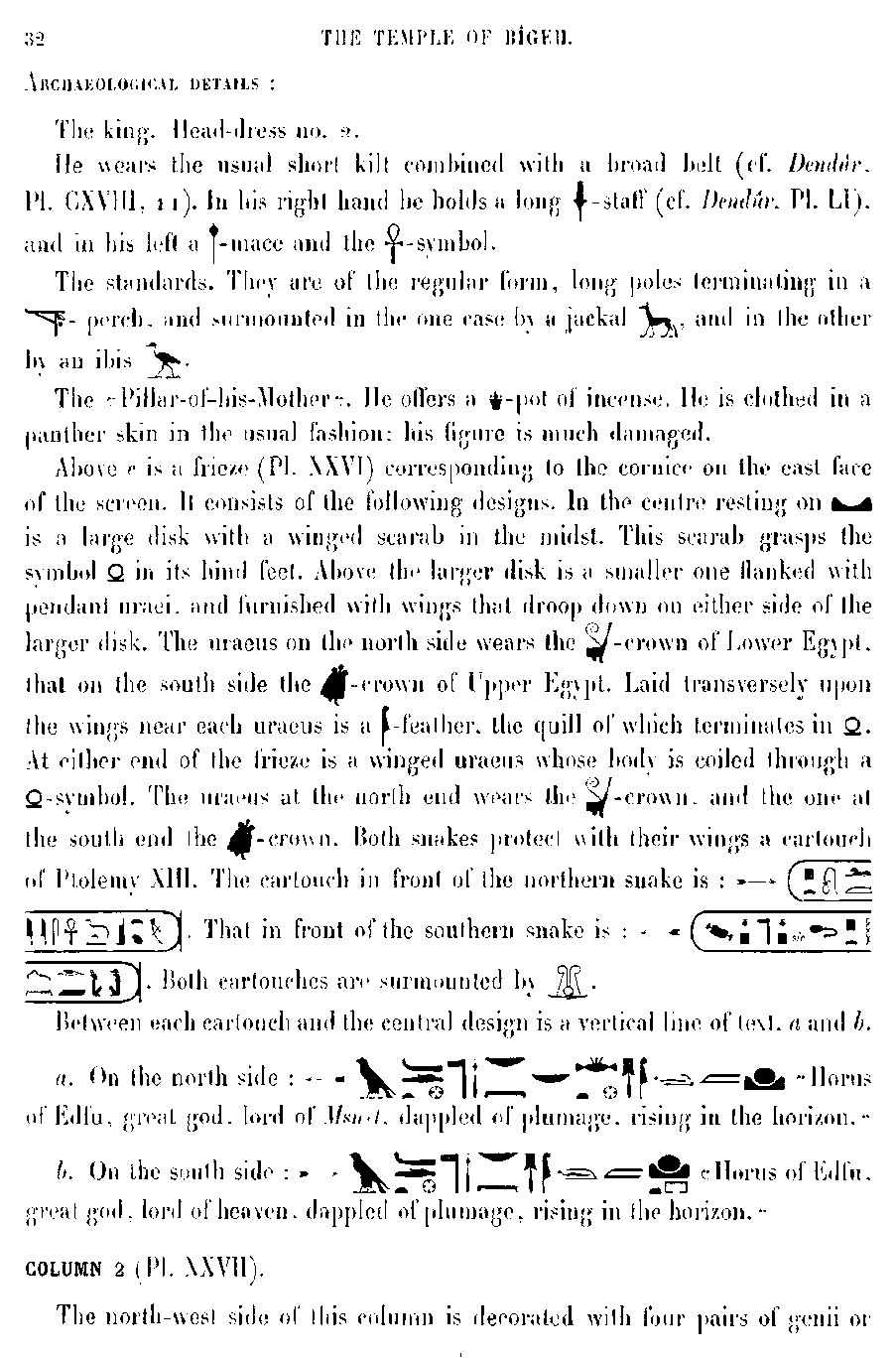
Senmet, the noble power who presides over the first of the nomes:
Note · Line 65
The first nome was the southernmost province of Upper Egypt. 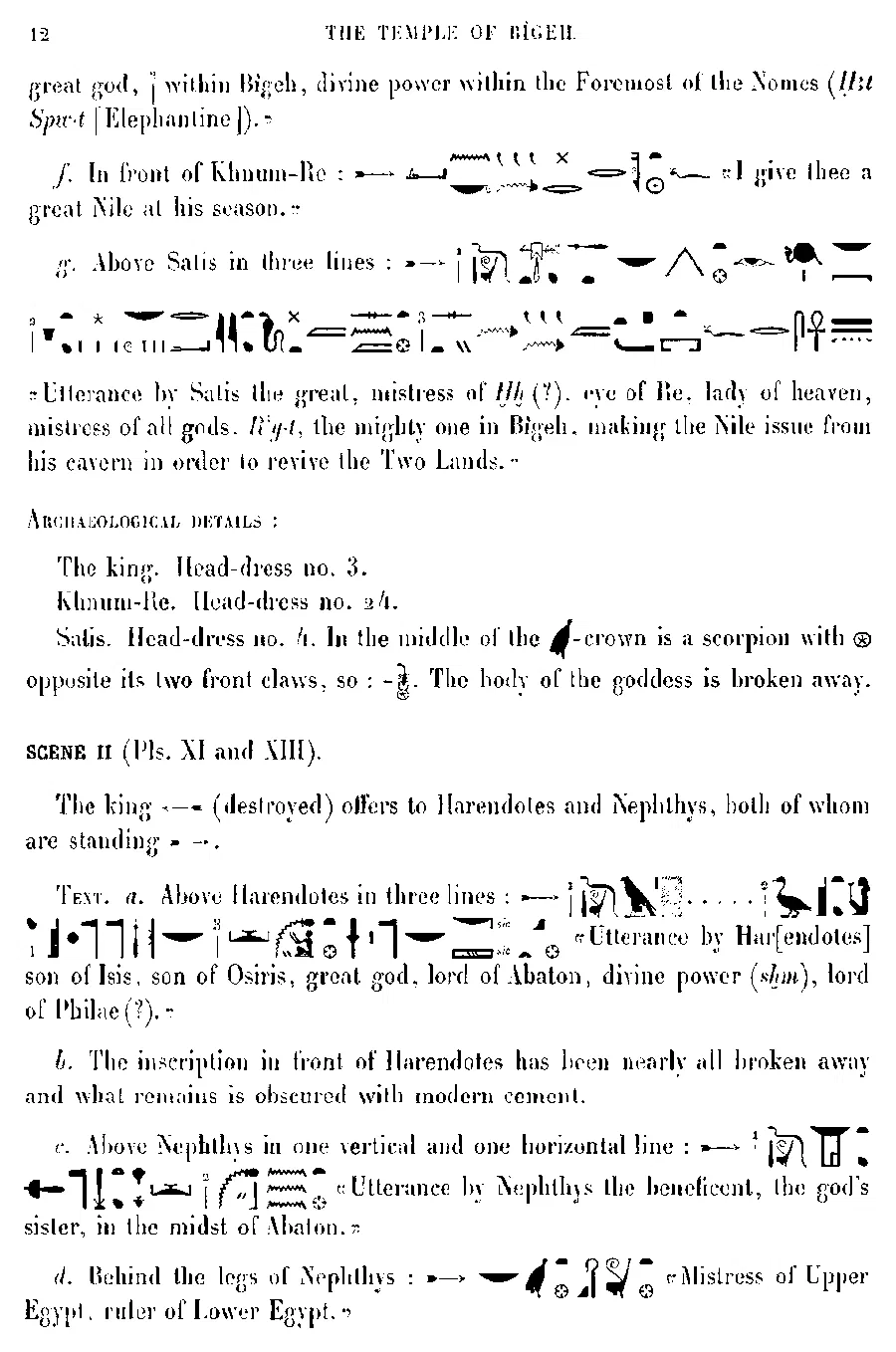
Page 12. Blackman, The Temple of Bigeh (1915), p. 12 Printed hieroglyphs from A. M. Blackman, The Temple of Bigeh (1915) - 66p. 12, l. 3
dj=(j) n=k ḥꜥpj wr r tr=f
I give you Hapy, high in his season.
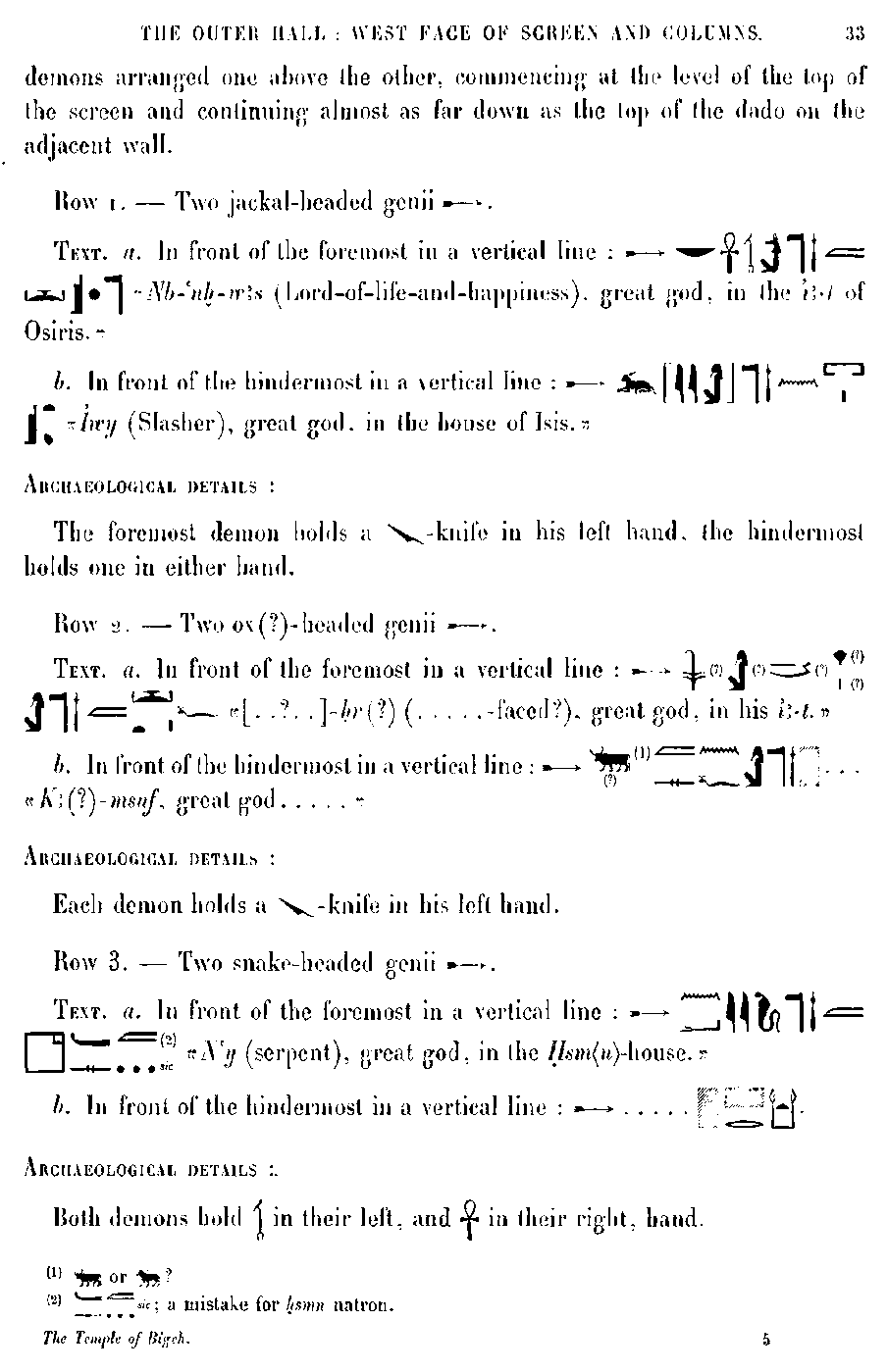
Note · Line 66
Hapy is the annual Nile flood in divine form. Khnum promises the king a high flood at the proper time. - 67p. 12, l. 5
ḏd-mdw jn st.t ꜥꜣ.t nb.(t) swnw jr.t rꜥ nb.(t) p.t
Words spoken by Satis the Great, lady of Swenet, Eye of Ra, lady of heaven,
Note · Line 67
Swenet is modern Aswan. The Eye of Ra is the sun god’s power embodied in a goddess. - 68p. 12, l. 6
ḥnw.t nṯr.w nb.w rꜥ.t wr.t m snm.t sṯj.(t) ḥꜥpj m ṯpḥ.t=f r sꜥnḫ tꜣ.wj
mistress of all the gods, the great Raet in Senmet, who pours Hapy from his cavern to give life to the Two Lands.
Note · Line 68
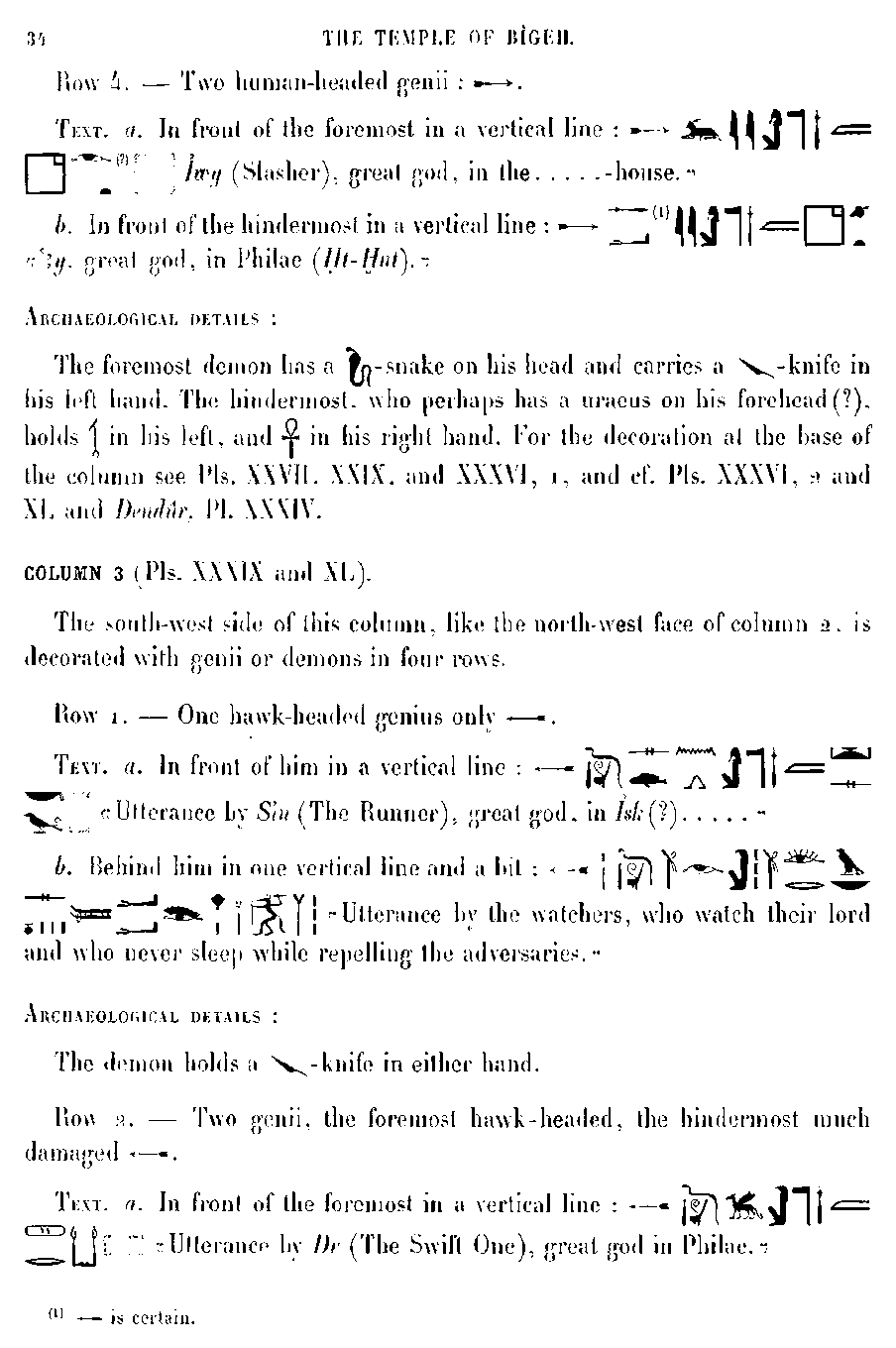
Raet is the female counterpart of Ra. The Egyptian word for “pours” echoes the name of Satis. - 69p. 12, l. 18
ḏd-mdw jn ḥrw --3Q-- sꜣ ꜣs.t
Words spoken by Horus … son of Isis,
- 70p. 12, l. 19
sꜣ wsjr nṯr ꜥꜣ nb jꜣ.t-wꜥb.t sḫm <šps> nb jwrḳ
son of Osiris, the great god, lord of the Abaton, the noble power, lord of Philae.
- 71p. 12, l. 24
ḏd-mdw jn nb.t-ḥw.t
Words spoken by Nephthys,
- 72p. 12, l. 25
mnḫ.(t) sn.t-nṯr ḥr.j.(t)-jb jꜣ.t-wꜥb.t
the excellent one, the god’s sister, who dwells in the Abaton,
- 73p. 12, l. 27
nb.(t) šmꜥw ḥḳꜣ.(t) mḥw
lady of Upper Egypt, ruler of Lower Egypt:
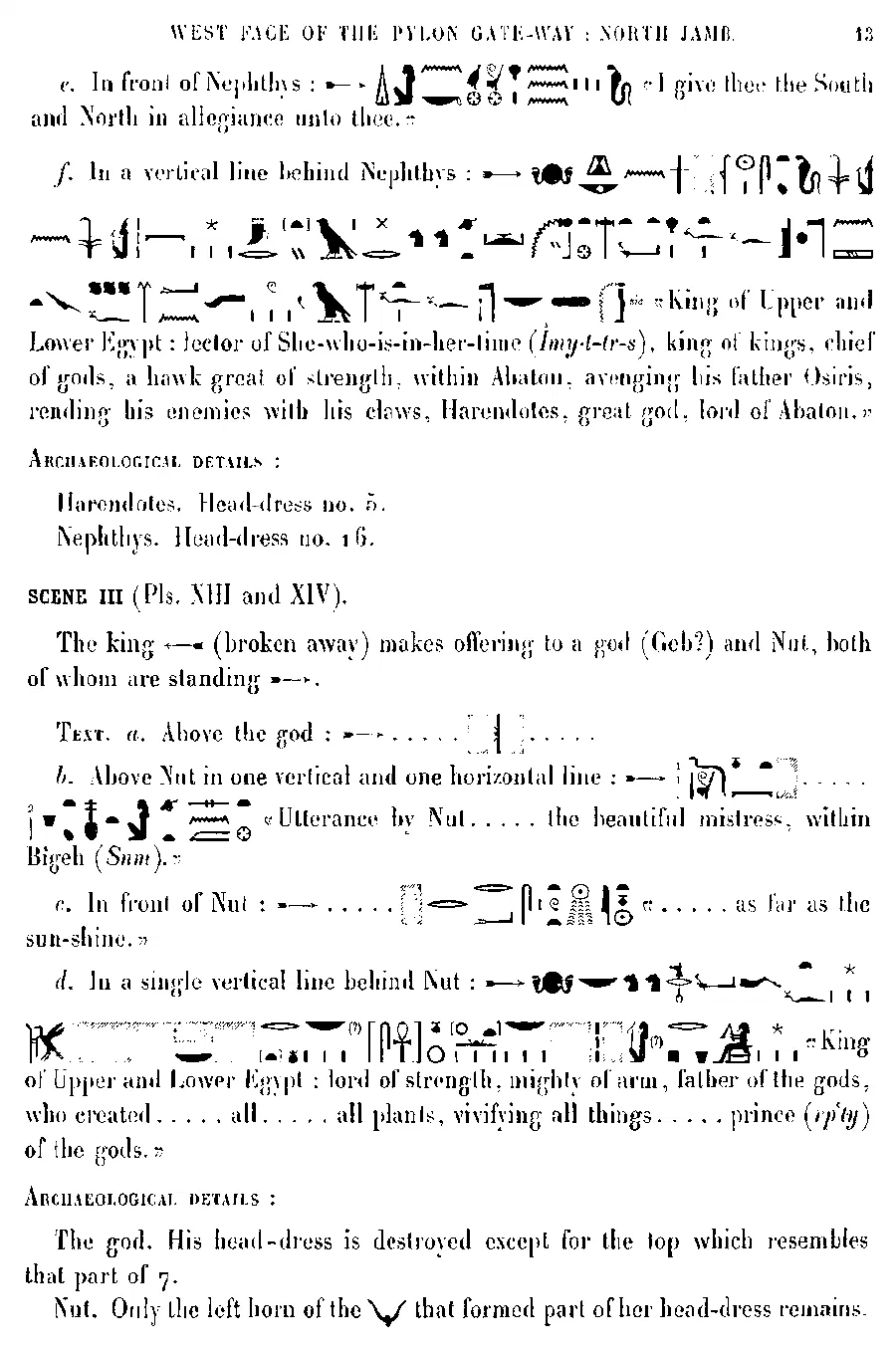
Page 13. Blackman, The Temple of Bigeh (1915), p. 13 Printed hieroglyphs from A. M. Blackman, The Temple of Bigeh (1915) - 74p. 13, l. 1
dj=j n=k šmꜥw mḥw ḥr mw=k
I give you Upper and Lower Egypt, both loyal to you.
Note · Line 74
In Egyptian, those who owe the king allegiance are said to be “on his water.” - 75p. 13, l. 3
ẖr.j-ḥb n jmj.(t) tr=s nswt
Lector priest of her who is in her season, king
Note · Line 75
A lector priest recited the sacred texts during a rite. Here the title belongs to Horus. - 76p. 13, l. 4
n nswt ḥr.j nṯr.w ḏrtj wr pḥtj ḫnt.j jꜣ.t-wꜥb.t nḏ ḥr jt=f wsjr
of kings, chief of the gods, the falcon of great strength who presides over the Abaton, who defends his father Osiris,
- 77p. 13, l. 5
nšd ḫrwj.w=f m ꜥn.w(t) =f ḥrw-nḏ-jt=f nṯr ꜥꜣ nb jw-wꜥb
who tears his enemies apart with his talons: Harendotes, the great god, lord of the Pure Island.
Note · Line 77
Harendotes means “Horus who defends his father.” The Pure Island is Bigeh. - 78p. 13, l. 16
ḏd-mdw jn nw.t --2Q--
Words spoken by Nut …
- 79p. 13, l. 17
ḥnw.t nfr.t ḫnt.j.(t) snm.t
the fair mistress who presides over Senmet.
- 80p. 13, l. 19
--2Q-- r-rꜣ-ꜥ stw.t jtn
… as far as the rays of the sun disk.
- 81p. 13, l. 21
nb pḥtj wsr ḫpš jt nṯr.w
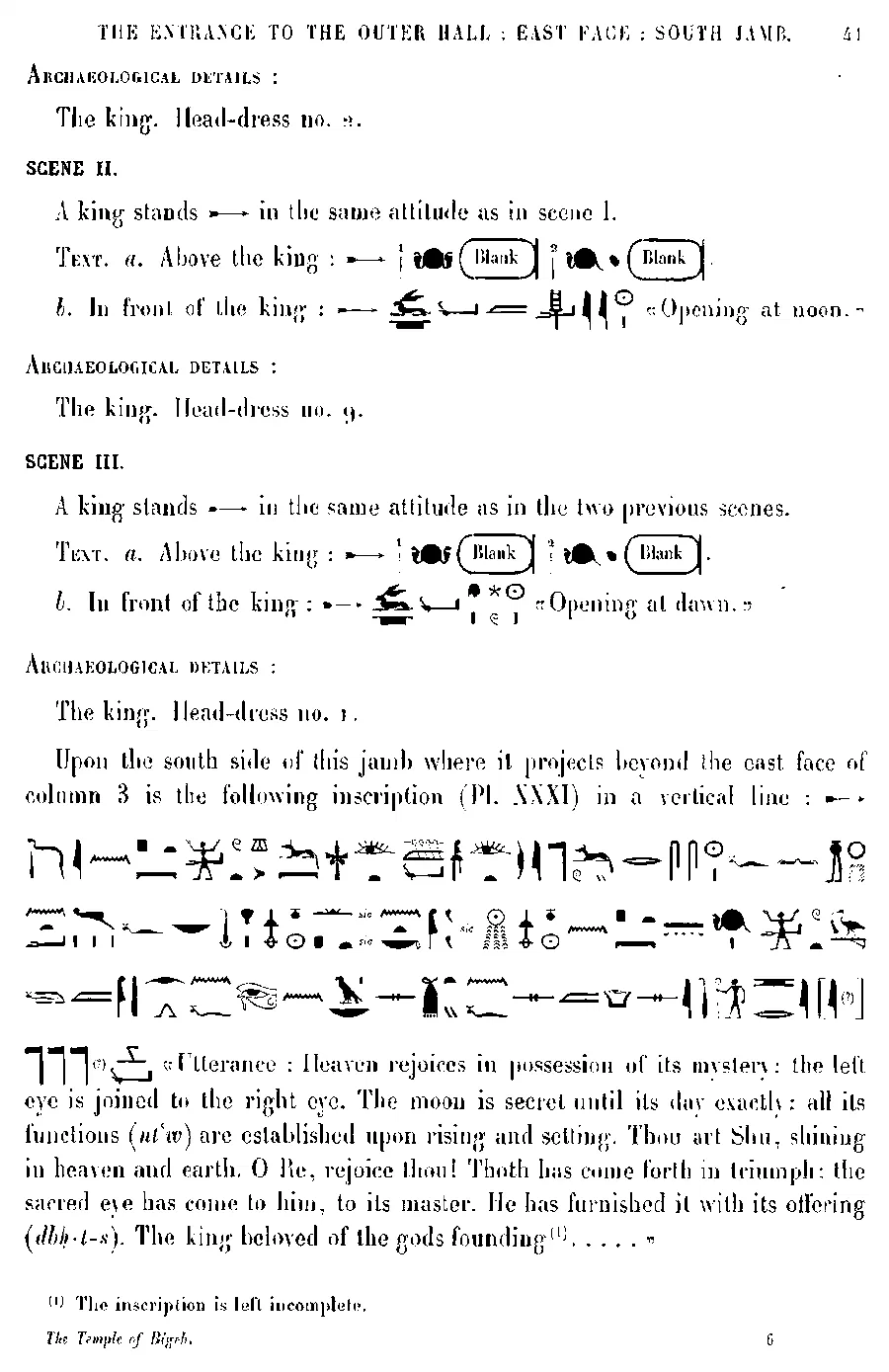
Lord of strength, mighty of arm, father of the gods,
- 82p. 13, l. 22
ḳmꜣ --3Q-- nb --1Q-- rḏ.w nb.w sꜥnḫ jḫ.t nb.{w}(t) --2Q-- (j)r.(j)-pꜥ.t nṯr.w
who created … every … all that grows, who gives life to all things … prince of the gods.
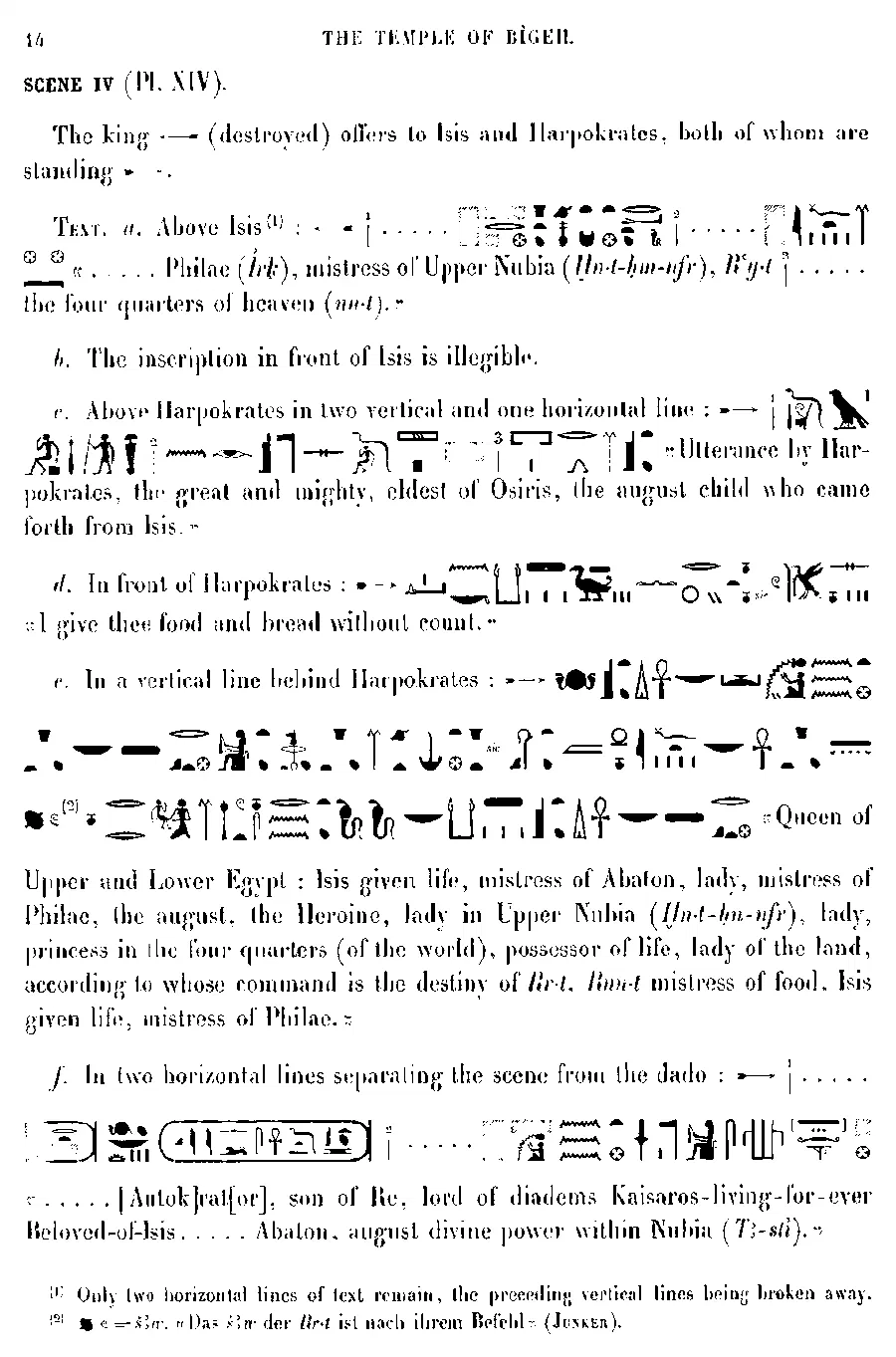
Page 14. Blackman, The Temple of Bigeh (1915), p. 14 Printed hieroglyphs from A. M. Blackman, The Temple of Bigeh (1915) - 83p. 14, l. 4
--2Q-- ḥnw.t ḫnt-ḥm-nfr rꜥ.t --1Q-- jfd.w m
… mistress of Khent-hem-nefer, Raet … the four corners of
- 84p. 14, l. 5
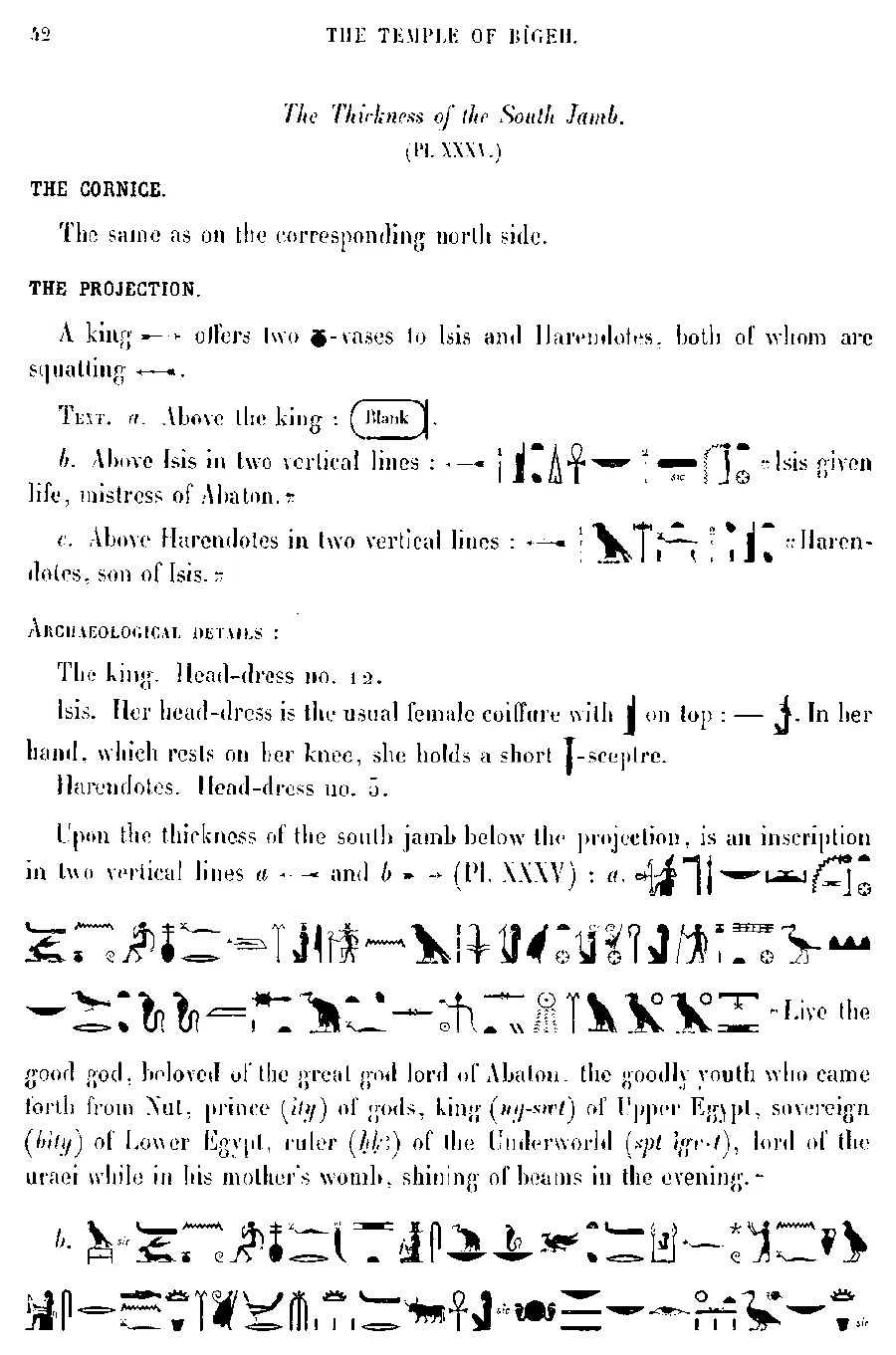
nn.t
heaven.
- 85p. 14, l. 8
ḏd-mdw jn ḥrw-
Words spoken by Horus
- 86p. 14, l. 9
pꜣ-ẖrd ꜥꜣ wr tp.j n wsjr sḏtj šp[s] prj m ꜣs.t
the Child, the very great one, firstborn of Osiris, the noble child born of Isis:
- 87p. 14, l. 12
dj=j n=k kꜣ.w ḏfꜣ n rḫ ṯnw=sn
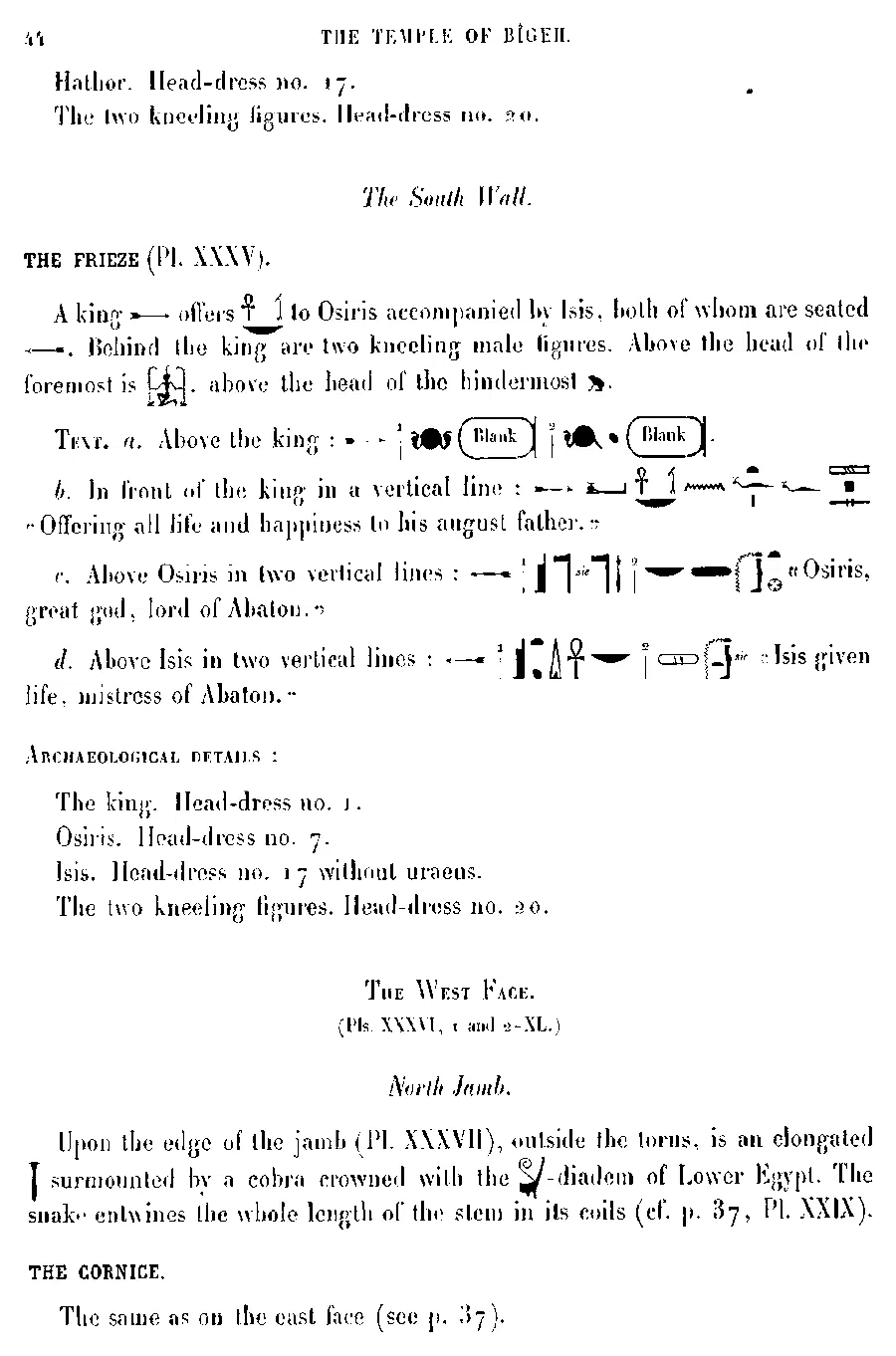
I give you food and provisions whose number no one knows.
- 88p. 14, l. 14
ꜣs.t dj.(t) ꜥnḫ nb.(t) jꜣ.t-wꜥb.t
Isis, giver of life, lady of the Abaton,
- 89p. 14, l. 15
ḥnw.t nb.(t) jwrḳ šps.t wsr.t ḥnw.t m ḫnt-ḥm-nfr ḥnw.t ḥḳꜣ.t m šn n jfd.w nb.(t) ꜥnḫ ḥnw.t tꜣ
mistress, lady of Philae, the noble one, the mighty one, mistress in Khent-hem-nefer, mistress and ruler within the compass of the four corners, lady of life, mistress of the land.
- 90p. 14, l. 16
šꜣj rr.t (4) m wḏ.t.n=s rnn.t nb.t kꜣ.w ꜣs.t dj.(t) ꜥnḫ nb.(t) jwrḳ
Shai and Reret are at her command. Renenutet, lady of food; Isis, giver of life, lady of Philae.
Note · Line 90
Renenutet is the harvest goddess, here identified with Isis. - 91p. 14, l. 23
--détruit-- [ꜣwtk]rt[r] sꜣ-rꜥ nb-ḫꜥ.w ḳysrs-ꜥnḫ-ḏ.t-mrj-ꜣs.t --détruit-- [jꜣ.t]-wꜥb.t sḫm šps ḫnt,j tꜣ-stj
… Autokrator, son of Ra, lord of crowns, Caesar, ever living, beloved of Isis … of the Abaton, august power, foremost in Nubia.
Note · Line 91
The Abaton, the “inviolable place,” was the sanctuary on Bigeh revered as the tomb of Osiris. 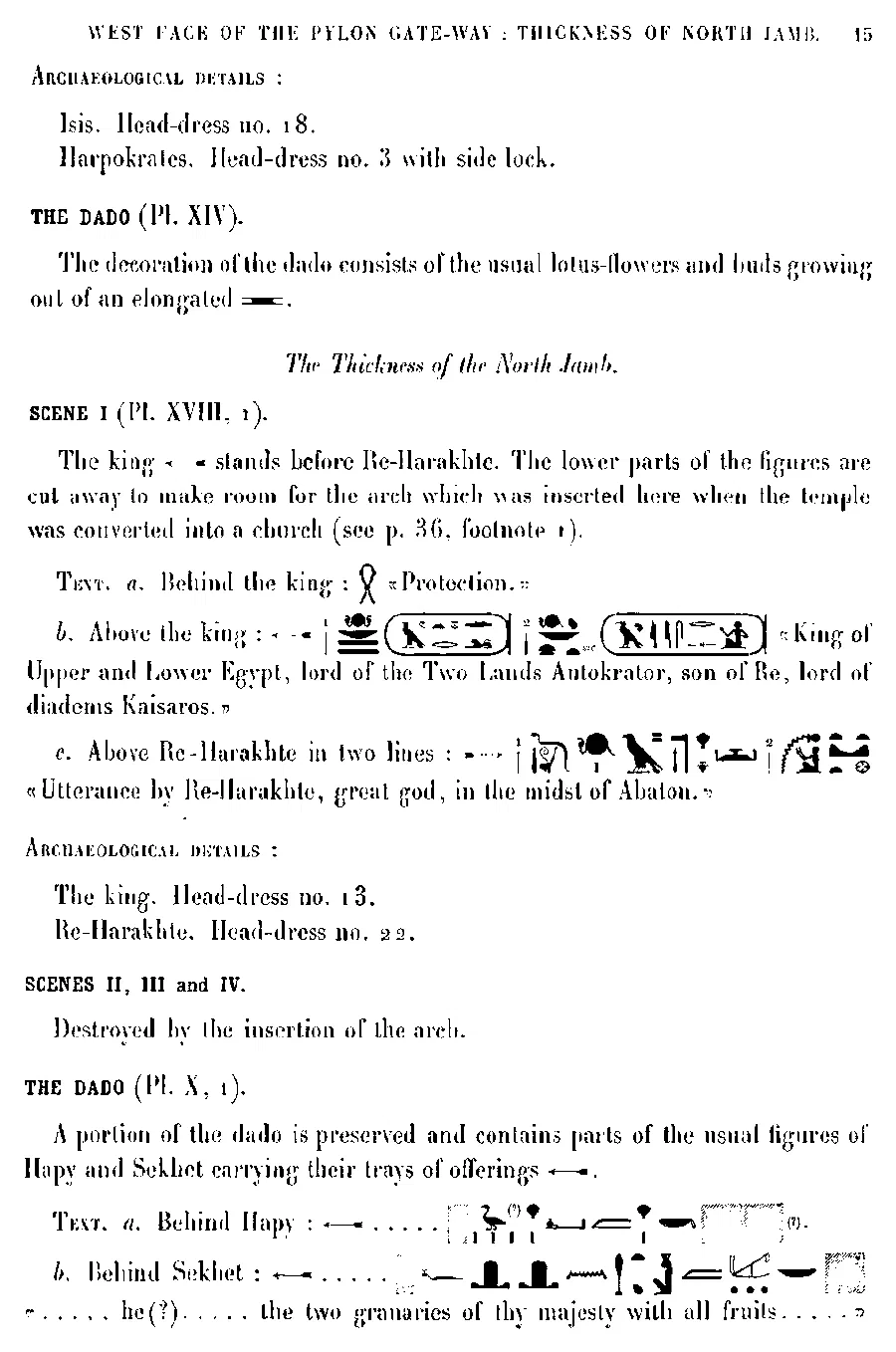
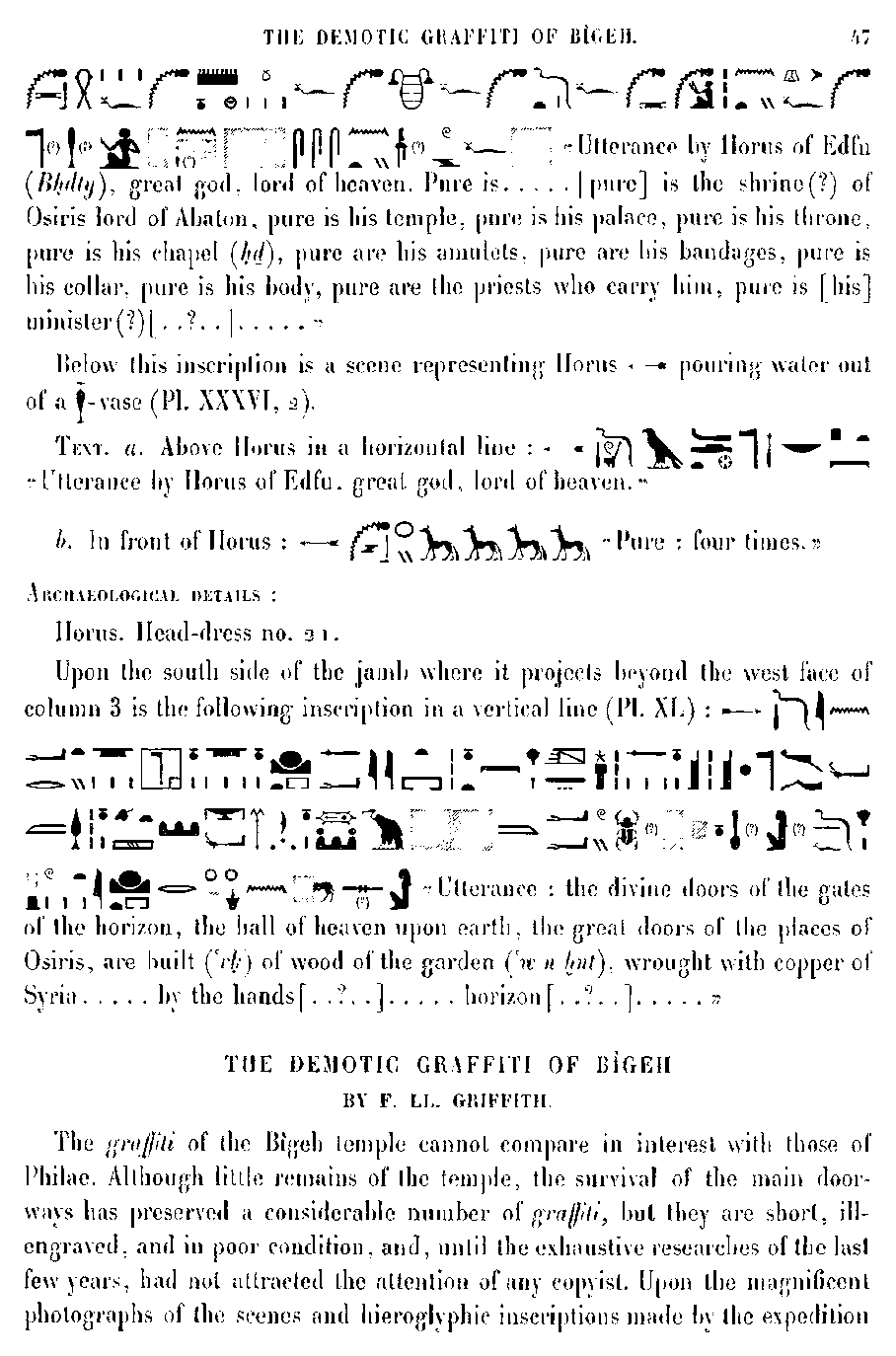
Page 15. Blackman, The Temple of Bigeh (1915), p. 15 Printed hieroglyphs from A. M. Blackman, The Temple of Bigeh (1915) - 92p. 15, l. 12
sꜣ
Protection.
- 93p. 15, l. 13
nswt-bj.tj nb-tꜣ.wj ꜣwtgrdr sꜣ-rꜥ nb-ḫꜥ.w kꜣysrs
The King of Upper and Lower Egypt, lord of the Two Lands, Autokrator, son of Ra, lord of crowns, Caesar.
- 94p. 15, l. 16
ḏd-mdw jn rꜥ-ḥrw-ꜣḫ.tj nṯr ꜥꜣ ḥr.j-jb jꜣ.t-wꜥb.t
Words spoken by Ra-Horakhty, the great god who dwells in the Abaton.
- 95p. 15, l. 26
--détruit-- ꜣpd.w(?) ḥr ḥnk m ḥr=k --détruit--
… fowl, offering them before your face …
- 96p. 15, l. 27
--détruit-- =f šnw.tj n ḥm=ṯ m pr.(t) nb.(t) --détruit--
he … the twin granaries for Your Majesty with every kind of fruit …
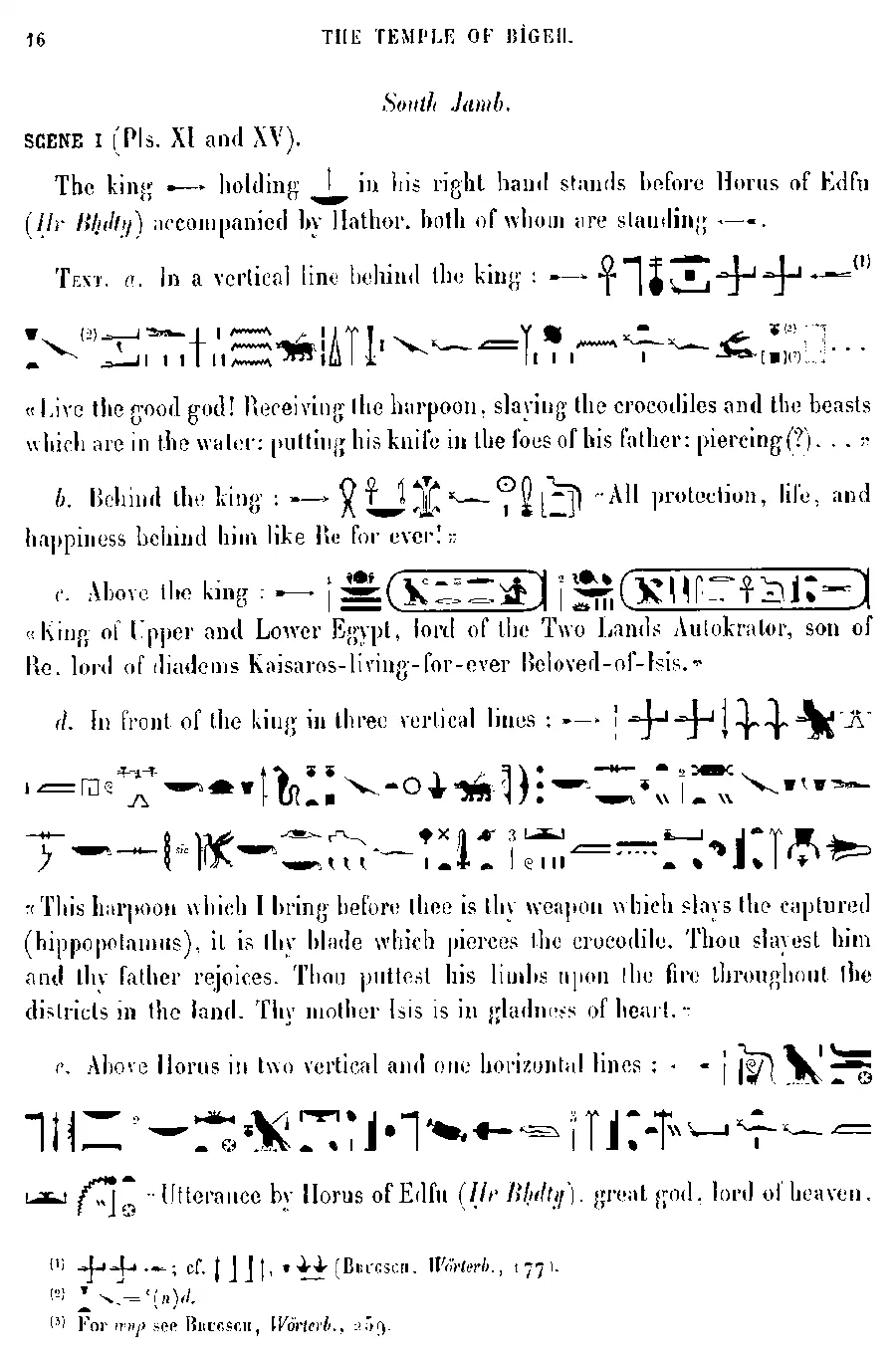
Page 16. Blackman, The Temple of Bigeh (1915), p. 16 Printed hieroglyphs from A. M. Blackman, The Temple of Bigeh (1915) - 97p. 16, l. 5
ꜥnḫ nṯr nfr šsp ꜥbb.t
Long live the perfect god, who takes up the harpoon,
Note · Line 97
The “perfect god” is the king. - 98p. 16, l. 6
šd ꜥfꜥ.w jm.j.w-mw dj msnj=f m sbj.w n jt=f wnp --10Q--
who slaughters the crocodiles and those that dwell in the water, who drives his knife into his father’s foes, who cuts …
Note · Line 98
In this rite the king takes the part of Horus. The animals he kills stand for the enemies of his father Osiris. - 99p. 16, l. 9
sꜣ ꜥnḫ wꜣs nb ḥꜣ=f mj rꜥ ḏ.t
All protection, life and dominion are behind him, as they are behind Ra, forever.
- 100p. 16, l. 11
nswt-bj.tj nb-tꜣ.wj ꜣwtgrdr sꜣ-rꜥ nb-ḫꜥ.w kꜣysrs-ꜥnḫ-ḏ.t-mrj-ꜣs.t
The King of Upper and Lower Egypt, lord of the Two Lands, Autokrator, son of Ra, lord of crowns, Caesar, ever living, beloved of Isis.
- 101p. 16, l. 14
ꜥbb.t nn ms=j
This harpoon I bring
Note · Line 101
The king addresses Horus as he presents the harpoon. - 102p. 16, l. 15
m-hꜣw=k ḫꜥ=k nt.j npṯ ḫꜣb ḳs=k sk nt.j ꜥḏ ꜥfꜥ
before you is your weapon that slaughters the hippopotamus. Your blade indeed is the one that pierces the crocodile.
- 103p. 16, l. 16
smꜣ=k sw nḏm ḳmꜣ=k jrj=k stp.w=f ḥr sḏ.t ḫnt jꜣ.wt m tꜣ mw.t=k ꜣs.t m ꜣw.t-jb
You kill it to your maker’s delight. You lay its choice cuts on the fire among the mounds of the land, and your mother Isis rejoices.
- 104p. 16, l. 21
ḏd-mdw jn ḥrw bḥd.tj
Words spoken by Horus of Edfu,
- 105p. 16, l. 22
nṯr ꜥꜣ nb p.t nb msn bjk n nbw.t sꜣ wsjr jwꜥ mnḫ prj m ꜣs.t nḏ jt=f m
the great god, lord of the sky, lord of Mesen, falcon of gold, son of Osiris, worthy heir born of Isis, who defends his father in
- 106p. 16, l. 23
jꜣ.t-wꜥb.t
the Abaton.
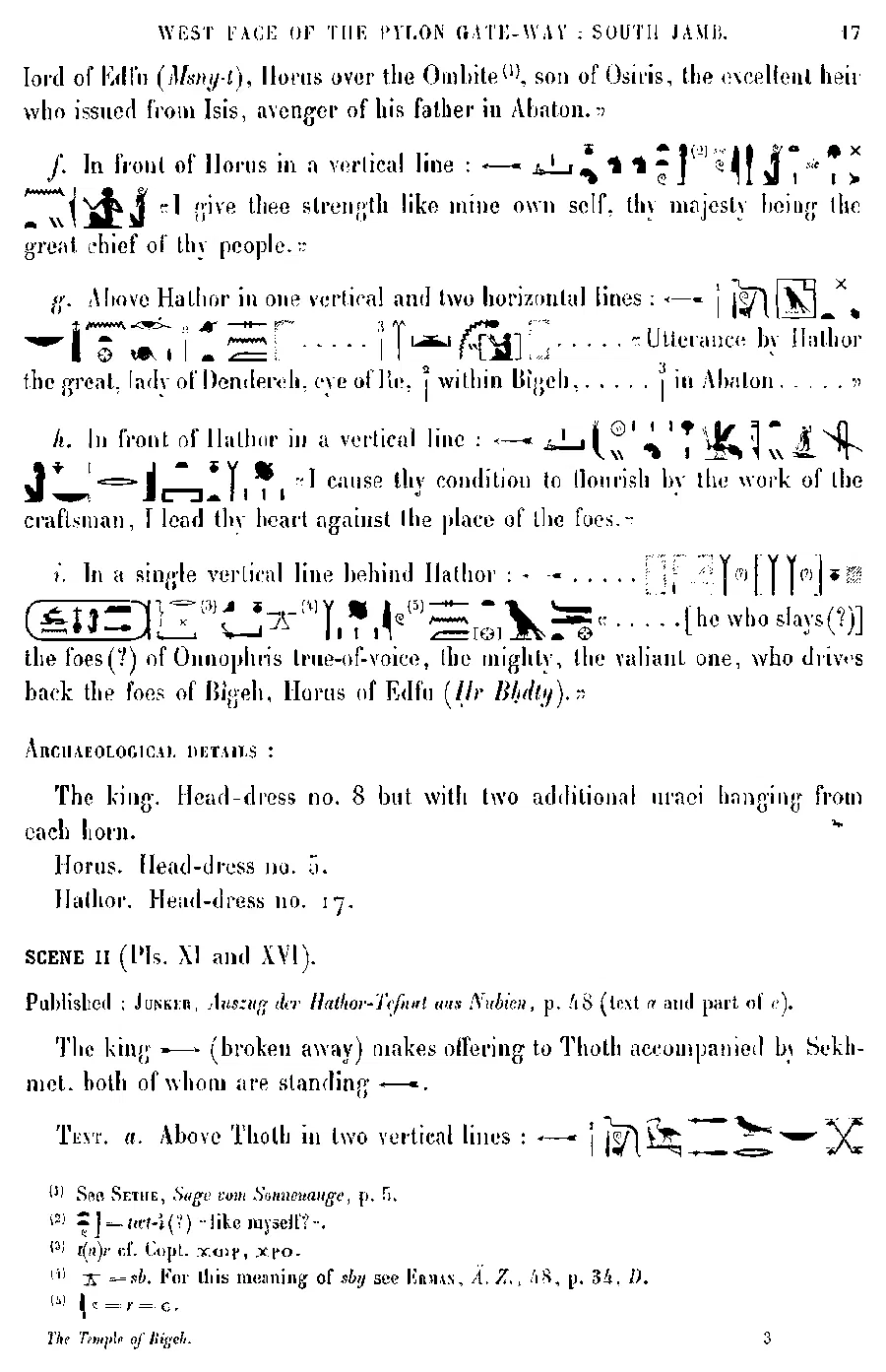
Page 17. Blackman, The Temple of Bigeh (1915), p. 17 Printed hieroglyphs from A. M. Blackman, The Temple of Bigeh (1915) - 107p. 17, l. 3
dj=j n=k pḥtj twt r ḥm=j ḥr.j-tp wr
I give you strength to match that of My Majesty, and great authority
- 108p. 17, l. 4
n js.t=j (5)
over my people.
- 109p. 17, l. 6
ḏd-mdw jn ḥw.t-ḥrw wr.t
Words spoken by Hathor the Great,
- 110p. 17, l. 7
nb.(t) jwn.t jr.t rꜥ ḫnt.j.t snm.t --détruit-- m jꜣ.t-wꜥb.t --détruit--
lady of Dendera, Eye of Ra, foremost in Senmet … in the Abaton …
- 111p. 17, l. 9
dj=j bnr sp.w=k ḥr kꜣ.t jꜣwtj sšm=j
I grant you success in what you do as a harpooner. I guide
- 112p. 17, l. 10
jb=k r s.t n sbj.w
your heart to where the rebels are.
- 113p. 17, l. 12
--12Q-- sbj.w n
… the rebels against
- 114p. 17, l. 13
wnn-nfr mꜣꜥ-ḫrw ṯnr ḳn sbj sbj.w r snm.t ḥrw bḥd.tj
Wennefer, the vindicated one. The valiant one, the mighty one, who repels those who rebel against Senmet: Horus of Edfu.
Note · Line 114
“Vindicated” is the verdict in his favor in the divine court. - 115p. 17, l. 25
ḏd-mdw jn ḏḥwtj ꜥꜣ ꜥꜣ wr nb ḫmnw
Words spoken by Thoth the thrice-great, lord of Hermopolis,
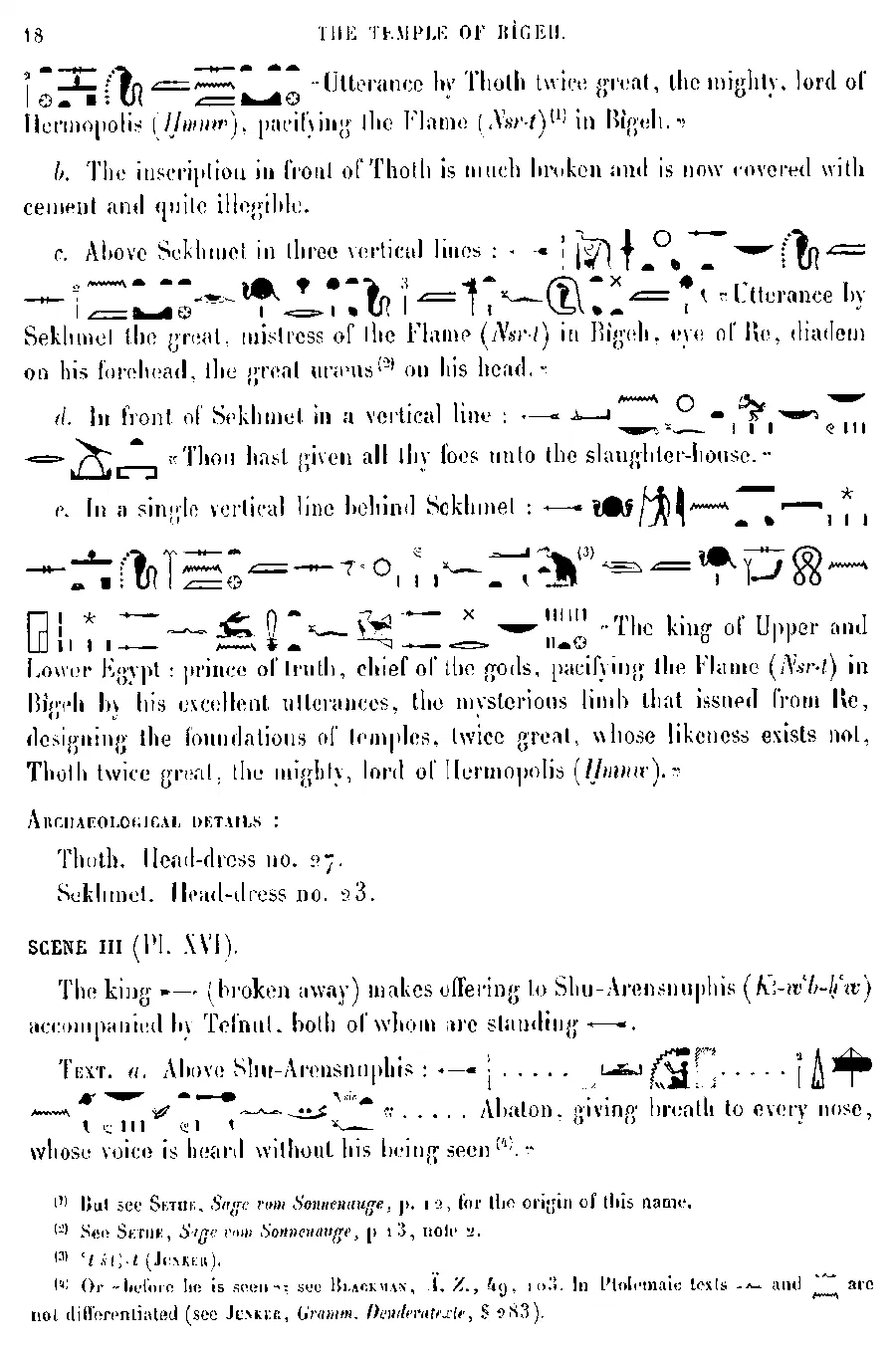
Page 18. Blackman, The Temple of Bigeh (1915), p. 18 Printed hieroglyphs from A. M. Blackman, The Temple of Bigeh (1915) - 116p. 18, l. 1
sḥtp nsr.t m snm.t
who soothes Neseret in Senmet.
Note · Line 116
Neseret is the “Fiery One.” Her name echoes in Sekhmet’s title “lady of flame.” - 117p. 18, l. 5
ḏd-mdw jn sḫm.t ꜥꜣ.t nb.(t) nsr.t m
Words spoken by Sekhmet the Great, lady of flame in
- 118p. 18, l. 6
snm.t jr.t rꜥ ḥr.j.t-tp m ḥꜣ.t=f mḥn.t wr.t m tp=f
Senmet, Eye of Ra, the uraeus on his brow, great Mehenet on his head.
Note · Line 118
The uraeus is the rearing cobra that guards Ra’s brow. Mehenet, “the Coiled One,” likewise names Sekhmet as his serpent guardian. - 119p. 18, l. 9
dj=(j) n=k ḫft.j.w=k nb.w
I give you all your enemies
- 120p. 18, l. 10
r nm.t
for the slaughterhouse.
- 121p. 18, l. 11
sr n mꜣꜥ.t ḥr.j nṯr.w
The noble of Maat, chief of the gods,
- 122p. 18, l. 12
sḥtp nsr.t m snm.t m sꜣḫw=f ꜥ.t štꜣ.t prj.(t) m rꜥ spẖr snṯ n
who soothes Neseret in Senmet with his spells, the secret limb sprung from Ra, who lays out the foundations of
Note · Line 122
Neseret, the “Fiery One,” is the cobra goddess of the sun. - 123p. 18, l. 13
ḥw.wt-nṯr.w ꜥꜣ ꜥꜣ n wn mjt.t=f ḏḥwtj ꜥꜣ ꜥꜣ wr nb ḫmnw
the temples, the twice-great, whose like is not to be found: Thoth the thrice-great, lord of Hermopolis.
Note · Line 123
Hermopolis was Thoth’s chief place of worship. - 124p. 18, l. 24
--détruit-- jꜣ.t-wꜥb.t --détruit-- dj ṯꜥw
… the Abaton … who gives breath
Note · Line 124
Its Greek name means a place not to be entered. - 125p. 18, l. 25
n fnḏ.(w) nb.w sḏm.tw ḫrw=f n mꜣ.tw=f
to every nose. His voice is heard, but he is not seen.
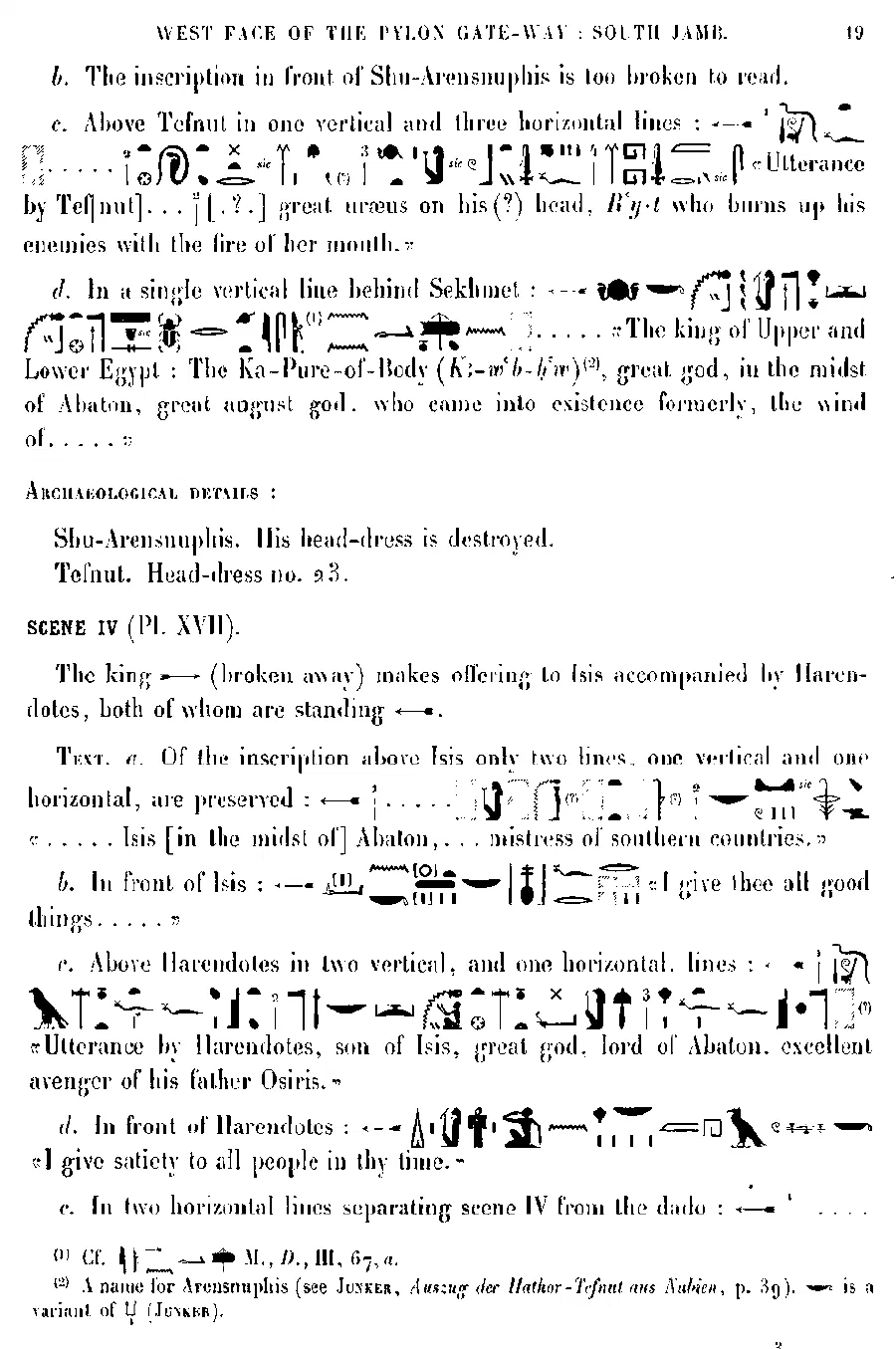
Page 19. Blackman, The Temple of Bigeh (1915), p. 19 Printed hieroglyphs from A. M. Blackman, The Temple of Bigeh (1915) - 126p. 19, l. 2
ḏd-mdw jn tf[n.t]
Words spoken by Tefnut:
- 127p. 19, l. 3
--3Q-- mḥn.t wr.t m tp=f rꜥ.t wbd.(t) ḫrwj.w=f m hh m r=s
… Mehenet, the great one upon his head, Raet, who burns his enemies with the flame from her mouth.
Note · Line 127
Tefnut appears here as the serpent coiled on the sun god’s head. - 128p. 19, l. 6
k(ꜣ) wꜥb ḥꜥ.w nṯr ꜥꜣ ḥr.j-jb jꜣ.t-
The ka, pure of limb, the great god who dwells in
Note · Line 128
The ka is the vital force of a person or a god. - 129p. 19, l. 7
wꜥb.t nṯr ꜥꜣ <sḫm> šps ḫpr ḫnt js-njw n --12Q--
the Abaton, the great god, the august power who came into being first, the breath of …
- 130p. 19, l. 18
--détruit-- wꜥb --détruit-- nb.(t) ḫꜣs.wt rsj.(wt)
… pure … lady of the foreign lands of the south.
- 131p. 19, l. 20
dj=[j] n=k jḫ.t nb.(t) nfr.(t) r --1/2Q--
I give you every good thing for …
- 132p. 19, l. 22
ḏd-mdw jn
Words spoken by
- 133p. 19, l. 23
ḥrw-nḏ-jt=f sꜣ ꜣs.t nṯr ꜥꜣ nb jꜣ.t-wꜥb.t nḏ mnḫ ḥr jt=f wsjr
Harendotes, son of Isis, the great god, lord of the Abaton, staunch defender of his father Osiris:
Note · Line 133
The last title echoes the name. - 134p. 19, l. 26
dj=j sꜣw n ḥr-nb m-hꜣw=k
In your time I give everyone their fill.
Note · Line 134
Horus is addressing the king. 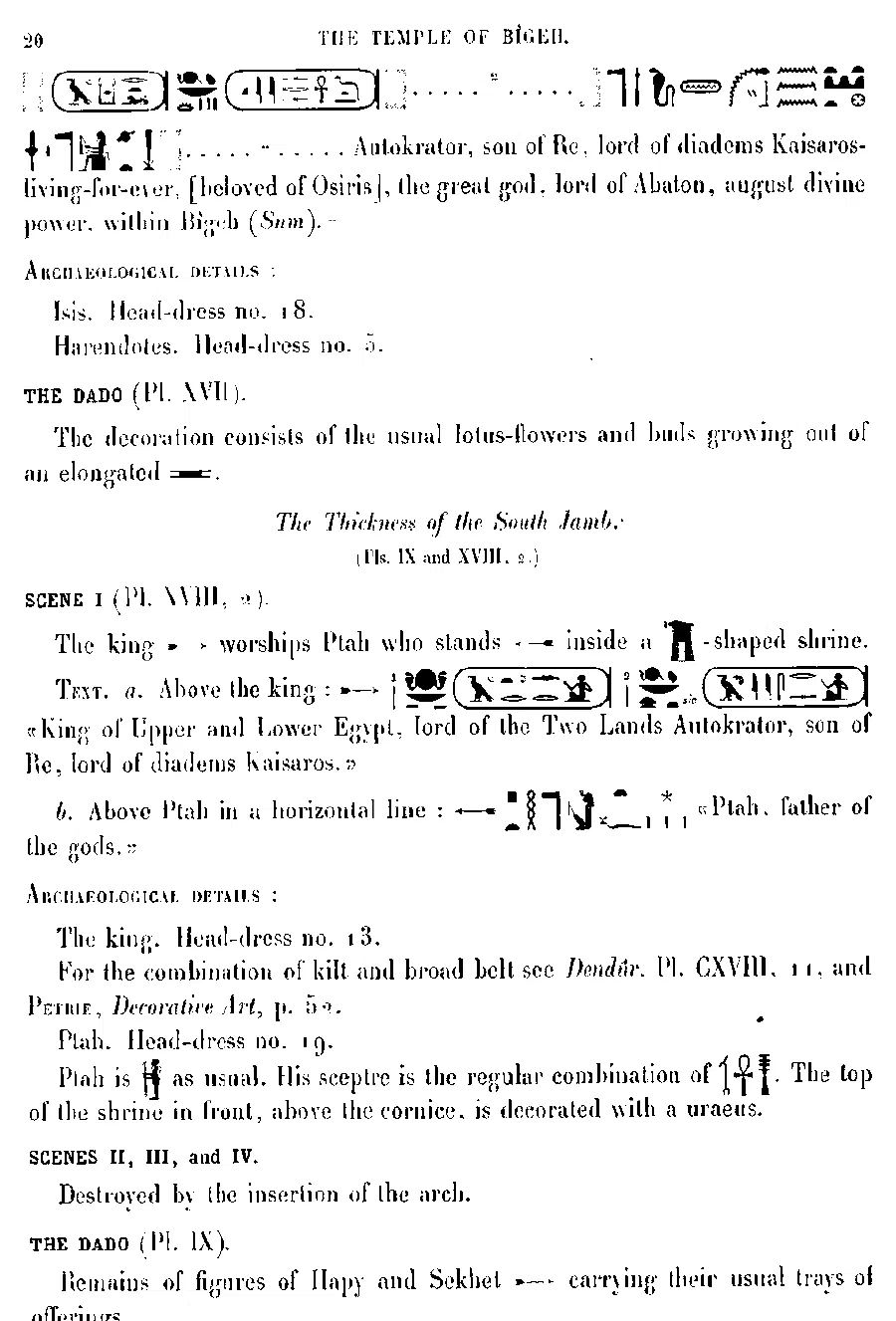
Page 20. Blackman, The Temple of Bigeh (1915), p. 20 Printed hieroglyphs from A. M. Blackman, The Temple of Bigeh (1915) - 135p. 20, l. 1
[nswt-bj.tj nb-tꜣ.wj] ꜣwtkꜣrtr sꜣ-rꜥ nb-ḫꜥ.w ḳysrs-ꜥnḫ-ḏ.t --détruit-- nṯr ꜥꜣ nb jw-wꜥb
The King of Upper and Lower Egypt, Lord of the Two Lands, Autokrator, Son of Ra, Lord of Crowns, Caesar, living forever … the great god, lord of the Pure Island,
- 136p. 20, l. 2
sḫm šps ḫnt.j sn[m.t] --détruit--
the august power, foremost in Senmet …
- 137p. 20, l. 15
nswt-bj.tj nb-tꜣ.wj ꜣwtgrdr sꜣ-rꜥ nb-ḫꜥ.w kꜣysrs
The King of Upper and Lower Egypt, Lord of the Two Lands, Autokrator, Son of Ra, Lord of Crowns, Caesar.
- 138p. 20, l. 18
ptḥ jt nṯr.w
Ptah, father of the gods.
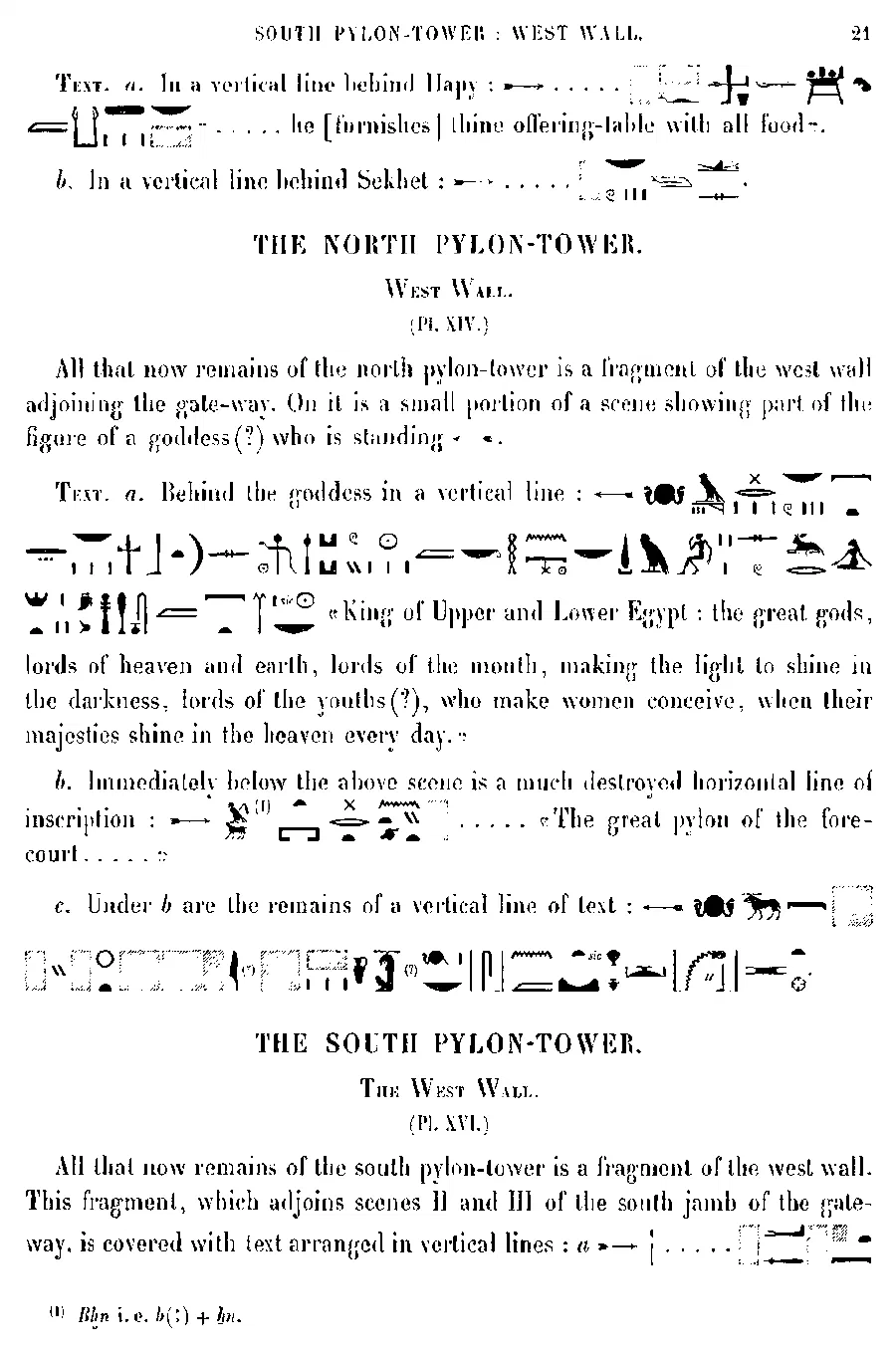
Page 21. Blackman, The Temple of Bigeh (1915), p. 21 Printed hieroglyphs from A. M. Blackman, The Temple of Bigeh (1915) - 139p. 21, l. 1
--détruit-- =f ꜥbꜣ=k
… he … your altar
- 140p. 21, l. 2
m kꜣ.w nb.[w]
with food of every kind.
- 141p. 21, l. 3
--détruit-- nb.w prj.(w) jm=s
… all that come forth from her.
- 142p. 21, l. 10
nṯr.w wr.w nb.w p.t
The great gods, lords of heaven
- 143p. 21, l. 11
tꜣ nb.w jbd sḥḏ.(w) ḥḏḏwy m knḥw nb.(w) ḏꜥm.w sjwr.(w)
and earth, lords of the month, whose rays shine in the night, lords of generations, who cause
- 144p. 21, l. 12
ḥm.wt ḏr psḏ ḥm=sn m p.t m rꜥ-nb
women to conceive, ever since their majesty began to shine in the sky each day.
- 145p. 21, l. 17
bḫn.t wr.t n.t{j} ḫnt --détruit--
The great gate of the court …
- 146p. 21, l. 19
bꜣ ḥr.j --7Q--
The ba, chief of …
Note · Line 146
The ba is the power of a god or a person to be present and act beyond the body. - 147p. 21, l. 20
ẖnmw-rꜥ nb snm.t ḥr.j-jb jꜣ.t-[wꜥb.t]
Khnum-Ra, lord of Senmet, who dwells in the Abaton,
- 148p. 21, l. 26
--détruit-- ꜥꜣ --1/2Q-- p.t
… great … sky
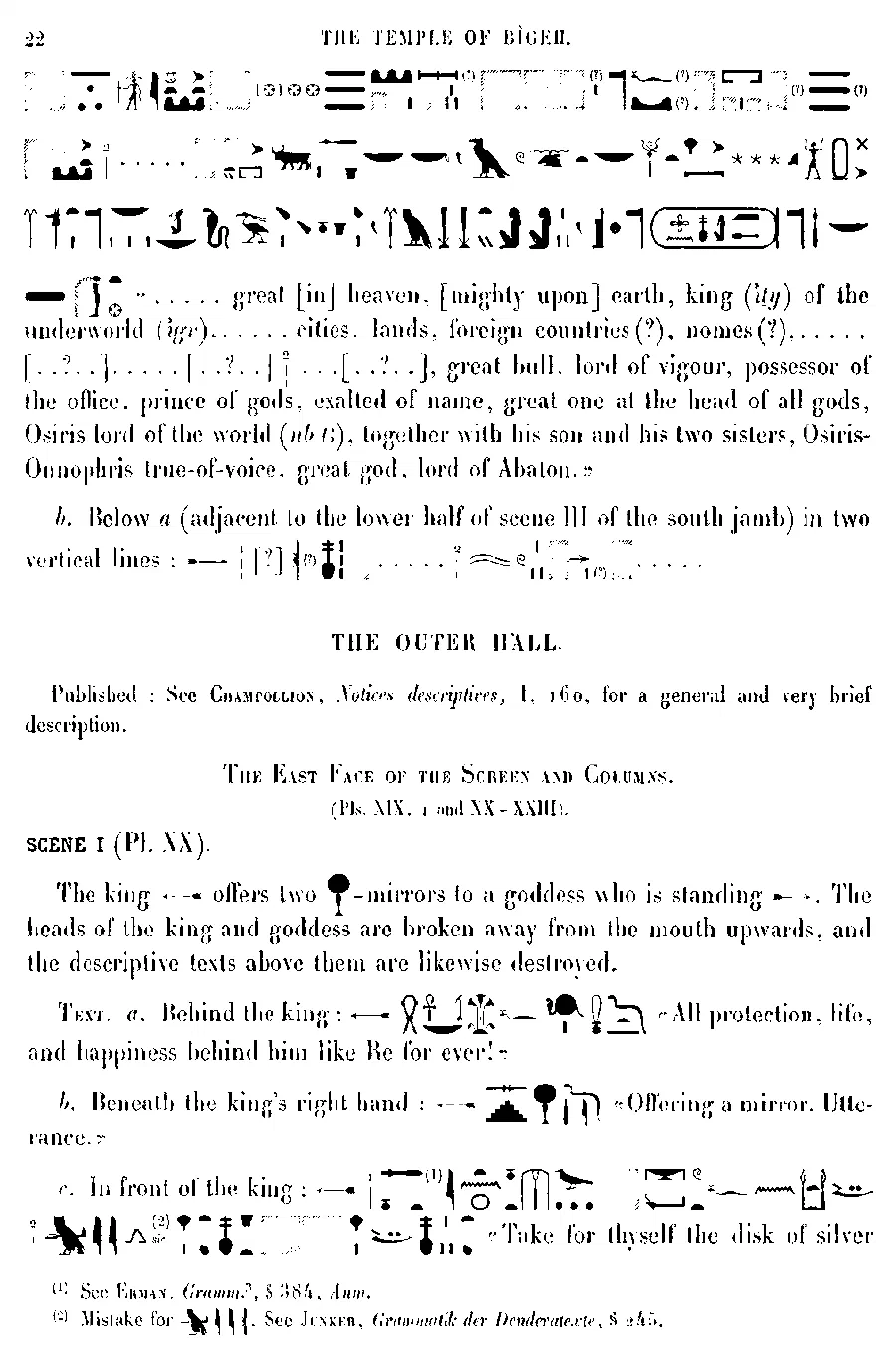
Page 22. Blackman, The Temple of Bigeh (1915), p. 22 Printed hieroglyphs from A. M. Blackman, The Temple of Bigeh (1915) - 149p. 22, l. 1
--1Q-- tꜣ jtj jgr.t --1Q-- njw.wt tꜣ.w ḫꜣs.wt spꜣ.wt --3Q-- …(?) tꜣ.w
… earth, ruler of Igeret … the cities, the lands, the foreign lands, the nomes … the lands
Note · Line 149
Igeret is the “Silent Realm,” the world of the dead. The nomes are the provinces of Egypt. - 150p. 22, l. 2
[jg]r.t --détruit-- kꜣ ꜥꜣ nb ḳfꜣ.t nb jꜣw.t ḥr.j nṯr.w ḳꜣ rn wr
Igeret … the great bull, lord of renown, lord of office, chief of the gods, lofty of name, the great one.
- 151p. 22, l. 3
m-ḥꜣ.t nṯr.(w) nb.w wsjr nb tꜣ (6)ḥnꜥ sꜣ=f m-m sn.tj=f wsjr wnn-nfr mꜣꜥ-ḫrw nṯr ꜥꜣ nb
at the head of all the gods, Osiris, lord of the earth, with his son, between his two sisters; Osiris Wennefer, justified, the great god, lord
Note · Line 151
His son is Horus; his sisters are Isis and Nephthys. “Justified” means that judgment has been given in Osiris’s favor. - 152p. 22, l. 4
jw-wꜥb
of the Abaton.
Note · Line 152
The Egyptian name means “Pure Island.” This was the sanctuary on Bigeh where Osiris was believed to be buried. - 153p. 22, l. 11
--détruit-- nfrw --détruit-- jm.j.w --détruit--
… beauty … those who are in …
- 154p. 22, l. 21
sꜣ ꜥnḫ wꜣs nb ḥꜣ=f mj rꜥ ḏ.t
All protection, life and dominion are behind him, as they are behind Ra, forever.
- 155p. 22, l. 23
sjꜥr wn-ḥr ḏd-mdw jn
Raising the mirrors. Words to be recited:
Note · Line 155
The king holds the mirrors up to the goddess. The Egyptian word for a mirror here means “opener of the face.” - 156p. 22, l. 25
mn n=ṯ jtn n ꜥrḳwr --1Q-- nbj.tw=f n kꜣ=ṯ mꜣ
Take for yourself the silver disk … It was fashioned for your ka. Look
Note · Line 156
A person or a god’s ka is the vital presence to which an offering is made. - 157p. 22, l. 26
mj ḥr=ṯ nfr ḥnw.t --2Q-- ḥr mꜣ nfrw=ṯ
now upon your beautiful face, mistress … at the sight of your beauty.
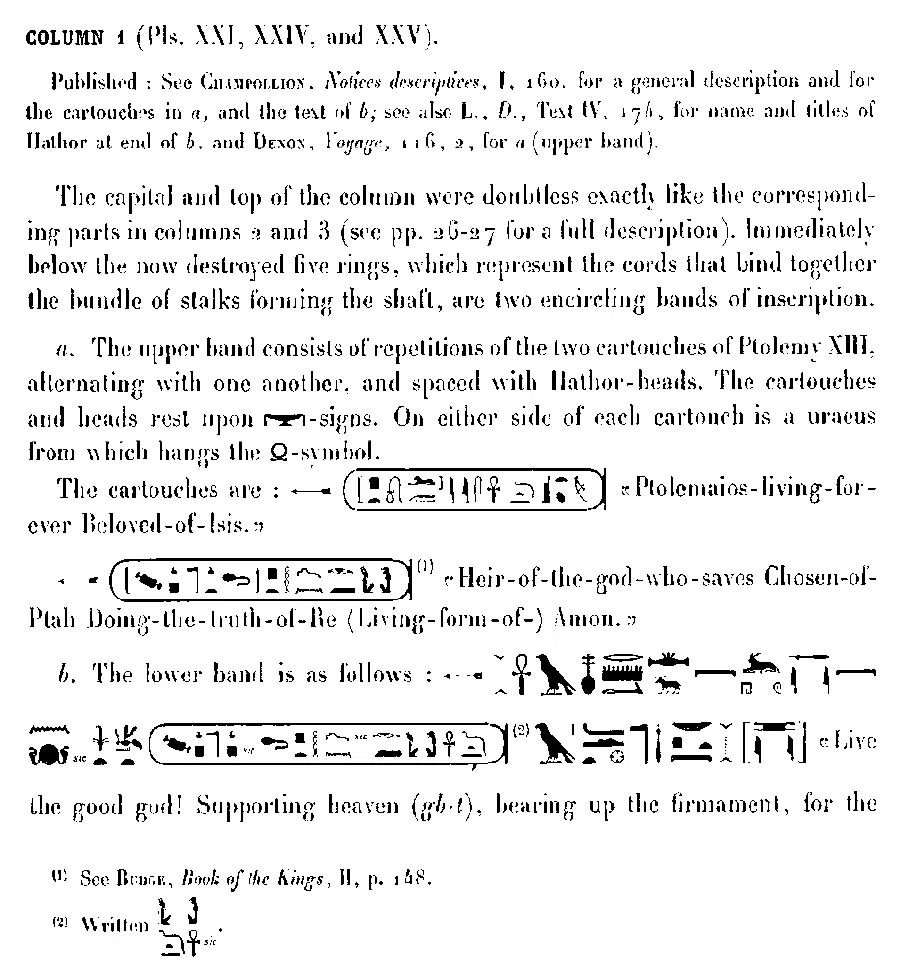
Page 23. Blackman, The Temple of Bigeh (1915), p. 23 Printed hieroglyphs from A. M. Blackman, The Temple of Bigeh (1915) - 158p. 23, l. 3
dj=(j) n=k ptr.n jtn m hrw dgj.n jꜥḥ m grḥ
I give you what the sun disk has seen by day,
and what the moon has beheld by night.Note · Line 158
The goddess now speaks to the king. - 159p. 23, l. 21
[ptwl]mys-ꜥnḫ-ḏ.t-mrj-ꜣs.t
Ptolemy, living forever, beloved of Isis.
- 160p. 23, l. 23
jwꜥ-n-p(ꜣ)-nṯr-nt.j-nḥm-stp-n-ptḥ-jrj-mꜣꜥ.t-rꜥ-<sḫm-ꜥnḫ-n>-jmn
Heir of the Savior God, chosen of Ptah, who enacts the justice of Ra, living image of Amun.
Note · Line 160
The Savior God is a deified king. “Justice” here is Maat, the right order of the world that the king must uphold. - 161p. 23, l. 25
ꜥnḫ nṯr nfr rmn gb.t jwh ꜥꜣj.t
Long live the perfect god, who shoulders the sky, who lifts the heavens
- 162p. 23, l. 26
n nswt-bj.tj nswt-bj.tj jwꜥ-n-p(ꜣ)-nṯr-nt.j-nḥm-stp-n-ptḥ-jrj-mꜣꜥ.t-rꜥ-<sḫm-ꜥnḫ-n>-jmn-ꜥnḫ--ḏ,t mrj ḥrw bḥd.tj nṯr ꜥꜣ nb p.t
for the King of Upper and Lower Egypt, the King of Upper and Lower Egypt, Heir of the Savior God, chosen of Ptah, who enacts the justice of Ra, living image of Amun, living forever, beloved of Horus of Edfu, the great god, lord of the sky.
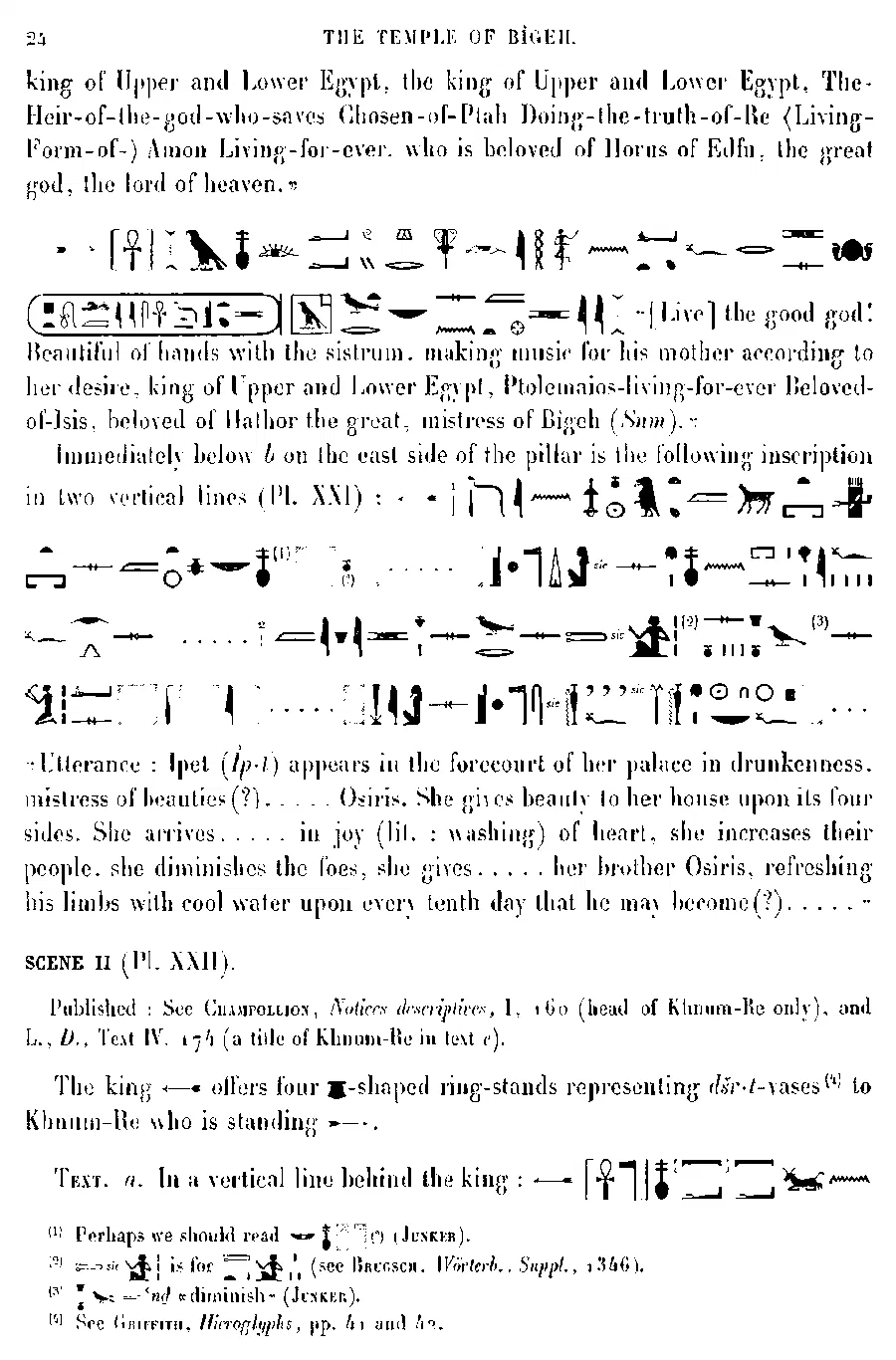
Page 24. Blackman, The Temple of Bigeh (1915), p. 24 Printed hieroglyphs from A. M. Blackman, The Temple of Bigeh (1915) - 163p. 24, l. 5
ꜥnḫ nṯr nfr ꜥn ꜥ.wj ẖr sšš.t jrj jḥj n mw.t=f r mrj=s nswt-bj.tj
Long live the perfect god, whose two arms are fair as they bear the sistrum, who makes music for his mother as she desires, the King of Upper and Lower Egypt,
Note · Line 163
The sistrum is a sacred rattle, shaken here for Hathor, the king’s divine mother. - 164p. 24, l. 6
ptwlmys-ꜥnḫ-ḏ.t-mrj-ꜣs.t mrj ḥw.t-ḥrw wr.t nb.(t) snm.t
Ptolemy, living forever, beloved of Isis, beloved of Hathor the Great, lady of Senmet.
- 165p. 24, l. 11
ḏd-mdw jn wbn šps.t m-ẖnw ꜥḥ=s
Words to be recited: The venerable goddess rises within her palace
- 166p. 24, l. 12
m tḫ ḥb nfr --9Q-- wsjr dj=s tp-nfr n pr=s ḥr jfd.w=f
in drunkenness at the beautiful feast … Osiris. She gives beauty to her house on all four sides.
- 167p. 24, l. 13
spr=s --6Q-- m jꜥj jb swr=s ṯ.t=sn ꜥnḏ=s
She reaches … with a glad heart. She swells the ranks of their people and thins
- 168p. 24, l. 14
ḫft.j.w dj=s --9Q-- sn=s wsjr sḳbḥ ḥꜥ.w=f m ḳbḥw tp.j hrw 10 nb ḫpr=f --6Q--
the ranks of the enemy. She gives … her brother Osiris. His limbs are cooled with the cool water of the libation on the first day of every ten, that he may come into being …
Note · Line 168
Every ten days Isis visited the sanctuary of Osiris to pour water for him. - 169p. 24, l. 25
ꜥnḫ nṯr nfr pꜥpꜥ.n
Long live the perfect god whom
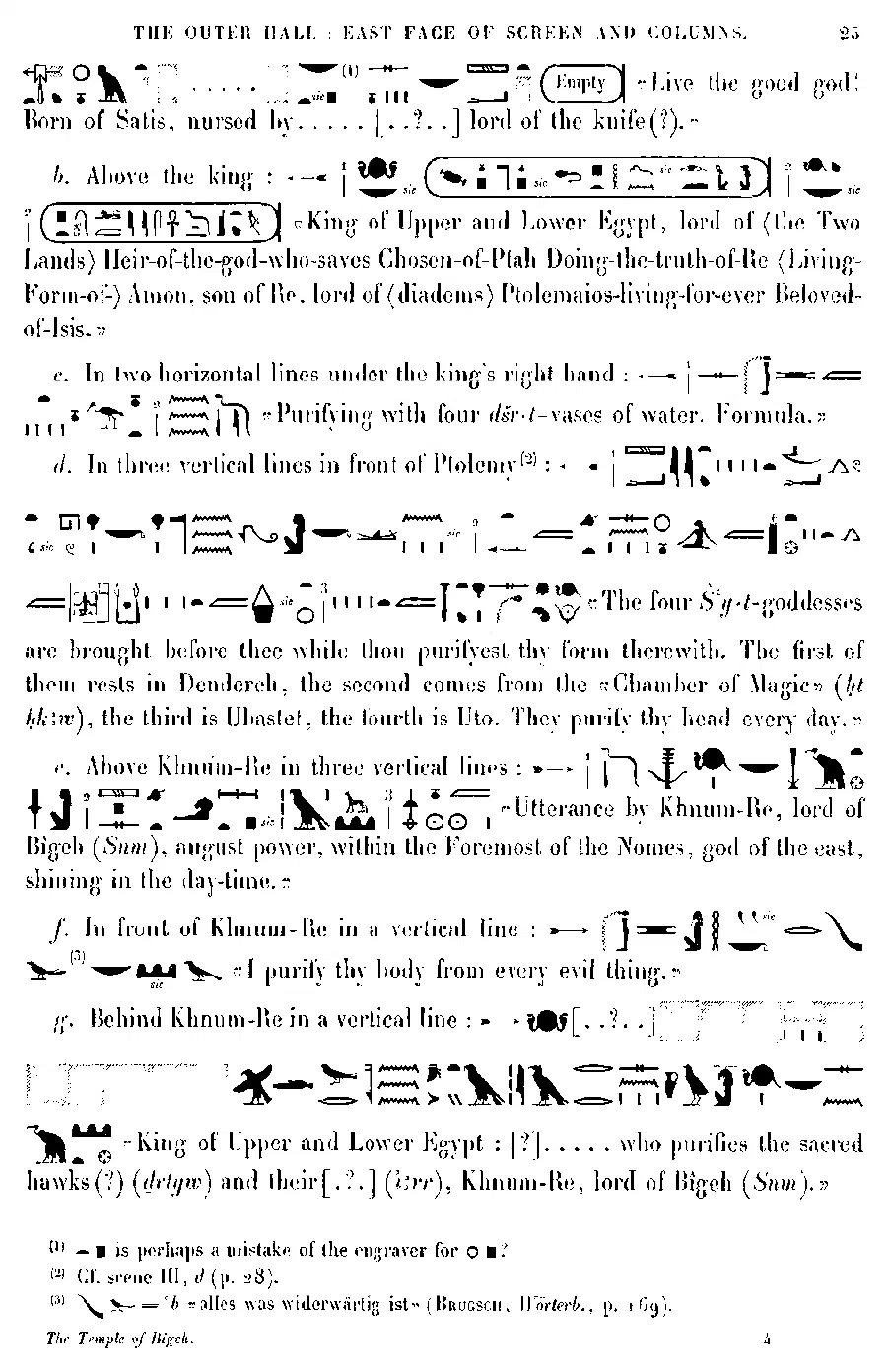
Page 25. Blackman, The Temple of Bigeh (1915), p. 25 Printed hieroglyphs from A. M. Blackman, The Temple of Bigeh (1915) - 170p. 25, l. 1
st.t ḫnm.t --9Q-- nb …? (7) =sn nb šꜥwtj (8) --cꜥrtouche vide--
Satis the nurse bore … lord … their …, lord of the two vessels, …
Note · Line 170
The oval meant to enclose the royal name was left empty. - 171p. 25, l. 3
nswt-bj.tj nb-<tꜣ.wj> jwꜥ-n-p(ꜣ)-nṯr-nt.j-nḥm-stp-n-ptḥ-jrj-mꜣꜥ.t-rꜥ-<sḫm-ꜥnḫ-n>-jmn sꜣ-rꜥ nb-<ḫꜥ.w>
The King of Upper and Lower Egypt, lord of the Two Lands, Heir of the Savior God, chosen of Ptah, who enacts the justice of Ra, living image of Amun, son of Ra, lord of crowns,
- 172p. 25, l. 4
ptwlmys-ꜥnḫ-ḏ.t-mrj-ꜣs.t
Ptolemy, living forever, beloved of Isis.
- 173p. 25, l. 8
swꜥb m
Purifying with
- 174p. 25, l. 9
fdw n dšr.t n.t mw ḏd-mdw jn
the four desheret jars of water. Words to be recited:
Note · Line 174
Desheret means “red”; it is the name of a ritual water jar. - 175p. 25, l. 10
šꜥwtj(?) fdw.t mꜣꜥ.tw
The four vessels are brought
- 176p. 25, l. 11
hꜣw ḥr=k ḥr nṯrj.t tj.t=k jm=<s>n wꜥ.t m-ḫnt=sn ḫn m jwn.t sn-nw jw
before you to purify your image with them. One of them rests in Dendera; the second comes
- 177p. 25, l. 12
m ḥw.t-ḥkꜣ.w ḫmt-nw m bꜣs.t fdw-nw m wꜣḏ.t ḥr swꜥb tp=k rꜥ-nb
from the House of Magic, the third from Bubastis, the fourth from Wadjet, to purify your head each day.
- 178p. 25, l. 16
ḏd-mdw <jn> ẖnmw-rꜥ nb snm.t
Words spoken by Khnum-Ra, lord of Senmet,
- 179p. 25, l. 17
sḫm šps ḫnt.j ḥꜣ.t-spꜣ.wt ḥrw jꜣb.tj wbn m hrw
venerable power who presides over the first of the nomes, Horus of the East, who rises by day:
Note · Line 179
A nome was a province. The first nome of Upper Egypt lay at the First Cataract, near Bigeh. - 180p. 25, l. 20
wꜥb=j ḥꜥ.w=k r ꜥb
I purify your limbs against …
- 181p. 25, l. 21
nb ḏw
every evil thing.
- 182p. 25, l. 22
--9Q--
[gap in the text]
- 183p. 25, l. 23
twr ḏrtj.w jꜣrr=sn(?) (9) ẖnmw-rꜥ nb snm.t
who purifies the ancestors …, Khnum-Ra, lord of Senmet.
Page 26. Blackman, The Temple of Bigeh (1915), p. 26 Printed hieroglyphs from A. M. Blackman, The Temple of Bigeh (1915) - 184p. 26, l. 24
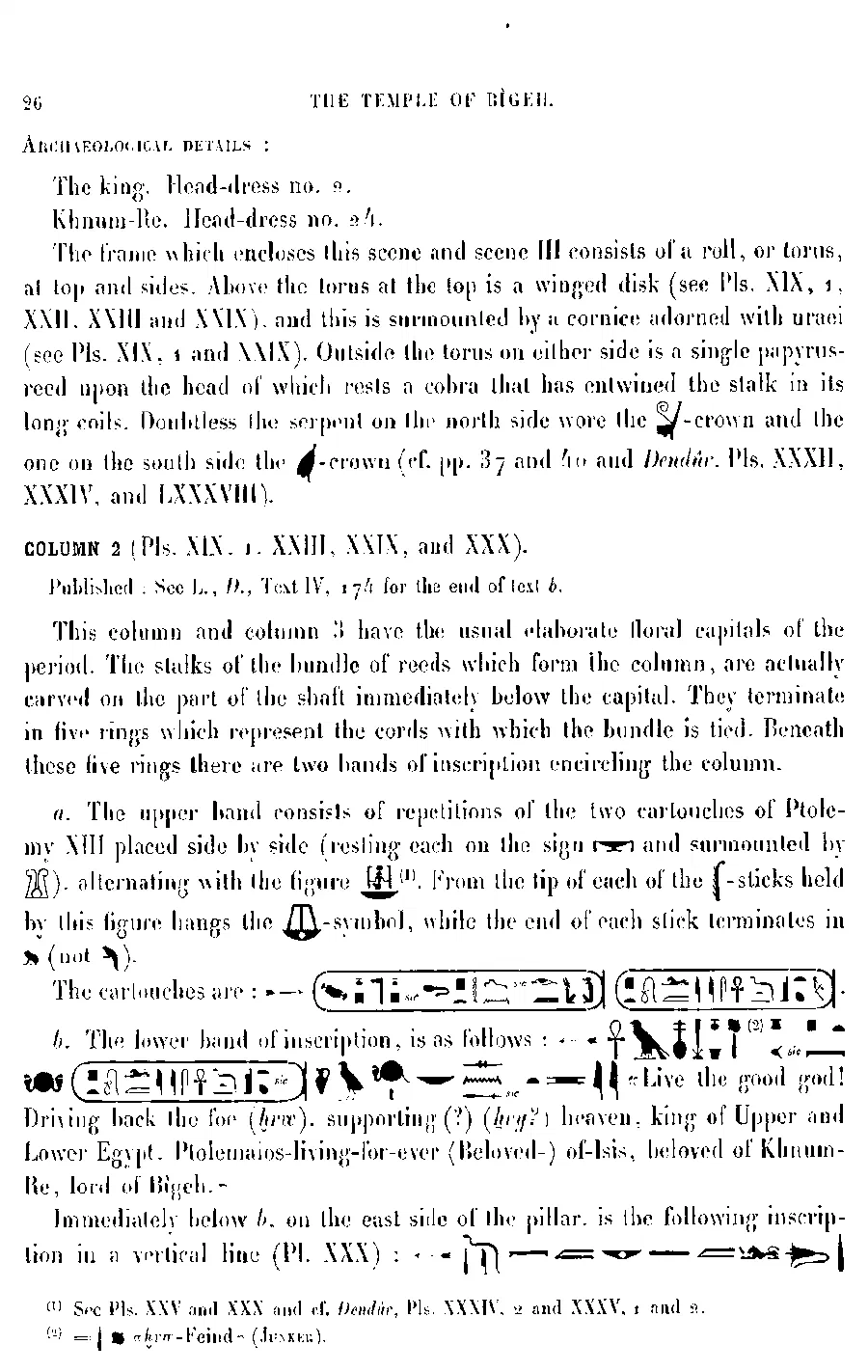
jwꜥ-n-p(ꜣ)-nṯr-nt.j-nḥm-stp-n-ptḥ-jrj-mꜣꜥ.t-rꜥ-<sḫm-ꜥnḫ-n>-jmn ptwlmys-ꜥnḫ-ḏ.t-mrj-ꜣs.t
Heir of the Savior God, chosen of Ptah, who upholds the Maat of Ra, living image of Amun; Ptolemy, living forever, beloved of Isis.
Note · Line 184
The first set of titles forms Ptolemy’s throne name. - 185p. 26, l. 25
ꜥnḫ nṯr nfr šnꜥ ḫrwj ẖr p.t
Long live the perfect god who drives back the foes beneath the sky,
- 186p. 26, l. 26
nswt-bj.tj ptwlmys-ꜥnḫ-ḏ.t-<mrj>-ꜣs.t mrj ẖnmw-rꜥ nb snm.t
the King of Upper and Lower Egypt, Ptolemy, living forever, beloved of Isis, beloved of Khnum-Ra, lord of Senmet.
- 187p. 26, l. 31
ḏd-mdw {jn} p.t m ḥb tꜣ m rš ḥp.tj
Words to be spoken: Heaven keeps festival,
earth rejoices,
the world 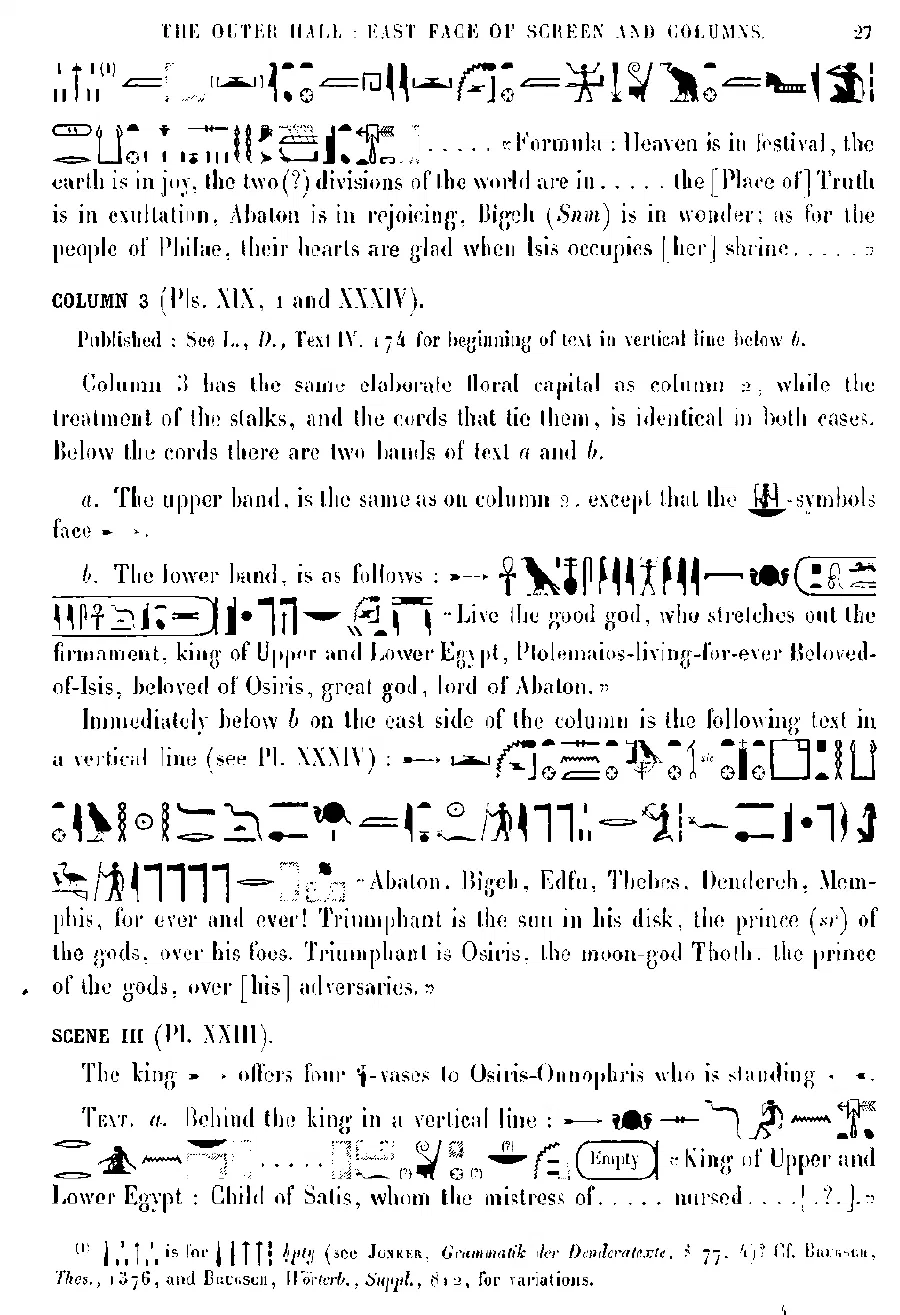
Page 27. Blackman, The Temple of Bigeh (1915), p. 27 Printed hieroglyphs from A. M. Blackman, The Temple of Bigeh (1915) - 188p. 27, l. 1
m --1Q-- jꜣ.t-mꜣꜥ.t m hj jꜣ.t-wꜥb.t m ḥꜥꜥ snm.t m ḫntš js.t
is in …;
the Mound of Maat cries out for joy,
the Abaton rejoices,
Senmet exults.
The peopleNote · Line 188
The Abaton, the “inaccessible place,” was the sanctuary on Bigeh where Osiris was believed to lie buried. - 189p. 27, l. 2
jwrḳ jb=sn nḏm ḏr šsp ꜣs.t stj.t --détruit--
of Philae are glad of heart since Isis took possession of the shrine …
- 190p. 27, l. 13
ꜥnḫ nṯr nfr sḫj ḫj.(t) nswt-bj.tj ptwlmys-
Long live the perfect god who raises the sky, the King of Upper and Lower Egypt, Ptolemy,
- 191p. 27, l. 14
ꜥnḫ-ḏ.t-mrj-ꜣs.t mrj wsjr nṯr ꜥꜣ nb <jꜣ.t>-wꜥb.t
living forever, beloved of Isis, beloved of Osiris, the great god, lord of the Abaton.
- 192p. 27, l. 18
jꜣ.t-wꜥb.t snm.t wṯs.t-ḥrw wꜣs.t jwn.t ḥw.t-kꜣ-ptḥ (10)
The Abaton, Senmet, Edfu, Thebes, Dendera and Memphis,
- 193p. 27, l. 19
r ḥḥ ḥnꜥ ḏ.t mꜣꜥ-ḫrw rꜥ m jtn=f sr nṯr.w r ḫft.j.w=f mꜣꜥ-ḫrw wsjr-jꜥḥ-
for endless ages and for eternity.
Ra in his disk, prince of the gods, is vindicated against his foes.
Osiris-Iah-Note · Line 193
Iah is the moon god. The compound name Osiris-Iah-Thoth brings Osiris together with Iah and Thoth in a single lunar deity. - 194p. 27, l. 20
ḏḥwtj sr nṯr.w r [ḫft,j.w=f]
Thoth, prince of the gods, is vindicated against his foes.
- 195p. 27, l. 26
sḏtj n st.t
Nursling of Satis,
- 196p. 27, l. 27
rr n nb --11Q-- nb wꜥb --cꜥrtouche vide--
infant of the lord …, lord of purification.
Note · Line 196
The cartouche, the oval reserved for the royal name, was left blank here. 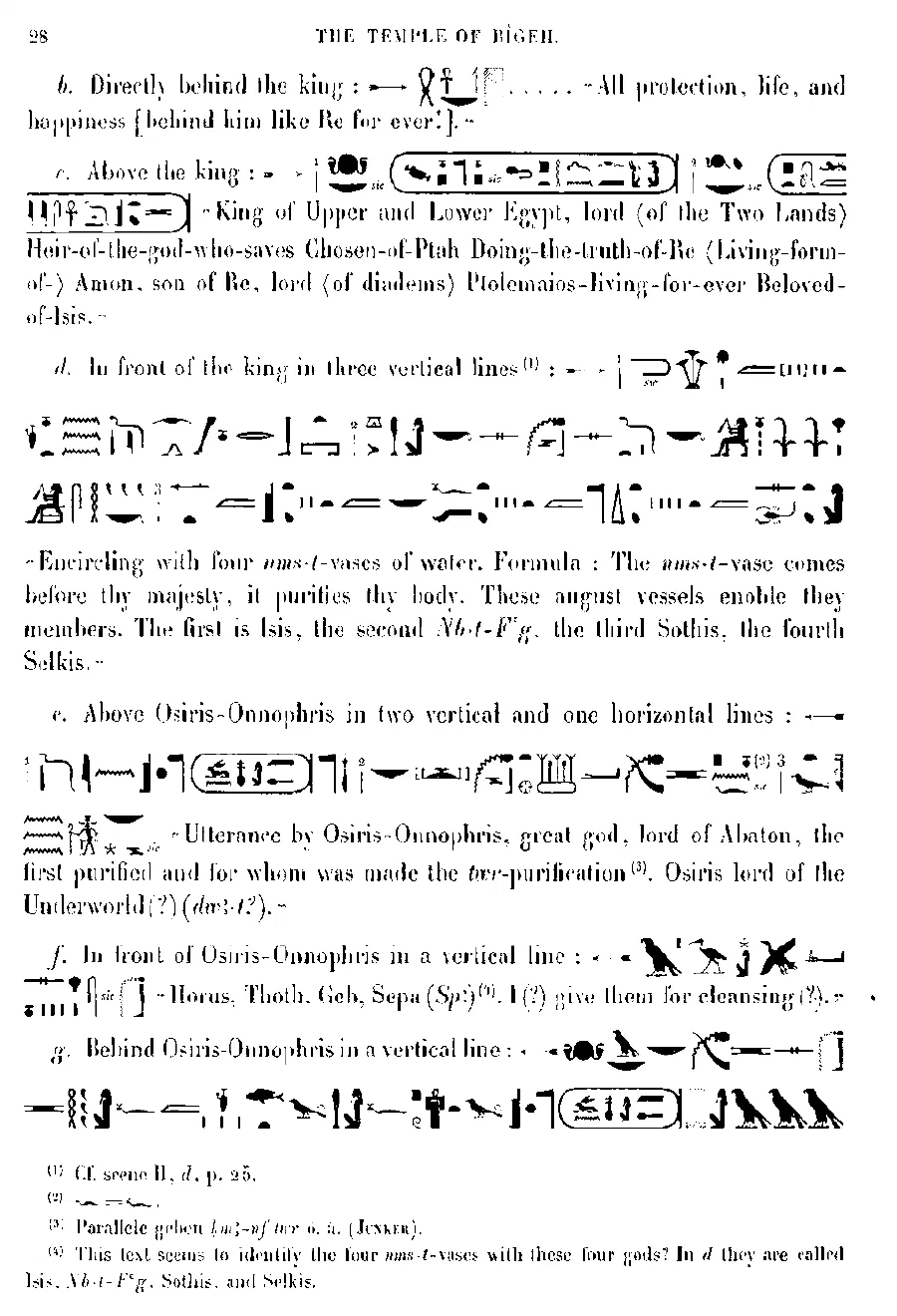
Page 28. Blackman, The Temple of Bigeh (1915), p. 28 Printed hieroglyphs from A. M. Blackman, The Temple of Bigeh (1915) - 197p. 28, l. 1
sꜣ ꜥnḫ wꜣs nb [ḥꜣ=f mj rꜥ ḏ.t]
All protection, life and dominion are behind him, as they are behind Ra, forever.
- 198p. 28, l. 3
nswt-bj.tj nb-<tꜣ.wj> jwꜥ-n-p(ꜣ)-nṯr-nt.j-nḥm-stp-n-ptḥ-jrj-mꜣꜥ.t-rꜥ-<sḫm-ꜥnḫ-n>-jmn sꜣ-rꜥ nb-<ḫꜥ.w> ptwlmys-
King of Upper and Lower Egypt, lord of the Two Lands, heir of the Savior God, chosen of Ptah, who upholds the Maat of Ra, living image of Amun; Son of Ra, lord of crowns, Ptolemy,
- 199p. 28, l. 4
ꜥnḫ-ḏ.t-mrj-ꜣs.t
living forever, beloved of Isis.
- 200p. 28, l. 8
pẖr ḥꜣ m fdw nms.t
Circling with four nemset jars
Note · Line 200
A nemset jar held water for ritual purification. - 201p. 28, l. 9
n.t mw ḏd-mdw {jn} spr nms.t r bw.t ẖr ḥm=k swꜥb=s ḏ.t=k šps.w nn ḥr
of water. Words to be spoken: The nemset jar comes to where Your Majesty is, to purify your body. These noble vessels
- 202p. 28, l. 10
šps ḥꜥ.w=k wꜥ.t m ꜣs.t sn-nw m nb.t fꜥg. ḫmt-nw m spd.t fdw-nw m srḳ.t
ennoble your limbs. The first is Isis, the second the Lady of Faget, the third Sothis, the fourth Serket.
- 203p. 28, l. 16
ḏd-mdw jn wsjr wnn-nfr mꜣꜥ-ḫrw nṯr ꜥꜣ nb jꜣ.t-wꜥb.t šꜣꜥ ꜥbw <ḳmꜣ>(11) n=f twr
Words spoken by Osiris Wennefer, vindicated, the great god, lord of the Abaton, who began the cleansing, for whom purification was created,
Note · Line 203
Wennefer, “He who remains perfect,” is a name of Osiris. - 204p. 28, l. 17
jtj nb nṯr.w(?)
the sovereign, lord of the gods.
- 205p. 28, l. 20
ḥrw ḏḥwtj gb spꜣ(?) dj=sn
Horus, Thoth, Geb and Sepa make
- 206p. 28, l. 21
ḥr=<k> {s} wꜥb
your face pure.
- 207p. 28, l. 22
nṯr nb ꜥbw swꜥb
The god, lord of purification, who purifies
- 208p. 28, l. 23
ḥꜥ.w=f m nms.wt bw.t ḥm=f pw sꜣ.t wsjr wnn-nfr mꜣꜥ-ḫrw [nswt] nṯr.w
his limbs with nemset jars—His Majesty abhors filth—Osiris Wennefer, vindicated, king of the gods.
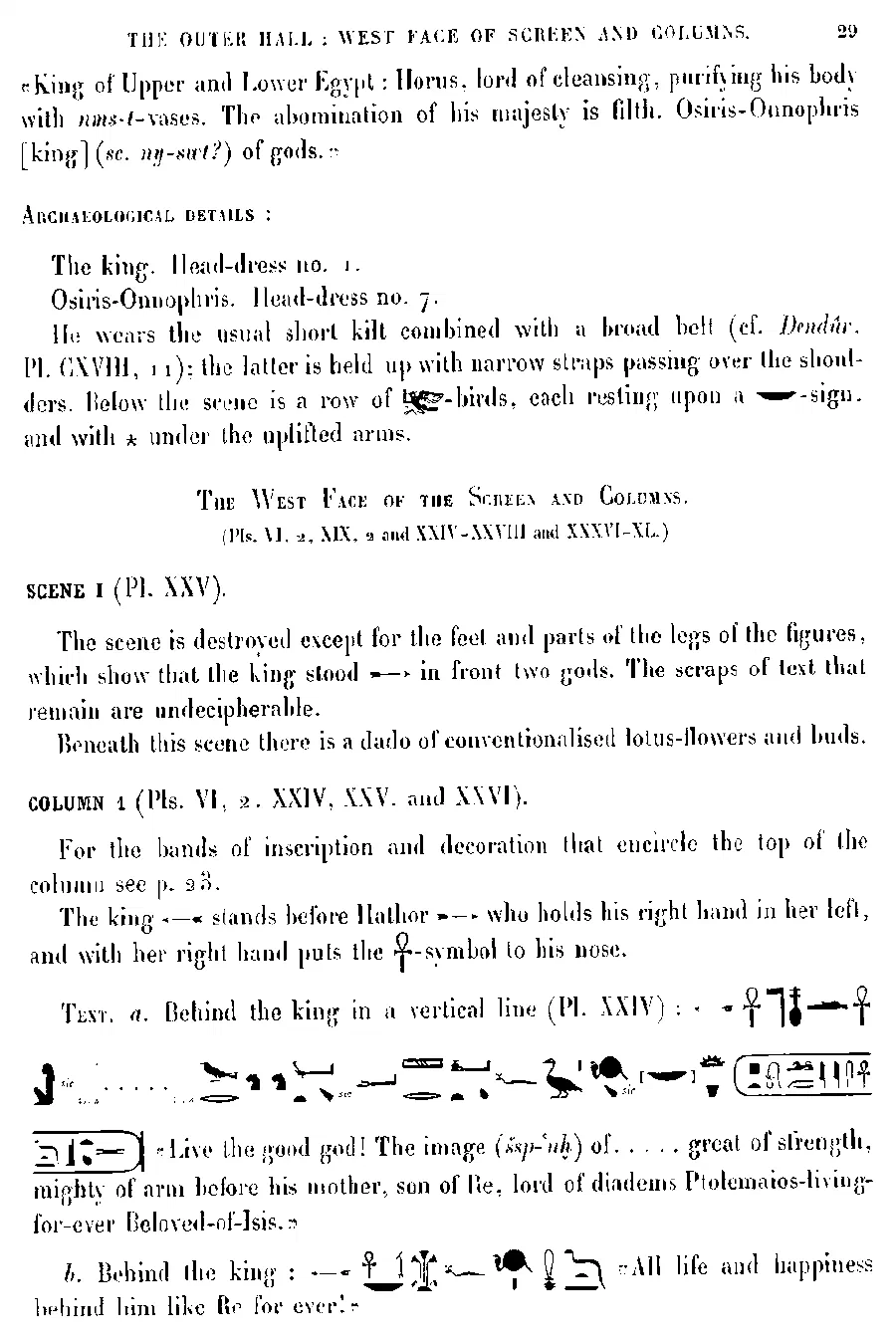
Page 29. Blackman, The Temple of Bigeh (1915), p. 29 Printed hieroglyphs from A. M. Blackman, The Temple of Bigeh (1915) - 209p. 29, l. 23
ꜥnḫ nṯr nfr šsp ꜥnḫ
Long live the perfect god, the living image
- 210p. 29, l. 24
--détruit-- wr pḥtj nḫt(?) ꜥ ḫr mw.t=f sꜣ-rꜥ nb-ḫꜥ ptwlmys-ꜥnḫ-
…, great in strength, mighty of arm beside his mother, Son of Ra, lord of crowns, Ptolemy, living
- 211p. 29, l. 25
ḏ.t-mrj-ꜣs.t
forever, beloved of Isis.
- 212p. 29, l. 28
<sꜣ> ꜥnḫ wꜣs nb ḥꜣ=f mj rꜥ ḏ.t
All protection, life and dominion are behind him, as behind Ra, forever.
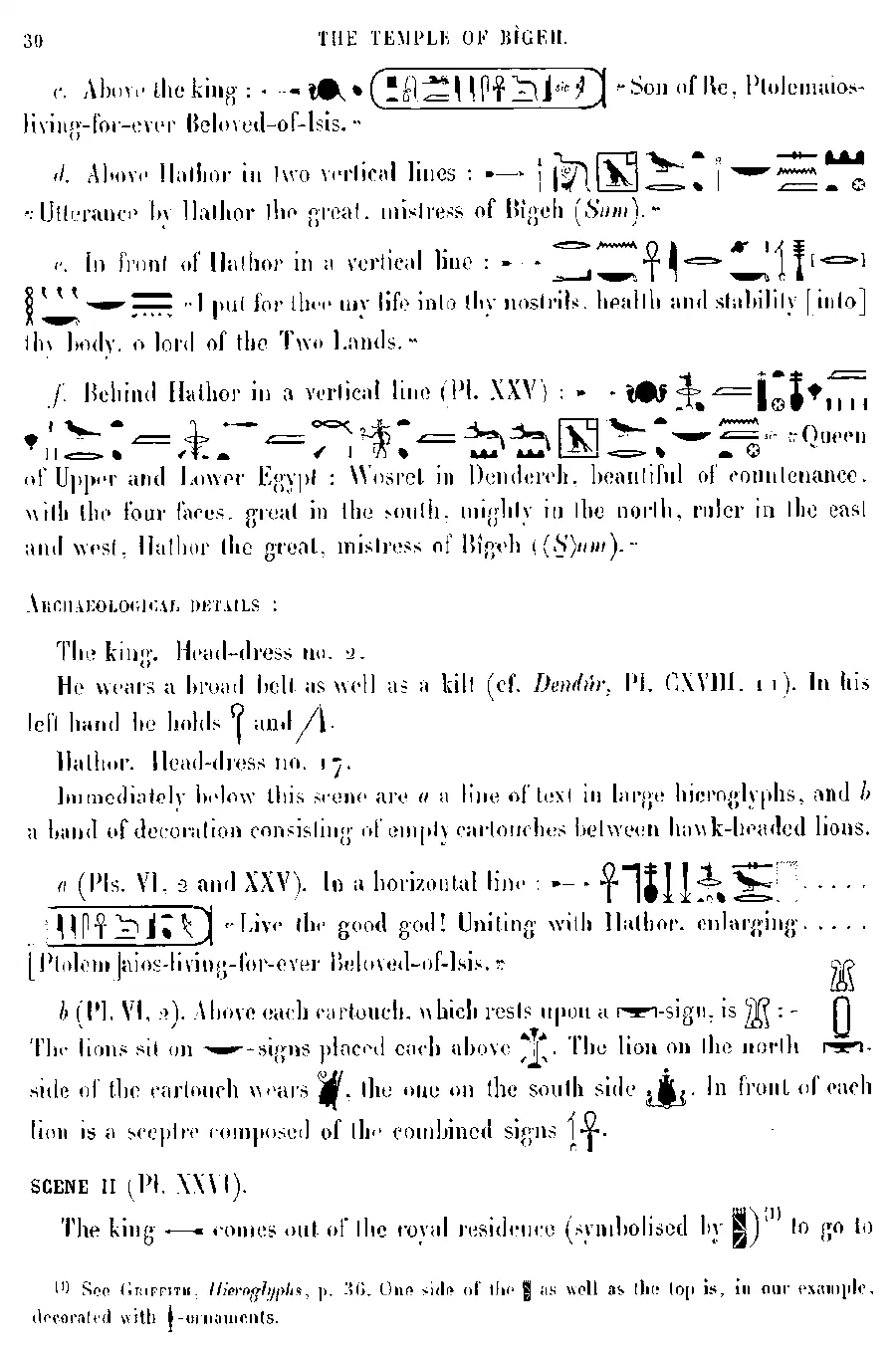
Page 30. Blackman, The Temple of Bigeh (1915), p. 30 Printed hieroglyphs from A. M. Blackman, The Temple of Bigeh (1915) - 213p. 30, l. 1
sꜣ-rꜥ ptwlmys-ꜥnḫ-ḏ.t-mrj-ꜣs.t
Son of Ra, Ptolemy, living forever, beloved of Isis.
- 214p. 30, l. 3
ḏd-mdw jn ḥw.t-ḥrw wr.t nb.(t) snm.t
Words spoken by Hathor the Great, Lady of Senmet:
- 215p. 30, l. 5
rdj=(j) n=k ꜥnḫ r fnḏ=k wꜣs ḏd r
I give you life for your nose, dominion and stability for
Note · Line 215
Life is the breath the king draws through his nose. - 216p. 30, l. 6
ḥꜥ.w=k nb-tꜣ.wj
your limbs, lord of the Two Lands.
Note · Line 216
The Two Lands are Upper and Lower Egypt. - 217p. 30, l. 8
wsr.t m jwn.t nfr.(t) ḥr m fdw
Wosret in Dendera, fair of face with four
Note · Line 217
Wosret means “the Mighty One,” here a name of Hathor. - 218p. 30, l. 9
ḥr.w wr.t m rsj ꜥꜣ.t m mḥw jtj.t m jmnt.t jꜣbt.t ḥw.t-ḥrw wr.t nb.(t) snm.t
faces, great in the south, mighty in the north, sovereign in the west and the east: Hathor the Great, Lady of Senmet.
Note · Line 218
Hathor’s four faces look to the four quarters of the world. - 219p. 30, l. 20
ꜥnḫ nṯr nfr snsn wsr.t swr --détruit--
Long live the perfect god, who joins with Wosret, who makes great …
- 220p. 30, l. 21
[ptwlm]ys-ꜥnḫ-ḏ.t-mrj-ꜣs.t
Ptolemy, living forever, beloved of Isis.
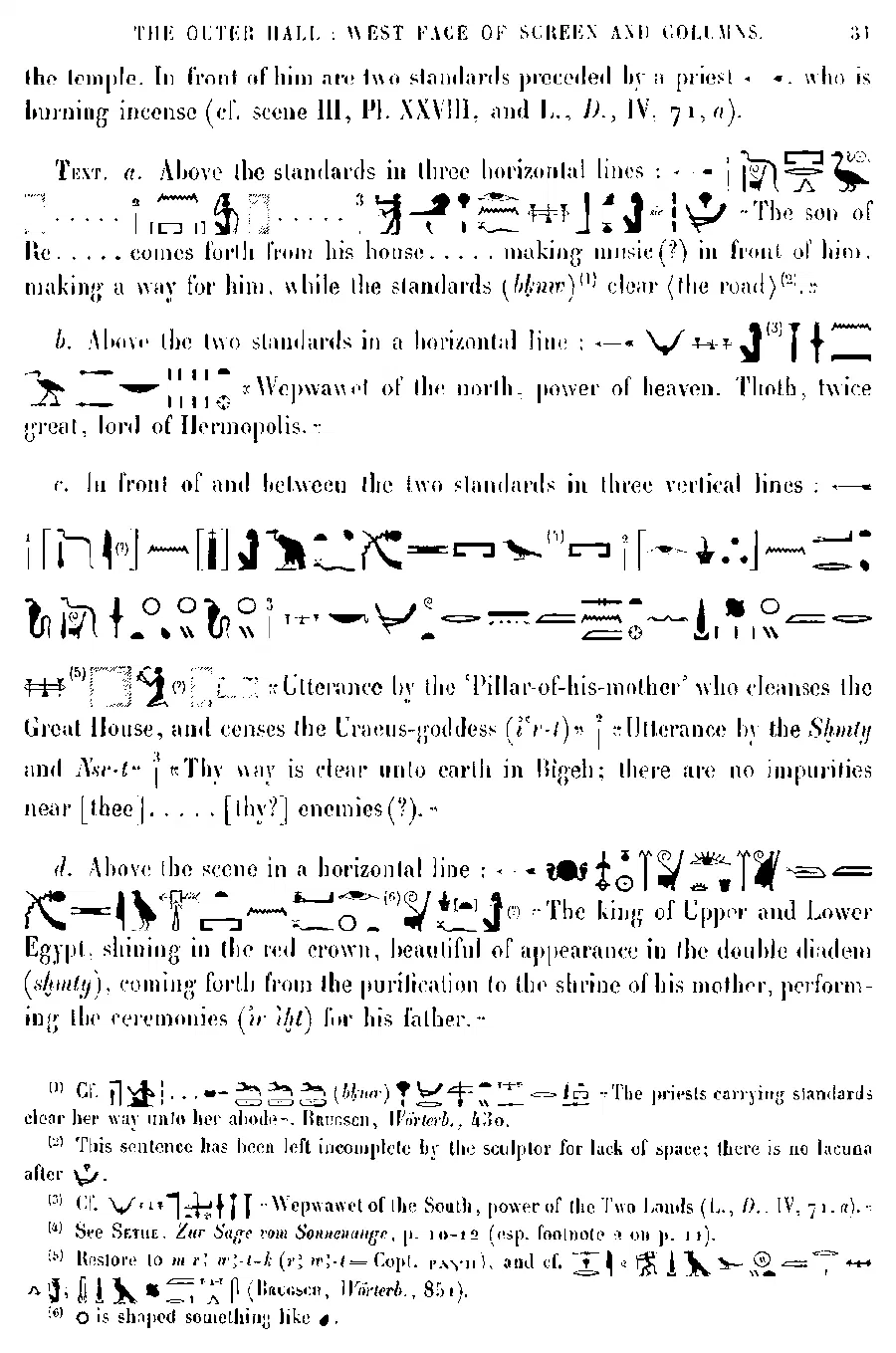
Page 31. Blackman, The Temple of Bigeh (1915), p. 31 Printed hieroglyphs from A. M. Blackman, The Temple of Bigeh (1915) - 221p. 31, l. 3
ḏd-mdw {jn} prj sꜣ-rꜥ
Recitation: The Son of Ra comes forth
- 222p. 31, l. 4
--5Q-- n pr=f --5Q-- jḥj ḥꜣ.t=f ḥr jrj.t n=f wꜣ.t bḳnḳn ḥr ḏsr
… of his house … Ihy goes before him, making a way for him as the standard-bearers clear it.
Note · Line 222
Ihy, Hathor’s son, leads the king in procession. - 223p. 31, l. 7
wpj-wꜣ.wt ḫrp n p.t
Wepwawet, ruler of the sky.
Note · Line 223
Wepwawet’s name means “Opener of the Ways.” - 224p. 31, l. 8
ḏḥwtj ꜥꜣ ꜥꜣ nb ḫmnw
Thoth, twice great, lord of Hermopolis.
- 225p. 31, l. 11
[ḏd-mdw j]n [jwn]-mw.t=f ꜥb pr-wr jrj snṯr n jꜥr.t
Words spoken by Iunmutef, who purifies the Great Shrine and burns incense for the uraeus.
Note · Line 225
Iunmutef means “Pillar of His Mother,” a ritual role taken by a priest. - 226p. 31, l. 12
ḏd-mdw jn sḫm.tj (12) wꜣ.t=k ḏsr.tj r tꜣ m snm.t n ḏꜣj.t m rꜣ-
Words spoken by the Double Crown: Your way to the land of Senmet is clear. No harm lies on
Note · Line 226
The Double Crown joins the White Crown of Upper Egypt to the Red Crown of Lower Egypt. - 227p. 31, l. 13
wꜣ.t --1Q-- ḫft.j.w --1Q--
the road … the enemies …
- 228p. 31, l. 17
wbn m n.t ꜥn ḫꜥ m sḫm.tj prj (13) m
He who rises in the Red Crown, fair when he appears in the Double Crown, who goes forth in
- 229p. 31, l. 18
ꜥbw r stj.t n mw.t=f jrj jḫ.t n jt=f
purity to his mother’s chapel and makes offerings to his father.
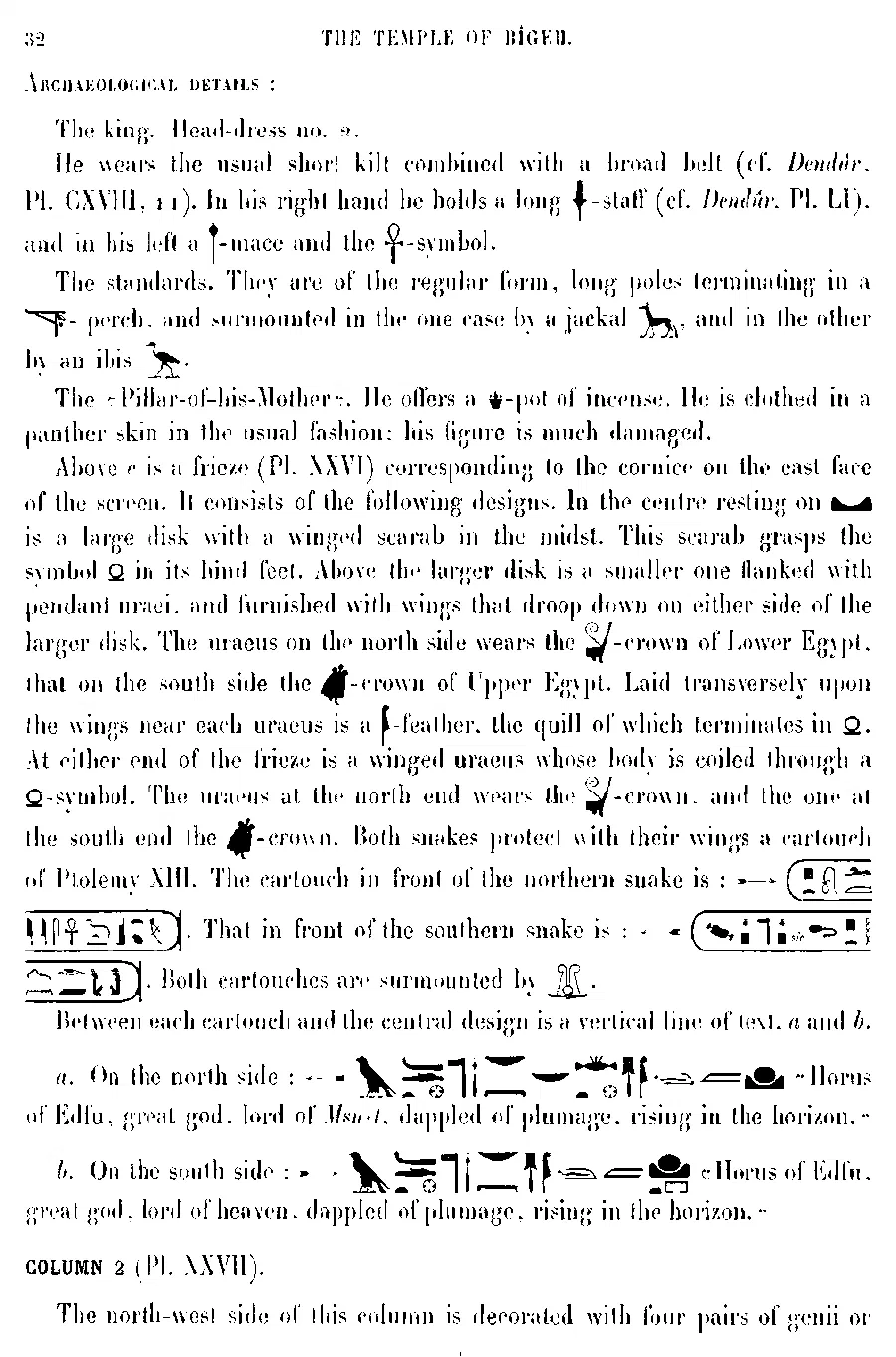
Page 32. Blackman, The Temple of Bigeh (1915), p. 32 Printed hieroglyphs from A. M. Blackman, The Temple of Bigeh (1915) - 230p. 32, l. 22
ptwlmys-
Ptolemy,
- 231p. 32, l. 23
ꜥnḫ-ḏ.t-mrj-ꜣs.t
living forever, beloved of Isis.
- 232p. 32, l. 23
jwꜥ-n-p(ꜣ)-nṯr-nt.j-nḥm-stp-n-ptḥ-
Heir of the god who saves, chosen of Ptah,
Note · Line 232
“The god who saves” is the royal cult title Soter, Greek for “Savior.” - 233p. 32, l. 24
jrj-mꜣꜥ.t-rꜥ-<sḫm-ꜥnḫ-n>-jmn
who upholds the Maat of Ra, living image of Amun.
- 234p. 32, l. 26
ḥrw bḥd.tj nṯr ꜥꜣ nb p.t nb msn sꜣb šw.t prj m ꜣḫ.t
Horus of Edfu, the great god, lord of the sky, lord of Mesen, whose plumage is many-colored, who comes forth from the horizon.
- 235p. 32, l. 28
ḥrw bḥd.tj nṯr ꜥꜣ nb p.t sꜣb šw.t prj m ꜣḫ.t
Horus of Edfu, the great god, lord of the sky, whose plumage is many-colored, who comes forth from the horizon.
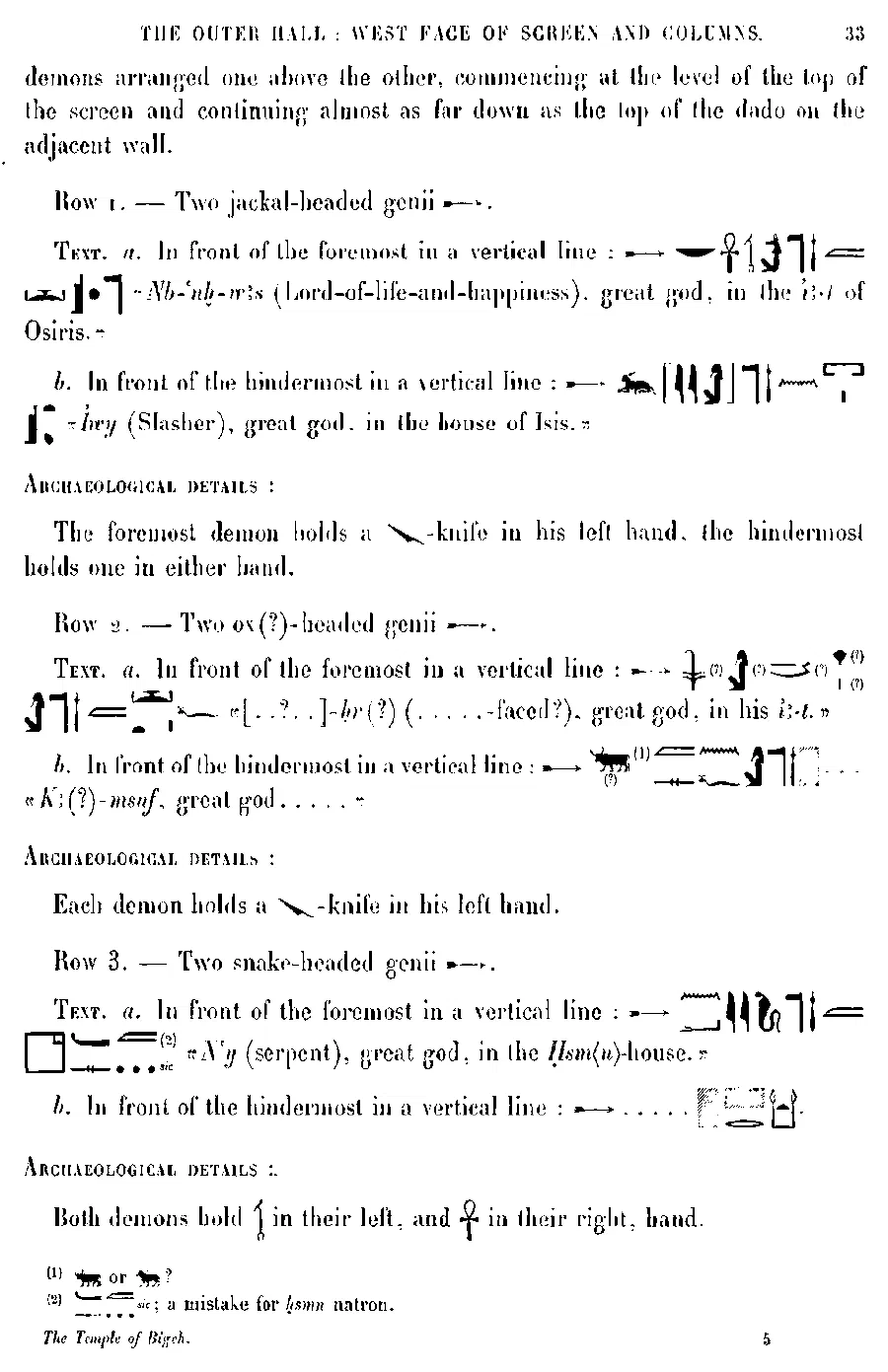
Page 33. Blackman, The Temple of Bigeh (1915), p. 33 Printed hieroglyphs from A. M. Blackman, The Temple of Bigeh (1915) - 236p. 33, l. 5
nb-ꜥnḫ-wꜣs nṯr ꜥꜣ m jꜣ.t-wsjr
Lord of life and dominion, the great god on the Mound of Osiris.
Note · Line 236
The mound on Bigeh was revered as a burial place of Osiris. - 237p. 33, l. 8
sštꜣ wr nṯr ꜥꜣ n pr-
He of the great secret, the great god of the House
- 238p. 33, l. 9
ꜣs.t
of Isis.
- 239p. 33, l. 14
nswt-mꜣꜥ-ḥr
The king with uplifted face,
- 240p. 33, l. 15
nṯr ꜥꜣ m jꜣ.t=f
the great god on his mound.
- 241p. 33, l. 16
bꜣ-<ꜥnḫ>-m-snf nṯr ꜥꜣ --détruit--
The ba who lives on blood, the great god …
- 242p. 33, l. 21
nꜥj nṯr ꜥꜣ m
The Nay-serpent, the great god in
- 243p. 33, l. 22
ḥw.t-ḥsmn
the House of Natron.
Note · Line 243
Natron is a naturally occurring salt used in purification rites. - 244p. 33, l. 23
--1Q-- r kꜣ=ṯ
… toward your ka.
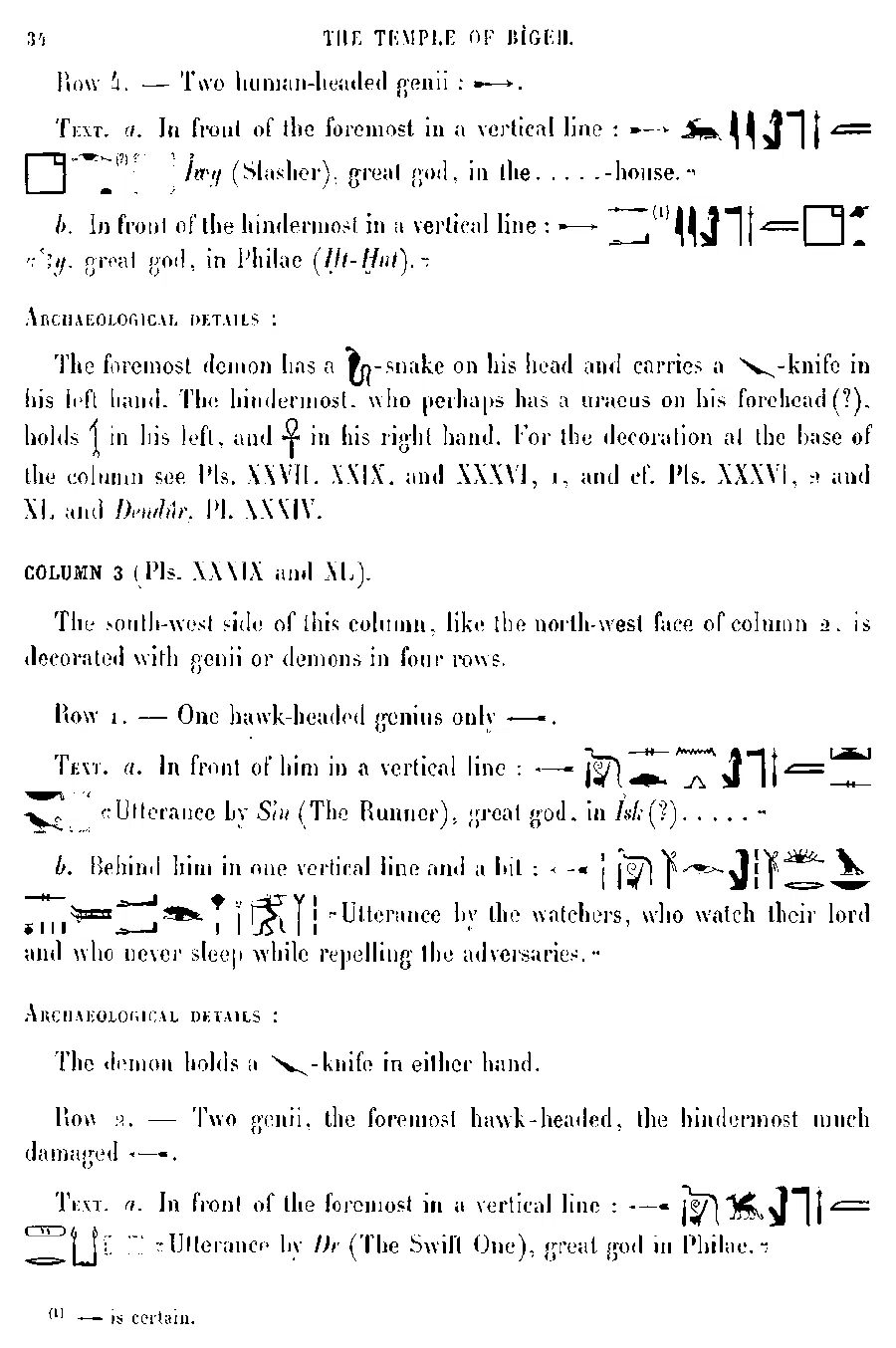
Page 34. Blackman, The Temple of Bigeh (1915), p. 34 Printed hieroglyphs from A. M. Blackman, The Temple of Bigeh (1915) - 245p. 34, l. 2
jwj nṯr ꜥꜣ m
The Weeper, the great god in
- 246p. 34, l. 3
ḥw.t-jrj.t --1Q--
the House of Irit …
- 247p. 34, l. 4
ꜥꜣj nṯr ꜥꜣ m ḥw.t-ḫnt
The Great One, the great god at Philae.
- 248p. 34, l. 16
ḏd-mdw jn sjn nṯr ꜥꜣ m jꜣ.t-
Words spoken by the Runner, the great god on the Mound
- 249p. 34, l. 17
sk --1Q--
of Destruction …
- 250p. 34, l. 18
ḏd-mdw jn rs.w rs.(w) r nb=sn
Words spoken by the Watchers, who watch over their lord,
- 251p. 34, l. 19
tm ꜥꜥw ḥr sḥr sbj.w
who do not sleep as they strike down the rebels.
- 252p. 34, l. 25
ḏd-mdw jn ḫꜣḫ nṯr ꜥꜣ m jwrḳ
Words spoken by the Swift One, the great god at Philae.
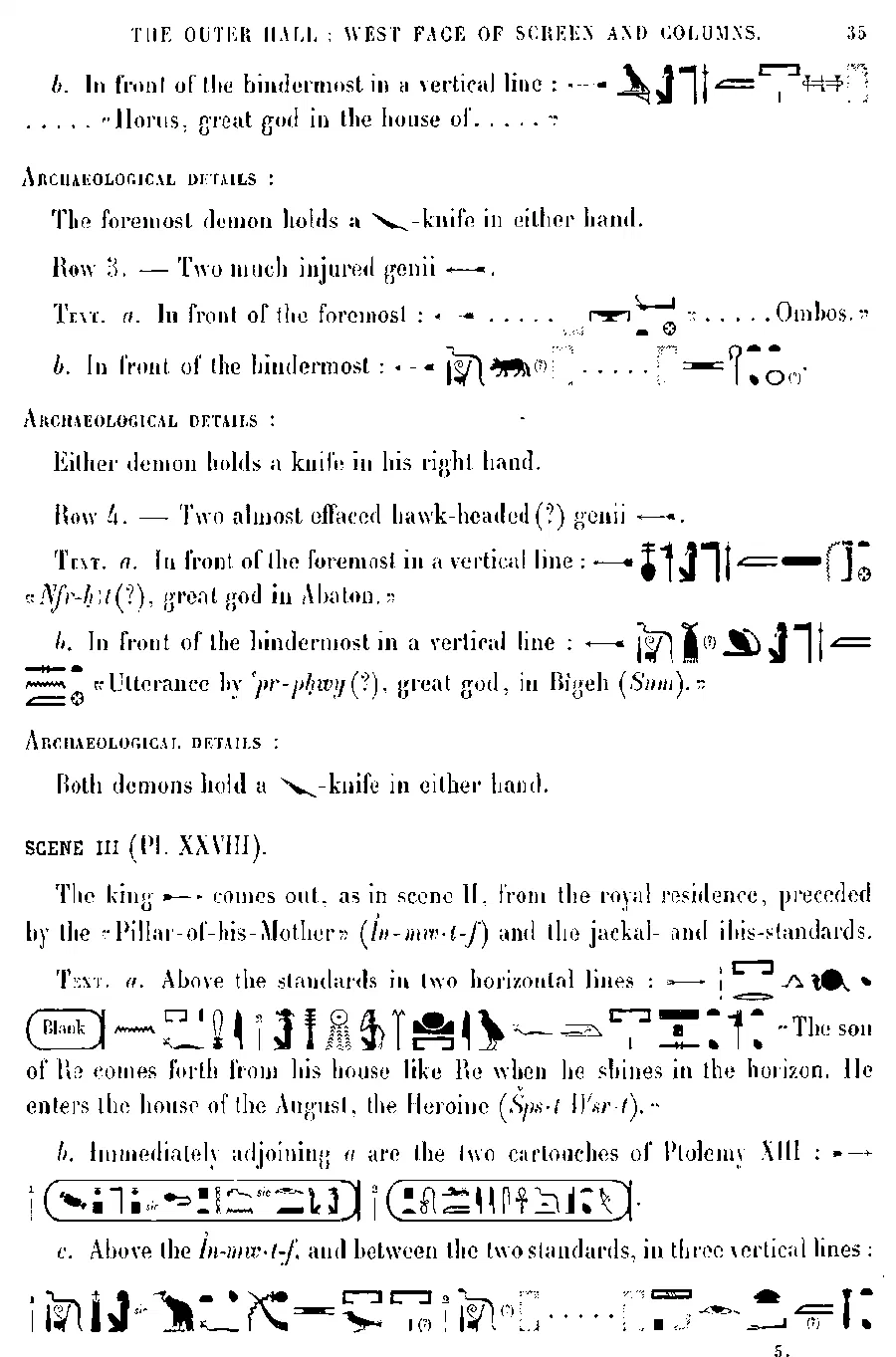
Page 35. Blackman, The Temple of Bigeh (1915), p. 35 Printed hieroglyphs from A. M. Blackman, The Temple of Bigeh (1915) - 253p. 35, l. 1
bjk nṯr ꜥꜣ m pr-wꜣ.t --1/2Q--
The Falcon, the great god in the House of the Way …
- 254p. 35, l. 6
--détruit-- nbw.t --détruit--
… Nebut …
- 255p. 35, l. 7
ḏd-mdw jn …(?) --détruit-- mrj ḥḳꜣ.t(?)
Words spoken by … beloved of the sovereign lady.
- 256p. 35, l. 11
nfr-ḥꜣ.t nṯr ꜥꜣ m jw-wꜥb
He of the Fair Brow, the great god in the Abaton.
- 257p. 35, l. 13
ḏd-mdw jn ꜥpr-pḥ nṯr ꜥꜣ m
Words spoken by him whose hindquarters are equipped, the great god at
- 258p. 35, l. 14
snm.t
Senmet.
- 259p. 35, l. 20
prj sꜣ-rꜥ
The Son of Ra comes forth
- 260p. 35, l. 21
--cꜥrtouche vide-- n pr=f mj rꜥ psḏ=f m ꜣḫ.t jw=f ꜥḳ pr šps.t wsr.t
from his house like Ra when he shines on the horizon. He enters the house of the Noble One, the Mighty One.
Note · Line 260
The cartouche, the oval frame for the king’s name, is blank here. - 261p. 35, l. 25
jwꜥ-n-p(ꜣ)-nṯr-nt.j-nḥm-stp-n-ptḥ-jrj-mꜣꜥ.t-rꜥ-<sḫm-ꜥnḫ-n>-jmn ptwlmys-ꜥnḫ-ḏ.t-mrj-ꜣs.t
Heir of the Savior God, chosen of Ptah, who upholds the Maat of Ra, living image of Amun; Ptolemy, living forever, beloved of Isis.
- 262p. 35, l. 27
ḏd-mdw jn jwn-mw.t=f ꜥb pr-wr
Words spoken by the Iunmutef, who purifies the Per-wer.
Note · Line 262
It is a title of Horus and of the priest who takes his part. - 263p. 35, l. 27
ḏd-mdw jn --détruit-- šp[s] ꜥn ḫꜥw m wꜣḏ.t
Words spoken by …, the Noble One, who appears in beauty as Wadjet,
Note · Line 263
Wadjet is the cobra goddess of Lower Egypt. 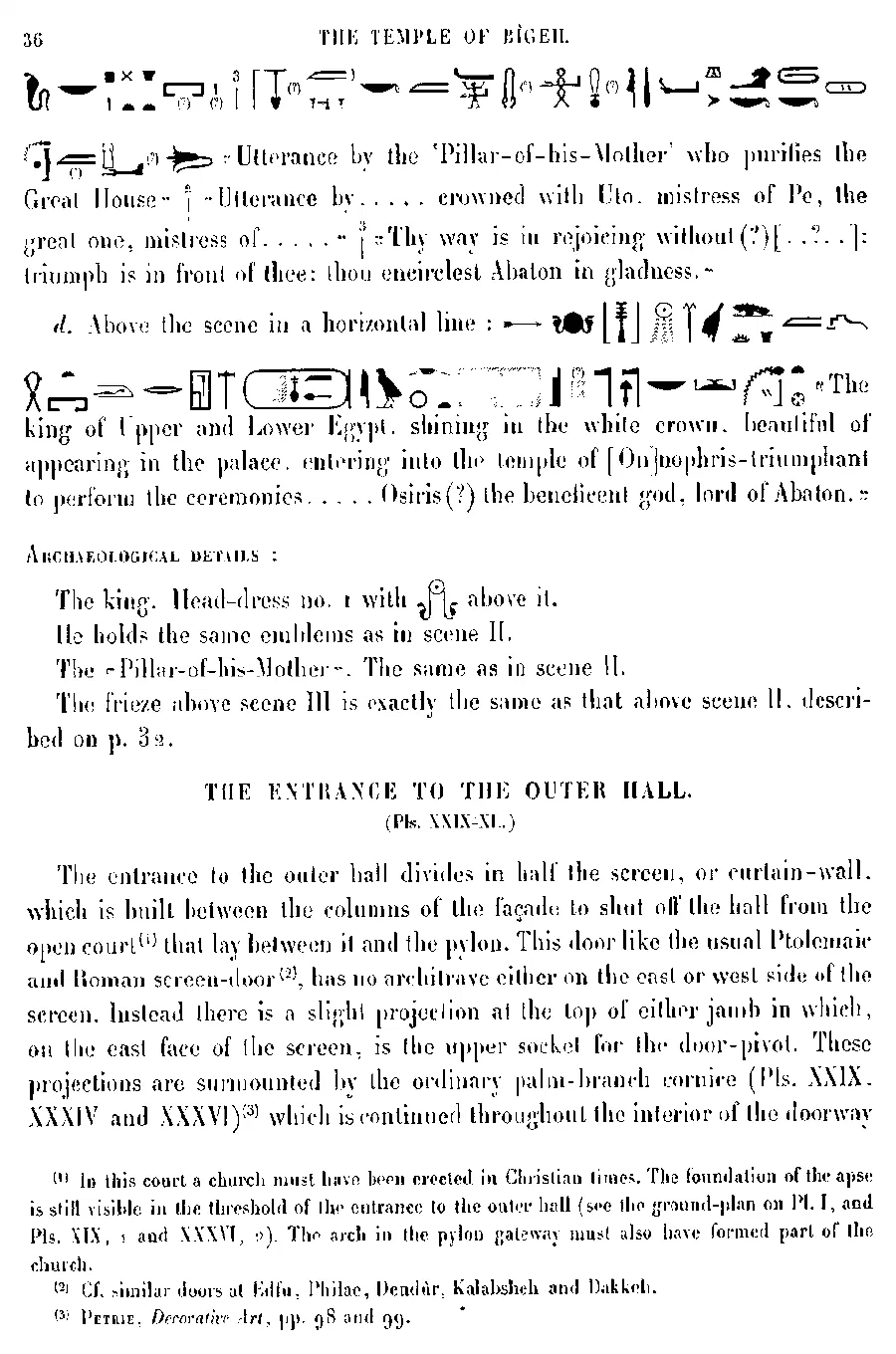
Page 36. Blackman, The Temple of Bigeh (1915), p. 36 Printed hieroglyphs from A. M. Blackman, The Temple of Bigeh (1915) - 264p. 36, l. 1
nb.(t) pr-wr ḥnw.t pr-nsr smꜣtj=k m ḥꜥꜥ mꜣḥ n(?) mꜣꜥ-ḫrw ẖr ḥꜣ.t=k pẖr=k jw-
lady of the Per-wer, mistress of the Per-neser: “Your path rejoices. The wreath of vindication rests on your brow, so that you may circle the
Note · Line 264
The Per-wer (“Great House”) and the Per-neser (“House of Flame”) are the emblematic shrines of Upper and Lower Egypt. - 265p. 36, l. 2
wꜥb m mk
Abaton in joy.”
- 266p. 36, l. 6
psḏ m ḥḏ.t ꜥn ḫꜥw m stp-
He who shines in the White Crown and appears in beauty in the palace
Note · Line 266
The White Crown is the crown of Upper Egypt. - 267p. 36, l. 7
sꜣ ꜥḳ r ḥw.t-nṯr n.t [wnn-]nfr mꜣꜥ-ḫrw r jrj.t jḫ.t --2Q-- wsjr nṯr ꜥꜣ nb jꜣ.t-wꜥb.t
enters the temple of Wennefer, the vindicated one, to make offerings … Osiris, the great god, lord of the Abaton.
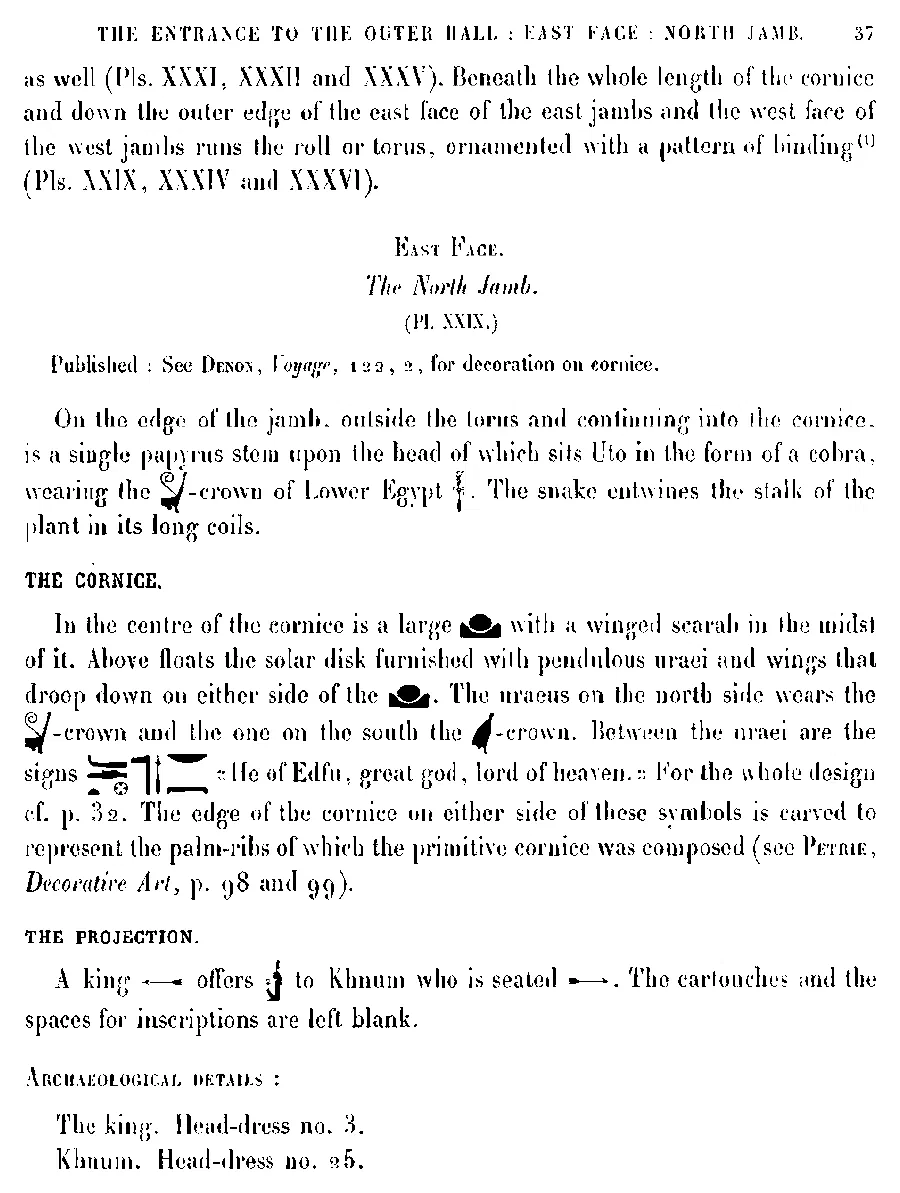
Page 37. Blackman, The Temple of Bigeh (1915), p. 37 Printed hieroglyphs from A. M. Blackman, The Temple of Bigeh (1915) - 268p. 37, l. 18
bḥd.tj nṯr ꜥꜣ nb p.t
He of Edfu, the great god, lord of the sky.
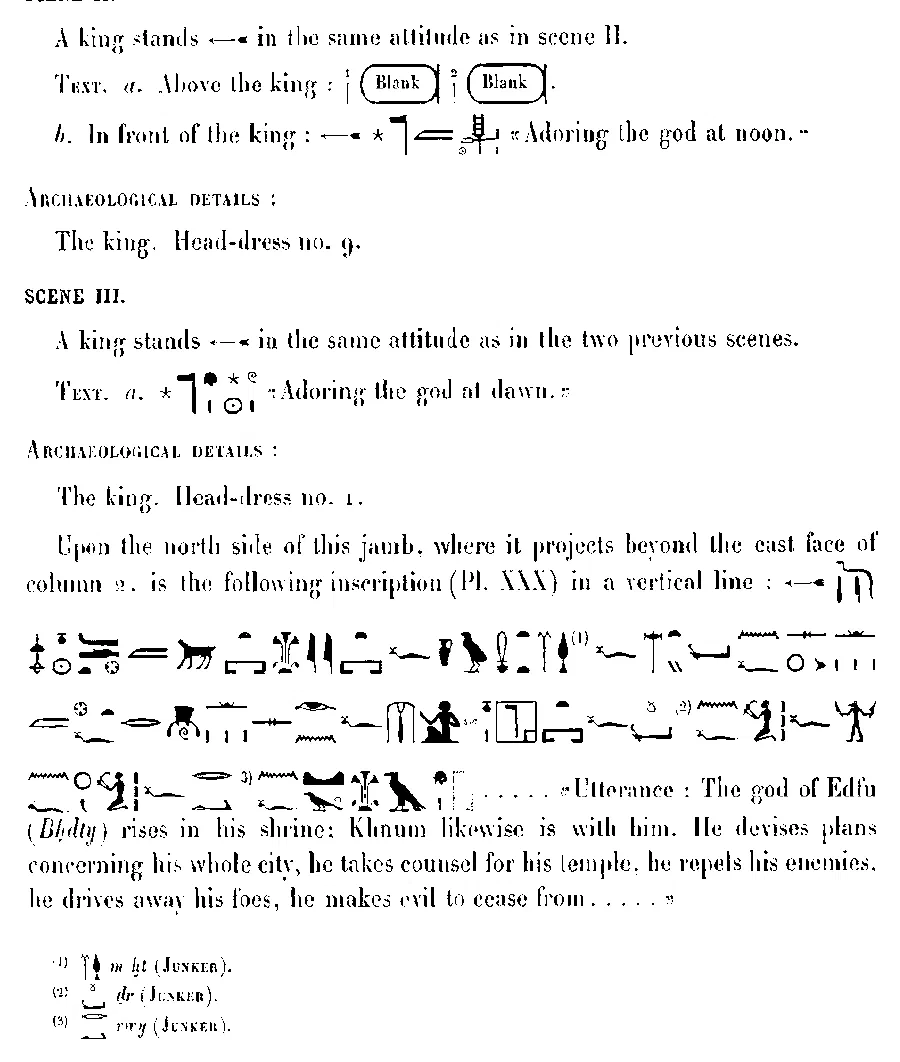
Page 38. Blackman, The Temple of Bigeh (1915), p. 38 Printed hieroglyphs from A. M. Blackman, The Temple of Bigeh (1915) - 269p. 38, l. 1
nswt-bj.tj --cꜥrtouche vide-- sꜣ-rꜥ --cꜥrtouche vide--
King of Upper and Lower Egypt, Son of Ra.
Note · Line 269
Both royal names are left blank. - 270p. 38, l. 2
dwꜣ-nṯr m mšrw
Adoring the god at evening.
- 271p. 38, l. 8
dwꜣ-nṯr m ꜥḥꜥj
Adoring the god at noon.
- 272p. 38, l. 13
dwꜣ-nṯr tp dwꜣw
Adoring the god at dawn.
- 273p. 38, l. 17
ḏd-mdw {jn}
Words to be spoken:
- 274p. 38, l. 18
wbn bḥd.tj m-ẖnw ḥꜥj.t=f ẖnmw mjt.t m-ḫt=f nḏ.n=f sḫr.w
He of Behdet rises within his chapel,
and Khnum rises likewise in his wake.
He has taken counselNote · Line 274
Khnum is the ram god worshipped near Bigeh at the First Cataract. - 275p. 38, l. 19
m njw.t=f r-ꜣw=s jrj.n=f sḥ n ḥw.t-nṯr=f dr.n=f ḫft.j.w=f sḥr.n=f
throughout his city;
he has given counsel to his temple.
He has driven off his enemies,
he has struck down - 276p. 38, l. 20
ḫft.j.w=f rwj.n=f ḏw ḥꜣ --10Q--
his enemies,
he has driven evil away from … 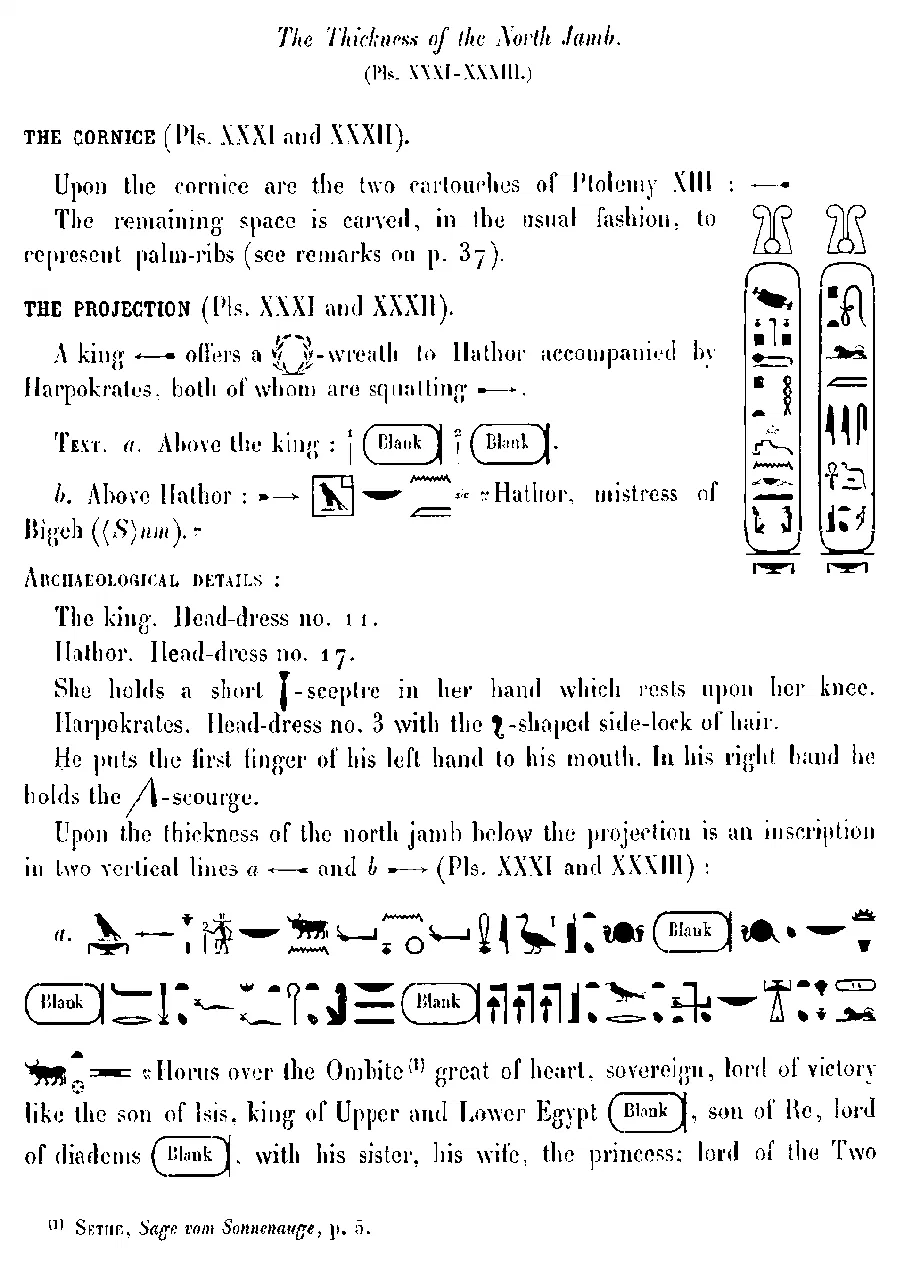
Page 39. Blackman, The Temple of Bigeh (1915), p. 39 Printed hieroglyphs from A. M. Blackman, The Temple of Bigeh (1915) - 277p. 39, l. 4
jwꜥ-n-p(ꜣ)-nṯr-nt.j-nḥm-stp-n-ptḥ-jrj-mꜣꜥ.t-rꜥ-<sḫm-ꜥnḫ-n>-jmn ptwlmys-ꜥnḫ-ḏ.t-mrj-ꜣs.t
Heir of the Savior God, chosen of Ptah, who upholds the Maat of Ra, living image of Amun; Ptolemy, living forever, beloved of Isis.
- 278p. 39, l. 11
ḥw.t-ḥrw nb.t <s>nm.t
Hathor, Lady of Senmet.
- 279p. 39, l. 22
ḥrw nbw ꜥꜣ jb jtj nb ḳn nḫt mj sꜣ ꜣs.t nswt-bj.tj --cꜥrtouche vide-- sꜣ-rꜥ nb-ḫꜥ
Golden Horus, great of heart, prince, lord of valor and might like the son of Isis; King of Upper and Lower Egypt, empty cartouche, Son of Ra, Lord of Crowns,
Note · Line 279
A cartouche is the oval frame that encloses a royal name. Here the name was left blank. - 280p. 39, l. 23
--cꜥrtouche vide-- ḥnꜥ sn.t=f ḥm.t=f ḥḳꜣ.t nb.(t)-tꜣ.wj --cꜥrtouche vide-- nṯr.w mnḫ.wj mrj ꜣs.t wr.t mw.t-nṯr nb.(t) jꜣtdj ḥr.j.t-jb jwrḳ
empty cartouche, with his sister, his wife, the sovereign, Lady of the Two Lands, empty cartouche: the two Benefactor Gods, beloved of Isis the Great, the god’s mother, Lady of Iatdi, who dwells on Philae.
Note · Line 280
“Benefactor Gods” is the title under which the royal couple were worshipped together. 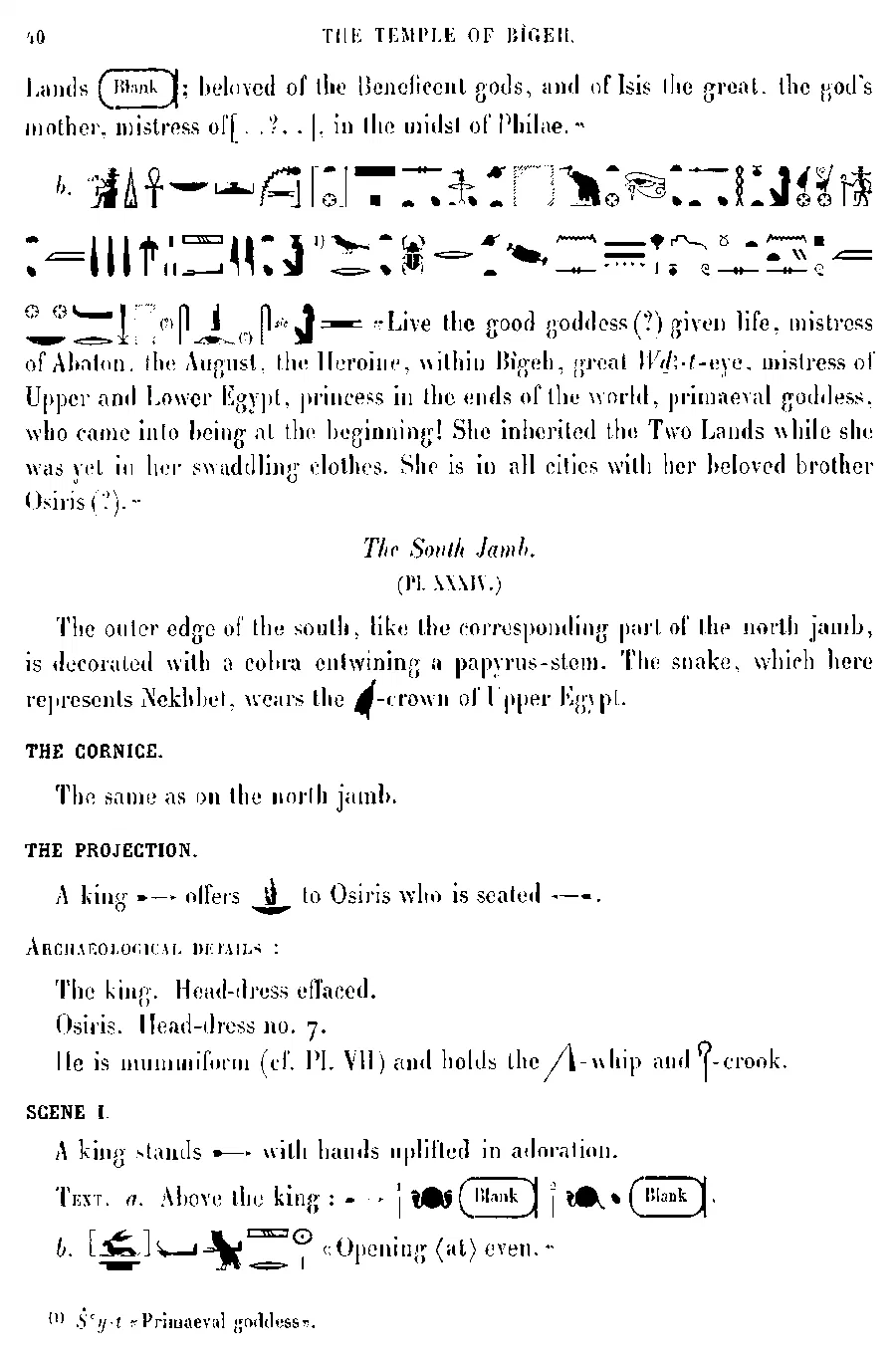
Page 40. Blackman, The Temple of Bigeh (1915), p. 40 Printed hieroglyphs from A. M. Blackman, The Temple of Bigeh (1915) - 281p. 40, l. 3
mrj ꜣs.t dj.(t) ꜥnḫ nb.(t) jꜣ.t-wꜥb.t šps.t wsr.t ḫnt.j.t [sn]m.t nṯr.t ꜥꜣ.t ḥnw.t šmꜥw mḥw jtj.t
Beloved of Isis, giver of life, Lady of the Abaton, the august one, the mighty one, foremost in Senmet, the great goddess, mistress of Upper and Lower Egypt, sovereign
Note · Line 281
The Abaton, the “inaccessible place,” was the sacred burial ground of Osiris on Bigeh. - 282p. 40, l. 4
m ḥp.tj šꜣꜥ.t wr.t ḫpr.(t) ḫnt jwꜥ.n=s tꜣ.wj tp nwd.t=s nts pw m
of the world, the primordial one, the great one who came into being before all. She inherited the Two Lands while still in her swaddling clothes. It is she who dwells in
- 283p. 40, l. 5
njw.wt nb.(wt) ḥnꜥ sn=s wsjr
every city with her brother Osiris.
- 284p. 40, l. 26
nswt-bj.tj --cꜥrtouche vide-- sꜣ-rꜥ --cꜥrtouche vide--
King of Upper and Lower Egypt, empty cartouche, Son of Ra, empty cartouche.
- 285p. 40, l. 27
wn <m> mšrw
Opening at dusk.
Page 41. Blackman, The Temple of Bigeh (1915), p. 41 Printed hieroglyphs from A. M. Blackman, The Temple of Bigeh (1915) - 286p. 41, l. 5
nswt-bj.tj --cꜥrtouche vide-- sꜣ-rꜥ --cꜥrtouche vide--
King of Upper and Lower Egypt, empty cartouche, Son of Ra, empty cartouche.
- 287p. 41, l. 6
wn m ꜥḥꜥj
Opening at noon.
- 288p. 41, l. 11
nswt-bj.tj --cꜥrtouche vide-- sꜣ-rꜥ --cꜥrtouche vide--
King of Upper and Lower Egypt, empty cartouche, Son of Ra, empty cartouche.
- 289p. 41, l. 12
wn tp dwꜣw
Opening at dawn.
- 290p. 41, l. 17
ḏd-mdw {jn} p.t ḥꜥ.tj ẖr štꜣ=<s> (14) jꜣbt.t šsp wnm.t jꜥḥ (15) jj (16) r sw=f n jnj ḥb (17)
Words to be spoken: The sky rejoices in the mystery it bears.
The left eye receives the right;
the moon comes on its appointed day, with no lapse in the feast,Note · Line 290
The left eye of Horus is the moon, his right eye the sun. The moon’s appointed day matters because festivals are timed by its phases. - 291p. 41, l. 18
nt-ꜥ=f nb mn ḥr wbn ḥtp ntk šw (18) wbn n p.t tꜣ rꜥ ḥꜥ.tj ḏḥwtj
its every rite fixed by rising and setting.
You are the light that shines for heaven and earth;
Ra rejoices. Thoth - 292p. 41, l. 19
prj m mꜣꜥ-ḫrw sjp.n=f (19) wḏꜣ.t n nb=s ꜥpr.n=f s(j) m dbḥ.t=s jtj mrj
comes forth vindicated.
He has reckoned the wedjat-eye for its lord,
having furnished it with all its parts.
The prince, belovedNote · Line 292
Thoth restores the injured eye of Horus piece by piece. The wedjat, the eye made whole, is also the full moon. - 293p. 41, l. 20
nṯr.w grg <n=k> (20) (21)
of the gods, makes ready for you.
Page 42. Blackman, The Temple of Bigeh (1915), p. 42 Printed hieroglyphs from A. M. Blackman, The Temple of Bigeh (1915) - 294p. 42, l. 9
ꜣs.t dj.(t) ꜥnḫ nb.(t) jw-wꜥb
Isis, giver of life, Lady of the Pure Island.
- 295p. 42, l. 11
ḥrw-nḏ-jt=f sꜣ ꜣs.t
Harendotes, son of Isis.
- 296p. 42, l. 19
wsjr nṯr ꜥꜣ nb jꜣ.t-wꜥb.t
Osiris, the great god, Lord of the Abaton.
- 297p. 42, l. 20
mrj ḥwnw nfr prj m nw.t jtj n nṯr.w nswt šmꜥw bj.tj mḥw ḥḳꜣ wr n sp.t-jgr.t
Beloved of the perfect youth who came forth from Nut, prince of the gods, king of Upper Egypt, king of Lower Egypt, great ruler of the nome of Igeret,
- 298p. 42, l. 21
nb wr.tj m ẖ.t mw.t=f sḥḏ stw.t m {m} jḫḫw
lord of the two rearing cobras even in his mother’s womb, whose rays shine in the darkness.
Note · Line 298
The two cobras are the goddesses who guard the royal brow. - 299p. 42, l. 26
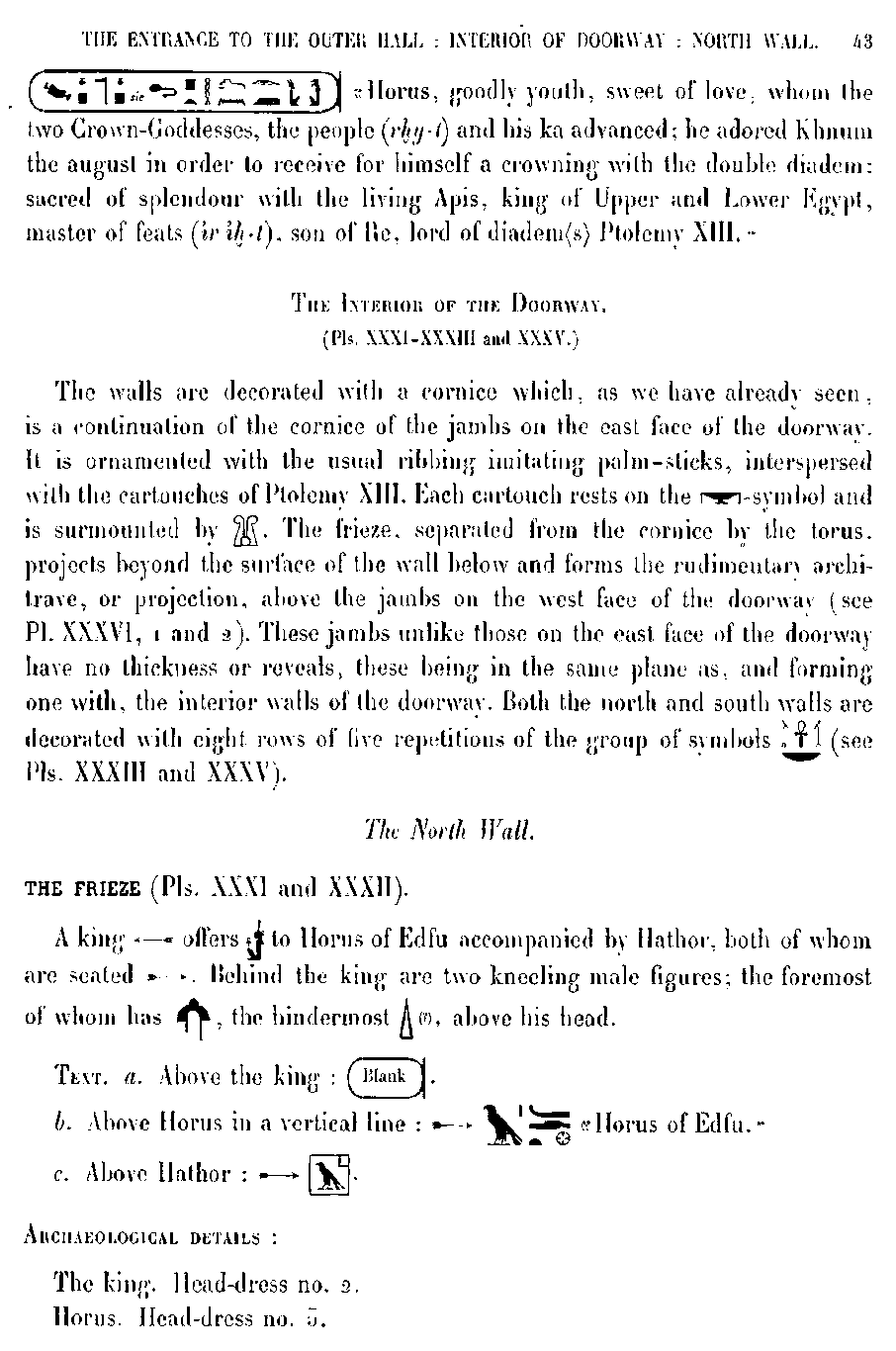
ḥrw ḥwnw nfr bnr mrw.t ṯnj=s(w) nb.tjt rḫj.t ḥnꜥ kꜣ=f dwꜣ.n=f ẖnmw
Horus, the perfect youth, whose love is sweet, whom the queen of the people raised up together with his ka. He has adored Khnum,
- 300p. 42, l. 27
šps r šsp n=f ḫꜥw m sḫm.tj ḏsr msḫꜥ ḥnꜥ ḥp ꜥnḫ nswt-bj.tj nb-tꜣ.wj nb jrj jḫ.t sꜣ-rꜥ nb-ḫꜥ
the august one, to receive the Double Crown at his royal appearing. Sacred is his coronation beside the living Apis. King of Upper and Lower Egypt, Lord of the Two Lands, lord who makes the offerings, Son of Ra, Lord of Crowns.
Note · Line 300
Apis was the sacred bull worshipped at Memphis. The Double Crown joins the crowns of Upper and Lower Egypt. 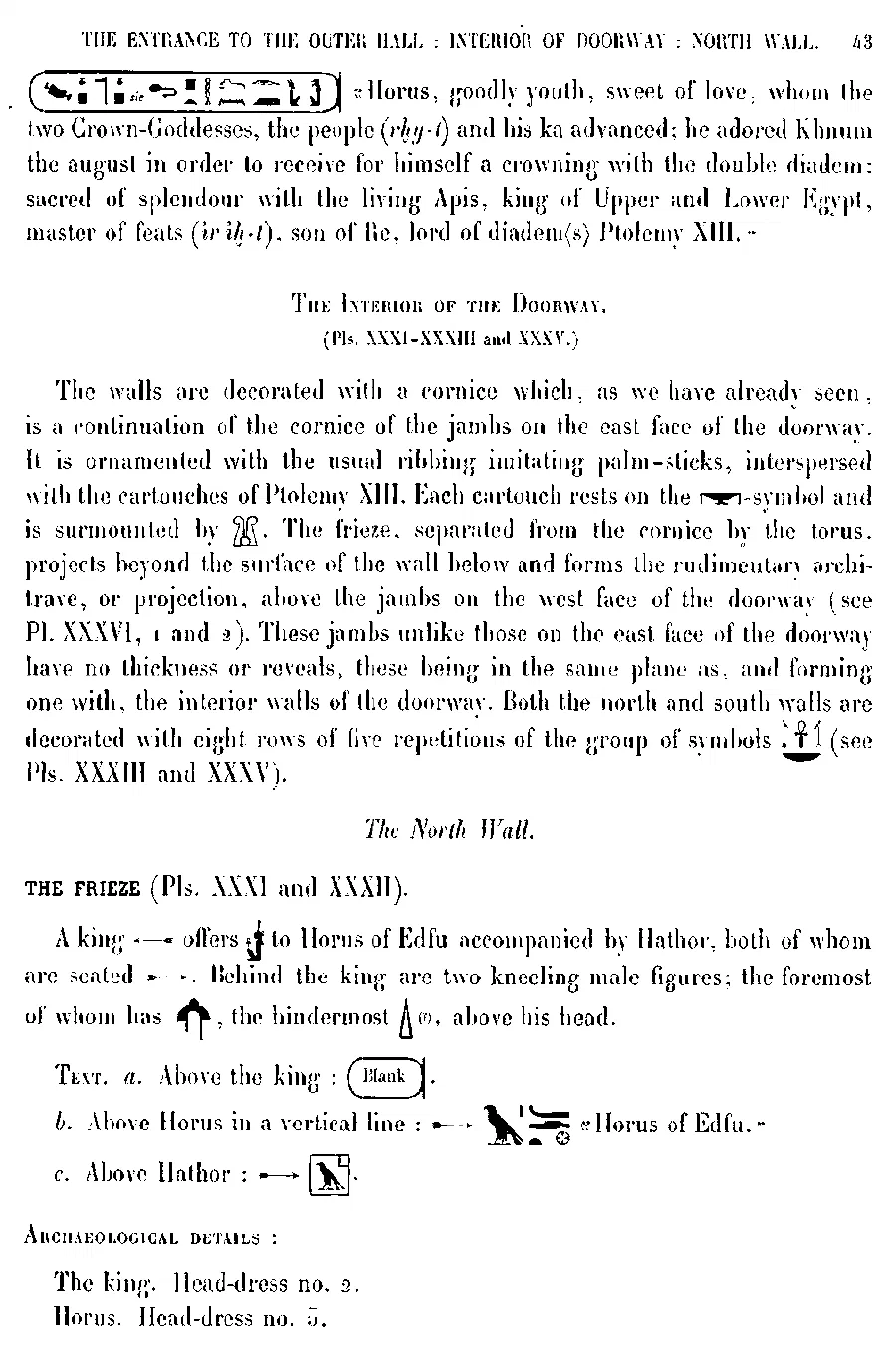
Page 43. Blackman, The Temple of Bigeh (1915), p. 43 Printed hieroglyphs from A. M. Blackman, The Temple of Bigeh (1915) - 301p. 43, l. 1
jwꜥ-n-p(ꜣ)-nṯr-nt.j-nḥm-stp-n-ptḥ-jrj-mꜣꜥ.t-rꜥ-<sḫm-ꜥnḫ-n>-jmn
Heir of the Savior God, chosen of Ptah, who upholds the Maat of Ra, living image of Amun.
- 302p. 43, l. 26
ḥrw-bḥd.tj
Horus of Edfu.
- 303p. 43, l. 27
ḥw.t-ḥrw
Hathor.
Page 44. Blackman, The Temple of Bigeh (1915), p. 44 Printed hieroglyphs from A. M. Blackman, The Temple of Bigeh (1915) - 304p. 44, l. 8
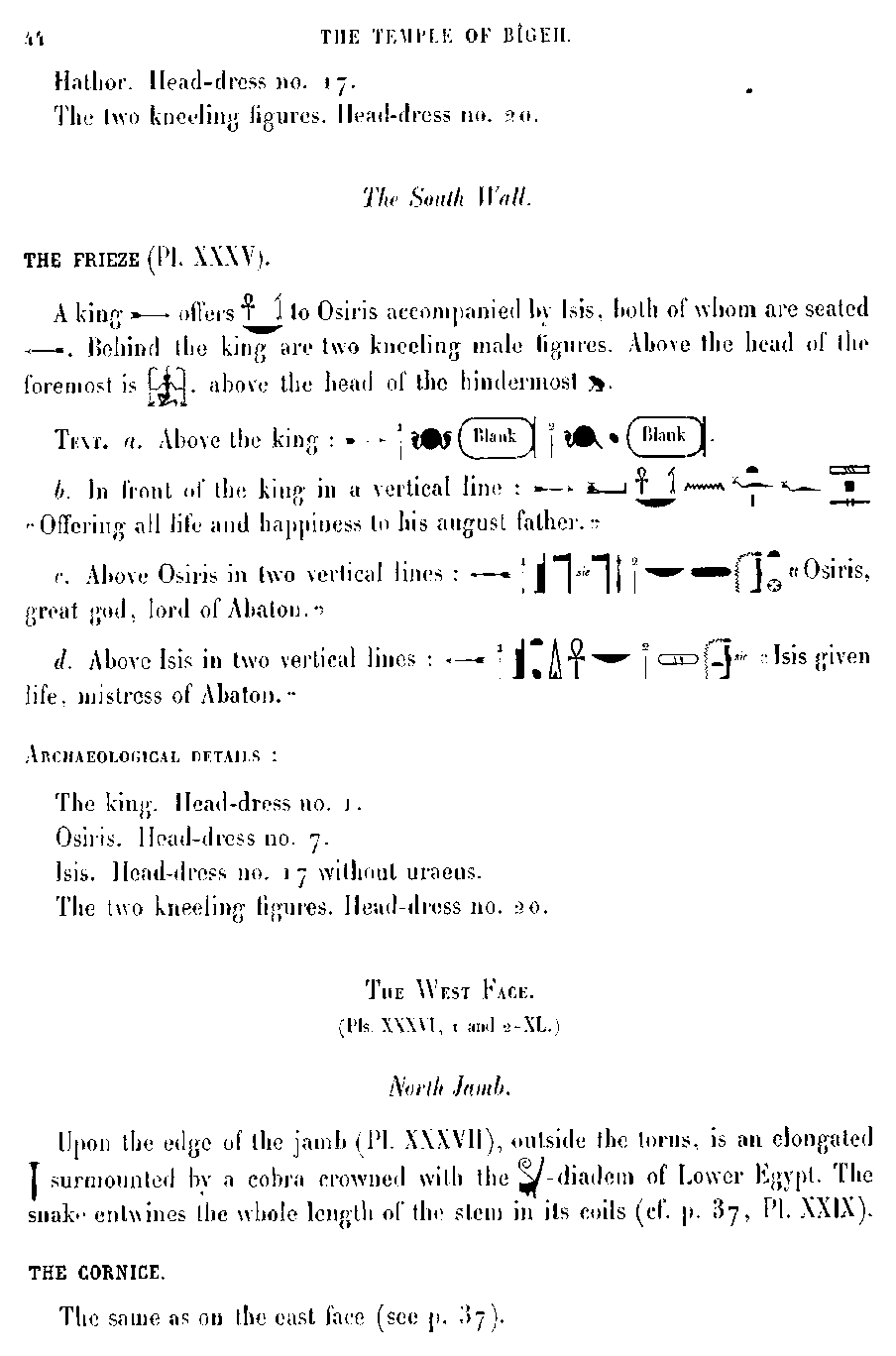
nswt-bj.tj --cꜥrtouche vide-- sꜣ-rꜥ --cꜥrtouche vide--
King of Upper and Lower Egypt (empty cartouche), Son of Ra (empty cartouche).
Note · Line 304
The first oval would normally hold the king’s throne name and the second his birth name. Both were left blank. - 305p. 44, l. 9
ḥnk ꜥnḫ wꜣs nb n jt=f šps
Offering all life and dominion to his revered father.
- 306p. 44, l. 11
wsjr nṯr ꜥꜣ nb jw-wꜥb
Osiris, the great god, lord of the Abaton.
Note · Line 306
Its name means “the place one may not enter.” - 307p. 44, l. 13
ꜣs.t dj.(t) ꜥnḫ nb.(t) jw-wꜥb
Isis, giver of life, lady of the Abaton.
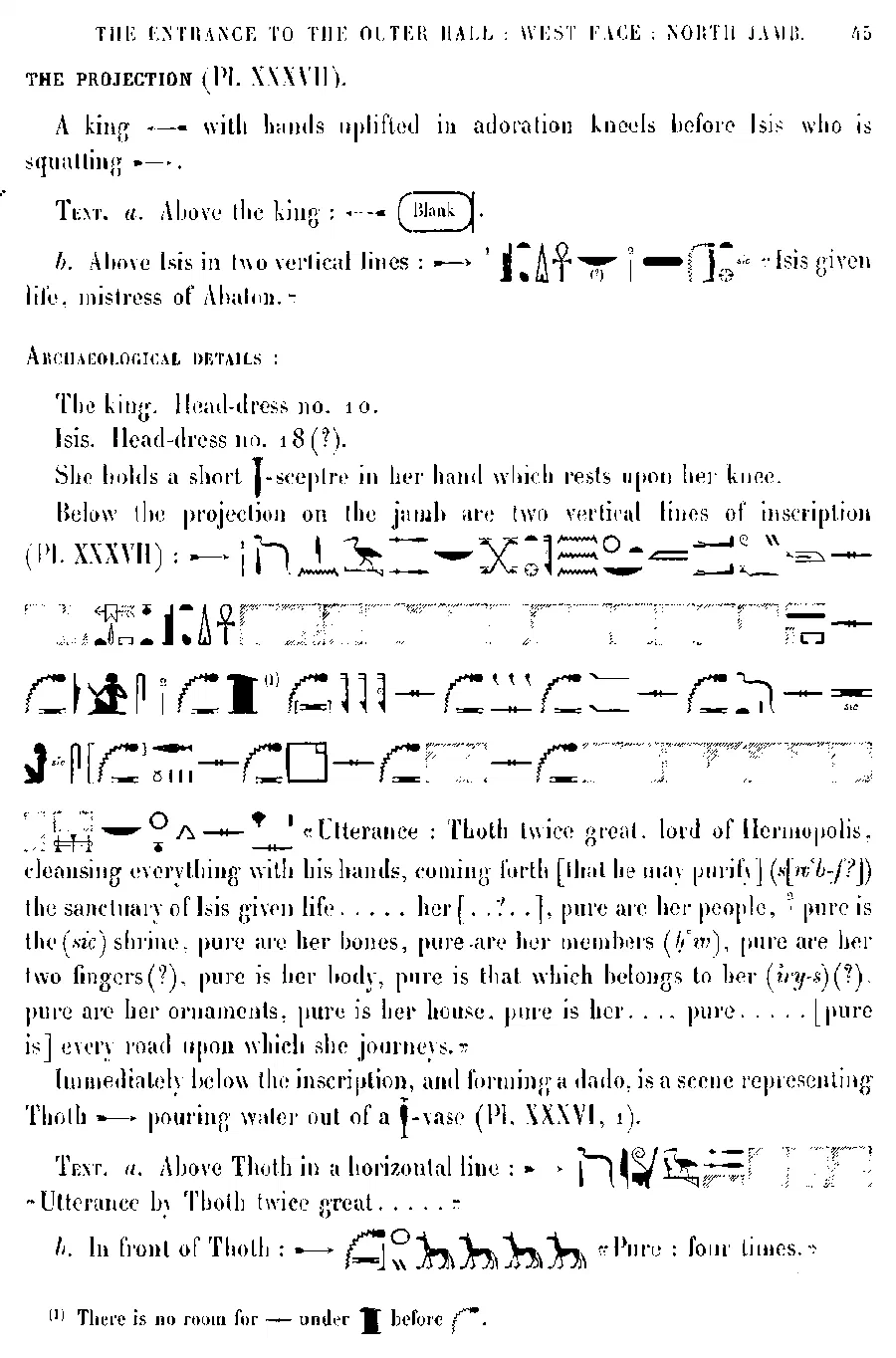
Page 45. Blackman, The Temple of Bigeh (1915), p. 45 Printed hieroglyphs from A. M. Blackman, The Temple of Bigeh (1915) - 308p. 45, l. 5
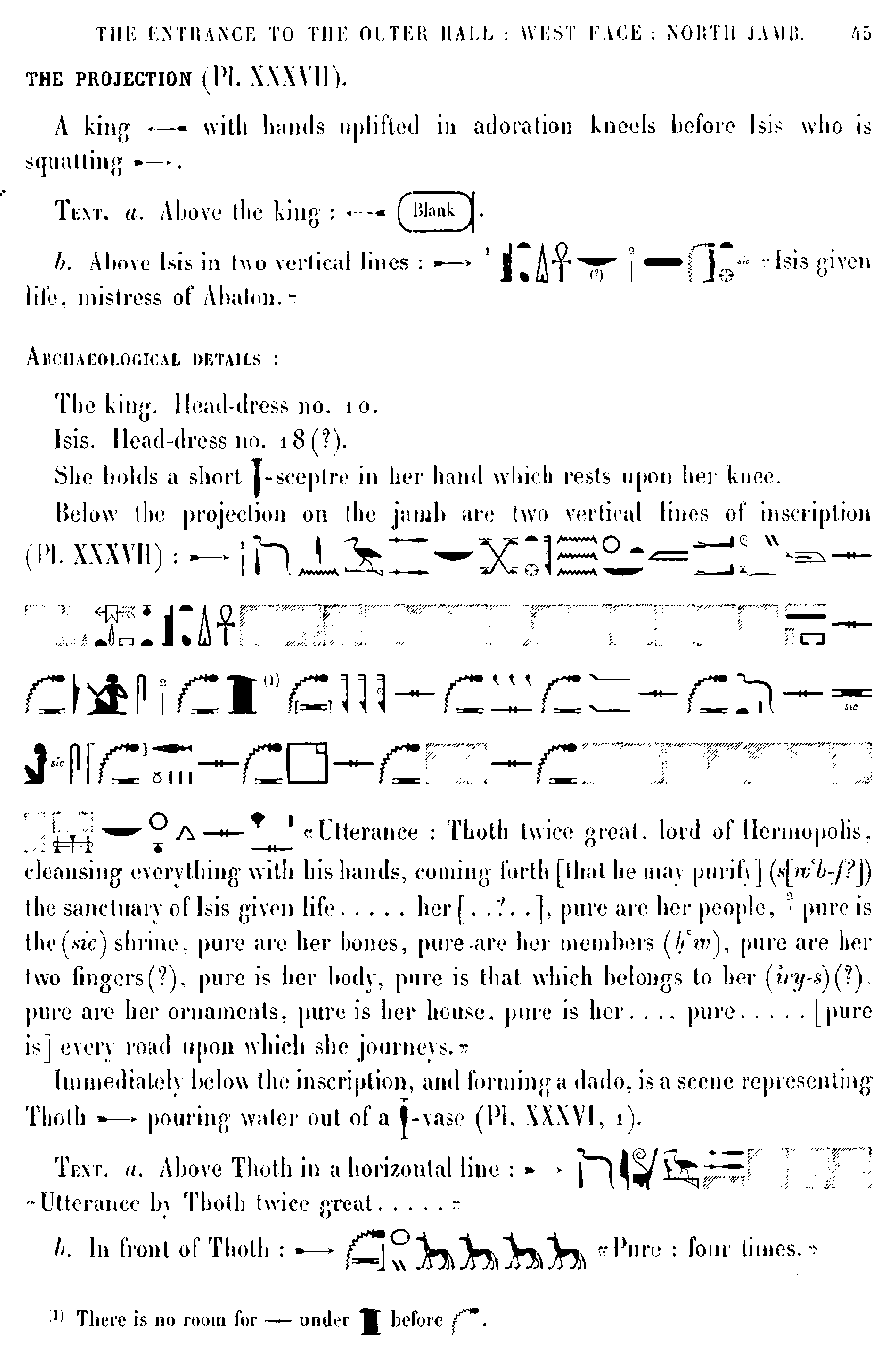
ꜣs.t dj.(t) ꜥnḫ nb.(t) jw-wꜥb
Isis, giver of life, lady of the Abaton.
- 309p. 45, l. 12
ḏd-mdw jn ḏḥwtj ꜥꜣ ꜥꜣ nb ḫmnw twr jḫ.t nb.t m ꜥ.wj=f prj=s
Words spoken by Thoth, twice great, lord of Hermopolis, who purifies every offering with his two hands: She comes forth
- 310p. 45, l. 13
--2Q-- stj.t n ꜣs.t dj.(t) ꜥnḫ --14Q--
… the chapel of Isis, giver of life, …
- 311p. 45, l. 14
wꜥb js.t=s wꜥb ḥḏ.t wꜥb ḳs.w=s wꜥb ḥꜥ.w=s wꜥb ḏbꜥ.wj=s wꜥb ḏ.t=s wꜥb
Pure are her attendants, pure is the shrine, pure are her bones, pure are her limbs, pure are her two fingers, pure is her body,
- 312p. 45, l. 15
jr.j=s wꜥb ẖkr.w=s wꜥb ḥw.t=s wꜥb --2Q-- =s wꜥb --8Q--
pure is what belongs to her, pure are her ornaments, pure is her temple, pure is her …, pure …
- 313p. 45, l. 16
wꜣ.t nb.t ḫn=s ḥr=s
every path she takes.
- 314p. 45, l. 25
ḏd-mdw jn ḏḥwtj ꜥꜣ ꜥꜣ --31/2Q--
Words spoken by Thoth, twice great, …
- 315p. 45, l. 27
wꜥb sp fdw
“Pure!” Four times.
Note · Line 315
The count tells the officiant how often to repeat the word. 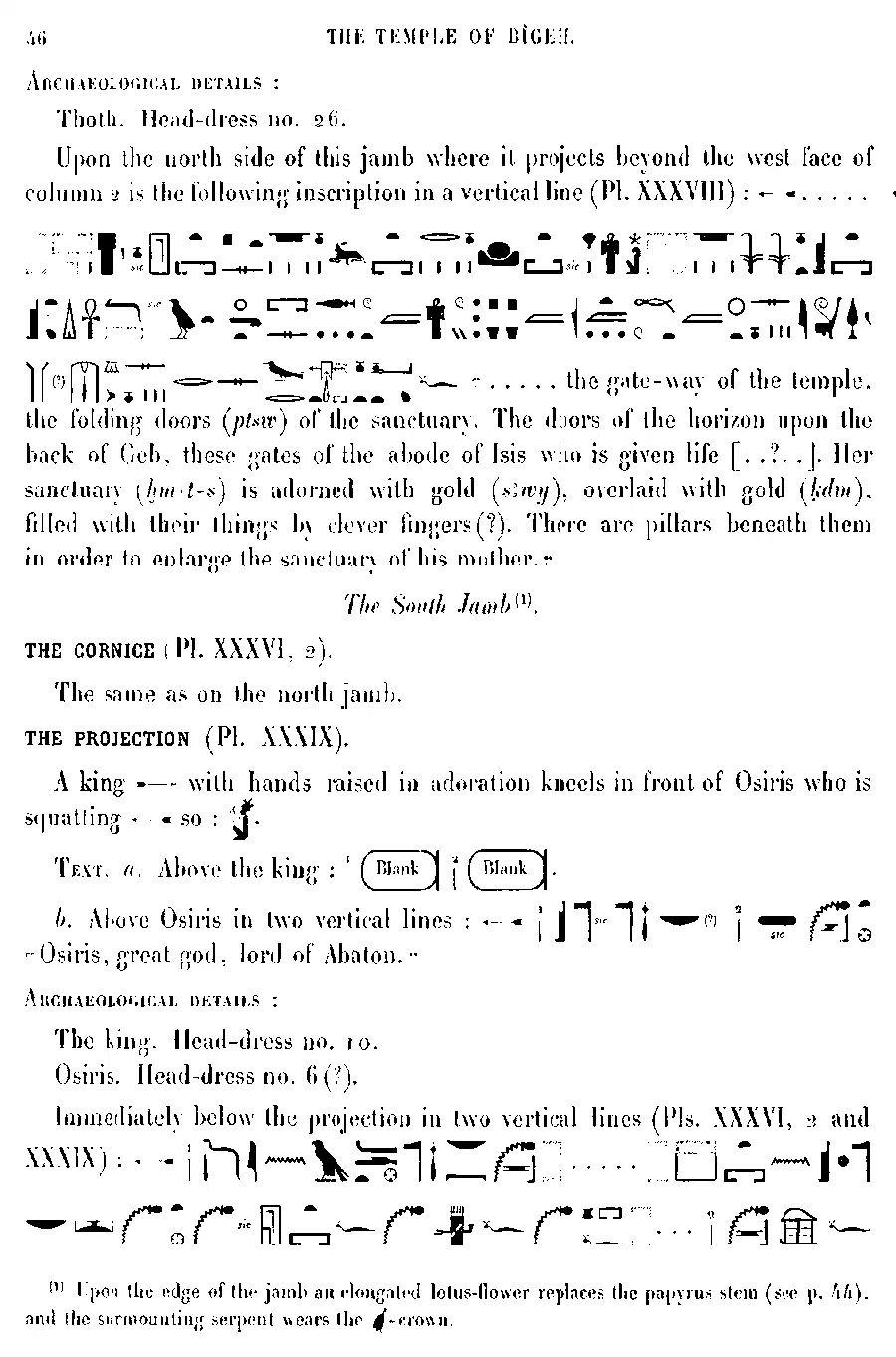
Page 46. Blackman, The Temple of Bigeh (1915), p. 46 Printed hieroglyphs from A. M. Blackman, The Temple of Bigeh (1915) - 316p. 46, l. 5
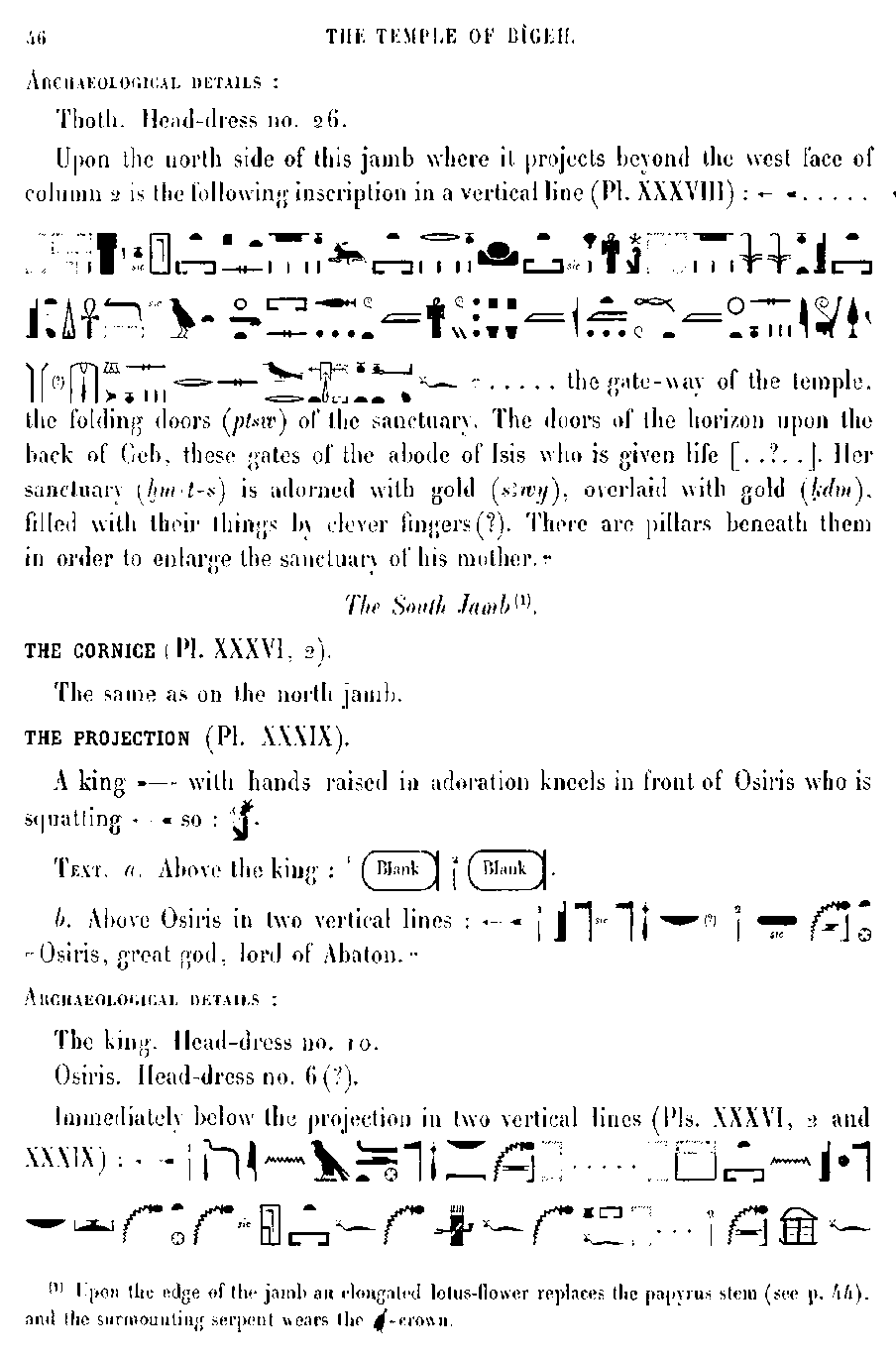
--2Q-- sbꜣ n ḥw.t-nṯr pts.w (22) n jwnn rꜣ.w n ꜣḫ.t ḥr sꜣ gb [pts.w] nn n s.t
… the gate of the temple, the doors of the sanctuary, the openings of the horizon on Geb’s back, these doors of the seat
Note · Line 316
Geb is the earth god: the temple stands on his back. - 317p. 46, l. 6
ꜣs.t dj.(t) ꜥnḫ ꜥrḳ.tj ḫm=s ẖkr.tj m sꜣwj pꜥpꜥ.tj m ḳdm mḥ.tj m jḫ.t=sn jn ḥm=f
of Isis, giver of life, are complete. Her sanctuary is adorned with gold, gleams with electrum, and is filled by His Majesty with what belongs to them.
Note · Line 317
Electrum is an alloy of gold and silver. - 318p. 46, l. 7
…(?) sḥ ẖr=sn (23) r swr stj.t n mw.t=f
… a shrine bears them, to enlarge the chapel of his mother.
- 319p. 46, l. 20
wsjr nṯr ꜥꜣ nb jw-wꜥb
Osiris, the great god, lord of the Abaton.
- 320p. 46, l. 26
ḏd-mdw jn ḥrw bḥd.tj nṯr ꜥꜣ nb p.t wꜥb --détruit-- [wꜥb] ḥw.t n wsjr
Words spoken by Horus of Edfu, the great god, lord of the sky: Pure … Pure is the temple of Osiris,
- 321p. 46, l. 27
nb jꜣ.t-wꜥb.t wꜥb ḥw.t-nṯr=f wꜥb ꜥḥ=f wꜥb ns.t=f --détruit-- wꜥb ḥḏ.t=f
lord of the Abaton. Pure is his temple, pure is his palace, pure is his throne … pure is his shrine,
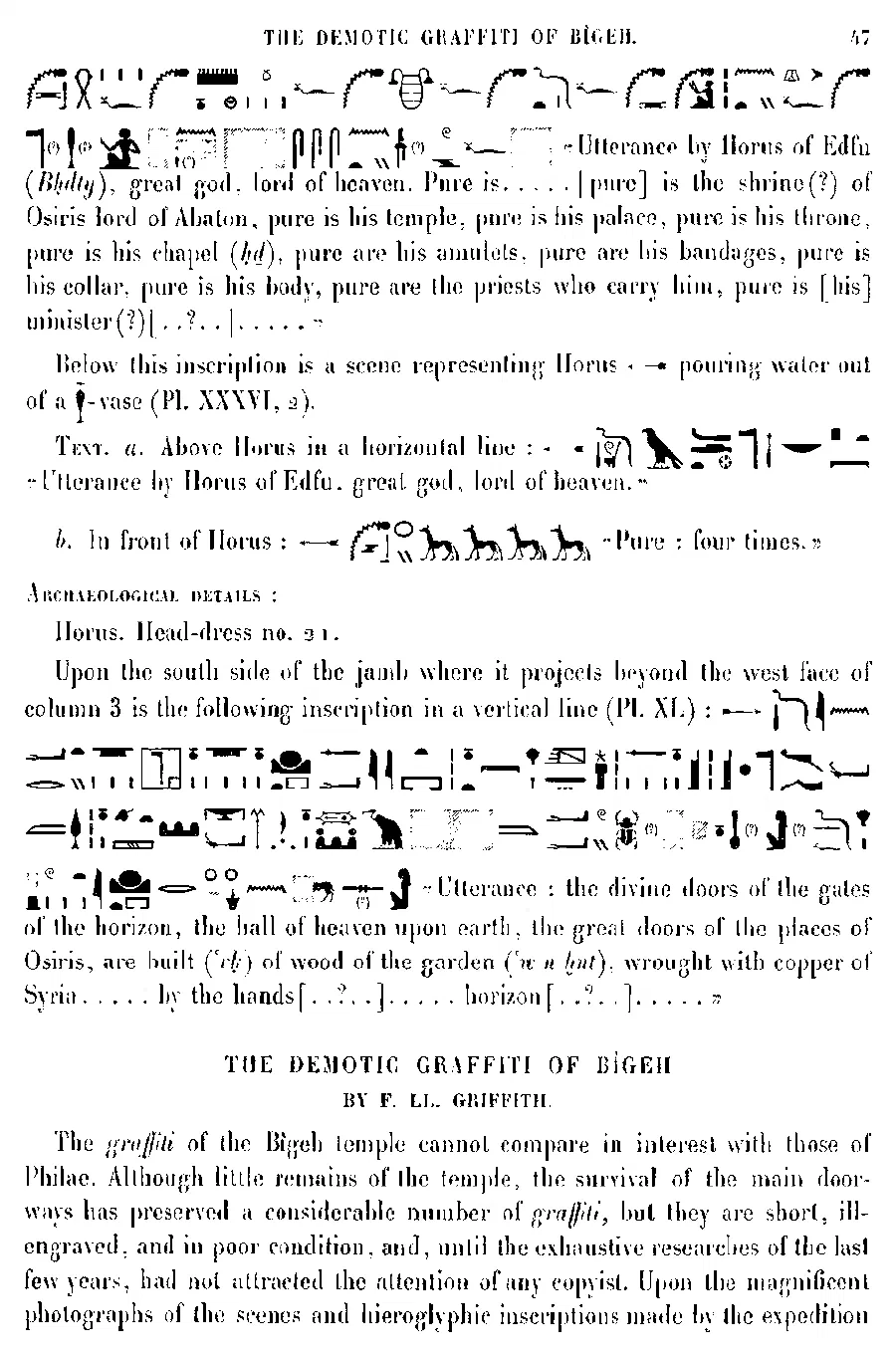
Page 47. Blackman, The Temple of Bigeh (1915), p. 47 Printed hieroglyphs from A. M. Blackman, The Temple of Bigeh (1915) - 322p. 47, l. 1
wꜥb sꜣ.w=f wꜥb mnḫ.wt=f wꜥb wsḫ=f wꜥb ḏ.t=f wꜥb wꜥb.w ntj ẖr=f wꜥb
pure are his amulets, pure are his linens, pure is his broad collar, pure is his body, pure are the wab-priests who serve under him,
Note · Line 322
A wab-priest was literally a “pure one”: the refrain echoes the priests’ own title. - 323p. 47, l. 2
ḥm.w-nṯr --3Q-- ntj wnmj=f --1Q--
pure are the servants of the god … who is at his right hand …
Note · Line 323
“Servant of the god” was the title of a priest who tended the god’s daily worship. - 324p. 47, l. 10
ḏd-mdw jn ḥrw bḥd.tj nṯr ꜥꜣ nb p.t
Words spoken by Horus of Edfu, the great god, lord of the sky.
- 325p. 47, l. 11
wꜥb sp fdw
“Pure!” Four times.
- 326p. 47, l. 16
ḏd-mdw {jn}
Words to be spoken:
- 327p. 47, l. 17
ꜥr.tj.w nṯrj.(wt) n ꜥꜣ.w n ꜣḫ.t ꜥꜣj.wt n p.t ḥr sꜣ tꜣ sbꜣ.w ꜥꜣ.w n s.wt wsjr ꜥrḳ
The divine door leaves of the gates of the horizon, the halls of the sky on the back of the earth, the great gates of the seats of Osiris are fashioned
- 328p. 47, l. 18
m ḫt.w n ḫntj-š nbj m bjꜣ n sṯ.t --2Q-- m ꜥ.wj …(?) ḏs=f ḥr
from the timber of Phoenicia, clad in copper from Asia … with the two hands of … himself, in
- 329p. 47, l. 19
…(?) ꜣḫ.t r …(?)
… the horizon toward …