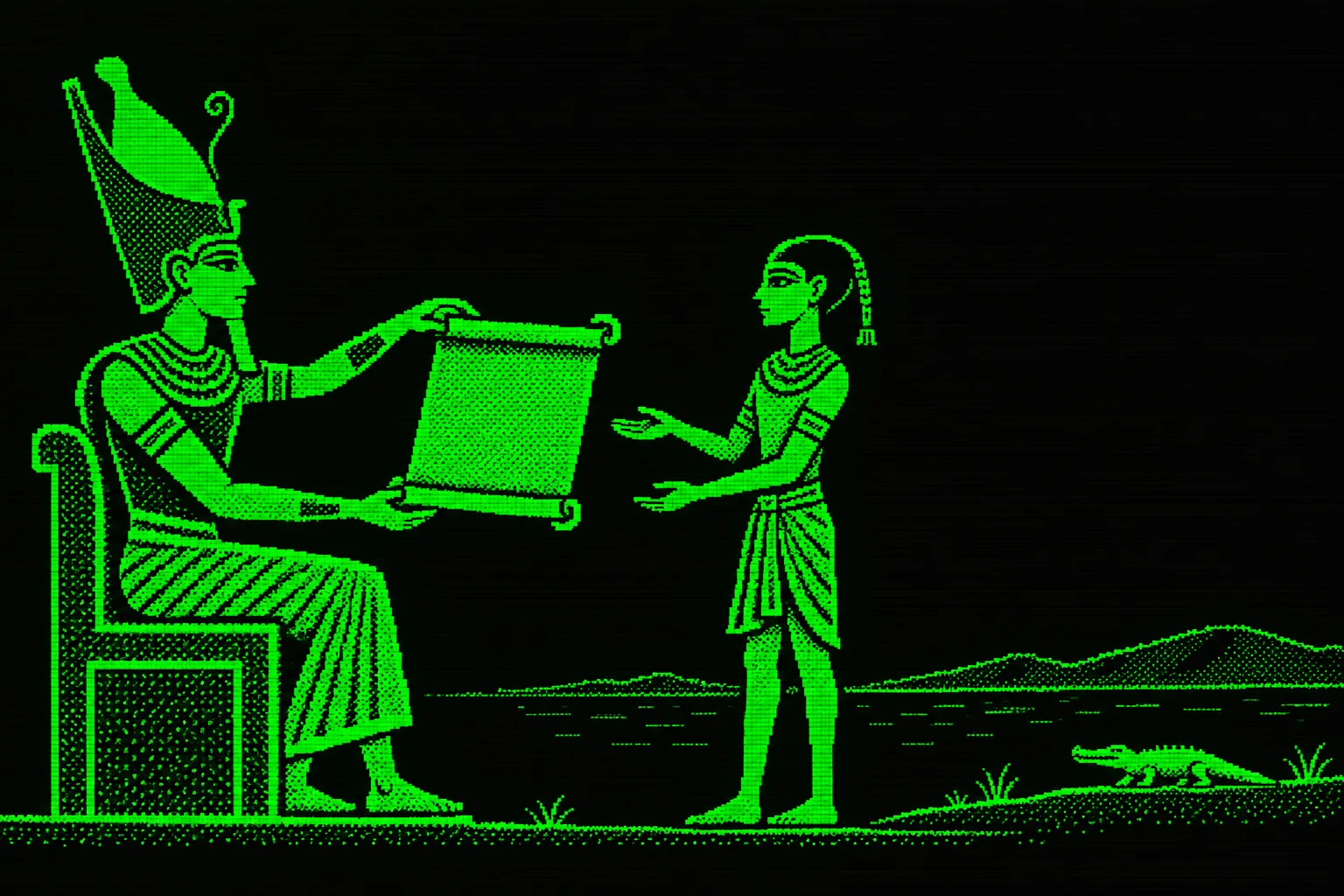
~/sacred-texts/egyptian-wisdom-literature
The Teaching for King Merikare: Speech Is Stronger Than Any Battle
- Date
- Composed in the Middle Kingdom in the voice of a Herakleopolitan king of the house of Khety (about 2050 BC); this copy was written by the scribe Khaemwaset in the 18th Dynasty (about 1425 BC)
- Found
- Papyrus St Petersburg 1116A verso, from the Memphis area, now in the State Hermitage Museum, St Petersburg; further copies are Papyrus Moscow 4658 and Papyrus Carlsberg 6 in Copenhagen
- Language
- Middle Egyptian (hieratic) · Hieratic
An old king of the house of Khety speaks to his son and heir Merikare. He begins hard. Of the man who stirs up the town he says Kill his children! and Wipe away his name! Then he turns to restraint: Do not kill. It does you no good. The dead face a court of gods, and They see a lifetime as an hour.
He confesses that in his reign the districts of Thinis were torn up, reports on the Delta frontier, where The Asiatic is a crocodile on his own riverbank, and ends with a hymn to the creator: People are well tended, the god’s flock. The scribe Khaemwaset signs the copy.
- 1
[...] [⸮H̱,t?]y n zꜣ =f Mri̯.yw-kꜣ-Rꜥ [...]
… Khety for his son Merikare …
Note · Line 1
A king counsels his son on how to rule. - 2
⸢⸮m?⸣ sfn ḥr sp nḏri̯ ⸢⸮n?⸣ [...]
Show no leniency over an offense. Seize …
- 3
ḫsf =k [...]
You shall punish …
- 4
[...] [___] =sn ḥr mdw,t nb.t
… their … over every word.
- 5
ḥꜣ,t ⸢⸮pw?⸣ ⸢⸮n.t?⸣ [...]
It is the beginning of …
- 6
[...] [___] =s ḫpr sꜥšꜣ ẖꜣk[.w-jb] [...]
… whose … has come to pass, swelling the number of rebels …
- 7
[...] [___].pl ḥnꜥ [sḥ],w =[⸮sn?] [⸮r?] =k
… people and their plots against you.
- 8
jr ḏd smj [...]
As for the man who brings a report …
- 9
jr r-sꜣ ḫpr mdw,t =k r b[__] [...]
Once you have spoken against …
- 10
[...] [k] [...] [_]ḥw.t nm[ꜥ] [...]
… you … show partiality …
- 11
[...] [___.tw] [nb] [...]
… lord …
- 12
jrr =f ⸢⸮gs?⸣ =s ⸮m? ꜥḥꜥ,w [...]
He makes half of it into a heap of …
- 13
kꜣ [...]
Then … will …
- 14
[...] [ḏd] [mj,tt] [...]
… say the same …
- 15
[...] f [...] psš [...] mr(,w) =j
… he … divide … my followers.
- 16
ḏꜣ [...]
[gap in the text]
- 17
[⸮m?] [⸮sfn?] [n] =[f] [...]
Show him no leniency …
- 18
[...] ꜥšꜣ m-⸮ḥr? =k
… many before you.
- 19
thi̯ =k ḥr wꜣ,t [...]
You stray from the path …
- 20
smꜣmw =k [_]nk.y.pl sw ⸮ḥr? =s rḫ.tj mr(,w) =f mr⸮r? sw
You shall kill those who … him for it, for you know his followers, those who love him.
- 21
jr gm[i̯] =[k] [...] [p]w n,j nʾ,t nb [pw] [n(,j)] wḥ,yt ḥn n =k sw
If you find …, the … of a town, the lord of a clan, summon him to you.
- 22
kꜣ tm ={{k}} _w_ [...]
Then … will not …
- 23
[...] ḥf⸮n? =⸮k? ꜥšꜣ
… your many hundreds of thousands.
- 24
m ḥḏi̯ z [⸮m?] [tp]-rd
Do not harm a man by decree.
- 25
n [...]
Not …
- 26
[nt]f ⸮ḥr,j? [ḥw,t].pl-wr.yt.pl [...]
He is chief of the high courts …
Note · Line 26
These courts were called “great halls.” - 27
[...] tʾ [...]
… bread …
- 28
[...] f _f _ =f n wḥ,yt
… he … for the clan.
- 29
zꜣu̯ tm [...]
Take care lest …
- 30
_ zꜣ,w.pl 〈n〉 =n ꜥnḫ.w [...]
… those guarded for us, the living …
- 31
sni̯.n ⸢ꜣbd⸣ [...]
When a month has passed …
Note · Line 31
The instruction takes the form of a king’s advice to his son Merikare. Only fragments of this part survive. - 32
[...] =f ḥꜥ =f
… he … his body.
- 33
ḏd =f mḥi̯ =f sḫꜣ =f
As he worries and remembers, he says:
- 34
[nḫt] =[j] [ꜣ] [ḥr] [tꜣ] [m] [ꜥ,t] [n.t] [jwf]
“Surely I shall be strong on earth in a body of flesh.”
- 35
[...] [r(m)ṯ] [wꜣ]
… the people who plot.
- 36
[ḥt]p n =f jb =k jꜥi̯
Be gracious to him when your heart is refreshed.
Note · Line 36
The image is of a heart washed clean of its distress. - 37
_ [bw-nb] [ḥr] [ms,t] =[f] [pw] [m-wḥm]
… everyone, saying, “This is his birth all over again.”
- 38
[s__] sn m ḥtp.yw[.pl]
… them into people at peace.
- 39
[...] k [...] mj nṯr
… you … like a god.
- 40
jr [gmi̯] =[k] [sw] [m] [jw,tj] hn,w =f [...] [rḫ] sw nʾ,t mr(,w) =f ꜥšꜣ m dmḏ,y[t] _ [sw] [...] [ḫ,t] =[f] ⸢⸮sbj?⸣.tw [rḫ] =f
If you find him without kin …,
though the town knows him
and his followers are many in the assembly,
… him … his possessions and even what he knows. - 41
ꜥq ⸮m? [⸮jb.pl?] ꜥni̯ sw m-ḥr ḏ,t =f
A man who finds his way into hearts is fair in the eyes of his dependents.
- 42
mn m j:tꜣ[ḥ] [pw] [mdw,tj]
A talker is forever stirring up trouble.
- 43
dr sw
Drive him out!
- 44
smꜣm 〈ms.w.pl〉 =〈f〉
Kill his children!
- 45
[s]jn rn =f
Wipe away his name!
Note · Line 45
Keeping a name alive was a duty owed to the dead. Erasing it threatened a person’s continued existence after death. - 46
[ski̯] hn,w =[f]
Destroy his kin!
- 47
[dr] [sḫꜣ] =[f] [mr(,w)] =f mr{t}〈r〉 sw
Do away with his memory and with the followers who love him!
- 48
sh[ꜣ] pw n(,j) nʾ,t ẖnn [⸮jb?]
A man quarrelsome at heart throws the town into turmoil.
- 49
jw =f sḫpr =f mr(,w).wj 2 m ḏꜣm.w
He forms two factions among the young.
- 50
jr gr.⸮t? gmi̯ =k n,j-sw nʾ,t [...] [sp] =f swꜣ ḥr =k s{ḫ}r〈ḫ〉 sw m-bꜣḥ šn,yt
And if you find a man of the town …
whose case has come before you,
accuse him before the courtiers! - 51
dr [sw]
Drive him out!
- 52
[s]bj pw gr.w
He too is a rebel.
- 53
tꜣḥ [pw] [n(,j)] [nʾ,t] [mdw,tj]
A talker is the town’s troublemaker.
- 54
qꜥḥ ꜥšꜣ,t
Bend the crowd to your will!
- 55
dr tꜣ r =s
Drive the heat out of it!
- 56
nn ṯs[.⸮t?] ⸮j?d[r] sbj m šwꜣ,ww [ssbj.n] [jt] =f
There is no blame when the rebel is driven off,
the poor man whose father spurred him to rebel. - 57
jn twꜣ.y shꜣ mšꜥ [...] tw
It is the poor man who throws the army into disorder … you.
- 58
jri̯ pḥ(,wj) =fj m šb[,t] [šꜣ.y].⸮n? =f
Make his end the payment he himself has set.
- 59
qnd ꜥšꜣ ḏi̯.tw ḥr šnꜥ
Anger runs high when a man is sent to the storehouse.
Note · Line 59
The storehouse was a place where goods were processed as well as stored. - 60
sfn [...] ḫsf =k
Be gentle … when you punish.
- 61
jw sšꜣ.w =k [...] m ḥꜥꜥ.wt
Thus you turn the … people to rejoicing.
- 62
smꜣꜥ ḫrw =k r-gs nṯr
Vindicate your voice at the god’s side.
Note · Line 62
To be declared “true of voice” was to have judgment given in one’s favor. - 63
jḫ ḏd r(m)ṯ [⸮m?-ḫm.t] =k ḫsf =k r-ḏꜣ.wt ⸮⸢jy⸣[.t]? =k
Then may people say, without your knowing it, that you punish in proportion to the harm done you.
- 64
p,t pw n.t z jwn nfr
A good temper is a man’s heaven.
- 65
qsn pw sḥwrj n(,j) ⸮d[nd]?-jb
A curse from an angry heart is a grievous thing.
- 66
ḥmw.w m mdw,t nḫt =[k]
Be skilled in speech, that you may be strong.
- 67
[...] ḫpš pw n(,j) ⸮nsw,t? ns =f
A king’s tongue is his … and his sword arm.
- 68
qn mdw,t r ꜥḥꜣ nb
Speech is stronger than any battle.
- 69
n jyi̯.n =tw ḥꜣ ḥmw jb
No one can outwit a man of practiced mind.
- 70
[...] ḥr tmꜣm
… on the mat.
Note · Line 70
An official might sit on a mat to hear a case. - 71
[...] pw n(,j) sr.w.pl sꜣꜣ
A wise man is the … house of the high officials.
- 72
n tkk.n sw rḫ.w.pl rḫ =f
Those who know what he knows do not attack him.
- 73
n ḫpr.[n] [⸮jy.t?] m-hꜣ,w =f
No harm comes to pass where he is.
- 74
jwi̯ n =f mꜣꜥ,t ꜥtḫ.tj mj sḫr.w.pl n(,j) ḏd.t.n tp(,j)w.pl-〈ꜥ〉
Truth comes to him strained clear, in the form of what the ancestors said.
- 75
snj r jt.w[.pl] =k [t]p(,j)w.pl-ꜥ.pl =k
Take your fathers and your forebears as your models.
- 76
bꜣk.tw [...] m rḫ[_]
… is wrought through knowledge.
- 77
m =k mdw,t =sn mn m zẖꜣ
Look, their words endure in writing.
- 78
pgꜣ šdi̯ =k snj =k r rḫ
Unroll them, that you may read them and take their learning as your model.
- 79
ḫpr ḥmw,w m sbbꜣ,yw
A well-taught pupil becomes a craftsman.
- 80
m ḏw
Do not be wicked.
- 81
nfr wꜣḥ jb
It is good to be considerate.
- 82
swꜣḥ mn,w =k m mr,wt =k
Make your monument endure through the love people bear you.
- 83
sꜥšꜣ _ [...] ẖnm n nʾ,t
Increase the number of … people bound to the town.
- 84
dwꜣ tw nṯr ḥr fqꜣ sbi̯.pl ⸮ḥr? [⸮rn?] =k dwꜣ.pl ḥr nfr =k nḥi̯ snb =k n ⸮nṯr.pl?
The god will praise you for rewarding those who stand up for your name,
who praise you for your goodness,
who ask the gods to keep you in health. - 85
[tr]j sr.w.pl
Respect the high officials.
- 86
swḏꜣ r(m)ṯ =k
Keep your people safe.
- 87
srwd tꜣš[.pl] =k 〈pẖr,t〉 =k
Strengthen your borders and your border guard.
- 88
nfr jri̯.t n m-ḫt
It is good to act for the future.
- 89
trj [...] [ꜥnḫ] [n(,j)] [w]bꜣ ḥr
Respect … the life of one whose face is open.
Note · Line 89
An open face here suggests a person who sees ahead. - 90
jw mḥ-jb r ꜣh,w
The trusting man will come to grief.
- 91
jmi̯ sbi̯.tw [...] m jwn =k nfr
See that men come forward … on the strength of your good character.
- 92
ẖsj mri̯ n =f tꜣ [⸮wn?] =⸮f? [...]
Wretched is the man who wants the land for himself; he is …
- 93
ḫm-ḫ,t pw ḥntj jw n k(y).wj
A fool is one who covets what belongs to others.
- 94
swꜣ [...] tp tꜣ nn ꜣw =f
… on earth passes away; it does not last long.
- 95
wꜣḏ pw sḫ[ꜣ.w] jm =f
He flourishes who is remembered there.
- 96
n ꜥqꜣ.n z ḥḥ.pl n nb-tꜣ.du
Millions of men cannot do justice to the Lord of the Two Lands.
Note · Line 96
The Two Lands are Upper and Lower Egypt; their lord is the king. - 97
wnn [z] ꜥnḫ r-nḥḥ
Does a man live forever?
- 98
rwwj jwi̯ m-ꜥ Jri̯-sj mj sfḫ nḏm-n≡f
He who came from her maker goes his way,
just as he who has made himself comfortable must let go.Note · Line 98
“Her” refers to Maat, the divine embodiment of truth, justice and right order. Her maker is the creator god. - 99
sꜥꜣ wr.w.pl =k jri̯ =sn hp.w.pl =k
Make your great men great, that they may carry out your laws.
- 100
〈n〉 nmꜥ.n ḫwd m pr =f
A man of wealth takes no sides when his house is well provided for.
- 101
nb ḫ,t pw tm gꜣ.w
He who lacks nothing is a man of property.
- 102
n ḏd.n šwꜣ,ww{.pl} m mꜣꜥ,t =f
A poor man cannot speak the truth as he sees it.
- 103
n ꜥqꜣ.n ḏd ḥꜣ n =j
No one who says, “If only it were mine!” can be upright.
- 104
nmꜥ =f n nb ḏbꜣ,w =f
He sides with the man who has a bribe for him.
- 105
wr wr wr.w.pl =f wr
Great is the great one whose great men are great.
- 106
qn pw nsw,t nb šn,yt
Strong is the king who commands a court.
- 107
šps pw ḫwd m sr.w.pl
Noble is he who is rich in high officials.
- 108
ḏd =k mꜣꜥ,t m pr =k snḏ n =k sr.w.pl n,tjw ḥr tꜣ
May you speak truth in your house,
that the officials in the land may stand in awe of you. - 109
mtj n(,j) nb ꜥqꜣ jb
A lord’s rectitude lies in an upright heart.
- 110
jn ḫnt,j ḏḏ snḏ n sꜣ
It is the front hall that puts fear into the back rooms.
Note · Line 110
The front hall is where the king holds court; the back rooms are the service quarters. - 111
jri̯ mꜣꜥ,t wꜣḥ =k tp tꜣ
Do justice, that you may endure on earth.
- 112
sgrj rm,w
Soothe the one who weeps.
- 113
m ꜣjr ḫꜣr,t
Do not oppress the widow.
- 114
m nš z ḥr ḫ,t jt =f
Do not drive a man from his father’s property.
- 115
m ḥḏi̯ sr.w.pl ḥr ns.t.pl =sn
Do not harm officials at their posts.
- 116
zꜣu̯.tj ḥr ḫsf m nf
Guard against punishing unjustly.
- 117
[m] sqrj
Do not kill.
- 118
nn st ꜣḫ n =k
It does you no good.
- 119
ḫsf =k m ḥw,y.pl m zꜣu̯,w⸮tj? jw tꜣ pn r grg ẖr =s wpw-[ḥr] [s]bj gmi̯ sḥ =f
If you punish with beatings and imprisonment,
this land will be set in order by such means—
except in the case of a rebel who has laid his plot. - 120
jw nṯr rḫ.w ẖꜣk.w-jb.pl
The god knows the treacherous of heart.
- 121
ḥwi̯ nṯr sḏb =f ḥr snf
For bloodshed the god strikes with his scourges.
Note · Line 121
A king is counseling his son Merikare on the use of royal power. - 122
jn sfn _ ꜥḥꜥw
It is the gentle man who lengthens life.
- 123
m smꜣm z jw =k rḫ.tj ꜣḫ.w =f pꜣu̯.n =k ḥsi̯ zẖꜣ,w ḥnꜥ =f šdi̯ m sjp.w [...] ḥr nṯr wstnj rd m s,t štꜣ.t
Do not kill a man whose worth you know,
with whom you once chanted the writings,
who was brought up as one approved … before the god,
whose foot moves freely in the secret place.Note · Line 123
The secret place is the private part of the palace. A man free to enter it was a trusted courtier. - 124
jwi̯ bꜣ r s,t rḫ.w.n =f n thi̯{t}.n =f wꜣ,t.pl =f n.t sf n ḫsf.n sw ḥkꜣ,w nb spr =f r ḏḏ.yw.pl mw =f
The ba comes to the place it has known.
It does not stray from its paths of yesterday.
No spell can turn it back.
It reaches those who pour its water.Note · Line 124
The ba was a person’s power to move and act beyond death. The living poured water as an offering for the dead. - 125
ḏꜣḏꜣ,t wḏꜥ sꜣr,yw rḫ.n =k tm =sn sfn hrw pf n(,j) wḏꜥ mꜣ(r) wnw,t n.t jri̯.t n,t-ꜥ
The court that judges the needy—
you know they will not be gentle
on that day when they judge the afflicted,
at the hour when the rites are performed.Note · Line 125
The needy here are the dead, who must answer for their lives before a court of gods. - 126
qsn pw srḫ,y m sꜣꜣ
A wise accuser is a hard man to face.
- 127
m mḥ jb =k m ꜣw,w rnp,t.pl
Put no trust in length of years.
- 128
mꜣꜣ =sn ꜥḥꜥ,w m wnw,t
They see a lifetime as an hour.
- 129
spp ={sn} 〈z〉 m-ḫt mnj.t rḏi̯.w sp.w.pl =f r-gs =f m ꜥḥꜥ,w
A man lives on after he comes to shore,
his deeds laid in a heap beside him.Note · Line 129
Coming to shore is an image for dying. - 130
nḥḥ pw gr,t wn〈n〉 jm
Now to be there is eternity.
- 131
wḫꜣ pw jri̯ ṯsi̯(.t) =st
A man who has done what they will condemn is a fool.
- 132
jr pḥ st nn jri̯.t jw wnn =f jm mj nṯr wstn mj nb.w.pl-r-nḥḥ.pl
But he who reaches that place without having done wrong
will be there like a god,
striding freely like the lords of eternity. - 133
ṯsi̯ ḏꜣm,w =k mri̯.y tw ẖnw
Muster your young men, that the Residence may love you.
Note · Line 133
The Residence is the royal seat, here standing for the people who live there. - 134
sꜥšꜣ mr(,w) =k m šw,t
Multiply your followers among the auxiliaries.
- 135
m =k nʾ,t =k mḥ.tj ẖr srd-mꜣ(w)
Look, your city is full of young men just come of age.
- 136
rnp,t 20 nꜣ ḏꜣm,w nḏm ḥr šms jb =f
For twenty years the young men have taken delight
in following their own hearts. - 137
šw,t ḥr [p]ri̯.[t] ḥr-{nw.t}sn〈.nw.t〉≡s
The auxiliaries are coming forth again.
- 138
sꜥq.y ḥr ꜥq n =f m ẖrd.w.pl [...] ⸮ḥr? ⸮stw?
The man called up comes before him with children …
- 139
jn js{f},t ꜥḥꜣ.y n =n ṯsi̯.n =j jm =s m ḫꜥi̯,⸮t? =j
It was the older generation that fought for us;
from them I raised troops when I took the throne. - 140
sꜥꜣ wr.w.pl =k
Make your great men great.
- 141
sḫnti̯ [__].y.pl =k
Promote your …
- 142
jmi̯ ḥꜣ,w ḥr ḏꜣm,w n(,j) [šm]s.w =k ꜥpr m rḫt mnj.w m ꜣḥ,t.pl sꜣḥ.w m mnmn,t
Add to the ranks of the young men in your retinue,
provided with allowances, settled on fields, endowed with cattle. - 143
m tni̯.t zꜣ-z r n[ḏs]
Do not favor a man of high birth over a commoner.
- 144
jni̯ n =k z ḥr rʾ-ꜥ.wj.du =fj jri̯.tw ḥm(w),t nb.t ⸮r? [...] n nb-ḫpš
Bring a man to you for the work of his two hands,
so that every craft may be practiced
until the … domain of the Lord of Strength flourishes.Note · Line 144
The Lord of Strength is the king. - 145
mki̯ tꜣš =k
Guard your border.
- 146
〈ṯzi̯〉 mn,w =k
Raise your monument.
- 147
ꜣḫ ṯ(ꜣ)z,t n nb =s
A troop serves its lord well.
- 148
jri̯ mn,w ={{k}} [...] n nṯr
Build a monument … for the god.
- 149
sꜥnḫ rn pw n jrr sj
That keeps its maker’s name alive.
- 150
jri̯ z ꜣḫ,t n bꜣ.pl =f wꜥb,t ꜣbd šzp ḥḏ.tj.du ẖnm rʾ-pr kfꜣ ḥr sštꜣ,w ꜥq ḥr 〈ḫm〉 wnm tʾ m ḥw,t-nṯr
Let a man do what benefits his ba-spirits:
serve his month as a priest,
put on the pair of white sandals,
visit the temple, unveil what is hidden,
enter the sanctuary, eat bread in the god’s house.Note · Line 150
Priests served in rotation, a month at a time. The bread they ate came from the offerings presented to the god. - 151
swꜣḏ w{ꜣ}ḏ〈ḥ〉,w
Keep the offering table laden.
Note · Line 151
Merikare’s father is instructing him in a king’s duties. Food was laid before the god in the temple each day. - 152
sꜥꜣ ꜥq,w
Increase the food allowances.
- 153
jmi̯ ḥꜣ,w ḥr 〈j〉mn,yt
Add to the standing daily offering.
- 154
ꜣḫ,t pw n jrr sj
It does good to the one who does it.
- 155
srwd mn,w =k ḫft wsr =k
Keep your monument sound as far as your power allows.
Note · Line 155
The monument here is a temple. - 156
jw hrw 〈wꜥ〉 ḏi̯ =f n nḥḥ wnw,t smnḫ =s n m-ḫt
A single day gives something to eternity;
an hour makes better what is to come. - 157
rḫ.n nṯr m jrr.w n =f
The god knows the one who acts for him.
- 158
sbi̯ tw〈t〉.pl =k r ḫꜣs,t wꜣ.yt jw.t{j}〈t〉 ḏḏ =sn sḥwj jr,j
Send your statues to a distant land of which no one gives a full account.
- 159
jw mr wšš ḫ,t ḫrw,y
Whoever lays waste an enemy’s property suffers.
- 160
n qbb.n ḫrw,y 〈m-ẖnw〉 Km,t
No enemy rests easy within Egypt.
- 161
jw ḏꜣm,w r ꜣjr ḏꜣm,w mj sr{.w}.n tp(,j).w.pl-ꜥ.pl r =s
One generation will press hard on another,
as the ancestors foretold. - 162
ꜥḥꜣ Km,t m ẖr(,t)-nṯr m ꜥḏ js{.wt}.pl m ꜥḏ,t sp.pl
Egypt will wage war in the necropolis,
hacking up tombs, butchering deeds.Note · Line 162
The necropolis is the city of the dead. To destroy a tomb was also to destroy the record of a life. - 163
jw jri̯.n =j mj,tt ḫpr mj,tt mj jri̯.t n thi̯{.t} n mj,tt m-ꜥ nṯr
I did the same, and the same befell me,
as it befalls one who commits the same wrong at the god’s hands. - 164
m bjn ḥnꜥ ꜥ-rsj jw =k rḫ.tj sr.n ẖnw r =s
Do not treat the southern province harshly;
you know what the Residence foretold about it.Note · Line 164
The southern province is Upper Egypt; the Residence is the royal court at Memphis. - 165
ḫpr.⸮n? nf [mj] ḫpr nn
That came to pass just as this will come to pass.
- 166
n thi̯{.t}.n =sn mj ḏd =sn [⸮r?] =[⸮s?]
They do not stray, just as they said of it.
- 167
ḥss =j Tn(w) ⸮Mqj? [tꜣ]š =s rs,j{.t} r ⸮Tꜣ-_,t? jṯi̯.n =j s(j) mj gp n(,j) mw
I favored Thinis and Meqi when its southern border lay at Ta-…t,
after I had seized it like a cloudburst.Note · Line 167
Thinis was a city near Abydos in Upper Egypt. - 168
n jri̯ st [___-___]-Rꜥ mꜣꜥ-ḫrw
…-Ra, the justified, did not do it.
Note · Line 168
“The justified” is a title of the dead: the king is named as one whose cause has been found just. - 169
sfn ḥr =s n ḥnn [...] ḥn{n}〈,t〉 [...] ḥn{n}〈,tj〉
Be gentle, then, with the one charged with … a charge … an allotted span.
- 170
s__ [___] =s
Do … it.
- 171
wḥm ḫtm.pl
Renew the treaties.
- 172
nn ⸢⸮wꜥb,t?⸣ rḏi̯ sdgꜣ =f
No pool can be kept hidden.
- 173
nfr jri̯.t n m-ḫt
It is good to act for the future.
- 174
nfr.w n =k ḥnꜥ ꜥ-rs,j
How well things stand between you and the southern province!
- 175
jwi̯ n =k ẖr(,j).pl-g(ꜣ),wt ẖr jn,w
The bearers of tribute come to you laden with gifts.
- 176
jw jri̯.n =j mj,tt n(.t) tp(,j).w.pl-ꜥ.pl nn jt =f ḏi̯ =f sw
I did as the ancestors did when the province had no barley to give.
- 177
jmꜣ n =k n gnn =sn n =k
It is pleasing to you that they yield to you.
- 178
sꜣi̯.w tw m tʾ =k ḥ(n)q,t =k
You have your fill of your bread and your beer.
- 179
jwi̯ n =k mꜣt nn šnꜥ
Granite comes to you unhindered.
- 180
m ḥḏi̯ mn,w n(,j) ky
Do not damage another’s monument.
- 181
wḥꜣ =k jnr m Rʾ-ꜣw
Quarry stone at Tura.
Note · Line 181
The quarries at Tura, across the Nile from Memphis, supplied fine white limestone. - 182
m qd js =k m sẖn,yt jri̯.yt r jr{r}.t(j) =sj
Do not build your tomb by tearing down what was built
to make way for what is yet to be built. - 183
m =k nsw,t nb ꜣw,t-jb sfnꜣ =k qd =k m ḫpš =k
Look, O king, lord of joy:
you may take your ease and sleep in the strength of your arm. - 184
šms{.w} jb =k m jri̯.t.n =j
Follow your heart, thanks to what I have done.
- 185
nn ḫrw,y m-qꜣb tꜣš =k
There is no troublemaker within your borders.
- 186
ꜥḥꜥ.n ꜥḥꜥ =j nb m nʾ,t jb =f ḥḏi̯ m-ꜥ Tꜣ-mḥ,w
Then I rose, a lord in the city,
heartsick over Lower Egypt.Note · Line 186
Lower Egypt is the Nile Delta. The king now recalls the state of the Delta when he came to power. - 187
Ḥw,t-šnw ((r)) =((s)) m ⸮Bꜣqꜣ?
The House of Trees belongs to it, along with Baqa.
- 188
tꜣš{t} =s{t} rs,j [r] ⸮ꜥꜣḏ.du?
Its southern border reaches the Canal of the Two Mullets.
- 189
sḥtp.n ={{s}} =((j)) jmn,tt mj-qd =s r-mn-〈m〉 pds,wt n.t š
I brought peace to the whole West,
as far as the coastal flats of the lake country. - 190
bꜣk ={sn} =〈s〉 ((n)) =((s)) ḏḏ =s mr[w]
When it works for itself, it yields cedar.
- 191
mꜣꜣ.tw wꜥn ḏḏ =sn n =n sw
When juniper is found, they give it to us.
- 192
jꜣb,tt m ḫwd pḏ,t(j)
The East is the bowman’s wealth.
Note · Line 192
“Bowman” is an Egyptian term for a foreigner. Here it refers to the people on Egypt’s eastern frontier. - 193
bꜣk.w =sn ḥr [...]
Their tribute …
- 194
ꜥn.w.tw jw.pl-ḥr,j-jb z nb m-qꜣb =f [gs.pl]-pr.pl ḥr wr trj tw r =j
The Middle Islands are brought back.
Every man there and the farming estates say,
“You are indeed greater than I.”Note · Line 194
The Middle Islands are the lands among the branches of the Nile in the central Delta. - 195
m =k [...] ḥḏi̯.n =st jri̯.w m spꜣ,t.pl nʾ,t nb.t wr.t [...]
Look, the … they laid waste has been organized into provinces,
and every great town … - 196
ḥqꜣ,t n.t wꜥ{,t(j)} m-((ꜥ)) z 10
The power of one man rests in the hands of ten.
- 197
((jri̯.w)) ((sr)) nḥb.w [m] [bꜣ]k[.w] 〈rḫ.w〉 m ḥtr.w nb
A high official was appointed, endowed with revenues
and versed in every levy. - 198
wn wꜥb nḥb.w m [ꜥḥ,t].pl bꜣk n =k mj ṯꜣz,t wꜥ.t
The priest was allotted fields
and serves you like a single troop. - 199
nn ḫpr ẖꜣk.w-jb.pl pw m-m
That is why no rebels will rise among them.
- 200
nn mn n =k Ḥꜥpj tm =f jwi̯
The Nile flood will cause you no distress
if it fails to come. - 201
〈bꜣk,t〉 m-ꜥ =k n.t Tꜣ-mḥ,w
The dues of Lower Egypt are in your hand.
- 202
m =k ḥwi̯ mnj,t m 〈w〉 jri̯.n =j ḥr jꜣb,tt 〈r〉-ḏr,w 〈Ḥw,t-bnw〉 r Wꜣ,t-Ḥr grg m nʾ,t mḥ m r(m)ṯ m stp,w{pw} n{.t} tꜣ r-ḏr =f r ḫsf ꜥ.wj.du jm =sn
Look, the mooring stake has been driven in
in the district I made in the east,
as far as Hebenu and on to the Way of Horus.
It is laid out as a town and filled with people
chosen from the whole land,
with whom to beat back both arms of the foe.Note · Line 202
The Way of Horus was the frontier route out of the eastern Delta toward Sinai. - 203
mꜣꜣ =j qn sni̯ =f r =s jri̯.n =f ḥꜣ,w ḥr jri̯.t.n =j
May I see a brave man follow that example,
one who has added to what I have done. - 204
ꜣf,t m-ꜥ jwꜥ,w ẖsj
Shame goes with a feeble heir.
- 205
ḏd swt nꜣ gr n pḏ,t(j)
Yet these things too are said of the bowman:
- 206
js(w) ꜥꜣm,w ẖsj qsn pw n bw n,t(j) =f jm ꜣh.w 〈m〉 mw štꜣ.w m ḫt
Look at the wretched Asiatic:
he is hard pressed by the place where he lives,
poor in water and scant in wood.Note · Line 206
“Asiatic” here means a man from the lands east of Egypt. The portrait is the Egyptian king’s view of a frontier enemy. - 207
ꜥšꜣ wꜣ,t.pl jr,j qsn m-ꜥ ḏw.w.pl
Its paths are many, and the mountains make them hard.
- 208
n ḥmsi̯ =f m s,t wꜥ.t stš{.w} ꜥq rd.du =fj
He has never settled in one place;
the search for bread keeps his two feet moving. - 209
jw =f ḥr ꜥḥꜣ ḏr rk Ḥr
He has been fighting since the time of Horus.
Note · Line 209
Horus figures as a king of Egypt in the age when gods ruled the land. - 210
n qn.n =f
He cannot prevail.
- 211
n gr qn.(n).tw =f
Nor can he be overcome.
Note · Line 211
He speaks of the people beyond Egypt’s eastern frontier as a single adversary. - 212
n smj.n =f hrw m ꜥḥꜣ mj (j)ṯꜣ šnꜥ.n zmꜣ,yt
He gives no warning of the day he will fight,
like a thief whose band has cast him out. - 213
ꜥnḫ =j swt wnn =j wn.kwj
Yet as surely as I live and shall live on,
- 214
wn nꜣ pḏ,t(j).pl 〈r〉 =f m m(j)nbj m ḫtm.w =s wn ḏdḥ.w =⸮j? r =f
those bowmen were an axe in its open fortress;
I shut them off from it.Note · Line 214
The fortress seems to be that of Lower Egypt, the Nile Delta. - 215
jw ḏi̯.n =j ḥwi̯ st Tꜣ-mḥ[,w] ḥꜣq.n =j ẖr.pl =sn nḥm.n =j mn[mn],t =sn r bwi̯.y.t ⸢ꜥꜣm⸣.[pl] r Km,t
I had Lower Egypt strike them.
I took their households captive,
I carried off their cattle,
until the Asiatics were made to loathe Egypt. - 216
m rḏi̯ jb =k m-sꜣ =f
Do not trouble yourself over him.
- 217
ꜥꜣm,w{.pl} pw msḥ ḥr mr,yt =f
The Asiatic is a crocodile on his own riverbank.
- 218
ḫnp =f [r] wꜣ,t =⸮f? wꜥ.t
He snatches his prey along his lonely path;
- 219
n jṯi̯.n =f r dmj nʾ,t ⸢ꜥšꜣ.t⸣
he does not seize it at the landing of a populous city.
- 220
šdi̯ Mdn,jt r ⸢w⸣ =s
Cut canals throughout the district of Medenit.
Note · Line 220
Medenit was a province on the east bank of the Nile, just south of the Delta. - 221
smḥi̯ gs =s 〈r〉 Km.wj
Water its flank as far as Kemwer.
Note · Line 221
Kemwer, “the Great Black,” may here denote the district of Athribis in the Delta or Lake Timsah farther east. - 222
m =k sj m ẖp(ꜣ) n ḫꜣs,tjw.pl
Look, it is the navel of the desert peoples.
- 223
jnb.w.pl =s ꜥḥꜣ.w
Its walls stand ready for battle;
- 224
mšꜥ =s ꜥšꜣ
its army is numerous.
- 225
mr,w jm =s rḫ.w šzp 〈ḫt〉 ḥr,w-〈r〉 wꜥb n(,j) ẖn(w) w
The retainers there know how to take up arms,
as do the freemen in the heart of the district. - 226
Ḏd,w-s,t.pl km =s z ḏbꜥ m nḏs.w.pl wꜥb nn bꜣk,w =f
Djed-sut can muster ten thousand men,
commoners and freemen who owe no levy.Note · Line 226
Djed-sut was the town attached to King Teti’s pyramid at Saqqara, near Memphis. - 227
jw sr.w.pl jm =s ḏr rk ẖnw
High officials have lived there since the days of the royal residence.
Note · Line 227
The king looks back to the Old Kingdom, when the court was at Memphis. - 228
smn tꜣ{w}š.pl
The borders are fixed;
- 229
qn ḫnr,wt =s
its barriers are strong.
- 230
mḥ,tjw.pl ꜥšꜣ smḥi̯ 〈n〉 =〈j〉 st 〈r〉 Tꜣ-mḥ,w bꜣk.w m jt m rʾ-ꜥ wꜥb
Many northerners water it for me as far as Lower Egypt;
they render their dues in barley, as freemen do. - 231
swꜣ.t pw ḥr jr{r} st
This outdoes the man who built it.
- 232
m =k st m 〈ꜥꜣ〉 n(,j) Tꜣ-mḥ,w
Look, it is the door to Lower Egypt.
- 233
jri̯.n =sn dnj,t r Nn-nsw,t
They have built a dike as far as Heracleopolis.
- 234
mtj(.t)-jb pw nʾ,t ꜥšꜣ(.t)
A populous city is true of heart.
- 235
zꜣw pẖr m mr(,w) n(,j) ḫrw,y
Guard against going about with a troublemaker’s followers.
- 236
jw 〈zꜣu̯,wt〉 snḫḫ =〈s〉 rnp,t
Keeping watch makes the year young again.
- 237
shꜣ tꜣš =k r ꜥ-[rs,j]
Stir up your border with the southern province.
- 238
pḏ,t pw šzp.t ꜥꜣgs,w
They are a people of the bow who put on the leather belt.
Note · Line 238
The belt seems to be part of a warrior’s dress. - 239
qd ḥw,t.pl m Tꜣ-mḥ,w
Build estates in the Delta.
- 240
nn šrj rn n(,j) z m jri̯.t.n =f
What a man has made will not make his name small.
- 241
n ḥḏi̯.n.tw nʾ,t grg.tj
A city firmly founded cannot be destroyed.
- 242
qd ḥw,t [n] tw〈t〉
Build a house for the statue.
Note · Line 242
The house is a shrine where the statue can receive offerings. - 243
jw ḫrw,y mri̯ =f ḥḏi̯(.t) jb
The troublemaker loves to wound the heart.
- 244
sp =f ẖs[j]
His deed is base.
- 245
šꜣ.n H̱,ty mꜣꜥ-ḫrw m sbꜣ[,w]
Khety, the justified, laid this down as a teacher:
- 246
gr,w r sḫm-jb ḥḏ{ḏ}〈.tw〉 [w{ꜣ}ḏḥ,w]
“The quiet man turns fierce when the offering stands are damaged.
- 247
tkk nṯr sbj ḥr rʾ-pr
The god strikes whoever rises against the temple.”
- 248
jwi̯ =t(w) ḥr =[f] [mj] jrr =f st
As he acts, so will they come against him.
- 249
jw =f r sꜣꜣ m šꜣ.[t].n =f sḫt r =f
He will have his fill of what he meant to snare for himself.
- 250
n jni̯ =tw ḥr mw hrw pf n(,j) jwi̯.t
No one will bring him onto the water on that day of coming.
Note · Line 250
Bringing someone onto the water may be an image of showing him favor. - 251
sḫwsj w{ꜣ}ḏḥ,w
Furnish the offering stands.
- 252
tr[j] nṯr
Honor the god.
- 253
m ḏd ẖsj pw jb
Do not say, “The heart is weak.”
- 254
m fḫ ꜥ.[wj].du =kj
Do not let your two arms go slack.
- 255
jri̯ gr⸮t? 〈r〉š.(w)t =k
Now do what brings you joy.
- 256
ḥḏi̯.t p,t pw rnp,t 100
A hundred years bring down the sky.
- 257
mn,w pw m ḏꜣ〈y,wt〉 [...] {m}〈w〉ḏꜣ
It is a monument amid wrongdoing … unscathed.
- 258
〈j〉r rḫ ḫrw,y nn ḥḏi̯ =f st m-mr,(w)t smnḫ jri̯.t.n =f jn ky jyi̯.y ḥr-sꜣ =f
If the troublemaker knows this, he will not destroy it,
so that another who comes after him may improve what he himself has made. - 259
nn-wn šwi̯ m ḫrw,y
No one is without an enemy.
- 260
rḫ-ḫ,t pw ⸮〈nb〉? jdb.du
The Lord of the Two Banks is a man of learning.
Note · Line 260
The Two Banks are the banks of the Nile; together they stand for Egypt. - 261
nn wḫꜣ.n nsw,t nb šn,y(t)
A king who is master of the court cannot be a fool.
- 262
sꜣꜣ =f m pr(,w) =f n.w ẖ,t
He is wise as he comes from the womb.
- 263
stn{n}.n sw 〈nṯr〉 ḫnt,j 〈z〉 ḥḥ.pl
The god has raised him above millions of men.
- 264
jꜣw,t pw nfr.t nsw,yt
Kingship is a fine office.
- 265
nn zꜣ ={j} =s nn sn =s swꜣḥ mn,w =s
It has no son, no brother to make its monument endure.
- 266
jn wꜥ smnḫ ky
It is one king who does another good.
- 267
jri̯ z [r] ⸮n,tj? ẖr-{ꜥ}〈ḥꜣ〉,t =f m-mr,yt smnḫ ={j} 〈jri̯.t.n〉 =〈f〉 jn ky jyi̯.y ḥr-sꜣ =f
Let a man act for the one who came before him,
so that another who comes after him may improve what he himself has made. - 268
m =k sp ẖsj ḫpr m-hꜣ,w =j ꜥḏ.tw ⸮ḏꜣ,t.pl? n.t Tnw
Look, a base deed was done in my day:
the districts of Thinis were torn up.Note · Line 268
The king recalls the devastation around Thinis, an Upper Egyptian city near the sacred burial grounds of Abydos. - 269
ḫpr.n js m jri̯.t.n =j rḫ.n =(j) st r-sꜣ jri̯.tw =tw ={j}
Though it came of what I had done,
I learned of it only after it was done. - 270
m =k ḏꜣr,w ={j} ḫnt,j jri̯.(t).n =j
Look what has come of what I did: distress.
- 271
ẖsj pw gr,t 〈ḥḏi̯.t〉
To destroy, moreover, is a wretched thing.
- 272
nn ꜣḫ n =f srwd sw[s]t(.t).n =f ={f} 〈qd〉 〈sẖn.t.n〉 =〈f〉 smnḫ ={f} 〈sꜥsꜥ.t.n〉 =〈f〉
It does a man no good to restore what he has laid waste,
to build what he has torn down,
to mend what he has marred. - 273
zꜣꜣ.tj r =s
Guard yourself against it.
- 274
ḏbꜣ.tw sḫi̯[.t] m mj,tt =f
A blow is repaid with a blow.
- 275
mḏd(.t) pw jrr.t nb.t
Every deed follows in the tracks of another.
- 276
snn ẖ,t m r(m)ṯ jmn.n s[w] [nṯr] rḫ.w qd,w
Among humankind, generation after generation passes
since the god who knows their natures hid himself. - 277
nn ḫsf ꜥ 〈n(,j)〉 nb ḏr,t
No one can ward off the arm of the Lord of the Hand.
Note · Line 277
The title names the creator god. The arm that no one can hold back is his power to repay a deed. - 278
[t]kk.pl pw mꜣꜣ.t jr,t.du
It is those under attack that the two eyes see.
- 279
[trj].tw nṯr ḥr wꜣ,t =f jri̯.w m ꜥꜣ,t msi̯.w [m] [ḥmtj] mj n,t ḏbꜣ.tj m n,t
The god is revered on his processional way,
fashioned of precious stone, born of copper,
like one wave giving way to another.Note · Line 279
A cult statue was carried out of the temple in procession. People could see the image even though the god himself was hidden. - 280
[nn] [j]tr,w rḏi̯ sdgꜣ =f
No river lets itself be hidden.
- 281
〈f〉ḫ{f} ꜥ pw jmn.n =f 〈sw〉 jm =f
It breaks through the dike behind which it hid itself.
- 282
šmi̯ bꜣ r bw rḫ.n =f gr
The ba, too, will go to the place it has known.
- 283
sjqr ḥw,t =k n.t jmn,t
Set your house in the West in order.
Note · Line 283
The West, where the sun sets, is the realm of the dead. - 284
smnḫ s,t =k n.t ẖr(.t)-nṯr m ꜥqꜣ m jri̯(.t) mꜣꜥ,t
Furnish your place in the necropolis well,
by living uprightly and doing justice. - 285
rhn.t jb =sn pw ḥr =s
It is on this that their hearts rest.
- 286
šzp bj(ꜣ),t n.t ꜥqꜣ jb r jwꜣ,w n(,j) jri̯ jsf,t
More welcome is the offering loaf of one upright in heart
than the longhorn ox of one who does wrong. - 287
jri̯ n nṯr jri̯ =f n =k mj,tt m ꜥꜣb,t n.t swꜣḏ ꜥbꜣ m ḫti̯.t
Act for the god, that he may do as much for you:
keep the altar laden with offerings, and carve inscriptions. - 288
sšm,t pw rn =k {s}š〈s〉ꜣ nṯr m jrr n =f
Your name is a sign:
by it the god knows who acts for him.Note · Line 288
The donor’s name could be carved on the dedication itself. - 289
ḥn r(m)ṯ ꜥw,t n.t nṯr
People are well tended, the god’s flock.
- 290
jri̯.n =f p,t tꜣ n-jb =sn dr.n =f snk n(,j) mw
For their sake he made sky and earth,
having driven back the hunger of the waters.Note · Line 290
The waters are the primeval waters from which dry land emerged. - 291
jri̯.n =f ṯꜣw jb ꜥnḫ 〈fnd〉.pl =sn
He made the breath of the heart
that their noses might live. - 292
snn.pl =f pw pri̯.pl m ḥꜥ.pl =f
They are his likenesses, sprung from his limbs.
- 293
wbn =f m p,t n-jb =sn
For their sake he rises in the sky.
- 294
jri̯.n =f n =sn sm,w ꜥw,t ꜣpd.pl rm.w.pl snm st
For them he made plants and flocks,
birds and fish to feed them. - 295
smꜣm =f ḫft,jw.pl =[f] [ḥ]ḏi̯ =f ms.w.pl =f ḥr k(ꜣ),t =sn m jri̯.t [sb]j(,w)
He slaughters his enemies and destroys his children
for plotting rebellion. - 296
jrr =f sšp n-jb{.pl} =sn
For their sake he makes the light.
- 297
={f} 〈sqdd〉 =〈f〉 r [m]ꜣꜣ =st
He sails about to see them.
Note · Line 297
The sun god crosses the sky in a boat. - 298
ṯs.n =f kꜣrj ḥꜣ =s[n]
He fitted a shrine together around them.
- 299
[r]mi̯.w =sn jw =f ḥr sḏm
Were they to weep, he would listen.
- 300
jri̯.n =f n =sn ḥqꜣ.w[.pl] [m] stj ṯs,w r ṯsi̯.t m [p]s[d] 〈n(,j)〉 sꜣ-ꜥ
For them he made rulers out of fragrance,
each a support to hold up the back of one whose arm is weak.Note · Line 300
Fragrance was a sign of divine presence. - 301
jri̯.n =f n =sn ḥkꜣ,w r ꜥḥꜣ,w r ḫsf ꜥ n(,j) ḫpr.yt rs.wt ⸢ḥr⸣ =s grḥ mj hrw
He made spells for them as weapons
to ward off the blow of what may come,
for which people keep watch by night as by day. - 302
smꜣm.n =f ẖꜣk.w.pl-jb m-m mj {ḥ}ḥwi̯ ={j} z zꜣ =f ḥr sn =f
He killed the rebels among them,
as a man strikes his son for his brother’s sake. - 303
jw nṯr rḫ.w rn nb
The god knows every name.
- 304
jmi̯ =k jri̯ mn,t nb(.t) 〈r〉 rʾ =j ḏḏ shp,w nb ḥr nsw,t swn ḥr =k ṯsi̯ =k m z
Do nothing base that goes against my word.
It sets out every rule of conduct for a king
and opens your eyes, that you may stand forth as a man. - 305
jḫ pḥ =k wj nn srḫ,y =k
Then may you come to me
with no one to accuse you.Note · Line 305
The father looks ahead to their meeting after death, when his son may have to answer for what he did as king. - 306
m smꜣm wꜥ tkn jm =k ḥsi̯.n =k sw nṯr rḫ sw
Do not kill a man close to you
once you have shown him favor. The god knows him. - 307
wꜥ jm =sn pw wꜣḏ tp tꜣ
Whoever flourishes on earth is one of them.
- 308
nṯr.pl pw šms,w nsw,t
The king’s followers are gods.
- 309
jmi̯ mr,wt =k n tꜣ-tm,w
Make yourself loved by all people.
- 310
s{w}ḫꜣ pw qd nfr rnp,t sbi̯.w j⸮m?
Good character lives on in memory
when the years have gone by. - 311
ḏd.⸮tw? =k ḥḏi̯ rk n(,j) mn jn n,tjw m pḥ.wj m pr H̱,ty m sšꜣ,w jwi̯.t =f mjn
May those who come after you in the house of Khety
call you “He who ended the days of suffering”
and pray, “May he come today!”Note · Line 311
Khety was a name borne by several kings of Merikare’s line. - 312
m =k ḏd.n =j n =k bw-ꜣḫ n(,j) ẖ,t =j
Look, I have told you the best of what is in my belly.
Note · Line 312
The belly is where a person keeps his inmost thoughts. - 313
jrr =k m grg m ḥr =k
You can act on what stands firm before you.
- 314
jwi̯ =s ḥtp.w mj gmi̯.yt m zẖꜣ,w zp-2 m zẖꜣ,w.pl zẖꜣ,w [Ḫꜥi̯]-m-Wꜣs,t n =f ḏs =f gr mꜣꜥ nfr bj(ꜣ),t wꜣḥ-jb mri̯ r(m)ṯ tm ꜥḥꜥ m jr,t ={j} ky tm štm bꜣk n nb =f zẖꜣ,w njs ḥsb ṯs sšꜣ.w ḥr m kꜣ,t Ḏḥwtj zẖꜣ,w Ḫꜥi̯-m-Wꜣs,t n sn =f mri̯.y =f n(,j)-s,t-jb gr mꜣꜥ nfr bj(ꜣ),t sšꜣ.w ḥr m kꜣ,t Ḏḥwtj zẖꜣ,w Mḥ zꜣ 〈___〉
It has come to its end in peace, just as it was found in writing, twice over. In the hand of the scribe Khaemwaset, for himself—a truly quiet man of fine character, kindhearted, one who loves people, who stands in no one’s way and does not slander a servant to his master; the scribe who reads out the tax accounts, skilled in the work of Thoth, the scribe Khaemwaset—and for his brother, his beloved, dear to his heart, a truly quiet man of fine character, skilled in the work of Thoth, the scribe Mehu, son of …
Note · Line 314
The king’s instruction has ended. The copyist now names himself and his brother. Thoth was the god of writing; his work is the scribe’s craft.