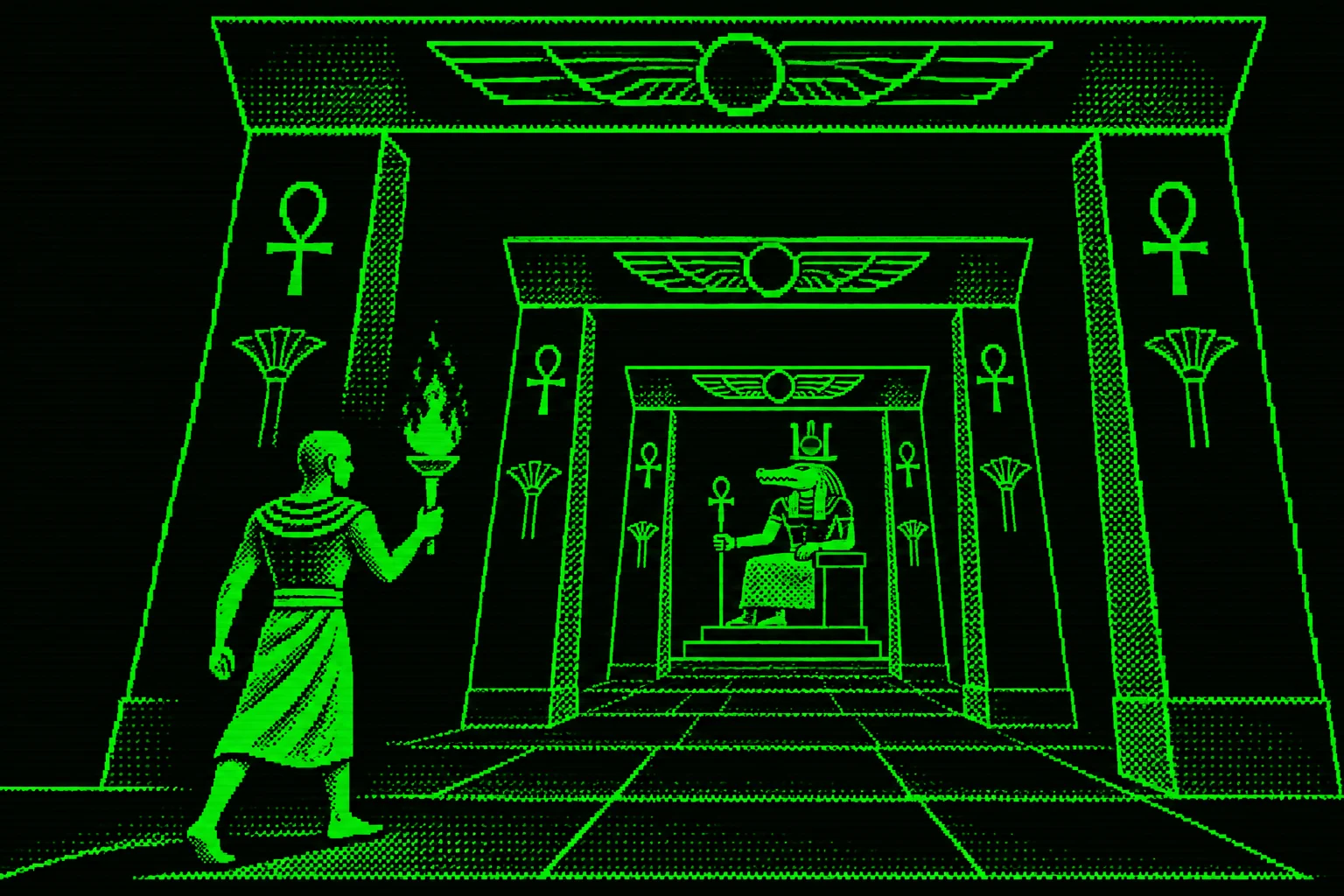
~/sacred-texts/egyptian-temple-rituals
I Am Pure: The Priest at the Gates of Sobek of Tebtunis
- Text
- Egyptian temple rituals, Daily Ritual for Sobek, Lord of Beten (pCarlsberg 307 and parallels)
- Date
- Copied in the Roman period (1st–2nd century AD) in hieratic at Tebtunis in the Fayum
- Found
- Tebtunis (Tebtynis), Fayum; fragments now in Copenhagen (pCarlsberg 307), Florence (PSI inv. I 79) and Berlin (P 14473a)
- Language
- Late Middle Egyptian · Hieratic
- 1
… 𓌭𓅓𓂻 𓆑 𓋴 𓅓 …
[...] sšmi̯ =f s m [...]
… may he lead them into …
Note · Line 1
The dots mark gaps where the words on the surviving papyrus fragments are lost or unreadable. - 2
… 𓃂𓈗 𓎛𓂝𓏏𓄹 𓆑 …
[...] wꜥb ḥꜥ =f [...]
… that his body may be pure …
- 3
… 𓋴𓂧𓊦𓍱 𓆓𓂧𓌃𓏤𓏫 …
[...] [ṯꜣi̯] sd ḏd-mdw ⸢sd⸣ [...]
… Putting on the sed-kilt. Recite: “The sed-kilt …”
Note · Line 3
The sed-kilt is part of the priest’s ritual dress. “Recite” marks the change from an instruction about what to do to the words he is to say as he does it. - 4
… 𓏲𓀀 𓅓 𓇋𓊪𓏭 𓀀 𓊪𓈖 𓅓 𓐪𓂧𓏌𓏛𓀾 𓆑
[...] [⸮_?] =f wj m jp jb ⸢ḫf⸣.n =j nṯr pn m qd =f
“… he … me as one who understands. I have seen this god in his own form.”
- 5
… 𓆌𓅆 …
[...] [⸮_?] Sbk nb-⸢Bdn⸣ [...]
“… Sobek, lord of Beten …”
Note · Line 5
Beten is Tebtunis, the town in the Fayum where this rite was performed. Sobek was its crocodile god. - 6
𓇓𓏏𓈖𓏙𓊵𓏏𓊪𓈀𓏥 𓇋𓏲 𓀀 𓃂𓈗𓎡𓏲𓀀
ḥtp-ḏi̯-n(j)swt jw =j wꜥb.kw
“An offering the king gives. I am pure.”
Note · Line 6
The offering is the king’s because the priest serves in his place. It is the priest himself who must be pure to pass through the temple doors. - 7
… 𓌉𓏏𓇳
[...] ⸢ṯbw,t⸣.du ḥḏ.t
… the two white sandals.
- 8
𓆓𓂧𓌃𓏤𓏫 … 𓁷𓏤 𓊨𓏏𓉐 𓋴𓈖𓏥 𓌥𓃀𓏲𓎡𓏲𓀀 𓅓 … 𓆑 𓉐𓏤 𓇋𓏏𓅆 𓆑 𓊨𓏰𓇳𓅆 𓅓 … 𓂋𓏤𓊪𓂋𓏤𓊪𓅆 𓇑𓇑𓏛
ḏd-mdw [...] ḥr s,t =sn ḏbw.kw m [⸮_?] [...] [⸮_?].n =f pr jt(j) =f Wsjr m [...] [ḫm].n Rprp nn
Recite: “… in their place. I am clad in … He has … the house of his father Osiris in … Reprep has not known this.”
- 9
… 𓐍𓅓𓂜𓈖 𓐍𓈖𓂧𓂻𓈖 𓆑 𓁷𓏤 𓋴𓈖𓏥
⸮swn? [...] ḫm{.n} ḫnd.n =f ḥr =sn
Opening … who does not know what he has trodden on.
- 10
… 𓏤𓊹𓉗𓏏𓉐𓅆
[...] ḥw,t-nṯr
… the temple.
- 11
𓆓𓂧𓌃𓏤𓏫 … 𓉪𓃥 𓀼 𓇋𓅆 𓇋𓋴
ḏd-mdw šsp [...] tꜣ,tj-sꜣb šps J js
Recite: “Receive … a noble vizier like I.”
Note · Line 11
“I” here is a name of Thoth, the divine scribe, not the English pronoun. A vizier was the king’s chief minister. - 12
… 𓅓𓏌𓉐𓈖 𓊢 𓊹𓆇𓏤 … 𓆑
[...] ⸢šmi̯⸣ m-ẖnw ⸮ꜥḥ{ꜥ}? nṯr ⸢⸮wḥs?⸣ [...] [⸮_?]sw =f ⸢ꜥb,w⸣ =⸢j⸣
“… going into the god’s palace and cutting off … he … my purification.”
- 13
… 𓆑
[...] [⸮_?] =f
… his …
- 14
𓇋𓏲 𓀀
ḥtp-ḏi̯-n(j)swt jw =j ⸢wꜥb.kw⸣
“An offering the king gives. I am pure.”
- 15
… 𓀀 𓂋 𓏏𓇯𓅆 𓇋𓏲 𓇼𓄿𓏲𓀢
[...] [⸮_?] =j r p,t jw dwꜣw
… I … toward the sky to give praise …
- 16
… 𓎼 𓈖𓏛 𓇋𓏏𓆑𓅆 𓆑 𓋴𓊵𓏏𓊪𓏛 𓀀 … 𓏌𓀀𓎡
[...] [rʾ] [n] ⸢ꜥq⸣ g(r) n jt(j) =f sḥtp =j [...] [⸮sꜣ-tꜣ?] jnk sḥtp [sw]
… Another spell for going in to his father. “I will appease … the serpent. It is I who appease him.”
- 17
𓃂𓈗𓎡𓏲𓀀
[ḥtp-ḏi̯-n(j)swt] [jw] =[j] wꜥb.kw
“An offering the king gives. I am pure.”
- 18
𓈖 𓂝𓈎𓂻 𓂋𓇋𓏲 … 𓃹𓈖𓉿𓂡 𓆑 𓆑
rʾ n ꜥq r-jw ⸢sbꜣ⸣ [n] [2,nw] [ḏd-mdw] [...] [⸮_?] wn =f br.du.wy.pl =f ⸢m-mꜣꜥ,t⸣
Spell for entering through the second gate. Recite: “… may he truly open his eyes.”
- 19
… 𓀀 𓆄𓏏𓏛𓅆 𓇋𓏲 … 𓄟𓋴𓏛𓊹𓊹𓊹𓅆𓏫 𓇋𓏲 𓋴𓈖𓏥 …
[...] sꜥr =j mꜣꜥ,t jw [...] [⸮qmꜣ?]-r(m)t.pl msi̯-nṯr.pl jw =sn [...]
“… I raise Maat to … the one who created humankind and brought forth the gods, while they …”
Note · Line 19
Maat is both the right order of the world and the goddess who embodies it. A priest could offer a small figure of her to the god as a gift. - 20
𓂋𓇋𓏲 𓇼𓄿𓏲𓆱𓉐 𓈖 … 𓎛𓂝𓂝𓀠𓏛 𓇋𓅓𓏛 𓀀
[rʾ] [n] [ꜥq] r-jw sbꜣw n ⸢3⸣,nw ḏd-mdw [...] ⸢htt⸣.pl ḥꜥꜥ jm =j
Spell for entering through the third gate. Recite: “… the Hetet baboons rejoice in me.”
Note · Line 20
Egyptian artists often showed baboons facing the rising sun with their arms raised. Their rejoicing here recalls that dawn greeting. - 21
[...] ⸢jnk⸣ ⸢J⸣ ⸢sḫpr⸣-jr,t-Ḥr-n≡f-m-ḫt-⸢bꜣgi̯.t⸣≡[s]
“… I am I, who restored the Eye of Horus for him after it had grown weak.”
Note · Line 21
The first “I” is the priest speaking; the second names Thoth. For the duration of the spell, the priest speaks as the god who healed Horus’s injured eye. - 22
𓈖 𓆓𓂧𓌃𓏤𓏫 𓃂𓈗 𓀀 𓅓 𓂐𓅆 … 𓉐𓂋𓂻𓈖 𓀀 𓅓 𓋴𓆓𓏏𓏤𓀔 … 𓊪𓃹𓈖𓏏𓏏𓈉𓊖
[rʾ] [n] [ꜥq] [r-jw] ⸢sbꜣw⸣ n 4,nw ḏd-mdw wꜥb =j m ḥꜥpj [...] ⸢⸮nw?⸣ pri̯.n =j m sḏ,t(j) =f ⸢wꜥb⸣[⸮.n?] =[⸮j?] [...] n ⸢⸮tꜣ?⸣ Pwn,t
Spell for entering through the fourth gate. Recite: “I cleanse myself in the Nile flood … the waters. I have come forth as his nursling. I have cleansed myself … of the land of Punt.”
Note · Line 22
Hapi, the Nile flood in divine form, can nourish the priest as a parent nourishes a child. Punt was a source of fragrant resins burned in Egyptian temples. - 23
𓏌𓀀𓎡 … 𓀀 𓅓 𓃀𓈖𓂧𓂑𓂑𓏥 𓊃 … 𓎛𓈖𓂝 𓉠𓏏𓆇𓁐 𓇋𓏲 𓂋𓂧𓊍 𓈖 𓎟𓊨𓏏𓉐
jnk [...] ⸢swr⸣ =j m bn,t.du.pl =s mhr =[⸮s?] [⸮wj?] [...] ḥnꜥ Nb,t-ḥw,t jw r(w)d n nb-s,t-[wr.t]
“I am … I drink from her two breasts. She suckles me … with Nephthys at the dais of the Lord of the Great Seat.”
- 24
[ḥtp-ḏi̯-n(j)swt] [jw] =[j] [wꜥb].kw
“An offering the king gives. I am pure.”
- 25
𓂋𓏤 𓈖 𓂝𓈎𓂻 𓂋𓇋𓏲 … 𓃂𓈗 𓇋𓏲 𓀀 𓊸𓏏𓏰𓈒𓏥 𓇋𓏲 𓀀 … 𓄏𓌯 𓎟 𓈋𓏲𓅪 𓂋 𓀀
rʾ n ꜥq r-jw wsḫ,t [ḏd-mdw] [...] [⸮wsḫ,t?] wꜥb jw =j bt jw =j [...] [ḫsr] =[ṯ] [šꜥy] [dr] =[ṯ] ꜥb,w nb ḏw r =j
Spell for entering the court. Recite: “… the court is pure. I am cleansed with natron. I … May you drive off terror and rid me of every evil taint.”
Note · Line 25
Natron is a naturally occurring mineral salt. Priests used it as well as water to cleanse themselves before serving in the temple. - 26
𓋴𓐍𓏏𓐍𓏏𓂽 …
sḫtḫt =[⸮ṯ?] [...]
“May you drive back …”
- 27
𓀀 𓅓 𓄐𓈗 𓊹𓊹𓊹𓅆𓏫
[jw] =[j] [wꜥb.kw] [jw] ⸢ꜥb,w⸣ =j m ꜥb,w nṯr.pl
“I am pure. My purity is the purity of the gods.”
- 28
𓉔𓄿𓇋𓇋𓀀 𓂧𓂋𓏛𓀜 𓂧𓈖𓏥 𓈋𓏲𓅪 … 𓇋𓏲 𓊹𓉗𓏏𓉐𓅆 𓁷𓏤𓈖𓏏𓏭 𓏌𓀀𓎡 𓇋𓅆
hꜣy [Nw,t] [Gb] [Wsjr] [ꜣs,t] [Nb,t-ḥw,t] ⸢Ḥr-sꜣ-ꜣs,t⸣ dr =dn ḏw [...] [⸮_?] =[sn] [m-sꜣ] =[j] jw ḥw,t-nṯr ḥr-n,tj jnk J sḫpr-[jr,t-Ḥr-m-ḫt]-⸢bꜣgi̯.t⸣≡s
“O Nut, Geb, Osiris, Isis, Nephthys and Horus son of Isis, may you drive out evil … they … behind me to the temple, for I am I, who restored the Eye of Horus after it had grown weak.”
Note · Line 28
The priest calls on three generations of one divine family: Nut and Geb are the parents of Osiris, Isis and Nephthys; Horus is the son of Isis and Osiris. - 29
𓇋𓏲 𓀀
ḥtp-ḏi̯-n(j)swt jw =j wꜥb[.kw]
“An offering the king gives. I am pure.”
- 30
𓆓𓂧𓌃𓏤𓏫 𓂋𓏤𓄹 𓀀 𓂧𓊃𓌪𓂡 𓂏𓏤𓏏𓄹 𓀀
[rʾ] [n] [ꜥq] [r-jw] [⸮bw-ḏsr?] ḏd-mdw rʾ =j ds sp,t.du =j [Nb,t-ḥw,t]
Spell for entering the sanctuary. Recite: “My mouth is sharp; my two lips are Nephthys.”
- 31
… 𓅓 𓇋𓋴
[...] [sp] [2] m ṯꜣ(,y).pl js ⸢ḥm,t.pl⸣ [js] [wḏꜥ] [tp,t] =[sn] [ḥsq] [⸮jb?] =[sn]
… (twice) with men and women alike, their heads cut off, their hearts cut out.
- 32
𓃂𓈗𓎡𓏲𓀀
ḥtp-[ḏi̯-n(j)swt] ⸢jw⸣ =j wꜥb.kw
An offering the king gives. I am pure.
- 33
𓂋𓏤 𓈖 𓂝𓈎𓂻 𓂋 𓉐𓏤𓆌𓅆 𓎟𓃀𓂧𓈖𓏌𓏲𓊖𓅆 𓈖 𓇳𓅆
rʾ n ꜥq r Pr-Sbk nb-Bdn [ḏd-mdw] [j:nḏ] [ḥr] =[tn] [nṯr.pl-m-p,t] [j:nḏ] [ḥr] =[tn] [nṯr.pl-m-tꜣ] [ḏꜣḏꜣ,t] [n,t] [⸮Bdn?] [⸮jri̯?] =[tn] [m] [wpw,t] ⸢n,t⸣ ḥm n Rꜥw
Spell for entering the sanctuary of Sobek, lord of Tebtynis. Recite:
Hail to you, gods in the sky!
Hail to you, gods on earth!
Divine council of Tebtynis, you act at the command of the Majesty of Ra.Note · Line 33
“Majesty” is a royal title: the local gods are carrying out the orders of Ra, the sun god, as a council would those of a king. - 34
𓂜𓈖 𓀀 𓇋 𓍚𓏛𓀜𓏤𓏲𓏏 𓈝
nn šnꜥ.tw =j j Wpw,dy.pl-Rꜥw nn ḫsf.tw šm =[j] [m-ꜥ] =[tn]
I shall not be turned away, O messengers of Ra;
you shall not bar my way. - 35
[dr] =[tn] [mwt] [nb] [mwt,t] [nb] [ḫft] [nb] [ḫft,t] [nb] [ḏꜣ] [nb] [ḏꜣ,t] [nb] [m-ꜥ] [Sbk] [nb-Bdn] [ꜥnḫ] =[f] [m] [mꜣꜥ,t]
May you drive every male ghost and every female ghost,
every male enemy and every female enemy,
every male adversary and every female adversary
away from Sobek, lord of Tebtynis. He lives on Maat. - 36
𓂧𓅓𓏛 𓋴𓏤𓀀 𓁷𓏤 𓉿𓆱
[ḏd-mdw] [m] [wꜣš] jw dm rdi̯.t šnꜥ.tw s ḥr ꜥꜣ ⸢pn⸣ [hꜣy] [Sbk] [nb-Bdn] [ḥnꜥ] [⸮psḏ,t?] =[k] [wꜣḥ.n] =[j] [n] =[dn] [tp.pl] =[dn] [ꜥnḫ] =[dn]
Words to be spoken in homage, so that no one is turned away at this door:
O Sobek, lord of Tebtynis, you and your Ennead,
I have set your heads back in place for you, so that you may live.Note · Line 36
An Ennead is a company of gods traditionally numbered at nine. Here it is Sobek’s own divine company at Tebtunis. - 37
𓏌𓀀𓎡 𓇋𓅆 𓋴𓏠𓈖𓍖𓁶𓏤𓄹𓈖𓊨𓂂𓅆𓈖𓆑
[rʾ] [n] [sḥḏ] ⸢dkꜣ,w⸣ ḏd-mdw jnk J smn-tp-n-Wsjr-n≡f
Spell for lighting a torch. Recite:
I am Iu, who fastened the head of Osiris in place for him.Note · Line 37
Iu is the same Thoth called “I” earlier. Osiris had been dismembered, so putting his head back in place is an act of bringing him back to life. - 38
[mꜣꜥ-ḫrw] [Sbk] [nb-Bdn] [ḥr] [mꜣꜥ,t] =[f] [...]
Sobek, lord of Tebtynis, is vindicated by his righteousness …
- 39
[hꜣy] [Sbk] [nb-Bdn] [jr,t-Ḥr] [jwi̯.ṱ] [m] [sšm] =[s]
O Sobek, lord of Tebtynis, the Eye of Horus has come in her own image.
Note · Line 39
The Eye can act as a goddess in her own right. It is the flame of the torch that makes her present here. - 40
𓇋𓀀 𓁹𓈐𓅆 𓅜𓐍𓏲𓏛 𓇋𓀀 𓁹𓈐𓅆 𓇅𓏲𓏏𓏛
[rʾ] [n] [sḥḏ] ⸢bs⸣ ⸢ḏd-mdw⸣ j jr,t-Ḥr ꜣḫw j jr,t-Ḥr wꜣḏw.t [j] [jr,t-Ḥr] [m-ḥtp] [psd] =[s] [mj] [Rꜥw] [m] [ꜣḫ,t] [sdgꜣw] [s(w)] [sḫm] [n] [Stš] [tp-ꜥ] [jr,t-Ḥr]
Spell for kindling a fire. Recite:
O mighty Eye of Horus!
O fresh green Eye of Horus!
O Eye of Horus, welcome!
When she shines like Ra on the horizon,
the power of Seth hides from the Eye of Horus. - 41
[jṯi̯.n] =[f] [s] [jni̯.n] =[f] [s] [tꜣw] [hh] =[s] [r] =[f]
He seized her, he carried her off;
her fiery breath was too hot for him.Note · Line 41
“He” is Seth, Horus’s rival; “her” is the Eye. Even in Seth’s grasp she can turn her fire against him. - 42
𓁹𓈐𓅆 𓍶 𓈖 𓎡 𓄡𓏏𓏤 𓎡 𓌨𓂋 𓋴
⸢Sbk⸣ ⸢nb-Bdn⸣ [mn] [n] =[k] jr,t-Ḥr šni̯ n =k ẖ,t =k ẖr =s ꜣḫw [n] =[k] [s]
Sobek, lord of Tebtynis, take the Eye of Horus for yourself.
Make your belly round with her;
she does you good.Note · Line 42
The language of eating belongs to the offering rite: the restored Eye is a gift that nourishes the god who receives it. - 43
[ḥtp-ḏi̯-n(j)swt] [...] [mn.ṱ] [ḫwꜣw.ṱ] [ḥsi̯] =[k] [s]
An offering the king gives … She endures, she is protected, for you favor her.
- 44
[ḥtp-ḏi̯-n(j)swt] [jw] =[j] ⸢wꜥb.kw⸣
An offering the king gives. I am pure.
- 45
𓂋𓏤 𓈖 𓂋 𓏤𓊹𓉗𓏏𓉐𓅆 𓇋𓏲 𓂝𓂝𓏤𓏲𓏭𓏥 𓆑 𓁷𓏤 …
rʾ n ⸢ꜥq⸣ r ḥw,t-nṯr jw ꜥ.du.wj.pl =f ḥr šf,t [jw] [jri̯] [ꜥb,w] [ḏd-mdw] [...] [sš.n] [Ḥr] [ꜥn,t.pl] =[f] [jm]
Spell for entering the temple with both hands on a lampstand to perform the purification. Recite:
… Horus has spread his claws for this. - 46
𓂝𓈖𓏌𓏲𓄹𓂷𓏥 𓆑 𓇋𓅓𓏛
[jji̯.n] [⸮J?] [sš.n] =[f] ꜥn,t.pl =f jm
Iu has come; he has spread his claws for this.
- 47
𓊃𓈙𓉿𓂡𓈖 𓀀 𓂝𓈖𓏌𓏲𓂷𓏏𓄹𓏥 𓀀 𓇋𓅓𓏛
sš.n =j ꜥn,t.pl =j jm
I have spread my claws for this.
Note · Line 47
The priest has both hands on the lampstand. After naming the claws of Horus and Iu, he calls his own fingers claws: his hands are doing what theirs did. - 48
[ḥtp-ḏi̯]-n(j)swt [jw] =[j] [wꜥb.kw]
An offering the king gives. I am pure.
- 49
… 𓋴𓊵𓏏𓊪𓏛 𓄣𓏤𓄹𓏥 𓊹𓊹𓊹𓅆𓏫 𓅓 𓌳𓂂𓂂 𓆑
[rʾ] [n] [...] [ḏd-mdw] [j:nḏ] [ḥr] =[k] [wṱḥ,w] [špsi̯] [bꜥḥ] ⸢Nw,w⸣ Nʾn,t sḥtp jb.pl nṯr.pl m mꜣꜣ =f
Spell for … Recite:
Hail to you, noble libation jar, flood of Nun and Naunet!
The sight of it gladdens the hearts of the gods.Note · Line 49
A libation is a liquid poured out as an offering. The jar holds water, but the priest greets it as the waters that existed before creation, personified as the god Nun and the goddess Naunet. - 50
𓂝𓂝𓏤𓏲𓏭
ꜥ.du.wj.pl =[j] [ḥr] =[k] [m] [Ḥr] [ḏr,t.pl] =[j] [ḥr] =[k] [m] [J] [ḏbꜥ.pl] =[j] [jr] =[k] [m] [Jnp] [ḫnt,j-sḥ-nṯr]
My two arms rest on you as the arms of Horus,
my hands rest on you as the hands of Iu,
my fingers touch you as the fingers of Anubis,
who presides over the god’s hall. - 51
[jnk] [wꜥb] [ꜥb,w] [qbḥ] [hrw] [wbꜣ] [qr,dj]
I am the pure priest of purification and libation
on the day the two springs of the Nile are opened.Note · Line 51
The priest’s Egyptian title, wab, means “pure one.” The flood was believed to issue from two springs at Elephantine, near the first cataract of the Nile at modern Aswan. - 52
𓃂𓈗𓎡𓏲𓀀
⸢ḥtp⸣-[ḏi̯-n(j)swt] ⸢jw⸣ =⸢j⸣ ⸢wꜥb.kw⸣
An offering the king gives. I am pure.
- 53
𓂋𓏤 𓈖 𓏲𓍑𓄿𓂻 𓌨𓂋𓏛 𓎗𓏲𓏏𓎛𓏲𓏊 𓇋𓏲 𓁶𓏤𓈖𓍇𓏌 …
rʾ n wḏꜣ ẖr wṱḥ,w jw tp-nw [...] [ḏd-mdw] [j:nḏ] [ḥr] =[k] [wṱḥ,w] [špsi̯] [n] [Sbk] [nb-Bdn] [ḥnꜥ] [psḏ,t] =[f]
Spell for walking in procession with the libation jar to the landing place … Recite:
Hail to you, noble libation jar of Sobek, lord of Tebtynis, and of his Ennead! - 54
𓇋𓅓 𓎡 𓇋𓏲 𓏫 𓃂𓈗 𓏁𓈗 𓄣𓏤𓄹 𓋴𓈖𓏥 𓌨𓂋 …
[šsp] =⸢sn⸣ ⸢qbḥ⸣ jm =k jw =w wꜥb qbḥ jb =sn ẖr [...] [ꜥ.du.wj.pl] =[j]
They receive the cool water from you;
they are pure and cool,
their hearts are … on my two hands. - 55
[nn] [ski̯] =[s] [nn] [ski̯] =[j] [ṯꜣs-pẖr]
It shall not perish; I shall not perish.
Recite in reverse order.Note · Line 55
The instruction concerns the order of the two claims, not the sounds of the words: on the second pass the priest names himself first and the jar second. - 56
𓌷𓂝𓏛
[⸮jr,t?] [nṯr] [jwi̯] =[s] [m-ḥtp] [jji̯.n] =[j] [ẖr] =[s] [m]-ḥtp mꜣꜥ
The Eye of the god comes in peace;
I have come bearing her, truly in peace. - 57
𓃂𓈗 𓊗 𓏤𓏤 𓎘𓏲𓏏𓎛𓏲𓏊 𓈖
wꜥb sp 2 wṱḥ,w n ⸢Sbk⸣ [nb-Bdn] [ḥnꜥ] [psḏ,t] =[f]
Pure, pure is the libation jar for Sobek, lord of Tebtynis, and his Ennead.
- 58
[ḥtp-ḏi̯-n(j)swt] [jw] =[j] [wꜥb.kw]
An offering the king gives. I am pure.
- 59
𓏌𓏌𓏌𓇯𓈗𓈘𓈇𓅆 𓇍𓇋𓂻𓈖 𓀀 𓐍𓂋 𓎡
[rʾ] [n] [ꜥq] [r-tp] [mr] [ḏd-mdw] [jji̯.n] =[j] [ḫr] =[k] Nw,w jji̯.n =j ḫr =k nw
Spell for approaching the canal. Recite:
I have come to you, Nun;
I have come to you, O flood.Note · Line 59
The Egyptian word for “flood” sounds like the name Nun. At the canal the priest can greet the water and the god almost in the same word. - 60
[...] [jm] [n] [Sbk] [nb-Bdn] [ḥnꜥ] [psḏ,t] =[f] [...]
… there for Sobek, lord of Tebtynis, and his Ennead …
- 61
𓇋𓏲 𓀀 𓃂𓈗𓎡𓏲𓀀
ḥtp-ḏi̯-n(j)swt jw =j wꜥb.kw
An offering the king gives. I am pure.
- 62
𓂋𓏤 𓈖 𓇋𓅓 𓇋𓇋𓏲𓂝𓈗𓏌 𓎘𓏲𓏏𓎛𓏲𓏊 𓈖 𓆌𓅆 𓎟𓃀𓂧𓈖𓏌𓏲𓊖𓅆
rʾ n ⸢⸮yw?⸣ [⸮wṱḥ,w?] [⸮m?] [nw] [ḏd-mdw] [j:nḏ] [ḥr] =[k] [nw] [Nw,w] [ꜥꜣ] [nn] [šn(n)] [mḥw] [m] [tꜣ] [ẖr] =[j] [jji̯.n] =[j] [ḫr] =[k] jm yw wṱḥ,w n Sbk nb-Bdn
Spell for washing the libation jar in the floodwaters. Recite:
Hail to you, Flood, great Nun without blemish,
welling up from the earth beneath me!
I have come to you from there to wash the libation jar for Sobek, lord of Beten. - 63
𓇋𓏲 𓀀 𓃂𓈗𓎡𓏲𓀀
[ḥtp-ḏi̯-n(j)swt] [jw] =[j] [wꜥb.kw]
An offering the king gives. I am pure.
- 64
[rʾ] [n] [ḫrp] [qbḥ,w] [ḏd-mdw] [j:nḏ] [ḥr] =[k] [Nw,w] [m] [rn] =[k] [n] [Nw,w]
Spell for presenting a libation. Recite:
Hail to you, Nun, in your name of Nun!Note · Line 64
The next four greetings are all addressed to the water being offered. Each calls it by a different sacred name, including Sema-Nun. - 65
𓇋𓐩𓏌 𓁷𓏤 𓎡 𓈖𓍇𓏌𓏲𓈗𓈘𓈇𓅆 𓅓 𓂋𓈖𓅆 𓎡 𓈖
j:nḏ ḥr =k nw m rn =k n nw
Hail to you, Flood, in your name of Flood!
- 66
[j:nḏ] [ḥr] =[k] [kkwy] [m] [rn] =[k] [n] [kkwy]
Hail to you, Dark Water, in your name of Dark Water!
- 67
[j:nḏ] [ḥr] =[k] [smꜣ-nw,w] [m] [rn] =[k] [n] [smꜣ]-nw,w
Hail to you, Sema-Nun, in your name of Sema-Nun!
- 68
𓄟𓋴𓏛 𓎡 …
msi̯ =k ⸢⸮wꜥb?⸣ [...]
You brought forth purity …
- 69
[jw] [di̯.n] =[j] [ḥr] [n] [Ḥr] [ẖr.du] [n] [St(š)]
I have given Horus his face and Seth his two testicles.
Note · Line 69
In the struggle for the kingship, Horus was wounded in the eye and Seth in the testicles. The priest claims to have healed both rivals, not just the victor. - 70
𓁷𓂋𓏲𓇯𓏥 𓈗𓈘𓈇 𓂧𓂋𓏛𓀜𓏤 𓀀 𓈋𓏲𓅪
[dr] =[j] [ḏw] ḥr,(j)w mw dr =j ḏw ⸢ẖr,jw⸣ [mw]
I drive out the evils above the water;
I drive out the evils below the water. - 71
[n(j)swt] [ḥn] [m] [ꜥnḫ] [jw] =[w] [wꜥb]
The king is refreshed with life; the waters are pure.
- 72
[ḥtp-ḏi̯-n(j)swt] [jw] =[j] [wꜥb.kw]
An offering the king gives. I am pure.
- 73
𓎘𓏲𓏏𓎛𓏲𓏊 𓁷𓏤 𓁶𓏤𓈖𓍇𓏌𓏲𓈗𓈘𓈇𓅆
[rʾ] [n] [ꜥq] [ẖr] [wṱḥ,w] [ḏd-mdw] [wḏꜣ] =[j] [ẖr] wṱḥ,w ḥr tp-nw
Spell for entering with the libation jar. Recite:
I come from the landing place bearing the libation jar. - 74
[nṯr] [nb] [m] [jhꜣy]
Every god rejoices.
- 75
[jji̯.n] [psḏ,t] [tm.ṱ] [jw] [ḫnp] [qbḥ,w] [jni̯.n] =[sn] [ꜥnḫ] [wꜣs] [ḥtp.pl] [di̯] =[sn]
The whole Ennead has come to present a libation.
They have brought life, well-being and the offerings they give. - 76
[ḥtp-ḏi̯-n(j)swt] [jw] =[j] [wꜥb.kw]
An offering the king gives. I am pure.
- 77
𓂋𓏤 𓂝𓈎𓂻 𓂋 𓏤𓊹𓉗𓏏𓉐𓅆 𓌨𓂋𓏛 𓎘𓏲𓏏𓎛𓏲𓏊
rʾ ꜥq r ḥw,t-nṯr ẖr wṱḥ,w [ḏd-mdw] [j:nḏ] [ḥr] =[k] [Ḥꜥpj] [j:nḏ] [ḥr] =[k] [Wsjr]
Spell for entering the temple with the libation jar. Recite:
Hail to you, Hapi! Hail to you, Osiris!Note · Line 77
Osiris, who returned to life after death, was associated with the land’s renewal when the Nile rose. The priest can therefore greet both Osiris and Hapi in the water he carries. - 78
[jji̯.n] =[j] [ḫr] =[k] [Ḥꜥpj] [jji̯.n] =[j] [ḫr] =[k] [Wsjr] [...]
I have come to you, Hapi.
I have come to you, Osiris … - 79
𓊵𓏏𓊪𓏛 𓊹𓊹𓊹𓅆𓏫 𓂋 𓊃 𓊵𓏏𓊪𓏛
ḥtp nṯr.pl r =s ḥtp Sbk [nb-Bdn] [ḥnꜥ] [psḏ,t] =[f] [jm] =[s]
The gods are content with it;
Sobek, lord of Beten, and his Ennead are content with it. - 80
[ḥtp-ḏi̯-n(j)swt] [jw] =[j] [wꜥb.kw]
An offering the king gives. I am pure.
- 81
𓋴𓇋𓐎𓈖𓏏𓈇𓏤𓏥 𓎡 𓅓 𓋁𓃀𓂧𓈉𓊖
[rʾ] [wꜣḥ] [ꜣꜥꜥb] [ḥr] [sḥtp,y] [ḏd-mdw] [ꜣḥ,t] =[k] [m] [Ḏd,w] sjn =k m ꜣbd
Spell for setting the incense cup on the censer. Recite:
Your earth is from Busiris, your clay from Abydos.Note · Line 81
The priest is speaking to the earthen cup itself. Busiris in the Nile Delta and Abydos farther south were both sacred to Osiris. - 82
swꜥb =[k] [m] [jr,t-Ḥr] [r] [jri̯] [jḫ,t] [jm] =[k] [n] [Sbk] [nb-Bdn] [ḥnꜥ] [psḏ,t] =[f]
You purify as the Eye of Horus, so that the offering may be made with you for Sobek, lord of Beten, and his Ennead.
- 83
[ḥtp-ḏi̯-n(j)swt] [jw] =[j] [wꜥb.kw]
An offering the king gives. I am pure.
- 84
𓆓𓂧𓌃𓏤𓏫 𓇍𓇋𓂻𓏏𓏲 𓊗 𓏤𓏤
[rʾ] [sḫi̯] [stꜣ] ḏd-mdw jji̯.ṱ sp 2 m-ḥtp [jr,t-Ḥr] [ꜣḫ.ṱ] [wḏꜣ.ṱ] [rnpi̯.ṱ] [m-ḥtp]
Spell for striking fire. Recite:
You have come, you have come in peace, Eye of Horus!
You are mighty, you are whole, you are young again. Welcome! - 85
[psd] =[s] [mj] [Rꜥw] [m] [ꜣḫ,t] [sdgꜣw] [s(w)] [sḫm] [n] [Stš] [tp-ꜥ] [jr,t-Ḥr]
It shines like Ra on the horizon;
the power of Seth hides from the Eye of Horus. - 86
[jṯi̯.n] =[f] [s] [jni̯.n] =[f] [s] [r] ⸢rdi̯.t⸣ [s,t] =[s] [n] [Ḥr,w]
He took it; he brought it to give Horus its place.
- 87
[jr,t-Ḥr] [ḥr] [dr] [ḫft] [n] [Sbk] [nb-Bdn] [ḥnꜥ] [psḏ,t] =[f]
The Eye of Horus is driving out the enemy of Sobek, lord of Beten, and his Ennead.
- 88
[ḥtp-ḏi̯-n(j)swt] [jw] =[j] [wꜥb.kw]
An offering the king gives. I am pure.
- 89
𓏖𓏏𓊹𓊹𓊹𓅆𓏥𓅆 𓆑
[rʾ] [n] [rdi̯.t] [snṯr] [ḥr] [sḏ,t] [n] [Sbk] [nb-Bdn] [ḥnꜥ] psḏ,t =f [ḏd-mdw] [n] [Bꜣ-jꜣb,tt] [n] [Ḥr-jꜣb,tt] [n] [Ḫꜥi̯-n-mw,t≡f-m-ẖnw-jtn≡f] [n] [Bꜣ-psd-m-wḏꜣ,dy.du.pl≡f] [n] [Rꜥw-Ḥr-ꜣḫ,ty] [nṯr-ꜥꜣ] [sꜣb-šw,t] [ḫnt,j-⸮jrt,ty.du-šmꜥ.t-n-p,t?]
Spell for placing incense on the fire for Sobek, lord of Beten, and his Ennead. Recite:
For the Ba of the East,
for Horus of the East,
for him who appears to his mother within his sun disk,
for the Ba who shines in his two wedjat eyes,
for Ra-Horakhty, the great god of many-colored plumage,
who presides over the two Upper Egyptian shrines of the sky.Note · Line 89
A ba is a form in which a god makes his presence felt; Ra-Horakhty is the sun god as “Horus of the Two Horizons.” A wedjat is an eye made whole again, and the sun god’s two eyes are the sun and moon. - 90
[rʾ] [n] [ṯꜣi̯] [sḥtp,y] ⸢ḏd⸣-mdw [j:nḏ] [ḥr] =[k] [jm,j-ḫt-J]
Spell for taking up the censer. Recite:
Hail to you, follower of I!Note · Line 90
The “follower” the priest greets is the censer he is about to lift. - 91
[ꜥ.du.wy.pl] =[j] [ḥr] =[k] [m] [Ḥr] [ḏr,t.pl] =[j] [ḥr] =[k] [m] [J] [ḏbꜥ.pl] =[j] [jr] =[k] [m] [Jnp] [ḫnt,j-sḥ-nṯr]
My two arms rest on you as the arms of Horus;
my hands rest on you as the hands of Iu;
my fingers touch you as the fingers of Anubis, who presides over the god’s hall. - 92
[jnk] [wꜥb] [jw] =[j] [wꜥb.kw] [ꜥb,w] =[j] [m] [ꜥb,w] [nṯr.pl]
I am the pure one. I am pure.
My purity is the purity of the gods. - 93
[ḥtp-ḏi̯-n(j)swt] [jw] =[j] wꜥb.kw
An offering the king gives. I am pure.
- 94
⸢rʾ⸣ ⸢n⸣ [⸮smn?] [⸮ḥḏ,t?] [ḥr] [tp] =[f] [ḏd-mdw] [jwi̯] [Wꜣḏy,t] [jwi̯] [Wnw,t] [jwi̯] [ꜣs,t] [jwi̯] [Nb,t-ḥw,t] [jwi̯] [Jms,tj] [jwi̯] [Ḥp,w] [jwi̯] [Dwꜣ-mw,t≡f] [jwi̯] [Qbḥ-sn.w≡f] [...]
Spell for setting the White Crown firmly on his head. Recite:
Wadjet comes, Unut comes,
Isis comes, Nephthys comes,
Imsety comes, Hapy comes,
Duamutef comes, Qebehsenuef comes …Note · Line 94
The White Crown represents Upper Egypt, the southern part of the country. The last four gods named are the sons of Horus; this Hapy is not the god of the Nile flood. - 95
𓋴𓈖𓏥
[s]wꜥb =sn [wj] [sẖkr] =[sn] [wj]
They purify me, they adorn me.
- 96
[jri̯] =[s] [s,t] =[s] [m] [ḥꜣ,t] =[j] [m] [rn] =[s] [pfj] [n] [ḥḏ,t] [pri̯-m-Nḫb]
She takes her place upon my brow in that name of hers, “The White Crown who came forth from Nekheb.”
Note · Line 96
“She” is the crown itself, now spoken of as a goddess. Nekheb, modern Elkab, was sacred to Nekhbet, the vulture goddess who protected the ruler of Upper Egypt. - 97
[jwi̯] [sdj] =[s] [r] =[j] [jnk] [qꜣi̯] [...]
Her fragrance comes to me.
I am the exalted one … - 98
[ḥtp-ḏi̯-n(j)swt] [jw] =[j] [wꜥb.kw]
An offering the king gives. I am pure.
- 99
𓅓 𓊸𓏏𓏯𓈒𓏥
[rʾ] [n] [⸮snṯr?] m snṯr ḏd-⸢mdw⸣ [wꜥb] [Ḥr] [snṯr.n] =[f] [sw] [m] [jr,t] =[f] [n,t] [ḏ,t] =[f]
Spell for censing with incense. Recite:
Horus is pure. He has censed himself with his eye, the eye of his own body.Note · Line 99
Here the incense itself serves as Horus’s restored eye. By passing through its smoke, the priest does for himself what Horus does for his own body. - 100
[wꜥb.kw] [snṯr.n] =[(j)] [wj] [m] [jr,t-Ḥr] [n,t] [ḏ,t] =[f]
I am pure. I have censed myself with the Eye of Horus, the eye of his own body.
- 101
[wꜥb.kw] [...]
I am pure …
- 102
𓊪𓂧
[pd.n] =[j] [jm] =[s] [m] [rn] =[s] [pfy] [n] p(ꜣ)d
I have burned incense with it in that name it bears, “Pellet of Incense.”
Note · Line 102
In Egyptian the verb for burning incense sounds like the word for the pellet being burned. The next line pairs the act of censing with the name of incense in the same way. - 103
[snṯr.n] =[(j)] [wj] [jm] =[s] [m] [rn] =[s] [pfj] [n] [snṯr]
I have censed myself with it in that name it bears, “Incense.”
- 104
[swꜥb.n] =[(j)] [wj] [jm] =[s] [mj] [swꜥb] [sw] [Rꜥw] [jm] =[s] [mj] [snṯr] =[f] [sw] [jm] =[s] [...]
I have purified myself with it,
as Ra purifies himself with it,
as he censes himself with it … - 105
[ḥtp-ḏi̯-n(j)swt] [jw] =[j] [wꜥb.kw]
An offering the king gives. I am pure.
- 106
𓂋𓏤
rʾ n [swꜥb] [wṱḥ,w] [ḏd-mdw] [wꜥb] [sp] [2] [wṱḥ,w] [n] [Sbk] [nb-Bdn] [ḥnꜥ] [psḏ,t] =[f]
Spell for purifying the food offering. Recite:
Pure, pure is the food offering for Sobek, lord of Beten, and his Ennead. - 107
[...] [m] [snṯr] ⸢wꜥb⸣ nḏm [sdj] [n,tj] [m] [sẖꜣ,ww] [J] [m] [pr-mḏꜣ,t] [nṯr]
… with pure incense, sweet of scent, as written in Iu’s scroll in the god’s House of Books.
Note · Line 107
The House of Books was the temple library. Calling the scroll Iu’s gives the instructions the authority of Thoth, the divine scribe. - 108
[ꜥ.du.wj.pl] =[j] [di̯] =[sn] [bꜥḥ] [swꜥb] =[sn] [wdn] [jḫ,t] [nb.t] [nfr] [n] [Sbk] [nb-Bdn] [ḥnꜥ] [psḏ,t] =[f]
My two hands pour out the flood;
they purify the offering of every good thing for Sobek, lord of Beten, and his Ennead. - 109
[jw] =[w] [wꜥb] [m] [⸮ḥw,t?] =[f] [n] ⸢Tꜣ-šmꜥ⸣ [m] [ꜥḥ,t] =[f] [n] [Tꜣ-mḥ,w] [ḥr] [wṱḥ,w] [špsi̯] [n,tj] [m] [p,t] [n,tj] [m] [tꜣ] [n,tj] [m] [Bdn] [n,tj] [m] [Tꜣ-š] [...]
They are pure in his temple of Upper Egypt, in his palace of Lower Egypt,
together with the splendid food offering
that is in heaven, that is on earth,
that is in Beten, that is in the Lake Land …Note · Line 109
The Lake Land is the Fayum, the region around the lake where Tebtunis stood. - 110
𓎛𓈖𓂝 …
[wꜥb] [sp] [2] [wṱḥ,w] [špsi̯] [n] [Sbk] [nb]-⸢Bdn⸣ ḥnꜥ [psḏ,t] =[f] [Psḏ,t-nb.w-nḥḥ] [n] [kꜣ] =[sn] [ḏ,t] [jw] =[w] [wꜥb] [...]
Pure, pure is the splendid food offering for Sobek, lord of Beten, and his Ennead,
the Ennead of the Lords of Eternity, for their ka forever.
They are pure …Note · Line 110
The ka is the vital power of a being. Food laid before the gods was meant to sustain that power. - 111
[...] [rʾ] [n] [wn-ḥr] [nṯr] [ḏd-mdw] [wn] [ꜥꜣ.du.wy.pl] [p,t] [sš] ꜥꜣ.du.wy.pl tꜣ
… Spell for unveiling the god’s face. Recite:
The double doors of heaven are opened;
the double doors of earth are thrown wide.Note · Line 111
The priest opens the doors of the shrine to reveal the god’s image. In the spell, that small pair of doors opens onto all of heaven and earth. - 112
𓐩𓏌𓂧 𓈖 𓁷𓏤
nd n ḥr [n] [Gb] [m] [ḏd] [n] [nṯr.pl] [mn.ṱ] [ḥr] [s,t] =[sn] [wn] [ꜥꜣ.du.wy.pl] [p,t] [psd] [psḏ,t]
Greeting the face of Geb by saying to the gods who abide upon their throne:
The double doors of heaven are opened;
the Nine are made to shine.Note · Line 112
Geb is the earth god. In Egyptian the word for “shine” sounds like the name of the Nine, the Ennead. - 113
𓊨𓏏𓉐 𓋴𓈖𓏥
[qꜣi̯] [Sbk] [nb-Bdn] [ḥr] [s,t] =[f] [wr.t] [qꜣi̯] [psḏ,t-ꜥꜣ.t] [ḥr] s,t =sn
High on his great throne is Sobek, lord of Beten;
high on their throne are the gods of the Great Ennead. - 114
𓄤𓏤𓏛𓏥 𓎡 𓈖 𓎡
nfr,w =k n =k Sbk [nb-Bdn] [ḥꜣi̯] [ḥbs.ṱ] [ꜥrq] [ꜥrq.ṱ]
Your beauty is yours, Sobek, lord of Beten.
What was bare is covered;
what was to be clothed is clothed. - 115
𓆌𓅆 …
[rʾ] [n] [⸮_?] [ḏd]-mdw Sbk nb-Bdn ⸢ḥnꜥ⸣ [psḏ,t] =[f] [...]
Spell for … Recite: Sobek, lord of Beten, and his Ennead …
- 116
𓁹𓈐𓅆 𓂞𓂞 …
jr,t-Ḥr jp ⸢rwd⸣ dd [⸮m?] [⸮s,t?] =[⸮s?] [...]
The Eye of Horus is whole and sound, set in its place …
- 117
𓊃𓊪𓊗
[⸮_?] sp 4
… four times.
- 118
𓂋𓏤 …
rʾ [⸮_?] [ḏd-mdw] [...]
Spell for … Recite: …
- 119
𓈖 𓊪𓈖
[⸮_?] n pr pn
… to this house.
- 120
⸢jji̯⸣ [...]
Here comes …
- 121
[J] [sḫpr]-jr,t-Ḥr-⸢m-ḫt⸣-bgꜣw≡s [...]
Iu, who restored the Eye of Horus when its strength had failed …
- 122
𓈖 𓂉 …
rʾ n [⸮jri̯.t?] ⸢sn⸣ ⸢tꜣ⸣ ḏd-mdw [⸮sn?] =[⸮j?] [⸮tꜣ?] [⸮ḥpt?] =[⸮j?] [⸮Gb?] [...]
Spell for the rite of kissing the ground. Recite: I kiss the ground; I embrace Geb …
Note · Line 122
Kissing the ground was a gesture of homage. Since the earth is Geb’s body, the priest can describe the same gesture as an embrace. - 123
… 𓆌𓅆
[...] ⸢Sbk⸣ ⸢nb-Bdn⸣
… Sobek, lord of Beten.
- 124
[...] jn
… moving slowly …
- 125
[...] ⸮msḥ? ḫ(ꜣ)ḫ [⸮_?]
… the crocodile is swift …
- 126
… 𓆌𓅆 𓎟𓃀𓂧𓈖𓏌𓏲𓊖𓅆
[...] ⸢⸮Nj,t?⸣ Sbk nb-Bdn
… Neith and Sobek, lord of Beten.
Note · Line 126
Neith was worshipped as Sobek’s mother. - 127
… 𓉐𓂋𓂻 𓅓 𓈎𓂋𓂧𓏭𓉐𓉐
[...] pri̯ ((m)) qr,dj.du
… who came forth from the twin wellsprings of the Nile.
- 128
… 𓋴𓌉𓆓𓇳
[...] sḥḏ
… to give light …
- 129
𓆓𓂧𓌃𓏤𓏫 …
[rʾ] [n] [⸮_?] ḏd-mdw [...] ⸢⸮Dmꜣ.t-pḏ,t?⸣ [...]
Spell for … Recite: … she who draws the bows …
- 130
… 𓅓 𓀀𓏥 𓆌𓅆
[...] ꜥnḫ.pl ⸢r-gs⸣ [...] [⸮_?] m [⸮_?].pl =j Sbk nb-Bdn
… the living beside … with my …, Sobek, lord of Beten.
- 131
𓂧𓎼𓄿𓏲𓀅 𓊃 …
[⸮_?] m mdn =⸢f⸣ dgꜣw [r] =s [...]
… in his stillness, hidden from her …
- 132
𓋴𓂧𓊦𓏛𓀜 …
⸮nn? sd =tw ⸢sjn⸣ [...]
The clay seal is not to be broken …
Note · Line 132
Clay pressed over the fastening of a shrine door served as a seal: a break in it showed that the door had been opened. - 133
𓇳𓏰𓅆 𓉗𓏏𓁷𓏤𓏏𓆇𓁐 𓂋𓐝𓏤 … 𓄫𓏲𓏛 𓈖𓐍𓐍𓀗 …
[⸮_?] Rꜥw sḥtp Ḥw,t-Ḥr r-gs [⸮jt(j)?] =[⸮s?] [...] ⸢m-ḫt⸣ [⸮_?] =f ꜣwi̯ [jb] nḫḫ mn [...]
… Ra, to soothe Hathor at her father’s side … after his … and to gladden the heart of the Aged One, who endures …
Note · Line 133
The Aged One is Ra as the evening sun. Hathor is his daughter. - 134
𓆑 𓆓𓊃 𓆑 … 𓋬𓏏𓏭 𓎛𓈖𓂝 𓏰𓇳𓅆 𓅓 …
ḏ,t =f ḏs =f wr-snd-m-ꜣtf sꜥḥꜥ [...] [Sbk] [nb]-⸢Bdn⸣ dmḏ ḥnꜥ Rꜥw m [...]
his own body, he who inspires great awe in the atef crown, who raises … Sobek, lord of Beten, united with Ra in …
Note · Line 134
The atef is a tall crown flanked by feathers, most closely associated with Osiris. - 135
[⸮Wsjr?] ḥr,j-jb-šꜥy
Osiris, who dwells amid the sands.
- 136
𓄙𓅓𓏛𓈖 𓎡 … 𓎡 𓉔𓈖𓇋𓏏𓁍 𓎡 …
wḥm.n =k ḫpr,w =[k] [...] ⸢wpš⸣.n =k tꜣ.du.pl hnjt n =k [...]
You have taken on your form anew …
You have shed light over the Two Lands, which shout for joy at the sight of you …Note · Line 136
The Two Lands are Upper and Lower Egypt, the Nile Valley in the south and the Delta in the north. - 137
𓇏𓏏𓈇𓏤 𓅤𓈗𓏏𓈇𓅆 𓅓 𓄤𓏤𓏛𓏥 𓎡 …
[⸮_?] sḫ,t bꜥḥi̯ m nfr,w =k [...] kꜣ,w
… the field is flooded with your beauty … food.
- 138
𓈖 𓌳𓂂𓂂 𓊹𓅆
rʾ n mꜣꜣ nṯr ḏd-mdw ḥr =j sꜣu̯ [tw] [r] [nṯr] [ṯ(ꜣ)s-pẖr]
Spell for seeing the god. Recite: My face, guard yourself against the god! Then say it in reverse.
Note · Line 138
On the second recitation the priest exchanges the roles: “O god, guard yourself against my face!” The warning goes both ways at the moment he looks upon the divine image. - 139
[nṯr.pl] [jri̯] [n] =[j] [wꜣ,t] [sš] =[j]
Gods, make way for me that I may pass.
- 140
𓀀 𓌳𓂂𓂂 𓊹𓅆
[jn] [n(j)swt] wṱi̯ (w)j r mꜣꜣ nṯr
It is the king who sent me to see the god.
- 141
𓇓𓏏𓈖𓏙𓊵𓏏𓊪𓈀𓏥 𓇋𓏲
ḥtp-ḏi̯-n(j)swt jw =[j] [wꜥb.kw]
An offering the king gives. I am pure.
- 142
𓄤𓆑𓂋𓏛 …
[rʾ] [n] [⸮_?] [ḏd]-mdw ⸢rs⸣ =k nfr rs =⸢k⸣ [m-ḥtp] [Sbk] [nb-Bdn] [...]
Spell for … Recite: May you wake in beauty,
may you wake in peace, Sobek, lord of Beten …Note · Line 142
Waking the god was part of the temple’s morning service. The priest addresses Sobek in his shrine as one would greet a ruler at the start of the day. - 143
𓊹𓊹𓊹𓅆𓏫 …
[⸮_?] nṯr.pl wr-šꜥy [...]
… gods, great in terror …
- 144
⸢Sbk⸣ ⸢nb-Bdn⸣ rs =k [nfr] [...]
Sobek, lord of Beten, may you wake in beauty …
- 145
𓆌𓅆 …
[rʾ] [n] [⸮_?] [ḏd-mdw] [⸮rs?] =[⸮k?] ⸢⸮nfr?⸣ Sbk [nb-Bdn] [...]
Spell for … Recite: May you wake in beauty, Sobek, lord of Beten …