~/sacred-texts/pa%C3%B1cavi%E1%B9%83%C5%9Ba-br%C4%81hma%E1%B9%87a-with-parallels
Pañcaviṃśa Brāhmaṇa 25.15: The Serpents' Session
Translated by AI straight from the Vedic Sanskrit, not from a modern translation, then checked against the editions and studies listed below. How we translate
- Text
- Pañcaviṃśa Brāhmaṇa, with parallels, PB 25.15; Baudhāyana ŚS 17.18; Āpastamba ŚS 23.14.8–9; TS 1.5.4.1; PB 4.9.4–6; ŚB 4.6.9.12–13
- Date
- Brāhmaṇa prose, early first millennium BC (roughly 900–600 BC); the Śrautasūtras somewhat later
- Found
- North India, the Kuru-Pañcāla country
- Language
- Vedic Sanskrit · Devanagari
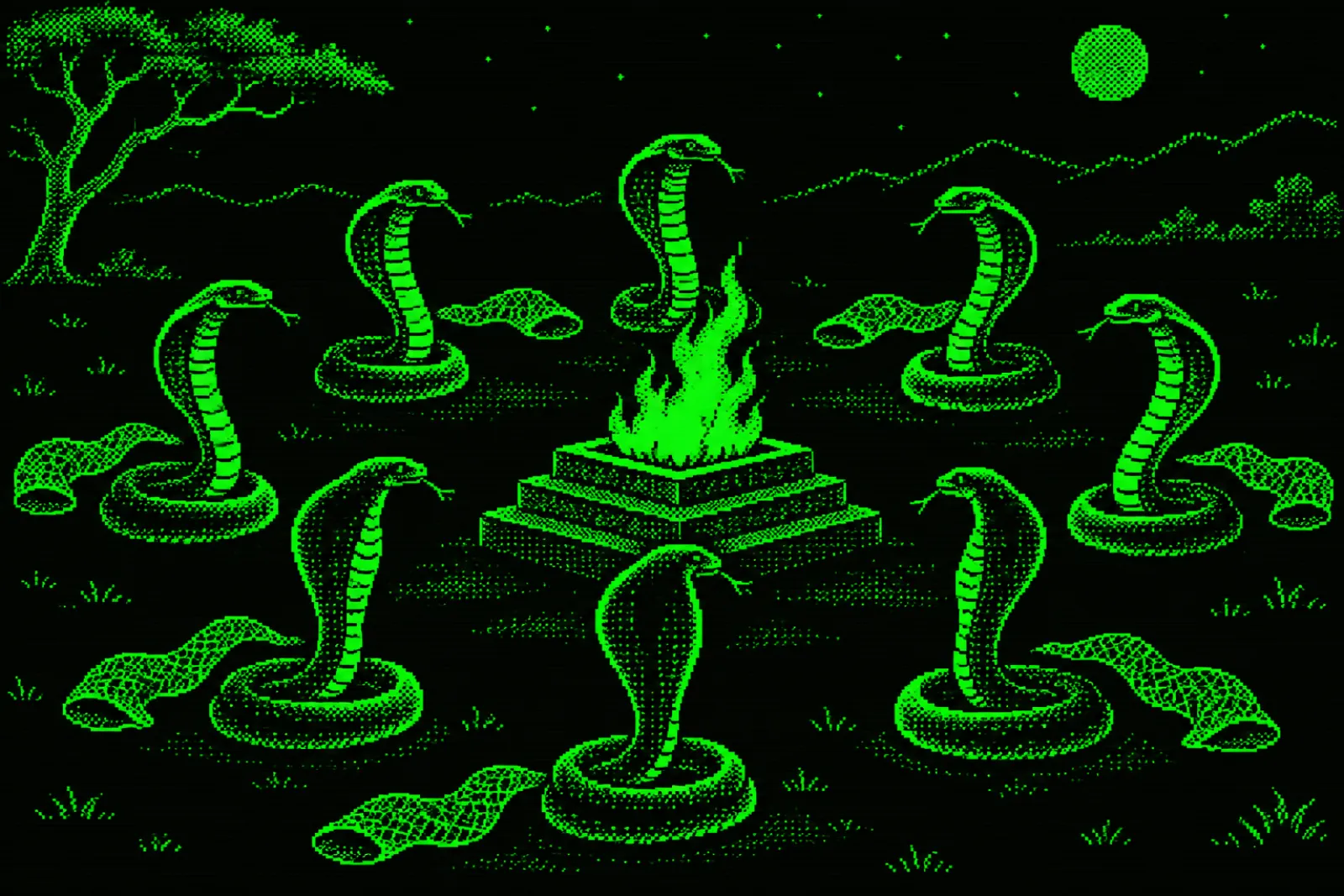
The Pañcaviṃśa Brāhmaṇa, “the Brāhmaṇa of twenty-five chapters”, is the prose handbook of the Sāmaveda singers. Its last chapter lists the great sacrificial sessions (sattras), each with the mythic beings who first held it and what they won. In 25.15 the founders are the serpents. They sit a session a year long, with every Soma priest’s office filled by a named serpent. Dhṛtarāṣṭra Airāvata is the Brahman, Takṣaka is a reciter, Arbuda praises the pressing-stones, and a Janamejaya is one of the two Adhvaryus. By this rite the serpents conquered death, and that, the text says, is why snakes shed their skins.
The Baudhāyana Śrautasūtra (17.18), a Yajurveda ritual manual, gives the same roster and adds the setting: the kings and princes of the serpents held the session at Khāṇḍavaprastha, in the form of men, wanting poison. The Āpastamba Śrautasūtra (23.14.8) sums it up in one line: by the serpents' session men strike away old age. Two shorter passages show the shedding as a rite. In the Taittirīya Saṃhitā (1.5.4.1) a serpent seer finds the formula by which the serpents strike off their worn-out bodies. In the Pañcaviṃśa Brāhmaṇa (4.9.5) the Serpent Queen’s verses are those by which “the serpent Arbuda struck off his dead skin”. The singers chant them so that they strike off theirs too. In the Mahābhārata the same names return in reverse, at King Janamejaya’s sarpasattra, where the serpents are the victims burnt in the fire, not the sacrificers. Caland took the Vedic rite for its prototype.
The Śatapatha Brāhmaṇa has no serpents’ session, but the shed skin runs through it as the sign of release. The sacrificer frees himself from evil “as a snake frees itself from its skin” in the daily fire offering (2.3.1.6), after the final bath (4.4.5.23), and, in the one who sacrifices to the self, from his mortal body (11.2.6.13). At death the body lies “like a snake’s slough, dead and cast off on an anthill” (14.7.2.10, the Bṛhadāraṇyaka Upaniṣad). The Serpent Queen is the earth (2.1.4.30, 4.6.9.17), and at the horse sacrifice “King Arbuda Kādraveya” is announced as ruler of the serpents, with the serpent-lore as his Veda (13.4.3.9). Only the passage on the close of a session (4.6.9.12–13), where the men who sat it crawl out like snakes, is translated here.
Every line is translated from the Sanskrit. Names of the serpent priests are left in Sanskrit; the notes give what the dictionaries say of them. The notes quote Caland’s English where it differs.
Each numbered line gives the Vedic Sanskrit first: the original script, then the same words in Latin letters. Our English is underneath. Tap a dotted word for its meaning, and Note for our comment on the line; our comments are in the right margin.
Pañcaviṃśa Brāhmaṇa 25.15: the serpents’ session
- 1PB 25.15.1
अतिरात्राव् अभितो ऽग्निष्टोमा मध्ये सर्वो दशदशी संवत्सरो द्वादशो विषुवान् सर्पसामानि विषुवति क्रियन्ते
atirātra an over-night rite: a Soma rite that runs through the night, used to open and close a year-long session · Monier-Williams abhito agniṣṭoma the basic one-day Soma rite (literally 'praise of Agni') · Monier-Williams madhye sarvo daśadaśin consisting of repeated tens (MW) · Monier-Williams saṃvatsara a year · Monier-Williams dvādaśo viṣuvat the central day of a year-long session (MW); later also the equinox · Monier-Williams sarpasāman the serpents' chants: Sāman melodies named for the serpents (MW) · Monier-Williams viṣuvat the central day of a year-long session (MW); later also the equinox · Monier-Williams kriyante
An atirātra: a Soma rite that runs through the night at either end, agniṣṭoma: the basic one-day Soma rite in the middle. The whole saṃvatsara: year is daśadaśin: made of repeated tens; the viṣuvat: the middle day of a year-long session is twelvefold. On the central day the sarpasāman: Sāman melodies named for the serpents are sung.
Note on line 1
The rite is a sattra, a session a year long, and the year is daśadaśin, “of tens and tens”. Caland (1931, p. 641 n.) says the reason is plain: daśa, “ten”, is a pun on daś-, “bite”. Baudhāyana says so outright (line 9). The Calcutta print has saṃvatsarī; Caland calls it a misprint for saṃvatsaro, which TITUS prints. Caland identifies the serpents’ chants as the ten sarpasāmans of the Āraṇyegeyagāna, of which the first three are meant. - 2PB 25.15.2
एतेन वै सर्पा एषु लोकेषु प्रत्यतिष्ठन्न् एषु लोकेषु प्रतितिष्ठन्ति य एतद् उपयन्ति
etena vai sarpa snake, serpent; literally 'creeper', from √sṛp, to creep (MW) · Monier-Williams eṣu loka world; the worlds are earth, the middle air and sky · Monier-Williams pratiṣṭhā to stand firm, to be established, to find a footing (MW) · Monier-Williams eṣu loka world; the worlds are earth, the middle air and sky · Monier-Williams pratiṣṭhā to stand firm, to be established, to find a footing (MW) · Monier-Williams ya etad upe upa-√i: to approach; to undertake, perform (a sacrifice) (MW) · Monier-Williams
By this the sarpa: snakes; literally 'creepers' pratiṣṭhā: to stand firm, be established in these loka: world. Those who upe: to undertake, perform a sacrifice this find a firm footing in these worlds.
Note on line 2
The Brāhmaṇa’s standard form: a mythic sacrificer did the rite and won a result; whoever repeats the rite wins the same. Sāyaṇa (BI p. 823) calls the line spaṣṭam, “plain”. - 3aPB 25.15.3
जर्वरो गृहपतिर् धृतराष्ट्र ऐरावतो ब्रह्मा पृथुश्रवा दौरेश्रवस उद्गाता ग्लावश् चाजगावश् च प्रस्तोतृप्रतिहर्तारौ दत्तस् तापसो होता
jarvara a Nāga priest (MW); also in Baudhāyana ŚS 17.18 · Monier-Williams gṛhapati master of the house; at a session, the chief sacrificer · Monier-Williams dhṛtarāṣṭra 'whose kingdom is firm'; a Nāga, also called Airāvata (MW) · Monier-Williams airāvata son of Irāvat; a Nāga (MW, from AV 8.10.29 on); later the name of Indra's elephant · Monier-Williams brahman the Brahman priest, who watches over the whole rite · Monier-Williams pṛthuśravā daureśravasa udgātṛ the chief singer of the Sāman chants · Monier-Williams glāvaś cājagāvaś ca prastotṛpratihartārau dattas tāpaso hotṛ the priest who recites the Ṛgveda verses · Monier-Williams
jarvara: a Nāga priest was the gṛhapati: master of the house; at a session, the chief sacrificer; dhṛtarāṣṭra: 'whose kingdom is firm'; a Nāga airāvata: son of Irāvat; a Nāga the brahman: the priest who watches over the rite; Pṛthuśravas Daureśravasa the udgātṛ: chief singer of the Sāman chants; Glāva and Ajagāva the Prastotṛ and the Pratihartṛ; Datta Tāpasa the hotṛ: the priest who recites the Ṛgveda verses;
Note on line 3a
The officiants are serpents, and every office of a Soma rite is filled. Dhṛtarāṣṭra Airāvata, the Brahman, is already a serpent in the Atharvaveda (AV 8.10.29, with Takṣaka). In the Mahābhārata Airāvata is both a serpent and Indra’s elephant (MW): nāga means both. The householder’s name, Jarvara, is unexplained in the dictionaries. We hear in it the root jṝ, “grow old”, which gives jīrṇa, “worn out”, in line 4b, but no scholar we have read says so. TITUS misprints pṛthuśvarā; the Calcutta print reads pṛthuśravā. - 3bPB 25.15.3
शितिपृष्ठो मैत्रावरुणस् तक्षको वैशालेयो ब्राह्मणाच्छंसी शिखानुशिखौ नेष्टापोताराव् अरुण आटो ऽच्छावाकस् तिमिर्घो दौरेश्रुतो ऽग्नीत्
śitipṛṣṭho maitrāvaruṇas takṣaka 'cutter'; a Nāga prince (MW: AV 8.10.29, PB 25.15, MBh.) · Monier-Williams vaiśāleyo brāhmaṇācchaṃsī śikhānuśikhau neṣṭāpotārāv aruṇa āṭo 'cchāvākas timirgho daureśruto 'gnīt
Śitipṛṣṭha the Maitrāvaruṇa; takṣaka: 'cutter'; a Nāga prince Vaiśāleya the Brāhmaṇācchaṃsin; Śikha and Anuśikha the Neṣṭṛ and the Potr; Aruṇa Āṭa the Acchāvāka; Timirgha Daureśruta the Agnīdh;
Note on line 3b
Takṣaka is the serpent who, in the Mahābhārata, bites King Parikṣit to death; his son Janamejaya then holds a snake sacrifice of his own, in which serpents are thrown into the fire. Here Takṣaka and a Janamejaya (line 3c) are priests side by side at the serpents’ own session. Caland (1931, p. 641 n.) calls this rite “the prototype of the sarpasattra … of Janamejaya in the Mahabharata”. - 3cPB 25.15.3
कौतस्ताव् अध्वर्यू अरिमेजयश् च जनमेजयश् चार्बुदो ग्रावस्तुद् अजिरः सुब्रह्मण्यश् चक्रपिशङ्गाव् उन्नेतारौ षण्डकुषण्डाव् अभिगरापगरौ
kautastāv adhvaryu the priest who does the handwork of the rite · Monier-Williams arimejayaś ca janamejaya 'making men tremble'; a king of the Mahābhārata, and in PB 25.15 a Nāga (MW) · Monier-Williams arbuda a serpent being, son of Kadrū (Kādraveya); said to be the author of RV 10.94, the hymn to the pressing-stones (MW) · Monier-Williams grāvastut praiser of the pressing-stones: the priest who recites to the stones that crush the Soma · Monier-Williams ajiraḥ subrahmaṇyaś cakrapiśaṅgāv unnetārau ṣaṇḍakuṣaṇḍāv abhigara with apagara: the praiser and the reviler (Caland) · Monier-Williams
the two Kautastas, Arimejaya and janamejaya: 'making men tremble'; here a Nāga, the adhvaryu: the priests who do the handwork of the rite; arbuda: a serpent, son of Kadrū; said to be the author of RV 10.94, the hymn to the pressing-stones the grāvastut: the priest who recites to the stones that crush the Soma; Ajira the Subrahmaṇya; Cakra and Piśaṅga the Unnetṛs; Ṣaṇḍa and Kuṣaṇḍa the abhigara: with apagara, the praiser and the reviler.
Note on line 3c
Arbuda Kādraveya, “son of Kadrū”, is named by the Anukramaṇī as the seer of RV 10.94, the hymn to the Soma-pressing stones (MW, s.v. arbuda), so he holds the office of praising the stones. Sāyaṇa reads kautastau as “the two sons of Kutasta”, Adhvaryu and Pratiprasthātṛ (BI p. 823). TITUS prints cakkapiśaṅgāv; Sāyaṇa, Caland and Baudhāyana have Cakra and Piśaṅga. The Praiser and Reviler (abhigara, apagara) belong to the Mahāvrata day, which this session lacks; Caland (p. 641 n.) suggests the list is simply given complete. - 4aPB 25.15.4
एतेन वै सर्पा अपमृत्युम् अजयन्न् अपमृत्युं जयन्ति य एतद् उपयन्ति
etena vai sarpa snake, serpent; literally 'creeper', from √sṛp, to creep (MW) · Monier-Williams apamṛtyu death driven away; the text itself splits it into apa … mṛtyum (Böhtlingk–Roth); later 'sudden death' (MW) · Monier-Williams ji to conquer, to win (MW) · Monier-Williams apamṛtyu death driven away; the text itself splits it into apa … mṛtyum (Böhtlingk–Roth); later 'sudden death' (MW) · Monier-Williams ji to conquer, to win (MW) · Monier-Williams ya etad upe upa-√i: to approach; to undertake, perform (a sacrifice) (MW) · Monier-Williams
By this the serpents ji: to conquer, to win apamṛtyu: death driven away; the text splits it into apa … mṛtyum. Those who undertake this conquer death and drive it away.
Note on line 4a
Apamṛtyu later means “sudden or accidental death” (MW p. 50), which would make the serpents win an untimely death. The text rules that out in the next clause, apa hi te mṛtyum ajayan, “for they drove death away by conquest”, splitting the preverb apa, “away”, from mṛtyum, “death”. Böhtlingk and Roth (PWG I, col. 285) say this passage must be read sarpā apa mṛtyum ajayan. Caland: “the serpents vanquished death.” - 4bPB 25.15.4
तस्मात् ते हित्वा जीर्णां त्वचम् अतिसर्पन्त्य् अप हि ते मृत्युम् अजयन्
tasmāt te hā to leave, abandon; hitvā, having left behind jīrṇa old, worn out, withered, decayed (MW); past participle of √jṝ, to grow old · Monier-Williams tvac skin (of men, serpents &c.), hide (MW) · Monier-Williams atisṛp to creep over, to creep beyond (MW); it echoes sarpa, 'creeper' · Monier-Williams apa hi te mṛtyu death; Death in person (MW) · Monier-Williams ji to conquer, to win (MW) · Monier-Williams
That is why they hā: to leave, abandon their jīrṇa: old, worn out, decayed; from √jṝ, to grow old tvac: skin, of men and serpents and atisṛp: to creep over, creep beyond: for they conquered mṛtyu: death and drove it away.
Note on line 4b
The shedding is the consequence (tasmāt, “therefore”) of a victory won once, at the rite. Every snake that sheds its skin is showing that its kind beat death. Jīrṇa is “aged”, from √jṝ, the root of jarā, “old age”; Monier-Williams glosses the Atharvaveda’s word for a snake’s slough, jarāyu, with Greek gēras, “old age”. Ati-sarpanti, “they creep beyond”, repeats sarpa. The Ṛgveda has a close parallel, of Soma: ahir na jūrṇām ati sarpati tvacam, “like a snake he creeps out of his worn-out skin” (RV 9.86.44). Caland: “having left aside their old hide, creep further”. - 4cPB 25.15.4
सर्पा वा आदित्या आदित्यानाम् इवैषां प्रकाशो भवति य एतद् उपयन्ति
sarpa snake, serpent; literally 'creeper', from √sṛp, to creep (MW) · Monier-Williams vā āditya sons of Aditi: the gods of the heavenly sphere; in the singular, the sun (MW) · Monier-Williams āditya sons of Aditi: the gods of the heavenly sphere; in the singular, the sun (MW) · Monier-Williams ivaiṣāṃ prakāśa brightness, shining; being openly seen (MW) · Monier-Williams bhavati ya etad upe upa-√i: to approach; to undertake, perform (a sacrifice) (MW) · Monier-Williams
The serpents are the āditya: sons of Aditi, the gods of the sky; in the singular, the sun. Those who undertake this prakāśa: brightness, shining like the Ādityas.
Note on line 4c
Literally “theirs becomes a brightness like the Ādityas’”. Caland turns the first clause around (“The Adityas are the serpents”); the Sanskrit puts the serpents first and names them as the sky gods. The Calcutta print reads sarpyā for sarpā; Sāyaṇa calls the sense plain (spaṣṭo ‘rthaḥ) and adds only ritual detail. The brightness is the newly sloughed snake’s: it comes out of the old skin glossy and bright, and the text gives the sacrificers the same sheen. Baudhāyana Śrautasūtra 17.18: the kings of the serpents at Khāṇḍavaprastha
- 5BŚS 17.18
जर्वरो गृहपतिर् धृतराष्ट्र ऐरावतो ब्रह्मा दत्तस् तापसो होता पृथुश्रवा दूरेश्रवा उद्गाता ग्लावश् चाजगावश् च प्रस्तोतृप्रतिहर्तारौ
jarvara a Nāga priest (MW); also in Baudhāyana ŚS 17.18 · Monier-Williams gṛhapati master of the house; at a session, the chief sacrificer · Monier-Williams dhṛtarāṣṭra 'whose kingdom is firm'; a Nāga, also called Airāvata (MW) · Monier-Williams airāvata son of Irāvat; a Nāga (MW, from AV 8.10.29 on); later the name of Indra's elephant · Monier-Williams brahman the Brahman priest, who watches over the whole rite · Monier-Williams dattas tāpaso hotṛ the priest who recites the Ṛgveda verses · Monier-Williams pṛthuśravā dūreśravā udgātṛ the chief singer of the Sāman chants · Monier-Williams glāvaś cājagāvaś ca prastotṛpratihartārau
Jarvara the householder, Dhṛtarāṣṭra Airāvata the Brahman, Datta Tāpasa the Hotṛ, Pṛthuśravas Dūreśravas the Udgātṛ, Glāva and Ajagāva the Prastotṛ and the Pratihartṛ;
Note on line 5
Baudhāyana, a ritual manual of the Black Yajurveda, gives the same roster as PB 25.15.3, in a slightly different order. Caland’s edition notes that the name Dūreśravas is found in one manuscript only (M). - 6BŚS 17.18
शितिपृष्ठो मैत्रावरुणस् तक्षको वैशालेयो ब्राह्मणाच्छंस्य् उपरीतिस् तार्क्ष्यः सदस्यः शिखातिशिखौ नेष्टापोताराव् अरुणो ऽह्यो ऽच्छावाकश् चक्रपिशङ्गाव् आग्नीध्राव् अजिरो माहेयः सुब्रह्मण्यो ऽर्बुदो ग्रावस्तुत् साण्ड उन्नेता पशुक्रो ध्रुवगोपः कौतुस्ताव् अध्वर्यू अरिमेजयश् च जनमेजयश् च
śitipṛṣṭho maitrāvaruṇas takṣaka 'cutter'; a Nāga prince (MW: AV 8.10.29, PB 25.15, MBh.) · Monier-Williams vaiśāleyo brāhmaṇācchaṃsy uparītis tārkṣyaḥ sadasyaḥ śikhātiśikhau neṣṭāpotārāv aruṇo 'hyo 'cchāvākaś cakrapiśaṅgāv āgnīdhrāv ajiro māheyaḥ subrahmaṇyo arbuda a serpent being, son of Kadrū (Kādraveya); said to be the author of RV 10.94, the hymn to the pressing-stones (MW) · Monier-Williams grāvastut praiser of the pressing-stones: the priest who recites to the stones that crush the Soma · Monier-Williams sāṇḍa unnetā paśukro dhruvagopaḥ kautustāv adhvaryu the priest who does the handwork of the rite · Monier-Williams arimejayaś ca janamejaya 'making men tremble'; a king of the Mahābhārata, and in PB 25.15 a Nāga (MW) · Monier-Williams ca
Śitipṛṣṭha the Maitrāvaruṇa, Takṣaka Vaiśāleya the Brāhmaṇācchaṃsin, Uparīti Tārkṣya the Sadasya, Śikha and Atiśikha the Neṣṭṛ and the Potr, Aruṇa Āhya the Acchāvāka, Cakra and Piśaṅga the two Agnīdhs, Ajira Māheya the Subrahmaṇya, Arbuda the Praiser of the Stones, Sāṇḍa the Unnetṛ, Paśukra the Keeper of the Ladle, the two Kautustas, Arimejaya and Janamejaya, the Adhvaryus.
Note on line 6
New beside PB: a Sadasya, Uparīti Tārkṣya, whose second name is the old name of the mythical horse or bird later identified with Garuḍa (MW, s.v. tārkṣya), the serpents’ enemy; and a Keeper of the Ladle (dhruvagopa), Paśukra. Caland marks aruṇo ‘hyo “uncertain” and compares PB’s Aruṇa Āṭa. The manuscripts vary on Uparīti, Paśukra and Kautusta; the text here is Caland’s (M), though his PB note (1931, p. 641) gives the ladle-keeper as Paśuka (Paśuga). - 7BŚS 17.18
एते वै सर्पाणां राजानश् च राजपुत्राश् च खाण्डवे प्रस्थे सत्त्रम् आसत पुरुषरूपेण विषकामाः
ete vai sarpa snake, serpent; literally 'creeper', from √sṛp, to creep (MW) · Monier-Williams rājan king · Monier-Williams ca rājaputra king's son, prince · Monier-Williams ca khāṇḍava the Khāṇḍava forest in Kurukṣetra, burnt by Agni in the Mahābhārata (MW) · Monier-Williams prastha a level height, a tableland; khāṇḍave prasthe, at Khāṇḍavaprastha · Monier-Williams sattra 'session': a long Soma rite held by many sacrificers together, all of them both priests and sacrificers (MW) · Monier-Williams ās to sit; sattram ās-, to sit a session · Monier-Williams puruṣarūpa the form of a man, human shape viṣakāma wanting poison: viṣa, poison, venom (MW) + kāma, desire
These, the rājan: king and rājaputra: king's son of the sarpa: snakes, ās: to sit; sattram ās-, to sit a session a sattra: a long Soma rite held by many sacrificers together at khāṇḍava: the forest in Kurukṣetra burnt by Agni in the Mahābhārata prastha: a level height, puruṣarūpa: human shape, viṣakāma: desiring viṣa, poison, venom.
Note on line 7
Baudhāyana adds the place, the disguise and the motive. In the Mahābhārata the Pāṇḍavas build Indraprastha at Khāṇḍavaprastha, and later Agni burns the Khāṇḍava forest with the serpents who lived in it; it was Takṣaka’s home. In this older story the serpents come there as men to sacrifice. Viṣa is “poison, venom” (MW): Caland renders “desirous of obtaining poison” (1931, pp. 641–642 n.). The session that in PB drives death away is here held for venom. - 8BŚS 17.18
तेषां दशस्तोमान्य् अन्यान्य् अहान्य् आसन् द्वादशस्तोमान्य् अन्यान्य् आचीयन्ति च
teṣāṃ daśastomāny anyāny ahāny āsan dvādaśastomāny anyāny ā-ci to heap up, accumulate (MW) · Monier-Williams ca
Of their days, some were of tenfold lauds, and others, of twelvefold lauds, ā-ci: to heap up, accumulate as well.
Note on line 8
Caland’s print reads ācīyanti; TITUS has ākṣīyanti. Caland notes that manuscript M leaves out the words from ahāny āsan to the second anyāny. The sense is the plan of PB 25.15.1: ten-versed lauds all year, twelve-versed on the central day. - 9BŚS 17.18
स यद् दशदशेति तस्मात् सर्पा दंशुका दंशवीर्यास् तद् एतल् लौक्यं पौत्रीयं पशव्यं सत्त्रं य एतद् उपयन्ति नैतान् सर्पा हिंसन्ति
sa yad daśadaśeti tasmāt sarpa snake, serpent; literally 'creeper', from √sṛp, to creep (MW) · Monier-Williams daṃśuka biting (MW) · Monier-Williams daṃśavīrya whose strength is in biting tad etal laukya belonging to the world (Böhtlingk–Roth); here, winning a world · Monier-Williams pautrīya bringing grandsons, offspring (from pautra, grandson) paśavya good for cattle (MW) · Monier-Williams sattra 'session': a long Soma rite held by many sacrificers together, all of them both priests and sacrificers (MW) · Monier-Williams ya etad upe upa-√i: to approach; to undertake, perform (a sacrifice) (MW) · Monier-Williams naitān sarpa snake, serpent; literally 'creeper', from √sṛp, to creep (MW) · Monier-Williams hiṃs to injure, harm, kill (MW) · Monier-Williams
Because it goes "ten and ten", snakes are daṃśuka: biting, daṃśavīrya: whose strength is in biting. This is a session that laukya: belonging to the world; here, winning a world, pautrīya: bringing grandsons, offspring and paśavya: good for cattle. Those who undertake it, the snakes do not hiṃs: to injure, harm, kill.
Note on line 9
The pun is daśa, “ten”, on daṃś-, “bite”: a year of tens made the serpents biters. Caland renders its first clause in his note on PB 25.15.3 (1931, pp. 641–642 n.). For daṃśavīryāḥ the manuscripts vary (Caland’s notes); the Be 7 manuscript leaves the whole passage out. Laukya is rare: Böhtlingk–Roth give “belonging to the world”; beside pautrīya and paśavya it is the third thing the session brings: a world won. Āpastamba Śrautasūtra 23.14.8–9: the serpents’ session strikes away old age
- 10ĀpŚS 23.14.8
सर्पाणां सत्त्रेणाप जरां घ्नते आदित्यानाम् इवैषां प्रकाशः
sarpa snake, serpent; literally 'creeper', from √sṛp, to creep (MW) · Monier-Williams sattra 'session': a long Soma rite held by many sacrificers together, all of them both priests and sacrificers (MW) · Monier-Williams jarā old age; personified as a daughter of Death (MW) · Monier-Williams apahan to beat off, strike away, destroy (MW) · Monier-Williams āditya sons of Aditi: the gods of the heavenly sphere; in the singular, the sun (MW) · Monier-Williams ivaiṣāṃ prakāśa brightness, shining; being openly seen (MW) · Monier-Williams
By the sarpa: snakes sattra: a long Soma rite held by many together they apahan: to beat off, strike away jarā: old age; personified as a daughter of Death away from themselves. Theirs is a prakāśa: brightness, shining like the āditya: the sky gods, sons of Aditi.
Note on line 10
Āpastamba sums up PB 25.15.4 and names the prize as jarā, “old age”, the abstract noun of the root behind jīrṇa, the “worn-out” skin. The verb is the one PB 25.17.3 uses for Prajāpati, who “struck away old age” (jarām apāhata) by a thousand-year session. TITUS prints āgityānām, a slip for ādityānām. - 11ĀpŚS 23.14.9
सर्वो दशदशी संवत्सरो द्वादशो विषुवान्
sarvo daśadaśin consisting of repeated tens (MW) · Monier-Williams saṃvatsara a year · Monier-Williams dvādaśo viṣuvat the central day of a year-long session (MW); later also the equinox · Monier-Williams
The whole saṃvatsara: year is daśadaśin: made of repeated tens; the viṣuvat: the middle day of the session is twelvefold.
Taittirīya Saṃhitā 1.5.4.1: the serpents strike off their worn-out bodies
- 12TS 1.5.4.1
सर्पा वै जीर्यन्तो ऽमन्यन्त स एतं कसर्णीरः काद्रवेयो मन्त्रम् अपश्यत् ततो वै ते जीर्णास् तनूर् अपाघ्नत
sarpa snake, serpent; literally 'creeper', from √sṛp, to creep (MW) · Monier-Williams vai jṝ to grow old, to wear out · Monier-Williams 'manyanta sa etaṃ kasarṇīra a kind of snake (AV 10.4.5); here a person (MW) · Monier-Williams kādraveya son of Kadrū, the mother of serpents: a name of Nāgas (MW) · Monier-Williams mantra a sacred formula; the seers 'see' them · Monier-Williams apaśyat tato vai te jīrṇa old, worn out, withered, decayed (MW); past participle of √jṝ, to grow old · Monier-Williams tanū the body, person, self (MW) · Monier-Williams apahan to beat off, strike away, destroy (MW) · Monier-Williams
The sarpa: snakes thought they were jṝ: to grow old, wear out. kasarṇīra: a kind of snake; here a person kādraveya: son of Kadrū, the mother of serpents saw this mantra: a sacred formula. Then they apahan: to beat off, strike away their jīrṇa: old, worn out tanū: the body, person, self.
Note on line 12
Keith (HOS 18, p. 72) translates “worn-out skins”, but tanū is “body, person, self” (MW): the serpents strike off whole aged selves. TS gives the act no sattra: one serpent seer “sees” the formula, and the race renews itself by it. The Vedic accents of the TITUS text are left off here. - 13TS 1.5.4.1
सर्पराज्ञिया ऋग्भिर् गार्हपत्यम् आ दधाति पुनर्नवम् एवैनम् अजरं कृत्वा धत्ते
sarparājñī the Serpent Queen; her verses are RV 10.189 (MW); the Brāhmaṇas say she is the earth · Monier-Williams ṛgbhir gārhapatya the householder's fire, the western of the three sacred fires · Monier-Williams ā dadhāti punarnava becoming new or young again, renewed (MW) · Monier-Williams evainam ajara not subject to old age, undecaying, ever young (MW) · Monier-Williams kṛtvā dhatte
With the verses of the sarparājñī: her verses are RV 10.189; the Brāhmaṇas call her the earth he sets up the gārhapatya: the western of the three sacred fires: he makes it punarnava: becoming new or young again and ajara: not subject to old age, ever young and so sets it up.
Note on line 13
This is the re-establishment of the sacred fires. The man who sets them up again borrows the serpents’ formula to make his fire young. Keith renders ajara “immortal”; it means “unaging”. The chanters sing the Serpent Queen’s verses in PB 4.9 too, and ŚB 4.6.9.17; ŚB 2.1.4.29 quotes RV 10.189.1 as one of them. Pañcaviṃśa Brāhmaṇa 4.9.4–6: Arbuda strikes off his dead skin
- 14PB 4.9.4
प्रत्यञ्चः प्रपद्य सार्पराज्ञ्या ऋग्भिः स्तुवन्ति
pratyañcaḥ prapadya sarparājñī the Serpent Queen; her verses are RV 10.189 (MW); the Brāhmaṇas say she is the earth · Monier-Williams ṛgbhiḥ stuvanti
Going in facing west, they chant the laud on the sarparājñī: the Serpent Queen; her verses are RV 10.189 verses.
Note on line 14
The tenth day of the ten-day rite (Caland). The laud is sung in the mind only, without sound (PB 4.9.8–9). The verses are RV 10.189.1–3 (Caland 1931, p. 65 n., misprinted IX.189). - 15PB 4.9.5
अर्बुदः सर्प एताभिर् मृतां त्वचम् अपाहत मृताम् एवैताभिस् त्वचम् अपघ्नते
arbuda a serpent being, son of Kadrū (Kādraveya); said to be the author of RV 10.94, the hymn to the pressing-stones (MW) · Monier-Williams sarpa snake, serpent; literally 'creeper', from √sṛp, to creep (MW) · Monier-Williams etābhir mṛta dead (MW) · Monier-Williams tvac skin (of men, serpents &c.), hide (MW) · Monier-Williams apahan to beat off, strike away, destroy (MW) · Monier-Williams mṛta dead (MW) · Monier-Williams evaitābhis tvac skin (of men, serpents &c.), hide (MW) · Monier-Williams apahan to beat off, strike away, destroy (MW) · Monier-Williams
With these the serpent arbuda: a serpent, son of Kadrū apahan: to beat off, strike away his mṛta: dead tvac: skin. With these they strike off their own dead skin.
Note on line 15
This Arbuda is the Praiser of the Stones at the serpents’ session (25.15.3): he sheds by these verses, and the chanters shed with him. TITUS misprints etābhirs. The same words are said in PB 9.8.7–9 when a consecrated man dies during a session: his bones are burnt and tied up, and the chanters walk three times around the mārjālīya hearth singing the Serpent Queen’s verses and slapping their left thighs (Caland, p. 221). - 16PB 4.9.6
इयं वै सार्पराज्ञ्य् अस्याम् एव प्रतितिष्ठन्ति
iyaṃ vai sarparājñī the Serpent Queen; her verses are RV 10.189 (MW); the Brāhmaṇas say she is the earth · Monier-Williams asyām eva pratiṣṭhā to stand firm, to be established, to find a footing (MW) · Monier-Williams
The sarparājñī: the Serpent Queen is this earth: on her they pratiṣṭhā: to stand firm, find a footing.
Śatapatha Brāhmaṇa 4.6.9.12–13: the men of the session creep out like snakes
- 17ŚB 4.6.9.12
यद् उत्तरस्य हविर्धानस्य जघन्यायां कूबर्याम् अगन्म ज्योतिर् अमृता अभूमेति ज्योतिर् वा एते भवन्त्य् अमृता भवन्ति ये सत्त्रम् आसते
yad uttarasya havirdhāna the two carts that hold the Soma, standing in their shed · Monier-Williams jaghanyāyāṃ kūbaryām aganma jyotis light (MW) · Monier-Williams amṛta immortal, not dead (MW) · Monier-Williams abhūmeti jyotis light (MW) · Monier-Williams vā ete bhavanty amṛta immortal, not dead (MW) · Monier-Williams bhavanti ye sattra 'session': a long Soma rite held by many sacrificers together, all of them both priests and sacrificers (MW) · Monier-Williams ās to sit; sattram ās-, to sit a session · Monier-Williams
At the rear pole of the northern havirdhāna: the cart that holds the Soma they sing, "We have come to the jyotis: light, we have become amṛta: immortal, not dead": for those who ās: to sit; sattram ās-, to sit a session a sattra: a long Soma rite held by many together become light, they become immortal.
Note on line 17
The close of a session, the “rising from the session” (sattrotthāna); the singing at the cart pole is set out in 4.6.9.11. Eggeling identifies the chant as VS 8.52. Eggeling: “for they who sit through a sacrificial session become indeed the light, they become immortal” (SBE 26, pp. 449–450). - 18ŚB 4.6.9.12
दिवं पृथिव्या अध्यारुहामेति दिवं वा एते पृथिव्या अध्यारोहन्ति ये सत्त्रम् आसते ऽविदाम देवान् इति विन्दन्ति हि देवान् स्वर् ज्योतिर् इति त्रिर् निधनम् उपावयन्ति स्वर् ह्य् एते ज्योतिर् ह्य् एते भवन्ति
divaṃ pṛthivyā adhyāruhāmeti divaṃ vā ete pṛthivyā adhyārohanti ye sattra 'session': a long Soma rite held by many sacrificers together, all of them both priests and sacrificers (MW) · Monier-Williams ās to sit; sattram ās-, to sit a session · Monier-Williams 'vidāma devān iti vindanti hi devān svar jyotis light (MW) · Monier-Williams iti trir nidhanam upāvayanti svar hy ete jyotis light (MW) · Monier-Williams hy ete bhavanti
"From the earth we have climbed to the sky": those who sit a session climb from the earth to the sky. "We have found the gods": for they find the gods. "Heaven, light!" they sing three times as the finale: for they become heaven, they become light.
Note on line 18
The Weber text on GRETIL ends the paragraph with “whatever the form of this Sāman, that they become who sit a session”, left out here. - 19ŚB 4.6.9.13
ते दक्षिणस्य हविर्धानस्य अधो ऽधो ऽक्षं सर्पन्ति स यथाहिस् त्वचो निर्मुच्येतैवं सर्वस्मात् पाप्मनो निर्मुच्यन्ते ऽतिच्छन्दसा सर्पन्ति
te dakṣiṇasya havirdhāna the two carts that hold the Soma, standing in their shed · Monier-Williams adho 'dho akṣa axle · Monier-Williams sṛp to creep, crawl (MW) · Monier-Williams sa yathāhis tvac skin (of men, serpents &c.), hide (MW) · Monier-Williams nirmuc to free oneself from; of a snake, to cast its skin (MW) · Monier-Williams sarvasmāt pāpman evil, misfortune, sin (MW) · Monier-Williams nirmuc to free oneself from; of a snake, to cast its skin (MW) · Monier-Williams aticchandas the 'over-metres': the longest metres (MW) · Monier-Williams sṛp to creep, crawl (MW) · Monier-Williams
They sṛp: to creep, crawl along right under the akṣa: axle of the southern havirdhāna: the cart that holds the Soma: as a snake nirmuc: to free oneself; of a snake, to cast its skin from its tvac: skin, so they free themselves from all pāpman: evil, misfortune, sin. They creep with a verse in an aticchandas: the longest metres.
Note on line 19
The men who have just sat a session crawl, as snakes, under the axle of the Soma cart, and come out the other side shed. The verb sarpanti is the root of sarpa. Eggeling: “They creeps [sic] along right under the axle of the southern cart: even as a snake frees itself from its skin, so do they free themselves from all evil” (SBE 26, p. 450). The rest of the paragraph explains the metre: the over-metre is all metres, so evil cannot overtake them.