~/sacred-texts/wang-jia-shiyi-ji-record-of-gleanings
Shiyi ji, Books 1–2: Yu Meets the Snake-Bodied Fuxi
Translated by AI straight from the Classical Chinese, not from a modern translation, then checked against the editions and studies listed below. How we translate
- Text
- Wang Jia, Shiyi ji (Record of Gleanings), Juan 1 (Fuxi to Shun) and juan 2 (Xia, Shang and early Zhou), with Xiao Qi's comments
- Date
- Wang Jia (d. 390 CE), Former Qin; re-edited with comments by Xiao Qi, 6th century
- Found
- Northwest China (Wang Jia was from Longxi, in present-day Gansu)
- Language
- Classical Chinese · Chinese characters (traditional), modern punctuation
Wang Jia 王嘉 (d. 390 CE) was a Daoist recluse of the Former Qin, a seer whom kings consulted and one of them killed. His Shiyi ji 拾遺記, “Record of Gleanings”, collects what the official histories left out, from the first sovereigns down to his own century. The book was damaged in the wars of the fourth century, and in the sixth Xiao Qi 蕭綺 put the surviving pieces in order and added his own comments, marked “Xiao Qi comments” here (錄曰). Wang Jia tells; Xiao Qi weighs his stories against the classics, defends them, and now and then argues with them.
These are the first two of its ten books. Book 1 runs from Fuxi, conceived when a rainbow coiled round his mother, through Shennong, the Yellow Emperor, Shaohao, Zhuanxu, Emperor Ku, Yao and Shun. Book 2 runs from Yu of Xia through the Shang to King Zhao of Zhou, who drowned in the Han River with his two fan-bearers. Between them are agate made of demons’ blood, a raft that sails round the sky every twelve years, a nation of feathered people who cast no shadow, and a flood-dragon coiled across heaven in Yao’s time, in a tale that envoys tell Shun and the text then calls false.
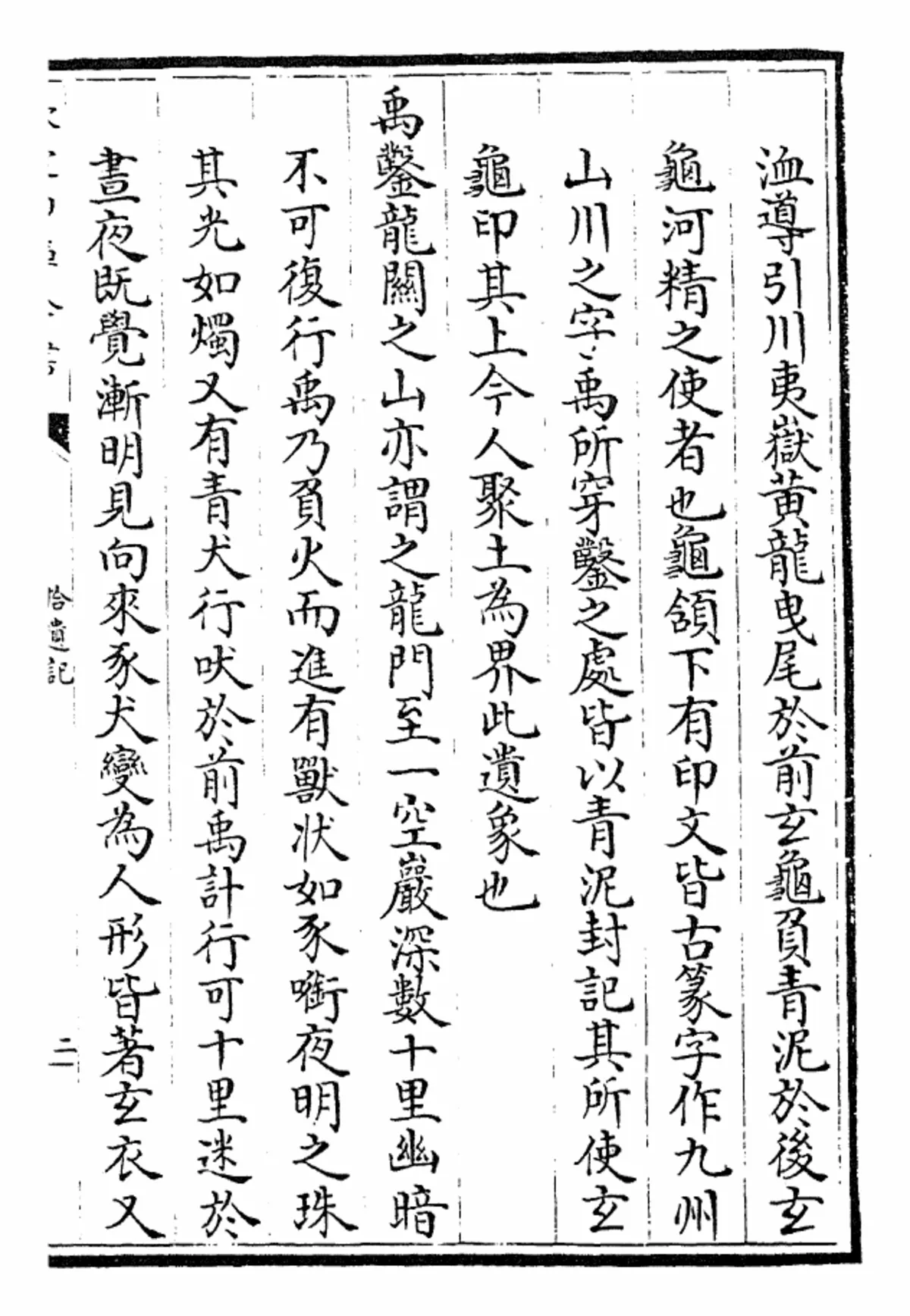
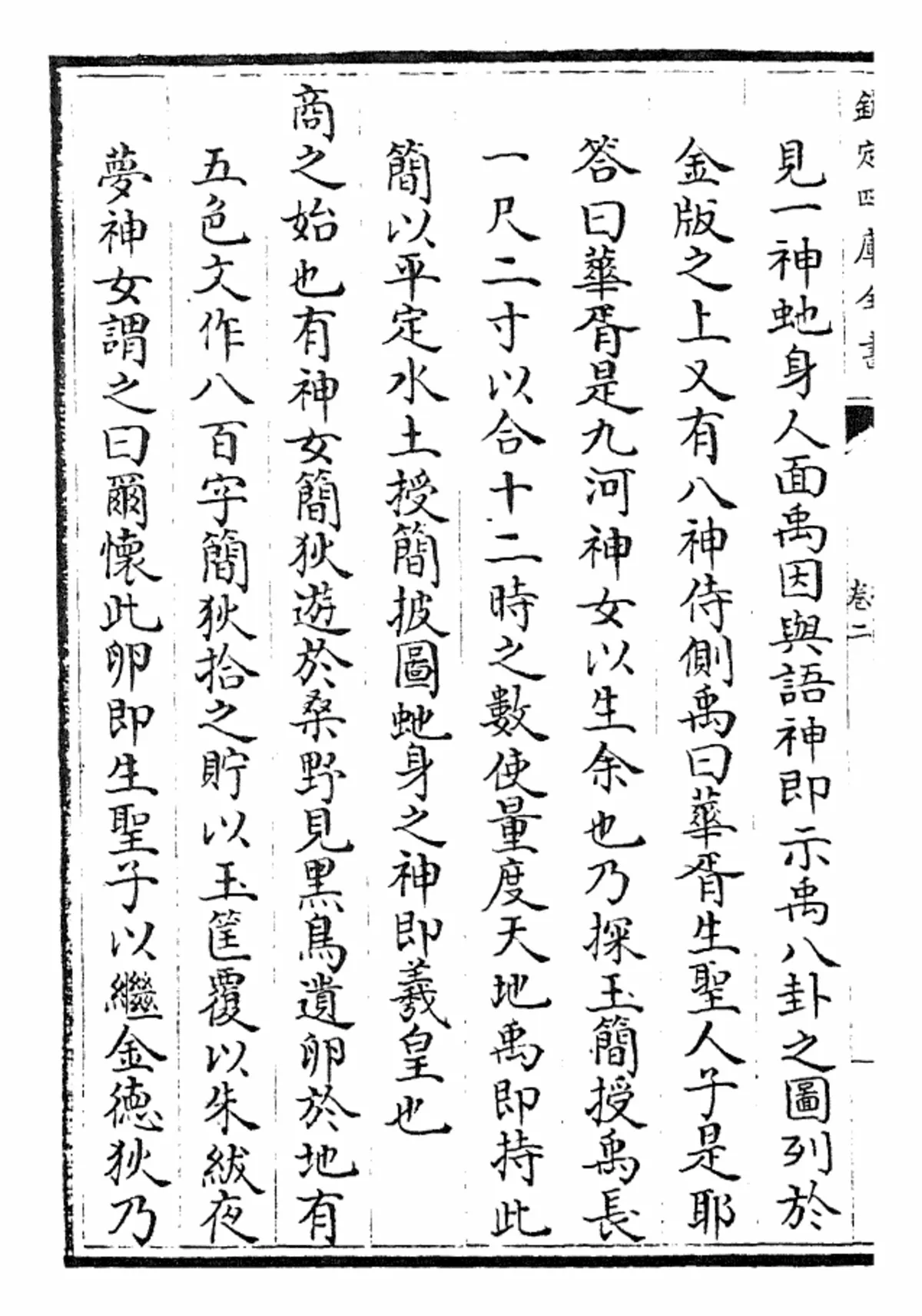
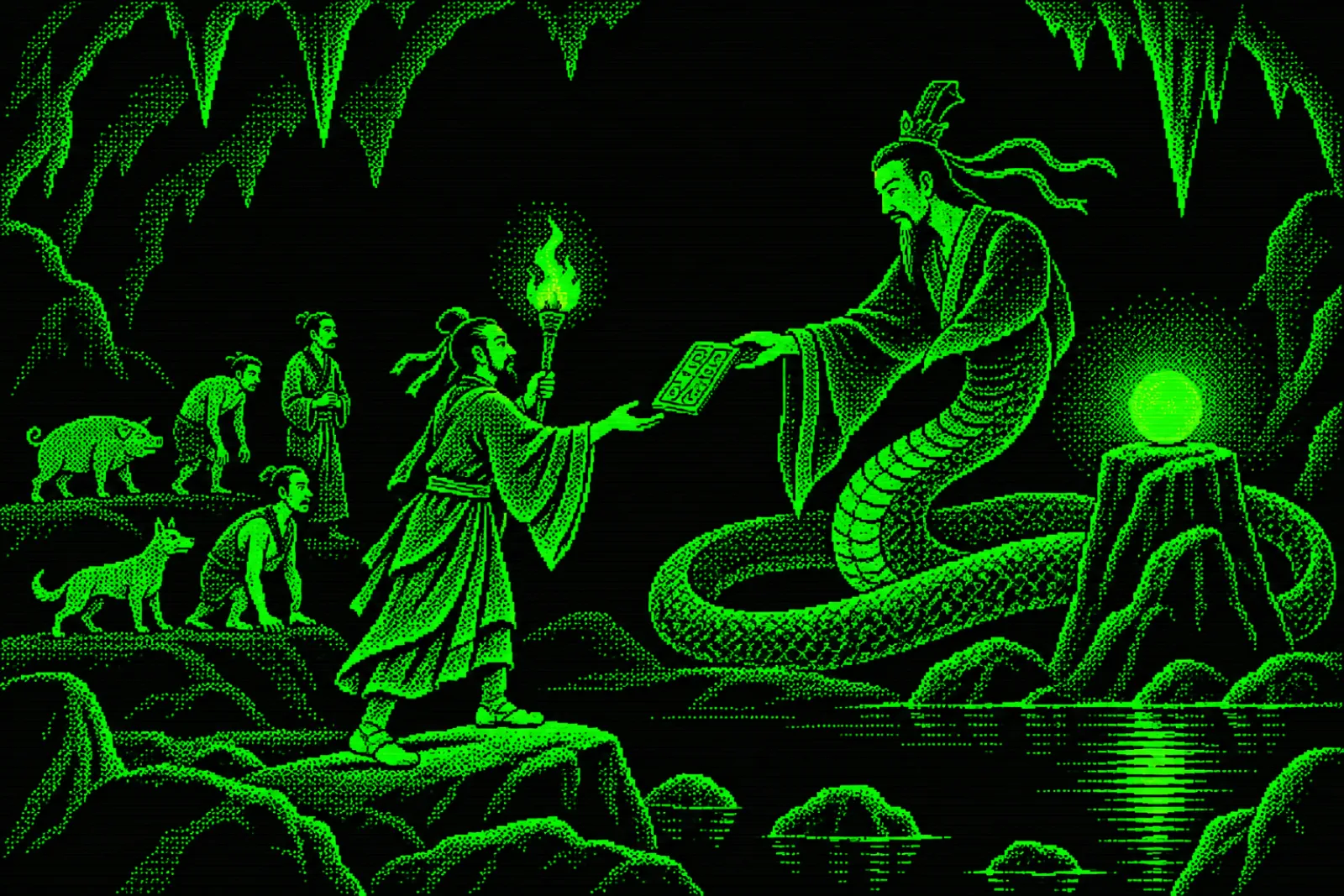
At the centre is the scene in book 2 (lines 119–123). Cutting through the mountain at Dragon Gate, Yu goes into a cave tens of li deep, follows a pig carrying a shining pearl and a barking dog, and meets a god with a snake’s body and a human face. The god shows him the eight trigrams on a gold tablet and gives him a jade slip, twelve inches long for the twelve hours, with which to measure heaven and earth. It is Fuxi. The older Siku print, shown beside those lines, has the scene with small differences and lacks Xiao Qi’s comment that follows it. No published English translation of these two books was found.
Each numbered line gives the Classical Chinese first. Our English is underneath. Tap a dotted word for its meaning, and Note for our comment on the line; our comments are in the right margin.
Juan 1 · The Spring Sovereign, Paoxi (Fuxi)
- 1juan 1
春皇者,庖犧之別號。所都之國,有蕐胥之洲。神母遊其上,有青虹繞神母,久而方滅,即覺有娠,歷十二年而生庖犧。
The Spring Sovereign was another name for Paoxi. In the realm where he made his capital there was the 蕐胥之洲: isle of Huaxu. The 神母: divine mother roamed upon it. A blue rainbow coiled around the divine mother, and only after a long time did it fade. Then she felt that she had conceived, and after twelve years she bore Paoxi.
Note on line 1
蕐 is 華: Huaxu, whom juan 2 names as Fuxi’s mother. - 2juan 1
長頭脩目,龜齒龍唇,眉有白毫,鬚垂委地。或人曰:歲星十二年一周天,今叶以天時。且聞聖人生皆有祥瑞。
He had a long head and long eyes, turtle's teeth and dragon's lips, white hairs in his eyebrows, and a beard that hung down to the ground. Someone said: 歲星: Jupiter goes once round the sky in twelve years, and now his birth matches heaven's timing. And I have heard that the birth of a sage always comes with auspicious omens.
- 3juan 1
昔者人皇虵身九首,肇自開闢。于時日月重輪,山明海靜。自爾以來,為陵成谷,世歷推移,難可紀筭。
In ancient times the Human Sovereign had a 虵身: snake body and nine heads, from the very opening of heaven and earth. At that time the sun and moon had double rings, the mountains were bright and the seas were still. Since then hills have become valleys, and generations have passed and shifted, so the count is hard to keep.
- 4juan 1
比于聖德,有踰前皇。禮義文物,於兹始作。去巢穴之居,變茹腥之食,立禮教以導文,造干戈以飾武。
Compared with the sovereigns before him, he surpassed them in sacred virtue. Ritual, rightness and the forms of civilization began with him. He took people out of nests and caves, changed their diet of raw and bloody meat, set up the teaching of rites to guide culture, and made 干戈: weapons to adorn the martial.
- 5juan 1
絲桑為瑟,均土為塤。禮樂於是興矣。調和八風,以畫八卦,分六位以正六宗。于時未有書契,規天為圖,矩地取法,視五星之文,分晷景之度,使鬼神以致羣祠,審地勢以定川岳,始嫁娶以脩人道。
He made 瑟: zither from silk and mulberry wood, and shaped earthenware 塤: ocarina. Ritual and music rose from this. He harmonized the eight winds and drew the eight trigrams, and divided the six positions to set right the Six Zong (the six revered powers). At that time there was no writing or tally, so he compassed the sky to make charts and squared the earth to take his pattern. He looked at the markings of the five planets, measured the degrees of the sun's shadow, caused the spirits and ghosts to receive many sacrifices, examined the lay of the land to fix the rivers and mountains, and began marriage, giving daughters and taking wives, to cultivate the way of humankind.
- 6juan 1
庖者,包也,言包含萬象。以犧牲登薦於百神,民服其聖,故曰庖犧,亦謂伏羲。變混沌之質,文宓其教,故曰宓犧。
"Pao" (cook) means "bao," to embrace: it says he embraced the myriad phenomena. Using sacrificial animals, he presented offerings to the hundred spirits, and the people submitted to his holiness, so he is called Paoxi. He is also called Fuxi. He transformed the chaotic substance and made his teaching refined and serene, so he is called Mixi.
Note on line 6
The line puns on 庖 (Pao, cook) and 包 (bao, to embrace). The pun is the text’s own argument for the name. - 7juan 1
布至德於天下,元元之類,莫不尊焉。以木德稱王,故曰春皇。其明叡照於八區,是謂太昊。
He spread perfect virtue through the world, and the common folk all held him in honor. He reigned by the virtue of Wood, so he is called the Spring Sovereign. His bright wisdom shone over the Eight Regions, and so he is called Taihao.
- 8juan 1
昊者,明也。位居東方,以含養蠢化,叶于木德,其音附角,號曰「木皇」。
"Hao" means bright. He held the east, nurturing and transforming the stirring creatures in accord with Wood's virtue. His note belongs to 角: jue, the note of Wood, so he is called the Wood Sovereign.
Juan 1 · The Flame Emperor, Shennong
- 9juan 1
炎帝始教民耒耜,躬勤畎畝之事,百穀滋阜。聖德所感,無不著焉。神芝發其異色,靈苗擢其嘉穎,陸地丹蕖,駢生如蓋,香露滴瀝,下流成池,因為豢龍之圃。
The Flame Emperor first taught the people the 耒耜: plough, and personally toiled in the work of furrows and ridges, and the hundred grains swelled and thrived. Whatever his sacred virtue moved, all of it showed itself. Divine fungi put out strange colors, and spirit sprouts raised fine ears. On dry land, red lotuses grew side by side like canopies, fragrant dew dripped and trickled, and below it flowed and formed a pool, which for this reason became 豢龍之圃: dragon-raising garden.
- 10juan 1
朱草蔓衍於街衢,卿雲蔚藹於叢薄,築圓丘以祀朝日,飾瑤階以揖夜光。奏九天之和樂,百獸率舞,八音克諧,木石潤澤。
Vermilion grass spread over the streets and crossroads, and auspicious clouds gathered thickly over the thickets. He built a round mound to sacrifice to the rising sun, and decorated 瑤階: jade steps to bow to the night light. He played the harmonious music of the Nine Heavens, the hundred beasts led the dance, the eight sounds were fully in harmony, and wood and stone were sleek and lustrous.
- 11juan 1
時有流雲灑液,是謂「霞漿」,服之得道,後天而老。有石璘之玉,號曰「夜明」,以闇投水,浮而不滅。
At times drifting clouds sprinkled a liquid called 'rose-cloud syrup'; whoever drank it attained the Way and grew old only after heaven did. There was a jade of 石璘: lustrous stone called 'Night-Bright': thrown into water in the dark, it floated and did not go out.
- 12juan 1
當斯之時,漸革庖犧之朴,辨文物之用。時有丹雀銜九穗禾,其墜地者,帝乃拾之,以植於田,食者老而不死。
At this time the simplicity of Paoxi was gradually transformed, and the uses of cultural objects were distinguished. Once a 丹雀: red sparrow carried nine-eared grain in its beak. The emperor picked up the ears that fell to the ground and planted them in the fields. Those who ate them grew old without dying.
- 13juan 1
採峻鍰之銅以為器。峻鍰,山名也。下有金井,白氣冠其上。人升於其間,雷霆之聲,在於地下。井中之金柔弱,可以緘縢也。
He took copper from Junhuan to make vessels; Junhuan is the name of a mountain. Below it is a 金井: well of gold, crowned with white vapour. When people climb up there, the sound of thunder is under the ground. The gold in the well is soft and pliant, and can be used to bind and tie.
Juan 1 · Xiao Qi’s comment on Fuxi and Shennong
- 14juan 1
錄曰:謹按《周易》云:伏羲為上古,觀文於天,察理於地,俯仰二儀,經綸萬象,至德備於冥昧,神化通於精粹。
Xiao Qi comments: Carefully checking the 《周易》: Zhou Changes, which says: Fuxi lived in high antiquity. He observed the patterns in heaven and examined the principles on earth, looked up and down at the two forms, ordered the myriad phenomena. His perfect virtue was complete in the dim and obscure, and his spiritual transformations reached the pure and refined.
Note on line 14
The wording echoes the Zhou Changes commentary on Fuxi’s looking up at heaven and down at earth. - 15juan 1
是以圖書著其跡,河洛表其文。變太素之質,改淳遠之化,三才之位既立,四維之義乃張。
Therefore the diagrams and writings recorded his traces, and the Yellow River and Luo River displayed his patterns. He transformed the primal substance and changed the pure and distant transformations. The positions of the 三才: heaven, earth, and humanity were already set up, and then the meanings of the Four Bonds were spread out.
Note on line 15
“River and Luo” alludes to the River Chart and the Luo Writing. - 16juan 1
禮樂文物,自茲而始。降于下代,漸相移襲。《八索》載其遐軌,《九丘》紀其淳化,備昭籍菉,編列柱史。
Ritual, music and the forms of culture began from here. Coming down to later ages, they were passed on and imitated in turn. The Eight Ropes record his far-off track and the Nine Hills chronicle his pure transformation; they are fully set out in the 籍菉: records and registers (菉 for 籙) and filed by the 柱史: archivist of the Zhou court, Laozi's office.
- 17juan 1
考驗先經,刊詳往誥,事列方典,取征群籍,博採百家,求詳可證。按《山海經》云:「棠帝之山,出浮水玉。
Examining and testing the earlier classics, correcting and detailing the past instructions, setting matters out in the old canonical books, drawing evidence from the many books, gathering broadly from the hundred schools, seeking detail that can be verified. Checking the 《山海經》: Classic of Mountains and Seas, which says: "On the Mountain of Tangdi, floating water-jade comes out."
Note on line 17
棠帝 is a variant form of the mountain’s name in the Classic of Mountains and Seas. - 18juan 1
巫閭之地,其木多文。」自非道真俗朴,理會冥旨,與四時齊其契,精靈協其德,禎祥之異,胡可致哉!
'In the land of Wulü the trees are much patterned.' Unless the Way is true and custom plain, unless reason meets the hidden intent, unless one's compact keeps step with the four seasons and the spirits accord with one's virtue, how could such wonders of good omen be brought about?
- 19juan 1
故使跡感誠著,幽只不藏其寶,只心剪害,殊性之類必馴也。以降露成池,蓄龍為圃。及乎夏代,世載綿絕,時有豢龍之官。考諸遐籍,由斯立矣。
So his traces stirred responses and his sincerity shone; the 幽只: 只 is 祇, earth spirits did not hide their treasures, and, their hearts set on cutting away harm, creatures of other natures were sure to be tamed. Sweet dew came down and made a pool, and dragons were kept in it as a park. By the Xia the generations were far off and the line broken, yet at times there was an office of 豢龍: dragon-rearing. Examine the far-off records: it was founded on this.
Note on line 19
幽只 is 幽祇, the hidden earth spirits. The dragon-keeper office alludes to the Xia story in the Zuo Commentary (Zhao 29). Juan 1 · Xuanyuan, the Yellow Emperor
- 20juan 1
軒轅出自有熊之國。母曰昊樞,以戊己之日生,故以土德稱王也。時有黃星之祥。考定曆紀,始造書契。
Xuanyuan came out of the state of Youxiong. His mother was named Haoshu. He was born on a 戊己之日: the earth days of the sexagenary cycle, so he ruled under 土德: the virtue of Earth. At that time there was the omen of a yellow star. He fixed the calendar's sequence and first made written tallies.
- 21juan 1
服冕垂衣,故有袞龍之頌。變乘桴以造舟楫,水物為之祥踴,滄海為之恬波。泛河沉璧,有澤馬群鳴,山車滿野。
He wore the crown and let his robes hang, so there is the ode on the embroidered dragon robe. He changed from riding rafts to building boats and oars, and the water creatures leapt in auspicious welcome for him, and the blue sea was calm of waves for him. He crossed the river and sank a 璧: a ring-shaped jade. Marsh horses neighed in flocks, and mountain carts filled the wilds.
- 22juan 1
吹玉律,正璇衡。置四史以主圖籍,使九行之士以統萬國。九行者,孝、慈、文、信、言、忠、恭、勇、義。
He blew the jade pitch-pipes and set the jade armillary straight. He set up four scribes to keep the maps and registers, and he made men of the Nine Conducts govern the myriad states. The Nine Conducts were: filial piety, compassion, learning, good faith, eloquence, loyalty, respect, courage, and righteousness.
- 23juan 1
以觀天地,以祠萬靈,亦為九德之臣。熏風至,真人集,乃厭世於昆臺之上,留其冠、劍、佩、舄焉。
With them he observed heaven and earth, and with them he sacrificed to the myriad spirits; they too were ministers of the Nine Virtues. When the warm southwind came and the perfected people gathered, he 厭世: died, lit. grew weary of the world on top of Kun Terrace. He left behind his cap, his sword, his jade pendants, and his shoes.
- 24juan 1
昆臺者,鼎湖之極峻處也,立館於其下。帝乘雲龍而遊。殊鄉絕域,至今望而祭焉。帝以神金鑄器,皆銘題。
Kun Terrace was the steepest place at Tripod Lake, and a lodge was built beneath it. The emperor rode a 雲龍: a dragon that rides the clouds and roamed. Distant villages and remote regions still look toward it and sacrifice to him. The emperor cast vessels from divine metal, and all of them were engraved with inscriptions.
- 25juan 1
及昇遐後,群臣觀其銘,皆上古之字,多磨滅缺落。凡所造建,咸刊記其年時,辭跡皆質。
After he 昇遐: died, lit. ascended into the distance, the officials looked at his inscriptions. They were all in the characters of high antiquity, and most were worn away, missing, or broken. Whatever he had made or built, all of it was carved with the year and season, and the wording and traces were all plain.
- 26juan 1
詔使百辟群臣受德教者,先列珪玉於蘭蒲席上,燃沉榆之香,舂雜寶為屑,以沉榆之膠和之為泥,以塗地,分別尊卑華戎之位也。
He decreed that the hundred lords and officials who received his moral teaching should first lay out jade tablets on mats of orchid and rush. They were to burn the fragrance of 沉榆: a fragrant wood, pound mixed treasures into powder, and mix it with sinking-elm glue into a paste to smear on the ground, in order to mark the places of high and low, Chinese and foreign.
- 27juan 1
【事出《封禪記》。】帝使風后負書,常伯荷劍,旦遊洹流,夕歸陰浦,行萬里而一息。洹流如沙塵,足踐則陷,其深難測。
[The matter comes from Record of the Feng and Shan Sacrifices.] The emperor sent Fenghou to carry 書: a written text and Changbo to shoulder the sword. In the morning they traveled the Huan Stream, and in the evening they returned to Yinpu (the Dark Shore), going ten thousand li in a single rest. The Huan Stream was like sand and dust; when a foot stepped on it, it sank, and its depth could not be measured.
- 28juan 1
大風吹沙如霧,中多神龍魚鱉,皆能飛翔。有石蕖青色,堅而甚輕,從風靡靡,覆其波上,一莖百葉,千年一花。
A great wind blew the sand up like fog. Within it were many divine dragons, fish and turtles, and all of them could fly. There was a 石蕖: lotus of stone of blue-green colour, hard yet very light, which bent before the wind and covered the waves. One stalk bore a hundred leaves, and it flowered once in a thousand years.
- 29juan 1
其地一名「沙瀾」,言沙湧起而成波瀾也。仙人寧封食飛魚而死,二百年更生,故寧先生遊沙海七言頌云:「青蕖灼爍千載舒,百齡暫死餌飛魚。」則此花此魚也。
The place has another name, 'Sand Waves', meaning that the sand surges up and becomes waves. The immortal Ning Feng ate flying fish and died; after two hundred years he lived again. So Master Ning's seven-character ode on roaming the Sand Sea says: 'The blue lotus, blazing bright, opens once in a thousand years; at a hundred I died awhile, from eating flying fish.' This flower and this fish are the ones meant.
Juan 1 · Shaohao
- 30juan 1
少昊以金德王。母曰皇娥,處璇宮而夜織。或乘桴木而晝游,經歷窮桑滄茫之浦。時有神童,容貌絕俗,稱為白帝之子,即太白之精,降乎水際,與皇娥宴戲,奏㛐娟之樂,游漾忘歸。
Shaohao ruled by 金德: the virtue of Metal. His mother was named Huang'e. She lived in a jade palace and wove at night. Sometimes she rode a wooden raft and roamed by day, passing the shores of Qiongsang ('Hollow Mulberry') and the vast waters. At that time there was a divine boy whose looks were beyond the common. He was called the son of the White Emperor, and was the essence of 太白: the planet Venus. He came down to the water's edge and feasted and played with Huang'e. They played 㛐娟: pianjuan, lovely, graceful and drifted on, forgetting to go home.
- 31juan 1
窮桑者,西海之濱,有孤桑之樹,直上千尋,葉紅椹紫,萬歲一實,食之後天而老。帝子與皇娥泛於海上,以桂枝為表,結熏茅為旌,刻玉為鳩,置於表端,言鳩知四時之候,故《春秋傳》曰「司至」,是也。
Qiongsang lies on the shore of the Western Sea, where there is a solitary mulberry tree rising straight up 千尋: a xun is eight feet. Its leaves are red and its berries purple. It bears fruit once in ten thousand years, and whoever eats it grows old only after heaven does. The emperor's son and Huang'e floated on the sea. They used a cassia branch as a mast, tied 熏茅: fragrant thatch-grass into a banner, and carved a jade dove and set it on top of the mast, saying that the dove knows the signs of the four seasons. So the Zuo Commentary speaks of the one 'in charge of the solstices': this is it.
Note on line 31
The Zuo Commentary (Duke Zhao 17) lists Shaohao’s officers named after birds; the one ‘in charge of the solstices’ (司至) is the shrike clan. Wang Jia ties the phrase to the jade dove. - 32juan 1
今之相風,此之遺像也。帝子與皇娥並坐,撫桐峰梓瑟。皇娥倚瑟而清歌曰:「天清地曠浩茫茫,萬象迴薄化無方。
The wind-vanes of today are the remnant of this image. The emperor's son and Huang'e sat side by side, plucking a 瑟: a large zither of paulownia-peak and catalpa wood. Huang'e leaned on the zither and sang a clear song: "Heaven is clear and earth is open, vast and boundless; the ten thousand forms surge back and press against one another, changing without fixed direction.
- 33juan 1
涵天蕩蕩望滄滄,乘桴輕漾著日傍。當其何所至窮桑,心知和樂悅未央。」俗謂遊樂之處為桑中也。
The sky-enfolding waters are broad and wide, and we gaze out at the blue-green. Riding the raft, drifting lightly, we came beside the sun. Where do we reach at this point? Qiongsang. Our hearts know harmony and joy, and delight without end." Common usage calls a place of pleasure and play "in the mulberries."
- 34juan 1
《詩》中《衛風》云:「期我乎桑中。」蓋類此也。白帝子答歌:「四維八埏眇難極,驅光逐影窮水域。
In the Odes, in the Wei Airs, it says: "Meet me in the mulberries." This is much like that. The son of the White Emperor answered with a song: "The Four Corners and the Eight Bounds are so vast they are hard to reach; driving the light and chasing the shadow, I exhaust the watery regions.
Note on line 34
The text cites the Wei section of the Odes, but “Meet me in the mulberries” is in the Yong Airs (鄘風). Translated as the text has it. - 35juan 1
璇宮夜靜當軒織。桐峰文梓千尋直,伐梓作器成琴瑟。清歌流暢樂難極,滄湄海浦來棲息。」
In the jade palace, in the quiet of night, she weaves by the window. 文梓: catalpa with a fine grain from the paulownia peaks, a thousand xun straight, and cut catalpa is made into instruments, into zither and se. The clear song flows on, and its joy is hard to exhaust; we come to the blue-green banks and the sea-shore to rest and settle."
- 36juan 1
及皇娥生少昊,號曰窮桑氏,亦曰桑丘氏。至六國時,桑丘子著陰陽書,即其餘裔也。少昊以主西方,一號金天氏,亦曰金窮氏。
When Huang'e bore Shaohao, he was called 窮桑: Hollow Mulberry, and also Sangqiu. In the time of the Six States, Master Sangqiu wrote books on yin and yang; he was of his remote line. Because Shaohao ruled the west, he was also called Jintian, and also Jinqiong.
- 37juan 1
時有五鳳,隨方之色,集於帝庭,因曰鳳鳥氏。金鳴於山,銀湧於地。或如龜蛇之類,乍似人鬼之形,有水屈曲亦如龍鳳之狀,有山盤紆亦如屈龍之勢,故有龍山、龜山、鳳水之目也。
At that time five 五鳳: five phoenix birds, each in the colour of its quarter, gathered at the emperor's court, and so the line was named the Phoenix clan. Gold rang out from the mountains; silver welled up from the ground. Some things were like turtles or snakes, and some for a moment took the shape of men or ghosts. There was water that wound and bent just like dragons and phoenixes, and there were mountains that coiled like a crouching dragon. That is why there are the names Dragon Mountain, Turtle Mountain, and Phoenix Water.
- 38juan 1
亦因以為姓,末代為龍丘氏,出班固《藝文志》;蛇丘氏,出《西王母神異傳》。
They also took these names as surnames. In the last generation the line became the Longqiu clan, which appears in Ban Gu's Treatise on Literature, and the Sheqiu ("Snake Hill") clan, which appears in the Marvels of the Queen Mother of the West.
Juan 1 · Zhuanxu
- 39juan 1
帝顓頊高陽氏,黃帝孫,昌意之子。昌意出河濱,遇黑龍負玄玉圖。時有一老叟謂昌意云:「生子必葉水德而王。」
Emperor Zhuanxu of Gaoyang was a grandson of the Yellow Emperor and a son of Changyi. Changyi went out to a riverside and met a black dragon carrying a 玄玉圖: a chart carved in black jade on its back. An old man said to Changyi at that time: "A son born to you will accord with the virtue of Water and rule as king."
- 40juan 1
至十年,顓頊生,手有文如龍,亦有玉圖之像。其夜昌意仰視天,北辰下,化為老叟。及顓頊居位,奇祥眾祉,莫不總集,不稟正朔者,越山航海而皆至也。
Ten years later Zhuanxu was born, and on his hand was a pattern like a dragon; there was also an image of the jade chart. That night Changyi looked up at the sky, the Pole Star came down, and it turned into the old man. When Zhuanxu took the throne, rare omens and many blessings all gathered, and those who would not take up his 正朔: the first month and first day of the reign's calendar came, crossing mountains and sailing seas, to all arrive.
- 41juan 1
帝乃揖四方之靈,群后執珪以禮,百辟各有班序。受文德者,錫以鐘磬;受武德者,錫以干戈。
The emperor then bowed to the spirits of the four quarters. The lords held 珪: ceremonial gui tablets according to ritual, and the hundred dukes each had their place in order of rank. Those who received the virtue of letters were given bells and chime-stones; those who received the virtue of arms were given 干戈: weapons.
- 42juan 1
有浮金之鐘,沉明之磬,以羽毛拂之,則聲振百里。石浮於水上,如萍藻之輕,取以為磬,不加磨琢。
There was a bell of floating gold and a chime-stone of sinking brightness; when it was brushed with a feather, its sound shook a 百里: li, about a third of a mile each. Stones floated on the water, as light as duckweed and algae; they were taken and made into chime-stones without any grinding or carving.
- 43juan 1
及朝萬國之時,及奏含英之樂,其音清密,落雲間之羽,鯨鯢游湧,海水恬波。有曳影之劍,騰空而舒,若四方有兵,此劍則飛起指其方,則剋伐;未用之時,常於匣裏如龍虎之吟。
When he held audience with the myriad states and the music Hanying ('Holding Blossoms') was played, its tones were clear and close, and it brought 羽: feathered ones down from among the clouds. Whales swam and surged, and the sea lay calm. There was a sword called Yeying ('Trailing Shadow'); when it was raised it soared into the sky and spread out. If there was war in any of the four quarters, the sword would fly up and point toward that quarter, and that quarter was conquered. When not in use it always lay in its case, growling like a dragon or a tiger.
- 44juan 1
溟海之北,有勃鞮之國。人皆衣羽毛,無翼而飛,日中無影,壽千歲。食以黑河水藻,飲以陰山桂脂。
North of the 溟海: the vast dark sea lies the land of Boti. The people are all clothed in feathers; without wings they fly; at midday they cast no shadow; and they live a thousand years. They eat the water-weed of the Black River and drink the 桂脂: resin of the cassia tree of Yin Mountain.
- 45juan 1
憑風而翔,乘波而至。中國氣暄,羽毛之衣,稍稍自落。帝乃更以文豹為飾。獻黑玉之環,色如淳漆。
They ride the wind to soar and ride the waves to arrive. When they came into the Central States the air was warm, and their feather garments slowly fell away by themselves. So the emperor gave them striped leopard skins for adornment instead. They presented a ring of black jade, its colour like pure lacquer.
- 46juan 1
貢玄駒千匹。帝以駕鐵輪,騁勞殊鄉絕域。其人依風泛黑河以旋其國也。
They presented a tribute of a thousand 玄駒: fabled horses. The emperor yoked them to iron-wheeled carts and sent them galloping to labour across distant lands and remote realms. Those people relied on the wind and floated down the Black River to return to their country.
- 47juan 1
闇河之北,有紫桂成林,其實如棗,群仙餌焉。韓終採藥四言詩曰:「闇河之桂,實大如棗。得而食之,後天而老。」
North of the Dark River, purple cassia grows in groves. Its fruit is like a jujube, and the host of immortals feed on it. Han Zhong gathered herbs and made this four-syllable poem: "The cassia of the Dark River, / its fruit as large as a jujube. / Get it and eat it, / and you will grow old after Heaven does."
Juan 1 · Gaoxin (Emperor Ku)
- 48juan 1
帝嚳之妃,鄒屠氏之女也。軒轅去蚩尤之兇,遷其民善者於鄒屠之地,遷惡者於有北之鄉。
The consort of Emperor Ku was a daughter of the Zoutu clan. When Xuanyuan rid the land of Chiyou's 兇: violence, he moved the good among that people to the land of Zoutu, and moved the wicked to the district of Youbei.
- 49juan 1
其先以地命族,後分為鄒氏、屠氏。女行不踐地,常履風雲,游於伊、洛。帝乃期焉,納以為妃。
Their forebears named the clan after the land; later it divided into the Zou and Tu lines. The woman never let her feet touch the ground; she always walked on wind and clouds, roaming along the 伊、洛: two rivers. The emperor arranged to meet her and took her as his consort.
- 50juan 1
妃常夢吞日,則生一子,凡經八夢,則生八子。世謂為「八神」,亦謂「八翌」,翌,明也,亦謂「八英」,亦謂「八力」,言其神力英明,翌成萬象,億兆流其神睿焉。
The consort dreamed of swallowing the sun, and each time she bore a son; in all she had eight dreams and bore eight sons. The world called them the Eight Spirits, and also the 八翌: 翌 means bright, the Eight Brilliants and the Eight Powers, meaning that their divine power was brilliant and bright, that they lit up and brought to completion the myriad forms, and that the countless multitudes were bathed in their divine wisdom.
- 51juan 1
有丹丘之國,獻碼瑙甕,以盛甘露。帝德所洽,被於殊方,以露充於廚也。碼瑙,石類也,南方者為之勝。
There was the land of 丹丘: "Cinnabar Hill" that presented an 碼瑙: also written "horse-brain" urn to hold sweet dew. The emperor's virtue reached and moistened the remote lands, so the dew was supplied to the kitchens. Agate is a kind of stone, and the southern agate is the finest.
- 52juan 1
今善別馬者,死則破其腦視之。其色如血者,則日行萬里,能騰空飛;腦色黃者,日行千里;腦色青者,嘶聞數百里;腦色黑者,入水毛鬣不濡,日行五百里;腦色白者,多力而怒。
Nowadays those skilled at judging horses, when a horse dies, break open its 腦: brain and look at it. If its colour is like blood, it runs ten thousand li a day and can soar and fly through the air. If the brain is yellow, it runs a thousand li a day. If the brain is blue-green, its whinny carries several hundred li. If the brain is black, it can enter water with its mane and hair staying dry, and it runs five hundred li a day. If the brain is white, it is strong and fierce.
Note on line 52
碼瑙, agate, is also written 馬腦, ‘horse brain’; the horse-judges’ lore follows from the name. - 53juan 1
今為器多用赤色,若是人工所制者,多不成器,亦殊朴拙。其國人聽馬鳴則別其腦色。丹丘之地,有夜叉駒跋之鬼,能以赤馬腦為瓶。
Today agate vessels are mostly red; those made by human work mostly fail as vessels and are very crude. The people of that land can tell the colour of a horse's brain by hearing it neigh. In the land of 丹丘: Cinnabar Hill there are yaksha and juba demons, who can make bottles out of red 赤馬腦: red agate.
Note on line 53
其國, ’that land’, is Danqiu. - 54juan 1
盂及樂器,皆精妙輕麗。中國人有用者,則魑魅不能逢之。一說云,馬腦者,言是惡鬼之血,凝成此物。
Bowls and musical instruments made of it are all exquisite, delicate and light. When people of China use them, 魑魅: chi and mei spirits cannot come near them. One account says: "horse-brain" means it is the blood of evil ghosts, congealed into this substance.
Note on line 54
馬腦 and 碼瑙 are two spellings of the stone’s name; ‘one account’ explains the name as the congealed blood of evil ghosts, which the next line tells. - 55juan 1
昔黃帝除蚩尤及四方群凶,并諸妖魅,填川滿谷,積血成淵,聚骨如岳。數年中,血凝如石,骨白如灰,膏流成泉。
Long ago the Yellow Emperor destroyed Chiyou and the wicked of the four quarters, together with all the sprites and demons. Their dead filled the rivers and choked the valleys, their blood pooled into deep waters, and their bones were heaped like mountains. Within several years the blood congealed like stone, the bones turned white as ash, and the fat flowed out into springs.
- 56juan 1
故南方有肥泉之水,有白堊之山,望之峨峨,如霜雪矣。又有丹丘,千年一燒,黃河千年一清,至聖之君,以為大瑞。
Therefore in the south there is the water of Feiquan [Fat Spring], and there is a mountain of white chalk; looking at it, it towers high, like frost or snow. There is also Danqiu, which burns once every thousand years, and the Yellow River, which runs clear once every thousand years. A ruler of supreme sagehood takes these as great omens.
- 57juan 1
丹丘之野多鬼血,化為丹石,則碼瑙也。不可斫削彫琢,乃可鑄以為器也。當黃帝時,碼瑙甕至,堯時猶存,甘露在其中,盈而不竭,謂之寶露,以班賜群臣。
On the plains of Danqiu there is much demon blood, which turned into cinnabar stone; this is agate. It cannot be hacked, carved or chiseled, but it can be cast into vessels. In the time of the Yellow Emperor an agate jar arrived. In Yao's time it still existed, with sweet dew inside it, full yet never running dry. It was called treasure dew, and was distributed to the assembled ministers as gifts.
- 58juan 1
至舜時,露已漸減。隨帝世之污隆,時淳則露滿,時澆則露竭,及乎三代,減於陶唐之庭。
By Shun's time the dew had already gradually diminished. It followed the rise and fall of each sovereign's age: when the age was pure, the dew was full; when the age was thin, the dew ran dry. By the Three Dynasties it had shrunk below what it was at the court of 陶唐: Yao's clan name.
- 59juan 1
舜遷寶甕於衡山之上,故衡山之岳有寶露壇。舜於壇下起月館,以望夕月。舜南巡至衡山,百辟群后皆得露泉之賜。
Shun moved the treasure jar to the top of Mount Heng, and so on that peak there is a 寶露壇: altar of treasure dew. Below the altar Shun built a moon lodge, for the 夕月: rite to the moon at dusk. When Shun toured south and reached Mount Heng, all the hundred lords and assembled rulers received gifts from the dew-spring.
- 60juan 1
時有雲氣生於露壇,又遷寶甕於零陵之上。舜崩,甕淪於地下。至秦始皇通汨羅之流為小溪,徑從長沙至零陵,掘地得赤玉甕,可容八斗,以應八方之數,在舜廟之堂前。
At that time cloud-vapor rose from the dew altar, and he moved the treasure jar again, to the top of Lingling. When Shun died, the jar sank into the earth. Later, when the First Emperor of Qin opened the flow of the Miluo into a small stream running straight from Changsha to Lingling, people dug into the ground and found a red-jade jar that could hold eight 八斗: dry measures, matching the number of the eight quarters. It stood in front of the hall of Shun's temple.
- 61juan 1
後人得之,不知年月。至後漢東方朔識之,朔乃作《寶甕銘》曰「寶雲生於露壇,祥風起於月館,望三壺如盈尺,視八鴻如縈帶。」
Later people found it, but did not know its date. In the Later Han, Dongfang Shuo recognized it, and Shuo composed an inscription for the Treasure Jar which says: "Treasure clouds rise from the dew altar, auspicious winds stir at the moon lodge. Looking at the Three Pots they seem a foot across; looking at the Eight Hong they are wound like sashes."
Note on line 61
Dongfang Shuo belongs to the Western Han, not the Later Han. Other reading: the period name is Wang Jia’s error, or a copyist’s slip for 前漢. - 62juan 1
三壺,則海中三山也。一曰方壺,則方丈也;二曰蓬壺,則蓬萊也;三曰瀛壺,則瀛洲也。
The 三壺: three mountains are the three mountains in the sea. The first is called Fanghu, which is Fangzhang; the second is Penghu, which is Penglai; the third is Yinghu, which is Yingzhou.
- 63juan 1
形如壺器。此三山上廣、中狹、下方,皆如工制,猶華山之似削成。八鴻者,八方之名;鴻,大也。
They are shaped like pot-vessels. These three mountains are broad at the top, narrow in the middle and square at the base, all like something made by craftsmen, just as Mount Hua looks as though it had been cut and shaped. The 八鴻: the eight directions are the names of the eight quarters; hong means great.
- 64juan 1
登月館以望四海三山,皆如聚米縈帶者矣。
Climbing the moon lodge to look out over the four seas and the three mountains, they all looked like heaped grain and wound sashes.
Juan 1 · Yao of Tang
- 65juan 1
帝堯在位,聖德光洽。河洛之濱,得玉版方尺,圖天地之形。又獲金璧之瑞,文字炳列,記天地造化之始。
When Emperor Yao was in power his sagely virtue spread widely. On the banks of the Yellow River and the Luo, he obtained a jade tablet a foot square, with a chart of the form of heaven and earth. He also received a gold disc as an omen, its writing clearly set out, recording the beginning of the creation and transformation of heaven and earth.
- 66juan 1
四兇既除,善人來服,分職設官,彞倫攸敘。乃命大禹,疏川瀦澤。有吳之鄉,有北之地,無有妖災。
The Four Fierce Ones were already removed, good people came to submit, offices were divided and posts set, and the moral order was set in sequence. Then he commanded Great Yu to dredge the rivers and drain the marshes. In the district of Wu and in the lands of the north there were no baleful disasters.
Note on line 66
彞 is a variant of 彝 (“constant order”), the reading we have followed. - 67juan 1
沉翔之類,自相馴擾。幽州之墟,羽山之北,有善鳴之禽,人面鳥喙,八翼一足,毛色如雉,行不踐地,名曰青鸐,其聲似鐘磬笙竽也。
The creatures that fly and dive tamed and calmed one another. In the wilds of Youzhou, north of Mount Yu, there is a bird that sings well, with a human face and a bird's beak, eight wings and one foot, plumage like a pheasant, walking without touching the ground. It is called the qingdi bird, and its voice is like chime-stones, bells, sheng pipes and yu organs.
- 68juan 1
《世語》曰:「青鸐鳴,時太平。」故盛明之世,翔鳴藪澤,音中律呂,飛而不行。至禹平水土,棲於川岳,所集之地,必有聖人出焉。
The Shiyu says: "When the qingdi sings, the age is at peace." Therefore in ages of flourishing brightness they flew and sang in the marshes and swamps, their notes matching the 律呂: pitch standards, flying without walking. When Yu leveled the waters and soil, they perched on the rivers and mountains; wherever they gathered, a sage was sure to appear.
- 69juan 1
自上古鑄諸鼎器,皆圖像其形,銘贊至今不絕。堯登位三十年,有巨查浮於西海,查上有光,夜明晝滅。
From high antiquity, whenever tripods and vessels were cast, its likeness was drawn on them, and the inscriptions in its praise have never ceased to this day. In the thirtieth year after Yao took the throne, a 巨查: great raft floated on the Western Sea. There was light on the raft, bright at night and gone by day.
- 70juan 1
海人望其光,乍大乍小,若星月之出入矣。查常浮繞四海,十二年一周天,周而復始,名曰貫月查,亦謂掛星查,羽人棲息其上。
Sea people watching its light saw it grow large and small by turns, like stars and the moon rising and setting. The raft drifted always round the four seas, going once round the sky in twelve years and then beginning again. It was named the Moon-Piercing Raft, and also the Star-Hanging Raft, and 羽人: feathered men roosted on it.
- 71juan 1
群仙含露以漱,日月之光則如冥矣。虞、夏之季,不復記其出沒。游海之人,猶傳其神偉也。
The host of immortals held dew in their mouths and rinsed with it, and then the light of the sun and moon seemed dark. From the end of 虞: Shun's dynasty and Xia on, its comings and goings were no longer recorded, but sea travellers still pass down tales of its divine grandeur.
- 72juan 1
西海之西,有浮玉山。山下有巨穴,穴中有水,其色若火,晝則通曨不明,夜則照耀穴外,雖波濤灌蕩,其光不滅,是謂「陰火」。
West of the Western Sea stands Floating Jade Mountain. Beneath the mountain is a huge cavity, and in the cavity is water the color of fire. By day it is dim and murky; by night its glow shines out beyond the cavity. Even when waves surge and wash through, its light is not put out. This is called "yin fire."
- 73juan 1
當堯世,其光爛起,化為赤雲,丹輝炳映,百川恬澈。游海者銘曰「沉燃」,以應火德之運也。
In Yao's time its light blazed up and turned into red clouds, a cinnabar glow shone out, and the hundred rivers grew calm and clear. Sea travellers named it 'Sunken Burning', to answer the turn of 火德: Yao's ruling element.
- 74juan 1
堯在位七十年,有鸞雛歲歲來集,麒麟遊於藪澤,梟鴟逃於絕漠。有秖支之國獻重明之鳥,一名「雙睛」,言雙睛在目。
Yao held the throne seventy years. Young luan birds came to gather year after year; qilin roamed the marsh-lakes, and owls and kites fled to the far deserts. The land of Zhizhi presented the Double-Bright bird, also called "Double Pupils," meaning it has two pupils in its eyes.
- 75juan 1
狀如雞,鳴似鳳。時解落毛羽,肉翮而飛。能搏逐猛獸虎狼,使妖災群惡不能為害。飴以瓊膏。
It looks like a rooster, and its cry is like the phoenix's. At times it sheds its feathers and flies on bare, fleshy wings. It can strike down and chase fierce beasts, tigers and wolves, so that monsters, calamities and all the evil things cannot do harm. It is fed on jade cream.
- 76juan 1
或一歲數來,或數歲不至。國人莫不掃灑門戶,以望重明之集。其未至之時,國人或刻木,或鑄金,為此鳥之狀,置於門戶之間,則魑魅醜類自然退伏。
Sometimes it came several times in a year; sometimes it did not come for several years. The people of the land all swept and sprinkled their doors and gates, hoping to see the Double-Bright bird arrive. In the time before it came, the people either carved wood or cast metal into the shape of this bird and set it between their doors and gates; then 魑魅: mountain demons and the vile kinds withdrew and lay low of their own accord.
- 77juan 1
今人每歲元日,或刻木鑄金,或圖畫為雞於牖上,此之遺像也。
Today, every year on New Year's Day, people either carve wood or cast metal, or paint a rooster on the window. These are the remnant images of it.
Juan 1 · Shun of Yu
- 78juan 1
虞舜在位十年,有五老遊於國都,舜以師道尊之,言則及造化之始。舜禪於禹,五老去,不知所從。
Shun held the throne ten years. Five elders roamed the capital; Shun honored them as teachers, and when they spoke, their words reached back to 造化之始: how things are made. Shun yielded the throne to Yu, and the Five Elders left; no one knew which way they had gone.
- 79juan 1
舜乃置五星之祠以祭之。其夜有五長星出,熏風四起,連珠合璧,祥應備焉。萬國重譯而至。
Shun then set up a shrine to the Five Planets and sacrificed to them. That night five long stars appeared, 熏風: southern breeze rose on every side, the stars linked like strung pearls and joined like paired jades, and all the auspicious responses came together. Myriad lands came, passing their messages through several interpreters.
- 80juan 1
有大頻之國,其民來朝,乃問其災祥之數。對曰:「昔北極之外,有潼海之水,渤潏高隱於日中。
There was the land of Dapin, whose people came to court, and Shun asked them about the count of calamities and omens. They replied: "Long ago, beyond the North Pole, there was the water of the Tong Sea, 渤潏: surging, boiling that it hid itself in the midst of the sun.
- 81juan 1
有巨魚大蛟,莫測其形也,吐氣則八極皆闇,振鬐則五岳波盪。當堯時,懷山為害,大蛟縈天,縈天則三河俱溢,海瀆同流。」
"There were giant fish and great 蛟: flood dragons whose shapes no one could fathom. When they breathed out, all the far reaches went dark; when they shook their 鬐: fin, spine, the Five Peaks were tossed in waves. In Yao's time, when the waters embraced the mountains and did harm, the great jiao coiled across the sky, and when it coiled across the sky, the three rivers all overflowed, and the seas and great rivers flowed together."
Note on line 81
懷山為害, ’embracing the mountains’, is the Documents phrase for Yao’s flood (懷山襄陵). - 82juan 1
三河者,天河、地河、中河是也。此三水有時通壅,至聖之治,水色俱澄,無有流沫。及帝之商均,暴亂天下,則巨魚吸日,蛟繞於天,故誣妄也。
The three rivers are the Heavenly River, the Earthly River and the Central River. These three waters at times run free and at times are blocked. Under the rule of a perfect sage their colors are all clear, with no foam or froth. But when it came to Shangjun, the emperor's son, who raged and threw the world into chaos, then giant fish sucked in the sun and jiao wound round the sky. So it is a false tale.
- 83juan 1
此言吸日而星雨皆墜,抑亦似是而非也。故使後來為之迴惑,託以無稽之言,特取其愛博多奇之間,錄其廣異宏麗之靡矣。
This tale says the sun was sucked in and the stars and rain all fell; but it seems right and is not. So later writers were led astray by it and set it down in baseless words, taking it up only out of a love of breadth and marvels, and recording the extravagance of its wide wonders and grand splendour.
- 84juan 1
舜葬蒼梧之野,有鳥如雀,自丹州而來,吐五色之氣,氤氳如雲,名曰憑霄雀,能群飛銜土成丘墳。
Shun was buried in the wilds of Cangwu. A bird like a sparrow came from Danzhou [Cinnabar region], breathing out five-colored vapor that swirled like clouds. It was named the 憑霄雀: Sky-Riding; it could fly in flocks, carrying earth in its beak to build burial mounds.
- 85juan 1
此鳥能反形變色,集於峻林之上。在木則為禽,行地則為獸,變化無常。常遊丹海之際,時來蒼梧之野。
This bird can reverse its form and change its colors. It alights on the high forest. In the trees it is a bird; walking on the ground it is a beast. Its changes have no constancy. It often roams the edges of the Danhai [Cinnabar Sea], and sometimes comes to the wilds of Cangwu.
- 86juan 1
銜青砂珠,積成壟阜,名曰「珠丘」。其珠輕細,風吹如塵起,名曰「珠塵」。今蒼梧之外,山人採藥,時有得青石,圓潔如珠,服之不死,帶者身輕。
It carries blue sand pearls in its beak and piles them into ridges and mounds, called the "Pearl Mound." The pearls are light and fine; when the wind blows they rise like dust, called "pearl dust." Today, outside Cangwu, mountain people gathering herbs sometimes find blue stone, round and clean as pearls. Whoever takes it does not die, and whoever wears it has a light body.
- 87juan 1
故仙人方迴《遊南岳七言贊》曰:「珠塵圓潔輕且明,有道服者得長生。」
Therefore the immortal Fang Hui, in his "Seven-Character Eulogy on Roaming the Southern Peak," says: "Pearl dust, round, clean, light and bright; whoever takes it and has the 道: the Dao gains long life."
- 88juan 1
冀州之西二萬里,有孝養之國。其俗人年三百歲,而織茅為衣,即《尚書》「島夷卉服」之類也。
Twenty thousand li west of Jizhou lies the land of Xiaoyang. Its people live three hundred years. They weave thatch into clothing, the very sort the Book of Documents calls 'island tribes in grass garments'.
Note on line 88
The phrase 島夷卉服 is quoted from the Shangshu, Yugong chapter. - 89juan 1
死,葬之中野,百鳥銜土為墳,群獸為之掘穴,不封不樹。有親死者,克木為影,事之如生。
When they die, they are buried in the open fields. A hundred birds carry earth to make mounds for them, and herds of beasts dig holes, with no mound raised and no tree planted. Anyone whose parent has died carves a wooden likeness and serves it as if it were alive.
Note on line 89
不封不樹 echoes the burial passage in the Yijing Xici: 古之葬者,厚衣之以薪,葬之中野,不封不樹. - 90juan 1
其俗驍勇,能齧金石,其舌杪方而本小。手搏千鈞,以爪畫地,則洪泉涌流。善養禽獸,入海取虯龍,育於圜室,以充祭祀。
Their customs are fierce and brave. They can gnaw 金石: metal and stone. Their tongues are square at the tip and small at the root. They can strike a weight of a thousand 鈞: a unit of weight, bare-handed, and when they draw on the ground with their claws, great springs gush up. They are skilled at raising birds and beasts. They go into the sea and take 虯龍: qiu-dragon, raise them in round chambers, and use them to supply the sacrifices.
- 91juan 1
昔黃帝伐蚩尤,除諸兇害,獨表此處為孝養之鄉,萬國莫不欽仰,故舜封為孝讓之國。舜受堯禪,其國執玉帛來朝,特加賓禮,異於餘戎狄也。
In the past the Yellow Emperor attacked Chiyou and cleared away every wicked harm. He alone marked this place as the 孝養: filial nurture, and the myriad lands all admired and looked up to it. So Shun enfeoffed it as the land of Xiaorang. When Shun received the abdication from Yao, its people came to court bearing jade and silk, and he gave them the special guest ceremony, different from the rest of the Rong and Di barbarians.
Note on line 91
孝養 and 孝讓 are two forms of the same name; the text uses both within this passage. Rendered as the text has them. - 92juan 1
爰及鳥獸昆蟲,以應陰陽。至億萬之夫,山一輪,海一竭,魚、蛟陸居,有赤烏如鵬,以翼覆蛟、魚之上。
And it reached to birds, beasts and insects, all answering to yin and yang. After a hundred million [years], when a mountain has turned once and a sea has once run dry, fish and 蛟: flood dragons live on land, and red crows as big as the peng bird cover the jiao and the fish with their wings.
Note on line 92
In 億萬之夫, 夫 stands for a span of time, ‘after a hundred million [years]’. 山一輪,海一竭 measures the span: a mountain turned over once, a sea dried up once. - 93juan 1
蛟以尾叩天求雨,魚吸日之光,冥然則暗如薄蝕矣,眾星與雨偕墜。舜乃禱海岳之靈,萬國稱聖。德之所洽,群祥咸至矣。
The jiao-dragons strike the sky with their tails to call for rain. The fish draw in the light of the sun. When it goes dark, as in an eclipse, the multitude of stars falls together with the rain. Shun then prayed to the spirits of the seas and mountains, and the myriad lands called him a sage. Where his 德: virtue reached, the flock of auspicious signs all arrived.
- 94juan 1
南潯之國,有洞穴陰源,其下通地脈。中有毛龍、毛魚,時蛻骨於曠澤之中。魚、龍同穴而處。
In the land of Nanxun there is a cave with a hidden source, whose lower part connects with the veins of the earth. Inside are 毛龍: hairy dragon and hairy fish, which from time to time shed their bones in the wide marsh. Fish and dragons dwell together in the same cave.
- 95juan 1
其國獻毛龍,一雌一雄,故置豢龍之官。至夏代養龍不絕,因以命族。至禹導川,乘此龍。及四海攸同,乃放河汭。
The land presented hairy dragons, one female and one male, so an office for feeding dragons was set up. In the Xia dynasty the raising of dragons never stopped, and so the clan took the name from it. When Yu channeled the rivers, he rode these dragons. When the four seas were all brought into one order, he released them at the bend of the river.
Juan 1 · Xiao Qi’s comments on Yao and Shun
- 96juan 1
錄曰:按《春秋傳》云:「星隕如雨,而夜猶明。」《淮南子》云:「麒麟鬥而日月蝕,鯨魚死而彗星見。」
Xiao Qi comments: Checking the 春秋傳: Zuo Commentary, it says: "The stars fell like rain, yet the night was still bright." The 淮南子: Huainanzi says: "When the 麒麟: qilin fight, the sun and moon are eclipsed; when the 鯨魚: whale dies, a comet appears."
Note on line 96
‘The stars fell like rain’ is the Zuo Commentary for Duke Zhuang 7 (687 BC); Xiao Qi quotes it loosely. - 97juan 1
夫盈虛薄蝕,未詳變於聖典;孛彗妖沴,著災異於圖冊。麒麟鬥,鯨魚死,靡聞於前經。求諸正誥,殆將昧焉。
As for the waxing and waning and the eclipses, no sacred canon has detailed these changes. As for 孛彗: comet and 妖沴: baleful vapor, they are recorded as portents in the charts and registers. That qilin fight and whales die is not heard of in the earlier classics. Look for it in the orthodox documents, and it will almost certainly be obscure.
- 98juan 1
錄曰:自稽考羣籍,伏羲至于軒轅、少昊、高辛、唐、虞之際,禪業相襲,符表名類,未若堯之盛也。
Xiao Qi comments: From examining the many books, from Fuxi down through Xuanyuan, Shaohao, Gaoxin, and the eras of Tang and Yu, the abdications and successions were passed down in turn, and the tokens displayed names and kinds. But none matched the flourishing of Yao.
Note on line 98
唐、虞 are the dynastic names of Yao (唐堯) and Shun (虞舜), here used together for their two reigns. - 99juan 1
按《易緯》云:堯為陽精,葉德乾道,粵若稽古,是謂上聖。惟天為大,惟堯則之。禪業有虞,所謂契葉符同,明象日月。
The Weft of the Changes says: Yao was the essence of yang, his virtue at one with the Way of Heaven. 'Examining antiquity', he is called the highest sage. 'Heaven alone is great, and Yao alone took it as his model.' He passed the throne to 有虞: Shun's clan: what is called matching like halves of a tally, bright as the images of sun and moon.
Note on line 99
The phrases 粵若稽古 (echoing the opening of the Canon of Yao in the Book of Documents) and 惟天為大,惟堯則之 (Analects 8.19) are quoted classics. - 100juan 1
蓋其載籍遐曠,算紀綿遠,德業異紀,神跡各殊。考傳聞於前古,求僉言於中世,而教道參差,祥德遞起,指明群說,能無徬佛!
For these records are remote and vast, and the reckonings of their eras long and distant. The virtues and deeds of each age differ, and the traces of the gods are each distinct. Examining hearsay from antiquity, and seeking the common sayings of the middle ages, the teachings diverge and auspicious virtues rise in turn. Pointing to the many accounts, how can one not be bewildered!
- 101juan 1
精靈冥昧,至聖之所不語,安以淺末,貶其有無者哉!劉子政曰:「凡傳聞不如親聞,親聞不如親見。」
Spirits and numina are dark and obscure, and even the utmost sage did not speak of them. How could one, using shallow trivia, disparage their existence or non-existence? 劉子政: Liu Xiang says: "Hearsay is not as good as hearing it yourself; hearing it yourself is not as good as seeing it yourself."
- 102juan 1
何則?神化欻忽,出隱難常,非膚受之所考算,恆情之所思測。至如龍火鳥水之異,雲鳳麟蟲之屬,魍魎百怪之形,欻忽之像,憑風雲而自生,因金玉而相化,未詳備於夏鼎,信莫記於山經。
Why so? Divine transformations are sudden and fleeting, emerging from hiding and hard to keep constant. They cannot be reckoned by superficial hearing, nor conceived by ordinary feeling. As for the strange things of dragon, fire, bird and water, the kinds of cloud, phoenix, qilin and insects, the forms of 魍魎: wangliang spirits and a hundred marvels, sudden shapes that arise on their own by riding wind and cloud and transform into one another through gold and jade, they are not fully recorded in the 夏鼎: Xia tripods, and truly never noted in the 山經: Mountain Classic.
- 103juan 1
貫月槎之誕,重明桂實之說,陽燎出於冰木,陰蟲生於炎山,易腸倒舌之民,蛻骨龍肉之景,憑風雲而托生,含雨露而蠢育,已表怪於眾圖,方見偉於群記。
The fable of the 貫月槎: the raft of juan 1, the tale of the 重明: the bird of juan 1 and the cassia fruit, yang fire coming out of the ice-tree, yin insects born on the Flame Mountain, the people who swap their guts and turn their tongues back, the sights of shed bones and dragon flesh: these take birth by riding wind and cloud, and stir into life by holding rain and dew. They are already shown as wonders in the many charts, and found to be marvels in the many records.
- 104juan 1
茫茫遐邇,眇眇流文,百家迂闊,各尚斯異,非守文於一說者矣。
Vast and far-reaching, faint and drifting, are the writings. The hundred schools, indirect and far off, each esteem these marvels. They are not men who keep to the text of one account.
Juan 2 · Yu of Xia
- 105juan 2
堯命夏鯀治水,九載無績。鯀自沉於羽淵,化為玄魚,時揚鬚振鱗,橫脩波之上,見者謂為「河精」。
Yao ordered 鯀: Gun of Xia to control the floods, and for nine years there was no achievement. Gun drowned himself in the 羽淵: Feather Abyss and transformed into a black fish. At times it raised its whiskers and shook its scales, crossing above the long waves, and those who saw it called it "the Spirit of the River."
- 106juan 2
羽淵與河海通源也。海民於羽山之中,脩立鯀廟,四時以致祭祀。常見玄魚與蛟龍跳躍而出,觀者驚而畏矣。
The Feather Abyss shares its source with the river and the sea. The sea people, within Mount Yu, built a temple to Gun and offered sacrifices in all four seasons. They often saw the black fish and the jiao-dragons leaping out, and the onlookers were startled and awed.
- 107juan 2
至舜命禹疏川奠岳,濟巨海則黿鼉而為梁,踰翠岑則神龍而為馭,行遍日月之墟,惟不踐羽山之地,皆聖德之感也。
When Shun ordered Yu to channel the rivers and settle the peaks, crossing the great sea was made possible by 黿鼉: giant turtles and alligators forming a bridge. Passing over the kingfisher-green peaks, spirit dragons became his 馭: charioteer. He travelled through every place the sun and moon reach, and only did not tread on the ground of Mount Yu. All of this was the response to his sacred virtue.
- 108juan 2
鯀之靈化,其事互說,神變猶一,而色狀不同。玄魚黃能,四音相亂,傳寫流文,「鯀」字或「魚」邊「玄」也。群疑眾說,並略記焉。
The changes in Gun's spirit: the accounts of the matter contradict one another. The spirit's transformations are still one and the same, but the colours and shapes differ. The 玄魚: a black fish and the 黃能: a three-legged turtle or bear: their four sounds have run together, and in copying and transmission the writing has drifted, so that 鯀 may have been written as 魚 with 玄 beside it. Every doubt and every account is recorded here briefly.
Note on line 108
四音 are the four syllables of 玄魚黃能; 鯀 is also written 鮌, with 玄 beside 魚. - 109juan 2
錄曰:書契之作,肇跡軒史,道朴風淳,文用尚質。降及唐、虞,爰迄三代,世祀遐絕,載歷綿遠。
Xiao Qi comments: Writing began with the traces of Xuanyuan's historian. The Way was plain and customs simple, and writing valued substance. Down to Tang and Yu (Yao and Shun) and on through the Three Dynasties, the generations are far off and cut off, and the years of the records long and remote.
- 110juan 2
列聖通儒,憂乎道缺。故使玉牒金繩之書,蟲章鳥篆之記,或秘諸巖藪,藏於屋壁;或逢喪亂,經籍事寢。
The sages and learned men of every generation worried that the Way was lost. So the books of 玉牒金繩: sacred tablets of jade bound with gold and the records in 蟲章鳥篆: seal forms shaped like insects and birds were sometimes hidden away in cliffs and marshes or walled up in houses. Or they met with calamity and upheaval, and the transmission of the classics was brought to a halt.
- 111juan 2
前史舊章,或流散異域。故字體與俗訛移,其音旨隨方互改。歷商、周之世,又經嬴、漢,簡帛焚裂,遺墳殘泯。
Earlier histories and old statutes were sometimes scattered into foreign lands. So the forms of the characters shifted and corrupted with common use, and their sounds and meanings changed from place to place. They passed through the ages of Shang and Zhou, then through Qin and Han. 簡帛: the writing surfaces of the age were burned and torn, and the surviving ancient writings were fragmentary and effaced.
- 112juan 2
詳其朽蠹之餘,採捃傳聞之說。是以「己亥」正於前疑,「三豕」析於後謬。子年所述,涉乎萬古,與聖葉同,擿文求理,斯言如或可據。
Examining what the rot and worms have left, I gather the accounts handed down by hearsay. So 己亥: a day of the sixty-day cycle was put right from the earlier doubt, and 三豕: the misreading of 己亥 was picked apart as a later error. What Zinian tells reaches across ten thousand ages and agrees with the sages; picking through the text for its sense, his words may perhaps be relied on.
Note on line 112
The Jihai and three-pigs pair is the anecdote in the Lüshi chunqiu, where the army’s crossing day 己亥 was misread as 三豕 (“three pigs crossed the river”). 葉 stands for 協, “accord”. - 113juan 2
《尚書》云:「堯殛鯀于羽山。」《春秋傳》曰:「其神化為黃能,以入羽淵。」是在山變為能,入水化為魚也。
The 尚書: the Shangshu says: "Yao executed Gun on 羽山: Feather Mountain." The 春秋傳: the Zuo Commentary says: "His spirit changed into a yellow neng and went into the Feather Abyss." So on the mountain he became a neng, and in the water he became a fish.
Note on line 113
The received Book of Documents (Canon of Shun) has 殛鯀于羽山 without Yao’s name; the line with 堯 and the yellow beast is the Zuo Commentary (Duke Zhao 7), whose received text reads 黃熊, ‘a yellow bear’, where Wang Jia has 黃能. 殛 can mean ‘banished’ as well as ’executed’. - 114juan 2
獸之依山,魚之附水,各因其性而變化焉。詳之正典,爰訪雜說,若真若似,並略錄焉。
Beasts that cling to mountains and fish that cling to water change according to their natures. I examined the standard canons first, then consulted miscellaneous accounts. Some seem true and some seem like it. Both are recorded here briefly.
- 115juan 2
禹鑄九鼎,五者以應陽法,四者以象陰數。使工師以雌金為陰鼎,以雄金為陽鼎。鼎中常滿,以占氣象之休否。
Yu cast the Nine Tripods. Five of them answer to the yang standard, and four are shaped to the yin number. He had the master craftsmen use 雌金: metal of yin nature for the yin tripods and male metal for the yang tripods. The tripod was kept always full, to divine the good or bad signs of the atmosphere.
- 116juan 2
當夏桀之世,鼎水忽沸。及周將末,九鼎咸震:皆應滅亡之兆。後世聖人,因禹之跡,代代鑄鼎焉。
In the age of Jie of Xia, the water in the tripods suddenly boiled. When the Zhou was near its end, all nine tripods shook, and each answered an omen of destruction. Later sages, following Yu's traces, cast tripods generation after generation.
- 117juan 2
禹盡力溝洫,導川夷岳。黃龍曳尾於前,玄龜負青泥於後。玄龜,河精之使者也。龜頷下有印,文皆古篆,字作九州山川之字。
Yu exerted himself to the utmost on ditches and channels, guiding the rivers and levelling the mountains. A yellow dragon dragged its tail in front, and a 玄龜: a black turtle carried blue-green mud on its back behind. The black turtle was the messenger of the 河精: the spirit of the river. Under its jaw the turtle bore a seal. Its lines were all in ancient seal script, and the characters were the names of the mountains and rivers of the Nine Provinces.
- 118juan 2
禹所穿鑿之處,皆以青泥封記其所,使玄龜印其上。今人聚土為界,此之遺像也。
Wherever Yu dug and cut, he sealed the spot with blue-green mud and had the black turtle stamp its seal on it. Today people heap up earth to mark boundaries; this is a surviving image of that.
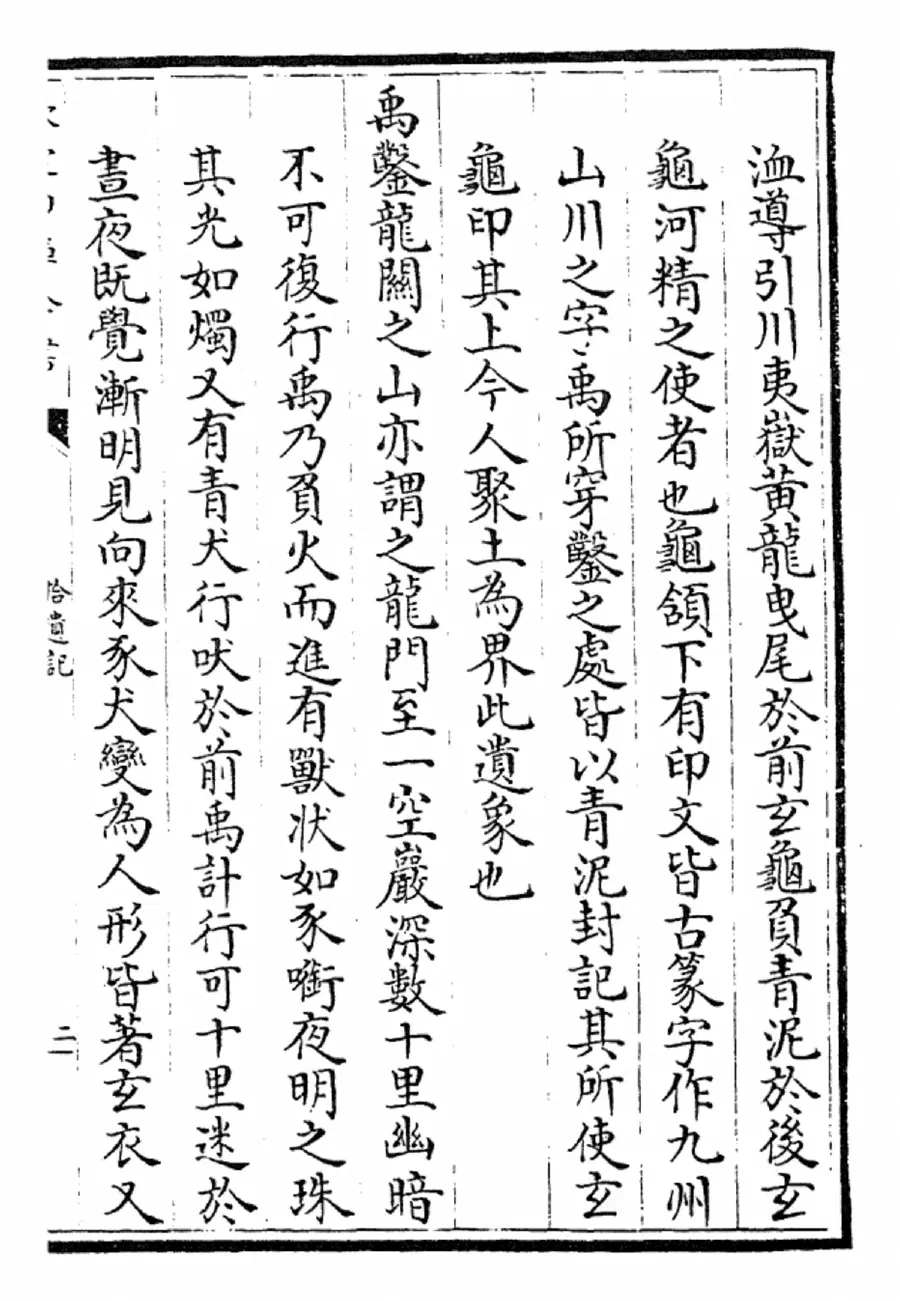
Page 35. Yu goes into the cave under Dragon Gate, led by a pig with a shining pearl and a barking dog. Scan of the Siku quanshu huiyao print of the Shiyi ji, juan 2 (Zhejiang University Library copy) Full source - 11935, juan 2
禹鑿龍關之山,亦謂之龍門。至一空巖,深數十里,幽暗不可復行,禹乃負火而進。有獸狀如豕,銜夜明之珠,其光如燭。
Yu cut through the mountain of Dragon Pass, which is also called Dragon Gate. He came to 空巖: hollow cliff, cavern, dozens of li deep, so dark that he could go no further, so Yu carried fire on his back and went in. There was a beast shaped like a pig, holding in its mouth a 夜明之珠: pearl that shines in the dark, and its light was like a candle.
- 12035, juan 2
又有青犬,行吠於前。禹計可十里,迷於晝夜。既覺漸明,見向來豕犬變為人形,皆著玄衣。
There was also a 青犬: dark-blue or green dog that went barking before him. Yu reckoned he had gone about ten li, and he lost track of day and night. When he became aware that it was growing light, he saw that the pig and dog that had come with him had changed into human form, all wearing black clothes.
Note on line 120
The Siku quanshu huiyao print (p. 35) reads 禹計行可十里, ‘Yu reckoned he had walked about ten li’. 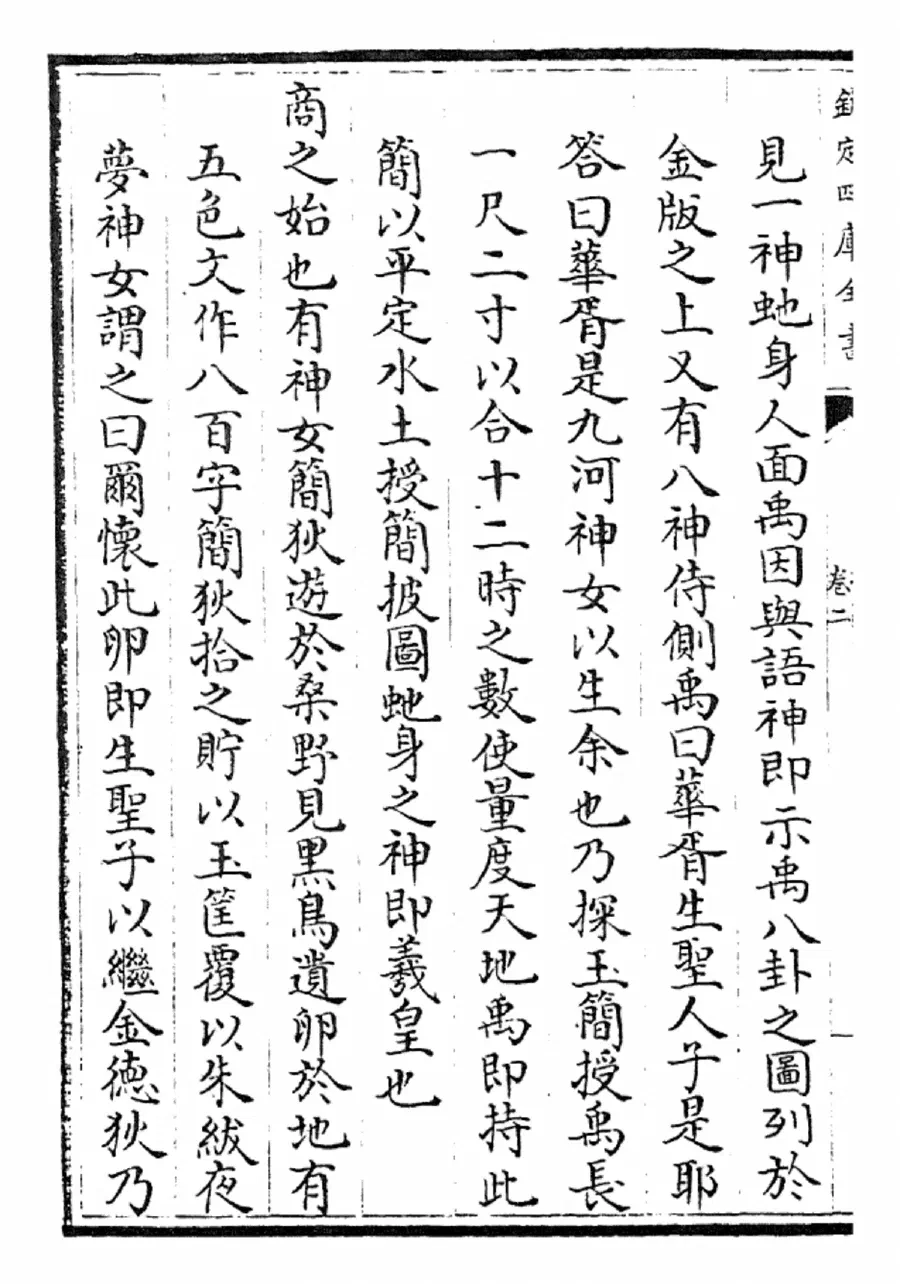
Page 36. The snake-bodied god shows Yu the eight trigrams and gives him the jade slip; the Shang section follows. Scan of the Siku quanshu huiyao print of the Shiyi ji, juan 2 (Zhejiang University Library copy) Full source - 12136, juan 2
又見一神,蛇身人面。禹因與語,神即示禹八卦之圖,列於金版之上。又有八神侍側。禹曰:「華胥生聖子,是汝耶?」
Then he saw a spirit with 蛇身: snake body and a human face. Yu spoke with it, and the spirit showed Yu the 八卦之圖: the eight trigrams, laid out on a gold tablet. Eight spirits also attended at its side. Yu said: "Huaxu bore a holy son. Are you that son?"
Note on line 121
The Siku quanshu huiyao print (p. 36) reads 聖人子, ’the son of a sage’, for 聖子, ‘a holy son’. - 12236, juan 2
答曰:「華胥是九河神女,以生餘也。」乃探玉簡授禹,長一尺二寸,以合十二時之數,使量度天地。
He answered: "Huaxu was a goddess of the Nine Rivers, and so she bore me." Then he took out a 玉簡: a slip of jade and gave it to Yu. It was one foot two inches long, matching the number of the 十二時: the twelve double-hours of the day, and with it Yu could measure heaven and earth.
Note on line 122
Huaxu stepped in a giant’s footprint and conceived Fuxi in the older sources; here she is a goddess of the Nine Rivers. The slip’s twelve inches match the twelve double-hours of the day, so the measure of the world is a measure of time too. - 12336, juan 2
禹即執持此簡,以平定水土。蛇身之神,即羲皇也。
Yu then held this slip and used it to level and settle the waters and the land. The snake-bodied spirit was Sovereign Xi (Fuxi).
Note on line 123
The Siku print reads 禹即持此簡, adds 授簡披圖 ‘he gave the slip and spread out the chart’ before the last sentence, and lacks Xiao Qi’s comment that follows here. - 124juan 2
錄曰:夫神跡難求,幽暗罔辨,希夷徬佛之間,聞見以之衒惑。若測諸冥理,先墳有所指明。
Xiao Qi comments: As for spirit traces, they are hard to pursue. They are dark and obscure, and cannot be made out. In the gap between the faint and the vague, what is heard and seen is dazzled and misled. If you measure them against the hidden principle, the earlier 先墳: the Three Mounds make it plain.
Note on line 124
徬佛 is 仿佛, ‘faint, half-seen’. 先墳 is the Three Mounds (三墳). - 125juan 2
是以彭生假見於貝丘,趙王示形於蒼犬,皆文備魯冊,驗表齊、漢。遠古曠代,事異神同。
That is why 彭生: the ghost of a murdered man appeared in disguise at Beiqiu, and the King of Zhao showed his form in a grey dog. All of these are fully written in the Lu registers and confirmed in the records of Qi and Han. Remote antiquity and vast ages: the events differ, the spirit is the same.
Note on line 125
Both of Xiao Qi’s examples are ghosts in animal form. Pengsheng, who killed Duke Huan of Lu, appeared to Duke Xiang of Qi at Beiqiu as a boar that stood up and wailed (Zuo Commentary, Duke Zhuang 8); Ruyi, King of Zhao, poisoned by Empress Lü, appeared to her as a grey dog (Shiji, Hanshu). They answer the pig and the dog in Yu’s cave. - 126juan 2
銜珠吐燭之怪,精靈一其均矣。若夫茫茫禹跡,杳漠神源,非末俗所能推辨矣。觀伏羲至於夏禹,歲歷悠曠,載祀綿邈,故能與日月共輝,陰陽齊契。
The marvels of holding pearls and spitting light: the spirit is one and the same in them all. As for the vast traces of Yu, whose spring of spirit is hidden in obscurity, these are beyond what the 末俗: the customs of a decadent age of later times can sort out. From Fuxi to Yu of Xia the years are long and far, the sacrifices reach a vast distance, and so these figures could shine together with the sun and moon, and agree in the harmony of yin and yang.
- 127juan 2
萬代百王,情異跡至,參機會道,視萬齡如旦暮,促累劫於寸陰。何嗟鬼神之可已,而疑羲、禹之相遇乎!
Across ten thousand generations and a hundred kings, their feelings differ but their traces reach the same end. They join the hidden springs and meet the Way, look on ten thousand years as one morning and evening, and press whole kalpas into 寸陰: a moment. Why cry out that ghosts and spirits can be dismissed, and doubt that Xi and Yu met?
Note on line 127
In 何嗟鬼神之可已, 已 means ‘set aside, done away with’. Juan 2 · Tang of Yin (Shang)
- 128juan 2
商之始也,有神女簡狄,遊於桑野,見黑鳥遺卵於地,有五色文,作「八百」字,簡狄拾之,貯以玉筐,覆以朱紱。
At the beginning of Shang there was a divine woman, Jiandi, who roamed in the mulberry fields. She saw a black bird drop an egg on the ground, its markings in five colors forming the characters "eight hundred." Jiandi picked it up, stored it in a 玉筐: basket of jade, and covered it with a vermilion cloth.
- 129juan 2
夜夢神母,謂之曰:「爾懷此卵,即生聖子,以繼金德。」狄乃懷卵,一年而有娠,經十四月而生契。
That night she dreamed of the divine mother, who said to her: "Hold this egg to your breast, and you will bear a holy son, who will carry on 金德: Shang's ruling element." So Jiandi held the egg to her breast; a year later she conceived, and fourteen months after that she bore Xie.
- 130juan 2
祚以八百,葉卵之文也。雖遭旱厄,後嗣興焉。
The reign was fixed at eight hundred years, in accordance with the markings on the egg. Although the line met with drought and calamity, its descendants rose.
- 131juan 2
傅說賃為赭衣者,舂於深巖以自給。夢乘雲繞日而行,筮得「利建侯」之卦。歲餘,湯以玉帛聘為阿衡也。
Fu Yue hired himself out among the 赭衣: convicts' ochre clothing, ramming earth in a deep gorge to keep himself. He dreamed that he rode the clouds and circled the sun, and divining he got the hexagram 'Favourable for setting up lords'. A year or so later Tang sent jade and silk to call him, and made him 阿衡: chief minister.
Note on line 131
Fu Yue’s labour is the 舂築, ‘pounding and building’, of Xiao Qi’s comment below: ramming earth walls, as in the Mozi. 利建侯 is the judgement of hexagram Zhun 屯. In the Documents tradition the king who finds Fu Yue is Wu Ding, not Tang. - 132juan 2
紂之昏亂,欲討諸侯,使飛廉、惡來誅戮賢良,取其寶器,埋於瓊臺之下。使飛廉等惑所近之國,侯服之內,使烽燧相續。
Zhòu was dissolute and disordered. Wanting to punish the lords, he sent Feilian and Elai to put the worthy to death and seize their precious vessels, which he buried beneath the Qiongtai [Jade Terrace]. He sent Feilian and the others to confuse the states nearest him, within the lords' zone, and had beacon fires kept burning one after another.
- 133juan 2
紂登臺以望火之所在,乃興師往伐其國,殺其君,囚其民,收其女樂,肆其淫虐。神人憤怨。
Zhòu climbed the terrace to look for where the fires were, then raised troops and went to attack that state. He killed its ruler, imprisoned its people, took its 女樂: women musicians, and indulged in 淫虐: lust and cruelty. Spirits and men raged in resentment.
- 134juan 2
時時有朱鳥銜火,如星之照耀,以亂烽燧之光。紂乃回惑,使諸國滅其烽燧。於是億兆夷民乃歡,萬國已靜。
From time to time a vermilion bird carried fire in its beak, shining like a star, to confuse the light of the beacon fires. Zhòu then grew muddled and had the states put out their beacon fires. Thereupon the countless multitudes of common people rejoiced, and the myriad states were at last quiet.
- 135juan 2
及武伐紂,樵夫牧豎探高鳥之巢,得玉璽,文曰:「水德將滅,木祚方盛。」文皆大篆,紀殷之世歷已盡,而姬之聖德方隆。
When King Wu attacked Zhòu, woodcutters and herd boys, searching the high bird nests, found a jade seal inscribed: "The 水德: the Water virtue is about to end; the throne of Wood is just now flourishing." All the characters were in the 大篆: greater seal script. The record of Yin's line had run out, while the holy virtue of the Ji house was just now rising.
- 136juan 2
是以三分天下而其二歸周。故蚩蚩之類,嗟殷亡之晚,望周來之遲也。
Thus two parts of the realm out of three went over to Zhou. Hence the ignorant multitudes sighed that Yin's fall had come so late, and longed for Zhou's coming, which was so slow.
- 137juan 2
師延者,殷之樂人也。設樂以來,世遵此職。至師延,精述陰陽,曉明象緯,莫測其為人。
Shi Yan was a musician of Yin. Ever since music was established, the office had been passed down generation after generation. In Shi Yan's time he had a precise command of yin and yang, understood the 象緯: astral signs and planetary paths, and no one could fathom what sort of man he was.
- 138juan 2
世載遼絕,而或出或隱。在軒轅之世,為司樂之官。及殷時,總脩三皇五帝之樂。拊一弦琴則地祇皆昇,吹玉律則天神俱降。
Across ages far apart he would appear and then hide again. In the age of Xuanyuan he held the office of Master of Music. In the time of Yin he gathered and kept up the music of the Three Sovereigns and Five Emperors. When he struck a one-stringed zither, the earth spirits all rose up; when he blew the 玉律: jade pitch-pipes, the gods of heaven all came down.
- 139juan 2
當軒轅之時,年已數百歲,聽眾國樂聲,以審興亡之兆。至夏末,抱樂器以奔殷。而紂淫於聲色,乃拘師延於陰宮,欲極刑戮。
In the age of Xuanyuan he was already several hundred years old, and he listened to the music of the many states to judge the omens of rise and fall. At the end of Xia he carried his instruments and fled to Yin. But Zhòu was 淫: lewd and lustful in sounds and sensual pleasures, and he confined Shi Yan in a dark palace, intending to subject him to the utmost penalty of death.
- 140juan 2
師延既被囚系,奏清商、流徵、滌角之音。司獄者以聞於紂,紂猶嫌曰:「此乃淳古遠樂,非餘可聽說也。」
Once imprisoned, Shi Yan played the clear shang, the flowing zhi, and the washing jue notes. The jailer reported this to Zhòu, but Zhòu still disliked it, saying: "This is pure, ancient, distant music, not something I can take pleasure in hearing."
Note on line 140
說 is read as 悅 (“to delight in”), not “to speak.” The shang, zhi and jue are the notes of the pentatonic scale. - 141juan 2
猶不釋。師延乃更奏迷魂淫魄之曲,以歡脩夜之娛,乃得免炮烙之害。周武王興師,乃越濮流而逝,或云死於水府。
Still he did not release him. So Shi Yan played instead tunes that 迷魂淫魄: lead the hun-soul astray, make the po-soul lewd, to heighten the pleasures of the long night, and so escaped the 炮烙: Zhòu's bronze pillar heated over coals. When King Wu of Zhou raised his army, Shi Yan crossed the Pu River and vanished; some say he died in the river's depths.
- 142juan 2
故晉、衛之人,鐫石鑄金以像其形,立祀不絕矣。
Therefore the people of Jin and Wei carved stone and cast metal to portray his form, and they kept up his sacrifices without end.
- 143juan 2
錄曰:《三墳》、《五典》及諸緯候雜說,皆言簡狄吞燕卵而生契。《詩》云:「天命玄鳥,降而生商。」
Xiao Qi comments: The Three Mounds, the Five Canons, and the miscellaneous accounts in the weft and omen texts all say that Jiandi swallowed a swallow's egg and bore Xie. The Odes says: "Heaven commanded the 玄鳥: the swallow, which descended and gave birth to Shang."
Note on line 143
The Odes quotation is from the Shang Song (“Xuanniao”). The dark bird is the swallow, the same bird the egg is said to come from. - 144juan 2
斯文正矣。此說懷感而生,眾言各異,故記其殊別也。傅說去其舂築,釋彼傭賃,應翹旌而來相,可謂知幾其神矣。
This text is the correct one. Wang Jia's account has her conceive by holding the egg to her breast, and the many accounts differ, so the differences are recorded. Fu Yue left his pounding and building and gave up his hired labour, answered the raised banner and came to be 相: minister: he can be said to have known the signs, and been divine in it.
- 145juan 2
同磻溪之歸周,異殷相之負鼎,龍蛇遇命,道會則通。斯則往賢之明教,通人之至規。「樂天知命」,信之經言也。
Like the man of Panxi coming over to Zhou, and unlike the Yin minister who carried a tripod on his back: dragon or snake, each meets his destiny, and when the Way comes together, it goes through. This is the clear teaching of the worthies of old and the highest rule of men of understanding. 'Delight in heaven and know fate': truly a saying of the classics.
Note on line 145
Panxi is where Lü Shang fished before King Wen found him; the tripod-bearer is Yi Yin, who came to Tang as a cook. ‘Dragon or snake’ echoes the Xici commentary to the Changes: ‘dragons and snakes go into hiding to keep themselves alive’ (龍蛇之蟄,以存身也), the sage lying low until his time. ‘Delight in heaven and know fate’ is also the Xici. - 146juan 2
死且不朽,是謂名也。烏無聲譽於後裔,揚風烈於萬祀。譬諸金玉,煙埃不能埋其堅貞;比之涇、濮,淄、渭,不能混其澄澈。
Dying and yet not perishing: this is what is called a name. How could he lack fame among later generations? His renown will be spread through ten thousand years of sacrifice. Like gold and jade, smoke and dust cannot bury his firm integrity; like the Jing and the Pu, the Zi and the Wei, nothing can muddy his clarity.
Note on line 146
烏 means ‘how’ here, making the sentence a rhetorical question. - 147juan 2
師延當紂之虐,矯步求存,因權取濟,觀時徇主,全身獲免。所謂困而能通,卒以智免。故影被丹青,形刊金石,愛其和樂之功,貴其神跡之遠矣。
Shi Yan, under Zhòu's cruelty, walked with restrained steps to seek survival, used expedience to get through, watched the times and served his lord, and kept his body whole and escaped. This is what is meant by: in distress he could get through, and in the end by wisdom he escaped. So his shadow was painted in cinnabar and azurite and his form carved in metal and stone. People loved the achievement of his harmony and joy, and prized the far-reaching traces of his divine work.
- 148juan 2
至如越思計然之利,鐫金以旌其德,方斯蔑矣。
As for Yue remembering the profit that Jiran brought, and casting gold to honour his virtue: beside this it is slight.
Note on line 148
The king of Yue had his adviser’s likeness cast in gold (the Guoyu names Fan Li, whose teacher was Jiran). Xiao Qi sets Shi Yan’s lasting cult above that honour. Juan 2 · Zhou
- 149juan 2
周武王東伐紂,夜濟河。時雲明如晝,八百之族,皆齊而歌。有大蜂狀如丹鳥,飛集王舟,因以鳥畫其旗。
King Wu of Zhou marched east against Zhòu and crossed the river by night. At that time the clouds were as bright as day, and the eight hundred clans all sang together in unison. A 大蜂: bee shaped like a cinnabar bird flew down and settled on the king's boat, so he painted a bird on his banner.
- 150juan 2
翌日而梟紂,名其船曰蜂舟。魯哀公二年,鄭人擊趙簡子,得其蜂旗,則其類也。【事出《太公六韜》。】
The next day he cut off Zhòu's head and hung it up, and named his boat the Bee Boat. In the second year of Duke Ai of Lu, the men of Zheng struck Zhao Jianzi and took his bee banner: it was of this kind. [The story comes from the Six Strategies of the Grand Duke.]
Note on line 150
The bee banner is in the Zuo Commentary, Duke Ai 2 (493 BC): at the battle of Tie the men of Zheng struck Zhao Jianzi in the shoulder and took his bee banner. - 151juan 2
武王使畫其像於幡旗,以為吉兆。今人幡信皆為鳥畫,則遺像也。
King Wu had its likeness painted on his banners as a good omen. Today's banners and signal flags are all painted with birds: this is the image that survives.
- 152juan 2
成王即政三年,有泥離之國來朝。其人稱:自發其國,常從雲裏而行,聞雷霆之聲在下;或入潛穴,又聞波濤之聲在上。
In the third year of King Cheng's rule, the land of Nili came to court. Its people said that since setting out from their country they had always travelled within the clouds, hearing the sound of thunder below them; or they went into hidden caverns and heard the sound of waves above them.
- 153juan 2
視日月以知方國所向,計寒暑以知年月。考國之正朔,則序曆與中國相符。王接以外賓禮也。
They watched the sun and moon to know the direction their land lay in, and reckoned cold and heat to know the years and months. When their state's 正朔: the first day and month of the year was checked against ours, its sequence of calendar matched that of the Central States. The king received them with the ceremony due to foreign guests.
- 154juan 2
四年。旃塗國獻鳳雛,載以瑤華之車,飾以五色之玉,駕以赤象,至於京師。育於靈禽之苑,飲以瓊漿,飴以雲實,二物皆出上元仙。
In the fourth year, the land of Zhantu presented a 鳳雛: phoenix chick, carried in a chariot of jade blossoms, decorated with five-colored jade, and drawn by red elephants to the capital. It was raised in the park of spirit birds, given drink of jade liquor and fed on cloud fruit. Both of these came from the immortals of the Upper Origin.
- 155juan 2
方鳳初至之時,毛色文彩未彪發;及成王封泰山、禪社首之後,文彩炳耀。中國飛走之類,不復喧鳴,咸服神禽之遠至也。
When the phoenix first arrived, its plumage and markings had not yet come out; but after King Cheng made the 封: sacrifice to heaven on Mount Tai and the 禪: sacrifice to earth at Sheshou, its markings blazed out. The flying and running creatures of the Central States stopped their clamour, all yielding to the divine bird that had come so far.
- 156juan 2
及成王崩,沖飛而去。孔子相魯之時,有神鳳遊集。至哀公之末,不復來翔,故云:「鳳鳥不至。」可為悲矣!
When King Cheng died, it flew off with a rush. When Confucius served as minister in Lu, a divine phoenix came and settled there. By the end of Duke Ai's reign it no longer came to soar, and so it is said: "The phoenix does not come." How sad that is!
Note on line 156
Quotes Analects 9.9 (“The phoenix does not come, nor does the river give forth its chart”). - 157juan 2
五年。有因祇之國,去王都九萬里,獻女工一人。體貌輕潔,被纖羅雜繡之衣,長袖脩裾,風至則結其衿帶,恐飄颻不能自止也。
In the fifth year, the land of Yinqi, ninety thousand li from the royal capital, presented one 女工: female weaver. Her body and bearing were light and fine. She wore a garment of fine gauze and mixed embroidery, with long sleeves and a trailing hem. When the wind came, she tied up her sash strings, for fear she would be blown away and could not keep herself steady.
- 158juan 2
其人善織,以五色絲內於口中,手引而結之,則成文錦。其國人來獻,有雲崑錦,文似雲從山岳中出也;有列堞錦,文似雲霞覆城雉樓堞也;有雜珠錦,文似貫珠珮也;有篆文錦,文似大篆之文也;有列明錦,文似列燈燭也。
This woman was a skilled weaver. She put five-coloured silk threads in her mouth, drew them out with her hands and knotted them, and they became patterned brocade. Her countrymen came and presented: cloud-Kun brocade, its pattern like clouds coming out of the mountains; battlement brocade, its pattern like clouds and mist over the parapets and towers of a city wall; mixed-pearl brocade, its pattern like strings of pearl pendants; seal-script brocade, its pattern like the characters of the great seal script; and row-of-lights brocade, its pattern like rows of lamps and candles.
- 159juan 2
幅皆廣三尺。其國丈夫勤於耕稼,一日鋤十頃之地。又貢嘉禾,一莖盈車。故時俗四言詩曰:「力勤十頃,能致嘉穎。」
Each bolt was three feet wide. The men of that land worked hard at plowing and sowing, and in a single day hoed ten qing of land. They also tributed fine grain, a single stalk filling a cart. Hence the popular four-word verse of the time says: "Strength and labor over ten qing, able to bring forth fine ears."
- 160juan 2
六年。燃丘之國獻比翼鳥,雌雄各一,以玉為樊。其國使者皆拳頭尖鼻,衣雲霞之布,如今朝霞也。
In the sixth year, the land of Ranqiu presented paired-wing birds, one male and one female, kept in a cage of jade. Its envoys all had fist-shaped heads and pointed noses, and wore cloth of cloud and haze, like today's morning glow.
- 161juan 2
經歷百有餘國,方至京師。其中路山川不可記。越鐵峴,泛沸海,蛇洲、蜂岑。鐵峴峭礪,車輪剛金為輞,比至京師,輪皆銚銳幾盡。
They passed through more than a hundred states before reaching the capital, and the mountains and rivers along the middle route cannot be recorded. They crossed the Iron Pass, sailed the 沸海: boiling sea, and passed Shezhou (Snake Isle) and Fengcen (Bee Peak). The Iron Pass was steep and sharp, so the cart wheels had rims of hard metal. By the time they reached the capital, the rims were worn nearly to nothing.
Note on line 161
銚銳 means the rims were ground down to nothing. - 162juan 2
又沸海洶湧如煎,魚鱉皮骨堅強如石,可以為鎧。泛沸海之時,以銅薄舟底,蛟龍不能近也。
The Boiling Sea also seethed as if being fried. The hides and bones of its fish and turtles were as hard as stone, and could be made into armor. When they sailed the Boiling Sea, they lined the bottom of the boat with thin copper, so that 蛟龍: flood dragons could not come near.
- 163juan 2
又經蛇洲,則以豹皮為屋,於屋內推車。又經蜂岑,燃胡蘇之木,此木煙能殺百蟲。經途五十餘年,乃至洛邑。
They also passed Snake Isle, and there they built houses of leopard hide and pushed their carts inside them. They passed Bee Peak and burned the wood of the 胡蘇之木: hu-su tree, whose smoke could kill a hundred kinds of insects. The journey took more than fifty years before they reached Luoyi.
- 164juan 2
成王封泰山,禪社首。使發其國之並童稚,至京師,鬚皆白。及還至燃丘,容貌還復少壯。
King Cheng made the feng sacrifice on Mount Tai and the shan at Sheshou. The envoys had set out from their country as children; when they reached the capital their beards were all white, and when they got back to Ranqiu their faces became young and strong again.
- 165juan 2
比翼鳥多力,狀如鵲,銜南海之丹泥,巢昆岑之玄木,遇聖則來集,以表周公輔聖之祥異也。
Paired-wing birds are strong. In form they are like magpies. They carry red mud from the southern sea and nest in the black wood of Kuncen (Kun Peak). When a sage appears, they come to gather, to mark the auspicious wonder of 周公輔聖: the Duke of Zhou aiding the sage.
- 166juan 2
七年。南陲之南,有扶婁之國。其人善能機巧變化,易形改服,大則興雲起霧,小則入於纖毫之中。
In the seventh year: south of the southern frontier lay the land of Fulou. Its people were very skilled at ingenious transformations, able to change their shapes and swap their clothing. Large, they could raise clouds and stir up mist; small, they could enter into a single hair's breadth.
- 167juan 2
綴金玉毛羽為衣裳。能吐雲噴火,鼓腹則如雷霆之聲。或化為犀、象、獅子、龍、蛇、犬、馬之狀。
They stitched gold, jade, and feathers into their garments. They could spit out clouds and blow out fire, and when they swelled their bellies the sound was like thunder. Or they took the shapes of rhinoceros, elephant, lion, dragon, 蛇: snake, dog, or horse.
Note on line 167
The subject is the people of Fulou, from the line before. - 168juan 2
或變為虎、兕,口中生人,備百戲之樂,宛轉屈曲於指掌間。人形或長數分,或復數寸,神怪欻忽,衒麗於時。
Or they changed into tigers and 兕: horned beasts, and out of their mouths they produced people, performing the full music of the hundred entertainments, twisting and bending within the palm of the hand. The human figures were sometimes a few fen long, sometimes several inches. Spirit marvels flashed in and out, dazzling the age with their beauty.
- 169juan 2
樂府皆傳此伎,至末代猶學焉,得粗亡精,代代不絕,故俗謂之婆候伎,則扶婁之音,訛替至今。
The music bureaus all passed this art down, and even in the last ages it was still learned, keeping the coarse and losing the fine, unbroken from generation to generation. So it is commonly called the Pohou act: the sound of 'Fulou', corrupted down to the present.
- 170juan 2
昭王即位二十年,王坐祇明之室,晝而假寐。忽夢白雲蓊蔚而起,有人衣服並皆毛羽,因名羽人。
In the twentieth year of King Zhao's reign, the king sat in the Qiming chamber and dozed in the daytime. Suddenly he dreamed of white clouds billowing up, and a person whose clothes were all feathers. Hence he was called the Feathered Man.
- 171juan 2
王夢中與語,問以上仙之術。羽人曰:「大王精智未開,欲求長生久視,不可得也。」王跪而請受絕慾之教。
In the dream the king spoke with him and asked about the arts of the highest immortals. The Feathered Man said, "Great King, your essence and wisdom are not yet opened. If you seek long life and 久視: long life, you cannot obtain it." The king knelt and asked to receive the teaching of 絕慾: abstaining from desire.
- 172juan 2
羽人乃以指畫王心,應手即裂。王乃驚寤,而血濕衿席,因患心疾,即卻膳撤樂。移於旬日,忽見所夢者復來,語王曰:「先欲易王之心。」
The Feathered Man then drew with his finger over the king's heart, and at his touch it split open. The king woke with a start; blood soaked his collar and mat. From this he suffered a heart sickness, and at once refused food and sent away the music. After ten days, the man he had dreamed of suddenly came again and said to the king: 'Before, I wished to change the king's heart.'
- 173juan 2
乃出方寸綠囊,中有續脈明丸、補血精散,以手摩王之臆,俄而即愈。王即請此藥,貯以玉罐,緘以金繩。
He took out a square-inch green pouch. Inside were the Pills That Continue the Vessels and the Powder That Restores the Blood and Essence. He rubbed the king's chest with his hand, and in an instant the king was healed. The king then asked for this medicine. He stored it in a jade jar and sealed it with a golden cord.
- 174juan 2
王以塗足,則飛天地萬里之外,如遊咫尺之內。有得服之,後天而死。
When the king smeared it on his feet, he could fly ten thousand li beyond heaven and earth, as if roaming within a few feet. Those who got to take it outlived Heaven itself.
Note on line 174
後天而死, ’to die only after heaven does’, is the text’s phrase for immortality, like 後天而老 earlier. - 175juan 2
二十四年。塗修國獻青鳳、丹鵲各一雌一雄。孟夏之時,鳳、鵲皆脫易毛羽。聚鵲翅以為扇,緝鳳羽以飾車蓋也。
In the twenty-fourth year, the land of Tuxiu presented a blue phoenix and a cinnabar magpie, one male and one female each. In the first month of summer the phoenix and the magpie both molted and replaced their feathers. They gathered the magpie wings to make fans, and twisted the phoenix feathers to decorate the 車蓋: carriage parasol.
- 176juan 2
扇一名遊飄,二名條翮,三名虧光,四名仄影。時東甌獻二女,一名延娟,二名延娛。使二人更搖此扇,侍於王側,輕風四散,泠然自涼。
The first fan was named Youpiao ('Roaming Gust'), the second Tiaohe ('Long Quill'), the third Kuiguang ('Waning Light'), the fourth Zeying ('Slanting Shadow'). At that time the land of Dong'ou presented two women, one named Yanjuan and the other Yanyu. The king had the two of them take turns waving these fans as they attended at his side, and a light breeze spread all round, cool of itself.
- 177juan 2
此二人辯口麗辭,巧善歌笑,步塵上無跡,行日中無影。及昭王淪於漢水,二女與王乘舟,夾擁王身,同溺於水。
These two had eloquent mouths and beautiful words, and were skilled at singing and laughing. They walked on dust and left no trace, and walked in the sun and cast no shadow. When King Zhao sank in the Han River, the two women rode the boat with the king, clasping his body from both sides, and drowned together in the water.
- 178juan 2
故江漢之人,到今思之,立祀於江湄。數十年間,人於江漢之上,猶見王與二女乘舟戲於水際。
So the people of the Jiang and Han rivers, still thinking of him down to the present, set up a shrine on the bank of the Jiang. For several decades afterward, people on the Jiang and Han still saw the king and the two women riding a boat and playing at the water's edge.
- 179juan 2
至暮春上巳之日,褉集祠間。或以時鮮甘味,採蘭杜包裹,以沉水中。或結五色紗囊盛食,或用金鐵之器,並沉水中,以驚蛟龍水蟲,使畏之不侵此食也。
On the Shangsi day of late spring, the third day of the third month, they gathered at the shrine for the purification rite. Some wrapped seasonal delicacies in orchids and fragrant 杜: fragrant herb and sank them in the water. Some tied food in five-colored gauze bags. Others used gold or iron vessels. All were sunk in the water, to frighten the 蛟龍: flood dragons and water creatures, so that they would be afraid and not attack this food.
- 180juan 2
其水傍號曰招祇之祠。綴青鳳之毛為二裘,一名燠質,二名暄肌,服之可以卻寒。至厲王流於彘,彘人得而奇之,分裂此裘,遍於彘土。
The shrine beside the water was called the Shrine of Zhaoqi. The blue phoenix's feathers were sewn into two coats, one named Yuzhi ('Warm Body') and the other Xuanji ('Warm Skin'); wearing them kept off the cold. When King Li was banished to Zhi, the people of Zhi got them and marvelled at them, tore the coats apart and scattered them through the land of Zhi.
- 181juan 2
罪入大闢者,抽裘一毫以贖其死,則價值萬金。
Those whose crimes merited death could buy back their lives with a single strand pulled from this fur. Its price was ten thousand in gold.
- 182juan 2
錄曰:武王資聖智而剋伐,觀天命以行誅。不驅熊羆之師,不勞三戰之旅,一戎衣而定王業,憑神力而協符瑞。
Xiao Qi comments: King Wu drew on sagely wisdom to conquer and attack. He observed the Mandate of Heaven in order to carry out the punitive killings. He did not drive forward a host of bears and brown bears, and did not wear out the three-battle army. With "one donning of armor" he settled the royal enterprise, relying on divine power to accord with the 符瑞: auspicious omens.
Note on line 182
“一戎衣” quotes the Doctrine of the Mean (Zhongyong), where King Wu “with one donning of armor had all under Heaven.” - 183juan 2
至于成王,制禮崇樂,姬德方盛,營洛邑而居九鼎,寢刑廟而萬國來賓。雖大禹之隆夏績,帝乙之興殷道,未足方焉。
As for King Cheng, he established ritual and honored music, and the virtue of the Ji house was at its height. He built Luoyi and set the Nine Tripods there. He stilled the punishments in the ancestral temple, and the myriad states came to pay court. Even the great Yu's flourishing achievements of the Xia, and Emperor Yi's revival of the way of the Yin [Shang], were not enough to compare with him.
Note on line 183
“寢刑廟” is read as “stilled punishments in the temple.” The phrase could also mean the punishments fell silent at the temple. - 184juan 2
故能繼后稷之先基,紹公劉之盛德,文、武之跡不墜,故《大雅》稱為「令德」。播聲教於八荒之外,流仁惠於九圍之表。
So he could carry on the first foundations of Houji and continue the flourishing virtue of Gongliu; the traces of Kings Wen and Wu did not fall, and the Greater Odes call it '令德: excellent virtue'. He spread his teaching beyond the Eight Wilds and let his kindness flow beyond the Nine Regions.
- 185juan 2
神智之所綏化,遐邇之所來服,靡不越岳航海,交贐於遼險之路。瑰寶殊怪之物,充於王庭;靈禽神獸之類,游集林蘌。
Where his divine wisdom pacified and transformed, near and far came to submit. None failed to cross mountains and sail the seas, exchanging tribute along the perilous roads of distant lands. Rare treasures and strange wonders filled the royal court. Spirit birds and divine beasts of every kind roamed and gathered in the groves.
Note on line 185
林蘌 is 林藪, forest and marsh thicket. - 186juan 2
詭麗殊用之物,鐫斲異於人功。方冊未之或載,篆素或所不絕。及乎王人風舉之使,直指踰於日月之陲,窮昏明之際,覘風星以望路,憑雲波而遠逝。
Strange, lovely things of exceptional use, carved and cut with skill beyond human work. The wooden tablets and books did not record them all, and the records in seal script on silk did not run out. Then came the king's envoys, who set out swift as the wind, heading straight past the edge where the sun and moon are. They reached the limit where dusk and dawn meet, watched the wind-stars to look out for the road, rode on clouds and waves, and went far away.
- 187juan 2
所謂道通幽微,德被冥昧者也。成、康以降,世祀陵衰。昭王不能弘遠業,垂聲教,南游荊楚,義乖巡狩,溺精靈於江漢,且極於幸由。
This is what is called a Way that reaches the hidden and subtle, and a virtue that covers the dark and obscure. From Cheng and Kang on, the dynasty declined. King Zhao could not widen the great work or hand down its teaching. He went south to roam in Jing and Chu, against the rule of royal tours, drowned his spirit in the Jiang and Han, and went to the limit in seeking his pleasure.
Note on line 187
幸由 is the king’s pursuit of what pleased him. - 188juan 2
水濱所以招問,《春秋》以為深貶。嗟二姬之殉死,三良之貞節。精誠一至,視殞若生。格之正道,不如強諫。楚人憐之,失其死矣。
That is why there were summonings and inquiries at the water's edge, and the Spring and Autumn took it as deep censure. Alas, the death of the two Ji women following the king, and the chaste integrity of the Three Worthies. When sincerity reaches its utmost, they regarded death as life. Measured against the correct way, it is not as good as forceful remonstrance. The people of Chu pitied them, and so missed the point of their deaths.
Note on line 188
When Qi asked Chu why King Zhao never came back from his southern campaign, Chu answered: ask the riverbank (Zuo Commentary, Duke Xi 4). The Three Good Men are the three Ziju brothers whom Duke Mu of Qin took with him in death (Zuo Commentary, Duke Wen 6; Odes, ‘Huangniao’).