~/sacred-texts/tales-of-setne-khamwas
Setne Khamwas I: The Deathless Serpent and the Book of Thoth
Translated by AI straight from the Demotic Egyptian, not from a modern translation, then checked against the editions and studies listed below. How we translate
- Text
- Tales of Setne Khamwas, Setne I (P. Cairo CG 30646), III,9–IV,26
- Date
- Copied in the Ptolemaic period (332–30 BC); the story is set under Ramesses II
- Found
- Said to come from a tomb at Thebes; bought by Mariette before 1865; now Egyptian Museum, Cairo, CG 30646
- Language
- Demotic Egyptian · Demotic
The First Tale of Setne Khamwas is a Demotic story copied in Ptolemaic Egypt about a prince of Memphis, Setne, who goes looking for a book of magic. He finds it in the tomb of an older prince, Naneferkaptah, who sits there awake among the dead with his wife Ahure and their son Merib. The opening pages of the papyrus are lost. In what survives, Ahure warns Setne off the book by telling him how they came to be there, and that is the part translated here.
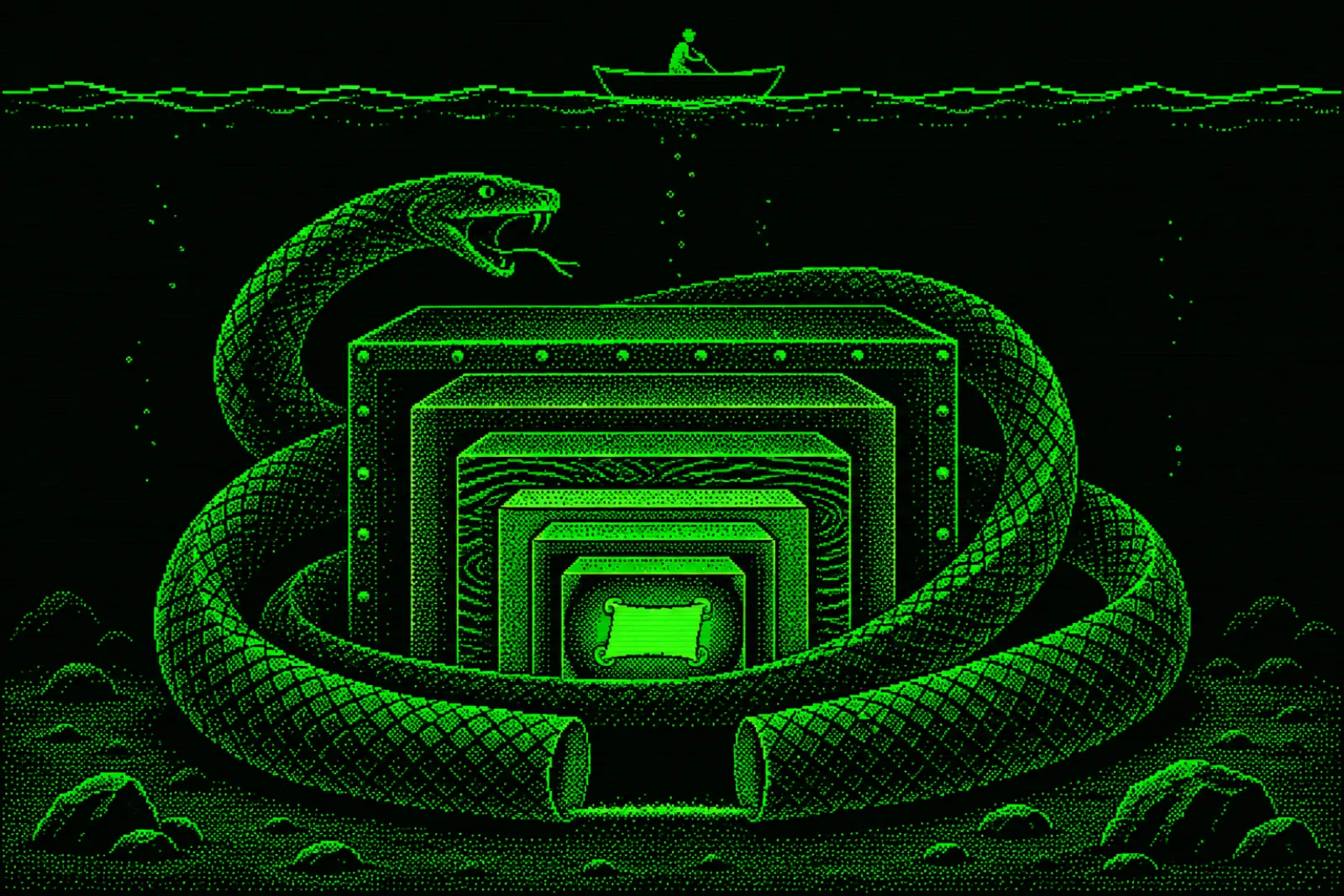
Naneferkaptah, a prince who lives for old writings, is told by a priest where the book of Thoth lies: in the middle of the “sea” of Coptos, in an iron box that holds a bronze one, then wood, ivory and ebony, silver and gold, ringed by a schoenus (a stretch of some miles) of snakes and scorpions, with a serpent of eternity coiled round the box. He sails south with Ahure, who is both his sister and his wife, and their boy. He makes a boat of wax, rows to the place, kills the serpent twice, cuts it in two the third time, and takes the book. He reads it, Ahure reads it after him, and he copies it, dissolves the copy and drinks it. Thoth complains to Re, and the family drowns, one by one, on the way home.
Ahure’s account runs from column III, line 9, to column IV, line 26 of the papyrus. The page sets it out in 200 lines. 137 are translated here from the Demotic of the open digital edition. The other 63, some of them covering several sentences, are broken in the papyrus or missing from the open edition; they are marked as missing and summarized from Griffith’s 1900 translation, so that the story reads through. Some short sentences (“He opened it”, “He fell into the river”) occur more than once in the tale, and the edition does not say where each copy stands; we have placed them by their wording against Griffith’s edition. For the Egyptian serpent texts as a whole, see Within the Coiled One.
Each numbered line gives the Demotic Egyptian first, in Latin letters. Our English is underneath. Tap a dotted word for its meaning, and Note for our comment on the line; our comments are in the right margin.
- 1III,9
This line is missing from the open Demotic Egyptian text we translate from.
Paraphrase Ahure is speaking to Setne. Her brother and husband Naneferkaptah had no occupation on earth but walking the desert cemetery of Memphis, reading the writings in the tombs of the pharaohs and on the stelae of the scribes of the House of Life, and the writings on the temples; his zeal for writings was very great.
Taken from the published translations until we can translate the Demotic Egyptian ourselves.
- 2III,10
After this there was a ḫꜥ: an appearance; a festival procession of Ptḥ: Ptah, god of Memphis.
- 3III,10
šm nꜣ.w-nfr-kꜣ-ptḥ ẖn ḥ.t-nṯr r wšd(e) to worship, to pay homage · TLA
Naneferkaptah went into the temple to wšd(e): to worship, to pay homage.
- 4III,10
ḫpr=f jw =f mšꜥ m-sꜣ pꜣ ḫꜥ an appearance; a festival procession · TLA jw =f ꜥš to call; to read aloud, recite · TLA n nꜣ sẖ writing; a written spell · TLA nty ḥr nꜣ gꜣ.t shrine, portable shrine · TLA n nꜣ nṯr.w
It happened that he was walking behind the procession, reading the writings on the gꜣ.t: shrine, portable shrine of the gods.
- 5III,11
This line is missing from the open Demotic Egyptian text we translate from.
Paraphrase Damaged: a priest, older than he, saw him.
Taken from the published translations until we can translate the Demotic Egyptian ourselves.
- 6III,11
sby to laugh · TLA =f
He sby: to laugh.
- 7III,11
This line is missing from the open Demotic Egyptian text we translate from.
Paraphrase Naneferkaptah said to him:
Taken from the published translations until we can translate the Demotic Egyptian ourselves.
- 8III,11
j.jr =k sby to laugh · TLA n.jm =y r-ḏbꜣ jḫ
“Why are you laughing at me?”
- 9III,11
This line is missing from the open Demotic Egyptian text we translate from.
Paraphrase He said:
Taken from the published translations until we can translate the Demotic Egyptian ourselves.
- 10III,11
bn tw =y sby to laugh · TLA n.jm =k jn
“I am not laughing at you!”
- 11III,11–14
This line is missing from the open Demotic Egyptian text we translate from.
Paraphrase The priest goes on: Naneferkaptah reads writings worth nothing beside a book that has no equal on earth. If he wants to recite a spell, the priest will have him taken to the place of the book that Thoth wrote with his own hand when he went down following the gods. Two formulae are written in it. Reading the first, he will enchant the sky, the earth, the underworld, the mountains and the seas; he will understand what the birds of the sky and the creeping things say; he will see the fish of the deep, with a divine power resting on the water above them.
Taken from the published translations until we can translate the Demotic Egyptian ourselves.
- 12III,14
jw =k ꜥš to call; to read aloud, recite · TLA pꜣ hp(e) law, right; a written formula · TLA mḥ-2 jw =f (r) ḫpr jw =k ẖn jmnṱ the West, the land of the dead · TLA jw =k n pꜣy =k gy form, shape, manner · TLA ḥr pꜣ tꜣ ꜥn
“If you recite the second hp(e): law, right; here a written formula, it will happen that you are in the jmnṱ: the West, the land of the dead, and you are in your gy: form, shape, manner on earth again.”
Note on line 12
The noun gy, “form”, comes back in the serpent’s fight: killed, the serpent “made its gy again” (line 67). The promise of the book and the power of its guardian are put in the same word. The TLA lemmatizes both as one noun (Demotic gy, “Art, Weise, Gestalt”): the serpent is the book’s power made flesh. Griffith (p. 20): “though thou be in Amenti, thou shalt take again thy form upon earth.” - 13III,14
This line is missing from the open Demotic Egyptian text we translate from.
Paraphrase You will see the sun rising in the sky with his Ennead, and the moon rising in its manner.
Taken from the published translations until we can translate the Demotic Egyptian ourselves.
- 14III,15
This line is missing from the open Demotic Egyptian text we translate from.
Paraphrase Naneferkaptah answers with the courtly address “O king, may he live!”
Taken from the published translations until we can translate the Demotic Egyptian ourselves.
- 15III,15
my ḏd =w n =y wꜥ.t md.t-nfr.t a good thing, a favour · TLA jw =k wḫꜣ =s tw =y jr =w s n =k mtw =k hb =y r pꜣ mꜣꜥ nty-jw pꜣy ḏmꜥ papyrus; a book, a roll · TLA n.jm =f
“Let me be told a md.t-nfr.t: a good thing, a favour you want, so I can have it done for you, and you send me to the place where this book is!”
- 16III,15
ḏd pꜣ wꜥb n nꜣ.w-nfr-kꜣ-ptḥ
The priest said to Naneferkaptah:
- 17III,15–16
This line is missing from the open Demotic Egyptian text we translate from.
Paraphrase “If you want to be sent to the place where this book is, you will give me a hundred deben of silver for my burial and have two priestly offices made out to me without fee.”
Taken from the published translations until we can translate the Demotic Egyptian ourselves.
- 18III,16
Naneferkaptah ꜥš: to call; to read aloud, recite a ẖl: boy, servant.
- 19III,16
tw =f tw =w pꜣ ḥḏ silver, money · TLA 100 n pꜣ wꜥb
He had the hundred (deben) of ḥḏ: silver, money given to the priest.
Note on line 19
A hundred deben is about the price of a middle-class embalming (Griffith, p. 21 n., after Diodorus I.91). The priest sells the way to the book for his own burial. - 20III,16–17
This line is missing from the open Demotic Egyptian text we translate from.
Paraphrase He had the two (offices) made out and given to the priest without fee. The priest said to Naneferkaptah:
Taken from the published translations until we can translate the Demotic Egyptian ourselves.
- 21III,17
pꜣ ḏmꜥ papyrus; a book, a roll · TLA n-rn =f jw =f n tꜣ mtr(e.t) middle; midday · TLA n pꜣ ym-(n-)Qbṱ the “sea” of Coptos · TLA ẖn wꜥ.t tby(.t) box, chest; coffin · TLA n bnpy iron · TLA
“That ḏmꜥ: papyrus; a book, a roll is in the middle of the ym-(n-)Qbṱ: the “sea” of Coptos, in a box of bnpy: iron,
Note on line 21
Griffith (p. 21 n.) thinks the “sea” of Coptos a sacred lake, or a stretch of the Nile near Coptos “magically extended” to guard the book. It takes three days to row to its middle. - 22III,17–18
This line is missing from the open Demotic Egyptian text we translate from.
Paraphrase the box of iron in a box of copper, the box of copper in a box of qede-wood,
Taken from the published translations until we can translate the Demotic Egyptian ourselves.
- 23III,18
jw tꜣ tby(.t) box, chest; coffin · TLA n ḫt n qd(e.t) a conifer wood (TLA: Aleppo pine) · TLA ẖn wꜥ.t tby(.t) box, chest; coffin · TLA n yb ivory · TLA hbyn ebony · TLA
the box of qd(e.t): a conifer wood; the TLA has Aleppo pine being in a box of yb: ivory and hbyn: ebony,
Note on line 23
Griffith (p. 21 n.): the priest gives the nesting inside out, and the boxes are told in their true order when Naneferkaptah opens them (lines 75–88). He compares the packing to “Hermetic sealing”. - 24III,18–20
This line is missing from the open Demotic Egyptian text we translate from.
Paraphrase the box of ivory and ebony in a box of silver, the box of silver in a box of gold, and the book is in it. A schoenus (a stretch of some miles) of snakes, scorpions and every kind of reptile lies around the box the book is in, and a serpent of eternity is around that box.”
Taken from the published translations until we can translate the Demotic Egyptian ourselves.
- 25III,20–21
This line is missing from the open Demotic Egyptian text we translate from.
Paraphrase When the priest had told him this, Naneferkaptah did not know where on earth he was. He came out of the temple and told me everything that had happened to him. He said to me:
Taken from the published translations until we can translate the Demotic Egyptian ourselves.
- 26III,21
jw =y (r) šm r Gbṱ Coptos, the modern Qift, on the Nile north of Thebes · TLA
“I will go to Gbṱ: Coptos, the modern Qift, on the Nile north of Thebes,
- 27III,21–22
This line is missing from the open Demotic Egyptian text we translate from.
Paraphrase and I will bring this book and come straight back north.” I reproached the priest: “May Amun curse you for telling him these (restored) ill-omened things! You have prepared the fight for me,
Taken from the published translations until we can translate the Demotic Egyptian ourselves.
- 28III,22
jn =k n =y pꜣ mlẖ fight, quarrel, battle · TLA
you have brought me the mlẖ: fight, quarrel, battle!”
- 29III,22
This line is missing from the open Demotic Egyptian text we translate from.
Paraphrase “The Thebaid: I have found it [cruel?]” (damaged). I did everything in my power to stop Naneferkaptah going to Coptos.
Taken from the published translations until we can translate the Demotic Egyptian ourselves.
- 30III,22
bn-pw =f sḏm to hear, to listen · TLA n =y
He did not sḏm: to hear, to listen to me.
- 31III,22
šm =f m-bꜣḥ pr-ꜥꜣ Pharaoh · TLA
He went before pr-ꜥꜣ: Pharaoh.
- 32III,23
This line is missing from the open Demotic Egyptian text we translate from.
Paraphrase He told Pharaoh everything the priest had told him. Pharaoh said to him: “What is it you want?” He said to him:
Taken from the published translations until we can translate the Demotic Egyptian ourselves.
- 33III,23
my tw =w n =y tꜣ shr(e)(.t) a royal boat · TLA pr-ꜥꜣ Pharaoh · TLA jrm pꜣy =s sbty equipment, fitting-out · TLA
“Let me be given Pharaoh's shr(e)(.t): a royal boat with its sbty: equipment, fitting-out!
- 34III,23–24
This line is missing from the open Demotic Egyptian text we translate from.
Paraphrase I will take Ahure and Merib, her boy, south with me,
Taken from the published translations until we can translate the Demotic Egyptian ourselves.
- 35III,24
and I will bring this book without wrr: to delay.”
- 36III,24
tw =w n =f shr(e)(.t) a royal boat · TLA pr-ꜥꜣ Pharaoh · TLA jrm pꜣy =s sbty equipment, fitting-out · TLA
He was given Pharaoh's pleasure-boat with its gear.
- 37III,24
ꜥl =n r mr(.t) ship-board; r mr.t, “on board” · TLA r.r =s
We went aboard it.
- 38III,24
jr =n sgr to sail, to travel by boat · TLA
We sgr: to sail, to travel by boat.
- 39III,24–25
This line is missing from the open Demotic Egyptian text we translate from.
Paraphrase We reached Coptos.
Taken from the published translations until we can translate the Demotic Egyptian ourselves.
- 40III,25
ꜥn =w smy report; complaint, accusation · TLA n.jm =s j.jr-ḥr nꜣ wꜥb.w-n-ꜣs.t n Gbṱ Coptos, the modern Qift, on the Nile north of Thebes · TLA pꜣ mr-šn the lesonis, a temple's chief administrator · TLA n Ꜣs.t Isis · TLA
It was reported to the priests of Ꜣs.t: Isis of Coptos and to the mr-šn: the lesonis, a temple's chief administrator of Isis.
- 41III,25
This line is missing from the open Demotic Egyptian text we translate from.
Paraphrase They came down to meet us.
Taken from the published translations until we can translate the Demotic Egyptian ourselves.
- 42III,25
bn-pw =w wrr to delay · TLA r-tꜣ-ḥꜣ.t-n nꜣ.w-nfr-kꜣ-ptḥ
They lost no time going to meet Naneferkaptah,
- 43III,25–26
This line is missing from the open Demotic Egyptian text we translate from.
Paraphrase and their wives came down to meet me. We went up from the shore into the temple of Isis and Harpocrates.
Taken from the published translations until we can translate the Demotic Egyptian ourselves.
- 44III,26
tw nꜣ.w-nfr-kꜣ-ptḥ jn =w jḥ jpd jrp
Naneferkaptah had cattle, fowl and wine brought,
- 45III,26
jr =f gll burnt offering · TLA wdn(e) libation · TLA m-bꜣḥ Ꜣs.t Isis · TLA n Gbṱ Coptos, the modern Qift, on the Nile north of Thebes · TLA Ḥr-pꜣ-ẖrd “Horus the Child” · TLA
and he made a gll: burnt offering and a wdn(e): libation before Isis of Coptos and Ḥr-pꜣ-ẖrd: “Horus the Child”.
- 46III,26–27
This line is missing from the open Demotic Egyptian text we translate from.
Paraphrase We were taken to a very beautiful house. Naneferkaptah spent four days feasting with the priests of Isis of Coptos,
Taken from the published translations until we can translate the Demotic Egyptian ourselves.
- 47III,27
jw nꜣ ḥm.t.w n nꜣ wꜥb.w-n-ꜣs.t jr hrw-nfr “good day”, a feast · TLA jrm =y ḥ(ꜥ) =y
while the wives of the priests of Isis feasted with me too.
- 48III,27–28
This line is missing from the open Demotic Egyptian text we translate from.
Paraphrase When the morning of the next day came, Naneferkaptah had a great deal of pure wax brought to him.
Taken from the published translations until we can translate the Demotic Egyptian ourselves.
- 49III,28
jr =f wꜥ rms a boat, a transport vessel · TLA jw =f mḥ n nꜣy =f ẖn(e) rower · TLA jrm nꜣy =f hyt sailor · TLA
He made a rms: a boat, a transport vessel full of his ẖn(e): rower and his hyt: sailor.
Note on line 49
The boat and its crew are made of the wax, which rests on Griffith’s restoration of the lost line before. Griffith (p. 24 n.) notes wax figures in older Egyptian magic (Papyrus Westcar; the Harem Conspiracy trial). - 50III,28
He recited a sẖ: writing; a written spell over them.
- 51III,28
tw =f ꜥnḫ to live · TLA =w
He made them ꜥnḫ: to live.
- 52III,28
tw =f n =w ṯꜣw breath, the breath of life · TLA
He gave them ṯꜣw: breath, the breath of life.
- 53III,28
ḥwy =f st r pꜣ ym sea; in this tale the “sea” of Coptos · TLA
He threw them into the ym: sea; here the “sea” of Coptos.
- 54III,28–29
This line is missing from the open Demotic Egyptian text we translate from.
Paraphrase He filled Pharaoh's pleasure-boat with sand (the rest of the sentence is lost).
Taken from the published translations until we can translate the Demotic Egyptian ourselves.
- 55III,29
ꜥl =f r mr(.t) ship-board; r mr.t, “on board” · TLA
He went mr(.t): ship-board; r mr.t, “on board”.
- 56III,29
ḥms =y ḥr-ḏꜣḏꜣ pꜣ ym-(n-)Qbṱ the “sea” of Coptos · TLA ḥ(ꜥ) =y ḏd jw =y (r) gm to find; to discover, understand · TLA pꜣ nty-jw =f r ḫpr n.jm =f
I, for my part, sat above the sea of Coptos, saying: “I will find out what becomes of him.”
- 57III,29–30
This line is missing from the open Demotic Egyptian text we translate from.
Paraphrase He said: “Rowers, row me to the place where this book is!” They rowed him by night as by day. He reached it in three days.
Taken from the published translations until we can translate the Demotic Egyptian ourselves.
- 58III,30
ḥwy =f šꜥ sand · TLA ḥꜣ.ṱ =f
He threw šꜥ: sand before him.
Note on line 58
Sand opens the water here, and sand ends the serpent (line 72): the same word, šꜥ, at both points of the crossing. - 59III,30–31
This line is missing from the open Demotic Egyptian text we translate from.
Paraphrase A gap opened in the river. He found a schoenus of snakes, scorpions and every kind of reptile around the place where the book was,
Taken from the published translations until we can translate the Demotic Egyptian ourselves.
- 60III,31
r.jr =f gm to find; to discover, understand · TLA wꜥ ḥf snake, serpent · TLA n ḏ.t eternity, everlastingness · TLA n pꜣ qdy circuit; n pꜣ qdy n, “around” · TLA n tꜣ tby(.t) box, chest; coffin · TLA n-rn =s
and he found a ḥf: snake, serpent ḏ.t: eternity, everlastingness qdy: circuit; n pꜣ qdy n, “around” that box.
Note on line 60
Ḥf n ḏ.t: the TLA lemmatizes ḏ.t as “eternity” and its German gives “Ewigkeitsschlange (Uroboros)”. Griffith (pp. 22, 24) translates “endless snake” and offers in his note “of eternity”, “referring to its supposed partial immunity from death”, or a species ḏt, perhaps the viper; he adds that the phrase “suggests a snake forming a complete ring round the box”. “Serpent of eternity” is right: the next lines show what the name means. - 61III,31
ꜥš to call; to read aloud, recite · TLA =f sẖ writing; a written spell · TLA r pꜣ ꜣr a long measure, the schoenus; the TLA has “mile” · TLA n ḥf snake, serpent · TLA wḥ(e)(.t) scorpion · TLA ḏdfe.t creeping thing, reptile · TLA nb nty n pꜣ qdy circuit; n pꜣ qdy n, “around” · TLA n tꜣ tby(.t) box, chest; coffin · TLA
He recited a writing against the ꜣr: a long measure, the schoenus; the TLA has “mile” of ḥf: snake, serpent, wḥ(e)(.t): scorpion and every ḏdfe.t: creeping thing, reptile that was around the box,
- 62III,31
bn-pw =f dy.t pꜣy =w
and he did not let them leap up.
- 63III,32
This line is missing from the open Demotic Egyptian text we translate from.
Paraphrase He came to the place where the serpent of eternity was.
Taken from the published translations until we can translate the Demotic Egyptian ourselves.
- 64III,32
jr =f qnqn(e) to fight, to beat · TLA jrm =f
He qnqn(e): to fight, to beat with it.
- 65III,32
ẖdb to kill · TLA =f s
He ẖdb: to kill it.
- 66III,32
ꜥnḫ to live · TLA =f
It ꜥnḫ: to live.
- 67III,32
jr =f pꜣy =f gy form, shape, manner · TLA ꜥn
It made its gy: form, shape, manner again.
Note on line 67
Literally “it made its gy again”: the TLA German has “it became again as before”, Griffith (p. 24) “it made its form again”. The verb is the plain jr, “make, do”: the serpent remakes itself. The same noun is the book’s promise in line 12 and the moon’s and stars’ “form” in line 107. - 68III,32
This line is missing from the open Demotic Egyptian text we translate from.
Paraphrase He fought with it again, a second time.
Taken from the published translations until we can translate the Demotic Egyptian ourselves.
- 69III,32
ẖdb to kill · TLA =f s
He killed it.
- 70III,32
ꜥnḫ to live · TLA =f ꜥn
It lived again.
- 71III,33
This line is missing from the open Demotic Egyptian text we translate from.
Paraphrase He fought with it again, a third time. He cut it in two pieces,
Taken from the published translations until we can translate the Demotic Egyptian ourselves.
- 72III,33
tw =f šꜥ sand · TLA jwṱ šꜥd.ṱ.t a cut piece, a section · TLA jrm tꜣy =s jry.t companion, fellow, the other of a pair · TLA
and put šꜥ: sand between one šꜥd.ṱ.t: a cut piece, a section and its jry.t: companion, fellow, the other of a pair.
Note on line 72
Jry.t is the word for a companion or the other of a pair: the halves would rejoin as fellows, and the sand keeps them apart. Dry earth breaks the serpent’s return to itself. - 73III,33
This line is missing from the open Demotic Egyptian text we translate from.
Paraphrase It died.
Taken from the published translations until we can translate the Demotic Egyptian ourselves.
- 74III,33
bn-pw =f jr pꜣy =f gy form, shape, manner · TLA r-šwe
It did not make its form again, ever.
- 75III,33
šm nꜣ.w-nfr-kꜣ-ptḥ r pꜣ mꜣꜥ nty-jw tꜣ tby(.t) box, chest; coffin · TLA n.jm =f
Naneferkaptah went to the place where the box was.
- 76III,34
This line is missing from the open Demotic Egyptian text we translate from.
Paraphrase He found that it was a box of iron.
Taken from the published translations until we can translate the Demotic Egyptian ourselves.
- 77III,34
wn to open · TLA =f r.r =s
He wn: to open it.
- 78III,34
gm to find; to discover, understand · TLA =f wꜥ.t tby(.t) box, chest; coffin · TLA n ḥmt copper, bronze · TLA
He found a box of ḥmt: copper, bronze.
- 79III,34
wn to open · TLA =f r.r =s
He opened it.
- 80III,34
gm to find; to discover, understand · TLA =f wꜥ.t tby(.t) box, chest; coffin · TLA n ḫt n qd(e.t) a conifer wood (TLA: Aleppo pine) · TLA
He found a box of qede-wood.
- 81III,34
wn to open · TLA =f r.r =s
He opened it.
- 82III,34
gm to find; to discover, understand · TLA =f tby(.t) box, chest; coffin · TLA n yb ivory · TLA hbyn ebony · TLA
He found a box of ivory and ebony.
- 83III,35
wn to open · TLA =f r.r =s
He opened it.
- 84III,35
This line is missing from the open Demotic Egyptian text we translate from.
Paraphrase He found a box of silver.
Taken from the published translations until we can translate the Demotic Egyptian ourselves.
- 85III,35
wn to open · TLA =f r.r =s
He opened it.
- 86III,35
He found a box of gold.
- 87III,35
This line is missing from the open Demotic Egyptian text we translate from.
Paraphrase He opened it and found the book in it.
Taken from the published translations until we can translate the Demotic Egyptian ourselves.
- 88III,35
He brought the book up out of the box of gold.
- 89III,35
ꜥš to call; to read aloud, recite · TLA =f wꜥ hp-n-sẖ “law of writing”, a written formula or spell · TLA n.jm =f
He ꜥš: to read aloud, recite a hp-n-sẖ: “law of writing”, a written formula or spell from it.
- 90III,36
This line is missing from the open Demotic Egyptian text we translate from.
Paraphrase He enchanted the sky, the earth, the underworld, the mountains and the seas; he understood what the birds of the sky, the fish of the deep and the beasts of the mountain were saying.
Taken from the published translations until we can translate the Demotic Egyptian ourselves.
- 91III,36
ꜥš to call; to read aloud, recite · TLA =f ky hp-n-sẖ “law of writing”, a written formula or spell · TLA
He read another written formula.
- 92III,37
This line is missing from the open Demotic Egyptian text we translate from.
Paraphrase He saw the sun shining forth in the sky with his Ennead, and the moon rising, and the stars in their form; he saw the fish of the deep, with a divine power resting on the water above them. He recited a writing over the water and made it become as it had been (restored).
Taken from the published translations until we can translate the Demotic Egyptian ourselves.
- 93III,38
This line is missing from the open Demotic Egyptian text we translate from.
Paraphrase He went aboard.
Taken from the published translations until we can translate the Demotic Egyptian ourselves.
- 94III,38
ḏd =f n nꜣ ẖn(e) rower · TLA
He said to the ẖn(e): rower:
- 95III,38
This line is missing from the open Demotic Egyptian text we translate from.
Paraphrase “Row me to the place …” (damaged).
Taken from the published translations until we can translate the Demotic Egyptian ourselves.
- 96III,38
They rowed him by grḥ: night as by mtr(e.t): middle; midday, here “by day”.
- 97III,38–39
This line is missing from the open Demotic Egyptian text we translate from.
Paraphrase He reached the place where I was. He found me sitting above the sea of Coptos, not having drunk or eaten, not having done anything on earth,
Taken from the published translations until we can translate the Demotic Egyptian ourselves.
- 98III,39
jw =y n smte n rmṯ jw pḥ =f r pr-nfr the “good house”, the embalming workshop · TLA
and I was like a person who has reached the pr-nfr: the “good house”, the embalming workshop.
Note on line 98
Griffith (p. 25 n.): the Good House is the embalming place, “not the grave itself”, where a corpse looked “far more ghastly” than as a wrapped mummy. Ahure, starved and sleepless for days, looks like a corpse on the embalmers’ table. - 99III,39
ḏd =y n nꜣ.w-nfr-kꜣ-ptḥ
I said to Naneferkaptah:
- 100III,40
This line is missing from the open Demotic Egyptian text we translate from.
Paraphrase “Let me see this book we have taken such pains over!”
Taken from the published translations until we can translate the Demotic Egyptian ourselves.
- 101III,40
He put the book in my (n-)ḏr.t: in the hand of.
- 102III,40
ꜥš to call; to read aloud, recite · TLA =y wꜥ hp-n-sẖ “law of writing”, a written formula or spell · TLA n.jm =f
I read a written formula from it.
- 103IV,1
pẖr to go around, to encircle; to enchant · TLA =y tꜣ p.t pꜣ tꜣ tꜣ dwꜣ(.t) the Duat, the underworld · TLA nꜣ tw(e) mountain · TLA nꜣ ym sea; in this tale the “sea” of Coptos · TLA
I pẖr: to go around, to encircle; to enchant the sky, the earth, the dwꜣ(.t): the Duat, the underworld, the tw(e): mountain and the seas.
Note on line 103
The woman reads the book after her husband. Pẖr is “go around, encircle”, and as a verb of magic “enchant”; its noun pẖr.t is the Demotic word for a drug or remedy (TLA lemma d2139). Ritner (The Mechanics of Ancient Egyptian Magical Practice, 1993, pp. 57–67) treats encircling as a root act of Egyptian magic. The spell encircles the world, as the serpent of eternity encircles the box. - 104IV,1
gm to find; to discover, understand · TLA =y nꜣ nty-jw nꜣ jpd.w n tꜣ p.t nꜣ rym.w n pꜣ mtr the deep, the flood · TLA jrm nꜣ tp-n-jꜣw.t cattle, herd animals · TLA ḏd n.jm =w ḏr =w
I gm: to find; to discover, understand everything the birds of the sky, the fish of the mtr: the deep, the flood and the tp-n-jꜣw.t: cattle, herd animals were saying.
- 105IV,2
ꜥš to call; to read aloud, recite · TLA =y ky hp-n-sẖ “law of writing”, a written formula or spell · TLA
I read another written formula.
- 106IV,2
This line is missing from the open Demotic Egyptian text we translate from.
Paraphrase I saw the sun shining in the sky with his Ennead,
Taken from the published translations until we can translate the Demotic Egyptian ourselves.
- 107IV,2
nw =y r pꜣ jꜥḥ moon · TLA jw =f wbn jrm nꜣ syw.w n tꜣ p.t ḏr =w jrm pꜣy =w gy form, shape, manner · TLA
I saw the jꜥḥ: moon rising with all the stars of the sky, and their gy: form, shape, manner.
- 108IV,2–3
This line is missing from the open Demotic Egyptian text we translate from.
Paraphrase I saw the fish of the deep, with a divine power resting on the water above them. But I was no scribe, compared with my elder brother Naneferkaptah, who was a good scribe and a very learned man.
Taken from the published translations until we can translate the Demotic Egyptian ourselves.
- 109IV,3
tw =f jn =w wꜥ.t šꜥd.ṱ.t a cut piece, a section · TLA n ḏmꜥ papyrus; a book, a roll · TLA n mꜣy j.jr-ḥr =f
He had a sheet of new ḏmꜥ: papyrus; a book, a roll brought before him.
- 110IV,4
This line is missing from the open Demotic Egyptian text we translate from.
Paraphrase He wrote on it every word that was on the roll before him, all of it. He had it soaked in beer,
Taken from the published translations until we can translate the Demotic Egyptian ourselves.
- 111IV,4
wty to dissolve, to melt · TLA =f s ḥr mw
he wty: to dissolve, to melt it in water,
- 112IV,4
rḫ =f s jw wꜣḥ =f wty to dissolve, to melt · TLA
he made sure it had dissolved,
- 113IV,4
swr to drink · TLA =f s
and he swr: to drink it.
Note on line 113
He takes the book into his body. Griffith (p. 26 n.) compares Muslim healers who wash a written charm into a drink. - 114IV,4
This line is missing from the open Demotic Egyptian text we translate from.
Paraphrase He knew according to what was in it.
Taken from the published translations until we can translate the Demotic Egyptian ourselves.
- 115IV,5
sṯꜣ(.ṱ) to turn back, return · TLA =n r Gbṱ Coptos, the modern Qift, on the Nile north of Thebes · TLA n pꜣ hrw n-rn =f
We went back to Coptos that same day.
- 116IV,5
jr =n hrw-nfr “good day”, a feast · TLA m-bꜣḥ Ꜣs.t Isis · TLA n Gbṱ Coptos, the modern Qift, on the Nile north of Thebes · TLA Ḥr-pꜣ-ẖrd “Horus the Child” · TLA
We made a hrw-nfr: “good day”, a feast before Isis of Coptos and Harpocrates.
- 117IV,5
ꜥl =n r mr(.t) ship-board; r mr.t, “on board” · TLA
We went aboard.
- 118IV,5
ẖdy to sail downstream, northward · TLA =n
We sailed ẖdy: to sail downstream, northward.
- 119IV,5
This line is missing from the open Demotic Egyptian text we translate from.
Paraphrase We reached a point one schoenus north of Coptos.
Taken from the published translations until we can translate the Demotic Egyptian ourselves.
- 120IV,5
ꜥs wꜣḥ Ḏḥwty Thoth, god of writing and wisdom · TLA gm to find; to discover, understand · TLA md(.t) nb (j.)jr ḫpr n nꜣ.w-nfr-kꜣ-ptḥ r-ḏbꜣ pꜣ ḏmꜥ papyrus; a book, a roll · TLA
Now Ḏḥwty: Thoth, god of writing and wisdom had found out everything that had happened with Naneferkaptah over the book.
- 121IV,6
Thoth did not delay.
- 122IV,6
He smy: to report; to accuse, to lodge a complaint before Rꜥ: Re, the sun god:
- 123IV,6
ḏd rḫ pꜣy (=y) hp(e) law, right; a written formula · TLA tꜣy (=y) wpy(.t) judgement, case · TLA jrm nꜣ.w-nfr-kꜣ-ptḥ pꜣ šr n pr-ꜥꜣ Pharaoh · TLA Mr-nb-ptḥ Merneptah · TLA
“Know my hp(e): law, right; a written formula and my wpy(.t): judgement, case against Naneferkaptah, the son of Pharaoh Mr-nb-ptḥ: Merneptah!
- 124IV,6–7
This line is missing from the open Demotic Egyptian text we translate from.
Paraphrase He went to my chamber and plundered it.
Taken from the published translations until we can translate the Demotic Egyptian ourselves.
- 125IV,7
ṯꜣy to take, to take away · TLA =f tꜣy (=y) tby(.t) box, chest; coffin · TLA ẖr tꜣy (=y) qnb(e.t) a legal deed, a document · TLA
He took my box with my qnb(e.t): a legal deed, a document.
Note on line 125
Thoth calls his book a qnb.t, a legal document or deed (TLA: “Urkunde”; Griffith p. 109: “document (?)”). The god sues for stolen property. - 126IV,7
This line is missing from the open Demotic Egyptian text we translate from.
Paraphrase He killed my guardian who was watching over it.”
Taken from the published translations until we can translate the Demotic Egyptian ourselves.
- 127IV,7
ḏd =w n =f
He was told:
- 128IV,7
jw =f j.jr-ḥr =k jrm rmṯ nb nty mtw =f ḏr =w
“He is in your power, with every person who belongs to him.”
Note on line 128
The guardian Thoth names just before is the serpent of eternity: the god counts its killing among the charges. The Demotic says literally “he is before you”, that is, in your power. - 129IV,7
wṱ =w wꜥ ḫṱ a demon or divine envoy · TLA r-ẖry n tꜣ p.t
A ḫṱ: a demon or divine envoy was sent down from the sky,
Note on line 129
The TLA reads ḫṱ, a kind of demon. Griffith (pp. 26, 109) reads nḫt, “a Power of God”, and compares the Gnostic dynameis, the angels. - 130IV,8
ḏd m-jr dy.t šm nꜣ.w-nfr-kꜣ-ptḥ r Mn-nfr Memphis · TLA jw =f wḏꜣ jrm rmṯ nb nty mtw =f ḏr =w
saying: “Do not let Naneferkaptah reach Memphis safe, with every person who belongs to him!”
- 131IV,8
wꜥ.t wnw.t hour, moment · TLA tꜣ j.jr ḫpr
There came a wnw.t: hour, moment.
- 132IV,8
This line is missing from the open Demotic Egyptian text we translate from.
Paraphrase Merib the boy came out from under the awning of Pharaoh's pleasure-boat.
Taken from the published translations until we can translate the Demotic Egyptian ourselves.
- 133IV,9
He hy: to fall into the yr: river.
- 134IV,9
jr =f ḥs “a praised one”, the Egyptian name for the drowned, who were held blessed · TLA
He drowned: he became a ḥs: “a praised one”, the Egyptian name for the drowned, who were held blessed.
Note on line 134
Jr=f ḥsy is “he became a praised one”, that is, he drowned: the drowned were called ḥsy, “praised”, and held blessed (compare Herodotus II.90). Griffith (pp. 26, 111) reads the same group ḥs(.t) pꜣ Rꜥ, “he did the will of Re”. The phrase recurs for Ahure (line 152) and Naneferkaptah (line 179). - 135IV,9
This line is missing from the open Demotic Egyptian text we translate from.
Paraphrase Everyone on board cried out. Naneferkaptah came out from under his awning.
Taken from the published translations until we can translate the Demotic Egyptian ourselves.
- 136IV,9
He recited a writing over him.
Note on line 136
The TLA German names him: “over the drowned boy”. - 137IV,9–10
This line is missing from the open Demotic Egyptian text we translate from.
Paraphrase He made him rise up, with a divine power resting on the water above him.
Taken from the published translations until we can translate the Demotic Egyptian ourselves.
- 138IV,10
He recited a writing over him.
- 139IV,10
This line is missing from the open Demotic Egyptian text we translate from.
Paraphrase He made him tell everything that had happened to him, and the accusation Thoth had made before Re.
Taken from the published translations until we can translate the Demotic Egyptian ourselves.
- 140IV,10
sṯꜣ(.ṱ) to turn back, return · TLA =n r Gbṱ Coptos, the modern Qift, on the Nile north of Thebes · TLA jrm =f
We went back to Coptos with him.
- 141IV,11
We had him taken to the Good House, the embalming house.
- 142IV,11
tw =n ꜥḥꜥ to stand; lifetime · TLA =w wbꜣ =f
We had his body ꜥḥꜥ: to stand; ꜥḥꜥ wbꜣ, “to stand by, attend to”.
Note on line 142
Griffith (p. 27 n.) thinks of “the unpleasant operations carried out by the embalmers”, or of watchers by the dead. - 143IV,11
We had him qs: to wrap, embalm, bury like a lord, a rmṯ-ꜥꜣ: a great man, a noble.
- 144IV,11
tw =n ḥtp to rest; to be at peace · TLA =f ẖn tꜣy =f tby(.t) box, chest; coffin · TLA ḥr tꜣ ḫꜣs.t desert; the necropolis · TLA n Gbṱ Coptos, the modern Qift, on the Nile north of Thebes · TLA
We laid him to ḥtp: to rest; to be at peace in his tby(.t): box, chest; coffin in the ḫꜣs.t: desert; the necropolis of Coptos.
Note on line 144
The word for his coffin, tby.t, is the word for the boxes the book lay in (lines 21, 75–88); the TLA gives both the same lemma. The point is ours: the child is shut in a box as the book was. - 145IV,11
ḏd nꜣ.w-nfr-kꜣ-ptḥ pꜣy (=y) sn
My brother Naneferkaptah said:
- 146IV,12
m-jr dy.t jr =n wrr to delay · TLA bw-jr pr-ꜥꜣ Pharaoh · TLA sḏm to hear, to listen · TLA nꜣ md(.t).w (j.)jr ḫpr n.jm =n mtw ḥꜣty(.ṱ) heart · TLA =f dḥr to be bitter, grieved · TLA r-ḏbꜣ.ṱ =s
“Let us not delay, so that Pharaoh does not hear what has happened to us and his heart grow dḥr: to be bitter, grieved over it!”
- 147IV,12
ꜥl =n r mr(.t) ship-board; r mr.t, “on board” · TLA
We went aboard.
- 148IV,12
ẖdy to sail downstream, northward · TLA =n
We sailed downstream.
- 149IV,12–13
This line is missing from the open Demotic Egyptian text we translate from.
Paraphrase Without delay we came to a point one schoenus north of Coptos, the place where Merib the boy had fallen into the river.
Taken from the published translations until we can translate the Demotic Egyptian ourselves.
- 150IV,13
tw =y jw r-bnr ẖr tꜣ ẖyb(ꜣ).t shade, shadow; an awning · TLA n shr(e)(.t) a royal boat · TLA pr-ꜥꜣ Pharaoh · TLA
I came out from under the ẖyb(ꜣ).t: shade, shadow; an awning of Pharaoh's pleasure-boat.
- 151IV,13
I fell into the river.
- 152IV,13
jr =y ḥs “a praised one”, the Egyptian name for the drowned, who were held blessed · TLA
I drowned: I became a praised one.
Note on line 152
Ahure tells her own drowning to Setne from inside the tomb at Memphis: the woman who read the book after her husband is the next to die. - 153IV,14
This line is missing from the open Demotic Egyptian text we translate from.
Paraphrase Everyone on board cried out. Naneferkaptah was told. He came out from under the awning of Pharaoh's pleasure-boat.
Taken from the published translations until we can translate the Demotic Egyptian ourselves.
- 154IV,14
He recited a writing over me.
- 155IV,14–15
This line is missing from the open Demotic Egyptian text we translate from.
Paraphrase He made me rise up, with a divine power resting on the water above me.
Taken from the published translations until we can translate the Demotic Egyptian ourselves.
- 156IV,15
tw =f jn =w ṱ =y r-ḥry
He had me brought up.
- 157IV,15
He recited a writing over me.
- 158IV,15
This line is missing from the open Demotic Egyptian text we translate from.
Paraphrase He made me tell him everything that had happened to me, and how Thoth had accused us before Re.
Taken from the published translations until we can translate the Demotic Egyptian ourselves.
- 159IV,15
sṯꜣ(.ṱ) to turn back, return · TLA =f r Gbṱ Coptos, the modern Qift, on the Nile north of Thebes · TLA jrm =y
He went back to Coptos with me.
- 160IV,16
tw =f jn =w ṱ =y r pr-nfr the “good house”, the embalming workshop · TLA
He had me taken to the Good House, the embalming house.
- 161IV,16
tw =f ꜥḥꜥ to stand; lifetime · TLA =w wbꜣ =y
He had my body tended.
- 162IV,16
He had me embalmed with the embalming of a lord, a very great man.
- 163IV,16
tw =f ḥtp to rest; to be at peace · TLA =y ẖn tꜣ ḥ.t tomb · TLA nty-jw mr-jb-ptḥ pꜣ h̭m-ẖl ḥtp to rest; to be at peace · TLA ẖn =s
He laid me to rest in the ḥ.t: tomb where Merib the boy was resting.
- 164IV,17
ꜥl =f r mr(.t) ship-board; r mr.t, “on board” · TLA
He went aboard.
- 165IV,17
ẖdy to sail downstream, northward · TLA =f
He sailed downstream.
- 166IV,17
This line is missing from the open Demotic Egyptian text we translate from.
Paraphrase Without delay he came to a point one schoenus north of Coptos, the place where we had fallen into the river.
Taken from the published translations until we can translate the Demotic Egyptian ourselves.
- 167IV,17
md =f jrm ḥꜣty(.ṱ) heart · TLA =f
He spoke with his ḥꜣty(.ṱ): heart:
- 168IV,17
ḏd jn jw =y (r) rḫ šm r Gbṱ Coptos, the modern Qift, on the Nile north of Thebes · TLA mtw =y ḥms n.jm =w
“Can I go to Coptos and live there?
- 169IV,18
This line is missing from the open Demotic Egyptian text we translate from.
Paraphrase Or if I go to Memphis at once and Pharaoh asks me about his children, what shall I say to him? Can I say to him: I took your children to the Thebaid,
Taken from the published translations until we can translate the Demotic Egyptian ourselves.
- 170IV,19
I ẖdb: to kill them, and I am alive;
Note on line 170
The verb is ẖdb, “kill”: Naneferkaptah names himself his wife’s and son’s killer. Griffith’s own word-for-word version has it (p. 113: “I slew them, I being alive”), but his running translation softens it to “and, living, let them die” (p. 28). The TLA German: “Ich habe sie getötet”. - 171IV,19
I have come to Mn-nfr: Memphis, still alive?”
- 172IV,19
tw =f jn =w wꜥ šrṱ n šs-(n-)nsw byssos, the finest linen · TLA mtw =f j.jr-ḥr =f
He had a strip of šs-(n-)nsw: byssos, the finest linen brought to him.
- 173IV,19
This line is missing from the open Demotic Egyptian text we translate from.
Paraphrase He made it into a band.
Taken from the published translations until we can translate the Demotic Egyptian ourselves.
- 174IV,19
He mr(e): to bind the book.
- 175IV,19
tw =f s r ẖ(e.t) body, belly · TLA =f
He put it on his ẖ(e.t): body, belly.
- 176IV,20
tw =f ḏr =f
He made it fast.
- 177IV,20
This line is missing from the open Demotic Egyptian text we translate from.
Paraphrase Naneferkaptah came out from under the awning of Pharaoh's pleasure-boat.
Taken from the published translations until we can translate the Demotic Egyptian ourselves.
- 178IV,20
He fell into the river.
- 179IV,20
jr =f ḥs “a praised one”, the Egyptian name for the drowned, who were held blessed · TLA
He drowned himself: he became a praised one.
Note on line 179
He drowns himself, with the book strapped to his body. The Demotic uses the same two sentences as for the child’s fall, but here they follow his question whether he can live in Coptos or face Pharaoh. - 180IV,20–21
This line is missing from the open Demotic Egyptian text we translate from.
Paraphrase Everyone on board cried out: “Great woe! Bitter woe!
Taken from the published translations until we can translate the Demotic Egyptian ourselves.
- 181IV,21
jn sṯꜣ(.ṱ) to turn back, return · TLA =f pꜣ sẖ-nfr “good scribe”, a master of writing and spells · TLA pꜣ rmṯ-rḫ “man who knows”, a sage · TLA nty-jw bn-pw ky ḫpr m-qdy.ṱ =f
Has he gone sṯꜣ(.ṱ): to turn back, return, the sẖ-nfr: “good scribe”, a master of writing and spells, the rmṯ-rḫ: “man who knows”, a sage, whose like has never been?”
Note on line 181
Griffith (p. 28 n.): “returned”, that is, “gone home”, died. - 182IV,21
This line is missing from the open Demotic Egyptian text we translate from.
Paraphrase Pharaoh's pleasure-boat sailed downstream, nobody on earth knowing where Naneferkaptah was.
Taken from the published translations until we can translate the Demotic Egyptian ourselves.
- 183IV,21
pḥ =w r Mn-nfr Memphis · TLA
They reached Memphis.
- 184IV,22
jr =w ꜥn-smy n.jm =s m-bꜣḥ pr-ꜥꜣ Pharaoh · TLA
It was reported to Pharaoh.
- 185IV,22
Pharaoh came down to meet the royal pleasure-boat
Note on line 185
The open edition splits the sentence; the next line, missing, goes on with what he wore. - 186IV,22–23
This line is missing from the open Demotic Egyptian text we translate from.
Paraphrase wearing mourning linen, and all the people of Memphis in mourning linen, with the priests of Ptah, the high priest of Ptah, the council and all Pharaoh's household.
Taken from the published translations until we can translate the Demotic Egyptian ourselves.
- 187IV,23
r.jr =w nw r nꜣ.w-nfr-kꜣ-ptḥ jw =f mḥṱ n nꜣ ḥny oar, steering oar · TLA n tꜣ shr(e)(.t) a royal boat · TLA pr-ꜥꜣ Pharaoh · TLA r-ḏbꜣ tꜣy =f wp(e.t) work, craft · TLA n sẖ-nfr “good scribe”, a master of writing and spells · TLA
They saw Naneferkaptah gripping the ḥny: oar, steering oar of Pharaoh's pleasure-boat by his wp(e.t): work, craft as a good scribe.
Note on line 187
Griffith (p. 28 n.) suggests the drowned man steered the boat home from under the water. “The craft of a good scribe” is magic. - 188IV,23
This line is missing from the open Demotic Egyptian text we translate from.
Paraphrase They took him up.
Taken from the published translations until we can translate the Demotic Egyptian ourselves.
- 189IV,23
They saw the book on his body.
- 190IV,24
This line is missing from the open Demotic Egyptian text we translate from.
Paraphrase Pharaoh said:
Taken from the published translations until we can translate the Demotic Egyptian ourselves.
- 191IV,24
my lg(y) to cease; to remove, take away · TLA =w pꜣy ḏmꜥ papyrus; a book, a roll · TLA nty n ẖ(e.t) body, belly · TLA =f
“Let this book that is on his body be lg(y): to cease; to remove, take away!”
Note on line 191
Griffith (p. 29) has “be hidden away”; the TLA’s verb lg means to stop or remove. In fact the book is buried with him. - 192IV,24
This line is missing from the open Demotic Egyptian text we translate from.
Paraphrase Pharaoh's council, with the priests of Ptah and the high priest of Ptah, said before Pharaoh:
Taken from the published translations until we can translate the Demotic Egyptian ourselves.
- 193IV,24
pꜣ pr-ꜥꜣ Pharaoh · TLA pꜣy =n nb ꜥꜣ
“Pharaoh, our great lord!
- 194IV,24
May he make the ꜥḥꜥ: lifetime; to stand of Re!
- 195IV,24
nꜣ.w-nfr-kꜣ-ptḥ sẖ-nfr “good scribe”, a master of writing and spells · TLA rmṯ-rḫ “man who knows”, a sage · TLA m-šs pꜣy
Naneferkaptah was a good scribe, a very learned man.”
- 196IV,25
This line is missing from the open Demotic Egyptian text we translate from.
Paraphrase Pharaoh had him given entry to the Good House (the embalming house) for sixteen days, wrapping for thirty-five, and coffining at seventy days in all (Griffith marks the figures uncertain).
Taken from the published translations until we can translate the Demotic Egyptian ourselves.
- 197IV,25
tw =w ḥtp to rest; to be at peace · TLA =f ẖn tꜣy =f tby(.t) box, chest; coffin · TLA n nꜣy =f ꜥ.wy-(n-)ḥtp “house of rest”, the tomb · TLA
He was laid to rest in his coffin in his ꜥ.wy-(n-)ḥtp: “house of rest”, the tomb.
- 198IV,25
twy-s nꜣ md.t-byn(.t) an evil thing, a misfortune · TLA b(y)n.w nty ḫpr n.jm =n r-ḏbꜣ pꜣy ḏmꜥ papyrus; a book, a roll · TLA nty-jw-jw =k ḏd my tw =w s n =y
“Here are the md.t-byn(.t): an evil thing, a misfortune that have happened to us because of this book, of which you say, ‘Let it be given to me!’
Note on line 198
Ahure ends her story by turning on Setne, who has come into the tomb to take the book. - 199IV,26
mn-mtw =k md(.t) mtw =f
You have no claim on it.
- 200IV,26
Our ꜥḥꜥ: lifetime; to stand on earth was ṯꜣy: to take, to take away from us because of it.”