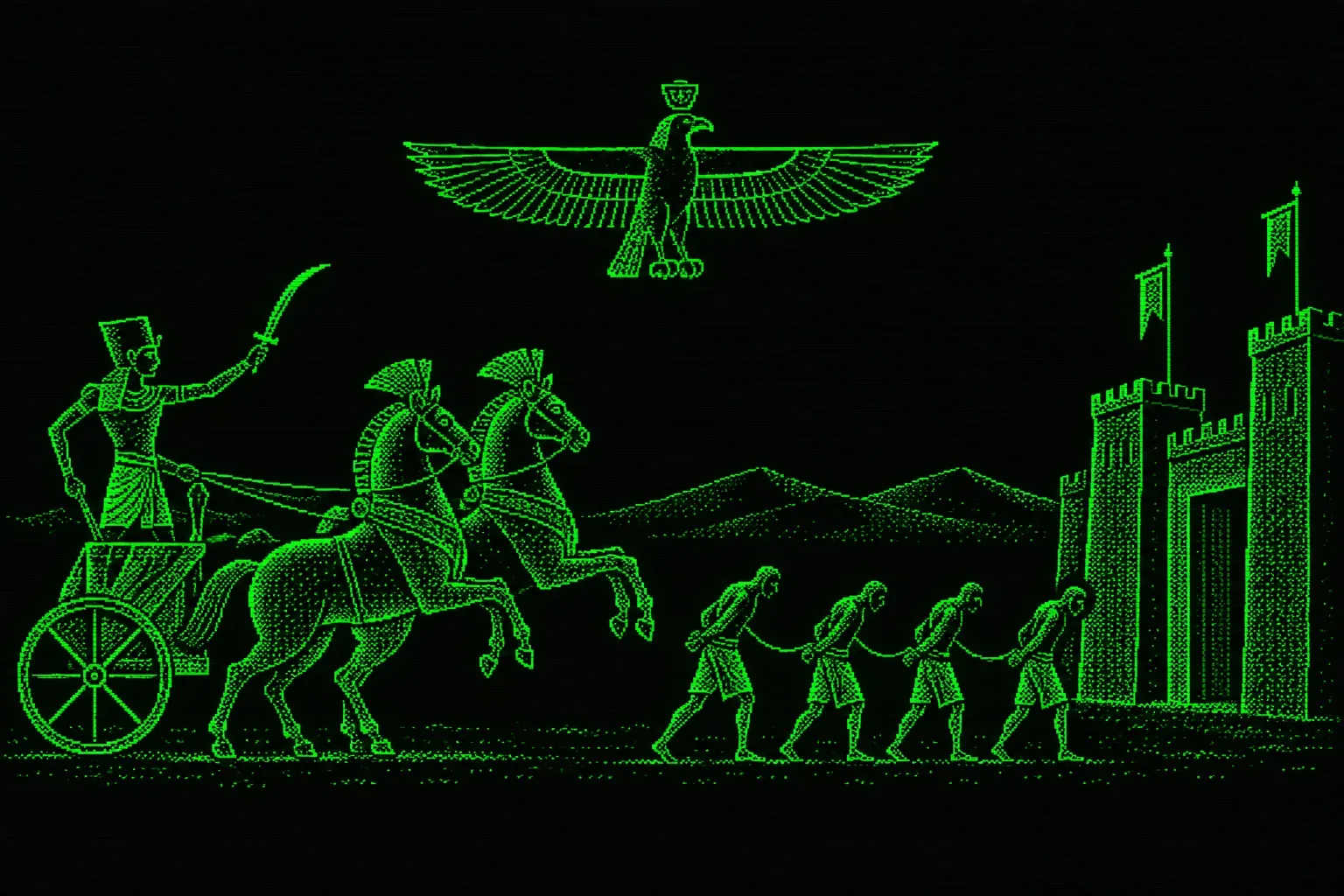
~/sacred-texts/karnak-war-reliefs-of-seti-i
Seti I Karnak Relief: Slaughter of the Shasu Rebels
- Date
- Carved in the 19th Dynasty (c. 1290–1279 BC) on the north exterior wall of the Great Hypostyle Hall at Karnak
- Found
- In situ on the north exterior wall (east side) of the Great Hypostyle Hall, Temple of Amun, Karnak (Luxor, Egypt)
- Language
- Late Egyptian · Hieroglyphic
- 1
rnp,t-zp 1 wḥm-ms,wt nswt-bj,tj nb-tꜣ,du Mn-Mꜣꜥ,t-Rꜥw ḏi̯ ꜥnḫ
Year 1 of the Renewal of Births. King of Upper and Lower Egypt, Lord of the Two Lands, Menmaatre, given life.
Note · Line 1
Menmaatre was the throne name of Seti I. The name “Renewal of Births” marks his reign as a new beginning. - 2
ꜥḥꜥ,n =tw jwi̯ r-ḏd n ḥm =f nꜣ-n ḫr.pl n Šꜣs,w šn.n =sn bdš
Then someone came to tell His Majesty: “These Shasu enemies have plotted rebellion.
Note · Line 2
The Shasu were nomadic herders of the lands east of Egypt. - 3
nꜣy =sn ꜥꜣ.pl n mhw,t dmḏ m bw wꜥ ꜥḥꜥ ḥr nꜣ-n ṯz,t n Ḫr
Their clan chiefs have gathered in one place and taken their stand in the mountains of Syria.
- 4
šzp =sn shꜣ ẖnn wꜥ jm ḥr smꜣ sn.nw{,t} =f
They have stirred up tumult and strife; each is slaughtering his fellow.
- 5
bw ḫmt =sn hp.pl n ꜥḥ
They give no thought to the laws of the palace.”
- 6
nḏm-jb.n ḥm =f ꜥnḫ-wḏꜣ-s(nb) ḥr =s
His Majesty—life, prosperity, health!—was glad at heart at this news.
Note · Line 6
“Life, prosperity, health!” is a blessing spoken at the mention of the king. - 7
jst jr nṯr-nfr ḥꜥꜥ =f n šzp ꜥḥꜣ ḫntš =f n th r =f ḥtp jb =f ḥr mꜣꜣ znf ḥsq.t =f tp.pl n ẖꜣk-jb.pl
Now the perfect god exults when he takes up battle;
he delights in whoever attacks him.
His heart is content at the sight of blood
when he cuts off the heads of rebels.Note · Line 7
“The perfect god” is the king himself. - 8
mrr =f ꜣ,t n tjtj r hrw n jhhj.pl
He loves a moment of trampling more than a day of jubilation.
- 9
smꜣ st ḥm =f m zp wꜥ b〈w〉 wꜣḥ ⸢=f⸣ [jwꜥ,wt.pl] m-j:m =sn
His Majesty slaughtered them at one stroke; he left no heirs among them.
- 10
zp ḥr ḏr,t =f m sqr-ꜥnḫ jni̯ r Tꜣ-mrj [...]
The rest, held in his hand as prisoners of war, were brought to Egypt …
- 11
nswt-bj,tj nb-tꜣ,du Mn-Mꜣꜥ,t-Rꜥw zꜣ-Rꜥw nb-ḫꜥ,w Stẖ,y-mr-n-Jmn ḏi̯ ꜥnḫ mj Rꜥw
King of Upper and Lower Egypt, Lord of the Two Lands, Menmaatre; Son of Ra, Lord of Crowns, Seti, beloved of Amun, given life like Ra.
Note · Line 11
The captions now identify the figures in the relief, beginning with the king. - 12
Nḫb,t ḥḏ,t-Nḫn ḏi̯ =s ꜥnḫ ḏd wꜣs mj Rꜥw
Nekhbet, the White One of Nekhen: may she give life, stability and dominion like Ra.
Note · Line 12
Nekhbet is the vulture goddess who protects the king. Nekhen was an ancient royal center in Upper Egypt. - 13
ḥtr ꜥꜣ tp,j n ḥm =f ꜥnḫ-wḏꜣ-s(nb) Jmn-ḏi̯≡f-pꜣ-ḫpš
His Majesty’s first great team of horses—life, prosperity, health!—“Amun Gives the Sword.”
Note · Line 13
The Egyptian word for the curved sword also means strength of arm. - 14
šms.w ⸢nswt⸣ r jwi̯.pl =f ḥr ḫꜣs,t.pl n.w Rṯn,w ⸢jn⸣ (j)r(,j)-p⸢ꜥ,t⸣ ḥꜣ,tj-ꜥ wr ⸢n⸣ ⸢sh⸣ ⸢m⸣ [...] ⸢zẖꜣ(,w)-nswt-mꜣꜥ⸣ [...] ⸢zꜣ-nswt⸣ n ẖ,t =f mri̯ =f [⸮tp?] [...] [⸮ḫꜣs,t?] nb [...]
The king is accompanied on his marches through the foreign lands of Retjenu by the hereditary prince and count, chief of … in …, true royal scribe …, the king’s son of his own body, whom he loves, foremost … every foreign land …
Note · Line 14
Retjenu was the Egyptian name for a region across much of present-day Israel, Palestine, Lebanon and Syria. - 15
tꜣ-dnj,t pꜣ ḫ[tm] [n] [Ṯꜣr,w] [...] Tꜣ-ꜥ,t-pꜣ-[mꜣj] [Pꜣ-mktr-n-Mn-Mꜣꜥ,t-Rꜥw] [[Tꜣ-ẖnm,t-⸮Ḥpn?]] ⸢Wꜣḏ,y⸣t[-n-Stẖ,y-mr-n-Ptḥ] [Tꜣ-ẖnm,t-ꜥ-n-⸮Jm,y?-ꜥꜣ]
The Denit Canal; the fortress of Tjaru; … the Lion’s Dwelling; the Tower of Menmaatre; the Well of Hepen; the Wadjet of Seti, Beloved of Ptah; the Well of the District of Imi-aa.
Note · Line 15
These labels mark places on the military road leading east from Tjaru, Egypt’s frontier fortress. - 16
ḥm-nṯr sr[.pl] ḥꜣ,wt.du [n.w] Šmꜥ,w Mḥ,w jy r swꜣš n nṯr-nfr ḫft jy =f ḥr ḫꜣs,t Rṯn,w ⸢ẖr⸣ ⸢ḥꜣq⸣ ꜥꜣ [ꜥšꜣ.pl] n ⸢pꜣu̯⸣ =tw ⸢mꜣꜣ.t⸣ mj,tt =f ḏr ⸢r⸣k nṯr
The priests, high officials and chiefs of Upper and Lower Egypt come to praise the perfect god as he returns from the foreign land of Retjenu, laden with spoils so great and so abundant that their like has not been seen since the time of the god.
Note · Line 16
“The time of the god” is the age when the gods themselves were said to rule Egypt. - 17
ḏd.n ={n}〈s〉n m dwꜣ,t ḥm =f m sꜥꜣ pḥ,tj =f jj,tj tw ḥr ḫꜣs,t.pl
They spoke in praise of His Majesty, extolling his strength:
“Welcome home from foreign lands! - 18
hd =k ḫpr
You have struck!
- 19
ḫrw =k ⸢mꜣꜥ⸣ ⸢ḫft⸣ ⸢ḫft.pl⸣ ⸢=k⸣ ẖr =k
Your war was just; your enemies lie beneath you.
- 20
⸢ꜥḥꜥ,w⸣ ⸢=k⸣ ⸢m⸣ [nswt] mj Rꜥw m p,t ḥr jꜥi̯ jb =k Pḏ,wt-9
You stand as king like Ra in the sky,
taking vengeance on the Nine Bows.Note · Line 20
The Nine Bows stand for all the traditional enemies of Egypt. - 21
jri̯.n Rꜥw tꜣš.pl =k ꜥ.wj =f m zꜣ ḥꜣ =k
Ra has set your borders;
his two arms are around you to protect you. - 22
ḥḏ =k ḥr tp n ḫꜣs,t nb wr.pl =s〈n〉 ḫr n zf,t ⸢=k⸣
Your mace is over the head of every foreign land;
their chiefs fall to your sword.”