~/sacred-texts/the-karnak-war-reliefs-of-seti-i
Seti I’s War Relief at Karnak: Captive Chiefs Given to Amun
- Date
- Carved in the reign of Seti I, 19th Dynasty (c. 1290–1279 BC), on the north outer wall of the Great Hypostyle Hall at Karnak, Thebes
- Found
- Still in place on the east side of the north exterior wall of the Great Hypostyle Hall, Karnak temple, Luxor
- Language
- Middle Egyptian (Hieroglyphic) · Hieroglyphic
- 1
ḏd-mdw jn Jmn-Rꜥw nb-ns,tpl-tꜣ,du jj,tj m ḥtp nṯr-nfr nb-tꜣ,du Mn-mꜣꜥ,t-Rꜥw
Words spoken by Amun-Ra, lord of the thrones of the Two Lands: Welcome in peace, perfect god, lord of the Two Lands, Menmaatre!
Note · Line 1
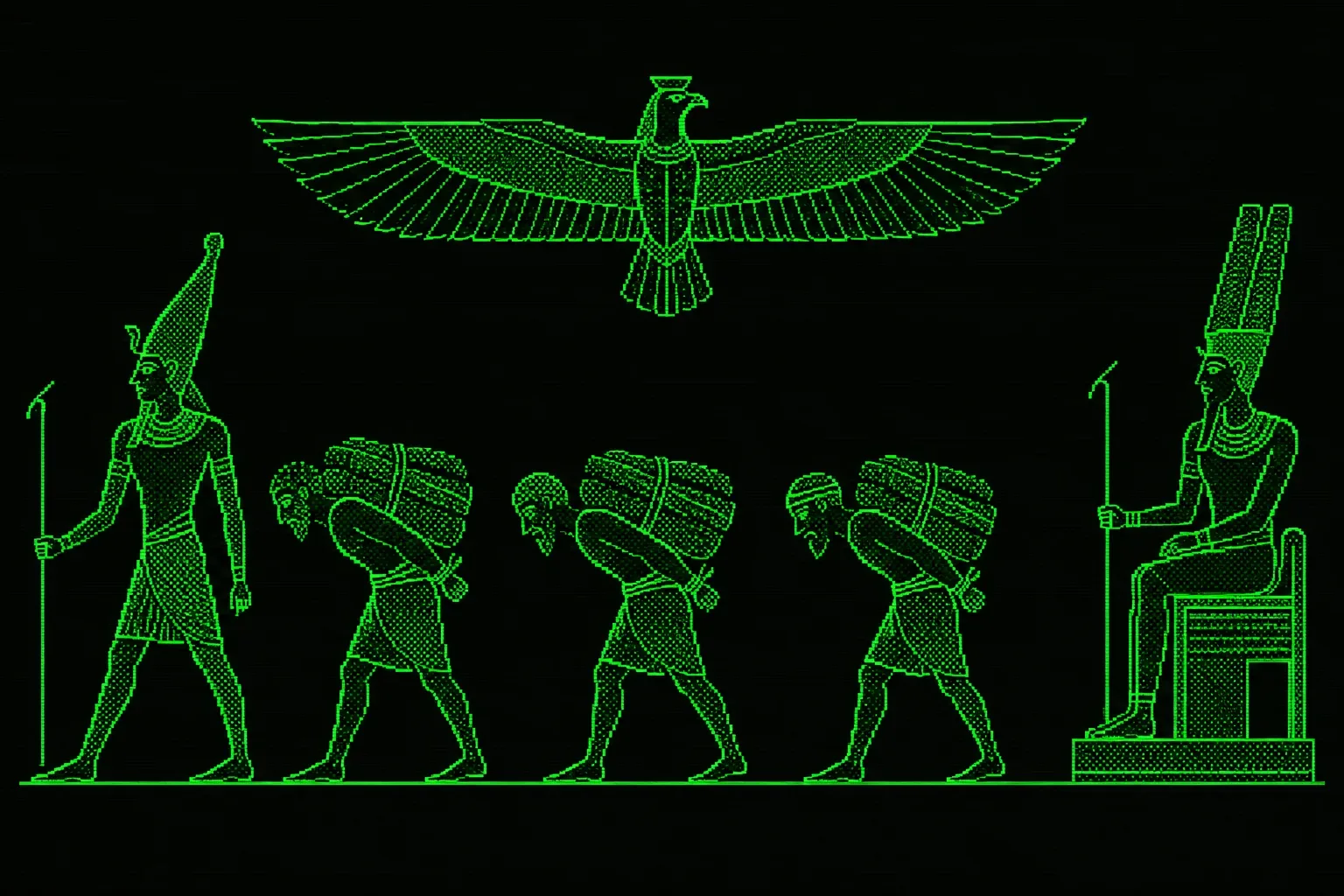
The relief shows King Seti I (c. 1290 BC) back from his campaign, presenting captives and plunder to the three gods of Thebes, Amun, Mut and Khonsu. Here Amun addresses the king. The “Two Lands” are Upper and Lower Egypt. Menmaatre is Seti’s throne name, “Enduring is the Maat of Ra”. - 2
ḏi̯ =j nḫt.pl nb ḥr ḫꜣs,t nb snḏ =k m jb pḏ,wt-9
I give you every victory over every foreign land, and the dread of you into the hearts of the Nine Bows.
Note · Line 2
The Nine Bows are the traditional enemies of Egypt, counted as nine peoples armed with the bow. - 3
jwi̯ n =k wr.pl =sn mj wꜥ ꜣṯp ḥr psḏ =sn
Their chiefs come to you as one man, their loads upon their backs.
Note · Line 3
The defeated rulers carry their own tribute on their backs. That is the gesture of submission shown in the relief. - 4
ḏi̯.n =j n =k tꜣ.pl ẖr snḏ =k pḏ,wt-9 m ks,w n hmhm,t =k
I have given you the lands, under the dread of you, and the Nine Bows bowed low at your war cry.
- 5
Mw,t wr,t nb,t-jšr,w nb,t-p,t ḥn,wt-nṯr,w-nb,w ḏi̯ =s ꜥnḫ mj Rꜥw
Mut the Great, lady of Isheru, lady of heaven, mistress of all the gods: may she give life like Ra.
Note · Line 5
Mut is Amun’s consort. Isheru is the horseshoe-shaped sacred lake around her temple at Karnak, and by extension her precinct there. - 6
Ḫns,w m Wꜣs,t Nfr-ḥtp nṯr-ꜥꜣ nb-p,t
Khonsu in Thebes, the perfectly gracious, the great god, lord of heaven.
Note · Line 6
Khonsu, a moon god, is the son of Amun and Mut. The three gods together form the divine family of Thebes. - 7
Nḫb,t nswt-bj,tj Mn-mꜣꜥ,t-Rꜥw zꜣ-Rꜥw Stẖ,y-mr-n-Jmn ḏi̯ ꜥnḫ mj Rꜥw
Nekhbet. The King of Upper and Lower Egypt Menmaatre, the Son of Ra Seti, beloved of Amun, given life like Ra.
Note · Line 7
Nekhbet, the vulture goddess of Upper Egypt, hovers protectively above the king. Seti’s two royal names follow: his throne name, and his birth name “Seti”, which means “the one of Seth”. - 8
mz jn,w.pl jn ḥm =f n jtj =f Jmn ḫft jwi̯ =f ḥr ḫꜣs,t Rṯn,w ẖzi̯ m ḥḏ nbw ḫsbd mfk(ꜣ,t) mḫn〈m〉,t ꜥꜣ,t nb šps,j
The presenting of tribute by his Majesty to his father Amun, when he came back from the foreign land of wretched Retjenu: silver and gold, lapis lazuli and turquoise, jasper, and every splendid precious stone.
Note · Line 8
Retjenu is the Egyptian name for Syria-Palestine. “Wretched” is the stock insult for any enemy land. The king calls Amun his father because every Egyptian king was held to be the god’s son. - 9
wr.pl ḫꜣs,t.pl ꜥrf m ḫfꜥ =f r mḥ šnꜥ,w n jtj =f Jmn m qn,t n ḏḏ =k n =j
The chiefs of the foreign lands, clutched in his fist, to fill the storehouses of his father Amun: "through the valor you have given me."
Note · Line 9
The words at the end are the king’s own, spoken to Amun. They credit the god with the strength that won the plunder. Captives and goods alike went to enrich Amun’s temple at Karnak. - 10
jy[.n] ḥm =f ⸢m⸣ Rṯn,w ḥr,j ḥr sws[ḫ] tꜣš.pl Km,t [...] sk[⸮sk?] [...] m [...] jn,w.pl [...]
His Majesty came back from Upper Retjenu, widening the borders of Egypt … destroying … in … tribute …
- 11
⸢wr⸣.pl ḫꜣs,t.pl ḫm Km,t jni̯.n ḥm =f m sqr-ꜥnḫ [...]
The chiefs of the foreign lands that knew not Egypt, whom his Majesty brought back as living captives …