~/sacred-texts/serapeum-stelae
Serapeum Stela of Darius I: Burial of the Apis Bull
- Date
- Carved in year 34 of the Persian king Darius I, second month of Peret, day 11 (about 488 BC), for the burial of an Apis bull in the Serapeum at Saqqara
- Found
- Found in the Serapeum at Saqqara; now in the Louvre, Paris (SIM 4039)
- Language
- Egyptian (Late Period hieroglyphic) · Hieroglyphic
- 1
rnp,t 34.n ꜣbd 2.n pr,t sw 11.n n(,j) nswt-bj.tj nb-tꜣ.dw Dryš
Year 34, second month of Peret, day 11, of the King of Upper and Lower Egypt, Lord of the Two Lands, Darius.
Note · Line 1
The date is in the reign of the Persian king Darius I, who ruled Egypt as pharaoh; his 34th year fell around 488 BC. - 2
jr.n =f ḥz(,t).pl n Ḥp ꜥnḫ ḏ =f n =f ꜥnḫ wꜣs [hrw] [pn]
He has shown favour to the living Apis, that he may grant him life and dominion this day.
Note · Line 2
Apis was the sacred bull of Memphis, honoured as the living embodiment of the god Ptah. - 3
zb nṯr m-ḥtp r jmn,t-nfr,t
The god went in peace to the Beautiful West.
Note · Line 3
The Beautiful West is the land of the dead, where the sun sets. This is the formal way of saying that the Apis bull has died and been carried to its burial. - 4
jsk wḏ [ḥm] =f ḫwz(.t) sṯꜣ,t =f r (r)ḏ.t ḥtp ḏbꜣ,t jm =s
Now His Majesty had commanded that his tomb be built, so that his coffin might rest there.
Note · Line 4
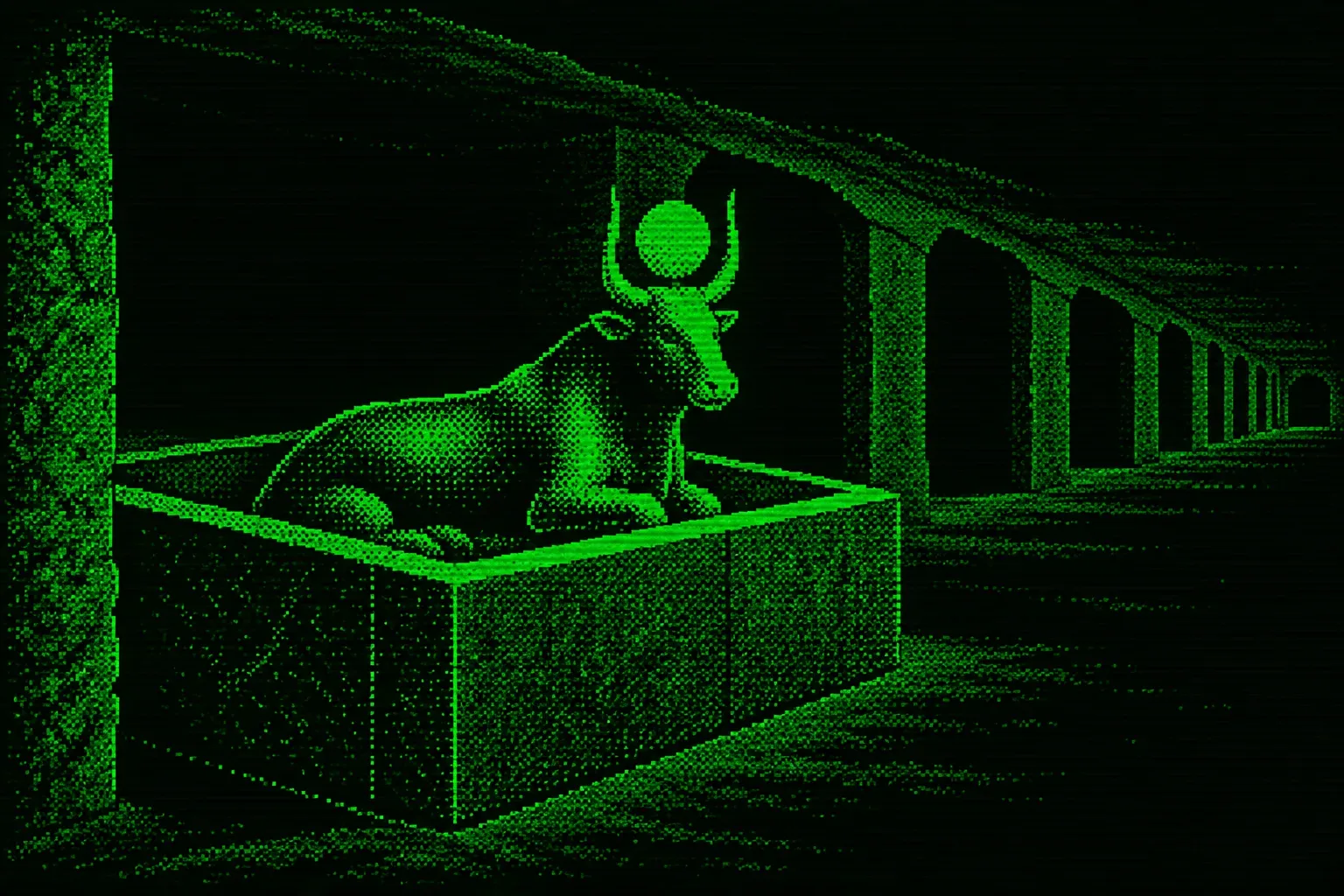
The Apis bulls were buried at Saqqara in the Serapeum, a long underground gallery of vaults, each holding a massive stone sarcophagus. This stela comes from there. - 5
wp [...] wꜣ,t r sm šꜣꜥ-r [...] ꜣw wꜣ,t jr.tn tp-ꜥ.pl
May … the way to the green pastures be opened, as far as … long … the way the forebears made.
- 6
ḥtm [...] m ḏbꜣ.w nb{,t} n nṯr [...] ḏbꜣ.w ḥḥ m šꜥy n nṯr pn 〈m〉 rnp,t tn ꜣbd 3.n [...]
May … be furnished with every offering for the god … adorned … the search in the sand for this god in this year, month 3 …
Note · Line 6
“The search in the sand” may refer to digging the burial, or to the search for the new Apis calf that followed a bull’s death. The broken text does not settle which. - 7
spr hrw n(,j) pr{r}〈.t〉 r [p,t] jn nṯr pn ꜥꜣ ꜥnḫ rḏ.t [...]
The day came for this great living god to go up to heaven … giving …
Note · Line 7
Going up to heaven is a second way of describing the god’s death. In death the bull joins the sky. - 8
nn jr.t [...] bꜣḥ [...] jm [...] jb =tn jm [...]
There shall be no doing … bah … there … your hearts in it …
Note · Line 8
Bah stands between breaks and its sense is uncertain. It may be part of m-bah, “in the presence of”, with the m lost in the gap, or the word for “flood”. - 9
m jr.t ḥz =tn [...] =tn [...] wr [...]
… in showing your favour … you … great …