~/sacred-texts/serapeum-stelae-louvre
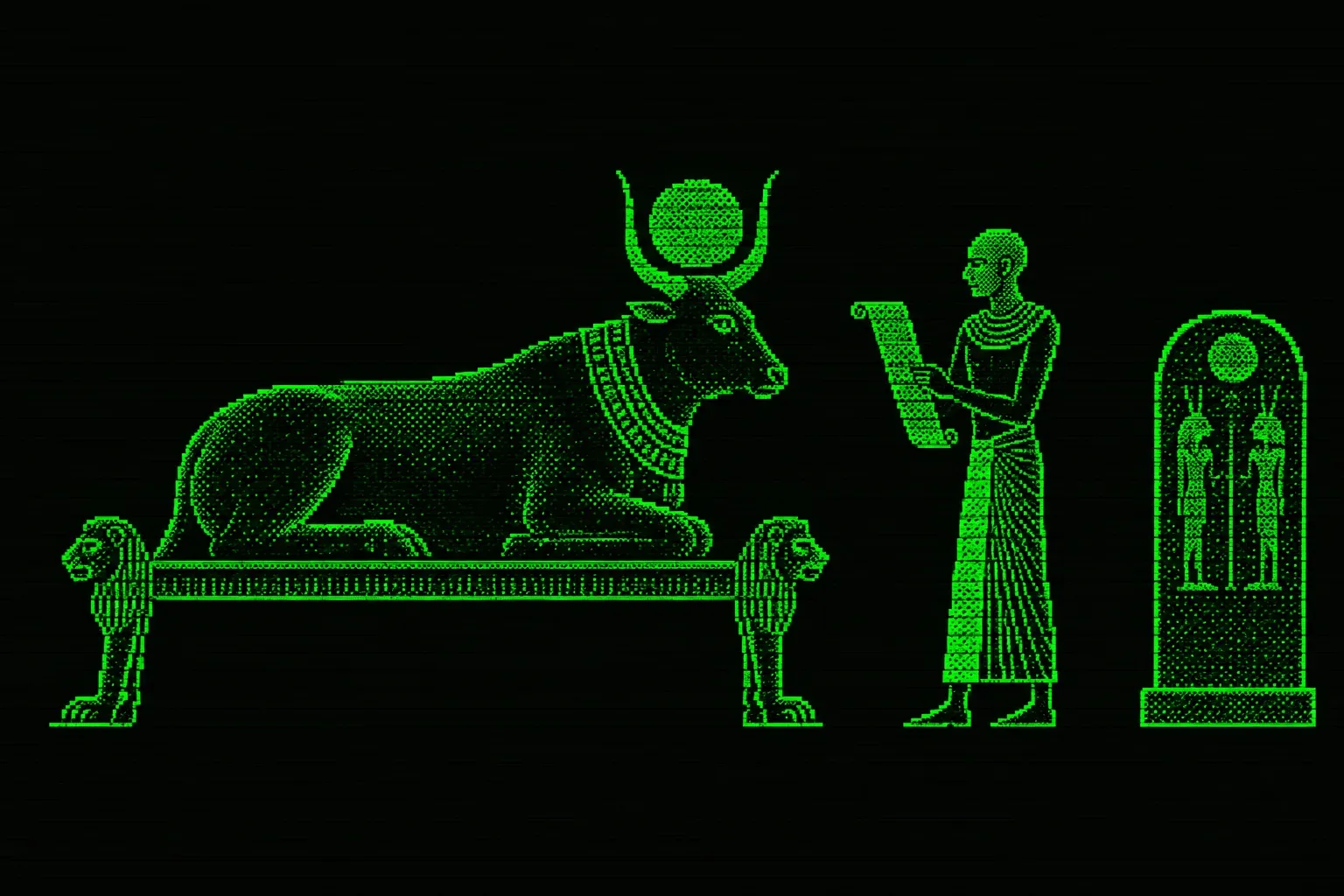
Serapeum Stela SIM 4114: Burying the Sacred Apis Bull
- Date
- Carved in the Late Period (664–332 BC) on a stela set up in the Serapeum, the burial galleries of the Apis bulls at Saqqara
- Found
- Found in the Serapeum at Saqqara during Auguste Mariette's excavations of the 1850s; now in the Louvre, Paris
- Language
- Egyptian (hieroglyphic) · Hieroglyphic
- 1
j Ḥp-Wsjr ḫnt(,j)-Jmn,t nṯr-ꜥꜣ nb-sṯꜣ,t nb-nḥḥ nswt-nṯr.pl ḏj =k mn 〈=j〉 rn n [...]
O Apis-Osiris, Foremost of the West, great god, lord of the necropolis, lord of eternity, king of the gods! May you cause my name to endure for …
Note · Line 1
Apis-Osiris is the sacred Apis bull of Memphis, who after death merged with Osiris, lord of the dead. - 2
smr-wꜥ,tj jr,t.du-nswt ḫw-Km,t ꜥq-ꜥḥ,t-wr,t-m-ḏsr.pl [...] ḫnt(,j)
Sole Companion, the Two Eyes of the King, protector of Egypt, who enters the great palace in splendour … forecourt.
Note · Line 2
These are court titles. “Sole Companion” marks a man of rank close to the king. “The Two Eyes of the King” names a trusted royal agent who sees on the king’s behalf. - 3
ḏ =tw spr wḏ n =f nswt m wꜥ.w
to whom petitions are presented, to whom the king gives his commands in private.
Note · Line 3
Petitions to the crown pass through him, and the king instructs him privately, in confidence. - 4
jmꜣḫ(,w) ḫr nṯr.pl nb(,w) nswt [...] m Ḫm [...] zꜣ jmꜣḫ(,w) ḫr Ḥw,t-Ḥr nb(,t)-jnb.pl ḥm.pl-nṯr Pꜣ-ḥṯr jr.{t}n nb,t-pr Tꜣw-jrw
Revered before all the gods and before the king … in Letopolis …, son of the one revered before Hathor, Lady of the Walls, the priest Paheter; born of the lady of the house Tauiru.
Note · Line 4
“Revered” (imakhu) describes someone honoured and provided for by gods and king, in life and in the tomb. - 5
nḏ.n =f ḥr wꜥb,t n,t ḥm =k snfr(.w) (j)ḫ,t nb(,t) n kꜣ =k
He watched over the embalming-place of Your Majesty, when everything had been made perfect for your ka.
Note · Line 5
The speaker now turns to address the dead Apis bull directly as “Your Majesty”. - 6
ꜥḥꜥ.n =f ḥr mdw,t.pl-nṯr.pl r qn =sn
Then he stood by the god's words until they were finished.
Note · Line 6
“The god’s words” are the sacred texts, the hieroglyphic spells recited over the body during the rites. - 7
njs.n =f ḥm.pl-nṯr m wꜣ r km spr,w [...] z [...]
He summoned priests from far away to bring the petitions to completion …
- 8
jw jb =f mḥ(.w) m ḥz,t nṯr.pl r ḥḥ m (j)ḫ,t nb(,t) nḥ =sn snb =f [...] nṯr.pl ꜥnḫ(.w) r nḥḥ
His heart is filled with the favour of the gods, more than millions of every good thing, while they pray for his health … the gods, who live forever.
- 9
ḥz s(w) [nṯr] mr s(w) ḥm.pl-nṯr ḥꜥꜥ b [...] jm =f m wḏ.tw [...]
May the god praise him, may the priests love him, rejoicing … in him, when … is commanded …
- 10
jtj.pl-nṯr ḥm.pl-nṯr [...] m ḥw,t-nṯr n,t Ḥp-Wsjr ḫnt(,j)-Jmn,t sꜣḫ [...] m ꜣḫ,t
The god's fathers and the priests … in the temple of Apis-Osiris, Foremost of the West, the glorification … in the horizon.
Note · Line 10
“God’s father” was a priestly rank.