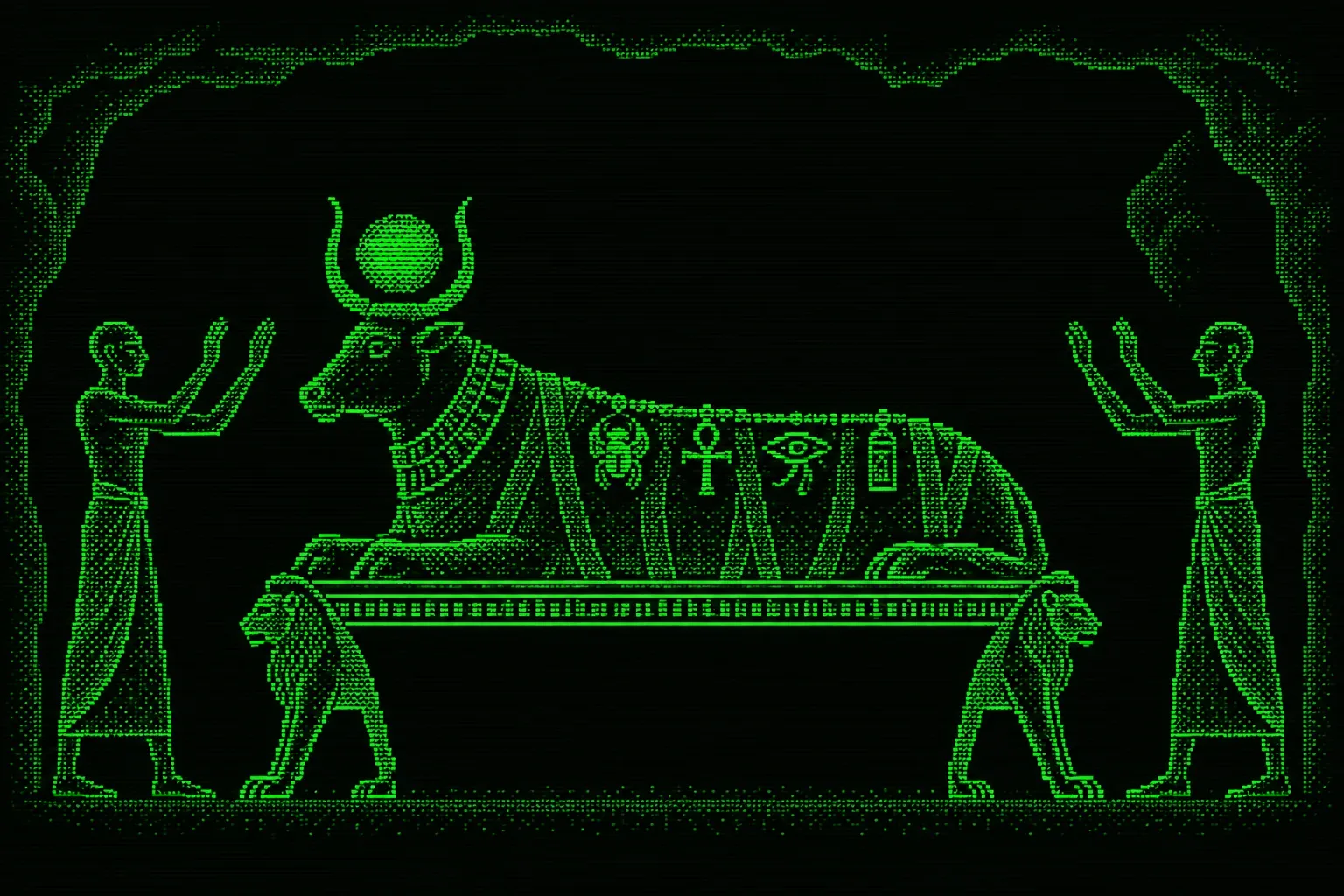
~/sacred-texts/serapeum-stelae
Serapeum Apis Stela: Burying the Sacred Bull with Gold
- Date
- Carved in the 26th Dynasty, in the reign of King Amasis (570–526 BC), on a stela set up in the Serapeum, the burial vaults of the Apis bulls at Saqqara
- Found
- Found in the Serapeum at Saqqara, the cemetery of Memphis; now in the Louvre, Paris (SIM 4115)
- Language
- Egyptian · Hieroglyphic
- 1
[...] jr n,t-ꜥ nb jr(r) =t(w) m wꜥb,t [...]
… who performs every rite that is performed in the place of embalming …
Note · Line 1
The speaker is an official of King Amasis (6th century BC). - 2
[...] nṯr pn r p,t jsṯ tw ḥr nḏ rn jtj.pl-nṯr ḥm.pl-nṯr-n.(j)w-Ptḥ [r] [jr.t] [n] [=f] [n,t-ꜥ]
… this god to heaven. Now the god's fathers and the priests of Ptah were being called upon by name to perform the rites for him …
Note · Line 2
“This god” is the dead Apis bull, whose soul is said to go up to heaven. “God’s father” was a rank of priest. - 3
[...] wꜥb,t tn
… this pure place.
- 4
n{n} ḫsf.n =j z nb ḥr ḫn jqr [...] nswt-bj.tj H̱nm-jb-Rꜥ Ḥp ꜥnḫ(.w) r nṯr nb
I rebuffed no man for an excellent word … the King of Upper and Lower Egypt Khnemibre; the Apis, may he live longer than any god.
Note · Line 4
Khnemibre is the throne name of King Amasis (reigned about 570–526 BC). The Apis, though dead and being buried, is wished an existence that outlasts every other god’s. - 5
jr-m-ḫt kꜣ,t jj [hrw] ꜣb ḥꜥ.pl nṯr zmꜣ(.w)-tꜣ
Then, after the work, came the day of parting, and the god's limbs were joined to the earth.
Note · Line 5
“The work” is the embalming. “Joined to the earth” is the usual Egyptian expression for death and burial. Here it plays against the “parting” of the same line. - 6
rḏ (=j) [n] =f zꜣ{f}.pl =f m nbw ꜥꜣ,t nb(,t) špss{w}(,t)
I gave him his amulets of gold and of every costly precious stone.
Note · Line 6
The amulets were laid on the bull’s mummy to protect it in the afterlife. - 7
ḥm =f wḏ{tw} =f n (=j) rḏ(.t) mn rn =j m zḥ-nṯr nṯr pn n-ꜥꜣ-n mr wj ḥm n(,j) nb =j
His Majesty commanded me to make my name endure in the god's hall of this god, so greatly does the Majesty of my lord love me.
Note · Line 7
The king’s favour allowed the official to set up this inscription inside the god’s sanctuary, so his name would last beside the Apis. That was a rare privilege. - 8
jw gr wḏ n =j ḥm =f [...] ḫft jj =f m Km.yt r ḥqꜣ ns,t =f m Jnb.pl-ḥḏ
His Majesty also commanded me … when he came from the Serapeum to take possession of his throne in Memphis.
Note · Line 8
The Serapeum is the great underground burial complex of the Apis bulls at Saqqara, the cemetery of Memphis.