~/sacred-texts/middle-kingdom-royal-inscriptions
Semna Boundary Stela of Senusret III: I Seized Their Wives
- Date
- Carved in year 16 of Senusret III (about 1860 BC, 12th Dynasty) on two stelae set up at the Nubian fortresses of Semna and Uronarti
- Found
- Semna stela: found in the fortress of Semna West at the Second Cataract (Sudan) in 1844; now Berlin, Ägyptisches Museum, ÄM 1157. Uronarti stela: found in the island fortress of Uronarti in 1899; now Khartoum, Sudan National Museum, no. 451.
- Language
- Middle Egyptian · Hieroglyphic
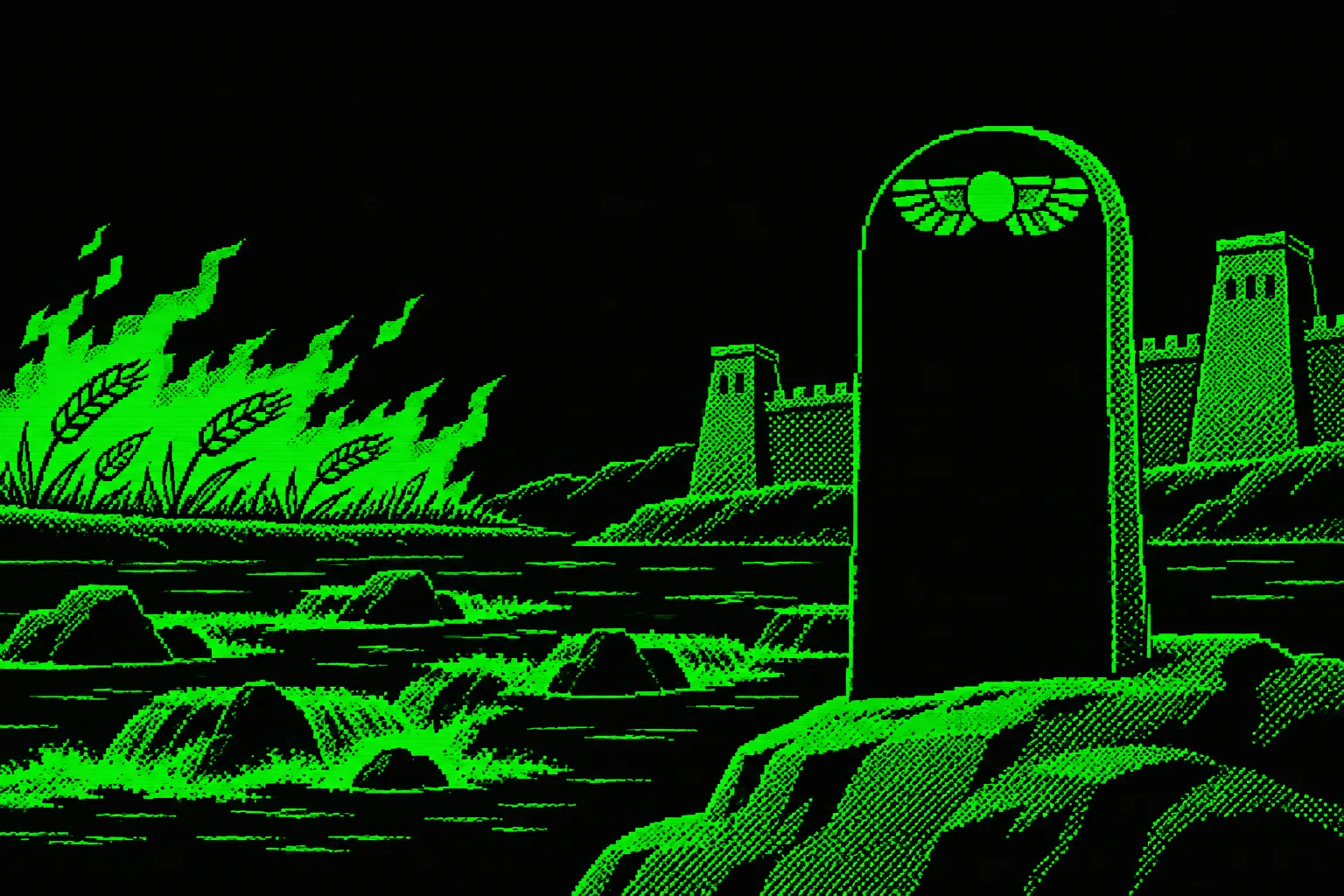
Senusret III speaks from two stelae set up in his sixteenth year at the Nubian forts of Semna and Uronarti. He has pushed Egypt’s border farther south than any king before him: I am a king who speaks and acts. Aggression is policy: To attack is courage, and the Nubians are wretches with broken hearts. His proof: I seized their wives, struck down their bulls, tore up their barley, I set fire to it.
Then he turns to his heirs. The son who holds the border is his son; whoever abandons it is no son of mine; he was not born to me. His statue stands at the frontier so that they fight for it.
The Great Semna Stela (Berlin ÄM 1157)
- 1
[...] Bḥd,tj
… the Behdetite.
Note · Line 1
The Behdetite is Horus of Behdet, shown here as a winged sun disk. - 2
[...] ꜥnḫ Ḥr Nṯr(,j)-ḫpr,w Nb,tj Nṯr(,j)-msw,t Nswt-bj,tj Ḫꜥi̯-kꜣ,w-Rꜥ ḏi̯ ꜥnḫ
… Long live the Horus “Divine in Form,” the Two Ladies “Divine in Birth,” the King of Upper and Lower Egypt Khakaure, given life.
Note · Line 2
The Two Ladies are Nekhbet and Wadjet, the guardian goddesses of Upper and Lower Egypt. Their title introduces one of the king’s royal names. - 3
ꜥnḫ Ḥr-nbw Ḫpr Zꜣ-Rꜥ n(,j) ẖ,t =f mri̯ =f nb-Tꜣ,wj Z-n-Wsr,t ḏi̯ ꜥnḫ ḏd wꜣs ḏ,t
Long live the Golden Horus “He Who Has Appeared,” the son of Ra, of his own body, whom he loves, the Lord of the Two Lands Senusret, given life, stability and power forever.
Note · Line 3
Khakaure is the throne name of Senusret III. - 4
rnp,t-zp 16 ꜣbd 3 pr,t jri̯.t ḥm =f tꜣš rs(,j) r Ḥḥ
Regnal year 16, third month of Peret: His Majesty establishes the southern boundary at Heh.
Note · Line 4
Peret was the growing season, after the Nile flood receded. Heh was at Semna in Nubia, near the Second Cataract of the Nile. - 5
jw jri̯.n =j tꜣš =j ḫnti̯ =j jt.pl =j
I have set my boundary, sailing farther upstream than my fathers did.
Note · Line 5
The king now speaks in his own voice. His “fathers” are the kings who ruled before him. - 6
jw rḏi̯.n =j ḥꜣ,w ḥr swḏ.t n =j
I have added to what was left to me.
- 7
jnk nswt ḏd.w jrr.w
I am a king who speaks and acts.
- 8
kꜣꜣ.t jb =j pw ḫpr.t m ꜥ =j
What my heart devises, my arm brings to pass.
- 9
ꜣd r jṯi̯.t sẖm.w r mꜥr
I am fierce in pursuit of conquest,
stern in pursuit of success, - 10
tm sḏr md(w),t m jb =f
one who lets no thought sleep in his heart,
- 11
ḫmt twꜣ,w.pl ꜥḥꜥ ḥr sf
who takes thought for the needy and stands for mercy,
- 12
tm sfn.w n ḫrw,y pḥ sw
yet shows no mercy to the enemy who attacks him,
- 13
pḥ pḥ.t(w) =f
who attacks when attacked,
- 14
gr.w gr.t(w)
who is silent when others are silent,
- 15
wšb.w md(w),t mj ḫpr.t jm =s
who answers each speech on its own terms.
- 16
ḏr-n,tjt jr gr m-ḫt pḥ ssḫm jb pw n(,j) ḫrw,y
For silence after an attack gives heart to the enemy.
- 17
qn,t pw ꜣd ẖs,t pw ḥmi̯ ḫti̯
To attack is courage;
to give ground and fall back is cowardice. - 18
ḥm pw mꜣꜥ ꜣr.w ḥr tꜣš =f
A coward indeed is the man who is driven from his own boundary.
- 19
ḏr-n,tjt ⸢sḏ⸣m nḥs(,j) r ḫr n(,j) rʾ
For the Nubian heeds what falls from the lips.
- 20
jn wšb =f ḏḏ ḥmi̯ =f
It is the answer he gets that makes him retreat.
- 21
ꜣd.t(w) r =f ḏḏ =f sꜣ =f
When he is attacked, he turns his back.
- 22
ḥmi̯ ḫti̯ wꜣi̯ =f r ꜣd
When his opponent gives ground and falls back, he prepares to attack.
- 23
n rmṯ(,t) js n(,j).t šfi̯.t st
They are no people to be held in respect.
- 24
ḥwrw.pl pw sḏ.w.pl jb,pl
They are wretches with broken hearts.
Note · Line 24
The king is saying that their courage breaks, not that they grieve. - 25
jw mꜣ.n st ḥm =j
My Majesty has seen it.
- 26
⸢nn⸣ m j(w)ms
It is no lie.
- 27
ḥꜣq.n =j ḥm,t.pl =sn jni̯.n =j ẖr(,j).pl =sn pr〈.n〉 =〈j〉 r ẖnm,t.pl =sn ḥwi̯〈.n〉 =〈j〉 kꜣ.pl =sn wḥꜣ〈.n〉 =〈j〉 jt =sn rḏi̯〈.n〉 =〈j〉 sḏ,t jm
I seized their wives,
I carried off their dependents,
I went out against their wells,
I struck down their bulls,
I tore up their barley,
I set fire to it. - 28
ꜥnḫ n =j jt =j ḏd =j m mꜣꜥ,t
As surely as my father lives for me, I speak the truth.
- 29
nn ḫn jm n(,j) ꜥbꜥ pri̯ m rʾ =j
Not a word of what has passed my lips is a boast.
- 30
jr grt zꜣ =j nb srwd.t(f) =fj tꜣš pn jri̯.n ḥm =j zꜣ =j pw msi̯.t(w) =f n ḥm =j
Now any son of mine who holds firm this boundary that My Majesty has set—
he is my son, born to My Majesty. - 31
twt zꜣ nḏ,tj-jt≡f srwd tꜣš n(,j) wtt sw
Worthy is the son who protects his father,
who holds firm the border of the man who begot him.Note · Line 31
“Protector of his father” is a title of Horus, who defended his father Osiris. Senusret III sets Horus up as a model for his successors. - 32
jr grt fḫ.t(j) =fj sw tm.t(j) =f(j) ꜥḥꜣ ḥr =f n zꜣ =j js n msi̯.t(w) =f js n =j
But whoever abandons it and fails to fight for it
is no son of mine; he was not born to me. - 33
jsṯ grt rḏi̯.n ḥm =j jri̯.t(w) twt n(,j) ḥm =j ḥr tꜣš pn jri̯.n ḥm =j n-mrw,t rwḏ =ṯn ḥr =f n-mrw,t ꜥḥꜣ =ṯn ḥr =f
Now My Majesty has had a statue of My Majesty made
at this border that My Majesty established,
that you may stand firm there,
that you may fight for it.Note · Line 33
Semna stood on the Nile in Nubia, at Egypt’s southern frontier. The Uronarti Stela (Khartoum 451)
- 34
[...] Bḥd,tj
… Horus of Behdet.
Note · Line 34
Horus of Behdet is the winged sun disk that crowns royal monuments. - 35
[...] Ḥr Nṯr(,j)-ḫpr,w Ḥr-nbw Ḫpr Nswt-bj,tj nb-Tꜣ,wj Ḫꜥi̯-kꜣ,w-Rꜥ ḏi̯ ꜥnḫ ḏd wꜣs mj Rꜥ ḏ,t
… Horus: Divine in His Forms; Golden Horus: He Who Has Taken Shape; King of Upper and Lower Egypt, Lord of the Two Lands, Khakaure, given life, stability and dominion like Ra forever.
Note · Line 35
The Horus and Golden Horus names are also names of the king. - 36
[...] Nb,tj Nṯr(,j)-msw,t Zꜣ-Rꜥ n(,j) ẖ,t =f Z-n-Wsr,t ḏi̯ ꜥnḫ ḏd wꜣs mj Rꜥ ḏ,t
… Two Ladies: Divine in Birth; Son of Ra, of his own flesh, Senusret, given life, stability and dominion like Ra forever.
- 37
wḏ jri̯.y m rnp,t-zp 16 ꜣbd 3 pr,t ḫft qd mn,w Ḫsf-jwn,tjw
Stela made in regnal year sixteen, in the third month of the growing season, during the building of the fortress Repeller of the Bowmen.
Note · Line 37
The fortress stood on the Nile island of Uronarti, near the Second Cataract in what is now Sudan. - 38
jw jri̯.n =j tꜣš ḫnti̯ =j jt.pl =j
I set the frontier, sailing farther upstream than my fathers.
Note · Line 38
The king now speaks. Upstream on this stretch of the Nile is south, into Nubia. - 39
jw rḏi̯.n =j ḥꜣ,w ḥr swḏ.t n =j
I added to what was handed down to me.
- 40
jnk nswt ḏd.w jr〈r〉.w
I am a king who speaks and acts.
- 41
kꜣꜣ.t jb =j pw ḫpr.t m ꜥ =j
What my heart conceives comes to pass by my hand.
- 42
ꜣd.w r jṯi̯.t sẖm.w r mꜥr
I am fierce in pursuit of conquest, unyielding in pursuit of success,
- 43
tm sḏr md(w),t m jb =f
one who lets no matter sleep in his heart,
- 44
ḫmt twꜣ,w.pl ꜥḥꜥ ḥr sf
who keeps the needy in mind and stands for mercy,
- 45
tm sfn.w n ḫrw,y pḥ sw
yet shows no mercy to the foe who attacks him,
- 46
pḥ.w pḥ.t(w) =f
who attacks when attacked,
- 47
gr.w ⸢gr.t(w)⸣
who keeps still when others keep still,
- 48
wšb.w md(w),t mj ḫpr.t jm =s
who answers a speech according to what was said.
- 49
ḏr-n,tjt jr gr m-ḫt pḥ ssḫm jb pw n(,j) ḫrw,y
For to keep still after an attack is to give the foe heart.
- 50
qn,t pw ꜣd ẖs.t pw ḥmi̯ ḫti̯
To attack is courage;
to draw back and retreat is cowardice. - 51
ḥm pw mꜣꜥ ꜣr.w ḥr tꜣš =f
A coward indeed is the man driven from his own frontier.
- 52
ḏr-n,tjt sḏm nḥs(,j) r ḫr n(,j) rʾ
For the Nubian heeds what falls from the mouth.
Note · Line 52
The king speaks of “the Nubian” as a single adversary, making his own contempt stand for a judgment on a whole people. - 53
jn wšb =f ḏḏ ḥmi̯ =f
It is the answer one gives him that makes him retreat.
- 54
ꜣd.t(w) r =f ḏḏ =f sꜣ =f
When he is attacked, he turns his back.
- 55
ḥmi̯ ḫti̯ wꜣi̯ =f r ꜣd
When one draws back and retreats, he prepares to attack.
- 56
n rmṯ(,t) js n(,j).t šfi̯.t st
They are not a people to be held in respect.
- 57
ḥwrw.pl pw sd.w jb.pl
They are wretches whose hearts are broken.
- 58
jw mꜣ〈.n〉 st ḥm =j
My Majesty has seen it.
- 59
nn m j(w)ms
It is no lie.
- 60
ḥꜣq.n =j ḥm,t.pl =sn jni̯.n =j ẖr(,jw) =sn pr〈.n〉 =〈j〉 r ẖnm,t.pl =sn ḥwi̯〈.n〉 =〈j〉 kꜣ.pl =sn wḥꜣ.n =j jt =sn rḏi̯〈.n〉 =〈j〉 sḏ,t jm
I took their wives captive, I carried off their dependents.
I went out against their wells, I struck their bulls.
I tore up their barley, I set fire to it. - 61
ꜥnḫ n =j jt ⸢=j⸣ ḏd.n =j m mꜣꜥ,t
As surely as my father lives for me, I have spoken the truth.
- 62
nn ḫn jm n(,j) ꜥbꜥ pri̯ m rʾ =j
Not a word of boasting in it has passed my lips.
- 63
jr grt zꜣ =⸢j⸣ nb srwd.t(j) =fj tꜣš pn jri̯.n ḥm =j ꜥnḫ-(w)ḏꜣ-s(nb) zꜣ =j ⸢pw⸣ [msi̯.tw] =[f] [n] ḥm =j ꜥnḫ-(w)ḏꜣ-snb
Now any son of mine who will hold firm this frontier that My Majesty—life, prosperity, health!—has set: he is my son, born to My Majesty—life, prosperity, health!
Note · Line 63
The blessing is customarily spoken of the king. Here Senusret makes holding the frontier the test of who may truly be called his son. - 64
twt zꜣ nḏ,tj-jt≡f srw[d] [tꜣš] [n(,j)] wtt sw
A son who protects his father and holds firm the frontier of the man who begot him is a model son.
Note · Line 64
Senusret III sets that example before the kings who will inherit his frontier in Nubia. - 65
jr grt fḫ.(j) =fj sw tm.t(j) =fj [ꜥḥꜣ] [ḥr] =[f] n zꜣ =j js n msi̯.t(w) =f js n =j
But whoever abandons it and fails to fight for it is no son of mine; he was not born to me.
- 66
js[ṯ] [grt] [rḏi̯.n] [ḥm] =[j] [ꜥnḫ-(w)ḏꜣ-s(nb)] jri̯.t(w) twt n(,j) ḥm =j ꜥnḫ-(w)ḏꜣ-s(nb) ḥr tꜣš p[n] [jri̯.n] [ḥm] =[j] [ꜥnḫ-(w)ḏꜣ-s(nb)] n-mrw,t rwd =ṯn ḥr =f ⸢n-mrw,t⸣ [ꜥḥꜣ] =[ṯn] [ḥr] =[f]
Now My Majesty (life, prosperity, health) has had a statue of My Majesty (life, prosperity, health) made at this frontier that My Majesty (life, prosperity, health) established, so that you may stand firm there, so that you may fight for it.
Note · Line 66
The repeated wish for the king’s well-being accompanies his title even when he speaks of himself.