~/sacred-texts/royal-inscriptions-of-the-second-intermediate-period
The Second Stela of Kamose: The Women of Avaris Will Not Conceive
- Date
- Carved under Kamose, last king of the 17th Dynasty (c. 1555–1550 BC), on a limestone stela set up in the temple of Amun at Karnak
- Found
- Found in 1954 at Karnak, reused in the foundation of a colossal statue before the Second Pylon; now in the Luxor Museum (J.43)
- Language
- Middle Egyptian (hieroglyphic) · Hieroglyphic
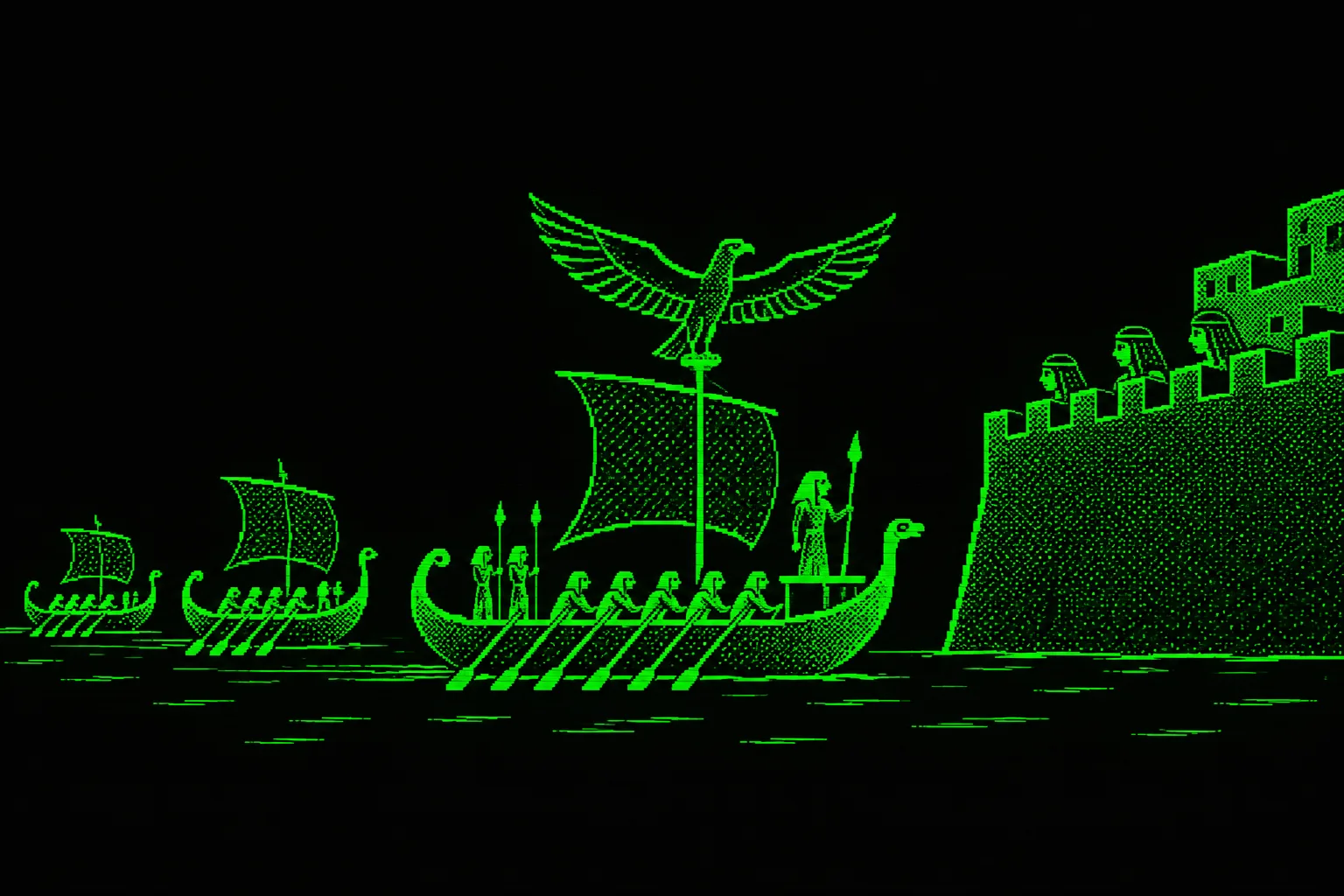
Kamose, king at Thebes, speaks to Apepi, the Hyksos king in Avaris. He brings his fleet under the walls, where the women peer out like young rodents poking out of their holes, and swears: I shall drink wine from your own vineyard, wine the Asiatics I take captive will press for me.
South of the oasis he intercepts Apepi’s letter to the ruler of Kush: Come! Sail downstream! Have no fear! and Then we shall divide the towns of Egypt between us. Kamose sends the letter back, sails home to a Thebes in festival, and orders the stela set up at Karnak.
- 1
[...] Bḥd,tj nb-p,t
… the Behdetite, lord of the sky.
Note · Line 1
The Behdetite is Horus of Behdet, shown as a winged sun disk above the king. - 2
[...] ḏi̯ =f ḏi̯ ꜥnḫ ḏd wꜣs
… May he grant the blessing “Given life, stability, and dominion.”
- 3
smj ẖs m-ẖn(w) dmj =k
There is bad news in your town:
Note · Line 3
Kamose, king at Thebes, is taunting Apepi, the Hyksos king whose capital was Avaris in the eastern Nile Delta. - 4
tw≡k tfi̯.tj r-gs mšꜥ =k
you have been driven out, you and your army.
- 5
rʾ =k ḥns m jri̯ =k wj m wr jw =k m ḥqꜣ r dbḥ n =k tꜣ nm,t ḫr.t =k n =s
Yours is a mean mouth: you call me a mere chief and yourself a ruler, to lay claim to the very thing you stole. It will be your downfall.
- 6
mꜣ sꜣ =k bjn
Your back will see trouble:
- 7
mšꜥ =j m-sꜣ =k
my army is at your back.
- 8
nn [j]wr ḥm,t.pl Ḥw,t-wꜥr,t nn sn jb.pl =sn m-ẖn(w) ẖ,t =sn sḏm.t(w) hmhm,t n(,j).t pꜣy =j mšꜥ
The women of Avaris will not conceive; their hearts will not open within their bodies when the battle cry of my army is heard.
Note · Line 8
Fear closes them up. Kamose returns to this image when the women catch sight of him. - 9
jw =j m(j)ni̯.kwj r Pr-ḏd-qn jb =j ꜣwi̯ ḏi̯ =j mꜣ Jppj ꜣ,t ḥwr.t wr n(,j) Rṯn,w ẖs ꜥ,wj ḫmt qn,w.pl m jb =f n ḫpr =sn n =f
I moored at Per-Djedqen, my heart wide with joy. I made Apepi see a bitter hour, that chief of Retjenu, both arms feeble, who laid so many plans in his heart and saw none come to pass.
Note · Line 9
Retjenu was the Egyptian name for lands in the Levant. Kamose turns the insult back on Apepi: he calls him a foreign chief, not a king. - 10
spr.kwj r Jn,yt-n,t-ḫnt tw≡j ḏꜣi̯.kwj n =sn r wšd st
I reached Inyt-net-khent and crossed over to speak to them.
- 11
jri̯.n =j pꜣ ꜥḥꜥ,w sꜥbꜣ(.w) ⸢wꜥ⸣ m-sꜣ wꜥ ḏi̯ =j ḥꜣ,t ḥr ḥm,w m nꜣy =j n(,j) qn,yt.pl ḥr ꜥẖi̯.t ḥr j{r}〈t〉r,w mj wnn bjk jmw =j n(,j) nbw r ḥꜣ,t ⸢jr,j⸣ ⸢jw⸣ =⸢j⸣ ⸢mj⸣ bjk ⸢〈nṯri̯〉⸣ r ḥꜣ,t =sn ḏi̯ =j pꜣ mk qn ḥr ḫꜣi̯ r ꜥd tꜣ (w)ḏꜣ,t m-sꜣ =f ⸢mj⸣ ⸢wnn⸣ ⸢ḏr,tjw⸣ ḥr ẖti̯.t ḥr ḏꜥ,t Ḥw,t-wꜥr,t
I drew the fleet up in formation, one ship behind another. I set my picked men bow to steering oar as they flew over the river like a falcon. My ship of gold led the way, and I was like a divine falcon at their head. I sent the bold mek-ship sounding its way to the bank, the rest following like kites plucking their prey over the djaat-lands of Avaris.
- 12
gmḥ.n =j ḥm,t.pl ḥr tp-ḥw,t =f ḥr nwꜣ m ššd.w.pl =⸢sn⸣ ⸢r⸣ ⸢mr,yt⸣
I caught sight of women on his roof, peering from their windows toward the riverbank.
- 13
nn sn ẖ,(t) =sn ⸢mꜣ⸣ =sn wj nwꜣ =sn m šr,wt.pl jr,j ḥr jnb.pl =sn mj ṯꜣ.pl n(,j.w) jnḥw m-ẖn(w) bꜣb(ꜣ).w.pl =sn m-ḏd ḥn pw
Their bodies stayed shut when they saw me. They peered out, noses over the walls like young rodents poking out of their holes, saying, “Here comes the attack!”
- 14
m =k wj jy.kwj mꜥr =j
Look at me! I have come in triumph.
- 15
sp,(y)t m-ꜥ =j
The rest of the land is in my hand.
- 16
mnḫ sp =j
My fortunes stand high.
- 17
wꜣḥ Jmn qn nn wꜣḥ =j tw nn ḏi̯ =j dgs =k ꜣḥ,t jw nn wj ḥr =k
As surely as mighty Amun endures, I will not leave you in peace. I will not let you set foot in a field without me over you.
Note · Line 17
Amun was the chief god of Thebes. Kamose swears by him. - 18
wh{m}〈ꜣ〉 jb =k jr =f ꜥꜣm ẖs
You whose heart has failed you, you wretched Asiatic!
- 19
m =k swrj =j m jrp n(,j) kꜣm,w =k m ꜥtḫ n =j ꜥꜣm.w.pl n(,j.w) ḥꜣq =j
Look, I shall drink wine from your own vineyard, wine the Asiatics I take captive will press for me.
- 20
ḫb(ꜣ) =j s,t =k ḥmsi̯.t
I will hack your dwelling to pieces.
- 21
šꜥd =j mn,w.pl =k
I will cut down your trees.
- 22
grm.n =j ḥm,t.pl =k r wnḏ,wt.pl nḥm =j tꜣ-n,t-ḥtrj
Once I have driven your women into the ships’ holds, I will seize your chariot corps.
- 23
n(n) wꜣḥ =j pḫ(ꜣ) ẖr bꜣ.w šn,t.pl n(,j) ꜥš wꜣḏ mḥ m nbw ḫsbd ḥḏ mfkꜣ,t ḥzmn mjnb nn ṯn,t =s ḥr(,w)-r bꜣq snṯr ꜥd bj,t j~tw~rn ssnḏm spnj ḫt =sn nb špsj jn,w nb nfr n(,j) Rṯn,w
I will not leave a plank of those hundreds of cargo ships of fresh cedar, laden with gold, lapis lazuli, silver, turquoise, bronze battle-axes beyond counting, besides moringa oil, frankincense, fat, honey, iteren-wood, sesendjem-wood, sepeni-wood, all their precious timbers and all the fine goods of Retjenu.
- 24
jf.n =j st r-ꜣw n(n) wꜣḥ =j nkt Ḥw,t-wꜥr,t n(,j.t) šwi̯ =s ꜥꜣm ꜣq
Once I have carried it all away, I will leave not a thing of Avaris. She will stand empty when the Asiatic lies ruined.
- 25
whꜣ jb =k jr =f ꜥꜣm ẖs wn ḥr ḏd
You whose heart has failed you, you wretched Asiatic, you who used to say:
- 26
jnk nb nn sn,nw =j šꜣꜥ-r Ḫmn,w Pr-Ḥw,t-Ḥr ḥr ⸮ḫrp? r Ḥw,t-wꜥr,t m j{r}〈t〉r,w 2
“I am lord without equal as far as Hermopolis. Per-Hathor sends its goods to Avaris by the two rivers.”
Note · Line 26
Hermopolis lay in Middle Egypt. Apepi is boasting of how far south his power reaches. - 27
wꜣḥ =j st m wšꜣ nn r(m)t.pl jm
I will leave it empty, with not a soul in it.
- 28
ḫb(ꜣ).n =j njw,t.pl =sn wbd =j 〈s,t〉 =sn jri̯ m jꜣ,t.pl dšr.t.pl n-ḏ,t ḥr pꜣ ḥḏi̯.t jri̯ =sn m-ẖn(w) tꜣ Km,t
I tore down their towns and burned the places where they stood. They became red mounds forever, for the destruction they wrought in Egypt.
Note · Line 28
The red of the barren mounds stands against Egypt’s own name, Kemet, “the Black Land,” the color of its fertile soil. - 29
ḏi̯.w.pl st ḥr sḏm jꜣꜥš n(,j) ꜥꜣm.w.pl btꜣ.n =sn Km,t ḥn,wt =sn
Those who gave ear to the call of the Asiatics deserted Egypt, their mistress.
- 30
kfꜥ.n =j wp(w),t =f m ḥr,t wḥꜣ,t ḥr ḫnt.yt r Kšj ḥr šꜥ,t zẖꜣ.w
South of the oasis I intercepted a message of his, a written letter on its way south to Kush.
Note · Line 30
An alliance would put Kamose between two enemies. - 31
gmi̯.n =j ḥr =s m-ḏd m zẖꜣ(,w) m-ꜥ ḥqꜣ n(,j) Ḥw,t-wꜥr,t
I found these words in it, written by the hand of the ruler of Avaris:
Note · Line 31
Kamose, king at Thebes, has intercepted a letter from Avaris, the Hyksos capital in the Nile Delta, to Kush in the south. - 32
ꜥꜣ-⸢wsr⸣-Rꜥ zꜣ-Rꜥ Jppj ḥr nḏ ḫr,t n(,j).t zꜣ ḥqꜣ n(,j) Kšj
“Aauserre, son of Ra, Apepi, sends greetings to the son, the ruler of Kush:
Note · Line 32
“Son” is a form of address between rulers; it need not imply a blood tie. - 33
ḥr-m ꜥḥꜥ =k m ḥqꜣ nn rḏi̯.t rḫ =j
Why did you rise to power without letting me know?
- 34
jn jw gmḥ =k jri̯.t.n Km,t r =j
Do you see what Egypt has done to me?
Note · Line 34
By “Egypt,” Apepi means the land ruled from Thebes by Kamose. - 35
ḥqꜣ n,tj m-ẖn(w) =s Kꜣ-ms-nḫt ḏi̯ ꜥnḫ ḥr thm =j ḥr jṯn{.pl} =j n pḥ =j sw mj qj n(,j) jri̯.t.n =f nb.t r =k
The ruler there, Kamose the Mighty, given life, is attacking me on my own soil, though I never attacked him. It is just like all he has done to you.
- 36
stp =f pꜣ tꜣ 2 r jꜣd st pꜣy =j tꜣ ḥnꜥ pꜣy =k ḫb(ꜣ).n =f st
He carves up the two lands to torment them—my land and yours—after laying them waste.
- 37
mj ḫdi̯ m ꜣꜥ
Come! Sail downstream! Have no fear!
Note · Line 37
Downstream from Kush is north. Apepi wants the Kushite ruler to attack from the south while Kamose is in the north. - 38
m =k sw ꜥꜣ m-ꜥ =j
Look, he is here with me.
- 39
nn n,⸢tj⸣ ⸢ꜥḥ⸣ꜥ n =k ḥr tꜣ Km,t
No one in Egypt stands in your way.
- 40
m =k nn ḏi̯ =j n =f wꜣ,t r spr.t =k
Look, I will give him no way out until you arrive.
- 41
kꜣ psš =n nꜣ-n dmj.w.pl n(,j).w tꜣ Km,t ⸢wn⸣[n] [Ḫnt-ḥn]-nfr ẖr rš,wt
Then we shall divide the towns of Egypt between us, and Khent-hen-nefer will rejoice.”
Note · Line 41
Khent-hen-nefer is an Egyptian name for a region in Nubia. - 42
Wꜣḏ-ḫpr-Rꜥ-nḫt ḏi̯ ꜥnḫ dꜣjr sp.w.pl
Wadjkheperre the Mighty, given life, who puts wrongs to rights:
Note · Line 42
The letter ends and Kamose speaks again. Wadjkheperre is his throne name. - 43
ḏi̯.n =j ḫꜣs,t.pl ⸮⸢ḥꜣ,t⸣? ⸮⸢tꜣ⸣? ẖr =j j{r}〈t〉r,w m-mj,t(j)t
I brought the deserts and the head of the land under my rule, and the river too.
- 44
n gmi̯.n.tw wꜣ,t n(,j).t msnb =j
No one can find a way to bring me down.
- 45
n bꜣgi̯.n =j ḥr mšꜥ =j
I do not neglect my army.
- 46
n jṯi̯ ḥr mḥ,〈t〉(j)
The northerner did not turn his face away.
Note · Line 46
The northerner is Apepi. - 47
snḏ.n =f n =j jw =j m ḫdi̯ n ꜥḥꜣ.{ṯ}〈t〉 =n n spr.t =j r =f
He feared me while I was still sailing downstream, before we fought, before I even reached him.
- 48
mꜣ.n =f hh =j h(ꜣ)b.n =f šꜣꜥ-r Kšj r wḫꜣ nḫ =f
He saw my scorching breath and sent word all the way to Kush to seek protection for himself.
- 49
kfꜥ.n =j sj ḥr wꜣ,t n ḏi̯ =j spr =s
I seized the letter on the road; I did not let it get through.
- 50
ꜥḥꜥ.n ḏi̯ =j jṯi̯.tw =s n =f ꜥnn.tj
Then I had it carried back to him.
- 51
wꜣḥ sj ḥr jꜣb,t(j)t r Tp-jḥ,w ꜥq nḫt =j m jb =f
It was left on the east bank by Atfih, so that my might would enter his heart.
- 52
ḫb(ꜣ) ḥꜥ,w =f sḏd n =f wp(w),t(j) =f nꜣ jri̯.t.n =j r pꜣ w n(,j) Jnp,wt{t} wn m (j)ḫ,t.pl =f
His body was shattered when his messenger told him what I had done to the territory of the province of Anubis, once part of his domain.
- 53
zbi̯.n =j pḏ,t =j nḫt(.t) n,t(j.t) ḥrti̯〈.tj〉 r ḫb(ꜣ) Ḏsḏs jw =j m Sꜣkꜣ r tm rḏi̯ wn rq,w ḥꜣ =j
I sent my strong troops, who were marching overland, to lay waste to Djesdjes while I was at Saka, so as to leave no enemy at my back.
Note · Line 53
Djesdjes is the Bahariya Oasis in the desert west of the Nile. - 54
ḫnti̯.n =j m wsr jb jb ꜣwi̯ s{ꜥḥꜥ}k =j rq,w nb n,tj ḥr tꜣ wꜣ,t
I sailed upstream, strong of heart and glad of heart, sweeping away every foe in my path.
- 55
ḫy pꜣ ḫnti̯ nfr n pꜣ ḥqꜣ ꜥnḫ-(w)ḏꜣ-s(nb) ẖr mšꜥ =f r-ḥꜣ,t =f
Oh, how fair was the voyage upstream for the ruler—life, prosperity, health!—with his army before him!
- 56
nn nh,w =sn n šni̯ z jr,j =f n rmi̯ jb =sn
They had suffered no losses. No man asked after his comrade; their hearts did not weep.
- 57
mnmn =j r zꜣt,w Njw,t trj 〈n(,j)〉 ꜣḫ,t
In the season of the flood I came to Theban soil.
- 58
jw ḥr nb ḥḏ tꜣ m rʾ~s~fj mr,yt ꜥbꜥb.tj Wꜣs,t m ḥ(ꜣ)b
Every face shone, the land was all astir, the riverbank gleamed, and the province of Thebes kept festival.
- 59
ḥm,t.pl ṯꜣ,w.pl jwi̯.pl r mꜣn =j
Women and men had come to see me.
- 60
z,t nb.t ḥpt =s sn,nw =s nn ḥr ẖr rm,yt
Every woman embraced her companion; not a face was wet with tears.
- 61
snṯr n ⸢Jmn⸣ r ẖnw-pr r bw ḏd.w jm šzp bw-nfr mj ḏ{ꜥ}〈ḏ〉 =f pꜣ ḫpš n zꜣ Jmn ꜥnḫ-(w)ḏꜣ-s(nb) nswt wꜣḥ Wꜣḏ-ḫpr-Rꜥ zꜣ-Rꜥ Kꜣ-ms-nḫt ḏi̯ ꜥnḫ dꜣjr rs(,j) sꜣsꜣ mḥ,tj jṯi̯ pꜣ tꜣ m nḫt ḏi̯ ꜥnḫ ḏd wꜣs ꜣw jb =f ḥnꜥ kꜣ =f mj Rꜥ ḏ,t nḥḥ
Incense was offered to Amun in the sanctuary, at the place where the words “Receive what is good!” are spoken, even as he grants the sickle-sword to the son of Amun (may he live, prosper, and be healthy), the enduring king Wadjkheperre, the Son of Ra, Kamose the Mighty, given life. He subdued the south, drove back the north, and seized the land by might. He is granted life, stability, and dominion; his heart rejoices with his ka, like Ra, forever and ever.
Note · Line 61
The south is Nubia; the north is the territory held by the Hyksos. The king’s ka is his vital force. - 62
w{ꜣ}ḏ ⸢ḥm⸣ =f n (j)r(,j)-pꜥ,t ḥꜣ,tj-ꜥ ⸢ḥr,j-sštꜣ⸣-n-pr-nswt ḥr,j-tp-n-tꜣ-r-ḏr≡f ḫtm,tj-bj,tj sbꜣ-tꜣ,wj-ḥꜣ(w),tj jm,j-rʾ-smr.w.pl jm,j-rʾ-ḫtm,t(j) Wsr-Nšm,t
His Majesty gave this command to Userneshemet, hereditary prince and count, keeper of the secrets of the royal house, chief of the whole land, seal-bearer of the King of Lower Egypt, foremost instructor of the Two Lands, overseer of courtiers and overseer of sealers:
Note · Line 62
The Two Lands are Upper and Lower Egypt. - 63
jmm jri̯.tw jri̯.t.n nb.t ḥm =(j) m nḫt ḥr wḏ ḥtp s,t =f m Jp,t-s,(w)t m Wꜣs,t n nḥḥ ḥnꜥ ḏ,t
“Have all that My Majesty has done in victory carved on a stela. It shall stand in its place at Karnak in the Theban province forever and ever.”
Note · Line 63
A stela is an upright stone slab. Kamose orders this record of his victories to be set up in Amun’s temple at Karnak. - 64
ḏd.jn =f ḫft ḥm =f
Then he said in His Majesty’s presence:
- 65
jrr =⸢j⸣ ⸢ḫft⸣ ⸢wḏ⸣.t [⸮n?] =[⸮j?] nb[.t] [r] ⸢ḥsw,t⸣ n(,j).t ḫr-nswt
“I shall do all that I have been commanded, to win the king’s favor.”
- 66
[...] jm,j-rʾ-ḫtm,t(jw) Nšj
… the overseer of sealers, Neshi.