~/sacred-texts/ancient-witnesses-to-sabazios
Sabazios Dossier: The God Through the Lap
Translated by AI straight from the Ancient Greek and Latin, not from a modern translation, then checked against the editions and studies listed below. How we translate
- Text
- Ancient witnesses to Sabazios, Demosthenes 18.259–260; Strabo 10.3.15, 18; Harpocration; Suda; Theophrastus, Characters 16; Gurob papyrus (Kern fr. 31); Diodorus 4.4.1–2; Clement, Protrepticus 2.12, 2.16; Arnobius 5.20–21; Firmicus Maternus 10.2, 26.1–2; Proclus (Kern fr. 199)
- Date
- From 330 BC (Demosthenes) to the 5th century AD (Proclus); the Suda is 10th-century
- Found
- Athens, Egypt (the Gurob papyrus), Alexandria, Roman North Africa, Sicily and Rome, Byzantium
- Language
- Ancient Greek and Latin · Greek and Latin alphabets
Sabazios was a god of Phrygia, in inland Asia Minor, whom the Greeks took for Dionysus or for his son. His rite reached Athens by the fourth century BC, and outsiders mocked it. No continuous account by a participant survives; the Gurob papyrus is a fragment of the rite itself. What survives is a dossier of hostile or learned witnesses: an orator’s insult, a comic sketch of a superstitious man, a scrap of a ritual papyrus, the dictionaries that explained the orator’s hard words, a historian of the gods, and three Christian writers who set out to expose the mysteries. This page gathers those that speak of the rite, the god and the serpent.
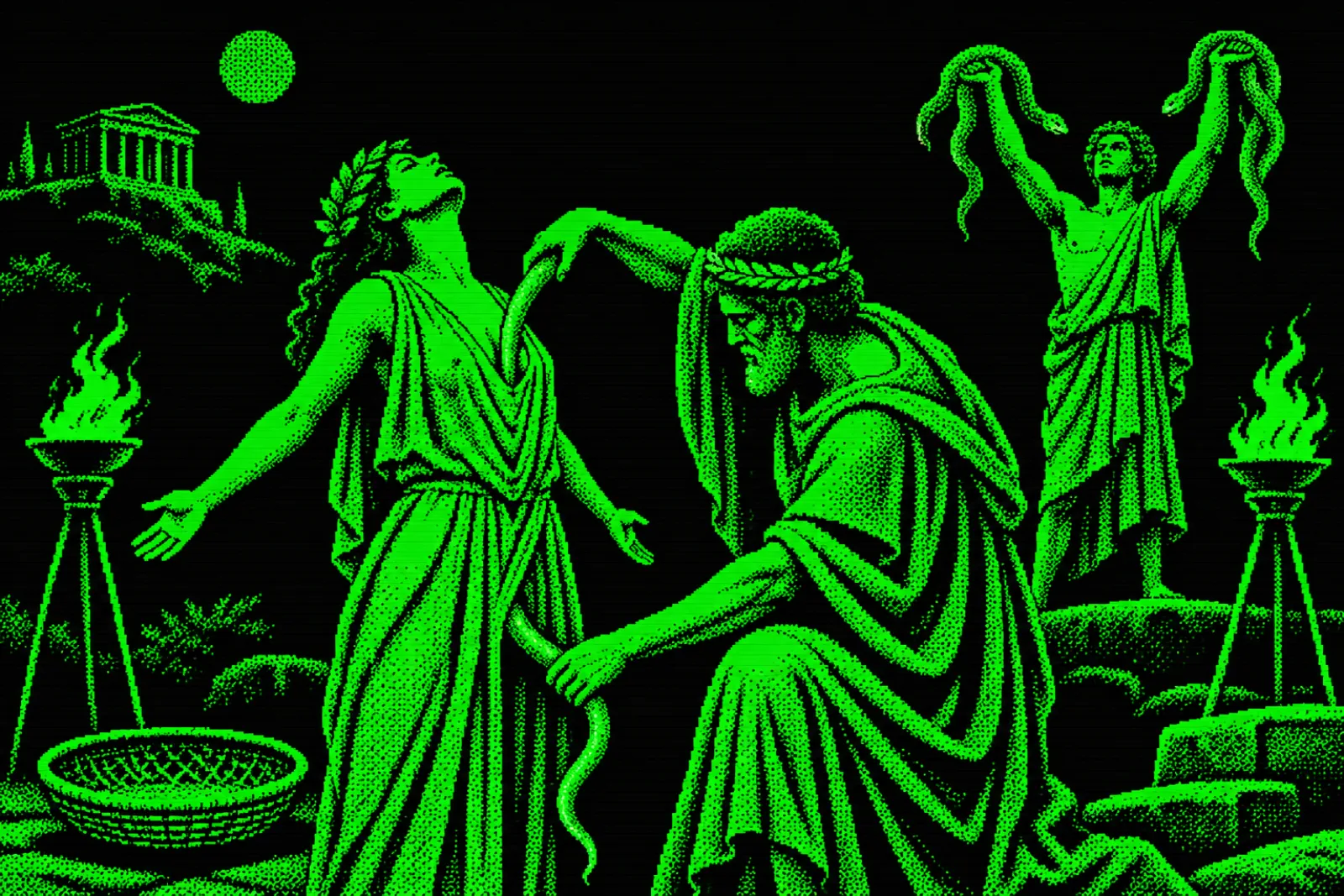
The witnesses run in time order, with each one’s comments beside it. Demosthenes describes his rival Aeschines leading his mother’s initiates through Athens, squeezing snakes and swinging them over his head, shouting euoi saboi. Strabo names the rites, and Harpocration and the Suda explain the words. Theophrastus’s superstitious man greets the snake in his house with the god’s name. The Gurob papyrus, from the third century BC, lists the passwords “god through the lap” and the toys of Dionysus, among them the bullroarer and the mirror. Diodorus reports that some make Sabazios the son of Zeus and Persephone, worshipped at night for shame of the intercourse. Clement, Arnobius and Firmicus then give the myth and the rite: Zeus as a serpent with his daughter, the password of the bull and the serpent, and the golden snake drawn through the initiate’s lap. Proclus closes with Hipta, the nurse of Dionysus, receiving the newborn god in a basket wreathed with a serpent.
Every line is translated from the Greek or Latin. The reference under each line is the author’s book and section, or the dictionary entry, or the papyrus line in Kern. Clement’s account of the same mysteries is given in full on the Orphic Zeus-serpent page, and the hymns to Sabazios and Hipta on the Orphic serpent hymns page. On Zeus’s serpent shape, see Zeus Drakôn.
Each numbered line gives the Ancient Greek and Latin first. Our English is underneath. Tap a dotted word for its meaning, and Note for our comment on the line; our comments are in the right margin.
- d1Dem. 18.259
ἀνὴρ δὲ γενόμενος τῇ μήτηρ mother; here the Mother of the Gods · Logeion τελέω to complete; to initiate, to perform a mystery rite · Logeion τὰς βίβλος papyrus roll, book · Logeion ἀνεγίγνωσκες καὶ τἄλλα συνεσκευωροῦ,
When you became a man, you read out the βίβλος: papyrus roll, book for your mother as she τελέω: to complete; to initiate, to perform a mystery rite, and helped her with the rest of the business:
Note on line d1
Demosthenes, On the Crown (330 BC), mocking his rival Aeschines. His mother is an initiator, and the son is her assistant. Strabo (below) names the rites: they are “Sabazian and of the Mother”. - d2Dem. 18.259
τὴν μὲν νύκτα νεβρίζω to robe in fawnskins, or to wear one, at the rites of Dionysus (LSJ) · Logeion καὶ κρατηρίζω to mix a bowl of wine, especially for the orgies (LSJ) · Logeion καὶ καθαίρω to cleanse, to purify · Logeion τοὺς τελέω to complete; to initiate, to perform a mystery rite · Logeion καὶ ἀπομάττω to wipe off; to smear on, to mould · Logeion τῷ πηλός clay, mud · Logeion καὶ τοῖς πίτυρον bran, husks · Logeion
by night νεβρίζω: to robe in fawnskins, or to wear one, at the rites of Dionysus (LSJ), κρατηρίζω: to mix a bowl of wine, especially for the orgies (LSJ), καθαίρω: to cleanse, to purify the initiates and ἀπομάττω: to wipe off; to smear on, to mould with the πηλός: clay, mud and the πίτυρον: bran, husks,
Note on line d2
Harpocration (below) gives both ancient readings of the two verbs. Nebrizōn: either dressing in fawnskins, or tearing fawns apart “according to some unspeakable account”. Apomattōn: either wiping, or plastering the initiates with mud and bran, as the Titans plastered themselves with gypsum before they fell on Dionysus (Clement and Nonnus have them tear him apart). Vince (Loeb, 1926) has “clothe the catechumens”; catechumen is a Christian word, and the Greek says only “those being initiated”. - d3Dem. 18.259
καὶ ἀνιστὰς ἀπὸ τοῦ καθαρμός cleansing, purification rite · Logeion κελεύων λέγειν ἔφυγον κακόν, εὗρον ἄμεινον,
and raising them up from the καθαρμός: cleansing, purification rite, telling them to say, “I fled the bad, I found the better,”
Note on line d3
The formula was also spoken at weddings in Athens (Zenobius 3.98, cited by LSJ and the commentators). Vince’s “Here I leave my sins behind” brings in “sins”; the Greek has “the bad”. - d4Dem. 18.259
ἐπὶ τῷ μηδένα πώποτε τηλικοῦτʼ ὀλολύζω to cry aloud, to raise the ritual shriek, mostly of women · Logeion σεμνυνόμενος (καὶ ἔγωγε νομίζω·
priding yourself that no one had ever ὀλολύζω: to cry aloud, to raise the ritual shriek, mostly of women so loud (and I believe it:
- d5Dem. 18.260
μὴ γὰρ οἴεσθʼ αὐτὸν φθέγγεσθαι μὲν οὕτω μέγα, ὀλολύζω to cry aloud, to raise the ritual shriek, mostly of women · Logeion δʼ οὐχ ὑπέρλαμπρον),
do not imagine that a man who speaks so loud does not shriek magnificently);
Note on line d5
The ololygē is in Greek usage mostly a women’s cry; the joke is that Aeschines shrieks like the women of the rite. - d6Dem. 18.260
ἐν δὲ ταῖς ἡμέραις τοὺς καλοὺς θίασος a band of worshippers, a Bacchic company · Logeion ἄγων διὰ τῶν ὁδῶν, τοὺς ἐστεφανωμένους τῷ μάραθον fennel · Logeion καὶ τῇ λεύκη white poplar · Logeion
and by day leading your fine θίασος: a band of worshippers, a Bacchic company through the streets, crowned with μάραθον: fennel and λεύκη: white poplar,
Note on line d6
Harpocration (below): initiates of the Bacchic rites wear white poplar because the tree belongs to the underworld, and so does “Persephone’s Dionysus”. - d7Dem. 18.260
τοὺς ὄφις snake · Logeion τοὺς παρείας a snake named for its big cheeks; reddish-brown, sacred to Asklepios (LSJ) · Logeion θλίβω to squeeze, to press · Logeion καὶ ὑπὲρ τῆς κεφαλῆς αἰωρέω to lift up; to swing, to hold aloft · Logeion
θλίβω: to squeeze, to press the παρείας: a snake named for its big cheeks; reddish-brown, sacred to Asklepios (LSJ) and αἰωρέω: to lift up; to swing, to hold aloft them over your head,
Note on line d7
Live snakes, carried in procession. Harpocration (below) says the pareiai are named for their bigger cheeks; Aelian (On Animals 8.12) describes the pareias as reddish and harmless, and sacred to Asklepios, which is why Jebb calls them “the red snakes”. Vince has “squeezed the fat-cheeked snakes, or brandished them”: the Greek has “and”, not “or”; both acts go together. - d8Dem. 18.260
καὶ βοῶν εὐοῖ the Bacchic cry · Logeion σαβοῖ the cry of the Saboi, the worshippers of Sabazios · Logeion καὶ ἐπορχέομαι to dance to, to dance over · Logeion ὑῆς Hyes, a cult-name; Plutarch gives it to Dionysus · Logeion Ἄττης Attes, Attis, the Mother's consort · Logeion Ἄττης Attes, Attis, the Mother's consort · Logeion ὑῆς Hyes, a cult-name; Plutarch gives it to Dionysus · Logeion
and shouting “εὐοῖ: the Bacchic cry σαβοῖ: the cry of the Saboi, the worshippers of Sabazios!” and ἐπορχέομαι: to dance to, to dance over “ὑῆς: Hyes, a cult-name; Plutarch gives it to Dionysus Ἄττης: Attes, Attis, the Mother's consort, attēs hyēs!”,
Note on line d8
Strabo (below) quotes these cries and says “these are Sabazian and of the Mother”. Plutarch (On Isis and Osiris 34) says the Greeks call Dionysus Hyēs as lord of the moist; Attes is the Mother’s Attis (Harpocration, below). Strabo’s text accents hyēs differently. - d9Dem. 18.260
ἔξαρχος one who leads off the song or the dance · Logeion καὶ προηγεμών one who goes before, a guide · Logeion καὶ κιττοφόρος ivy-bearing; some wrote κιστοφόρος, bearer of the sacred chest · Logeion καὶ λικνοφόρος carrying the sacred λίκνον, the winnowing basket, in procession (LSJ) · Logeion καὶ τοιαῦθʼ ὑπὸ τῶν γρᾳδίων προσαγορευόμενος,
hailed by the old women as ἔξαρχος: one who leads off the song or the dance, προηγεμών: one who goes before, a guide, κιττοφόρος: ivy-bearing; some wrote κιστοφόρος, bearer of the sacred chest, λικνοφόρος: carrying the sacred λίκνον, the winnowing basket, in procession (LSJ) and the like,
Note on line d9
The liknon is the winnowing basket in which the infant Dionysus was cradled and the sacred things were carried (Harpocration, below; Orphic Hymn 46; Proclus, at the end of this page, has Hipta wreathe it with a serpent). Vince has “Fan-carrier”. Harpocration notes that some wrote kistophoros, “chest-bearer”, for “ivy-bearer”. - d10Dem. 18.260
μισθὸν λαμβάνων τούτων ἔνθρυπτος crumbled into liquid; τὰ ἔνθρυπτα, sops or a kind of cake · Logeion καὶ στρεπτοὺς καὶ νεήλατα,
and taking as your pay for all this ἔνθρυπτος: crumbled into liquid; τὰ ἔνθρυπτα, sops or a kind of cake, twists and cakes of fresh meal.
- d11Dem. 18.260
ἐφʼ οἷς τίς οὐκ ἂν ὡς ἀληθῶς αὑτὸν εὐδαιμονίσειε καὶ τὴν αὑτοῦ τύχην;
For such rewards, who would not truly count himself and his fortune blessed?
- s1Strabo 10.3.15
καὶ ὁ Σαβάζιος Sabazios, the Phrygian god; as adjective, Sabazian · Logeion δὲ τῶν Φρυγιακῶν ἐστι καὶ τρόπον τινὰ τῆς μήτηρ mother; here the Mother of the Gods · Logeion τὸ παιδίον παραδίδωμι to hand over; to hand down a rite or teaching · Logeion τὰ τοῦ Διονύσου καὶ αὐτός.
Σαβάζιος: Sabazios, the Phrygian god; as adjective, Sabazian too belongs to the Phrygian gods, and is in a way the μήτηρ: mother; here the Mother of the Gods's child, he too having παραδίδωμι: to hand over; to hand down a rite or teaching the rites of Dionysus.
Note on line s1
Strabo, Geography (c. AD 20), on the rites of the Kouretes, the Korybantes and the Mother. Jones (Loeb) reads the sentence the same way: “in a way is the child of the Mother”. - s2Strabo 10.3.18
τῶν δὲ Φρυγίων Δημοσθένης διαβάλλων τὴν Αἰσχίνου μήτηρ mother; here the Mother of the Gods · Logeion καὶ αὐτὸν ὡς τελέω to complete; to initiate, to perform a mystery rite · Logeion τῇ μήτηρ mother; here the Mother of the Gods · Logeion συνόντα καὶ συνθιασεύω to be a fellow-member of a θίασος, a Bacchic band · Logeion
and the Phrygian rites are mentioned by Demosthenes, when he slanders Aeschines' mother, and Aeschines himself as one who joined his mother in her initiations and συνθιασεύω: to be a fellow-member of a θίασος, a Bacchic band
Note on line s2
Strabo has just said that Plato mentions the Thracian rites of Bendis; “are mentioned by” fills out his elliptical Greek. - s3Strabo 10.3.18
καὶ ἐπιφθεγγόμενον εὐοῖ the Bacchic cry · Logeion σαβοῖ the cry of the Saboi, the worshippers of Sabazios · Logeion πολλάκις καὶ ὑῆς Hyes, a cult-name; Plutarch gives it to Dionysus · Logeion Ἄττης Attes, Attis, the Mother's consort · Logeion Ἄττης Attes, Attis, the Mother's consort · Logeion ὑῆς Hyes, a cult-name; Plutarch gives it to Dionysus · Logeion ταῦτα γάρ ἐστι Σαβάζιος Sabazios, the Phrygian god; as adjective, Sabazian · Logeion καὶ μητρῷος of a mother; of the Mother of the Gods · Logeion
and cried out many times “euoi saboi” and “hyēs attēs, attēs hyēs”: for these are Σαβάζιος: Sabazios, the Phrygian god; as adjective, Sabazian and μητρῷος: of a mother; of the Mother of the Gods.
- h1Harp. s.v. Σαβοί
Σαβοί Saboi, the initiates of Sabazios · Logeion Δημοσθένης ὑπὲρ Κτησιφῶντος. οἱ μὲν Σαβοί Saboi, the initiates of Sabazios · Logeion λέγεσθαι τοὺς τελέω to complete; to initiate, to perform a mystery rite · Logeion τῷ Σαβάζιος Sabazios, the Phrygian god; as adjective, Sabazian · Logeion τουτέστι τῷ Διονύσῳ, καθάπερ τοὺς τῷ Βάκχῳ Βάκχους.
Saboi (Demosthenes, On the Crown). Some say that those initiated to Sabazios, that is, to Dionysus, are called Σαβοί: Saboi, the initiates of Sabazios, as those of Bacchus are called Bacchoi.
Note on line h1
Harpocration, Lexicon of the Ten Orators (2nd c. AD), explaining the hard words of Demosthenes’ passage; Dindorf’s text (1853). Each entry opens with the word and the speech it comes from. - h2Harp. s.v. Σαβοί
τὸν αὐτὸν δὲ εἶναι Σαβάζιος Sabazios, the Phrygian god; as adjective, Sabazian · Logeion καὶ Διόνυσόν φασιν ἄλλοι τε καὶ Νύμφις β περὶ Ἡρακλείας.
Others, among them Nymphis in book 2 of On Herakleia, say that Sabazios and Dionysus are the same.
- h3Harp. s.v. Σαβοί
οὕτω δέ φασι καὶ τοὺς Ἕλληνάς τινες τοὺς Βάκχους Σαβοί Saboi, the initiates of Sabazios · Logeion καλεῖν. Μνασέας δὲ ὁ Παταρεὺς υἱὸν εἶναί φησι τοῦ Διονύσου Σαβάζιος Sabazios, the Phrygian god; as adjective, Sabazian · Logeion
So too, some say, the Greeks call the Bacchoi Saboi. But Mnaseas of Patara says Sabazios is the son of Dionysus.
- h4Harp. s.v. εὐοῖ σαβοῖ
εὐοῖ the Bacchic cry · Logeion σαβοῖ the cry of the Saboi, the worshippers of Sabazios · Logeion Δημοσθένης ἐν τῷ ὑπὲρ Κτησιφῶντος. Βακχικόν τι ἐπίφθεγμα a cry uttered over something; a refrain · Logeion ἐστι τὸ εὐοῖ the Bacchic cry · Logeion
Euoi saboi (Demosthenes, On the Crown). Euoi is a Bacchic ἐπίφθεγμα: a cry uttered over something; a refrain.
- h5Harp. s.v. εὐοῖ σαβοῖ
Ἀριγνώτη δέ φησιν ὅτι τινὲς ἔλεξαν εὐοῖ the Bacchic cry · Logeion ἀντὶ τοῦ εὖ σοι, τὸ εὕρημα a find, a discovery · Logeion τοῦ κάτοπτρον mirror · Logeion ἐπαινέοντες.
Arignote says that some said euoi for eu soi, “well for you!”, praising the εὕρημα: a find, a discovery of the κάτοπτρον: mirror.
Note on line h5
Arignote, a Pythagorean woman, wrote On the Rites (Harpocration cites it again under nebrizōn). The mirror is one of the toys with which the Titans lured the child Dionysus (Clement, Protr. 2.17–18; the Gurob papyrus, below, line 30). The cry hails that mirror when it is found again in the rite. - h6Harp. s.v. Ἄττης
Ἄττης Attes, Attis, the Mother's consort · Logeion Δημοσθένης ὑπὲρ Κτησιφῶντος. ὁ Ἄττης Attes, Attis, the Mother's consort · Logeion παρὰ Φρύξ a Phrygian, of inland Asia Minor · Logeion μάλιστα τιμᾶται ὡς πρόσπολος servant, attendant, minister · Logeion τῆς μήτηρ mother; here the Mother of the Gods · Logeion τῶν θεῶν. τὰ δὲ περὶ αὐτὸν δεδήλωκε Νεάνθης· μυστικός of the mysteries, secret · Logeion δὲ ὁ λόγος.
Attēs (Demosthenes, On the Crown). Attes is honoured most among the Φρύξ: a Phrygian, of inland Asia Minor, as πρόσπολος: servant, attendant, minister of the Mother of the Gods. Neanthes has told his story; it is a μυστικός: of the mysteries, secret account.
- h7Harp. s.v. νεβρίζων
νεβρίζω to robe in fawnskins, or to wear one, at the rites of Dionysus (LSJ) · Logeion Δημοσθένης ἐν τῷ ὑπὲρ Κτησιφῶντος. οἱ μὲν ὡς τοῦ τελέω to complete; to initiate, to perform a mystery rite · Logeion νεβρίς fawnskin · Logeion ἐνάπτω to fasten on; middle and passive, to put on, to wear · Logeion ἢ καὶ τοὺς τελέω to complete; to initiate, to perform a mystery rite · Logeion διαζώννυμι to gird round · Logeion νεβρίς fawnskin · Logeion
Nebrizōn (Demosthenes, On the Crown). Some take it of the initiator ἐνάπτω: to fasten on; middle and passive, to put on, to wear a νεβρίς: fawnskin, or διαζώννυμι: to gird round the initiates with fawnskins;
- h8Harp. s.v. νεβρίζων
οἱ δὲ ἐπὶ τοῦ νεβρός fawn · Logeion διασπάω to tear apart, to tear asunder · Logeion κατά τινα ἄρρητος unspoken; not to be spoken, secret · Logeion λόγον. ἔστι δὲ ὁ νεβρισμὸς καὶ παρὰ Ἀριγνώτῃ ἐν τῷ περὶ τῶν τελετή rite of initiation · Logeion
others of διασπάω: to tear apart, to tear asunder νεβρός: fawn apart according to some ἄρρητος: unspoken; not to be spoken, secret account. The nebrismos is in Arignote too, in her On the Rites.
Note on line h8
Diaspaō is the verb Clement uses for the Titans tearing the child Dionysus apart (Protr. 2.18, διέσπασαν). We read the “unspeakable account” as that myth: the fawn torn in the rite stands for the god. - h9Harp. s.v. ἀπομάττων
ἀπομάττω to wipe off; to smear on, to mould · Logeion Δημοσθένης ἐν τῷ ὑπὲρ Κτησιφῶντος. οἱ μὲν ἁπλοϊκώτερον ἀκούουσιν ἀντὶ τοῦ ἀποψῶν καὶ ἀπολυμαινόμενος,
Apomattōn (Demosthenes, On the Crown). Some take it more simply, as “wiping off” and “cleansing”;
- h10Harp. s.v. ἀπομάττων
ἄλλοι δὲ περιεργότερον, οἷον περιπλάσσω to plaster all over · Logeion τὸν πηλός clay, mud · Logeion καὶ τὰ πίτυρον bran, husks · Logeion τοῖς τελέω to complete; to initiate, to perform a mystery rite · Logeion ὡς λέγομεν ἀπομάττω to wipe off; to smear on, to mould · Logeion τὸν ἀνδριάντα πηλός clay, mud · Logeion
others more curiously, as “περιπλάσσω: to plaster all over the mud and the bran all over the initiates”, as we say a statue is ἀπομάττω: to wipe off; to take an impression, to mould in clay;
- h11Harp. s.v. ἀπομάττων
ἀλείφω to anoint, to smear · Logeion γὰρ τῷ πηλός clay, mud · Logeion καὶ τῷ πίτυρον bran, husks · Logeion τοὺς μυέω to initiate · Logeion ἐκμιμέομαι to imitate closely, to copy · Logeion τὰ μυθολογούμενα παρ’ ἐνίοις,
for they ἀλείφω: to anoint, to smear the initiates with the mud and the bran, ἐκμιμέομαι: to imitate closely, to copy what some tell in myth:
- h12Harp. s.v. ἀπομάττων
ὡς ἄρα οἱ Τιτάν a Titan · Logeion τὸν Διόνυσον λυμαίνομαι to outrage, to maltreat, to ruin · Logeion γύψος gypsum, white chalk · Logeion καταπλάσσω to plaster over, to daub · Logeion ἐπὶ τῷ μὴ γνώριμοι γενέσθαι.
that the Τιτάν: a Titan, καταπλάσσω: to plaster over, to daub with γύψος: gypsum, white chalk so as not to be recognised, λυμαίνομαι: to outrage, to maltreat, to ruin Dionysus.
Note on line h12
Nonnus too has the Titans’ faces whitened with gypsum when they cut the child down (Dionysiaca 6.169–170, on /texts/orphic-zeus-serpent/). The initiates were made up as the god’s killers. - h13Harp. s.v. ἀπομάττων
τοῦτο μὲν οὖν τὸ ἔθος ἐκλιπεῖν, πηλός clay, mud · Logeion δὲ ὕστερον καταπλάσσω to plaster over, to daub · Logeion νομίμου χάριν.
That custom, they say, died out, and later the initiates were plastered with mud for the sake of the rule.
- h14Harp. s.v. λεύκη
λεύκη white poplar · Logeion Δημοσθένης ἐν τῷ ὑπὲρ Κτησιφῶντος ἐστεφανωμένους τῷ μάραθον fennel · Logeion καὶ τῇ λεύκη white poplar · Logeion
Leukē (Demosthenes, On the Crown: “crowned with fennel and white poplar”).
- h15Harp. s.v. λεύκη
οἱ τὰ Βακχικὰ τελέω to complete; to initiate, to perform a mystery rite · Logeion τῇ λεύκη white poplar · Logeion στέφονται διὰ τὸ χθόνιος of the earth; of the underworld · Logeion μὲν εἶναι τὸ φυτὸν, χθόνιος of the earth; of the underworld · Logeion δὲ καὶ τὸν τῆς Περσεφόνη Persephone, daughter of Zeus and Demeter, queen of the dead · Logeion Διόνυσον.
Those initiated into the Bacchic rites are crowned with white poplar because the tree belongs to the χθόνιος: of the earth; of the underworld, and so does Περσεφόνη: Persephone, daughter of Zeus and Demeter, queen of the dead's Dionysus.
Note on line h15
“Persephone’s Dionysus” is her son, the Dionysus whom Zeus begot on her, his own daughter, as a serpent (Clement 2.16 and Arnobius 5.21, below); Diodorus (below) says some call him Sabazios. - h16Harp. s.v. παρεῖαι ὄφεις
παρείας a snake named for its big cheeks; reddish-brown, sacred to Asklepios (LSJ) · Logeion ὄφις snake · Logeion Δημοσθένης ὑπὲρ Κτησιφῶντος. παρείας a snake named for its big cheeks; reddish-brown, sacred to Asklepios (LSJ) · Logeion ὀνομάζονταί τινες ὄφις snake · Logeion παρὰ τὸ παρειά cheek · Logeion μείζους ἔχειν, ὡς καὶ Κρατῖνος ἐν τῷ Τροφωνίῳ ὑποσημαίνει.
Pareiai opheis (Demosthenes, On the Crown). Some snakes are named pareiai from having bigger παρειά: cheek, as Cratinus too indicates in his Trophonius.
Note on line h16
Harpocration goes on to quote the orator Hypereides: all snakes are hated, but vipers harm people, while the pareiai eat the vipers. The snakes of the Sabazian procession are these harmless ones. - h17Harp. s.v. λικνοφόρος
λικνοφόρος carrying the sacred λίκνον, the winnowing basket, in procession (LSJ) · Logeion Δημοσθένης ἐν τῷ ὑπὲρ Κτησιφῶντος. τὸ λίκνον winnowing basket; the cradle of the infant Dionysus; a carrier of the sacred things · Logeion πρὸς πᾶσαν τελετή rite of initiation · Logeion καὶ θυσίαν ἐπιτήδειόν ἐστιν· ὁ τοῦτο οὖν φέρων λικνοφόρος carrying the sacred λίκνον, the winnowing basket, in procession (LSJ) · Logeion λέγοιτ’ ἄν.
Liknophoros (Demosthenes, On the Crown). The λίκνον: winnowing basket; the cradle of the infant Dionysus; a carrier of the sacred things is fit for every τελετή: rite of initiation and sacrifice; so whoever carries it would be called liknophoros.
- su1Suda Σ 3
Σαβάζιος Sabazios, the Phrygian god; as adjective, Sabazian · Logeion ὁ αὐτός ἐστι τῷ Διονύσῳ. ἔτυχε δὲ τῆς προσηγορίας ταύτης παρὰ τὸν γινόμενον περὶ αὐτὸν θειασμός divine inspiration, religious frenzy · Logeion
Sabazios: he is the same as Dionysus. He got this name from the θειασμός: divine inspiration, religious frenzy that goes on around him;
Note on line su1
The Suda, a Byzantine encyclopedia of the 10th century, in Adler’s edition. - su2Suda Σ 3
τὸ γὰρ εὐάζω to cry εὐαί, the Bacchic shout · Logeion οἱ βάρβαρος a non-Greek · Logeion σαβάζειν φασίν. ὅθεν καὶ τῶν Ἑλλήνων τινὲς ἀκολουθοῦντες τὸ εὐασμός the crying of εὐαί · Logeion σαβασμὸν λέγουσιν· ἔνθεν Σαβάζιος Sabazios, the Phrygian god; as adjective, Sabazian · Logeion ὁ Διόνυσος.
for the βάρβαρος: a non-Greek say sabazein for εὐάζω: to cry εὐαί, the Bacchic shout. So some Greeks follow them and call the εὐασμός: the crying of εὐαί a sabasmos; hence Dionysus is Sabazios.
Note on line su2
The god is named for the cry. Clement (below, 2.12) hears the same cry, euan, as the name of Eve. - su3Suda Σ 3
Σαβοί Saboi, the initiates of Sabazios · Logeion ἔλεγον καὶ τοὺς ἀφιερόω to dedicate, to consecrate · Logeion αὐτῷ τόπους καὶ τοὺς Βάκχους αὐτοῦ.
They called the places ἀφιερόω: to dedicate, to consecrate to him saboi, and his Bacchoi too.
- t1Char. 16.1
ἀμέλει ἡ δεισιδαιμονία fear of the gods; superstition; also piety · Logeion δόξειεν ἂν εἶναι δειλία cowardice, timidity · Logeion πρὸς τὸ δαιμόνιον the divine power, the divine · Logeion ὁ δὲ δεισιδαίμων τοιοῦτός τις, […]
δεισιδαιμονία: fear of the gods; superstition; also piety, of course, would seem to be δειλία: cowardice, timidity towards the δαιμόνιον: the divine power, the divine; and the superstitious man is the kind who […]
Note on line t1
Theophrastus, Characters (c. 319 BC), sketch 16, “The Superstitious Man”; Diels’s text. An is Diels’s addition. Sections 16.2–3 (the hand-washing, the laurel leaf, the weasel) are left out here. - t2Char. 16.4
καὶ ἐὰν ἴδῃ ὄφις snake · Logeion ἐν τῇ οἰκίᾳ, ἐὰν παρείας a snake named for its big cheeks; reddish-brown, sacred to Asklepios (LSJ) · Logeion Σαβάζιος Sabazios, the Phrygian god; as adjective, Sabazian · Logeion καλεῖν, ἐὰν δὲ ἱερός holy, sacred; ὁ ἱερὸς ὄφις, a kind of snake · Logeion ἐνταῦθα ἡρῷον shrine of a hero · Logeion εὐθὺς ἱδρύσασθαι.
And if he sees a ὄφις: snake in the house, he calls out “Sabazios!” if it is a παρείας: a snake named for its big cheeks; reddish-brown, sacred to Asklepios (LSJ), and if it is a ἱερός: holy, sacred; ὁ ἱερὸς ὄφις, a kind of snake, he sets up a ἡρῷον: shrine of a hero on the spot at once.
Note on line t2
Sabadion is the manuscripts’ spelling, which Diels keeps; Jebb prints Sabazius. Kalein can mean “call on” or “call”: Jebb has “he will invoke Sabazius”, and the words can as well mean that he names the snake Sabazios. Both senses hold at once: he greets the snake with the god’s name, because the pareias is the snake of the Sabazian procession (Demosthenes, above). Jebb’s “red snake” follows Aelian’s colour for the pareias. - g22fr. 31.22
[…]λεν Ἠρικεπαῖος Erikepaios, a name of Phanes, of unknown meaning · Logeion σῶισομ με
[…] Ἠρικεπαῖος: Erikepaios, a name of Phanes, of unknown meaning, save me!
Note on line g22
The Gurob papyrus, a ritual text of the 3rd century BC from Gurob in the Fayum, Egypt (Kern fr. 31, column 1; Smyly’s edition, 1921). The left edge of the column is lost; […] marks the missing letters. Kern prints Irikepaige, the papyrus’s spelling of Erikepaios, and sōisom for sōison. - g23fr. 31.23
[…]ητα εἷς Διόνυσος σύμβολον token, sign; in the mysteries, a password or a sacred object · Logeion
[…] one Dionysus. σύμβολον: token, sign; in the mysteries, a password or a sacred object:
- g24fr. 31.24
[…]υρα θεὸς διὰ κόλπος bosom, lap; the fold of a robe; womb · Logeion
[…] god through the κόλπος: bosom, lap; the fold of a robe; womb
Note on line g24
Kern prints the papyrus’s accusative kolpon, which would strictly give “on account of the lap”; in his notes (p. 104) he writes it dia kolpou, Clement’s genitive, and so do we in the English. Five centuries before Clement, the papyrus already lists “god through the lap” among the passwords. Kern (p. 104) sets beside it Hymn 52.11, hypokolpie, “you under the lap”, and the Thurii gold tablet’s “I went down under the lap of the Mistress”. - g25fr. 31.25
[…]ν ἔπιον ὄνος βουκόλος cowherd; a title in Bacchic cult · Logeion
[…] I drank; ass; βουκόλος: cowherd; a title in Bacchic cult
Note on line g25
Kern compares the ass “carrying the mysteries” in Aristophanes, Frogs 159. The cowherd is the boukolos of Clement’s password (2.16, below). - g26fr. 31.26
[…]γιας σύνθημα a token, signal or password agreed on · Logeion ἄνω κάτω τοῖς
[…] σύνθημα: a token, signal or password agreed on: up, down, to the […]
- g27fr. 31.27
καὶ ὅ σοι ἐδόθη ἀναλίσκω to use up, to spend, to consume · Logeion
and what was given you, ἀναλίσκω: to use up, to spend, to consume;
- g28fr. 31.28
[εἰ]ς τὸν κάλαθος basket narrow at the base; carried in Demeter's procession · Logeion ἐμβαλεῖν
throw it into the κάλαθος: basket narrow at the base; carried in Demeter's procession:
Note on line g28
Kern prints the infinitives anēlōsai, emballein as instructions; the English gives them as commands. - g29fr. 31.29
κῶνος pine cone; a spinning top · Logeion ῥόμβος a bullroarer, whirled on a cord; also a spinning top or magic wheel · Logeion ἀστράγαλος knucklebone, used as a die · Logeion
κῶνος: pine cone; a spinning top, ῥόμβος: a bullroarer, whirled on a cord; also a spinning top or magic wheel, ἀστράγαλος: knucklebone, used as a die,
Note on line g29
These are the toys of Dionysus, with which the Titans lured him (Kern fr. 34; Clement 2.17). Into the basket go the bullroarer and the mirror. - g30fr. 31.30
[…]η ἔσοπτρον mirror · Logeion
[…] ἔσοπτρον: mirror.
- di1Diod. 4.4.1
μυθολογοῦσι δέ τινες καὶ ἕτερον Διόνυσον γεγονέναι πολὺ τοῖς χρόνοις προτεροῦντα τούτου.
Some tell in myth that there was another Dionysus too, far earlier in time than this one.
Note on line di1
Diodorus of Sicily, Library of History (c. 30 BC), on the several gods called Dionysus; Vogel’s text. “This one” is Semele’s son. - di2Diod. 4.4.1
φασὶ γὰρ ἐκ Διὸς καὶ Φερσεφόνη Persephone (this spelling Phersephone) · Logeion Διόνυσον γενέσθαι τὸν ὑπό τινων Σαβάζιος Sabazios, the Phrygian god; as adjective, Sabazian · Logeion ὀνομαζόμενον,
For they say that a Dionysus was born of Zeus and Φερσεφόνη: Persephone (this spelling Phersephone), the one some call Sabazios,
- di3Diod. 4.4.1
οὗ τήν τε γένεσιν καὶ τὰς θυσίας καὶ τιμὰς νυκτερινὰς καὶ κρύφιος hidden, secret · Logeion παρεισάγουσι διὰ τὴν αἰσχύνη shame, disgrace · Logeion τὴν ἐκ τῆς συνουσία being together; sexual intercourse · Logeion ἐπακολουθοῦσαν.
whose birth, sacrifices and honours they bring in by night and in κρύφιος: hidden, secret, because of the αἰσχύνη: shame, disgrace that followed from the συνουσία: being together; sexual intercourse.
Note on line di3
The intercourse is Zeus’s with Persephone, his own daughter. Oldfather (Loeb, 1935) has “because of the disgrace resulting from the intercourse of the sexes”: “of the sexes” is not in the Greek, and turns a father’s sex with his daughter into sex in general. Jebb, quoting the passage in his note on Theophrastus 16.4, leaves the clause out. - di4Diod. 4.4.2
λέγουσι δʼ αὐτὸν ἀγχίνοια quickness of mind · Logeion διενεγκεῖν, καὶ πρῶτον ἐπιχειρῆσαι βοῦς ζεύγνυμι to yoke · Logeion καὶ διὰ τούτων τὸν σπόρον τῶν καρπῶν ἐπιτελεῖν· ἀφʼ οὗ δὴ καὶ κερατίας horned · Logeion αὐτὸν παρεισάγουσι.
They say he excelled in ἀγχίνοια: quickness of mind, and was the first to ζεύγνυμι: to yoke oxen and get the crops sown with them; that is why they show him κερατίας: horned.
Note on line di4
He is the horned son Persephone bears in the other witnesses: in Clement (2.16, below) she bears “a bull-shaped child”, and in Arnobius (5.21) a child “in the shape of a bull”. - c12aProtr. 2.12
Διόνυσον μαινόλης raving, mad · Logeion ὀργιάζω to celebrate secret rites, orgia · Logeion Βάκχοι ὠμοφαγία eating of raw flesh · Logeion τὴν ἱερομανία sacred madness · Logeion ἄγοντες
The Bacchoi hold ὀργιάζω: to celebrate secret rites, orgia for μαινόλης: raving, mad Dionysus, keeping up their ἱερομανία: sacred madness by ὠμοφαγία: eating of raw flesh,
Note on line c12a
Clement of Alexandria, Exhortation to the Greeks (c. AD 200), opening his attack on the mysteries; Butterworth’s text (Loeb, 1919). Butterworth has “by a feast of raw flesh”. - c12bProtr. 2.12
καὶ τελίσκουσι τὰς κρεονομία distribution of flesh · Logeion τῶν φόνος killing, slaughter; blood · Logeion ἀναστέφω to crown, to wreathe · Logeion τοῖς ὄφις snake · Logeion
and they perform the κρεονομία: distribution of flesh of their φόνος: killing, slaughter; blood, ἀναστέφω: to crown, to wreathe with snakes,
- c12cProtr. 2.12
ἐπολολύζω to raise the ritual shriek over · Logeion εὐάν the Bacchic cry · Logeion Εὔα Eve · Logeion ἐκείνην, δι’ ἣν ἡ πλάνη wandering; error · Logeion παρηκολούθησεν·
ἐπολολύζω: to raise the ritual shriek over “εὐάν: the Bacchic cry!”, that Εὔα: Eve through whom πλάνη: wandering; error followed;
Note on line c12c
Clement hears the Bacchic cry as the name of Eve; it is Demosthenes’ euoi and the Suda’s euazein. Butterworth has “that Eva through whom error entered into the world”; “into the world” is his. - c12dProtr. 2.12
καὶ σημεῖον sign, mark, token · Logeion ὀργίων βακχικῶν ὄφις snake · Logeion ἐστὶ τελέω to complete; to initiate, to perform a mystery rite · Logeion
and the σημεῖον: sign, mark, token of the Bacchic orgies is a snake that has been τελέω: to complete; to initiate; perfect passive, initiated, consecrated.
Note on line c12d
Tetelesmenos is the word for the initiate (Orphic Hymn 48.3; Plato, Phaedo 69c). Butterworth has “a consecrated snake”. Clement means it literally: the snake of the rites is itself an initiate. - c12eProtr. 2.12
αὐτίκα γοῦν κατὰ τὴν ἀκριβῆ τῶν Ἑβραῖος a Hebrew · Logeion φωνὴν τὸ ὄνομα τὸ Ἕυια δασύνω to pronounce with the rough breathing, the h-sound · Logeion ἑρμηνεύεται ὄφις snake · Logeion ἡ θήλεια·
Indeed, in the exact speech of the Ἑβραῖος: a Hebrew, the name Hevia, δασύνω: to pronounce with the rough breathing, the h-sound, means “the female snake”.
Note on line c12e
Aramaic ḥiwyā is “snake”, beside Ḥawwā, Eve; the rabbis made the same pun on Eve’s name (Genesis Rabbah 20.11). - c16aProtr. 2.16
μίγνυται δ᾽ αὖθις ὁ γεννήσας οὑτοσὶ Ζεὺς τῇ Φερέφαττα Pherephatta, the Attic name of Persephone · Logeion τῇ ἰδίᾳ θυγατρί, μετὰ τὴν μήτηρ mother; here the Mother of the Gods · Logeion τὴν Δηώ, ἐκλαθόμενος τοῦ προτέρου μύσος pollution, abomination · Logeion
and this same Zeus who begot her has sex again, with Φερέφαττα: Pherephatta, the Attic name of Persephone, his own daughter, after her mother Deo, forgetting his earlier μύσος: pollution, abomination
Note on line c16a
Copied unchanged from /texts/orphic-zeus-serpent/, where Clement’s whole account is translated. Zeus has raped his mother Deo, or Demeter (2.15); now he turns to their daughter. - c16bProtr. 2.16
[πατὴρ καὶ φθορεύς destroyer; the violator of a virgin · Logeion κόρης ὁ Ζεύς] καὶ μίγνυται δράκων serpent, large snake; not a winged “dragon” · Logeion γενόμενος, ὃς ἦν, ἐλέγχω to expose, to convict · Logeion
[Zeus, father and φθορεύς: destroyer; the violator of a virgin of the girl], and he has sex with her having become a serpent, ἐλέγχω: to expose, to convict as what he was.
Note on line c16b
The bracketed words are missing from Eusebius’s copy of the passage, and Stählin took them for a gloss (Butterworth’s note). “Exposed as what he was”: the serpent was Zeus’s real nature (Butterworth: “his true nature being thus revealed”), and hos ēn also shows him up as the ravisher he was. Butterworth’s “meeting her under the form of a serpent” leaves out mignytai, “has sex”. - c16cProtr. 2.16
Σαβάζιος Sabazios, the Phrygian god; as adjective, Sabazian · Logeion γοῦν μυστηρίων σύμβολον token, sign; in the mysteries, a password or a sacred object · Logeion τοῖς μυέω to initiate · Logeion ὁ διὰ κόλπος bosom, lap; the fold of a robe; womb · Logeion θεός·
So the σύμβολον: token, password of the Σαβάζιος: of Sabazios, the Phrygian god mysteries for those being μυέω: to initiate is “the god through the lap”;
Note on line c16c
Butterworth has “the god over the breast”; dia with the genitive is “through”. The Gurob papyrus (3rd c. BC, Kern fr. 31) already has “god through the lap” among its passwords, beside “Brimo” and the toys of Dionysus. - c16dProtr. 2.16
δράκων serpent, large snake; not a winged “dragon” · Logeion δέ ἐστιν οὗτος, διέλκω to draw through, to pull through · Logeion τοῦ κόλπος bosom, lap; the fold of a robe; womb · Logeion τῶν τελέω to complete; to initiate, to perform a mystery rite · Logeion ἔλεγχος ἀκρασία incontinence, lack of self-control · Logeion Διός.
this god is a serpent, διέλκω: to draw through, to pull through the lap of those being initiated: proof of Zeus's ἀκρασία: incontinence, lack of self-control.
Note on line c16d
Arnobius (5.21) says in Latin what “through the lap” means: in the Sabazian rites “a golden snake is let down into the bosom of the consecrated and drawn out again from the lower and lowest parts”. The rite acts out on the initiate what Zeus did to Persephone. Butterworth again has “drawn over the breast”. - c16eProtr. 2.16
κυεῖ καὶ ἡ Φερέφαττα Pherephatta, the Attic name of Persephone · Logeion παῖδα ταυρόμορφος in the shape of a bull · Logeion
Pherephatta too is pregnant, with a ταυρόμορφος: in the shape of a bull child.
- c16fProtr. 2.16
ἀμέλει, φησί τις ποιητὴς εἰδωλικός, ταῦρος bull · Logeion δράκων serpent, large snake; not a winged “dragon” · Logeion καὶ πατὴρ ταῦρος bull · Logeion δράκων serpent, large snake; not a winged “dragon” · Logeion ἐν ὄρει τὸ κρύφιος hidden, secret · Logeion βουκόλος cowherd; a title in Bacchic cult · Logeion τὸ κεντρίον a goad; a sting · Logeion
Of course, says some idolatrous poet, “The bull is the serpent's father, and the serpent the bull's; on the mountain the κρύφιος: hidden, secret, the βουκόλος: cowherd; a title in Bacchic cult, the κεντρίον: a goad; a sting.”
Note on line c16f
Arnobius (5.21) gives the same password in Latin: “the bull begot the serpent, and the serpent the bull”. Two Christian writers quote it, and it tells the myth: serpent-Zeus begets the bull-child. Butterworth prints Tournier’s rewriting of the verse, “On hills the herdsman bears his mystic goad”. Clement goes on to say the goad is the fennel-stalk the bacchants wreathe; kentrion is Dindorf’s text for the manuscripts’ kentron. - a1Adv. nat. 5.20
Erat nobis consilium praeterire, praetervehi illa etiam mysteria, quibus Phrygia initio to initiate into mysteries · Logeion atque omnis gens Ilia,
We had meant to pass by, to sail past, those mysteries too into which Phrygia is initio: to initiate into mysteries, and all the Trojan race,
Note on line a1
Arnobius of Sicca, Against the Nations (c. AD 300), book 5; Reifferscheid’s text (CSEL 4, 1875). Ilia, “Trojan”, is Memmius’s correction, which Reifferscheid prints; the manuscript has illa, “all that race” (so Bryce–Campbell). - a2Adv. nat. 5.20
nisi nomen interpositum his Iuppiter Jupiter, Zeus · Logeion prohiberet nos strictim iniurias eius ignominiasque transire,
had not the name of Iuppiter: Jupiter, Zeus, set into them, forbidden us to pass lightly over the wrongs and disgraces done to him:
- a3Adv. nat. 5.20
non quo nobis dulce sit tam foedus foul, filthy, loathsome · Logeion inequito to ride over, to trample · Logeion mysteriis, sed ut ipsis vobis promptum etiam atque etiam fiat, quid in eos congeratis iniuriae quorum profitemini vos esse custodes vindices veneratores.
not that it is sweet to us to inequito: to ride over, to trample mysteries so foedus: foul, filthy, loathsome, but so that it may be plain to you again and again what wrong you heap on those whose guardians, champions and worshippers you profess to be.
- a4Adv. nat. 5.20
Quondam Diespiter Father Day, an old name of Jupiter · Logeion inquiunt, cum in Ceres Ceres, Demeter · Logeion suam matrem libido desire, lust · Logeion improbis atque inconcessis cupiditatibus aestuaret (nam genetrix haec Iuppiter Jupiter, Zeus · Logeion regionis eius ab accolis traditur)
Once, they say, Diespiter: Father Day, an old name of Jupiter, burning for his own mother Ceres: Ceres, Demeter with wicked libido: desire, lust and forbidden desires (for the people of that region hold her to be Jupiter's mother),
Note on line a4
Reifferscheid marks the parenthesis with dashes. In the Orphic poem the mother is Rhea, who becomes Demeter by bearing Zeus (Kern fr. 145; /texts/orphic-zeus-serpent/). - a5Adv. nat. 5.20
neque tamen auderet id quod procaci adpetitione conceperat apertissima vis force, violence · Logeion petere, ingeniosas comminiscitur captio a trick, a deception · Logeion quibus nihil tale metuentem castitas chastity, sexual purity · Logeion imminueret genetricem:
and yet did not dare to go after with open vis: force, violence what he had conceived in his shameless craving, devises clever captio: a trick, a deception to rob his mother, who feared nothing of the kind, of her castitas: chastity, sexual purity:
- a6Adv. nat. 5.20
fit ex deus god · Logeion taurus bull · Logeion et sub pecoris specie subsessor one who lies in wait, an ambusher · Logeion animum atque audaciam celans in securam et nesciam repentina immittitur vis force, violence · Logeion furens, agit incestus unchaste, polluted; incestuous · Logeion res suas
from a god he becomes a taurus: bull, and hiding the mind and daring of an subsessor: one who lies in wait, an ambusher under the look of a beast, he hurls himself on her, unsuspecting and unaware, raging with sudden violence, and, incestus: unchaste, polluted; incestuous, does his business,
Note on line a6
Agit res suas, “does his business”, is the sex act, and with “sudden violence” on an unsuspecting woman it is rape. Bryce–Campbell has “obtains his incestuous desires”. Incestus is Sabaeus’s correction of the manuscript’s incestios. - a7Adv. nat. 5.20
et prodita per libido desire, lust · Logeion fraude intellectus et cognitus evolat.
and, his trick betrayed by his lust, he flies off, found out and known.
- a8Adv. nat. 5.20
Ardescit furiis atque indignationibus mater, spumat anhelat exaestuat nec fremitum continere tempestatemque irarum valens ex continua passio suffering; passion, emotion · Logeion Brimo Brimo, “the Furious”, a name of the underworld goddess · Logeion deinceps ut appelletur adsumpsit,
The mother blazes with fury and outrage; she foams, pants, seethes; unable to hold in her roaring and the storm of her rage, from her unbroken passio: suffering; passion, emotion she took the name Brimo: Brimo, “the Furious”, a name of the underworld goddess, to be called so from then on;
Note on line a8
Brimo is Canterus’s correction of the manuscript’s primo. Clement (2.15) says the same: Deo was named Brimo from her wrath. - a9Adv. nat. 5.20–21
neque alia cordi est res ei quam ut audaciam filii poenis quibus potis est persequor to pursue, to hunt down; to punish · Logeion
nor has she anything else at heart but to persequor: to pursue, to hunt down; to punish her son's audacity with what punishments she can.
- a10Adv. nat. 5.21
Iuppiter Jupiter, Zeus · Logeion satagit fractus metu nec quibus remediis leniat violo to do violence to; to violate, to rape · Logeion animos reperit.
Jupiter is in a fix, broken by fear, and finds no remedy to soothe the mind of the woman he violo: to do violence to; to violate, to rape.
- a11Adv. nat. 5.21
Fundit preces et subplicat: obstructae sunt dolentis aures. Adlegatur deus god · Logeion universus ordo: nullius auctoritas tanta est ut audiatur.
He pours out prayers and begs: the grieving woman's ears are blocked. The whole order of the gods is sent to plead: no one's authority is great enough to be heard.
- a12Adv. nat. 5.21
Ad postremum filius vias satisfactio amends, satisfaction · Logeion inquirens comminiscitur remedium tale:
At last the son, searching for ways to make satisfactio: amends, satisfaction, devises this remedy:
- a13Adv. nat. 5.21
aries ram · Logeion nobilem bene grandibus cum testiculus testicle · Logeion deligit, exseco to cut out; to castrate · Logeion hos ipse et lanato exuit ex folliculus a small bag; the scrotum · Logeion tegmine.
he picks out a fine aries: ram with good big testiculus: testicle, exseco: to cut out; to castrate himself, and strips them out of the woolly covering of the folliculus: a small bag; the scrotum.
Note on line a13
Bryce–Campbell (Ante-Nicene Fathers 6) leave this sentence untranslated, in Latin. Clement (2.15) tells the same: Zeus tore off a ram’s testicles and threw them into Deo’s lap. - a14Adv. nat. 5.21
Accedens maerens et summissus ad matrem et tamquam ipse sententia condemnavisset se sua, in gremium lap, bosom; womb · Logeion proicit [et iacit] hos eius.
Coming to his mother grieving and humbled, as if he had condemned himself by his own sentence, he throws them [and casts them] into her gremium: lap, bosom; womb.
Note on line a14
Orelli deleted et iacit as a doublet, and Reifferscheid brackets it. “As if he had condemned himself”: a sham self-castration, as in Clement, “as though he had castrated himself”. - a15Adv. nat. 5.21
virilitas manhood; the male parts · Logeion pignus pledge, token · Logeion visa sumit animum mitiorem et concepti fetus revocatur ad curam:
Seeing the virilitas: manhood; the male parts of the pignus: pledge, token, the testicles, she takes a milder mind, and is called back to caring for the child she had conceived:
- a16Adv. nat. 5.21
parit mensem post decimum luculenti filiam corporis, quam aetas mortalium consequens modo Libera Libera, the Italian goddess paired with Liber · Logeion modo Proserpina Proserpina, Persephone · Logeion nuncupavit.
after the tenth month she bears a daughter of splendid body, whom the later age of mortals has named now Libera: Libera, the Italian goddess paired with Liber, now Proserpina: Proserpina, Persephone.
- a17Adv. nat. 5.21
Quam cum verveceus of a wether, a castrated ram; Arnobius's mock title · Logeion Iuppiter Jupiter, Zeus · Logeion bene validam, floridam et sucus juice, sap; vigour · Logeion esse conspiceret plenioris,
When Jupiter verveceus: of a wether, a castrated ram; Arnobius's mock title saw that she was strong, in bloom and sucus: juice, sap; vigour,
Note on line a17
Verveceus is Sabaeus’s correction of the manuscript’s uiruiricens. A vervex is a castrated ram: Arnobius jeers at the god who has just pretended to castrate himself with a ram’s testicles. Bryce–Campbell leave “Jupiter Verveceus” untranslated. - a18Adv. nat. 5.21
oblitus paulo ante quid malorum et sceleris esset adgressus et temeritatis quantum, redit ad prioris actus,
forgetting what evil and crime he had attempted a little before, and how much recklessness, he goes back to his former acts;
- a19Adv. nat. 5.21
et quia nefarius wicked, abominable, against divine law · Logeion videbatur satis, patrem cum filia comminus uxoria coniugatio joining; marital union · Logeion misceo to mix; passive, to have sex with · Logeion
and because it seemed nefarius: wicked, abominable, against divine law enough for a father to be misceo: to mix; passive, to have sex with with his daughter face to face, in a wife's coniugatio: joining; marital union,
Note on line a19
Comminus, “at close quarters, hand to hand”: in his own shape, as a husband with a wife. So he takes another shape to have her. - a20Adv. nat. 5.21
in draco serpent, large snake · Logeion terribilem formam migrat, ingentibus spira coil of a snake · Logeion pavefactam colligo to tie together, to bind up · Logeion virgo girl, virgin · Logeion
he passes into the terrible shape of a draco: serpent, large snake, colligo: to tie together, to bind up the terrified virgo: girl, virgin in huge spira: coil of a snake
Note on line a20
Clement (2.16, above) says the same in Greek: Zeus “has sex with her having become a serpent”. - a21Adv. nat. 5.21
et sub obtentu ferus wild; as a noun, a wild beast · Logeion mollissimis ludo to play; to sport sexually · Logeion atque adulatur amplexus embrace; sexual embrace · Logeion
and under the cover of a ferus: wild; as a noun, a wild beast, ludo: to play; to sport sexually and fawns on her in the softest amplexus: embrace; sexual embrace.
Note on line a21
This is the rape of Persephone, which Clement (2.16) tells with mignytai, “has sex”: the girl is terrified and bound. Feri, “of a beast”, is Ursinus’s correction, which Reifferscheid prints; the manuscript has fero, “fierce” (Bryce–Campbell, “under a fierce appearance”). Ludere is the ordinary Latin word for sex play. - a22Adv. nat. 5.21
Fit ut et ipsa de semen seed, semen · Logeion fortissimi compleo to fill; of a woman, to make pregnant · Logeion Iuppiter Jupiter, Zeus · Logeion sed non eadem condicione qua mater:
So it comes about that she too is compleo: to fill; of a woman, to make pregnant with the semen: seed, semen of most mighty Jupiter, but not on the same terms as her mother:
- a23Adv. nat. 5.21
nam illa filiam reddidit liniamentis descriptam suis, at ex partu virgo girl, virgin · Logeion taurus bull · Logeion specie fusa Iovialis monumentum memorial, reminder, record · Logeion pellacia enticement, wiles · Logeion
for the mother gave back a daughter drawn in her own lines, but from the girl's labour, in the shape of a taurus: bull, poured out the monumentum: memorial, reminder, record of Jupiter's pellacia: enticement, wiles.
Note on line a23
Pellacia is enticement, wiles: Arnobius’s word for a trick, after he has told of the terrified girl bound in the coils. Bryce–Campbell’s “her seduction by Jupiter” makes the rape a seduction. The bull-child is Clement’s “bull-shaped child” (2.16), and Diodorus’s horned Sabazios. - a24Adv. nat. 5.21
auctor author, authority, source · Logeion aliquis desiderabit rei: tum illum citabimus Tarentinus of Tarentum, in southern Italy · Logeion notumque senarius a verse of six iambic feet · Logeion quem antiquitas canit dicens: taurus bull · Logeion draco serpent, large snake · Logeion gigno to beget · Logeion et taurus bull · Logeion draco serpent, large snake · Logeion
Someone will want an auctor: author, authority, source for the story: then we will cite that well-known Tarentinus: of Tarentum, in southern Italy senarius: a verse of six iambic feet, which antiquity sings: “The bull gigno: to beget the serpent, and the serpent the bull.”
Note on line a24
The password of Clement 2.16 (above) and Firmicus 26.1 (below), here called a line from Tarentum. - a25Adv. nat. 5.21
Ipsa novissime sacrum a sacred thing; plural, rites · Logeion et ritus initiatio initiation into mysteries · Logeion ipsius, quibus Sebadia the Sabazia, the rites of Sabazios · Logeion nomen est, testimonio esse poterunt veritati:
Last of all, the sacrum: a sacred thing; plural, rites themselves and the ritual of the initiatio: initiation into mysteries itself, which is called the Sebadia: the Sabazia, the rites of Sabazios, can bear witness to the truth:
- a26Adv. nat. 5.21
in quibus aureus golden, of gold · Logeion coluber snake, serpent · Logeion in sinus the fold of the robe at the breast; bosom; lap; womb · Logeion demitto to let down, to drop, to lower · Logeion consecro to consecrate; to initiate · Logeion et eximitur rursus ab inferioribus partibus atque imis.
in them a aureus: golden, of gold coluber: snake, serpent is demitto: to let down, to drop, to lower into the sinus: the fold of the robe at the breast; bosom; lap; womb of the consecro: to consecrate; to initiate and drawn out again from the lower and lowest parts.
Note on line a26
Sinus is the Latin for Clement’s kolpos: the fold of the robe, the bosom, the lap, the womb. Arnobius says the snake goes in at the sinus and is drawn out from the lowest parts; that is, in at the breast of the robe and out between the legs. Bryce–Campbell has “taken away again from the lower parts” and leaves out atque imis, “and lowest”. The rite is the myth just told, done on the initiate: the serpent father enters the girl. - f1Err. 10.2
Sebazius Sabazios · Logeion colentes Iuppiter Jupiter, Zeus · Logeion anguis snake, serpent · Logeion cum initio to initiate into mysteries · Logeion per sinus the fold of the robe at the breast; bosom; lap; womb · Logeion ducunt.
Those who worship Sebazius: Sabazios, when they initio: to initiate into mysteries, draw a anguis: snake, serpent through the sinus: the fold of the robe at the breast; bosom; lap; womb.
Note on line f1
Firmicus Maternus, On the Error of Profane Religions (c. AD 346), addressed to the emperors Constantius and Constans; Ziegler’s text (1907), p. 27. Ziegler keeps the manuscript’s active initiant, and argues from Clement that the priests drew the snake through the initiates’ robes; Dieterich (Eine Mithrasliturgie, p. 123) read initiantur, “when they are initiated” (Ziegler’s apparatus). Either way the snake goes per sinum, Clement’s dia kolpou. - f2Err. 10.2
Adhuc primi error wandering; error · Logeion vitia grassantur, et quicquit homines perdo to destroy, to ruin · Logeion colitur, et funestus deadly, fatal; defiled by death · Logeion anguis snake, serpent · Logeion callida ac malitiosa crudelitas adoratur.
The vices of the error: wandering; error still run riot: whatever perdo: to destroy, to ruin mankind is worshipped, and the cunning, malicious cruelty of the funestus: deadly, fatal; defiled by death snake is adored.
Note on line f2
The first error is the serpent’s in Eden, as Firmicus makes plain in 26.1. Quicquit is the manuscript’s spelling, kept by Ziegler. - f3Err. 26.1
Sequitur adhuc aliud symbolum token, sign; in the mysteries, a password · Logeion quod pro magno miserorum hominum credulis auribus traditur:
There follows yet another symbolum: token, sign; in the mysteries, a password, handed on as something great to the credulous ears of wretched men:
Note on line f3
Firmicus quotes a series of mystery passwords in chapters 18–27, each in Greek, and answers each one. - f4Err. 26.1
ταῦρος bull · Logeion δράκων serpent, large snake; not a winged “dragon” · Logeion καὶ ταῦρος bull · Logeion δράκων serpent, large snake; not a winged “dragon” · Logeion πατήρ.
“The ταῦρος: bull is the δράκων: serpent, large snake; not a winged “dragon”'s father, and the serpent the bull's.”
Note on line f4
Clement’s password (2.16) with its words in another order. Wower rewrote it to match; Ziegler keeps the manuscript, judging with Bursian that the slip is Firmicus’s own (apparatus, p. 67). - f5Err. 26.1
Aliquando nobis signa diabolus the devil · Logeion maculo to spot, to stain, to defile · Logeion nominis prodidisti, aliquando infame nomen propria voce confessus es.
Sometimes, diabolus: the devil, you have betrayed to us the signs of your maculo: to spot, to stain, to defile name; sometimes you have confessed your infamous name in your own voice.
- f6Err. 26.1
Scio qui fueris· quid ausus sis, scio quid fecerit scelerum tuorum malitiosa persuasio persuasion, conviction · Logeion
I know who you were, what you dared; I know what the malicious persuasio: persuasion, conviction of your crimes has done.
Note on line f6
The raised point (·) is Ziegler’s light stop. - f7Err. 26.1
Hoc erat quod Eva Eve · Logeion cum eam perdo to destroy, to ruin · Logeion magnopere pollicebaris, cum ei diceres: ‘Eritis quasi deus god · Logeion
This is what you promised so grandly to Eva: Eve when you were destroying her, when you said to her, “You shall be as deus: god.”
Note on line f7
Genesis 3:5 in the Old Latin. Firmicus reads the bull-and-serpent password as the serpent of Eden speaking: the snake of the mysteries is the snake that promised Eve godhood. - f8Err. 26.1
Tunc iam parabas tibi ac tuis templa, et delubra faciebas, et venenatus poisoned; venomous · Logeion oris inluviem nefarius wicked, abominable, against divine law · Logeion caerimonia sacred rite, ceremony · Logeion consecro to consecrate; to initiate · Logeion
Already then you were preparing temples for yourself and yours, and building shrines, and consecro: to consecrate; to initiate the filth of your venenatus: poisoned; venomous mouth with abominable caerimonia: sacred rite, ceremony.
- f9Err. 26.2
serpo to creep, to crawl · Logeion in templis, et occisarum hostia sacrificial victim · Logeion misero pasceris sanguine,
You serpo: to creep, to crawl in the temples, and feed on the wretched blood of slaughtered hostia: sacrificial victim,
- f10Err. 26.2
nec venenum poison, venom; a drug · Logeion tuis cruor defuit, nec semustae crematorum corporum partes, humanarum te etiam victima sacrificial victim · Logeion frequenter sanguine cruentasti,
nor did your venenum: poison, venom; a drug lack gore, nor the half-burnt parts of burnt bodies; you have often bloodied yourself with the blood of victima: sacrificial victim too,
Note on line f10
Semustae is Wower’s spelling of the manuscript’s se muste. - f11Err. 26.2
et Latiaris of Latium; Jupiter Latiaris, god of the Latin League · Logeion templi cruore· vel ara Carthago Carthage · Logeion rabies tua et siccarum faucium venenum poison, venom; a drug · Logeion nutrita sunt.
and your rage and the venoms of your dry throat were fed on the gore of the temple of Latiaris: of Latium; Jupiter Latiaris, god of the Latin League or the altar of Carthago: Carthage.
Note on line f11
Christian writers said Jupiter Latiaris was still honoured with human blood (Minucius Felix, Octavius 30.4); we take the altar of Carthage as that of the child sacrifices to Saturn, which the same writers denounce. - f12Err. 26.2
Tu haec faciens hominibus te miseris prodesse iactas, ut crudelitate tua perimas, persuasio persuasion, conviction · Logeion decipias, pollicitatione prosternas.
Doing this, you boast that you help wretched men, so as to kill them with your cruelty, cheat them with your persuasion, lay them low with your promises.
- f13Err. 26.2
Sic tuis prospicis parricida murderer of a parent or kinsman · Logeion Fugite o miseri homines fugite, et contagio contact; infection, pollution · Logeion istam quantacumque potestis celeritate deserite.
So you look after your own, parricida: murderer of a parent or kinsman. Flee, wretched men, flee, and leave this contagio: contact; infection, pollution as fast as you can.
- f14Err. 26.2
draco serpent, large snake · Logeion est qui colitur· latere non potest, proprietatem nominis sui ipse confessus est, confessum reum poena consequitur.
It is a draco: serpent, large snake that is worshipped: he cannot hide; he has himself confessed what his name properly is, and punishment follows a defendant who confesses.
Note on line f14
The confession is the password: drakōn, “serpent”, in the god’s own words. - p1fr. 199
ἡ μὲν γὰρ Ἵπτα Hipta, the Mother of Asia Minor who nursed Dionysus · Logeion τοῦ παντὸς οὖσα ψυχή soul, life · Logeion καὶ οὕτω κεκλημένη παρὰ τῷ θεολόγος one who speaks of the gods; Proclus's name for Orpheus · Logeion
For Ἵπτα: Hipta, the Mother of Asia Minor who nursed Dionysus, who is the ψυχή: soul, life of the universe and is so named by the θεολόγος: one who speaks of the gods; Proclus's name for Orpheus
Note on line p1
Proclus, Commentary on Plato’s Timaeus (5th c. AD), I 407–408 Diehl, reading the Orphic poem as Neoplatonic doctrine; Kern prints it as fr. 199 (p. 222). Kern’s text, with iota subscript for his adscript. - p2fr. 199
τάχα μὲν ὅτι καὶ ἐν ἀκμαιοτάταις κινήσεσιν αἱ νοήσεις αὐτῆς οὐσίωνται, τάχα δὲ καὶ διὰ τὴν ὀξυτάτην τοῦ παντὸς φορά motion, revolution · Logeion ἧς ἐστιν αἰτία,
perhaps because her thoughts have their being in the most vigorous motions, perhaps also because of the swiftest φορά: motion, revolution of the universe, of which she is the cause,
Note on line p2
Proclus explains the name from swiftness. The name plays on hiptamai, “to fly”. - p3fr. 199
λίκνον winnowing basket; the cradle of the infant Dionysus; a carrier of the sacred things · Logeion ἐπὶ τῆς κεφαλῆς θεμένη καὶ δράκων serpent, large snake; not a winged “dragon” · Logeion αὐτὸ περιστέφω to crown round, to wreathe about · Logeion τὸν κραδιαῖος of the heart (LSJ); in older editions, of fig-shoots · Logeion ὑποδέχομαι to receive, to take in; to take under one's protection · Logeion Διόνυσον·
having set the λίκνον: winnowing basket; the cradle of the infant Dionysus; a carrier of the sacred things on her head and περιστέφω: to crown round, to wreathe about it with a δράκων: serpent, large snake; not a winged “dragon”, ὑποδέχομαι: to receive, to take in; to take under one's protection κραδιαῖος: of the heart (LSJ); in older editions, of fig-shoots.
Note on line p3
Kradiaios: LSJ, “of or belonging to the heart”, citing Proclus’s own Hymn 1.6. The older editions read to kradiaion, with the basket: Gesner translated “plaited of fig-shoots”, and Lobeck conjectured kradion; Kern prints ton kradiaion, with Dionysus (apparatus, p. 222). The heart is the one part of the torn child that Athena saved (Clement 2.17; Kern fr. 35). The manuscripts M and P have peristrepsasa, “having wound it round”. The same image is in the note to Orphic Hymn 49.1 on /texts/orphic-serpent-hymns/. - p4fr. 199
ὁ δὲ ἀπὸ τοῦ μηρός thigh · Logeion τοῦ Διὸς πρόειμι to go forward, to come forth · Logeion εἰς αὐτήν
And he πρόειμι: to go forward, to come forth from the μηρός: thigh of Zeus into her.
Note on line p4
Orphic Hymn 48, to Sabazios, tells the same birth: Sabazios sewed Dionysus into his thigh, and he came out initiated, to Tmolos and to Hipta. Proclus goes on to explain the birth in Neoplatonic terms. - p5fr. 199
διὸ καὶ συλλαμβάνω to take part, to assist; of a woman, to conceive · Logeion ἡ Ἵπτα Hipta, the Mother of Asia Minor who nursed Dionysus · Logeion λέγεται τίκτω to bring forth, to give birth · Logeion τῷ Διί·
That is why Hipta is said to συλλαμβάνω: to take part, to assist; of a woman, to conceive Zeus as he τίκτω: to bring forth, to give birth.