~/sacred-texts/late-egyptian-miscellanies
Rebuke of the Idle Scribe: You Are Like a Donkey Taking a Beating
- Date
- Copied as school exercises in the late 19th and 20th Dynasties (about 1200–1100 BC): Papyrus Anastasi IV in year 1 of Seti II, Papyrus Koller at the end of the 19th Dynasty, Papyrus Lansing at the end of the 20th
- Found
- Papyrus Koller and Papyrus Anastasi IV come from Memphis, Papyrus Lansing from Thebes. Koller is in Berlin (P. 3043); Anastasi IV (EA 10249) and Lansing (EA 9994) are in the British Museum.
- Language
- Late Egyptian · Hieratic
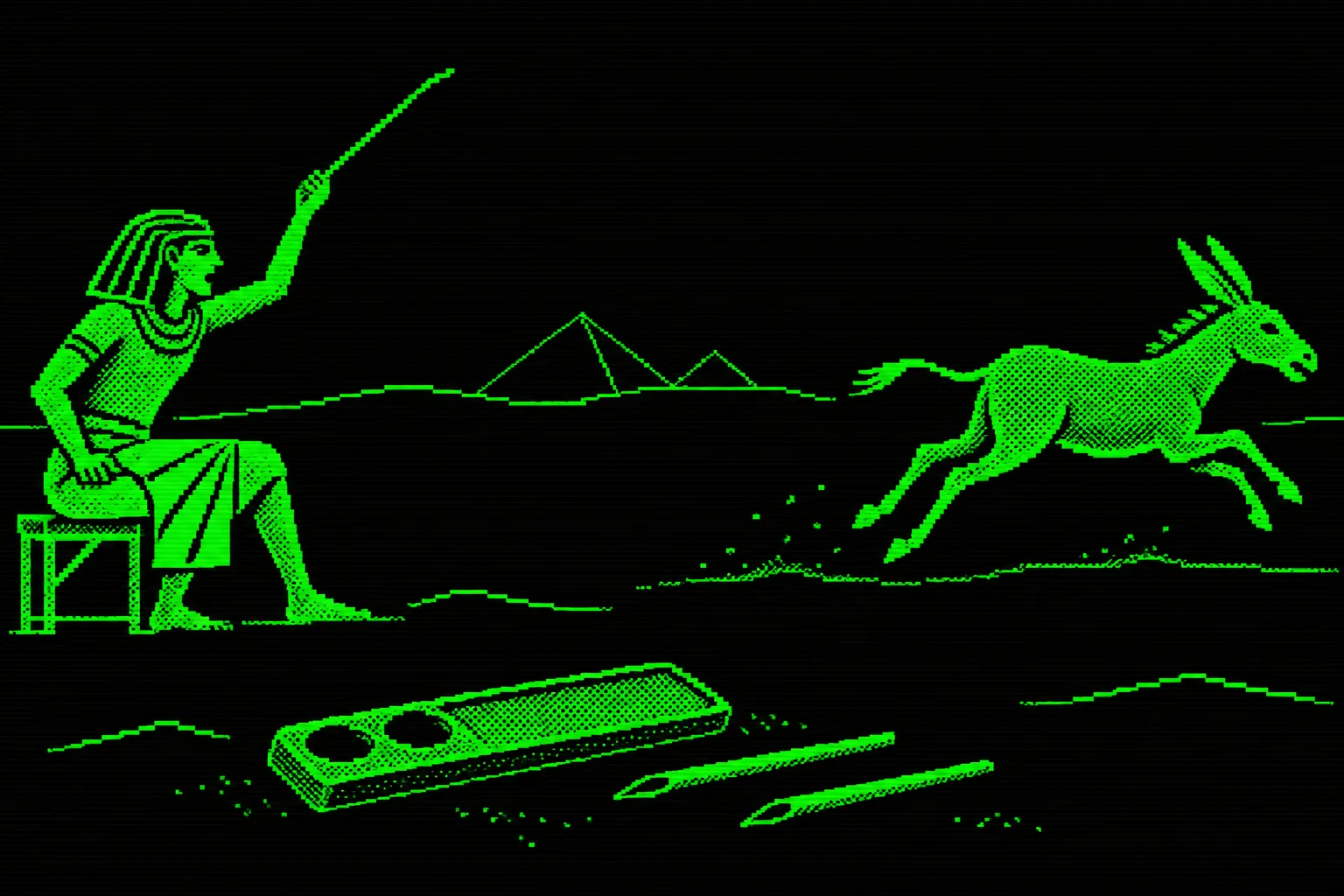
A teacher writes to a pupil who has bolted from scribal school. In Papyrus Koller the boy is a marsh bird, a hartebeest in full flight, a boatman’s mate who keeps no watch for foul winds and ends up hauling the towrope, a man who ties a strip of cloth to his backside for a loincloth. Papyrus Anastasi IV carries the same letter: You are like a donkey taking a beating.
Papyrus Lansing argues instead. Cows learn the plough and horses the harness for fear of a beating. Yet I can beat you with every stick, and still you do not listen. Then the lure: writing is sweeter than a mother who has given birth, and the scribe is young every day.
Papyrus Koller: The Runaway Pupil
- 1
[...] r-n,tj ḏd.tw n =j
… The matter is this: word has reached me
Note · Line 1
A teacher is writing to a pupil who has been training as a scribe. - 2
ḫꜣꜥ =kwj zẖꜣ
that you have given up writing
- 3
tw≡k ḥr šmi̯.t ḥr wꜥr
and are running away.
- 4
ḫꜣꜥ =kwj [...] zẖꜣ
You have given up … writing
- 5
mḥ =k m rd.du =k mj ḥtrj n pꜣ ṯꜣ~ḥꜣ~bw
and taken to your heels like a team of horses out of the tjeheb.
Note · Line 5
The tjeheb was a building; its precise use is unknown. - 6
ḥꜣ,tj =k tfy
Your heart has taken flight!
Note · Line 6
For the Egyptians the heart was the seat of thought and judgment. - 7
tw≡k mj ꜥḫy
You’re like a marsh bird.
- 8
msḏr,t =k dn~jrʾ~gꜣ.t
Your ear is deaf.
- 9
tw≡k mj ꜥꜣ{,t.pl} m šsp qnqn.pl
You’re like a donkey taking blow after blow.
- 10
tw≡k mj sšsꜣ,w{.pl} m wꜥr
You’re like a hartebeest in full flight.
Note · Line 10
The hartebeest is a large antelope. - 11
nn [...] nn mntk nw n tꜣ ḫꜣs,t mḏꜣ,jw n tꜣ jmn,tt
Not … Are you a desert hunter, a Medjay of the West?
Note · Line 11
The Medjay served as police. The West here is the necropolis they guarded. - 12
mntk 〈s〉ḫy
You’re a deaf man,
- 13
bw jri̯ =f sḏm
one who does not hear,
- 14
j:jri̯ =tw n =f m ḏr,t
one people speak to with their hands.
- 15
tw≡k mj ẖr,j-ꜥ n nf,w jw =f sšsꜣ m pꜣ ꜥḥꜥ,w{.pl}
You’re like a boatman’s mate who knows his way about the boat.
- 16
wnn =f m nf,w ⸢m⸣ pꜣ ꜥḥꜥ,w jw =f (ḥr) ꜥḥꜥ 〈ḥr〉 dp,tj
When he’s the boatman on board, he takes his stand on the depety.
- 17
bn sw (ḥr) nw(ꜣ) n ṯꜣw.pl nꜣ~⸢ḥꜣ⸣.pl
He keeps no watch for foul winds.
- 18
bw ḏꜣ~jrʾ =f pꜣ hꜣnꜣ
He does not scan the swell.
- 19
jr ḫꜣꜥ =tw [pꜣ] nwḥ{.w.pl} 〈r-bw~n~rʾ〉 jw tꜣ ḫnt~tʾ~tj [m] ḫ[ḫ]wj =k
When they cast out the rope, the khentetet is at your neck.
Note · Line 19
A man on the bank hauls the boat by a towrope. The khentetet seems to be part of the towing gear. - 20
wnn =f (ḥr) jtḥ nwḥ{.w.pl} jw =⸢f⸣ (ḥr) gꜣ~pw [___]⸢.y⸣[.pl] [jw] =⸢f⸣ (ḥr) fqꜣ šrj.w.pl ḥr nꜣ ⸢wḏb,w⸣ jw =[f] [ḥr] ⸢pn⸣sꜣ ⸢m⸣ꜣ~qꜣ~qꜣ,t.pl
When he hauls on the rope, he scrapes the … birds, tears up shoots along the banks and churns up the wet fields.
- 21
tꜣy =f mt⸢rt⸣,yt ⸮[__]? jw =[f] [ḥr] [dp] [n] [ksbw~y]
His metret is … while he is up in the crown of the acacia.
Note · Line 21
The metret and the wah in the next line are wooden objects whose use is unknown. - 22
pꜣy =f wꜣḥ{,t} mḥ 7 jw =[f] ḥr šꜥd šwy
His wah measures seven cubits as he chops hay.
- 23
tꜣy =f nbd(,t) [_]s~jrʾ r rd.du ={k} =〈f〉 m bꜣk,w n Kšj
His plait of hair, worked in the style of Kush, hangs down to his feet.
Note · Line 23
Kush lay south of Egypt, in Nubia. - 24
tꜣy =f jw~tʾ~tj n nfꜥj wbḫ.t m bꜣk,w n (j)m(,j)-r(ʾ)-ꜥbw,t{{j}}
His itet-cake of nefa, made in the cattle overseer’s fashion, gleams.
Note · Line 24
Nefa is a plant. - 25
j:jri̯ =f gꜣ~wꜣ~tnw ptjrʾ n pḥ,wj =f n-ꜣb,w ṯꜣy sḏ,yw
To have a loincloth to wear, he ties a strip of cloth to his backside.
- 26
sw mḥ msḏr,t hrw ꜥꜣ{,t} (m) ḥm,yt hrw jmw
He is all ears on the day of the donkey, a steering oar on the day of the boat.
- 27
j:jri̯ =j n =f nn-n r-ḏr,w jw ḫꜣꜥ =f ḥꜣ =f r jꜣw,t =f grḥ [...]
I’ll do all this to him now that he’s turned his back on his post. End. …
Note · Line 27
“End” marks a break in the text. Papyrus Lansing: Beaten with Every Stick
- 28
[...] kꜣ~jrʾ~jꜣ-šrjw ꜥꜣ wsj jb =k
… Cadet, what a proud heart you have!
Note · Line 28
Here he addresses him as a young soldier. - 29
bw sḏm =k jw =j (ḥr) mdwi̯.t
You do not listen when I speak.
- 30
{jri̯}〈d〉ns{mn} jb =k r mn,w{.pl} ꜥꜣ n mḥ 100 m ḫy wmt 10 jw =f grḥ r rʾ-ꜥ ꜣtp =f
Your heart is heavier than a great monument a hundred cubits high and ten thick, finished and ready to load.
Note · Line 30
A hundred Egyptian cubits is about 52 metres, or 170 feet. - 31
thm n =f ⸮zꜣ?.pl ꜥšꜣ{.t}.pl
Many work crews were mustered for it.
- 32
sḏm n =f mdw,t.pl n r(m)ṯ.pl
For its sake men’s words were heeded.
- 33
sw ꜣtp r ꜥ-n-sẖ,w wḏj ⸢m⸣ ꜣbw ẖnw ẖrj-r =f r ḥtp s,t =f m Wꜣs,t
It is loaded onto a barge sent from Elephantine and rowed under its weight, so that the monument may come to rest in its place at Thebes.
Note · Line 33
Elephantine lay by the granite quarries at Aswan. Thebes was downriver. - 34
ḫr jni̯ =tw tꜣ jd,t m tꜣ rnp,t mtw =st skꜣ.ṱ (n) nrj
A cow is brought in this year, and when the season comes she will plow.
- 35
sw ḫpr.tj 〈ḥr〉 sḏm m mnj,w
She has grown up listening to the herdsman.
- 36
〈wḏꜣ〉.n =sst r mdw,t
At a word she moved.
- 37
ssm,t.pl jny.t m sḫ,t
The horses have been brought in from pasture.
- 38
smḫ =st nꜣy =st mw,t.pl
They have forgotten their mothers.
- 39
st nḥb 〈ḥr〉 ṯsj hꜣy m wpw,t nb(.t) n ḥm =f ꜥnḫ-(w)ḏꜣ-s(nb)
They are harnessed and go up and down on every errand of His Majesty—life, prosperity, and health to him!
- 40
st ḫpr mj n,tj (ḥr) msi̯ =w jw =w ꜥḥꜥ m pꜣ jḥ jw ⸢j⸣:jri̯ =st r-ḏr,w zp-2 zp-2 n snd n qnqn
They have become like the mares that bore them: they stand in the stable and do everything, absolutely everything, for fear of a beating.
- 41
ḫr jry =j qnqn =k m ḫt nb{.t}
Yet I can beat you with every stick,
- 42
ḫr bn tw≡k (ḥr) sḏm
and still you do not listen.
- 43
bsi̯ =j rḫ.kwj k⸢y⸣ sḫr,w n jri̯ =f jry =j sw n =k sḏm =k
If only I knew another way to do it! I would use it on you so you would listen.
- 44
tw≡k m r(m)ṯ n šꜣ,w zẖꜣ ⸢jw⸣ bw jri̯.t =k nk
You are a man marked out for writing before you ever had sex.
- 45
wḥꜥ jb =k
May your heart have understanding,
- 46
sšsꜣ ḏbꜥ.pl =k
may your fingers be skilled,
- 47
spd rʾ =k 〈ḥr〉 šdi̯
may your mouth be nimble when you read aloud!
- 48
jr zẖꜣ nḏm sw r ⸢⸮snḏm?⸣ jb m ṯꜣy ⸢b⸣ꜣy wꜥḥ
As for writing, it is sweeter than treating yourself to a box of tiger-nut cakes.
- 49
nḏm sw r mw,t msi̯{.pl} n,tj bw ft.n jb =st jw =st (ḥr) rd m mnꜥ{,tt} zꜣ =st
It is sweeter than a mother who has given birth, whose heart never tires as she goes on nursing her son,
- 50
mnd,t =st m rʾ =f rꜥ-nb
her breast in his mouth day after day.
- 51
ršw{,t} pꜣ jb 〈n〉 jri̯ zẖꜣ,w
What joy there is in the wish to be a scribe!
- 52
sw rnpj rꜥ-nb grḥ [...]
Each day he is young again. …
Note · Line 52
A pause mark closes the stanza. Papyrus Anastasi IV: The Same Letter, Second Copy
- 53
[...] r-n,tj ḏd =tw n =j ḫꜣꜥ =kwj zẖꜣ.w
… as follows: I am told you have cast writing aside
- 54
tw≡k ḥr šm.t ḥr wꜥr
and are running away.
- 55
ḫꜣꜥ =kwj zẖꜣ.w
You have cast writing aside;
- 56
mḥ =k m rd.du =k mj ḥtrj 〈n〉 pꜣ ṯꜣ~ḥꜣ~bw
you have taken to your heels like a team of horses from the Tjeheb.
Note · Line 56
The Tjeheb seems to be the name of a building. - 57
ḥꜣ,tj =k tfi̯.y
Your heart has leapt away;
Note · Line 57
The heart was the seat of thought as well as feeling. - 58
tw≡k {m-}mj ꜥḫy
you are like an akhy-bird.
Note · Line 58
The bird may be a swan. - 59
msḏr{,t} =k dn~jrʾ~gꜣ
Your ear has gone deaf.
- 60
tw≡k mj ꜥꜣ m šzp qnqn
You are like a donkey taking a beating.
- 61
tw≡k mj sšsꜣ m wꜥr
You are like a hartebeest in flight.
- 62
mntk nw n tꜣ ḫꜣs,t mꜥ~ḏꜣ~jw n tꜣ jmn,tt
Are you a hunter of the desert, a Medjay of the West?
Note · Line 62
The Medjay served as desert patrolmen. - 63
nn mntk sḫi̯.y jw bw jri̯ =f sḏm
Are you a deaf man who does not hear?
- 64
j:jri̯ =tw n =f m ḏr,t
With him one has to use the hand.
Note · Line 64
The hand can make a sign or deliver a blow. - 65
tw≡k mj ẖr,j-ꜥ n nf,w jw =f sšsꜣ.w 〈m〉 pꜣ ꜥḥꜥ,w
You are like the helper of a boatman who knows his way about the boat.
- 66
wnn =f m nf,w m pꜣ ⸮ꜥḥꜥ,w? jw =f ꜥḥꜥ 〈ḥr〉 tp,tj
When the helper is the boatman on board, he stands on the tepeti.
Note · Line 66
The tepeti is a part of the boat; which part is unknown. - 67
bn sw (ḥr) nw n ṯꜣw nꜣ~ḥꜣ
He keeps no watch for a foul wind;
- 68
bw ḏꜥ~jrʾ =f pꜣ hꜣ~nꜣ
he never studies the swell.
- 69
jr ḫꜣꜥ.tw pꜣ nwḥ.w r-bw~npl~rʾ jw tꜣ ḫntj~tʾ~tj [...] m ḫḫ.wj =f
When the line is cast out, the khentetet-rope … round his neck.
- 70
wnn =f (ḥr) jtḥ.w pꜣ nw[ḥ.w] [jw] =f ⸢ḥr⸣ [gꜣ~pw] __y [...] jw =f ḥr fqꜣ.w šrj.w ḥr nꜣ wḏb.w jw =f ḥr pn~sꜣ mꜣ~qꜣ~qꜣ
When he hauls in the line, he catches akhy-birds …, tears up sheri-plants along the banks and ploughs up the wet ground.
- 71
[tꜣy] =[f] [mtr,yt] [...] ⸢jw⸣ =⸢f⸣ ⸢ḥr⸣ ⸢tp⸣ ⸢n⸣ ksb.wy jw pꜣy =f wꜣḥ{,t} n ⸢mḥ⸣ ⸢7⸣ jw =f (ḥr) šꜥd šwy
His wooden metryt …; he is in the top of a kesbet tree, his wah is seven cubits long, and he cuts dry rushes.
Note · Line 71
Seven cubits is roughly twelve feet. The objects called metryt and wah have not been identified. - 72
tꜣy =f [nbd] [sr] r [r]d.du =f m bꜣk.w n Kš
His plaited hair hangs down to his feet in the fashion of Kush.
Note · Line 72
Kush lay to the south of Egypt, in Nubia. - 73
tꜣy =f jw~tʾ~tj n nfꜥj wbḫ{t} m bꜣk.w n jm,j-rʾ-ꜥb{t.pl}
His cake of nefa-plants gleams white in the fashion of the overseer of horned cattle.
- 74
jri̯.y =f gꜣ~wꜣ~tn~nw pt~jrʾ n pḥ.wj =f m ꜣb,w [ṯꜣ]i̯.y sḏw,y
He has knotted strips of cloth to his backside because he wants to wear a loincloth.
- 75
sw mḥ msḏr hrw ꜥꜣ ḥmy,t hrw ⸮ꜥjmw?
He is all ears on the day of the donkey, a steering oar on the day of the boat.
- 76
j:jri̯ =j n =f nn r-ḏr =w jw ḫꜣꜥ =f ḥꜣ =f r jꜣw,t =〈f〉
All this I shall do to him when he has turned his back on his calling.
- 77
grḥ [...]
End. …