~/sacred-texts/royal-inscriptions-of-ramesses-ii
Manshiyet es-Sadr Stela of Ramesses II: Granaries Pregnant with Grain
- Date
- Carved in or just after regnal year 9 of Ramesses II (about 1270 BC), 19th Dynasty; the events run from year 8 to year 9
- Found
- Found in 1907 at Manshiyet es-Sadr, beside ancient Heliopolis and the Red Mountain (Gebel Ahmar), Cairo; now in the Egyptian Museum, Cairo (CG 34504)
- Language
- Egyptian · Hieroglyphic
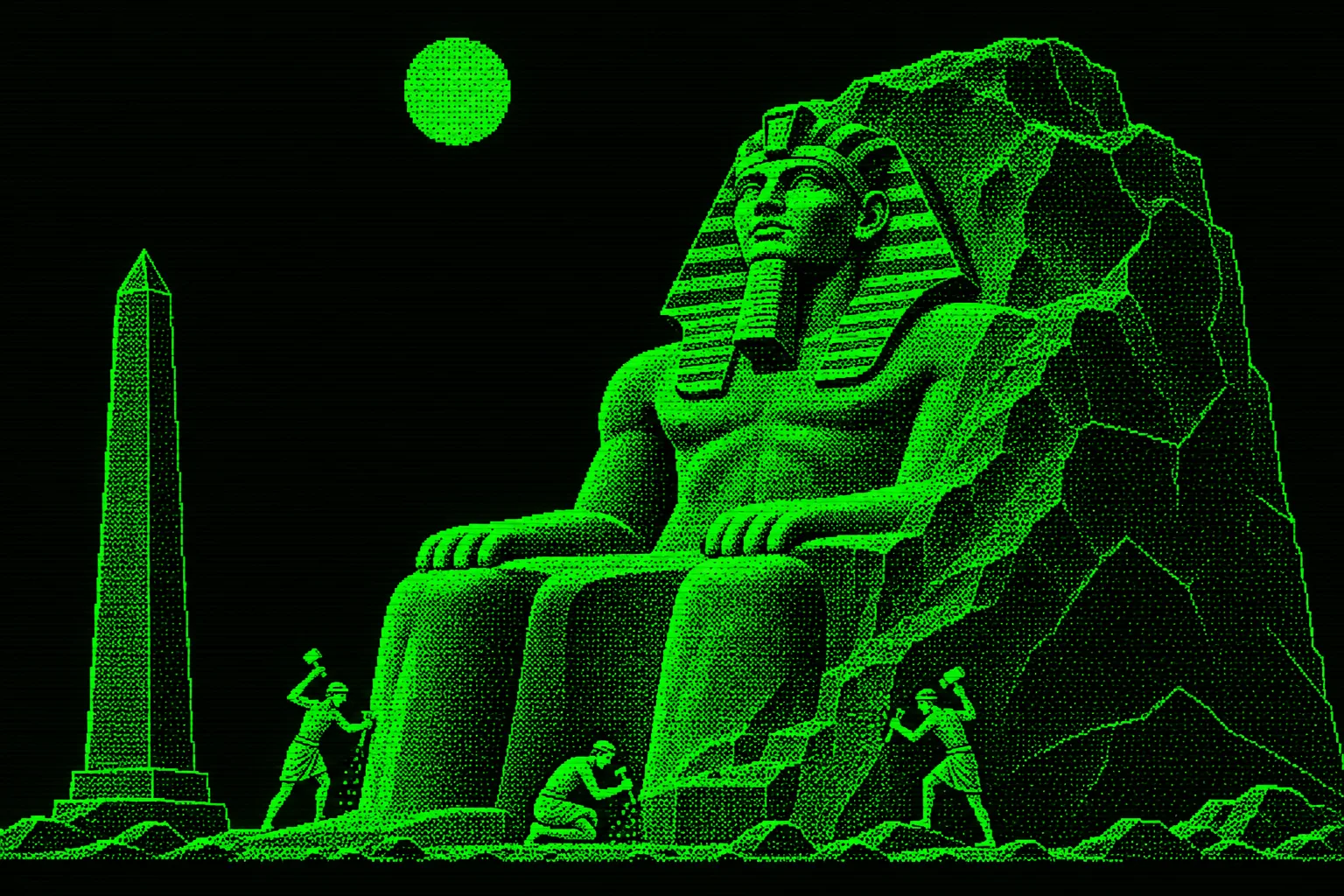
In regnal year 8 Ramesses II walks the desert beside Heliopolis and finds a block of quartzite at the Red Mountain: It stood taller than an obelisk of granite. A year later it is the colossus “Ramesses Meryamun the god.”
Then the king speaks to his stonecutters, men who penetrate granite and become one with quartzite. He lists what he gives them: bread, meat, cakes, sandals, oil for their heads every ten days. For you the granaries have been made pregnant with grain, he says, and It is a joy to work at it on a full belly. He ends at Elephantine, where he saw my face in the Perfect Mountain, and names three new quarries.
- 1
rnp,t-sp 8 ꜣbd 2 pr,t sw 8 nswt-bj,tj Wsr-Mꜣꜥ,t-Rꜥw-stp.n-Rꜥw sꜣ-Rꜥw Rꜥw-msi̯-sw-mri̯.y-Jmn
Regnal year 8, second month of Peret, day 8. King of Upper and Lower Egypt, Usermaatre Setepenre; Son of Ra, Ramesses Meryamun.
Note · Line 1
These are the throne name and birth name of Ramesses II. Peret was the season when the fields emerged from the Nile flood; Shemu was the harvest season. - 2
hrw pn jst ḥm =f m Jwn,w-Rꜥw ḥr jri̯.t ḥss.wn jtj =f Rꜥw-Ḥr,w-ꜣḫ,t.du-Jtm,w nb-Tꜣ.wj-Jwn,w
On this day His Majesty was in Heliopolis of Ra, doing what his father Ra-Horakhty-Atum, lord of the Two Lands and of Heliopolis, praised.
- 3
jst ḥm =f ḥr swtwt ḥr ḫꜣs,t ḥr ḫnt,j n Pr-Rꜥw mḥ,tj Pr-psḏ,t r-ꜥqꜣ Ḥw,t-Ḥr,w nb,t-Ḏw-dšr.t
His Majesty was walking in the desert south of the precinct of Ra, north of the precinct of the Ennead, opposite Hathor, Lady of the Red Mountain.
Note · Line 3
The Ennead was the company of nine gods of Heliopolis. The Red Mountain is Gebel Ahmar, the quartzite quarry near Heliopolis. - 4
ꜥḥꜥ.n gm.n ḥm =f wꜥ bjꜣ ꜥꜣ.t n gm.n =tw mj-qd =f ḏr 〈r〉k Rꜥw
There His Majesty found a great block of quartzite. Its like had not been found since the days of Ra.
Note · Line 4
The days of Ra were the time when the sun god himself ruled Egypt. - 5
qꜣw =f r tḫn n mꜣṯ
It stood taller than an obelisk of granite.
- 6
jn ḥm =f qmꜣ sw ḏs =f m stw,t =f mj ꜣḫ,t =f
It was His Majesty himself who fashioned it, for it shone like his own horizon.
- 7
ꜥḥꜥ.n sḥn s ḥm =f ḏs =f m kꜣ,t.pl stp.yw rḫ.yw ḏr,t =w m rnp,t-sp 8 ꜣbd 3 šm,w sw 21
Then His Majesty himself set chosen workmen to it, men who knew what their hands could do, in regnal year 8, third month of Shemu, day 21.
- 8
ḫpr.n =f ḥr mḥ m rnp,t-sp 9 ꜣbd 3 šm,w sw 18
It was finished in regnal year 9, third month of Shemu, day 18.
- 9
jri̯ n wꜥ rnp,t.pl twt ꜥꜣ Rꜥw-msi̯-sw-mr.y-Jmn-pꜣ-nṯr
A year in all went into the making of the great statue “Ramesses Meryamun the god.”
- 10
ꜥḥꜥ.n fqꜣ.n ḥm =f jm,j-rʾ-kꜣ,t.pl pn m ḥḏ nbw qn.wpl ꜥšꜣ.tpl kꜣ,t.pl ḫpš.yw n,tj ḥr bꜣk j:m =f m ḥzw n.t ḫr-nswt
Then His Majesty rewarded this overseer of works with silver and gold in great abundance, and the able workmen who had worked on the statue with a gift of royal favor.
- 11
jw ḥm =f ḥr mk =sn rꜥw-nb jw bꜣk =sn n ḥm =f m jb mri̯.pl
His Majesty provided for them day after day, and they worked for His Majesty with loving hearts.
- 12
nswt-bj,tj nb-Tꜣ.wj Wsr-Mꜣꜥ,t-Rꜥw-stp.n-Rꜥw sꜣ-Rꜥw Rꜥw-msi̯-sw-mr.y-Jmn
King of Upper and Lower Egypt, Lord of the Two Lands, Usermaatre Setepenre; Son of Ra, Ramesses Meryamun.
- 13
jst gmi̯.n ḥm =f k.t ẖꜣ,t r-gs =f m twt.pl m bjꜣ,t ḥr sni̯ r mry
Now beside the block His Majesty found another bed of stone for statues: quartzite the color of cedarwood.
- 14
wḥm.n =〈f〉 sḥn =sn r Pr-Ptḥ
Once again he assigned workmen to the statues, this time for the temple of Ptah.
Note · Line 14
This temple stood at Memphis. - 15
jri̯.w n =sn rn.pl ḥr rn wr 〈n〉 ḥm =f m Rꜥw-msi̯-sw-mri̯.y-Jmn-sꜣ-Ptḥ
They were given names after the great name of His Majesty: “Ramesses Meryamun, son of Ptah.”
- 16
ktḫ twt j:m =s r Pr-Jmn-n-Rꜥw-msi̯-sw-mri̯.y-Jmn r Pr-Ptḥ-n-Rꜥw-msi̯-sw-mri̯.y-Jmn m Pr-Rꜥw-msi̯-sw-mri̯.y-Jmn-ꜥꜣ-nḫt.pl
Other statues from that bed were for the Temple of Amun of Ramesses Meryamun and the Temple of Ptah of Ramesses Meryamun in Pi-Ramesses Meryamun, Great in Victories.
Note · Line 16
Pi-Ramesses was the king’s residence in the eastern Nile Delta. - 17
mḥ =j Pr-Rꜥw m šsp.pl qn.pl m twt.pl ḥr šms ꜥnt.w ḥr fꜣi̯ jḫ,t
“I filled the precinct of Ra with a multitude of sphinxes, with statues bringing myrrh and bearing offerings.”
- 18
nswt-bj,tj Wsr-Mꜣꜥ,t-Rꜥw-stp.n-Rꜥw sꜣ-Rꜥw Rꜥw-msi̯-sw-mri̯.y-Jmn ḏd =f ḏs =f
The King of Upper and Lower Egypt, Usermaatre Setepenre, the Son of Ra, Ramesses Meryamun, himself said:
- 19
nꜣ-n kꜣwt.ypl stp.ypl ḫpš.ypl rḫ.pl ḏr,t =w n,tj ḥr wḥꜣ n =j mnw,w m ṯnw nb.t n〈,tj〉 dwꜣ kꜣ,t.pl m ꜥꜣ,t mnḫ.t ꜥq.ypl m mꜣṯ ẖnm m bjꜣ,t qnj.pl pr-ꜥ m bꜣk mnw,w mḥ =j rʾ-pr.pl nb.t jri̯.y =j ꜥḥꜥ,w =sn
“Chosen workmen, men of strength who know what their hands can do,
who hew monuments for me in any number,
who prize work in the finest stone,
who penetrate granite and become one with quartzite,
valiant men, heroes at shaping monuments,
that I may fill all the temples and give them their span of life! - 20
nꜣ ꜥḥꜣ,wtj.pl nfr.pl tm.ypl nnj.pl nꜣ rs jri̯.ypl kꜣ,t.pl m ẖr,t-hrw r jri̯.t jꜣw,t.pl =sn ḏrj mnḫ.t n ḏd.ṱ =w
Fine fighters who never tire,
watchful men who work day by day
to carry out their duties with skill and distinction, for they say - 21
jri̯.y =w m =k ḫft sḫr.pl
they will do it, mark you, just as planned.
- 22
šm.tpl ḥr nꜣy =w smd,t m Ḏw-nṯr,j sḏm ḏd.tn ={w}〈j〉 n =tn
Men who go about their workings on the Divine Mountain, hear what I say to you!
Note · Line 22
The Divine Mountain is the Red Mountain where the king found the stone. - 23
m =k ꜣḫ,tpl j:m =tn wn.w sp ḫft md,t.pl
See what strength there is in you when deed matches word.
- 24
jnk Rꜥw-msi̯-sw-mri̯.y-Jmn pꜣ sḫpr ḏꜣm.pl m sꜥnḫ.ṱ =w
I am Ramesses Meryamun, who raises up young crews by giving them life.
- 25
kꜣ.pl ṯnf m-ꜥq =tn
Food overflows before you.
- 26
nn ḥꜣ~n~rʾ n r =s
There is no cry of ‘If only I had more!’
- 27
ꜥšꜣ.t ḏfꜣ.pl m swꜣ.t =tn nb.t
Provisions abound on every side of you.
- 28
jri̯.y =j ḫr,t =tn m šs nb r-ḏd bꜣk =tn n =j m jb mrw,t
I have supplied your every need so that you may work for me with loving hearts.
- 29
jw =j rwd.kw m nḏ,tj ḫr,t =tn
I stand firm as guardian of your livelihood.
- 30
dns kꜣ.pl m-dj =tn r bꜣk,tpl m ꜣbi̯ sꜥnḫ =tn r sḫpr =tn
The food in your hands outweighs the fruits of your labor,
for I wish to give you life and raise you up.” - 31
jw =j rḫ.k tꜣ =tn kꜣ,t.pl ḏri̯.t mnḫ
I know your work is hard to do and finely done.
Note · Line 31
Ramesses II is addressing the stoneworkers who make his statues. - 32
ḥꜥꜥ =tw bꜣk j:m =s jw ẖ,t mḥ.ṯ
It is a joy to work at it on a full belly.
- 33
sbꜣg n =tn šnw,t.pl ẖr sšr r tm.t di jri̯.yt hrw n gꜣ,w ꜥnḫ.pl
For you the granaries have been made pregnant with grain, so that you need not spend a single day short of food.
- 34
jw wꜥ nb.t j:m =tn stn.w n ꜣbd
Each one of you has his fill for the month.
- 35
mḥ =j n =tn wḏꜣ.pl m ḫ,t nb.t m ꜥq.w jwf.pl šꜥ.yw r mk tn ṯb,t.pl ḥbs.pl sgnn.pl qn.w r wrḥ tp =tn r tnw hrw 10 ḥbs tn tnw rnp,t
I filled the storehouses for you with everything: bread, meat and cakes to feed you; sandals, cloth and oils in plenty, to anoint your heads every ten days, to clothe you every year,
Note · Line 35
The Egyptian month was divided into three periods of ten days. - 36
rd rd.du =tn n rꜥw-nb
and to keep both your feet firm day after day.
- 37
nn sḏr j:m =tn jhm =f n gꜣ,w
None of you lies down at night suffering from want.
- 38
di =j r(m)ṯ qn.w r sḏfꜣ =tn r qsn.pl
I have assigned many people to keep you supplied against hardship:
- 39
wḥꜥ.tpl r jni̯ rsf.pl
fishers and fowlers to bring in their catch,
- 40
ktḫ m kꜣr,y.pl r jri̯.t ḥsb,t.pl
others as gardeners to grow garden produce.
- 41
qd,w-nḏs,t ḥr qd ḥr jri̯.t ḥnw.pl r sqb n =tn mw m tr šm,w
A potter shapes his pots, making henu-jars to cool water for you in summer.
Note · Line 41
Water stays cool in a porous earthenware jar because moisture seeps through the clay and evaporates from the surface. - 42
ẖnn n =tn Tꜣ-šmꜥ,w r Tꜣ-Mḥ,w
Upper Egypt rows for you to Lower Egypt;
Note · Line 42
Upper Egypt lies to the south, upstream on the Nile; Lower Egypt lies to the north, in the Delta. - 43
ẖnn n =tn Tꜣ-Mḥ,w r Tꜣ-šmꜥ,w m jt bd,t sw,tı͗ ḥmꜣ jwr.ypl n rʾ-ꜥ =sn
Lower Egypt rows for you to Upper Egypt with barley, emmer, wheat, salt and long beans without end.
- 44
jw jri̯.n nn r-ḏr =w r-ḏd ḫpr =tn jw =tn m jb wꜥ ḥr bꜣk n =j
I have done all this so that you may come to be of one heart as you work for me.
- 45
tw≡j šm.k r 〈ꜣbw〉 gmḥ.n =j ḥr m Ḏw-nfr
I went to Elephantine and saw my face in the Perfect Mountain.
Note · Line 45
Elephantine is an island at Aswan, near the southern quarries. The king speaks as though his likeness were already there in the rock. - 46
di =j smd,t =f n =tn
I gave you its quarry workers.
- 47
jw =j ꜥḥꜥ.k wḏ n =tn bꜣk m ẖꜣ,t ḥr rn
I stood and charged you to work in the quarry that bears my name.
- 48
T-ẖꜣ,t-Rꜥw-msi̯-sw-mri̯.y-Jmn-mri̯.y-mj-Rꜥw ḫr =tw r =s
They call it “The Quarry of Ramesses-Meriamun, Beloved like Ra.”
Note · Line 48
Meriamun means “beloved of Amun.” - 49
gm n =tn k.t ẖꜣ,t m jnr km r-gs =s m twt.pl ꜥꜣ.pl ḫꜥ,w.pl =sn jrj m bjꜣ,t
Beside it I found you another quarry, one of black stone for great statues whose crowns are made of quartzite.
Note · Line 49
The black stone is diorite. - 50
T-ẖꜣ,t-Wsr-Mꜣꜥ,t-Rꜥw-stp.n-Rꜥw-ḥqꜣ-Tꜣ.du ḫr =tw r =s
They call it “The Quarry of Usermaatre-Setepenre, Ruler of the Two Lands.”
Note · Line 50
Usermaatre-Setepenre is the throne name of Ramesses II. The Two Lands are Upper and Lower Egypt. - 51
gm n =tn k.t ẖꜣ,t m pꜣ ḏw jnm =s mj ḥḏ jꜥi̯
I found you another quarry in the mountain, its stone the color of washed silver.
- 52
T-ẖꜣ,t-Rꜥw-msi̯-sw-mr.y-Jmn-mr.y-mj-Ptḥ ḫr =tw r =s
They call it “The Quarry of Ramesses-Meriamun, Beloved like Ptah.”
- 53
nswt-bj,tj Wsr-Mꜣꜥ,t-Rꜥw-stp.n-Rꜥw sꜣ-Rꜥw Rꜥw-msi̯-sw-mri̯.y-Jmn di ꜥnḫ
King of Upper and Lower Egypt, Usermaatre-Setepenre; Son of Ra, Ramesses-Meriamun, given life.