~/sacred-texts/kadesh-battle-reliefs-of-ramesses-ii
Ramesses II at Kadesh: Severed Hands and Hittite Plunder
- Date
- Carved in the reign of Ramesses II, 19th Dynasty (1279–1213 BC), after the Battle of Kadesh in Syria (about 1274 BC)
- Language
- Late Egyptian · Hieroglyphic
- 1
[⸮_?]-wj tw [pꜣ] ḥqꜣ nḫt [ḏ]r hd =k [⸮pꜣ?] [ḫr]w.pl [m] [nḫ]t,w =k
"How … you are, O mighty ruler, since you fell upon the foes with your might!"
Note · Line 1
Egyptian soldiers presenting prisoners to Ramesses II speak these captions. - 2
[nt]k [...] [jw] =k ⸢mj⸣ ⸢Mnṯ,w⸣
"You are …, and you are like Montu.
Note · Line 2
Montu is the Theban war god, the usual model for a pharaoh in battle. - 3
hd =k [ḫꜣs],t nb Pr-[ꜥꜣ] [ꜥnḫ-(w)ḏꜣ-s(nb)] pꜣy =j nb nfr
You fall upon every foreign land, Pharaoh, life, prosperity, health, my good lord!"
Note · Line 3
“Life, prosperity, health” is a set blessing written after the king’s name or title. - 4
sꜣ.pl-tp,j-n-Wsr-Mꜣꜥ,t-Rꜥw-stp.n-Rꜥw-wsr-ḫpš pꜣ wḏ n =f [n]ḫt,[w.pl]
The First Regiment of "Usermaatre-setepenre-Mighty-of-Sword," to whom victories were granted.
Note · Line 4
Usermaatre-setepenre is the throne name of Ramesses II. Regiments were named after the king, and this one bears a slogan-name praising his sword. - 5
Jmn pꜣ nṯr wḏ =[f] pꜣ nḫt,w n pꜣ ḥqꜣ [...] Pr-ꜥꜣ ꜥnḫ-(w)ḏꜣ-s(nb) nꜣ [⸮_?] n =k
"O Amun, the god: he decreed the victory for the ruler … Pharaoh, life, prosperity, health, the … for you.
Note · Line 5
Amun was the chief god of Thebes and was held to grant the king his victories. - 6
whꜣı͗ jb n pꜣ tꜣ n Ḫt
The heart of the land of Hatti has failed.
Note · Line 6
Hatti is the kingdom of the Hittites in Anatolia, Egypt’s great rival in Syria. - 7
pḥ ḫ,t =f ḥr,t sḫm.n pꜣ ḥqꜣ j:m =f fḫ =f sw ḏ,t
Its fire reaches the sky, since the ruler has prevailed over it and destroyed it forever."
- 8
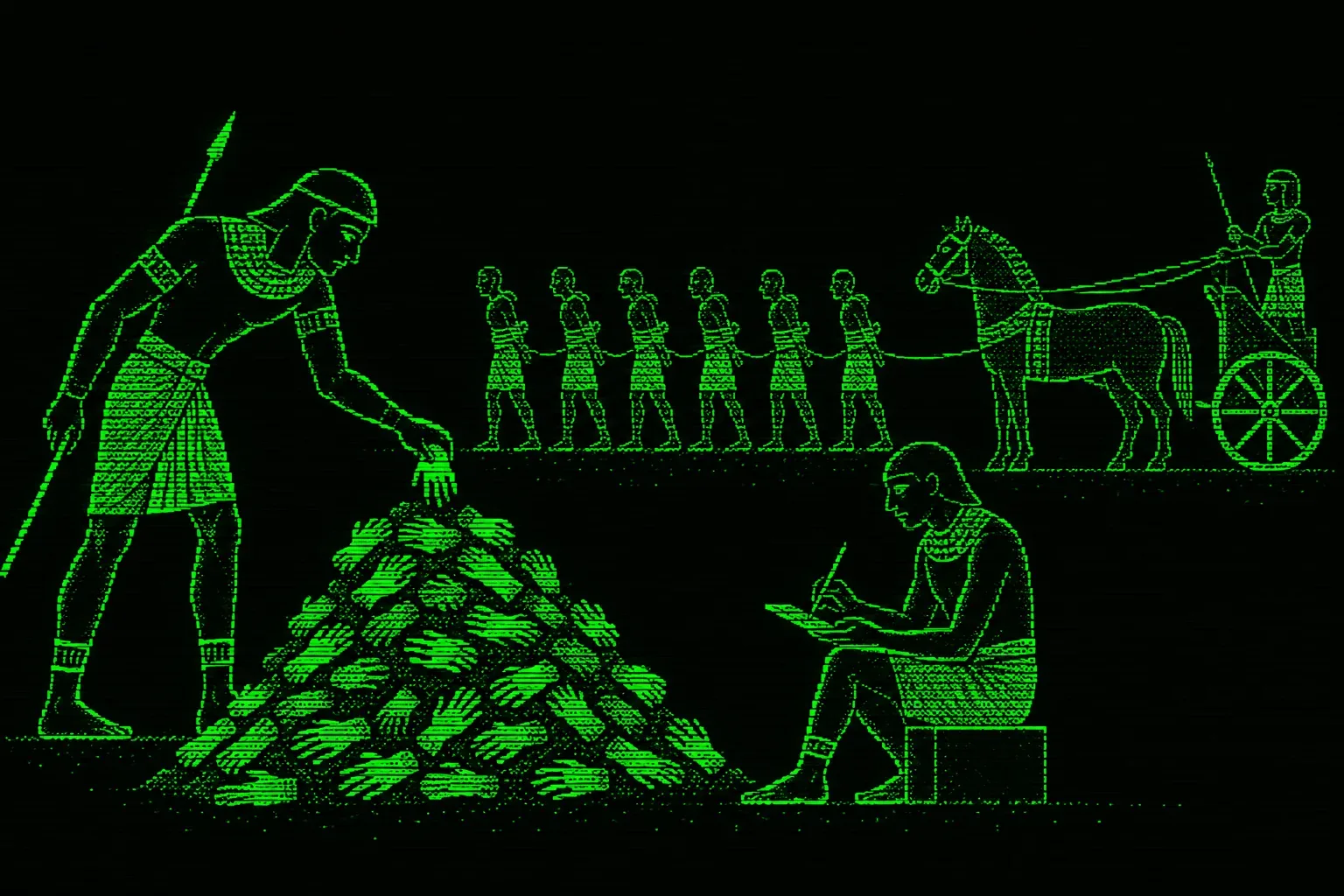
[sbj] [...] ḏr,t ḥr ẖꜣ,t dmḏ ssm,t.pl [ḥr] wrry,t.pl
Rebels … hands and bodies all together, horses and chariots.
Note · Line 8
This caption labels a man heaping up severed hands while a scribe records them. Cutting a hand from each dead enemy was how the Egyptian army counted its kills. - 9
šsp kfꜥ.pl m jni̯.n pꜣ [ḫpš] ṯnr n ḥm =f ḫft sḫr =f nꜣ-n ḫr.pl n Ḫt ḥnꜥ [wr] nb n ḫꜣs,t.pl nb jy ḥnꜥ{n} =sn jw ḥm =f wꜥi̯.w n mšꜥ [ḥnꜥ] =[f] m-ḫt rdi̯.n =f m ḥr n ḥꜣ,wtj [nb] [n] [mšꜥ] =⸢f⸣ r-ḏd
Receiving the plunder that the strong sword of His Majesty brought back when he felled those foes of Hatti, together with every chief of every foreign land who had come with them, while His Majesty was alone, with no army with him, after he had said to every leader of his army:
Note · Line 9
This is the official story of the Battle of Kadesh in Syria (about 1274 BC). - 10
jni̯ n =tn kfꜥ.pl m ḥꜣq,t.pl =j jw =j wꜥi̯.kw jw n mšꜥ ḥnꜥ =j n n,ṯ-ḥtr.pl [...]
"Bring in the plunder from my own spoils, taken when I was alone, with no army beside me and no chariotry …"