~/sacred-texts/ramesside-royal-inscriptions
Karnak Relief of Ramesses II: Hittite Captives for Amun
- Date
- Carved in the 19th Dynasty (reign of Ramesses II, 1279–1213 BC) on the outer south wall of the Great Hypostyle Hall at Karnak
- Found
- In situ on the outer south wall of the Great Hypostyle Hall, Temple of Amun-Ra, Karnak, Luxor, Egypt
- Language
- Late Egyptian · Hieroglyphic
- 1
[ms] jn,w m ḫꜣs,t.pl mḥ,tj.w jy r tkk tꜣš.pl n ḥm =f smꜣ.n ḥm =f
Presenting tribute from the northern foreign lands whose people came to attack His Majesty’s borders and were killed by His Majesty.
Note · Line 1
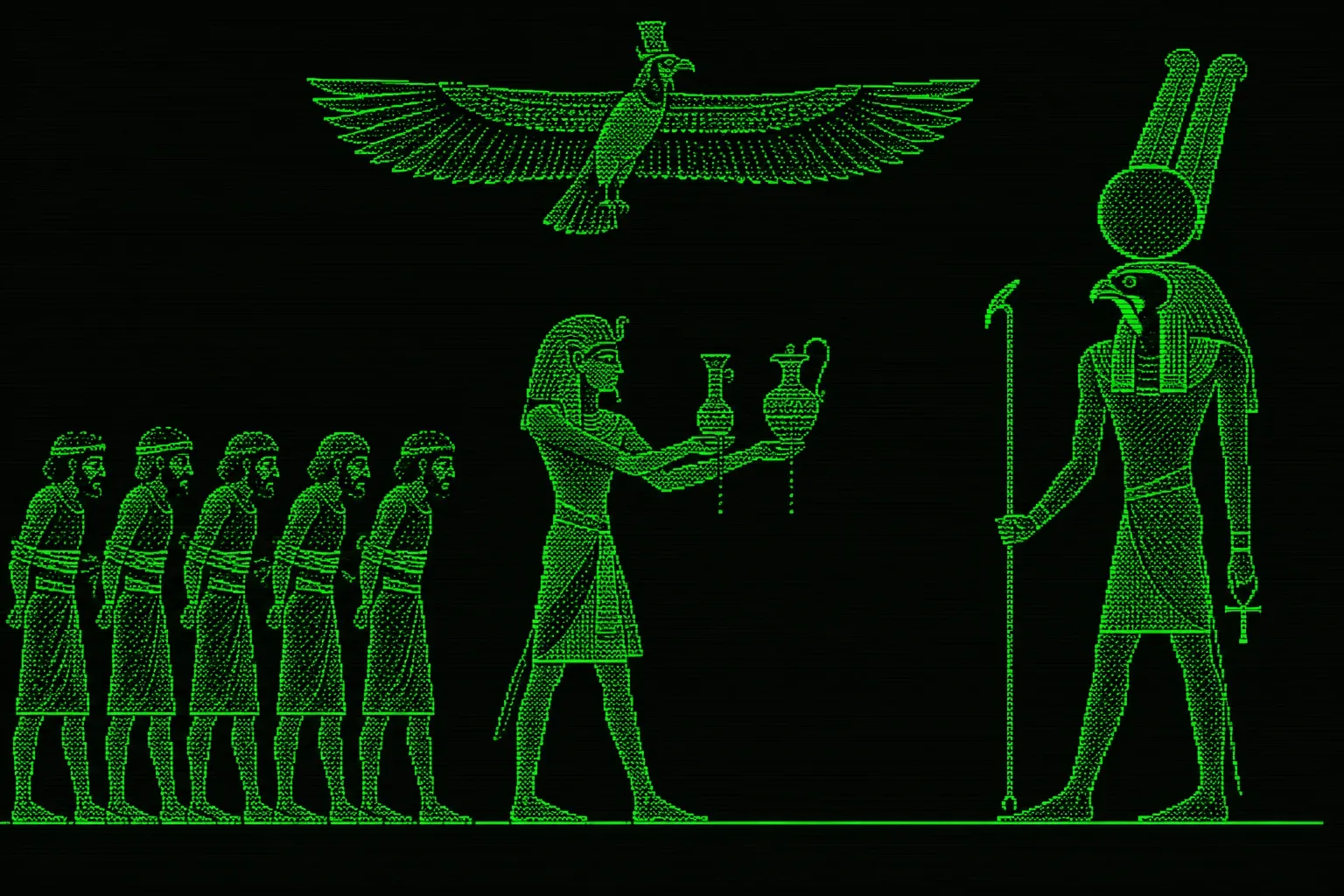
Ramesses II stands before Amun, Mut and Khonsu. Behind him, the captives are arrayed in three rows. - 2
jni̯ ẖr,j.pl =sn m sqr-ꜥnḫ r mḥ šnꜥ n jtj =f Jmn
Bringing their people as prisoners of war to fill the storehouse of his father Amun.
Note · Line 2
The prisoners are being assigned to work in the temple storehouse. - 3
sḥw wr.pl n.w tꜣ Ḫt jni̯.n ḥm =f ꜥnḫ-(w)ḏꜣ-s(nb) m sqr-ꜥnḫ r pr jtj =f Jmn Dr~dn~y Pj~d~sꜣ Q~⸢r~q~š⸣ Mꜣ~sꜣ Rw~kꜣ
All the princes of the land of Hatti whom His Majesty—life, prosperity, health!—brought as prisoners of war to the temple of his father Amun: Dardany, Pidasa, Karkisha, Masa, Lukka.
Note · Line 3
Hatti was the Hittite kingdom. The list names the lands the captive princes represent, not the princes themselves. - 4
[...] [K~r~]k~m~š Jr~wn~nꜣ Jr~ṯw
… Carchemish, Arwanna, Arzawa.
- 5
ṯꜣ,y-ḫw-ḥr-wn[m,j]-nswt sẖꜣ,w-nswt jm,j-rʾ-mšꜥ-wr sꜣ-nswt Jmn-ḥr-ḫpš≡f
Fan-bearer at the king’s right hand, royal scribe, commander-in-chief, the king’s son Amunherkhepeshef.
- 6
sẖꜣ,w-nswt jm,j-rʾ-mšꜥ-wr ⸢sꜣ-nswt⸣-[n-ẖ,t≡f] [mri̯.y] =[f] [Rꜥw]-msi̯-s(w)
Royal scribe, commander-in-chief, Ramesses, son of the king’s own body, whom the king loves.
- 7
M~r~yn.pl n.w N~h~r~n ẖs
Maryannu warriors of wretched Naharina.
Note · Line 7
The maryannu were an elite class of chariot warriors. Naharina was the Egyptian name for the northern kingdom of Mitanni. - 8
[kḏn-tp,j-n]-ḥm≡f sẖꜣ,w-nswt jm,j-rʾ-ssm,t.pl
His Majesty’s first charioteer, royal scribe and master of the horse.
- 9
M~r~y~nꜣ.pl n.w Ḫ~r~b
Maryannu warriors of Aleppo.
- 10
[ms] [jn,w] [m]-⸢sꜣ⸣ ḥm =f jn sꜣ-nswt Ḫꜥi̯-m-Wꜣs,t
The king’s son Khaemwaset presenting tribute behind His Majesty.
- 11
ms.w.pl wr.pl n.w tꜣ n Ḫt
Children of the princes of the land of Hatti.
- 12
M~r~y~nꜣ.pl n.w K~š~⸢k~š⸣
Maryannu warriors of Kashkash.
- 13
ms [jn,w] m-sꜣ ḥm =f jn sꜣ-nswt Mri̯.y-Jmn
The king’s son Meryamun presenting tribute behind His Majesty.
- 14
[M~r~y~n] n.w Dr~dn~y
Maryannu warriors of Dardany.
- 15
[ms] [jn,w] [m]-⸢sꜣ⸣ ḥm =f 〈jn〉 Jmn-m-wjꜣ
Amunemwia presenting tribute behind His Majesty.
- 16
ms jn,w m-sꜣ ḥm =f jn sꜣ-nswt Stẖ.y ⸢mꜣꜥ⸣-[ḫrw]
The king’s son Seti, true of voice, presenting tribute behind His Majesty.
Note · Line 16
“True of voice” is an honor paid to the dead: it declares that Seti has been vindicated before the gods. - 17
ꜥḥꜣ.pl-ḥr-rd,wj n.w K~r~kꜣ~m~š
Foot soldiers of Carchemish.
- 18
[ms] [jn,w] [m-sꜣ] ḥm =f j[n] sꜣ-nswt [Mri̯.y]-Rꜥw
The king’s son Meryre presenting tribute behind His Majesty.
- 19
[ms] jn,w [jn] [jr,j-pꜥ,t] [s,tj]-Gb sꜣ-nswt sms,w Mri̯.n-Ptḥ
The hereditary prince, Geb’s deputy, the king’s eldest son Merneptah, presenting tribute.
Note · Line 19
Geb is the earth god, himself once king of the gods. - 20
ꜥḥꜣ.pl-ḥr-rd,wj n.w Jkrṯ
Foot soldiers of Ugarit.
- 21
ms jn,w n wdḥ,w.pl n jtj =f Jmn-Rꜥw nswt-nṯr.pl-nb.pl jn nswt nb-Tꜣ,wj nb-jri̯,t-jḫ,t m ḥꜣq.n ḫpš =f qn nb-Tꜣ,wj Wsr-Mꜣꜥ,t-Rꜥw-stp.n-Rꜥw nb-ḫꜥ,w Rꜥw-msi̯-s(w)-mri̯.y-Jmn di ꜥnḫ mj Rꜥw sꜥꜣ.n Jmn pḥ,tj =f
From the spoils his mighty sickle-sword seized, the king, lord of the Two Lands and lord of ritual, presents libation vessels as tribute to his father Amun-Ra, king of all the gods. He is the lord of the Two Lands, Usermaatre Setepenre, the lord of crowns, Ramesses Meryamun, whose strength Amun has made great, given life like Ra.
Note · Line 21
The Two Lands are Upper and Lower Egypt. Usermaatre Setepenre is the throne name of Ramesses II; Meryamun means “beloved of Amun.” - 22
wr.pl ḫꜣs,t.pl jni̯.n ḥm =f m nḫt,w.pl =f ḥr ḫꜣs,t Rṯn,w r mḥ šnꜥ n [jtj] =[f] šps Jmn-Rꜥw nswt-nṯr.pl m ḥꜣq.n ḫpš =f qn
Princes of foreign lands whom His Majesty brought back from his victories over the foreign land of Retjenu, to fill the storehouse of his august father Amun-Ra, king of the gods, with the spoils his mighty sickle-sword seized.
Note · Line 22
Retjenu was the Egyptian name for a region of the Levant. - 23
Nḫb,t ḥḏ,t-Nḫn ꜣw,t-ꜥ nb,t-p,t ḥn,wt-nṯr.pl di =s ꜥnḫ
Nekhbet, the White One of Nekhen, her arm outstretched, lady of heaven, mistress of the gods: she gives life.
Note · Line 23
Nekhbet flies above the king in the form of a vulture; her outstretched arm is her wing. - 24
ḏd-mdw jn Jmn-Rꜥw nb-p,t
Words spoken by Amun-Ra, lord of heaven:
- 25
sꜣ =j n ẖ,t =j mri̯.y nb-Tꜣ,wj Wsr-Mꜣꜥ,t-Rꜥw-stp.n-Rꜥw di.n n =k qn,t nḫt nb
“My beloved son, born of my own body, lord of the Two Lands, Usermaatre Setepenre, I have given you valor and every victory.”
- 26
Mw,t nb,t-Jšr,w nb,t-p,t ḥn,wt-nṯr.pl
Mut, lady of Isheru, lady of heaven, mistress of the gods.
Note · Line 26
Isheru is the sacred lake at Mut’s temple at Karnak. - 27
ḏ[d-mdw] [jn] Ḫns,w-m-Wꜣs,t-Nfr-ḥtp
Words spoken by Khonsu-in-Thebes Neferhotep:
Note · Line 27
Neferhotep means “perfectly gracious.” - 28
di.[n] [n] =[k] ꜥnḫ wꜣs nb
“I have given you all life and well-being.”