~/sacred-texts/pyramid-texts
Pyramid Texts 710: Pepi I Enters the Sky as the Nile Flood
- Text
- Pyramid Texts, Utterance 710
- Date
- Carved in the 6th Dynasty, in the reign of Pepi I (c. 2321–2287 BC), on the walls of his pyramid at Saqqara
- Found
- Pyramid of Pepi I, South Saqqara, Egypt; the spell survives only in broken wall fragments
- Language
- Old Egyptian · Hieroglyphic
- 1
[ḏ(d)-mdw]
Words to be spoken:
Note · Line 1
The standard heading that marks what follows as a spell to be recited aloud. - 2
[...] [sḫ,t]-jꜣr,w
… the Field of Reeds.
Note · Line 2
The Field of Reeds is a marshy region of the sky where the blessed dead are purified and live on. - 3
[...] [sḫ,t]-jꜣr,w
… the Field of Reeds.
Note · Line 3
This is a second copy of the same broken line. - 4
wn.y ꜥꜣ.du p,[t] [...]
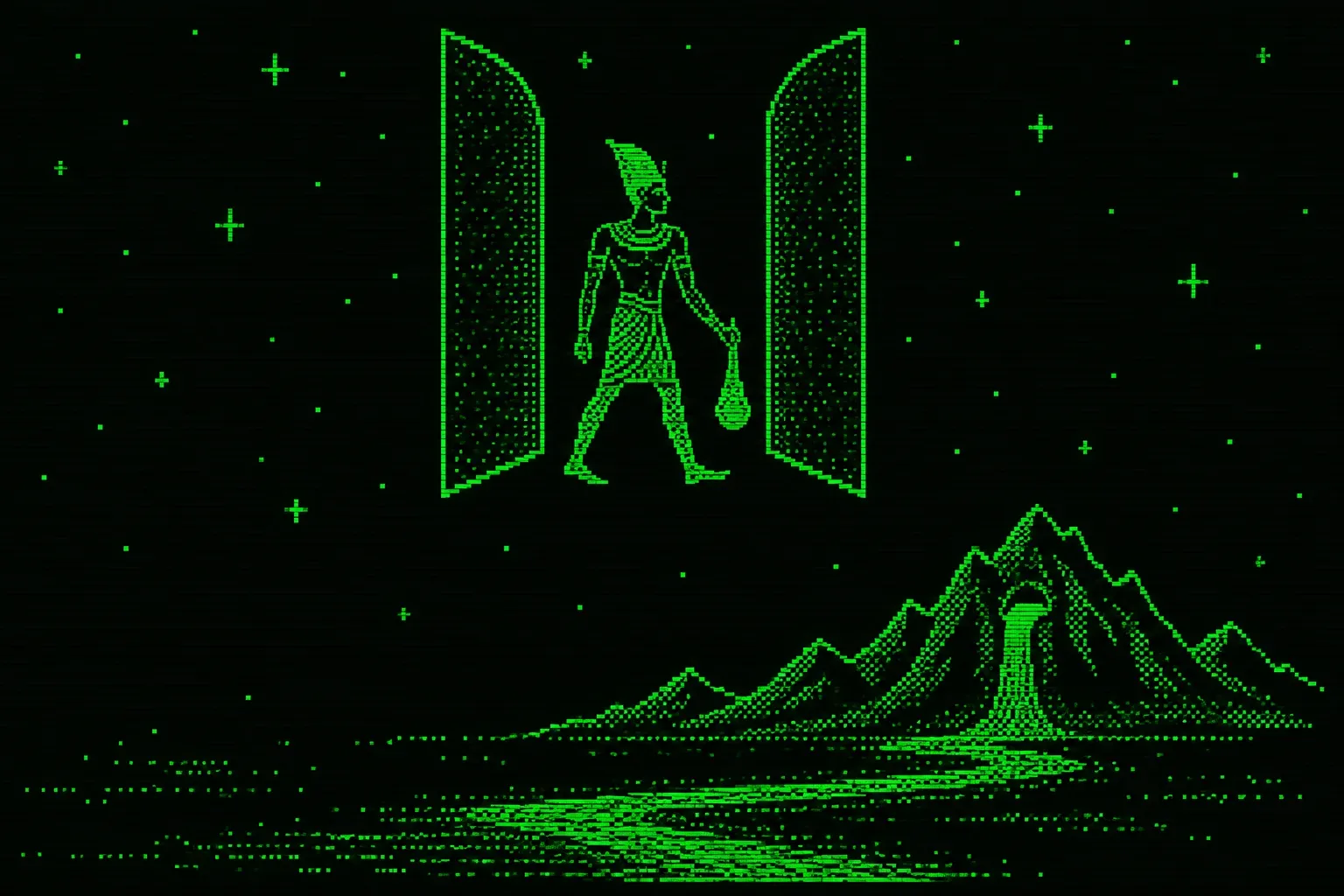
Open are the double doors of the sky, …
- 5
[...] [j:zn].y ꜥꜣ.du ⸢qbḥ,w⸣ [...]
… flung open are the double doors of the Cool Waters …
- 6
[...] ⸢sw⸣ḥ =f nṯr(,j) ḥr =f ḥḏ n(,j) Ppy [pn] [m] [ꜥ] =[f] [...]
… his divine kilt upon him, this Pepi's mace in his hand …
Note · Line 6
Pepi is King Pepi I of the Sixth Dynasty, in whose pyramid this spell is carved. Here he is dressed and armed like a god for his entry into the sky. - 7
[...] ⸢sw⸣ jr mr nṯr(,j) wꜥb =f ⸢jm⸣ =[f] [...]
… him to the divine canal, that he may purify himself in it …
Note · Line 7
Before a dead king can join the gods, he must be washed clean in the waters of the sky. - 8
[...] nṯr.pl jpw ⸢jy⸣j ⸢nzw⸣ [...] ⸢_⸣z⸢_⸣w n(,j) nṯr ḫ[r] =f
… to these gods: "The king has come, … of a god is with him."
- 9
[p]ri̯ Ppy pn j:hꜣi̯ =f m [...]
This Pepi shall go up, and he shall go down into …
- 10
[_]ꜣ Ppy pn p,t wꜣḥ{j}.n =f sw ⸢ḥr⸣ [...]
This Pepi … the sky, having laid himself upon …
- 11
[...] j.n wꜥb n(,j) Rꜥw n [...] [_]⸢nw⸣
… says the Pure One of Ra to … …
- 12
nṯr =k pn ⸢jy.j⸣
"This god of yours has come.
Note · Line 12
The “god” is the dead king himself, presented as a newly arrived god to someone whose name is lost. - 13
jmi̯ jwt =f
Let him come!
- 14
jmi̯ j:ꜥq =f [...] jptw wḫꜣ.t n.t Ḥr,w tm jz,⸢t⸣.[pl] [...]
Let him enter … these shaken-out … of Horus, that the boundary stones may be no more …
- 15
[...] n nṯr.pl sḥtp =f ꜣḫ.⸢pl⸣
… to the gods; he will satisfy the spirits."
- 16
[jwi̯] nṯr.pl m k[s,w] n nḫt(,w) zꜣ Gbb šꜥ.n =s[n] [_]w[_] =[sn] ⸢ḥs⸣b.n =sn pḏ,t.pl =sn
The gods come bowing before the might of Geb's son, having cut off their … and broken their bows.
Note · Line 16
“Geb’s son” is the king, who is cast as the heir of Geb, the earth god. - 17
j[_] [...] [_]s[_] [...]
[gap in the text]
- 18
[...] Ppy pn p,t ḥnꜥ [ꜣḫꜣḫ].⸢pl⸣ =s ḥnꜥ jwn.pl =s [_]t jdb.pl =s
… this Pepi … the sky, together with its Akhakh-stars, together with its pillars, … its banks.
Note · Line 18
The Akhakh are a group of stars; the name may mean something like “the green, sprouting ones.” - 19
ḥ(ꜥ)p(j)-wr p ⸢Ppy⸣ pn zꜣ [...] ḥj p Ppy pn pri̯ m ḏw q[ꜣ]
This Pepi is the High Flood, son of …;
this Pepi is the surging water that pours out of the high mountain.Note · Line 19
The High Flood is the yearly Nile inundation, which Egyptians thought welled up from a source in the far southern mountains. By naming himself the flood, the dead king claims its power to renew life. - 20
[...] [_] =k r w[_] [...]
… your … to …
- 21
sq(r) pꜣḏ =f s[_] [...] ⸢m⸣ pꜣḏ =[f]
Let his round loaf be offered … as his round loaf.
Note · Line 21
The Egyptian names a specific kind of round loaf, a common item in the offering lists for the dead.