~/sacred-texts/pyramid-texts
Pyramid Texts Utterance 698: Escaping the Gods’ Knives
- Text
- Pyramid Texts, Utterance 698
- Date
- Carved in the 6th Dynasty, in the reign of Pepi I (c. 2330–2280 BC), on the walls of his pyramid at Saqqara
- Found
- Pyramid of Pepi I, South Saqqara
- Language
- Old Egyptian · Hieroglyphic
- 1
[ḏ(d)-mdw]
Recitation:
- 2
[wn] -(Subst.)- [ꜣḫ,t] [n] [Ḥr,w] [swꜣ] =[f] jm
The … of the horizon opens for Horus, that he may pass through.
- 3
Ppy ꜣ p Ḥr,w swꜣ =f jm
Pepi is Horus indeed, and he shall pass through.
Note · Line 3
The litany moves in couplets. A passage opens for a god, and then the king is declared to be that god, so the way opens for him as well. - 4
wn rmn ḏw,⸢t⸣ [n] [Ḥr,w] swꜣ =f j⸢m⸣
The shoulder of the mountain opens for Horus, that he may pass through.
Note · Line 4
The sun was pictured rising between two peaks on the eastern horizon. The mountain’s “shoulder” is its flank, which splits open to let him through. - 5
Ppy ꜣ pw Ḥr,w swꜣ =f [j]⸢m⸣
Pepi is Horus indeed, and he shall pass through.
- 6
[wn] -(Subst.)- [ꜣḫ,t] [n] ꜣḫ,tj swꜣ =f jm
The … of the horizon opens for Him of the Horizon, that he may pass through.
Note · Line 6
“Him of the Horizon” is a title formed from the word for horizon itself: the one who belongs to it and lives there, the rising sun-god. - 7
Ppy ꜣ [p] [ꜣḫ],tj [swꜣ] =[f] [jm]
Pepi is Him of the Horizon indeed, and he shall pass through.
- 8
[wn] [rmn] [ḏw,t] n ꜣḫ,[tj] [swꜣ] =[f] [jm]
The shoulder of the mountain opens for Him of the Horizon, that he may pass through.
- 9
[Ppy] [ꜣ] [p] [ꜣḫ,tj] [swꜣ] =[f] [jm]
Pepi is Him of the Horizon indeed, and he shall pass through.
- 10
[wn] -(Subst.)- ⸢ꜣḫ⸣,t n Šz[m],tj swꜣ =f jm
The … of the horizon opens for Him of Shezmet, that he may pass through.
Note · Line 10
Shezmet was an eastern land, linked with the desert toward Sinai and its malachite. “He of Shezmet” is a form of Horus as a god of the East, where the sun comes up. - 11
Ppy ꜣ [p] Šzm,tj 〈swꜣ〉 =〈f〉 〈jm〉
Pepi is Him of Shezmet indeed, and he shall pass through.
- 12
wn rmn ⸢ḏw⸣,t n Šzm,tj swꜣ =f jm
The shoulder of the mountain opens for Him of Shezmet, that he may pass through.
- 13
Ppy ꜣ p Šzm,tj [s]wꜣ =f [jm]
Pepi is Him of Shezmet indeed, and he shall pass through.
- 14
[j] ⸢nṯr.pl⸣ ꜥnḫ.w m(w)t.w
O gods, you living, you dead!
Note · Line 14
The spell now turns to address every being, divine, living or dead, who could still harm the king on his way. - 15
[nhi̯.y] [Ppy] -(Subst.)- =[ṯn] [n] ⸢m⸣(w)t =f n -(Subst.)- =[ṯn]
Pepi shall escape your …, and he shall not die of your ….
Note · Line 15
The nouns are lost. They named whatever harmful thing these beings might send against him. - 16
[nhi̯.y] [Ppy] -(Subst.)- =[ṯn] ⸢n⸣ ⸢m(w)t⸣ =⸢f⸣ n pri̯.t [m] -(Subst.)- =ṯn
Pepi shall escape your …, and he shall not die of what comes out of your ….
- 17
[n]hi̯.y Ppy m⸢d⸣(w).pl =ṯn n [m(w)t] =f 〈n〉 [ḥ]mḥm.pl =[ṯn]
Pepi shall slip past your staves;
he shall not die by your war cries.Note · Line 17
The “you” throughout is the gods of the two Enneads named below: the two companies of nine gods. - 18
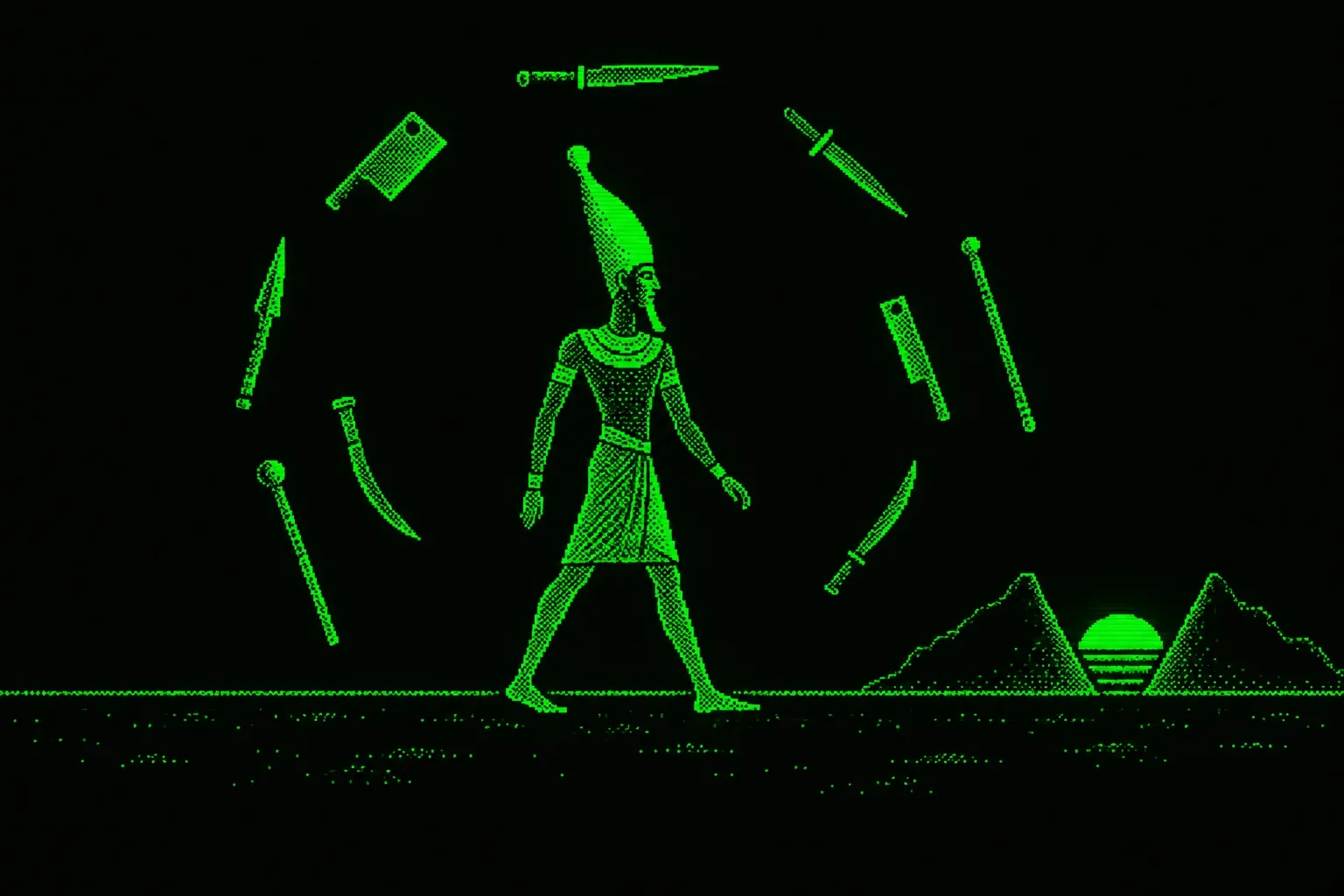
[nhi̯].⸢y⸣ Ppy šꜥ.w,t =ṯn n m(w)t =f n zwꜣ,t.pl =ṯn
Pepi shall slip past your knives;
he shall not die by your cleavers. - 19
nhi̯.y Ppy šn,t =ṯn n ⸢m⸣(w)[t] =f n šn,wt =ṯn
Pepi shall slip past your circling;
he shall not die in your encircling.Note · Line 19
The two nouns come from the same root, “to encircle”: a ring of guards or a closing trap. - 20
[nhi̯.y] [Ppy] [zꜣ,wt] =[ṯn] n m(w)[t] =[f] [n] [zꜣr.pl] =[ṯn]
Pepi shall slip past your tether;
he shall not die in your fetters. - 21
[nhi̯.y] Ppy [_].pl =ṯn n m(w)t =f [n] [_].pl =⸢ṯn⸣
Pepi shall slip past your …;
he shall not die by your …. - 22
[...] ⸢psḏ,t.du⸣ [Mn]w js Jnp,w js
… you two Enneads, as Min, as Anubis.
Note · Line 22
Min is a god of fertility and potency. Anubis is the jackal god of embalming and the cemetery. - 23
wꜣḥ =ṯn tp.pl =ṯn n Ppy kfj =ṯn n =f r(m)n.pl =ṯn [...] [_]ꜣ =ṯn n[_]
Bow your heads to Pepi, bare your shoulders for him, … your ….
Note · Line 23
Baring the shoulders is a gesture of submission or respect before a superior. - 24
[snḏ] [n(,j)] Ppy pn r jb =[ṯn] šꜥ,t =f jr ḥꜣ,t(j).pl =[ṯ]n mr [s]⸢nḏ⸣ [n(,j)] [Ḥr,w] [ḫꜥi̯] [m] ⸢ḥḏ⸣,[t]
Let dread of this Pepi be in your heart, his terror in your hearts,
like the dread of Horus when he appears in the White Crown.Note · Line 24
The White Crown is the tall crown of Upper (southern) Egypt. The king is to be feared as Horus, the divine model of kingship, is feared when he appears wearing it. - 25
s[nḏ] [n(,j)] [Ppy] [pn] [r] [jb] =[ṯn] [šꜥ,t] =[f] [jr] ḥꜣ,t(j).pl =ṯn mr snḏ n(,j) Rꜥw ḫꜥi̯ m šꜣb,t(j)
Let dread of this Pepi be in your heart, his terror in your hearts,
like the dread of Ra when he appears in the Coiled Crown.Note · Line 25
The “Coiled Crown” (Egyptian šꜣbtj) is a name for the Red Crown of Lower (northern) Egypt, from the spiral of wire that springs from its front. - 26
wr snḏ n(,j) Ḥr,w ḫꜥi̯ m ḥḏ,t [...]
Great is the dread of Horus when he appears in the White Crown; …
- 27
[_]w snḏ Rꜥw [...] [šꜣ]b,[t(j)]
… the dread of Ra … the Coiled Crown.