~/sacred-texts/pyramid-texts
Pyramid Texts Utterance 674: I Am Horus, Your Son
- Text
- Pyramid Texts, Utterance 674
- Date
- Carved in the 6th Dynasty, in the reign of Pepi II (c. 2278–2184 BC), on the walls of his pyramid at Saqqara
- Found
- Pyramid of Pepi II at South Saqqara, where the inscribed walls remain
- Language
- Old Egyptian · Hieroglyphic
- 1
[ḏ(d)-mdw]
Words to be spoken:
- 2
[jwi̯.n] =[(j)] [ḫr] =[k] [jnk] [zꜣ] =[k]
I have come to you; I am your son.
Note · Line 2
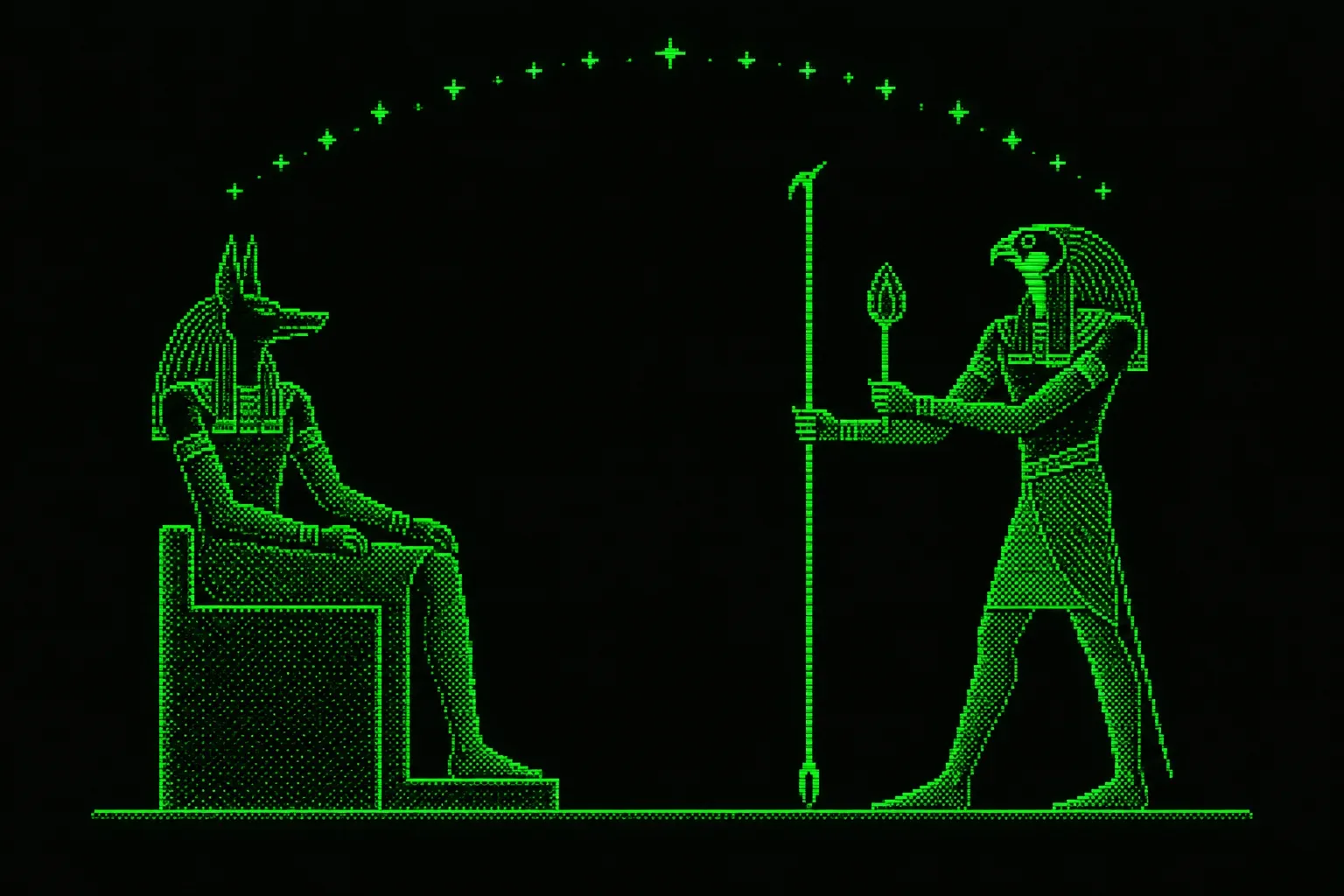
Horus, the son, speaks to the dead king, who is addressed as his father, Osiris. - 3

[jwi̯.n] =[(j)] [ḫr] =k Ppy Nfr-kꜣ-Rꜥw pw jnk Ḥr,w
I have come to you, Pepi Neferkare; I am Horus.
Note · Line 3
Neferkare is the throne name of Pepi II, the king for whose pyramid these spells were carved. - 4
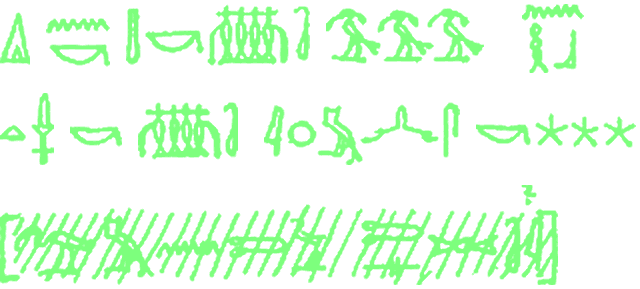
ḏi̯ =(j) n =k mdw =k ḫntj ꜣḫ.pl nḥb,t =k ḫntj j:ḫm.pl-sk
I give you your staff at the head of the spirits,
your lotus-bud scepter at the head of the Imperishable Stars. - 5

[gmi̯] =[(j)] [ṯw] [ṯ(ꜣ)z] =[(j)] [ḥr] =〈k〉 m z(ꜣ)b pḥ =〈k〉 m qbḥ,(w)t
I have found you, and I knit on your face as a jackal's, your hindparts as Qebehut's.
Note · Line 5
Horus rebuilds his father’s body. The jackal face is the face of Anubis, god of embalming. Qebehut is Anubis’s daughter, a goddess of cool water and purification. - 6
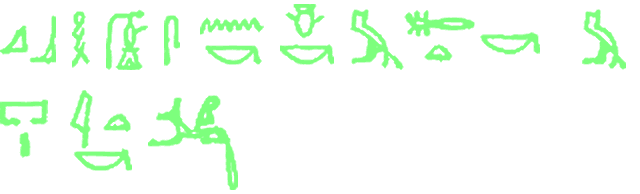
qbḥ =s n =k jb =k m ẖ,t =k m pr jt(j) =k Jnp,w
May she cool your heart for you in your body, in the house of your father Anubis.
- 7
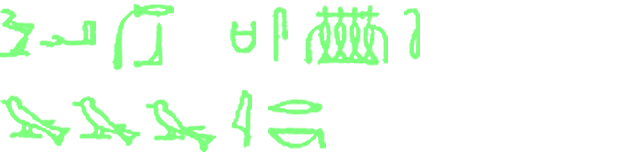
wꜥb ḥmsi̯ ḫntj wr.pl jr =k
Purify yourself; sit at the head of those greater than you.
- 8
[ḥmsi̯] [r] =[k] [ḥr] [ḫnd,w] =[k] bjꜣ.wy ḥr ns,t Ḫnt,j-jmn,t(j)w
Sit down, then, on your metal throne, on the throne of the Foremost of the Westerners.
Note · Line 8
“Foremost of the Westerners” (Khentiamentiu) is a title of the god of the dead, later identified with Osiris. The West is the land of the dead. - 9
stjš.pl =k ntsn ṯꜣj =sn
Your setjesh: it is they who shall take.
Note · Line 9
The word setjesh is not otherwise attested, and its meaning is unknown. - 10

ḏsw n =k Smn,tt (Ꜣ)s,t js
The Wailing Woman shall cry out to you as Isis,
Note · Line 10
The Wailing Woman and She Who Hails are the two professional mourners at a funeral. They play the parts of the sisters Isis and Nephthys, who mourned Osiris. - 11
hnj n =k [hnj,(w)t] [Nb,t-ḥw(,t)] [js]
She Who Hails shall hail you as Nephthys.
- 12
ꜥḥꜥ =k ḫntj sn,t.pl Mnw js
You shall stand before the senut-shrines like Min.
- 13
ꜥḥꜥ =k ḫntj km,t(j).w Ḥp js
You shall stand before the Egyptians like Apis.
Note · Line 13
Apis is the sacred bull of Memphis. - 14
ꜥḥꜥ =k m pḏ,w Zkr [js]
You shall stand in the Pedju like Sokar.
Note · Line 14
The Pedju, “the Spread-Out (Lake),” was a cult place of Sokar, a falcon god of the Memphite necropolis. - 15
[ꜥḥꜥ] =[k] [jr] [r(w)d]-wr ꜥbꜣ =k nwḏ,t =k
You shall stand at the Great Stair with your aba-scepter and your nudjet.
- 16
ꜥn,t.pl =k tp.t ḏbꜥ.pl =k m(j)ꜣz.w tp.w rmn.du Ḏḥw,tj mds pri̯ m Stš
The nails on your fingers are the spikes on the shoulders of Thoth, the knife that came out of Seth.
Note · Line 16
The king’s fingernails become weapons taken from two gods. - 17
ḥwi̯ =k [ꜥ] =[k] [jr] [m(w)t.pl] [jr] ꜣḫ.⸢pl⸣ nḏrw.t =sn ꜥ =k n Ḫnt,j-jmn,t(j)w
You swing your arm at the dead, at the akhs who would seize your arm for Khentiamentiu.
Note · Line 17
The king strikes out against both the ordinary dead and the akhs, who would seize him for Khentiamentiu, god of the dead. He fights them off because he has not died. - 18
hꜣ Ppy Nfr-kꜣ-Rꜥw wr wrš ꜥꜣ sḏr
O Pepi Neferkare, great in waking, mighty in sleep!
Note · Line 18
Pepi Neferkare is Pepi II of the Sixth Dynasty. - 19
bn jr =k bn.w
Be sweet, you sweet one!
- 20
ṯzi̯ ṯw [Ppy] [Nfr-kꜣ-Rꜥw] [p]w n m(w)t =k
Lift yourself up, Pepi Neferkare: you have not died!
Note · Line 20
The spell ends on the central claim of the Pyramid Texts: the king’s death is not a real death but a passage to rising again.