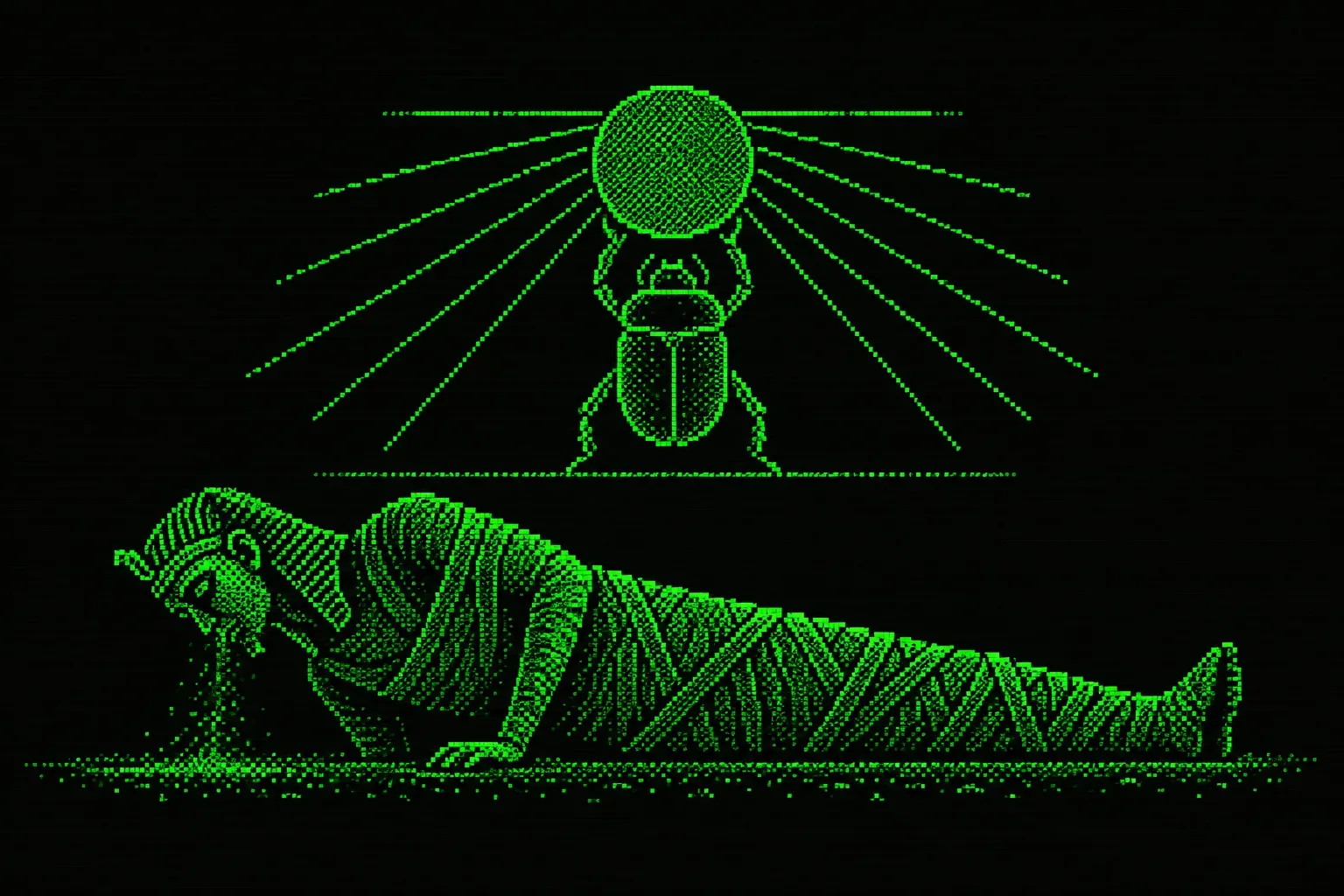
~/sacred-texts/pyramid-texts
Pyramid Texts Utterance 662: The Dead Rise from Their Tombs
- Text
- Pyramid Texts, Utterance 662
- Date
- Carved in the 6th Dynasty (c. 2280–2180 BC) on the inner walls of the pyramid of King Pepi II Neferkare at Saqqara
- Found
- Pyramid of Pepi II, South Saqqara, Egypt
- Language
- Old Egyptian · Hieroglyphic
- 1

ḏ(d)-mdw
Words spoken:
- 2
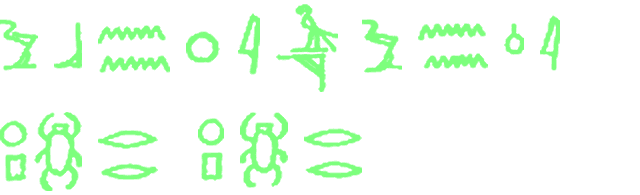
wbnn,j w〈b〉nn,j Ḫprr Ḫprr
Shining one, shining one! Khepri, Khepri!
Note · Line 2
Khepri is the scarab god of the rising sun. - 3

j(w) =k r Ppy Nfr-kꜣ-Rꜥw jw Ppy Nfr-kꜣ-Rꜥw jr =k
You belong to Pepi Neferkare,
and Pepi Neferkare belongs to you.Note · Line 3
Pepi Neferkare is King Pepi II, in whose pyramid this spell was carved. The god and the dead king are bound to each other in mirrored phrases, and the pattern recurs through the spell. - 4
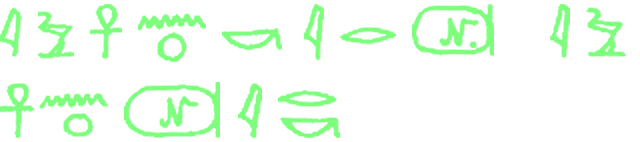
jw ꜥnḫ =k jr Ppy Nfr-kꜣ-Rꜥw jw ꜥnḫ Ppy Nfr-kꜣ-Rꜥw jr =k
Your life is for Pepi Neferkare,
and Pepi Neferkare's life is for you. - 5

j wꜣḏ pri̯ m Wꜣḏ,t
O papyrus, come forth from Wadjet!
- 6
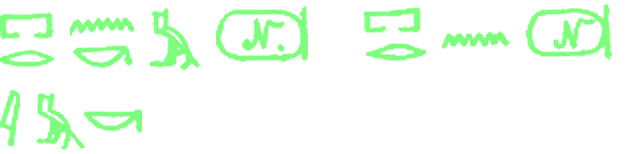
pri̯.n =k m Ppy Nfr-kꜣ-Rꜥw pri̯.n Ppy Nfr-kꜣ-Rꜥw jm =k
You have come forth in Pepi Neferkare,
and Pepi Neferkare has come forth in you. - 7

wsr.n Ppy Nfr-kꜣ-Rꜥw m wꜣš =k
Pepi Neferkare has grown mighty through your honour.
- 8
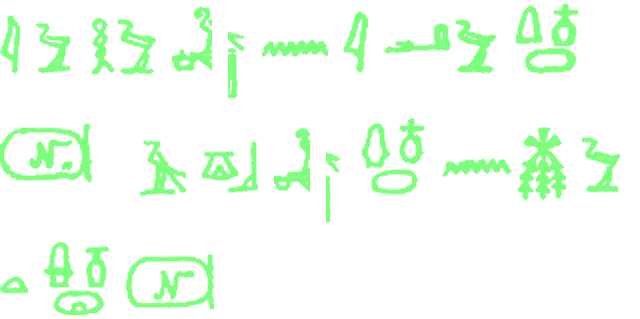
jw Ḥw n jꜥ,w Ppy Nfr-kꜣ-Rꜥw Ꜣgb(,w) n ms,wt Ppy Nfr-kꜣ-Rꜥw
Sustenance is Pepi Neferkare's breakfast,
Flood is Pepi Neferkare's supper.Note · Line 8
Sustenance (Hu) and Flood (Agbu, the primeval waters of plenty) are treated as divine persons. They become the king’s morning and evening meals. - 9

n sḫm hdd,wt m ꜥnḫ Ppy Nfr-kꜣ-Rꜥw
The hededut shall have no power over Pepi Neferkare's life.
Note · Line 9
The hededut (hdd.wt) are probably scorpions; a similar name belongs to a scorpion goddess. Their sting is one of the dangers the dead king must be kept safe from. - 10
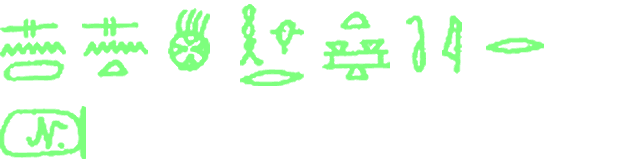
znzn,t ḥri̯.tj r Ppy Nfr-kꜣ-Rꜥw
The blaze is kept far from Pepi Neferkare.
- 11
ꜥnḫ Ppy Nfr-kꜣ-Rꜥw m ꜣgb,j =k bꜥḥi̯ Ppy Nfr-kꜣ-Rꜥw m bꜥḥ,t =k Rꜥw rꜥw-nb
Pepi Neferkare shall live on your flood,
Pepi Neferkare shall overflow with your overflowing, O Ra, every day.Note · Line 11
The Egyptian plays on its own words: the king “overflows with your overflow,” just as he lives on the god’s “flood,” echoing the Flood of P-08. - 12
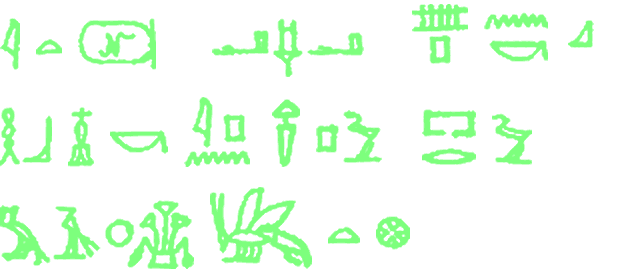
jt(j) Ppy Nfr-kꜣ-Rꜥw ꜥḥꜥ šzp n =k qbḥ =k jpn tp(,j).w pri̯.w m Ꜣḫ-bj,t
Father Pepi Neferkare, stand up, take for yourself these first cool waters of yours that come out of Chemmis.
Note · Line 12
Chemmis was a papyrus marsh in the Delta where Isis hid the infant Horus. Water from there is pure, life-giving water for the dead king. Here the voice turns to address the king himself. - 13

ꜥḥꜥ jm(,j).w jz.pl =sn
Stand up, all you who are in their tombs!
- 14

sfḫḫ wt.pl =ṯn
Undo your mummy-wrappings!
- 15

wḫꜣ šꜥ jr ḥr =k
Shake the sand from your face!
- 16
ṯzi̯ ṯw ḥr gs =k jꜣb(,j) srw ṯw ḥr gs =k wnm(,j)
Raise yourself from your left side,
turn yourself onto your right side.Note · Line 16
The dead were laid in the tomb on their left side. Turning over is the first movement of the body waking to new life. - 17
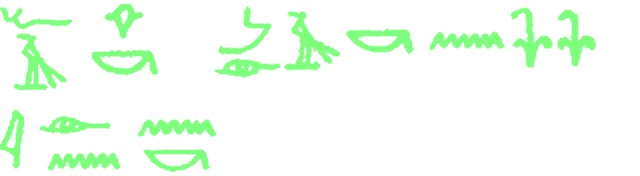
fꜣi̯ ḥr =k mꜣ =k nn jri̯.n =(j) n =k
Lift up your face and see what I have done for you.
Note · Line 17
The speaker is the dead king’s son and successor, addressing his father. He plays the part Horus plays for his dead father Osiris: the son who tends his father’s cult. - 18

jnk zꜣ =k
I am your son.
- 19

jnk jwꜥ(,w) =k
I am your heir.
Note · Line 19
By Egyptian custom the heir proved his claim by providing for his father’s burial and offerings. That is why these words lead straight into the work the son has done. - 20
bꜣ.n =(j) n =k bd,t skꜣ.n =(j) n =k jt(j) jt(j) n wꜣg =k bd,t n rnp.w,t =k
I have hoed emmer for you,
I have ploughed barley for you:
barley for your Wag festival,
emmer for your yearly feasts.Note · Line 20
Emmer is an ancient hulled wheat, a staple grain of Egypt alongside barley. The Wag festival was a feast of the dead, held early in the year, when offerings were brought to the tombs. - 21
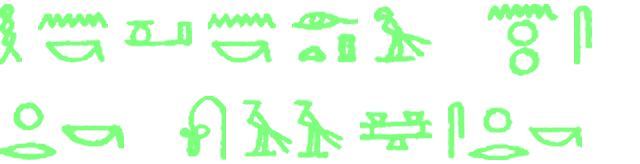
ḥnk =(j) n =k jr,t-Ḥr,w nḫḫ =s ḫr =k wꜣꜣ =s ḫr =k
I present you with the Eye of Horus:
it shall endure with you,
it shall reach far with you.Note · Line 21
The Eye of Horus was torn out by Seth and then restored. In the offering ritual every gift handed to the dead is called “the Eye of Horus,” a token of wholeness given back. - 22
nb-pr ꜥ =k ḥr jš,t.pl =k
Master of the house, may your hand be upon your goods.
Note · Line 22
The dead father is greeted as head of his household, free to lay hold of the provisions set out for him and claim them as his own.