~/sacred-texts/pyramid-texts
Pyramid Texts Utterance 658: Seth Pinned Under the Dead King
- Text
- Pyramid Texts, Utterance 658
- Date
- Carved in the 6th Dynasty (c. 2300 BC) on the walls of the pyramid of Pepi I at Saqqara
- Found
- Pyramid of Pepi I, South Saqqara, Egypt; the inscribed walls remain in place
- Language
- Old Egyptian · Hieroglyphic
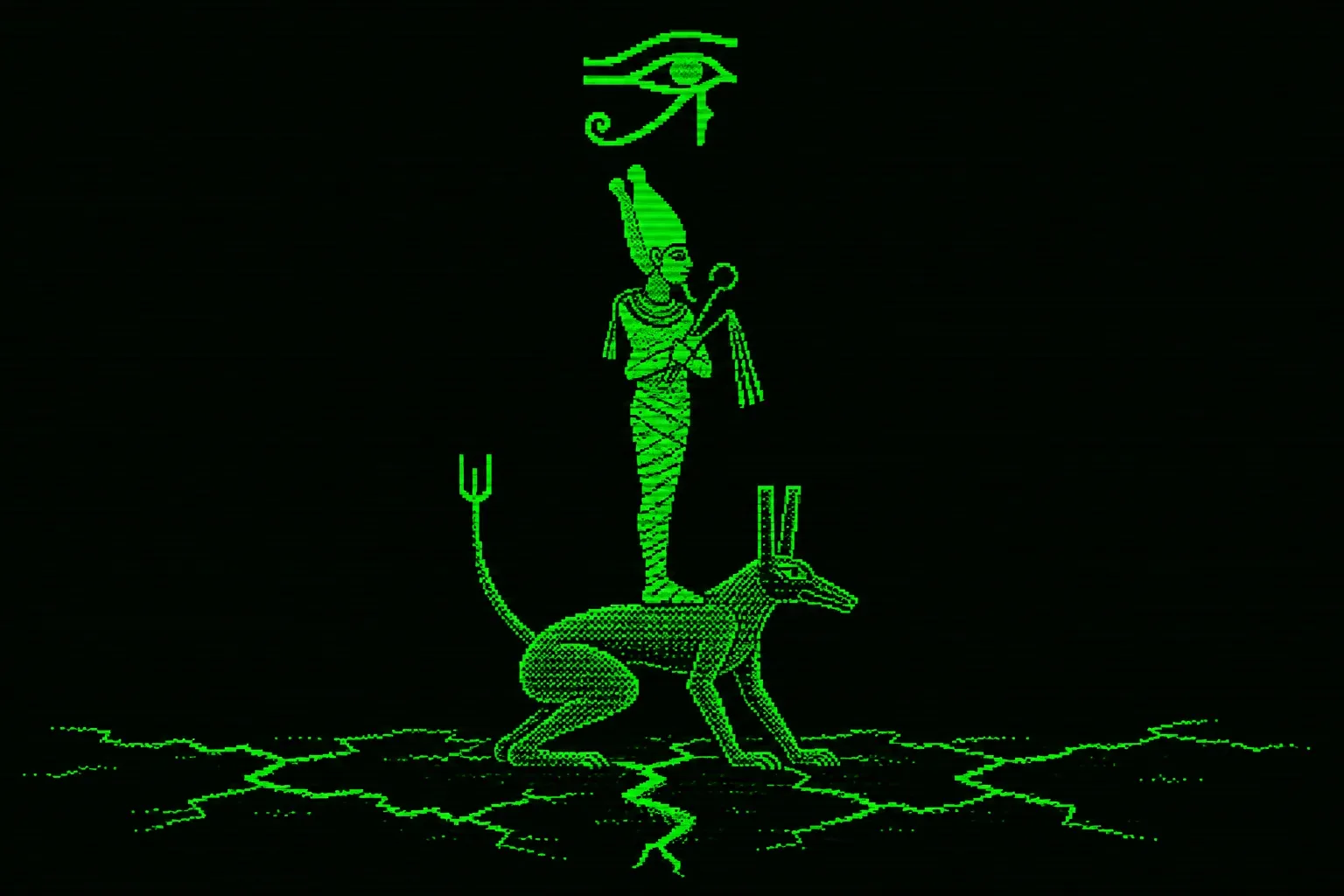
A priest speaks to the dead king, calling him Osiris Pepi. Horus avenges his father: he has seized Seth and set him beneath you, to lift you up and quake beneath you like an earthquake. The king is told to stand upon him, and Do not let go of him, and Thoth drags the king’s enemies to him and throws them down. Horus then gives the king the Eye that Seth tore out, in its name of Offering.
In the second half Horus sets the king on his feet (Do not totter!), and the four children of Horus carry him like the boat of Sokar. The spell ends with the king as the horizon itself, you from whom Ra comes forth.
- 1
[ḏ(d)-mdw]
Recitation:
Note · Line 1
“Words spoken” marks the start of a spell to be read aloud for the dead king. - 2
[hꜣ] [(W)s]r(,w) Ppy
O Osiris Pepi!
Note · Line 2
Pepi is the king buried in this pyramid. In death every king became an Osiris, so the god’s name is put before his own. - 3
jni̯.n n =⸢k⸣ [...]
… has brought to you …
- 4
[jwi̯.n] Ḥr,w [j]p =f [ṯw] [...]
Horus has come to reckon you …
- 5
[sḏꜣ.n] [ṯw] [nṯr.pl] [j:mr] =[sn] [ṯw]
The gods have kept you safe, for they love you.
- 6
[ꜣbi̯.n] [ṯw] nṯr.pl n Ḥr,w ⸢m⸣ [rn] =[k] [n(,j)] [Ꜣbw(,j)]
The gods have longed for you for Horus in your name of the One of Elephantine.
- 7
[jri̯.n] [ṯw] [nṯr.pl] [n] [Ḥr,w] [m] [rn] =[k] [n(,j)] [...]
The gods have made you for Horus in your name of …
- 8
[nḏri̯.n] [Ḥr,w] [Stš] [di̯.n] =[f] [n] =[k] [sw] [ẖr] =[k] [wṯz] =[f] [ṯw] [nwr] =[f] [ẖr] =[k] [m] [nwr-tꜣ]
Horus has seized Seth and set him beneath you, to lift you up and quake beneath you like an earthquake.
- 9
[m] [nhp] =[f] [m-ꜥ] =[k]
Let him not get away from you.
- 10
hꜣi̯ ḏsr.[t] [jr] =[f]
Go down, set apart from him.
- 11
[pri̯] [ꜥḥꜥ] [r-ḥr] =[f]
Come out, stand upon him.
- 12
[sḫti̯] [n] =[k] [sw] [sṯp] [jr] =[k] [ḥr] =[f] [_n_] ꜥnḫ
Drive him back for yourself; leap up onto him … life.
- 13
[sbḫ] [n] =[k] [ꜥ.du] =[k] [ḥꜣ] =[f] [zp] [2] [m] [rn] =[k] [n(,j)] mnw,〈t〉 [...]
Lock your arms around him (twice) in your name of Dove …
Note · Line 13
“Twice” tells the reciter to say these words two times. - 14
[m] [sfḫḫ] =[k] [jm] =[f] m pri̯ =f m-[ꜥ] =[k]
Do not let go of him; let him not get away from you.
- 15
[di̯.n] [n] =[k] [Ḥr,w] [ḫft(,j).w] =[k] [ẖr] =[k] ḏꜣi̯ ⸢mꜣ⸣[ꜥ]
Horus has set your enemies beneath you, ferried over and led in.
- 16
[jp.n] [n] =[k] [sn] [Ḏḥw,tj] sṯꜣ =f n =[k] [sn] [sḫr.n] =[f] [n] =[k] [sn] [ẖ]r =k rḏi̯.[n] =[f] [...] [jr,t]-Ḥr,w ḥtp =[k] [...] n =k s(j) [...]
Thoth has reckoned them up for you and drags them to you; he has thrown them down under you for you; he has given … the Eye of Horus, that you may be content … to you, it …
Note · Line 16
Thoth is the god of reckoning and writing. The Eye of Horus, torn out by Seth and restored, stands for every offering presented to the dead king. - 17
mḥ.n k[w] [Ḥr,w] [tm.tj] [m] [jr,t] =[f] [m] [r]n =s n(,j) wꜣḥ,(w)t
Horus has filled you to the full with his Eye, in its name of Offering.
Note · Line 17
The Eye of Horus, torn out by Seth and later restored, stands in the Pyramid Texts for every offering presented to the dead king. Here the gift is named outright as an offering. - 18
[nḥm.n] [Ḥr,w] [jr,t] =[f] m-ꜥ Stš [ḏi̯.n] =[f] [n] =[k] [s(j)]
Horus has rescued his Eye from Seth and given it to you.
- 19
[jr,t] =[f] [tn] [bn.t] sḫti̯ n =k [s(j)]
This sweet Eye of his: draw it back to yourself.
- 20
[hꜣ] [nḫḫ] [ḫr] =[k]
Oh, may it endure with you!
- 21
[...] [ꜥ,t].⸢pl⸣ =k sḏꜣ.⸢n⸣ [...]
… your limbs … has made whole …
- 22
[j:sꜥ.t] [...]
You have gone up …
- 23
[h]ꜣ (W)sr(,w) Ppy
O Osiris Pepi!
Note · Line 23
The dead king Pepi is addressed as Osiris, the murdered god who was revived and became ruler of the dead. - 24
n bꜥ Ḥr,w jm =k [m] [rn] =[k] [n(,j)] [bꜥḥ]
Horus will not bathe in you, in your name of Inundation.
- 25
[sꜥḥꜥ.n] [ṯw] [Ḥr,w]
Horus has stood you upright.
- 26
[m] [n]w[t]wt.w
Do not totter!
- 27
wṯz jb =k ꜥꜣi̯ jb =k [...]
Lift up your heart, let your heart be great …
- 28
ḏi̯.n n =k Ḥr,w ms.pl =f wṯz =sn ṯw [šms] =[sn] [ṯw] sḫm =k jm =sn
Horus has given you his children, to lift you up, to follow you, and for you to have power over them.
Note · Line 28
The “children of Horus” are the four gods who guard the dead man’s body. Here they act as his bearers and his retinue. - 29
fꜣi̯.n ṯw [ms.pl] [Ḥr,w] [m] [rn] =[k] [n(,j)] [...] m rn =k n(,j) Zkr
Horus's children have raised you up in your name of … in your name of Sokar.
Note · Line 29
Sokar was a funerary god of the Memphis region, merged with Osiris. His sacred boat was hoisted and carried in procession, and that is what the “raising up” here calls to mind. - 30
ꜥnḫ.t nmnm =⸢k⸣ [rꜥw-nb] [m] [rn] =[k] [n(,j)] [ꜣḫ,t] prr.t Rꜥw jm =k wꜣš.tj spd.tj [...] [ḏ,t]
Live, and sway to and fro every day in your name of Horizon, you from whom Ra comes forth, honored and keen … eternity.
Note · Line 30
The king is himself the horizon, and the sun god Ra rises out of him each day. “Keen” renders a word meaning literally “sharp, pointed,” and so also “effective, alert.”