~/sacred-texts/pyramid-texts
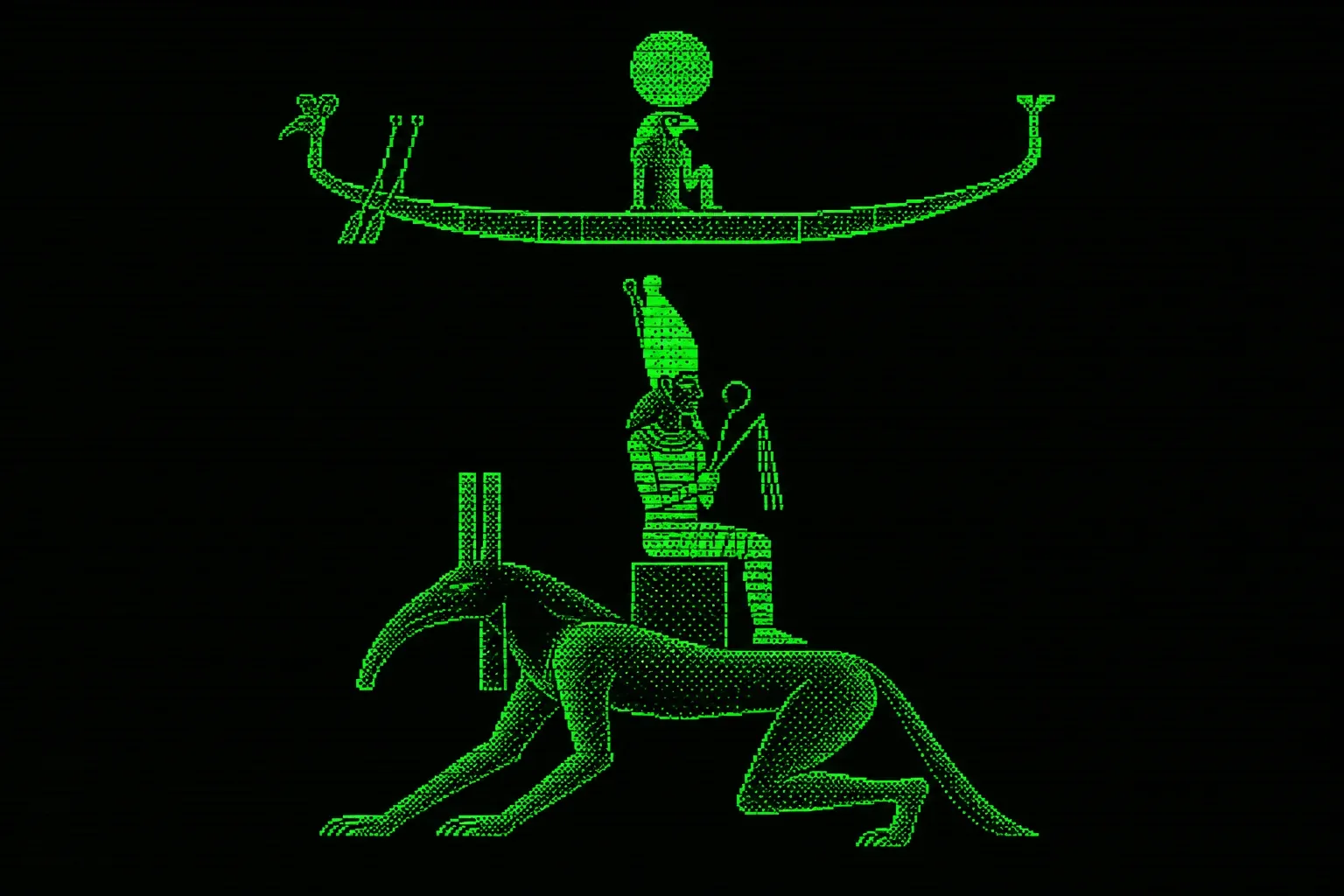
Pyramid Texts Utterance 606: Seth Forced to Carry Osiris
- Text
- Pyramid Texts, Utterance 606
- Date
- Carved in the 6th Dynasty (c. 2300 BC) on the walls of the pyramid of Pepi I at Saqqara
- Found
- Pyramid of Pepi I, South Saqqara, Egypt
- Language
- Old Egyptian · Hieroglyphic
- 1
[ḏ(d)-mdw]
Recitation:
- 2
[...] [ꜥḥ]⸢ꜥ⸣ ⸢n⸣ =⸢f⸣ [...]
… Stand up for him …
Note · Line 2
The dead king, addressed throughout as Osiris, is called to rise for his son Horus, who has come to revive him. - 3
[ntf] p ⸢zꜣ⸣ =[k] [...]
He is your son …
- 4
[...] [sꜥ]nḫ =f ṯw jnq =f n =k [qs.pl] =[k] [...]
… that he may bring you to life, that he may knit your bones together for you …
- 5
[...] [Ḥr,w] nḏ-jt(j)≡f
… Horus, who protects his father:
- 6
ḥwi̯.n =f n =k ḥwi̯ ṯ⸢w⸣
he has struck down for you the one who struck you down.
Note · Line 6
The killer is Seth, Osiris’s brother. - 7
[jyi̯.n] =[f] [r] =[k] ⸢m⸣ ⸢wp(w),t(j)⸣ ⸢Ḥr,w⸣ wdn.n =f ṯw jt(j) (W)sr(,w) Ppy ⸢ḥr⸣ ns,t (J)tm(,w) ⸢sšmi̯⸣ =⸢k⸣ ḥn[mm],t
He has come to you as the messenger of Horus, and has set you, father, the Osiris Pepi, on the throne of Atum, that you may lead the henmemet.
Note · Line 7
Pepi is the dead king, merged with Osiris in death. The henmemet (ḥnmm.t) are a class of beings linked with the sun god, often understood as the “sun-folk.” - 8
[h]⸢ꜣ⸣i̯.w =k r =k [m] wjꜣ p[w] n(,j) [Rꜥw] ⸢mr⸣[r].⸢w⸣ ⸢nṯr.pl⸣ [jꜥ] [n] =[f] [mrr].w ⸢nṯr.pl⸣ h[ꜣi̯.t] ⸢j⸣[m] =f ẖnn.[w] [Rꜥw] jm =f jr ꜣḫ,t [...]
So you shall step down into this boat of Ra, which the gods love to climb aboard, which the gods love to step down into, in which Ra is rowed to the horizon …
Note · Line 8
The sun god Ra crosses the sky by boat. Taking a place in it means joining the sun’s daily journey. - 9
[...] [wḏ] =[k] [md]⸢w⸣ n ⸢nṯr.pl⸣
… and you shall give the gods their orders.
- 10
n ṯwt [js] [Rꜥw] [...]
For you are Ra …
- 11
[...] [j.n] [psḏ,t.du] [wr.t] [ꜥꜣ].⸢t⸣ ḫnt.[t] [Bꜣ,w-Jwn,w]
… say the two great and mighty Enneads who preside over the Souls of Heliopolis.
- 12
[wdi̯.n] [ṯw] [nṯr.du] [jpw] [wr.w] [ꜥꜣ.w] [ḫnt.w] sḫ,[t]-[j]⸢ꜣr⸣.[w] [ḥr] ⸢ns⸣,t [Ḥ]⸢r⸣,[w] [...]
These two great and mighty gods who preside over the Field of Reeds have set you on the throne of Horus …
Note · Line 12
The Field of Reeds is the blessed marshland in the sky where the dead live on. - 13
[...] [Tfn,t] [m] [gs] =[k] ⸢jmn,t(j)⸣ Nw,w [m] [gs] =[k] [rs(,j)] Nn,t m [gs] =⸢k⸣ ⸢mḥ,t(j)⸣ ⸢sšmi̯⸣ =sn [ṯw] [jr] [s,t.pl] =[sn] [jptw] [nfr.t] [wꜥb.t] jri̯.[t.n] =[sn] [n] (J)tm(,w) m [w]d.[t] =[sn] ⸢sw⸣ ḥr ns,t.pl =[sn]
… Tefnut at your western side, Nun at your southern side, Nenet at your northern side, that they may lead you to these fair and pure places of theirs which they made for Atum when they set him upon their thrones.
Note · Line 13
Primeval gods now guard the king on every side. Tefnut is goddess of moisture. Nun is the primordial water. Nenet is his female counterpart, the “counter-sky” that lies beneath the earth. - 14
[...] [nḥr] =[k] [j]:t[r.w] ⸢Ḥr,w⸣-ꜣḫ,[t]⸢j⸣ ⸢m⸣ jri̯.t =⸢s⸣n rn =f ⸢m⸣ [ḥri̯] ⸢j⸣[r] [nṯr.pl]
… that you may match the seasons of Harakhti, as when they made his name "He who is far from the gods."
Note · Line 14
Harakhti, “Horus of the Horizon,” is the rising sun. Matching his seasons means sharing in the sun’s endless cycle. - 15
[jri̯] =[sn] [n] =[k] [rʾ] [pw] jri̯.n =[sn] [n] [(J)tm(,w)] [psḏ] [rꜥw-nb]
They will make for you that spell which they made for Atum, who shines every day.
- 16
[jꜥ] =⸢k⸣ n =sn [mj] ⸢Rꜥw⸣ [m] [rn] =[f] [pw] [n(,j)] [Rꜥw]
You shall rise up to them like Ra, in this his name of Ra.
Note · Line 16
Egyptian formulas often tie a god’s power to his name. To rise “in the name of Ra” is to rise as Ra himself. - 17
[tnm] =[k] [m] ḥr =sn ⸢mj⸣ ⸢Rꜥw⸣ m rn =f pw n(,j) (J)tm(,w)
You will turn away from their faces like Ra in this his name of Atum.
Note · Line 17
The dead king Pepi is likened to the sun god under his name Atum, often the sun as it sets and passes from view. - 18
[j:ḥꜥꜥ] [r] =sn(j) ⸢psḏ,t.du⸣ [...]
So the Two Enneads will rejoice, …
Note · Line 18
The Two Enneads are the two great companies of gods, each of nine deities, who assemble to receive the dead king. - 19
[jyi̯] [n] =⸢n⸣ sn =[n] j.n =sn(j) [psḏ,t.du] [...]
"Our brother has come to us," say the Two Enneads, …
Note · Line 19
The gods greet Pepi as Osiris, whose brothers and sisters belong to the Ennead. - 20
[wtw,t(j)] n(,j) mʾw,t =f [j.n] =[sn(j)] [psḏ,t.du] [...]
"The eldest son of his mother," say the Two Enneads, …
Note · Line 20
Osiris was the firstborn of the sky goddess Nut. - 21
[jyi̯] [n] =[n] [jri̯.y] [mr,t] [r] =[f] [jn] [sn] =[f] Stš j.n =sn(j) [psḏ,t.du]
"He to whom evil was done by his brother Seth has come to us," say the Two Enneads.
Note · Line 21
In myth Seth murdered his brother Osiris. The king, now one with Osiris, is the injured party. - 22
[n] [ḥm] [rḏi̯] =[n] [šwi̯.y] [Stš] [m] [wṯz] =[k] ḏ,t jt(j) Ppy [j.n] =[sn(j)] [psḏ,t.du] [jr] =[k] [jt(j)] [Ppy]
"We will never, for all eternity, let Seth be free of carrying you, Father Pepi," say the Two Enneads of you, Father Pepi.
Note · Line 22
Seth’s punishment is to serve forever as the bearer of the murdered Osiris, carrying him beneath him. - 23
[jw] =[k] [ꜥn]ḫ.tj
You live.