~/sacred-texts/pyramid-texts
Pyramid Texts Utterance 601: A Prayer to Make a Pyramid Last
- Text
- Pyramid Texts, Utterance 601 (PT 601)
- Date
- Carved in hieroglyphs in the 6th Dynasty, in the reign of Pepi II Neferkare (c. 2278–2184 BC), inside his pyramid at Saqqara
- Found
- Pyramid of Pepi II, South Saqqara; still in place on the pyramid's inner walls
- Language
- Egyptian (Old Egyptian) · Hieroglyphic
- 1

ḏ(d)-mdw
Words to be spoken:
Note · Line 1
A standard heading telling the priest that what follows is to be recited aloud. - 2

jꜣ psḏ,t-ꜥꜣ,t jm.t Jwn,w
O Great Ennead that is in Heliopolis!
Note · Line 2
The Ennead is the “Nine” of Heliopolis, the family of creation gods: Atum, his children Shu and Tefnut, their children Geb and Nut, and theirs, Osiris, Isis, Seth and Nephthys. - 3
rḏi̯ =ṯn rwḏ Ppy Nfr-kꜣ-Rꜥw ḏi̯ =ṯn rwḏ mḥr pn n(,j) Ppy Nfr-kꜣ-Rꜥw kꜣ,t =f tn n-ḏ,t-ḏ,t mj rwḏ r{r}〈n〉 n(,j) (J)tm(,w) ḫnt,j psḏ,t-ꜥꜣ,t
You shall make Pepi Neferkare endure,
you shall make this pyramid of Pepi Neferkare and this work of his endure for ever and ever,
as the name of Atum, foremost of the Great Ennead, endures.Note · Line 3
Pepi Neferkare is Pepi II, last great king of the Sixth Dynasty; Neferkare is his throne name. - 4
rwḏ rn n(,j) Šw nb mns,t ḥr.t m Jwn,w rwḏ 〈rn〉 〈n(,j)〉 Ppy Nfr-kꜣ-Rꜥw rwḏ mḥr =f pn kꜣ,t =f tn mj(,y) n-ḏ,t-ḏ,t
As the name of Shu, lord of Upper Menset in Heliopolis, endures,
so shall the name of Pepi Neferkare endure,
so shall this pyramid of his and this work of his likewise endure, for ever and ever.Note · Line 4
Menset is a sanctuary at Heliopolis, divided into an upper and a lower part. Shu, god of the air, holds the upper and his sister Tefnut the lower. - 5
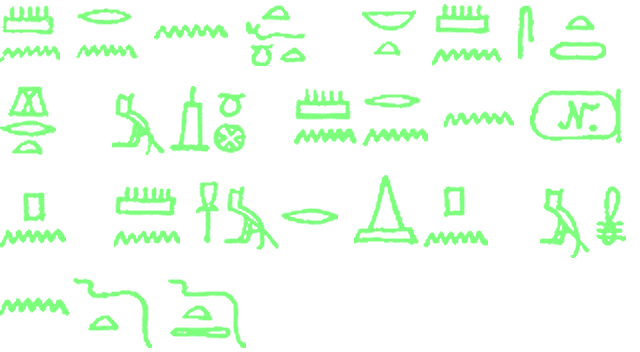
mn rn n(,j) Tfn,wt nb,t mns,t ẖr.t m Jwn,w mn rn n(,j) Ppy Nfr-kꜣ-Rꜥw pn mn mḥr pn mj(,y) n-ḏ,t-ḏ,t
As the name of Tefnut, lady of Lower Menset in Heliopolis, abides,
so shall the name of this Pepi Neferkare abide,
so shall this pyramid likewise abide, for ever and ever.Note · Line 5
Here the verb shifts from “endure” (Egyptian rwḏ, “to be firm, to last”) to “abide” (mn, “to stay fixed, to remain”). The two are near-synonyms, and the litany alternates them. - 6
rwḏ rn n(,j) Gbb jr(,j) Bꜣ-tꜣ rwḏ rn n(,j) Ppy Nfr-kꜣ-Rꜥw rwḏ mḥr pn n(,j) Ppy Nfr-kꜣ-Rꜥw rwḏ kꜣ,t =f tn mr(,y) n-ḏ,t-ḏ,t
As the name of Geb, he of Ba-ta, endures,
so shall the name of Pepi Neferkare endure,
so shall this pyramid of Pepi Neferkare endure,
so shall this work of his likewise endure, for ever and ever.Note · Line 6
Geb is the earth god. Ba-ta is a place or shrine linked with him whose nature is not known. - 7
rwḏ rn n(,j) {ḫ}〈Nw〉,t m ḥw,t-šn(j,t) m Jwn,w rwḏ rn n(,j) Ppy Nfr-kꜣ-Rꜥw pn rwḏ mḥr =f pn rwḏ kꜣ,t =f tn mj(,y) n-ḏ,t-ḏ,t
As the name of Nut in the Shenit-House in Heliopolis endures,
so shall the name of this Pepi Neferkare endure,
so shall this pyramid of his endure,
so shall this work of his likewise endure, for ever and ever. - 8
rwḏ rn n(,j) (W)sr(,w) m Tꜣ-wr rwḏ rn n(,j) Ppy Nfr-kꜣ-Rꜥw pn rwḏ mḥr pn n(,j) Ppy Nfr-kꜣ-Rꜥw rwḏ kꜣ,t =f tn mr(,y) n-ḏ,t-ḏ,t
As the name of Osiris in the Thinite nome endures,
so shall the name of this Pepi Neferkare endure,
so shall this pyramid of Pepi Neferkare endure,
so shall this work of his likewise endure, for ever and ever.Note · Line 8
The Thinite nome, Egyptian Ta-wer (“Great Land”), is the province of Upper Egypt that contains Abydos, the chief cult place of Osiris. - 9
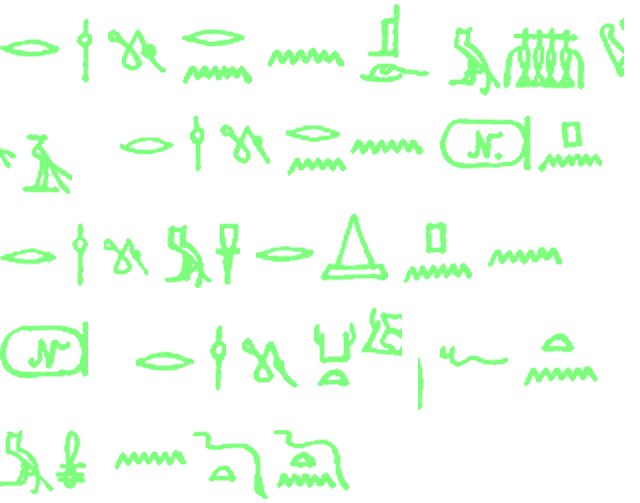
rwḏ rn n(,j) (W)sr(,w) m Ḫnt(,j)-jmn,t(j)w rwḏ rn n(,j) Ppy Nfr-kꜣ-Rꜥw pn rwḏ mḥr pn n(,j) Ppy Nfr-kꜣ-Rꜥw rwḏ kꜣ,t =f tn mr(,y) n-ḏ,t-ḏ,t
As the name of Osiris as Foremost of the Westerners endures,
so shall the name of this Pepi Neferkare endure,
so shall this pyramid of Pepi Neferkare endure,
so shall this work of his likewise endure, for ever and ever.Note · Line 9
Khentamentiu, “Foremost of the Westerners,” was an old jackal god of Abydos whose title Osiris absorbed. The “Westerners” are the dead, who dwell where the sun sets. - 10
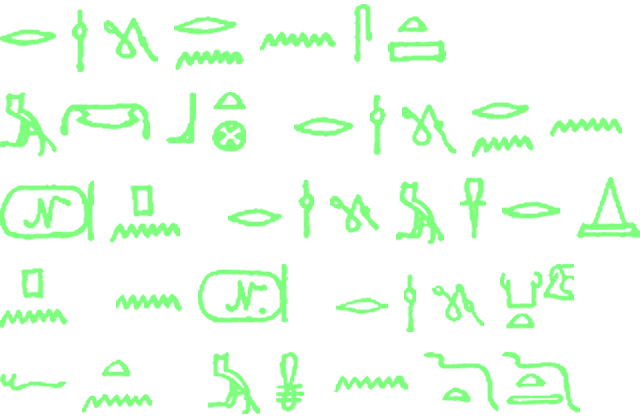
rwḏ rn n(,j) Stš m Nbw,t rwḏ rn n(,j) Ppy Nfr-kꜣ-Rꜥw pn rwḏ mḥr pn n(,j) Ppy Nfr-kꜣ-Rꜥw rwḏ kꜣ,t =f tn mj(,y) n-ḏ,t-ḏ,t
As the name of Seth in Ombos endures,
so shall the name of this Pepi Neferkare endure,
so shall this pyramid of Pepi Neferkare endure,
so shall this work of his likewise endure, for ever and ever.Note · Line 10
Ombos (Egyptian Nubt), in Upper Egypt, is Seth’s home city. - 11
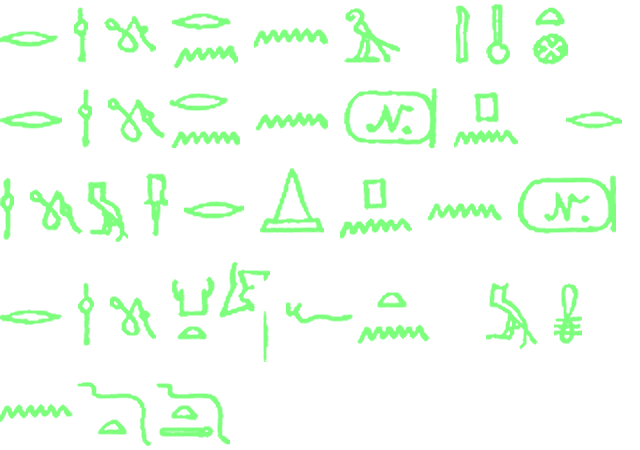
rwḏ rn n(,j) Ḥr,w m Ḏbꜥ,wt rwḏ rn n(,j) Ppy Nfr-kꜣ-Rꜥw pn rwḏ mḥr pn n(,j) Ppy Nfr-kꜣ-Rꜥw rwḏ kꜣ,t =f tn mj(,y) n-ḏ,t-ḏ,t
As the name of Horus in Djebaut endures,
so shall the name of this Pepi Neferkare endure,
so shall this pyramid of Pepi Neferkare endure,
so shall this work of his likewise endure, for ever and ever.Note · Line 11
Djebaut is a cult place of Horus in the Delta, part of the later city of Buto. - 12
rwḏ rn n(,j) Rꜥw jr ꜣḫ,t rwḏ rn n(,j) Ppy Nfr-kꜣ-Rꜥw pn rwḏ mḥr pn n(,j) Ppy Nfr-kꜣ-Rꜥw rwḏ kꜣ,t =f tn mj(,j) n-ḏ,t-ḏ,t
As the name of Ra at the horizon endures,
so shall the name of this Pepi Neferkare endure,
so shall this pyramid of Pepi Neferkare endure,
so shall this work of his likewise endure, for ever and ever. - 13
mn rn n(,j) Ḫnt(,j)-jr(,tj) jr Ḫm rwḏ rn n(,j) Ppy Nfr-kꜣ-Rꜥw pn rwḏ mḥr =f pn rwḏ kꜣ,t tn n.t Ppy Nfr-kꜣ-Rꜥw mj(,j) n-ḏ,t-ḏ,t
As the name of Khenty-irty, he of Letopolis, abides,
so shall the name of this Pepi Neferkare endure,
so shall this pyramid of his endure,
so shall this work of Pepi Neferkare likewise endure, for ever and ever.Note · Line 13
Khenty-irty, “Foremost of the Two Eyes,” is a falcon god, a form of Horus, worshipped at Letopolis just north of Memphis. - 14
rwḏ rn n(,j) Wꜣḏ,t m Dp rwḏ rn n(,j) Ppy Nfr-kꜣ-Rꜥw pn rwḏ mḥr pn n(,j) Ppy Nfr-kꜣ-Rꜥw rwḏ kꜣ,t =f tn mj(,j) n-ḏ,t-ḏ,t
As the name of Wadjet in Dep endures,
so shall the name of this Pepi Neferkare endure,
so shall this pyramid of Pepi Neferkare endure,
so shall this work of his likewise endure, for ever and ever.Note · Line 14
Wadjet is the cobra goddess, protector of Lower Egypt and its king. Dep is her city in the Delta, the twin of Djebaut in the later Buto.