~/sacred-texts/pyramid-texts
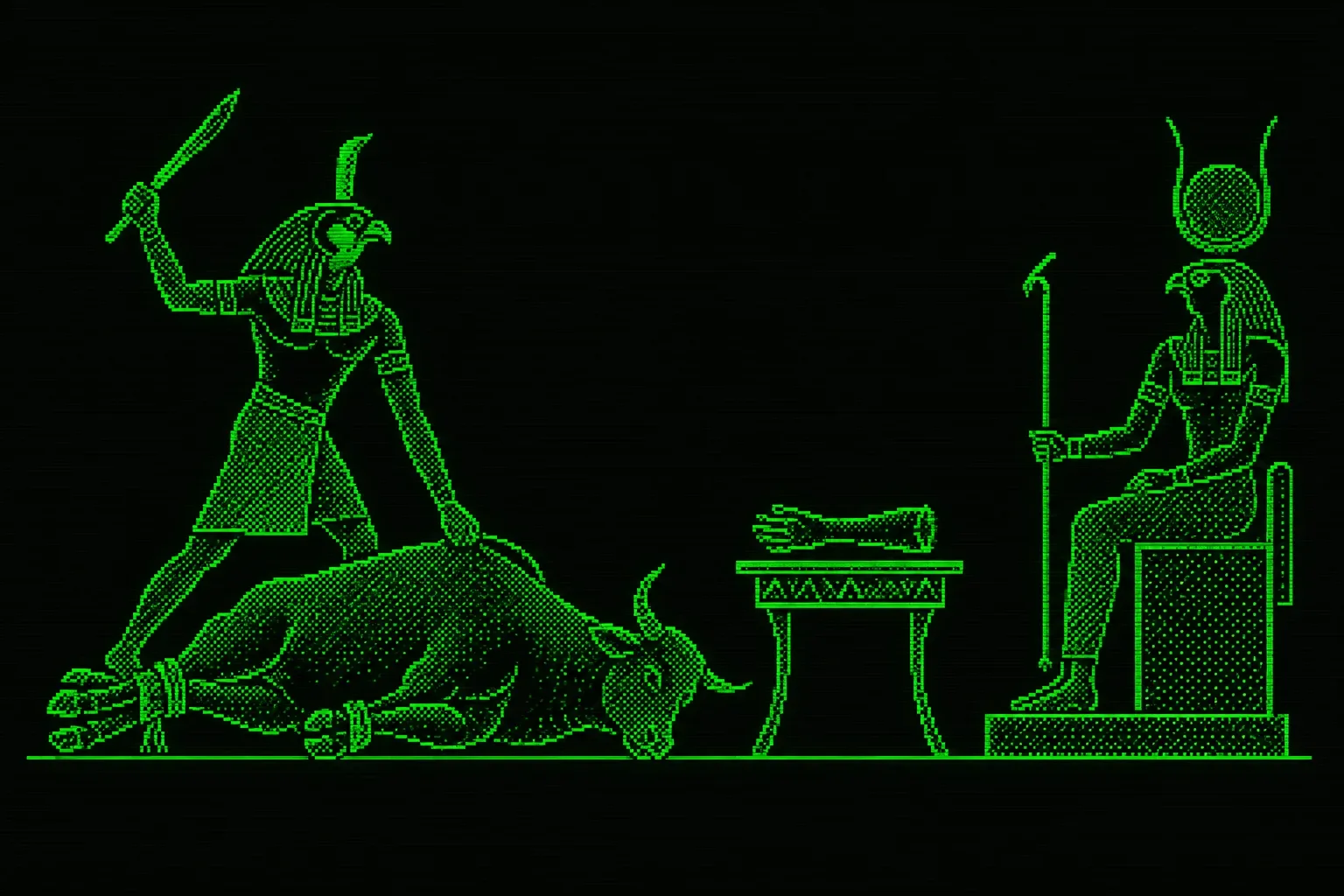
Pyramid Texts Utterance 580: Seth Slain and Eaten as a Bull
- Text
- Pyramid Texts, Utterance 580 (PT 580)
- Date
- Carved in the 6th Dynasty, in the reign of Pepi I (c. 2321–2287 BC), on the walls of his burial chambers in his pyramid at Saqqara
- Found
- Pyramid of Pepi I, South Saqqara, Egypt, where the inscribed walls remain
- Language
- Old Egyptian · Hieroglyphic
- 1

ḏ(d)-mdw
Recitation:
- 2

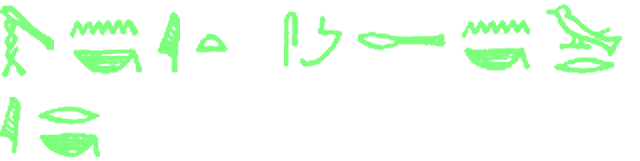
ḥwi̯ jt(j) =(j) smꜣ wr jr =f
O you who struck my father, who killed one greater than himself!
Note · Line 2
The speaker is the dead king’s son and heir, in the role of Horus. He addresses Seth, the god who murdered his own brother Osiris. The dead king Pepi is identified with Osiris throughout. - 3
ḥwi̯.n =k jt(j) =(j) smꜣ.n =k wr jr =k
You struck my father; you killed one greater than you.
- 4

jt(j) (W)sr(,w) Ppy pn
Father, the Osiris Pepi!
Note · Line 4
The son now turns to his dead father, the king. - 5
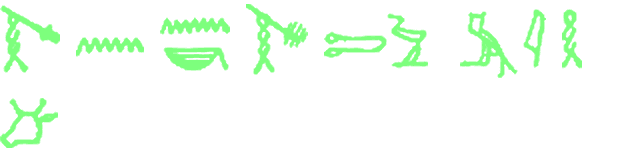
ḥwi̯.n =(j) n =k ḥwi̯ ṯw m jḥ
I have struck down for you the one who struck you down, as an ox.
Note · Line 5
Seth is punished by being treated as a sacrificial animal, and his flesh becomes the offering meal. - 6
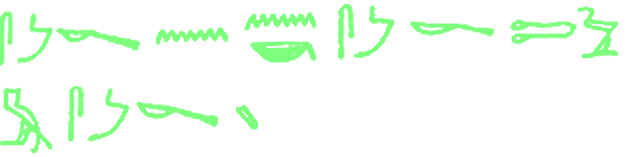
smꜣ.n =(j) n =k smꜣ ṯw m smꜣ
I have slain for you the one who slew you, as a wild bull.
- 7
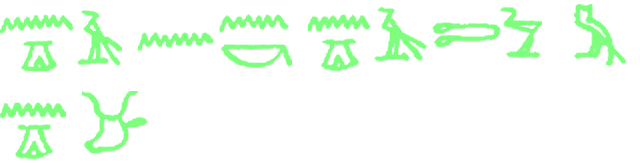
ngꜣ.n =(j) n =k ngꜣ ṯw m ngꜣ(,w)
I have killed for you the one who killed you, as a longhorn.
- 8
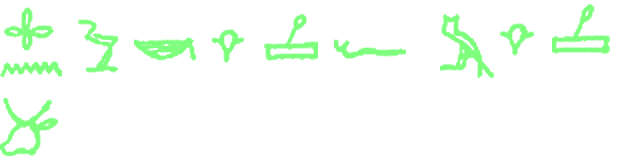
wn.w =k ḥr sꜣ =f m ḥr(,j)-sꜣ
The one whose back you rode on is an On-the-Back bull.
- 9
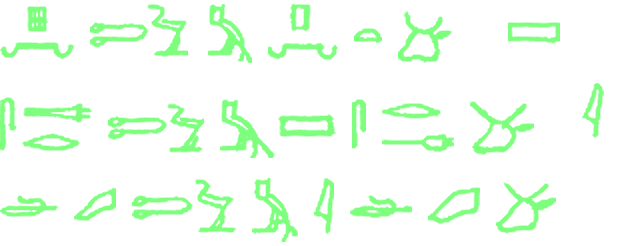
pḏ ṯw m pḏ,t(j) šsr ṯw m šsr jdi̯ ṯw m jd
The one who stretched you out is a Stretched-Out bull;
the one who slaughtered you is a slaughter-bull;
the one who deafened you is an id-bull. - 10
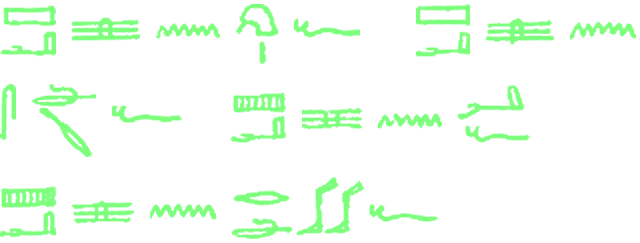
šꜥ.n =(j) tp =f šꜥ.n =(j) sd =f šꜥ.n =(j) ꜥ〈.du〉 =f šꜥ.n =(j) rd.du =f
I have cut off his head, I have cut off his tail;
I have cut off his arms, I have cut off his legs. - 11
ḫpš =f ḥr(,j) 〈n〉 Ḫpr ḫpš =f ẖr,j ⸢n⸣ ⸢(J)tm(,w)⸣ jt(j) nṯr.pl
His upper foreleg is for Khepri,
his lower foreleg is for Atum, father of the gods.Note · Line 11
The foreleg was the choicest cut of an Egyptian offering. Seth’s carcass is now butchered and shared among the great gods. Khepri is the sun at dawn. Atum is the creator, father of the gods. - 12
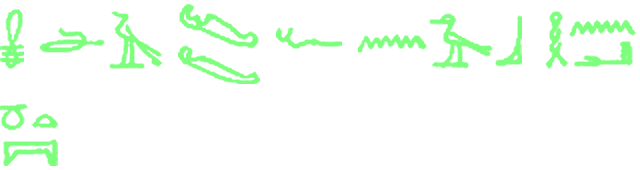
jwꜥ.du =f n Šw ḥnꜥ Tfn,t
His two haunches are for Shu and Tefnut.
Note · Line 12
The gods are served in pairs, following the divine family tree. - 13

mjdꜣ.du =f n Gbb ḥnꜥ Nw,t
His two midja-cuts are for Geb and Nut.
- 14
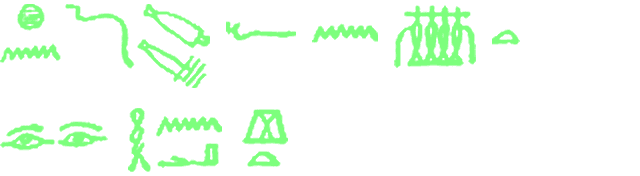
sw,t.du =f n (Ꜣ)s,t ḥnꜥ Nb,t-ḥw(,t)
His two sut-cuts are for Isis and Nephthys.
- 15
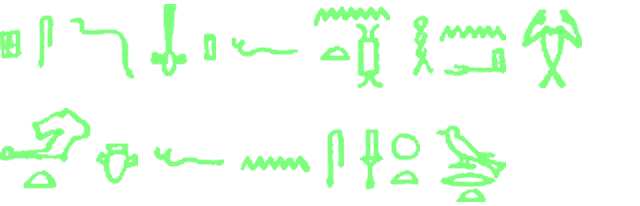
ḫnḏ.du =f n Ḫnt(,j)-jr,tj ḥnꜥ H̱r,t(j)
His two shins are for Khenti-irti and Kherty.
Note · Line 15
Khenti-irti is a falcon god, a form of Horus. Kherty is a ram-headed god of the dead. - 16
psḏ =f n Nj,t ḥnꜥ Srq,t
His back is for Neith and Selket.
Note · Line 16
Neith and Selket are protective goddesses who also guarded the bodies of the dead. - 17
ḥꜣ,t(j) =f n Sḫm,t wr.t
His heart is for Sekhmet the Great.
Note · Line 17
The victim being carved up throughout this passage is Seth, killer of Osiris, who has been slain in the form of a bull. - 18
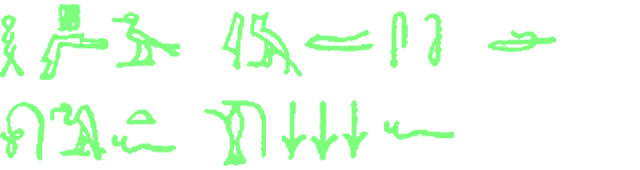
jm.t =f m pḥ(,wj) n fd.w jpw nṯr.pl ms.w Ḥr,w mri̯ =f Ḥjp(,y) Jms,tj Dwꜣ-mʾw,t≡f Qbḥ-sn.pl≡f
What is inside him at the hind end is for these four gods, the children of Horus whom he loves:
Hapy, Imsety, Duamutef, Qebehsenuef.Note · Line 18
The Four Sons of Horus guard the dead king’s internal organs; later their heads topped the four canopic jars that held his viscera. Here they get the animal’s guts from the hindquarters. - 19
tp =f sd =f ꜥ.du =f rd.du =f n Jnp(,wj) (W)sr(,w) ḫnt(,j)-mn,(w)t≡f
His head, his tail, his two arms and his two legs are for Anubis, Osiris, and Khentimenutef.
Note · Line 19
Khentimenutef (“He Who Is Before His Thighs”) is a little-known god connected with butchery and the slaughter-post. The name read here as Anubis, the jackal god of embalming, is written in an unusual form. - 20
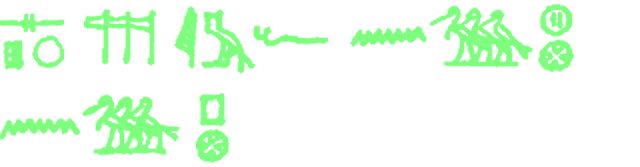
zpi̯ nṯr.pl jm =f n Bꜣ,pl-Nḫn n Bꜣ,pl-P
What the gods leave of him is for the Souls of Nekhen and the Souls of Pe.
Note · Line 20
The Souls of Nekhen and of Pe are the spirits of the ancient kings of Hierakonpolis in the south and Buto in the north. - 21
wn(m) =n wn(m) =n jḥ dšr n nm,t-š jri̯.t.n Ḥr,w n jt(j) =f (W)sr(,w) Ppy pn
Let us eat, let us eat the red bull of the Slaughterhouse of the Lake,
which Horus made for his father, the Osiris Pepi.Note · Line 21
Red is Seth’s colour, so the “red bull” is Seth himself, offered as a meal.