~/sacred-texts/pyramid-texts
Pyramid Texts Utterance 556: The Dead King Rises as a Jackal
- Text
- Pyramid Texts, Utterance 556
- Date
- Carved in the 6th Dynasty, in the reign of Pepi I (c. 2321–2287 BC), on the walls of his pyramid at Saqqara
- Found
- Pyramid of Pepi I at South Saqqara, Egypt, where the inscribed walls remain
- Language
- Old Egyptian · Hieroglyphic
- 1
ḏ(d)-mdw
Recitation.
- 2
zj zy.t ḫpr nfr,t
He who was going is gone; good has come to pass.
- 3
mꜣꜥ r =f jt(j) =(j) m nfr,t
My father, then, has been led into goodness.
Note · Line 3
The speaker is the dead king’s son and heir. He plays the role of Horus caring for his father Osiris, so throughout he calls the king “Father.” - 4
šzp.j ꜥ =f jn jm(,j).w wr.pl jr s,t.pl nṯr.pl
His arm has been grasped by those among the Great Ones and drawn toward the seats of the gods.
- 5
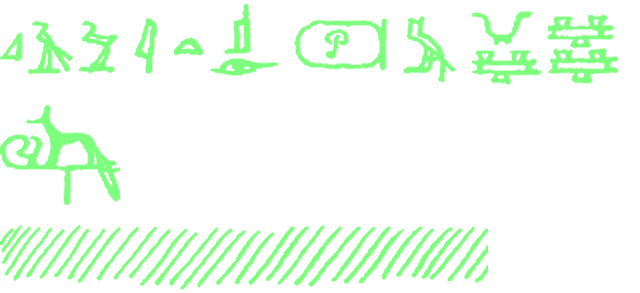
qꜣi̯.w jt(j) (W)sr(,w) Ppy m Wpi̯-wꜣ,t.pl m-ḫnt jtr,t.du
Father Osiris Pepi will stand tall as Wepwawet at the head of the Two Shrines.
Note · Line 5
Pepi is Pepi I of the Sixth Dynasty, in whose pyramid this text is carved. - 6
ṯzi̯ ṯw jt(j) (W)sr(,w) Ppy ṯzi̯ sw Jnp,w mn(j),wj
Raise yourself, Father Osiris Pepi, as Anubis, He of the Shrine, raises himself.
Note · Line 6
Anubis is the jackal god of embalming and of the dead. “He of the Shrine” is one of his titles. - 7
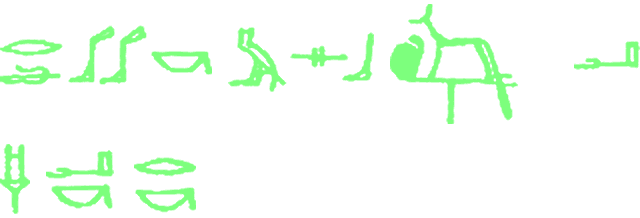
rd.du =k m z(ꜣ)b ꜥḥꜥ =k r =k
Your feet are a jackal's feet: stand up, then!
Note · Line 7
The king’s limbs become those of a jackal, the animal of Anubis and Wepwawet, so that he can rise and travel as they do. - 8
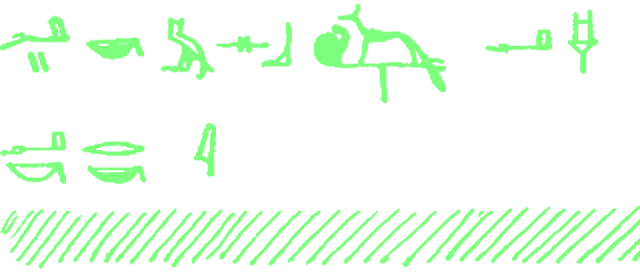
ꜥ.du =k m z(ꜣ)b ꜥḥꜥ =k r =k j[r] zḫn,t wr.t nb,t ḥz,w ḥr.t-jb Wnw ḥzi̯.t.n Gbb jr =s ḥnꜥ Nw,t
Your arms are a jackal's arms: stand up, then, at the great Post, mistress of the Praised One, who dwells in Hermopolis, to whom Geb and Nut made their way.
Note · Line 8
Geb is the earth god and Nut the sky goddess, the parents of Osiris. - 9
njs =⸢k⸣ jr ẖni̯ ḥr-tp =f jnt =f n =k wꜥ,t sḫm,t ḏꜣi̯ =k jm =s mr,j.w ḫꜥ.pl
You shall call to the one who rows on it, that he may bring you the One, the Double Crown, and with her you shall cross the canals and the mounds.
Note · Line 9
The Double Crown, the united crown of Upper and Lower Egypt, is literally “the Two Mighty Ones.” Here she is treated almost as a vessel that carries the king across the waters of the sky. - 10
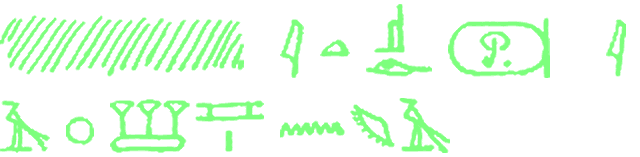
wbꜣ ⸮mꜣꜥ? jt(j) (W)sr(,w) Ppy jꜣḫi̯ mr-n(,j)-ḫꜣ,j
Opened is the Maa canal of Father Osiris Pepi; flooded is the Winding Waterway.
Note · Line 10
These are waterways in the sky that the dead must cross to reach the east, where the sun and stars rise. They must be opened and filled with water before the crossing can begin. - 11
njs r =f jt(j) (W)sr(,w) Ppy jr ḥmi̯ jr smt ḏꜣi̯ =sndu jt(j) (W)sr(,w) Ppy jr gs pf jꜣb(,j) n(,j) p,t
So Father Osiris Pepi will call to the Helmsman and to the Listener, that they may ferry Father Osiris Pepi to that eastern side of the sky.
Note · Line 11
The Helmsman and the Listener are divine ferrymen of the sky. - 12
j:šm r =f jt(j) (W)sr(,w) Ppy jr gs pf n(,j) p,t jr [b]⸢w⸣ [...]
Father Osiris Pepi will go, then, to that side of the sky, to the place …
- 13
[...] m bw pf mss.w nṯr.pl jm
… in that place where the gods are born.
- 14
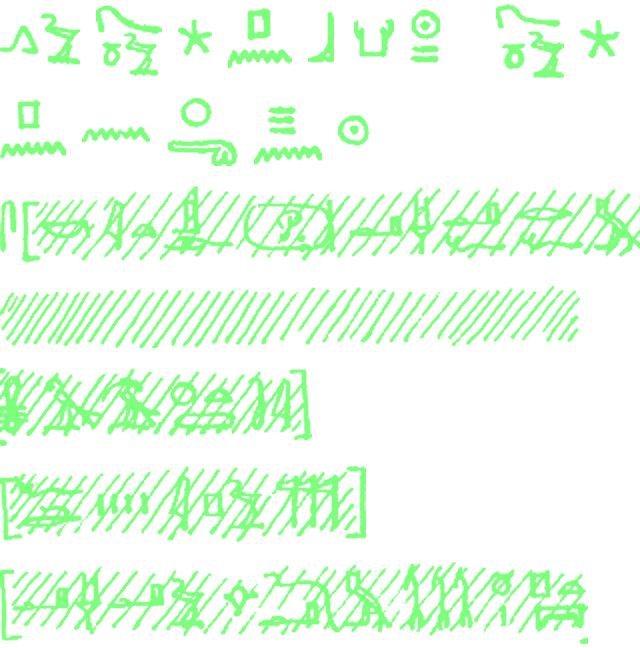
jwi̯ nw pn bkꜣ nw pn n(,j) ḫmt.n(w) hrw sṯ jt(j) (W)sr(,w) Ppy m sbꜣ wꜥ,tj m gs pf ⸢jꜣb(,j)⸣ n(,j) p,t wḏ =f mdw nṯr js sḏm =〈f〉 mdw ={f} mr Ḥr,w-ꜣḫ,⸢tj⸣
When this hour comes tomorrow, this hour of the third day, and Father Osiris Pepi is the lone star on that eastern side of the sky, he will give commands like a god and hear cases like Horakhty.
Note · Line 14
The “third day” after death seems to be the moment of rebirth, when the king rises in the east like a star at dawn. - 15
[n] [m(w)t.n] ⸢j⸣[s] [jt(j)] (W)sr(,w) Ppy m(w)t.t
Father Osiris Pepi has not died the death.
- 16

ꜣḫ.n jt(j) pw (W)sr(,w) Ppy ꜣḫ.t
Father Osiris Pepi has become an akh, truly an akh.
Note · Line 16
An akh is the radiant, effective spirit that the dead attain when they are fully transformed and take their place among the gods and stars. - 17
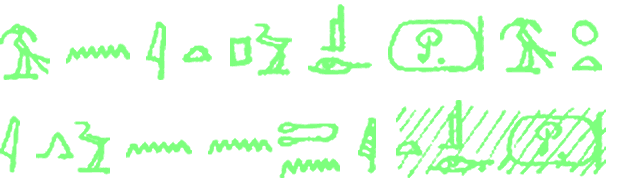
jwi̯.n n =ṯn j[t](j) [p]w (W)sr(,w) Ppy wḥ[ꜥ].n =f qꜣ[s].[pl] =f sfḫḫ.n =f [_]w[_]
Father Osiris Pepi has come to you: he has loosened his bonds and set free his …
Note · Line 17
Pepi, the dead king, is called “Osiris”: in death he becomes the god who was killed and brought back to life. - 18
nḥm.n =f sw m-ꜥ jn,wtj
He has saved himself from the hand of the Netter.
- 19
n rḏi̯.y =f n ẖr,t.pl
He shall not be handed over to the Lower Ones.
- 20
mn [...]
Enduring …
Note · Line 20
The rest of the line is lost.