~/sacred-texts/pyramid-texts
Pyramid Texts Utterance 553: Dead Pepi II Rises as a Star
- Text
- Pyramid Texts, Utterance 553
- Date
- Carved in the 6th Dynasty, in the reign of Pepi II (c. 2280–2180 BC), on the inner walls of his pyramid at South Saqqara
- Found
- Pyramid of Pepi II, South Saqqara, Egypt; the inscribed walls remain in the pyramid
- Language
- Old Egyptian · Hieroglyphic
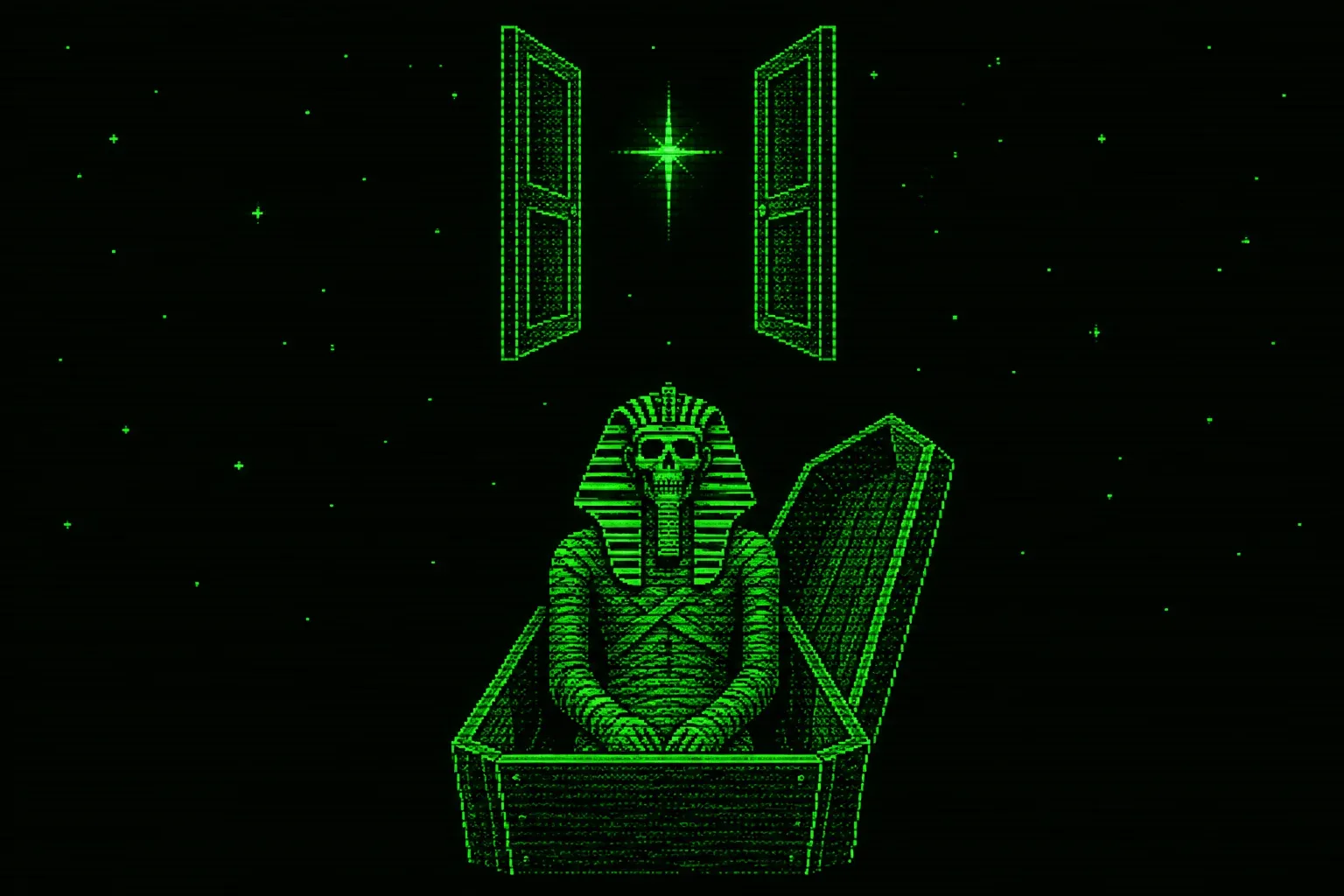
The reciter speaks to the earth god Geb, then to the dead Pepi II, calling him again and again: Raise yourself, you akh, this Pepi Neferkare! The king is fed, given the claws of a predator god, and handed the Nile flood: the fluid that ran out of the rot of Osiris is yours. The doors of tomb and coffin swing open, his mummy wrappings become the braids of Nephthys, and he travels seated on your throne of iron.
The world mourns as he leaves: The sky weeps for you, the earth quakes for you. He goes up as a star, as the Morning God, and sits on the thighs of his father Geb, his bones knitted together as Osiris’s were.
- 1
[ḏ(d)-mdw]
Words spoken:
- 2
[ṯzi̯] [ṯw] [Gbb] [srs] [n] =[k] [ꜣḫ] =⸢k⸣ pw j:mn mnz(ꜣ) =k j:mn mnz(ꜣ) =k
Rise up, Geb! Wake this akh of yours for yourself, so that your menza-jar may endure, so that your menza-jar may endure!
Note · Line 2
The akh is the transfigured, effective spirit of the blessed dead, here the dead king, whom the speaker presents to the earth god Geb. - 3
ḏsr.t jr(,j).w Šw [ḥnꜥ] [Tfn,t] [m] [ḥw,t] Ḥtm,wt
Set apart are those who belong to Shu and Tefnut in the Mansion of Her Who Equips.
Note · Line 3
Shu (air) and Tefnut (moisture) are the first divine pair, children of the creator. “Her Who Equips” appears to be a goddess who supplies the dead. - 4
n ṯ[wt] [js] [ꜣḫ] [s]nq[.w] [Nb,t-ḥw(,t)] [m] [mnḏ] =[s] [jꜣb(,j)]
For you are the akh whom Nephthys suckled at her left breast.
Note · Line 4
Nephthys, sister of Isis and Osiris, often acts as the dead king’s nurse and mourner. - 5
[rḏi̯.n] [n] =[k] [(W)sr(,w)] [ꜣḫ.pl] Ppy Nfr-kꜣ-[Rꜥw] šdi̯.n =k jr,t-Ḥr,w
Osiris has given you the akhs, Pepi Neferkare, and you have taken the Eye of Horus.
Note · Line 5
Pepi Neferkare is Pepi II of the Sixth Dynasty, in whose pyramid the spell is carved. The Eye of Horus, torn out by Seth and restored, stands for every offering given to the dead. - 6
šm,t 4 =k jp[t]w [tp.t-ꜥ.du] [ḥ]ꜣ,t 〈Ḥr,w〉 šmi̯.t šmi̯.t jm [n] [nṯr] [ḏr] [hꜣi̯.t] [Rꜥw]
These four paths of yours that lie before the tomb of Horus: you have walked them, walked to the god, once Ra had gone down.
Note · Line 6
Ra’s going down is sunset, the moment the sun enters the underworld and the dead set out with him. - 7
[n]ḏri̯ =f [n] =[f] ꜥ =k Ppy Nfr-kꜣ-Rꜥw [wꜥb.n] [ṯw] ⸢Zk⸣[r] [ḫnt(,j)] [pḏ,w] [jr] [ns,t] =[k] [jm.t] [qbḥ,w]
He will take you by the arm, Pepi Neferkare, once Sokar, foremost of Pedju, has purified you, to your throne in the sky's cool waters.
Note · Line 7
Sokar is a falcon-headed god of the Memphite necropolis, and Pedju is one of his cult places. The “cool waters” (qbḥw) are the watery regions of the sky. - 8
[ṯzi̯] [ṯw] [ꜣḫ] [p]w Ppy Nfr-[kꜣ]-Rꜥw [pn] ḥmsi̯ w[š]b =⸢k⸣
Raise yourself, you akh, this Pepi Neferkare! Sit down, that you may feed!
- 9
ḥmsi̯ kꜣ =k wn(m) =[f] [tʾ] [ḥnꜥ] =[k] [n] [nwr] [n-ḏ,t-ḏ,t]
May your ka sit and eat bread with you, without ceasing, for ever and ever.
Note · Line 9
The ka is a person’s life force or double. It is the ka that receives offerings of food and drink. - 10
šm,t =k t[w] [s,t(j)] [js] [(W)sr(,w)]
This is how you go, as the deputy of Osiris:
- 11
[...] [ꜥ] =[sn] [jni̯] =[sn] [n] =[k] [ḥ(ꜣ)b].pl =[k] [n] [jbḥ.pl] =[k] ḥḏ.w ꜥ[n,t.pl] =k ꜣtf,t.t
… their arms bring you your catch for your white teeth, and your claws are those of the god of Atfet.
Note · Line 11
Atfet is the twelfth province of Upper Egypt. The king is given the fangs and claws of a predator god who takes his own prey. - 12
[ḏꜣi̯] =[k] [kꜣ] wr jr ⸢s⸣ḫ,[t.pl] [wꜣḏ.t] [r] [s,t.pl] [Rꜥw] wꜥb[.t]
May you cross over, great bull, to the green fields, to the pure places of Ra.
Note · Line 12
“Great bull” is a royal epithet of strength. The crossing is by ferry over the waters of the sky to the fields of the blessed. - 13
[ṯzi̯] [ṯ]w ꜣḫ [pw] [Ppy] [Nfr-kꜣ-Rꜥw] [pn]
Raise yourself, you akh, this Pepi Neferkare!
- 14
[mw] =[k] [n] =[k] [bꜥḥ] =k n =k r[ḏw] =k n =k pri̯ m ḥwꜣꜣ,t (W)sr(,w)
Your water is yours, your flood is yours, the fluid that ran out of the rot of Osiris is yours.
Note · Line 14
The fluids seeping from the decaying body of the murdered Osiris were identified with the Nile’s yearly flood. His corruption is the source of all fertility, and the king receives it as his own. - 15
wn n =k [ꜥꜣ.du] [p,t] [j:zn] [n] =[k] [ꜥꜣ.du] [qbḥ(,w)]
Open for you are the doors of the sky, flung wide for you are the doors of the cool waters.
- 16
[wn.t] [n] =[k] [ꜥꜣ.du] [ḥꜣ,t] [nḫbḫb] [n] =[k] [ꜥꜣ.du] [ḏr]w,t
Let the doors of the tomb be opened for you, let the doors of the coffin swing back for you.
- 17
n(j)n(j) j[.t] [jn] [(Ꜣ)s,t] [sḏꜣ] m [ḥtp(,w)] [j.t] [jn] [Nb,t-ḥw(,t)] [mꜣ.n] =[s] [jt(j)] =[k] (W)[s]⸢r⸣(,w) hrw pw n(,j) ḥ(ꜣ)b m mt
"Turn around," says Isis; "Go in peace," says Nephthys, once she has seen your father Osiris on that day of the hunt with the throw-stick.
Note · Line 17
Isis and Nephthys, sisters and mourners of the murdered Osiris, greet the dead king as his heir. - 18
qꜣi̯ ḏ[db,t].pl grg[.w] [bꜣ] =[k]
Tall are the shrines that your ba has founded.
Note · Line 18
The ba is the aspect of a person that can move about freely after death, often shown as a human-headed bird. - 19
〈ṯzi̯〉 〈ṯw〉 [wḫ]⸢ꜣ⸣ n =k [ḫ]⸢mw⸣ =k j:d[r] [n] =[k] nṯn,t j[r.t] [ḥr] =k [w]ḥꜥ n =k [qꜣs.pl] =[k]
Raise yourself, shake off your dust, remove the netjenet that is on your face, loosen your bonds.
- 20
[n] qꜣ[s.w] [js] [pw] [nꜣp.w] [pw] [n(,j).w] Nb,t-ḥw(,t)
These are no bonds, these are the braids of Nephthys.
Note · Line 20
The wrappings are recast as the hair of Nephthys. Mourning women let their hair hang loose over the body. - 21
dndn =k jꜣ,t.pl rs.t dndn =〈k〉 jꜣ[,t.pl] mḥ,t.t ḥmsi̯.t ḥr ḫnd,w =[k] [bjꜣ(,j)]
May you travel through the southern mounds, may you travel through the northern mounds, seated on your throne of iron.
Note · Line 21
The mounds are the sacred sites of Upper (southern) and Lower (northern) Egypt. Iron was known to the Egyptians mainly as meteoric iron, a metal fallen from the sky. - 22
[wḏ] [Jnp,w] [ḫnt(,j)] zḥ-nṯr ꜣḫ =k ḥꜣ =k sḫm =k m-ẖn(w) =k j:mn.t ḫnt sḫm⸢.pl⸣
Anubis, Foremost of the God's Booth, has commanded: your akh about you, your power within you, as you endure at the head of the Powers.
Note · Line 22
Anubis is the god of embalming, and the “God’s Booth” is the tent where the body was embalmed. - 23
wꜥb.t [m] [fd.t] =[k] [nms,t.pl] [jptw] [špn.t] ꜥꜣb,t pri̯.t n =k m [zḥ-nṯr] nṯri̯ =k
You are cleansed with these four swelling nemset-jars of yours and the aabet-jug, which have come out for you from the God's Booth, that you may become a god.
- 24
rmi̯ n =k p[,t] [sdꜣ] [n] =[k] [tꜣ] [sb]ḥ n =k S[mn,tt] [ḏ]sjw n =⸢k⸣ [Mn]j,t-wr.t sq(r) n =k rd.du ⸢ḏꜣ⸣[m] [n] =k ꜥ.wdu pri̯ =[k] [jr] [p,t] [...] [m] sb(ꜣ) m Nṯr-dwꜣ(,wj)
The sky weeps for you, the earth quakes for you, the Wailing Woman shrieks for you, the Great Mooring Post calls to you; feet stamp for you, arms wave for you, as you go up to the sky … as a star, as the Morning God.
Note · Line 24
The Great Mooring Post is a title of Isis, imagined as the post to which the dead king’s boat makes fast. - 25
jy.n Ppy Nfr-kꜣ-Rꜥw ḫr =k jt(j) =f jy.n Ppy Nfr-[kꜣ]-Rꜥw [ḫr] =[k] [Gb]b
Pepi Neferkare has come to you, his father; Pepi Neferkare has come to you, Geb.
Note · Line 25
Geb, the earth, is father of Osiris, and so of the king who becomes Osiris. - 26
zmꜣ.[n] =[f] [ẖrm,t] =[ṯn] [nṯr.pl]
He has joined your ramp, you gods.
- 27
[jmi̯] [ḥmsi̯] [Pp]y Nfr-kꜣ-Rꜥw ḥr s,t-wr.t ḥr mn,t.⸢du⸣ ⸢jt(j)⸣ =f Gbb
Let Pepi Neferkare sit on the Great Seat, on the thighs of his father Geb.
- 28
[...] [s]ꜥb ꜥn,t.pl =f ḥr.t ẖr[.t]
… his fingernails and toenails have been cleansed.
- 29
[jri̯] [n] =[f] [jri̯.t] [n] jt(j) =f (W)sr(,w) hrw pw n(,j) ṯ(ꜣ)z [qs.pl] n(,j) s[mnḫ] [ṯb,t.pl] [n(,j)] [ḏ]ꜣi̯.t rd.pl
There has been done for him what was done for his father Osiris on that day of knitting the bones, of restoring the soles, of stretching out the feet.
Note · Line 29
The king’s body is restored as Osiris’s was after Seth tore it apart: the bones joined, the feet made whole again. - 30
hꜣi̯.w n =k Sꜣ,[t](j)⸢pl⸣ ꜥrq[.w] [hꜣi̯] [n] =[k] [jtr,t-šmꜥ,t] [jwi̯] n =k jtr,t-mḥ[,t] ⸢m⸣ k[sw] [ḏdi̯.t] [ḏ,t] ḫntj sḫm.pl
The Satiu will come down to you bent low, the Shrine Row of Upper Egypt will come down to you, the Shrine Row of Lower Egypt will come to you bowing, while you endure for ever at the head of the Powers.