~/sacred-texts/pyramid-texts
Pyramid Texts Utterance 536: The Dead King Rises as Osiris
- Text
- Pyramid Texts, Utterance 536
- Date
- Carved in the 6th Dynasty, under Pepi I (c. 2321–2287 BC), on the walls of his pyramid at Saqqara
- Found
- Pyramid of Pepi I, South Saqqara; the inscribed walls remain at the site
- Language
- Old Egyptian · Hieroglyphic
- 1

ḏ(d)-mdw
Words to be spoken:
- 2
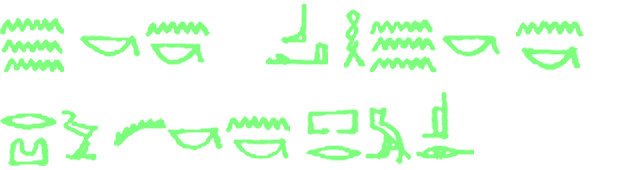
mw =k n =k bꜥḥ =k n =k rḏw =k n =k pri̯ m (W)sr(,w)
Your water is yours, your flood is yours,
your efflux is yours, that which came out of Osiris.Note · Line 2
The dead king is spoken to as Osiris. The Nile’s yearly flood was imagined as the fluids running from the god’s dead body. Here those life-giving fluids are handed back to him as his own. - 3
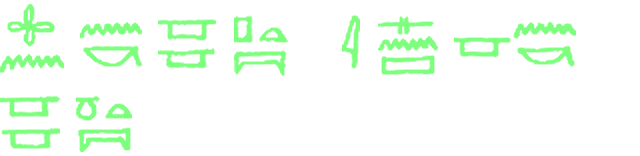
wn n =k ꜥꜣ.du p,t j:zn n =k ꜥꜣ.du Nw,t
The double doors of the sky open for you,
the double doors of Nut swing wide for you.Note · Line 3
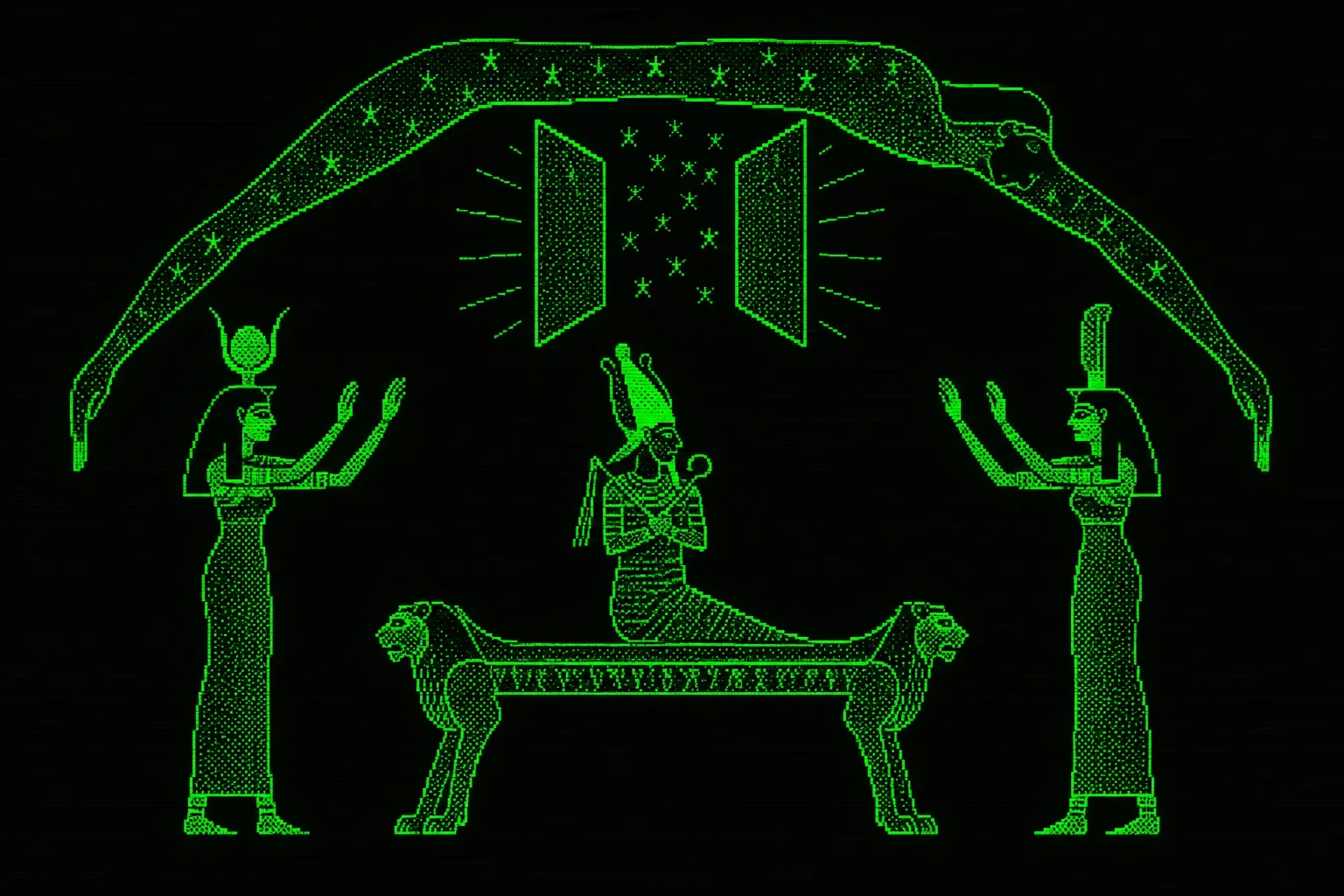
Nut is the sky goddess, mother of Osiris. Her body arches over the earth. - 4
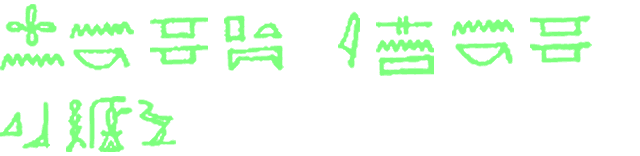
wn n =k ꜥꜣ.du p,t j:zn n =k ꜥꜣ.du qbḥ,w
The double doors of the sky open for you,
the double doors of the cool waters swing wide for you.Note · Line 4
The cool waters (Egyptian qebehu) are the watery expanse of the sky that the dead must cross. - 5
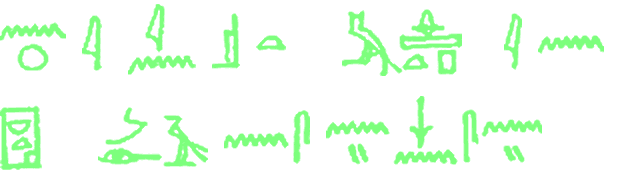
nḫj j.n (Ꜣ)s,t m ḥtp(,w) j.n Nb,t-ḥw(,t) mꜣ.n =sndu sn =sndu
"Endure!" says Isis, "In peace!" says Nephthys, when the two of them see their brother.
Note · Line 5
Isis and Nephthys are the sisters of Osiris and his mourners. The verb shows that both of them do the seeing. - 6

ṯzi̯ ṯw
Raise yourself up!
- 7

wḥꜥ n =k qꜣs.pl =k
Untie your bonds!
- 8

wḫꜣ n =k ḫm,w =k
Shake off your dust!
- 9
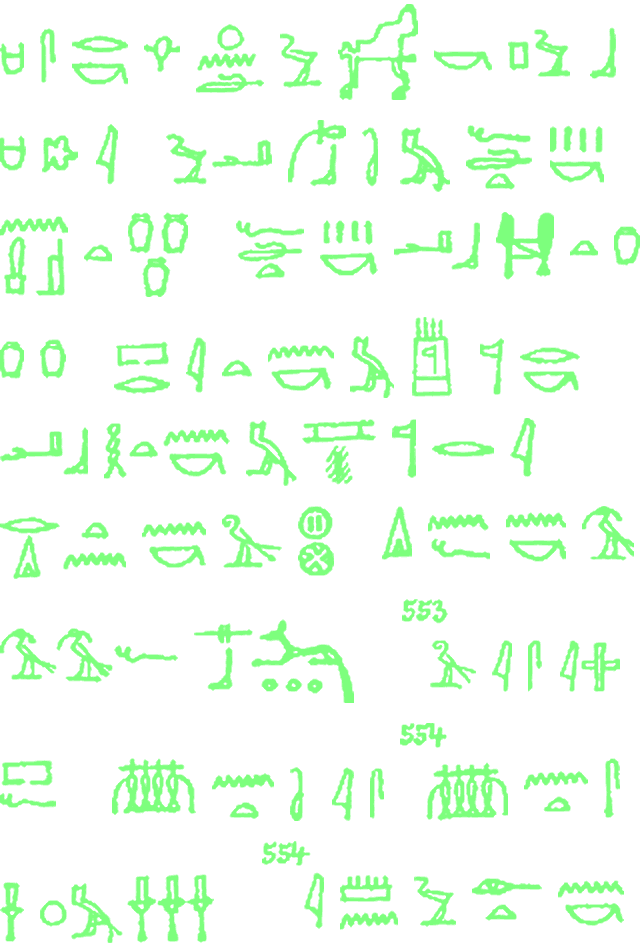
ḥmsi̯ r =k ḥr ḫnd,w =k pw bjꜣ,j wꜥb.tj m fd.t =k nms,t.pl fd.t =k ꜥ(ꜣ)b,t.pl prj.t n =k m ꜥḥ-nṯr nṯri̯ =k ꜥbḥ.t n =k m mr nṯr,j rḏi̯.t.n n =k Ḥr,w-nḫn(,j) ḏi̯.n =f n =k ꜣḫ.pl =f z(ꜣ)b.pl Ḥr,w js jm(,j) pr =f ḫnt,j js ḫnt(,j) sḫm.pl
Sit, then, on this metal throne of yours,
cleansed with your four nemset-jars and your four aabet-ewers
that have come out for you from the god's palace, so that you may be a god,
and have been filled to the brim for you from the Natron Canal,
which Horus of Nekhen has given you.
He has given you his spirits, the jackals,
as to a Horus who is in his house,
as to a foremost one who stands at the head of the Powers. - 10

j:mn =w(j) jri̯.t n =k
How lasting is what has been done for you!
- 11
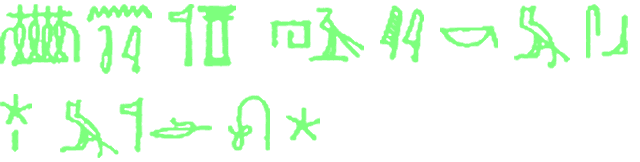
wḏ.n Jnp,w ḫnt,j-zḥ-nṯr hꜣi̯.y =k m sbꜣ m nṯr-dwꜣ(,wj)
Anubis, Foremost of the God's Booth, has commanded that you go down as a star, as the Morning God.
Note · Line 11
The God’s Booth is the tent where the body was embalmed, and Anubis, the jackal god, presides over it. The Morning God is the morning star. - 12
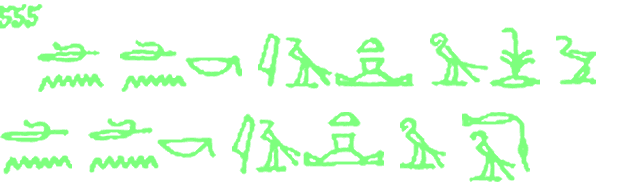
dndn =k jꜣ,t Ḥr,w rs(,j).w dndn =k jꜣ,t Ḥr,w mḥ,t(j).w
You will roam the Mound of Horus of the Southerners,
you will roam the Mound of Horus of the Northerners.Note · Line 12
The two Mounds are regions of the beyond, the southern and northern domains ruled by Horus. - 13
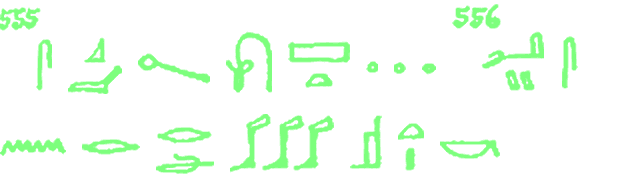
sq(r) wꜣš,(w)t ꜥ.du =sn r r(w)d s,t =k
The washut will strike their arms together into a stairway up to your seat.
Note · Line 13
The washut are a group of beings in the beyond. Their name is probably connected with wꜣš, ’to be honored’, so it may mean ’the honored ones'. - 14
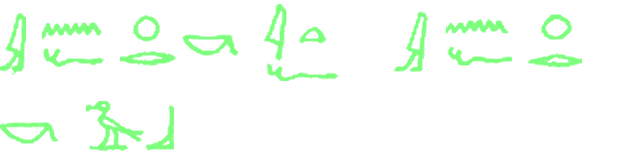
jy.n =f ḫr =k jt(j) =f jy.n =f ḫr =k Gbb
He has come to you, his father,
he has come to you, Geb.Note · Line 14
The speaker now turns to Geb, the earth god and father of Osiris, and speaks of the king as “he.” - 15
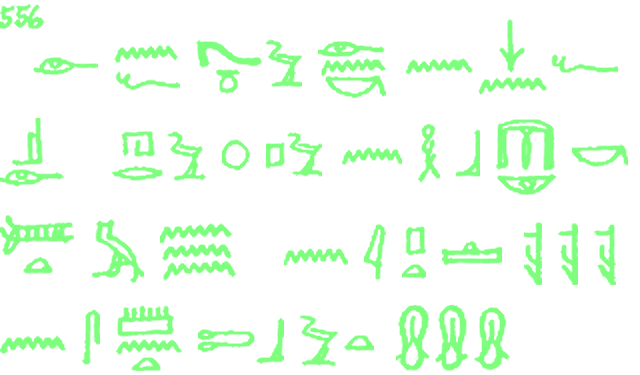
jri̯ n =f nw jri̯.n =k n sn =f (W)sr(,w) hrw pw n(,j) ḥ(ꜣ)b =k tm.t(j) m mw n(,j) jp.t qs.pl n(,j) smn.t ṯbw,t.pl
Do for him what you did for his brother Osiris
on that day when you fished him out, whole, from the water,
the day of counting the bones, of fastening the sandals.Note · Line 15
In myth Osiris was killed and his body thrown into the water. - 16
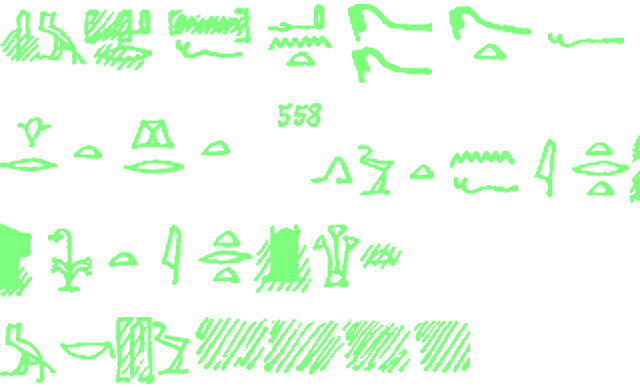
smꜥr [n] =f ꜥn,t.plt =f ḥr.t ẖr.t jwt n =f jtr,t-šmꜥ,t jtr,t-mḥ.t m k[s],w [...]
Clean his nails for him, fingernails and toenails, so that the Southern Shrine-Row and the Northern Shrine-Row come to him bowing …
Note · Line 16
The two Shrine-Rows are the rows of national chapels for the gods of Upper and Lower Egypt. Here they come to pay homage to the king. The rest of the line is lost.