~/sacred-texts/pyramid-texts
Pyramid Texts Utterance 510: The Sky Doors Open for Pepi I
- Text
- Pyramid Texts, Utterance 510 (PT 510)
- Date
- Carved in the 6th Dynasty (c. 2330–2280 BC) in the pyramid of King Pepi I at Saqqara
- Found
- Pyramid of Pepi I, South Saqqara, Egypt
- Language
- Old Egyptian · Hieroglyphic
It is not Pepi but Horus, the loving son, who asks to see Osiris in death. Then a refrain sounds six times: The doors of the sky are opened, the doors of the cool waters are drawn back. It names three forms of Horus, and after each one it names Pepi. Pepi speaks once himself: I am purified with these four nemset-jars of mine. Ra’s priest admits him, Geb hands him to Ra, and the dead surrender, having broken their staffs and their weapons. Pepi then claims to be the wild bull, the flood, Nehebkau of the many coils and the Eye of Horus, lifted by Horus and Seth together.
- 1
ḏ(d)-mdw
Recitation.
- 2
n jn js Ppy dbḥ mꜣ =f ṯw m qd =k pw ḫpr jr =k (W)sr(,w) dbḥ mꜣ =f ṯw m qd =k pw ḫpr jr =k
It is not Pepi who asks to see you in this shape of yours that has befallen you, Osiris,
not he who asks to see you in this shape of yours that has befallen you.Note · Line 2
The “shape that has befallen” Osiris is his state in death. The spell insists that the king is not the one presuming to look on the dead god. That privilege belongs to his son. - 3
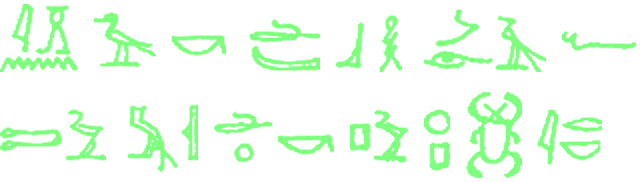
jn zꜣ =k dbḥ mꜣ =f ṯw m qd =k pw ḫpr jr =k
It is your son who asks to see you in this shape of yours that has befallen you;
- 4
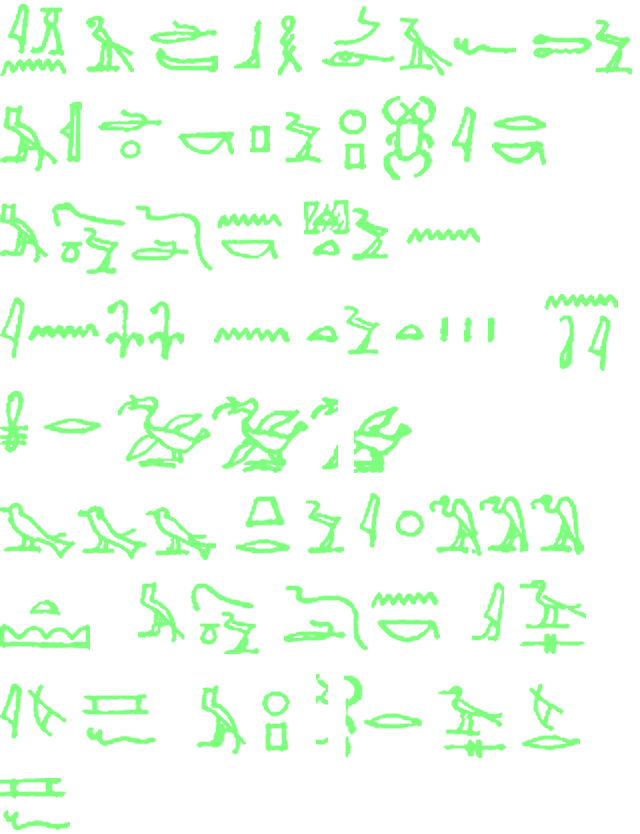
jn Ḥr,w dbḥ mꜣ =f ṯw m qd =k pw ḫpr jr =k m nw ḏd.n =k twt n =j nn n(,j) twt 3 n,tj mr ṯꜣ.pl wr.pl ẖr(,j).w jḫm,t.pl m nw ḏd.n =k jy zꜣ j:mr =f m ḫpr zꜣ-mr≡f
it is Horus who asks to see you in this shape of yours that has befallen you,
in keeping with what you said: "Like me are these three likenesses, who are like young swallows beneath the riverbanks,"
and in keeping with what you said: "A loving son is coming." And so the Loving Son came to be.Note · Line 4
The Egyptian puns on twt, “to be like,” and twt, “likeness, image.” - 5
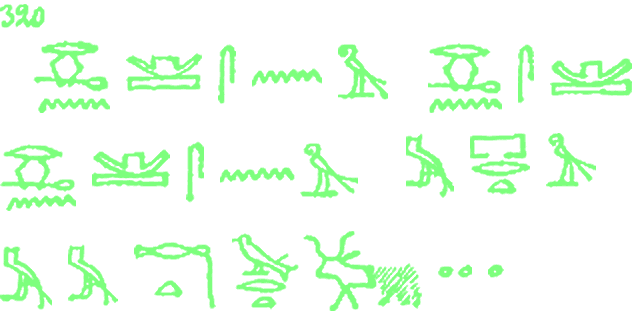
ẖni̯ =sn Ḥr,w ẖni̯ =s〈n〉 ={sn} Ḥr,w m pr,t Ḥr,w m Mḥ,t-wr.t
They shall row Horus, they shall row Horus, when Horus goes forth from the Great Flood.
Note · Line 5
The Great Flood (Mehet-weret) is the primeval celestial water, pictured as a cow, from which the sun-god rises. - 6
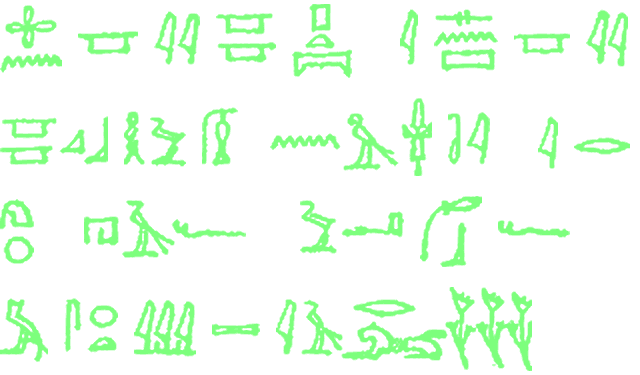
wn.y ꜥꜣ.du p,t jzn.y ꜥꜣ.du qbḥ,w n Ḥr,w-jꜣb,tj jr tp hrw hꜣi̯ =f wꜥb =f m sḫ,t-jꜣr.w
The doors of the sky are opened, the doors of the cool waters are drawn back
for Eastern Horus at break of day, that he may go down and be purified in the Field of Reeds.Note · Line 6
Each “door” is a pair of leaves, a double door. - 7
wn.y ꜥꜣ.du p,t jzn.y ꜥꜣ.du qbḥ,w n Ppy jr tp hrw hꜣj Ppy wꜥb Ppy m sḫ,t-jꜣr.w
The doors of the sky are opened, the doors of the cool waters are drawn back
for Pepi at break of day, that Pepi may go down, that Pepi may be purified in the Field of Reeds. - 8
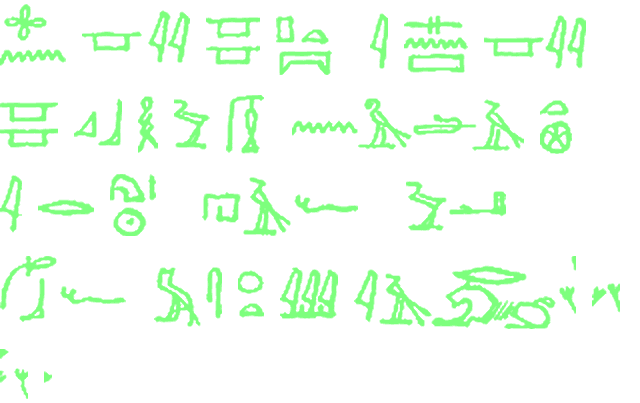
wn.y ꜥꜣ.du p,t jzn.y ꜥꜣ.du qbḥ,w n Ḥr,w-d(w)ꜣ,t(j) jr tp hrw hꜣi̯ =f wꜥb =f m sḫ,t-jꜣr.w
The doors of the sky are opened, the doors of the cool waters are drawn back
for Horus of the Duat at break of day, that he may go down and be purified in the Field of Reeds.Note · Line 8
The Duat is the netherworld through which the sun travels by night. - 9
wn.y ꜥꜣ.du p,t jzn.y ꜥꜣ.du qbḥ,w n Ppy pn jr tp hrw hꜣi̯.y =f wꜥb ={j}f m sḫ,t-jꜣr.w
The doors of the sky are opened, the doors of the cool waters are drawn back
for this Pepi at break of day, that he may go down and be purified in the Field of Reeds. - 10
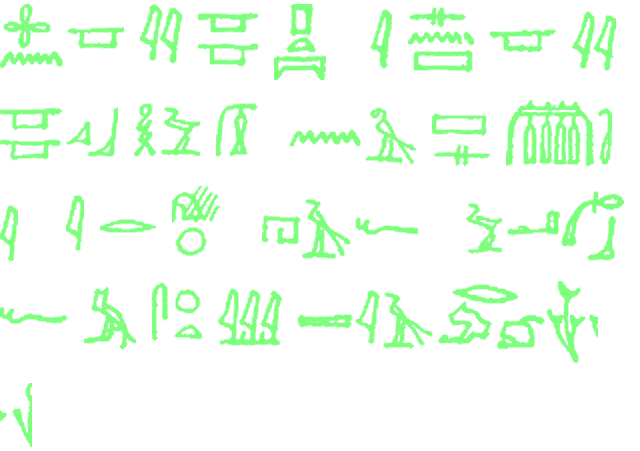
wn.y ꜥꜣ.du p,t jzn.y ꜥꜣ.du qbḥ,w n Ḥr,w-šz(m),tj jr tp hrw hꜣi̯ =f wꜥb =f m sḫ,t-jꜣr.w
The doors of the sky are opened, the doors of the cool waters are drawn back
for Horus of Shezmet at break of day, that he may go down and be purified in the Field of Reeds.Note · Line 10
Shezmet is a region of the eastern horizon, linked with the desert lands and their green malachite. Its Horus is a form of the rising sun. - 11
wn.y ꜥꜣ.du p,t jzn.y ꜥꜣ.du qbḥ,w n Ppy jr tp hrw hꜣi̯ Ppy wꜥb ={j}f m sḫ,t-jꜣr.w
The doors of the sky are opened, the doors of the cool waters are drawn back
for Pepi at break of day, that Pepi may go down and be purified in the Field of Reeds. - 12
ḫbss n =f tꜣ sq(r) n =f wdn,t ḫꜥi̯.j m nzw sꜥḥ ={j} =〈f〉 n =f ns,t =f 〈n〉 =〈f〉
The earth is hoed for him, an offering is set before him,
for he has appeared as king: his rank is his, his throne is his.Note · Line 12
“Hoeing the earth” was a rite of breaking the ground, performed at foundations and in the offering cult. - 13
ḏꜣi̯ =f ptr,tj šꜣs =f mr-n(,j)-ḫꜣ
He shall cross the Pteretj, he shall travel the Knife Canal.
Note · Line 13
Pteretj (Egyptian ptrtj) and the Knife Canal are places in the sky. The name Pteretj seems to come from ptr, “to see,” but its exact meaning is unclear. The Knife Canal is a heavenly waterway the dead pass through on their way up. - 14
nḏri̯.w n =s Jm,tt ꜥ n(,j) Ppy ḏr ḫm =s ḏr sštꜣ =s jri̯.n n =s nṯr n Ppy js wꜥb zꜣ wꜥb
She of Buto shall take Pepi by the arm, at her shrine, at her secret place which the god made for her,
for Pepi is pure, the son of one who is pure.Note · Line 14
She of Buto is most likely the cobra goddess Wadjet, protector of the king. Buto was her ancient Delta city. - 15
wꜥb =j m fd.t{t} =j jptw nms,t.pl bꜥḥ.t m nṯr m Nṯr,w ẖr ṯꜣw (Ꜣ)s,t wr,t sṯ (Ꜣ)s,t wr,t sšwi̯ =s Ḥr,w js
I am purified with these four nemset-jars of mine, brimming from the God's Canal in Netjeru,
beneath the breath of Isis the Great, when Isis the Great raised me up as Horus.Note · Line 15
The voice switches to the first person: Pepi speaks of his own cleansing. - 16
jmi̯ jwt =f jw =f wꜥb j.n wꜥb n(,j) Rꜥw jr Ppy
"Let him come, for he is pure," says Ra's pure priest concerning Pepi.
Note · Line 16
The “pure one” (wab) was the ordinary title of a priest. Ra’s own priest, a “pure one,” certifies that Pepi is pure and may enter. - 17
jr(,j)-ꜥꜣ qbḥ,w ꜣwj =f sw n fd.w jpw nṯr.pl tp(,j).pl mr knz,tj jri̯ =sn mꜣꜥ,w n (W)sr(,w) Ppy jri̯ =sn mꜣꜥ,w n Rꜥw
The doorkeeper of the waters of the sky hands him over to these four gods who are on the Canal of Kenzet,
that they may set the course for the Osiris Pepi,
that they may set the course for Ra.Note · Line 17
The king, Pepi I, is “the Osiris Pepi” because every dead king becomes Osiris. - 18
tm tꜣš.pl =f n gmi̯ jz,t.pl =f sṯ Gbb ꜥ =f jr p,t ꜥ =f jr tꜣ ꜣwi̯ =f Mr,y-Rꜥw n Rꜥw ẖrp n =f Mr,y-Rꜥw nṯr.pl ꜥbꜣ n =f Mr,y-Rꜥw wjꜣ nṯr
His borders are not there, his boundary stones cannot be found,
while Geb, one arm to the sky and his other arm to the earth, hands Meryre on to Ra,
that Meryre may lead the gods for him,
that Meryre may command the god's barque for him.Note · Line 18
Geb is the god of the earth. - 19
jṯi̯ Mr,y-Rꜥw p,t jwn.pl =s ꜣḫꜣḫ.pl =s
Meryre shall take the sky, its pillars and its Akhakh-stars.
- 20
jwj n =f nṯr.pl m ksj.w
The gods shall come to him bowing.
- 21
ꜣḫ.pl š(m)s =sn Mr,y-Rꜥw n bꜣ ={j}f ḥsb.n =sn md(w).pl =sn ꜥḥꜣ.w.pl =sn n Ppy js wr zꜣ wr msi̯.w Nw,t
The akh-spirits follow Meryre for his ba-might,
having broken their staffs and their weapons,
for Pepi is a great one, son of a great one, whom Nut bore.Note · Line 21
The akh-spirits are the glorified dead. “Ba” here means a being’s awe-inspiring power. The spirits break their weapons as a sign of surrender. Nut is the sky goddess, mother of Osiris. - 22
pḥ,t(j) Ppy pḥ,tj Stš nbw,t(j)
Pepi's strength is the strength of Seth of Ombos.
Note · Line 22
Ombos (Egyptian Nubt) in Upper Egypt was Seth’s home town. Seth was the very type of brute strength. - 23
Ppy pn smꜣ-wr prj m Ḫnt(,j)-jmn,t(j)w
This Pepi is the great wild bull who has come forth as Foremost of the Westerners.
Note · Line 23
Khentiamentiu, “Foremost of the Westerners,” was a god of the dead at Abydos who merged with Osiris. The “Westerners” are the dead, buried on the western edge of the desert, where the sun sets. - 24
Mr,y-Rꜥw p rḏw ḥy pri̯ =f jm ḫpr.n mw
Meryre is the outflow of the flood,
issuing from it once the water had come to be.Note · Line 24
The word for “outflow” is also used for the fluids that ran from Osiris’s dead body. - 25
swt Nḥb-kꜣ.pl ꜥšꜣ qꜣb.w
He is Nehebkau of the many coils.
Note · Line 25
Nehebkau is a serpent god, a powerful guardian of the dead and the gods. - 26
Ppy p zẖꜣ(.w) mḏꜣ,t nṯr ḏd n,tt sḫpr jw,tt
Pepi is the scribe of the god's book,
who says what is and brings to be what is not.Note · Line 26
Here the king takes the role of the divine scribe, like Thoth. In Egyptian thought, speaking something is enough to make it real. - 27
Ppy p sšd pw n(,j) ṯms,t pri̯ m jḫ,t-wr.t
Pepi is this headband of red cloth that came forth from the Great Thing.
- 28
Ppy p jr(,t)+ tw n.t +Ḥr,w wsr.t jr r(m)ṯ.pl nḫt.t jr nṯr.pl
Pepi is this Eye of Horus, mightier than men, stronger than the gods.
Note · Line 28
The Eye of Horus was torn out by Seth and later healed. It became the great symbol of a restored whole and of the offerings given to the dead. - 29
fꜣi̯ Ḥr,w Mr,y-Rꜥw sṯzi̯ sw Stš
Horus lifts Meryre up, Seth raises him high.
Note · Line 29
Horus and Seth were bitter rivals, but here they work together to lift the king into the sky. - 30
jri̯ Ppy wdḥ.w wdḥ sb(ꜣ) sḥtp =f nṯr.du ḥtp.wy sḥtp =f nṯr.du špt.wy
Pepi makes an outpouring, pours out a star;
he pleases the two gods who are pleased,
he pleases the two gods who are displeased.Note · Line 30
The two gods are Horus and Seth. The king calms the pair both at peace and in their anger. The Egyptian plays on “please” and “pleased” (sehetep / hetep), as the English does.