~/sacred-texts/pyramid-texts
Pyramid Texts Utterance 508: The King Suckled by a Cobra
- Text
- Pyramid Texts, Utterance 508
- Date
- Carved in the 6th Dynasty (c. 2300 BC) on the wall of the burial chamber in the pyramid of Pepi I at Saqqara
- Found
- Pyramid of Pepi I, South Saqqara; still in place
- Language
- Old Egyptian · Hieroglyphic
- 1

ḏ(d)-mdw
Words to be spoken:
Note · Line 1
A recitation label: what follows is to be spoken aloud. - 2

pri̯ pri̯ pri̯ Mr,y-Rꜥw pn
He who goes up has gone up:
this Meryre has gone up!Note · Line 2
Meryre is the throne name of King Pepi I (Sixth Dynasty), in whose pyramid this spell is carved. - 3
j:ḥꜥ r =s nb,t Dp nḫnḫ jb n(,j) ḥr.t-jb Nḫb hrw(,w) pw pri̯.n Ppy jm m s,t Rꜥw
The Lady of Dep has rejoiced,
the heart of her who dwells in Elkab has been glad,
on the day that Pepi went up to the seat of Ra.Note · Line 3
The Lady of Dep is Wadjet, the cobra goddess of Lower Egypt, whose town later became Buto. - 4
sq(r).n n =f Mr,y-Rꜥw jꜣḫ,w =k pw m r(w)d ẖr rd.du =f pri̯ Mr,y-Rꜥw ḥr =s ḫr mʾw,t =f tf jꜥr,t ꜥnḫ.t tp.t Rꜥw
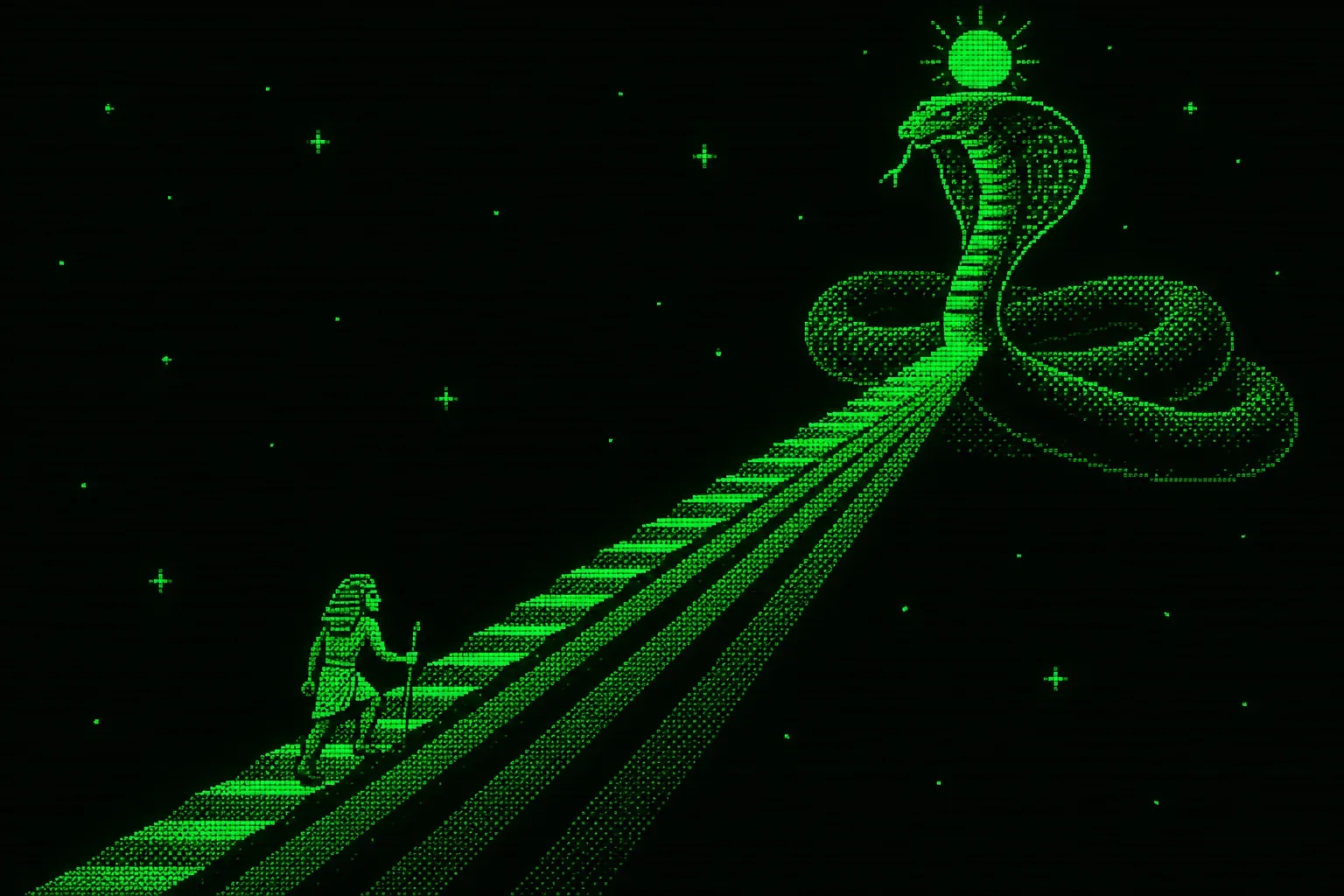
Meryre has laid down this radiance of yours as a stairway under his feet,
so that Meryre may go up on it to that mother of his, the living uraeus upon Ra.Note · Line 4
The king speaks of the sun’s rays as a staircase he climbs into the sky. - 5
mr jb =s n =f ḏi̯ =s n =f mnḏ =s snq ={j}f sw
Her heart aches for him; she gives him her breast, and he sucks it.
- 6

zꜣ =j j.t(j)
"My son," she says,
- 7
m n =k mnḏ =j pn snq =k sw j.t(j) m-ḏr jw,t jyi̯.n =k js jr ṯnw hrw(,w).pl =k
"take this breast of mine and suck it," she says,
"for you have not yet come to the full number of your days."Note · Line 7
The goddess nurses the king as a newborn. His ascent is a rebirth, and he has not yet lived out his allotted span. - 8
mdwi̯ p,t sdꜣ tꜣ ꜣgbgb nṯr.pl Jwn,w ḥr ḫrw wdn,t tp-ꜥ.wdu Mr,y-Rꜥw
The sky spoke, the earth quaked,
the gods of Heliopolis quivered
at the sound of the offering laid before Meryre. - 9
šdy.n sw mʾw,t =f Bꜣs,tt j:snḫ.n sw ḥr.t-jb Nḫb rḏi̯〈.n〉 ={j} ḥr.t-jb Dp ꜥ.w(j) =s jr =f
His mother Bastet has nursed him,
she who dwells in Elkab has reared him,
she who dwells in Dep has held out her arms to him.Note · Line 9
Bastet is the cat- or lioness-goddess. With Nekhbet and Wadjet she makes a trio of nursing and protecting mothers. - 10
m =k sw jy.y m =k sw jy.y
Look, here he comes! Look, here he comes!
- 11

m =k Mr,y-Rꜥw pn jy.y n ꜥnḫ wꜣs
Look, this Meryre comes for life and dominion!
- 12
jri̯.y =f ={j} ḥzmn,w.pl =f m dꜣb m jrp jm(,j) kꜣn(,w) nṯr
He will make his meals of figs, and of wine from the god's vineyard.
Note · Line 12
The word rendered “meals” occurs only here. It is understood as some kind of repast. - 13
jri̯ n =f sšm n(,j) jm(,j) ḏbꜥ =f (j)ḫ,t jm =f
The butcher of him who is at his finger will make him a meal from it.
- 14

zj =j j:zzj =j
As I fare, I snare.
- 15
fd,t =j fd,t Ḥr,w sṯ(j) Mr,y-Rꜥw sṯ(j) Ḥr,w
My sweat is the sweat of Horus;
Meryre's smell is the smell of Horus.Note · Line 15
Horus is the falcon god of kingship. The king claims the god’s very body, down to his sweat and smell. - 16
jr p,t jr p,t m-ꜥb nṯr.pl prw,t(j).w
To the sky! To the sky,
among the perutiu gods! - 17
Ppy r p,t m-ꜥb nṯr.pl prw,t(j).w
Pepi is bound for the sky, among the perutiu gods.
Note · Line 17
Pepi is Pepi I, the Sixth Dynasty king in whose pyramid this spell was carved. - 18
sn =j nn jr(,j) jm =j nn j.n Gbb nḏri̯ =f Ppy ḥr ꜥ =f sšmi̯ =f sw m sb(ꜣ).pl p,t
"This is my brother, this is the one at my side," says Geb,
as he takes Pepi by the arm and leads him through the gates of the sky.Note · Line 18
Geb is the earth god. He greets the dead king as his kin and escorts him up into the sky. - 19
nṯr m s,t =f nfr nṯr m s,t =f j:sꜥb.n sw Sṯj,t m fd.t =s ꜥꜣb.w,t m Ꜣb(w)
The god is in his place; how fine is the god in his place,
now that Satet has washed him clean with her four jars in Elephantine.Note · Line 19
Satet was the goddess of Elephantine, the island at the First Cataract where the Nile flood was thought to well up from below. - 20
jꜣ jwi̯.n =k trj ṯn(j) zꜣ =j
"Oh, where is it you have come to, my son?"
Note · Line 20
A dialogue begins. - 21
jt(j) =f jwi̯.n =f ḫr psḏ,t jr.t p,t sḥtp =f{j} s(j) m pꜣq =s
"Father, he has come to the Ennead of the sky, to please them with their flatbread."
- 22

jꜣ jwi̯.n =k trj ṯn(j) zꜣ =j
"Oh, where is it you have come to, my son?"
- 23
jt(j) =f jwi̯.n =f ḫr psḏ,t jr.t tꜣ sḥtp =f{j} s(j) m pꜣq =s
"Father, he has come to the Ennead of the earth, to please them with their flatbread."
- 24
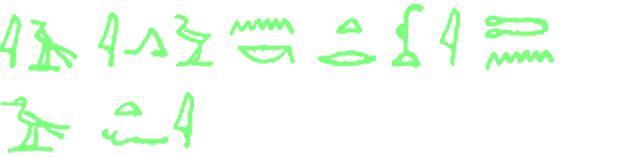
jꜣ jwi̯.n =k trj ṯn(j) zꜣ =(j)
"Oh, where is it you have come to, my son?"
- 25
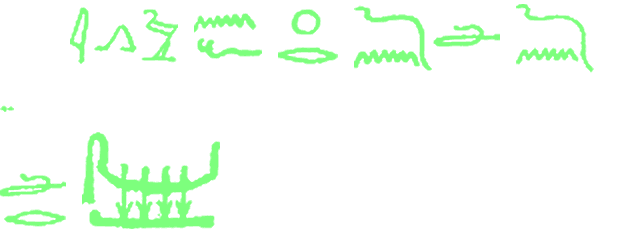
jt(j) =f jwi̯.n =f ḫr ḏnd ḏndr(,w)
"Father, he has come to the Wrathful One of the dendru-bark."
- 26
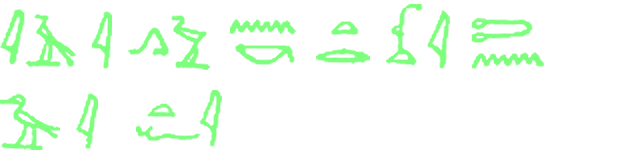
jꜣ jwi̯.n =k trj ṯn(j) zꜣ =j
"Oh, where is it you have come to, my son?"
- 27
jt(j) =f jwi̯.n =f ḫr mʾw,t.du =f jptwt(j) nr,t.du ꜣwi̯.tj šn(j).pl dḥdḥ.tj mnḏ.pl tp.tj ḏw-sḥsḥ
"Father, he has come to these two mothers of his,
the two vultures with long hair and hanging breasts, who are on the mountain of Sehseh. - 28
ḏꜣj =sn(j) mnḏ =sn(j) tp rʾ n(,j) Mr,y-Rꜥw n ḥm wḏḥj =sn(j) sw ḏ,t
They will pass their breast over the mouth of Meryre,
and never, ever will they wean him.Note · Line 28
Meryre (“Beloved of Ra”) is Pepi I’s throne name. Being suckled for ever and never weaned means the king is endlessly nourished and endlessly renewed, a god’s child for all time.