~/sacred-texts/pyramid-texts
Pyramid Texts Utterance 485: The King’s Corpse Shall Not Rot
- Text
- Pyramid Texts, Utterance 485
- Date
- Carved in the 6th Dynasty, in the reign of Pepi I (c. 2321–2287 BC), on the walls of his pyramid at Saqqara
- Found
- Pyramid of Pepi I, South Saqqara, Egypt; the inscribed walls remain in place
- Language
- Old Egyptian · Hieroglyphic
The spell sets terms for the gods who will carry Pepi to the sky. Those who lift him get bulls butchered in their honour. Those who refuse shall not go up to the Mansion of Horus that is in the sky. Pepi then takes the part of the searcher for the murdered Osiris. Geb comes, his might upon him, his yellow paint upon his face, and finds his son laid on his side in Gehesty. A speaker boasts of binding the killer Seth hand and foot.
At the close the sky goddess Nut is called on to rebuild the corpse: may you join his bones to his head, may you join his head to his bones. He shall not rot. Then Pepi rises as the great star in the midst of the east.
- 1
ḏ(d)-mdw
Recitation:
- 2
wn ꜥꜣ.du p,[t] [j:zn].⸢y⸣ ꜥꜣ.du qbḥ(,w) tp-ꜥ.du nṯr.pl š[di̯.t] =[sn] [Ppy] [pn] [jr] [p],t ꜥnḫ ḏdi̯
The double doors of the sky are opened, the double doors of the Cool Waters are flung wide before the gods who will take this Pepi to the sky, alive and enduring.
Note · Line 2
The “Cool Waters” are the waters of the sky, which the dead king must cross to reach the gods. - 3
nṯr nb šdi̯.t =f Ppy pn jr p,t ꜥnḫ ḏdi̯ swt wꜣš =f [s]w[t] ⸢bꜣ⸣ =f swt s{j}n =f p(ꜣ)q swt pri̯ =f jr ḥw,t Ḥr,w jr.t p,t
Every god who takes this Pepi to the sky, alive and enduring:
he shall be mighty,
he shall be a ba,
he shall smell the pak-bread,
he shall go up to the Mansion of Horus that is in the sky.Note · Line 3
A ba is the power of a god or a blessed dead person to show itself and act in the world. - 4
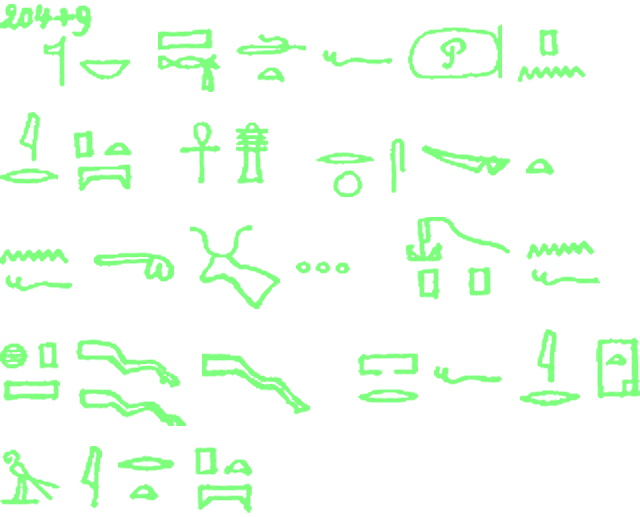
nṯr nb šdi̯.t =f Ppy pn jr p,t ꜥnḫ ḏdi̯ rḫs.t n =f kꜣ.pl stpp n =f ḫpš.pl pri̯ =f jr ḥw,t Ḥr,w jr.t p,t
Every god who takes this Pepi to the sky, alive and enduring:
for him shall bulls be butchered,
for him shall forelegs be carved,
he shall go up to the Mansion of Horus that is in the sky.Note · Line 4
The foreleg was the choicest cut of the offering bull. - 5
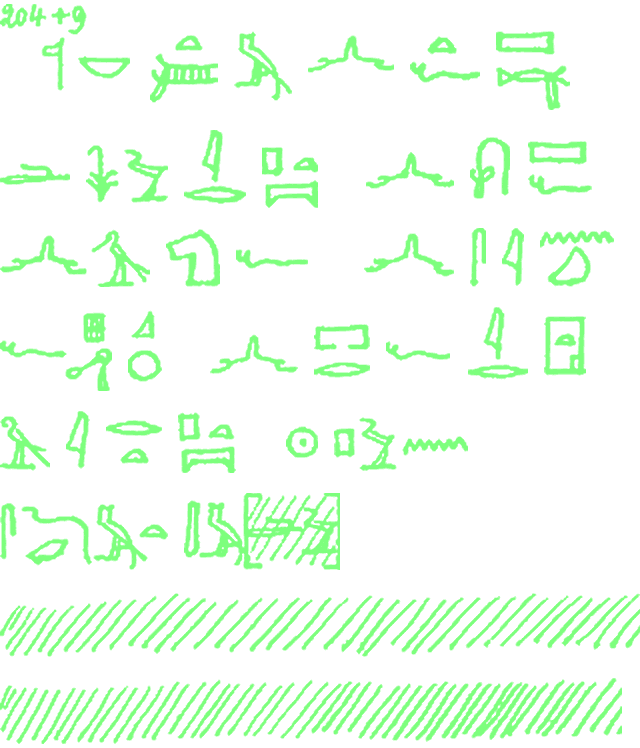
nṯr nb tm.t =f šdi̯ sw jr p,t n wꜣš =f n bꜣ =f n s{j}n =f p(ꜣ)q n pri̯ =f jr ḥw,t Ḥr,w jr.t p,t hrw pw n(,j) sḏm,t md⸢w⸣ ⸢sḏm⸣[.t] [mdw] [Ḥr,w] ḥnꜥ Stš Rꜥw m s,t [...] m s,t Rꜥw
Every god who does not take him to the sky:
he shall not be mighty,
he shall not be a ba,
he shall not smell the pak-bread,
he shall not go up to the Mansion of Horus that is in the sky,
on that day of hearing the case, when the case of Horus and Seth is heard, Ra in the seat … in the seat of Ra.Note · Line 5
The “case” is the divine trial in which Horus and Seth disputed the kingship of Egypt after Seth murdered Osiris. - 6
Ḥr,w sḏꜣ Ppy [pn] ḥnꜥ =⸢k⸣
Horus, carry this Pepi off with you!
- 7
Ḥr,w m jwi̯ sw [...] =f n ⸮Rꜥw? tp-ꜥ.w(j) =f
Horus, do not leave him stranded … his … to Ra, in his presence.
Note · Line 7
The Egyptian verb means to leave someone without a boat to cross the water, and so to leave him helpless. “Stranded” carries both senses. - 8
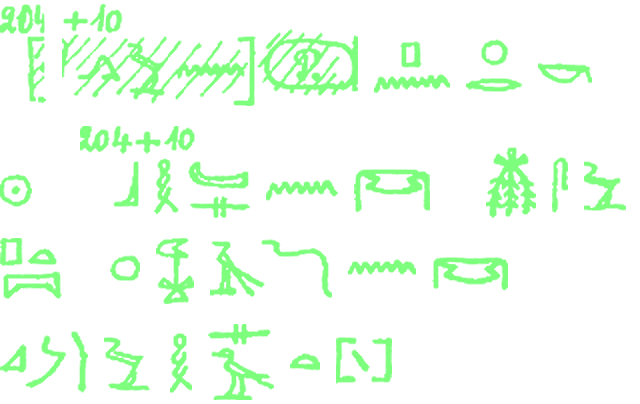
jwi̯.n Ppy pn ḫr =k Rꜥw bḥz n(,j) nbw msi̯.w p,t ḫꜣḏ n(,j) nbw qmꜣ.w Ḥzꜣ,t
This Pepi has come to you, Ra, as a golden calf whom the sky bore, a golden fatted calf whom Hesat fashioned.
- 9
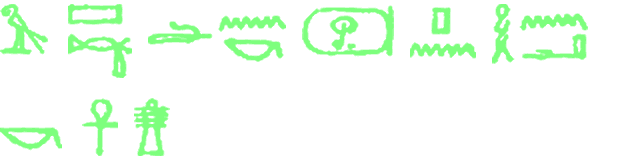
Ḥr,w šdi̯ n =k Ppy pn ḥnꜥ =k ꜥnḫ ḏdi̯
Horus, take this Pepi along with you, alive and enduring.
- 10

Ḥr,w m jwi̯ Ppy pn
Horus, do not leave this Pepi stranded.
- 11
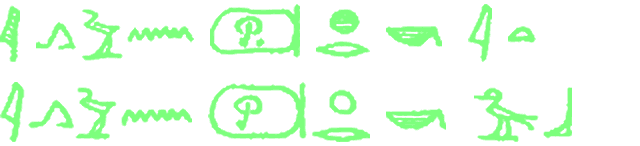
jwi̯.n Ppy ḫr =k jt(j) jwi̯.n Ppy ḫr =k Gbb
Pepi has come to you, father; Pepi has come to you, Geb.
Note · Line 11
Geb, the earth god, is the father of Osiris and of Seth. The king calls him “father” as the heir of Osiris. - 12
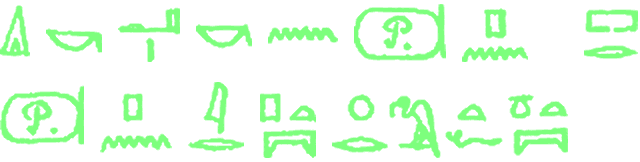
ḏi̯ =k ꜥ =k n Ppy pn pri̯ Ppy pn jr p,t ḫr mʾw,t =f Nw,t
Give your hand to this Pepi, that this Pepi may go up to the sky, to his mother Nut.
Note · Line 12
Nut, the sky goddess, is Geb’s consort and mother of Osiris. The dead king claims her as his own mother. - 13
Ppy [p]w ... [m] [zḫn,w] zꜣ =k (W)sr(,w)
This Pepi is … in search of your son Osiris.
- 14
gmi̯.n =f sw di̯.y ḥr gs =f
He has found him laid upon his side.
Note · Line 14
Osiris lies dead on his side after Seth has killed him. Pepi plays the part of the searcher, as Isis and Horus do in the myth. - 15
jn psḏ,t.du mdwi̯ n Stš ḫft =f ḏd [_] [jt(j)] =f Gbb ḥḥ n(,j) ḥkꜣ
It was the Two Enneads who spoke to Seth against him, while … his father Geb spoke a million spells.
Note · Line 15
The Ennead is the “Nine,” the great company of gods, here doubled into two companies. They and Geb act in Osiris’s defence against Seth. - 16
di̯.n psḏ,t.du nḏ jr-ꜥ =f
The Two Enneads have set a protector at his side.
- 17
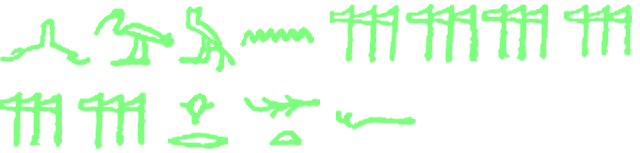
n gmi̯.n psḏ,t.du ḥr(,j)-ḫt =f
The Two Enneads cannot find the one who is behind him.
Note · Line 17
The Two Enneads are the two great companies of gods, each traditionally nine strong. Even the assembled gods fail to find the one who is behind him; who this is remains unclear. - 18
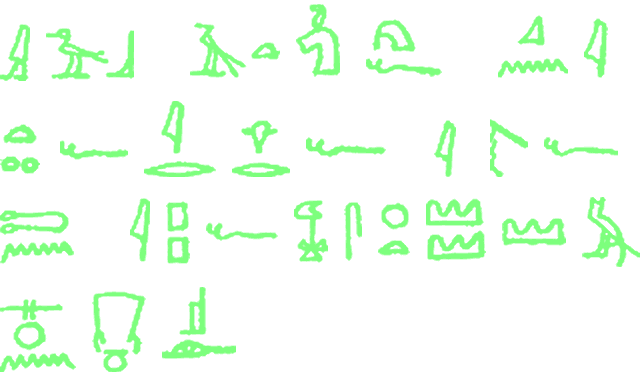
jy Gbb ꜣ,t =〈f〉 tp =f qnj,t =f jr ḥr =f j:ḥw =f ṯn(j.w) jpp =f ḫꜣs,t.pl m zḫn,w (W)sr(,w)
Geb comes, his might upon him, his yellow paint upon his face,
beating the border-ridges, scouring the hill-countries in search of Osiris.Note · Line 18
Geb, the earth god, is the father of Osiris. - 19
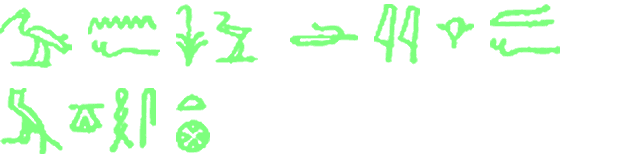
gmi̯.n =f sw di̯.y ḥr gs =f m Gḥs,t
He has found him laid on his side in Gehesty.
Note · Line 19
Gehesty, “Gazelle-land,” is the place where Seth struck Osiris down. Lying on the side is the posture of the dead. - 20
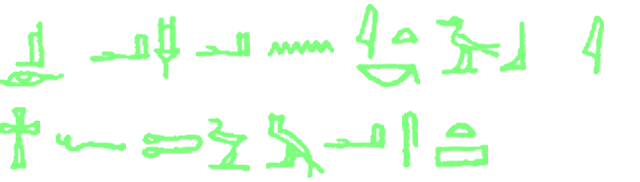
(W)sr(,w) ꜥḥꜥ n jt(j) =k Gbb j:nḏ =f ṯw m-ꜥ Stš
Osiris, stand up for your father Geb, that he may save you from Seth.
- 21
jn⸮k? [nw] [...] S[t]š ḥr gs =f qꜣ{j}[s].〈j〉 rd.du =f qꜣs.j ꜥ.du =f [di̯] sw ḥr gs =f m Tꜣ-rw
I am the one who … Seth on his side, who bound his legs, who bound his arms, who laid him on his side in Ta-ru.
- 22
Ḥr,w šdi̯ sw [ḥ]nꜥ =k jr p,t
Horus, take him up with you to the sky.
Note · Line 22
Horus, son of Osiris, is asked to carry his father heavenward. - 23
jnk nw j:nḏ =[f] j[t(j)] =k 〈j:〉nḏ =f (W)sr(,w) m-ꜥ sn =f Stš
I am the one who will save your father, who will save Osiris from his brother Seth.
- 24
jnk nw qꜣs rd.du =f qꜣs ꜥ.du =f di̯ sw ḥr gs =f m Tꜣ-rw
I am the one who bound his legs, who bound his arms, who laid him on his side in Ta-ru.
- 25
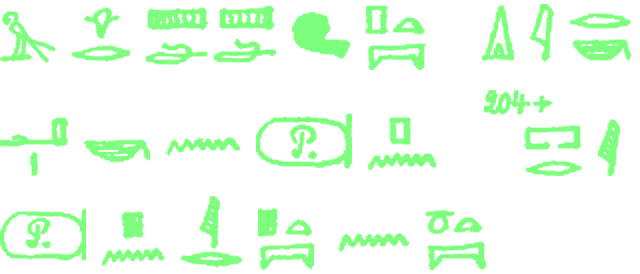
Ḥr,w ḥr(,j) šdšd p,t jmi̯ jr =k ꜥ =k n Ppy pn prj Ppy pn jr p,t n Nw,t
Horus who is upon the standard-boss of the sky, give your arm to this Pepi, that this Pepi may go up to the sky, to Nut.
Note · Line 25
The standard-boss is the rounded cushion on top of a divine standard pole, here pictured as set up in the sky. - 26

〈Nw,t〉 jmi̯ ꜥ =ṯ jr Ppy m ꜥnḫ wꜣs
Nut, give your arm to Pepi with life and dominion.
Note · Line 26
Nut is the sky goddess, mother of Osiris, who receives the dead king into her body. - 27

dmḏ =ṯ qs.pl =f
May you join his bones together,
Note · Line 27
The dead body, like the dismembered Osiris, must be reassembled before it can live again. - 28

jnq =ṯ ꜥ,t.pl =f
may you knit his limbs together,
- 29
dmḏ =ṯ qs.pl =[f] [j]r [tp] =[f] dmḏ =ṯ tp =f jr qs.pl =f
may you join his bones to his head, may you join his head to his bones.
- 30
n ḥwꜣ =f
He shall not rot.
- 31
n jmk =f
He shall not decay.
- 32
n [t]⸢m⸣ =f
He shall not come to an end.
- 33
n r⸮_?w =f
He shall not rew.
Note · Line 33
The verb (Egyptian r? w) is unidentified. The next line, about his smell, suggests it means something like rotting: a royal body that does not decay is a recurring hope in these spells. - 34
n pri̯ sṯ(j) =f
His smell shall not seep out.
- 35
⸢nṯr⸣ ⸢nb⸣ ⸢stp⸣ [zꜣ] [...] ⸢jm⸣ =⸢f⸣ [...] Ppy šw.t m nṯr
Every god who extends protection … over him … Pepi, shut as a god.
Note · Line 35
The line is badly damaged. The word shut (šw.t) is uncertain; it may mean “shadow” or “free (of)”. - 36
prj =f r =f šwi̯ =f r =f jr p,t m sbꜣ ꜥꜣ ḥr(,j)-jb jꜣb(,t)
Let him come forth, then, let him rise, then, to the sky,
as the great star in the midst of the east.Note · Line 36
Pepi is the king for whose pyramid these spells were carved.