~/sacred-texts/pyramid-texts
Pyramid Texts Utterance 422: Pepi I Takes Osiris’ Throne
- Text
- Pyramid Texts, Utterance 422
- Date
- Carved in the Sixth Dynasty, in the reign of Pepi I (c. 2330–2280 BC), on the walls of his burial chambers
- Found
- Pyramid of Pepi I at Saqqara
- Language
- Old Egyptian · Hieroglyphic
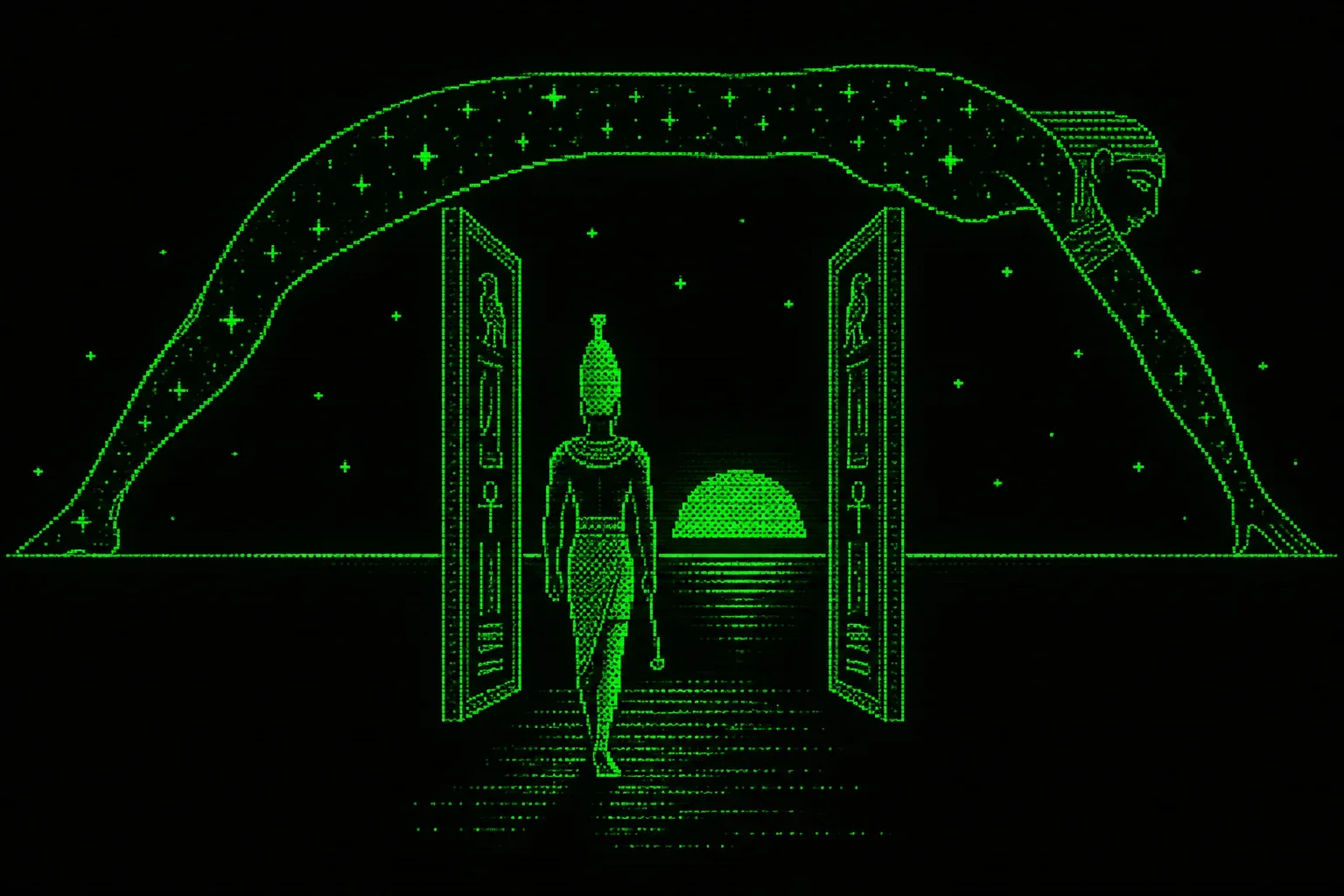
A priest speaks to the dead king Pepi I. The god’s followers cry out at his coming: “The god comes! The god comes! This Pepi comes upon the throne of Osiris!” Isis and Nephthys call to him, and the blessed dead kiss the earth at his feet in dread. His mother Nut, the sky, shows him the road to the horizon: Open for you are the double doors of the sky. Ra stands waiting to set him on the throne of Osiris.
On earth his son takes his throne and feeds him: He shall plough barley, he shall plough emmer, and present you with it. The spell ends: May your name live on earth, may your name endure on earth. You shall not perish, you shall not be destroyed, for ever and ever.
- 1

ḏ(d)-mdw
Recitation:
- 2

hꜣ Ppy pw
O Pepi!
- 3
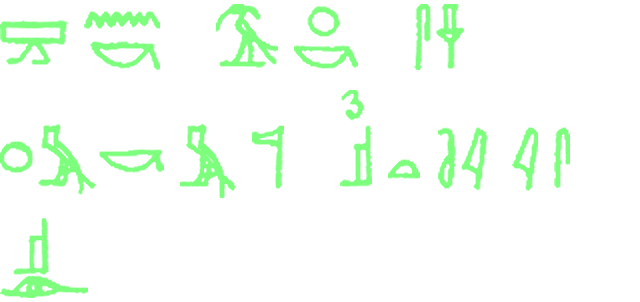
šmi̯.n =k ꜣḫ =k sḫm =k m nṯr s,tj js (W)sjr
You have gone away to be an akh, to have power as a god, as the successor of Osiris.
Note · Line 3
“Gone away” means Pepi has died. - 4

bꜣ =k n =k m-ẖnw =k
Your ba is yours, within you;
Note · Line 4
The ba is the part of the person that can move freely between this world and the next. - 5

sḫm =k n =k ḥꜣ =k
your power is yours, behind you;
- 6

wrr,t =k n =k tp =k
your Wereret crown is yours, upon you;
Note · Line 6
Wereret means “the Great One,” a name for the White Crown of Upper Egypt. - 7
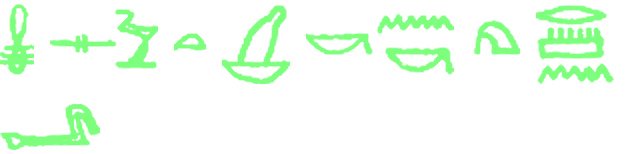
mjz,wt =k n =k tp-rmn =k
your Mizut crown is yours, at your shoulder.
Note · Line 7
The Mizut is another name for the White Crown of Upper Egypt. - 8

ḥr =k m-bꜣḥ =k
Your face is before you,
- 9

jꜣw =k tp-ꜥ,du =k
your praise goes before you.
- 10
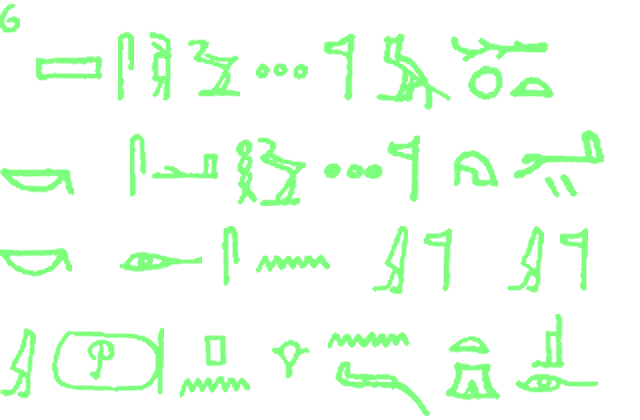
š(m)s,w.pl nṯr m-ḫt =k sꜥḥ.w nṯr tp-ꜥ,du =k jri̯ =sn jy nṯr jy nṯr jy Ppy pn ḥr ns,t (W)sr(,w)
The god's followers are behind you, the god's nobles before you, and they cry:
"The god comes! The god comes!
This Pepi comes upon the throne of Osiris! - 11
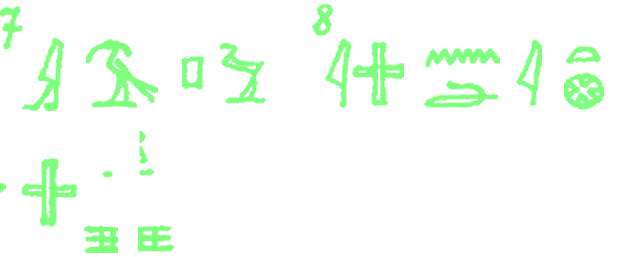
jy ꜣḫ pw jm(,j) Ndj,t sḫm jm(,j) Tꜣ-wr
He comes, this akh who is in Nedit, the power who is in the Thinite nome!"
Note · Line 11
Nedit is the place where Osiris was struck down and died. The Thinite nome is the province of Upper Egypt around Abydos, Osiris’s great cult centre. Pepi arrives as Osiris himself. - 12
mdwi̯ n =k (Ꜣ)s,t ḏsw n =k Nb,t-ḥw,t jwi̯ n =k ꜣḫ.pl m ksj,w sn =sn tꜣ r rd.du =k n šꜥ,t =k Ppy pw m nʾ,t.pl Sjꜣ
Isis speaks to you, Nephthys calls out to you, the akhs come to you bowing low and kiss the earth at your feet for dread of you, Pepi, in the towns of Sia.
Note · Line 12
Isis and Nephthys are the sisters of Osiris who mourned him and helped revive him. Sia is the god of Perception, divine insight personified. - 13
pri̯ =k r =k ḫr mʾw,t =k Nw,t
Go up, then, to your mother Nut!
Note · Line 13
Nut is the sky goddess. The dead king is reborn as her son and rises into her body, the sky. - 14
nḏri̯ =s ꜥ =k ḏi̯ =s n =k wꜣ,t jr ꜣḫ,t r bw ẖr(,j) Rꜥ(w)
May she take your arm and give you the road to the horizon, to the place where Ra is.
- 15

wn n =k ꜥꜣ.du p,t
Open for you are the double doors of the sky;
- 16

snz n =k ꜥꜣ.du qbḥ,w
unbolted for you are the double doors of Qebehu.
Note · Line 16
Qebehu, “the Cool Waters,” is a name for the watery regions of the sky. The gates of heaven swing open to let the king through. - 17

gmi̯ =k Rꜥ(w) ꜥḥꜥ j:zꜣ =f n =k
You shall find Ra standing, waiting for you.
Note · Line 17
The dead king, Pepi I, is addressed throughout. He is promised a welcome by the sun god Ra at his arrival in the sky. - 18
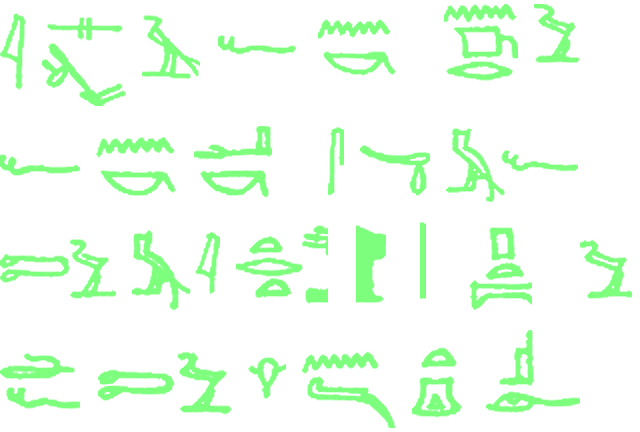
nḏri̯.w =f n =k ꜥ =k sšmi̯ =f ṯw m jtr,t.du p,t wdi̯ =f ṯw ḥr ns,t (W)sr(,w)
He will take your arm for you, lead you into the Two Shrines of the sky, and set you on the throne of Osiris.
Note · Line 18
The Two Shrines are the national sanctuaries of Upper and Lower Egypt, imagined here as rows of chapels in the sky where the gods of the two lands assemble. - 19

hꜣ Ppy pw
O Pepi!
Note · Line 19
The cry, literally “O this Pepi!” , marks the start of a new stanza of the spell. - 20

jy n =k jr,t-Ḥr,w mdwi̯ =s ṯw
Here comes the Eye of Horus to you, to speak to you.
Note · Line 20
The Eye of Horus, torn out by Seth and restored, stands for every offering made to the dead and for wholeness regained. - 21

jy n =k bꜣ =k jm(,j) nṯr.pl
Here comes your ba to you, the ba that is among the gods.
Note · Line 21
Here it returns to the king. - 22
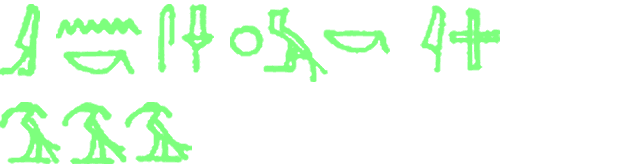
jy n =k sḫm =k jm(,j) ꜣḫ.pl
Here comes your power to you, the power that is among the akhs.
Note · Line 22
The akhs are the blessed, transfigured dead, who shine like spirits of light. - 23
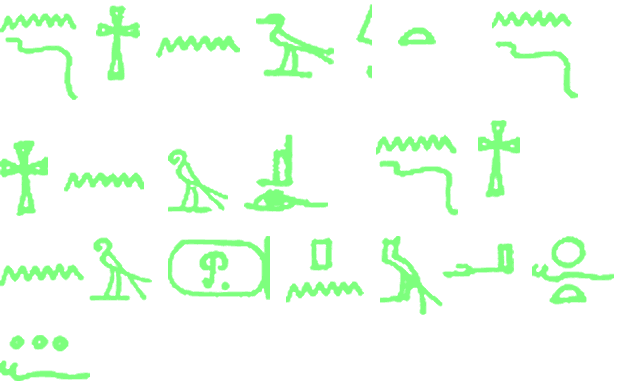
nḏ.n zꜣ jt(j) =f nḏ.n Ḥr,w (W)sr(,w) nḏ.n Ḥr,w Ppy pn m-ꜥ ḫft.pl =f
The son has protected his father, Horus has protected Osiris, Horus has protected this Pepi from his enemies.
Note · Line 23
In myth Horus defended his murdered father Osiris and won back his kingship. - 24
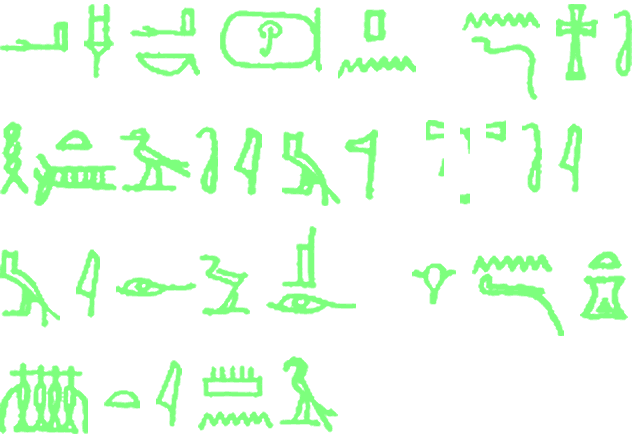
ꜥḥꜥ =k Ppy pn nḏ.tj ḥtm.tj m nṯr ꜥpr.tj m jr,w (W)sr(,w) ḥr ns,t Ḫnt(,j)-jmn,t.w
You shall stand, Pepi, protected and provided as a god, equipped with the form of Osiris, on the throne of Khentiamentiu.
Note · Line 24
Khentiamentiu, “Foremost of the Westerners”, is the ancient lord of the dead of Abydos, identified with Osiris. - 25
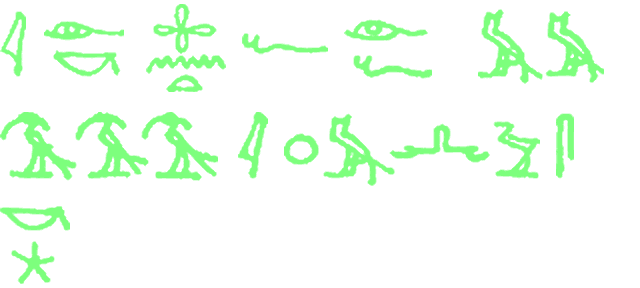
jri̯ =k wn.t =f jri̯ =f mm ꜣḫ.pl j:ḫm.w-sk
You shall do what he used to do among the akhs and the Imperishable Stars.
Note · Line 25
The Imperishable Stars are the circumpolar stars, which never set. They are the eternal home the dead king hopes to join. - 26
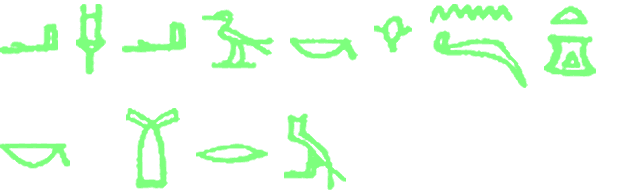
ꜥḥꜥ zꜣ =k ḥr ns,t =k ꜥpr m jr,w =k
Your son shall stand on your throne, equipped with your form.
Note · Line 26
On earth the living heir takes the throne just as the dead king takes Osiris’ throne in the beyond. - 27
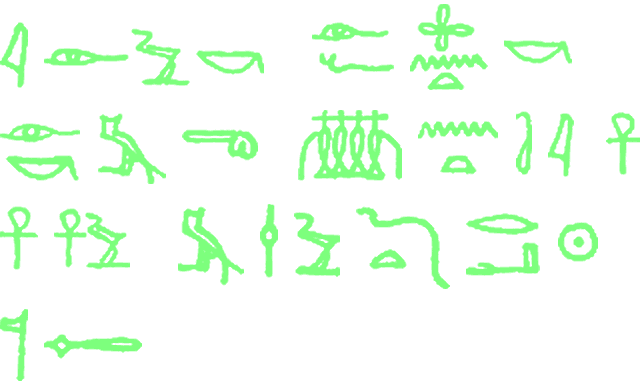
jri̯ =f wn.t =k jri̯ =k m-bꜣḥ ḫntj ꜥnḫ.w m wḏ.t Rꜥ(w) nṯr-ꜥꜣ
He shall do what you used to do before, at the head of the living, at the command of Ra, the great god.
- 28
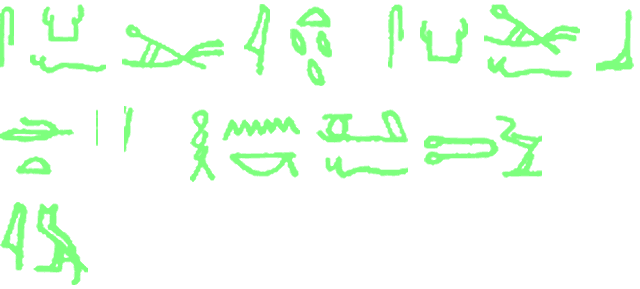
skꜣ =f jt skꜣ =f bd,t ḥnk =f ṯw jm
He shall plough barley, he shall plough emmer, and present you with it.
Note · Line 28
The heir’s duty is to keep his dead father supplied with grain. Emmer is an ancient wheat. - 29

hꜣ Ppy pw
O Pepi!
- 30
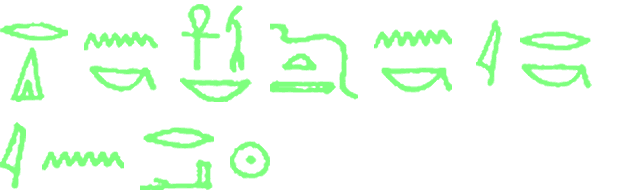
rḏi̯ n =k ꜥnḫ wꜣs nb ḏ,t n =k jr =k jn Rꜥ(w)
All life and dominion are given you forever, given to you as your own, by Ra.
- 31
mdwi̯ =k ḏ,t =k šzp.n =k jr,w nṯr ꜥꜣi̯ =k jm ḫr nṯr.pl ḫnt(,j).w ši
You shall speak to your body, having received the form of a god, that you may be great by it among the gods who are foremost of the Lake.
Note · Line 31
The king, now godlike, addresses his own body, which is reunited with the ba and power that have come to him. The Lake is one of the celestial waters where the gods dwell. - 32
hꜣ Ppy pw
O Pepi!
- 33
ꜥḥꜥ bꜣ =k mm nṯr.pl mm ꜣḫ.pl
May your ba stand among the gods, among the akhs:
- 34
snḏ =k pw jr ḥꜣ,t(j).pl =sn
this is the dread of you upon their hearts.
- 35
hꜣ Ppy pw
O Pepi!
Note · Line 35
The spell is spoken to the dead king, Pepi I of the Sixth Dynasty, in whose pyramid it was carved. - 36
ꜥḥꜥ Ppy pn ḥr ns,t =k ḫnt ꜥnḫ.w
Stand, Pepi, upon your throne at the head of the living:
Note · Line 36
“The living” are those who live on after death, among whom the king is to rule. - 37
šꜥ,t =k pw jr ḥꜣ,t(j).pl =sn
this is the terror of you upon their hearts.
- 38
ꜥnḫ rn =k tp tꜣ nḫḫ rn =k tp tꜣ
May your name live on earth,
may your name endure on earth.Note · Line 38
A remembered name kept a person in existence. As long as Pepi’s name lived among people on earth, he himself lived on. - 39
n ski̯ =k n ḥtm =k n ḏ,t ḏ,t
You shall not perish, you shall not be destroyed,
for ever and ever.