~/sacred-texts/pyramid-texts
Pyramid Texts Utterance 224: The Dead King Puts On His Body
- Text
- Pyramid Texts, Utterance 224 (PT 224)
- Date
- Carved in the early 6th Dynasty (c. 2345–2333 BC) inside the pyramid of King Teti at Saqqara
- Found
- Pyramid of Teti, Saqqara, Egypt
- Language
- Old Egyptian · Hieroglyphic
- 1
ḏ(d)-mdw zp 4
Recite four times:
- 2
wd(n) n =f m sꜥḥ =f nb m s,t =f nb.t
Make offering to him in all his dignities, in all his places.
Note · Line 2
A stage direction for the officiant: the dead king Teti is to receive offerings in every rank he holds and in every place where he may be. - 3
ḏ(d)-mdw
Recite:
- 4
ḥtp =w(j) ḫr,t =k
How content your state is!
Note · Line 4
The verb for “be content” (ḥtp) is the same root as the word for “offering,” which closes the spell, so the greeting already hints that the king is satisfied by what is offered to him. - 5
ꜣḫ =k hꜣ Ttj m-ꜥb sn.w =k nṯr.pl
You are an akh, Teti, among your brothers the gods.
Note · Line 5
An akh is the transfigured, effective spirit that a dead person becomes once the rites succeed. As an akh the king lives on among the gods as one of their kin. - 6
nš =w(j) s(j) nš =w(j) s(j)
How changed it is, how changed it is!
- 7
nḏj ms.w =k
Stand by your children!
- 8
zꜣu̯ ṯw ḏr =k pw jm(,j) tꜣ
Guard yourself against that boundary of yours that is in the earth!
Note · Line 8
The “boundary in the earth” is most likely the grave itself, the limit that could hold the dead king fast below ground. - 9
ḏ(d)-mdw zp 4
Recite four times:
- 10
wnḫ ḏ,t =k jwt =k ḫr =sn
Clothe yourself in your body, and come to them!
Note · Line 10
“Them” are the gods, his brothers. The king puts on his body like a garment so that he can join them. - 11
ḏ(d)-mdw
Recite:
- 12
wḥ ṯw Ttj j:nn ṯw Ttj
Loosen yourself, Teti! Turn around, Teti!
Note · Line 12
The first verb (wḥ) is barely attested. It seems to mean shaking loose from the bonds or wrappings of death, after which the king turns to rise. - 13
šmi̯ n =k wḏ =k mdw n jꜣ(,t).pl Ḥr(,w)
Go, and give orders to the Mounds of Horus!
Note · Line 13
The “Mounds” are domains or territories. Those of Horus and Seth stand for the two halves of the land, which the rival gods divided between them, so the king rules over both. - 14
šmi̯ n =k wḏ =k mdw n jꜣ(,t).pl Stš
Go, and give orders to the Mounds of Seth!
- 15
šmi̯ n =k wḏ =k mdw n jꜣ(,t).pl (W)sr(,w)
Go, and give orders to the Mounds of Osiris!
Note · Line 15
The Mounds of Osiris are the realm of the dead, which Osiris rules. The king’s authority reaches there as well. - 16
ḥtp-ḏi̯-nzw m sꜥḥ.pl =k nb.w
An offering that the king gives, in all your dignities.
Note · Line 16
“An offering that the king gives” is the standard formula of Egyptian funerary offerings. Every gift to the dead was presented as coming from the king’s bounty. - 17
ḥbs =k bꜣ ḥbs =k ḫsdḏ
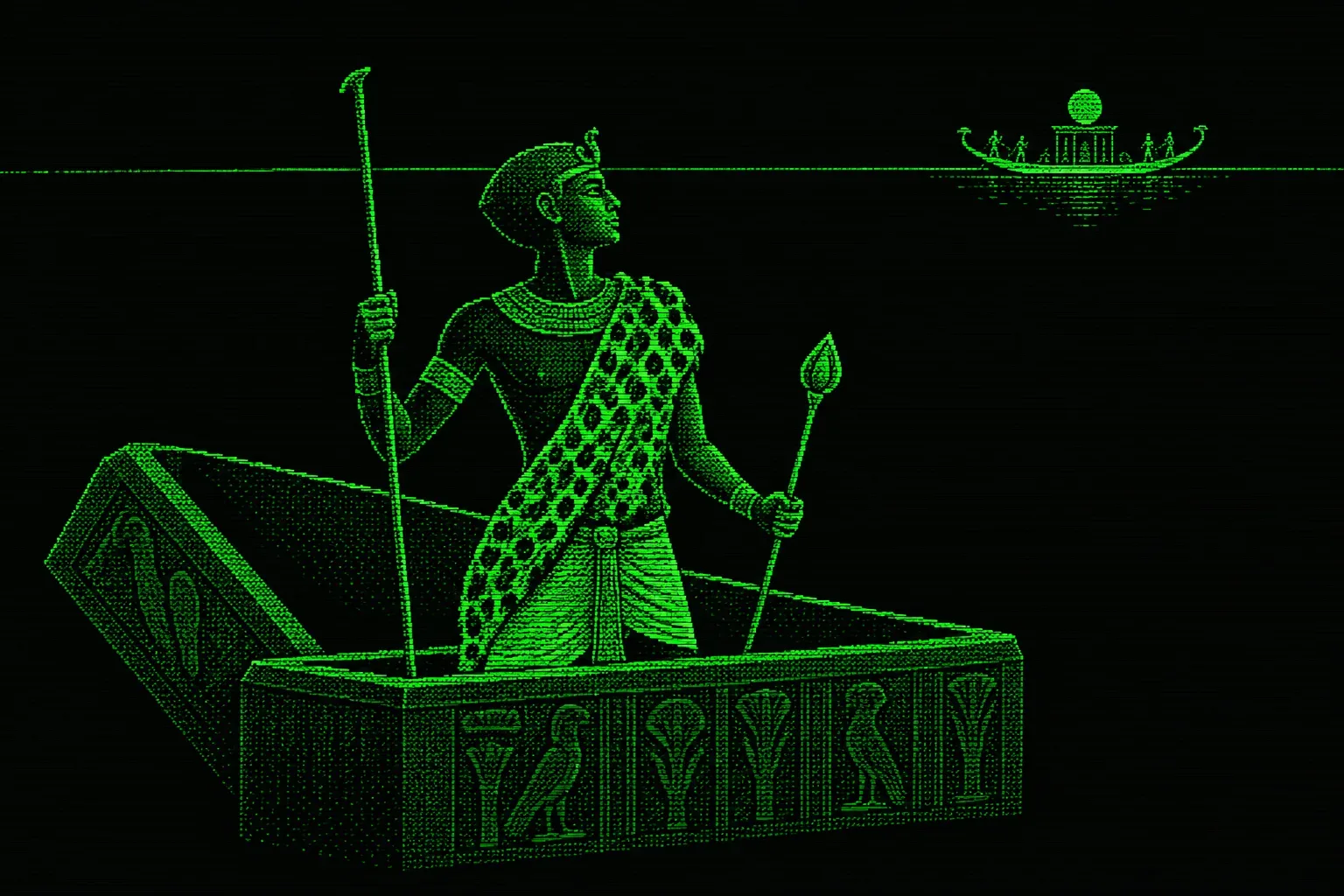
Your garment is the leopard skin, your garment is the khesedj-kilt.
Note · Line 17
The dead king Teti is dressed as a priest and chieftain. - 18
šmi̯ =k m wḫꜣ,t.du =〈k〉 rḫs =〈k〉 jḥ šmi̯ =k m Wꜣḏ-ꜥn m sꜥḥ =k nb m s,t.pl =k nb(.t)
May you walk in your sandals, may you slaughter an ox,
may you sail in the Wadj-an bark, in all your dignities, in all your places.Note · Line 18
The Wadj-an is the name of a sacred boat in which the king travels; “dignities” are the insignia and ranks that mark his status. - 19
nḥb,t =k ḫnt ꜥnḫ.w md(w) =k ḫnt ꜣḫ.pl Jnp(,w) js ḫnt(,j) jmn,t(j)w Ꜥnḏ,tj js ḫnt(,j) zp(ꜣ),t.pl jꜣb,t.t
Your lotus-bud scepter is at the head of the living, your staff at the head of the akhs,
like Anubis, foremost of the Westerners, like Andjety, foremost of the eastern nomes.Note · Line 19
The akhs are the blessed dead, transfigured and effective spirits. - 20
ḥtp =w(j) ḫr,t =k
How content is your state!
- 21
ꜣḫ =k hꜣ Ttj m-ꜥb sn.w =k nṯr.pl
You are an akh, O Teti, among your brothers the gods.
Note · Line 21
To be an akh is to have become a transfigured, effective spirit, the fulfilled form of the dead. - 22
nš =w(j) s(j) nš =w s(j)
How changed it is, how changed it is!
- 23
nḏ ms.w =k
Look after your children!
- 24
zꜣu̯ ṯw ḏr =k pw jm(,j) tꜣ
Beware of that boundary of yours which is in the earth!
- 25
ḏ(d)-mdw zp 4
Recite four times:
- 26
wnḫ ḏ,t =k jwt =k ḫr =sn
Don your body and come to them!
Note · Line 26
The body is put on like a garment, echoing the leopard skin and kilt he is given to wear earlier in the spell. - 27
ḏ(d)-mdw
Recite:
- 28
ḥtp-ḏj-Gbb m sꜥḥ =k nb m s,t =k nb(.t)
An offering that Geb gives, in all your dignities, in all your places.
Note · Line 28
This adapts the standard offering formula, “an offering that the king gives.” Here the giver is Geb, god of the earth, who provides for the dead.