~/sacred-texts/pyramid-texts
Pyramid Texts 215: Healing Seth’s Testicles, Horus’s Eye
- Text
- Pyramid Texts, Utterance 215
- Date
- Carved in the 5th Dynasty (c. 2375–2345 BC) on the burial chamber wall of the pyramid of King Unas at Saqqara; copied again in 6th Dynasty royal pyramids
- Found
- Burial chamber of the pyramid of Unas, Saqqara; still in place
- Language
- Egyptian (Old Egyptian) · Hieroglyphic
A reciter speaks to the dead King Unas, whose heralds race ahead to Atum, and says: I am your companion. The king heals the two rival gods: May you spit on the face of Horus for him and May you catch the testicles of Seth for him. Born as Horus and conceived as Seth, he outranks Osiris and Geb. No one can judge him: Osiris, you have no power over him; your son has no power over him.
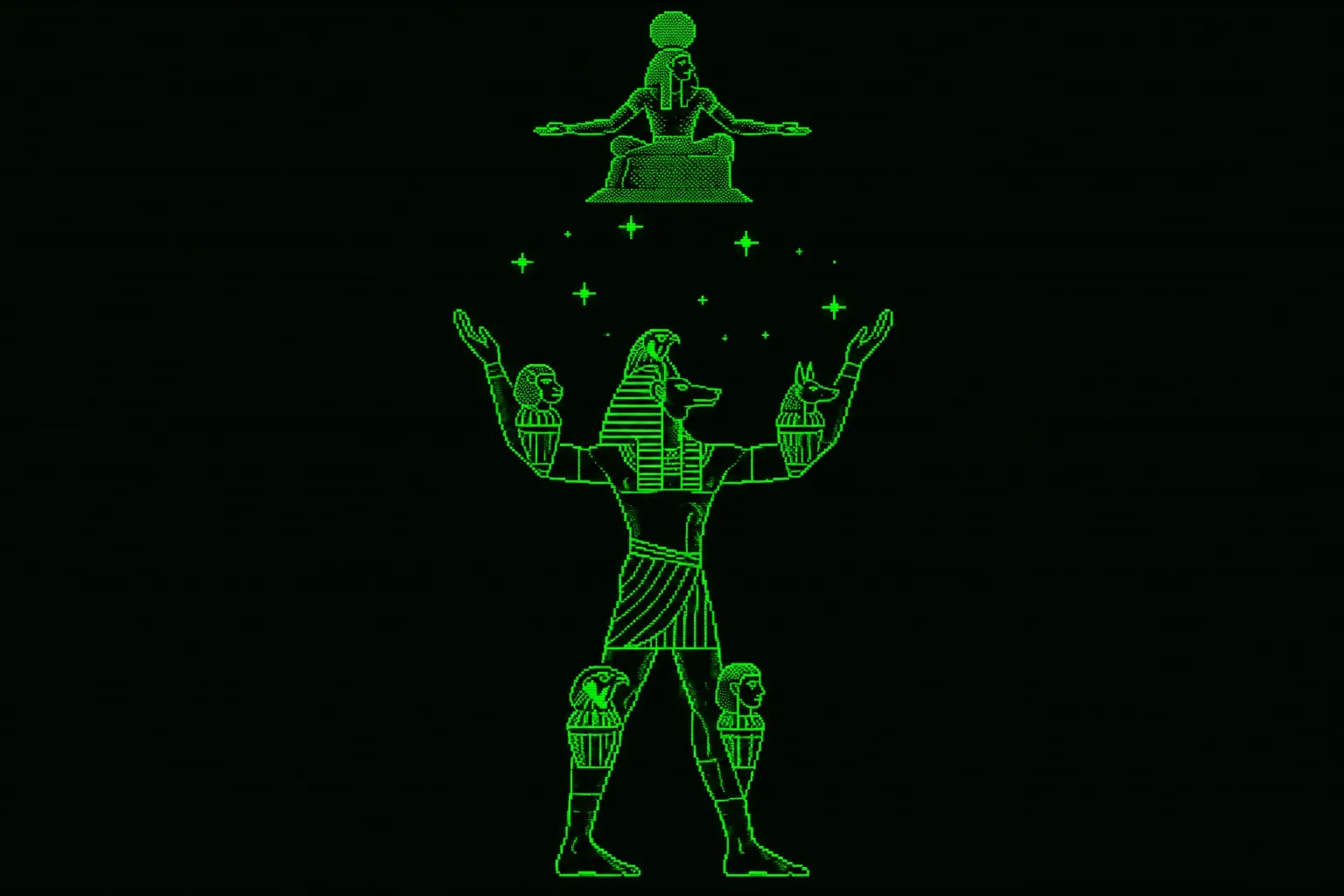
Then his body is rebuilt out of gods, from head to limbs, and each line ends Imperishable One! The four Sons of Horus become his arms and legs. The spell closes: You shall not perish; your ka shall not perish.
- 1
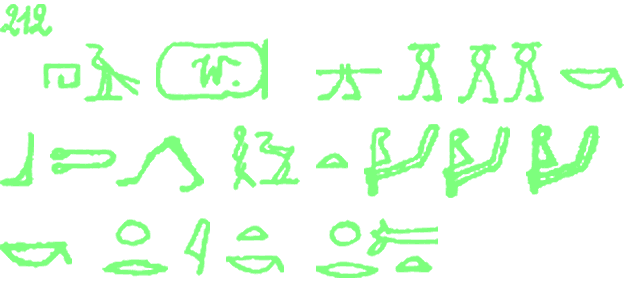
hꜣ Wnjs zj jn.pl =k bṯ ḥw(w),t(j).pl =k ḫr jt(j) =k ḫr (J)tm(,w)
O Unas, your messengers go,
your heralds run
to your father, to Atum.Note · Line 1
Unas, last king of the Fifth Dynasty, is the dead king addressed throughout. His heralds race ahead to announce him to Atum, the creator god and first father of the gods. - 2
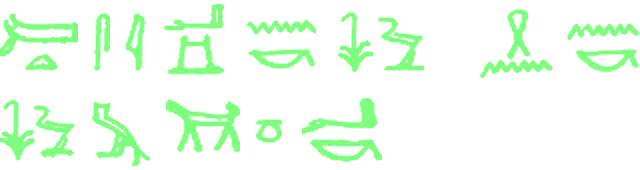
(J)tm(,w) sjꜥ n =k sw šni̯ n =k sw m-ẖn,w ꜥ =k
Atum, raise him up to you,
fold him within your arms.Note · Line 2
The speaker turns from the king to Atum. “Him” is Unas. - 3

n sbꜣ jw,tj rmn,wtj =f
There is no star without its companion.
- 4

jnk rmn,wtj =k
I am your companion.
- 5
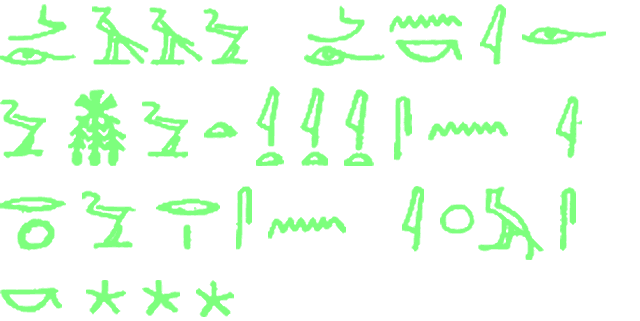
mꜣꜣ w mꜣ.n =k jr,w ms,wt jt(j).pl =sn j:rḫ.w rʾ =sn j:ḫm-sk
Look at me, now that you have looked on the forms of the children of their fathers,
who know their spell,
the Ones Who Know No Perishing.Note · Line 5
The Imperishable Stars are the stars near the pole, which never sink below the horizon. - 6
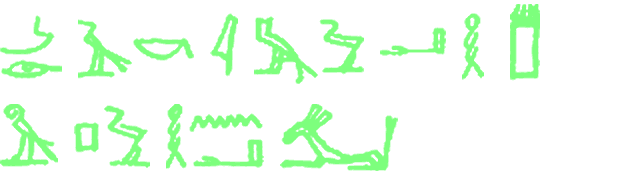
mꜣ =k jm(,j).w(j) ꜥḥ Ḥr,w pw ḥnꜥ Stẖ
May you see the two who are in the palace:
that is Horus and Seth.Note · Line 6
Horus and Seth are rival gods who fought for the kingship after Seth murdered Osiris, Horus’s father. - 7
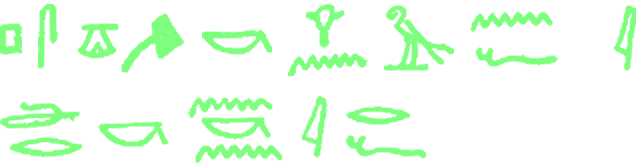
psg =k ḥr n Ḥr,w n =f j:dr =k nkn jr(,j) =f
May you spit on the face of Horus for him
and drive away the wound that is on him.Note · Line 7
In their fight Seth tore out Horus’s eye. Spittle was a healing substance, so spitting on the wounded face restores it. - 8
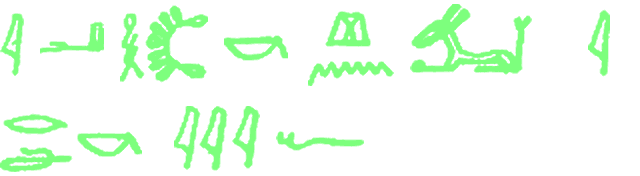
jꜥḥ =k ẖr(,wj) n Stẖ j:dr =k jy =f
May you catch the testicles of Seth for him
and drive away his mutilation.Note · Line 8
In the same fight Horus tore off Seth’s testicles. Here they are caught and given back, so both rivals are made whole. - 9

msi̯ n =k pf jwr n =k pn
That one was born to you;
this one was conceived for you.Note · Line 9
“That one” is Horus and “this one” is Seth, as the following lines show. The king takes into himself both rivals, born and conceived for him. - 10
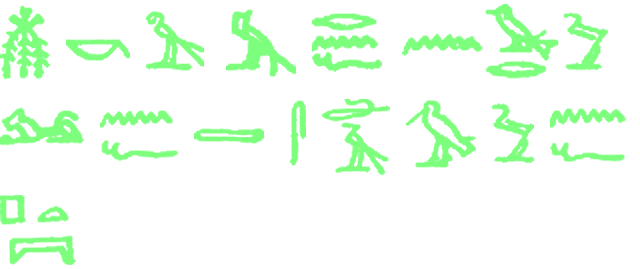
msi̯ =k Ḥr,w m rn =f nwr.w n =f tꜣ sdꜣ.w n =f p,t
You were born, Horus, in his name
"He for whom the earth quakes,"
"He for whom the sky shudders." - 11
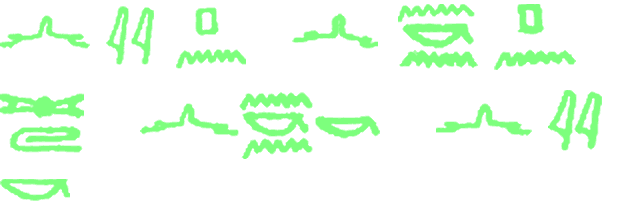
n jj pn n nkn pn ṯꜣz-pẖr n nkn =k n jj =k
This one has no mutilation, this one has no wound,
and the reverse:
you have no wound, you have no mutilation.Note · Line 11
The Egyptian inserts the instruction “vice versa,” a note to the reciter to repeat the sentence with the two nouns swapped. Each god in turn is declared unharmed, and therefore so is the king. - 12
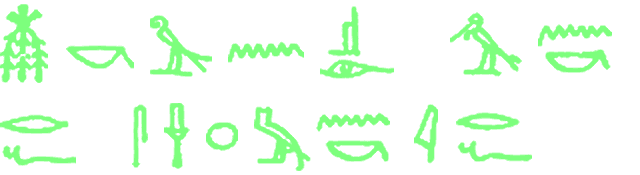
msi̯ =k Ḥr,w n (W)sjr bꜣ.n =k r =f sḫm.n =k jr =f
You were born, Horus, to Osiris;
you have more ba than he,
you have more might than he.Note · Line 12
The ba is a being’s power to act and to appear in the world. It is often loosely called the “soul.” To have more ba than someone is to have greater effective power. - 13
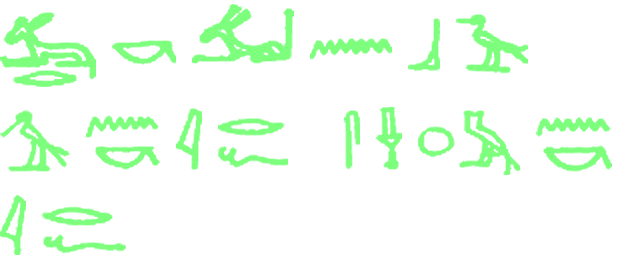
jwr =k Stẖ n Gbb bꜣ.n =k jr =f sḫm.n =k jr =f
You were conceived, Seth, for Geb;
you have more ba than he,
you have more might than he.Note · Line 13
Geb, the earth god, is Osiris’s father. The king, as Horus and as Seth, surpasses both the older generations of kings. - 14
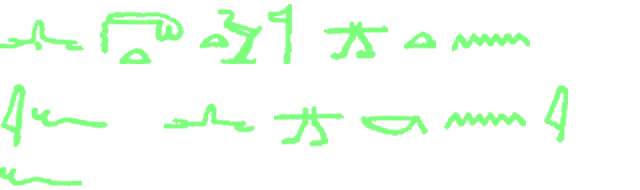
n mtw,t nṯr zj.t(j) n j =f n zj =k n j =f
No god's semen that is his has ever gone missing,
and you, who are his, will not go missing.Note · Line 14
The phrase rendered “that is his” and “you who are his” is obscure in the Egyptian. - 15
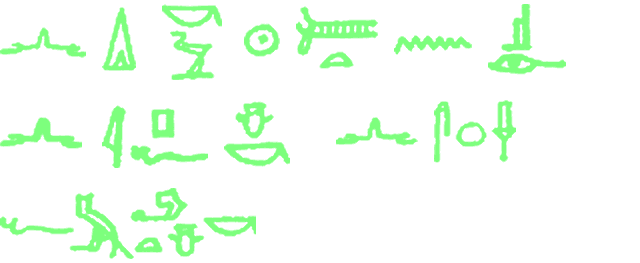
n ḏi̯ kw (J)tm(,w) n (W)sjr n jp =f jb =k n sḫm =f m ḥꜣ,t(j) =k
Atum will not give you to Osiris:
he will not lay claim to your mind,
he will not have power over your heart.Note · Line 15
Osiris ruled the dead and judged them by weighing the heart. - 16
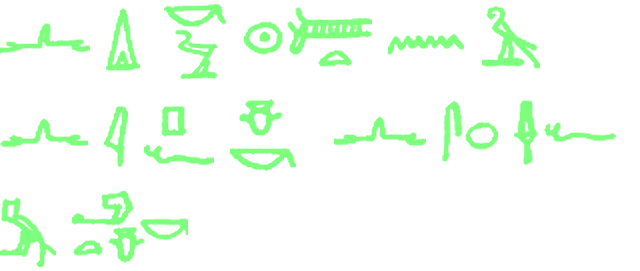
n ḏi̯ kw (J)tm(,w) n Ḥr,w n jp =f jb =k n sḫm =f m ḥꜣ,t(j) =k
Atum will not give you to Horus:
he will not lay claim to your mind,
he will not have power over your heart. - 17
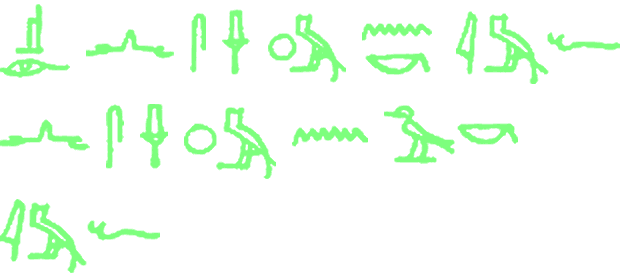
(W)sjr n sḫm.n =k jm =f n sḫm.n zꜣ =k jm =f
Osiris, you have no power over him; your son has no power over him.
Note · Line 17
The king is speaking of himself, or being spoken of, as beyond anyone’s control. Not even Osiris, lord of the dead, or his son Horus, the living king’s patron, can master him. - 18
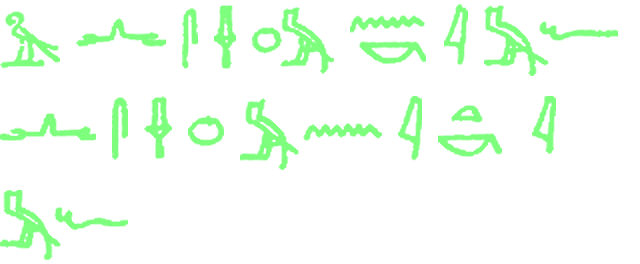
Ḥr,w n sḫm.n =k jm =f n sḫm.n jt(j) =k jm =f
Horus, you have no power over him; your father has no power over him.
- 19
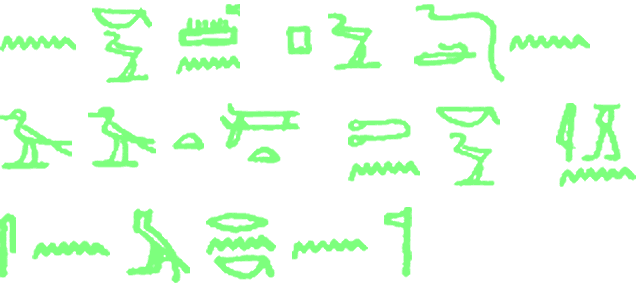
n(,j) kw mn nṯr pw ḏd.n zꜣ,t.du (J)tm(,w) ṯni̯ kw j.n =sn m rn =k n nṯr
You belong, N., to that god of whom Atum's twin children said: "You are exalted," they said, "in your name of 'god.'"
Note · Line 19
N. (Egyptian mn, “so-and-so”) stands in the text for the king’s name. - 20

ḫpr =k j:tm.t(j) 〈m〉 nṯr nb
You shall come into being complete, as every god.
- 21

tp =k m Ḥr,w-dwꜣ,t(j) j:ḫm-sk
Your head is Horus of the Duat, Imperishable One!
Note · Line 21
From here the king’s body is mapped part by part onto gods. - 22
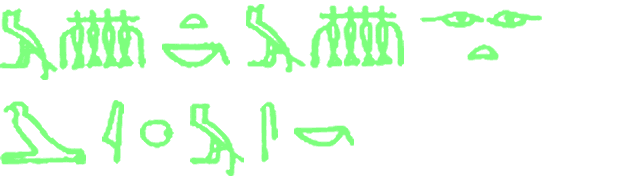
mḫnt =k m Ḫnt(,j)-jr,t.du j:ḫm-sk
Your face is Khenti-irti, Imperishable One!
- 23
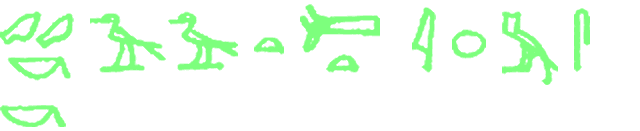
msḏr.du =k zꜣ,t.du (J)tm(,w) j:ḫm-sk
Your ears are Atum's twin children, Imperishable One!
- 24
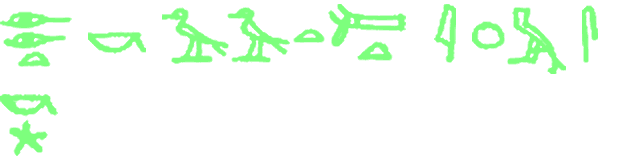
jr,t.du =k zꜣ,t.du (J)tm(,w) j:ḫm-sk
Your eyes are Atum's twin children, Imperishable One!
- 25

fnḏ =k m zꜣb j:ḫm-sk
Your nose is the jackal, Imperishable One!
- 26

jbḥ.pl =k Spd(,w) j:ḫm-sk
Your teeth are Sopdu, Imperishable One!
Note · Line 26
Sopdu, a god of the eastern frontier, has a name meaning “the Sharp One.” That makes him an apt match for teeth. - 27

ꜥ.du =k Ḥ(j)p(,w) Dwꜣ-mʾw,t≡f
Your arms are Hapy and Duamutef:
Note · Line 27
Hapy, Duamutef, Imsety and Qebehsenuef are the four Sons of Horus, guardians of the dead man’s body. Here they become his limbs. - 28

dbḥ =k pri̯ =k r p,t prr =k
when you want to go up to the sky, you go up.
- 29

rd.du =k (J)ms,t(j) Qbḥ-sn(,w)≡f
Your legs are Imsety and Qebehsenuef:
- 30
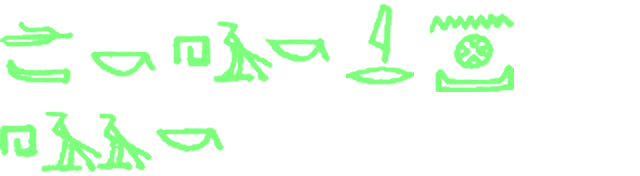
dbḥ =k hꜣi̯ =k jr nn,t hꜣꜣ =k
when you want to go down to the lower sky, you go down.
Note · Line 30
The lower sky is the counter-sky that arches beneath the earth, through which the sun and stars travel by night. - 31
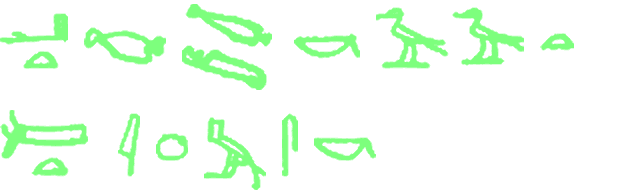
ꜥ,t.pl =k zꜣ,t.du (J)tm(,w) j:ḫm-sk
Your limbs are Atum's twin children, Imperishable One!
- 32

n ski̯ =k n ski̯ kꜣ =k
You shall not perish; your ka shall not perish.
Note · Line 32
The ka is a person’s life force, which lives on after death. “Perish” is the same verb hidden in the name “Imperishable One.” The spell ends by making the name come true. - 33

ṯwt kꜣ
You are the ka.