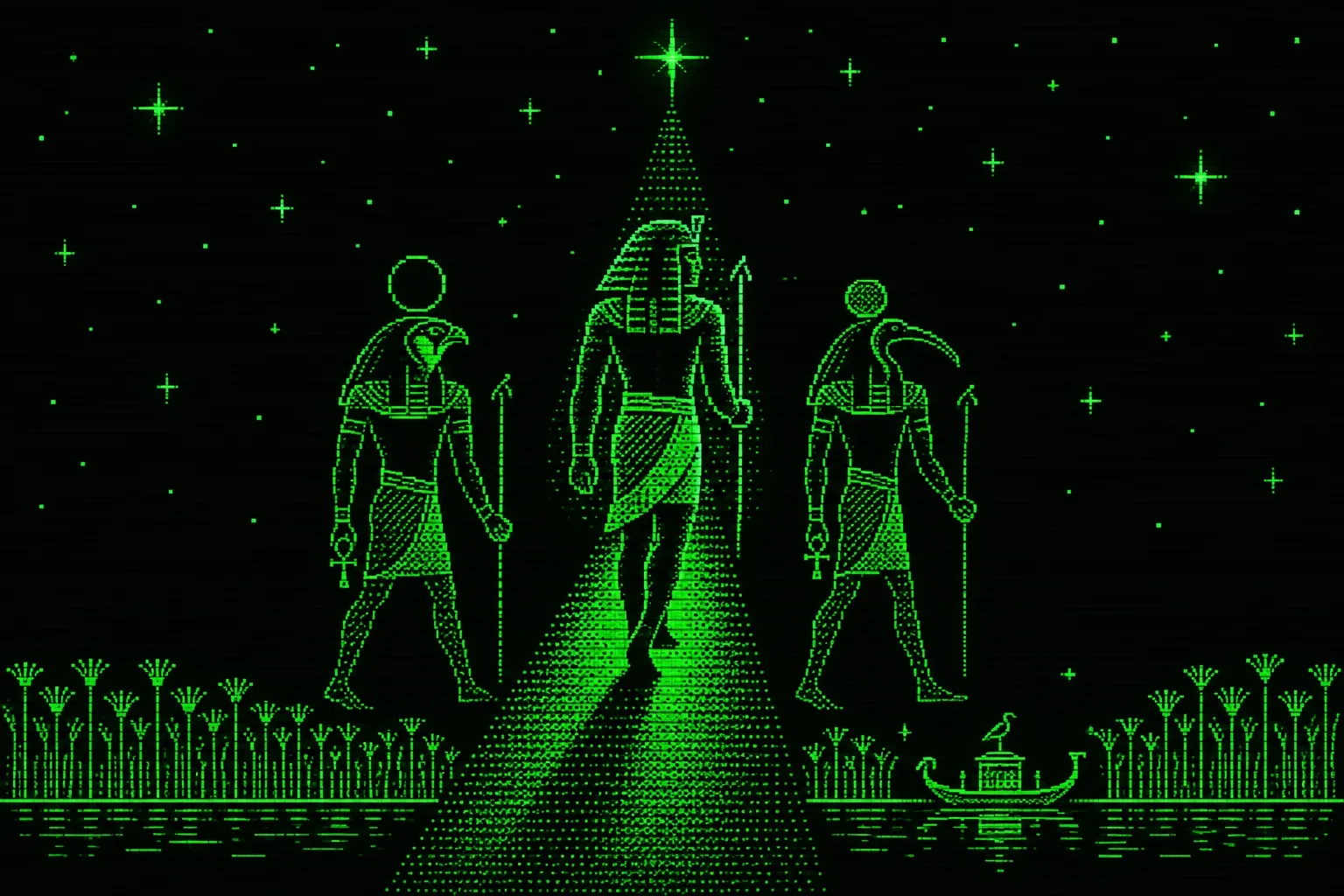
~/sacred-texts/pyramid-texts
Pyramid Texts Utterance 1044: Pepi I’s Road into the Sky
- Text
- Pyramid Texts, Utterance 1044
- Date
- Carved in the Sixth Dynasty, under Pepi I (c. 2321–2287 BC), on the walls of his pyramid at Saqqara
- Found
- Pyramid of Pepi I, South Saqqara
- Language
- Old Egyptian · Hieroglyphic
- 1
[...] [sḫ,t]-jꜣr,w r twr s(j) n nṯr.pl [...] ⸢r⸣ wpi̯[.t] [...] [_].y [zḫ]ni̯ =f nbḏ [...] wjꜣ pšr š(m)s,w.pl
… the Field of Reeds, to keep it set apart for the gods … to divide … when he seeks out the Evil One … the bark which the followers go around.
Note · Line 1
The Field of Reeds is a marshy paradise in the sky where the dead king hopes to live among the gods. - 2
wꜥb ⸢ḥw,t⸣ bꜥḥi̯ [...] m ḫsf,w nṯr wsr [...]
Pure is the House, in flood is … at the approach of the mighty god …
- 3
[...] sḫm.pl j.j jn Ḫnt(,j)-jr(,t)du
"… the Powers," says Khenti-irti.
Note · Line 3
Khenti-irti, “the one at the front of the two eyes,” is a form of Horus, a falcon god worshipped at Letopolis in the Delta. - 4
mj jr =k bꜣ.tj sḥtp =k sw sšmi̯ =k sw m [_] ḏsr.t
Come, then, mighty as a ba: content him,
and lead him through the holy …Note · Line 4
The ba is the aspect of a being that can move and act with power, especially after death. To be “ba-mighty” is to have that power fully. - 5
[...] n =k Ꜣs,t [...] [w]⸢r⸣.w sḫwy.n =k n =f ⸢k⸣[nz,t.pl] [...] [j]r(,j).w tꜣ
… to you, Isis … the Great Ones. You have defended the Kenzet lands for him … which belong to the earth.
Note · Line 5
The Kenzet lands are regions of the afterlife, apparently at the far edges of the sky. The king must be given safe passage through them. - 6
ḏd Ppy n =ṯn nṯr.pl mꜣꜣ =ṯn Ppy pn sḏm =ṯn mdw =f
Pepi speaks to you, gods:
see this Pepi, hear his words.Note · Line 6
Pepi is King Pepi I of the Sixth Dynasty, whose pyramid holds this spell. Here he addresses the gods directly. - 7
[...] [šn]j ⸢wpi̯⸣ nš[n,j]
… the cloud(?), he who parts the storm.
- 8
⸢wꜥb⸣ =ṯn Ppy ⸮n? Ḏḥw,tj ḥnꜥ Ḫnt(,j)-[jr(,t)du]
You purify Pepi for Thoth and Khenti-irti.
Note · Line 8
Thoth is the ibis-headed god of writing, reckoning and judgement. - 9
wsr Ppy pn r =sn
This Pepi is mightier than they.
- 10
šꜥ,t =f jri̯ =s wꜣ,t n Ppy pn m p,t smn =s n =[f] [...] ⸢ḫnt⸣ wr.w
His terror makes a road for this Pepi in the sky,
and establishes for him … at the head of the Great Ones.Note · Line 10
“His terror” is the dread the king inspires in others. That fear clears his path, so that no one blocks his way. - 11
sḫwi̯.y =sn n =f knz,t.⸢pl⸣ ḏd =〈sn〉 wsr.n Ppy [...]
They shall defend the Kenzet lands for him, saying: "Pepi has grown mighty …"
- 12
[...] ḫnt wr.w sḫwy.n n =k Ppy pn knz,t.pl j.n Ḏḥw,tj
"… at the head of the Great Ones: this Pepi has defended the Kenzet lands for you," says Thoth.
- 13
[...] [sḫw]y.n =ṯn [j.n] Ḫnt(,j)-jr(,t)du
"… you have defended," says Khenti-irti.
- 14
mꜣ Ppy [pn] [m] ⸢r⸣n =f pw n(,j) Ppy [...] [_]⸢m⸣r[_] [...] =⸢f⸣ jm =f n jm =f
See this Pepi in this his name of Pepi … within him, beside him.
Note · Line 14
For the Egyptians a name held the essence of its bearer. To be seen “in his name” is to be recognized for who he truly is. - 15
jy ḫsf jm =f
Come, go up to him!
- 16
mtr,w =n pw mꜣ[ꜥ]
He is our true witness.
Note · Line 16
The gods, or Thoth and Khenti-irti, accept the king as a trustworthy witness of their own number. This is a mark of his acceptance into their company. - 17
[...] Ppy pn m nbḏ,t [_]sj Ppy [m] mds,t n ski̯.[n] =[f]
… this Pepi from malice,
… Pepi from violence:
he cannot perish.Note · Line 17
The verbs that once governed this Pepi and Pepi are lost to damage in the inscription.