~/sacred-texts/pyramid-texts
Pyramid Texts Utterance 1025: The Sky Doors Open for Pepi I
- Text
- Pyramid Texts, Utterance 1025
- Date
- Carved in the 6th Dynasty, in the reign of Pepi I (c. 2321–2287 BC), on the south wall inside his pyramid at Saqqara
- Found
- Pyramid of Pepi I at South Saqqara, Egypt. The broken wall blocks remain at the site.
- Language
- Old Egyptian · Hieroglyphic
- 1
[ḏ(d)-mdw]
Recitation.
Note · Line 1
Spoken aloud over the spell. Here it rubric-marks a spell carved for Pepi I on the south wall of his pyramid. - 2
[pr]r Ppy pn pri̯ [...] [Ḥr,w]-⸢Šzm⸣,t(j) [...] [wꜥb] =⸢f⸣ ⸢m⸣ [sḫ,t]-jꜣr.w
When this Pepi goes forth, … goes forth …
Horus of Shezmet …
… and he purifies himself in the Field of Reeds.Note · Line 2
Horus of Shezmet is one of several forms of Horus who rise in the east with the dawn. - 3
[...] [wꜥb] =k m [sḫ,t]-⸢j⸣[ꜣ]r.w ⸢Ḥr,w⸣-⸢jꜣb⸣,t(j) ⸢pri̯⸣ wꜥb =k m sḫ,t-jꜣr.w ⸢Ḥr,w⸣-[Šzm,t(j)] [...] [pri̯] ⸢w⸣ꜥb =k m ⸢sḫ⸣,[t-jꜣr.w] [...] [sḫ,t-jꜣr.w]
… and purify yourself in the Field of Reeds.
Eastern Horus, go forth and purify yourself in the Field of Reeds!
Horus of Shezmet, …
… go forth and purify yourself in the Field of Reeds!
… the Field of Reeds.Note · Line 3
The Field of Reeds is a marshy region of the eastern sky. Sun, gods and the dead king wash there before the sunrise, and the washing makes them fit to enter the sky. - 4
wn ⸢ꜥꜣ.du⸣ [...] [Ḥr,w]-⸢jꜣb⸣,t(j) pri̯ =f r =f ⸢jr⸣ [p],⸢t⸣ [...] j⸢z⸣[n].⸢y⸣ ꜥꜣ.du [qbḥ(,w)] [n] Ḥr,w-šzm,t(j) pri̯ =⸢f⸣ ⸢j⸣[r] =[f] [jr] [p,t] [šz]⸢p⸣.[t] [ꜥ] =f jn ⸢Rꜥw⸣ wn ꜥꜣ.du p,t jz[n.y] [ꜥꜣ.du] [qbḥ(,w)] [n] Ḥr,w šꜣ,tj [...] [Ppy] pn pri̯ =f ⸢r⸣ =⸢f⸣ [j]r p,t šzp.t ꜥ =[f] [jn] [Rꜥw]
Thrown open are the two door-leaves … for Eastern Horus, so that he may go forth, up to the sky …
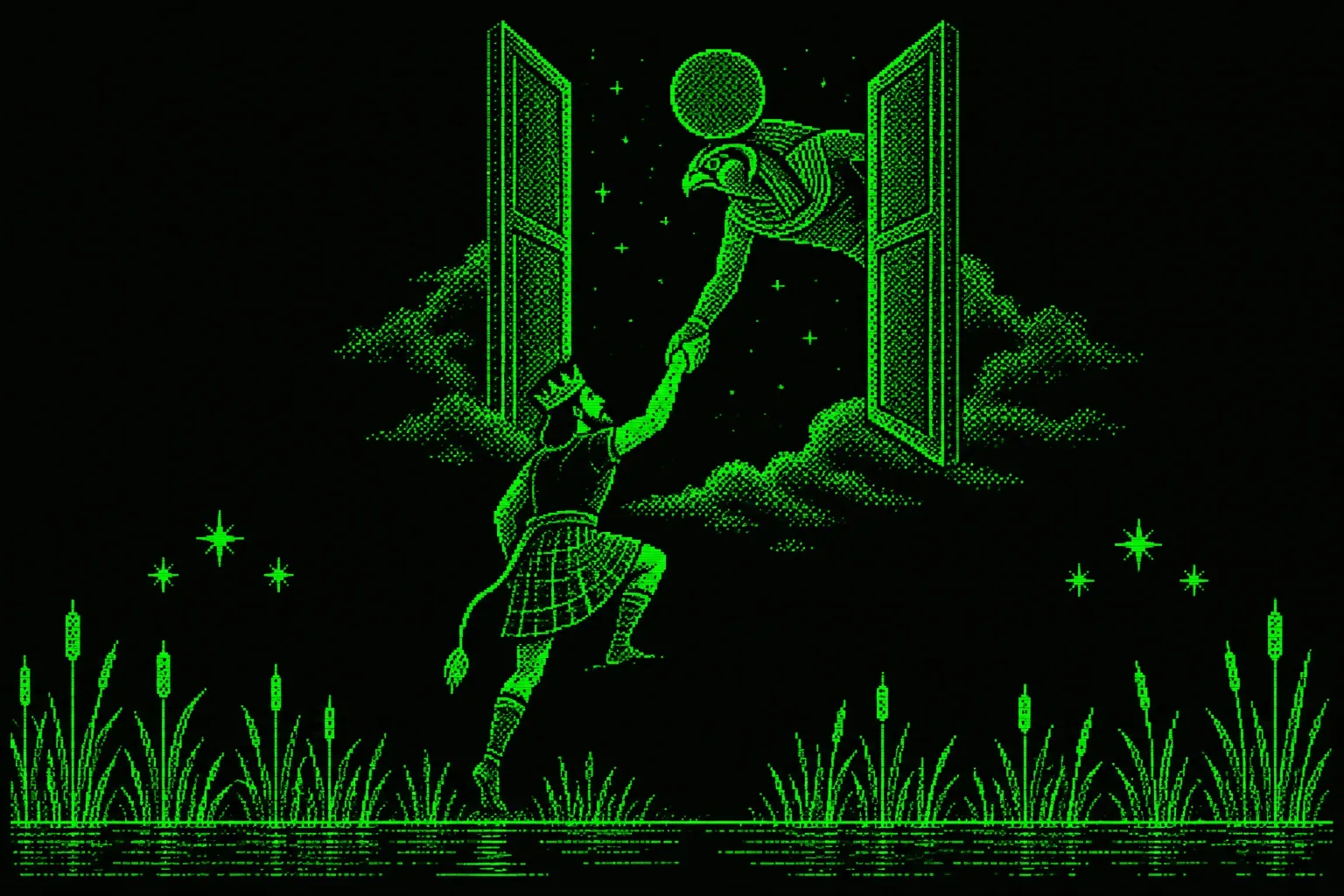
… drawn back are the two door-leaves of the cool waters for Horus of Shezmet, so that he may go forth, up to the sky, and his arm be grasped by Ra.
Thrown open are the two door-leaves of the sky, drawn back are the two door-leaves of the cool waters for Horus of Shat …
… for this Pepi, so that he may go forth, up to the sky, and his arm be grasped by Ra.Note · Line 4
The sky is imagined as having a great double door. - 5
[...] [Ppy] pn ⸢ꜥḥꜥ⸣ [...]
… this Pepi stands …
- 6
[...] ⸢_⸣ḏḏ ẖ,t mʾw,t =f Nw,t [...] [jrṯ,t] [ḥʾm],t.du km.[t(j)] [mn]⸢ꜥ⸣,t.du Bꜣ,w-Jwn,w ḫn(m),⸢t⸣t.[du] [...]
… the belly of his mother Nut … the milk of the two black cows, the two nurses of the Bas of Heliopolis, the two wet-nurses …
Note · Line 6
Nut is the sky goddess, mother of the king reborn as a star. The Bas of Heliopolis are the divine powers of the sun god’s holy city. Divine cows suckle the newborn king. - 7
[...] nn,t šdi̯.n =(j) ṯ[w]
… the lower sky. I have taken you.
Note · Line 7
The lower sky is the counter-sky beneath the earth, through which the sun passes at night. - 8
[...] n ⸢Ppy⸣ p[w] Šw
… of Pepi is Shu.
Note · Line 8
Shu is the god of air and light who holds up the sky, a fitting kinsman for a king rising heavenward. - 9
jmi̯ ꜥ =[k] [...]
Give your arm …
- 10
[...] ⸢Ppy⸣ ḥm[s]i̯ Ppy pn jr rmn Rꜥw m [...]
… Pepi, so that this Pepi may sit at the shoulder of Ra in …
- 11
[...] ꜥḏ
… safe and sound.
- 12
mdwi̯ tꜣ.pl jꜣ wr [j].n nṯr.pl
"The lands speak great praise," say the gods.
- 13
ꜥ [...] ṯ(ꜣ)z tp j.n Gbb
"… knit on the head," says Geb.
Note · Line 13
Geb, the earth god, is father of Osiris. Joining the head back to the body is a recurring act in these spells, rebuilding the dead king whole. - 14
ḏbꜣ.n sw Ppy pn m ḫb⸢z⸣,[t] [...]
This Pepi has decked himself with a tail …
Note · Line 14
Kings wore an animal’s tail hanging from the back of the kilt, a sign of royal and divine power. - 15
[...] [Jḫ,t-wt,t]
… Ikhet-utet.
Note · Line 15
Ikhet-utet is a divine serpent. - 16
wn [...] r [...] jꜣb,[t] [z].wy ⸢ꜥꜣ⸣ n(,j) Nḫn
Opened … to … the east … the two bolts of the door of Nekhen.
Note · Line 16
Nekhen (Hierakonpolis) is the ancient city of Horus in Upper Egypt. Its gate stands here for the gate of the sky. - 17
⸢jw⸣ [...] [j]⸢w⸣i̯ Jḫm.w-sk [m] [ks,w] [...]
… the Imperishable Stars come bowing low …
Note · Line 17
The Imperishable Stars are the stars near the celestial pole that never sink below the horizon. The Egyptians saw them as the deathless company the dead king hoped to join in the northern sky. - 18
[...] ⸢m⸣ ḥw,t.pl mn.j
… in the estates of the Enduring One.
- 19
di̯ mdw ⸢Ḏḥw,tj⸣ [...]
The word of Thoth has been laid down …
Note · Line 19
Thoth, god of writing and reckoning, often speaks with authority on the king’s behalf in these spells. His “word” here may be a decree or a judgement in Pepi’s favour. - 20
[...] ⸢Ppy⸣ pn [...]
… this Pepi …
Note · Line 20
Pepi is the king for whose pyramid these spells were carved on the burial chamber walls. Throughout, the text calls him “this Pepi” in the third person. - 21
[...] [Ppy] pn
… this Pepi.
- 22
mꜣ Ppy pn [...]
This Pepi shall see …
- 23
[...] [wj]⸢ꜣ⸣ pf n(,j) sk [...] tm tm ⸢ḫpr⸣ [...]
… that bark of Sek … not … come into being …
- 24
[...] n =k ꜥ [n(,j)] [ꜣḫ] [pn] [ꜥ] n(,j) Ppy pn
… for you the arm of this akh, the arm of this Pepi.
Note · Line 24
An akh is the dead person transformed into a radiant, effective spirit, the goal of the whole ritual. The spell equates the arm of this akh with the arm of the king himself.