~/sacred-texts/new-kingdom-royal-hymns
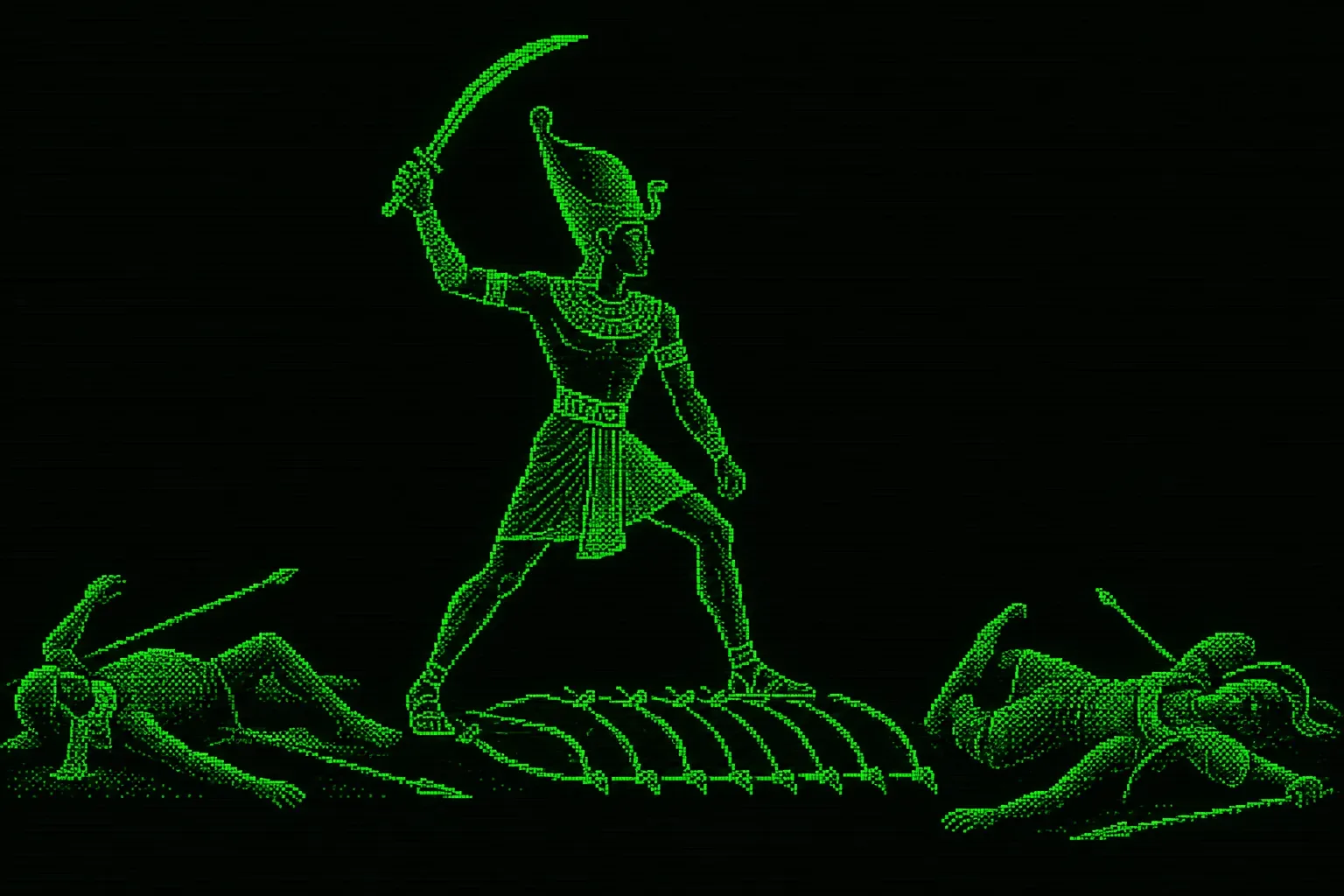
Praise of Ramesses II: A Warrior King Slaughtering Libya
- Date
- New Kingdom, 19th Dynasty (reign of Ramesses II, c. 1279–1213 BC)
- Language
- Ancient Egyptian · Hieratic
- 1
[...] nṯr-nfr 〈ꜥꜣ〉 pḥ,tj mj Mntjw jty wr nḫt.pl
… The perfect god, great in strength like Montu,
the ruler rich in victories;Note · Line 1
Montu was a god of war. The king is praised here as a god in his own right. - 2
_ [n]tr,j pri̯ m Rꜥ 〈mst,jw〉 n(,j) Kꜣ-Jwn,w
the divine child sprung from Ra,
offspring of the Bull of Heliopolis;Note · Line 2
Heliopolis was a center of sun worship, where a sacred bull was honored as a living form of the sun god. - 3
ꜥḥꜥ ḥr pw~gꜣ kꜥf.w ḥr ḫpš =f mj ꜥꜣ-pḥ,tj m wjꜣ-n(,j)-ḥḥ.pl
who stands on the field of battle
and takes spoil with his sword arm,
like Great in Strength aboard the Barque of Millions;Note · Line 3
The one called Great in Strength is Seth, who defends the sun god’s boat against the serpent that threatens its passage. He is also the Son of Nut named below. - 4
nsw 〈m〉 sḥw,t mj ḥm n(,j) Ḥr,w jṯi̯.n =f tꜣ.pl m nḫt.pl =f wꜥwf =((f)) tꜣ.du m sḫr.w =f
a king in the egg, like the majesty of Horus.
By his victories he has seized the lands;
by his designs he subdues the Two Lands.Note · Line 4
Horus embodies kingship: Ramesses is king even before he hatches. The Two Lands are Upper and Lower Egypt. - 5
pḏ,t-9.pl ḫnd.w [...] ḫnd.w ẖrj rd.du =f
The Nine Bows lie trampled …
trampled beneath his two feet.Note · Line 5
The Nine Bows stand for Egypt’s traditional enemies. Their images were often placed on royal footstools and sandal soles, beneath the king’s feet. - 6
ḫꜣs,t nb(.t) stꜣ(.tj) n =f ẖrj jn,w.pl =sn
The foreign lands are all led before him, laden with their tribute.
- 7
ḏḏ n =f tꜣ.pl nb.w.pl ḥr mtn wꜥ nn rq,y.pl =f
All lands have been set on a single road for him;
he has no foes. - 8
wr.w.pl n.w tꜣ{=w}〈.pl〉 bšt.pl gꜣnn
The princes of the rebel lands have grown weak;
- 9
st ḫpr.w m jꜣ⸢d⸣,t n ḥr,yṱ =f
for fear of him they have become a herd.
- 10
sw (ḥr) ꜥq m-ẖnw =sn mj zꜣ-Nw,t
He goes in among them like the Son of Nut;
- 11
ḥdb.w =sn n hꜣ~hꜣ =f m km-(n,j)-jꜣ,t
in an instant they fall before his burning breath.
- 12
Rʾ~bw ḫr〈.ṱ〉 n šꜥw〈.t〉 =〈f〉 ḫr.ṱ n dm.w =f
Libya has fallen to his slaughter,
fallen to his sword. - 13
ḏi̯ ={f} =〈tw〉 n =f ḫpš{,t} =f r-(n)ḥḥ-ḏ,t jn[q] bꜣ,w =f ḏw.w.pl Rꜥ-msi̯-sw-mri̯-Jmn (ꜥnḫ-wḏꜣ)-s(nb) nb ḫpš mki̯ mšꜥ =f
May the strength of his arm be granted him for ever and ever,
that his might may encompass the mountains:
Ramesses, beloved of Amun—may he live, prosper and be healthy!—
lord of the strong arm, who shields his army. - 14
grḥ [...]
End. …