~/sacred-texts/late-egyptian-miscellanies-papyrus-anastasi-ii
Praise of Merenptah: A Chariot Laden with Severed Hands
- Date
- Copied in the 19th Dynasty (c. 1213–1203 BC), during the reign of Pharaoh Merenptah, on Papyrus Anastasi II
- Found
- Findspot in Egypt unrecorded; now in the British Museum, London (EA 10243)
- Language
- Late Egyptian · Hieratic
- 1
[...] nṯr-nfr ꜥnḫ m Mꜣꜥ,t jty mri̯.y nṯr.pl
… the perfect god who lives by Maat, the sovereign beloved of the gods,
Note · Line 1
Maat is both the right order of the world and the goddess who embodies it. - 2
sḥw,t jqr.t zꜣ Ḫprj 〈mstjw〉 n(,j) Kꜣ-Jwnw
the splendid egg, son of Khepri, scion of the Bull of Heliopolis,
Note · Line 2
The egg is the king himself, still unhatched. Khepri is the sun god in his morning form, the scarab. - 3
pꜣ bjwk ꜥq m pꜣ mnš msi̯.y ꜣs,t Ḥr,w
the falcon who has entered the cartouche, Horus born of Isis,
Note · Line 3
The cartouche is the oval that encloses a royal name. The falcon Horus entering it is the king taking the throne. - 4
Bꜣ-n-Rꜥ (ꜥnḫ-wḏꜣ)-s(nb) ḫꜥi̯ [m] Km,t pꜣ tꜣ hꜣi̯.w r s,ṱ =f
Baenre—may he live, prosper and be well—who has risen in Egypt: the land has settled into its place.
Note · Line 4
Baenre is Merenptah’s throne name. His rising evokes the sunrise. - 5
tjnrw.wsj Bꜣ-n-Rꜥ ꜥnḫ-(w)ḏꜣ-s(nb)
How mighty is Baenre—may he live, prosper and be well!
- 6
spd.w[sj] sḫr.w.pl =f
How keen his plans!
- 7
j:ḏd.t =f mnḫ mj Ḏḥw,tj
What he says is sound, like the words of Thoth.
Note · Line 7
Thoth is the god of writing and wisdom. - 8
j:jri̯.t =f nb ḫpr.w
All he does comes to pass.
- 9
[s]w mj sšm,w wꜣ,t r-ḥꜣ,t pꜣy =f mšꜥ
He is like a guide leading the way at the head of his army;
- 10
mdw,t =[f] [n] =sn m sbtj
his word to them is a wall.
- 11
mr{w,t}〈i̯〉.wsj pꜣ hꜣn n =f ꜣ,tj =f n Mri̯.y-Jmn ꜥnḫ-(w)ḏꜣ-s(nb)
How dear to Meryamun—may he live, prosper and be well—is the man who bows his back to him!
Note · Line 11
Meryamun, “beloved of Amun,” is another name for the king. - 12
mšꜥ nḫt jwi̯.t {ḥbn}〈ḥb.n〉 =f m nḫt ḥr wsr
The victorious army has come home after his triumph by strength and might.
- 13
ḫꜣꜥ =sn ḫ,t r ((Js~dj))~rk~tjw
They set fire to Isderektiu;
- 14
ḏꜣf =sn Mꜥ~jrʾ~y~nꜣ
they burned Maryna.
- 15
nꜣ Šꜣ~rʾ~dꜣ~nꜣ jni̯.w =k ḥr ḫpš =k ḥꜣq =sn mꜥ~hj(,t) ḫꜣs,t.pl
The Sherden whom you brought by the strength of your arm have carried off the clans of foreign lands.
Note · Line 15
The poet now addresses the king directly. The Sherden were foreign warriors who served in the Egyptian army. - 16
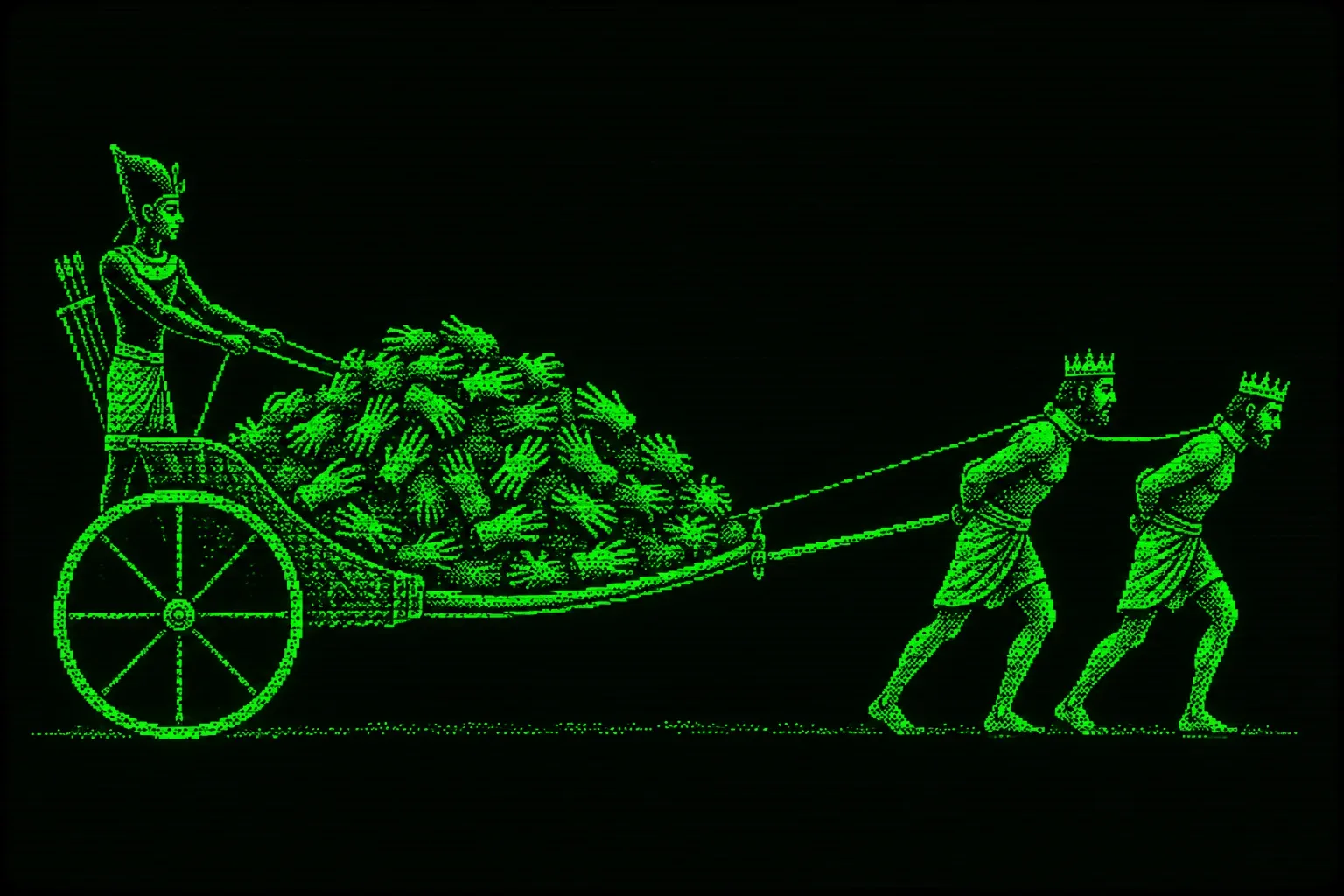
nḏm.wsj pꜣy =k šm r Wꜣs,t {{nḫt.tj}} jw tꜣy =k wr~rʾ~y,t hꜣnn.tj m ḏr,t.pl
How sweet your journey to Thebes, your chariot bowed under the weight of hands!
Note · Line 16
Soldiers cut hands from the enemy dead and brought them back to be counted. - 17
wr.w.pl dnḥ{t} r-ḥꜣ,ṱ =k jw =k r mz =w n jt =k šps,j Jmn Kꜣ-mw,t≡f
The princes are pinioned before you; you will present them to your august father, Amun, Bull of His Mother.
Note · Line 17
The captives are held like birds caught by the wings. “Bull of His Mother” names Amun as the god who begets himself. - 18
grḥ [...]
The end. …