~/sacred-texts/philae-birth-house-mammisi-inscriptions
Tiberius in the Philae Birth House: Semen on the Potter’s Wheel
- Date
- Carved under Ptolemy VI and Ptolemy VIII (180–116 BC) and under the emperor Tiberius (AD 14–37) on the walls of the birth house of the Isis temple at Philae
- Found
- Birth house of the temple of Isis, Philae, south of Aswan; the temple was moved stone by stone to Agilkia island in 1972–1980 and stands there today.
- Language
- Egyptian · Hieroglyphic
Three kings share these walls. Ptolemy VI signs the friezes. Ptolemy VIII brings food, myrrh, wine, a water jar and fields, and his queen Cleopatra urges him on: My beloved brother, set your heart on Isis. The gods pay him in water: I give you the Nile flood, high in its season.
Then Tiberius, pharaoh under the name Autokrator, burns incense for Osiris, hands Thoth the scribe’s palette, gives Amun Maat, your throat, which never leaves you, and holds two mirrors up to Isis. To Khnum he sings: Hail to you, god who shapes semen into an embryo on his potter’s wheel. Khnum answers: I give you your heart, firm in its place.
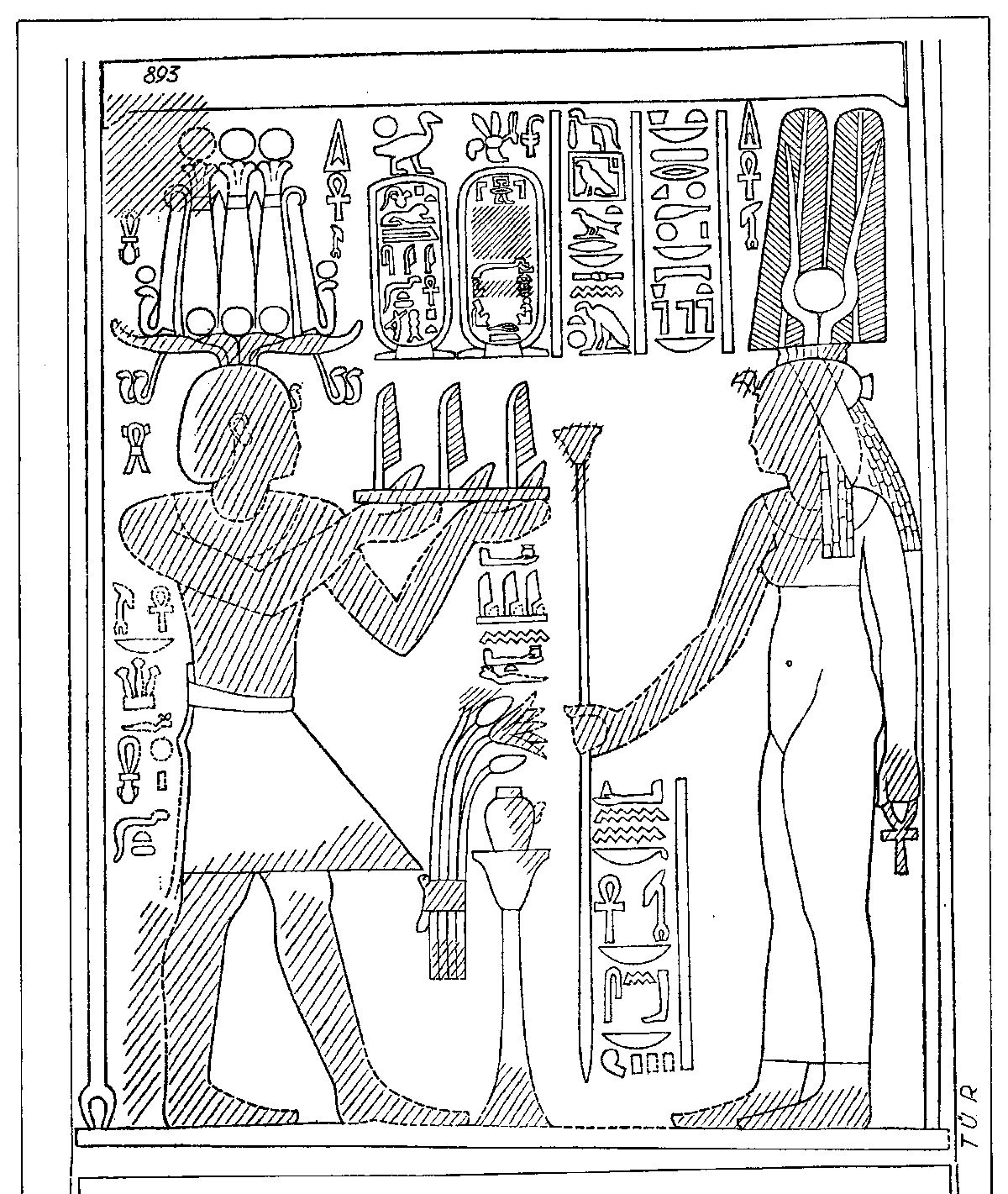
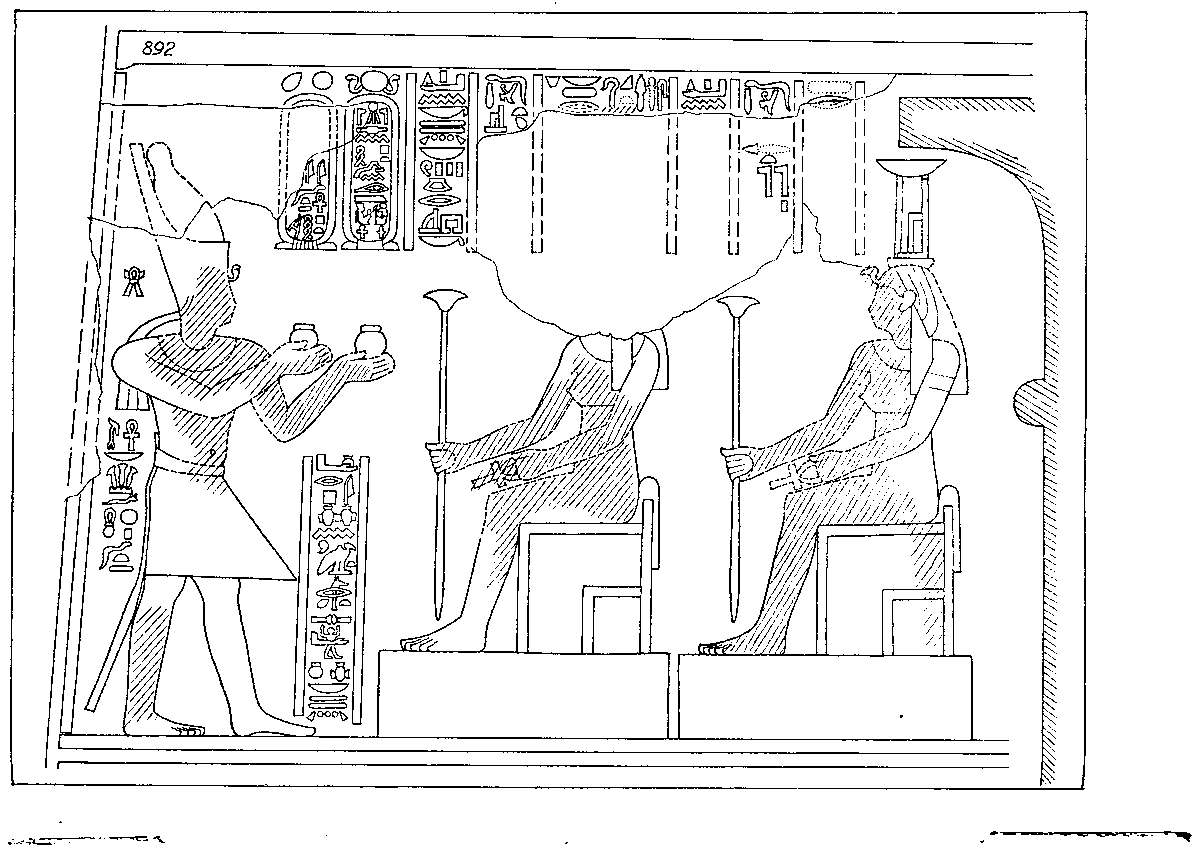
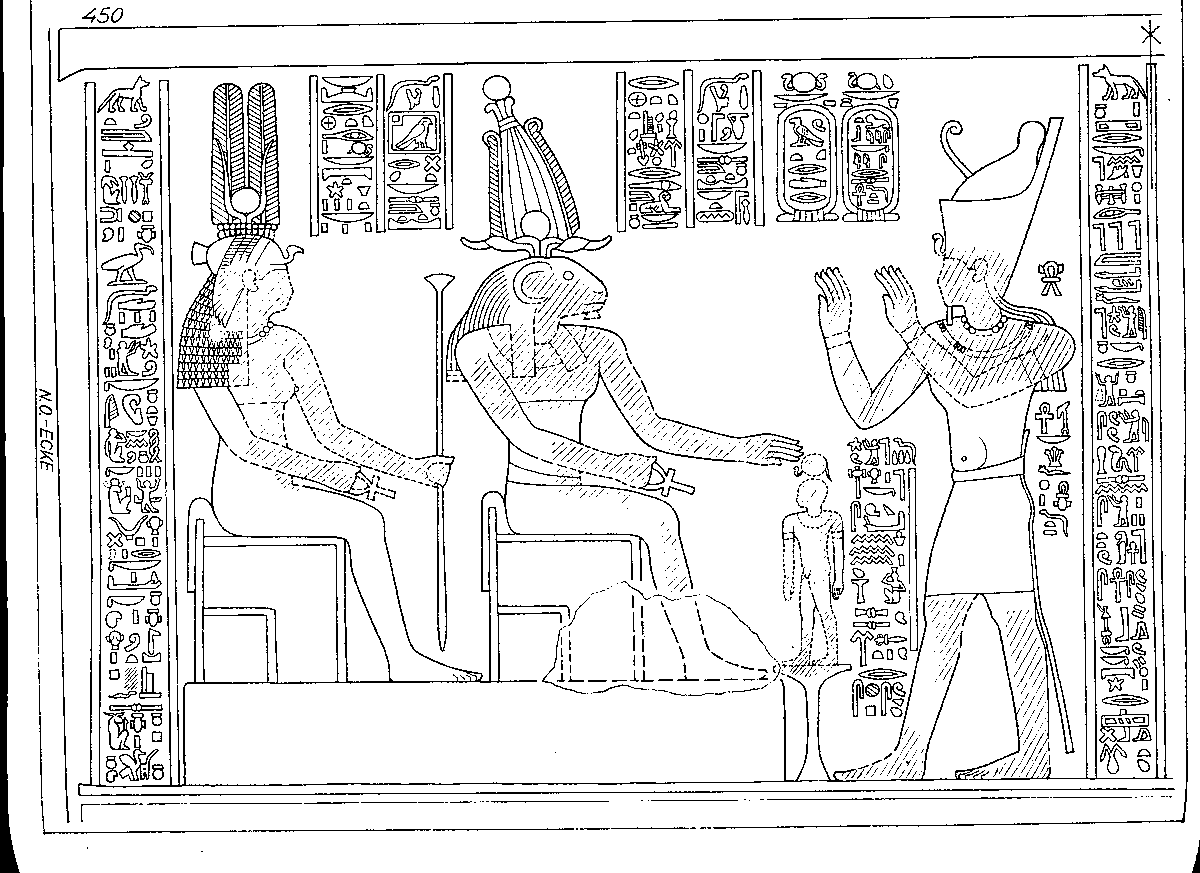
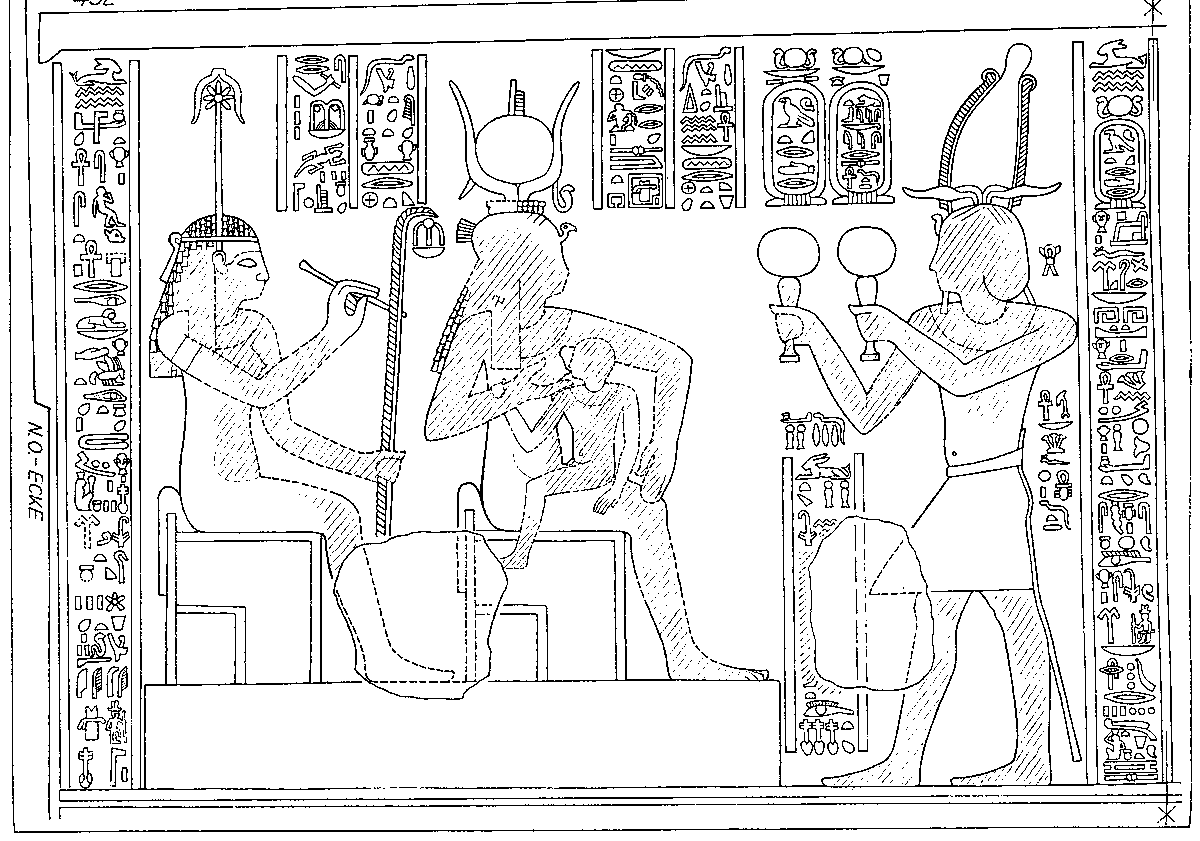
The king and Hapy bring the flood water to Isis
Page 161. The scene as drawn on the wall, facing p. 161 of the edition. Drawing by Otto Baum, in Junker and Winter, Das Geburtshaus des Tempels der Isis in Philä (1965)The hatched figures were hacked off the wall on purpose. After Justinian closed the temple of Isis around 537, Christians made it a church and chiselled out the gods and kings, mostly sparing the hieroglyphs. - 1p. 161, l. 10
njswt bjt … sꜣ Rꜥ …
King of Upper and Lower Egypt …, Son of Ra …
Note · Line 1
The cartouches, the ovals that would normally enclose the king’s names, were left blank here. - 2p. 161, l. 11
ḏd mdw n Ḥꜥpj ḫr Js.t
Hapy speaks to Isis:
Note · Line 2
Hapy is the Nile flood in divine form. - 3p. 161, l. 12
jnj-j (n-ṯ) … prj m ḳrr.t
I bring you … that flows from the cavern.
Note · Line 3
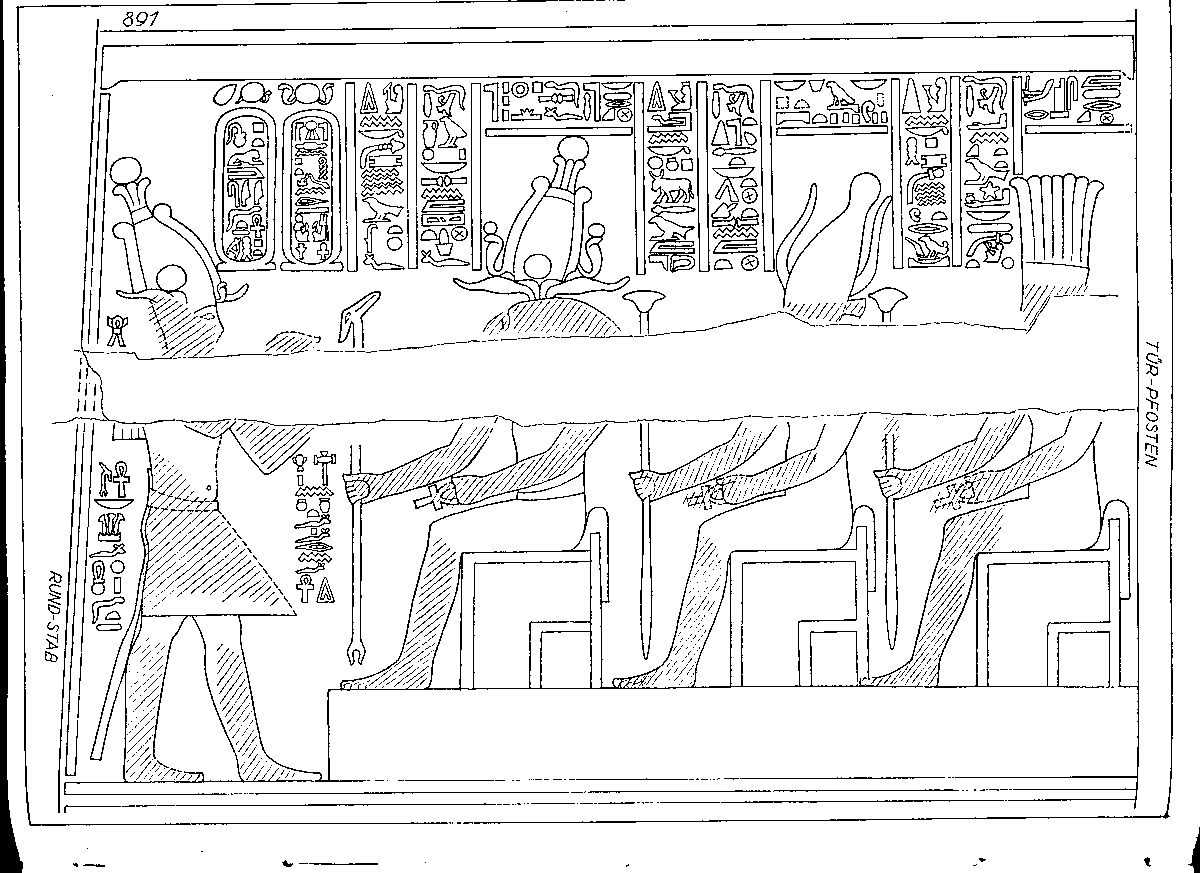
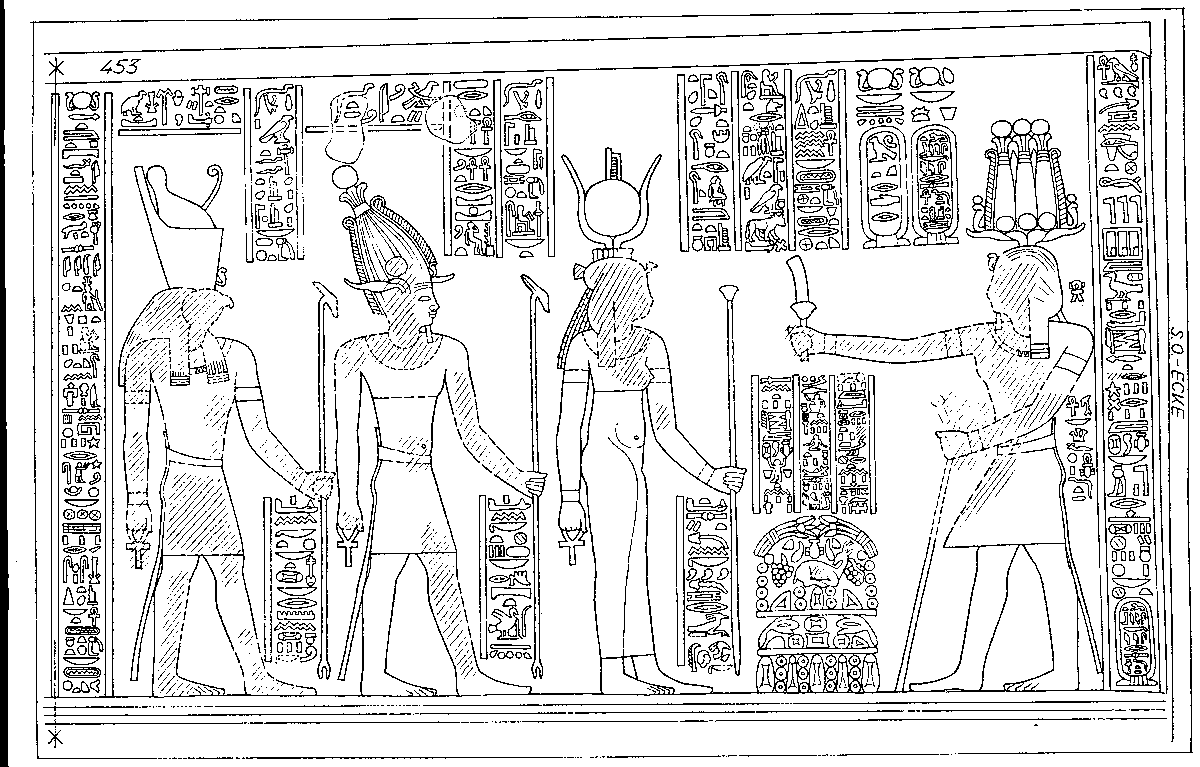
The Nile flood was believed to rise from an underground cavern. North wall, east part: upper frieze inscription of Ptolemy VI and Cleopatra
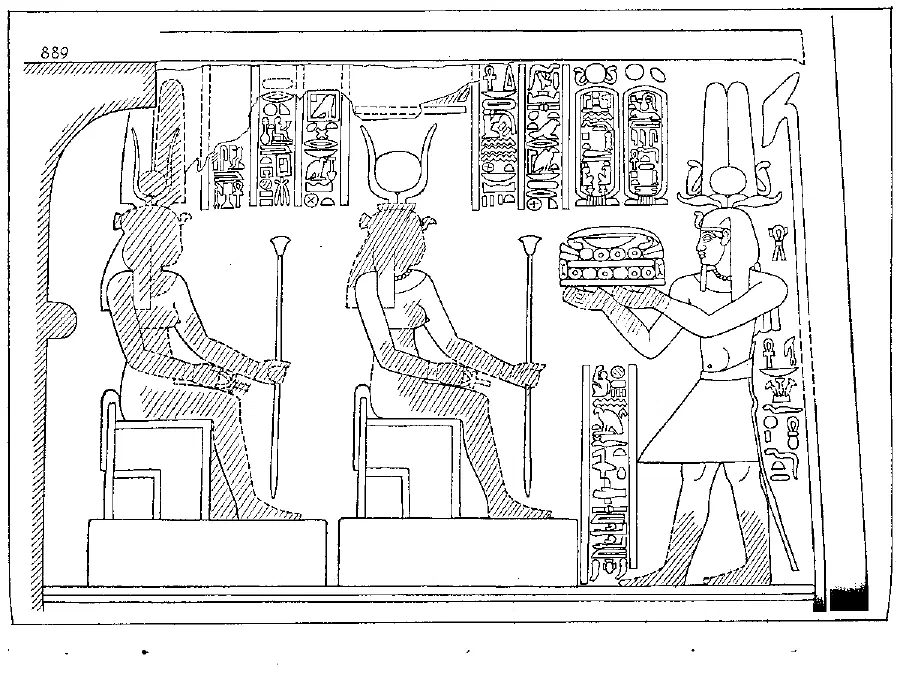
Page 163. The scene as drawn on the wall, facing p. 163 of the edition. Drawing by Otto Baum, in Junker and Winter, Das Geburtshaus des Tempels der Isis in Philä (1965) - 4p. 163, l. 1
bjk n nb wr pḥtj
Golden Horus, great in strength,
Note · Line 4
Golden Horus is one of the king’s five traditional titles. - 5p. 163, l. 2
nb ḥb.w-sd mj jt-f Ptḥ Tnn jt nṯr.w
lord of jubilees like his father Ptah-Tatenen, father of the gods,
Note · Line 5
At the royal jubilee, or Sed festival, the king ritually renewed his power to rule. - 6p. 163, l. 3
jtj mj Rꜥ
sovereign like Ra,
- 7p. 163, l. 4
sꜣ Rꜥ Pt …
Son of Ra, Ptolemy …
Note · Line 7
The king here is Ptolemy VI. - 8p. 163, l. 5
ḥnꜥ sn.t-f ḥm.t-f ḥḳꜣ.t nb(.t) tꜣ.wj
with his sister and wife, the ruler, lady of the Two Lands,
- 9p. 163, l. 6
Krwꜣpdrꜣ.t nṯr.w mrj mw.tj
Cleopatra, the Mother-loving Gods.
Note · Line 9
The title names Ptolemy VI and Cleopatra II together and honors their mother, Cleopatra I. - 10p. 163, l. 7
jrj-n-f mnw-f n mw.t-f Jś.t (nb.t) prj-mśj(.t)
He made his monument for his mother Isis, lady of the birth house.
Note · Line 10
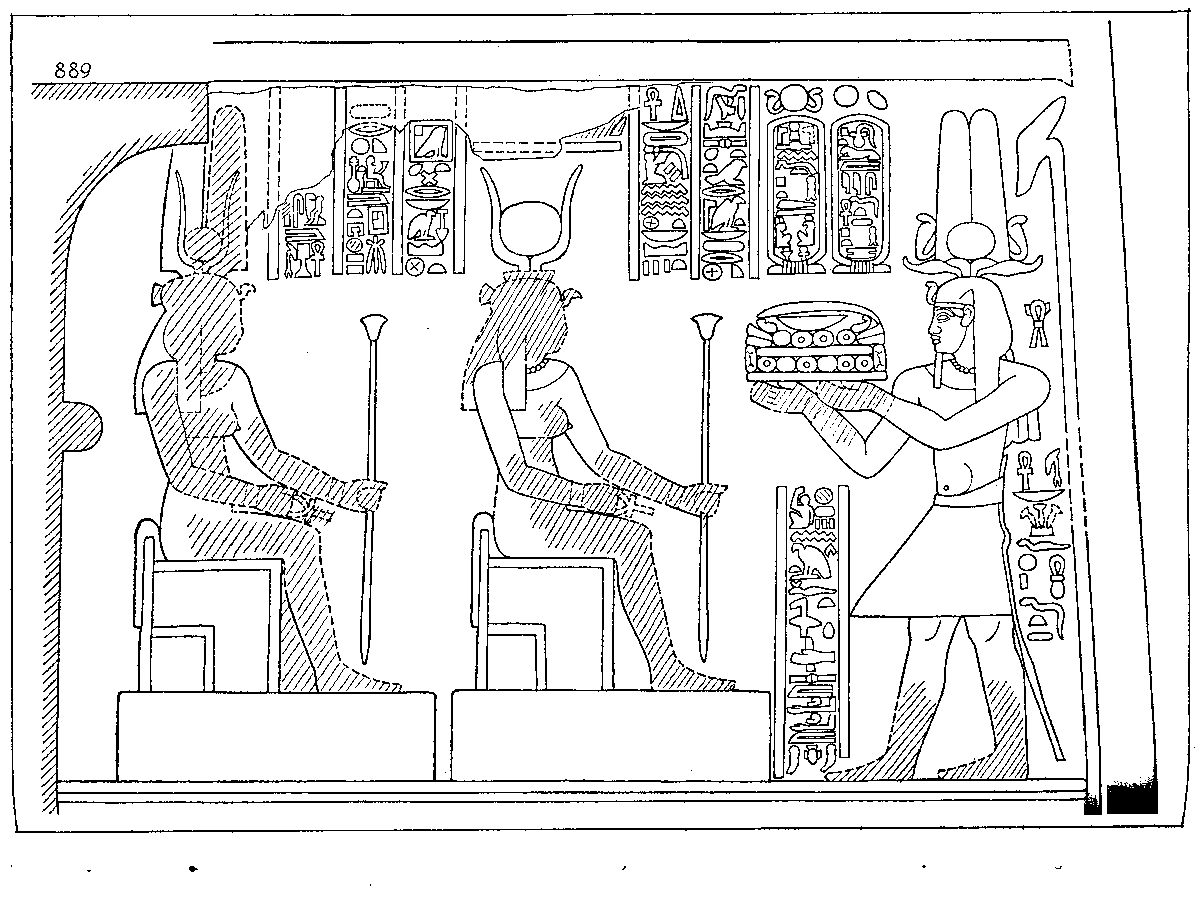
The birth of Horus, the son of Isis, was celebrated in the birth house. Ptolemy VIII gives Isis food
- 11p. 163, l. 8
fꜣj(.t) jḫ.t n mw.t-f Wśr.t
Bearing food to his mother Wosret:
- 12p. 163, l. 9
šsp śj m ꜥ.wj(-j) m nḏm jb
Receive it from my two hands with a glad heart.
- 13p. 163, l. 10
njśwt bjt jwꜥw …
King of Upper and Lower Egypt, heir of …
- 14p. 163, l. 11
sꜣ Rꜥ Pt …
Son of Ra, Ptolemy …
Note · Line 14
The king in this and the following offering scene is Ptolemy VIII. - 15p. 163, l. 12
sꜣ ꜥnḫ wꜣś nb ḥꜣ-f mj Rꜥ ḏ.t
May all protection, life and dominion surround him as they surround Ra, forever.
- 16p. 163, l. 13
ḏd mdw n | Jś.t wr.t mw.t nṯr nb(.t) Jrk
Words spoken by Isis the Great, mother of the god, lady of Philae,
- 17p. 163, l. 14
dj(.t) ꜥnḫ nb(.t) jꜣ.t wꜥb.t nb(.t) ḫꜣś.wt (rśj.wt) …
giver of life, lady of the Abaton, lady of the southern foreign lands …
Note · Line 17
The Abaton was the sacred burial place of Osiris on Bigeh, the island beside Philae. Its Greek name means “place not to be entered.” - 18p. 163, l. 15
… Ḥw.t-Ḥrw wr.t nb(.t) Snm.t
… Hathor the Great, lady of Bigeh,
- 19p. 163, l. 16
… Jrk šps.t nfr.t m ḥw.t msḫn
… of Philae, the noble one, the beautiful one in the birth house,
- 20p. 163, l. 17
… rr(?) św .?. m ꜥnḫ ḏd wꜣś
… nourishing him … with life, stability and dominion.
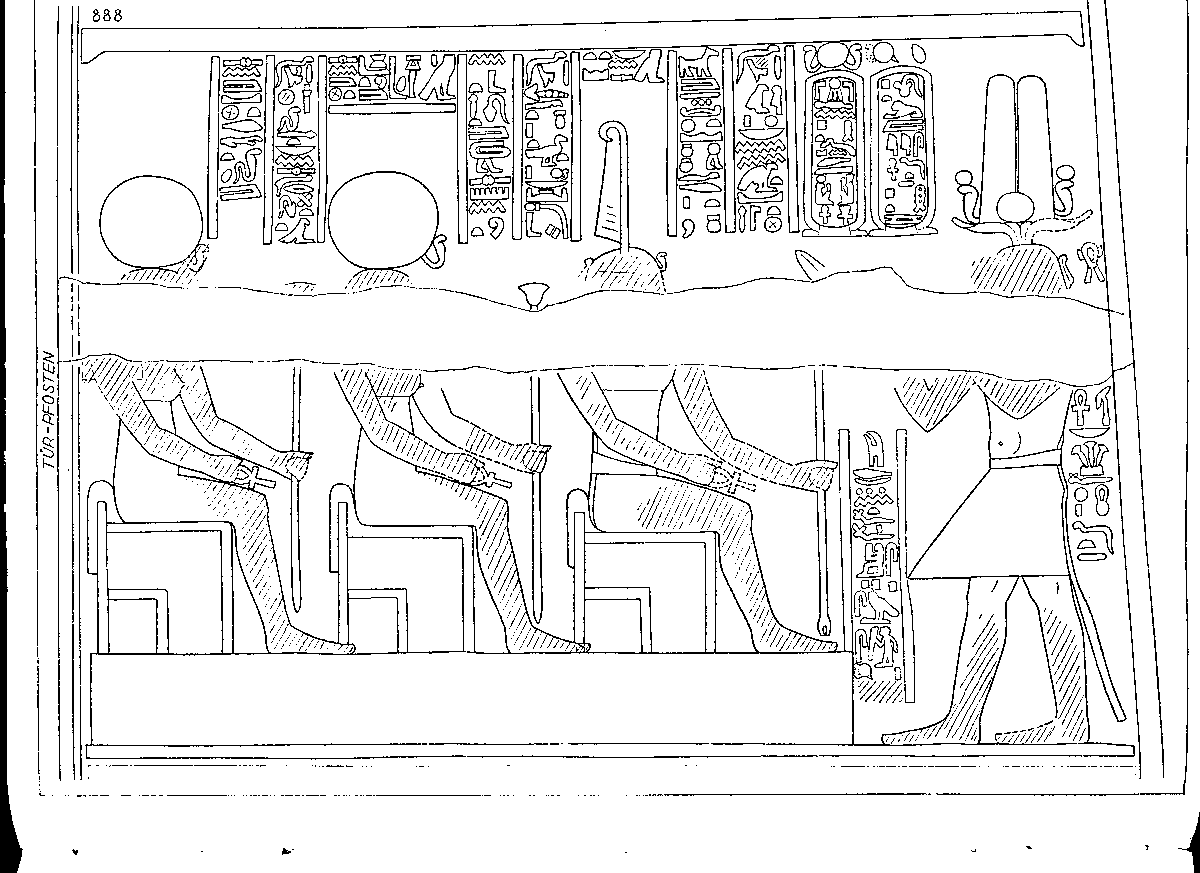
Ptolemy VIII gives Shu myrrh
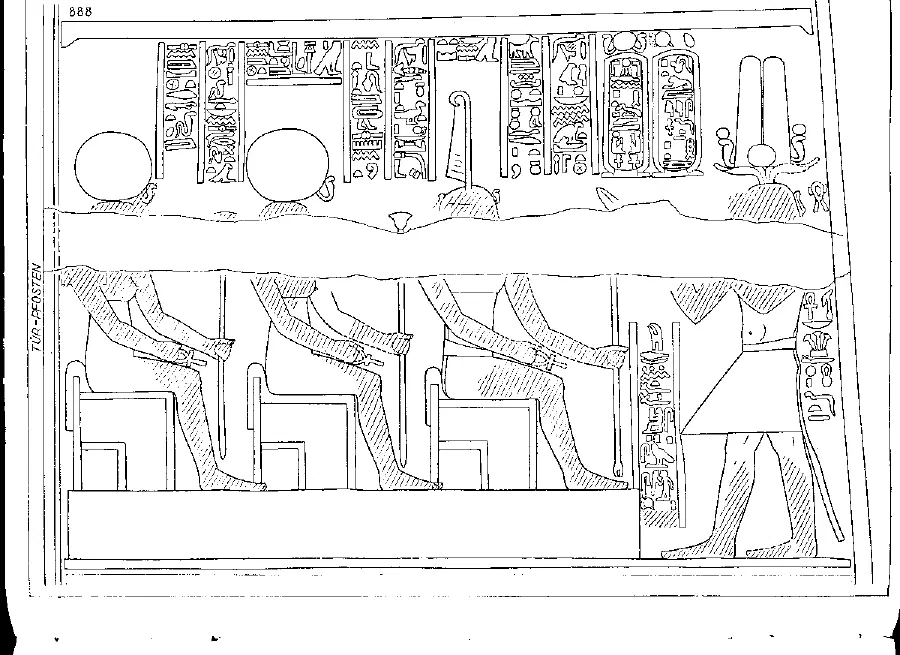
Page 165. The scene as drawn on the wall, facing p. 165 of the edition. Drawing by Otto Baum, in Junker and Winter, Das Geburtshaus des Tempels der Isis in Philä (1965) - 21p. 165, l. 1
šms ꜥntjw n jt-f špsj
Presenting myrrh to his august father,
- 22p. 165, l. 2
šmsw Rꜥ …
Ra’s firstborn …
- 23p. 165, l. 3
njswt bjt jwꜥw …
King of Upper and Lower Egypt, heir of …
- 24p. 165, l. 4
sꜣ Rꜥ Pt …
Son of Ra, Ptolemy …
- 25p. 165, l. 5
sꜣ ꜥnḫ wꜣs nb ḥꜣ-f mj Rꜥ ḏ.t
May all protection, life and dominion surround him as they surround Ra, forever.
- 26p. 165, l. 6
ḏd mdw n | Šw (sꜣ) Rꜥ nb Snm.t
Words spoken by Shu, son of Ra, lord of Bigeh,
- 27p. 165, l. 7
nṯr ꜥꜣ jj m Tꜣ-stj
the great god who came from Nubia:
- 28p. 165, l. 8
jnj-n-f jr.t (Rꜥ) n-f m Kns.t
he brought Ra his Eye from Kenset.
Note · Line 28
The Eye is Ra’s daughter Tefnut. Shu brought her home from Kenset, a region in Nubia. - 29p. 165, l. 9
ḏd mdw n | Tfn.t sꜣ.t Rꜥ
Words spoken by Tefnut, daughter of Ra,
- 30p. 165, l. 10
nb(.t) jꜣ.t wꜥb.t nbj.t ꜥꜣ.t m pḥr-s
lady of the Abaton, with the great flame all around her.
- 31p. 165, l. 11
mn.tj m ꜣbw ḫꜥj.tj m Snm.t
who abides on Elephantine and shines forth on Bigeh.
Note · Line 31
Elephantine and Bigeh are islands in the Nile near Aswan. - 32p. 165, l. 12
ḏd mdw n | Sḫm.t ꜥꜣ.t nb(.t) nsr.t
Words spoken by Sekhmet the Great, lady of the flame,
- 33p. 165, l. 13
tꜣ Snm.t(?) jrj.t jḫ.t(?) m …
she of Bigeh, who performs the rites in …
Ptolemy VIII gives Isis a field
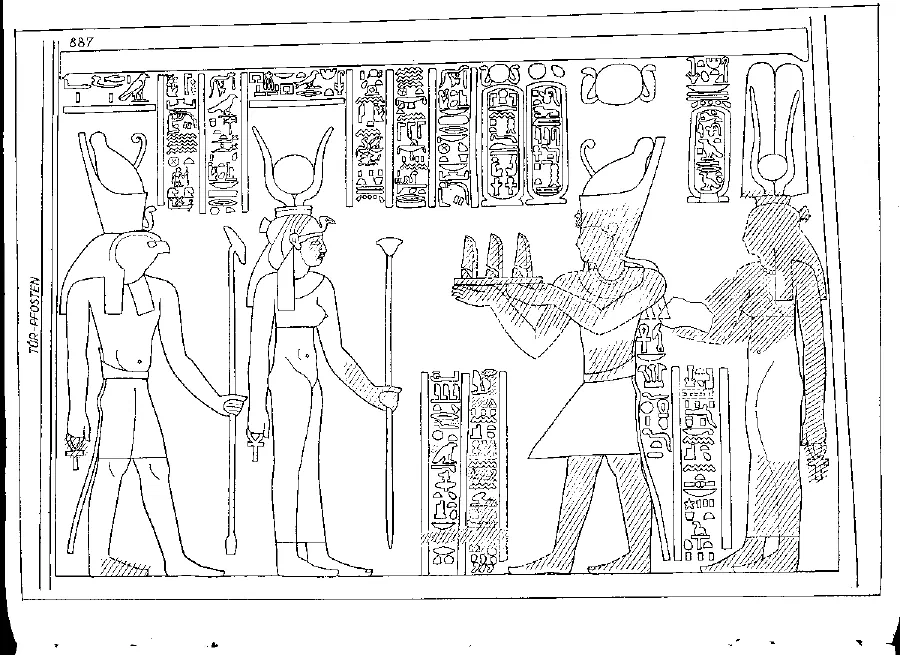
Page 167. The scene as drawn on the wall, facing p. 167 of the edition. Drawing by Otto Baum, in Junker and Winter, Das Geburtshaus des Tempels der Isis in Philä (1965) - 34p. 167, l. 1
ḥnk sḫ.t r ḫft mw.t-f Wsr.t
Presenting a field before his mother Wosret,
Note · Line 34
Wosret means “the Mighty One.” Here it is a name for Isis, the king’s divine mother. - 35p. 167, l. 2
Js.t nb(.t) Jrk jtrw(?) (12?) n Js.t …
Isis, lady of Philae: twelve schoeni for Isis …
Note · Line 35
A schoenus was a measure of distance. The stretch of Nubia south of Philae whose revenues supported the temple was known as the Land of the Twelve Schoeni. - 36p. 167, l. 3
… (Šwnw?) … Tꜣkms.t
… Aswan … Takompso.
- 37p. 167, l. 4
njswt bjt jwꜥw …
King of Upper and Lower Egypt, heir …
Note · Line 37
The king is Ptolemy VIII. His title names him heir to the Manifest Gods, his parents Ptolemy V and Cleopatra I. - 38p. 167, l. 5
sꜣ Rꜥ Pt…
Son of Ra, Ptolemy …
- 39p. 167, l. 6
ꜥnḫ wꜣs nb ḥꜣ-f mj Rꜥ ḏ.t
May all life and dominion surround him as they surround Ra forever.
- 40p. 167, l. 7
ḥm.t njswt ḥḳꜣ(.t) nb(.t) tꜣ.wj Krjwꜣpꜣdrꜣ.t
King’s wife, ruler, lady of the Two Lands, Cleopatra.
Note · Line 40
The queen is Cleopatra III. The Two Lands are Upper and Lower Egypt. - 41p. 167, l. 8
sn-j mrj mḥ jb-k n Js.t
My beloved brother, set your heart on Isis.
Note · Line 41
“Brother” is the language of royal marriage here: Cleopatra III was Ptolemy VIII’s niece and wife. - 42p. 167, l. 9
nts nb(.t) nṯr.w ḥnw.t nṯr.wt
She is the lady of the gods, the sovereign of the goddesses.
- 43p. 167, l. 10
ḏd mdw n | Js.t nb(.t) Jrk ḥnw.t nb(.t) jꜣ.t wꜥb.t
Words spoken by Isis, lady of Philae, sovereign, lady of the Abaton,
Note · Line 43
The Abaton, or “Pure Mound,” was the sacred burial place of Osiris on Bigeh. Access was restricted. - 44p. 167, l. 11
nb n nṯr.w ḏꜥm n nṯr.wt
gold of the gods, electrum of the goddesses,
Note · Line 44
Electrum is gold alloyed with silver, paler than pure gold. - 45p. 167, l. 12
Rꜥ j.t šnw n jtn nb.tj rḫj.t ḥnw.t tꜣ.wj
sun goddess within the circuit of the sun disk, queen of the people, sovereign of the Two Lands,
- 46p. 167, l. 13
ḥm.t njswt wr.t nb(.t) prj-msj(.t)
great royal wife, lady of the birth house.
Note · Line 46
The birth house was the sanctuary where the birth of Horus to Isis was celebrated. - 47p. 167, l. 14
ḏd mdw n | Ḥrw nḏ.tj jt-f
Words spoken by Horus, avenger of his father,
Note · Line 47
Horus avenged his father Osiris, whom Seth had killed. - 48p. 167, l. 15
sꜣ Js.t nb Jrk
son of Isis, lord of Philae,
- 49p. 167, l. 16
nṯr ꜥꜣ nb jꜣ.t wꜥb.t
great god, lord of the Abaton,
- 50p. 167, l. 17
wr pḥtj Ḥrw ṯmꜣ-ꜥ
great in might, Horus the strong-armed.
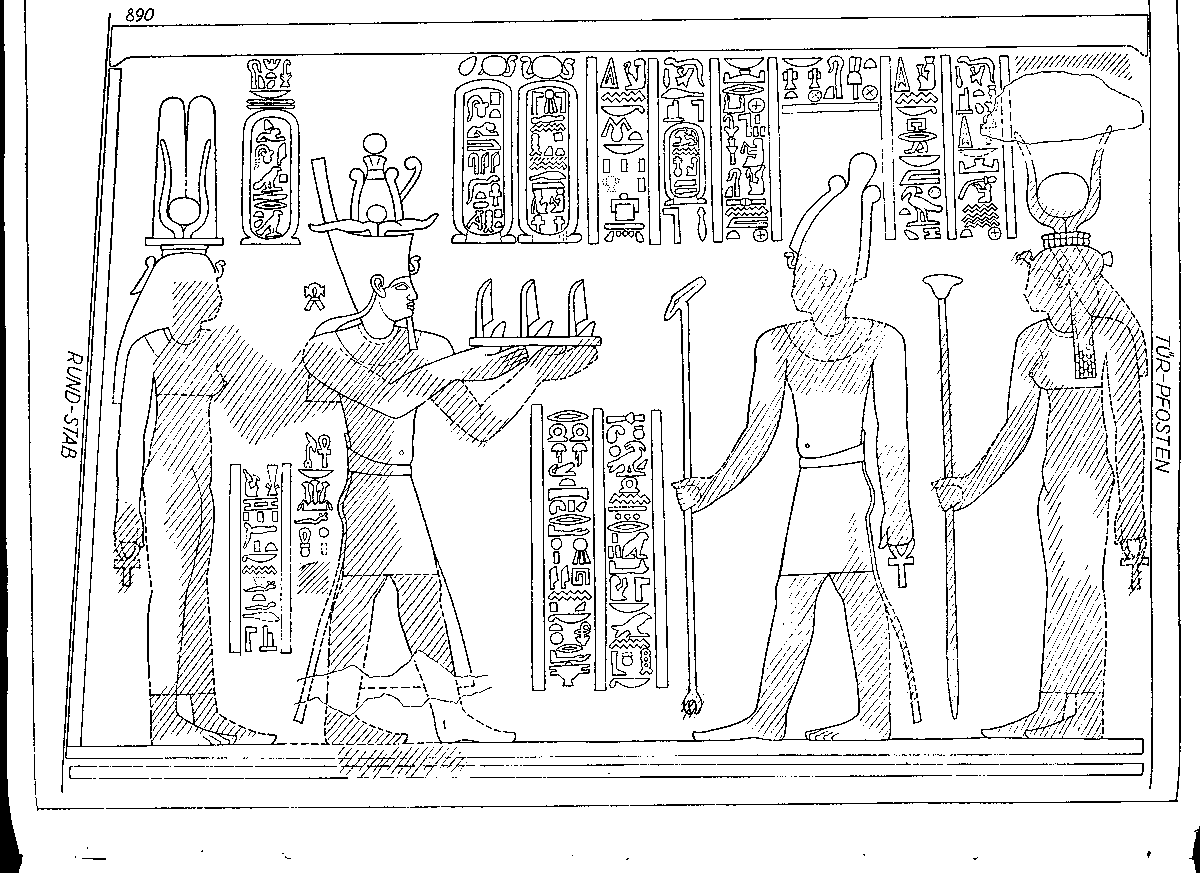
North wall, west part: upper frieze inscription of Ptolemy VI
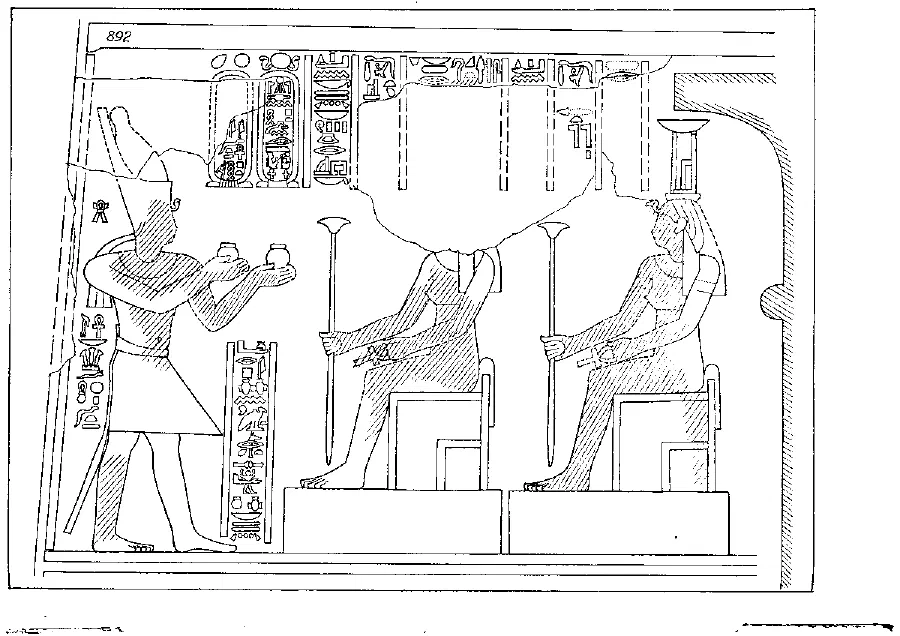
Page 169. The scene as drawn on the wall, facing p. 169 of the edition. Drawing by Otto Baum, in Junker and Winter, Das Geburtshaus des Tempels der Isis in Philä (1965) - 51p. 169, l. 1
Ḥrw ṯnj m ẖ.t ḫtr Ḥp ꜥnḫ ḥr msḫn-sn (so)
Horus, exalted in the womb, twin brother of the living Apis on their birth bricks.
Note · Line 51
This is a Horus name of Ptolemy VI. It sets the king beside Apis, the sacred bull of Memphis, at the very moment of birth. Women crouched on bricks to give birth. - 52p. 169, l. 2
nbtj m mꜣꜥ.t sḫꜥj-n sw jt-f
He who is truly of the Two Ladies: his father crowned him.
Note · Line 52
The Two Ladies are Nekhbet, the vulture goddess of Upper Egypt, and Wadjet, the cobra goddess of Lower Egypt. - 53p. 169, l. 3
njśwt bjt nb tꜣ.wj jwꜥw …
King of Upper and Lower Egypt, lord of the Two Lands, heir …
- 54p. 169, l. 4
sꜣ Rꜥ Pt … nṯr.w mrj mw.tj
Son of Ra, Ptolemy …, the Mother-loving Gods.
Note · Line 54
Ptolemy VI and his sister-wife Cleopatra II shared this cult title. - 55p. 169, l. 5
jrj-n-f mnw-f (n) jt-f (Ḥrw) pꜣ ḫrd sꜣ ỉś.t sꜣ (so) Wśjr
He made this as his monument for his father Horus the Child, son of Isis, son of Osiris.
Note · Line 55
Even as a child, Horus is called the king’s father: the king dedicates the monument as a son honoring a god. Ptolemy VIII gives Isis wine
- 56p. 169, l. 6
ḥnk jrp n mw.t-f Wśr.t
Offering wine to his mother Wosret,
- 57p. 169, l. 7
sḫꜥꜥ jb n nb(.t) tꜣ.wj
gladdening the heart of the lady of the Two Lands.
- 58p. 169, l. 8
njśwt bjt jwꜥw …
King of Upper and Lower Egypt, heir …
- 59p. 169, l. 9
sꜣ Rꜥ Pt …
Son of Ra, Ptolemy …
- 60p. 169, l. 10
sꜣ ꜥnḫ wꜣś nb ḥꜣ-f mj Rꜥ ḏ.t
May protection and all life and dominion surround him as they surround Ra forever.
- 61p. 169, l. 11
ḏd mdw n | ỉś.t …
Words spoken by Isis …
- 62p. 169, l. 12
ḥnw.t nb(.t) ỉrk ḥḳꜣ.t mnḫ.t (?) …
sovereign lady, mistress of Philae, able ruler …
- 63p. 169, l. 13
dj-j n-k tꜣ.w nb.w ḫr ꜥnś.t-k
I give you all lands beneath your throne.
Note · Line 63
Isis is addressing the king. - 64p. 169, l. 14
ḏd mdw n | (Nb.t-ḥw.t) mnḫ.t nṯr.w … (nb.t) ỉr(k) …
Words spoken by Nephthys, the excellent one among the gods … Lady of Philae …
- 65p. 169, l. 15
dj-j n(-k) …
I give you …
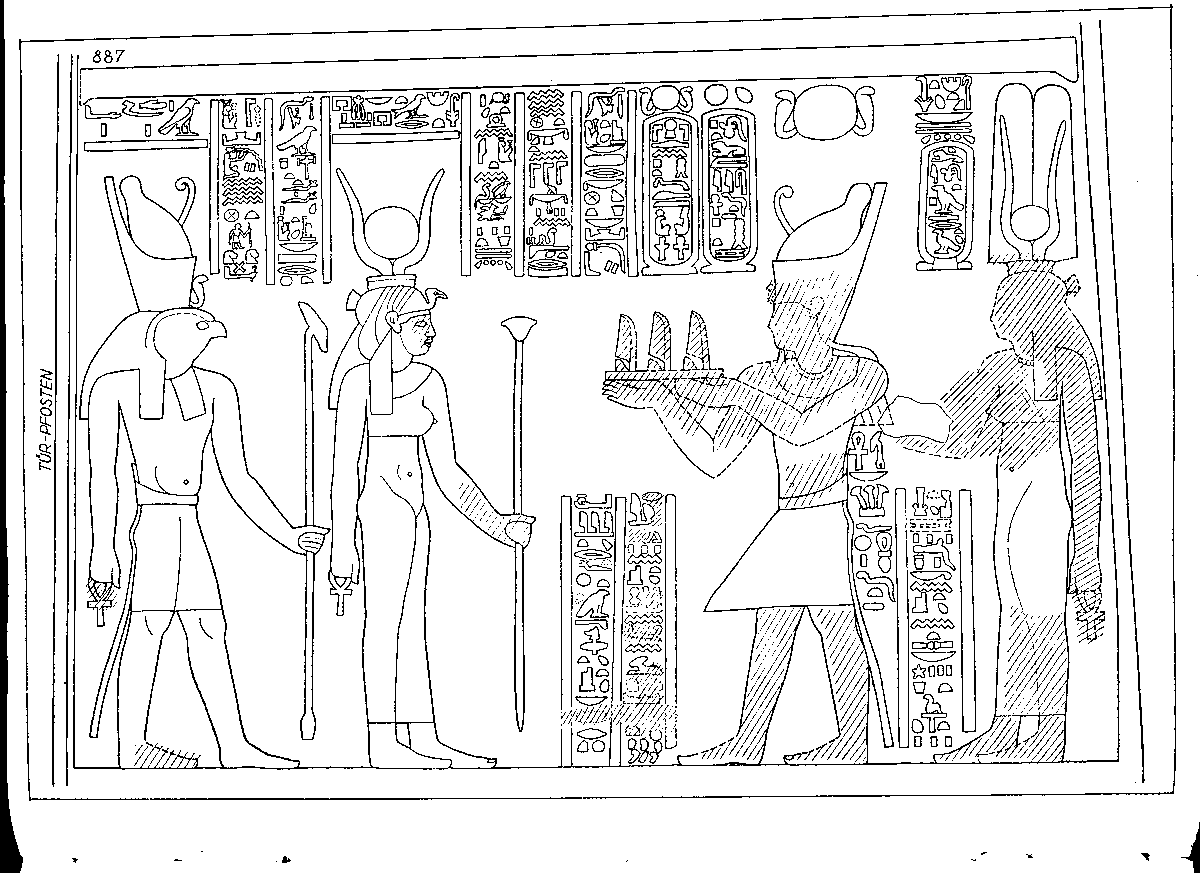
Ptolemy VIII gives Khnum the nemset-jar
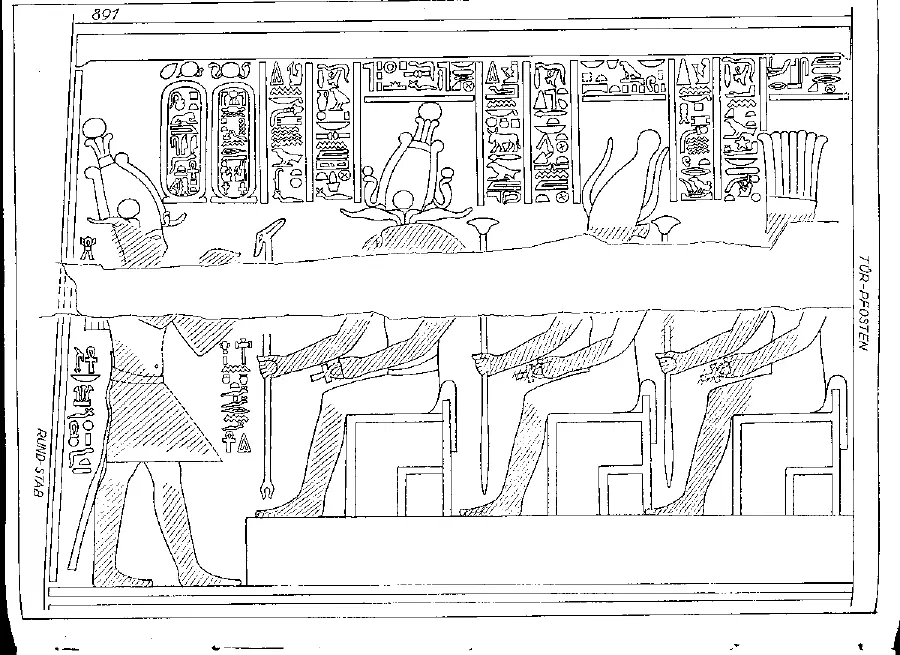
Page 171. The scene as drawn on the wall, facing p. 171 of the edition. Drawing by Otto Baum, in Junker and Winter, Das Geburtshaus des Tempels der Isis in Philä (1965) - 66p. 171, l. 1
nḏ-ḥr m (so) nmś.t n jt-f jrj-n-f ḏj ꜥnḫ
Presenting the nemset-jar to his father. He has done this that he may be given life.
Note · Line 66
The king presents a jar used for pouring water in purification rites. His father here is the god Khnum-Ra. - 67p. 171, l. 2
njśwt bjt jwꜥw …
King of Upper and Lower Egypt, heir of the two Manifest Gods …
Note · Line 67
The Manifest Gods were Ptolemy V and Cleopatra I, the parents of Ptolemy VIII. - 68p. 171, l. 3
sꜣ Rꜥ Pt …
Son of Ra, Ptolemy …
- 69p. 171, l. 4
sꜣ ꜥnḫ wꜣś nb ḥꜣ-f mj Rꜥ ḏ.t
May all protection, life and dominion surround him as they surround Ra, forever.
- 70p. 171, l. 5
ḏd mdw n | Ḫnmw-Rꜥ nb Śnm.t
Words spoken by Khnum-Ra, lord of Bigeh,
Note · Line 70
Bigeh is the island beside Philae. - 71p. 171, l. 6
jt nṯr.w ḫpr ḏs-f nṯr ꜥꜣ nb ’Jrk
father of the gods, who came into being of himself, the great god, lord of Philae:
- 72p. 171, l. 7
ḏj-j n-k ḥꜥpj wr (r) tr-f
I give you the Nile flood, high in its season.
- 73p. 171, l. 8
ḏd mdw n | Śpd.t ꜥꜣ.t nb(.t) Śḫḫ(?)
Words spoken by Sothis the Great, lady of Sekhekh,
Note · Line 73
Sothis is the goddess of Sirius, the star whose return to the dawn sky heralded the Nile flood. - 74p. 171, l. 9
ḫnt Śnm.t nb(.t) p.t ḥnw.t nṯr.w nb.w
foremost in Bigeh, lady of the sky, sovereign lady of all the gods:
- 75p. 171, l. 10
ḏj-j prj n-k ḥnp-kꜣ(?) ꜥꜣ wr m ḳrr.t
I make the floodwaters well up for you with great force from the cavern.
Note · Line 75
The cavern was held to be the source of the Nile flood. - 76p. 171, l. 11
ḏd mdw n | ꜥnḳ.t wr.t mw.t nṯr
Words spoken by Anukis the Great, the god’s mother,
- 77p. 171, l. 12
nb(.t) jꜣ.t wꜥb.t
lady of the Abaton,
Note · Line 77
The Abaton, the “Pure Mound” in Egyptian, was the sacred burial place of Osiris on Bigeh. - 78p. 171, l. 13
ḏsr ś.t-ś m ’Jrk
whose seat on Philae is holy:
- 79p. 171, l. 14
ḏj-j n-k ḥꜥpj wꜥb r ꜥb
I give you the Nile flood, pure of all impurity.
Ptolemy VIII gives Osiris a field
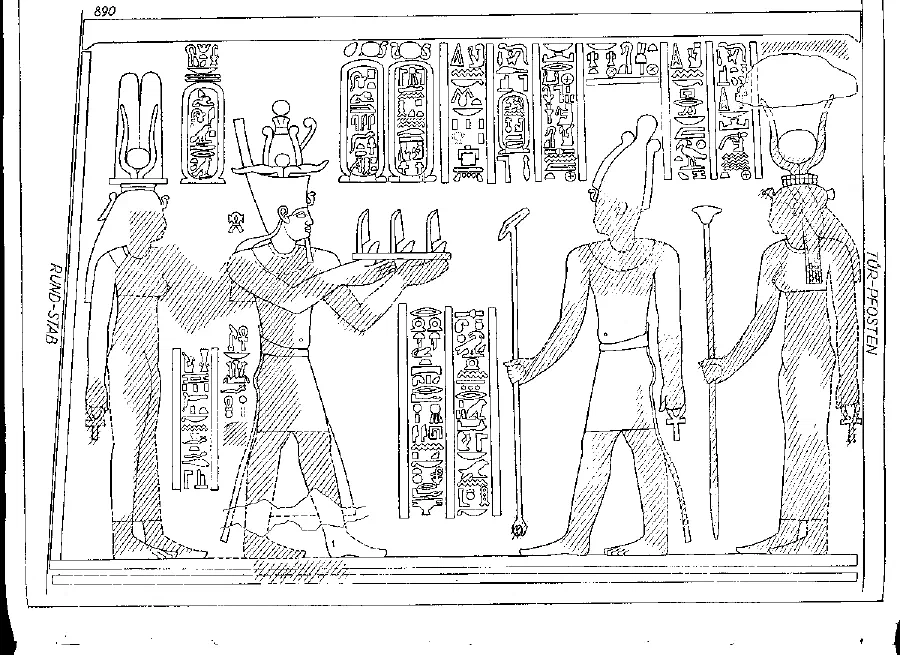
Page 173. The scene as drawn on the wall, facing p. 173 of the edition. Drawing by Otto Baum, in Junker and Winter, Das Geburtshaus des Tempels der Isis in Philä (1965) - 80p. 173, l. 1
mn n-k ꜣḥ.t šnw n tꜣ r ḥfn.w (?)
Receive the field, the whole circuit of the earth, vast beyond reckoning.
- 81p. 173, l. 2
dj nṯr nb wr ḥnb(.t)-k r ḥp.tj
Every god grants that your field extend to the two ends of the world,
- 82p. 173, l. 3
pḥ tꜣš (so)-k r-ꜥ šwt.t jtn
that your boundary reach as far as the rays of the sun disk,
- 83p. 173, l. 4
ḥjn-k rśj r-ꜥ ṯꜣw
and your southern border as far as the wind.
- 84p. 173, l. 5
njśwt bjt jwꜥw …
King of Upper and Lower Egypt, heir of the two Manifest Gods …
- 85p. 173, l. 6
sꜣ Rꜥ Pt …
Son of Ra, Ptolemy …
- 86p. 173, l. 7
sꜣ ꜥnḫ wꜣś nb ḥꜣ-f mj Rꜥ (ḏ.t)
May all protection, life and dominion surround him as they surround Ra, forever.
- 87p. 173, l. 8
ḥm.t njśwt ḥḳꜣ(.t) nb(.t) tꜣ.wj Krjwꜣpḏrꜣ.t
King’s wife, ruler, Lady of the Two Lands, Cleopatra.
- 88p. 173, l. 9
śn-j mrj mḥ jb (so)-k n jt-k (so) Wśjr
My beloved brother, give your heart to your father Osiris.
- 89p. 173, l. 10
ḏd mdw n | Wśjr Wnn nfrw mꜣꜥ ḫrw
Words spoken by Osiris Wennefer, the vindicated one,
Note · Line 89
“Vindicated” means that judgment was given in his favor in his quarrel with Seth. - 90p. 173, l. 11
nṯr ꜥꜣ nb ꜣJrk njśwt nṯr.w
the great god, lord of Philae, king of the gods,
- 91p. 173, l. 12
sḫm špsj ḥḳꜣ Snm.t nb Ḏdw ḥḳꜣ ꜣbḏw
August power, ruler of Bigeh, lord of Busiris, ruler of Abydos.
Note · Line 91
These are titles of Osiris. - 92p. 173, l. 13
dj-j n-k rd.t nb.t ḥr sꜣ tꜣ
I give you all that grows on the back of the earth.
Note · Line 92
Osiris is speaking to the king. - 93p. 173, l. 14
ḏd mdw n | ꜣJś.t dj(.t) ꜥnḫ nb(.t) jꜣ.t wꜥb.t …
Words spoken by Isis, giver of life, lady of the Abaton …
- 94p. 173, l. 15
dj-j n-k prj(.t) nb(.t) m ꜣḥ.t
I give you all that springs from the field.
Tiberius burns incense before Osiris
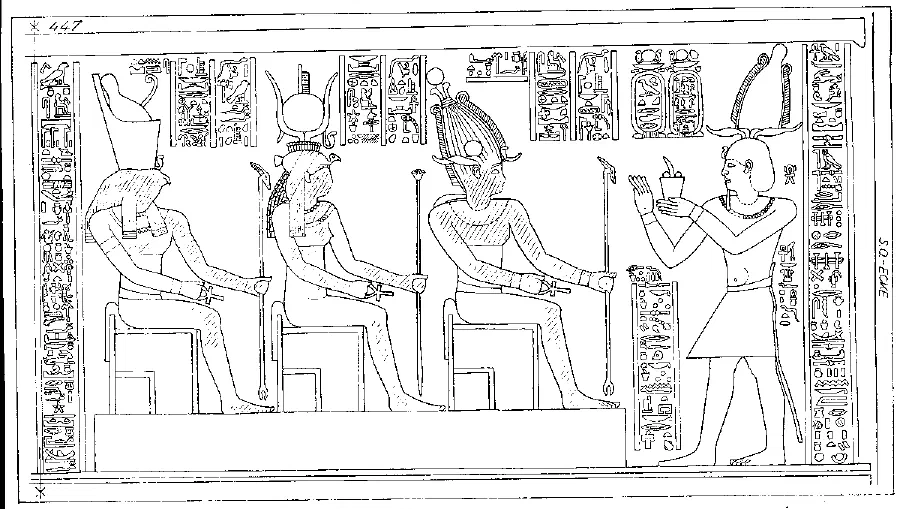
Page 175. The scene as drawn on the wall, facing p. 175 of the edition. Drawing by Otto Baum, in Junker and Winter, Das Geburtshaus des Tempels der Isis in Philä (1965) - 95p. 175, l. 1
jrj(.t) šnṯr ḏd mdw
Burning incense. Words to be spoken:
Note · Line 95
The king speaks as he offers incense to the god. - 96p. 175, l. 2
mn n-k šnṯr štj-f r fnḏ-k
Take the incense for yourself; may its scent reach your nose.
- 97p. 175, l. 3
šnṯr-n-f ś.t-k r śst
It has cleansed your seat of dirt.
Note · Line 97
The Egyptian word for “incense” returns here as the verb “to cleanse.” - 98p. 175, l. 4
njśwt bjt nb tꜣ.wj ꜣwtḳrdr
King of Upper and Lower Egypt, lord of the Two Lands, Autokrator,
Note · Line 98
Autokrator is a Greek imperial title. Here the Roman emperor bears the titles of an Egyptian king. - 99p. 175, l. 5
sꜣ Rꜥ nb ḫꜥ.w Tbrjś Kjsrs ꜥnḫ ḏ.t
son of Ra, lord of crowns, Tiberius Caesar, who lives forever.
- 100p. 175, l. 6
sꜣ ꜥnḫ wꜣś nb ḥꜣ-f mj Rꜥ ḏ.t
May all protection, life and dominion surround him as they surround Ra, forever.
- 101p. 175, l. 7
ḏd mdw n | Wśjr nṯr ꜥꜣ nb jꜣ.t wꜥb.t
Words spoken by Osiris, the great god, lord of the Abaton,
- 102p. 175, l. 8
śḫm špśj nb ’Jrk
august power, lord of Philae,
- 103p. 175, l. 9
nb Pwn.t (so) ḥḳꜣ Tꜣ-nṯr (so)
lord of Punt, ruler of the Land of the God,
Note · Line 103
Punt, in the Red Sea region, supplied Egypt with fragrant resins. The Land of the God was a name for the lands from which such aromatics came. - 104p. 175, l. 10
šmś jb-f m ꜥntjw
whose heart delights in myrrh.
- 105p. 175, l. 11
ḏd mdw n | ’Jś.t dj(.t) ꜥnḫ nb(.t) jꜣ.t wꜥb.t
Words spoken by Isis, giver of life, lady of the Abaton,
- 106p. 175, l. 12
ḥnw.t nb(.t) ’Jrk špś.t wśr.t nb.t šnṯr (?)
sovereign, lady of Philae, august one, mighty one, lady of incense.
- 107p. 175, l. 13
ḏd mdw n | Ḥrw nḏ.tj jt-f
Words spoken by Horus, avenger of his father,
Note · Line 107
The title recalls Horus’s struggle against Seth, who killed Osiris. - 108p. 175, l. 14
sꜣ ’Jś.t sꜣ Wśjr nb ’Jrk
son of Isis, son of Osiris, lord of Philae,
- 109p. 175, l. 15
ḥsf śbj.w r ḳmꜣ-f m Śnm.t
who drives the rebels back from his maker on Bigeh.
- 110p. 175, l. 16
nṯr pn špśj ḥrj nṯr.w ḫnt Śnm.t
This august god, chief of the gods, foremost on Bigeh,
- 111p. 175, l. 17
śp.t (?) ḏśr.t mrj(.t) jb-f
the sacred district his heart loves:
- 112p. 175, l. 18
jnj-k (n)-j šnṯr wbn ḥr śḏ.t
You bring me incense that glows in the flame.
- 113p. 175, l. 19
ḥꜥj jb-j m ḫnmw-f
My heart rejoices in its fragrance.
- 114p. 175, l. 20
dj-j n-k Pwn.t ḥr jmj.t-f
I give you Punt with what it holds,
- 115p. 175, l. 21
Tꜣ-nṯr ḥr pr(r.t) jm-f
and the Land of the God with what springs from it.
- 116p. 175, l. 22
ꜥnḫ | Ḥrw ḥwn nb Kbn
Long live Horus the youth, lord of Byblos,
Note · Line 116
Byblos, on the coast of present-day Lebanon, supplied Egypt with timber and resins. - 117p. 175, l. 23
śḥtp nṯr m štj nṯr
who pleases the god with the fragrance of a god,
- 118p. 175, l. 24
rḏj jr.t Ḥrw ḥr jr.t Ḥrw
who sets the Eye of Horus upon the Eye of Horus
Note · Line 118
The first Eye is the incense; the second is the flame. Both bear the name of Horus’s injured and restored eye, a sign of wholeness. - 119p. 175, l. 25
r śnḏm jb n jt-f jm-ś
to gladden his father’s heart with it:
- 120p. 175, l. 26
ḥnk-śn n-k m ḫr.t¹ hrw n.t rꜥ nb
They are offered to you as your daily due, day after day.
Tiberius gives Thoth the scribe’s palette
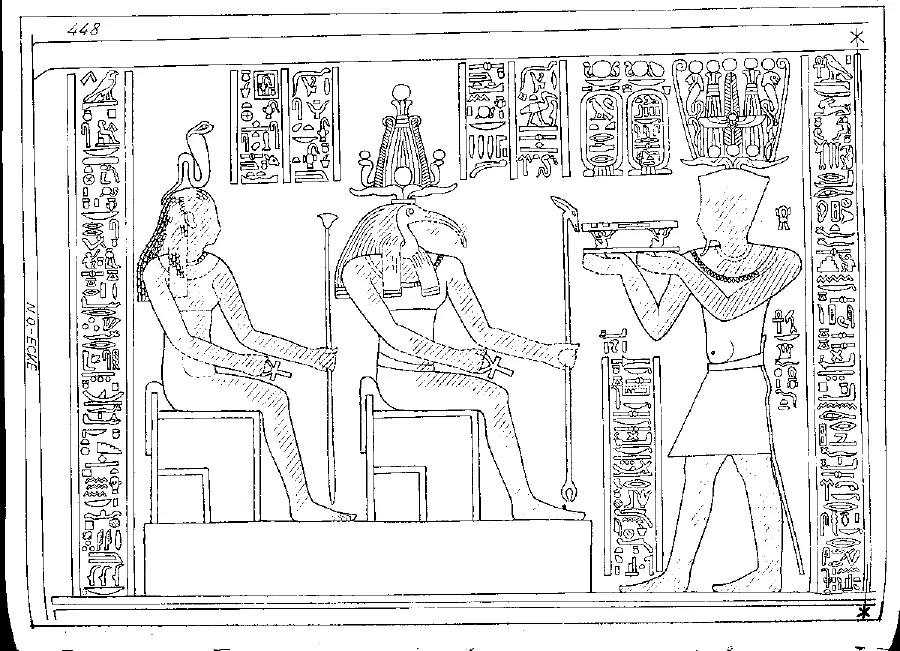
Page 177. The scene as drawn on the wall, facing p. 177 of the edition. Drawing by Otto Baum, in Junker and Winter, Das Geburtshaus des Tempels der Isis in Philä (1965) - 121p. 177, l. 1
ḥnk gštj ḏd mdw
Offering the palette. Words to be spoken:
- 122p. 177, l. 2
mn n-k gštj
Take the palette for yourself,
- 123p. 177, l. 3
gšgš-k tꜣ jm-f
that with it you may order the earth
- 124p. 177, l. 4
r nḥb nḫb.t n(.t) sꜣ Wsjr
and ordain the royal titles of the son of Osiris.
Note · Line 124
The son is Horus, heir to his father’s throne. Here the king who offers the palette bears the titles of Horus on earth. - 125p. 177, l. 5
njśwt bjt nb tꜣ.wj ꜣwtḳrdr
King of Upper and Lower Egypt, Lord of the Two Lands, Autokrator,
- 126p. 177, l. 6
sꜣ Rꜥ nb ḫꜥ.w Tbrjś …
Son of Ra, Lord of Crowns, Tiberius …
- 127p. 177, l. 7
sꜣ ꜥnḫ wꜣś nb ḥꜣ-f mj Rꜥ ḏ.t
May all protection, life, and dominion surround him as they surround Ra, forever.
- 128p. 177, l. 8
ḏd mdw n | Ḏḥwtj śḥtp Nsr.t m Śnm.t
Words spoken by Thoth, who soothes the fiery serpent on Bigeh,
Note · Line 128
The fiery serpent is the cobra of the sun god, here the goddess Wepeset. - 129p. 177, l. 9
jb n Rꜥ nb mdw.w nṯr
heart of Ra, lord of divine words.
Note · Line 129
“Divine words” is the Egyptian name for hieroglyphic writing. - 130p. 177, l. 10
ḏd mdw n | Wpś.t nb(.t) nbj.t m ḥw.t-nbj.t
Words spoken by Wepeset, Mistress of the Flame in the Chamber of Flame.
- 131p. 177, l. 11
śḥtp ḥm.t-ś ḫnt Śnm.t
Her Majesty is soothed on Bigeh.
- 132p. 177, l. 12
nṯr pn špśj nb jꜣ.t wꜥb.t
This august god, lord of the Abaton,
Note · Line 132
The Abaton, the “Pure Mound,” was the sacred burial place of Osiris on Bigeh. - 133p. 177, l. 13
jb n Rꜥ nb śpḫr
heart of Ra, lord of engraving:
- 134p. 177, l. 14
jnj(-k) n-j gštj ḫr ꜥr-f
You bring me the palette with its stylus,
Note · Line 134
Thoth addresses the king who brings the offering. - 135p. 177, l. 15
r ḥśb tꜣ pn jm-f
to take the measure of this land with it.
- 136p. 177, l. 16
dj-j n-k Km.t ḥtp ḫr mw-k (so)
I give you Egypt, at peace and loyal to you;
- 137p. 177, l. 17
n ḫpr ḫrwjw m rnp.wt-k
no strife shall arise in your years.
- 138p. 177, l. 18
ꜥnḫ | Ḥrw ḥwn n ꜥm-tꜣ.wj
Long live Horus, young son of him who knows the Two Lands,
Note · Line 138
The king appears as Horus. The father he approaches here is Thoth, the one who knows the Two Lands of Egypt. - 139p. 177, l. 19
rdj jr.t-ꜥnḫ¹ ḫr jt-f
who brings a palette to his father:
- 140p. 177, l. 20
śꜥr-j n-k gštj r gšgš tꜣ pn
I bring you the palette to order this land,
- 141p. 177, l. 21
ꜥn r grg-f
the beautiful one, to set it in order.
- 142p. 177, l. 22
ḥnk-j św m bꜣḥ-k
I offer it before you
- 143p. 177, l. 23
r śnḏm jb-k r śpḫr njśwj.t n sꜣ Jś.t
to gladden your heart, that you may inscribe the kingship for the son of Isis.
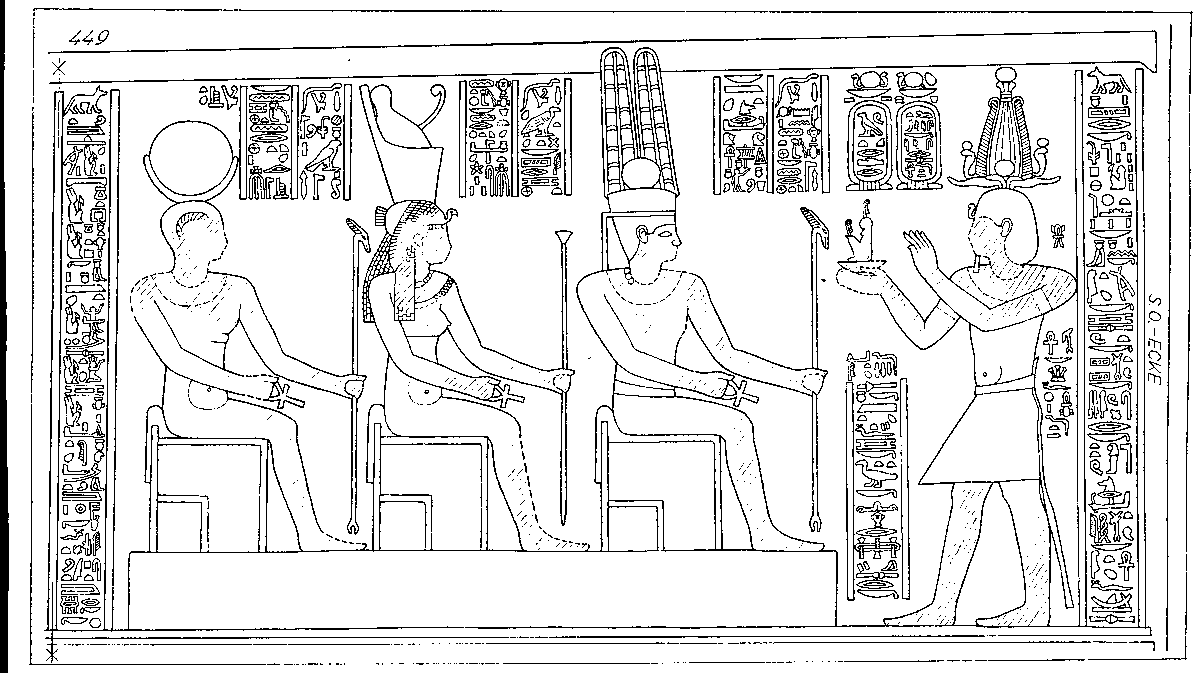
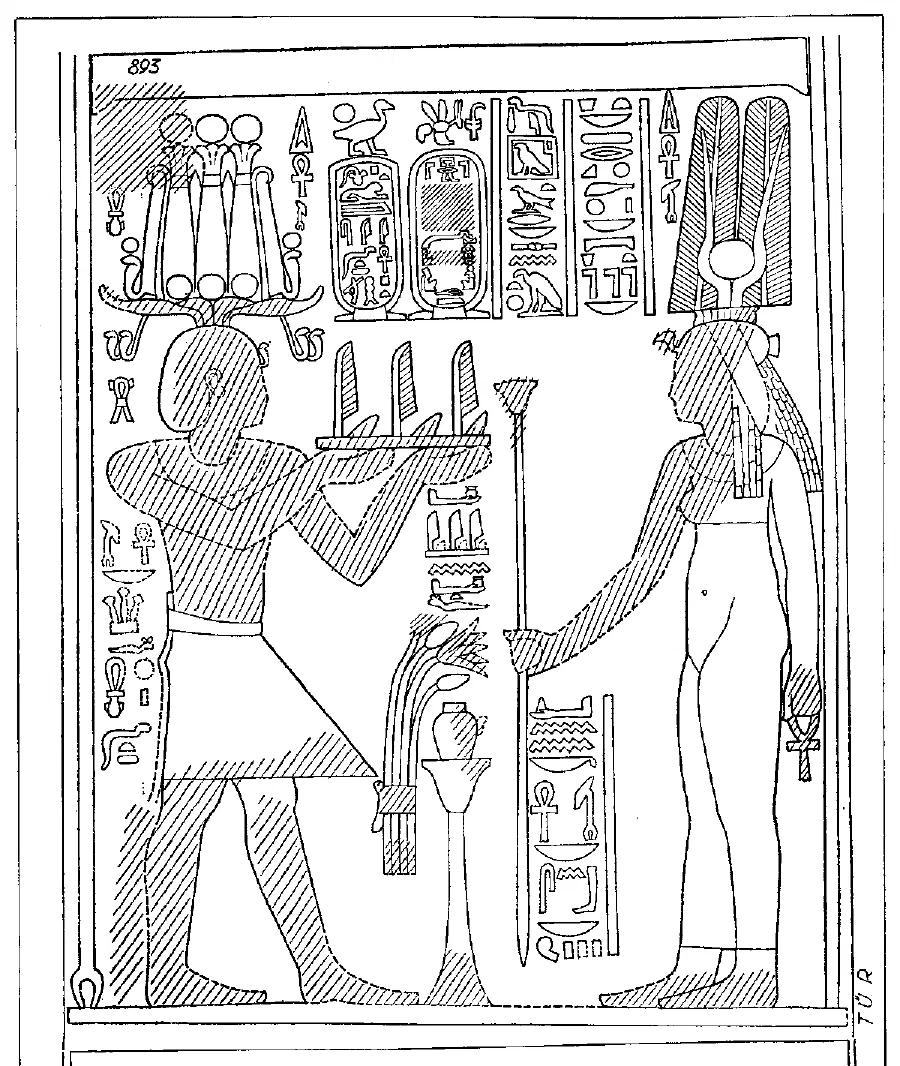
Tiberius gives Amun Maat
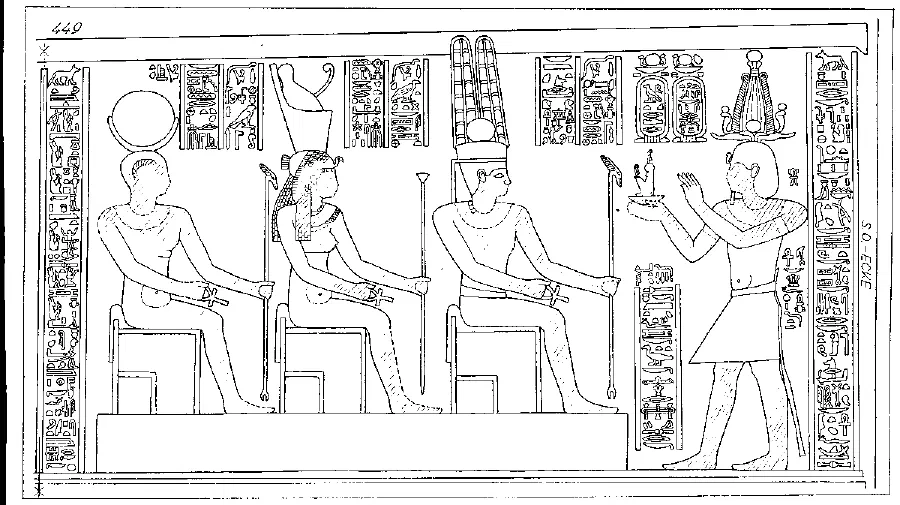
Page 179. The scene as drawn on the wall, facing p. 179 of the edition. Drawing by Otto Baum, in Junker and Winter, Das Geburtshaus des Tempels der Isis in Philä (1965) - 144p. 179, l. 1
ḥnk mꜣꜥ.t ḏd mdw
Offering Maat. Words to be spoken:
Note · Line 144
Maat is truth and right order embodied as a goddess. The king offers her in the form of a small figure. - 145p. 179, l. 2
mn n-k mꜣꜥ.t tf mrj-k
Take for yourself that Maat whom you love,
- 146p. 179, l. 3
sꜣ.t-k n ḫrj-s r-k
your daughter; may she never leave you.
- 147p. 179, l. 4
njśwt bjt nb tꜣ.wj ꜣwtḳrdr
King of Upper and Lower Egypt, Lord of the Two Lands, Autokrator,
- 148p. 179, l. 5
sꜣ Rꜥ nb ḫꜥ.w Tbrjś …
Son of Ra, Lord of Crowns, Tiberius …
- 149p. 179, l. 6
sꜣ ꜥnḫ wꜣś nb ḥꜣ-f mj Rꜥ ḏ.t
May all protection, life, and dominion surround him as they surround Ra, forever.
- 150p. 179, l. 7
ḏd mdw n | Jmn-Rꜥ ḥrj-jb jꜣ.t wꜥb.t
Words spoken by Amun-Ra, who dwells in the Abaton,
- 151p. 179, l. 8
nṯr ꜥꜣ nb Jrlk nb mꜣꜥ.t wśr pḥ.tj
the great god, lord of Philae, lord of Maat, mighty in strength,
- 152p. 179, l. 9
dj ṯꜣw n ꜥnḫ n ꜥš n-f
who gives the breath of life to whoever calls on him.
- 153p. 179, l. 10
ḏd mdw n | Mw.t wr.t nb(.t) Jšrw
Words spoken by Mut the Great, lady of Isheru,
Note · Line 153
Isheru is the sacred lake at Mut’s sanctuary at Karnak. - 154p. 179, l. 11
ḥrj(.t)-jb jꜣ.t wꜥb.t ḥnw.t nb(.t) Jrlk
who dwells in the Abaton, sovereign lady, lady of Philae,
Note · Line 154
The Abaton, the “Sacred Mound” in Egyptian, was the burial sanctuary of Osiris on the island of Bigeh beside Philae. - 155p. 179, l. 12
mw.t nṯr mś(.t) nṯr.w
mother of the god, who bore the gods.
- 156p. 179, l. 13
ḏd mdw n | Ḫnśw Ḥrw pꜣ ḫrd
Words spoken by Khonsu-Horus the Child,
Note · Line 156
Khonsu, son of Amun and Mut, is identified here with Horus, son of Osiris and Isis. - 157p. 179, l. 14
nṯr ꜥꜣ nb jꜣ.t wꜥb.t Jrlk
the great god, lord of the Abaton and of Philae,
- 158p. 179, l. 15
sꜣ Wśjr mśj n Jś.t
son of Osiris, born of Isis.
- 159p. 179, l. 16
jj.tj m ḥtp sꜣ-j mrj
Welcome in peace, my beloved son,
Note · Line 159
The god addresses the king as his son and heir. - 160p. 179, l. 17
ḫrj nś.t-j ntj ḥr nś.t-j
heir to my throne, who sits upon my throne!
- 161p. 179, l. 18
jnj-k n-j mꜣꜥ.t ḥꜥj-j n mꜣꜣ-s
You bring me Maat, and I rejoice to see her,
Note · Line 161
In this rite the king offers the god a figure of Maat: his gift is the very order he is charged with upholding. - 162p. 179, l. 19
mr.t-j mr(.t) jb-j
my Meret, whom my heart loves.
Note · Line 162
Meret is the goddess of ritual song. Her name echoes the Egyptian word for “beloved.” - 163p. 179, l. 20
dj-j n-k mꜣꜥ.t mꜣꜥ.tj m tr-k
I give you Maat to lead in your time,
- 164p. 179, l. 21
jśf.t śpt.tj m rk-k
with wrongdoing laid low in your reign.
- 165p. 179, l. 22
jj-n-j¹ ḫr-k njśwt nṯr.w pꜣw.tj (w?) ḳmꜣ jḫ.t nb(.t)
I have come to you, king of the gods, primeval one who made all things.
Note · Line 165
The king now speaks to the god. - 166p. 179, l. 23
jnj-n-j¹ n-k mꜣꜥ.t mrj(.t)-k mrj-s twk
I have brought you Maat, whom you love and who loves you,
- 167p. 179, l. 24
šꜣšj.t-k n šw-s r-k
your throat, which never leaves you.
- 168p. 179, l. 25
twt nṯr wśr ḥtj.t
You are the god whose throat is strong,
- 169p. 179, l. 26
nb mꜣꜥ.t ꜥnḫ-f jm-s
the lord of Maat, who lives on her.
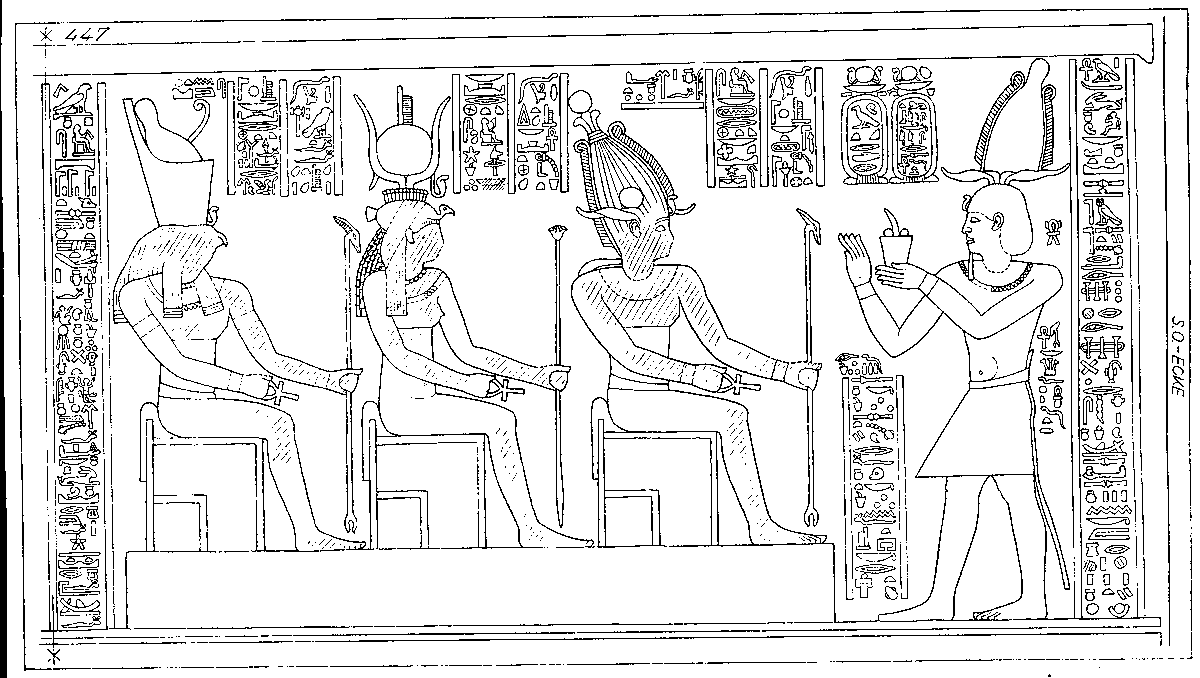
Tiberius worships Khnum
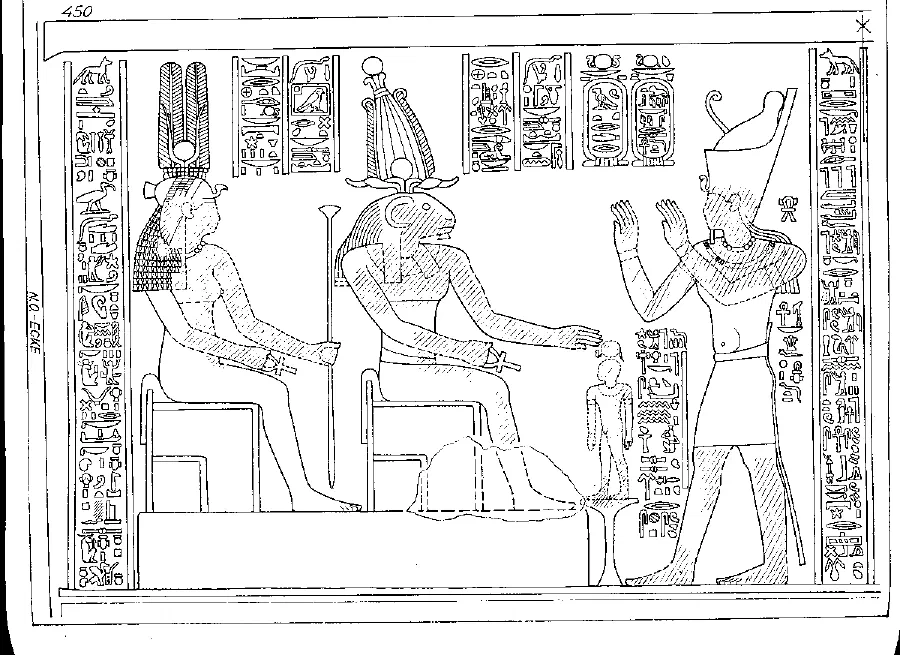
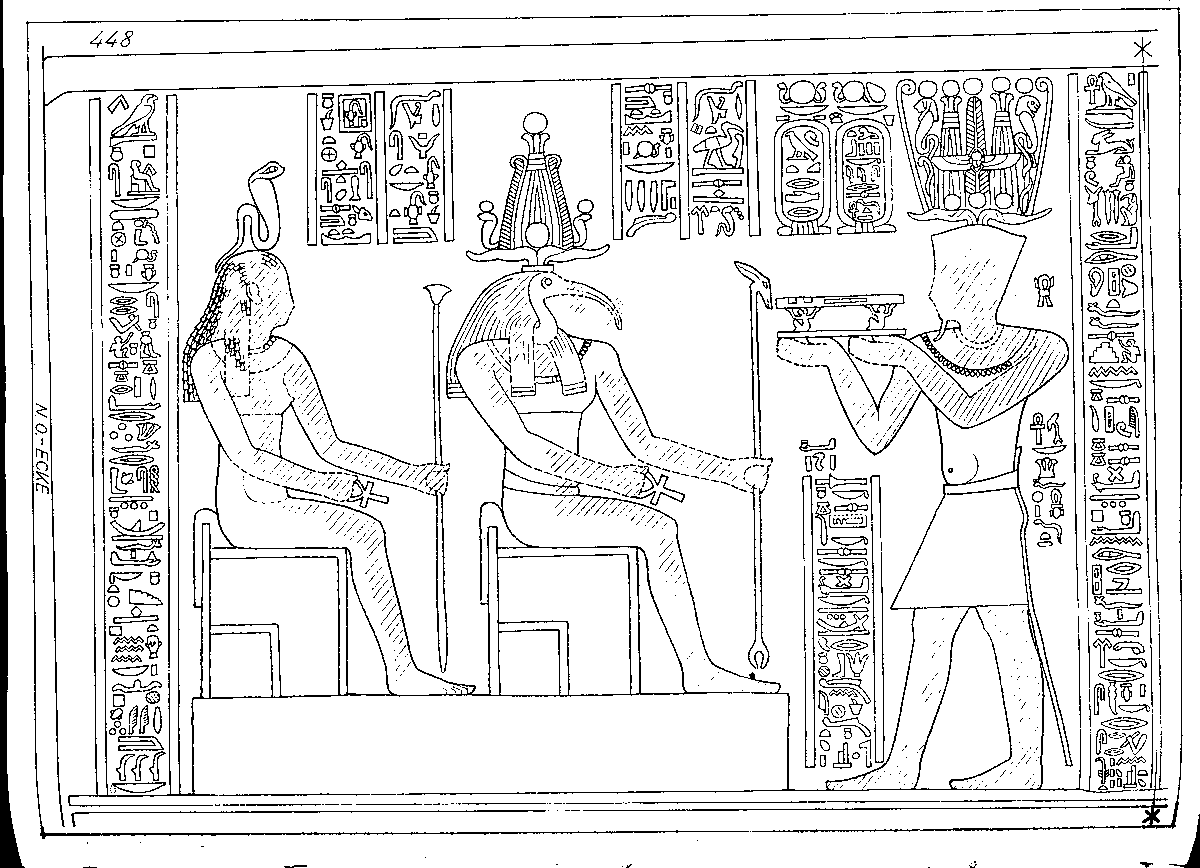
Page 181. The scene as drawn on the wall, facing p. 181 of the edition. Drawing by Otto Baum, in Junker and Winter, Das Geburtshaus des Tempels der Isis in Philä (1965) - 170p. 181, l. 1
dwꜣ nṯr ḏd mdw
Worshipping the god and reciting:
- 171p. 181, l. 2
nḏ ḥr-k nṯr śwḥ mw ḥr (so)¹ nḥp-f
Hail to you, god who shapes semen into an embryo on his potter’s wheel,
Note · Line 171
The divine potter is Khnum. His work at the wheel is the shaping of a child in the womb. - 172p. 181, l. 3
ṯs-f m ḥ.t r śḫpr śwḥ.t
who knits it together in the womb to bring the egg into being!
- 173p. 181, l. 4
njśwt bjt nb tꜣ.wj ꜣwtḳrdr
King of Upper and Lower Egypt, lord of the Two Lands, Autokrator,
- 174p. 181, l. 5
sꜣ Rꜥ nb ḫꜥ.w Tbrjś ...
son of Ra, lord of crowns, Tiberius …
- 175p. 181, l. 6
sꜣ ꜥnḫ wꜣś nb ḥꜣ-f mj Rꜥ ḏ.t
May all protection, life and dominion surround him as they surround Ra, forever.
- 176p. 181, l. 7
ḏd mdw n | Ḫnmw-Rꜥ nb Śnm.t nṯr ꜥꜣ
Words spoken by Khnum-Ra, lord of Bigeh, the great god,
- 177p. 181, l. 8
nb ’Jrk nḥp sꜣ ’Jś.t m wnw.t nfr.t
lord of Philae, who shaped the son of Isis on his wheel at the auspicious hour,
- 178p. 181, l. 9
r jrj(.t) nb m tꜣ pn
that he might be lord in this land.
- 179p. 181, l. 10
ḏd mdw n | Ḥw.t-Ḥrw wr.t nb(.t) Śnm.t
Words spoken by Hathor the Great, lady of Bigeh,
- 180p. 181, l. 11
nb(.t) ’Jrk jr.t Rꜥ nb(.t) p.t ḥnw.t nṯr.w nb.w
lady of Philae, Eye of Ra, lady of heaven, sovereign of all the gods.
Note · Line 180
As the Eye of Ra, Hathor is the sun god’s power to act and protect. - 181p. 181, l. 12
jj.tj m ḥtp sꜣ ꜥm-tꜣ.wj
Welcome, son of him who knows the Two Lands,
Note · Line 181
The god who knows them is Thoth, god of wisdom and writing. - 182p. 181, l. 13
pḥꜣ jb tḳr (? rḫ?) ḏd(.t)?
keen of mind and skilled in speech.
- 183p. 181, l. 14
šsp-n-j (so) dwꜣ.w-k nḏb-j ḥkn.w-k
I have received your praises; I hear your song of praise.
- 184p. 181, l. 15
ḥꜥj-j ḥr wp-rꜣ-k
I rejoice in the words you speak.
- 185p. 181, l. 16
dj-j n-k jb-k mn ḥr ś.t-f
I give you your heart, firm in its place.
- 186p. 181, l. 17
śwnf (oder: śnb?) jb-j n ḳmꜣ-n-k
What you have composed gladdens my heart.
- 187p. 181, l. 18
jj-n-j ḥr-k nṯr n ḏr-ꜥ
I have come to you, god from the beginning,
- 188p. 181, l. 19
jrj nṯr.w m ꜥ.wj-f
who made the gods with his own two hands.
- 189p. 181, l. 20
dwꜣ-j n-k nṯr r ḳꜣ.w n p.t
I praise you, O god, to the height of heaven;
- 190p. 181, l. 21
śwꜣš-j ḥm-k m šnś.w
I extol your majesty in hymns.
- 191p. 181, l. 22
twt ꜥnḫ śꜥnḫ śwḥ.t
You are the living one who gives life to the egg,
- 192p. 181, l. 23
wbꜣ(?) kkw r wšb(?) tmꜣ.t
who parts the darkness to protect the mother.
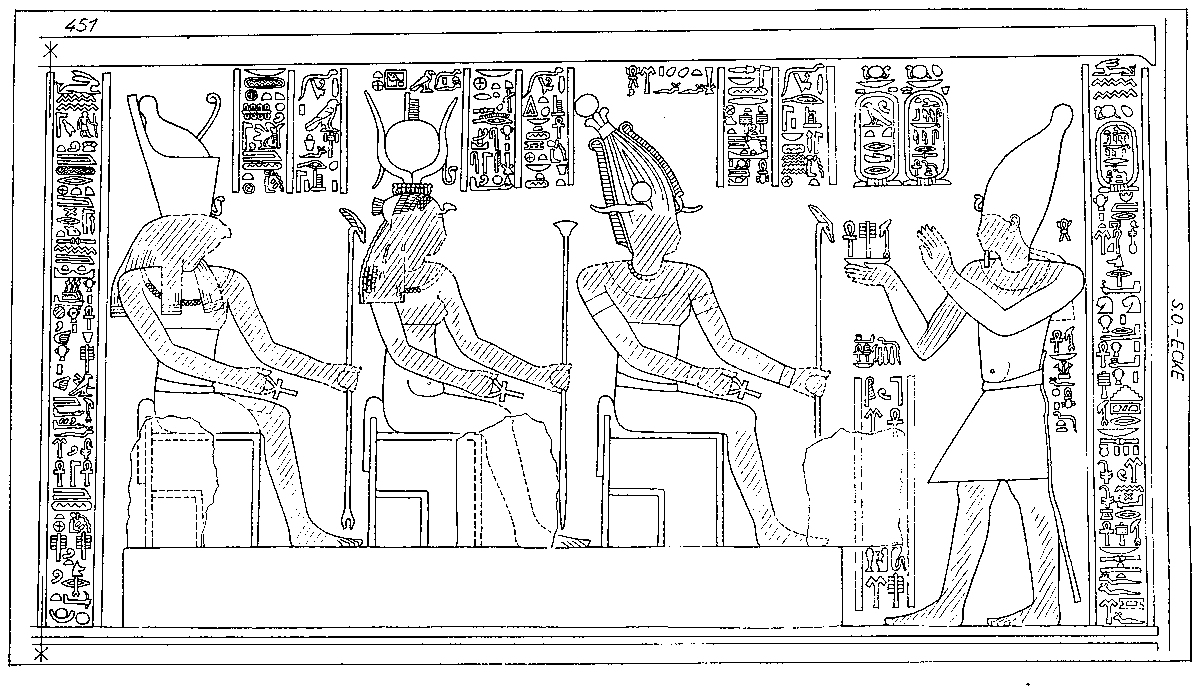
Tiberius gives Osiris life, stability and dominion
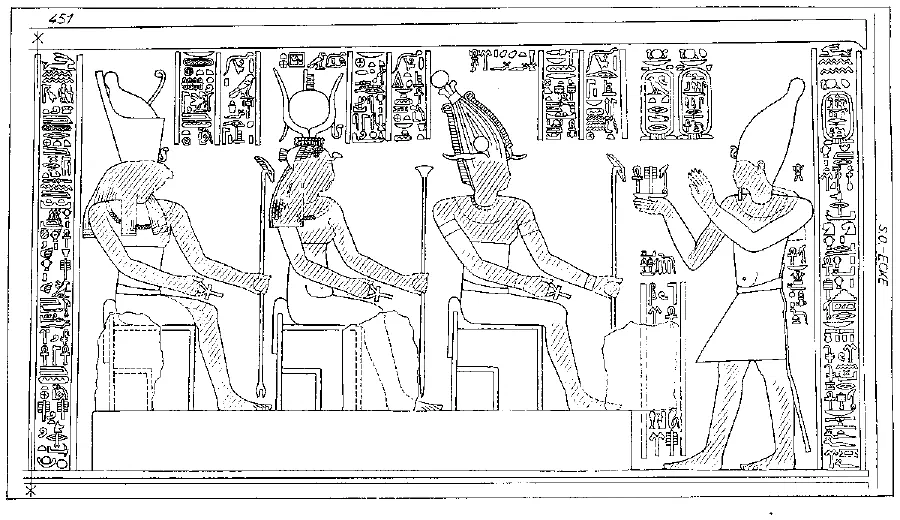
Page 183. The scene as drawn on the wall, facing p. 183 of the edition. Drawing by Otto Baum, in Junker and Winter, Das Geburtshaus des Tempels der Isis in Philä (1965) - 193p. 183, l. 1
ḥnk ꜥnḫ ḏd wꜣs nb ḏd mdw
Presenting all life, stability and dominion. Words to be spoken:
Note · Line 193
The offerings are emblems: the ankh for life, the djed-pillar for stability and the was-sceptre for dominion. - 194p. 183, l. 2
Šw m ꜥnḫ
Shu is life;
Note · Line 194
Shu is the god of air, the breath of life. - 195p. 183, l. 3
… ḥm-k m ḏd
… your majesty as the djed-pillar.
- 196p. 183, l. 4
njśwt bjt nb tꜣ.wj ꜣwtḳrdr
King of Upper and Lower Egypt, lord of the Two Lands, Autokrator,
- 197p. 183, l. 5
sꜣ Rꜥ nb ḫꜥ.w Tbrjś …
son of Ra, lord of crowns, Tiberius …
- 198p. 183, l. 6
sꜣ ꜥnḫ wꜣś nb ḥꜣ-f mj Rꜥ ḏ.t
May protection and all life and dominion surround him as they surround Ra, forever.
- 199p. 183, l. 7
ḏd mdw n | Wśjr nṯr ꜥꜣ nb jꜣ.t wꜥb.t
Words spoken by Osiris, the great god, lord of the Abaton,
- 200p. 183, l. 8
nṯr mnḫ nb ’Jrk ḏdj ḫnt Śnm.t mj Rꜥ m ꜣḫ.t
the excellent god, lord of Philae, who abides on Bigeh as Ra abides on the horizon.
- 201p. 183, l. 9
śn.t-f sꜣ-f m sꜣ-f
His sister and his son stand guard at his back.
Note · Line 201
His sister is Isis; their son is Horus. - 202p. 183, l. 10
ḏd mdw n | ’Jś.t dj(.t) ꜥnḫ nb(.t) jꜣ.t wꜥb.t
Words spoken by Isis, giver of life, lady of the Abaton,
- 203p. 183, l. 11
ḥnw.t nb.t ’Jrk (so)
sovereign lady, mistress of Philae,
- 204p. 183, l. 12
rśj.t rś-ḥr śwḏꜣ śn-ś
the sentinel with a watchful gaze, who keeps her brother safe,
- 205p. 183, l. 13
ḥwj(.t) ḏ.t-f m (so) Ḥw.t-ḥnt
who guards his body on Philae.
- 206p. 183, l. 14
ḏd mdw n | Ḥrw nḏ.tj jt-f sꜣ Wśjr nb ’Jrk
Words spoken by Horus, avenger of his father, son of Osiris, lord of Philae,
- 207p. 183, l. 15
jrj² sꜣ ḳmꜣ-f m jꜣ.t wꜥb.t
who guards his maker in the Abaton.
- 208p. 183, l. 16
wnn śr ḥḏ.t³ ḫꜥj m ’Jrk
The prince of the White Crown appears in glory on Philae
Note · Line 208
The prince is Osiris. The White Crown is the crown of Upper Egypt. - 209p. 183, l. 17
m nṯr ꜥꜣ wr ḫnt Śnm.t
as a god of surpassing greatness, foremost on Bigeh,
- 210p. 183, l. 18
ḥr šsp ꜥnḫ ḥr ḥfꜥ ḏd
receiving life and grasping stability.
- 211p. 183, l. 19
ḥr ꜣmm wꜣś m ꜥ.wj-f
and grasping dominion in both hands.
Note · Line 211
Dominion takes the form of the was-scepter, a staff with an animal head and a forked foot. - 212p. 183, l. 20
św m ꜥnḫ ꜥnḫ m jꜣ.t wꜥb.t ḏdj wśr rꜥ nb
He is the Living One who lives on the Pure Mound, enduring and mighty day after day.
Note · Line 212
The Pure Mound is the Abaton, the sanctuary of Osiris on Bigeh, the island beside Philae. - 213p. 183, l. 21
wnn sꜣ Rꜥ Trbjś … ḥr ḥmr-f
The Son of Ra, Tiberius …, is on his throne,
- 214p. 183, l. 22
m ḥḳꜣ nfr wśr pḥ.tj
a fine ruler, mighty in strength,
- 215p. 183, l. 23
ḥr rdj.t ꜥnḫ ḥr ḥnk ḏd
giving life, offering stability,
Note · Line 215
Life is offered in the form of the ankh, a looped cross; stability in the form of the djed, a pillar. - 216p. 183, l. 24
ḥr ꜥr wꜣś ḥr nb-śn (sic)
bringing dominion to their lord.
- 217p. 183, l. 25
św m njśwt nḫt ḥr ꜥnḫ ḏd wꜣś nb
He is the king, strong in all life, stability and dominion,
- 218p. 183, l. 25
śḥtp jt-f m mr(r.t)-f
who gladdens his father with what he loves.
Tiberius gives Isis two mirrors
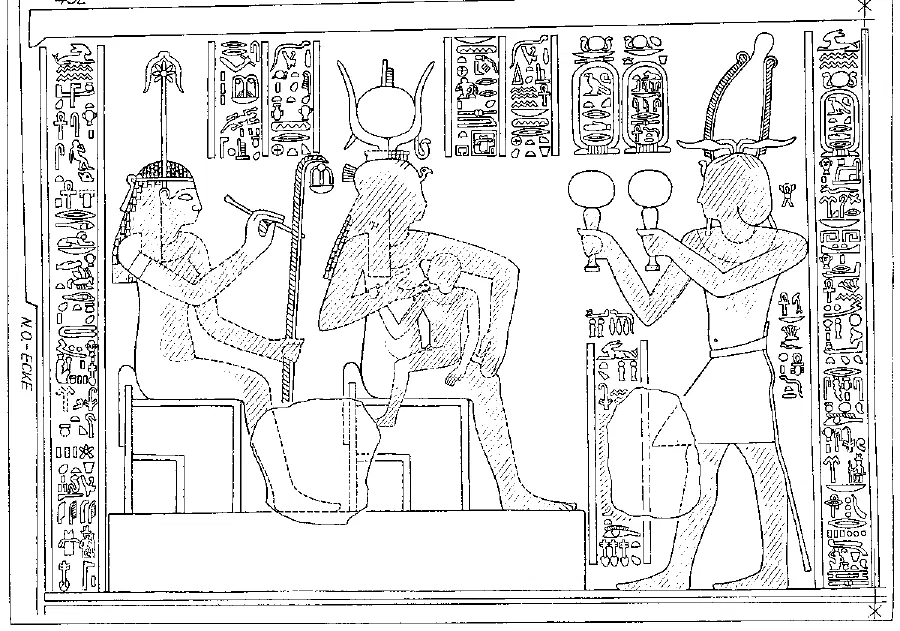
Page 185. The scene as drawn on the wall, facing p. 185 of the edition. Drawing by Otto Baum, in Junker and Winter, Das Geburtshaus des Tempels der Isis in Philä (1965) - 219p. 185, l. 1
ḥnk wn.tj-ḥr ḏd mdw
Presenting the two mirrors. Words to be spoken:
- 220p. 185, l. 2
wn.tj-ḥr nn … (dgj?) nfrw-ṯ
These two mirrors … see your beauty.
- 221p. 185, l. 3
njśwt bjt nb tꜣ.wj ꜣwtḳrdr
King of Upper and Lower Egypt, Lord of the Two Lands, Autokrator,
- 222p. 185, l. 4
sꜣ Rꜥ nb ḫꜥ.w Tbrjś …
Son of Ra, Lord of Crowns, Tiberius …
- 223p. 185, l. 5
sꜣ ꜥnḫ wꜣś nb ḥꜣ-f mj Rꜥ ḏ.t
May all protection, life and dominion surround him as they surround Ra, forever.
- 224p. 185, l. 6
ḏd mdw jn | ꜣŚ.t dj(.t) ꜥnḫ nb(.t) ꜣJrk ḥnw.t
Words spoken by Isis, giver of life, lady of Philae, sovereign,
- 225p. 185, l. 7
nb(.t) jꜣ.t wꜥb.t rr sꜣ-s m Ḥw.t-wṯṯ
lady of the Pure Mound, who nurses her son in the birth house.
- 226p. 185, l. 8
ḏd mdw n | Mꜣꜥ.t sꜣ.t Rꜥ ḥrj(.t)-jb ꜣJrk
Words spoken to Maat, daughter of Ra, who dwells in Philae,
- 227p. 185, l. 9
śpḥr ḥb.w-śd ꜥšꜣ.w n sꜣ Wśjr
who records many Sed festivals for the son of Osiris.
Note · Line 227
The Sed festival was a royal jubilee that renewed the king’s power to rule. - 228p. 185, l. 10
wnn mw.t nṯr ḥr śꜥnḫ sꜣ-s ḫnt śbḫ.t (n) ꜥnḫ
The god’s mother gives life to her son within the Gate of Life,
Note · Line 228
The Gate of Life is a name for the birth house. - 229p. 185, l. 11
r jrj(.t) nb
that he may become lord,
- 230p. 185, l. 12
ḥr šsp kꜣ.t jrj(.t) n-ṯ (sic) sꜣ-ṯ (sic)
and she receives the work your son has made for you
Note · Line 230
The words turn from speaking of Isis to addressing her. The work is the mirror presented to her. - 231p. 185, l. 13
ḥr mꜣꜣ nfrw n ḥm-ṯ (sic)
and beholds the beauty of Your Majesty.
- 232p. 185, l. 14
św (sic) m ḥḳꜣ.t n nṯr.w
He is queen of the gods,
Note · Line 232
The titles belong to Isis, though the pronoun here is masculine. - 233p. 185, l. 15
ḥnw.t n nṯr.wt jtj(.t) wṯṯ nṯr nfr
mistress of the goddesses, sovereign who bore the good god.
Note · Line 233
“The good god” is a title of the king. - 234p. 185, l. 16
wnn njśwt bjt ꜣwtḳrdr ḥr p-f
The King of Upper and Lower Egypt, Autokrator, is on his throne,
- 235p. 185, l. 17
m ḥḳꜣ wr nb Ḥḥ
a great ruler, lord of Heh,
- 236p. 185, l. 18
ḥr rdj(.t) ꜥnḫ-n-mꜣꜣ-ḥr ḥr mw.t-f
giving his mother a mirror for seeing the face,
Note · Line 236
The Egyptian word for “mirror” here also means “life.” - 237p. 185, l. 19
r śnḏm jb-s n ḥf ḥr-s
to gladden her heart with the sight of her face.
- 238p. 185, l. 20
św m jtj nb r.wj² (m-)ꜥb r-ḥmt
He is the sovereign, lord of gold and silver,
- 239p. 185, l. 21
ꜥrḳ kꜣ.t n ḥnw.t-f mrj(.t)-s³
who completes for his lady the work she loves.
Tiberius consigns an offering to Isis, Osiris and Horus, avenger of his father
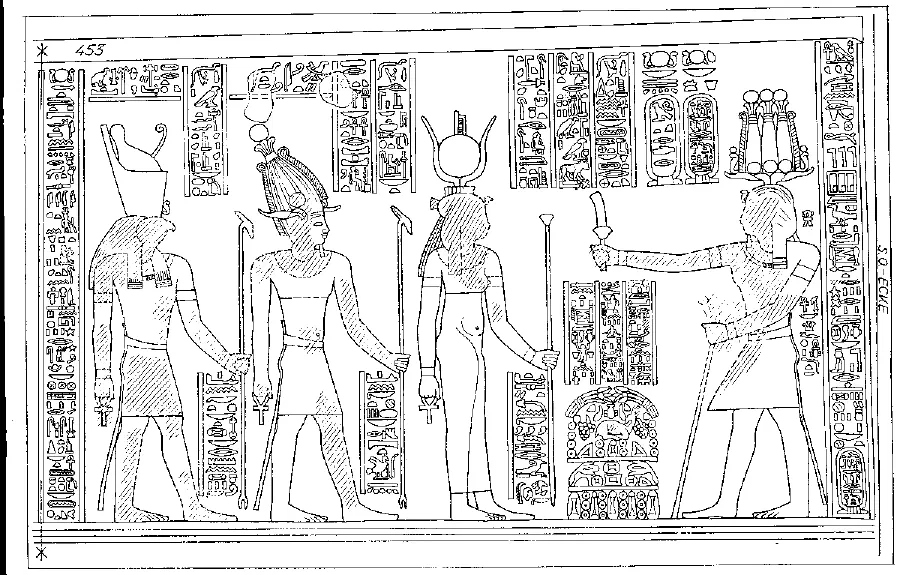
Page 187. The scene as drawn on the wall, facing p. 187 of the edition. Drawing by Otto Baum, in Junker and Winter, Das Geburtshaus des Tempels der Isis in Philä (1965) - 240p. 187, l. 1
mn n-tn ꜥb.t m jḫ.t nb.t(?)¹
Take for yourselves the offering of all things.
- 241p. 187, l. 2
ḥꜥꜥ-tn ḥr mꜣꜣ jrj(.t)-n-j
Rejoice when you see what I have done.
Note · Line 241
The emperor, speaking as pharaoh, invites the gods to eat the food he has offered them. - 242p. 187, l. 3
ꜥḥꜥ-tn ḥms-tn jm-sn jw.w wꜥb.w
Eat of these offerings, for they are pure.
- 243p. 187, l. 4
m ḫr.t-t(n) mꜣꜥ(.t)-j ḫr-tn
What I set before you is your due.
- 244p. 187, l. 5
ḥtp-tn ḥr jr.t Ḥrw
Take delight in the Eye of Horus.
Note · Line 244
The food is offered as the Eye of Horus: the eye was injured in his struggle with Seth and made whole again. - 245p. 187, l. 6
njswt bjt nb tꜣ.wj ꜣwtḳrdr
King of Upper and Lower Egypt, lord of the Two Lands, Autokrator,
- 246p. 187, l. 7
sꜣ Rꜥ nb ḫꜥ.w Tbrjs Kjsrs ꜥnḫ ḏ.t mrj Ptḥ Js.t
son of Ra, lord of crowns, Tiberius Caesar, who lives forever, beloved of Ptah and Isis.
- 247p. 187, l. 8
sꜣ ꜥnḫ wꜣs nb ḥꜣ-f mj Rꜥ ḏ.t
May all protection, life and dominion surround him as they surround Ra, forever.
- 248p. 187, l. 9
ḏd mdw n | Js.t dj(.t) ꜥnḫ
Words spoken by Isis, giver of life,
- 249p. 187, l. 10
nb(.t) jꜣ.t wꜥb.t ḥnw.t nb(.t) Jrk
lady of the Abaton, sovereign lady, mistress of Philae,
- 250p. 187, l. 11
šps.t wsr.t ḫnt (so) š.t-msḫn
the august one, the mighty one who presides over the birth house,
- 251p. 187, l. 12
mw.t nṯr n(.t) Ḥrw kꜣ nḫt
divine mother of Horus, the mighty bull,
- 252p. 187, l. 13
ḥḳꜣ.t mnḫ.t ḥm.t n(.t) ḥḳꜣ
able ruler, wife of the ruler,
- 253p. 187, l. 14
jr(.t) msw.t ḥḳꜣ m š.t tn
who gave birth to the ruler in this place:
- 254p. 187, l. 15
dj-j stj n-k ḥꜥpj r bꜥḥ ꜣḫ.t-k tp-rnp.t
I make the Nile pour forth for you to flood your farmland each year.
- 255p. 187, l. 16
ḏd mdw n | Wsjr nṯr ꜥꜣ nb jꜣ.t wꜥb.t
Words spoken by Osiris, the great god, lord of the Abaton,
- 256p. 187, l. 17
sḫm špsj nb Jrk ꜥnḫ nb ꜥnḫ
august power, lord of Philae, living one, lord of life,
- 257p. 187, l. 18
ꜥnḫ r nḥḥ rnpj mꜣwj r ḏ.t
who lives for eternity, who grows young again and renews himself forever:
Note · Line 257
The two words for eternity evoke time that returns in cycles and time that endures without end. - 258p. 187, l. 19
dj-j n-k jḫ.t nb.t ḏr(.t) p.t ḳmꜣ(.t) tꜣ
I give you all that the sky bestows and the earth creates.
- 259p. 187, l. 20
ḏd mdw n | Ḥrw nḏ.tj jt-f sꜣ Js.t sꜣ Wsjr
Words spoken by Horus, champion of his father, son of Isis, son of Osiris,
- 260p. 187, l. 21
nb jꜣ.t wꜥb.t Jrk nḏ.tj jt-f m Snm.t
lord of the Abaton and of Philae, who champions his father on Bigeh:
- 261p. 187, l. 22
dj-j n-k jḫ.t nb.t nfr.t nb.t (sic) r mn-k
I give you all things, every good thing, to sustain you.
- 262p. 187, l. 23
njswt bjt | ꜥꜣ.t m p.t jfd n tꜣ ḫr wḏ.t-s
King of Upper and Lower Egypt, great one in heaven, the four corners of the earth at her command,
Note · Line 262
Here Isis herself bears the title of pharaoh. - 263p. 187, l. 24
jtj.t n(.t) tpj.w-ꜥ
queen of those who came before,
- 264p. 187, l. 25
ḥḳꜣ.t n(.t) jj(.w) ḫr sꜣ-s
ruler of those who come after her,
- 265p. 187, l. 26
nḥp nṯr.w r dwꜣ-s rꜥ nb
whom the gods rise at dawn each day to praise,
- 266p. 187, l. 27
nb(.t) njw.wt spꜣ.wt ḥnꜥ sn-s sꜣ-s
lady of towns and provinces together with her brother and her son,
Note · Line 266
Her brother is Osiris, her son Horus. - 267p. 187, l. 28
Js.t dj(.t) ꜥnḫ nb.t jꜣ.t wꜥb.t
Isis, giver of life, lady of the Abaton,
- 268p. 187, l. 29
ḥnw.t (so) nb(.t) Jrk
sovereign lady, mistress of Philae.
- 269p. 187, l. 30
ꜥnḫ | nṯr nfr ḥꜥpj n bꜣḳ.t
Long live the good god, the Nile of Egypt,
Note · Line 269
He feeds the temples as the Nile feeds Egypt. - 270p. 187, l. 31
mḥ ḥw.wt nṯr.w m ḏfꜣ.w
who fills the houses of the gods with food,
- 271p. 187, l. 32
rdj ꜥb.t ꜥꜣ.t (ḥr?) nṯr.w wr.w m jḫ.t nb.t(?)¹
who gives the great gods a great offering of every kind,
- 272p. 187, l. 33
jnj nṯr r ḥtp.w sp ḫmt n hrw
who brings the god to the offerings three times a day,
- 273p. 187, l. 34
nb jḫ.t Tbrjs …
lord of offerings, Tiberius …