~/sacred-texts/philae-birth-house-of-the-isis-temple
Philae Birth House, Seven Hathors: We Beat the Tambourine for You
- Date
- Carved in the birth house of the Isis temple at Philae from Ptolemy VI (180–145 BC) to Tiberius (AD 14–37); the seven Hathors, the palace procession and the purification belong to Ptolemy XII (80–51 BC)
- Found
- Philae, at the First Cataract of the Nile; the temple was taken apart and rebuilt on Agilkia island near Aswan in 1977–1980, where the inscriptions still stand
- Language
- Egyptian · Hieroglyphic
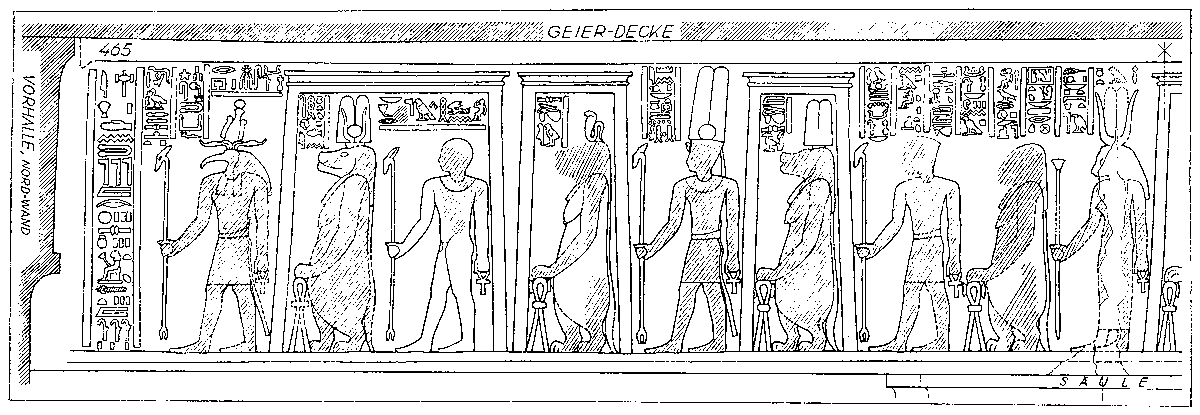
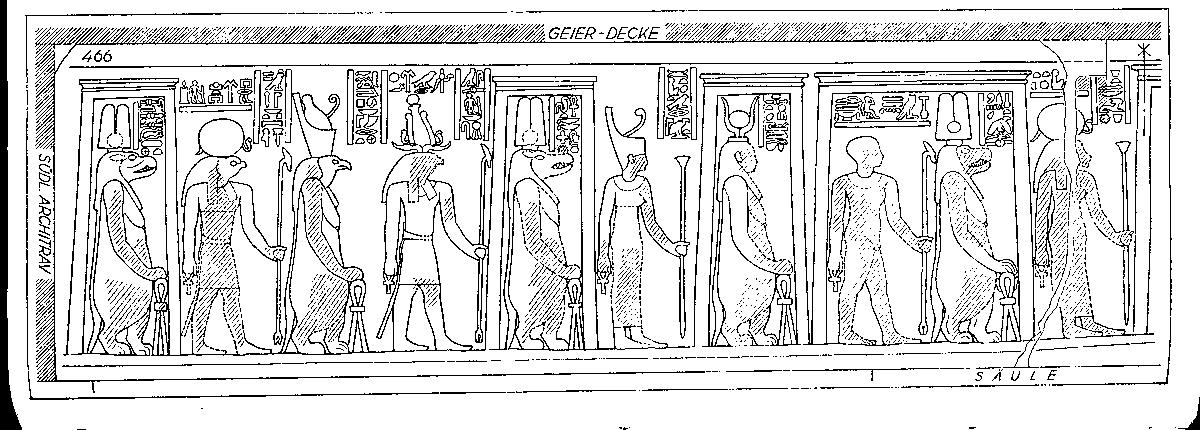
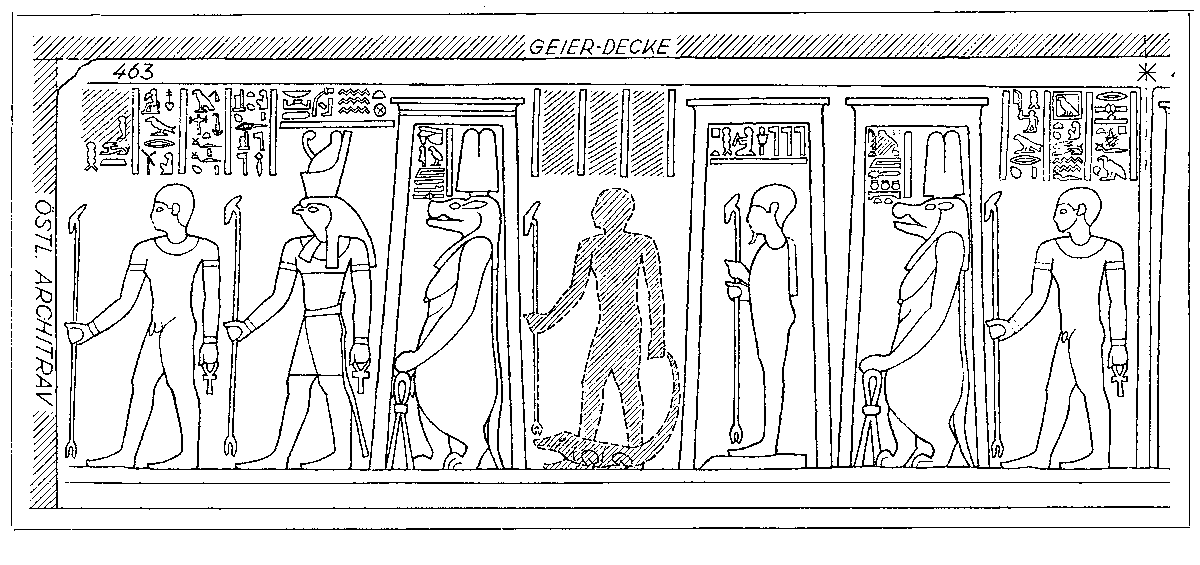
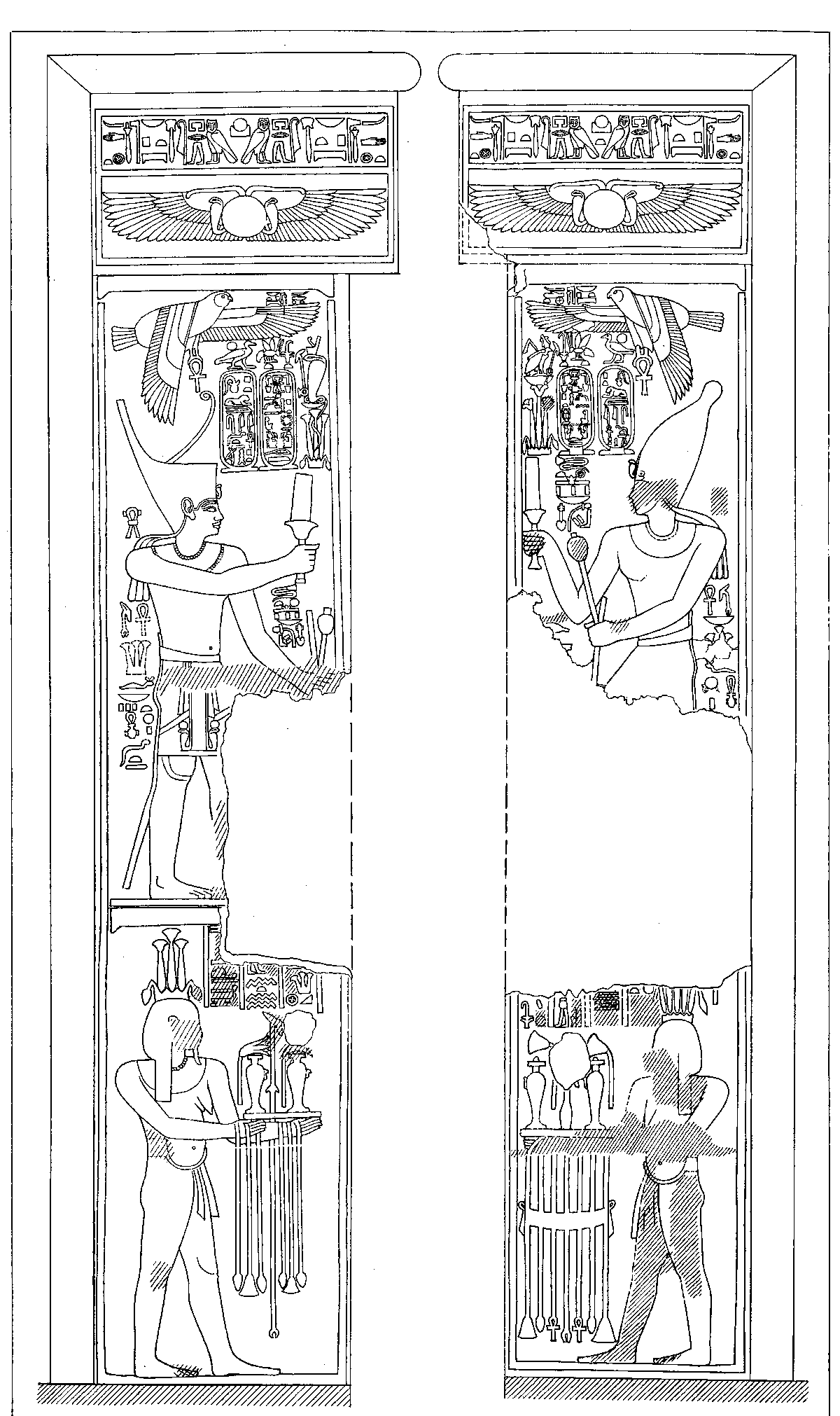
Tiberius holds out gifts to the gods of Philae: a gold amulet for Isis, a mirror for Satis and Anuket, wine for Horus the Child, to whom Hathor promises drunkenness day after day. Gods of the months cross the architraves; vultures spread their wings over the ceiling.
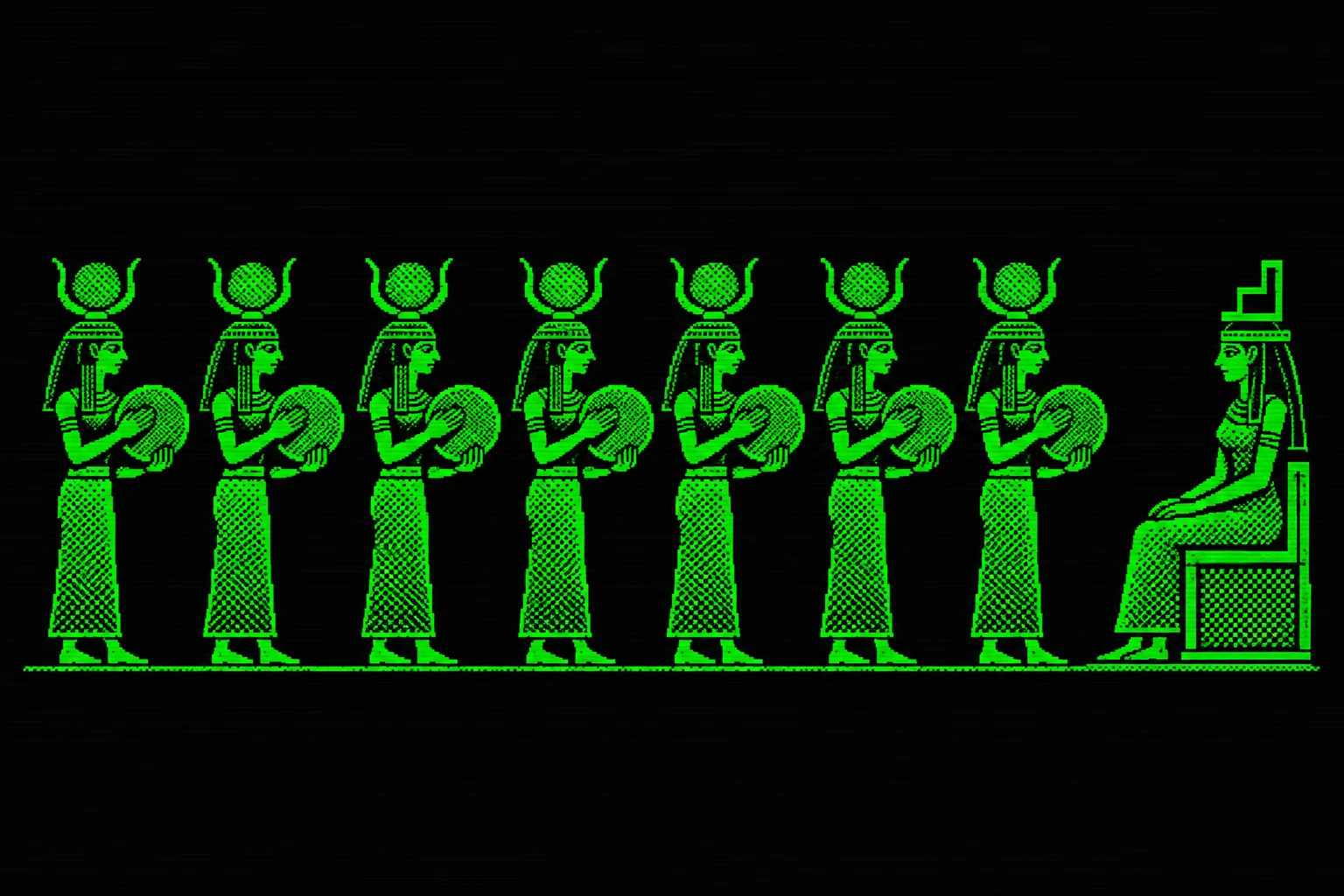
Under Ptolemy XII seven Hathors sing to Isis: We beat the tambourine for you, lady of the Abaton. The king leaves his palace behind standards that shout Back with you, foes, foes who cross Pharaoh’s path! A priest censes the cobra, and Thoth washes the king: I have driven the evil that was on you down to the ground.
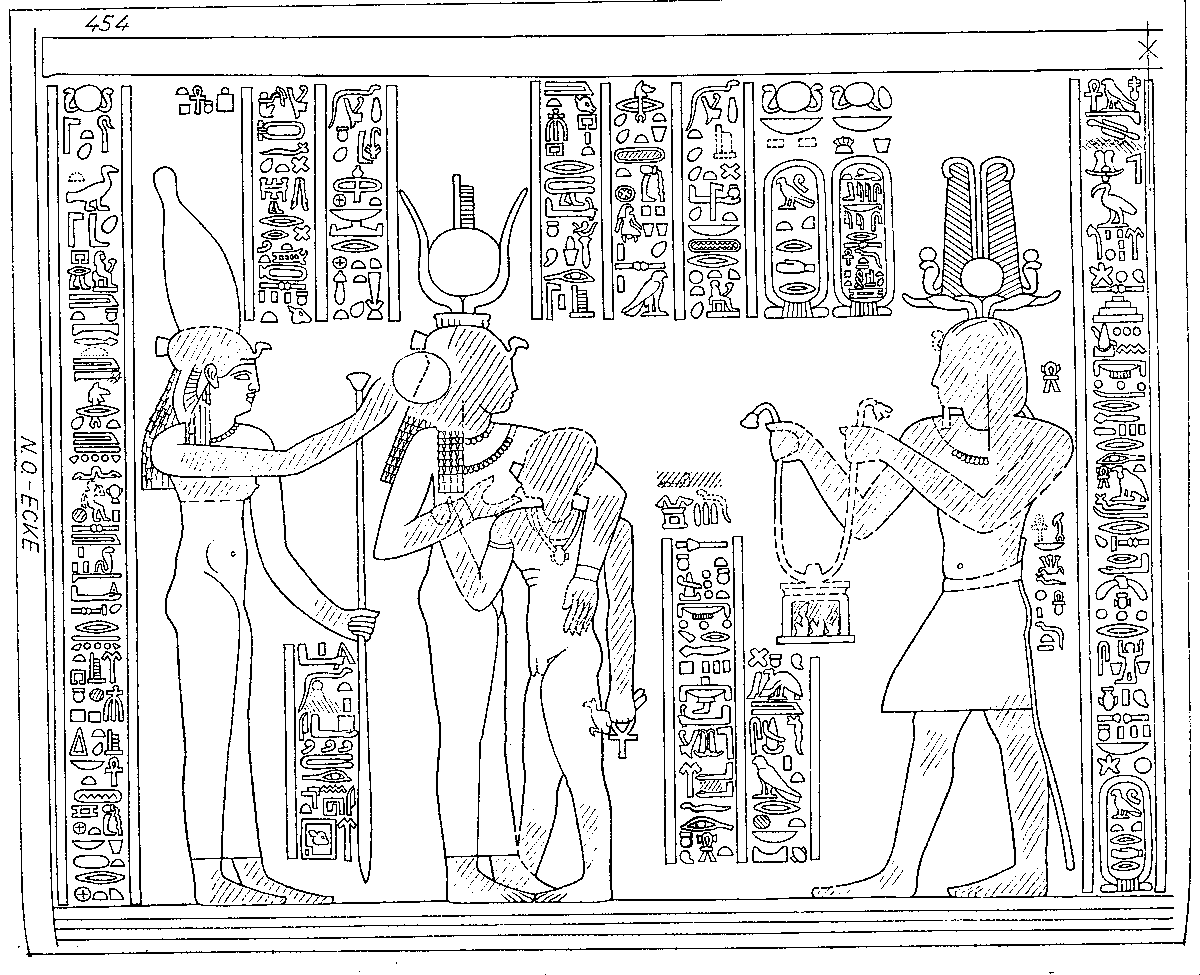
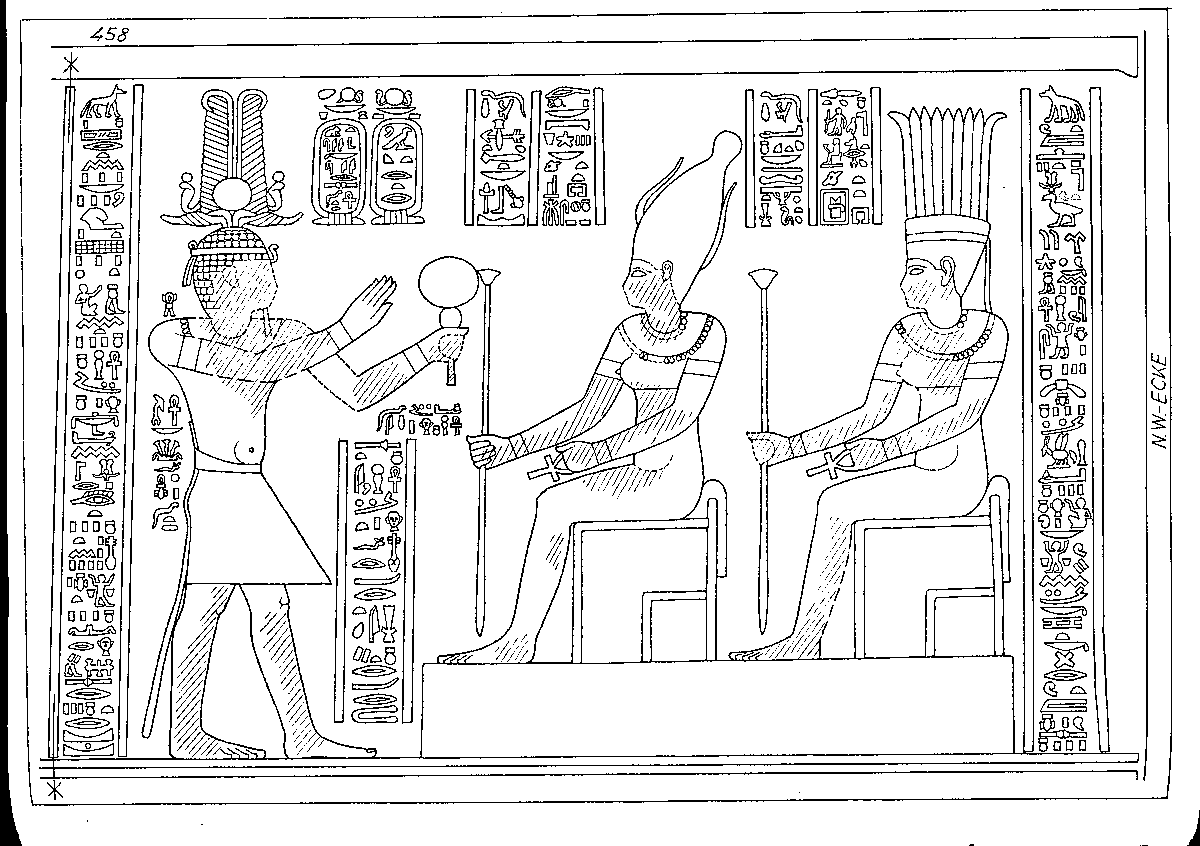
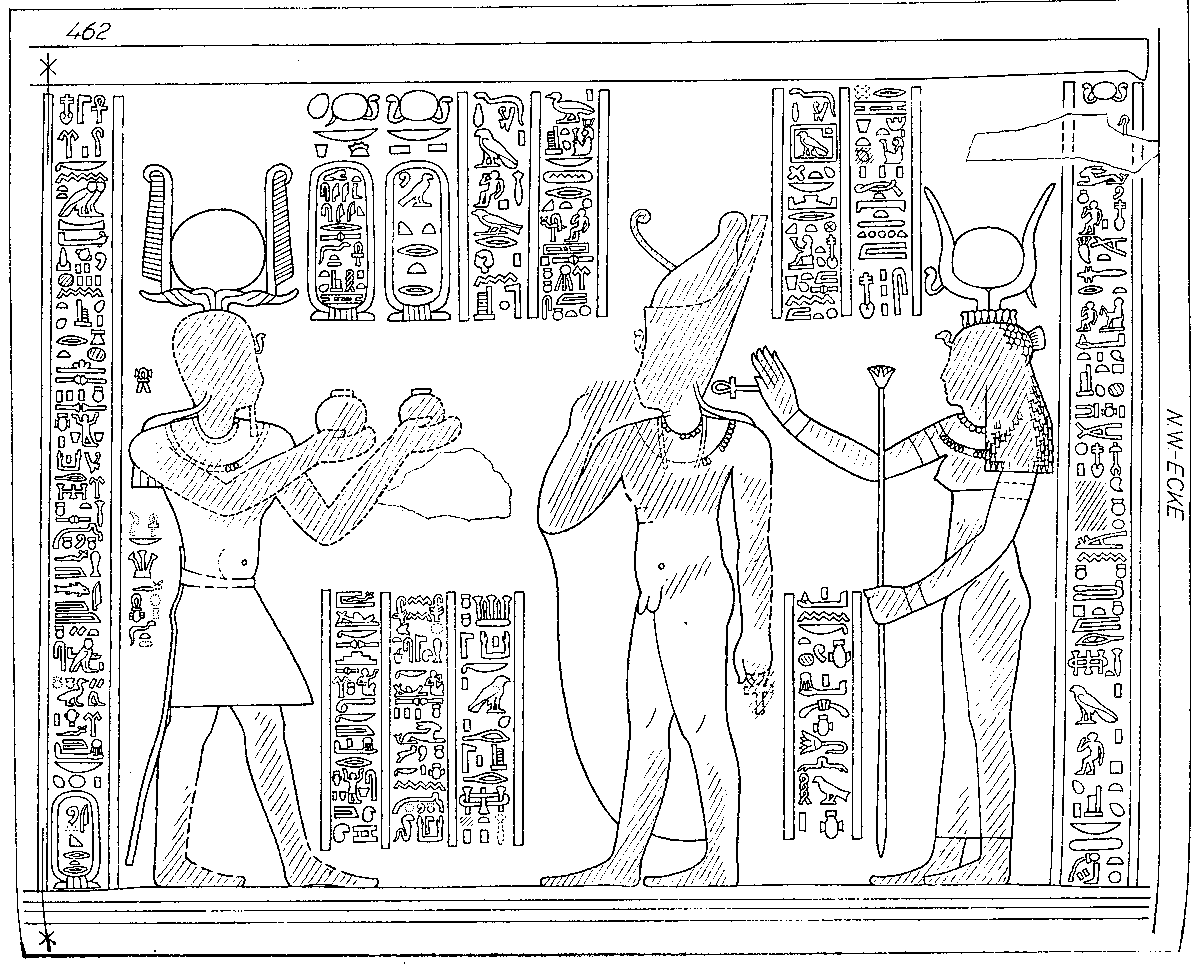
Tiberius gives Isis a breast amulet of gold
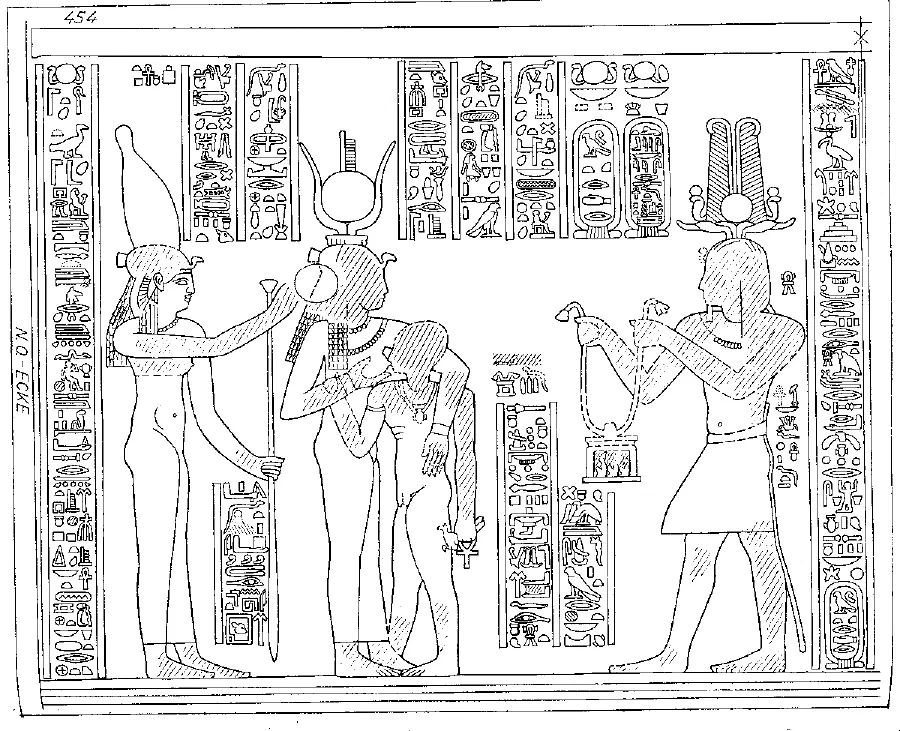
Page 189. The scene as drawn on the wall, facing p. 189 of the edition. Drawing by Otto Baum, in Junker and Winter, Das Geburtshaus des Tempels der Isis in Philä (1965)The hatched figures were hacked off the wall on purpose. After Justinian closed the temple of Isis around 537, Christians made it a church and chiselled out the gods and kings, mostly sparing the hieroglyphs. - 1p. 189, l. 1
(ḥnk) wḏꜣw ḏd mdw
Presenting a breast amulet. Words to be spoken:
Note · Line 1
The king presents the amulet to Isis. - 2p. 189, l. 2
mn n-ṯ wḏꜣw n nb ḥnꜥ ꜥꜣ.wt
Receive this amulet of gold and precious stones,
- 3p. 189, l. 3
nbj-n Tnn m ꜥ.wj-f
which Tatenen fashioned with his own two hands.
Note · Line 3
Tatenen was a creator god identified with Ptah, patron of craftsmen. - 4p. 189, l. 4
jrj-n-f sꜣ-ṯ wḥm-n-f mk.t-ṯ
It has guarded you and renewed your protection;
- 5p. 189, l. 5
śwḏꜣ-f Ḥrw-ṯ r jḫ.t nb.t ḏw.t
it keeps your Horus safe from every evil thing.
- 6p. 189, l. 6
njśwt bjt nb tꜣ.wj ꜣwtḳrdr
King of Upper and Lower Egypt, Lord of the Two Lands, Autokrator,
Note · Line 6
Autokrator is the Greek imperial title borne here by the Roman emperor in his role as pharaoh. - 7p. 189, l. 7
sꜣ Rꜥ nb ḫꜥ.w Tbrjś …
Son of Ra, Lord of Crowns, Tiberius …
- 8p. 189, l. 8
sꜣ ꜥnḫ wꜣś nb ḥꜣ-f mj Rꜥ ḏ.t
May all protection, life and dominion surround him as they surround Ra, forever.
- 9p. 189, l. 9
ḏd mdw n | ꜣꜤś.t wr.t mw.t nṯr nb(.t) ꜣJrk
Words spoken by Isis the Great, Mother of the God, Lady of Philae,
- 10p. 189, l. 10
špś.t wśr.t ḥnw.t jꜣ.t wꜥb.t
the august one, the mighty one, mistress of the Abaton,
Note · Line 10
The Abaton, the “Pure Mound” in Egyptian, was the sacred burial place of Osiris on the island of Bigeh beside Philae. - 11p. 189, l. 11
pꜥpꜥ sꜣ-ś Ḥrw m ḫnt prj-mśj.t
who bore her son Horus within the birth house,
Note · Line 11
The birth house was the sanctuary where the birth of the divine child was celebrated. - 12p. 189, l. 12
r jṯj(.t) jꜣw.t n jt-f Wśjr
that he might take up the office of his father Osiris.
Note · Line 12
The office is kingship: Horus succeeds his father as king. - 13p. 189, l. 13
ḏd mdw n | Nḫb.t ḥḏ.t Nḫn nb(.t) ꜣJrk
Words spoken by Nekhbet, the White One of Nekhen, Lady of Philae,
Note · Line 13
Nekhbet was the vulture goddess of Upper Egypt. Her title recalls its white crown. - 14p. 189, l. 14
śn.t mnḫ.t n jmn-rn-f
excellent sister of him whose name is hidden,
- 15p. 189, l. 15
wr.t n ḫrj r wr
the Great One who never leaves the Great One;
- 16p. 189, l. 16
ḏm-tw rn-śn ḫnt śḫḫ.t n(.t) ꜥnḫ
their names are spoken in the Pavilion of Life.
Note · Line 16
The Pavilion of Life is a name for the birth house. - 17p. 189, l. 17
ḥwj-j ḏ.t-ṯ(?) mkj(?)-j ḥꜥ.w-ṯ
I guard your body and protect your limbs.
Note · Line 17
Nekhbet speaks here to Isis. - 18p. 189, l. 18
jrj-j nḥ.t m ḥw.t-ḥnt
I provide protection at Philae.
- 19p. 189, l. 19
njśwt bjt | ḥḳꜣ.t sꜣ.t Gb
King of Upper and Lower Egypt, ruler, daughter of Geb,
Note · Line 19
Isis bears the king’s title here. Geb is the earth god, Nut the sky goddess. - 20p. 189, l. 20
špś.t prj(.t) m Nw.t
the august one who came forth from Nut,
- 21p. 189, l. 21
ꜥꜣ.t m p.t wśr.t m tꜣ
great in heaven, mighty on earth,
- 22p. 189, l. 22
nn ḥr ḥ.w-ś m nṯr.wt
without equal among the goddesses,
- 23p. 189, l. 23
ḏj(.t) sꜣ-ś r tꜣ m ś.t-mśḫn(.t)
who brought her son into the world in the birth chamber:
- 24p. 189, l. 24
ꜣꜤś.t ḏj(.t) ꜥnḫ nb.t jꜣ.t wꜥb.t ḥnw.t nb(.t) ꜣJrk
Isis, giver of life, Lady of the Abaton, sovereign, Lady of Philae.
- 25p. 189, l. 25
ꜥnḫ | nṯr nfr jwꜥw n Tnn
Long live the good god, heir of Tatenen,
Note · Line 25
The “good god” is the king, here in the role of a divine craftsman. - 26p. 189, l. 26
jḳr ḏbꜥ.w¹ m wnw.t-f²
deft of finger at his work,
- 27p. 189, l. 27
śꜣr wḏꜣw n nb ḥnꜥ ꜥꜣ.wt
who holds out an amulet of gold and precious stones.
- 28p. 189, l. 28
r jrj(.t) sꜣ mw.t-f ḥnꜥ sꜣ-ś
to keep his mother and her son safe,
- 29p. 189, l. 29
rḏj ꜥw.t-jb r śḫꜥꜥ jb-śn
who gives the amulet to gladden their hearts,
- 30p. 189, l. 30
nb wnw.t³ ꜣwtḳrdr
master of craftsmanship, Autokrator.
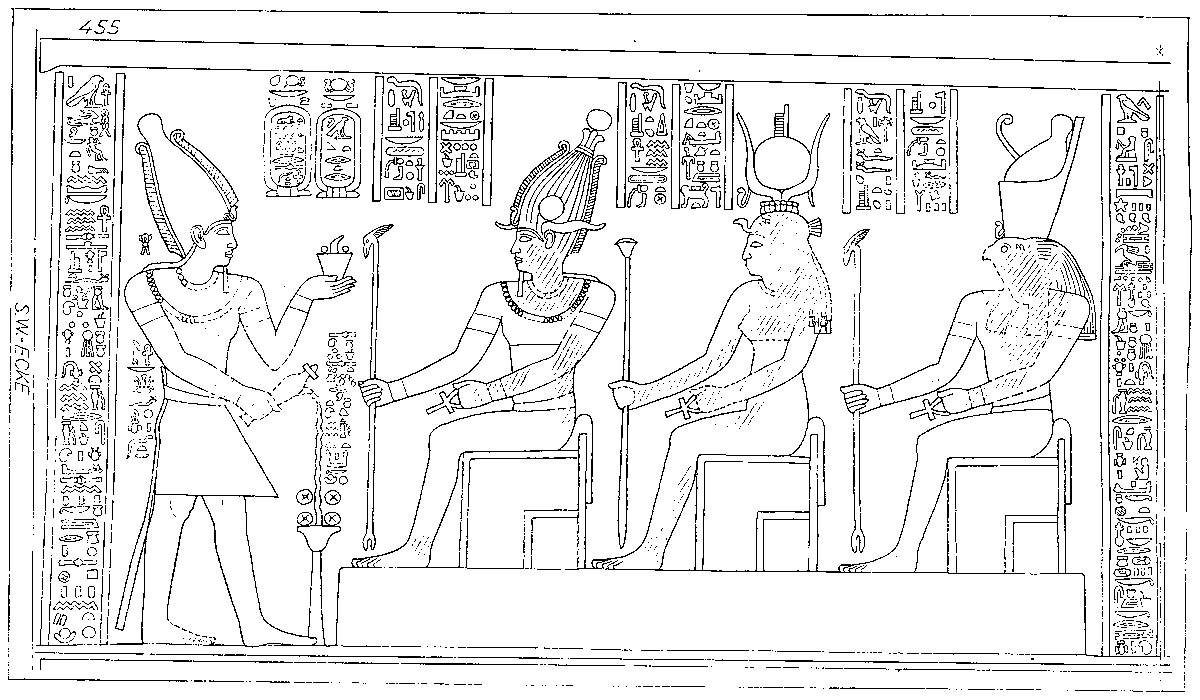
Tiberius burns incense and pours water for Osiris
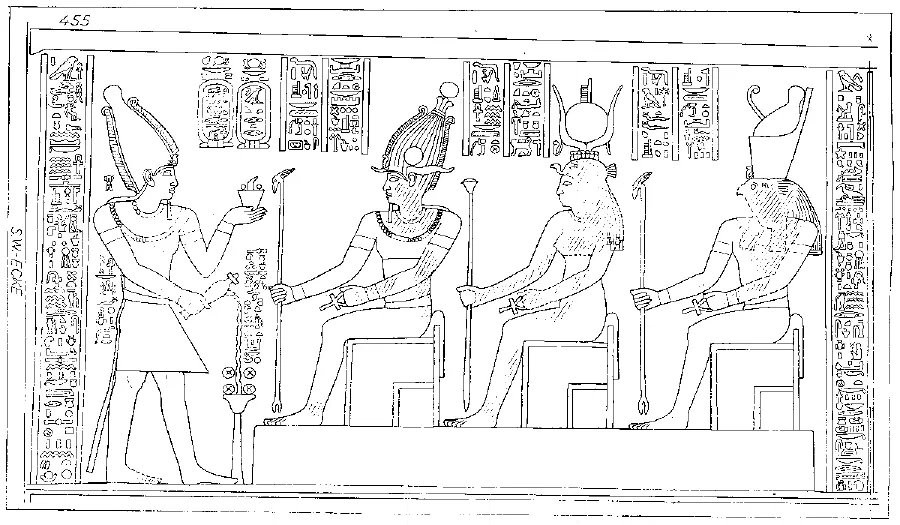
Page 191. The scene as drawn on the wall, facing p. 191 of the edition. Drawing by Otto Baum, in Junker and Winter, Das Geburtshaus des Tempels der Isis in Philä (1965) - 31p. 191, l. 1
mn n-k snṯr
Take the incense for yourself;
- 32p. 191, l. 2
sṯj-f r fnḏ-k
may its fragrance reach your nose.
- 33p. 191, l. 3
ḳbḥ-tw (?) kꜣ-k rꜥ nb
A libation is poured for your ka every day.
Note · Line 33
The ka is the life force of a god or a person. Offerings of food and drink sustain it. - 34p. 191, l. 4
njśwt bjt nb tꜣ.wj ꜣwtḳrtr
King of Upper and Lower Egypt, lord of the Two Lands, Autokrator,
- 35p. 191, l. 5
sꜣ Rꜥ nb ḫꜥ.w Tbrjś …
son of Ra, lord of crowns, Tiberius …
- 36p. 191, l. 6
sꜣ ꜥnḫ wꜣś nb ḥꜣ-f mj Rꜥ ḏ.t
May all protection, life and dominion surround him as they surround Ra, forever.
- 37p. 191, l. 7
ḏd mdw n | Wśjr nṯr ꜥꜣ nb jꜣ.t wꜥb.t
Words spoken by Osiris, the great god, lord of the Abaton,
Note · Line 37
The Abaton was the sacred burial place of Osiris on the island of Bigeh, beside Philae. - 38p. 191, l. 8
śḫm špśj nb ꜣJrḳ
august power, lord of Philae,
- 39p. 191, l. 9
nb mnwr snṯr ś.t-f m snṯr
lord of incense, whose seat is censed with incense.
- 40p. 191, l. 10
ḏd mdw n | ꜣJś.t dj(.t) ꜥnḫ nb(.t) jꜣ.t wꜥb.t
Words spoken by Isis, giver of life, lady of the Abaton,
- 41p. 191, l. 11
ḥnw.t nb(.t) ꜣJrḳ
sovereign lady, mistress of Philae,
- 42p. 191, l. 12
ḥwj.t ḫntj nmj.t¹
who shields the one upon the bier.
Note · Line 42
It is Osiris, her husband, who lies on the bier. - 43p. 191, l. 13
ḏd mdw n | Ḥrw nḏ.tj jt-f
Words spoken by Horus, avenger of his father,
- 44p. 191, l. 14
sꜣ ꜣJś.t sꜣ Wśjr nb jꜣ.t wꜥb.t
son of Isis, son of Osiris, lord of the Abaton,
- 45p. 191, l. 15
… jt-f r sbj.w
… his father from the rebels.
- 46p. 191, l. 16
ꜥnḫ | Ḥrw ḥwn nb Kbn
Long live Horus the youth, lord of Byblos,
- 47p. 191, l. 17
nb (so) ꜥnḫ śḥtp nṯr ḥr ś.t-f
lord of life, who gladdens the god on his throne:
- 48p. 191, l. 18
jnj-j n-k snṯr wbn ḥr śḏ.t
I bring you incense rising on the flame
- 49p. 191, l. 19
ḳbḥw r śḳbb jb-k
and cool water to cool your heart.
- 50p. 191, l. 20
ḥnk-śn n-k m ḫr.t hrw sp ḫmt n.t rꜥ nb
They are offered to you as your daily portion, three times each day.
- 51p. 191, l. 21
nṯr pn špśj śḫm wr ḥrj nṯr.w
This august god, the great power above the gods,
- 52p. 191, l. 22
ḥꜥpj bꜥḥ tꜣ m nfrw-f
Hapy, who floods the land with his beauty:
Note · Line 52
Osiris now answers as Hapy, the Nile in flood. - 53p. 191, l. 23
jnj-k n-j snṯr wbn ḥr śḏ.t
You bring me incense rising on the flame
- 54p. 191, l. 24
ḳbḥw r śḳbb jb-j
and cool water to cool my heart.
- 55p. 191, l. 25
dj-j n-k ḫ.t-k (sic) nfr.t nb.t r ḫr.t-k
I give you all your good things for your sustenance,
- 56p. 191, l. 26
śꜥm-k r mr(r.t) jb-k
that you may eat to your heart’s content.
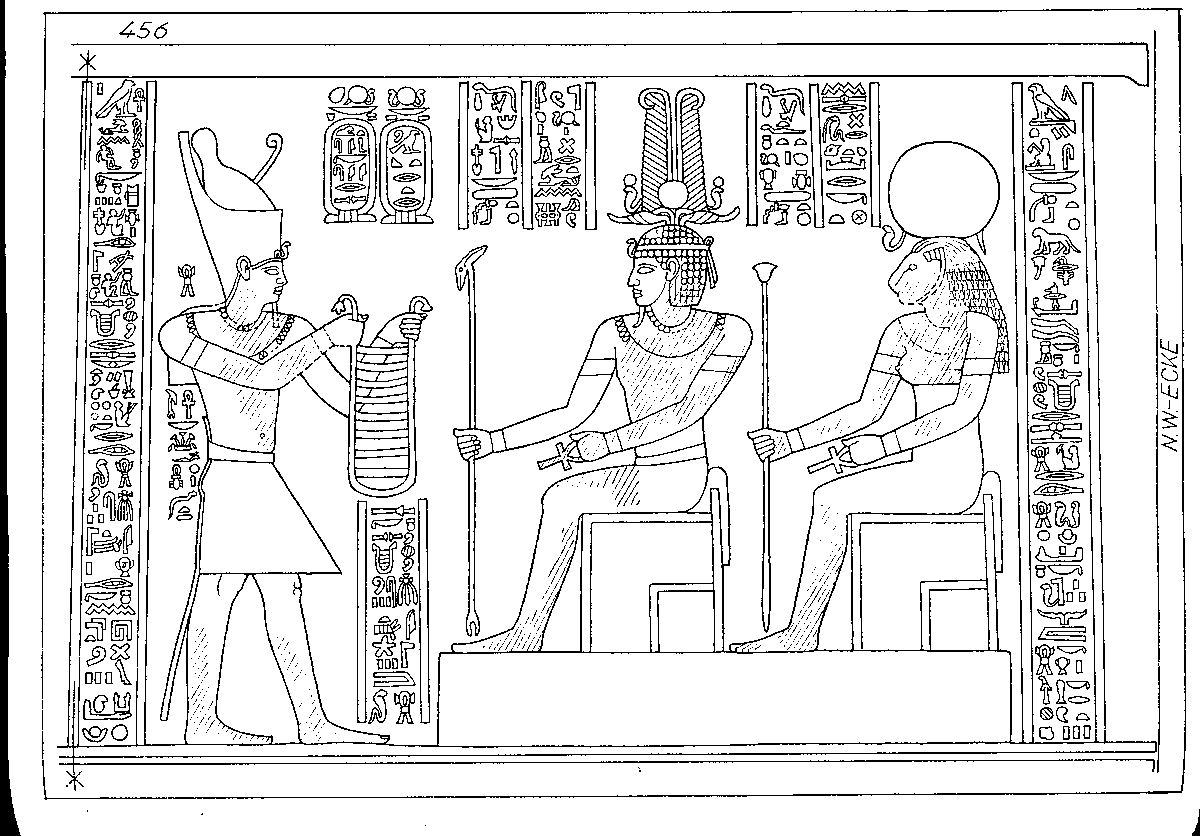
Tiberius gives Arensnuphis a broad collar
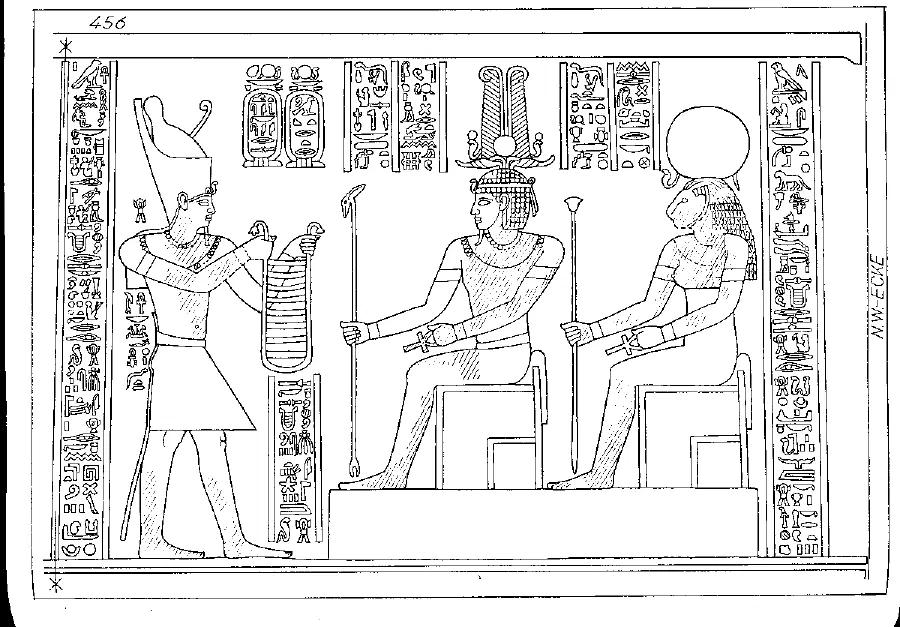
Page 193. The scene as drawn on the wall, facing p. 193 of the edition. Drawing by Otto Baum, in Junker and Winter, Das Geburtshaus des Tempels der Isis in Philä (1965) - 57p. 193, l. 1
mn n-k wsḫ
Take the broad collar for yourself.
- 58p. 193, l. 2
ms.w ’Jtm m sꜣ-k
Atum’s children are your protection.
Note · Line 58
Atum’s children are Shu and Tefnut, the two gods named below. - 59p. 193, l. 3
njśwt bjt nb tꜣ.wj ꜣwtḳrtr
King of Upper and Lower Egypt, Lord of the Two Lands, Autokrator,
Note · Line 59
Here it stands where a pharaoh’s throne name would stand. - 60p. 193, l. 4
sꜣ Rꜥ nb ḫꜥ.w Tbrjś Kjsrs
Son of Ra, Lord of Crowns, Tiberius Caesar.
- 61p. 193, l. 5
sꜣ ꜥnḫ wꜣś nb ḥꜣ-f mj Rꜥ ḏ.t
May all protection, life and dominion surround him as they surround Ra, forever.
- 62p. 193, l. 6
ḏd mdw n | ’Jrj-ḥms-nfr nṯr ꜥꜣ nb jꜣ.t wꜥb.t
Words spoken by Arensnuphis, the great god, lord of the Abaton,
- 63p. 193, l. 7
Šw sꜣ Rꜥ jnj wr.t wn ḥrj(.tj)
Shu, son of Ra, who brought back the Great One who was far away.
Note · Line 63
Arensnuphis is named here as Shu. The Great One is Tefnut, the daughter of Ra who had gone far from her father. - 64p. 193, l. 8
ḏd mdw n | Tfn.t sꜣ.t Rꜥ ḥrj(.t)-jb jꜣ.t wꜥb.t
Words spoken by Tefnut, daughter of Ra, who dwells in the Abaton,
- 65p. 193, l. 9
nsr.t wr.t ḫnt ’Jrk
the great fire-serpent, foremost in Philae.
- 66p. 193, l. 10
ꜥnḫ | Ḥrw ḥwn nb (so) ḥnb.w
Long live Horus the youth, lord of the fields,
- 67p. 193, l. 11
nfr-jb jrj mr(r.t) nṯr
glad of heart, who does what the god loves:
- 68p. 193, l. 12
jnj-j n-k wsḫ r śḥb šnb.t-k
I bring you the broad collar to adorn your breast for the feast,
Note · Line 68
The king offers a collar made to cover the neck and upper chest. - 69p. 193, l. 13
jrj.t-ḫḫ-k r jrj(.t) sꜣ-k
your neckpiece to keep you safe.
- 70p. 193, l. 14
ms.w ’Jtm ḥr jrj(.t) n-k nh.t
Atum’s children shield you
- 71p. 193, l. 15
wḥm-w (= śn) mk.t-k rꜥ nb
and renew your protection every day.
- 72p. 193, l. 16
nṯr pw(?) špsj nb jꜣ.t wꜥb.t
This august god, lord of the Abaton,
Note · Line 72
The god who receives the collar now answers the king. - 73p. 193, l. 17
mꜣj rśj wśr ḫpš.wj
the southern lion, mighty in both forelegs:
- 74p. 193, l. 18
jnj-k n-j wsḫ r śḥtp ḥm-j(?)¹
You bring me the broad collar to gladden my Majesty,
- 75p. 193, l. 19
r jrj(.t) sꜣ-j(?) rꜥ nb
to protect me every day.
- 76p. 193, l. 20
dj-j n-k nṯr.w nṯr.wt dmd m sꜣ-k
I give you the gods and goddesses, all together for your protection,
- 77p. 193, l. 21
ḥr ḥwj(.t) ḥm-k r ḫftj.w
shielding your Majesty against enemies.
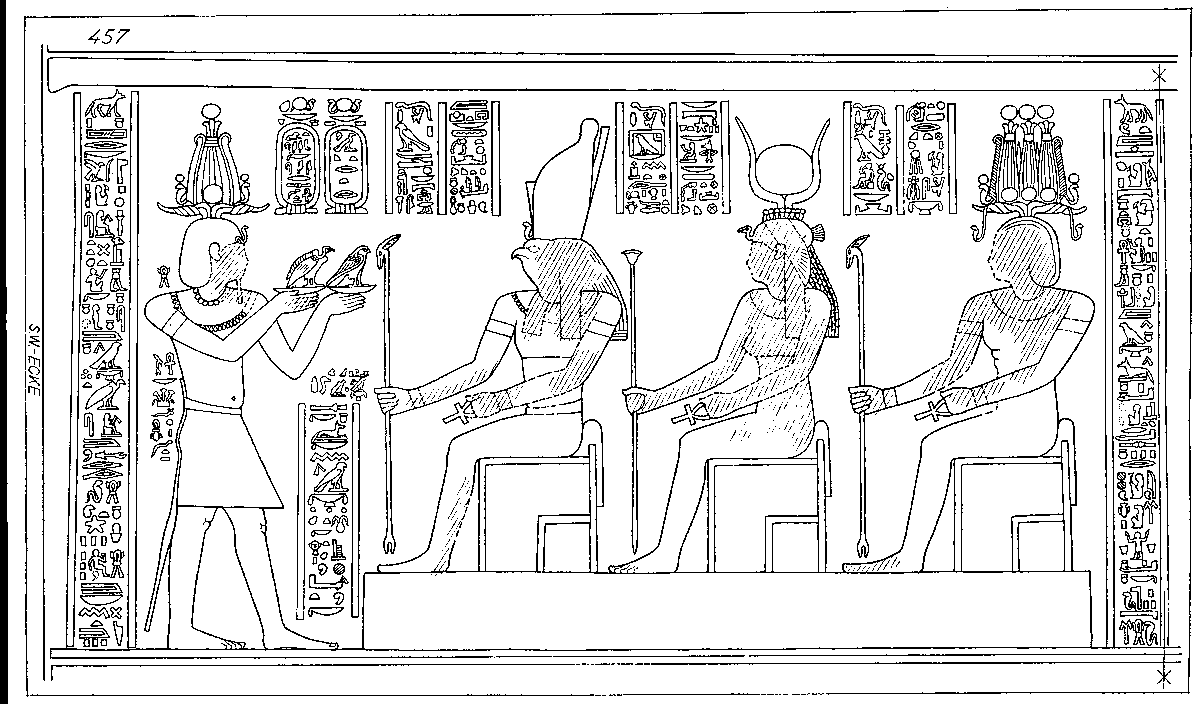
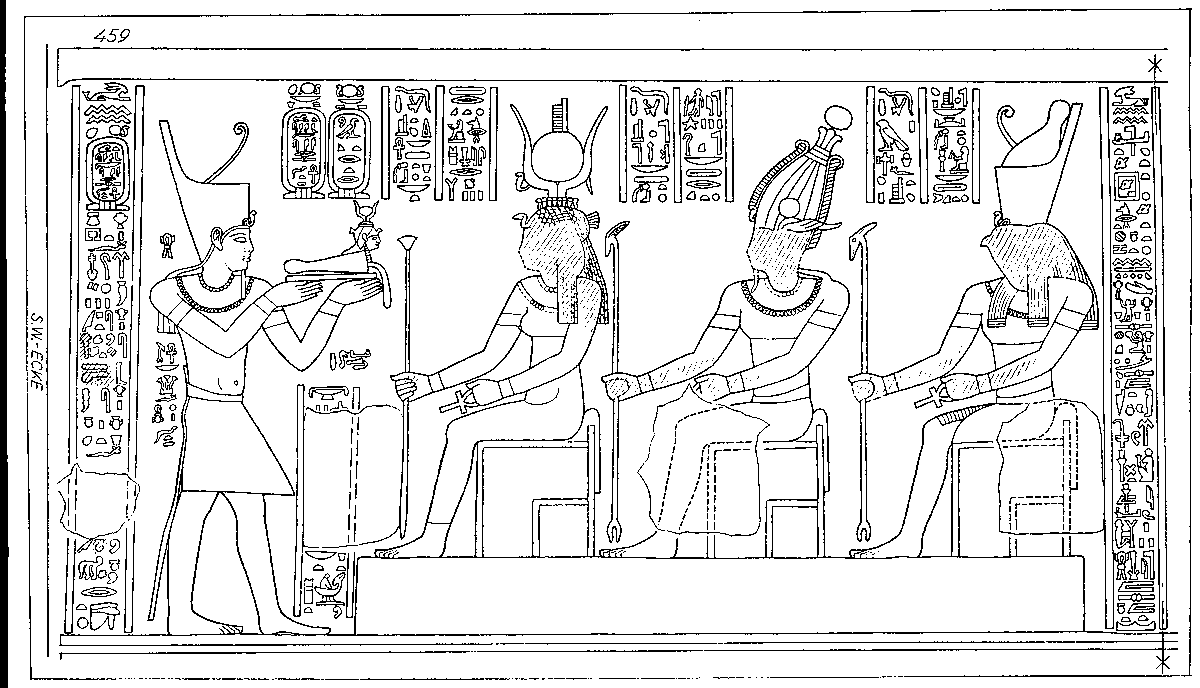
Tiberius gives Horus the falcon and vulture figures
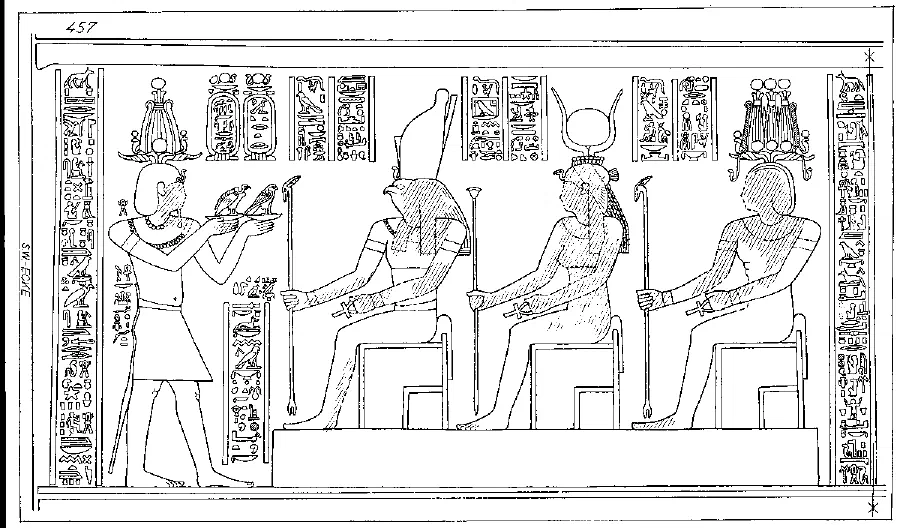
Page 195. The scene as drawn on the wall, facing p. 195 of the edition. Drawing by Otto Baum, in Junker and Winter, Das Geburtshaus des Tempels der Isis in Philä (1965) - 78p. 195, l. 1
ḥnk bjk n nb ḥnꜥ nr.t ḏd mdw
Offering the falcon of gold together with the vulture. Words to be spoken:
- 79p. 195, l. 2
mn n-k šštꜣ-k n bjk n nb
Receive your secret form as a falcon of gold,
Note · Line 79
The falcon is Horus himself in the form of an offering; the vulture represents his mother. - 80p. 195, l. 3
tmꜣ.t-k ꞌJs.t ḥr ḥwj.t-k
while your mother Isis shields you.
- 81p. 195, l. 4
njśwt bjt nb tꜣ.wj ꜣwtḳrtr
King of Upper and Lower Egypt, Lord of the Two Lands, Autokrator,
- 82p. 195, l. 5
sꜣ Rꜥ nb ḫꜥ.w Tbrjś …
Son of Ra, Lord of Crowns, Tiberius …
- 83p. 195, l. 6
sꜣ ꜥnḫ wꜣś nb ḥꜣ-f mj Rꜥ ḏ.t
May all protection, life and dominion surround him as they surround Ra, forever.
- 84p. 195, l. 7
ḏd mdw n | Ḥrw Bḥd.t nṯr ꜥꜣ nb p.t
Words spoken by Horus of Edfu, the great god, lord of the sky,
- 85p. 195, l. 8
śꜣb šw.t prj m ꜣḫ.t
bright of plumage, who rises from the horizon,
- 86p. 195, l. 9
nb jꜣ.t wꜥb.t ꞌJrk
lord of the Abaton and of Philae,
- 87p. 195, l. 10
nḥw nfr n jt-f
the good guardian of his father.
Note · Line 87
Horus’s father is Osiris. - 88p. 195, l. 11
ḏd mdw n | Ḥw.t-Ḥrw nb(.t) ꞌJwn.t
Words spoken by Hathor, lady of Dendera,
- 89p. 195, l. 12
jr.t Rꜥ ḥrj(.t)-jb Bḥd.t nb(.t) p.t ḥnw.t nṯr.w nb.w
Eye of Ra, who dwells in Edfu, lady of the sky, mistress of all the gods,
Note · Line 89
As the Eye of Ra, Hathor embodies the sun god’s power to act and protect. - 90p. 195, l. 13
šps(.t) wśr(.t) nb(.t) jꜣ.t wꜥb.t ꞌJrk
august and mighty, lady of the Abaton and of Philae.
Note · Line 90
The Abaton, the “Pure Mound” in Egyptian, was the sacred burial ground of Osiris on the island of Bigeh, beside Philae. - 91p. 195, l. 14
ḏd mdw n | Ḥrw śmꜣ tꜣ.wj pꜣ ḫrd sꜣ Ḥw.t-Ḥrw
Words spoken by Harsomtus the Child, son of Hathor,
Note · Line 91
Harsomtus means “Horus who unites the Two Lands,” Upper and Lower Egypt. - 92p. 195, l. 15
nb jꜣ.t wꜥb.t ꞌJrk sꜣ jꜣḫw(?) mśj n nb
lord of the Abaton and of Philae, son of the sun’s radiance, born of the Golden One.
Note · Line 92
The Golden One is Hathor. - 93p. 195, l. 16
jj-n-j ḥr-k nṯr ḳmꜣ pꜣw.tjw
I have come before you, O god who fashioned the primeval gods,
Note · Line 93
The king addresses the god as he presents the offering. - 94p. 195, l. 17
śḫm špśj ḫnt ś.t wr.t
august power upon the great throne.
- 95p. 195, l. 18
jnj-j n-k snn-k(?) m bjk n nb
I bring you your likeness as a falcon of gold,
- 96p. 195, l. 19
nr.t špś.t m ḫt-f r jrj(.t) sꜣ-k
with the august vulture behind him to guard you.
Note · Line 96
The vulture represents Isis. The two figures are to be worn at the god’s neck. - 97p. 195, l. 20
ntk jt nṯr.w sꜣ mś.w m nb …
You are the father of the gods, the protector of children, as lord …
- 98p. 195, l. 21
jj.tj m ḥtp sꜣ-j mrj
Welcome, my beloved son,
Note · Line 98
The god answers the king, greeting him as his son and heir. - 99p. 195, l. 22
ḥrj nś.t-j n.t² ꜥnḫ.w
you who sit on my throne of the living.
- 100p. 195, l. 23
jnj-k n-j ḫw.t-j m bjk n nb
You bring me my image as a falcon of gold
- 101p. 195, l. 24
šštꜣ n mw.t-j(?) ꞌJs.t
and the secret image of my mother Isis.
- 102p. 195, l. 25
rḏj-śn r ḥḥ-j jw jb-j m ḥꜥꜥ
They are set against my throat, and my heart rejoices.
- 103p. 195, l. 26
dj-j n-k nṯr.w nṯr.wt m sꜣ-k
I give you the gods and goddesses to guard you.
Tiberius gives Satis and Anuket a mirror
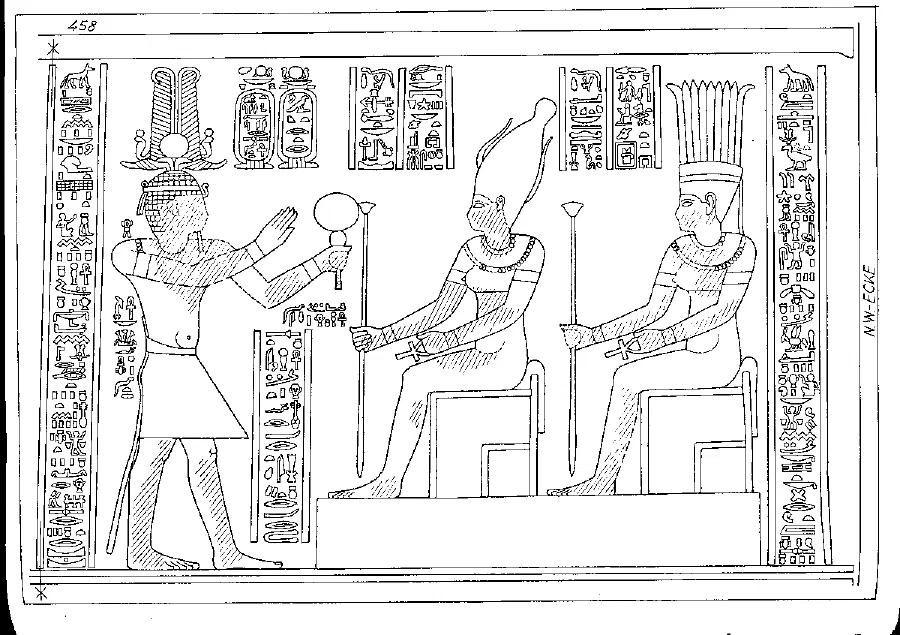
Page 197. The scene as drawn on the wall, facing p. 197 of the edition. Drawing by Otto Baum, in Junker and Winter, Das Geburtshaus des Tempels der Isis in Philä (1965) - 104p. 197, l. 1
ḥnk ꜥnḫ n mꜣꜣ ḥr ḏd mdw j (sic)
Offering the mirror for seeing one’s face. Words to be spoken:
Note · Line 104
The Egyptian word for “mirror,” ankh, also means “life.” - 105p. 197, l. 2
mn n-ṯ ꜥnḫ r mꜣꜣ ḥr-ṯ nfr
Take this mirror to see your beautiful face
- 106p. 197, l. 3
ḥnꜥ sn.t(-ṯ) nt.t r ḥnꜥ-ṯ
together with your sister who stands beside you.
Note · Line 106
The king offers the mirror to Satis in the company of her sister Anuket. - 107p. 197, l. 4
njśwt bjt nb tꜣ.wj ꜣwtḳrtr
King of Upper and Lower Egypt, lord of the Two Lands, Autokrator,
Note · Line 107
Autokrator, the Greek title for the Roman emperor, stands in the place of an Egyptian king’s throne name. - 108p. 197, l. 5
sꜣ Rꜥ nb ḫꜥ.w Tbrjś …
son of Ra, lord of crowns, Tiberius …
- 109p. 197, l. 6
sꜣ ꜥnḫ wꜣś nb ḥꜣ-f mj Rꜥ ḏ.t
May all protection, life and dominion surround him as they surround Ra, forever.
- 110p. 197, l. 7
ḏd mdw n | Śṯj.t ꜥꜣ.t nb(.t) ꜣbw
Words spoken by Satis the Great, lady of Elephantine,
- 111p. 197, l. 8
jr.t Rꜥ nb(.t) p.t ḥnw.t nṯr.w nb.w ḫnt ś.t msḫn(.t)
Eye of Ra, lady of the sky, mistress of all the gods, who presides over the place of birth.
- 112p. 197, l. 9
ḏd mdw n | ꜥnḳ.t nb(.t) Tꜣ-stj
Words spoken by Anuket, lady of Nubia,
- 113p. 197, l. 10
sn.t mnḫ.t n śr ḥḏ.t¹
excellent sister of the prince of the White Crown,
Note · Line 113
The prince is Osiris. The White Crown is the crown of Upper Egypt. - 114p. 197, l. 11
šps.t wśr.t ḫnt Ḥw.t-wtt
august and mighty, who presides over the House of Begetting.
Note · Line 114
The House of Begetting is the temple’s birth house, where the birth of the divine child was celebrated. - 115p. 197, l. 12
jj-n-j ḫr-ṯn nb.w(t) ḥꜣ.t śp.wt
I have come to you, ladies of the first of the provinces.
Note · Line 115
Elephantine lay in the southernmost province of Upper Egypt, the first in the traditional order. - 116p. 197, l. 13
jnj-j n-ṯn ꜥnḫ n mꜣꜣ ḥr
I bring you the mirror for seeing one’s face,
- 117p. 197, l. 14
nbj n Tnn
cast by Tenen,
Note · Line 117
Tenen is a creator god identified with Ptah, patron of craftsmen. - 118p. 197, l. 15
ptr-ṯn nfrw-ṯn ḥꜥj jb-ṯn
that you may see your beauty and your heart rejoice.
- 119p. 197, l. 16
n ḥrj-ś (sic) r-ṯn r nḥḥ
Never shall it be far from you.
- 120p. 197, l. 17
jj.tj m ḥtp śn.nw (n) Tnn
Welcome, you who are a second Tatenen,
Note · Line 120
Here the gods greet the king as a craftsman in his own right. - 121p. 197, l. 18
jḳr ḏbꜥ.w m wnw.t-f²
deft of finger at his craft.
- 122p. 197, l. 19
jnj-k n-n ꜥnḫ r śḥꜥꜥ jb-n
You bring us the mirror to gladden our heart;
Note · Line 122
The Egyptian word for “mirror” also means “life.” - 123p. 197, l. 20
ꜣw jb-n (n) mꜣꜣ kꜣ.t ḥm(-k)
our heart swells with joy at the sight of Your Majesty’s handiwork.
- 124p. 197, l. 21
ḏj-n n-k ḥr nb ḥꜥꜥ n mꜣꜣ-k
We give you every face rejoicing at the sight of you,
- 125p. 197, l. 22
mrw.t-k wr.tj m jb-śn
their hearts full of love for you.
Tiberius gives Isis the menat necklace
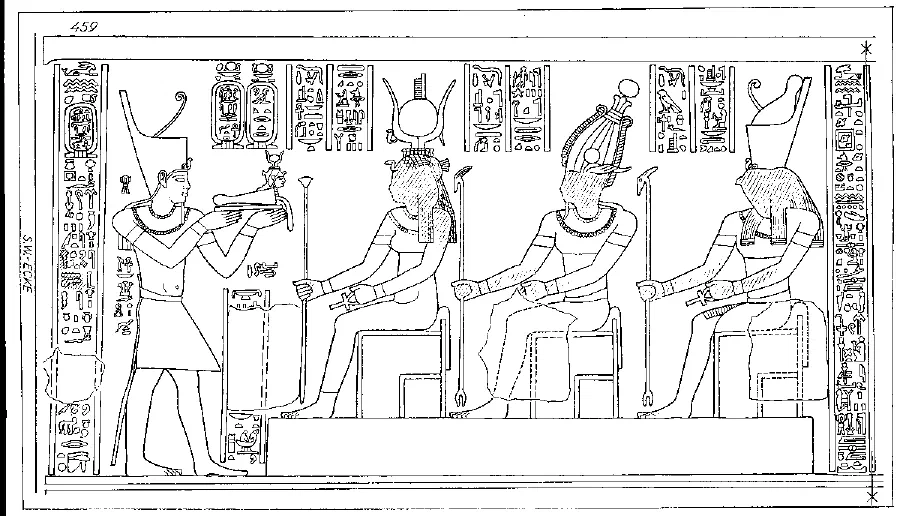
Page 199. The scene as drawn on the wall, facing p. 199 of the edition. Drawing by Otto Baum, in Junker and Winter, Das Geburtshaus des Tempels der Isis in Philä (1965) - 126p. 199, l. 1
ḥnk mnj.t ḏd mdw
Presenting the menat necklace. Words to be spoken:
Note · Line 126
The menat was a beaded necklace with a counterweight. It could be held in the hand and shaken as a rattle in worship. - 127p. 199, l. 2
nb nṯr.w … ḥnw.t nb.t (?) Skr ḥn
Gold of the gods … O sovereign lady, O mistress, Sokar is protected.
- 128p. 199, l. 3
njśwt bjt nb tꜣ.wj ꜣwtḳrtr
King of Upper and Lower Egypt, lord of the Two Lands, Autokrator,
- 129p. 199, l. 4
sꜣ Rꜥ nb ḫꜥ.w Tbrjś …
son of Ra, lord of crowns, Tiberius …
- 130p. 199, l. 5
sꜣ ꜥnḫ wꜣś nb ḥꜣ-f mj Rꜥ ḏ.t
May protection and all life and dominion surround him as they surround Ra forever.
- 131p. 199, l. 6
ḏd mdw n | ꜣJs.t dj(.t) ꜥnḫ nb(.t) jꜣ.t wꜥb.t
Words spoken by Isis, giver of life, lady of the Abaton,
- 132p. 199, l. 7
ḥnw.t nb.t Jꜣrk špś(.t) wśr(.t)
sovereign lady, mistress of Philae, august and mighty,
- 133p. 199, l. 8
ḥn śn-s r śbj.w
who shields her brother from the rebels.
Note · Line 133
Her brother is Osiris, who is also her husband. - 134p. 199, l. 9
ḏd mdw n | Wśjr nṯr ꜥꜣ nb jꜣ.t wꜥb.t
Words spoken by Osiris, the great god, lord of the Abaton,
- 135p. 199, l. 10
śr nṯr.w ḥḳꜣ nb Jꜣrk
prince of the gods, ruler, lord of Philae.
- 136p. 199, l. 11
ḏd mdw n | Ḥrw nḏ.tj jt-f sꜣ ꜣJs.t sꜣ Wśjr
Words spoken by Horus, avenger of his father, son of Isis, son of Osiris,
Note · Line 136
Horus avenges his father Osiris, whom Seth killed. - 137p. 199, l. 12
nb jꜣ.t wꜥb.t sḫm špśj nb Jꜣrk
lord of the Abaton, august power, lord of Philae.
- 138p. 199, l. 13
wnn sꜣ Rꜥ Tbrjś … ḥr nś.t-f
The son of Ra, Tiberius …, is on his throne
- 139p. 199, l. 14
m ḥḳꜣ nfr bnr sp
as a good ruler, gracious in his deeds,
- 140p. 199, l. 15
ḥr śpt jśwj …
cutting off both testicles …
- 141p. 199, l. 16
ḥr śnḏm jb n ḥnw.t-f
and gladdening the heart of his sovereign lady.
- 142p. 199, l. 17
… n-f nbḏ r bꜣḳ.t
He … the Evil One from Egypt.
- 143p. 199, l. 18
wnn mw.t nṯr ḫnt Ḥw.t-ḥnt
The god’s mother is foremost in Philae,
- 144p. 199, l. 19
wśr.t ḫnt Ḥnt-n-tꜣ
the mighty one, foremost at the Head of the Land,
Note · Line 144
The Head of the Land is a sacred name for Philae. - 145p. 199, l. 20
ḥr šsp ḥꜥꜥ ḥr sḫ …²
receiving shouts of joy and beating the tambourine …
- 146p. 199, l. 21
ḥr mꜣꜣ sꜣ-s m ḳd-f
as she looks upon her son in his own form.
- 147p. 199, l. 22
śj (so) m Sḫm.t wr.t sḫm r śbj.w
She is Sekhmet the Great, mighty against the rebels.
Note · Line 147
Sekhmet’s name means “the Mighty One.” Here Isis takes the form of this lioness goddess. - 148p. 199, l. 23
sꜣ śn m Śnm.t
who guards her brother on Bigeh.
Note · Line 148
Bigeh, an island beside Philae, was revered as a burial place of Osiris, the brother of Isis. Tiberius gives Hathor the rattle and the sistrum
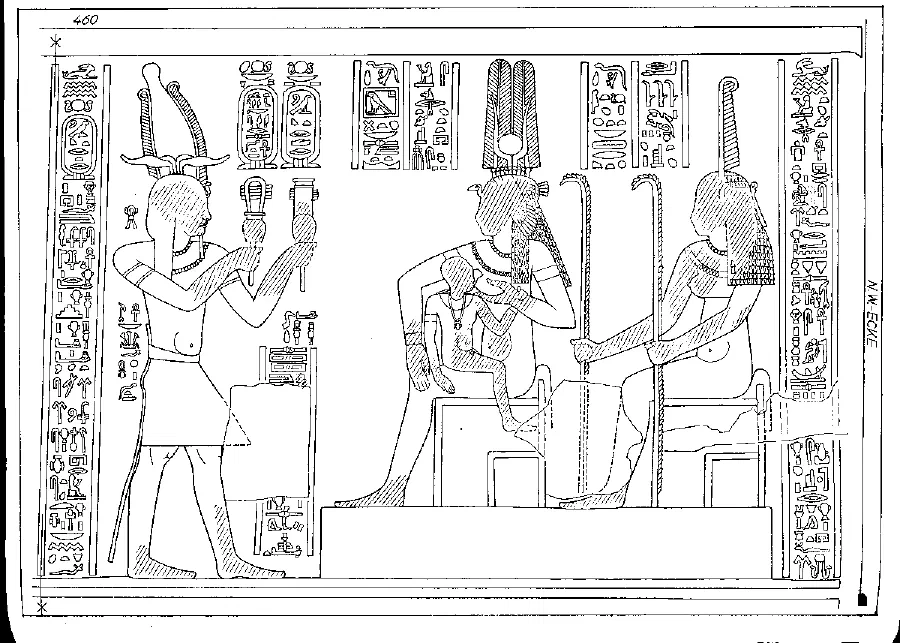
Page 201. The scene as drawn on the wall, facing p. 201 of the edition. Drawing by Otto Baum, in Junker and Winter, Das Geburtshaus des Tempels der Isis in Philä (1965) - 149p. 201, l. 1
ḥnk sšš.t sḫm ḏd mdw
Presenting the rattle and the sistrum. Words to be spoken:
Note · Line 149
These are two forms of sacred rattle. Both were shaken in the worship of Hathor. - 150p. 201, l. 2
sšš.t m … ḥr sbj sḫm-ṯ
The rattle is in …, driving away your fury.
Note · Line 150
The Egyptian word for “fury” here sounds like the name of the sistrum: the instrument quiets the very power its name evokes. - 151p. 201, l. 3
njśwt bjt nb tꜣ.wj ꜣwtḳrdr
King of Upper and Lower Egypt, Lord of the Two Lands, Autokrator,
Note · Line 151
Here the Roman emperor bears the titles of an Egyptian king. - 152p. 201, l. 4
sꜣ Rꜥ nb ḫꜥ.w Tbrjś …
Son of Ra, Lord of Crowns, Tiberius …
- 153p. 201, l. 5
sꜣ ꜥnḫ wꜣś nb ḥꜣ-f mj Rꜥ ḏ.t
May all protection, life and dominion surround him as they surround Ra, forever.
- 154p. 201, l. 6
ḏd mdw n | Ḥw.t-Ḥrw wr.t nb(.t) Śnm.t
Words spoken by Hathor the Great, Lady of Bigeh,
- 155p. 201, l. 7
špś(.t) wśr.t ḫnt ś.t msḫn(.t)
august and mighty, foremost in the birth house.
- 156p. 201, l. 8
ḏd mdw n | Mꜣꜥ.t sꜣ.t Rꜥ nb(.t) ’Jrk
Words spoken by Maat, daughter of Ra, Lady of Philae,
- 157p. 201, l. 9
rḏj(.t) rnp.wt ꜥšꜣ.wt n sꜣ ’Jś.t
who grants many years to the son of Isis.
Note · Line 157
The son of Isis is Horus. - 158p. 201, l. 10
wnn njśwt bjt ꜣwtḳrtr ḥr nś.t-f
The King of Upper and Lower Egypt, Autokrator, is on his throne
- 159p. 201, l. 11
m snn ꜥnḫ n Tnn
as the living likeness of Tenen,
- 160p. 201, l. 12
ḥr rḏj(.t) sšš.t ḥr jꜥr sḫm
giving the rattle and bringing the sistrum,
- 161p. 201, l. 13
ḥr ḥnk mw.t-f m mr(r.t)-ś
offering his mother what she loves.
- 162p. 201, l. 14
św m ḥḳꜣ nfr ḥr śḫrj jb (n) špś.t
He is the good ruler, gladdening the heart of the august one
- 163p. 201, l. 15
ḥr jrj(.t) ꜣbb jb nb n ḥnw.t-f
and fulfilling every wish of his lady’s heart.
- 164p. 201, l. 16
wnn špś.t wśr.t ḫnt śḫb.t-(n.t)-ꜥnḫ
The august and mighty one presides over the House of Life,
- 165p. 201, l. 17
ḥr rr sꜣ-ś m ḫnt-f
nursing her son there,
- 166p. 201, l. 18
ḥr rḏj(.t) mnḏ-ś ḥr ꜥnḫ-wꜣś
offering her breast with its milk
Note · Line 166
The milk is called “life and dominion”: at his mother’s breast the child receives both life and the power to rule. - 167p. 201, l. 19
ḥr śꜥnḫ nḫn-nṯr jm-śn²
and with them keeping the divine child alive.
- 168p. 201, l. 20
(śj) … ḥr śwḏꜣ sꜣ Wśjr
She is …, keeping the son of Osiris safe
- 169p. 201, l. 21
r ꜥḥꜥ ḥr nś.t-f m njśwt bjt
so that he may take his place on his throne as King of Upper and Lower Egypt.
Tiberius gives Osiris a food offering
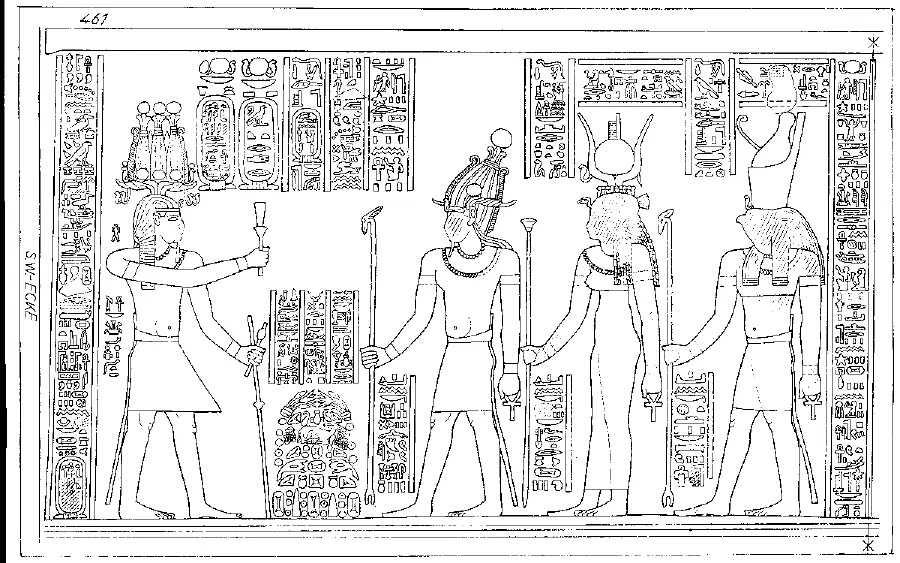
Page 203. The scene as drawn on the wall, facing p. 203 of the edition. Drawing by Otto Baum, in Junker and Winter, Das Geburtshaus des Tempels der Isis in Philä (1965) - 170p. 203, l. 1
mn n-k ꜥb.t m iḫ.t nb.t(?)¹
Receive for yourself the offering of all things,
- 171p. 203, l. 2
… wp-rꜣ(?)-k jm-s
… your mouth opens for it.
- 172p. 203, l. 3
wꜣḥj-k špd-k mꜣꜣ-k prj jm-k
You rejoice and are glad when you see what comes forth from you,
- 173p. 203, l. 4
ḥtp kꜣ-k ḥr jr.t Ḥrw
and your ka is content with the Eye of Horus.
Note · Line 173
The food is presented as the Eye of Horus, once injured and made whole again. - 174p. 203, l. 5
njśwt bjtj nb tꜣ.wj ꜣwtḳrtr
King of Upper and Lower Egypt, Lord of the Two Lands, Autokrator,
- 175p. 203, l. 6
sꜣ Rꜥ nb ḫꜥ.w Tbrjś …
Son of Ra, Lord of Crowns, Tiberius …
- 176p. 203, l. 7
sꜣ ꜥnḫ wꜣś nb ḥꜣ-f mj Rꜥ ḏ.t
May all protection, life and dominion surround him as they surround Ra, forever.
- 177p. 203, l. 8
ḏd mdw n | Wśjr Wnn nfrw mꜣꜥ ḫrw nṯr ꜥꜣ
Words spoken by Osiris Wennefer, vindicated, the great god:
Note · Line 177
“Vindicated” recalls the divine judgment that upheld Osiris against Seth, his killer. - 178p. 203, l. 9
nb jꜣ.t wꜥb.t njśwt nṯr.w ḥḳꜣ Śnm.t
lord of the Abaton, king of the gods, ruler of Bigeh,
Note · Line 178
Revered as a burial place of Osiris, it was closed to all but a few. - 179p. 203, l. 10
ḥꜥpj wr ḳmꜣ wnn.t nb.t śr nṯr.w
great Hapy, who fashioned all that is, prince of the gods,
Note · Line 179
Hapy is the Nile flood as a god. Its yearly rise nourished the fields. - 180p. 203, l. 11
jrj ḫr(.t) n ꜥnḫ.w
who provides for the living.
- 181p. 203, l. 12
dj-j n-k kꜣ.w wr.w nn ḏrw-śn
I give you provisions in plenty, without limit.
- 182p. 203, l. 13
ḏd mdw n | ꜣŚ.t dj(.t) ꜥnḫ nb(.t) ꜣJrk
Words spoken by Isis, giver of life, lady of Philae,
- 183p. 203, l. 14
ḥnw.t nb.t jꜣ.t wꜥb.t šps.t wśr.t
sovereign lady, mistress of the Abaton, august and mighty,
- 184p. 203, l. 15
nb(.t) prj msj.t mw.t nṯr n bjk n nb
lady of the birth house, divine mother of the Golden Falcon:
Note · Line 184
The Golden Falcon is Horus. - 185p. 203, l. 16
dj-j n-k (jḫ?).t nb.t nfr.t r ḫr(.t)-k
I give you every good thing for your sustenance.
- 186p. 203, l. 17
ḏd mdw n | Ḥrw nḏ.tj jt-f sꜣ Wśjr nb ꜣJrk
Words spoken by Horus, avenger of his father, son of Osiris, lord of Philae,
Note · Line 186
Horus avenged the murder of Osiris by Seth and succeeded his father as king. - 187p. 203, l. 18
jwꜥw mnḫ prj m … wr ḥr ś.t n.t jt-f
the worthy heir who comes forth from …, great upon his father’s throne:
- 188p. 203, l. 19
dj-j n-k jḫ.t nb.t ḥrj śꜣ Gb
I give you everything on Geb’s back.
Note · Line 188
His back is the ground beneath our feet. - 189p. 203, l. 20
ꜥnḫ | nṯr nfr ḥꜥpj jrj nt.t²
Long live the good god, Hapy, who makes what is,
Note · Line 189
The king, named below as Tiberius, is hailed as the Nile flood that feeds Egypt. - 190p. 203, l. 21
bꜥḥ jdb.w Ḥrw m ḏfꜣ.w
who floods the banks of Horus with food,
Note · Line 190
The banks of Horus are Egypt, the land on either side of the Nile. - 191p. 203, l. 22
śmꜣꜥ(?) ꜥb.t(?)³ n jt-f m jḫ.t nb.t(?)¹
who presents his father with an offering of every kind of thing,
- 192p. 203, l. 23
rdj śn.w r ś.t ꜥnḫ⁴ nṯr.w
who gives offering loaves to the seat of life of the gods,
- 193p. 203, l. 24
jnj nṯr r šb.w sp ḥmtj n rꜥ nb nb ḫr.t Tbrjś …
who brings the god to his meal three times a day, lord of provisions, Tiberius …
- 194p. 203, l. 25
njśwt bjtj | śr nṯr.w ḥꜥpj ḳmꜣ wnn.t
King of Upper and Lower Egypt, prince of the gods, Hapy, who fashioned what is,
- 195p. 203, l. 26
ḥꜥj r śꜥnḫ ṯm.w
who rises in flood to give people life,
- 196p. 203, l. 27
ḥr rdj(.t) ḥtp.w-nṯr n nṯr.w
giving divine offerings to the gods
- 197p. 203, l. 28
pr.t (ḫr) ḫrw n ꜣḫ.w
and invocation offerings to the blessed dead.
Note · Line 197
An invocation offering was a gift of food or drink made available to the dead by speaking its name. - 198p. 203, l. 29
ꜥnḫj pw ꜥnḫ-tw mꜣꜣ Wśjr nṯr ꜥꜣ nb jꜣ.t wꜥb.t
He is the Living One, for one lives at the sight of Osiris, the great god, lord of the Abaton.
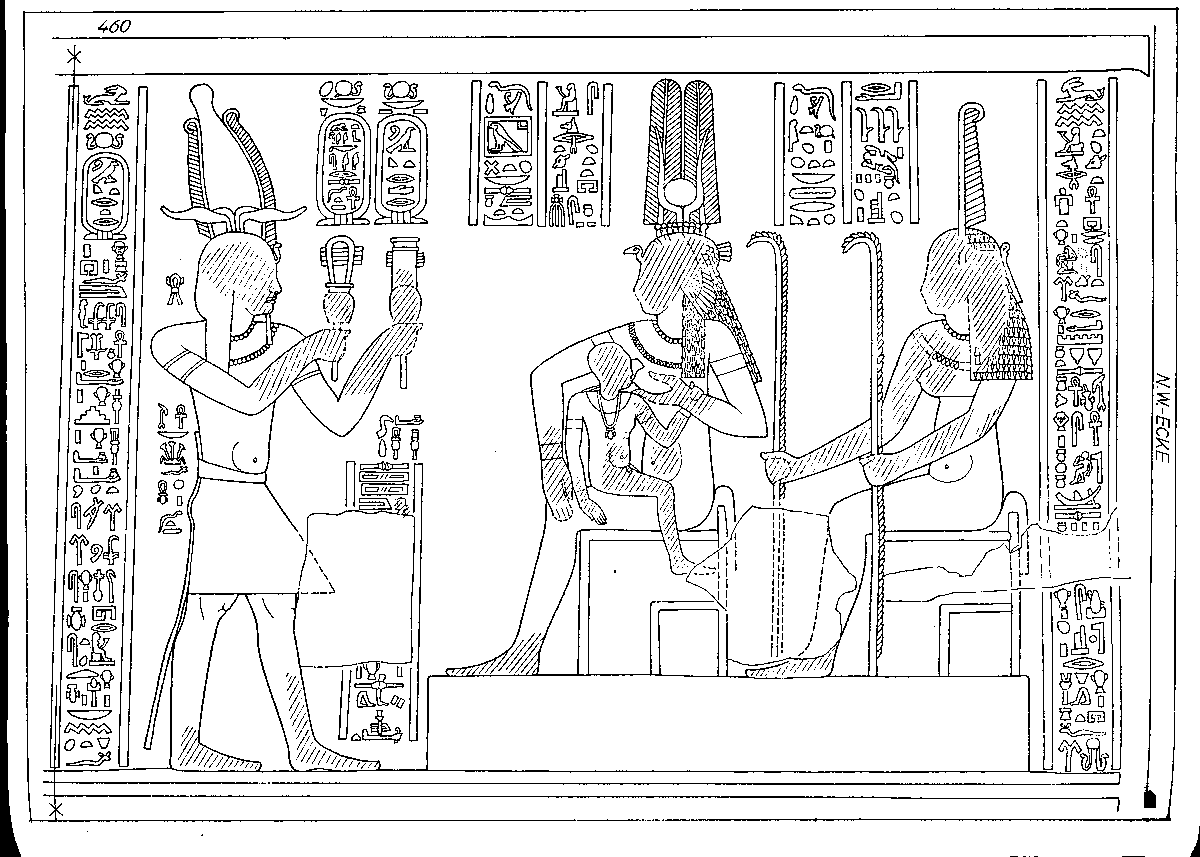
Tiberius gives Horus the Child wine
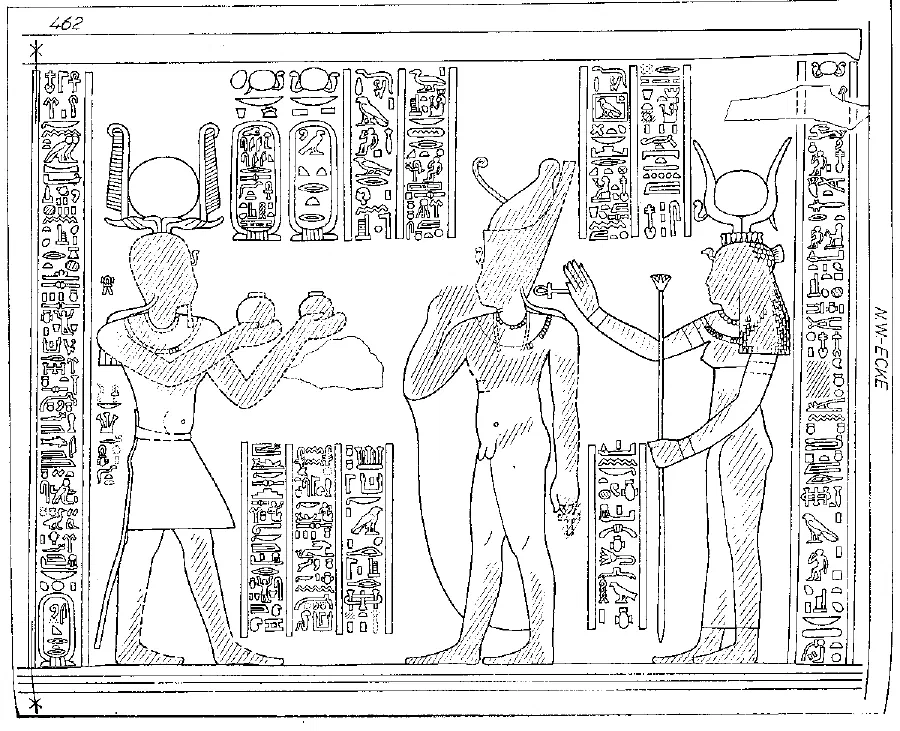
Page 205. The scene as drawn on the wall, facing p. 205 of the edition. Drawing by Otto Baum, in Junker and Winter, Das Geburtshaus des Tempels der Isis in Philä (1965) - 199p. 205, l. 1
šꜣ n kꜣ-k Ḥrw sꜣ Wsjr
Wine for your ka, Horus, son of Osiris;
Note · Line 199
It draws nourishment from offerings. - 200p. 205, l. 2
jr.t-Ḥrw wꜣḏ.t nn ḥr ḥm-k
this green Eye of Horus is for Your Majesty.
Note · Line 200
The wine is presented as the eye Horus lost and regained, an emblem of restored wholeness. - 201p. 205, l. 3
sḏb-k jm-šn wnf jb-k
May you drink of them and may your heart rejoice;
- 202p. 205, l. 4
nwḥ (so) kꜣ-k prj jm-k
may your ka drink what came forth from you.
- 203p. 205, l. 5
sꜥr-j šn m bꜣḥ-k m ḥr.t hrw r sḫꜥꜥ jb-k m mr(.t)-k
I set them before you as your daily provision, to gladden your heart with what you love.
- 204p. 205, l. 6
njswt bjt nb tꜣ.wj ꜣwtḳrtr
King of Upper and Lower Egypt, lord of the Two Lands, Autokrator,
- 205p. 205, l. 7
sꜣ Rꜥ nb ḫꜥ.w Tbrjś …
son of Ra, lord of crowns, Tiberius …
- 206p. 205, l. 8
sꜣ ꜥnḫ wꜣs nb ḥꜣ-f mj Rꜥ ḏ.t
May all protection, life and dominion surround him as they surround Ra, forever.
- 207p. 205, l. 9
ḏd mdw n | Ḥrw pꜣ ḫrd ꜥꜣ wr tpj n Wsjr
Words spoken by Horus the Child, the very great one, firstborn of Osiris:
- 208p. 205, l. 10
sꜣ ꜣs.t nb ꜣJrk
Son of Isis, lord of Philae,
- 209p. 205, l. 11
šfj špsj wbn m Snm.t
the noble child who shines forth on Bigeh.
Note · Line 209
Bigeh is an island beside Philae. - 210p. 205, l. 12
ḏd mdw n | Ḥw.t-Ḥrw wr.t nb(.t) ꜣJrk
Words spoken by Hathor the Great, Lady of Philae,
- 211p. 205, l. 13
šps.t nfr.t (sic) ḥnw.t m Snm.t
august and beautiful, sovereign on Bigeh,
- 212p. 205, l. 14
wr(.t) mrw.t ḥnw.t ḥm.wt¹
great in love, sovereign of women,
- 213p. 205, l. 15
mḥ.t p.t tꜣ m nfrw-s
who fills heaven and earth with her beauty:
- 214p. 205, l. 16
dj-j n-k tḫ.t ḥr.t hrw
“I give you drunkenness day after day,
Note · Line 214
Drunkenness was a sacred joy at Hathor’s festivals. - 215p. 205, l. 17
ꜣw.t-jb nn ḥwrw-jb²
a glad heart without heartache.”
- 216p. 205, l. 18
ꜥnḫ | nṯr nfr ḥḳꜣ m Knm.t
Long live the good god, ruler in Kharga Oasis,
- 217p. 205, l. 19
ḫrp³ wḥꜣ.tjw n sꜣ ꜣs.t ḥr jḫ.t-šn
who leads the oasis dwellers with their gifts to the son of Isis,
- 218p. 205, l. 20
sḫꜥꜥ jb n kꜣ(-f) m jr.t-Ḥrw wꜣḏ.t
who gladdens the heart of his ka with the green Eye of Horus,
Note · Line 218
Here the green Eye of Horus is the wine offered to the god. - 219p. 205, l. 21
snwḥ (so?) ḥm-f m jnm.tj
who makes His Majesty drunk on wine,
- 220p. 205, l. 22
ms jrp⁴ m ḥr-f m ḥr.t hrw
who sets wine before his face as his daily fare,
- 221p. 205, l. 23
nb … ? … sꜣ Rꜥ (sic) ꜣwtḳrtr
the lord …, Son of Ra, Autokrator.
- 222p. 205, l. 24
njswt bjt | … ḥḳꜣ … (ḥ)wn nfr bnr mrw.t
King of Upper and Lower Egypt … ruler …, fair youth, sweet in love,
- 223p. 205, l. 25
ḫrd špsj (n) mw.t-f ꜣs.t
noble child of his mother Isis,
- 224p. 205, l. 26
pḥꜣ-jb mrj hrw nfr
glad of heart, lover of a festive day.
- 225p. 205, l. 27
wbꜣ(-tw n?)-f hbn.t tp.t⁵ m jr.t Ḥrw wꜣḏ.t
For him they open the hebenet jar and the tepet jar, both filled with the green Eye of Horus:
- 226p. 205, l. 28
Ḥrw pꜣ ḫrd sꜣ ꜣs.t nb jꜣ.t wꜥb.t
Horus the Child, son of Isis, lord of the Abaton.
Note · Line 226
Horus the Child is also known as Harpocrates. Procession of gods and hippopotamus goddesses: east architrave, inner face
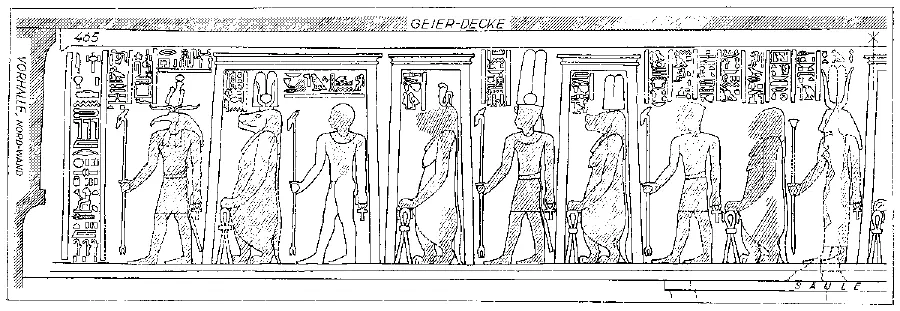
Page 207. The scene as drawn on the wall, facing p. 207 of the edition. Drawing by Otto Baum, in Junker and Winter, Das Geburtshaus des Tempels der Isis in Philä (1965) - 227p. 207, l. 1
jnd ḥr-ṯn (so) nṯr.w jmj.w (so) jbd.w-šn šps.wt mnḫ.wt (?) (ꜥꜣ.wt?) m rnp.wt
Hail to you, gods who dwell in your months, and you excellent hippopotamus goddesses, great in the years!
- 228p. 207, l. 2
ḏd mdw n | Ḏḥwtj ꜥꜣ ꜥꜣ sḥtp nṯr.w sḫꜣ-tw kꜣ-f r prj-msj(.t) wp rnp.t nfr.t
Words spoken by Thoth, twice great, who brings the gods contentment, whose ka is remembered in the birth house, who opens the good year.
- 229p. 207, l. 3
Tḥn.t tp(.t) jn(r?)¹
She who gleams like faience, finest of stones.
Note · Line 229
Egyptian faience has a lustrous glaze, often blue or green. - 230p. 207, l. 4
nb sšn(?) Ḥrw ḥwn
Lord of the lotus, Horus the Youth.
- 231p. 207, l. 5
swḏꜣ(.t) Šw
She who keeps Shu safe.
- 232p. 207, l. 6
Jmn-Rꜥ nb ns.(w)t tꜣ.wj njswt nḥḥ
Amun-Ra, lord of the thrones of the Two Lands, king of eternity.
Note · Line 232
The Two Lands are Upper and Lower Egypt. The title evokes Amun-Ra’s great sanctuary at Karnak. - 233p. 207, l. 7
jmj(.t)² wḏꜣ.t sꜣḫ(.t) Jtmw
She who dwells in the Wedjat Eye, who transfigures Atum.
Note · Line 233
The Wedjat is the injured Eye of Horus made whole again. - 234p. 207, l. 8
…³ ḥwj tꜣ.wj wp rnp.t nfr.t nb.t n Ḥrw pꜣ ḫrd sꜣ Js.t
…, who guards the Two Lands and opens every good year for Horus the Child, son of Isis.
- 235p. 207, l. 9
psḏ.t pr(.t) m wḏꜣ.t wp.t rnp.wt nfr.wt nb.wt n Ḥrw pꜣ ḫrd ꜥꜣ wr tpj (n) Wsjr
The shining one who came forth from the Wedjat Eye, who opens all good years for Horus the Child, the very great one, firstborn of Osiris.
- 236p. 207, l. 10
Ḥw.t-Ḥrw nb(.t) Jrḳ jr.t Rꜥ nb(.t) p.t ḥnw.t mw.t nṯr n.t nṯr(?) ꜥꜣ
Hathor, Lady of Philae, Eye of Ra, Lady of Heaven, sovereign, divine mother of the great god.
- 237p. 207, l. 11
psḏ.t (so)⁴ ḫnt ḥr.t
The shining one at the head of the heavens.
- 238p. 207, l. 12
Ḥrw-ḥknw nṯr pf ḏsr ḫpr.w n psḏ.t sštꜣ wr nn rḫ(-tw)-f
Horus-Hekenu, that god who makes splendid the forms of the Ennead, the great hidden one whom no one knows.
Note · Line 238
The Ennead is a company of nine gods. - 239p. 207, l. 13
sḫn-s ḥr jt-s
She settles on her father.
Note · Line 239
The daughter takes the form of the uraeus, the cobra that rears on the sun god’s brow. - 240p. 207, l. 14
Jnpw ḫnt sḥ-nṯr sꜣ Wsjr nḫt ḫpš wsr pḥtj mj sn-f mnḫ(?) …⁵
Anubis, foremost in the divine pavilion, son of Osiris, strong of arm and great in might like his worthy brother, …
Note · Line 240
The divine pavilion is where the dead are embalmed under Anubis’s care. - 241p. 207, l. 15
sṯ.t(?)⁶ sr … n
Setet-ser … en
Note · Line 241
This fragment, like Djeset-Tawy and Ip-hemet-es below, names a form of Taweret, the hippopotamus goddess who protects women in childbirth. - 242p. 207, l. 16
ꜥꜣ pḥtj sḫr sbj.w(?) ḫr-f ḫftj.w(?) r prj-msj.t m ḥr.t hrw
Great in strength, he strikes down rebels. Day after day he fells the foes of the birth house.
- 243p. 207, l. 17
mrj(.t) jꜣḫw(?) wr.t mrw.t
She who loves the sunlight, great in love.
- 244p. 207, l. 18
Mw.t wr.t nb(.t) Jšrw
Mut the Great, lady of Isheru.
Note · Line 244
Isheru is the sacred lake at Mut’s temple at Karnak. - 245p. 207, l. 19
nb(.t) ḏnḥ⁷ jḫ.t-s(??)
Lady of the wing, her own possession.
Procession of gods and hippopotamus goddesses: west architrave, inner face
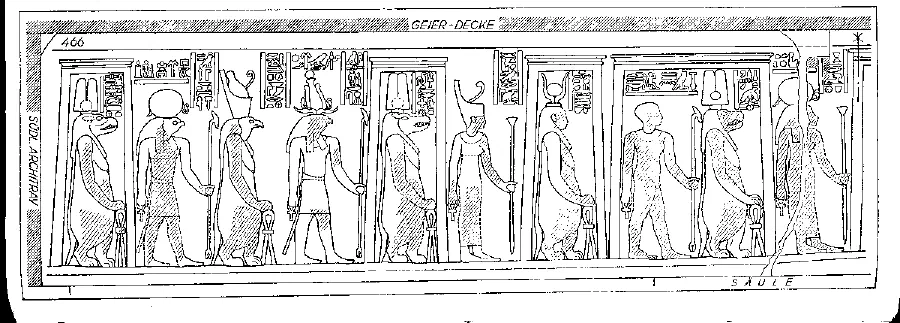
Page 209. The scene as drawn on the wall, facing p. 209 of the edition. Drawing by Otto Baum, in Junker and Winter, Das Geburtshaus des Tempels der Isis in Philä (1965) - 246p. 209, l. 1
jnḏ ḥr-ṯ wr.t ꜥꜣ(.t) ḥnw.t tꜣ.wj šps.t ḫnt ś.t jb śbḫ.t nṯr.t pw prj (sic)
Hail to you, great and mighty one, mistress of the Two Lands, noble one in the seat dear to your heart, the goddess’s gateway from which one comes forth.
- 247p. 209, l. 2
Jś.t nb(.t) prj-msj(.t) mw.t nṯr
Isis, lady of the birth house, mother of the god.
- 248p. 209, l. 3
jmj.t (so)¹ p.t šśm(.t) nṯr.w
She who dwells in the sky and guides the gods.
- 249p. 209, l. 4
Ḥrw (pꜣ) ḫrd sꜣ Jś.t sꜣ Wśjr
Horus the Child, son of Isis, son of Osiris.
- 250p. 209, l. 5
ḏs.t tꜣ.wj²
Djeset-Tawy.
- 251p. 209, l. 6
Jmn-Rꜥ njswt nṯr.w nṯr ꜥꜣ nb jꜣ.t wꜥb.t
Amun-Ra, king of the gods, the great god, lord of the Abaton.
Note · Line 251
The Abaton, called the Pure Mound in Egyptian, was the burial place of Osiris on Bigeh, the island beside Philae. - 252p. 209, l. 7
Jp-ḥm.t-s³ ḫntj.t ꜣḫ.t
Ip-hemet-es, foremost on the horizon.
- 253p. 209, l. 8
Wp-wꜣ.wt⁴ šmꜥ.w sḫm (so)⁵ m tꜣ.wj
Wepwawet of Upper Egypt, mighty in the Two Lands.
- 254p. 209, l. 9
ḥkn.t m sꜣ
She who rejoices in the son.
- 255p. 209, l. 10
ḥnw.t … ꜥꜣ nb(?) wn …
Mistress … great one, lady of what is …
- 256p. 209, l. 11
nfr-wj(?)⁶ mk(.t) jrj śj
How fair is she who guards the one who made her!
- 257p. 209, l. 12
smꜣ tꜣ.wj jrj n (so?) nb
Somtus, born of the Golden One.
Note · Line 257
Somtus means “Uniter of the Two Lands.” - 258p. 209, l. 13
psḏ.t pr(.t) m wḏꜣ.t
The shining one who came forth from the Wedjat Eye.
- 259p. 209, l. 14
N.t wr.t mw.t nṯr
Neith the Great, mother of the god.
- 260p. 209, l. 15
ꜥnḫ.t wnm(.t) wnn.t⁷
The living one who devours what exists.
- 261p. 209, l. 16
šmsw nb šw.t śḥḏ wr m jtn-f
The eldest, lord of rays, who lights the Great One with his sun disk.
- 262p. 209, l. 17
ḥkn.t⁸ m tp nb (r) ḏr
She who rejoices on the head of the Lord of All.
- 263p. 209, l. 18
Rꜥ-Ḥrw-ꜣḫ.tj nṯr ꜥꜣ nb p.t sꜣb šw.t prj m ꜣḫ.t wr Jwnw
Ra-Horakhty, the great god, lord of the sky, the one of many-colored plumage who comes forth from the horizon, the great one of Heliopolis.
- 264p. 209, l. 19
šms.t (so) sḏfꜣ(.t) nḫn⁹
The eldest, who nourishes the child.
Procession of gods and hippopotamus goddesses: south architrave, inner face
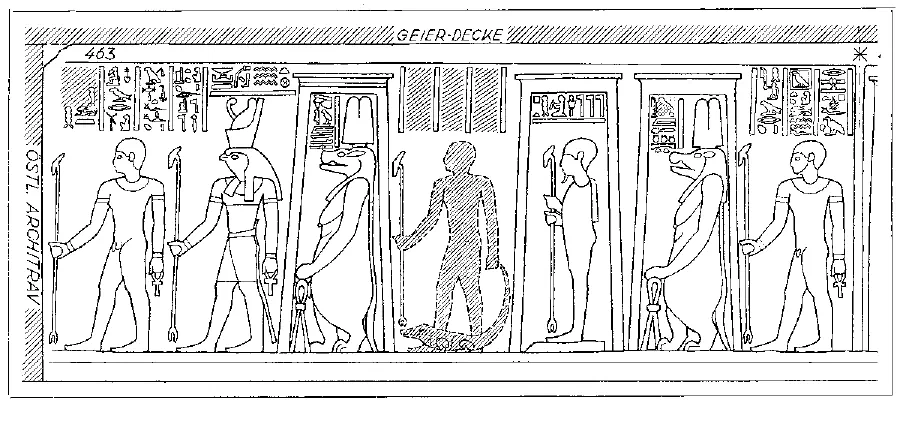
Page 211. The scene as drawn on the wall, facing p. 211 of the edition. Drawing by Otto Baum, in Junker and Winter, Das Geburtshaus des Tempels der Isis in Philä (1965) - 265p. 211, l. 1
… ḥwn nfr wr …
… the fair young man, great …
- 266p. 211, l. 2
Ḥrw nḏ.tj jt-f sꜣ Js.t sꜣ Wsjr nṯr ꜥꜣ nb jꜣ.t wꜥb.t
Horus, avenger of his father, son of Isis, son of Osiris, the great god, lord of the Abaton.
- 267p. 211, l. 3
wḏ(.t) Šw m … s
She who grants well-being to Shu with her …
- 268p. 211, l. 5
Ptḥ-Tnn jt nṯr.w
Ptah-Tatenen, father of the gods.
- 269p. 211, l. 6
Jp-wr.t² m ḥ.t Nw.t
Ipet the Great on Nut’s belly.
Note · Line 269
Ipet is a hippopotamus goddess who guards women in childbirth. She is identified with Taweret. Nut is the goddess whose body forms the sky. - 270p. 211, l. 7
Jḥj wr sꜣ Ḥw.t-Ḥrw wnn-f r sḥtp jt-f mw.t-f
Ihy the Great, son of Hathor, lives to gladden his father and mother.
- 271p. 211, l. 8
Rꜥ m ḥtp-f (?) (m) ḥ.t (?) Nw.t
Ra at his setting, on Nut’s belly.
Note · Line 271
At sunset Nut swallows the sun; at dawn she gives birth to it again. - 272p. 211, l. 9
Wsjr Wnn nfrw mꜣꜥ ḫrw njswt nṯr.w sꜣ Gb mśj Nw.t
Osiris Wennefer, the vindicated, king of the gods, son of Geb, born of Nut.
Note · Line 272
Wennefer is a name of Osiris. He is called vindicated because the gods ruled in his favor against Seth. - 273p. 211, l. 10
dꜣ.t.t ḥrj(.t) nṯr.w
She of the underworld, who stands above the gods.
- 274p. 211, l. 11
ḥrj kꜣ (?) ḫnt nṯr.w
He who is over the ka, foremost among the gods.
- 275p. 211, l. 12
Mḥj.t (?) …
Mehit …
Note · Line 275
Mehit is the lioness goddess of Thinis. - 276p. 211, l. 13
…⁴ wr ꜥꜣ pḥtj
… the great, great in might.
- 277p. 211, l. 14
dgj nb-s
She who sees her lord.
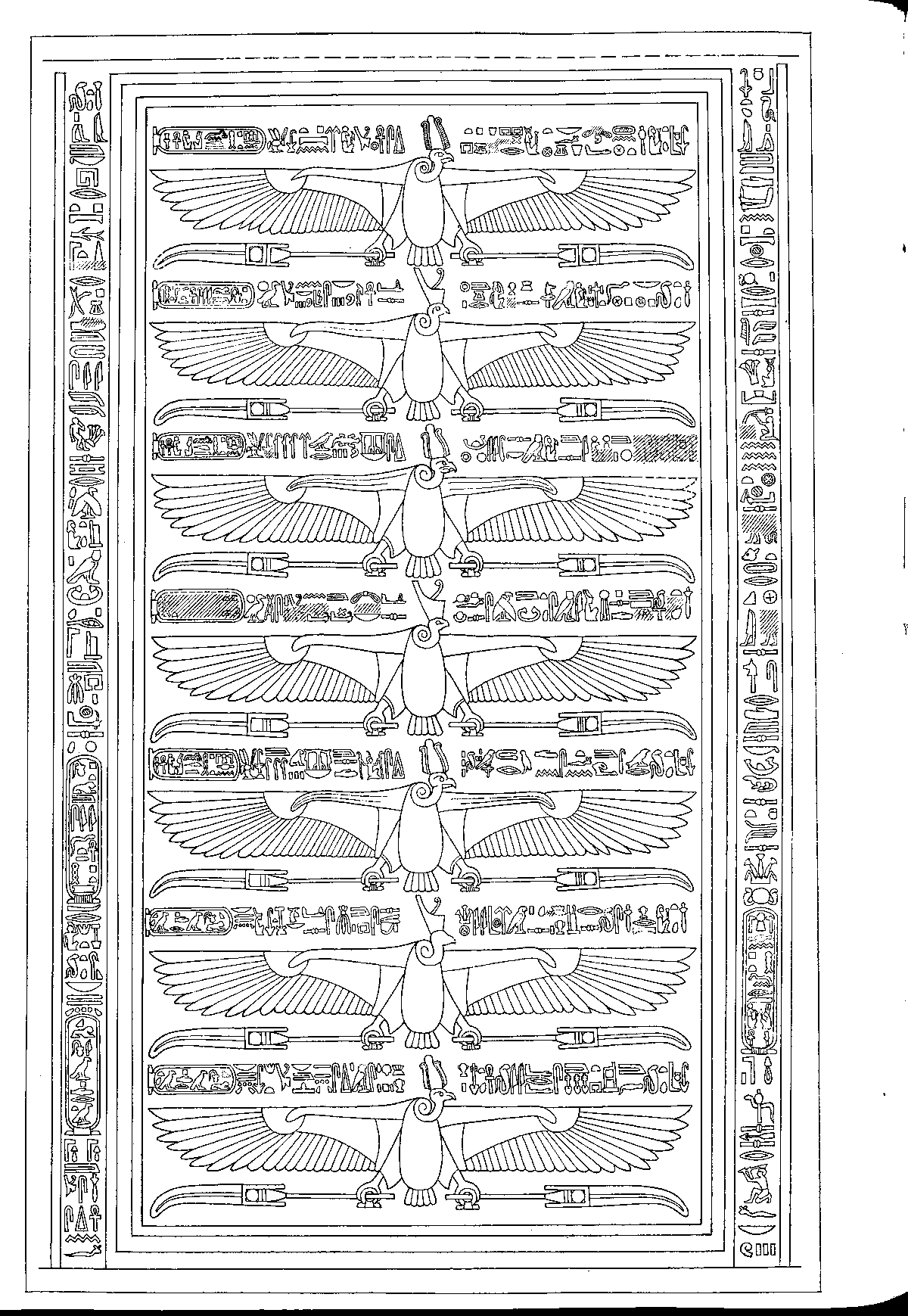
Forecourt ceiling, west band: Nekhbet closes her wings around Ptolemy VIII
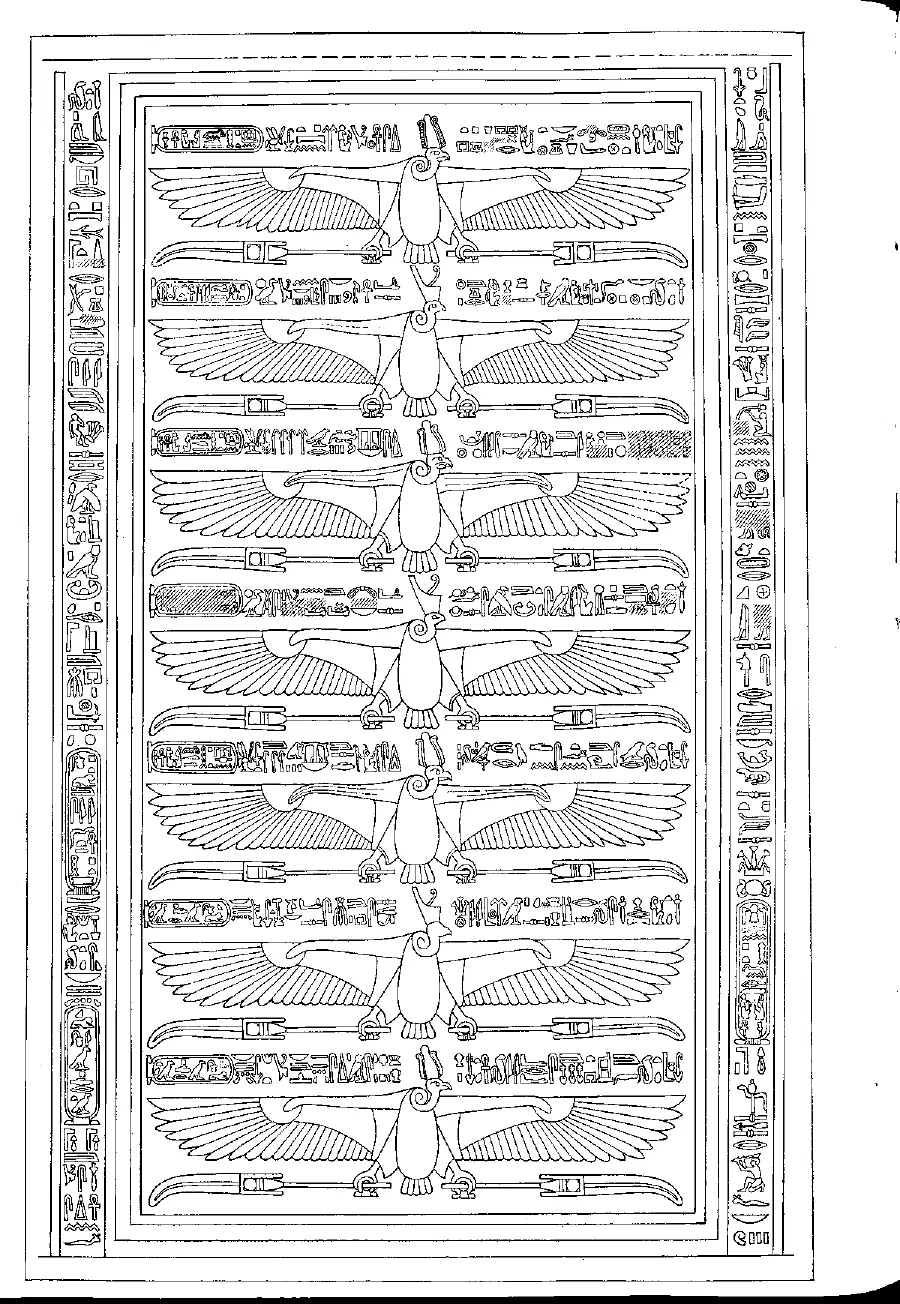
Page 213. The scene as drawn on the wall, facing p. 213 of the edition. Drawing by Otto Baum, in Junker and Winter, Das Geburtshaus des Tempels der Isis in Philä (1965) - 278p. 213, l. 1
Nḫb.t tj.tj m ḏsr(.w) n p.t ḫr Rꜥ
Nekhbet comes into the splendor of heaven, to Ra’s side,
- 279p. 213, l. 2
r ṯs šw.tj-ś ḥꜣ nb jꜣ.t wꜥb.t
to draw her two wings together around the lord of the Pure Mound.
Note · Line 279
The Pure Mound was the sacred burial ground of Osiris on Bigeh, the island beside Philae. - 280p. 213, l. 3
ḥwj-ś … ḫnt ỉrk
May she protect … foremost in Philae.
- 281p. 213, l. 4
jj-ś wśr.tj m (m)śkt.t
May she come in her might aboard the evening barque
Note · Line 281
The evening barque carries the sun through the night; the morning barque carries it across the sky by day. - 282p. 213, l. 5
śḳ-ś¹ ḏnḥ-ś ḥꜣ njśwt bjt jwꜥw … pꜣ nṯr mnḫ
and close her wing around the King of Upper and Lower Egypt, heir …, the Beneficent God.
Note · Line 282
The king is Ptolemy VIII. He and his sister and wife, Cleopatra II, bore the joint title “the Beneficent Gods.” - 283p. 213, l. 6
wḏ-ś šśr-ś r ḫftj.w-f nb.w
May she send her arrow against all his enemies.
Forecourt ceiling, east band: Wadjet spreads her wings around Ptolemy VIII and Cleopatra II
- 284p. 213, l. 7
Wꜣḏ.t jj mk ḥrw p.t ḫr² Śpd.t³
Wadjet comes—look, the sky is content in Sopdet’s presence—
Note · Line 284
Sopdet is the goddess of the star Sirius. - 285p. 213, l. 8
r pgꜣ ḏmꜣ.tj-ś ḥꜣ sꜣ-ś mrj
to spread her two wings around her beloved son,
- 286p. 213, l. 9
r mkj(.t) sꜣ ỉs.t m (m)ꜥnḏ.t sꜣ Wśjr m prj-mśj(.t)
to guard the son of Isis in the morning barque, the son of Osiris in the birth house.
Note · Line 286
Both titles name Horus. - 287p. 213, l. 10
ḥwj-ś sꜣ Rꜥ Pt … ḥnꜥ śn.t ḥm.t-f ḥḳꜣ.t nb(.t) tꜣ.wj Kl … nṯr.wj mnḫ.wj
May she protect the Son of Ra, Ptolemy …, and his sister and wife, the ruler and Lady of the Two Lands, Cleopatra …, the two Beneficent Gods,
- 288p. 213, l. 11
m wꜣḏ(so)-ś n ꜥnḫ⁴ d(d)-ś n-f
with her papyrus scepter of life, which she gives him.
Note · Line 288
Wadjet’s name and the Egyptian word for her scepter both evoke the green of growing papyrus. Captions of the ceiling vultures: Nekhbet and Wadjet
- 289p. 213, l. 12
Nḫb.t ḥḏ(.t) Nḫn jw(.t)-ꜥ nb(.t) Fꜥg nb.t prj-wr ḫnw.t nś.t(?)⁵
Nekhbet, the White One of Nekhen, her arm outstretched, Lady of Fag, Lady of the Great Shrine, mistress of the throne.
Note · Line 289
The Great Shrine is the traditional shrine of Upper Egypt. - 290p. 213, l. 13
dj-ś ꜥnḫ n Rꜥ m p.t n njśwt bjt jwꜥw …
May she give the life of Ra in heaven to the King of Upper and Lower Egypt, heir …
- 291p. 213, l. 14
Wꜣḏ.t nb(.t) P Dp jꜣb.t n(?) Rꜥ m(?)⁶ wśr ḫꜥw-ś ḥr-f m ḥr.t hrw
Wadjet, Lady of Pe and Dep, the left eye of Ra, she whose radiance is mighty upon him day after day.
Note · Line 291
Pe and Dep were the twin settlements of Buto, Wadjet’s city in Lower Egypt. - 292p. 213, l. 15
dj-ś ꜥnḫ wꜣś nb śnb nb n sꜣ Rꜥ Pt …
May she give all life and dominion and all health to the Son of Ra, Ptolemy …
- 293p. 213, l. 16
Nḫb.t … wbn(?) Rꜥ jm-ś⁷ m (m)śkt.t
Nekhbet … Ra shines through her in the evening barque.
- 294p. 213, l. 17
dj-ś ḥb.w-śd ꜥšꜣ.w wr m rnp.wt njśwt bjt jwꜥw …
May she grant many Sed festivals, rich in years, to the King of Upper and Lower Egypt, heir …
Note · Line 294
The Sed festival was a royal jubilee at which the king’s power was renewed. - 295p. 213, l. 18
Wꜣḏ.t … pśḏ ỉtmw jm-ś m (m)ꜥnḏ.t(?) mkj-ś jt-ś rꜥ nb
Wadjet … Atum shines through her in the morning barque. May she guard her father every day.
- 296p. 213, l. 19
dj-ś ꜣw.t(-jb) nb m nḫt(?) n sꜣ-ś mrj sꜣ Rꜥ Pt …
May she give every joy as strength to her beloved son, the Son of Ra, Ptolemy …
- 297p. 213, l. 20
Nḫb.t wr.t m ḥꜣ.t jt n(?) štnj.tj(?) r nṯr.w nṯr.wt
Nekhbet, great upon the father’s brow, for she is exalted above the gods and goddesses.
Note · Line 297
Nekhbet’s vulture and Wadjet’s cobra were worn on the royal brow as signs of divine protection. - 298p. 213, l. 21
dj-ś ḥḥ m ḥb.w-śd ḥfn m rnp.wt njśwt bjt jwꜥw …
May she grant a million Sed festivals and a hundred thousand years to the King of Upper and Lower Egypt, heir …
- 299p. 213, l. 22
Wꜣḏ.t ḥrj(.t) wꜣḏ-ś rś(.t)⁸ ḥr sꜣ-ś Ḥrw m ꜣḫbjt
Wadjet on her papyrus stalk, who watches over her son Horus in Chemmis.
Note · Line 299
Chemmis was the marsh refuge in the Nile Delta where Horus grew up in hiding. - 300p. 213, l. 23
śwḏꜣ-ś m prj-mśj(.t) dj-ś šfj.t nb.t śn.t njśwt bjt(?) nb(.t) tꜣ.wj Kl. …
May she give protection in the birth house and grant all honor to the sister of the King of Upper and Lower Egypt, the Lady of the Two Lands, Cleopatra …
Note · Line 300
The queen named here is Cleopatra II. - 301p. 213, l. 24
Nḫb.t mḥ(.t) ḥw.t m nfrw-ś
Nekhbet, who fills the temple with her beauty,
- 302p. 213, l. 25
jꜥr.t ꜥnḫ.t nfr(.t) ḥr ḫꜥ(.t) ḥr tp sꜣ-ś Ḥrw
the living uraeus, fair of face, who shines on the head of her son Horus.
Note · Line 302
The uraeus is the rearing cobra worn on the brow as a sign of divine protection and kingship. - 303p. 213, l. 26
dj-ś tꜣ.w nb.w m ḥtp n ḥm.t njśwt nb(.t) tꜣ.wj Kl. …
May she give all lands in peace to the king’s wife, the Lady of the Two Lands, Cleopatra …
Above the winged sun disk: Horus of Behdet
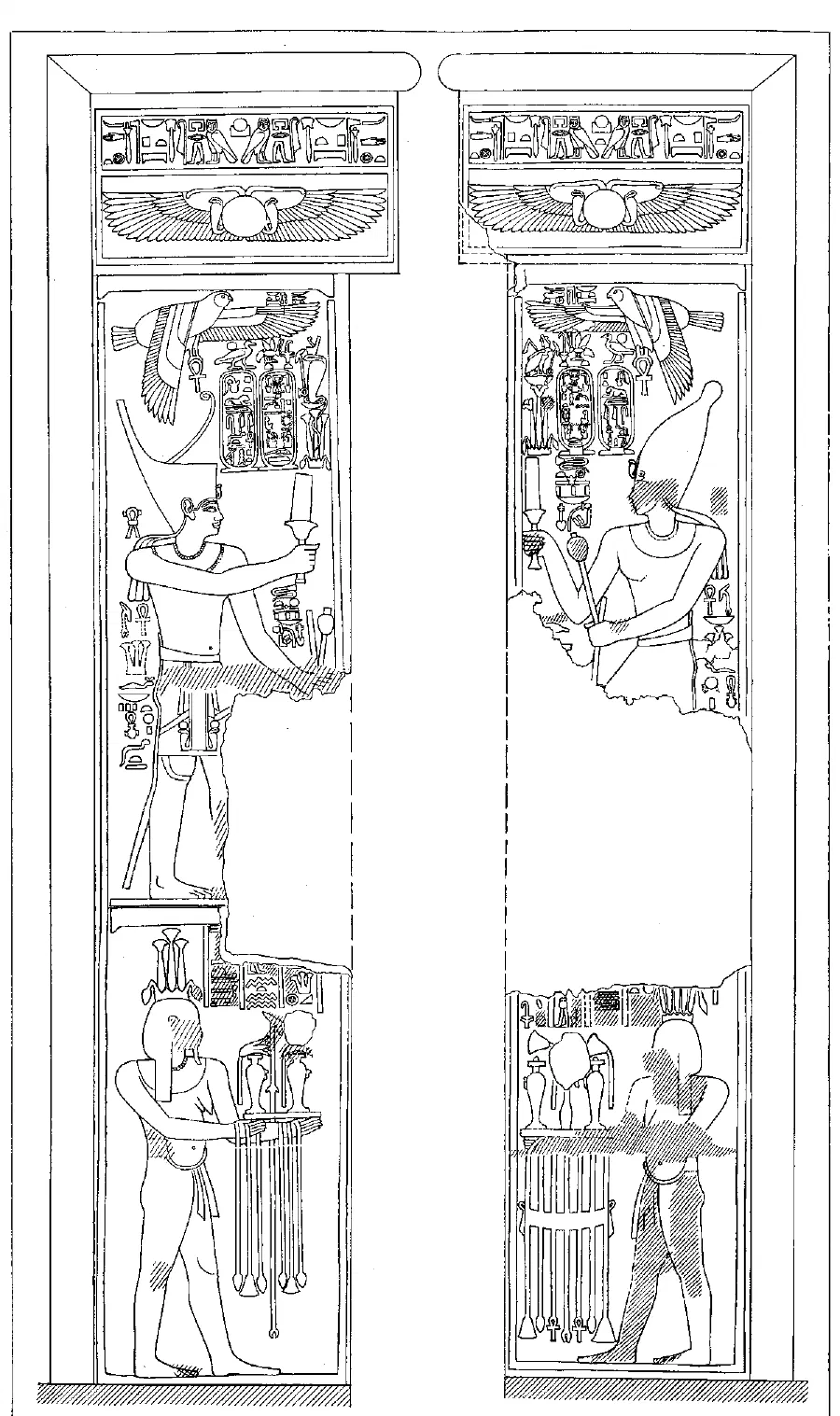
Page 215. The scene as drawn on the wall, facing p. 215 of the edition. Drawing by Otto Baum, in Junker and Winter, Das Geburtshaus des Tempels der Isis in Philä (1965) - 304p. 215, l. 1
Bḥd.tj nṯr ꜥꜣ nb p.t šꜣb šw.t prj m ꜣḫ.t
He of Behdet, the great god, lord of the sky, many-colored in plumage, who comes forth from the horizon.
Note · Line 304
He of Behdet is Horus in his falcon form worshipped at Edfu. Ptolemy VI consecrates an offering of every good and pure thing
- 305p. 215, l. 2
wdn ḫ.t nb.t nfr.t wꜥb.t
Offering every good and pure thing.
- 306p. 215, l. 3
njswt bjt jwꜥw n nṯr.wj prj.wj ḫpr.w Ptḥ stp n Ỉmn jrj mꜣꜥ.t Rꜥ²
King of Upper and Lower Egypt, heir of the two Manifest Gods, embodiment of Ptah, chosen of Amun, who upholds the Maat of Ra,
Note · Line 306
The two Manifest Gods are Ptolemy V and Cleopatra I, parents of the reigning king, Ptolemy VI. Maat is the right order the king maintains in the world. - 307p. 215, l. 4
sꜣ Rꜥ Ptwrmjs ꜥnḫ ḏ.t mrj Ptḥ
Son of Ra, Ptolemy, who lives forever, beloved of Ptah.
- 308p. 215, l. 5
sꜣ ꜥnḫ wꜣs ḥꜣ-f nb mj Rꜥ ḏ.t
May protection, life and dominion all surround him as they surround Ra, forever.
- 309p. 215, l. 6
Bḥd.tj nṯr ꜥꜣ nb p.t
He of Behdet, the great god, lord of the sky.
The Nile god brings water
- 310p. 215, l. 7
… (ḥꜥpj) mḥw
… the Nile of Lower Egypt.
Note · Line 310
The Nile flood is personified as Hapy, who appears here in two regional forms, one for Lower Egypt in the north and one for Upper Egypt in the south. - 311p. 215, l. 8
… jnj(-j?) n-ṯ(?) mw(?) …
… I bring you water …
- 312p. 215, l. 9
… ḥꜣ.t n ḥꜥpj³
… the best of the Nile.
Ptolemy VI consecrates an offering of every good and pure thing
- 313p. 215, l. 11
wdn ḫ.t nb.t nfr.t wꜥb.t
Offering every good and pure thing.
- 314p. 215, l. 12
njswt bjt jwꜥw …
King of Upper and Lower Egypt, heir …
- 315p. 215, l. 13
sꜣ Rꜥ Pt. …
Son of Ra, Ptolemy …
- 316p. 215, l. 14
(sꜣ) ꜥnḫ wꜣs nb ḥꜣ-f mj Rꜥ (ḏ.t)
May protection and all life and dominion surround him as they surround Ra, forever.
- 317p. 215, l. 15
Bḥd.tj nṯr ꜥꜣ nb p.t
He of Behdet, the great god, lord of the sky.
The Nile god brings water
- 318p. 215, l. 16
… (ḥꜥpj) šmꜥ.w
… the Nile of Upper Egypt.
- 319p. 215, l. 17
… jnj-j(?) …
… I bring …
- 320p. 215, l. 18
… m prj …
… as that which comes forth …
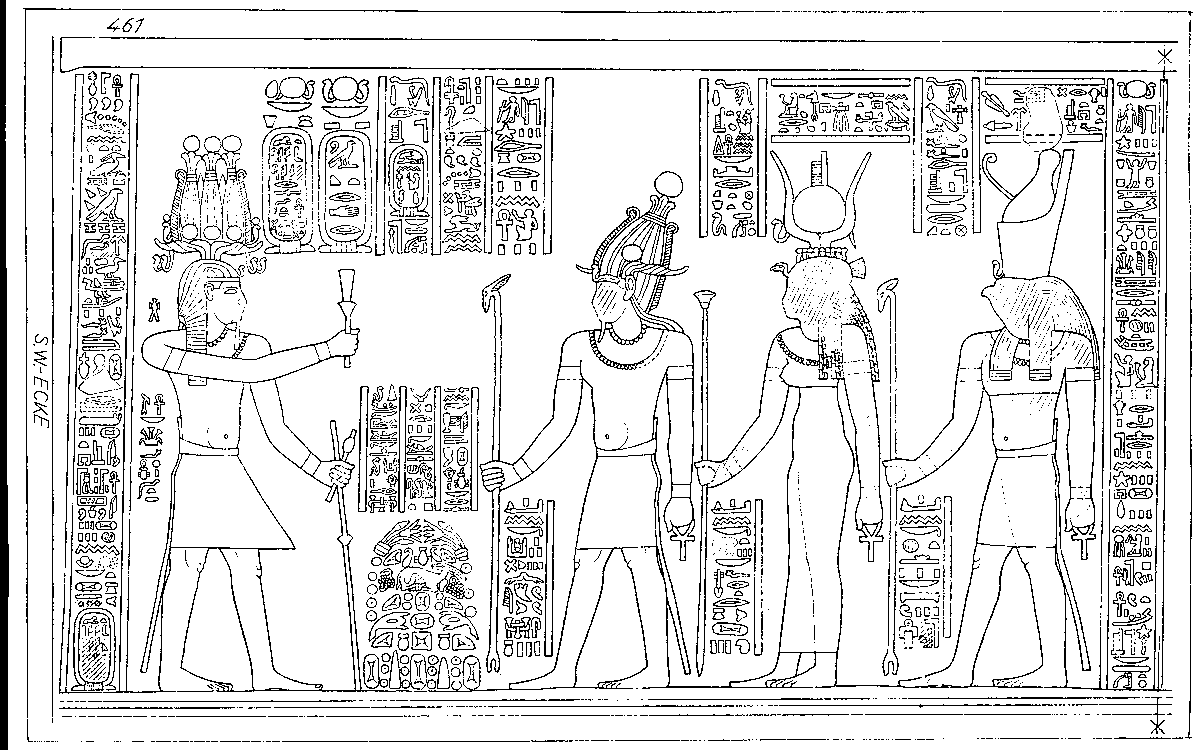
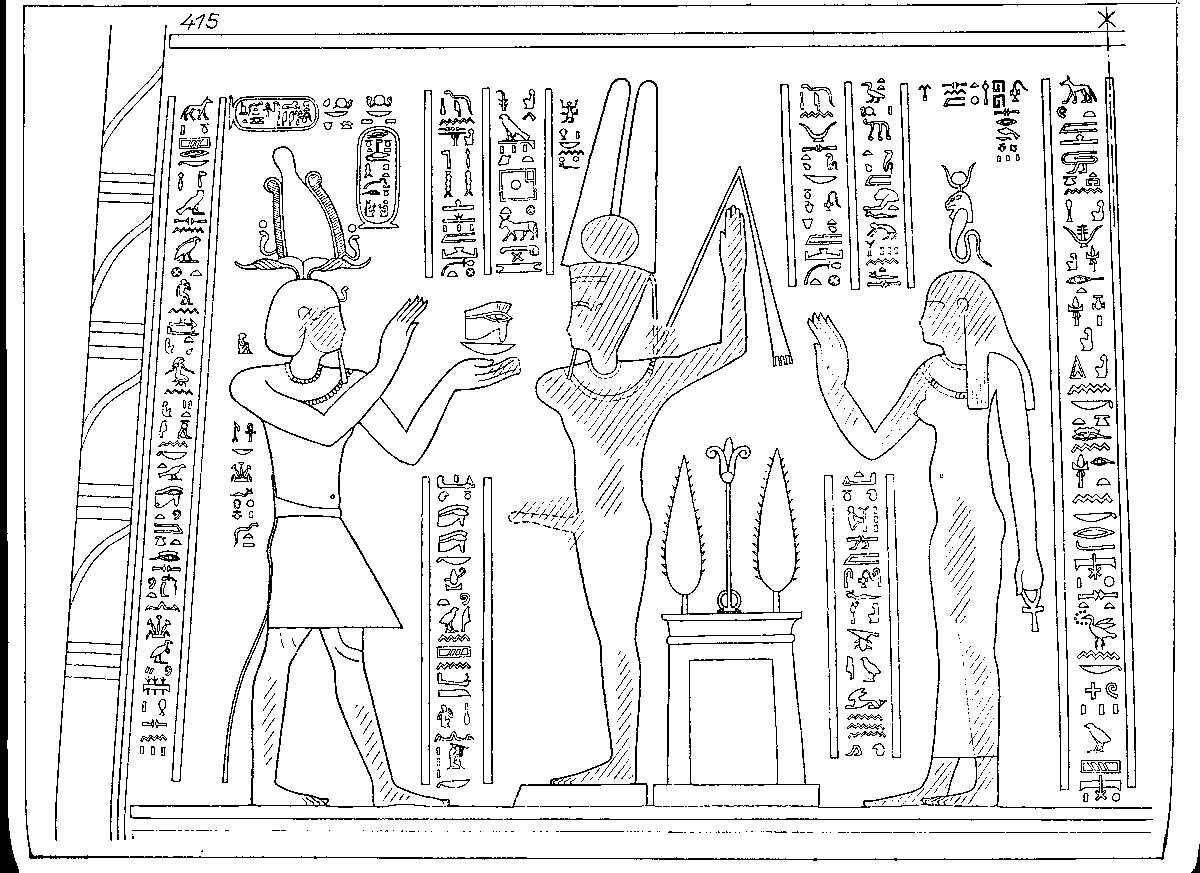
Ptolemy XII gives Min the Wedjat eye
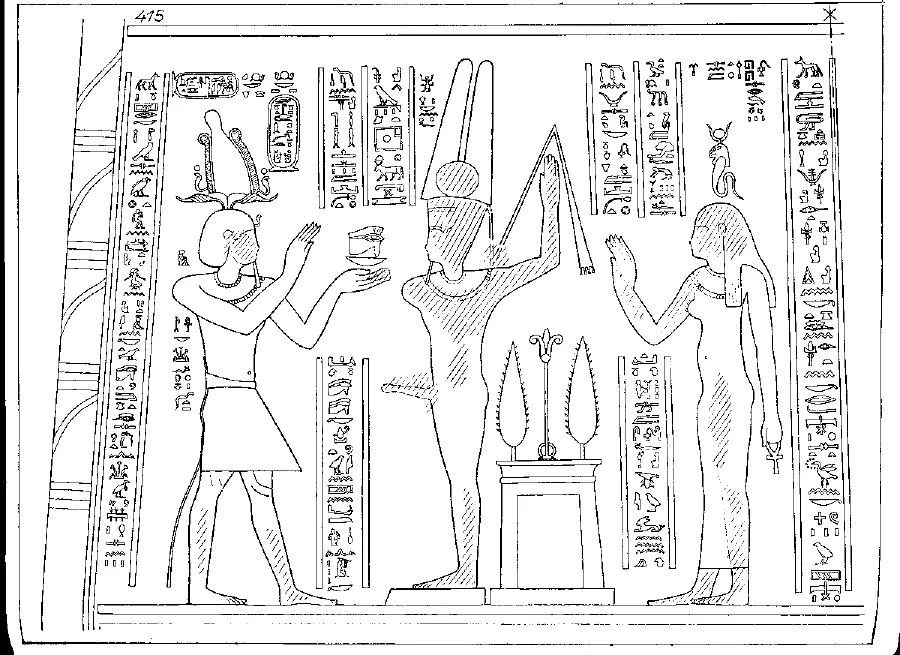
Page 217. The scene as drawn on the wall, facing p. 217 of the edition. Drawing by Otto Baum, in Junker and Winter, Das Geburtshaus des Tempels der Isis in Philä (1965) - 321p. 217, l. 1
ḏj-j n-k wḏꜣ.tj-k
I give you your two Sound Eyes,
Note · Line 321
The sacred eye of Horus, injured and then healed, takes its Egyptian name from the word for being sound or whole. Here the gift is a pair of such eyes. - 322p. 217, l. 2
wḏꜣ.tj r nšn
both sound, free of rage,
- 323p. 217, l. 3
mꜣꜥ ḫrw(-k) nn ḫftj.w-k
that you may triumph and have no enemies.
- 324p. 217, l. 4
njswt bjt nb tꜣ.wj jwꜥw n pꜣ nṯr ntj nḥm stp (n) Ptḥ jrj (mꜣꜥ.t) Rꜥ sḫm ꜥnḫ (n) Jmn
King of Upper and Lower Egypt, Lord of the Two Lands, heir of the god who saves, chosen of Ptah, who upholds the Maat of Ra, living image of Amun,
- 325p. 217, l. 5
sꜣ Rꜥ nb ḫꜥ.w Ptwlmyś ꜥnḫ ḏ.t mrj Jś.t
Son of Ra, Lord of Crowns, Ptolemy, who lives forever, beloved of Isis.
- 326p. 217, l. 6
sꜣ ꜥnḫ wꜣś nb ḥꜣ-f mj Rꜥ ḏ.t
May protection and all life and dominion surround him as they surround Ra, forever.
- 327p. 217, l. 7
ḏd mdw jn | Mnw nṯr ꜥꜣ
Words spoken by Min, the great god:
- 328p. 217, l. 8
wꜣḥ ḥtp.w m jꜣ.t wꜥb.t
who lays down offerings on the Abaton,
Note · Line 328
The Abaton, the “pure mound” on the island of Bigeh near Philae, was revered as a burial place of Osiris. - 329p. 217, l. 9
njswt nṯr.w ḫnt Ḥw.t ḫnt (?)
king of the gods, foremost in Philae,
- 330p. 217, l. 10
kꜣ wr mr(w.t) ḥꜥ ḥr nb n mꜣꜣ-f
bull greatly loved, at the sight of whom every face lights up.
- 331p. 217, l. 11
ḏd mdw jn | Wpś.t nb(.t) nbj.t ḫnw.t m jꜣ.t wꜥb.t
Words spoken by Wepeset, mistress of flame, princess on the Abaton,
Note · Line 331
Wepeset’s name means “She Who Burns.” - 332p. 217, l. 12
sꜣ.t Rꜥ ḥrj.t-tp m ḥꜣ.t-f
daughter of Ra, the diadem on his brow,
Note · Line 332
The diadem is a rearing cobra: Ra wears his daughter on his brow, where her fiery breath protects him. - 333p. 217, l. 13
sḫr śbj.w n jt-ś m Śnm.t
who strikes down her father’s rebels on Bigeh
- 334p. 217, l. 14
wḏ ḥḥ-ś r ḥꜣk.w-jb
and sends her fiery breath against the wicked:
- 335p. 217, l. 15
ḏj-j n-k śbj.w sbj m śśf
I give you the rebels, burned to ash.
- 336p. 217, l. 16
wḏ-j šꜥ.t r wnj mw-k
I send terror against your adversaries.
- 337p. 217, l. 17
jj-n-j ḫr-k nṯr ꜥꜣ m Śnm.t
I have come to you, great god on Bigeh,
- 338p. 217, l. 18
ms n wꜥ.t msj n śn.nw.t
child of the One, born of the Second.
Note · Line 338
The One and the Second are both female. - 339p. 217, l. 19
jnj-j n-k wr.t wḏꜣ.tj m dgj(.t)-ś
I bring you the Great One, sound of sight,
Note · Line 339
The Great One offered here is the left eye of Horus, identified with the moon. - 340p. 217, l. 20
wꜥb.tj nn ḫtj ḫr-ś(n) (sic)
pure, with no cloud upon it.
- 341p. 217, l. 21
jj.tj m ḥtp pḫr-nś.t n ḥm-j
Welcome, heir to the throne of My Majesty.
Note · Line 341
The god now answers the king who has brought him the eye. - 342p. 217, l. 22
ḫnm-j jꜣb.t ꜣbj jb-j
I embrace the left eye my heart longs for.
- 343p. 217, l. 23
ḏj-j n-k dgj n jꜣb.t m (so) grḥ
I give you what the left eye sees by night,
- 344p. 217, l. 24
sḏꜣḏꜣ n-k jmj.w wšꜣw
and those who dwell in darkness tremble before you.
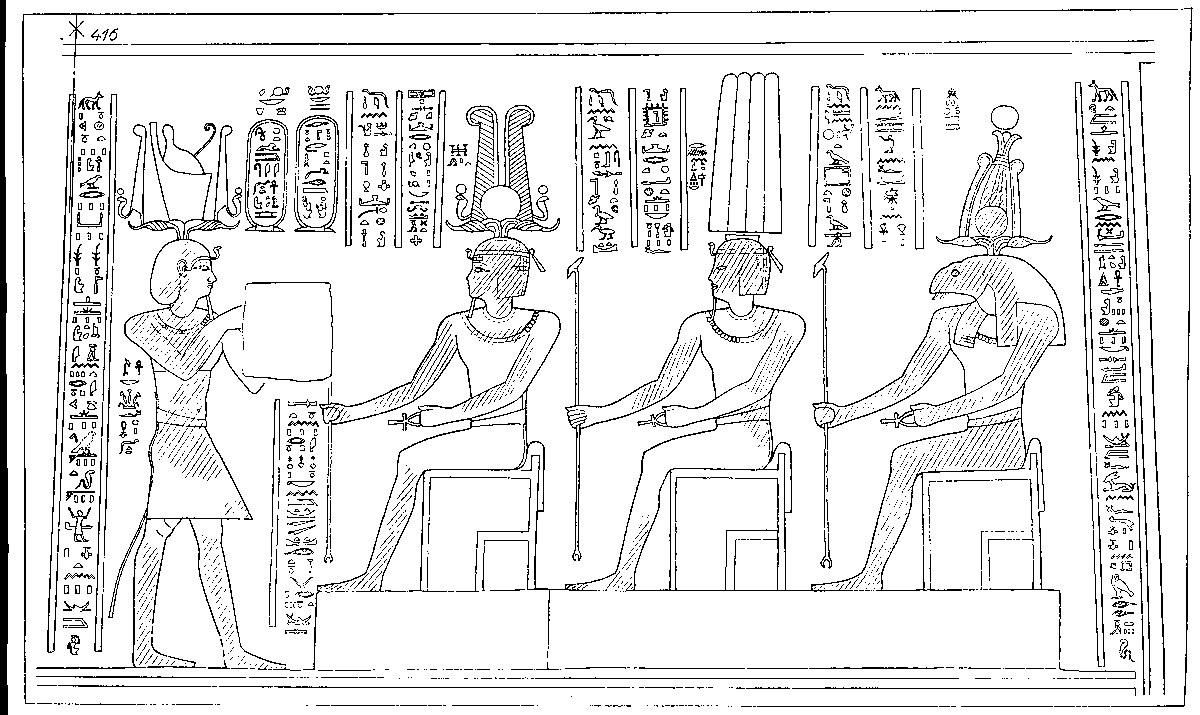
Ptolemy XII gives Arensnuphis, Thoth and Amun-Ra wine
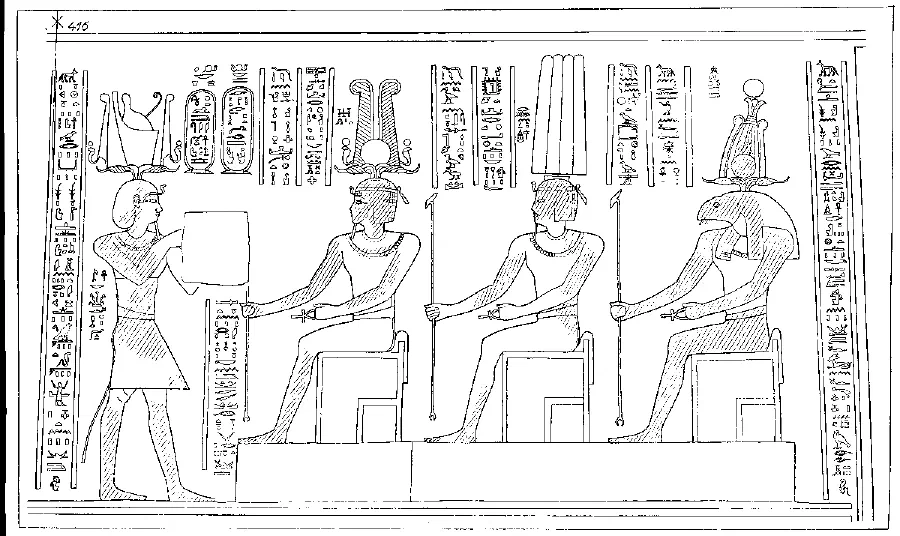
Page 219. The scene as drawn on the wall, facing p. 219 of the edition. Drawing by Otto Baum, in Junker and Winter, Das Geburtshaus des Tempels der Isis in Philä (1965) - 345p. 219, l. 1
mn n-ṯn jrp.w nfr.w nj.w Knm Dšdš
Receive the fine wines of Kharga and Bahariya,
Note · Line 345
Kharga and Bahariya are oases in Egypt’s Western Desert. - 346p. 219, l. 2
jr.t (Ḥrw) wꜣḏ.t wp rꜣ-ṯn jm-s
the green Eye of Horus. Open your mouths with it.
Note · Line 346
The wine itself is offered as the Eye of Horus. Its green color signifies freshness and vigor. - 347p. 219, l. 3
njśwt bjt nb tꜣ.wj jwꜥw n pꜣ nṯr ntj nḥm…
King of Upper and Lower Egypt, Lord of the Two Lands, heir of the god who saves …
- 348p. 219, l. 4
sꜣ Rꜥ nb ḫꜥ.w Pt. …
Son of Ra, Lord of Crowns, Ptolemy …
- 349p. 219, l. 5
ꜥnḫ wꜣś nb ḥꜣ-f mj Rꜥ ḏ.t
May all life and dominion surround him as they do Ra, forever.
- 350p. 219, l. 6
ḏd mdw jn | ỉrj-ḥmsj-nfr nṯr ꜥꜣ ḥrj-jb jꜣ.t wꜥb.t
Words spoken by Arensnuphis, the great god who dwells on the Abaton,
- 351p. 219, l. 7
śḫm špsj ḫnt ỉrk
the august power foremost in Philae,
- 352p. 219, l. 8
Šw sꜣ Rꜥ nb Tꜣ-stj
Shu, son of Ra, lord of Nubia,
- 353p. 219, l. 9
jnj wr.t wn.t ḫr.tj
who brought back the Great One who was far away.
Note · Line 353
In the story of the Distant Goddess, Ra’s daughter, his Eye, wanders to Nubia. Here it is Shu who brings her home. - 354p. 219, l. 10
ḏd mdw jn | Ḏḥwtj-Rꜥ n Prj-nbś
Words spoken by Thoth-Ra of Pnubs,
- 355p. 219, l. 11
nṯr ꜥꜣ ḫnt Bwgm
the great god foremost in Bugem,
- 356p. 219, l. 12
nṯr nṯrj ḫnt ỉrk
the divine god foremost in Philae,
- 357p. 219, l. 13
dj jḫ.t nb.t n ꜥbꜣ.w(?)-f²
who gives every kind of food for his altars.
- 358p. 219, l. 14
r … n ỉś.t dj(.t) ṯꜣw nb
for the … of Isis, who gives every breath.
- 359p. 219, l. 15
ḏd mdw jn | ỉmn-Rꜥ n Tꜣ-ḥw.t
Words spoken by Amun-Ra of Debod,
Note · Line 359
Debod, whose name means “the Temple,” was a sanctuary of Amun south of Philae. - 360p. 219, l. 16
nṯr mnḫ jś tj n ꜥš n-f
the excellent god, who comes in haste to whoever calls to him,
- 361p. 219, l. 17
dj ṯꜣw n ꜥnḫ ḥr msḫn(.t)
who gives the breath of life at the place of birth:
- 362p. 219, l. 18
jj-n-j ḫr-ṯn śḫm.w wr.w
I have come to you, great powers,
- 363p. 219, l. 19
kꜣ.w nn nj.w ḥtp.w nṯr ỉś.t
you kas of the divine offerings of Isis.
Note · Line 363
Here the powers that give the offerings their power to nourish are addressed as living beings. - 364p. 219, l. 20
jnj-j n-ṯn (so) jrp ḫr.t nṯr.w nṯr.wt
I bring you wine, the sustenance of gods and goddesses,
- 365p. 219, l. 21
ḥꜥj jb-ṯn jm-f
that your heart may rejoice in it.
- 366p. 219, l. 22
jj.tj m ḥtp njśw.t nj.w-św.t(?)
Welcome in peace, king of kings,
Note · Line 366
The powers receiving the wine now answer the king. - 367p. 219, l. 23
wr nḫt n(?) ỉś.t dj(.t) ꜥnḫ
great in might for Isis, giver of life.
- 368p. 219, l. 24
šsp-n jḫ.t-k śwm-n jm-f (sic)
We accept your offering and drink of it;
- 369p. 219, l. 25
wnf jb n …⁵ n(?) mꜣꜣ jnw-k
the heart of … is glad at the sight of your gifts.
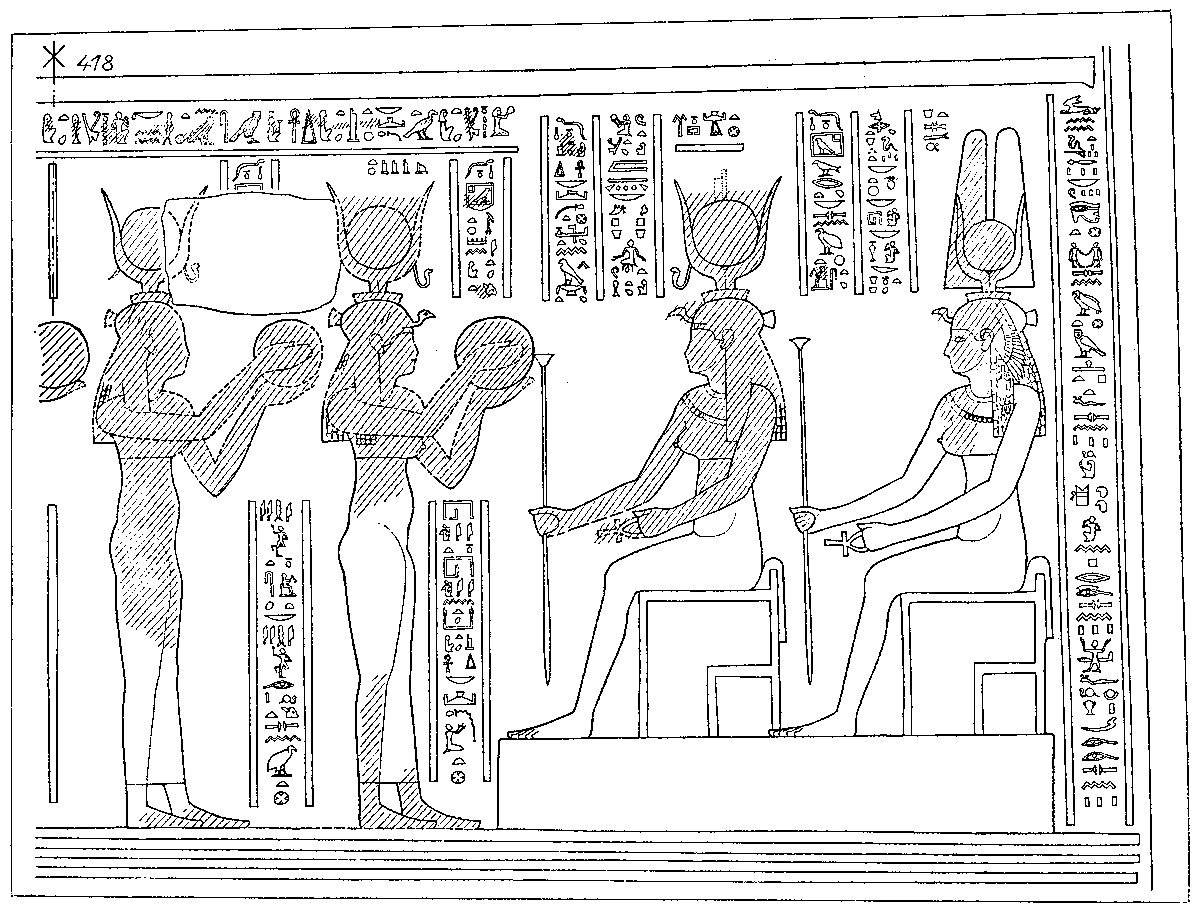
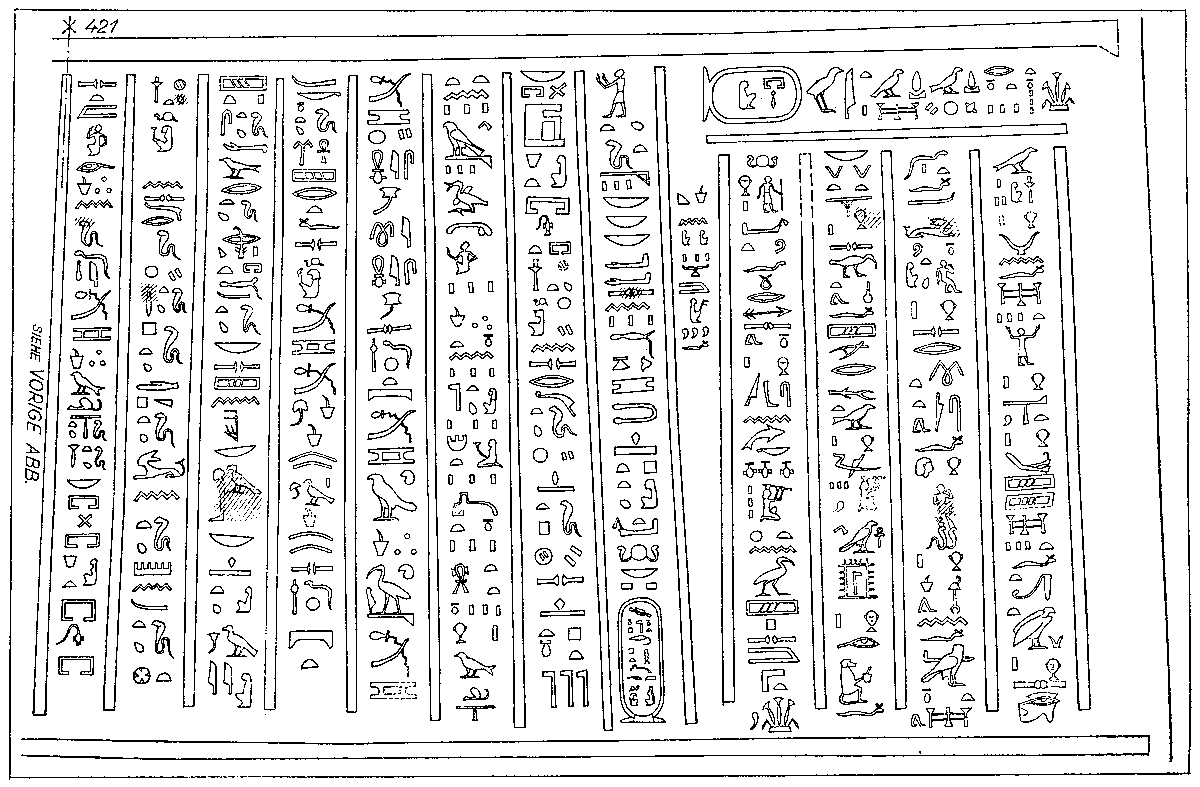
The seven Hathors beat the tambourine before Isis
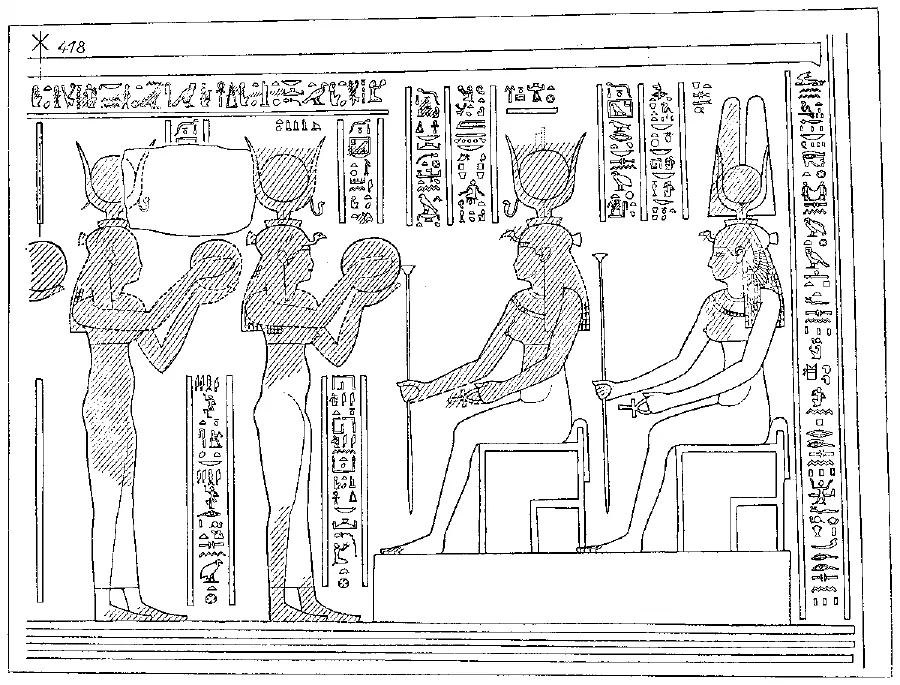
Page 221. The scene as drawn on the wall, facing p. 221 of the edition. Drawing by Otto Baum, in Junker and Winter, Das Geburtshaus des Tempels der Isis in Philä (1965) - 370p. 221, l. 1
ḏd mdw n | Jś.t dj(.t) ꜥnḫ nb(.t) jꜣ.t wꜥb.t
Words spoken to Isis, giver of life, lady of the Abaton,
Note · Line 370
Entry was restricted. - 371p. 221, l. 2
mw.t nṯr n bjk (n) nb
divine mother of the Golden Falcon:
- 372p. 221, l. 3
nhm-tw n-ṯ m tꜣ nb
In every land they raise a joyous cry to you,
- 373p. 221, l. 4
ḏr pꜥpꜥ-tw ḥm.t-ṯ m ḫnw jꜣ.t-dj(?)¹
ever since Your Majesty was born in Dendera.
- 374p. 221, l. 5
ḏd mdw n | Ḥw.t-Ḥrw wr.t nb(.t) Śnm.t
Words spoken to Hathor the Great, lady of Bigeh,
- 375p. 221, l. 6
šps.t wśr.t ḫnw.t nṯr.wt
noble one, mighty one, sovereign of the goddesses,
- 376p. 221, l. 7
nb(.t) tḫ(.t) nb(.t) hjj nb(.t) ḥśj(.t)
lady of drunkenness, lady of jubilation, lady of song,
- 377p. 221, l. 8
nb(.t) ꜥnṯjw ḫnw.t ṯs-mꜣḥ
lady of myrrh, sovereign of the weaving of garlands.
- 378p. 221, l. 9
wnn nṯr.wt ꜥꜣ.wt nb.wt Bꜣḳ.t
The great goddesses, the ladies of Egypt,
- 379p. 221, l. 10
śnśn Śnm.t m ḥtp
unite with Bigeh in peace.
- 380p. 221, l. 11
jt-šn Rꜥ ḥngg n ptr-šn
Their father Ra delights in the sight of them;
- 381p. 221, l. 12
ḥꜥj-f rꜥ nb ḥr mꜣꜣ-šn
every day he rejoices to see them.
- 382p. 221, l. 13
nhm-n n-ṯ tꜣ nb.t jꜣ.t wꜥb.t
We beat the tambourine for you, lady of the Abaton,
- 383p. 221, l. 14
Jś.t dj(.t) ꜥnḫ nb.t m Śnm.t
Isis, giver of life, lady in Bigeh.
- 384p. 221, l. 15
ḥkn-n n ḥm.t-ṯ ḥkn(.t) m ꜥnḫ
We rejoice for Your Majesty, who rejoices in life.
- 385p. 221, l. 16
Ḥw.t-Ḥrw wr.t nb(.t) Śnm.t
Hathor the Great, lady of Bigeh,
- 386p. 221, l. 17
ḥśj-n m ḥr-ṯ
we play the harp before you,
- 387p. 221, l. 18
tꜣ ḥḳꜣ.t n(.t) Bwgm
ruler of Bugem.
- 388p. 221, l. 19
tꜣ nb.t n km.t² r ꜣw
O Lady of all Egypt.
- 389p. 221, l. 20
dj-n jꜣw r ḳꜣ.w n p.t
We raise our praise to the heights of heaven
- 390p. 221, l. 21
jhj r wsḫ n tꜣ
and shout for joy as far as the earth is wide,
- 391p. 221, l. 22
ḥꜥj jb-ṯn śḫm.w wr.w
that your heart may rejoice, O great powers,
- 392p. 221, l. 23
ḥr tp ꜥnḫ ḏd wꜣś n prj-ꜥꜣ
for the life, stability and dominion of Pharaoh.
- 393p. 221, l. 24
① ḏd mdw n | Ḥw.t-Ḥrw nb(.t) Wꜣś.t
1. Words spoken by Hathor, Lady of Thebes,
Note · Line 393
Seven local forms of Hathor take turns singing to Isis in the birth house, where the birth of her child Horus was celebrated. - 394p. 221, l. 25
Jmn.t ḫnt jp.t-św.t
Amunet, foremost in Karnak:
Note · Line 394
Here Hathor of Thebes is identified with Amunet, the female counterpart of Amun. - 395p. 221, l. 26
hj n-ṯ hj n kꜣ-ṯ
Joy to you, joy to your ka,
Note · Line 395
It too can receive praise and offerings. - 396p. 221, l. 27
Jś.t dj(.t) ꜥnḫ nb(.t) jꜣ.t wꜥb.t
O Isis, giver of life, Lady of the Abaton.
Note · Line 396
The Abaton, the “inaccessible place,” was the sacred ground on Bigeh, near Philae, where Osiris was believed to be buried. - 397p. 221, l. 28
② ḏd mdw n | Ḥw.t-Ḥrw (nb.t Jwn.t?) …
2. Words spoken by Hathor, Lady of Dendera …
- 398p. 221, l. 29
jhj n-ṯ šps.t nb(.t) jhj
Joy to you, O noble one, Lady of Joy,
- 399p. 221, l. 30
jr.t Rꜥ ḫnt Śnm.t
Eye of Ra, foremost on Bigeh.
Note · Line 399
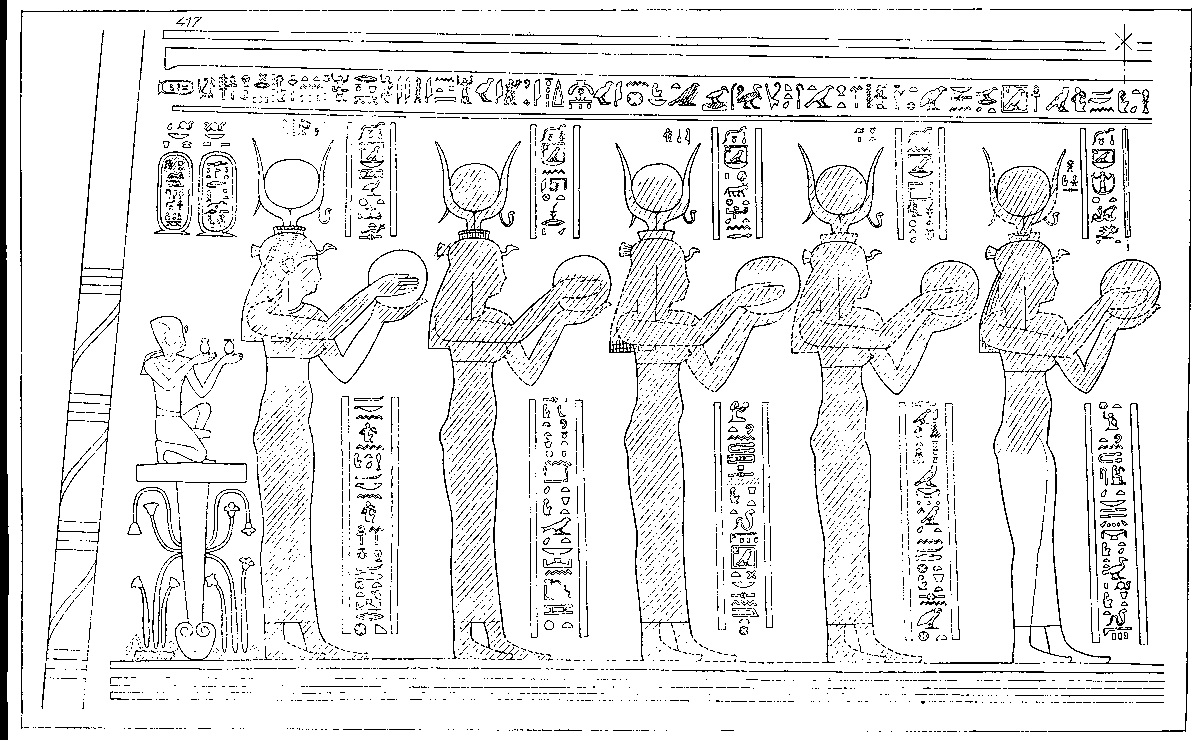
The Eye of Ra is the sun god’s own power embodied in a goddess who acts on his behalf. The seven Hathors beat the tambourine before Isis (continued)
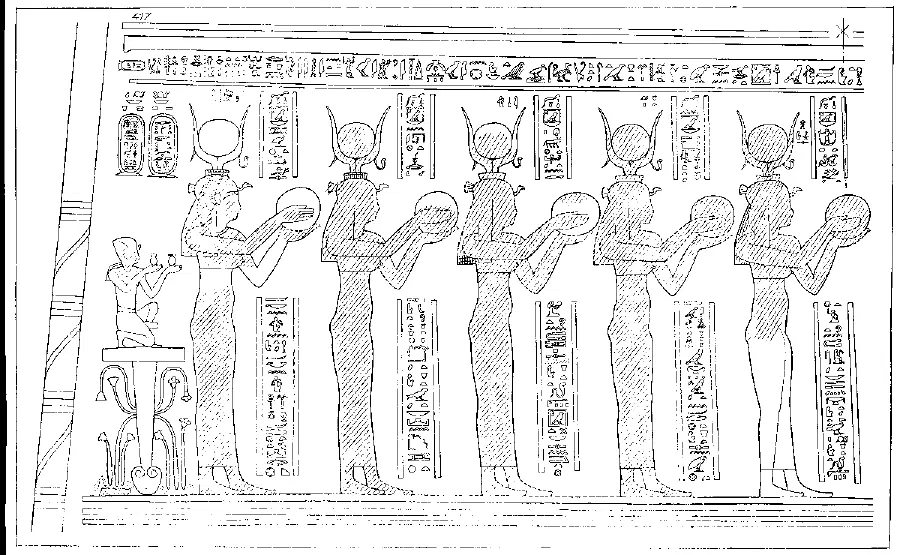
Page 223. The scene as drawn on the wall, facing p. 223 of the edition. Drawing by Otto Baum, in Junker and Winter, Das Geburtshaus des Tempels der Isis in Philä (1965) - 400p. 223, l. 1
[3] ḏd mdw n | Ḥw.t-Ḥrw nb(.t) Ḳjs
3. Words spoken by Hathor, Lady of Cusae,
- 401p. 223, l. 2
nb.tj rḫj.t sꜣ sn-s
queen of the people, who guards her brother:
- 402p. 223, l. 3
tbn (?)¹-tw n-ṯ šps.t nb(.t) tꜣ.wj
They beat the tambourine for you, O noble one, Lady of the Two Lands,
- 403p. 223, l. 4
nb sꜣ.t Rꜥ ḥnw.t nṯr.wt
Gold, daughter of Ra, sovereign of the goddesses.
Note · Line 403
Gold is a name of Hathor that evokes her solar radiance. - 404p. 223, l. 5
[4] ḏd mdw n | Ḥw.t-Ḥrw nb(.t) Ḥw.t-nn-njswt
4. Words spoken by Hathor, Lady of Heracleopolis,
- 405p. 223, l. 6
tmꜣ.t n.t Rꜥ
mother of Ra:
- 406p. 223, l. 7
wḏj(-j?)² jꜣw n-ṯ wbn(.t) m nb
I give you praise, you who rise as gold,
- 407p. 223, l. 8
bjk.t n(.t) Bḥd.t ḥnw.t Snm.t
she-falcon of Edfu, sovereign of Bigeh.
- 408p. 223, l. 9
[5] ḏd mdw n | Ḥw.t-Ḥrw nb(.t) Tp-jḥw
5. Words spoken by Hathor, Lady of Atfih,
- 409p. 223, l. 10
mw.t nṯr n(.t) ꜥꜣ-mꜣꜥ-ḫrw
divine mother of the Victorious One:
- 410p. 223, l. 11
nḥm-tw n-ṯ šps(.t) ḥnw.t nṯr.wt
They play the tambourine for you, O noble one, sovereign of the goddesses,
- 411p. 223, l. 12
Ḥw.t-Ḥrw wr.t nb(.t) Snm.t
Hathor the Great, Lady of Bigeh.
- 412p. 223, l. 13
[6] ḏd mdw n | Ḥw.t-Ḥrw nb(.t) nh.t rsj.t
6. Words spoken by Hathor, Lady of the Southern Sycamore:
- 413p. 223, l. 14
sḳr (so)-tw n-ṯ tbn n kꜣ-ṯ
The tambourine is struck for you, for your ka,
- 414p. 223, l. 15
ḥnw.t wr.t nb(.t) jꜣ.t wꜥb.t
O great sovereign, Lady of the Abaton.
- 415p. 223, l. 16
[7] ḏd mdw n | Ḥw.t-Ḥrw nb(.t) š-dšr
7. Words spoken by Hathor, Lady of the Red Lake,
- 416p. 223, l. 17
nḏj.t jt-s r ḫftj.w-s (sic)
who defends her father against her enemies:
- 417p. 223, l. 18
ḥknw n ḥm.t-ṯ
Praise to Your Majesty!
- 418p. 223, l. 19
ḥkn(.t) m ꜥnḫ ḥrj(.t)-jb Bḥd.t ḫnt Jrk
She who rejoices in life, who dwells in Edfu and presides over Philae.
- 419p. 223, l. 20
njswt bjt nb tꜣ.wj jwꜥw n pꜣ nṯr ntj nḥm …
King of Upper and Lower Egypt, Lord of the Two Lands, heir of the god who saves …
- 420p. 223, l. 21
sꜣ Rꜥ nb ḫꜥ.w Pt …
Son of Ra, Lord of Crowns, Ptolemy …
Ptolemy XII goes from the palace to the temple
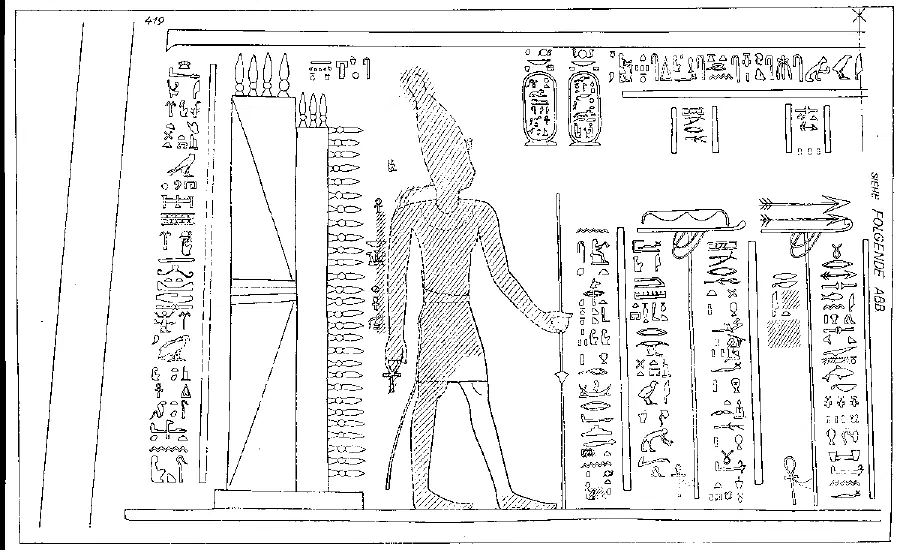
Page 225. The scene as drawn on the wall, facing p. 225 of the edition. Drawing by Otto Baum, in Junker and Winter, Das Geburtshaus des Tempels der Isis in Philä (1965) - 421p. 225, l. 1
prj njśwt bjt prj-ꜥꜣ m prj-f
The King of Upper and Lower Egypt, Pharaoh, comes forth from his house,
Note · Line 421
“Pharaoh” means “Great House.” The Egyptian word for coming forth echoes the word for house. - 422p. 225, l. 2
jw bnrw-f m jb.w rmṯ (so)
his sweetness in the hearts of the people.
- 423p. 225, l. 3
ꜥḳ-f ś.t wr.t n(.t) špś.t ḥnw.t
He enters the Great Seat of the August One, the Mistress,
Note · Line 423
The Great Seat is the goddess’s sanctuary. - 424p. 225, l. 4
r śn-tꜣ n nb(.t) tꜣ.wj
to kiss the ground before the Lady of the Two Lands,
- 425p. 225, l. 5
r dwꜣ ḥm.t-ś m ḏꜣḏꜣ.t¹ śtp.t
to praise Her Majesty with choice hymns,
- 426p. 225, l. 6
r rdj(.t) śnśn² r ḫft-ḥr-ś
to offer praise before her face.
- 427p. 225, l. 7
mśḥꜣ jb-ś dgj-n-ś ḥm-f
Her heart rejoices at the sight of His Majesty,
- 428p. 225, l. 8
dj-ś jśw n ḥwśj-n-f
and she rewards him for what he has built.
- 429p. 225, l. 9
njśwt bjt nb tꜣ.wj jwꜥw n pꜣ nṯr ntj nḥm …
King of Upper and Lower Egypt, Lord of the Two Lands, heir of the god who saves …
- 430p. 225, l. 10
sꜣ Rꜥ nb ḫꜥ.w Pt …
Son of Ra, Lord of Crowns, Ptolemy …
- 431p. 225, l. 11
sꜣ ꜥnḫ (wꜣś) nb ḥꜣ(-f) mj Rꜥ ḏ.t
May all protection, life and dominion surround him as they surround Ra, forever.
- 432p. 225, l. 12
prj-j m mnḫb r špr ś.t wr.t
I come forth from the palace to reach the Great Seat,
Note · Line 432
The king now speaks in his own voice. - 433p. 225, l. 13
r ḥb n špś.t wśr.t
to bow before the August One, the Mighty One,
- 434p. 225, l. 14
bḳnḳn ḥr jrj(.t) gś-dp.t³
with the standards standing guard,
Note · Line 434
The standards are divine emblems carried on poles in the royal procession. - 435p. 225, l. 15
r jꜥr ꜥj.t n Rꜥj.t
to ascend to the chamber of the sun goddess.
- 436p. 225, l. 16
śḫ.t tꜣ pn
The palace of this land.
- 437p. 225, l. 17
ḫꜥj jn njśwt m ḥnt ś.t wr.t
The king shines forth upon the Great Seat
- 438p. 225, l. 18
m ḥrw śp.t Rꜥ m Tꜣ-stj
in Ra’s province in Nubia.
- 439p. 225, l. 19
šsp św m ḥꜥꜥ mw.t-f Jś.t dj(.t) ꜥnḫ
His mother Isis, giver of life, welcomes him with joy,
- 440p. 225, l. 20
ḥḳꜣ.t mw.t nṯr n ḥḳꜣ
the sovereign, divine mother of the sovereign.
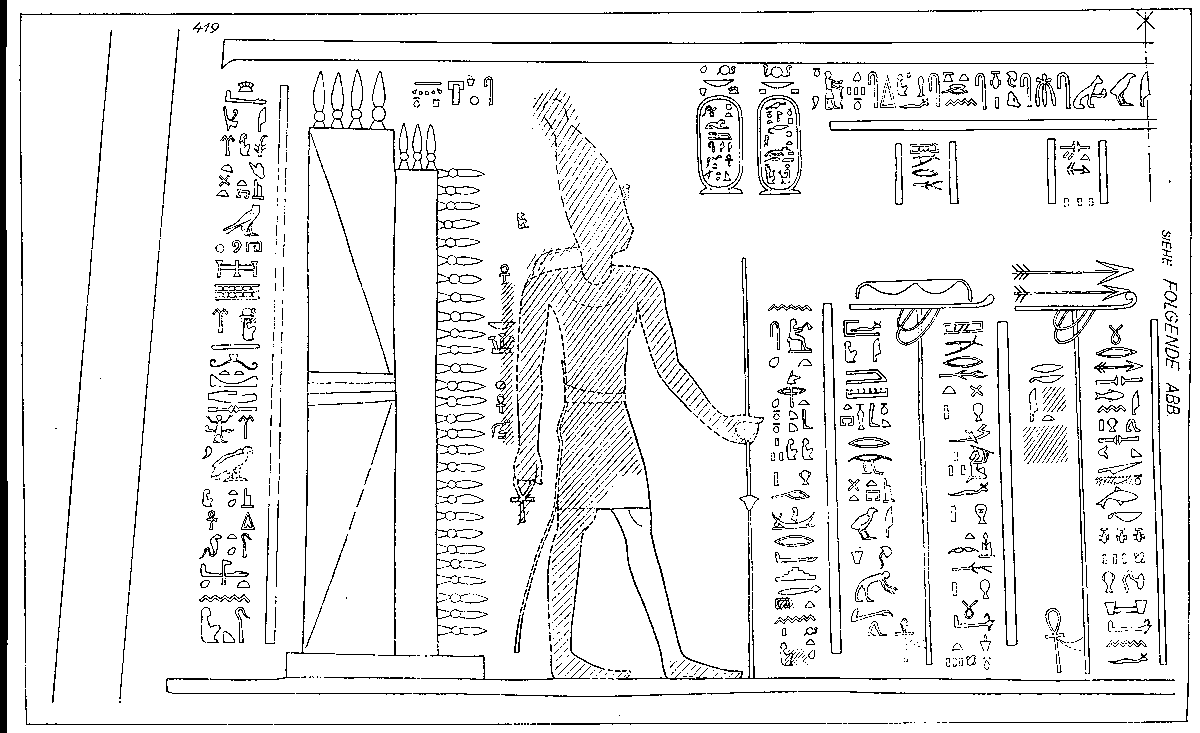
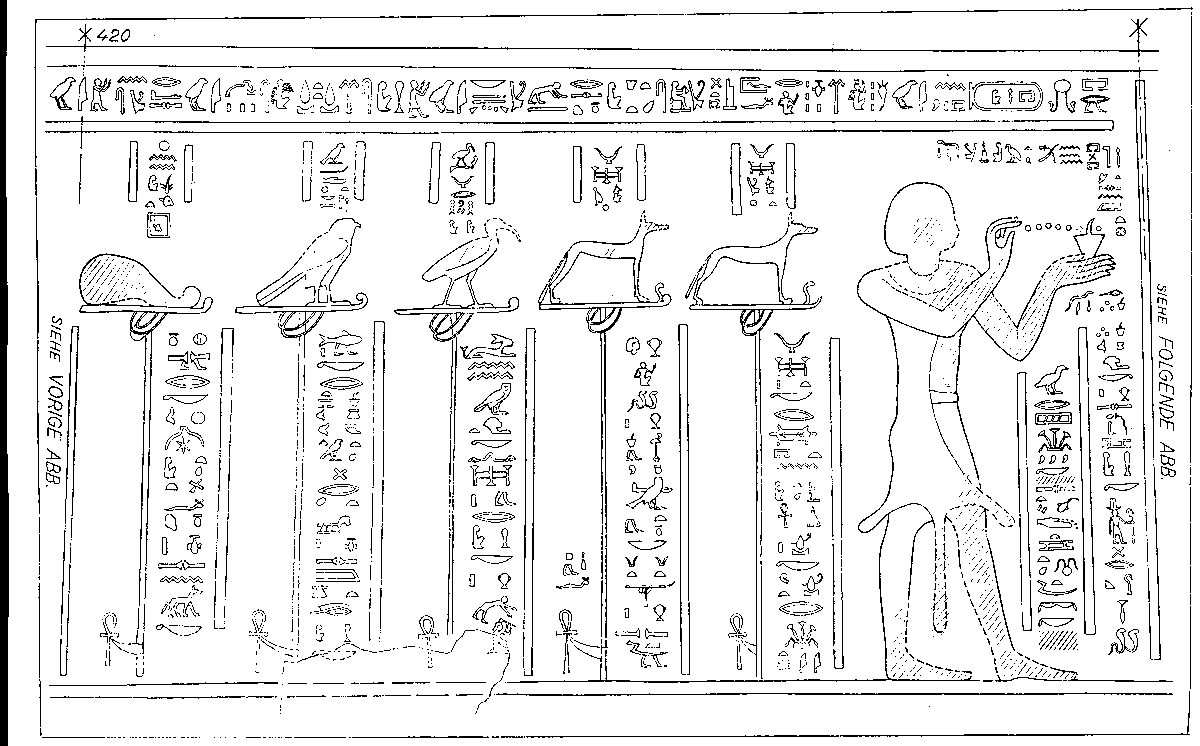
Ptolemy XII goes from the palace to the temple (continued): the standards, the censing of the uraeus
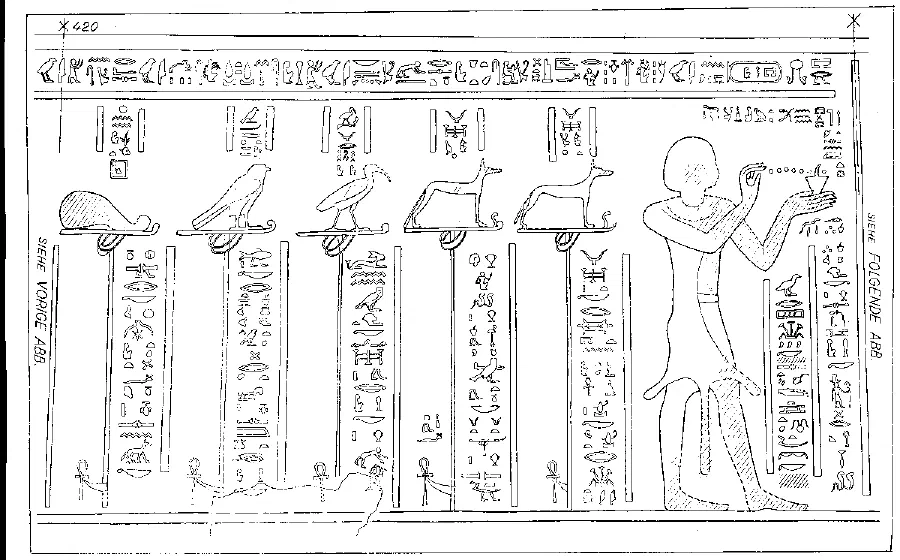
Page 227. The scene as drawn on the wall, facing p. 227 of the edition. Drawing by Otto Baum, in Junker and Winter, Das Geburtshaus des Tempels der Isis in Philä (1965) - 441p. 227, l. 1
Wp-wꜣ.wt mḥw
Wepwawet of the North:
Note · Line 441
Wepwawet is the jackal god whose name means “Opener of Ways.” - 442p. 227, l. 2
wp(-j) wꜣ.t-k r štj.t n(.t) Jś.t dj(.t) ꜥnḫ
I open your way to the sanctuary of Isis, giver of life.
- 443p. 227, l. 3
wḏꜣ-k wḏꜣ.tj r ḫꜣj.t
You go in safety, safe from harm.
- 444p. 227, l. 4
Wp-wꜣ.wt šmꜥ.w
Wepwawet of the South:
- 445p. 227, l. 5
ḥrj-tp jꜥr.tj (?) ḥr wbꜣ n-f mṯn
The leader of the two rearing cobras opens the road for him.
Note · Line 445
The rearing cobras, called uraei, protect the king. - 446p. 227, l. 6
nb šdšd ḥr śmꜥ ḫp-f
The lord of the shedshed guides his steps.
Note · Line 446
The shedshed is the rounded swelling in front of the jackal on Wepwawet’s standard. - 447p. 227, l. 7
Ḏḥwtj wp rḫ.wj
Thoth, who judges between the Two Companions:
Note · Line 447
The Two Companions are Horus and Seth, rivals for the throne of Egypt. - 448p. 227, l. 8
wnn(-j) m ḥꜣ.t-k n ḥrj-j r ḥm-k
I am before you; I do not draw away from Your Majesty,
- 449p. 227, l. 9
ḥr śḫr ḫftj.w …
laying the enemies low …
- 450p. 227, l. 10
Ḥrw Bḥd.tj nṯr ꜥꜣ nb p.t
Horus of Behdet, the great god, lord of the sky:
Note · Line 450
Behdet is Edfu, where Horus was worshipped as a falcon. - 451p. 227, l. 11
bś-k r bw ḥr ḏrtj.t wr.t
You enter the place where the great she-falcon is.
Note · Line 451
The she-falcon is Isis. - 452p. 227, l. 12
ḥntś jb-ś m (sic) dgj ḥm-k
Her heart delights in the sight of Your Majesty.
- 453p. 227, l. 13
Ḥnś¹ ḫnt Ḥw.t-ḥnt
The Henes standard at the head of Philae:
Note · Line 453
A standard is a sacred emblem carried on a pole. Its name here, Henes, echoes the Egyptian command to hasten. - 454p. 227, l. 14
ḥns r-k ḥr Śšꜣ.t wr.t
Hasten, then, to Seshat the Great;
- 455p. 227, l. 15
wnf² jb-ś n jj-k
her heart is glad at your coming.
- 456p. 227, l. 16
śtj (.wj)
The two arrows:
- 457p. 227, l. 17
šśr śjn ḥr śḳr n-k ḥꜣk.w jb.w
The arrow speeds on, felling the rebellious of heart for you.
- 458p. 227, l. 18
ꜥḥꜣ ḥr mḏd n-f rḫj.w …
For him the weapon strikes the adversaries …
- 459p. 227, l. 19
šmr.t
The bow:
- 460p. 227, l. 20
šmr.t wr.t ḥr śmꜣ ḫftj.w-f
The great bow kills his enemies,
- 461p. 227, l. 21
ḥr jwn.t ḥr dr bṯnw.w
and the Iunet bow drives off the rebels.
- 462p. 227, l. 22
ḏd mdw j | Jwn-mw.t-f
Words to be spoken: The Iunmutef priest
Note · Line 462
Iunmutef means “Pillar of His Mother,” a name of Horus in his role as a son. The priest takes that role in the rite. - 463p. 227, l. 23
wꜥb prj-wr nṯr ꜥꜣ ḫnt Śnm.t
purifies the Per-wer shrine of the great god who presides over Bigeh.
Note · Line 463
Per-wer means “Great House.” - 464p. 227, l. 24
jrj(.t) śnṯr ḏd mdw j
Offering incense. Words to be spoken:
- 465p. 227, l. 25
śnṯr ḥr ḥꜣ.t-k ḥr śwꜥb ḥm-k
Incense is before you, purifying Your Majesty.
- 466p. 227, l. 26
jtj wr ḥḳꜣ wꜣḏ.tj wrrḥ ḥꜥ.w-k
O great king, ruler of the two uraei, your limbs bloom,
- 467p. 227, l. 27
… śtj wꜣḏ.t (= jḏ.t)
… the scent of perfume,
- 468p. 227, l. 28
dmꜣ.t pḏ.wt-k? …
the binding of your bows …
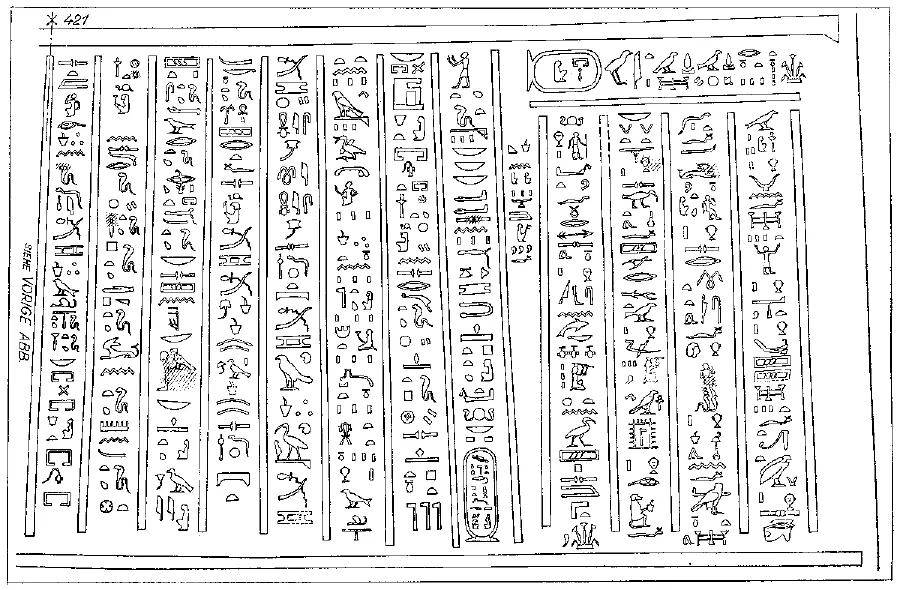
Page 229. The scene as drawn on the wall, facing p. 229 of the edition. Drawing by Otto Baum, in Junker and Winter, Das Geburtshaus des Tempels der Isis in Philä (1965) - 469p. 229, l. 1
šm jrj snṯr n jꜥr.t ḏd mdw j
The sem-priest offers incense to the uraeus and recites:
- 470p. 229, l. 2
ꜥbw(-ṯ) snṯr wr.t-ḥḳꜣ.w
Your purification is incense, O Great of Magic,
- 471p. 229, l. 3
Wꜣḏ.t nb(.t) prj-wr ḥnw.t prj-nsr
Wadjet, lady of the Per-wer, mistress of the Per-neser,
Note · Line 471
Wadjet is the cobra goddess of Lower Egypt. The Per-neser, or “House of Flame,” is her sanctuary at Buto. - 472p. 229, l. 4
Sḫm.t (sp sn) Nsr.t (sp sn) Wꜣḏ.t
Sekhmet, Sekhmet, flame-serpent, flame-serpent, Wadjet,
- 473p. 229, l. 5
Pj.t Dpj.t wnw.t mnhj.t
you of Pe, you of Dep, serpent goddess, uraeus,
- 474p. 229, l. 6
nw.t š-š² wr.t
you of the city of her lake, great one,
- 475p. 229, l. 7
rś(-n.t) mḥ(-n.t) nb(.t) ššn
you of the southern shrine and of the northern shrine, lady of Lotus Town,
- 476p. 229, l. 8
nb(.t) ḫb(š) nb(.t) ḥtp.t Tꜣj.t
lady of Khabes, lady of Hetepet, Tayet,
- 477p. 229, l. 9
ḥkn.t m ꜥnḫ ḫr jt-ś Rꜥ
who rejoices in life beside her father Ra.
- 478p. 229, l. 10
ꜥbw ꜥbw ḫbb ḫb šḥḏ p.t
Pure, pure! The coil of the Red Crown dances, lighting up the sky.
Note · Line 478
The Red Crown of Lower Egypt has a slender coil rising from its front; the White Crown is its Upper Egyptian counterpart. - 479p. 229, l. 11
ꜥbw (sp sn) mjsw.t(?) dmj(?) mjsw.t(?) šḥḏ p.t
Pure, pure! The White Crown touches the White Crown, lighting up the sky.
- 480p. 229, l. 12
ꜥbw-k Ḥrw snṯr-k Ḏḥwtj
Your purification is Horus’s; your cleansing is Thoth’s.
- 481p. 229, l. 13
ꜥbw-ṯn nṯr.w ṯꜣj.w
Your purification, you male gods!
- 482p. 229, l. 14
snṯr-ṯn nṯr.wt ḥm.wt
Your cleansing, you female deities!
- 483p. 229, l. 15
śtp-ṯn sꜣ-ṯn ḥr wr.t-ḥḳꜣ.w
Lay your protection over her who is Great of Magic,
Note · Line 483
Great of Magic is the goddess whose power dwells in the royal crowns and in the cobra on the king’s brow. - 484p. 229, l. 16
nb(.t)-prj-wr ḥnw.t prj-nsr.t
lady of the Great House, mistress of the House of Flame.
- 485p. 229, l. 17
Sḫm.t (sp sn) Nsr.t (sp sn)
Sekhmet, Sekhmet! Fiery Serpent, Fiery Serpent!
- 486p. 229, l. 18
Ḥtp.t (sp sn) śḥtp n-ṯ (sic) nṯr.w
Hetepet, Hetepet! The gods appease you;
Note · Line 486
The name Hetepet echoes the Egyptian word for bringing someone to peace. - 487p. 229, l. 19
dwꜣ-ṯw⁴ nṯr.wt nb.wt
all the goddesses praise you,
- 488p. 229, l. 20
ꜥ.wj-śn mḥ ḥr mr(r.t?)-ṯ
their arms full of what you love.
- 489p. 229, l. 21
Ḥtp.t ḥwj-ṯ njśwt bjt nb tꜣ.wj jwꜥw n pꜣ nṯr ...
Hetepet, shield the King of Upper and Lower Egypt, Lord of the Two Lands, heir of the god …
- 490p. 229, l. 22
ḥꜣ-ṯn r-ṯn ḏꜣj.w (sp sn) ḏꜣj wꜣ.t r prj-ꜥꜣ
Back with you, foes, foes who cross Pharaoh’s path!
- 491p. 229, l. 23
wr śḫm.w ḥr wp n-f wꜣ.wt
The Great One among the Powers opens the ways for him;
Note · Line 491
The king’s protectors are named in turn. Many are emblems carried aloft on poles, or standards, in procession. - 492p. 229, l. 24
ḳꜣ-ḥr-ꜣ.t-f ḥr ḏśr ššꜣ.wt-f (so)⁵
he who stands high on his standard clears his paths;
- 493p. 229, l. 25
ṯj.t štꜣ.t ḥr śwḏꜣ ḏ.t-f
he whose form is secret keeps his body sound;
- 494p. 229, l. 26
ḥwn.t ḥr śrwḏ šḳd.t-f
the Maiden makes his going sure;
- 495p. 229, l. 27
ḥrj-tp jꜥr.tj ḥr wbꜣ n-f mṯn
the chief of the two cobras opens the road for him;
- 496p. 229, l. 28
nb šdšd ḥr śḳr ḥp.t-f
the Lord of the Bolster gives him a faultless stride;
Note · Line 496
The bolster is the rounded object shown in front of the jackal on the standard of Wepwawet, whose name means “Opener of the Ways.” - 497p. 229, l. 29
šmr.t wr.t ḥr śmꜣ ḫftj.w-f
the Great Bow kills his enemies;
- 498p. 229, l. 30
bjk nṯrj ḥr jrj(.t) bsꜣ-f
the divine falcon keeps him safe;
- 499p. 229, l. 31
ꜥpj⁶ wr ḥr ḥwj.t-f
the great winged sun shields him;
Note · Line 499
The winged sun can take the form of a scarab with outspread wings. - 500p. 229, l. 32
šśr śjn ḥr śbḏ⁷ n(-f) ḥꜣk.w-jb.w
the arrow flies, destroying the rebels for him;
- 501p. 229, l. 33
ṯḥn špś m nh.t ḥꜣ-f
the noble ibis stands guard behind him;
- 502p. 229, l. 34
bḳn(ḳn) dmḏ m sꜣw ḥꜥ.w-f
the standards together guard his limbs.
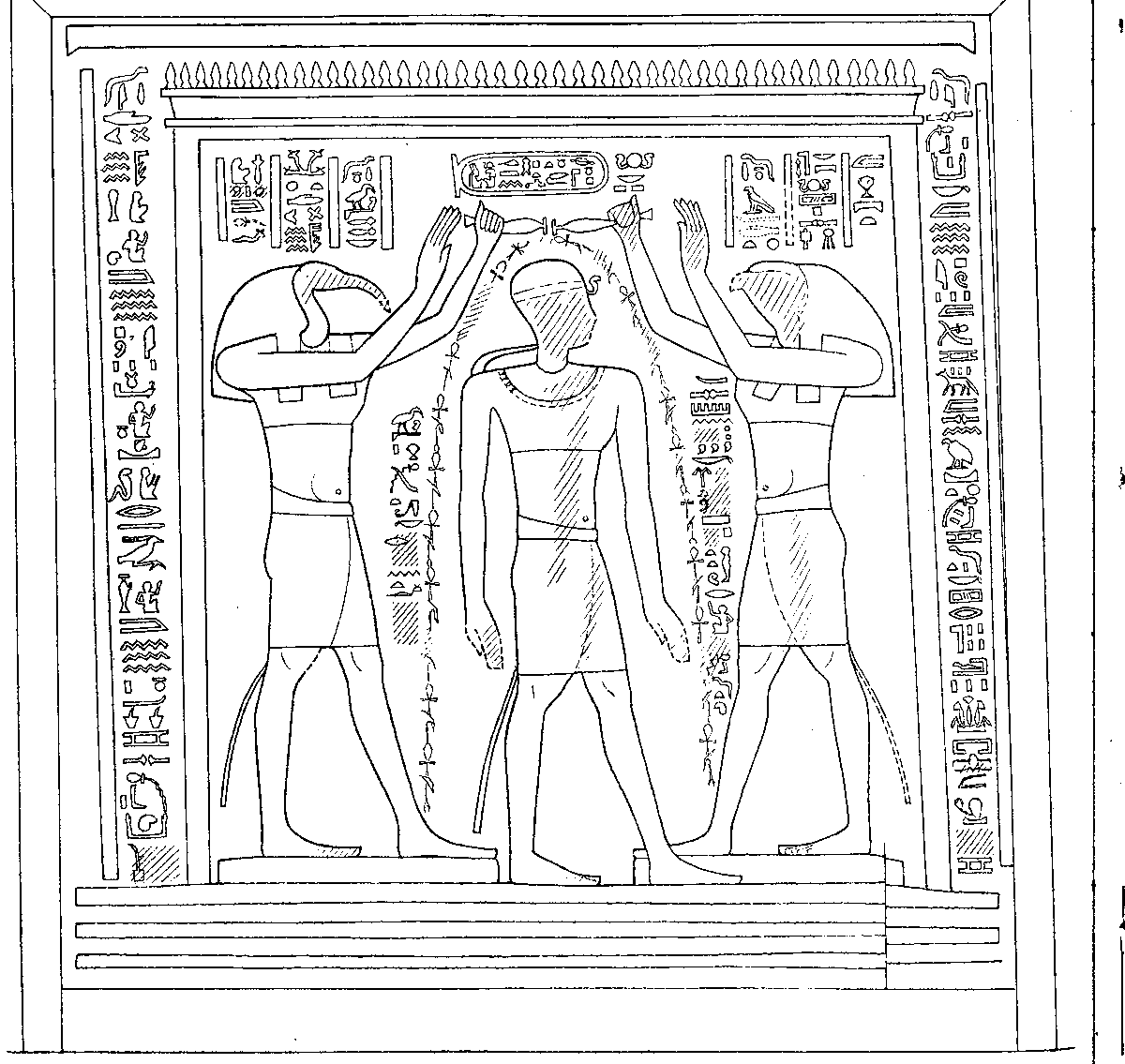
Horus and Thoth purify Ptolemy XII with water
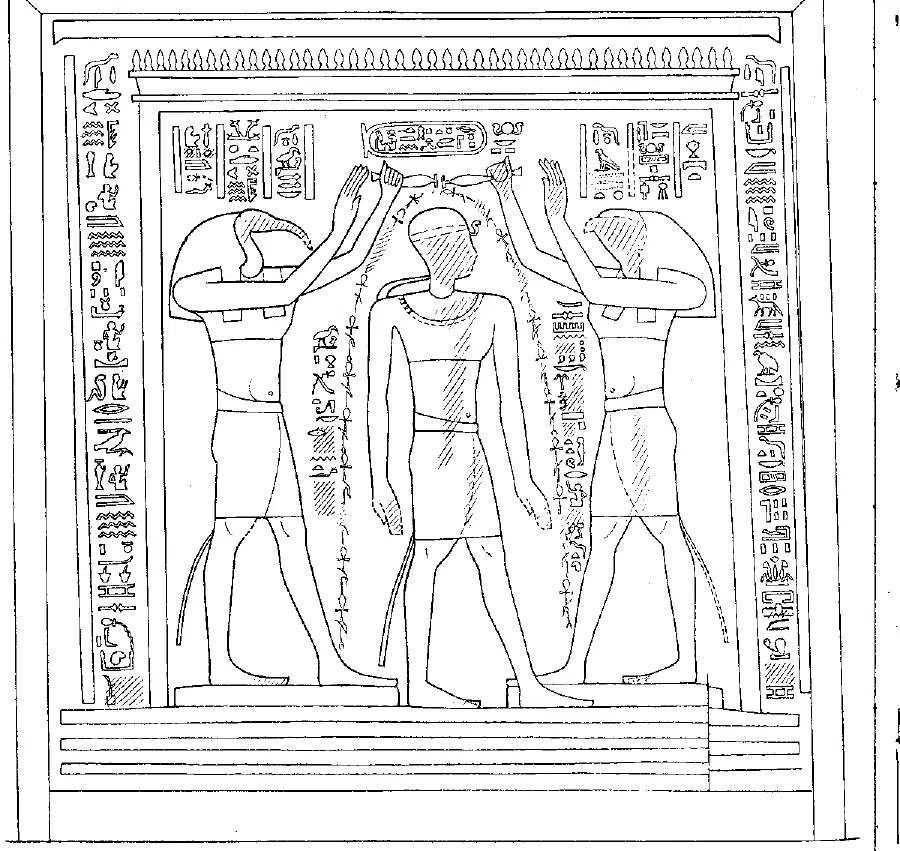
Page 231. The scene as drawn on the wall, facing p. 231 of the edition. Drawing by Otto Baum, in Junker and Winter, Das Geburtshaus des Tempels der Isis in Philä (1965) - 503p. 231, l. 1
njśwt bjt nb tꜣ.wj jwꜥw n pꜣ nṯr nṯj nḥm …
King of Upper and Lower Egypt, Lord of the Two Lands, heir of the god who saves …
Note · Line 503
“The god who saves” is his father, Ptolemy IX. - 504p. 231, l. 2
ḏd mdw n | Ḥrw Bḥd.tj nṯr ꜥꜣ nb p.t
Words to be spoken to Horus of Behdet, the great god, lord of the sky,
- 505p. 231, l. 3
ꜥpj (?) špsj psḏ m ḥr.t
the noble winged sun who shines on high:
- 506p. 231, l. 4
ḥsmn (-j) ḥꜥ.w-k m …
I purify your limbs with …
- 507p. 231, l. 5
twt r-j¹ … wꜥb ḏ.t-k
It is I … who purify your body.
- 508p. 231, l. 6
ḏd mdw n | Ḏḥwtj ꜥꜣ ꜥꜣ nb Ḫmnw
Words spoken by Thoth, twice great, lord of Hermopolis,
Note · Line 508
Hermopolis was Thoth’s chief place of worship. - 509p. 231, l. 7
twr sḫm sꜣ-f m ꜥbw-f
who cleanses his son’s form with his cleansing water:
- 510p. 231, l. 8
Ḏḥwtj ḥr wꜥb tj.t-k
Thoth is purifying your likeness.
- 511p. 231, l. 9
… r … ntf
… to … he himself
- 512p. 231, l. 10
ḏd mdw j | śwꜥb-j kꜣ-k m mw jpw
Recitation: I purify your ka with these waters,
- 513p. 231, l. 11
m ꜥbw jj m Śnm.t
with the cleansing water that comes from Bigeh.
Note · Line 513
Bigeh, the island beside Philae, held a sanctuary revered as the burial place of Osiris. - 514p. 231, l. 12
wꜥb ḏ.t-k ḫr nṯr.w fdw
Your body is pure before the four gods
- 515p. 231, l. 13
prj.w ḥꜣ prj … m wḏꜣ² …
who came forth from behind the house … in safety …
- 516p. 231, l. 14
ḏd mdw j | twr-j ḥm-k m mw jpw
Recitation: I cleanse Your Majesty with these waters.
- 517p. 231, l. 15
dr-n-j ḏw jrj-k r tꜣ
I have driven the evil that was on you down to the ground.
- 518p. 231, l. 16
bꜥḥ-j ḳbḥw m mw n ḥbb.t
I fill the libation jar with the waters of the flood.
- 519p. 231, l. 17
śwꜥb-j kꜣ-k … rnp
I purify your ka … renewal.