~/sacred-texts/philae-birth-house-of-the-isis-temple
Philae Birth House Offerings: The Sole Uraeus on Every God’s Brow
- Date
- Carved in the reign of Ptolemy VIII Euergetes II (145–116 BC), with his wife Cleopatra III, on the walls and doorways of the birth house of the Isis temple at Philae
- Found
- Philae, at the First Cataract south of Aswan. The temple was taken apart in the 1970s and rebuilt on the neighbouring island of Agilkia, where the reliefs stand today.
- Language
- Egyptian (Ptolemaic hieroglyphic) · Hieroglyphic
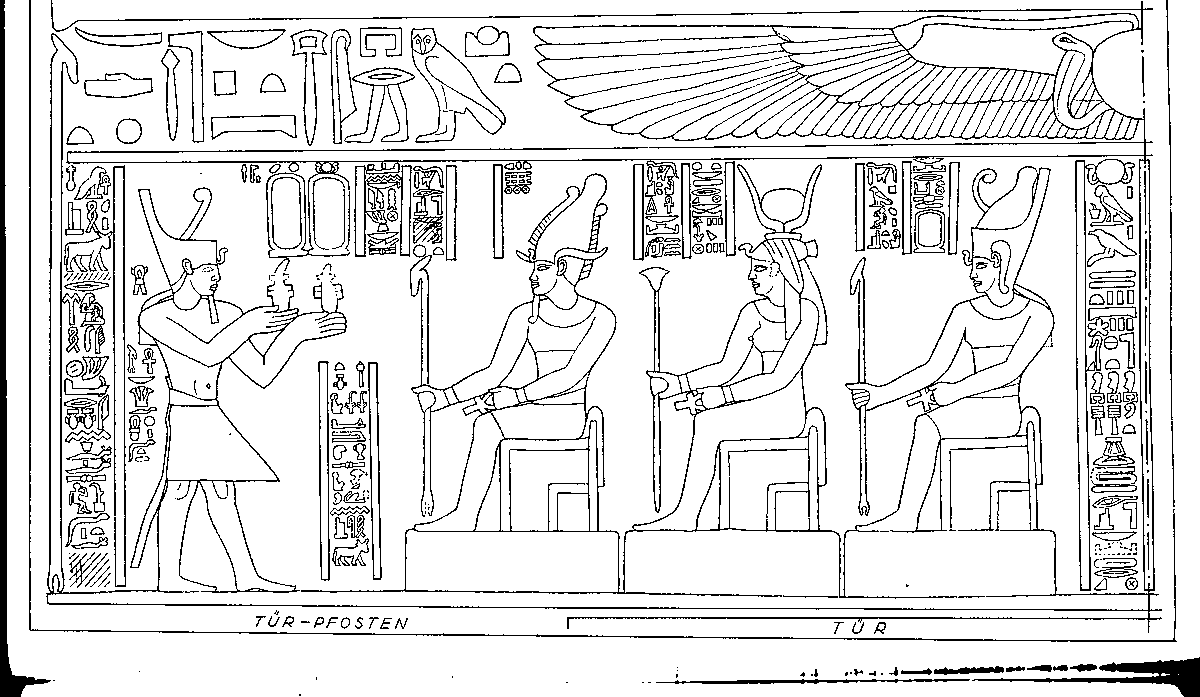
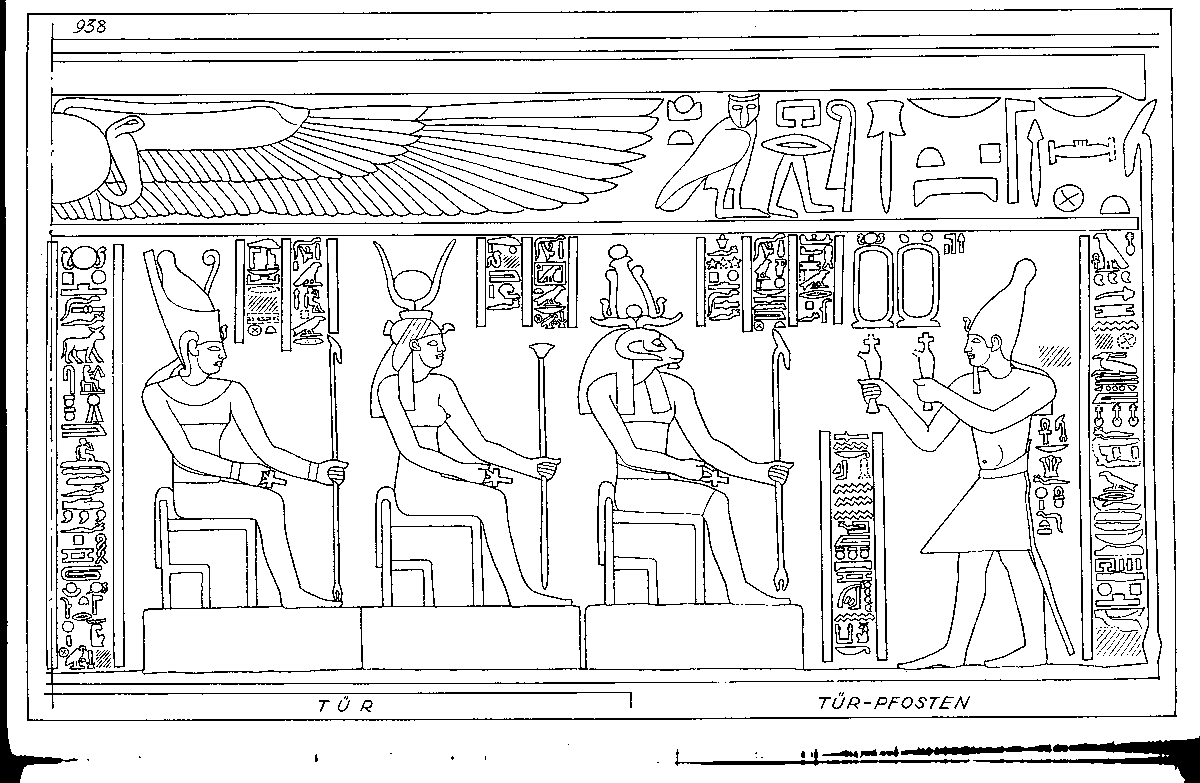
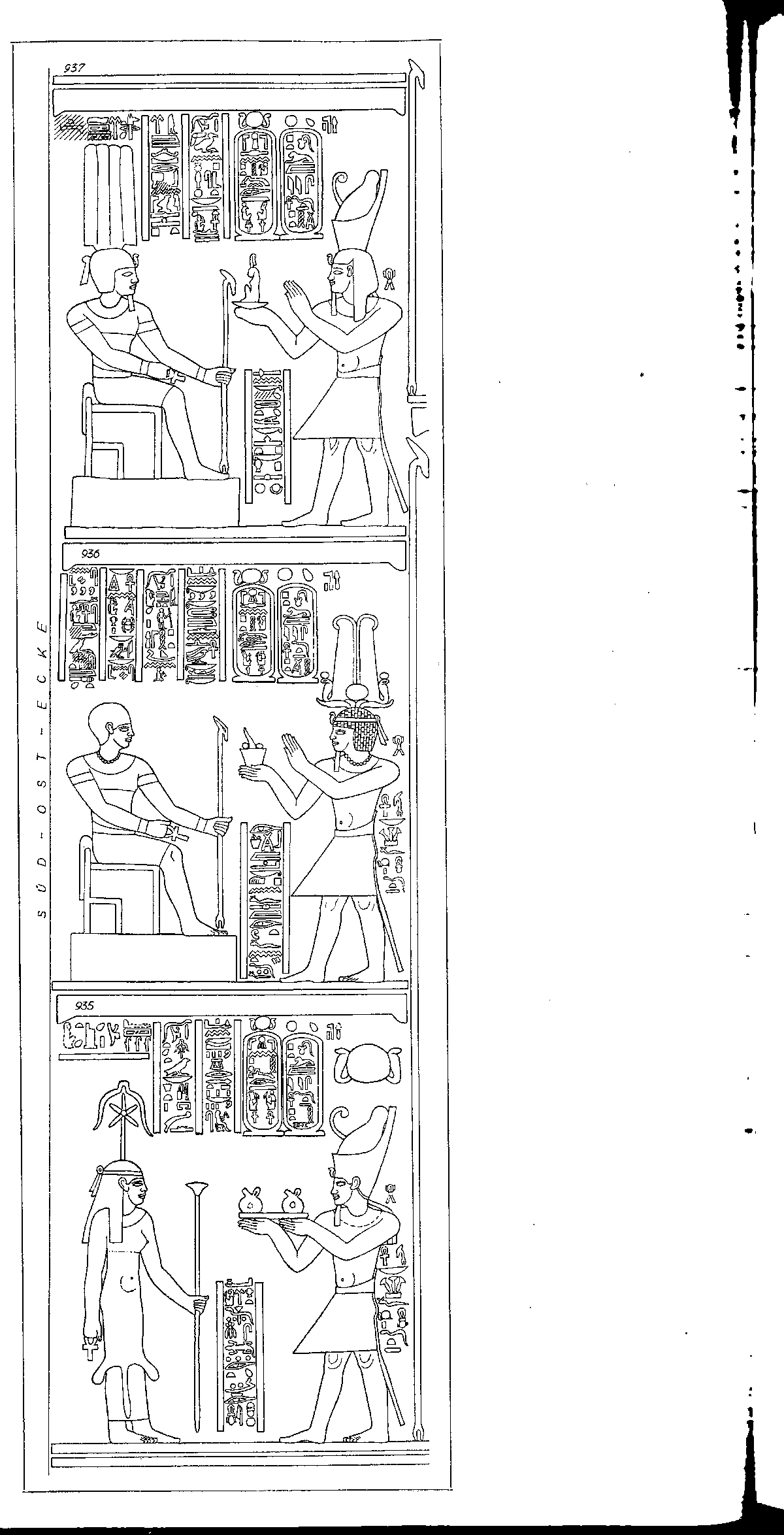
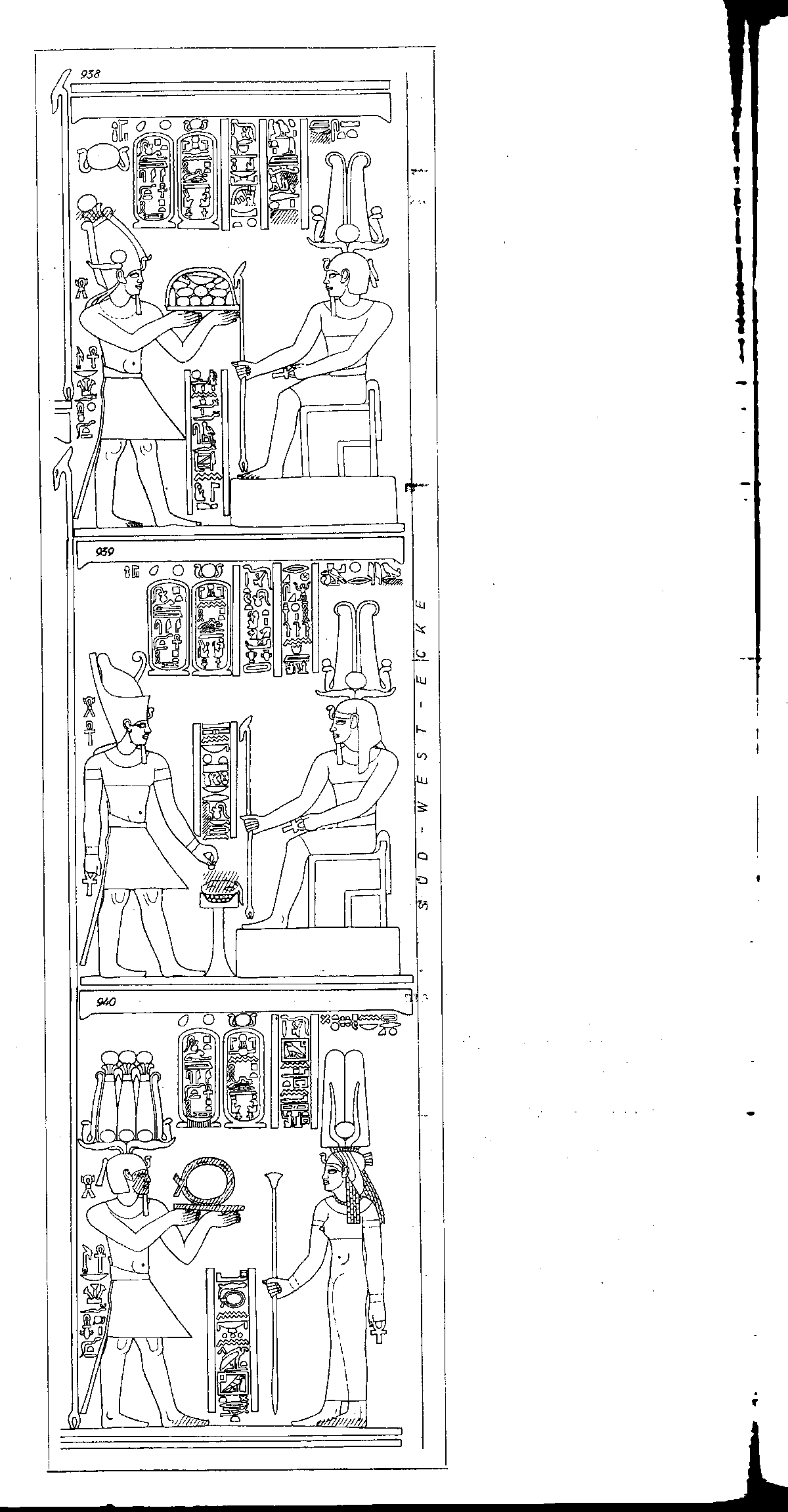
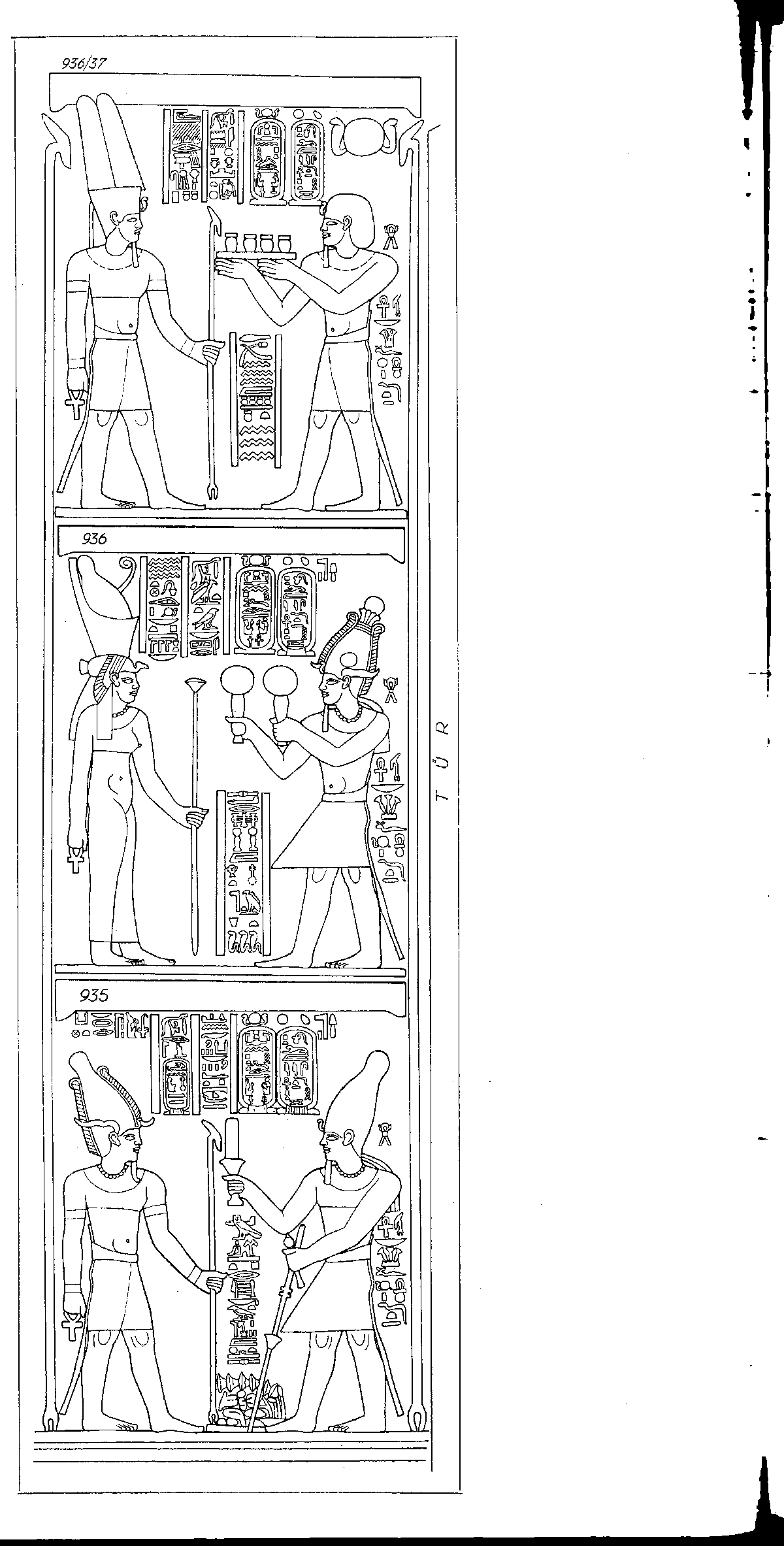
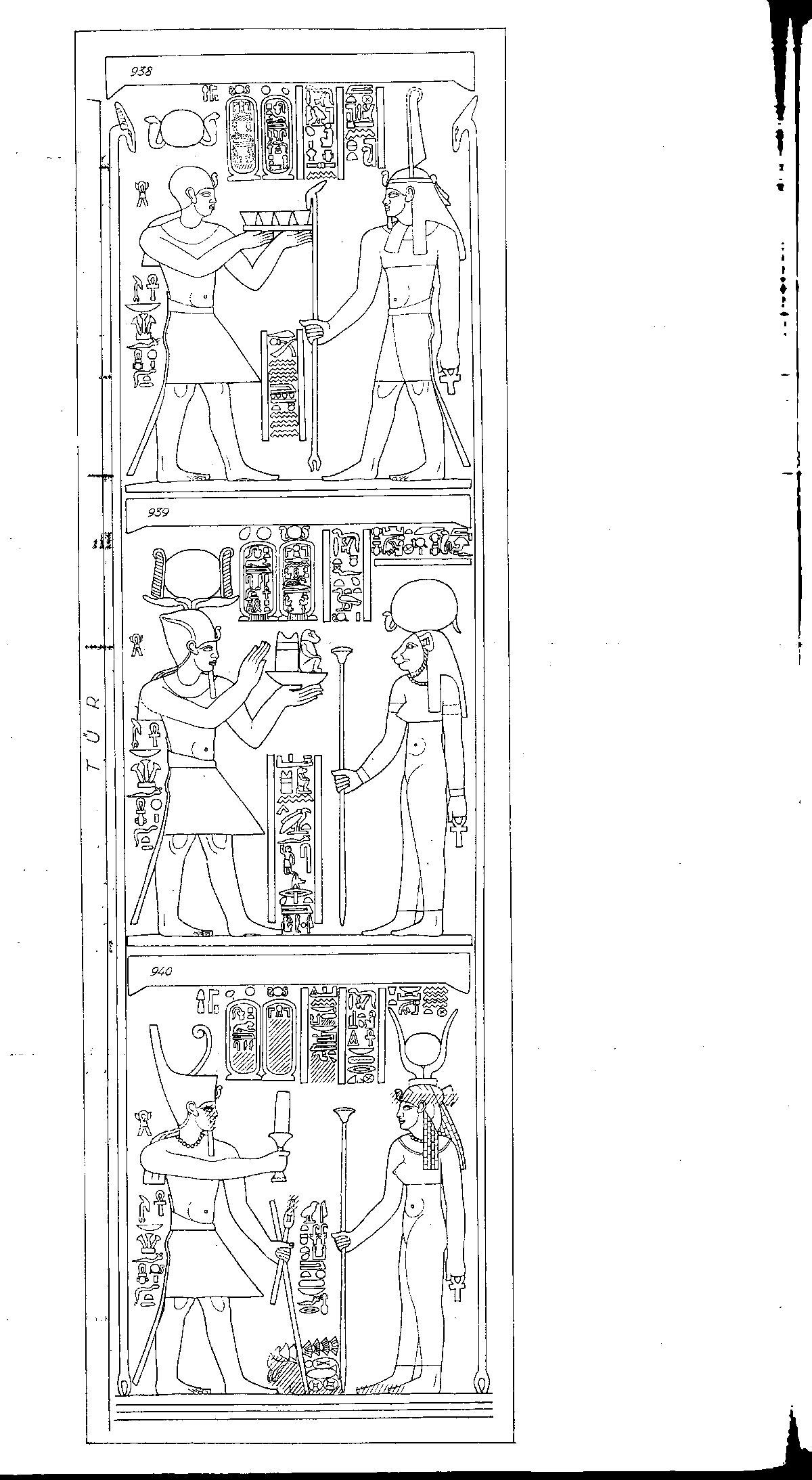
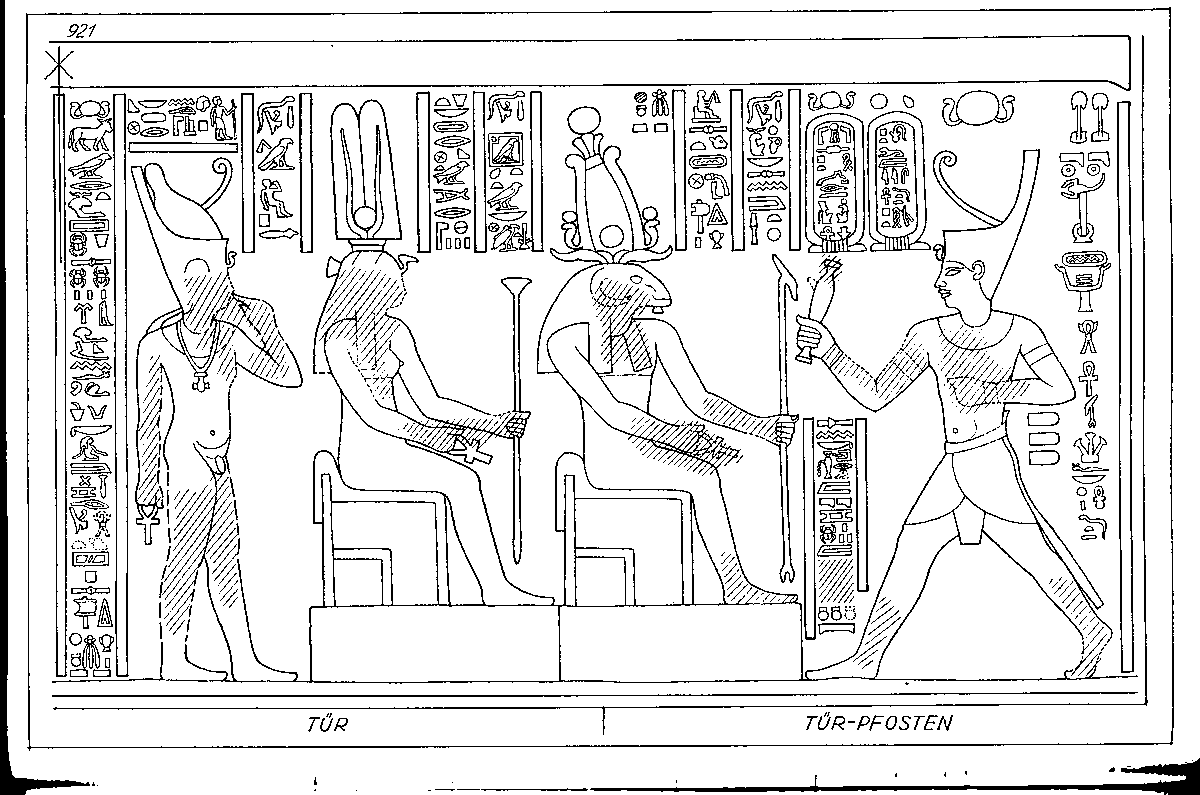
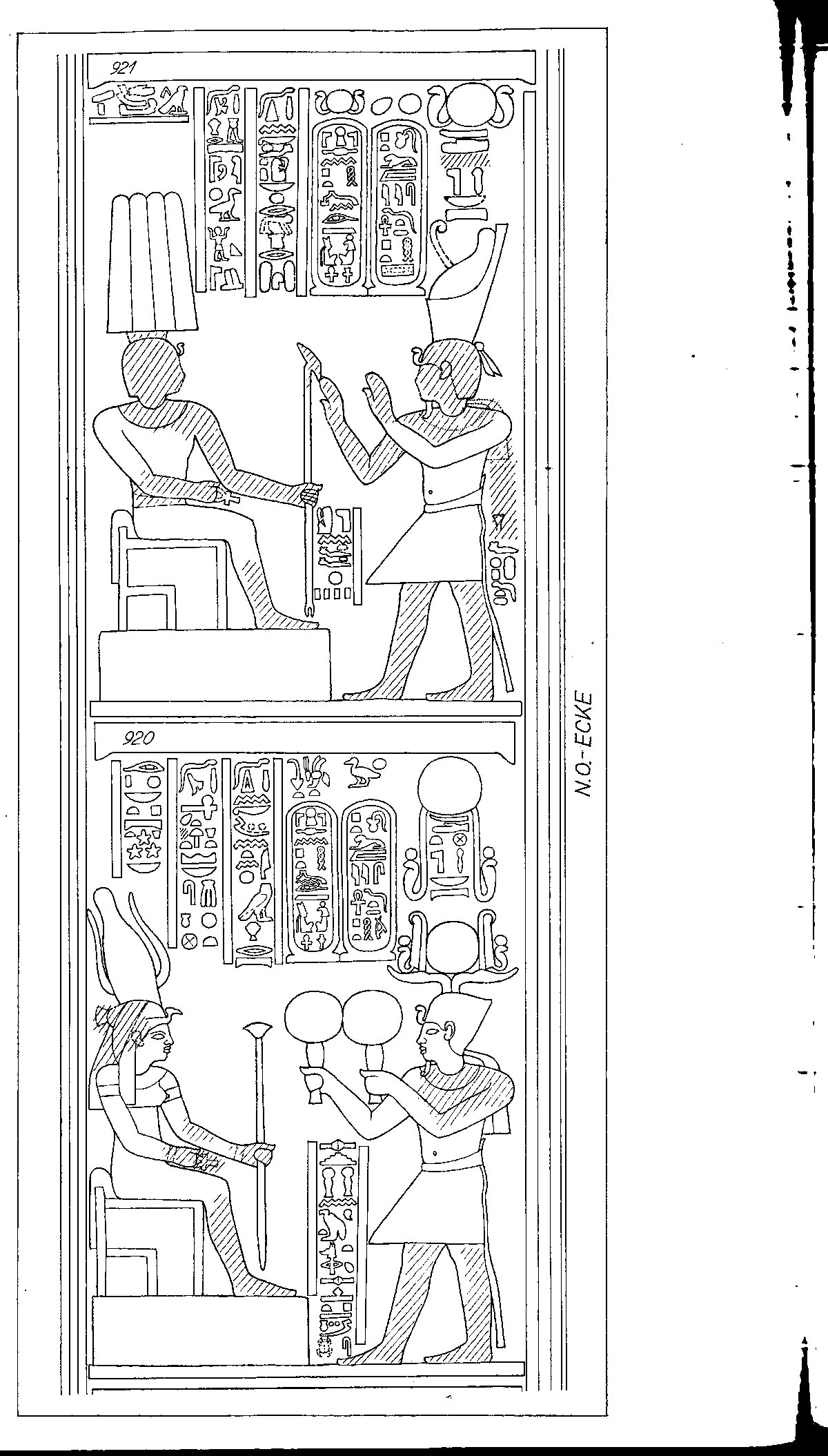
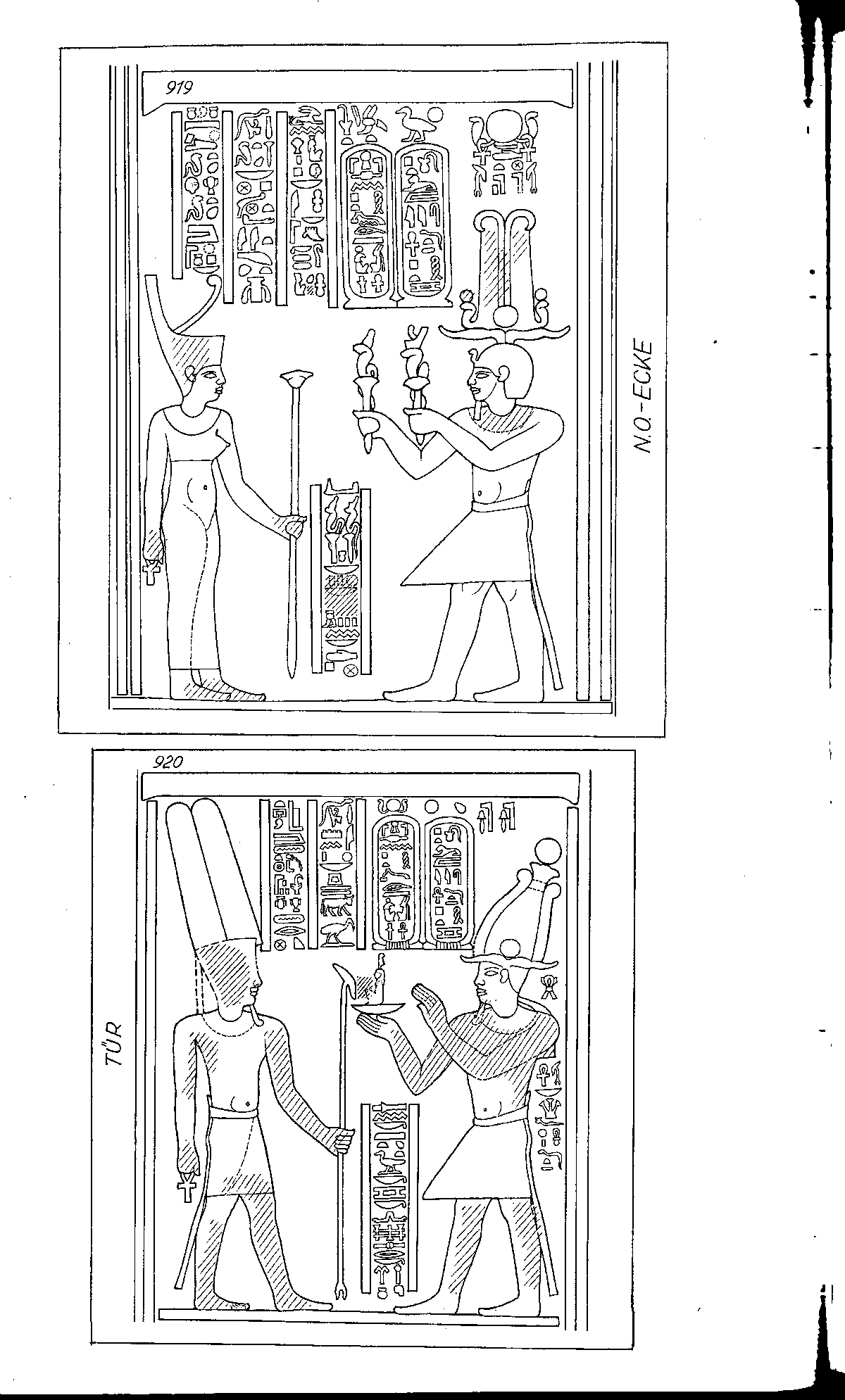
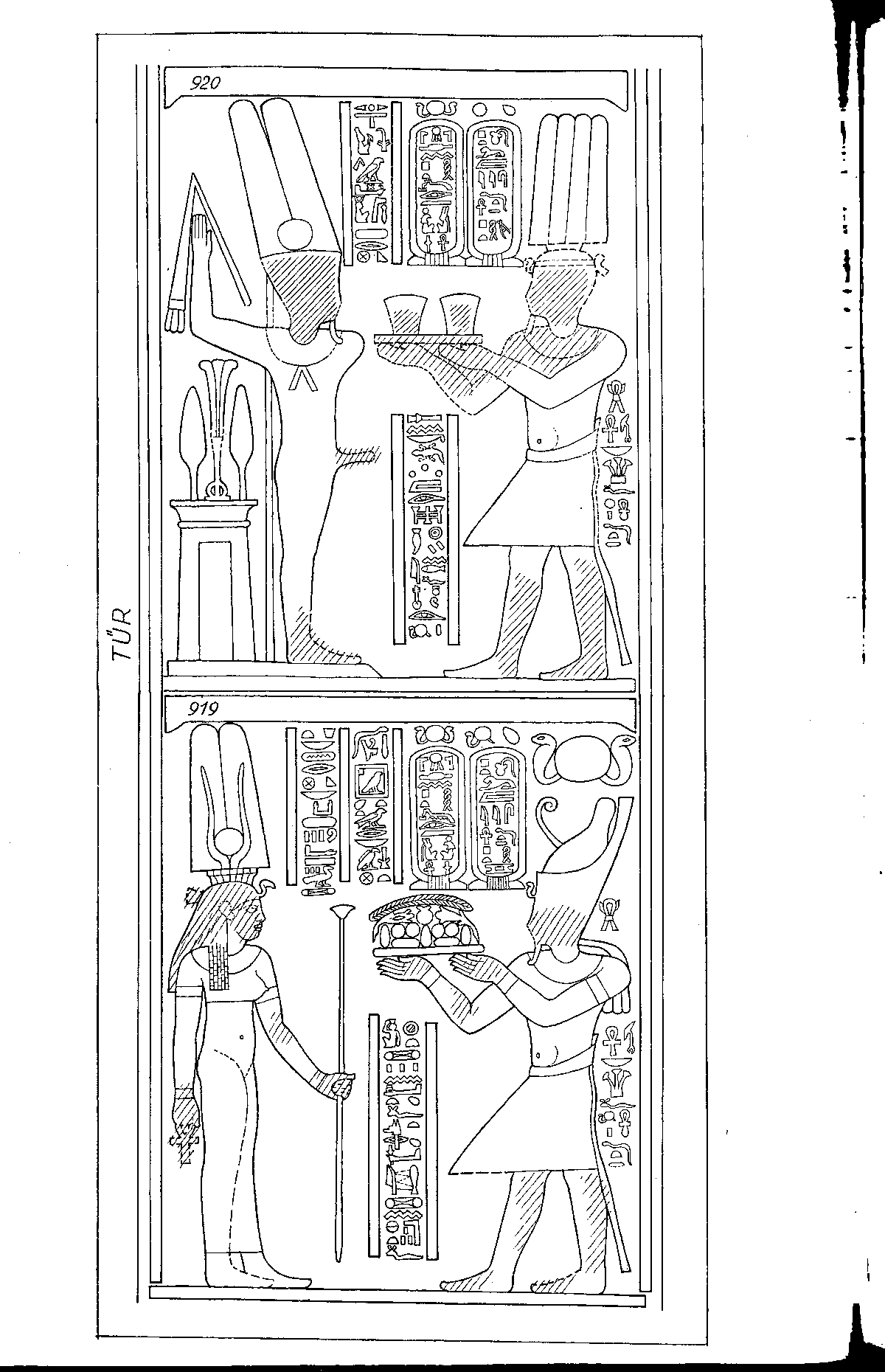
Ptolemy VIII goes from god to god with a gift for each: milk for Osiris, drawn from the udder of the Hesat cow; green and black eye paint for Seshat; a goose burned before Tutu, who saves people from every calamity; mirrors for Mut and Satis; two cobras for Wadjet. Each god answers with a grant. Khnum: I grant a high Nile in its season. Onuris: I give you your enemies, fallen beneath your two sandals.
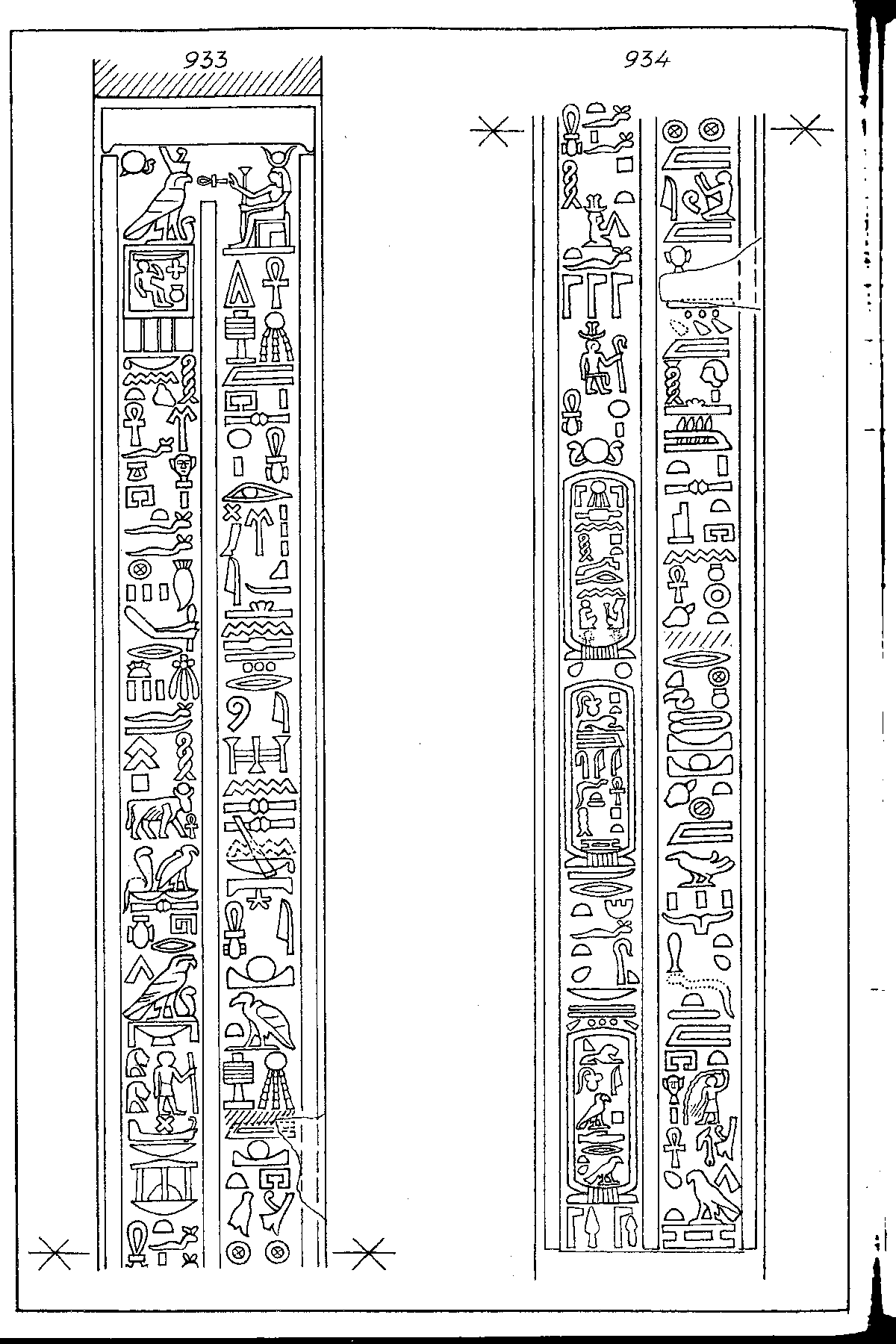
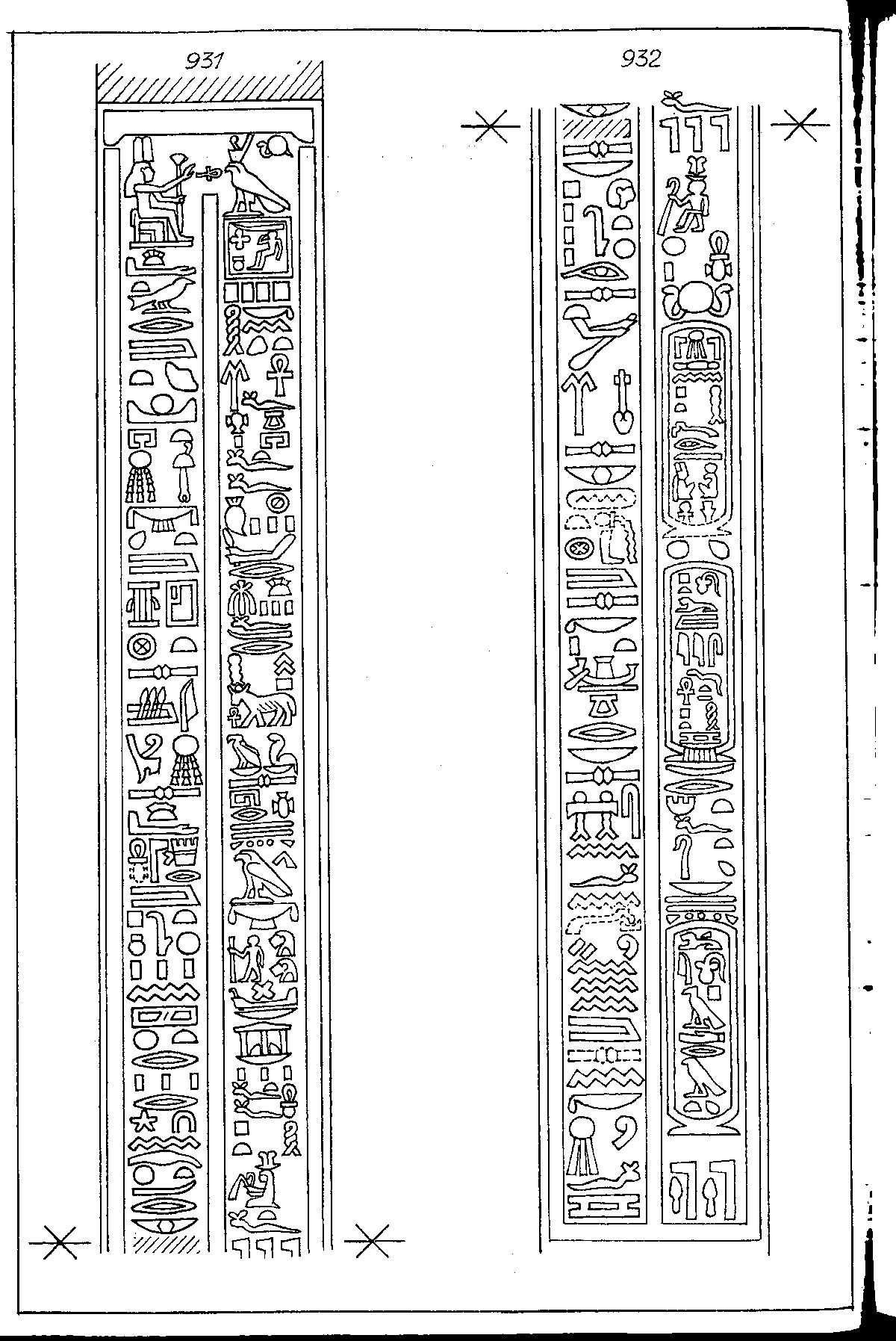
On the doorway Isis comes out of her house like the sun: She has set foot on earth and driven off the dark. She takes her seat in Philae and suckles the king’s model: as you give milk to your son Horus, the beloved.
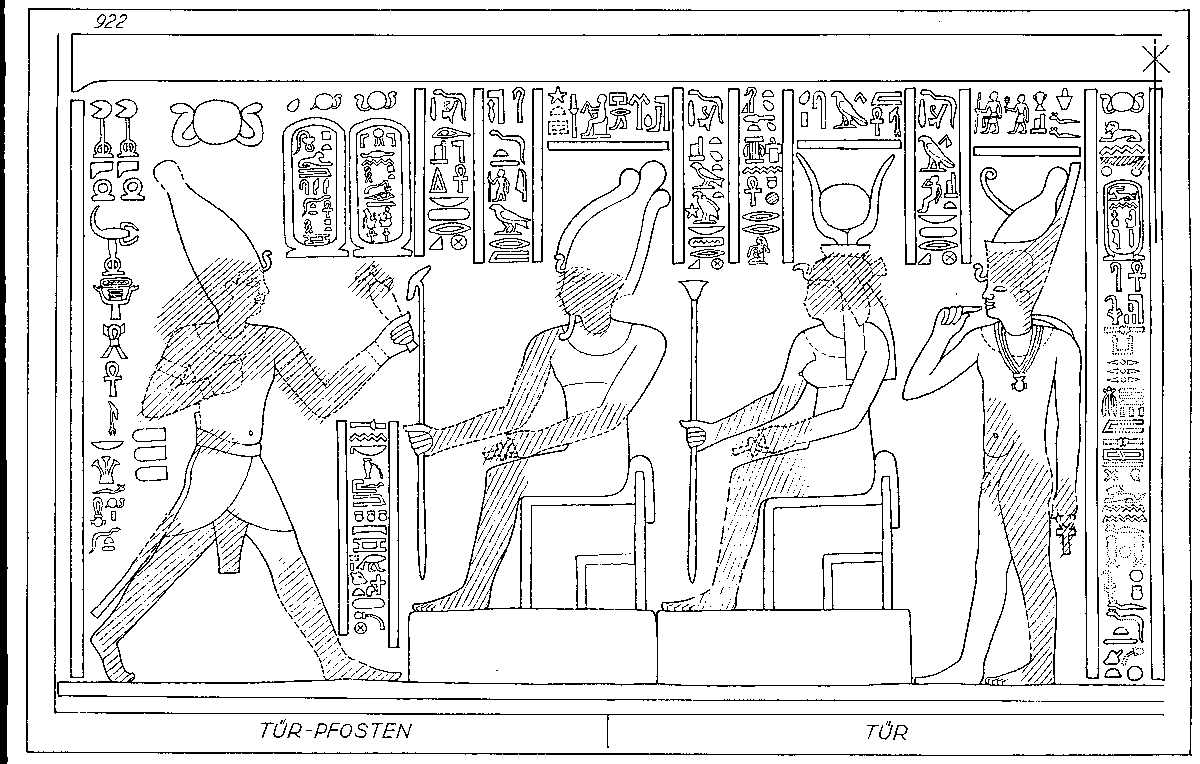
The king gives Osiris milk
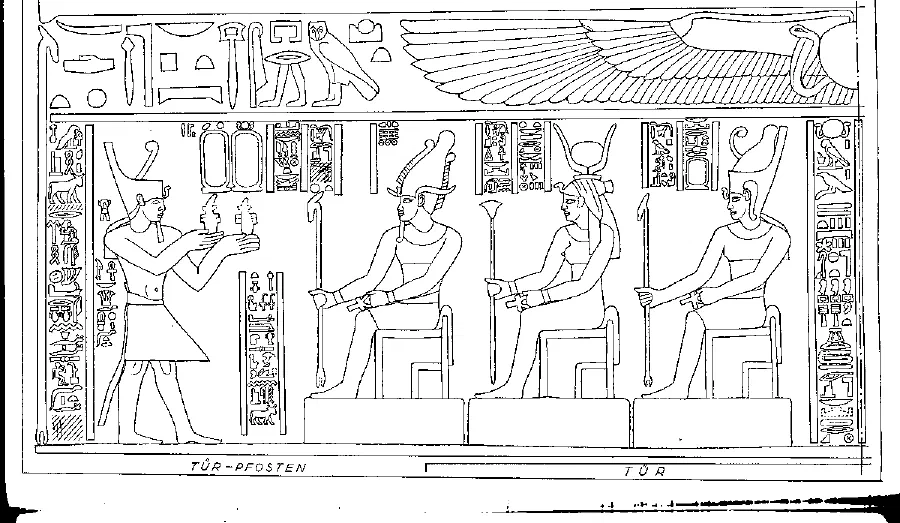
Page 65. The scene as drawn on the wall, facing p. 65 of the edition. Drawing by Otto Baum, in Junker and Winter, Das Geburtshaus des Tempels der Isis in Philä (1965)The hatched figures were hacked off the wall on purpose. After Justinian closed the temple of Isis around 537, Christians made it a church and chiselled out the gods and kings, mostly sparing the hieroglyphs. - 1p. 65, l. 1
Bḥd.tj nṯr ꜥꜣ nb p.t šꜣb šw.t prj m ꜣḫ.t
He of Edfu, the great god, lord of the sky, many-colored in plumage, who comes forth from the horizon.
Note · Line 1
He of Edfu is Horus, often shown above a temple scene as a winged sun disk. - 2p. 65, l. 2
ḥḏ.t nn dj(-j) m ḥr-k
This milk I set before you,
- 3p. 65, l. 3
ššr(?) pḥ n ḥsꜣ.t
drawn from the udder of the Hesat cow.
Note · Line 3
Hesat is a cow goddess whose milk nourishes gods and kings. - 4p. 65, l. 4
njśwt bjt NN sꜣ Rꜥ NN pꜣ nṯr mnḫ
King of Upper and Lower Egypt, NN, Son of Ra, NN, the excellent god.
Note · Line 4
The two name slots are for the king’s throne name and his birth name, in that order. - 5p. 65, l. 5
sꜣ ꜥnḫ wꜣś nb ḥꜣ-f mj Rꜥ ḏ.t
May all protection, life and dominion surround him as they surround Ra, forever.
- 6p. 65, l. 6
ḏd mdw n | Wśjr nb ?wꜥb.t … śp.wt njw.wt
Words spoken by Osiris, lord of the Abaton … provinces and cities:
Note · Line 6
The Abaton was the sanctuary on Bigeh, near Philae, revered as a burial place of Osiris. Access to it was restricted. - 7p. 65, l. 7
dj-j n-k jḏḥw ḥr nb jm-ś
I give you the marshes of the Delta with everything in them.
- 8p. 65, l. 8
ḏd mdw n | ỉś.t dj(.t) ꜥnḫ nb(.t) jꜣ.t wꜥb.t
Words spoken by Isis, giver of life, lady of the Abaton,
- 9p. 65, l. 9
nb(.t) ỉrk nb(.t) ḫꜣś.wt rśj.wt
lady of Philae, lady of the foreign lands to the south.
- 10p. 65, l. 10
ḏd mdw n | Ḥrw pꜣ ḫrd sꜣ ỉś.t
Words spoken by Horus the Child, son of Isis,
- 11p. 65, l. 11
nb ỉrk jwꜥw mnḫ (Wnn nfrw mꜣꜥ ḫrw)
lord of Philae, worthy heir of Wennefer, the vindicated.
Note · Line 11
Wennefer is a name of Osiris, father of Horus. “Vindicated” means that judgment was given in his favor. - 12p. 65, l. 12
ꜥnḫ | nṯr nfr sꜣ ḥsꜣ.t
Long live the good god, son of the Hesat cow,
Note · Line 12
“The good god” is the king, here in the role of Hesat’s calf. - 13p. 65, l. 13
rr m jḏḥw
reared in the marshes of the Delta,
- 14p. 65, l. 14
?rdj jrṯ.t n jt-f
who gives milk to his father
- 15p. 65, l. 15
śrnp ḏ.t-f …
and makes his father’s body young again …
- 16p. 65, l. 16
njśwt bjt | bꜣ bꜥḥ tꜣ.wj
King of Upper and Lower Egypt, the ba who floods the Two Lands,
Note · Line 16
The Two Lands are Upper and Lower Egypt. - 17p. 65, l. 17
ḥrj nṯr.w ḥḳꜣ pśḏ.t
chief of the gods, ruler of the Ennead,
Note · Line 17
The Ennead is a company of nine gods. - 18p. 65, l. 18
gś.w-prj.w ḏd.tj ḥr …
through whose … the temples endure,
- 19p. 65, l. 19
Wśjr nb ỉrk (so)
Osiris, lord of Philae.
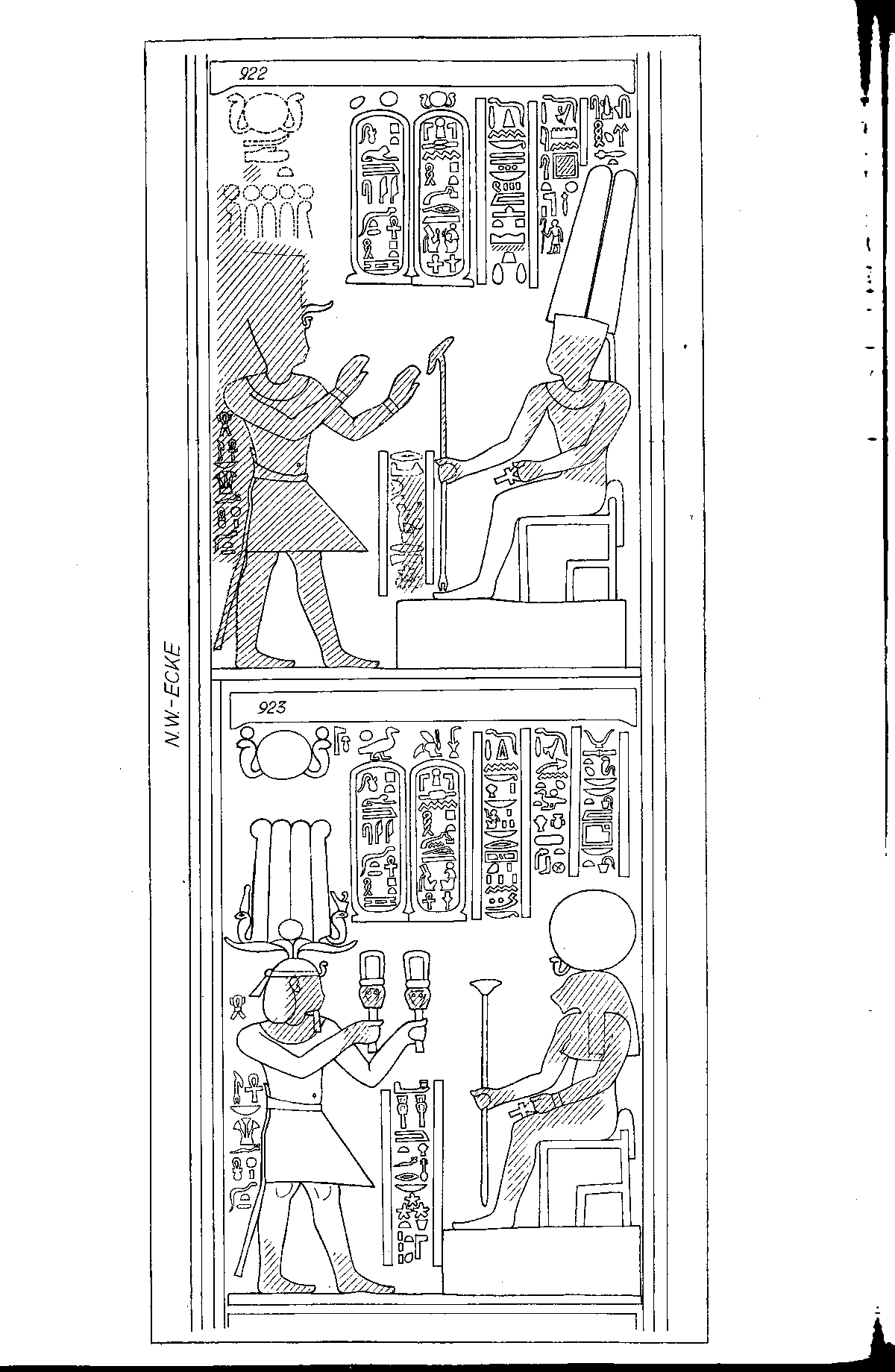
The king gives Khnum two jars of water
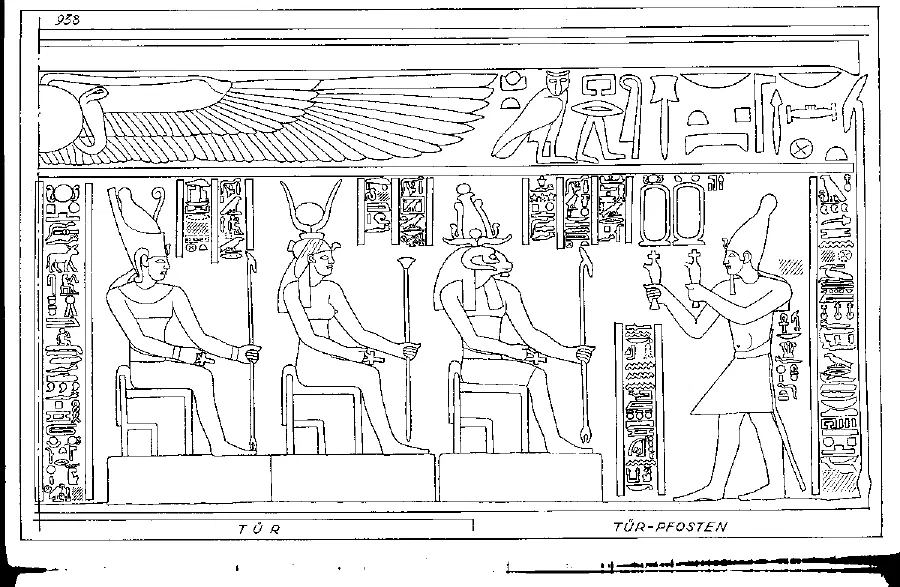
Page 67. The scene as drawn on the wall, facing p. 67 of the edition. Drawing by Otto Baum, in Junker and Winter, Das Geburtshaus des Tempels der Isis in Philä (1965) - 20p. 67, l. 1
nb Mśn nṯr ꜥꜣ nb p.t šꜣb šw.t prj m ꜣḫ.t
The lord of Mesen, the great god, lord of the sky, many-colored in plumage, who comes forth from the horizon.
Note · Line 20
Mesen is a sacred name for Edfu, the seat of Horus. - 21p. 67, l. 2
mn n-k ḳbḥw prj m nwnw
Take for yourself the cool water that comes forth from Nun,
Note · Line 21
Nun is the primeval expanse of water from which the world emerged. - 22p. 67, l. 3
wꜥb ḥꜥ.w n kꜣ-k
which purifies the limbs of your ka.
Note · Line 22
The ka is the life force of a god or a person; it receives nourishment from offerings. - 23p. 67, l. 4
njśwt bjt NN sꜣ Rꜥ NN pꜣ nṯr mnḫ
King of Upper and Lower Egypt, NN, son of Ra, NN, the beneficent god.
Note · Line 23
The first NN stands for the king’s throne name, the second for his birth name. - 24p. 67, l. 5
(sꜣ) ꜥnḫ wꜣś nb ḥꜣ-f mj Rꜥ ḏ.t
May all protection, life and dominion surround him as they surround Ra, forever.
- 25p. 67, l. 6
ḏd mdw n | Ḫnmw-Rꜥ nb Śnm.t
Words spoken by Khnum-Ra, lord of Bigeh,
Note · Line 25
Bigeh is an island beside Philae. - 26p. 67, l. 7
jt nṯr.w ḫpr ḏś-f
father of the gods, who came into being of himself:
- 27p. 67, l. 8
dj-j ḥꜥpj wr r tr (so)-f
“I grant a high Nile in its season.”
Note · Line 27
The gift is the annual flood that watered Egypt’s fields. - 28p. 67, l. 9
ḏd mdw n | Ḥw.t-Ḥrw wr.t nb(.t) Śnm.t
Words spoken by Hathor the Great, lady of Bigeh,
- 29p. 67, l. 10
jr.t Rꜥ ḥrj.t tp (?) m ḥꜣ.t-f
the Eye of Ra, the cobra on his brow.
Note · Line 29
As the Eye of Ra, Hathor protects the sun god in the form of the cobra he wears on his forehead. - 30p. 67, l. 11
ḏd mdw n | Ḥrw pꜣ ḫrd ꜥꜣ wr (n) Wśjr
Words spoken by Horus the Child, the great one, eldest son of Osiris,
Note · Line 30
Horus the Child is also known by the Greek name Harpocrates. - 31p. 67, l. 12
nb ꜣJr(k)¹
lord of Philae.
- 32p. 67, l. 13
njśwt bjt | ḫpr ḏś-f
King of Upper and Lower Egypt, who came into being of himself,
Note · Line 32
Here the royal title belongs to Khnum-Ra. - 33p. 67, l. 14
bꜣ špś wbn m nwnw (so)
august ba who rose from the primeval waters,
Note · Line 33
A god’s ba is a form in which his power can move and make itself felt. - 34p. 67, l. 15
… ḥꜥ.w-f (?fd.t-f)² ḥꜥpj pḥr³ rꜥ nb …
… his limbs, the Nile that makes its circuit every day …
- 35p. 67, l. 16
Ḫnmw-Rꜥ (nb) Śnm.t
Khnum-Ra, lord of Bigeh.
- 36p. 67, l. 17
ꜥnḫ | nṯr nfr ḥꜥpj n Km.t
Long live the good god, the Nile of Egypt,
- 37p. 67, l. 18
bꜥḥ tꜣ.wj m nfr.w-f
who floods the Two Lands with his bounty,
- 38p. 67, l. 19
… wr … sḫpr …
… great in … who brings … into being.
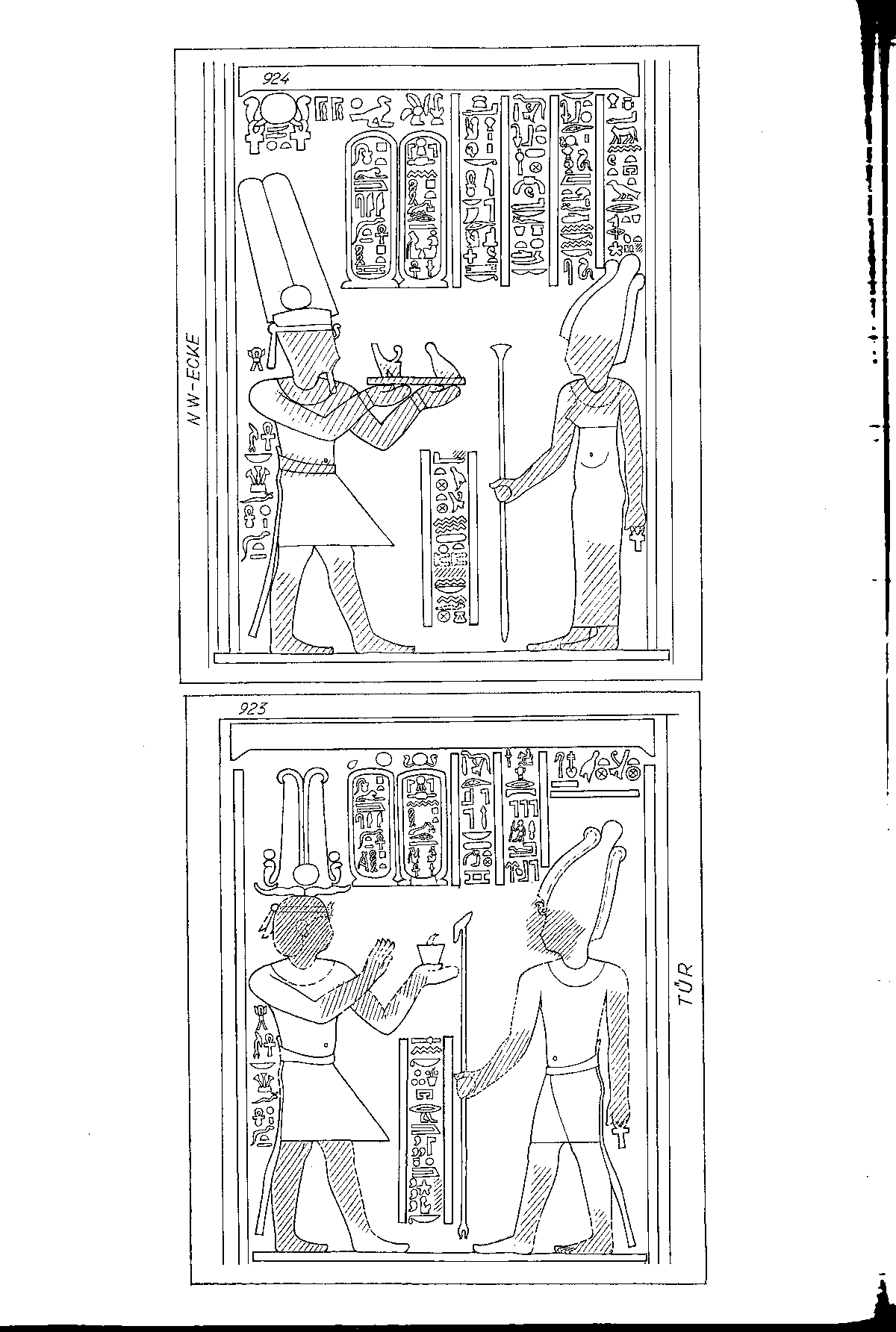
Ptolemy VIII gives Thoth of Pnubs a figure of Maat
Page 69. The scene as drawn on the wall, facing p. 69 of the edition. Drawing by Otto Baum, in Junker and Winter, Das Geburtshaus des Tempels der Isis in Philä (1965) - 39p. 69, l. 1
mn n-k … t mr(r.t)-k
Receive … Maat, whom you love;
Note · Line 39
Maat is truth and right order, personified as a goddess. In this rite the king offers her to the god. - 40p. 69, l. 2
ḥtp-k ḥr-s rꜥ nb
may you take pleasure in her every day.
- 41p. 69, l. 3
njśwt bjt jwꜥw …
King of Upper and Lower Egypt, heir of the two Manifest Gods …
Note · Line 41
The Manifest Gods are Ptolemy V and Cleopatra I, the parents of Ptolemy VIII. - 42p. 69, l. 4
sꜣ Rꜥ Pt … pꜣ nṯr mnḫ sꜣ
son of Ra, Ptolemy … the beneficent god. Protection.
- 43p. 69, l. 5
ḏd mdw n | Ḏḥwtj n Prj-nbś
Words spoken by Thoth of Pnubs,
Note · Line 43
Pnubs was a sanctuary of Thoth in Nubia. - 44p. 69, l. 6
nb mꜣꜥ.t ꜥnḫ-f jm-s
lord of Maat, who lives by her,
- 45p. 69, l. 7
jj m Tꜣ-stj r (bw pn?)
who came from Nubia to this place
- 46p. 69, l. 8
Šw śḥtp Wśr.t m Śnm.t?
as Shu, who soothes the Mighty One on Bigeh.
Note · Line 46
The Mighty One is the fierce solar goddess. Thoth takes the part of Shu, who pacifies her on her return from Nubia. Ptolemy VIII burns incense before Imhotep
- 47p. 69, l. 9
jrj śnṯr ḏbꜣ m ꜥ-k
Offering incense prepared by your hand
- 48p. 69, l. 10
kꜣp n-f św? m jrj.tw-f n ḏfḏ(?)
and burning it for him with what was made from the pupil of the eye.
- 49p. 69, l. 11
njśwt bjt jwꜥw …
King of Upper and Lower Egypt, heir of the two Manifest Gods …
- 50p. 69, l. 12
sꜣ Rꜥ Pt … pꜣ nṯr mnḫ
son of Ra, Ptolemy … the beneficent god.
- 51p. 69, l. 13
sꜣ ꜥnḫ wꜣś nb ḥꜣ-f mj Rꜥ ḏ.t
May all protection, life and dominion surround him as they surround Ra, forever.
- 52p. 69, l. 14
ḏd mdw n | Jj-mḥtp wr sꜣ Ptḥ
Words spoken by Imhotep the Great, son of Ptah.
- 53p. 69, l. 15
nṯr mnḫ ḳmꜣ-n Tnn nb ꜥnḫ dj n mrr-f
The beneficent god whom Tatenen fashioned, lord of life, who gives life to whomever he loves,
Note · Line 53
Tatenen is the god of the first earth to rise from the waters at creation. - 54p. 69, l. 16
ꜥnḫ ḥr nb jm-f nb śnb śnb ḥꜥ.w-f
through whom all live, lord of health, sound of limb,
- 55p. 69, l. 17
śꜥnḫ s(?) m ꜥ mwt śrwḏ(?) śwḥ.t(?) m ẖ.t
who brings to life the man in death’s grip and makes the egg thrive in the womb.
- 56p. 69, l. 18
dj-j n-k ḥꜥ.w-k tm n ꜥnḫ n ꜥb nb (so) jm-k
I give you your limbs, whole for life. May no sickness be in you.
Ptolemy VIII gives Seshat green and black eye paint
- 57p. 69, l. 19
ḥnk-j m ḥr-t wꜣḏw mśdm.t
I offer green and black eye paint before your face,
Note · Line 57
The king is offering the goddess the two traditional eye paints: green malachite and black kohl. - 58p. 69, l. 20
jr.t-t mꜣꜣ mj jtn
so that your eye may see like the sun disk.
- 59p. 69, l. 21
njśwt bjt (jwꜥw) n …
King of Upper and Lower Egypt, heir of …
Note · Line 59
The full title names Ptolemy VIII as heir to the Manifest Gods: his parents, Ptolemy V and Cleopatra I. - 60p. 69, l. 22
sꜣ Rꜥ Pt … pꜣ nṯr mnḫ
Son of Ra, Ptolemy …, the beneficent god.
- 61p. 69, l. 23
sꜣ ꜥnḫ wꜣś nb ḥꜣ-f mj Rꜥ ḏ.t
May protection and all life and dominion surround him as they surround Ra, forever.
- 62p. 69, l. 24
ḏd mdw n | Śšꜣ.t wr.t nb(.t) sš
Words spoken by Seshat the Great, lady of writing,
- 63p. 69, l. 25
ḫnw.t prj-mḏꜣ.t ꜥšꜣ(.t) rnp.wt n sꜣ Jś.t
mistress of the House of Books, who multiplies the years of the son of Isis:
Note · Line 63
The House of Books is the temple library. The son of Isis is Horus, whose birth is celebrated here. - 64p. 69, l. 26
dj-j n-k ḏw.w ḥr ꜥꜣ.wt nb.wt špś.wt
I give you the mountains with all their precious stones.
Ptolemy VIII gives Arensnuphis food
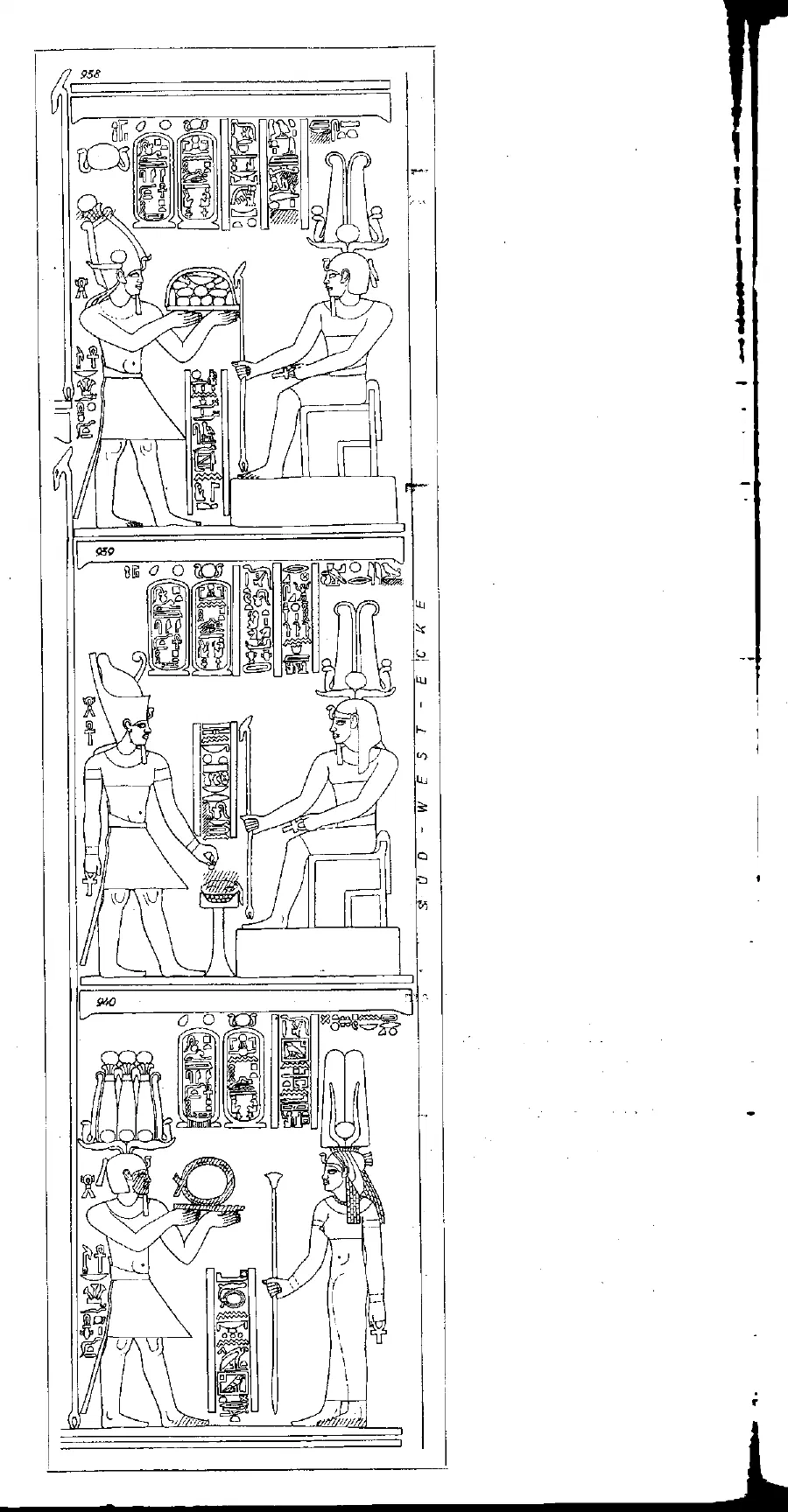
Page 71. The scene as drawn on the wall, facing p. 71 of the edition. Drawing by Otto Baum, in Junker and Winter, Das Geburtshaus des Tempels der Isis in Philä (1965) - 65p. 71, l. 1
fꜣj jḥ.t n jt-f šps
Presenting food to his revered father,
Note · Line 65
The king presents the food to a god whom he addresses as his father. - 66p. 71, l. 2
ꜥb.t¹ n nṯr mnḫ (?ꜥꜣ)
an offering to the beneficent god.
- 67p. 71, l. 3
njśwt bjt jwꜥw …
King of Upper and Lower Egypt, heir of …
- 68p. 71, l. 4
sꜣ Rꜥ Pt … pꜣ nṯr mnḫ
Son of Ra, Ptolemy …, the beneficent god.
- 69p. 71, l. 5
sꜣ ꜥnḫ wꜣś nb ḥꜣ-f mj Rꜥ ḏ.t
May protection and all life and dominion surround him as they surround Ra, forever.
- 70p. 71, l. 6
ḏd mdw n | ꜥJrjḥmśjnfr nb jꜣ.t wꜥb.t
Words spoken by Arensnuphis, lord of the Abaton,
- 71p. 71, l. 7
Šw sꜣ Rꜥ jj m Tꜣ-stj
Shu, son of Ra, who came from Nubia
Note · Line 71
Arensnuphis is identified here with Shu, the god of air. - 72p. 71, l. 8
jnj n-f jr.t Rꜥ m Kns.t
and brought him the Eye of Ra from Keneset:
Note · Line 72
Keneset is a name for Nubia. Ra’s Eye is his daughter, a goddess who went south in anger and was brought home to him. Ptolemy VIII burns a goose before Tutu
- 73p. 71, l. 9
tꜣs-j (tś-j) n-k jḥ.t nb(.t) r śḏ.t-k(?) tn
For you I lay every offering on this flame of yours.
- 74p. 71, l. 10
njśwt bjt jwꜥw …
King of Upper and Lower Egypt, heir of …
- 75p. 71, l. 11
sꜣ Rꜥ Pt … pꜣ nṯr mnḫ sꜣ ꜥnḫ
Son of Ra, Ptolemy …, the beneficent god. Protection and life.
- 76p. 71, l. 12
ḏd mdw n | Twtw (ꜥꜣ) pḥtj ḥrj-jb ꜥJrk
Words spoken by Tutu, great in strength, who dwells on Philae,
- 77p. 71, l. 13
śkꜣ ꜥḥꜥw wꜣḥ rnp.wt
who lengthens life and adds years,
- 78p. 71, l. 14
nḥm rmṯ mꜥ ḫrj.t (nb.t?)
who saves people from every calamity.
Ptolemy VIII gives Hathor a wreath of gold
- 79p. 71, l. 15
ḥnk mḥ n nb
Presenting a wreath of gold
- 80p. 71, l. 16
n mw.t(-f) Ḥw.t-Ḥrw wr.t mrw.t
to his mother Hathor, rich in love.
- 81p. 71, l. 17
njśwt bjt jwꜥw …
King of Upper and Lower Egypt, heir of …
- 82p. 71, l. 18
sꜣ Rꜥ Pt …
Son of Ra, Ptolemy …
- 83p. 71, l. 19
sꜣ ꜥnḫ wꜣś nb ḥꜣ-f mj Rꜥ ḏ.t
May all protection, life and dominion surround him as they surround Ra forever.
- 84p. 71, l. 20
ḏd mdw n | Ḥw.t-Ḥrw n pꜣ ꜥ-n-ꜥš
Words spoken by Hathor of the House of Calling:
- 85p. 71, l. 21
ś.t wr(.t) tḫ(.t) pw n nb(.t) ꜥJrk
It is the Lady of Philae’s great seat of drunkenness.
Note · Line 85
Drunkenness had a place in Hathor’s worship. In one myth, when she was bent on killing humankind, beer dyed the color of blood made her drunk and ended the slaughter. Ptolemy VIII purifies Amun with four jars of water
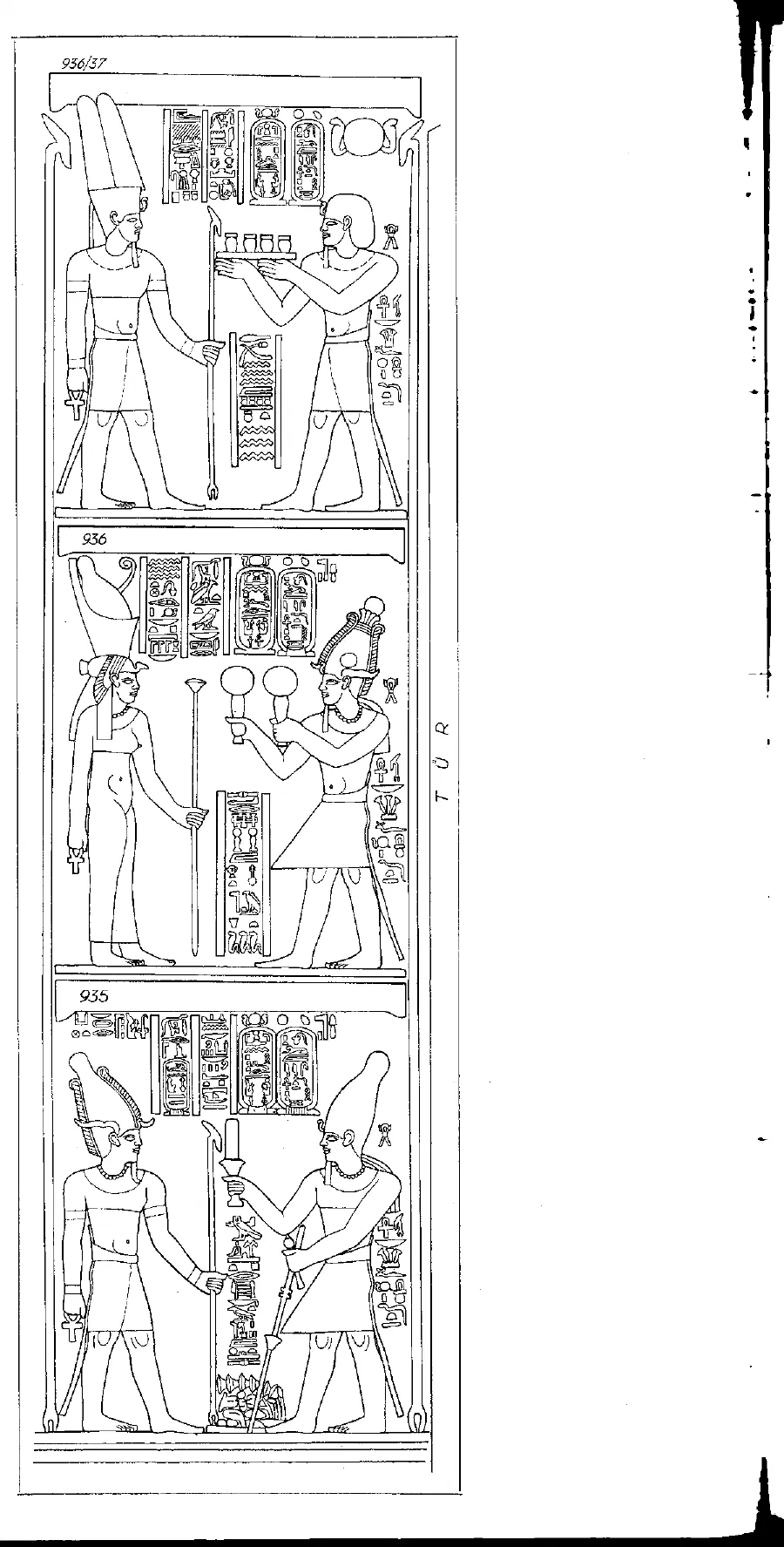
Page 73. The scene as drawn on the wall, facing p. 73 of the edition. Drawing by Otto Baum, in Junker and Winter, Das Geburtshaus des Tempels der Isis in Philä (1965) - 86p. 73, l. 1
jrj(.t) ꜥbw m dš fdw n mw
Purifying with four jars of water.
- 87p. 73, l. 2
njśwt bjt jwꜥw …
King of Upper and Lower Egypt, heir …
Note · Line 87
His full title calls him heir to the Manifest Gods: his parents, Ptolemy V and Cleopatra I. - 88p. 73, l. 3
sꜣ Rꜥ Pt …
Son of Ra, Ptolemy …
- 89p. 73, l. 4
sꜣ ꜥnḫ wꜣś nb ḥꜣ-f mj Rꜥ ḏ.t
May all protection, life and dominion surround him as they surround Ra forever.
- 90p. 73, l. 5
ḏd mdw n | Jmn-Rꜥ ḥrj-jb jꜣ.t wꜥb.t
Words spoken by Amun-Ra, who dwells in the Abaton,
- 91p. 73, l. 6
ꜥḳ (m? Jrk?) r? rdj.t ṯꜣw ḥr msḫn
who enters Philae to give breath at the place of birth.
Ptolemy VIII gives Mut two mirrors
- 92p. 73, l. 7
śꜥr-j ꜥnḫ.wj (wn.tj ḥr?) m ḥr-t nfr
Before your beautiful face I raise the two mirrors that reveal the face,
Note · Line 92
The Egyptian word for “mirror” also means “life”: the king raises a pair of mirrors and, in their very name, offers life. - 93p. 73, l. 8
mw.t nṯr ḥnw.t nṯr.wt
mother of the god, mistress of the goddesses.
- 94p. 73, l. 9
njśwt bjt jwꜥw …
King of Upper and Lower Egypt, heir …
- 95p. 73, l. 10
sꜣ Rꜥ Pt … pꜣ nṯr mnḫ
Son of Ra, Ptolemy …, the excellent god.
- 96p. 73, l. 11
sꜣ ꜥnḫ wꜣś nb ḥꜣ-f mj Rꜥ ḏ.t
May all protection, life and dominion surround him as they surround Ra forever.
- 97p. 73, l. 12
ḏd mdw n | Mw.t wr.t nb(.t) Jšrw
Words spoken by Mut the Great, Lady of Isheru,
Note · Line 97
Isheru is the sacred lake at Mut’s sanctuary at Karnak. - 98p. 73, l. 13
jr.t Rꜥ nb(.t) p.t ḥnw.t nṯr.w nb.w
Eye of Ra, Lady of Heaven, mistress of all the gods.
Ptolemy VIII sets the great offering before Osiris
- 99p. 73, l. 14
mj m ḥtp r ꜥꜣb.t-k wr.t
Come in peace to your great offering;
- 100p. 73, l. 15
ḏbꜥ.w ḫꜣ.w m jḫ.t-ś
its gifts number tens of thousands and thousands.
- 101p. 73, l. 16
njśwt bjt jwꜥw …
King of Upper and Lower Egypt, heir …
- 102p. 73, l. 17
sꜣ Rꜥ Pt … pꜣ nṯr mnḫ
Son of Ra, Ptolemy …, the excellent god.
- 103p. 73, l. 18
sꜣ ꜥnḫ wꜣś nb ḥꜣ-f mj Rꜥ ḏ.t
May all protection, life and dominion surround him as they surround Ra forever.
- 104p. 73, l. 19
ḏd mdw n | Wśjr Wnn nfrw mꜣꜥ ḫrw
Words spoken by Osiris Wennefer, the vindicated,
- 105p. 73, l. 20
njśwt nṯr.w nb Jrk
king of the gods, lord of Philae:
- 106p. 73, l. 21
dj-j n-k kꜣ.w nb.w dj p.t ḳmꜣ tꜣ
I give you all the food that heaven gives and earth brings forth.
Ptolemy VIII purifies Shu with four jars of water
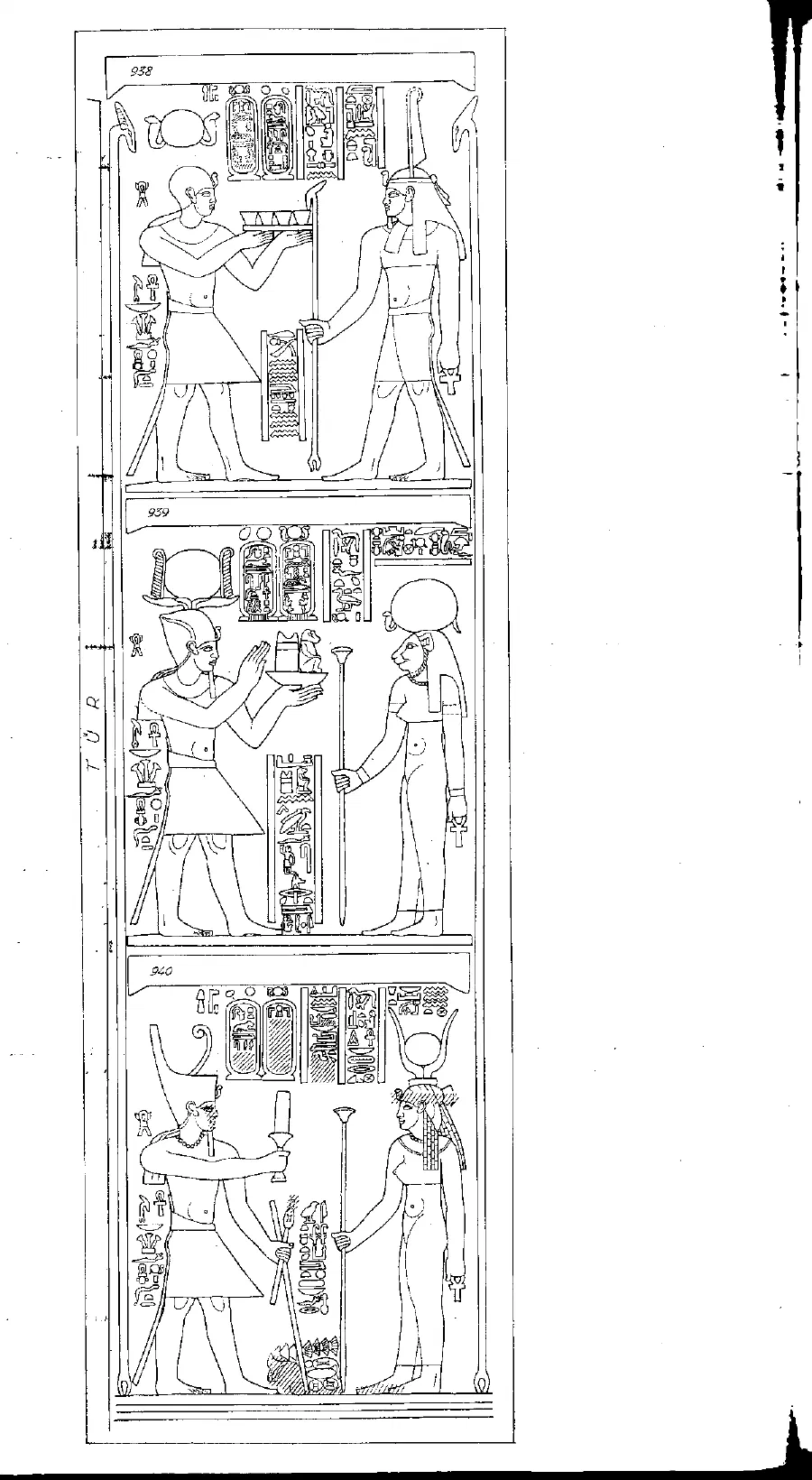
Page 75. The scene as drawn on the wall, facing p. 75 of the edition. Drawing by Otto Baum, in Junker and Winter, Das Geburtshaus des Tempels der Isis in Philä (1965) - 107p. 75, l. 1
jrj(.t) ꜥbw m dš fdw n mw
Purifying with four jars of water.
- 108p. 75, l. 2
sꜣ Rꜥ Pt …
Son of Ra, Ptolemy …
- 109p. 75, l. 3
njśwt bjt jwꜥw … pꜣ nṯr mnḫ
King of Upper and Lower Egypt, heir …, the excellent god.
- 110p. 75, l. 4
sꜣ ꜥnḫ wꜣś nb ḥꜣ-f mj Rꜥ ḏ.t
May all protection, life and dominion surround him as they surround Ra forever.
- 111p. 75, l. 5
ḏd mdw n | Šw sꜣ Rꜥ ḥrj-jb Śnm.t
Words spoken by Shu, son of Ra, who dwells on Bigeh,
- 112p. 75, l. 6
nṯr ꜥꜣ n(?) mnḫ(?) n pśḏ.t
the great god who does good for the Ennead.
Ptolemy VIII gives Tefnut the wensheb water clock
- 113p. 75, l. 7
ḥnk wnšb(? wtt) n mw.t-f
Presenting the water clock to his mother,
Note · Line 113
The king makes the offering. A water clock marks the hours by the flow of water. - 114p. 75, l. 8
śḥꜥj Wśr.t m jrw-f
gladdening the Mighty One with its form.
- 115p. 75, l. 9
njśwt bjt jwꜥw …
King of Upper and Lower Egypt, heir of the Manifest Gods …
- 116p. 75, l. 10
sꜣ Rꜥ Pt …
Son of Ra, Ptolemy …
- 117p. 75, l. 11
sꜣ ꜥnḫ wꜣś nb ḥꜣ-f mj Rꜥ ḏ.t
May all protection, life and dominion surround him as they surround Ra, forever.
- 118p. 75, l. 12
ḏd mdw n | Tfn.t sꜣ.t Rꜥ ḥrj(.t)-jb jꜣ.t wꜥb.t
Words spoken by Tefnut, daughter of Ra, who dwells on the Abaton,
- 119p. 75, l. 13
jr.t Rꜥ ḥrj.t-tp (so) m ḥꜣ.t-f
the Eye of Ra, the cobra on his brow.
Note · Line 119
As the Eye of Ra, Tefnut is the sun god’s power embodied in the cobra that guards his brow. Ptolemy VIII sets every good thing before Isis
- 120p. 75, l. 14
jw nn n kꜣ-t
This is for your ka:
- 121p. 75, l. 15
m jḫ.t nb.t nfr.t
every good thing.
- 122p. 75, l. 16
njśwt bjt jwꜥw …
King of Upper and Lower Egypt, heir of the Manifest Gods …
- 123p. 75, l. 17
sꜣ Rꜥ Pt … pꜣ nṯr mnḫ
Son of Ra, Ptolemy … the Beneficent God.
- 124p. 75, l. 18
sꜣ ꜥnḫ wꜣś nb ḥꜣ-f mj Rꜥ ḏ.t
May all protection, life and dominion surround him as they surround Ra, forever.
- 125p. 75, l. 19
ḏd mdw n | Jś.t dj(.t) ꜥnḫ nb(.t) Jrk
Words spoken by Isis, giver of life, lady of Philae,
- 126p. 75, l. 20
ḥnw.t nb(.t) jꜣ.t wꜥb.t
sovereign lady, mistress of the Abaton:
- 127p. 75, l. 21
dj-j n-k kꜣ.w nb.w prj m ꜣḫ.t …
I give you all the food that springs from the fields …
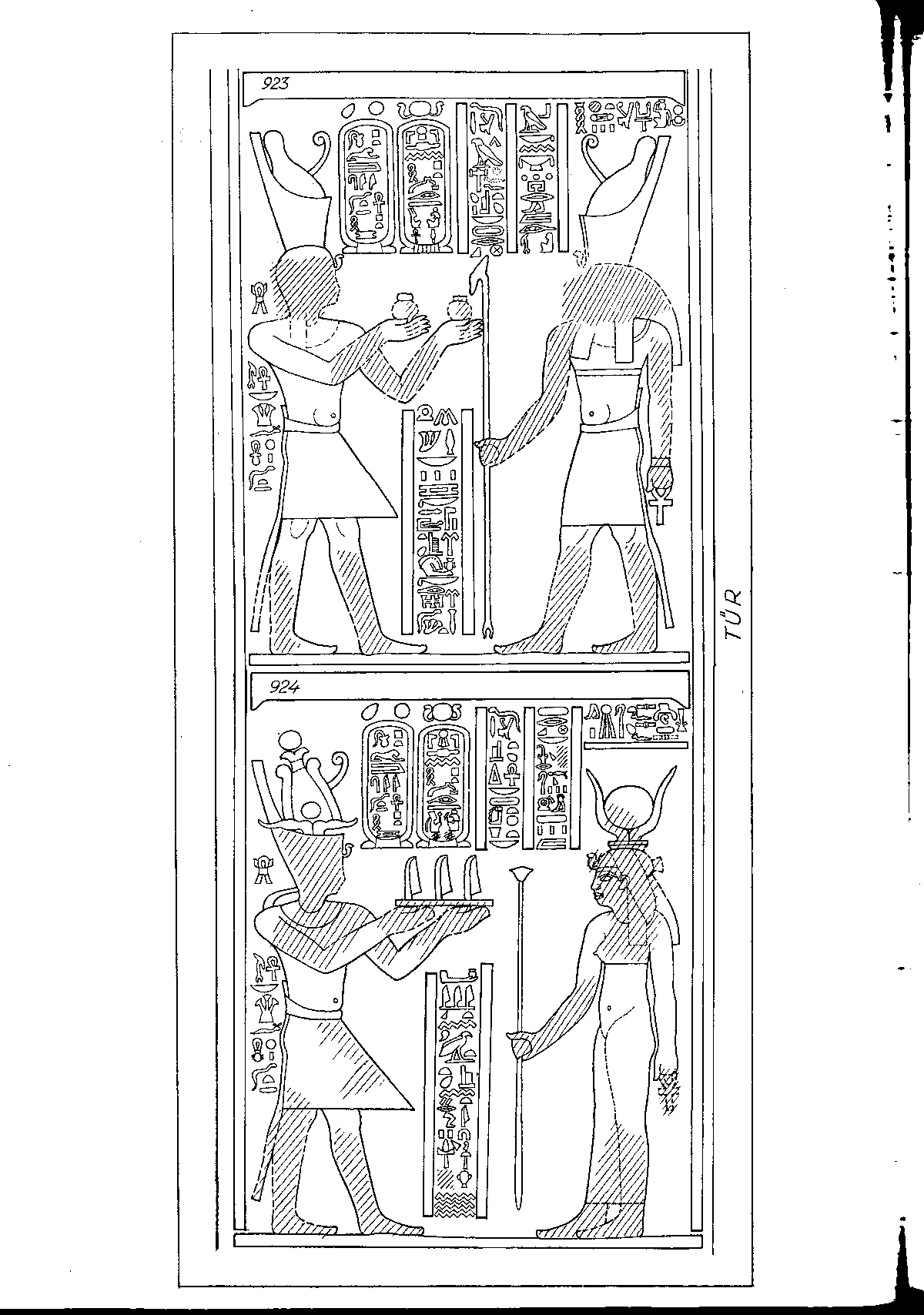
West door thickness: Isis shines forth from her house and suckles Horus
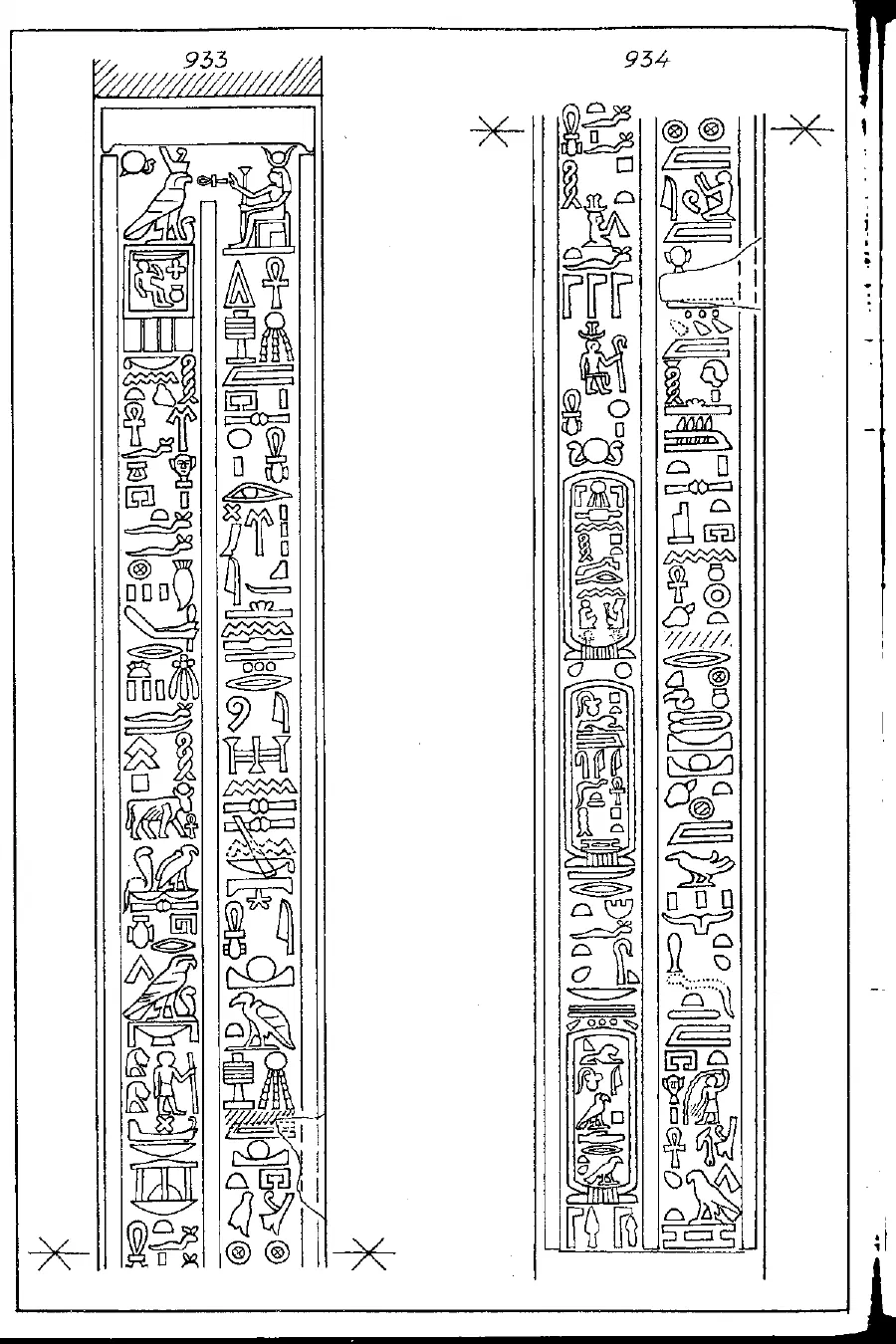
Page 77. The scene as drawn on the wall, facing p. 77 of the edition. Drawing by Otto Baum, in Junker and Winter, Das Geburtshaus des Tempels der Isis in Philä (1965) - 128p. 77, l. 1
Jȝs.t dj.t ꜥnḫ¹ psḏ m prj-s
Isis, giver of life, shines forth from her house
- 129p. 77, l. 2
mj Rꜥ jrj wḥmw
like Ra making his round again.
- 130p. 77, l. 3
tḫ-n-s tȝ
She has set foot on earth
- 131p. 77, l. 4
rwj-n-s ḳnk.t
and driven off the dark,
- 132p. 77, l. 5
mj ȝḫ.tj psḏ(-f?) m ȝḫ.t
like the Horizon-Dweller when he shines on the horizon.
- 133p. 77, l. 6
šmꜥw mḥw m jȝw m ḥr(-s)
Upper and Lower Egypt offer praise before her;
- 134p. 77, l. 7
tȝ.w(?) m wȝḥ tp
the lands bow their heads.
- 135p. 77, l. 8
šsp-s s.t n ꜥnḫ ḫnt Jrk
She takes the seat of life in Philae.
Note · Line 135
The “seat of life” is the birth house, where the birth of Horus was celebrated. - 136p. 77, l. 9
nrw n-t nḥḥ ḫnt ḫm.w
Dread of you stands forever before your foes.
- 137p. 77, l. 10
dmḏ ḥm.t(-t) ḏ.t m prj-t
Your Majesty is one with your house forever,
- 138p. 77, l. 11
ḥr štj ꜥnḫ-wȝs n sȝ-t Ḥrw mrj
as you give milk to your son Horus, the beloved:
Note · Line 138
The milk is called “life and dominion,” two of the blessings invoked for the king. - 139p. 77, l. 12
Ḥrw ḥwn ḥkn-tw m ꜥnḫ-f
Horus: the youth in whose life people rejoice,
Note · Line 139
The hymn passes from the young god to the king, whose first royal name identifies him with Horus. - 140p. 77, l. 13
ḥr ns.t jt-f bnr sp
on his father’s throne, gracious in his deeds,
- 141p. 77, l. 14
ḏsr mšḫꜥ-f ḥnꜥ Ḥp ꜥnḫ
holy when he appears beside the living Apis.
Note · Line 141
Apis was the sacred bull worshipped at Memphis. - 142p. 77, l. 15
nb.tj šḥrj jb (tȝ.wj)
He of the Two Ladies, who gladdens the heart of the Two Lands.
Note · Line 142
The king’s Two Ladies name invokes Nekhbet, the vulture goddess of Upper Egypt, and Wadjet, the cobra goddess of Lower Egypt. - 143p. 77, l. 16
Ḥrw nb wr pḥtj
Golden Horus, great in strength,
Note · Line 143
“Golden Horus” is one of the traditional titles of an Egyptian king. - 144p. 77, l. 17
nb ḥb.w-sd mj jt-f Ptḥ Ṯnn jt nṯr.w
lord of jubilees like his father Ptah-Tatenen, father of the gods,
Note · Line 144
At the royal jubilee, called the Sed festival, the king ritually renewed his power to rule. - 145p. 77, l. 18
jtj mj Rꜥ
sovereign like Ra,
- 146p. 77, l. 19
njśwt bjt jwꜥw …
King of Upper and Lower Egypt, heir of …
Note · Line 146
The king’s throne name calls him heir of the two Manifest Gods, his parents Ptolemy V and Cleopatra I. - 147p. 77, l. 20
sȝ Rꜥ Pt …
Son of Ra, Ptolemy …
Note · Line 147
The royal couple named here are Ptolemy VIII and Cleopatra III. - 148p. 77, l. 21
ḥnꜥ ḥm.t-f ḥḳȝ.t nb(.t) tȝ.wj
together with his wife, the ruler, Lady of the Two Lands,
- 149p. 77, l. 22
Kl … nṯr.wj mnḫ.wj
Cleopatra …, the two Benefactor Gods.
Note · Line 149
“Benefactor Gods” is the title the king and queen shared in their cult. East door thickness: Isis rises at Philae on 12 Epiphi
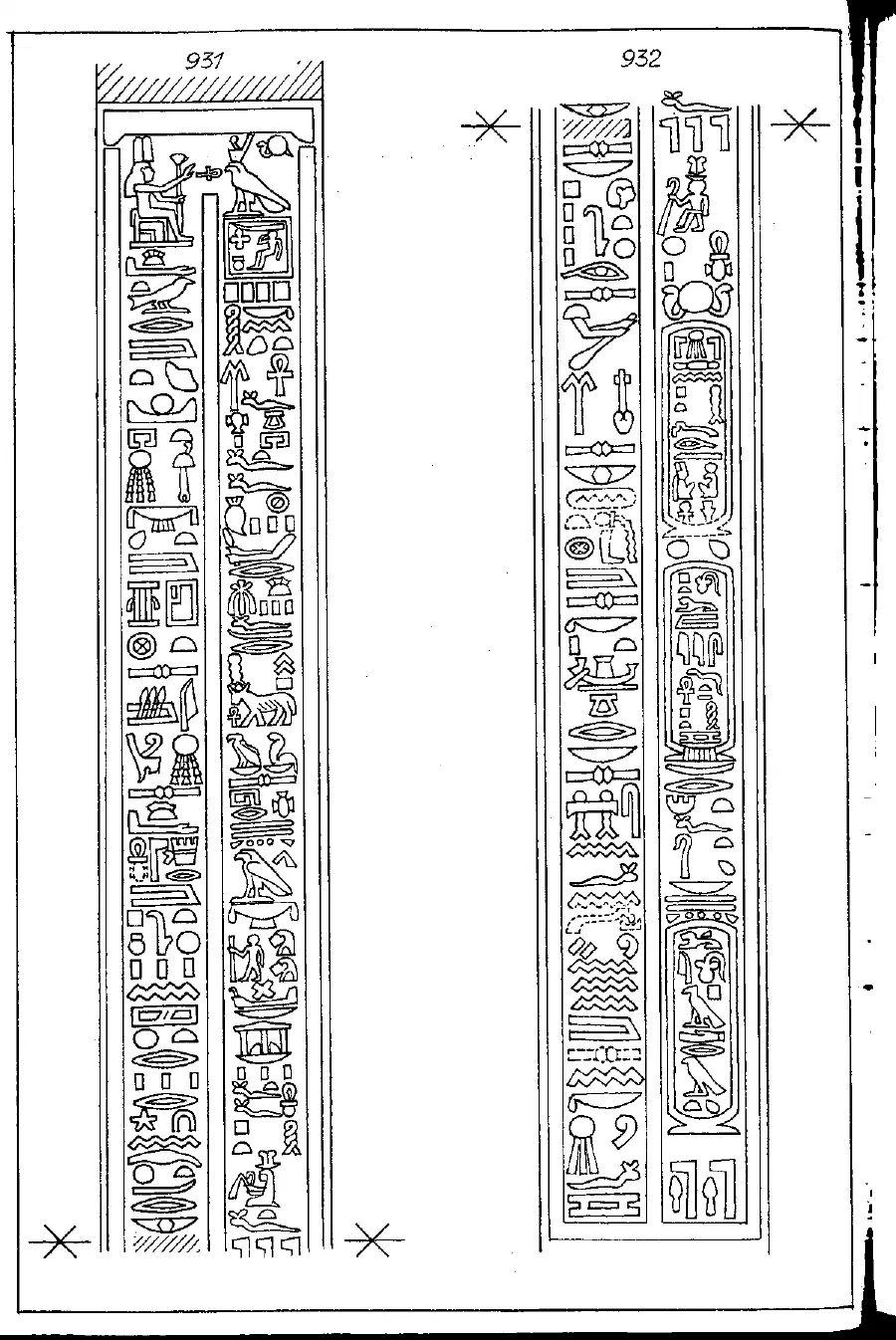
Page 79. The scene as drawn on the wall, facing p. 79 of the edition. Drawing by Otto Baum, in Junker and Winter, Das Geburtshaus des Tempels der Isis in Philä (1965) - 150p. 79, l. 1
Ḥrw ḥwn ḥkn-tw m ꜥnḫ-f
Horus: the youth in whose life people rejoice,
- 151p. 79, l. 2
ḥr ns.t jt-f bnr sp
on his father’s throne, gracious in his ways,
- 152p. 79, l. 3
ḏsr mšḫꜥ-f ḥnꜥ Ḥp ꜥnḫ
holy in his appearing beside the living Apis.
- 153p. 79, l. 4
nb.tj šḥrj jb tꜣ.wj
Two Ladies: he who gladdens the heart of the Two Lands.
Note · Line 153
The Two Ladies are Nekhbet, the vulture goddess of Upper Egypt, and Wadjet, the cobra goddess of Lower Egypt. - 154p. 79, l. 5
Ḥrw nb wr pḥtj
Golden Horus, great in strength,
- 155p. 79, l. 6
nb ḥb.w-sd mj jt-f Ptḥ Ṯnn jt nṯr.w
lord of jubilees like his father Ptah-Tatenen, father of the gods,
- 156p. 79, l. 7
jtj mj Rꜥ
sovereign like Ra,
- 157p. 79, l. 8
njswt bjt jwꜥw …
King of Upper and Lower Egypt, heir of …
- 158p. 79, l. 9
sꜣ Rꜥ Pt …
Son of Ra, Ptolemy …
- 159p. 79, l. 10
ḥnꜥ ḥm.t-f ḥḳꜣ.t nb(.t) tꜣ.wj
together with his wife, the ruler, Lady of the Two Lands,
- 160p. 79, l. 11
Kl … nṯr.wj mnḫ.wj
Cleopatra …, the two Benefactor Gods.
- 161p. 79, l. 12
Ꜣs.t dj.t ꜥnḫ¹ ḫꜥj wr.t m ḫnt ꜣḫ.t
Isis, giver of life. The Great One rises radiant from the horizon;
- 162p. 79, l. 13
wbn nb m ḥw.t-ḫnt
the Golden One rises at Philae.
- 163p. 79, l. 14
šsp-n-s ḫꜥw² mj³ (nb-r-)ḏr⁴
She has put on splendour like the Lord of All,
- 164p. 79, l. 15
m tr (so) pn ḫmt n šmw (šw) rꜣ ḫmt + rꜣ mḏ-djw n jbd
at this time, on the twelfth day of the third month of Harvest,
Note · Line 164
The month is Epiphi. The date is given as a third and a fifteenth of a thirty-day month: ten days and two. - 165p. 79, l. 16
ḥnꜥ ḥb.w-s nb tp tr.w (so)
and at all her feasts that open the seasons.
- 166p. 79, l. 17
jrj-s ḫn.t nfr(.t) m(? n) sḥb jꜣ.t wꜥb.t
She makes a fair voyage to bring joy to the Pure Mound.
Note · Line 166
The Pure Mound was the Abaton, the sanctuary of Osiris on Bigeh. Isis crossed there by boat from Philae. - 167p. 79, l. 18
mškt.t ḥr nb(.t)-s
The evening bark bears its lady;
- 168p. 79, l. 19
sṯḥn-f (sic) nwj m šw.t-f (sic) mrj⁵
he makes the flood gleam with his beloved rays.
Ptolemy VIII runs to Khnum with two jars of cool water
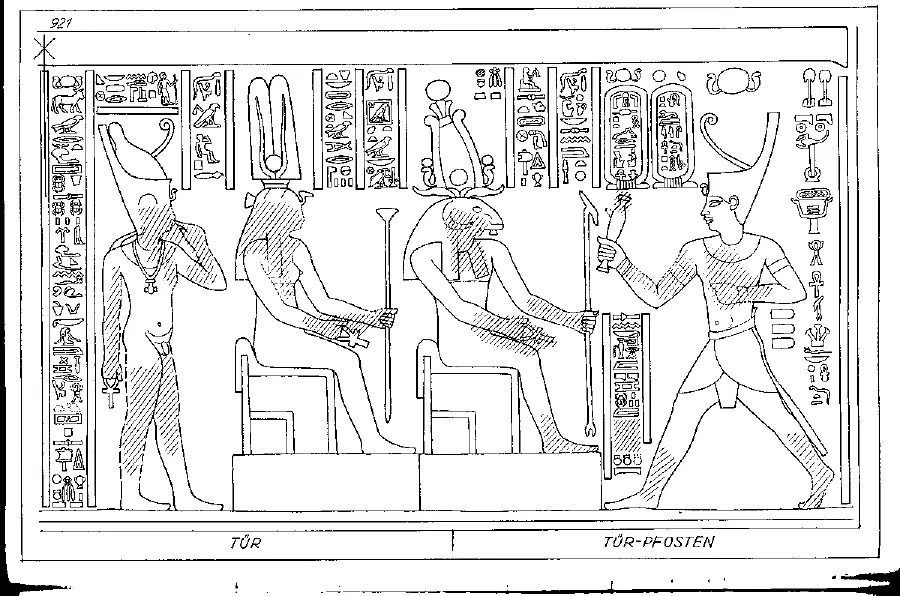
Page 81. The scene as drawn on the wall, facing p. 81 of the edition. Drawing by Otto Baum, in Junker and Winter, Das Geburtshaus des Tempels der Isis in Philä (1965) - 169p. 81, l. 1
mn n-k ḳbḥw prj m ḳr.tj
Receive for yourself the cool water that wells from the two caverns,
Note · Line 169
The water is offered as a libation. The Nile was believed to rise from two caverns near the First Cataract. - 170p. 81, l. 2
ḫpr m … nwnw
that comes into being in … the primeval waters.
- 171p. 81, l. 3
njśwt bjt jwꜥw …
King of Upper and Lower Egypt, heir of …
- 172p. 81, l. 4
sꜣ Rꜥ Pt …
Son of Ra, Ptolemy …
- 173p. 81, l. 5
… sꜣ ꜥnḫ wꜣś ḥꜣ-f nb mj Rꜥ ḏ.t
… May protection, life and dominion all surround him as they surround Ra, forever.
- 174p. 81, l. 6
ḏd mdw n | Ḫnmw-Rꜥ nb Śnm.t
Words spoken by Khnum-Ra, lord of Bigeh,
Note · Line 174
Khnum was the ram-headed god who shaped children on his potter’s wheel. - 175p. 81, l. 7
śḫm šps ḫnt jꜣ.t wꜥb.t
noble power who presides over the Abaton,
- 176p. 81, l. 8
dj ṯꜣw ḥr mśḫn
who gives breath at the place of birth.
- 177p. 81, l. 9
ḏd mdw n | Ḥw.t-Ḥrw wr.t nb(.t) Śnm.t
Words spoken by Hathor the Great, lady of Bigeh,
- 178p. 81, l. 10
ḥnw.t nb(.t) Jrk wr.t mrw.t psḏ.t
sovereign lady, lady of Philae, greatly loved by the Ennead.
- 179p. 81, l. 11
ḏd mdw n | Ḥrw pꜣ ḫrd
Words spoken by Horus the Child,
- 180p. 81, l. 12
ꜥꜣ wr tpj n Wśjr nb Jrk
the very great one, firstborn of Osiris, lord of Philae.
- 181p. 81, l. 13
njśwt bjt | Bꜣ wr šfj.t
King of Upper and Lower Egypt, Ba of great majesty,
Note · Line 181
A ba is a being’s power to manifest itself; for a god, it can be the form in which that god is present. - 182p. 81, l. 14
šꜣꜥ ḫpr śḫpr ḫprw
who first came into being and brought beings into being,
- 183p. 81, l. 15
jj m ḥꜣ.t ḳmꜣ-n-f pḥ
who came at the beginning and fashioned the end,
- 184p. 81, l. 16
šḏj bkꜣ.t m wꜣḏ-wr
who rescued the pregnant one from the Great Green,
Note · Line 184
The Great Green is an Egyptian name for the sea. - 185p. 81, l. 17
jrj sꜣ n fnḏ šps dj ṯꜣw ḥr mśḫn
who guards the sacred nose and gives breath at the place of birth.
Ptolemy VIII praises Onuris four times
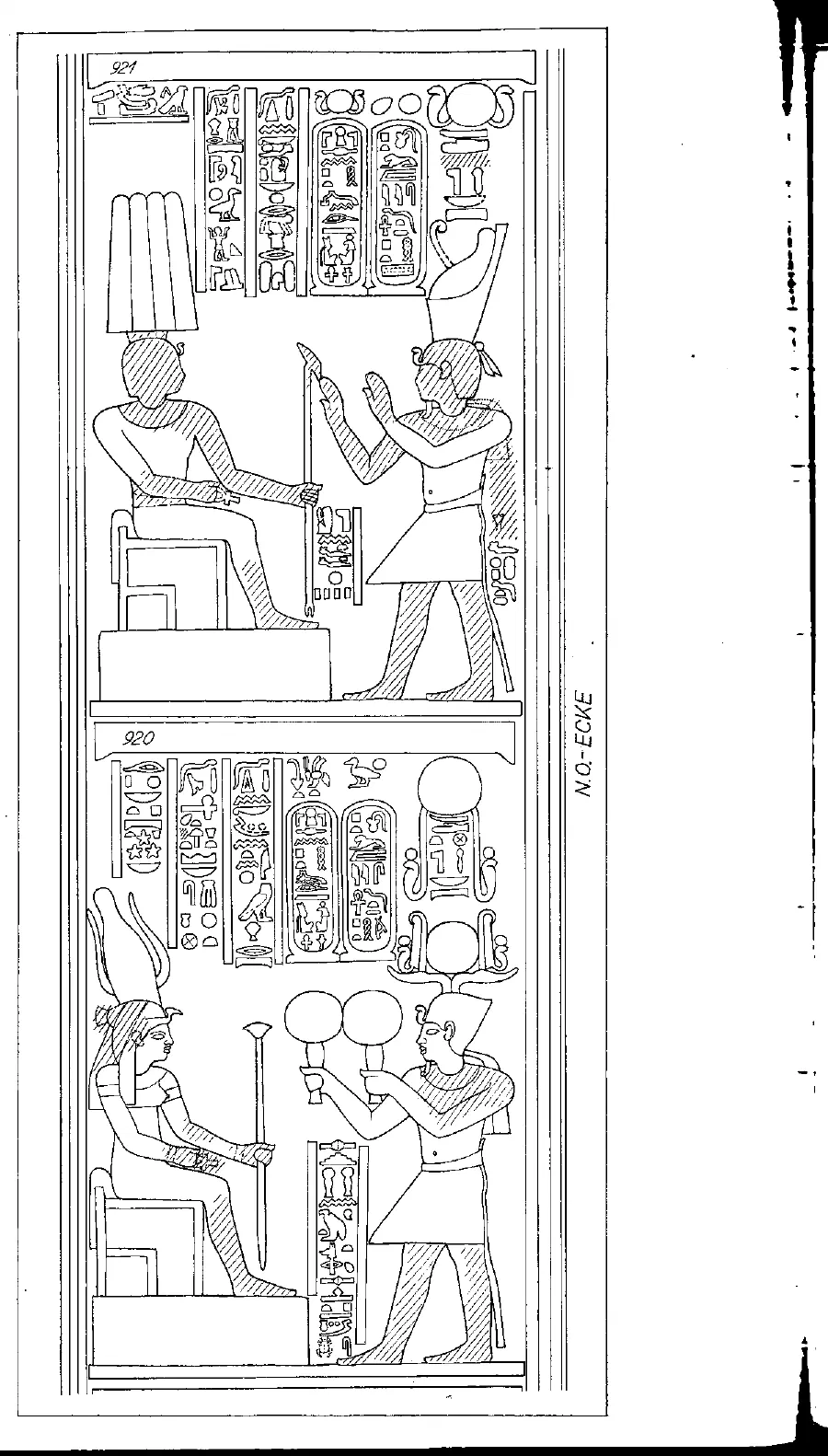
Page 83. The scene as drawn on the wall, facing p. 83 of the edition. Drawing by Otto Baum, in Junker and Winter, Das Geburtshaus des Tempels der Isis in Philä (1965) - 186p. 83, l. 1
dwꜣ nṯr n jt-f sp fdw
Giving divine praise to his father, four times.
Note · Line 186
This is a ritual direction: the king performs the act of praise four times. - 187p. 83, l. 2
njśwt bjt jwꜥw …
King of Upper and Lower Egypt, heir of …
- 188p. 83, l. 3
sꜣ Rꜥ Pt … ḥꜣ-f mj Rꜥ ḏ.t
Son of Ra, Ptolemy … around him as around Ra, forever.
- 189p. 83, l. 4
Bḥd.tj nṯr ꜥꜣ nb p.t
He of Edfu, the great god, lord of the sky.
- 190p. 83, l. 5
ḏd mdw n | Jnj-ḥr.t Šw sꜣ Rꜥ
Words spoken by Onuris-Shu, son of Ra,
- 191p. 83, l. 6
ḳꜣ šw.tj Ḥrw ṯmꜣ-ꜥ
whose twin plumes rise high, Horus of the mighty arm.
- 192p. 83, l. 7
ḏd mdw | dj(-j) n-k ḫftj.w-k (so) ḫr.w ḥr ṯb.tj-k
Words spoken: I give you your enemies, fallen beneath your two sandals.
Ptolemy VIII gives Satis two mirrors
- 193p. 83, l. 8
śꜥr wn.tj ḥr (ꜥnḫ.wj?) n mw.t-f Wśr.t
Presenting the two mirrors to his mother Wosret,
- 194p. 83, l. 9
śḥtp śj (so) n mꜣꜣ ḫprw-ś
to delight her with the sight of her own form.
- 195p. 83, l. 10
njśwt bjt jwꜥw …
King of Upper and Lower Egypt, heir of …
- 196p. 83, l. 11
sꜣ Rꜥ Pt …
Son of Ra, Ptolemy …
- 197p. 83, l. 12
Bḥd.tj nṯr ꜥꜣ nb p.t
He of Edfu, the great god, lord of the sky.
- 198p. 83, l. 13
ḏd mdw n | Śṯj.t ḥnw.t ꜣbw
Words spoken by Satis, mistress of Elephantine,
- 199p. 83, l. 14
nb(.t) mśḫn.t jr.t Rꜥ nb(.t) p.t ḥnw.t nṯr.w nb.w
lady of the birth house, Eye of Ra, lady of the sky, mistress of all the gods.
Note · Line 199
The Eye of Ra is the sun god’s power to act and protect, embodied in a goddess. - 200p. 83, l. 15
ḏd mdw | dj(-j) n-k mꜣꜣ n jtn m ḥr.t
Words spoken: I give you what the sun disk sees in the sky.
Ptolemy VIII gives Wadjet two cobras
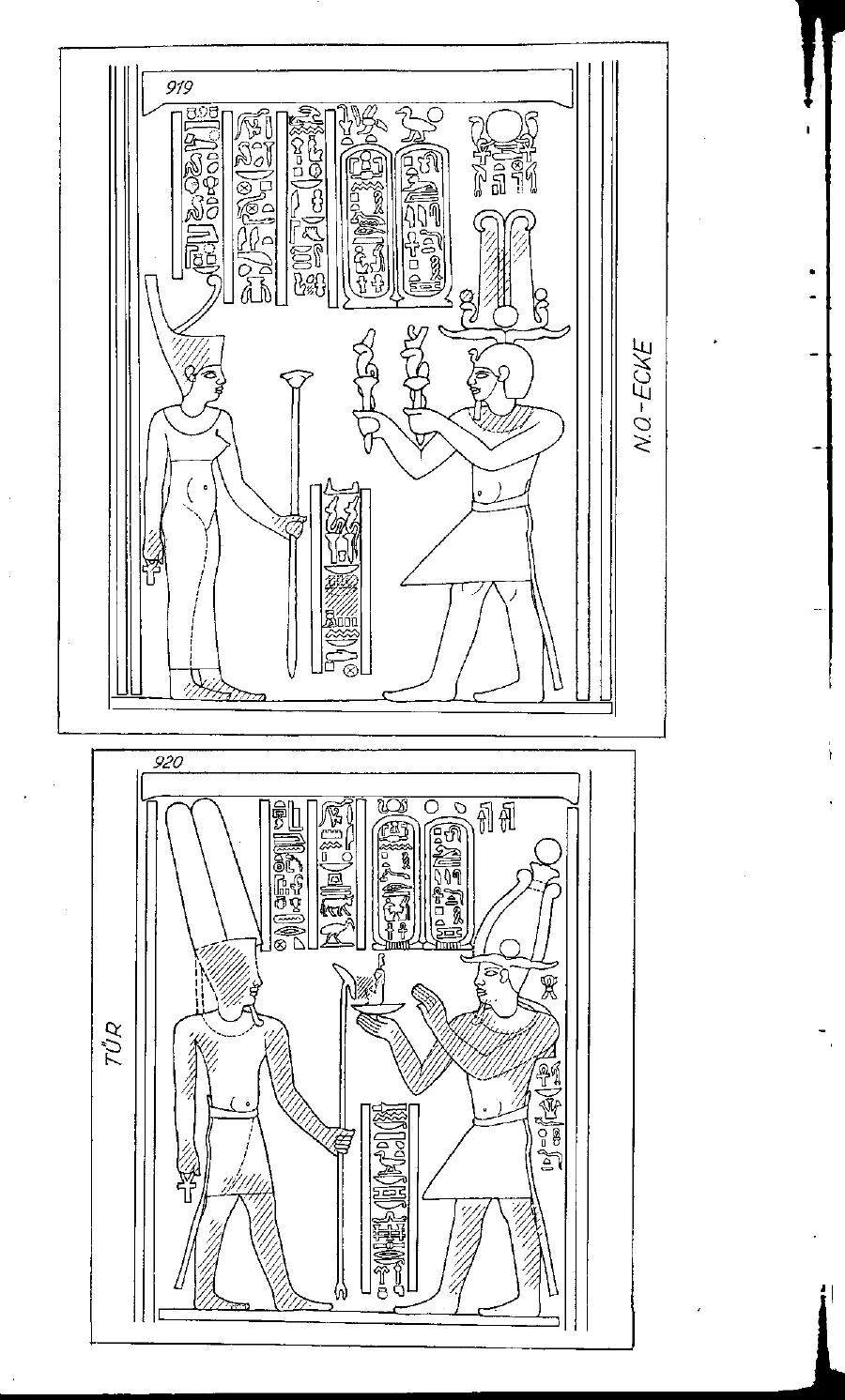
Page 85. The scene as drawn on the wall, facing p. 85 of the edition. Drawing by Otto Baum, in Junker and Winter, Das Geburtshaus des Tempels der Isis in Philä (1965) - 201p. 85, l. 1
ḏj jꜥr.tj n nb(.t)? …
Offering the two uraei to the lady …
Note · Line 201
A uraeus is a rearing cobra, the emblem worn on the brow of a god or king for protection. - 202p. 85, l. 2
… jnw n nb(.t) Dp
… gifts for the lady of Dep.
Note · Line 202
Dep was one of the two ancient settlements that made up Buto in the Nile Delta. - 203p. 85, l. 3
njswt bjt jwꜥw …
King of Upper and Lower Egypt, heir …
Note · Line 203
His throne name calls him heir to the two Manifest Gods, his parents Ptolemy V and Cleopatra I. - 204p. 85, l. 4
sꜣ Rꜥ Pt …
Son of Ra, Ptolemy …
- 205p. 85, l. 5
Bḥd.tj nṯr ꜥꜣ
The Behdetite, the great god.
Note · Line 205
The Behdetite is Horus of Behdet, the city now called Edfu. - 206p. 85, l. 6
ḏd mdw n | Wꜣḏ.t nb(.t) P Dp
Words spoken by Wadjet, lady of Pe and Dep,
Note · Line 206
Pe and Dep were the two parts of Buto, Wadjet’s city in the Nile Delta. - 207p. 85, l. 7
tꜣj.t (so)¹ ḫnt nwnw(?)
Tayet, foremost in the primeval waters,
Note · Line 207
Here Wadjet is identified with Tayet, the goddess of weaving. - 208p. 85, l. 8
wꜥ.t(?) ḥrj.t tp m? tp? n nṯr nb
the sole uraeus on the brow of every god:
- 209p. 85, l. 9
wnn-j ḥr tp-k (sic) mj nb (r) ḏr
I shall be on your brow as on the brow of the Lord of All,
- 210p. 85, l. 10
ḥḳꜣ-k tꜣ.wj mj sꜣ Ꜣs.t
that you may rule the Two Lands as the son of Isis does.
Note · Line 210
Wadjet addresses the king. Ptolemy VIII gives Amun a figure of Maat
- 211p. 85, l. 11
mn n-k mꜣꜥ.t sꜣ.t-k mrj-k
Receive Maat, your daughter, whom you love.
Note · Line 211
The king presents the god with Maat, the goddess who embodies truth and right order. - 212p. 85, l. 12
n ḥrj-š r-k m …²
She shall not depart from you in …
- 213p. 85, l. 13
njswt bjt jwꜥw …
King of Upper and Lower Egypt, heir …
- 214p. 85, l. 14
sꜣ Rꜥ Pt … nṯr.wj mnḫ.wj
Son of Ra, Ptolemy … the two Beneficent Gods.
Note · Line 214
The title names the king and queen together as objects of worship. - 215p. 85, l. 15
sꜣ ꜥnḫ wꜣs nb ḥꜣ-f mj Rꜥ ḏ.t
May all protection, life and dominion surround him as they surround Ra, forever.
- 216p. 85, l. 16
ḏd mdw n | Jmn-Rꜥ nb ns.t tꜣ.wj
Words spoken by Amun-Ra, lord of the throne of the Two Lands,
- 217p. 85, l. 17
kꜣ ḳmꜣ(?)³ s.t-f m jꜣ.t wꜥb.t
the bull who makes his seat on the Pure Mound,
- 218p. 85, l. 18
njswt nṯr.w ḥrj-jb Jrḳ
king of the gods, who dwells in Philae.
Ptolemy VIII gives Min two ointment jars and black eye paint
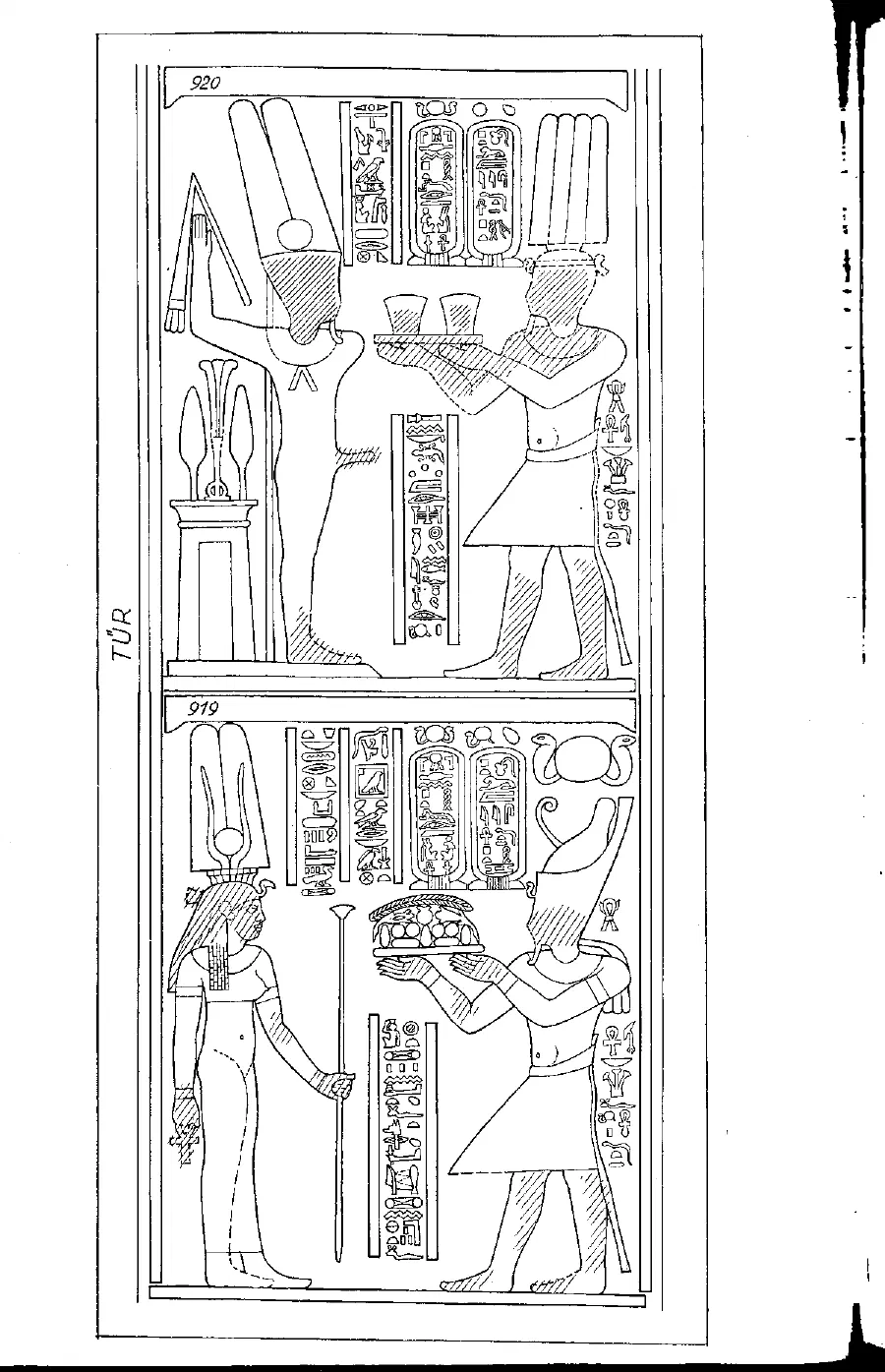
Page 87. The scene as drawn on the wall, facing p. 87 of the edition. Drawing by Otto Baum, in Junker and Winter, Das Geburtshaus des Tempels der Isis in Philä (1965) - 219p. 87, l. 1
mn n-k mšdm.t¹ m jr.t Ḥrw bnr sp šn
Receive the black kohl as the Eye of Horus, sweet, sweet.
Note · Line 219
Kohl is a dark eye paint. In the offering rite it stands for the Eye of Horus, restored to him after it was injured. - 220p. 87, l. 2
jwn-f nfr n jr.t Rꜥ
Its lovely color is that of the Eye of Ra.
- 221p. 87, l. 3
njšwt bjt jwꜥw …
King of Upper and Lower Egypt, heir …
- 222p. 87, l. 4
sꜣ Rꜥ Pt …
Son of Ra, Ptolemy …
- 223p. 87, l. 5
sꜣ ꜥnḫ wꜣš nb ḥꜣ-f mj Rꜥ ḏ.t
May all protection, life and dominion surround him as they surround Ra, forever.
- 224p. 87, l. 6
Mnw njšwt Ḥrw nḫt nṯr ꜥꜣ nb Jrk
Min the King, Horus the Strong, the great god, lord of Philae.
Ptolemy VIII gives Hathor food
- 225p. 87, l. 7
fꜣj jḫ.t n mw.t-f Wsr.t
Raising food offerings to his mother Wosret,
- 226p. 87, l. 8
ḫrp ꜥb.t n psḏ.t-f (sic)
presenting an offering to his Ennead.
- 227p. 87, l. 9
njšwt bjt jwꜥw …
King of Upper and Lower Egypt, heir …
- 228p. 87, l. 10
sꜣ Rꜥ Pt …
Son of Ra, Ptolemy …
- 229p. 87, l. 11
sꜣ ꜥnḫ wꜣš nb ḥꜣ-f mj Rꜥ ḏ.t
May all protection, life and dominion surround him as they surround Ra, forever.
- 230p. 87, l. 12
ḏd mdw n | Ḥw.t-Ḥrw wr.t nb(.t) Snm.t
Words spoken by Hathor the Great, lady of Bigeh,
- 231p. 87, l. 13
ḥnw.t nb(.t) Jrk
the sovereign lady, mistress of Philae,
- 232p. 87, l. 14
nb(.t) kꜣ.w ꜥšꜣ ḏfꜣ.w
lady of sustenance, rich in provisions.
Ptolemy VIII runs to Osiris with two jars of cool water
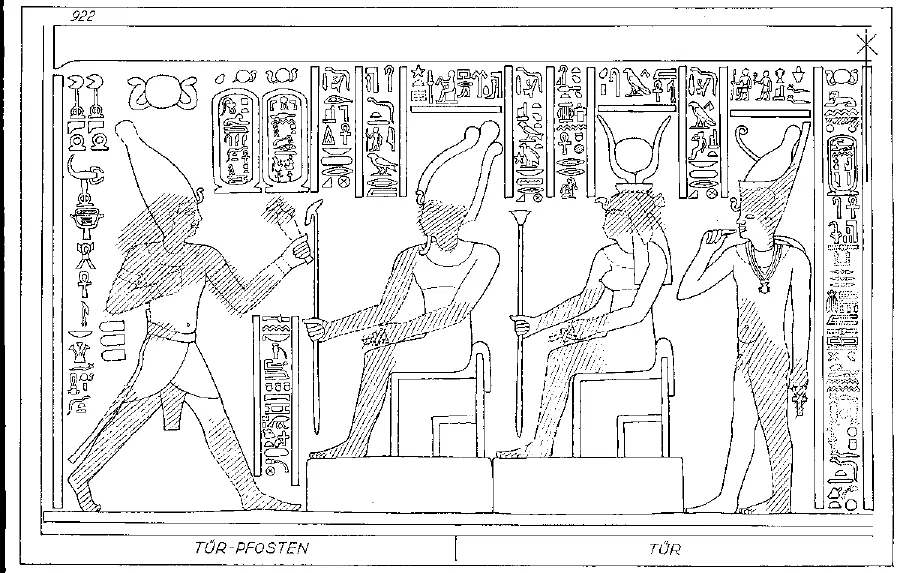
Page 89. The scene as drawn on the wall, facing p. 89 of the edition. Drawing by Otto Baum, in Junker and Winter, Das Geburtshaus des Tempels der Isis in Philä (1965) - 233p. 89, l. 1
mn n-k ḳbḥw prj.w m Nwnw
Take the cool water that flows from Nun,
- 234p. 89, l. 2
bsj.w ỉm-k ḫnt tꜣ.t wꜥb.t
that wells up from you at the head of the Abaton.
Note · Line 234
The king offers water to Osiris, from whom the Nile was believed to rise. - 235p. 89, l. 3
njśwt bjt jwꜥw …
King of Upper and Lower Egypt, heir of the Manifest Gods …
- 236p. 89, l. 4
sꜣ Rꜥ Pt …
Son of Ra, Ptolemy …
- 237p. 89, l. 5
… sꜣ ꜥnḫ wꜣś nb ḥꜣ-f mj Rꜥ ḏ.t
… May all protection, life and dominion surround him as they surround Ra, forever.
- 238p. 89, l. 6
ḏd mdw n | Wśjr dj ꜥnḫ nb Jrk
Words spoken by Osiris, giver of life, lord of Philae,
- 239p. 89, l. 7
nṯr ꜥꜣ ḥḳꜣ ḏ.t śr wr m dꜣ.t
great god, ruler of eternity, great prince in the underworld,
- 240p. 89, l. 8
śḫm šps prj m Gb
august power sprung from Geb.
Note · Line 240
Geb, the earth god, is the father of Osiris. - 241p. 89, l. 9
ḏd mdw n | Jś.t wr.t mw.t nṯr nb(.t) Jrk
Words spoken by Isis the Great, mother of the god, lady of Philae,
- 242p. 89, l. 10
ḥḳꜣ.t mnḫ.t ḫnt śbḫ.t-n-ꜥnḫ
the excellent ruler who presides over the birth house,
Note · Line 242
The birth house is the temple where the birth and nursing of the divine child were celebrated. - 243p. 89, l. 11
rr sꜣ-s Ḥrw m ꜥnḫ-wꜣś
who nurses her son Horus with life and dominion.
Note · Line 243
“Life and dominion” is a name for the milk of Isis: Horus draws both from her breast. - 244p. 89, l. 12
ḏd mdw n | Ḥrw sꜣ Jś.t nb Jrk
Words spoken by Horus, son of Isis, lord of Philae,
- 245p. 89, l. 13
śr(?) nṯr ꜥꜣ(?) ḥr ś.t jt-f
the prince, the great god on his father’s throne.
- 246p. 89, l. 14
njśwt bjt | nb n … Wnn nfrw mꜣꜥ ḫrw
King of Upper and Lower Egypt, lord of …, Wennefer, vindicated,
Note · Line 246
“Vindicated” declares that judgment was given in his favor against Seth, who killed him. - 247p. 89, l. 15
ḥḳꜣ ꜥnḫ njśwt nṯr.w
ruler of life, king of the gods,
- 248p. 89, l. 16
śkꜣ ḥnb.wt¹ mśj tꜣ.w(?) m śštꜣ-f
who plows the fields and gives birth to loaves from his hidden depths.
- 249p. 89, l. 17
wn n-f ḥḥ sḫn(?)² (n)-f ḏ.t ḫntj wꜥb.t (sic)
Endless time is his; eternity is joined to him who presides over the Abaton.
Ptolemy VIII praises Amun, who keeps the egg safe in the womb
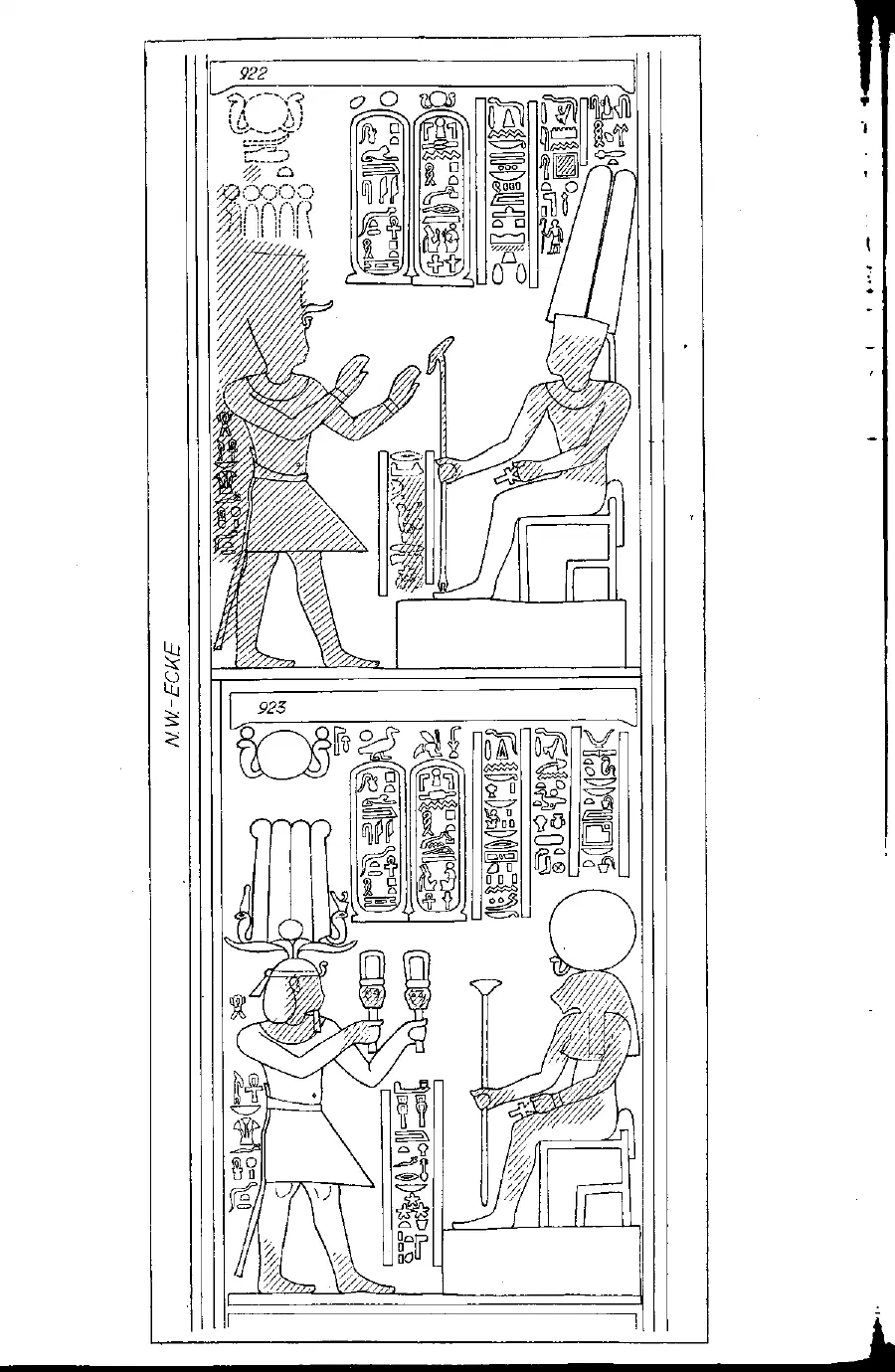
Page 91. The scene as drawn on the wall, facing p. 91 of the edition. Drawing by Otto Baum, in Junker and Winter, Das Geburtshaus des Tempels der Isis in Philä (1965) - 250p. 91, l. 1
rdj (?) dwꜣ.t … ? … r p.t¹ …
Giving praise … to the sky …
- 251p. 91, l. 2
njśwt bjt jwꜥw …
King of Upper and Lower Egypt, heir of the Manifest Gods …
- 252p. 91, l. 3
sꜣ Rꜥ Pt …
Son of Ra, Ptolemy …
- 253p. 91, l. 4
sꜣ ꜥnḫ wꜣś nb ḥꜣ-f mj Rꜥ ḏ.t
May all protection, life and dominion surround him as they surround Ra, forever.
- 254p. 91, l. 5
Bḥd.tj
He of Behdet.
Note · Line 254
His emblem is the winged sun disk. - 255p. 91, l. 6
ḏd mdw n | Jmn ḥḳꜣ ḥw.t (? ḫnt)
Words spoken by Amun, ruler of Philae,
- 256p. 91, l. 7
nṯr ꜥꜣ ḥḳꜣ (?) śwḏꜣ śwḥ.t m ẖ.t
great god, ruler who keeps the egg safe in the womb.
- 257p. 91, l. 8
ḏd mdw | dj (-j) n-k tꜣ.w nb.w m ḥtp
Words to be spoken: I give you all lands at peace
- 258p. 91, l. 9
ḫꜣś.wt ḫr ṯb.tj (-k)
and the foreign lands beneath the soles of your two feet.
Ptolemy VIII gives Tefnut two sistra
- 259p. 91, l. 10
ḥnk sšš.tj m ḥr-t nfr
Offering the two sistra before your beautiful face,
Note · Line 259
Sistra are rattles shaken in worship. - 260p. 91, l. 11
nb (.t) nṯr.w ḥnw.t nṯr.wt
lady of the gods, mistress of the goddesses.
- 261p. 91, l. 12
njśwt bjt jwꜥw …
King of Upper and Lower Egypt, heir of the Manifest Gods …
- 262p. 91, l. 13
sꜣ Rꜥ Pt … nṯr mnḫ
Son of Ra, Ptolemy …, the beneficent god.
- 263p. 91, l. 14
sꜣ ꜥnḫ wꜣś nb ḥꜣ-f mj Rꜥ ḏ.t
May all protection, life and dominion surround him as they surround Ra, forever.
- 264p. 91, l. 15
ḏd mdw n | Tfn.t sꜣ.t Rꜥ ḥrj (.t)-jb jꜣ.t wꜥb.t
Words spoken by Tefnut, daughter of Ra, who dwells on the Pure Mound,
- 265p. 91, l. 16
wpś.t nb (.t) nbj.t m ḥw.t-nbj.t
Wepeset, Lady of Flame in the House of Flame.
Note · Line 265
Wepeset means “she who burns.” Here it names Tefnut in her fiery form. - 266p. 91, l. 17
ḏd mdw | dj (-j) n-k ḥr-nb nb (m ?) ršw.t n mꜣꜣ-k
Words spoken: I grant you this: every face shall light up with joy at the sight of you.
Ptolemy VIII gives Nekhbet the White Crown and the Red Crown
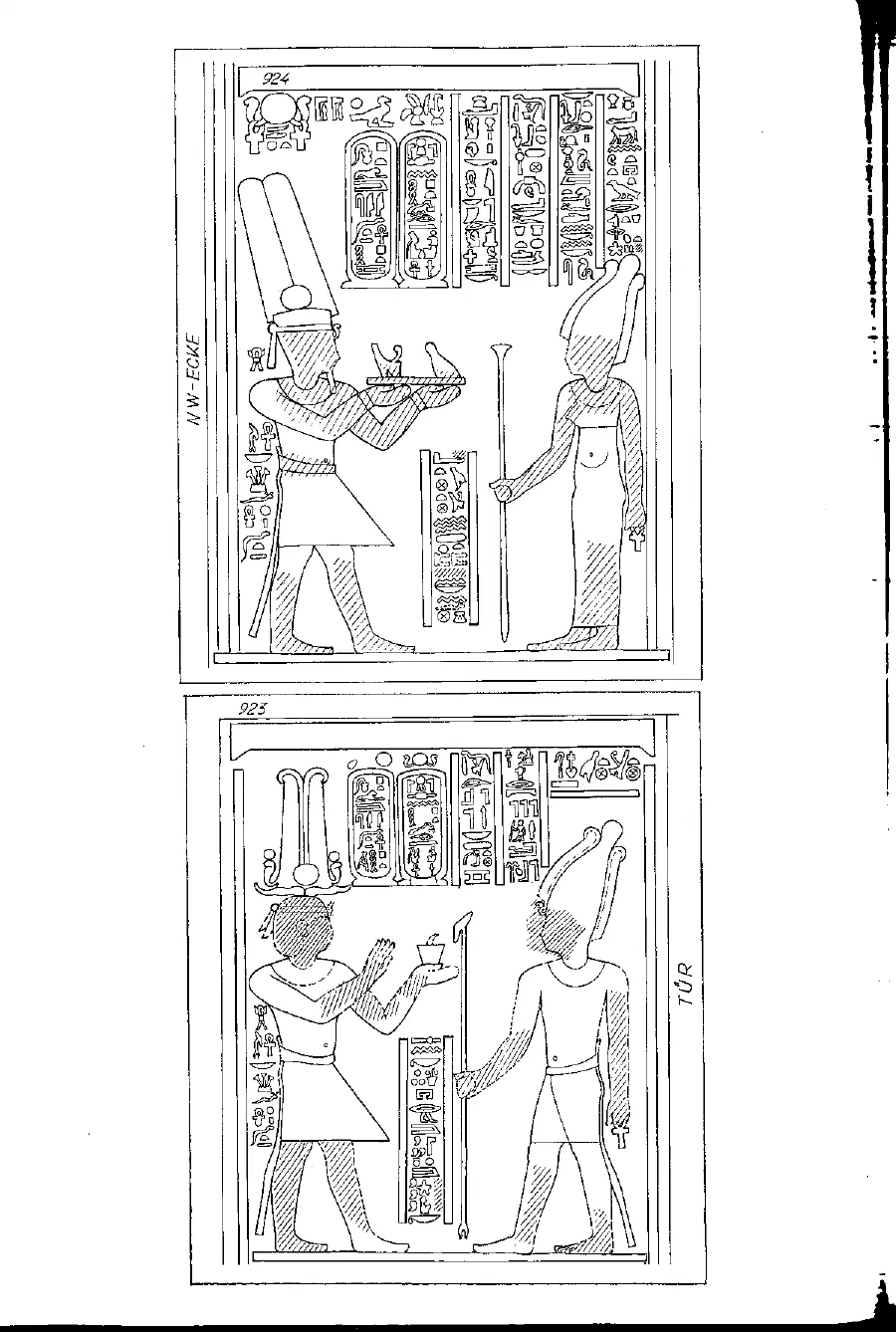
Page 93. The scene as drawn on the wall, facing p. 93 of the edition. Drawing by Otto Baum, in Junker and Winter, Das Geburtshaus des Tempels der Isis in Philä (1965) - 267p. 93, l. 1
ḥnk (? dj?) ḥḏ.t dšr.t n Nḫnj.t
Presenting the White Crown and the Red Crown to her of Nekhen,
Note · Line 267
The White Crown is that of Upper Egypt, the Red Crown that of Lower Egypt. The goddess receiving them is Nekhbet. - 268p. 93, l. 2
pšš.tj n nb(.t) n fꜥg (so)
and the two halves of the land to the Lady of Fag.
- 269p. 93, l. 3
njśwt bjt jwꜥw …
King of Upper and Lower Egypt, heir …
Note · Line 269
In Ptolemy VIII’s full title he is heir to the Manifest Gods, his parents Ptolemy V and Cleopatra I. - 270p. 93, l. 4
sꜣ Rꜥ Pt … nṯr.wj mnḫ.wj
Son of Ra, Ptolemy …, the two Beneficent Gods.
- 271p. 93, l. 5
sꜣ ꜥnḫ wꜣś nb ḥꜣ-f mj Rꜥ ḏ.t
May all protection, life and dominion surround him as they surround Ra, forever.
- 272p. 93, l. 6
Bḥd.tj
He of Behdet.
Note · Line 272
A title of Horus of Edfu, often shown as a winged sun disk. - 273p. 93, l. 7
ḏd mdw n | Nḫb.t ḥḏ.t Nḫn
Words spoken by Nekhbet, the White One of Nekhen,
Note · Line 273
Nekhbet is the vulture goddess who protects the king of Upper Egypt. - 274p. 93, l. 8
ꜣw.t-ꜥ nb(.t) fꜥg
whose arm reaches far, Lady of Fag,
- 275p. 93, l. 9
dmꜣ.t pḏ.wt nb(.t) Nḫb
who binds the bows together, Lady of Nekheb,
Note · Line 275
The bows stand for Egypt’s traditional enemies. Nekheb, now Elkab, stood across the Nile from Nekhen. - 276p. 93, l. 10
jr.t Rꜥ ḥrj.t tp m ḥꜣ.t-f
Eye of Ra, the diadem on his brow,
- 277p. 93, l. 11
dngngś ḥrj-jb ꜥḥnwtj
the uraeus in the palace,
- 278p. 93, l. 12
wr.t wśr.t ḥnw.t nṯr.w
the great one, the mighty one, mistress of the gods:
- 279p. 93, l. 13
ḫꜥj-j ḥr tp-k mj nb (r) ḏr
I rise in splendor on your head as on the head of the Lord of All.
- 280p. 93, l. 14
jrj-j ś.t(-j?) jm(?) mrj-k
I take my place there as you wish.
Ptolemy VIII burns incense before Osiris
- 281p. 93, l. 15
mn n-k śnṯr prj m ḥꜥ.w-nṯr
Receive the incense that comes from the god’s limbs;
- 282p. 93, l. 16
ḫnm (śṯj?)-nṯr ḥꜥ.w-k
breathe in the divine scent of your limbs.
- 283p. 93, l. 17
njśwt bjt jwꜥw …
King of Upper and Lower Egypt, heir …
- 284p. 93, l. 18
sꜣ Rꜥ Pt …
Son of Ra, Ptolemy …
- 285p. 93, l. 19
sꜣ ꜥnḫ wꜣś nb ḥꜣ-f mj Rꜥ ḏ.t
May all protection, life and dominion surround him as they surround Ra, forever.
- 286p. 93, l. 20
ḏd mdw n | Wśjr nṯr ꜥꜣ nb jꜣ.t wꜥb.t
Words spoken by Osiris, the great god, Lord of the Pure Mound,
- 287p. 93, l. 21
śḫm šps ḥrj nṯr.w śr (?) mnḫ prj m Gb
the august power who presides over the gods, the worthy prince sprung from Geb,
- 288p. 93, l. 22
ḥḳꜣ nfr (n?) šmꜥ.w mḥw
the good ruler of Upper and Lower Egypt.
Ptolemy VIII gives Horus wine, the green Eye of Horus
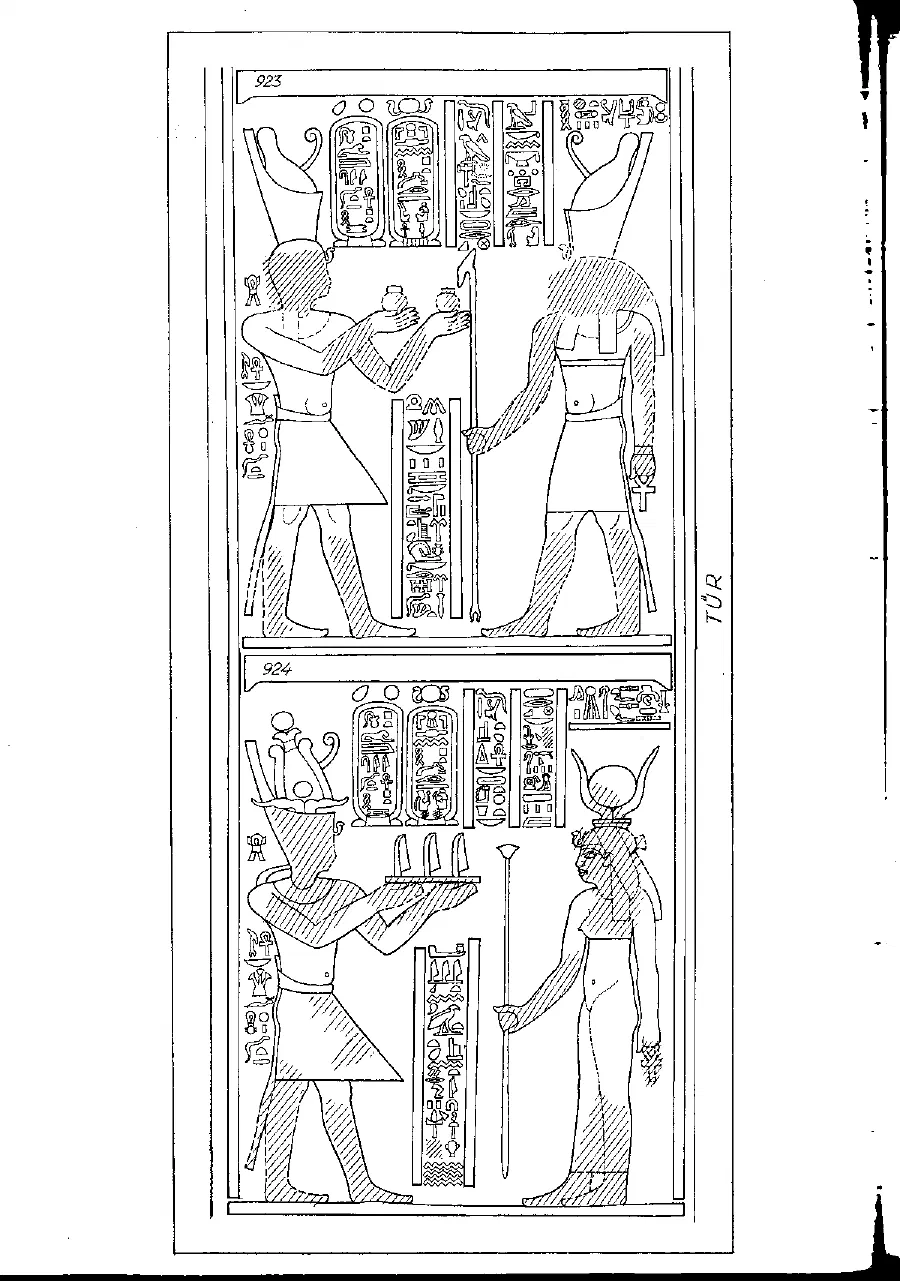
Page 95. The scene as drawn on the wall, facing p. 95 of the edition. Drawing by Otto Baum, in Junker and Winter, Das Geburtshaus des Tempels der Isis in Philä (1965) - 289p. 95, l. 1
rḏ šn.w nb.w mrj-k
All the trees you love are growing,
- 290p. 95, l. 2
nṯr ꜥꜣ prj m Jś.t
great god born of Isis.
- 291p. 95, l. 3
ḥnṯś jb-k m jr.t Ḥrw wꜣḏ.t
May your heart rejoice in the green Eye of Horus.
Note · Line 291
The Eye of Horus, injured and made whole again, is an image of the offering. Here the offering is wine. - 292p. 95, l. 4
njśwt bjt jwꜥw …
King of Upper and Lower Egypt, heir …
- 293p. 95, l. 5
sꜣ Rꜥ Pt …
Son of Ra, Ptolemy …
- 294p. 95, l. 6
sꜣ ꜥnḫ wꜣś nb ḥꜣ-f mj Rꜥ ḏ.t
May all protection, life and dominion surround him as they surround Ra, forever.
- 295p. 95, l. 7
ḏd mdw n | Ḥrw nḏtj jt-f sꜣ Jś.t nb Jrk
Words spoken by Horus, avenger of his father, son of Isis, lord of Philae,
- 296p. 95, l. 8
bjk n nb prj m Wśjr
the falcon of gold who came forth from Osiris,
- 297p. 95, l. 9
wꜣḥ jḫ.t n kꜣ-f rꜥ nb
who lays out offerings for his father’s ka each day.