~/sacred-texts/philae-birth-house-mammisi-inscriptions
Philae Birth House: Isis Nurses Horus, Your Semen Has Become a Man
- Date
- Carved under Ptolemy VIII Euergetes II and Cleopatra III (145–116 BC) in the sanctuary of the birth house of the Isis temple at Philae
- Found
- Sanctuary (Chamber III) of the birth house, temple of Isis, Philae; the temple was moved stone by stone to Agilkia Island near Aswan in 1972–1980, where it stands today
- Language
- Egyptian (Ptolemaic hieroglyphic) · Hieroglyphic
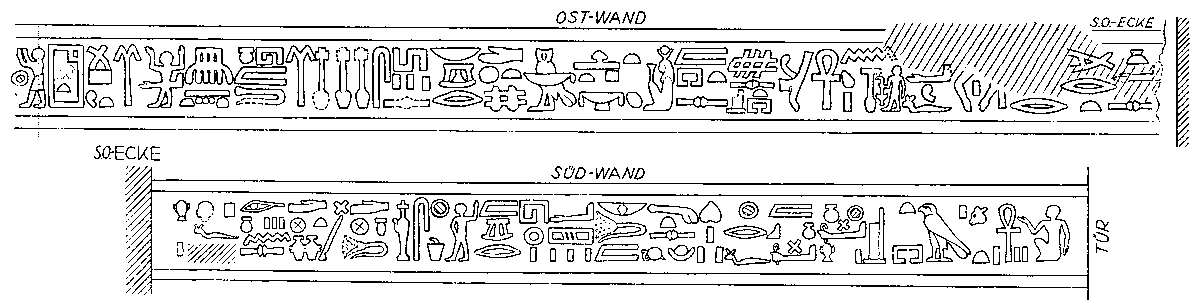
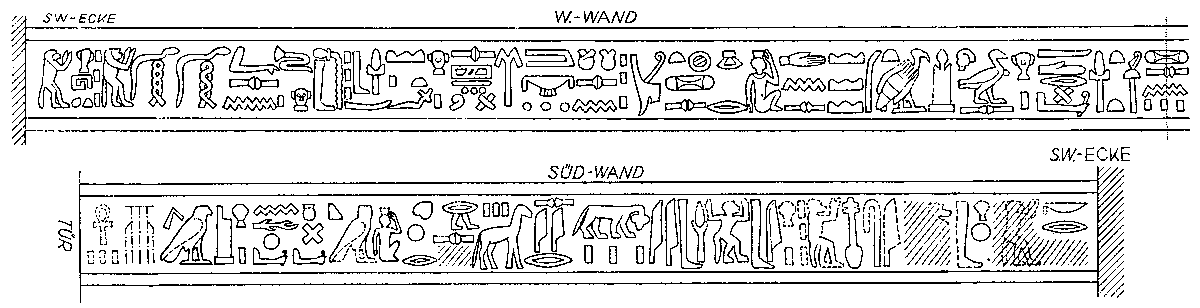
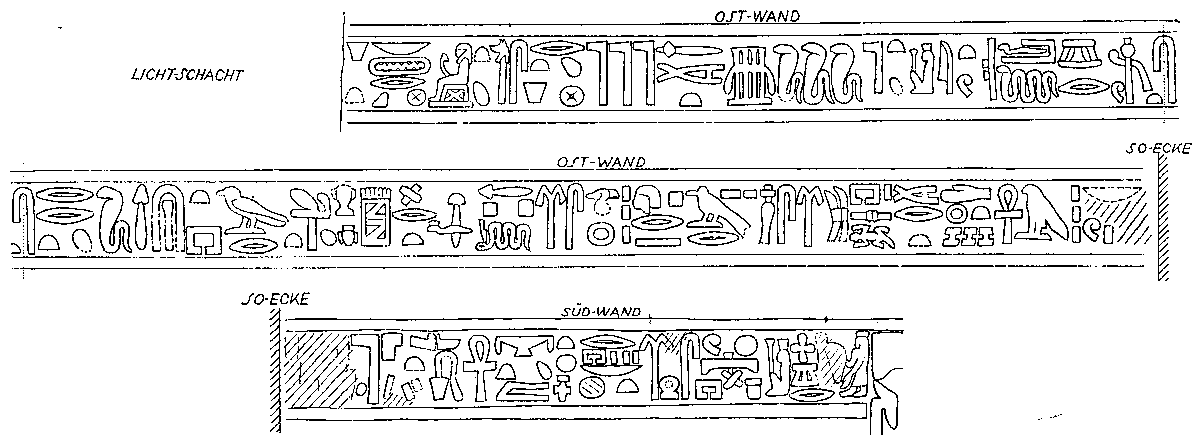
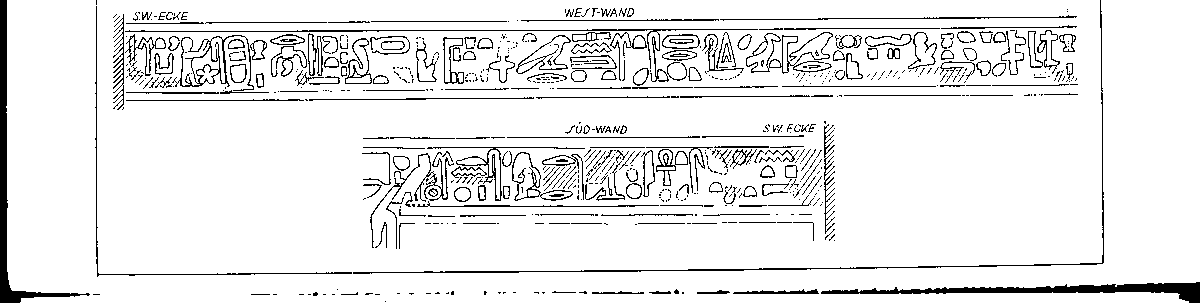
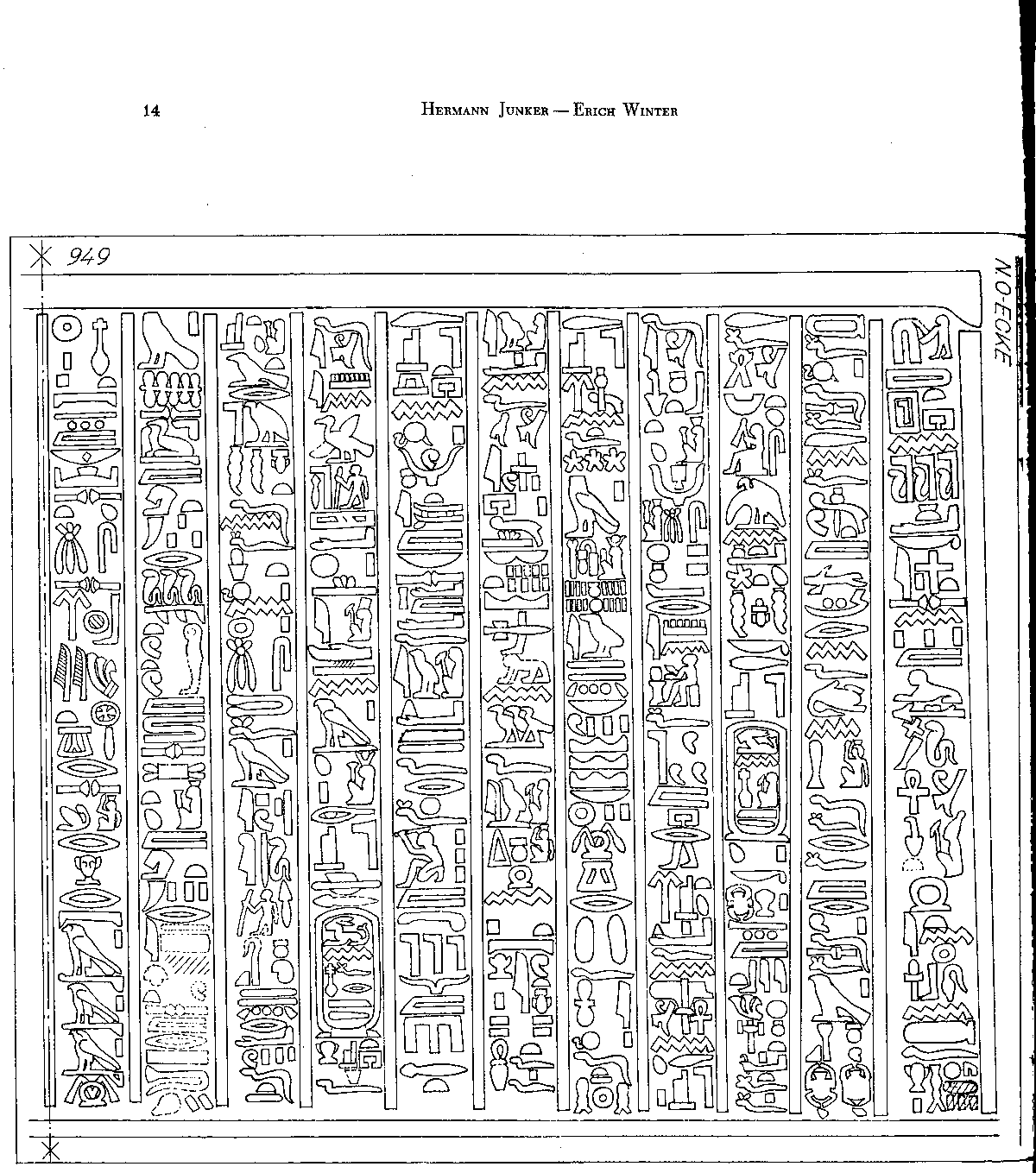
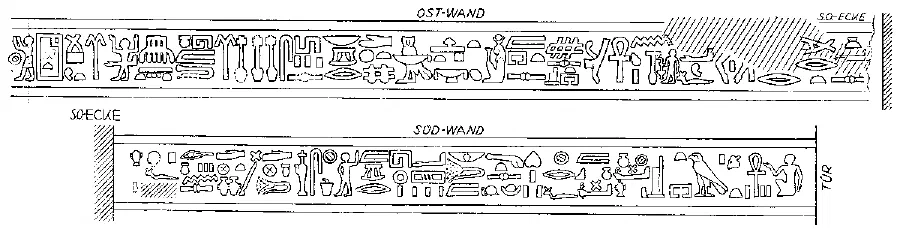
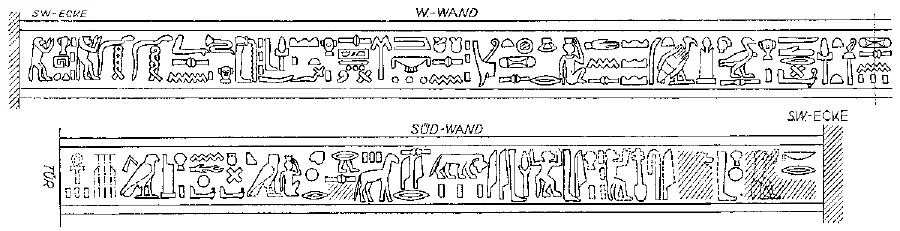
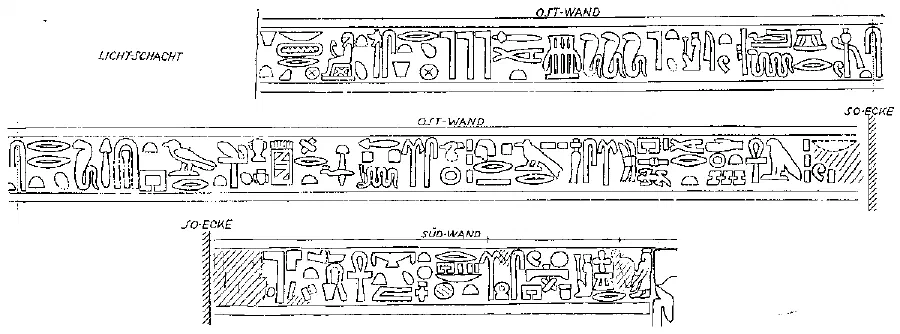
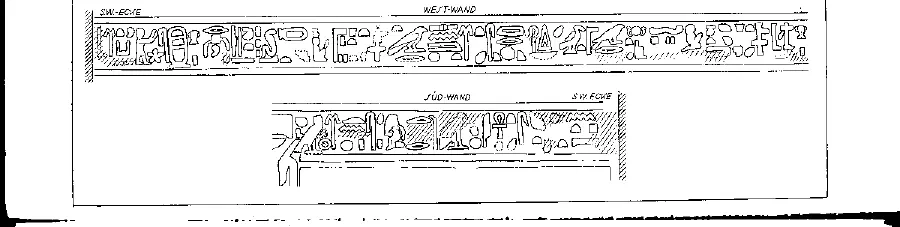
Ptolemy VIII’s dedication runs round the sanctuary: he built the house of fine, hard stone, and nomads bring gold and ivory while the kiri monkeys dance. The upper band praises Hathor-Isis, whose house stays open at night: All the gods live on incense burning in the flame; Gold lives on strong drink.
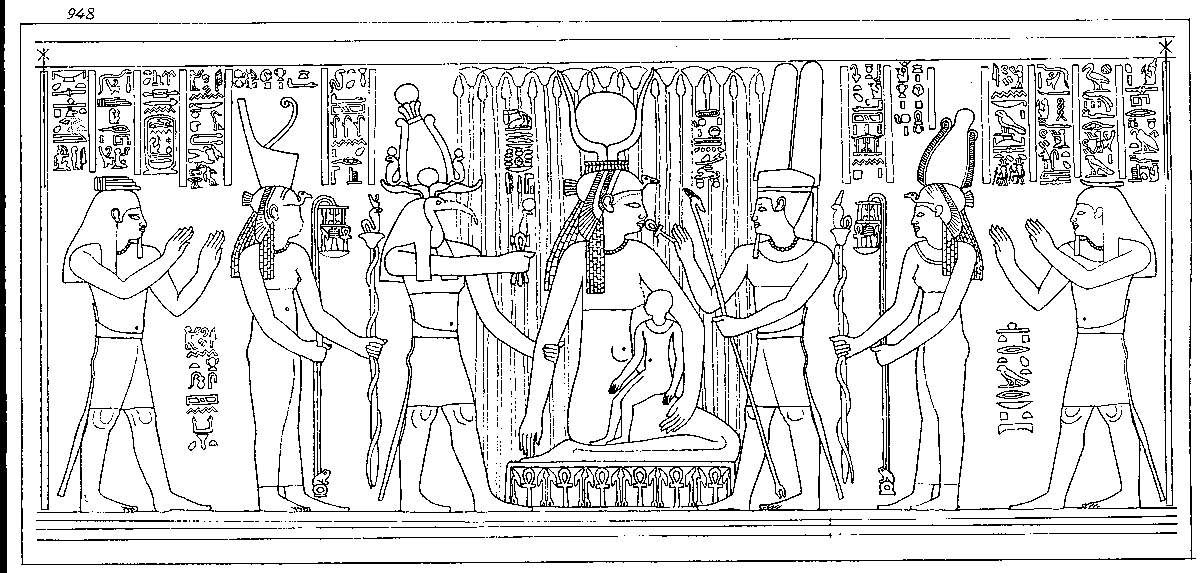
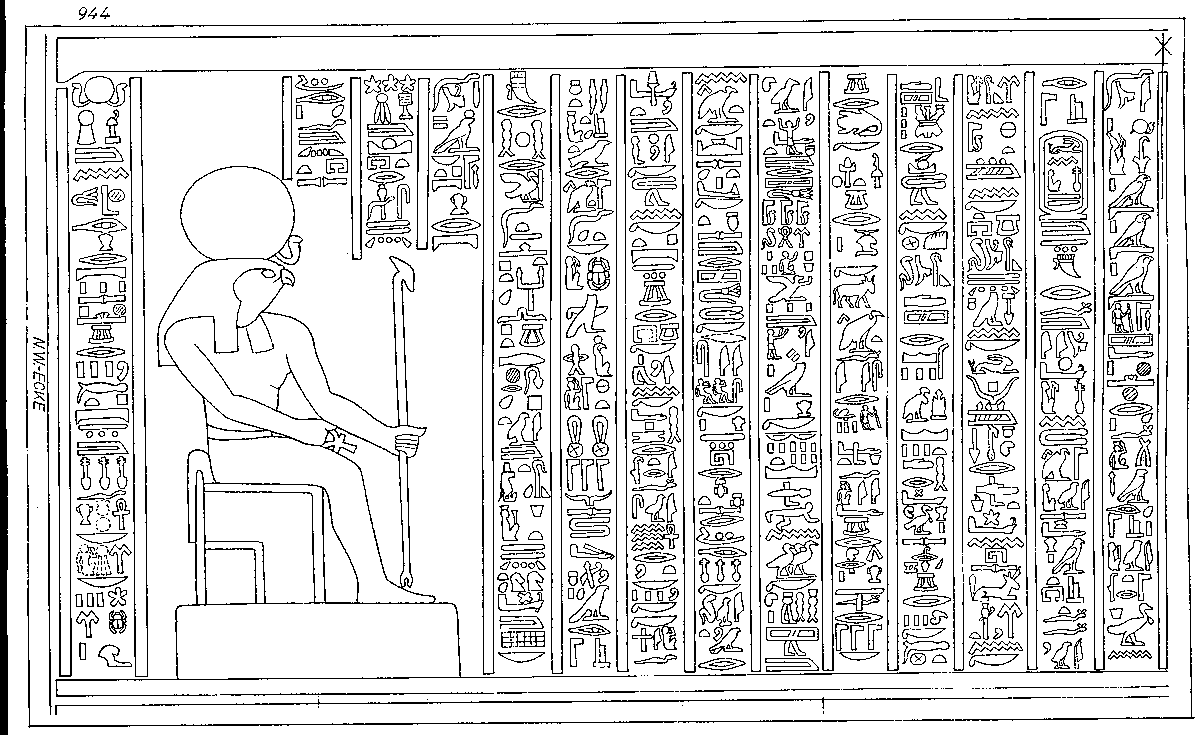
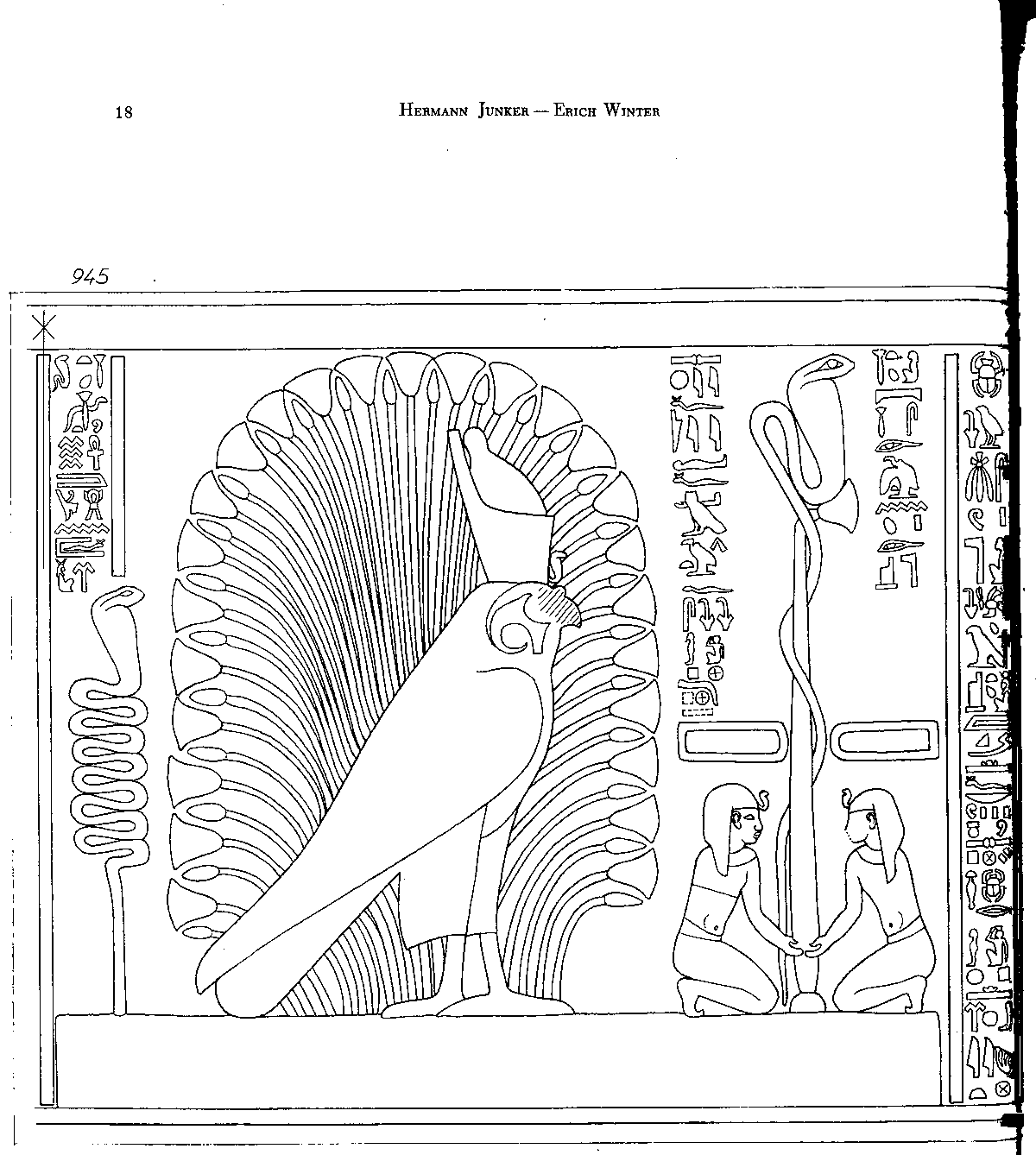
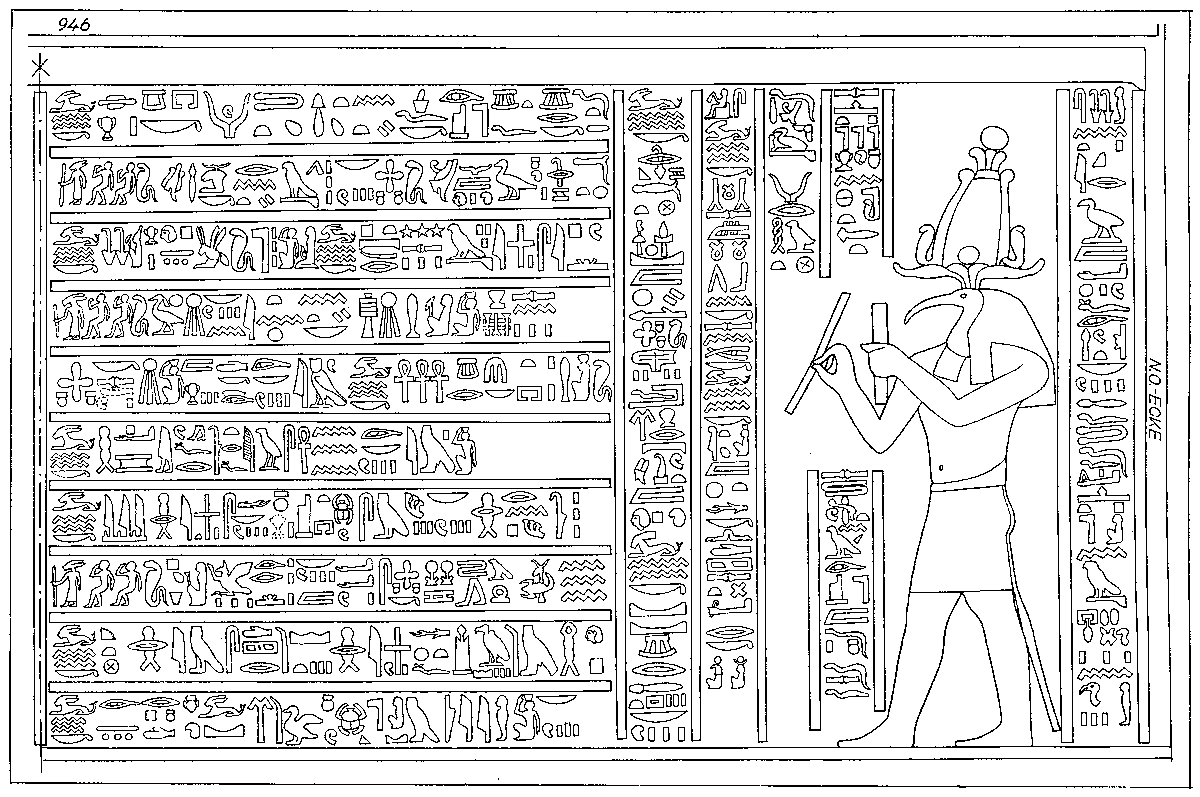
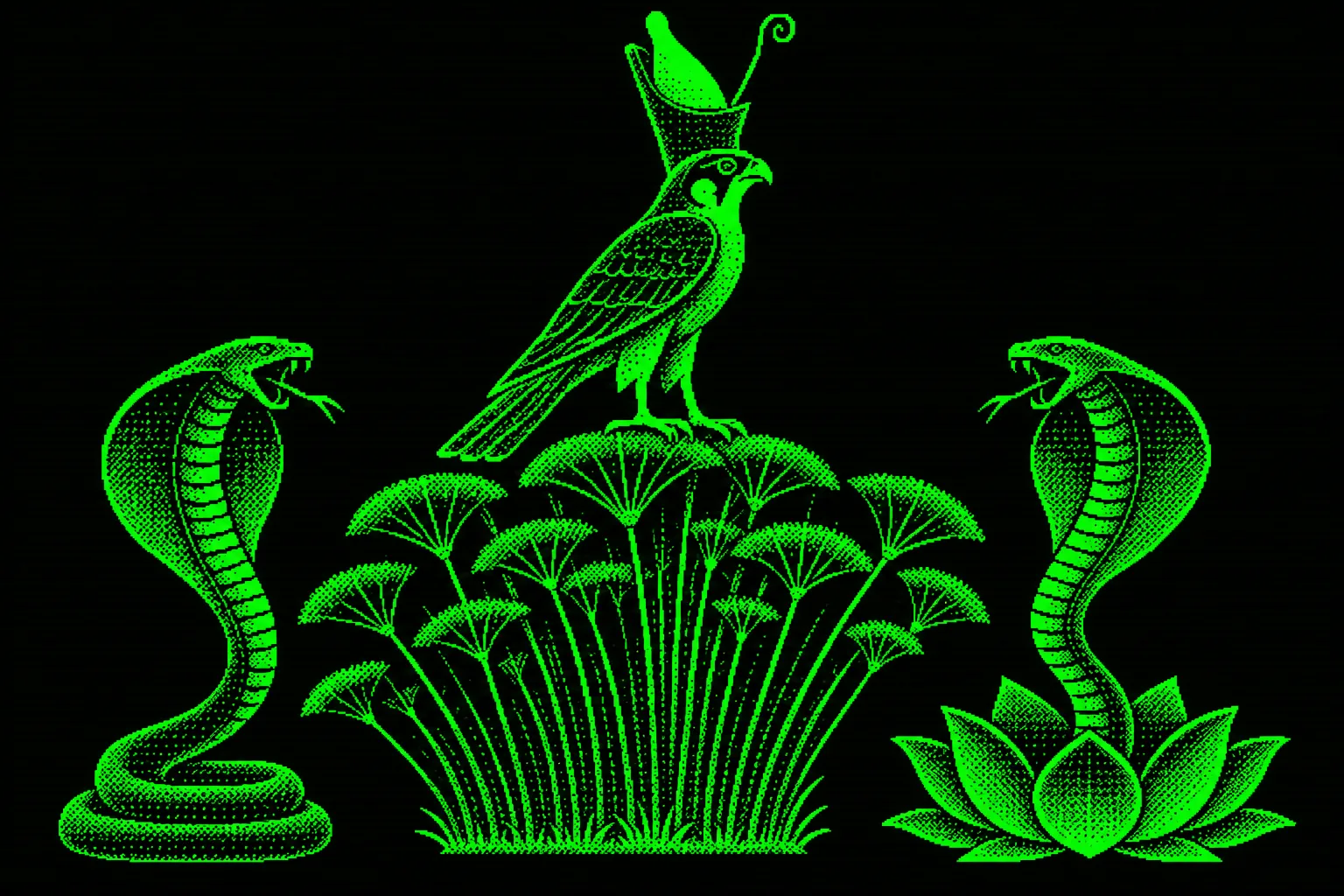
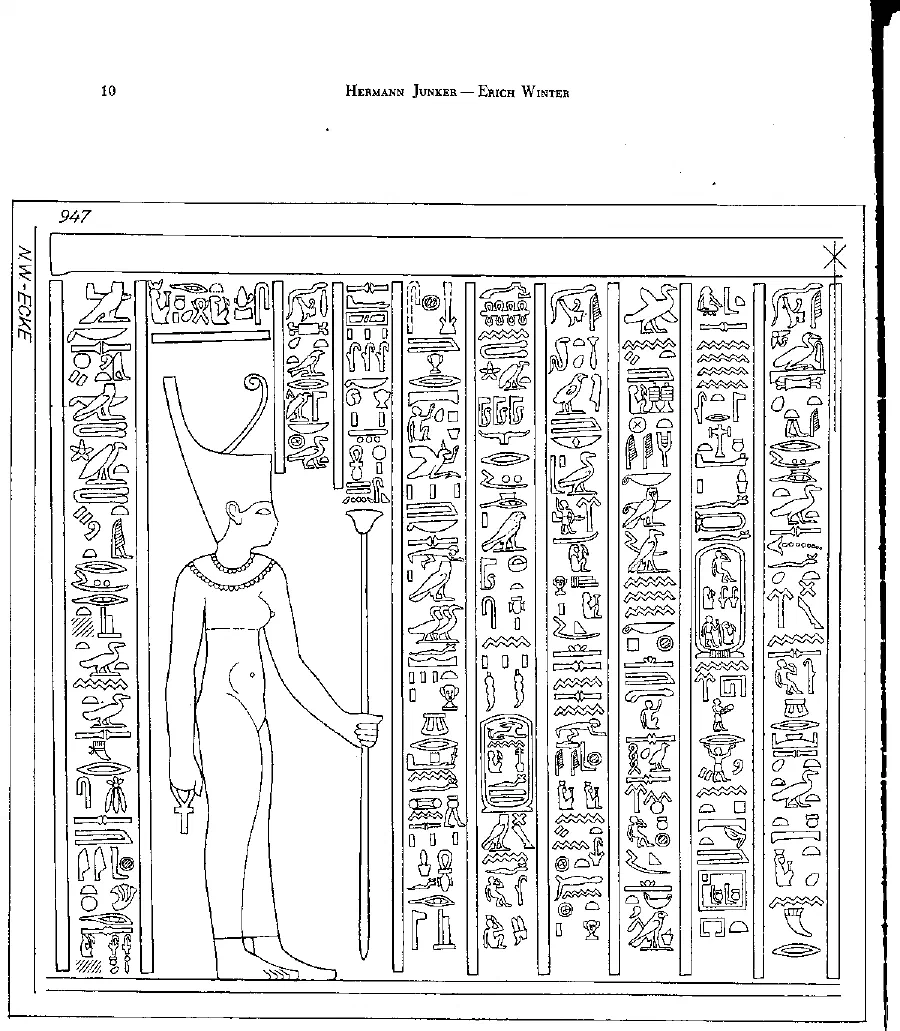
In the marsh scene Isis gives birth in Chemmis. Thoth calls to dead Osiris in Busiris: Look, your semen has become a man. Wadjet, Nekhbet, Neith, Amun, Hu and Sia stand guard. Above, the falcon stands in the papyrus between two cobras. Ra tells him: Take up the spear to run Seth through, and Thoth writes the decree giving him sky, Nile, Punt and the four winds.
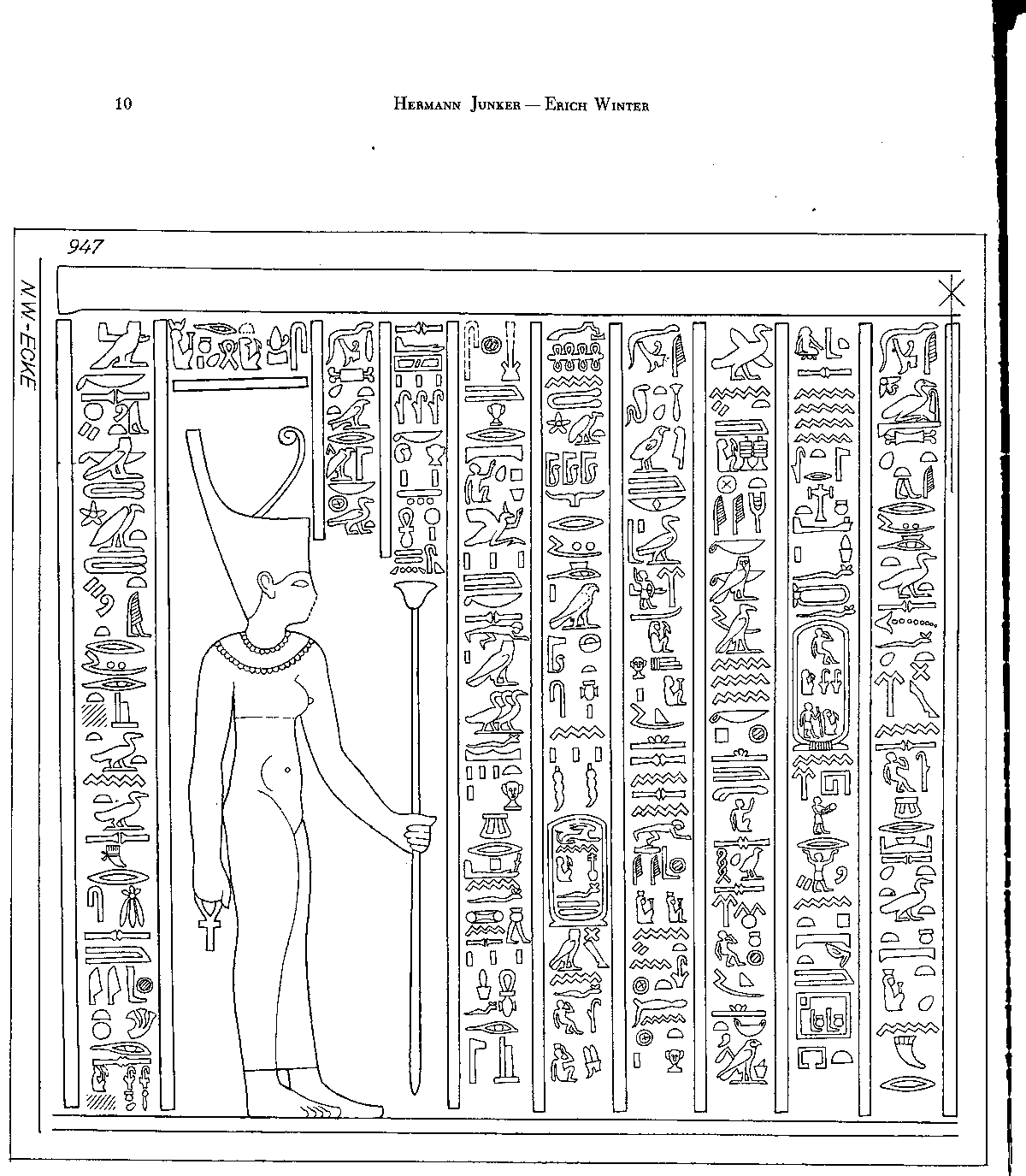
Ptolemy VIII dedicates the birth house to Isis: the border inscriptions of Chamber III
Page 3. The scene as drawn on the wall, facing p. 3 of the edition. Drawing by Otto Baum, in Junker and Winter, Das Geburtshaus des Tempels der Isis in Philä (1965)The hatched figures were hacked off the wall on purpose. After Justinian closed the temple of Isis around 537, Christians made it a church and chiselled out the gods and kings, mostly sparing the hieroglyphs. - 1p. 3, l. 1
ꜥnḫ | Ḥrw ḥwn ḥkn-tw m ꜥnḫ-f
Long live Horus, the youth in whose life people rejoice,
Note · Line 1
This is the first of the royal names of Ptolemy VIII. It names the king as Horus. - 2p. 3, l. 2
ḥr ns.t jt-f bnr sp(w)
on his father’s throne, sweet in his ways,
- 3p. 3, l. 3
ḏsr mšḫꜥ-f ḥnꜥ Ḥp ꜥnḫ
glorious as he shines forth beside the living Apis;
Note · Line 3
Apis was the sacred bull worshipped at Memphis. - 4p. 3, l. 4
nb.tj³ sḥrj jb tꜣ.wj
he of the Two Ladies, who gladdens the heart of the Two Lands;
Note · Line 4
The Two Ladies are Nekhbet, the vulture goddess of Upper Egypt, and Wadjet, the cobra goddess of Lower Egypt. Their realms are the Two Lands. - 5p. 3, l. 5
Ḥrw nb wr pḥtj
Horus of Gold, great in strength;
- 6p. 3, l. 6
nb ḥb.w-sd mj jt-f Ptḥ Tnn jt nṯr.w
lord of Sed festivals like his father Ptah-Tatenen, father of the gods;
Note · Line 6
The Sed festival was a royal jubilee that renewed the king’s power to rule. - 7p. 3, l. 7
jtj mj Rꜥ
sovereign like Ra;
- 8p. 3, l. 8
njśwt bjt jwꜥw n nṯr.wj prj.wj stp n Ptḥ jrj mꜣꜥ.t Rꜥ sḫm ꜥnḫ Jmn
king of Upper and Lower Egypt, heir of the two Manifest Gods, chosen of Ptah, who upholds the Maat of Ra, living image of Amun;
Note · Line 8
The two Manifest Gods are the king’s parents, Ptolemy V and Cleopatra I. Maat is the just order of the world. - 9p. 3, l. 9
sꜣ Rꜥ Ptwrmjs ꜥnḫ ḏ.t mrj Ptḥ
son of Ra, Ptolemy, ever living, beloved of Ptah …
- 10p. 3, l. 10
nb(.t) Snm.t ḥnw.t nb(.t) Jrk
Lady of Bigeh, sovereign lady, Lady of Philae,
Note · Line 10
These are titles of Isis. Bigeh is the island beside Philae. - 11p. 3, l. 11
n(?) nṯr.wj (mrj) sn.wj nṯr.wj mnḫ.wj (so) nṯr.wj mrj jt
and for the two Sibling-Loving Gods, the two Benefactor Gods, the two Father-Loving Gods,
- 12p. 3, l. 12
nṯr.wj prj.wj pꜣ nṯr mnḫ ṯnj jt-f pꜣ nṯr mrj mw.t-f
the two Manifest Gods, the beneficent god who exalts his father, and the god who loves his mother.
- 13p. 3, l. 13
ḫws ꜥḥ.t wr.t n prj m Js.t
He built the great palace for the one who came forth from Isis,
- 14p. 3, l. 14
sḏm ḥm-s r gs-f⁷
at whose side Her Majesty sits,
- 15p. 3, l. 15
n mw.t-f Wsr.t ḥtp jb-s wꜣḥ kꜣ-s
and for his mother Wosret, that her heart may be content when offerings are laid before her ka.
Note · Line 15
Wosret means “the Mighty One.” The ka is the life force that offerings sustain. - 16p. 3, l. 16
jw n-s (so) psḏ.t nj.t ḥm-f m jꜣw (sp-sn)
His Majesty’s Ennead comes to her with praise, with praise.
Note · Line 16
An Ennead is a company of nine gods. - 17p. 3, l. 17
Ḥw.t-ḫnt ꜥpr.tj m ḥꜥw.t
Hut-khent is filled with jubilation;
Note · Line 17
Hut-khent is a sacred name for Philae. - 18p. 3, l. 18
ḫntj-tꜣ nhm(.tj) m nfrw-s
Khenti-ta cries out for joy at her beauty.
- 19p. 3, l. 19
mr.t-s nb ḥr tḫ.t
All her people are drunk.
- 20p. 3, l. 20
mk ḥtp nb m prj-s
Look, Gold comes to rest in her house.
Note · Line 20
“Gold” is a name of Hathor, here given to Isis. - 21p. 3, l. 21
šsp-s s.t n ꜥnḫ n sꜣ smsw
She enters the eldest son’s Seat of Life.
Note · Line 21
The Seat of Life is the birth house, where the birth of Horus, son of Isis, was celebrated. - 22p. 3, l. 22
ꜥ.wj-f (?) ḳnj … jw mr.t ḥꜥj-s ḥr tp-f
His two arms embrace …; the meret gleams on his head.
Note · Line 22
The meret appears here as part of the son’s regalia. - 23p. 3, l. 23
mj (?) jrj-n n-s tḫ.t wḥm tḫ(.t)
Come, let us give her drunken revels, and drunken revels again,
- 24p. 3, l. 24
ḥs(.t) ḥbj m ḥr.t hrw
song and dance day after day,
- 25p. 3, l. 25
ꜥšꜣ ḥb m bꜣḥ-s rꜥ nb
and many a feast in her presence every day.
- 26p. 3, l. 26
jšw ḥr-f m ḳn.t nḫt
May valor and victory be his reward
Note · Line 26
The reward is the king’s for building the birth house. - 27p. 3, l. 27
ḥr s.t-Ḥrw ḫnt ꜥnḫ.w
on the throne of Horus, at the head of the living.
Page 5. The scene as drawn on the wall, facing p. 5 of the edition. Drawing by Otto Baum, in Junker and Winter, Das Geburtshaus des Tempels der Isis in Philä (1965) - 28p. 5, l. 1
Ḥrw ḥwn ḥkn-tw m ꜥnḫ-f
Horus, the youth in whose life people rejoice,
- 29p. 5, l. 2
ḥr ns.t jt-f bnr sp(w)
on his father’s throne, sweet in his ways,
- 30p. 5, l. 3
ḏsr mšḫꜥ-f ḥnꜥ Ḥp ꜥnḫ
glorious as he shines forth beside the living Apis.
- 31p. 5, l. 4
nb.tj šḥrj jb tꜣ.wj
He of the Two Ladies, who gladdens the heart of the Two Lands;
- 32p. 5, l. 5
Ḥrw nb wr pḥtj
Golden Horus, great in strength;
Note · Line 32
Golden Horus is one of the king’s ceremonial titles. - 33p. 5, l. 6
nb ḥb.w-sd mj jt-f Ptḥ Ṯnn jt nṯr.w
lord of jubilees like his father Ptah-Tatenen, father of the gods;
Note · Line 33
At the royal jubilee, or Sed festival, the king ritually renewed his power to rule. - 34p. 5, l. 7
jtj mj Rꜥ
sovereign like Ra;
- 35p. 5, l. 8
njśwt bjt jwꜥw n nṯr.wj prj.wj …
King of Upper and Lower Egypt, heir of the two Manifest Gods …
Note · Line 35
The Manifest Gods are the king’s parents, Ptolemy V and Cleopatra I. - 36p. 5, l. 9
sꜣ Rꜥ Ptwrmjś …
Son of Ra, Ptolemy …
- 37p. 5, l. 10
ḥnꜥ ḥm.t-f ḥḳꜣ.t nb(.t) tꜣ.wj
together with his wife, the ruler, Lady of the Two Lands,
- 38p. 5, l. 11
Kriwpꜣdrꜣ.t nṯr.wj mnḫ.wj
Cleopatra—the two Beneficent Gods.
Note · Line 38
The queen is Cleopatra III. The title “Beneficent Gods” belongs to king and queen together. - 39p. 5, l. 12
jrj-n-f mnw-f n mw.t-f Wśr.t
He made his monument for his mother Wosret,
- 40p. 5, l. 13
Ꜣś.t dj(.t) ꜥnḫ nb jꜣ.t wꜥb.t
Isis the life-giver, Lady of the Pure Mound,
Note · Line 40
The Pure Mound was the Abaton, the sanctuary of Osiris on the island of Bigeh, across from Philae. - 41p. 5, l. 14
ḏsr ś.t ḫnt Ꜣrk
whose seat is sacred, foremost in Philae,
- 42p. 5, l. 15
nṯr.wj (mrj) śn.wj nṯr.wj mnḫ.wj
and for the two Sibling-Loving Gods, the two Beneficent Gods,
- 43p. 5, l. 16
nṯr.wj mrj jt nṯr.wj prj.wj
the two Father-Loving Gods, the two Manifest Gods,
- 44p. 5, l. 17
pꜣ nṯr ṯnj jt-f pꜣ nṯr mrj mw.t-f
the god who exalts his father, the god who loves his mother,
- 45p. 5, l. 18
nṯr.wj mnḫ.wj
and the two Beneficent Gods.
Note · Line 45
Here the list reaches the reigning king and queen. - 46p. 5, l. 19
m jnr nfr rwḏ
He made it of fine, hard stone.
- 47p. 5, l. 20
ḥw.t msḫn kꜣ-tw m rn-f
“House of Birth” is the name they give it.
- 48p. 5, l. 21
šḫꜥj sꜣ-f Ḥrw m ḫnt-f
Within it his son Horus is brought forth in glory;
Note · Line 48
The birth celebrated here is that of Horus, child of Osiris and Isis. His coming forth also evokes a king’s appearance in glory. - 49p. 5, l. 22
śnḏm jb-ś r mꜣꜣ nfrw-f
her heart rejoices to see his beauty.
- 50p. 5, l. 23
jw n-ś rśj.w m hjmś ḥr gꜣw.t-śn
The people of the south come to her laden with their gifts;
- 51p. 5, l. 24
ḫntj n-ś mḥtj.w ḥr jnw-śn
the people of the north sail upstream to her bearing theirs.
Note · Line 51
On the Nile, upstream is south, toward Philae. - 52p. 5, l. 25
jmn.t jꜣb.t ḫtrj ḥr bꜣk(.w)-ś
West and East are bound to pay her tribute.
- 53p. 5, l. 26
jwntj.w dnś ḥr jḫ.t-śn
The desert nomads are laden with their offerings;
Note · Line 53
The people named here lived in the Eastern Desert, between the Nile and the Red Sea. - 54p. 5, l. 27
šś-śn m nb m šštꜣ-f ḥr ḫꜣś.t-f
their treasure is gold in its hidden splendor, from its mountain;
- 55p. 5, l. 28
ꜣbw wꜥb wdn ḥr rmnw-śn
pure ivory weighs on their shoulders.
- 56p. 5, l. 29
ḏḥḏḥ.w ḥr htt
The djehdjeh monkeys cry out for joy,
- 57p. 5, l. 30
kjrj.w ḥr ḥbj(.t)
the kiri monkeys dance,
- 58p. 5, l. 31
jś nfrj.w ḥr jbꜣ
and the nefer monkeys leap.
- 59p. 5, l. 32
ꜣbj.w ś(j)r.w pḥr-ś(n)
Panthers and giraffes run to and fro.
- 60p. 5, l. 33
jśw ḫr-f m ḳn.t nḫt
May strength and victory be his reward.
- 61p. 5, l. 34
ḥr ś.t Ḥrw ḫnt ꜥnḫ.w
on the throne of Horus, at the head of the living.
Page 7. The scene as drawn on the wall, facing p. 7 of the edition. Drawing by Otto Baum, in Junker and Winter, Das Geburtshaus des Tempels der Isis in Philä (1965) - 62p. 7, l. 1
Ḥrw ḥwn ḥkn nṯr.w rmṯ ḥr-f
Horus the youth, in whom gods and mortals rejoice:
- 63p. 7, l. 2
rr-šw mw.t-f r njśwt bjt
his mother reared him to be king of Upper and Lower Egypt;
- 64p. 7, l. 3
šsp-n-f njśwj.t m ꜥ.wj jt-f
he received the kingship from his father’s two hands.
- 65p. 7, l. 4
njśwt bjt Ḥrw pꜣ ḫrd sꜣ Jś.t ꜥꜣ wr tpj n Wśjr
King of Upper and Lower Egypt, Harpocrates, son of Isis, great and mighty firstborn of Osiris,
Note · Line 65
Harpocrates is the Greek form of the Egyptian name Horus the Child. - 66p. 7, l. 5
nb ꜥnḫ śrḳ ḥtj.t jrj ḫr.t n ꜥnḫ
lord of life, who gives breath to the throat and provides what sustains life.
- 67p. 7, l. 6
bjk.t wr.t šps.t m ꜣḫ.t
Great falcon goddess, noble one in the horizon,
- 68p. 7, l. 7
ḫrj.t-tp m ꜥḥ(.t) štꜣ(?) nb …
diadem in the secret palace, lady of …
- 69p. 7, l. 8
ḥnw.t prj-nsr ḏsr.t ś.t-s ḫnt prj-nw
sovereign of the Per-neser shrine, whose seat is holy at the head of the Per-nu shrine,
Note · Line 69
Per-neser, the “House of Flame,” and Per-nu are shrines associated with Buto in the Nile Delta. - 70p. 7, l. 9
sꜣ.t Rꜥ ḫrj.t-tp m ḥꜣ.t-f
daughter of Ra, diadem on his brow:
Note · Line 70
The goddess takes the form of the rearing cobra on the sun god’s brow and guards him there. - 71p. 7, l. 10
jrj-f jḫ.t nb.t ḫft wḏ.t-s
he does all things at her command.
- 72p. 7, l. 11
jr(r.t) wṯs nṯr.w ḥkr.w
She makes the gods bear their crowns;
- 73p. 7, l. 12
jrj n-s sḫm sšš.t
the sekhem and the sesheshet are shaken for her.
- 74p. 7, l. 13
Nb … ḥnw.t(? ṯḥn.t?)
Gold … the Sovereign Lady,
- 75p. 7, l. 14
Ḥw.t-Ḥrw wr.t nb(.t) Śnm.t
Hathor the Great, mistress of Bigeh,
Note · Line 75
Bigeh, the island beside Philae, was revered as a burial place of Osiris. - 76p. 7, l. 15
ḥnw.t nb(.t) Jrḳ šps.t wsr.t
sovereign lady, mistress of Philae, noble one, mighty one,
- 77p. 7, l. 16
ḥnw.t nṯr.w ꜥꜣ(.t) mrw.t ḫnt nṯr.wt
sovereign of the gods, great in love among the goddesses.
- 78p. 7, l. 17
nṯr.t tw prj šꜣw ḥr wḏ.t-s
This goddess, at whose command fate comes forth,
- 79p. 7, l. 18
rr.t mnḫ(.t) sḫ
Renenet, excellent in counsel,
Note · Line 79
Renenet personifies the good fortune allotted to a child at birth. - 80p. 7, l. 19
wr.t-ḥkꜣw ḥrj.t jb ꜥḥ(.t) wr.t
Great of Magic, who dwells in the Great Palace,
- 81p. 7, l. 20
ḥsf(.t) ꜥꜣpp m sꜣḫ.w tp rꜣ-s
who wards off Apophis with the spells on her lips,
Note · Line 81
Apophis is the serpent that threatens the sun god on his nightly journey. - 82p. 7, l. 21
wr.t ḥsw.t n(so) šmśj prj-s
great in favor toward whoever serves her house,
- 83p. 7, l. 22
ꜥšꜣ(.t) mrw.t tḫ.t(?) …
abounding in love, drunkenness …
- 84p. 7, l. 23
ꜥnḫ nṯr.w nb.w (m snṯr) ḥr sḏ.t
All the gods live on incense burning in the flame;
- 85p. 7, l. 24
ꜥnḫ nb m tḫ.t
Gold lives on strong drink.
Note · Line 85
Drinking and music were part of Hathor’s festivals. - 86p. 7, l. 25
rꜣ.w-prj.w nb.w ḫtm śwḥ
All the temples are sealed at night;
- 87p. 7, l. 26
prj n ḥnw.t wn ḥr ḥś.t (m bn.t?)
the house of the sovereign lady stands open to the sound of song and harp.
Page 9. The scene as drawn on the wall, facing p. 9 of the edition. Drawing by Otto Baum, in Junker and Winter, Das Geburtshaus des Tempels der Isis in Philä (1965) - 88p. 9, l. 1
Rꜥ m ḥb Ḏḥwtj ḥꜥj m ršw.t
Ra holds festival; Thoth exults for joy.
- 89p. 9, l. 2
nḏm jb-ṯn nṯr.w nṯr.wt
May your hearts be glad, gods and goddesses:
- 90p. 9, l. 3
mśj Jś.t Ḥrw-ś
Isis has borne her Horus.
- 91p. 9, l. 4
m njśwt ḥr ś.t jt-f
as king on his father’s throne.
Note · Line 91
The royal son is Horus, child of Isis and Osiris. The birth house at Philae celebrates his divine birth. - 92p. 9, l. 5
ḥḳꜣ-f pśḏ.t
He rules the Nine Bows.
Note · Line 92
The Nine Bows stand for the foreign peoples traditionally shown subject to the Egyptian king. - 93p. 9, l. 6
nś.t Gb ḫr ... f
Geb’s throne is under his …
Note · Line 93
Geb, the earth god, held the kingship before Osiris and Horus. - 94p. 9, l. 7
jꜣw.t n Jtmw dj m ꜥ-f (?)
Atum’s office has been placed in his hand;
- 95p. 9, l. 8
pḥtj n Mntw m ꜥmm.t-f (? ḫfꜥ-f)
Montu’s might is in his fist.
Note · Line 95
Montu is a warrior god. - 96p. 9, l. 9
bjk.t ꜣḫtj.t ḫpr.t m ḥꜣ.t
The falcon goddess, she of the horizon, who came into being in the beginning,
- 97p. 9, l. 10
mḥ(.t) p.t tꜣ m nfr.w-ś
who fills heaven and earth with her beauty,
- 98p. 9, l. 11
ḥrj.t-tp pśḏ m nb
diadem of him who shines as gold,
- 99p. 9, l. 12
dngngś ḥrj(.t?) jb ꜥḥnwtj
the uraeus in the heart of the temple.
Note · Line 99
The uraeus is the rearing cobra worn on the brow of a god or king. Here the goddess herself is that protecting cobra. - 100p. 9, l. 13
jtj.t n(.t) nṯr.w p.t
Queen of the gods of heaven,
- 101p. 9, l. 14
ḥḳꜣ.t n(.t) nṯr.w tꜣ
ruler of the gods of earth,
- 102p. 9, l. 15
ḏrtj.t jś n(.t) nṯr.w dꜣ.t
falcon goddess of the gods of the underworld.
- 103p. 9, l. 16
njśwj.t jt(.t) jꜣw.t m śḫr.w-ś
The queen who took office by her own counsel:
- 104p. 9, l. 17
ḫꜥj nb ḥr ś.t-rꜣ-ś
at her command the king appears in glory;
- 105p. 9, l. 18
śtp ꜣbj-jb-ś r ꜥḥꜥ ḥr nś.t
the one her heart desires is chosen to take his place upon the throne.
- 106p. 9, l. 19
n hb r ꜥḥ m ḫm-ś
No one enters the palace without her knowledge.
- 107p. 9, l. 20
njś-tw nḥ-tw mꜣꜣ-ś jmꜣḫ.t n(.t) tꜣ (r) ḏr-f
People call out; they long to see her, the one the whole land honors.
- 108p. 9, l. 21
grg gś.w-prj.w ḥr śḫm n śn-ś
By the power of her brother the temples are founded.
Note · Line 108
Her brother is Osiris, who is also her husband. - 109p. 9, l. 22
ḏm-tw rn-f m ḥꜣ.t-śn
His name is the first spoken in them.
- 110p. 9, l. 23
jrj n-f ḫtmn ḥr mw-ś (?)
The world serves him at her bidding;
- 111p. 9, l. 24
jj n-f tꜣ ḥr nḏb-f
the earth in its entirety comes to him.
- 112p. 9, l. 25
wśr.t ḥnw.t (?) ...
The mighty one, the mistress …
- 113p. 9, l. 26
njśwt bj.t Jś.t wr(.t) mw.t nṯr dj(.t) ꜥnḫ nb(.t) Jrḳ
King of Upper and Lower Egypt, Isis the Great, mother of the god, giver of life, lady of Philae,
Note · Line 113
Isis bears the full title of a reigning pharaoh. - 114p. 9, l. 27
ḥḳꜣ.t m Śnm.t wr.t wśr.t
ruler on Bigeh, great and mighty,
- 115p. 9, l. 28
ḥnw.t nṯr.w ṯnj(.t) rn ḫnt nṯr.wt
mistress of the gods, whose name stands high above the goddesses.
- 116p. 9, l. 29
ḫtm (?) tꜣ r-ꜣw ḥr rn-ś
The whole earth is sealed in her name.
Note · Line 116
A seal marked ownership or authority. - 117p. 9, l. 30
dwꜣ-tw kꜣ-ś ... n p.t
Her ka is praised … of heaven,
- 118p. 9, l. 31
Rꜥj.t (?) ... ḥḳꜣ.t ... ꜥnḫ ...
sun goddess … ruler … life …
- 119p. 9, l. 32
rr śꜣ-ś ...
who feeds her son …
Isis nurses Horus in the marsh of Chemmis, guarded by the gods
Page 11. The scene as drawn on the wall, facing p. 11 of the edition. Drawing by Otto Baum, in Junker and Winter, Das Geburtshaus des Tempels der Isis in Philä (1965) - 120p. 11, l. 1
ḏd in Ḏḥwtj
Thoth speaks:
- 121p. 11, l. 2
N.t ij.tj r mꜣꜣ sꜣ.t-s Tfn.t
Neith has come to see her daughter Tefnut.
- 122p. 11, l. 3
wḥm-n-s rnp ḥr Js.t sꜣ.t Nw.t
She has renewed her youth in Isis, daughter of Nut,
- 123p. 11, l. 4
m-ḏr bkꜣ-s m mjw nṯrj
when Isis is pregnant with divine semen.
- 124p. 11, l. 5
nḏ.tj it-f rn-f
Avenger of His Father is his name.
Note · Line 124
The child is Horus. This title recalls how he avenged his father Osiris, whom Seth had killed. - 125p. 11, l. 6
Ḥmnj.w nhm r ḳꜣ.w n p.t
The Eight shout for joy to the heights of heaven;
Note · Line 125
The Eight are the four pairs of gods of Hermopolis who embody the world before creation. - 126p. 11, l. 7
sḏm-tw m ḥw.t-bnbn
their cry is heard in the House of the Obelisk.
- 127p. 11, l. 8
pꜣ ntj m Ḏdw ꜥḥꜥ-k
You who are in Busiris, rise!
Note · Line 127
Osiris is addressed here. Busiris, in the Nile Delta, was one of his chief places of worship. - 128p. 11, l. 9
mk mjw-k ḫpr m tꜣj
Look, your semen has become a man,
- 129p. 11, l. 10
swḥ.t šrd m nḫn
the egg has grown into a child,
- 130p. 11, l. 11
ḳmꜣ kꜣ.t bjk
the womb has fashioned the falcon.
Note · Line 130
The falcon is Horus himself. - 131p. 11, l. 12
ḏd in Wꜣḏ.t
Wadjet speaks:
- 132p. 11, l. 13
Šw m ḥb Gb m ḥꜥj
Shu keeps festival, Geb rejoices.
- 133p. 11, l. 14
Ḥw Sỉꜣ ḥr ḳmꜣ šnšn
Hu and Sia raise a song of praise.
Note · Line 133
Hu is the god of authoritative speech; Sia is the god of perception. - 134p. 11, l. 15
ḫbj.tj n.t rs-nt mḥ-nt
The two dancers of Neith’s southern and northern shrines
- 135p. 11, l. 16
ḥr štp-sꜣ n mw.t-nṯr
stand guard over the god’s mother.
- 136p. 11, l. 17
nṯr.w nṯr.wt dmd r mꜣꜣ Ḥrw
Gods and goddesses have gathered to see Horus;
- 137p. 11, l. 18
psḏ.t ib-sn nḏm
the Nine are glad at heart.
Note · Line 137
The Nine, also called the Ennead, are the divine family headed by Atum. - 138p. 11, l. 19
Wnn nfrw mꜣꜥ ḫrw wḥm-n-f rnp
Wennefer, vindicated, has grown young again.
Note · Line 138
Wennefer is a name of Osiris. “Vindicated” declares that the gods have judged in his favor. - 139p. 11, l. 20
šw.tj-f šnšn m ḥr.t
His twin plumes mingle with the sky;
- 140p. 11, l. 21
pꜥ.t rḫj.t m ksw n bꜣ.w-f
nobles and commoners bow before his might.
- 141p. 11, l. 22
ḫꜣs.wt ḥr ḥrp n-f in.w-sn
Foreign lands present their tribute to him
- 142p. 11, l. 23
mj it-f Wsjr
as they do to his father Osiris.
- 143p. 11, l. 24
ḏd mdw n | N.t wr.t mw.t nṯr nb.t Sꜣ
A recitation for Neith the Great, the god’s mother, Lady of Sais,
- 144p. 11, l. 25
swḏꜣ(.t) … ? … ir(r.t) sꜣ n sꜣ Js.t
who grants health to … and guards the son of Isis:
- 145p. 11, l. 26
ꜥšꜣ(-j) rnp.wt-k ḥr tp tꜣ
I multiply your years on earth
- 146p. 11, l. 27
mj Rꜥ ḥḳꜣ tꜣ.wj
like those of Ra, ruler of the Two Lands.
Note · Line 146
The Two Lands are Upper and Lower Egypt. - 147p. 11, l. 28
mk sj ij.tj (sp sn)
Look, she has come! Look, she has come!
- 148p. 11, l. 29
mk(? mt) mw.t nṯr twj(?) ij.tj
Look, this mother of the god has come
- 149p. 11, l. 30
r mꜣꜣ Js.t sꜣ.t n(.t) sꜣ.t-s
to see Isis, her daughter’s daughter,
- 150p. 11, l. 31
ḏr msj-s m ꜣḫbjt
as she gives birth in Chemmis.
Note · Line 150
Chemmis is the refuge in the Delta marshes where Isis kept Horus hidden from Seth. - 151p. 11, l. 32
irj-s nswj.t(?) ꜥꜣ(.t) n sꜣ(-s? mrj?)
She establishes the great kingship for her beloved son.
Note · Line 151
The birth house at Philae celebrated the birth of Horus to Isis and his right to succeed his father Osiris as king. 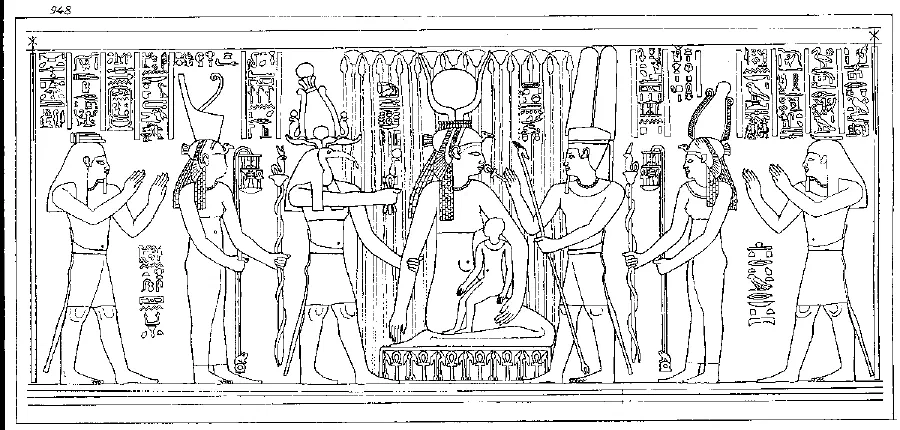
Page 13. The scene as drawn on the wall, facing p. 13 of the edition. Drawing by Otto Baum, in Junker and Winter, Das Geburtshaus des Tempels der Isis in Philä (1965) - 152p. 13, l. 1
Ḏḥwtj ꜥꜣ ꜥꜣ nb Ḫmnw nb mdw nṯr
Thoth, twice great, lord of Hermopolis, lord of divine words.
Note · Line 152
“Divine words” was the Egyptian name for hieroglyphs. Thoth was the god of writing. - 153p. 13, l. 2
Wꜣḏ.t ꜥšꜣ(.t) rnp.wt n sꜣ Wsjr
Wadjet, who multiplies the years of the son of Osiris,
Note · Line 153
Wadjet, the cobra goddess of Lower Egypt, rears up on the king’s brow to protect him. - 154p. 13, l. 3
ḫꜥ(.t) ḥr tp-f rꜥ-nb
who shines forth on his head each day.
- 155p. 13, l. 4
ḏd mdw n | Sjꜣ jrj ḥj n nb
Words spoken by Sia, who sings the praises of the Golden One,
Note · Line 155
Sia personifies divine perception. The Golden One is a title of Hathor, here associated with Isis. - 156p. 13, l. 5
sḥtp wsr.t m jrw-f
who gladdens the Mighty One with his rites:
- 157p. 13, l. 6
jw n-k ḥḳꜣ-n-k tꜣ (?) šmꜥ.w
Hail to you! Rule Upper Egypt,
- 158p. 13, l. 7
pꜣ sꜣ (? ḫrd) prj m ỉs.t
O son who came forth from Isis,
- 159p. 13, l. 8
jwꜥw mnḫ n Wnn nfrw mꜣꜥ ḫrw
worthy heir of Wennefer, the vindicated!
Note · Line 159
He was vindicated in the divine court against Seth, who had killed him. - 160p. 13, l. 9
jw n ḥr-ṯ šwš n kꜣ-ṯ
Praise to your face, reverence to your ka!
Note · Line 160
The address turns to the goddess. Her ka is her vital power. - 161p. 13, l. 10
Jmn-Rꜥ pꜣwtj-tꜣ.wj ḳmꜣ wnn(.t)
Amun-Ra, primeval god of the Two Lands, who created what is.
- 162p. 13, l. 11
Nḫb.t ꜥšꜣ(.t) ḥb.w-sd n sꜣ (so) Js.t
Nekhbet, who multiplies the Sed festivals of the son of Isis,
Note · Line 162
Nekhbet, the vulture goddess of Upper Egypt, is Wadjet’s counterpart. - 163p. 13, l. 12
ḫꜥ(.t) ḥr tp mj Rꜥ
who shines forth on his head like Ra.
- 164p. 13, l. 13
ḏd mdw n | Ḥw ḥfꜣ wsr.t m sꜣḥ.w-f
Words spoken by Hu, who praises the Mighty One with his recitations,
Note · Line 164
Hu personifies the power of the spoken word. - 165p. 13, l. 14
jrj jw n Ḥrw sꜣ Wsjr sḫrj jb n mw.t-f Js.t
who gives praise to Horus, son of Osiris, and gladdens the heart of his mother Isis:
- 166p. 13, l. 15
jw n-k Ḥrw (sꜣ) Js.t jtj sꜣ jtj
Hail to you, Horus, son of Isis, king, son of a king!
- 167p. 13, l. 16
ḥtp-r-ṯ wr.t nb(.t) p.t
Be content, Great One, lady of heaven.
- 168p. 13, l. 17
hrw nfr p.t tꜣ m ḥb
A fair day! Heaven and earth keep festival
- 169p. 13, l. 18
Js.t msj-s m ꜣḫbjt
as Isis gives birth in Chemmis.
- 170p. 13, l. 19
ḫrw-s pḥ-f r ḥr.t
Her voice reaches the heights of heaven.
- 171p. 13, l. 20
nṯr.w dmd m sꜣ-s
The gods stand together to guard her,
- 172p. 13, l. 21
Ḏḥwtj m ḥꜣ.t jrj.w (?)
Thoth at their head;
- 173p. 13, l. 22
jw nṯr.wt twt m pḥr-s
the goddesses are gathered around her,
- 174p. 13, l. 23
N.t m ḥꜣ.t jrj.w (?)
Neith at their head,
- 175p. 13, l. 24
jw …¹ … m ršrš
while … rejoices.
- 176p. 13, l. 25
Js.t wr.t mw.t nṯr nḏm jb-ṯ
Isis the Great, mother of the god, may your heart be glad!
- 177p. 13, l. 26
ḏd n-f jt-ṯ Rꜥ
Your father Ra says to him
- 178p. 13, l. 27
m hrw msj-tw-f
on the day of his birth:
- 179p. 13, l. 28
Ḥrw pwj mꜣꜥ-ḫrw-k
“O Horus, you are vindicated!
- 180p. 13, l. 29
jtj mnḫ ḥḳꜣ-n-k tꜣ.wj rꜣ-ꜥ ḏ.t
Worthy king, you shall rule the Two Lands forever.”
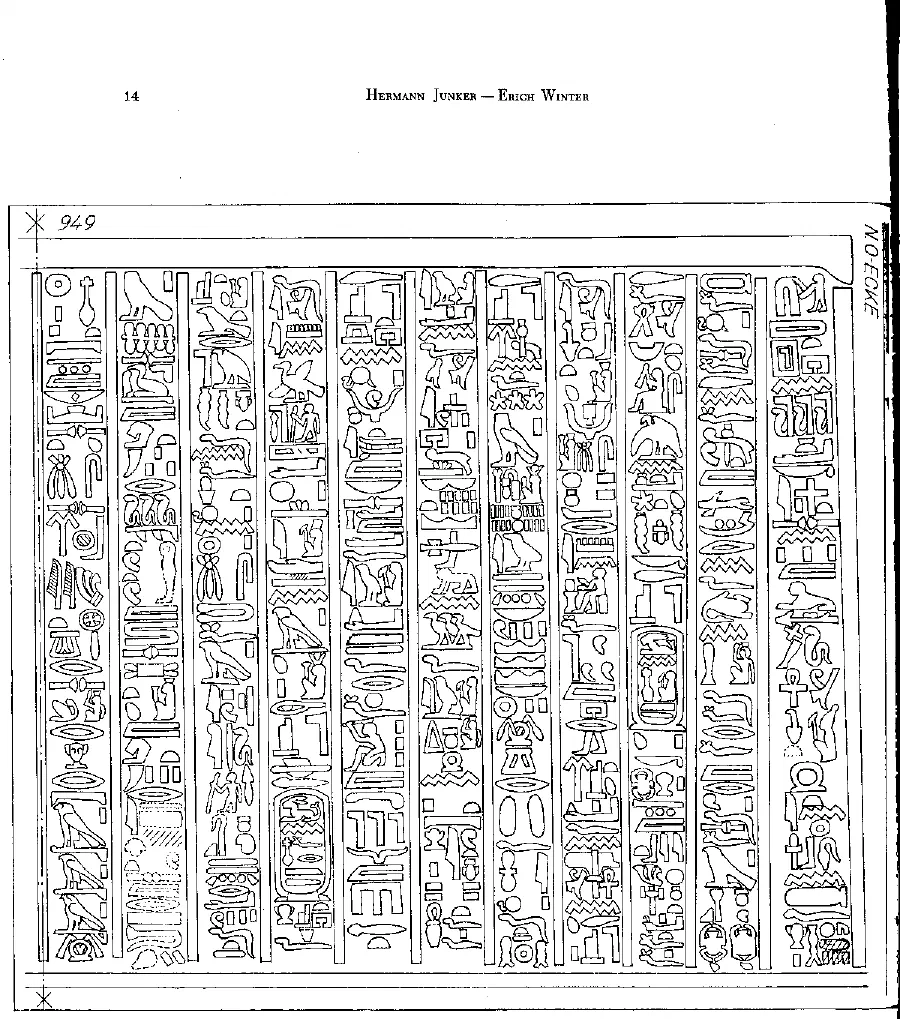
Page 15. The scene as drawn on the wall, facing p. 15 of the edition. Drawing by Otto Baum, in Junker and Winter, Das Geburtshaus des Tempels der Isis in Philä (1965) - 181p. 15, l. 1
ḏd in Jmn pꜣ nṯr ꜥꜣ wr(?) šꜣꜥ ḫpr
Amun, the great god, the Great One, the first to come into being, speaks:
- 182p. 15, l. 2
jw wḏj¹-n(-j) Ḥrw sꜣ Js.t Wsjr
“I have set Horus, son of Isis and Osiris,
- 183p. 15, l. 3
jwꜥw mnḫ Wnn nfrw mꜣꜥ ḫrw
worthy heir of Wennefer the vindicated,
Note · Line 183
To be vindicated is to be declared in the right. - 184p. 15, l. 4
ḥr s.t jt-f Wsjr
on the throne of his father Osiris.
- 185p. 15, l. 5
ns.t n(.t) Rꜥ jꜣw.t n(.t) Jtmw
The throne of Ra, the office of Atum,
- 186p. 15, l. 6
mkś dj m ꜥ-f
the deed of kingship—all are placed in his hand.
Note · Line 186
The king could be shown holding the case for the deed that gave him title to Egypt. - 187p. 15, l. 7
jw-j dj mꜣꜥ-ḫrw-f r ḫftj.w
I have him vindicated against his enemies
- 188p. 15, l. 8
m bꜣḥ nṯr.w dmd m hꜣj.t(?) ꜥꜣ.t
before the gods assembled in the great hall.
Note · Line 188
The gods sit in judgment on the claim of Horus to his father’s throne, which Seth contests. - 189p. 15, l. 9
jw-j dj n-f šmꜥ.w mḥ.w r jmj.t prj
I give him Upper and Lower Egypt as his inheritance,
Note · Line 189
Upper Egypt is the Nile Valley to the south; Lower Egypt is the Delta to the north. Together they are the Two Lands. - 190p. 15, l. 10
pḏ.t ḥꜣb n bꜣ.w-f
the Nine Bows bending to his might.
Note · Line 190
The Nine Bows stand for the foreign peoples subject to the king. - 191p. 15, l. 11
jw-j dj n-f šn.w n p.t ḥr jfd
I give him the circuit of the sky to its four corners,
- 192p. 15, l. 12
mj jt-f Wsjr
as I gave it to his father Osiris,
- 193p. 15, l. 13
m wḏ n jt nṯr.w
by decree of the father of the gods,
- 194p. 15, l. 14
m sš nb Ḫmnw
as the lord of Hermopolis has written,
Note · Line 194
Thoth, lord of Hermopolis, is the scribe of the gods. - 195p. 15, l. 15
jw tꜣ.w nb.w ḫꜣs.wt nb.w(t) (sp śn.nw)
with all lands and all foreign lands
Note · Line 195
The words are to be said twice. - 196p. 15, l. 16
dmd ḥr ṯbw.t-f mj Rꜥ ḏ.t nḥḥ
gathered beneath his sandals as beneath Ra’s, for ever and ever.”
- 197p. 15, l. 17
ḏd in Nḫb.t
Nekhbet speaks:
Note · Line 197
Nekhbet is the vulture goddess of Upper Egypt and a protector of the royal child. - 198p. 15, l. 18
ḫnm-j msḫn.t ḥnꜥ Jmn
“I enter the birth house with Amun
- 199p. 15, l. 19
nḫp-f ḥꜥ.w nṯr n prj m Js.t
that he may fashion the divine limbs of the one who comes forth from Isis
- 200p. 15, l. 20
dj(-n?)-f ṯꜣw n ꜥnḫ n sꜣ Wsjr
and give the breath of life to the son of Osiris,
- 201p. 15, l. 21
jrj-f sꜣ n kꜣ.t šps.t
that he may guard the sacred vulva
- 202p. 15, l. 22
mk(.t) n mw.t nṯr
and shield the god’s mother.
- 203p. 15, l. 23
nḏm jb-k Wsjr Wnn nfrw mꜣꜥ ḫrw
Let your heart be glad, Osiris Wennefer, vindicated one!
- 204p. 15, l. 24
sꜣ-k ḫpr ḥr tꜣ m ꜣḫbjt (so)
Your son has come into being on earth, in Chemmis.
- 205p. 15, l. 25
nḏtj jt-f rn f
Avenger of His Father is his name.
- 206p. 15, l. 26
Rꜥ ḏs-f jrj-n-f wḏ.t
Ra himself issued a decree
- 207p. 15, l. 27
m ḫt mꜣꜣ-n-f śnḏ n ḥm-f
after seeing the dread his majesty inspired.
- 208p. 15, l. 28
ḏd-f(?) r-f m rꜣ ḏs-f
With his own mouth he said of him:
- 209p. 15, l. 29
Ḥrw ḥḳꜣ-n-f tꜣ.wj
‘Horus has taken up the rule of the Two Lands.
- 210p. 15, l. 30
ḳd … ḥw.t-nṯr n nṯr.w nṯr.wt
… build a temple for the gods and goddesses.’”
- 211p. 15, l. 31
ḫꜥj-k jmj.wtj-śn m nb wꜥ
May you shine forth among them as sole lord.
- 212p. 15, l. 32
wḥm-k ꜥnḫ n njśwt
May you renew life for the king.
Note · Line 212
The king here is Osiris. - 213p. 15, l. 33
šn.w jtn ꜣb n rn-f
All that the sun disk encircles is stamped with his name
- 214p. 15, l. 34
ḥr wꜣḥ jḥ.t … ? …
and lays down offerings …
Ra and Thoth decree the kingship for the falcon Horus in the papyrus thicket
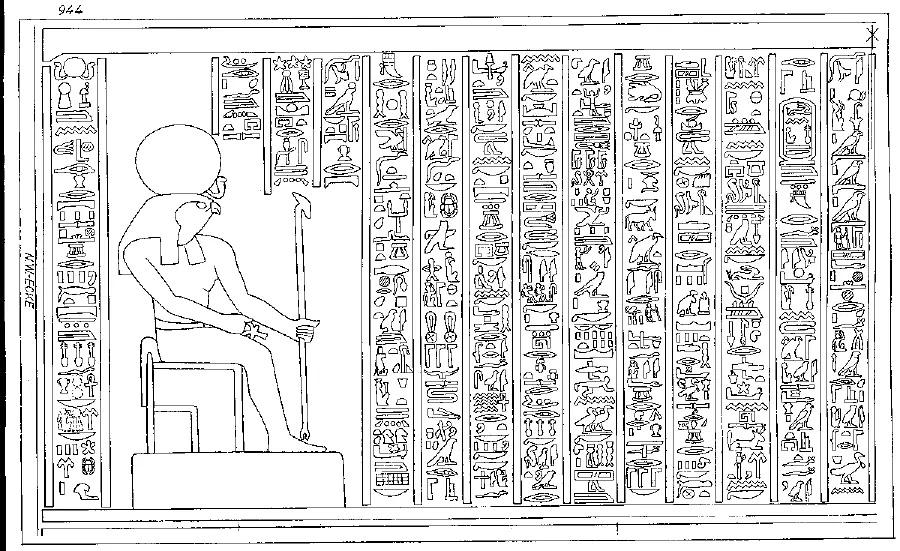
Page 17. The scene as drawn on the wall, facing p. 17 of the edition. Drawing by Otto Baum, in Junker and Winter, Das Geburtshaus des Tempels der Isis in Philä (1965) - 215p. 17, l. 1
ḏd in Rꜥ njśwt nṯr.w
Ra, king of the gods, spoke,
- 216p. 17, l. 2
nṯr ꜥꜣ wr šꜣꜥ ḫpr
the great god, the Great One, the first to come into being,
- 217p. 17, l. 3
ḥr sꜣ-f mrj-f Ḥrw (?) ꜥꜣ sꜣ Wśir
to his beloved son, Horus the Great, son of Osiris:
- 218p. 17, l. 4
iw-j nṯr.j bꜣ n Wśir Wnn nfrw mꜣꜥ ḫrw
I hallow the ba of Osiris Wennefer, true of voice,
Note · Line 218
The ba is the aspect of a being that can move about and make its presence felt. - 219p. 17, l. 5
m tꜣ ḏr-f m nḥw nfr n mw.t nṯr
throughout the land, as the fair guardian of the god’s mother.
Note · Line 219
The god’s mother is Isis, mother of Horus. - 220p. 17, l. 6
iw-j śḫꜥj Ḥrw ḥr ś.t it-f
I make Horus shine forth on his father’s throne
- 221p. 17, l. 7
iw-f m ḥḳꜣ n pśḏ.t
as ruler of the Ennead.
- 222p. 17, l. 8
šsp n-k nś.t ḥḳꜣ n-k tꜣ.wj
Take the throne for your own; rule the Two Lands.
- 223p. 17, l. 9
smꜣ n-k wn wpj
Unite what was divided.
- 224p. 17, l. 10
šsp n-k wꜣś (??) r dbdb nhś
Take up the spear to run Seth through,
- 225p. 17, l. 11
m wḏ.t n-k bdš.w r nm.t
consigning the rebels to the place of execution.
- 226p. 17, l. 12
iṯj n-k km.t
Take the Black Land for your own;
Note · Line 226
The Black Land is Egypt’s dark, cultivated soil; the Red Lands are the deserts. - 227p. 17, l. 13
ḥḳꜣ n-k dšr.wt
rule the Red Lands,
- 228p. 17, l. 14
Jwntj.w ḥtr ḫr bꜣk-ś(n)
with the Iuntiu bound to pay their tribute.
Note · Line 228
The Iuntiu are peoples of the desert. - 229p. 17, l. 15
rśj ḫr nrw-k
The south stands in dread of you,
- 230p. 17, l. 16
mḥ.tj ḫr śnḏ-k
the north in fear of you,
- 231p. 17, l. 17
imn.t iꜣb.t ḫr šfj.t-k
west and east in awe of you.
- 232p. 17, l. 18
Kꜣ-mw śr nṯr.w (?)
Kamephis, prince of the gods,
- 233p. 17, l. 19
ꜥb (m nfrw-f?) fꜣj-ꜥ ḥr nḫꜣḫꜣ
who glories in his beauty and lifts his arm with the flail,
Note · Line 233
The arm raised with the flail is a familiar pose of Min, the fertility god. - 234p. 17, l. 20
wśr(?) ḥr ?iꜣ.t-f r nṯr.w nb.w
mightier on his pedestal than all the gods,
- 235p. 17, l. 21
iw-k (wn?) ḥꜥj.tj m ršw.t
you exult in joy.
- 236p. 17, l. 22
nṯr.w nṯr.wt m sꜣ-k
Gods and goddesses stand guard over you;
- 237p. 17, l. 23
pꜥ.t rḫj.t m iꜣw m ḥr-k
nobles and commoners offer praise before your face;
- 238p. 17, l. 24
pśḏ.t ḫꜣb n bꜣ.w-k
the Nine Bows fall prostrate before your might.
Note · Line 238
The Nine Bows stand for the foreign peoples Egypt counted as its foes. - 239p. 17, l. 25
wꜥḥ inw-k šm n mw.t-k Jś.t
Your gifts are laid down as offerings and go to your mother Isis.
- 240p. 17, l. 26
dj-k ib-ś m ršw.t
You fill her heart with joy.
- 241p. 17, l. 27
dgj-ś snn-k ḥr tꜣ
When she sees your likeness on earth,
Note · Line 241
The child addressed is Horus; the mother who looks on him is Isis. - 242p. 17, l. 28
ḥrj ib-ś r mꜣꜣ nfrw-k
her heart delights in the sight of your beauty
- 243p. 17, l. 29
iw-k wr.tj ?śḫm.tj m irw-k
as you grow great and mighty in form.
- 244p. 17, l. 30
iṯj n-k p.t tꜣ ḫr nś.t-k
Take heaven and earth for yourself beneath your throne.
- 245p. 17, l. 31
iw iw n-k Ḥꜥpj r tr-f
Hapy will come to you in his season
Note · Line 245
Hapy is the god of the Nile flood, whose yearly rise watered the fields. - 246p. 17, l. 32
r śꜥnḫ rd nb wnm im-f
to give life to every growing thing that people eat.
- 247p. 17, l. 33
nḏm ib (so) Jś.t wr.t mw.t nṯr
Rejoice, Isis the Great, mother of the god!
- 248p. 17, l. 34
ḏd(.t)-ṯ nb ḫpr(.t)
All you have said has come to pass.
- 249p. 17, l. 35
mk Rꜥ ḥnꜥ pśḏ.t-f
Look: Ra with his Ennead
- 250p. 17, l. 36
itr.tj nṯr.w dmd
and the two shrines of the gods, all together,
Note · Line 250
The paired shrines stand for the gods of Upper and Lower Egypt. - 251p. 17, l. 37
śpḫr wḏ n Ḥrw sꜣ Wśir
are writing a decree for Horus, son of Osiris,
- 252p. 17, l. 38
ḏr nḥḥ r km ḏ.t
from eternity to the end of everlasting time.
Note · Line 252
The first word for eternity suggests time that comes round again; the second, time that endures. - 253p. 17, l. 39
ḥtp kꜣ-ṯ n špt .?. ḥr-ṯ (so)
May your ka be at peace, and may no anger rest upon you,
- 254p. 17, l. 40
iw-ṯ m ḥḳꜣ.t wr.t ḥnw.t tꜣ.wj pḥtj.t nḫt(?) m śpꜣ.t nb.t
for you are a great ruler, mistress of the Two Lands, a mighty one, strong in every province.
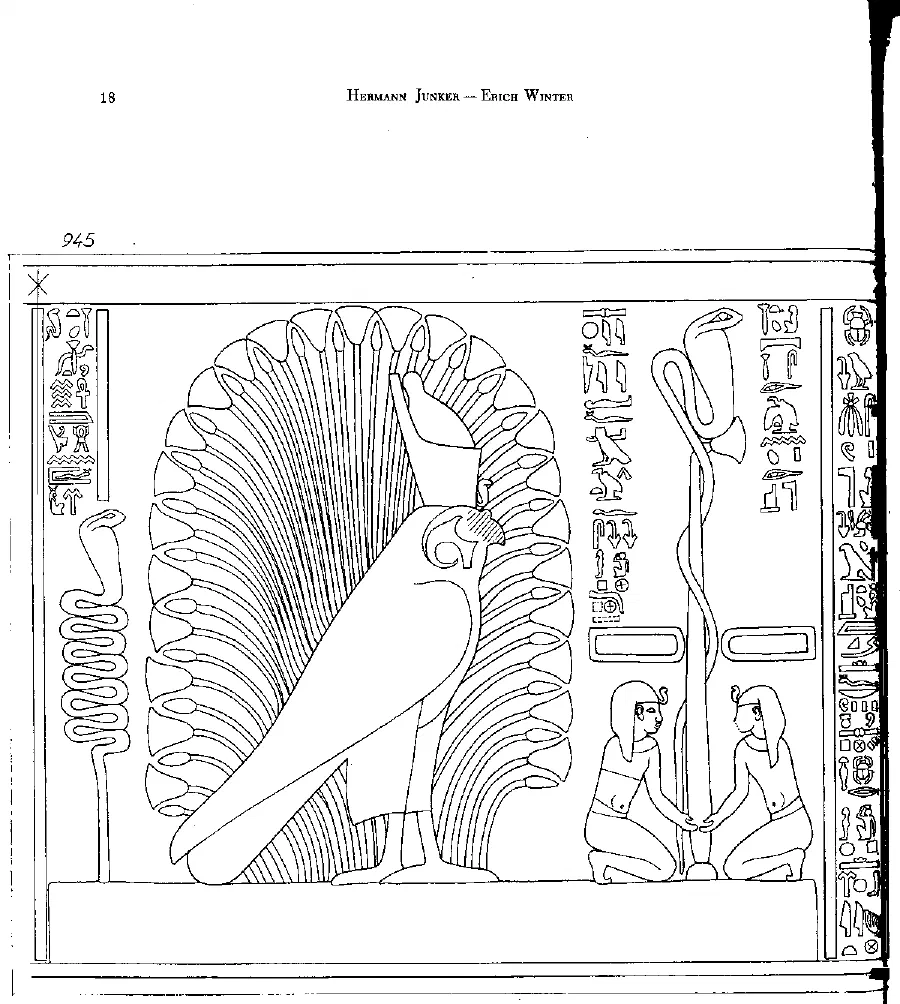
Page 19. The scene as drawn on the wall, facing p. 19 of the edition. Drawing by Otto Baum, in Junker and Winter, Das Geburtshaus des Tempels der Isis in Philä (1965) - 255p. 19, l. 1
ḏd mdw n | Rꜥ-Ḥrw ꜣḫtj nṯr ꜥꜣ nb p.t
Words spoken by Ra-Horakhty, the great god, lord of heaven,
Note · Line 255
Ra-Horakhty is the sun god Ra as Horus of the Two Horizons. - 256p. 19, l. 2
ḥrj nṯr.w psḏ m ꜣḫ.t
who is above the gods, who shines on the horizon
- 257p. 19, l. 3
r sḥḏ tꜣ.wj
to light the Two Lands,
- 258p. 19, l. 4
mꜣꜣ sꜣ-f m ḥm-s (sic)
who sees his son in her sanctuary.
- 259p. 19, l. 5
njswt bjt | wbn m nḥb
The King of Upper and Lower Egypt, who rose from the lotus,
Note · Line 259
The lotus opening at dawn was an image of the sun’s first rising. - 260p. 19, l. 6
jrj ḥrj.w sḫpr ḫrj.w
who made what is above and brought what is below into being,
- 261p. 19, l. 7
mḥ p.t tꜣ m nfrw-f
who fills heaven and earth with his beauty:
- 262p. 19, l. 8
ꜥnḫ ḥr nb m wbn-f
every face lives when he rises.
- 263p. 19, l. 9
nb nṯr.w ḫpr m ḥꜣ.t
Lord of the gods, he came into being in the beginning.
- 264p. 19, l. 10
sḥw ḳd-f mꜥ mw.t-f
His form is protected by his mother,
- 265p. 19, l. 11
snn-f? Pj.t Dpj.t
his likeness by the Lady of Pe and Dep.
Note · Line 265
This title names Hathor here. Pe and Dep were the twin settlements of Buto in the Nile Delta. - 266p. 19, l. 12
Wꜣḏ.t ḥrj(.t) wꜣḏ.t-s jr(r.t) mk.t n sꜣ Wsjr
Wadjet upon her lotus, who guards the son of Osiris;
Note · Line 266
Wadjet is the cobra goddess of Lower Egypt. Her name, “the Green One,” echoes in the word for her plant and again in “green with life.” - 267p. 19, l. 13
Wꜣḏ.t wꜣḏ.t ꜥnḫ m-sꜣ n prj m Ꜣs.t
Wadjet, green with life, who watches over him who came forth from Isis.
- 268p. 19, l. 14
ḫpr šw ms nṯr
The child has come into being, the god’s offspring,
- 269p. 19, l. 15
njswt bjt Ḥrw sꜣ Ꜣs.t
the King of Upper and Lower Egypt, Horus, son of Isis,
- 270p. 19, l. 16
m ḳm(.w)-f nb.w nj.w sp tpj
in all his forms of the First Time.
Note · Line 270
The First Time is the dawn of creation. - 271p. 19, l. 17
ḫpr(.w)-f ḫpr m ꜣḫbjt
His form took shape in Chemmis.
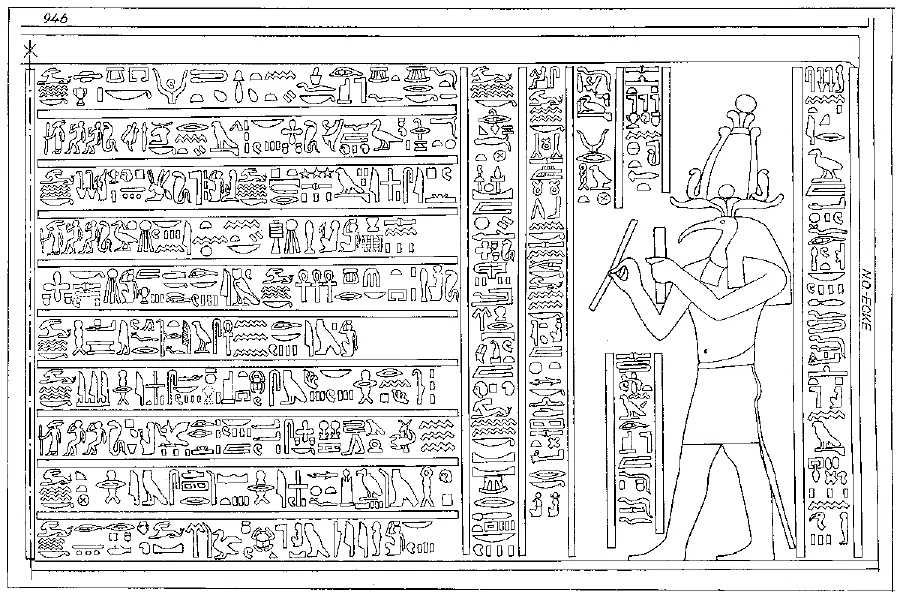
Page 21. The scene as drawn on the wall, facing p. 21 of the edition. Drawing by Otto Baum, in Junker and Winter, Das Geburtshaus des Tempels der Isis in Philä (1965) - 272p. 21, l. 1
wnn n-k jwꜥ.t ḥr ns.t-k
May the inheritance be yours upon your throne,
- 273p. 21, l. 2
jw.t mnḫ.t n.t jt-k Wsjr
and the splendid office of your father Osiris.
- 274p. 21, l. 3
ns.t-f ḫr-k ḏ.t
May his throne be beneath you forever.
- 275p. 21, l. 4
wnn n-k ꜣtf
May the atef crown be yours.
Note · Line 275
The atef is the tall crown flanked by feathers that Osiris wears. - 276p. 21, l. 5
ꜥꜣ šfj.t-k r ntj.t nṯr.w nb.w
May you command greater awe than all the gods.
- 277p. 21, l. 6
wnn n-k sḫm.tj dmd m tp-k
May the Double Crown be yours, joined to your head.
Note · Line 277
The Double Crown unites the white crown of Upper Egypt and the red crown of Lower Egypt. - 278p. 21, l. 7
bꜣ(k?) n-k rsj mḥ.tj
May South and North serve you.
- 279p. 21, l. 8
wnn n-k nswj.t ḥr tp tꜣ
May kingship on earth be yours.
- 280p. 21, l. 9
bjt.j-k nṯr.w rmṯ
May you rule gods and people as king of Lower Egypt.
- 281p. 21, l. 10
wnn n-k p.t ḥnꜥ sbꜣ.w-s
May the sky be yours with its stars:
- 282p. 21, l. 11
nṯr.w jmj.w-s pw
they are the gods who dwell in it.
- 283p. 21, l. 12
wnn n-k ꜣḫ nb n jtn
May all that the sun disk lights be yours,
- 284p. 21, l. 13
nt(.t) nb(.t) psḏ ḥm-f ḥr-s(n)
everything on which His Majesty shines.
- 285p. 21, l. 14
wnn n-k štꜣ.t-f m ḥr.w
May his rays be yours as they fall on faces;
- 286p. 21, l. 15
dgj jr.t nb.t jm-f
by his light every eye sees.
- 287p. 21, l. 16
wnn n-k ꜥnḫ.w ḥr ḥb.w ḥm-k
May the living be yours as they keep Your Majesty’s feasts.
- 288p. 21, l. 17
wnn n-k ḥꜥpj jj-f r tr-f
May the Nile flood be yours as it comes in its season
- 289p. 21, l. 18
r sꜥnḫ jr.t nb.t jm-f
to give life to every eye through its waters.
Note · Line 289
“Every eye” stands for everyone who depends on the flood for life. - 290p. 21, l. 19
wnn n-k sḫ.t ḥnꜥ jmj.t-s
May the fields be yours with all they hold:
- 291p. 21, l. 20
ḫt nb n(?) ḥr s.t ḫpr šm.w nb.w ḥnꜥ rnpw.t
every tree where it grows, every herb and all the fresh shoots.
- 292p. 21, l. 21
wnn n-k pꜥ.t rḫj.t
May the nobles and the common people be yours,
- 293p. 21, l. 22
jrr.w nb.w m ꜥ.wj-s
and all they make with their two hands.
- 294p. 21, l. 23
wnn n-k šn pḥr wr šn šrḳ
May the seas of Shen, Peher-wer and Shen-sherq be yours.
- 295p. 21, l. 24
wnn n-k km.t ḥnꜥ jmj(.t)-s
May Egypt be yours with all it holds,
Note · Line 295
The Egyptian name for Egypt means “Black Land,” the dark soil of the Nile valley. The deserts in the next line are the “red lands.” - 296p. 21, l. 25
dšr.wt ḥnꜥ jmj-ḫt-f (sic)
the deserts with all that belongs to them,
- 297p. 21, l. 26
ꜢJwntj.w m wꜣḥ tp
and the desert bowmen with heads bowed.
- 298p. 21, l. 27
wnn n-k ꜥntj.w
May the myrrh be yours,
- 299p. 21, l. 28
jw Pwn.t n-k (so) m ḳmꜣ-n-f
for Punt is yours with all it yields,
Note · Line 299
Punt was a trading partner in the Red Sea region from which the Egyptians obtained fragrant resins. - 300p. 21, l. 29
Tꜣ-nṯr m ḳd-f nb
and the whole of the god’s land.
- 301p. 21, l. 30
wnn n-k rsj mḥ.tj
May south and north be yours,
- 302p. 21, l. 31
jmn.t jꜣb.t m sp wꜥ
west and east, all as one.
- 303p. 21, l. 32
wnn n-k ṯꜣw fdw prj m ḥr.t
May the four winds that come forth from the sky be yours,
- 304p. 21, l. 33
šw.tj mn.tj m tp-k
with the twin plumes of the crown set firm on your head.
- 305p. 21, l. 34
wnn n-k ḏw.w
May the mountains be yours,
- 306p. 21, l. 35
ḫr ꜥꜣ.t nb.t šps.t
bearing every precious stone.
- 307p. 21, l. 36
wnn n-k mnḫ.t šsp
May garments and robes be yours,
- 308p. 21, l. 37
ḏbꜣ (so) n-k šn n? mrj-k
that you may clothe yourself as you please.
- 309p. 21, l. 38
wnn n-k mꜣꜥ.t m ḫt-k
May Maat be yours and stand behind you,
- 310p. 21, l. 39
n ṯsj-r-k rꜥ nb
never leaving you, not for a day.
- 311p. 21, l. 40
ḏd mdw n | Ḏḥwtj wp rḥ.wj
Words spoken by Thoth, who judges between the Two Companions,
Note · Line 311
The Two Companions are Horus and Seth, rivals for the throne of Egypt. - 312p. 21, l. 41
sḥtp nṯr.w ḥrj tp n psḏ.t ꜥꜣ.t
who sets the gods at peace, chief of the Great Ennead:
Note · Line 312
The Great Ennead is the divine family of nine headed by Atum. - 313p. 21, l. 42
sẖr (-j) wḏ.t n Ḥrw sꜣ (so) Wsjr
I write the decree for Horus, son of Osiris,
- 314p. 21, l. 43
m ḏd n (Rꜥ) ḏs-f
as Ra himself has said.
- 315p. 21, l. 44
snn n(tj) jḳr m ꜥ(?)-f
Likeness of him whose arm excels,
- 316p. 21, l. 45
jrj wḏ.t nb(.t) ꜥꜣ(? mnḫ) …f
who issues every decree, great in his …,
- 317p. 21, l. 46
dj ḥtp-nṯr n nṯr(.w)
who gives divine offerings to the gods
- 318p. 21, l. 47
prj ḫrw n ꜣḫ.w
and invocation offerings to the blessed dead.
Note · Line 318
These gifts of food and drink were called forth for the dead by reciting an offering formula.